EP1653445A1 - Système pour d'optimisation de signaux périodiques - Google Patents
Système pour d'optimisation de signaux périodiques Download PDFInfo
- Publication number
- EP1653445A1 EP1653445A1 EP05023037A EP05023037A EP1653445A1 EP 1653445 A1 EP1653445 A1 EP 1653445A1 EP 05023037 A EP05023037 A EP 05023037A EP 05023037 A EP05023037 A EP 05023037A EP 1653445 A1 EP1653445 A1 EP 1653445A1
- Authority
- EP
- European Patent Office
- Prior art keywords
- signal
- filter
- enhancement system
- logic
- adaptive filter
- Prior art date
- Legal status (The legal status is an assumption and is not a legal conclusion. Google has not performed a legal analysis and makes no representation as to the accuracy of the status listed.)
- Withdrawn
Links
- 230000000737 periodic effect Effects 0.000 title description 17
- 230000003044 adaptive effect Effects 0.000 claims abstract description 85
- 230000002787 reinforcement Effects 0.000 claims abstract description 16
- 230000003111 delayed effect Effects 0.000 claims abstract description 12
- 238000000034 method Methods 0.000 claims description 25
- 230000006978 adaptation Effects 0.000 claims description 15
- 230000008569 process Effects 0.000 claims description 12
- 230000001934 delay Effects 0.000 claims description 5
- 230000002708 enhancing effect Effects 0.000 claims description 2
- 230000003014 reinforcing effect Effects 0.000 claims 1
- 230000005236 sound signal Effects 0.000 abstract description 5
- 239000011295 pitch Substances 0.000 description 27
- 230000004044 response Effects 0.000 description 16
- 238000005070 sampling Methods 0.000 description 14
- 238000001514 detection method Methods 0.000 description 13
- 238000012545 processing Methods 0.000 description 11
- 230000007423 decrease Effects 0.000 description 8
- 230000008859 change Effects 0.000 description 6
- 230000005540 biological transmission Effects 0.000 description 5
- 238000012805 post-processing Methods 0.000 description 5
- 230000008901 benefit Effects 0.000 description 4
- 238000010586 diagram Methods 0.000 description 4
- 230000001965 increasing effect Effects 0.000 description 4
- 230000001629 suppression Effects 0.000 description 4
- 230000000694 effects Effects 0.000 description 3
- 230000006870 function Effects 0.000 description 3
- 238000007781 pre-processing Methods 0.000 description 3
- 230000003247 decreasing effect Effects 0.000 description 2
- 230000007613 environmental effect Effects 0.000 description 2
- 238000005192 partition Methods 0.000 description 2
- 238000000926 separation method Methods 0.000 description 2
- 230000000007 visual effect Effects 0.000 description 2
- 230000001413 cellular effect Effects 0.000 description 1
- 230000000593 degrading effect Effects 0.000 description 1
- 238000001914 filtration Methods 0.000 description 1
- 239000004973 liquid crystal related substance Substances 0.000 description 1
- 239000000203 mixture Substances 0.000 description 1
- 238000004321 preservation Methods 0.000 description 1
- 230000003595 spectral effect Effects 0.000 description 1
- 230000002123 temporal effect Effects 0.000 description 1
Images




Classifications
-
- G—PHYSICS
- G10—MUSICAL INSTRUMENTS; ACOUSTICS
- G10L—SPEECH ANALYSIS TECHNIQUES OR SPEECH SYNTHESIS; SPEECH RECOGNITION; SPEECH OR VOICE PROCESSING TECHNIQUES; SPEECH OR AUDIO CODING OR DECODING
- G10L21/00—Speech or voice signal processing techniques to produce another audible or non-audible signal, e.g. visual or tactile, in order to modify its quality or its intelligibility
- G10L21/02—Speech enhancement, e.g. noise reduction or echo cancellation
-
- G—PHYSICS
- G10—MUSICAL INSTRUMENTS; ACOUSTICS
- G10L—SPEECH ANALYSIS TECHNIQUES OR SPEECH SYNTHESIS; SPEECH RECOGNITION; SPEECH OR VOICE PROCESSING TECHNIQUES; SPEECH OR AUDIO CODING OR DECODING
- G10L21/00—Speech or voice signal processing techniques to produce another audible or non-audible signal, e.g. visual or tactile, in order to modify its quality or its intelligibility
- G10L21/02—Speech enhancement, e.g. noise reduction or echo cancellation
- G10L21/0316—Speech enhancement, e.g. noise reduction or echo cancellation by changing the amplitude
- G10L21/0364—Speech enhancement, e.g. noise reduction or echo cancellation by changing the amplitude for improving intelligibility
Definitions
- This invention relates to signal processing systems, and more particularly to a system that may enhance periodic signal components.
- Audio signal processing systems support many roles. Audio signal processing systems clearly and cleanly capture sound, reproduce sound, and convey sound to other devices. However, audio systems are susceptible to noise sources that can corrupt, mask, or otherwise detrimentally affect signal content.
- Wind, rain, background noise such as engine noise, electromagnetic interference, and other noise sources may contribute noise to a signal captured, reproduced, or conveyed to other systems.
- noise level of sound increases, intelligibility decreases.
- This invention provides a signal enhancement system that may reinforce signal content and may improve SNR in a signal.
- the system detects, tracks, and reinforces non-stationary periodic signal components in the signal.
- the periodic signal components may represent vowel sounds or other voiced sounds.
- the system also may detect, track, and attenuate quasi-stationary signal components in the signal.
- the enhancement system includes a signal input, delay logic, a partitioned adaptive filter, and signal reinforcement logic.
- the partitioned adaptive filter may track non-stationary fundamental frequency components in the input signal based on a delayed version of the input signal.
- the partitioned adaptive filter outputs multiple filtered signals.
- the filtered signals may approximately track and enhance frequency content in the input signal.
- the reinforcement logic combines the input signal and the filtered signals to produce an enhanced signal.
- a second adaptive filter may be employed to track and suppress quasi-stationary signal components in the input signal.
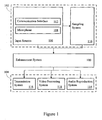
- Figure 1 is a signal enhancement system with preprocessing and post processing logic.
- Figure 2 is a single stage signal enhancement system.
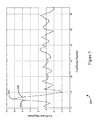
- Figure 3 is a plot of filter coefficients in a filter adapted to a female voice.
- Figure 4 is a plot of filter coefficients in a filter adapted to a male voice.
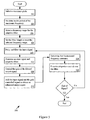
- Figure 5 is a flow diagram of signal enhancement.
- Figure 6 is a multiple stage signal enhancement system.
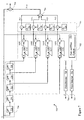
- Figure 7 is a signal enhancement system including a partitioned adaptive filter.
- Figure 8 is an alternative implementation of a signal enhancement system including a partitioned adaptive filter.
- Figure 9 is a comparison of frequency performance of signal enhancement systems shown in Figures 2 and 8.
- Figure 10 is a comparison of frequency performance of signal enhancement systems shown in Figures 7 and 8.
- Figure 11 is a flow diagram of signal enhancement.
- Figure 12 are multiple stage signal enhancement systems.
- the enhancement system detects and tracks one or more fundamental frequency components in a signal.
- the signal enhancement system reinforces the tracked frequency components.
- the enhancement system may improve the intelligibility of information in a speech signal or other audio signals.
- the reinforced signal may have an improved signal-to-noise ratio (SNR).
- a signal enhancement system 100 may operate in conjunction with preprocessing logic 102 and post-processing logic 104.
- the enhancement system 100 may be implemented in hardware and/or software.
- the enhancement system 100 may include a digital signal processor (DSP).
- the DSP may execute instructions that delay an input signal, track frequency components of a signal, filter a signal and/or reinforce spectral content in a signal.
- the enhancement system 100 may include discrete logic or circuitry, a mix of discrete logic and a processor, or may be distributed over multiple processors or programs.
- the enhancement system 100 may accept input from the input sources 106.
- the input sources 106 may include digital signal sources or analog signal sources such as a microphone 108.
- the microphone 108 may be connected to the enhancement system 100 through a sampling system 110.
- the sampling system 110 may convert analog signals sensed by the microphone 108 into digital form at a selected sampling rate.
- the sampling rate may be selected to capture any desired frequency content.
- the sampling rate may be approximately 8 kHz to about 22 kHz.
- the sampling rate may be approximately 22 to about 44 kHz.
- Other sampling rates may be used for speech and/or music.
- the digital signal sources may include a communication interface 112, other circuitry or logic in the system in which the enhancement system 100 is implemented, or other signal sources.
- the enhancement system 100 may accept the digital signal samples with or without additional pre-processing.
- the signal enhancement system 100 may also connect to post-processing logic 104.
- the post-processing logic 104 may include an audio reproduction system 114, digital and/or analog data transmission systems 116, or video processing logic 118. Other post-processing logic also may be used.
- the audio reproduction system 114 may include digital to analog converters, filters, amplifiers, and other circuitry or logic.
- the audio reproduction system 114- may be a speech and/or music reproduction system.
- the audio reproduction system 114 may be implemented in a cellular phone, car phone, digital media player /recorder, radio, stereo, portable gaming device, or other devices employing sound reproduction.
- the video processing system 118 may include circuitry and/or logic that provides a visual output.
- the signal used to prepare the visual output may be enhanced by the processing performed by the enhancement system 100.
- the video processing system 118 may control a television or other entertainment device. Alternatively, the video processing system 118 may control a computer monitor or liquid crystal display (LCD).
- LCD liquid crystal display
- the transmission system 116 may provide a network connection, digital or analog transmitter, or other transmission circuitry and/or logic.
- the transmission system 116 may communicate enhanced signals generated by the enhancement system 100 to other devices.
- the transmission system 116 may communicate enhanced signals from the car phone to a base station or other receiver through a wireless connection such as a ZigBee, Mobile-Fi, Ultrawideband, Wi-fi, or a WiMax network.
- FIG 2 illustrates the enhancement system 100.
- the enhancement system 100 includes a signal input 202.
- the signal input 202 carries an input signal that will be processed by the enhancement system 100.
- the input signal is labeled "x".
- the input signal may be time domain samples of speech.
- speech signals are discussed below.
- the enhancement system 100 may enhance signals with any other range of frequency content, whether audible or inaudible.
- the enhancement system 100 may process quasi-stationary or non-stationary signals.
- Non-stationary signals may vary in their frequency and/or amplitude content relatively quickly over time.
- Voice is one example of a non-stationary signal.
- the fundamental frequency component in a speaker's voice changes during speech.
- the change in fundamental frequency may vary by as much as approximately 50 percent per 100 ms or more.
- the speaker's voice may have a relatively constant pitch.
- Quasi-stationary signals change in frequency and/or amplitude less frequently than non-stationary signals.
- Quasi-stationary signals may arise from machine noise, a controlled human voice, or from other sources. Slowly changing engine noise or alternator whine are examples of quasi-stationary signals.
- the input signal is coupled to delay logic 204.
- the delay logic 204 imparts a delay to the input signal.
- the delay may vary widely depending on the particular implementation of the enhancement system 100.
- the delay may correspond to a period of a selected maximum pitch.
- the maximum pitch may be equal to the greatest pitch in the input signal that the enhancement system 100 enhances.
- the maximum pitch may vary widely depending on the type and characteristics of the input signal.
- Speech signals may include a fundamental frequency component from approximately 70 Hz to about 400 Hz.
- Male speech often includes a fundamental frequency component between approximately 70 Hz to about 200 Hz.
- Female speech often includes a fundamental frequency component between approximately 200 Hz to about 400 Hz.
- a child's speech often includes a fundamental frequency component between approximately 250 Hz to about 400 Hz.
- the enhancement system 100 may process input signals that include speech from both male and female voices, either separately or simultaneously and overlapping.
- the maximum pitch period may approximately correspond to the period of the fundamental frequency of the female voice.
- the maximum pitch period may be approximately about 1/300 Hz (approximately 3.3 ms), or may be another pitch period associated with female voice.
- the enhancement system 100 may processes speech only from males.
- the maximum pitch period may correspond to the period of the fundamental frequency of male voice.
- the maximum pitch period may be approximately 1/150 Hz (approximately 6.6 ms), or may be another pitch period.
- the delay logic 204 may delay the input signal by the number of signal samples corresponding to the maximum pitch period.
- the delayed input signal may be received by the filter 206.
- the filter 206 includes a filter output 208 that carries a filtered output signal, labeled 'y' in Figure 2.
- the filter 206 may track one or more frequency components in the input signal based on the delayed input signal.
- the filter 206 may track the fundamental frequencies in the input signal as the pitch changes during voiced speech.
- the filter 206 may reproduce, replicate, approximate or otherwise include the tracked frequency content in the filtered output signal.
- the filter 206 may be a Finite Impulse Response Filter (FIR) or other type of digital filter.
- the coefficients of filter 206 may be adaptive.
- the filter 206 may be adapted by a Normalized Least Mean Squares (NLMS) technique or other type of adaptive filtering technique such as Recursive Least Squares (RLS) or Proportional LMS.
- NLMS Normalized Least Mean Squares
- RLS Recursive Least Squares
- Proportional LMS Proportional LMS
- the filter 206 may converge to the fundamental frequency in the input signal.
- the filter length L may increase or decrease to increase or decrease the frequency extent over which the filter 206 tracks frequency components.
- the maximum pitch was approximately 300 Hz and the delay logic 204 implemented a 27 sample delay.
- the filter 206 may adapt over time.
- the filter 206 may quickly adapt by evaluating an error signal 'e' on a sample-by-sample basis.
- the filter 206 may adapt based on blocks of samples, or other another basis.
- the filter 206 may change one or more of its filter coefficients.
- the filter coefficients may change the response of the filter 206.
- the filter coefficients may adapt the filter 206 so that the filter 206 attempts to minimize the error signal 'e'.
- the error estimator 210 may generate the error signal 'e'.
- the error estimator 210 may be an adder, comparator, or other circuitry or logic.
- the error estimator 210 may compare the input signal 'x' with the filtered output signal 'y'.
- the filter 206 converges to the fundamental frequency in the input signal, the error signal decreases. As the error signal decreases, the filtered output signal 'y' more closely resembles the input signal 'x' delayed by an integer multiple of the signal's fundamental frequencies.
- the gain control logic 212 may respond to the error signal.
- the optional gain control logic 212 may include a multiplier 214 and a gain parameter 216.
- the gain control logic 212 may attenuate, amplify, or otherwise modify the filtered output signal.
- Figure 2 shows that the gain control logic 212 applies a gain, 'A', to the filtered output signal to produce the gain controlled signal'Ay'.
- the reinforcement logic 218 may reinforce frequency content in the input signal 'x' with the gain controlled signal 'Ay'.
- the reinforcement logic 218 may be an adder or other circuitry and/or logic.
- the gain control logic 212 may reduce the gain, 'A'.
- the filtered output signal may contribute less to the enhanced output signal.
- the relationship between the error signal and the gain may be continuous, stepped, linear, or non-linear.
- the enhancement system 100 establishes one or more error thresholds. As the error signal exceeds an upper threshold, the gain control logic 212 may reduce the gain 'A' to 0 (zero). The upper threshold may be set to the input signal so that if e > x, then the gain 'A' may be set to zero. As the error signal falls below a lower threshold, the gain control logic 212 may increase the gain 'A' to 1 (one).
- the filter control logic 220 may reset the filter 206.
- the control logic 220 may zero-out the filter coefficients, re-initialize the filter coefficients, or may take other actions.
- the control logic 220 may also dynamically modify the filter length, may modify the delay implemented by the delay logic 204, or may modify other characteristics of the enhancement system 100.
- the control logic 220 also may modify the enhancement system 100 to adapt to changing environments in which the enhancement system 100 is used, to adapt the enhancement system 100 to a new speaker, or other applications..
- the filter control logic 220 also may control how quickly the filter 206 adapts, whether the filter adapts, or may monitor or control other filter characteristics. In the context of a system that enhances non-stationary signals, the control logic 220 may expect quickly changing frequency and amplitude components in the input signal. The control logic 220 may also expect or determine over time that particular frequency components in the input signal are prevalent.
- the control logic 220 also may determine that the input signal has changed in frequency content, amplitude, or other characteristics from what is expected or from what has been determined. In response, the control logic 220 may stop the filter 206 from attempting to adapt to the new signal content, may slow the rate of adaptation, or may take other actions. The control logic 220 may exercise control over the filter 206 until the input signal characteristics return to what is expected, until a predetermined time has elapse, until instructed to release control, or until another time or condition is met.
- the delay logic 204 prevents the filtered output signal from precisely duplicating the current input signal 'x'.
- the filtered output signal may closely track the selected periodicities in the input signal 'x'.
- periodic signal components may combine constructively and random noise components may combine destructively. Therefore, the periodic signal components may be enhanced more than the noise.
- the delay introduced by the delay logic 204 and the filter 206 may be approximately one cycle of a fundamental frequency component tracked by the filter 206.
- the delay may correspond to the glottal pulse delay for voice sounds, such as vowels.
- the delay may allow the fundamental frequency components to add in-phase or approximately in-phase.
- the resulting gain in the fundamental frequency content in the enhanced output signal may be approximately 6 dB or more.
- the noise in the input signal and the filtered output signal tends to be out of phase.
- the noise may increase less than the enhanced frequency content, for example by 3 dB or less.
- the enhanced output signal may have increased SNR.
- the input signal that the enhancement system 100 processes may include multiple fundamental frequencies. For example, when two speakers are speaking at the same time, the input signal may include two non-stationary fundamental frequencies. When multiple fundamental frequencies are present, the filter 026 continues to adapt and converge to provide a filtered out signal 'y' that is a delayed version of the input signal.
- the reinforcement logic 218 may reinforce one or more of the fundamental frequencies present in the input signal.
- a plot illustrates coefficients 300 for the filter 206.
- the coefficients are plotted by coefficient number on the horizontal axis and magnitude on the vertical axis.
- the coefficients 300 show the filter 206 as it has adapted to female speech.
- the coefficients 300 may be analyzed to determine a fast estimate of the fundamental frequencies in the input signal. with good temporal resolution.
- the coefficients 300 begin to peak around coefficient 304 (the fifth filter coefficient), coefficient 306 (the sixth filter coefficient), and coefficient 308 (the seventh filter coefficient).
- a plot shows coefficients 400 for the filter 206 as it has adapted to male speech.
- the coefficient peak appears near coefficient 402 (the 34th filter coefficient), coefficient 404 (the 35th filter coefficient), and coefficient 406 (the 36th filter coefficient).
- the control logic 220 may store historical data on many characteristics of the input signal, including the fundamental frequency of the input signal as it changes over time.
- the control logic 220 may examine the historical data as an aid in determining whether the characteristics of the input signal have unexpectedly changed.
- the control logic 220 may respond by exercising adaptation control over the filter 206 or by taking other actions.
- Figure 5 shows a flow diagram 500 of acts that may be taken to enhance a periodic signal.
- a maximum pitch is selected for processing by the enhancement system 100 (Act 502).
- the delay logic 204 may be set to implement the period of the maximum pitch (Act 504).
- a frequency range over which the enhancement system 100 will operate may also be selected (Act 506).
- the filter length of the filter 205 may be set to accommodate the frequency range (Act 508).
- the filter length may be dynamically changed during filter 206 operation.
- the input signal is delayed and filtered (Act 510).
- the enhancement system 100 may generate an error signal and responsively adapt the filter 206 (Act 512).
- the enhancement system 100 may control the gain of the filtered output signal (Act 514).
- the enhancement system 100 may add the input signal and the gain controlled signal (Act 516). An enhanced output signal may result.
- the enhancement system 100 also may determine fundamental frequency estimates (Act 518).
- the enhancement system 100 may employ the frequency estimates to exercise adaptation control over the filter 206 (Act 520).
- FIG. 6 shows a multiple stage enhancement system 600.
- the enhancement system 600 includes a first filter stage 602 and a second filter stage 604.
- the filter stages 602 and 604 may respond or adapt at different rates.
- the first filter stage 602 may adapt slowly and may suppress quasi-stationary signal components.
- the quasi-stationary signal components may be present in the input signal because of relatively consistent background noise, such as engine noise or environmental effects, or for other reasons.
- a signal input 606 connects to the first stage 602.
- the signal input 606 may connect to the delay logic 608.
- the delay logic may implement a delay that corresponds to the period of a maximum quasi-stationary frequency that may be suppressed by the first stage 602.
- the maximum quasi-stationary frequency may be selected according to known or expected characteristics of the environment in which the enhancement system 600 is used.
- the filter control logic 610 may dynamically modify the delay to adapt the first stage 602 to the environment.
- the filter control logic 610 also may control the quasi-stationary filter 612.
- the filter 612 in the first stage may include signal component tracking logic such as a NLMS adapted FIR filter or RLS adapted FIR filter.
- the filter 612 in the first stage may adapt slowly, for example with a sampling rate of 8 kHz and a filter length of 64 an NLMS step size larger than 0 and less than approximately 0.01 may allow attenuation of quasi-stationary periodic signals while minimally degrading typical speech signals.
- the first stage filtered output 614 may provide a filtered output signal that approximately reproduces the quasi-stationary signal component in the input signal.
- the suppression logic 616 and slow filter adaptation may allow non-stationary signal components to pass through the first stage 602 to the second stage 604.
- the suppression logic 616 may suppress quasi-stationary signal components in the input signal.
- the suppression logic 616 may be implemented as arithmetic logic that subtracts the filtered output signal from the input signal.
- the replicated quasi-stationary signal content in the filtered output signal is removed from the input signal.
- the first stage output 618 may be connected to the second stage 604.
- the second stage 604 may process the signal 'x 2 ' with the adaptive filter 206.
- the filter 206 may adapt quickly, for example with a sampling rate of 8 kHz and a filter length of 64 an NLMS step size larger than approximately 0.6 and less than 1.0 may allow the adaptive filter 206 to track the fundamental frequencies in typical speech signals..
- the second stage 604 may enhance non-stationary signal components in the first stage output signal.
- the non-stationary signal components may be present in the input signal as a result of speech, music, or other signal sources.
- the second stage 604 may process the first stage output signal as described above.
- the enhancement system 600 employs a first suppression stage 602 followed by a second enhancement stage 604.
- the enhancement system 600 may be employed to reinforce non-stationary signal content, such as voice content.
- the enhancement system 600 may remove or suppress the slowly changing signal components.
- the first stage 602 may remove or suppress engine noise, road noise, or other noises, while the second stage 604 enhances non-stationary signal components, such as male or female voice components.
- the signal enhancement system 100 may enhance periodic signal content, increase SNR, and/or decrease noise in an input signal. When applied to a voice signal, the enhancement system 100 may reinforce fundamental speech frequencies and may strengthen vowel or other sounds. The enhancement system 100 may enhance other signals, whether they are audible or inaudible.
- the overall delay introduced by the delay logic 204 or 608 and the filter 206 or 612 also may be approximately an integer number (one or greater) of cycles of the tracked pitch period. Delaying by additional cycles may allow the input signal to change to a greater degree than waiting one cycle. Adding the longer delayed filtered signal to the current input signal may produce special effects in the output signal such as reverberation, while still enhancing fundamental frequency components.
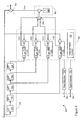
- a signal enhancement system 700 includes a partitioned adaptive filter 702 as well as partitioned delay logic 704.
- the partitioned adaptive filter 702 includes multiple adaptive filters, illustrated in Figure 7 as adaptive filters 1 through 'i'.
- the adaptive filters 1, 2, 3, and 'i' are labeled 706, 708, 710, and 712, respectively.
- the output of each adaptive filter may connect to gain logic 744 including multipliers that apply fixed or variable gain parameters to the filter outputs.
- Figure 7 illustrates gain parameters 714, 716, 718, and 720 individually applied to the outputs of the filters 706-712.
- the gain and filter control logic 722 may exercise control over the gain parameters 714 - 720 and filter adaptation for each individual filter 706-712.
- One or more of the gain weighted filter outputs may be added together by the reinforcement logic 724 to obtain a weighted sum of the filter outputs, 'y SUM '
- the reinforcement logic 726 adds the weighted summed filter outputs 'y SUM ' to the input signal 'x' to create the output signal 's'.
- the reinforcement logic may be an adder or other signal summer.
- the partitioned delay logic 704 includes multiple series-connected delay blocks, five of which are labeled as delay blocks 728, 730, 732, 734, and 736.
- the partitioned filter 702 divides the entire signal tracking task across multiple adaptive filters 706-712.
- Each adaptive filter 706-712 may process and adapt a portion of the overall impulse response of the partitioned filter 702. As a result, each adaptive filter 706-712 may have a smaller length (e.g., a smaller number of taps) than the longer adaptive filter shown in Figure 2.
- each adaptive filter may process 20 (or any other number) taps of the overall impulse response.
- the number of adaptive filter partitions in the filter 702 is equal to the length of the overall impulse response, and therefore each adaptive filter has length 1.
- the overall length of the partitioned filter 702 may be chosen as explained above with respect to the range of frequencies that the partitioned filter 702 will track.
- the adaptive filters 706-712 may vary in length depending on the expected fundamental frequencies in an input signal. For processing the portion of the impulse response at or around the expected fundamental frequency, the adaptive filters 706-712 may be partitioned into shorter, more quickly adapting filters. Away from the expected fundamental frequency, the adaptive filters 706-712 may be longer more slowly adapting filters. Thus, the lengths of the adaptive filters 706-712 may be selected to provide fast adaptation at or around frequencies of interest in the input signal.
- Each adaptive filter 706-712 individually uses fewer filter coefficient updates.
- the adaptive filter 706-712 may update more quickly than filters in an implementation employing longer adaptive filters.
- Faster filter updates yield enhanced overall tracking performance, particularly at higher frequencies.
- the increase in overall tracking performance lends itself to tracking fundamental frequencies that change quickly, whether those frequencies are voiced or are artificially created.
- a least-mean-square (LMS) algorithm, a recursive-least-square (RLS) algorithm, variants of the LMS RLS, or other techniques may be employed to update the filter coefficients based on the individual error signals 'e i '.
- the delay logic 704 delays the arrival of the input signal 'x' to one or more of the filters 706-712.
- Figure 7 shows that each filter 706-712 is associated with its own delay.
- Each delay block 728-736 may implement a delay of any number of signal samples.
- One implementation uses an initial delay of D samples in the first delay block 728.
- Each subsequent delay logic 730-736 has an individually configurable delay, shown in Figure 7 as delays of M1, M2, M3, and Mi samples.
- the delay block 730 feeds the first adaptive filter 706, the delay block 732 feeds the second adaptive filter 708, the third delay block 734 feeds the third adaptive filter 710, and so on up to the i th delay block 736 that feeds the i th filter 712.
- the delays D, M1, ..., Mi may each be the same or may each be different.
- the delays M1, ..., Mi may correspond to the length (e.g., the number of taps) of the adaptive filter which the delay block feeds, or may be different from the length of the adaptive filter which the delay block feeds.
- the length of the adaptive filter 710 may be M3 taps and the delay block 734 that feeds the adaptive filter 706 may delay signal samples by M3 samples.
- the adaptive filter When the length of an adaptive filter 'i' is less than its associated delay Mi, the adaptive filter may initially converge faster. When the length of an adaptive filter 'i' is greater than its associated delay Mi, the adaptive filter may experience a smaller mean squared error upon convergence.
- the filter lengths and/or delay logic 730-736 may be set according to the implementation guidelines for the implementation in which the system 700 is employed.
- the delay D may be chosen to set a range of fundamental frequencies over which the system 700 will adapt.
- the gain and filter control logic 722 may exercise control over the gains 714-720 and filter adaptation on an individual basis, i.e., for each individual filter 706-712.
- the control techniques described above with respect to the filter control 220 may also be employed in the signal enhancement system 700.
- the gains 714-720 may be proportional to, or may be otherwise set based on the signal to noise ratio of the input signal 'x'. As SNR decreases, one or more of the gains 714-720 may increase in an attempt to suppress the noise. As SNR increases, one or more of the gains 714-720 may decrease or may be set to zero.
- the gains 714-720 may be determined as a function of the filter coefficients of its corresponding adaptive filter, or in other ways.
- f ( h i ) max n
- 2 f ( h i ) ⁇ n h i ( n ) + ⁇ n
- 2 f ( h i ) max n
- + max n h i ( n ) 2 f ( h i ) [ max n
- the gains 714-720 may be selected or determined based on other information in addition to or as an alternative to the filter coefficients.
- the gains 714-720 may be selected or modified (e.g., increased) to amplify the effect of an adaptive filter with coefficients that will enhance or strengthen periodic components of the input signal.
- the gains 714-720 may also be selected or modified (e.g., reduced or set to zero) to reduce or eliminate the effect of an adaptive filter with coefficients (generally negative coefficients) that would degrade or weaken periodic components of the input signal.
- the gains 714-720 may be set in other ways that depend on the magnitude of the filter coefficients, however. Accordingly, the enhancement system 700 may set the gains 714-720 on an individual basis such that only enhancement occurs in the system 700.
- Figure 8 shows an enhancement system 800 that provides an alternative to the enhancement system 700.
- the enhancement system 800 replaces the individually controlled gains 714-720 with the gain logic 802, e.g., a multiplier and a gain parameter.
- the gain logic 802 biases the sum of the adaptive filter outputs by the gain parameter 'A' 804.
- the reinforcement logic 806 may provide a sum of each adaptive filter output.
- the signal 's' generated by the enhancement systems 700 and 800 includes strengthened fundamental frequencies and harmonics of the fundamental frequencies, resulting in a more intelligible audio signal.
- Each adaptive filter 706-712 in the enhancement systems may be updated independently by its own error signal, leading to faster adaptation for the filter and overall.
- the division into multiple adaptive filters thereby leads to decreased smearing between adjacent harmonics, better preservation of smaller harmonics (e.g., harmonics close to the noise level), and less distortion of non-periodic components of the input signal.
- the enhancement system 700 may enhance even harmonics embedded in noise to levels above the noise, and may preserve small harmonics better.
- the enhancement system 800 has the advantages of reduced complexity and reduced computational requirements, while the enhancement system 700 has the advantage of providing the flexibility to independently control the gain of each adaptive filter 702-708 and its influence on the output signal.
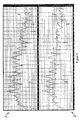
- Figure 9 is a comparison of frequency performance of the signal enhancement systems 200 and 800.
- the plot 902 illustrates the performance of the signal enhancement system 200, including input signal 904 and output signal 906.
- the plot 908 illustrates the performance of the signal enhancement system 800, including the same input signal 904 and enhanced output signal 910.
- the plot 908 shows the improved overall tracking response of the enhancement system 800 over the signal enhancement system 200, including improved high frequency response.
- the output signal 910 much more closely tracks the high frequency content of the input signal 904.
- the plots 902 and 908 also show the improved separation between harmonics achieved by the enhancement system 800.
- Plot 902 shows the frequency response gap 912 between the input signal 904 and the enhanced signal 906.
- the plot 908 of the performance of the enhancement system 800 shows that the gap is far smaller, as indicated at reference numeral 914.
- the output signal 910 has improved separation between harmonics , leading to less smearing between the harmonics in the output signal 910.
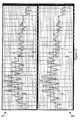
- Figure 10 is a comparison of frequency performance of the signal enhancement systems 700 and 800.
- the plot 1002 illustrates the performance of the signal enhancement system 800, including the input signal 1004 and output signal 1006 generated by the enhancement system 800.
- the plot 1008 illustrates the performance of the signal enhancement system 700, including the same input signal 1004 and output signal 1010.
- the plot 1008 shows the improved overall tracking response of the enhancement system 700 (with individually controlled gains 714-720), including improved enhancement of smaller harmonics.
- Examples of enhanced smaller harmonics 1012, 1014, 1016, and 1018 are labeled in Figure 10.
- the enhanced harmonics 1012 and 1014 are located at approximately 3000 and 3200 Hz in the plot 1002 and were strengthened by the enhancement system 800.
- the enhancement system 700 provides even greater enhancement of smaller harmonics as indicated by the enhanced harmonics 1016 and 1018 in plot 1008.
- Figure 11 shows a flow diagram 1100 of acts that may be taken to enhance a periodic signal.
- a maximum pitch that the enhancement systems 700, 800 will track is selected (Act 1102).
- the pitch may be chosen according to the type of signals expected to be encountered and their characteristics, such as male, female, or child voice characteristics.
- the overall delay implemented by the delay blocks 728-736 may be set to the period of the maximum pitch (Act 1104).
- a frequency range over which the enhancement systems 700, 800 will operate may also be selected (Act 1106).
- the overall filter length of the adaptive filters 702 - 708 may be set to accommodate the frequency range (Act 1108).
- the filter length, frequency range, and maximum pitch may be dynamically changed during enhancement system operation.
- the enhancement system partitions the overall impulse response across multiple adaptive filters 702-708 (Act 1110).
- the adaptive filter may be partitioned into smaller blocks at portions where the magnitude of the impulse response of the fundamental frequency of interest is high.
- Any adaptive filter 706-712 may process one or more points of the impulse response.
- Each adaptive filter 706-712 may process the same or different number of points of the impulse response.
- the enhancement systems 700 and 800 receive an input signal (Act 1112).
- the enhancement systems 700 and 800 filter the input signal using the partitioned adaptive filter (Act 1114).
- Individually selected gains are applied to the filtered output signal of each adaptive filter (Act 1116).
- the gain controlled output signals are then summed. Alternatively, a gain may be applied to the sum of one or more filtered output signals.
- the enhancement systems 700, 800 add the input signal and the gain controlled output signals (Act 1118).
- An enhanced output signal results, with strengthened fundamental frequency and harmonic content.
- the enhancement systems 700 and 800 may incorporate pitch detection logic 738 including a pitch estimate output 'p' 740.
- the pitch detection logic 738 may determine fundamental frequency estimates of signal components of the input signal (Act 1120) as described above. The estimates may be based on an analysis of the filter coefficients across each adaptive filter 706-712 to quickly estimate the fundamental frequency.
- the frequency estimates or other information may provide a basis for the enhancement systems 700 and 800 to exercise adaptation control over the filters 702-708 and gains (Act 1122), such as increasing or decreasing adaptation rate, changing the filter lengths, adding or removing filters, and other adaptations.
- the enhancement systems 700 and 800 may also include voice detection logic 742 including a voice detection output 'v' 744.
- the voice detection logic 742 may locate peaks in the filter coefficients that are above a pre-selected threshold (e.g., the background noise level). Such coefficients may indicate the presence of a periodic frequency component in the input signal. Vowel sounds may give rise to coefficient peaks above the background noise level that may be particularly strong peaks.
- the voice detection logic 742 may assert the voice detection output 'v' when peaks above the threshold are present, indicating that an input signal includes a voiced component.
- the voice detection logic 742 may determine a detection measure.
- the detection measure provides an indication of whether voice is present in the input signal.
- the detection measure may be a sum of magnitudes of positive filter coefficients. When the sum exceeds a threshold, the voice detection logic may assert the voice detection output 'v' 744.
- Each adaptive filter 702-708 generates its own error signal (Act 1124). Each adaptive filter 702-708 thereby adapts based on its own error signal (Act 1126).
- the enhancement systems 700, 800 may continue to provide an enhanced output signal for the duration of the input signal (Act 1128).
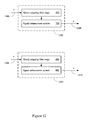
- Figure 12 shows a multiple stage enhancement system 1202 and a multiple stage enhancement system 1204.
- the system 1202 includes a slowly adapting filter stage (e.g., stage 602) coupled to the signal enhancement system 700.
- the input signal 'x' 1206 is coupled to the slowly adapting filter stage 602, and the signal enhancement system 700 produces the enhanced output signal 's' 1208.
- the multiple stage enhancement system 1204 employs a slowly adapting filter stage 602 that is coupled to the signal enhancement system 800, generating an enhanced output signal 's' 1210.
- the slowly adapting filter stage 602 may suppress quasi-stationary signal components.
- the quasi-stationary signal components may be present in the input signal because of background noise with slowly varying frequency content.
- the slowly adapting filter stage 602 may suppress engine noise, environmental effects, or other noise sources with relatively slowly changing frequency characteristics.
- the signal enhancement systems 700, 800 follow to enhance periodic frequency content, such as that present in a voice signal, that passes through the slowly adapting filter stage 602.
- the signal enhancement systems 200, 600, 700, and 800 may be implemented in hardware, software, or a combination of hardware and software.
- the enhancement systems may take the form of instructions stored on a machine readable medium such as a disk, EPROM, flash card, or other memory.
- the enhancement systems 200, 600, 700, and 800 may be incorporated into communication devices, sound systems, gaming devices, signal processing software, or other devices and programs.
- the enhancement systems 200, 600, 700, and 800 may pre-process microphone input signals to enhance SNR of vowel sounds for subsequent processing.
Landscapes
- Engineering & Computer Science (AREA)
- Computational Linguistics (AREA)
- Quality & Reliability (AREA)
- Signal Processing (AREA)
- Health & Medical Sciences (AREA)
- Audiology, Speech & Language Pathology (AREA)
- Human Computer Interaction (AREA)
- Physics & Mathematics (AREA)
- Acoustics & Sound (AREA)
- Multimedia (AREA)
- Soundproofing, Sound Blocking, And Sound Damping (AREA)
- Filters That Use Time-Delay Elements (AREA)
Applications Claiming Priority (3)
| Application Number | Priority Date | Filing Date | Title |
|---|---|---|---|
| US10/973,575 US7680652B2 (en) | 2004-10-26 | 2004-10-26 | Periodic signal enhancement system |
| US11/102,251 US7610196B2 (en) | 2004-10-26 | 2005-04-08 | Periodic signal enhancement system |
| US11/101,796 US8170879B2 (en) | 2004-10-26 | 2005-04-08 | Periodic signal enhancement system |
Publications (1)
| Publication Number | Publication Date |
|---|---|
| EP1653445A1 true EP1653445A1 (fr) | 2006-05-03 |
Family
ID=35698847
Family Applications (1)
| Application Number | Title | Priority Date | Filing Date |
|---|---|---|---|
| EP05023037A Withdrawn EP1653445A1 (fr) | 2004-10-26 | 2005-10-21 | Système pour d'optimisation de signaux périodiques |
Country Status (4)
| Country | Link |
|---|---|
| EP (1) | EP1653445A1 (fr) |
| JP (1) | JP2006126841A (fr) |
| KR (1) | KR100754558B1 (fr) |
| CA (1) | CA2524162C (fr) |
Cited By (3)
| Publication number | Priority date | Publication date | Assignee | Title |
|---|---|---|---|---|
| US8270626B2 (en) | 2008-11-20 | 2012-09-18 | Harman International Industries, Incorporated | System for active noise control with audio signal compensation |
| US8718289B2 (en) | 2009-01-12 | 2014-05-06 | Harman International Industries, Incorporated | System for active noise control with parallel adaptive filter configuration |
| US9020158B2 (en) | 2008-11-20 | 2015-04-28 | Harman International Industries, Incorporated | Quiet zone control system |
Families Citing this family (1)
| Publication number | Priority date | Publication date | Assignee | Title |
|---|---|---|---|---|
| BR112023017453A2 (pt) * | 2021-03-22 | 2023-10-03 | Dolby Laboratories Licensing Corp | Aperfeiçoamento de desempenho/robustez para melhoramento de fala baseado em aprendizagem profunda contra artefatos e distorção |
Citations (1)
| Publication number | Priority date | Publication date | Assignee | Title |
|---|---|---|---|---|
| EP0275416A1 (fr) * | 1986-12-16 | 1988-07-27 | Gte Laboratories Incorporated | Procédé pour améliorer la qualité de la parole codée |
Family Cites Families (1)
| Publication number | Priority date | Publication date | Assignee | Title |
|---|---|---|---|---|
| KR100300964B1 (ko) * | 1999-05-18 | 2001-09-26 | 윤종용 | 음성 코딩/디코딩 장치 및 그 방법 |
-
2005
- 2005-10-21 EP EP05023037A patent/EP1653445A1/fr not_active Withdrawn
- 2005-10-24 CA CA2524162A patent/CA2524162C/fr not_active Expired - Lifetime
- 2005-10-26 JP JP2005311122A patent/JP2006126841A/ja active Pending
- 2005-10-26 KR KR1020050101336A patent/KR100754558B1/ko not_active Expired - Lifetime
Patent Citations (1)
| Publication number | Priority date | Publication date | Assignee | Title |
|---|---|---|---|---|
| EP0275416A1 (fr) * | 1986-12-16 | 1988-07-27 | Gte Laboratories Incorporated | Procédé pour améliorer la qualité de la parole codée |
Non-Patent Citations (2)
| Title |
|---|
| KAUPPINEN I ED - SKODRAS A N ET AL: "Methods for detecting impulsive noise in speech and audio signals", DIGITAL SIGNAL PROCESSING, 2002. DSP 2002. 2002 14TH INTERNATIONAL CONFERENCE ON SANTORINI, GREECE 1-3 JULY 2002, PISCATAWAY, NJ, USA,IEEE, US, vol. 2, 1 July 2002 (2002-07-01), pages 967 - 970, XP010600013, ISBN: 0-7803-7503-3 * |
| VASEGHI S V ET AL: "The effects of non-stationary signal characteristics on the performance of adaptive audio restoration systems", ICASSP 89, 23 May 1989 (1989-05-23) - 26 May 1989 (1989-05-26), Glasgow UK, pages 377 - 380, XP010083080 * |
Cited By (4)
| Publication number | Priority date | Publication date | Assignee | Title |
|---|---|---|---|---|
| US8270626B2 (en) | 2008-11-20 | 2012-09-18 | Harman International Industries, Incorporated | System for active noise control with audio signal compensation |
| US8315404B2 (en) | 2008-11-20 | 2012-11-20 | Harman International Industries, Incorporated | System for active noise control with audio signal compensation |
| US9020158B2 (en) | 2008-11-20 | 2015-04-28 | Harman International Industries, Incorporated | Quiet zone control system |
| US8718289B2 (en) | 2009-01-12 | 2014-05-06 | Harman International Industries, Incorporated | System for active noise control with parallel adaptive filter configuration |
Also Published As
| Publication number | Publication date |
|---|---|
| KR20060049382A (ko) | 2006-05-18 |
| KR100754558B1 (ko) | 2007-09-05 |
| CA2524162A1 (fr) | 2006-04-26 |
| JP2006126841A (ja) | 2006-05-18 |
| CA2524162C (fr) | 2011-01-11 |
Similar Documents
| Publication | Publication Date | Title |
|---|---|---|
| US8170879B2 (en) | Periodic signal enhancement system | |
| US7680652B2 (en) | Periodic signal enhancement system | |
| US7610196B2 (en) | Periodic signal enhancement system | |
| US8306821B2 (en) | Sub-band periodic signal enhancement system | |
| US8447044B2 (en) | Adaptive LPC noise reduction system | |
| US6820053B1 (en) | Method and apparatus for suppressing audible noise in speech transmission | |
| US6023674A (en) | Non-parametric voice activity detection | |
| CA2571417C (fr) | Amelioration d'un signal periodique evolue | |
| US8543390B2 (en) | Multi-channel periodic signal enhancement system | |
| EP1312162B1 (fr) | Systeme d'amelioration de la qualite de signaux vocaux | |
| US8352257B2 (en) | Spectro-temporal varying approach for speech enhancement | |
| AU771444B2 (en) | Noise reduction apparatus and method | |
| EP1833163B1 (fr) | Système d'amélioration audio et son procédé | |
| US7302062B2 (en) | Audio enhancement system | |
| KR101671389B1 (ko) | 가변 대역 폭 적응 노치 필터, 및 가변 대역 폭 적응 노치 필터를 이용하여 하울링을 제거하는 방법 및 장치 | |
| US20080137874A1 (en) | Audio enhancement system and method | |
| US20070232257A1 (en) | Noise suppressor | |
| US9454956B2 (en) | Sound processing device | |
| JP2003534570A (ja) | 適応ビームフォーマーにおいてノイズを抑制する方法 | |
| WO2012142270A1 (fr) | Systèmes, procédés, appareil et support lisible par un ordinateur pour une égalisation | |
| JP2002541753A (ja) | 固定フィルタを用いた時間領域スペクトラル減算による信号雑音の低減 | |
| EP1008140A1 (fr) | Detecteur de periodicite base sur la forme d'onde | |
| US20100017207A1 (en) | Method and device for ascertaining feature vectors from a signal | |
| EP2230664B1 (fr) | Procédé et appareil pour atténuer le bruit dans un signal d'entrée | |
| US20060089836A1 (en) | System and method of signal pre-conditioning with adaptive spectral tilt compensation for audio equalization |
Legal Events
| Date | Code | Title | Description |
|---|---|---|---|
| PUAI | Public reference made under article 153(3) epc to a published international application that has entered the european phase |
Free format text: ORIGINAL CODE: 0009012 |
|
| AK | Designated contracting states |
Kind code of ref document: A1 Designated state(s): AT BE BG CH CY CZ DE DK EE ES FI FR GB GR HU IE IS IT LI LT LU LV MC NL PL PT RO SE SI SK TR |
|
| AX | Request for extension of the european patent |
Extension state: AL BA HR MK YU |
|
| 17P | Request for examination filed |
Effective date: 20060614 |
|
| AKX | Designation fees paid |
Designated state(s): DE FR GB IT |
|
| RAP1 | Party data changed (applicant data changed or rights of an application transferred) |
Owner name: QNX SOFTWARE SYSTEMS (WAVEMAKERS), INC. |
|
| STAA | Information on the status of an ep patent application or granted ep patent |
Free format text: STATUS: THE APPLICATION HAS BEEN WITHDRAWN |
|
| 18W | Application withdrawn |
Effective date: 20090105 |