EP1653794A1 - Technique de vérification d'un système d'inspection optique - Google Patents
Technique de vérification d'un système d'inspection optique Download PDFInfo
- Publication number
- EP1653794A1 EP1653794A1 EP05077405A EP05077405A EP1653794A1 EP 1653794 A1 EP1653794 A1 EP 1653794A1 EP 05077405 A EP05077405 A EP 05077405A EP 05077405 A EP05077405 A EP 05077405A EP 1653794 A1 EP1653794 A1 EP 1653794A1
- Authority
- EP
- European Patent Office
- Prior art keywords
- paste
- solder paste
- optical inspection
- inspection system
- simulated
- Prior art date
- Legal status (The legal status is an assumption and is not a legal conclusion. Google has not performed a legal analysis and makes no representation as to the accuracy of the status listed.)
- Withdrawn
Links
Images
Classifications
-
- G—PHYSICS
- G01—MEASURING; TESTING
- G01N—INVESTIGATING OR ANALYSING MATERIALS BY DETERMINING THEIR CHEMICAL OR PHYSICAL PROPERTIES
- G01N21/00—Investigating or analysing materials by the use of optical means, i.e. using sub-millimetre waves, infrared, visible or ultraviolet light
- G01N21/84—Systems specially adapted for particular applications
- G01N21/88—Investigating the presence of flaws or contamination
- G01N21/95—Investigating the presence of flaws or contamination characterised by the material or shape of the object to be examined
- G01N21/956—Inspecting patterns on the surface of objects
- G01N21/95684—Patterns showing highly reflecting parts, e.g. metallic elements
-
- G—PHYSICS
- G01—MEASURING; TESTING
- G01R—MEASURING ELECTRIC VARIABLES; MEASURING MAGNETIC VARIABLES
- G01R31/00—Arrangements for testing electric properties; Arrangements for locating electric faults; Arrangements for electrical testing characterised by what is being tested not provided for elsewhere
- G01R31/28—Testing of electronic circuits, e.g. by signal tracer
- G01R31/302—Contactless testing
- G01R31/308—Contactless testing using non-ionising electromagnetic radiation, e.g. optical radiation
- G01R31/309—Contactless testing using non-ionising electromagnetic radiation, e.g. optical radiation of printed or hybrid circuits or circuit substrates
-
- G—PHYSICS
- G06—COMPUTING OR CALCULATING; COUNTING
- G06T—IMAGE DATA PROCESSING OR GENERATION, IN GENERAL
- G06T7/00—Image analysis
- G06T7/0002—Inspection of images, e.g. flaw detection
- G06T7/0004—Industrial image inspection
- G06T7/0008—Industrial image inspection checking presence/absence
-
- G—PHYSICS
- G06—COMPUTING OR CALCULATING; COUNTING
- G06T—IMAGE DATA PROCESSING OR GENERATION, IN GENERAL
- G06T7/00—Image analysis
- G06T7/0002—Inspection of images, e.g. flaw detection
- G06T7/0004—Industrial image inspection
- G06T7/001—Industrial image inspection using an image reference approach
-
- H—ELECTRICITY
- H05—ELECTRIC TECHNIQUES NOT OTHERWISE PROVIDED FOR
- H05K—PRINTED CIRCUITS; CASINGS OR CONSTRUCTIONAL DETAILS OF ELECTRIC APPARATUS; MANUFACTURE OF ASSEMBLAGES OF ELECTRICAL COMPONENTS
- H05K3/00—Apparatus or processes for manufacturing printed circuits
- H05K3/30—Assembling printed circuits with electric components, e.g. with resistors
- H05K3/32—Assembling printed circuits with electric components, e.g. with resistors electrically connecting electric components or wires to printed circuits
- H05K3/34—Assembling printed circuits with electric components, e.g. with resistors electrically connecting electric components or wires to printed circuits by soldering
- H05K3/3465—Application of solder
- H05K3/3485—Application of solder paste, slurry or powder
-
- G—PHYSICS
- G01—MEASURING; TESTING
- G01R—MEASURING ELECTRIC VARIABLES; MEASURING MAGNETIC VARIABLES
- G01R31/00—Arrangements for testing electric properties; Arrangements for locating electric faults; Arrangements for electrical testing characterised by what is being tested not provided for elsewhere
- G01R31/28—Testing of electronic circuits, e.g. by signal tracer
- G01R31/2801—Testing of printed circuits, backplanes, motherboards, hybrid circuits or carriers for multichip packages [MCP]
- G01R31/281—Specific types of tests or tests for a specific type of fault, e.g. thermal mapping, shorts testing
- G01R31/2812—Checking for open circuits or shorts, e.g. solder bridges; Testing conductivity, resistivity or impedance
-
- G—PHYSICS
- G06—COMPUTING OR CALCULATING; COUNTING
- G06T—IMAGE DATA PROCESSING OR GENERATION, IN GENERAL
- G06T2207/00—Indexing scheme for image analysis or image enhancement
- G06T2207/30—Subject of image; Context of image processing
- G06T2207/30108—Industrial image inspection
- G06T2207/30152—Solder
-
- H—ELECTRICITY
- H05—ELECTRIC TECHNIQUES NOT OTHERWISE PROVIDED FOR
- H05K—PRINTED CIRCUITS; CASINGS OR CONSTRUCTIONAL DETAILS OF ELECTRIC APPARATUS; MANUFACTURE OF ASSEMBLAGES OF ELECTRICAL COMPONENTS
- H05K1/00—Printed circuits
- H05K1/02—Details
- H05K1/0266—Marks, test patterns or identification means
- H05K1/0269—Marks, test patterns or identification means for visual or optical inspection
-
- H—ELECTRICITY
- H05—ELECTRIC TECHNIQUES NOT OTHERWISE PROVIDED FOR
- H05K—PRINTED CIRCUITS; CASINGS OR CONSTRUCTIONAL DETAILS OF ELECTRIC APPARATUS; MANUFACTURE OF ASSEMBLAGES OF ELECTRICAL COMPONENTS
- H05K2201/00—Indexing scheme relating to printed circuits covered by H05K1/00
- H05K2201/10—Details of components or other objects attached to or integrated in a printed circuit board
- H05K2201/10007—Types of components
- H05K2201/10204—Dummy component, dummy PCB or template, e.g. for monitoring, controlling of processes, comparing, scanning
Definitions
- the present invention is generally directed to a technique for optical inspection system verification and, more specifically, to verifying proper operation of an optical inspection system that inspects solder paste deposited upon a printed circuit board.
- PCBs printed circuit boards
- SMT service mount technology
- solder paste print inspection systems have included cameras that provide a two-dimensional (2D) view of solder pad coverage and solder paste registration on a PCB. These inspection systems have been utilized to make adjustments and corrections to the solder paste printer, when the printer drifts out of alignment while in use.
- Other solder paste inspection systems have implemented cameras that have a three-dimensional (3D) capability, which allows the inspection system to estimate solder paste height, based on a single mid-pad measurement.
- 3D three-dimensional
- this approach may miss flaws, such as dog ears and stencil blockages at the edges of a pad, and exhibit reduced accuracy and have limited repeatability.
- AOI automated optical inspection
- 3D laser inspection systems have been introduced that allow for 3D solder paste inspection.
- such 3D inspection systems implement a solid-state scanning laser whose beam is swept back and forth across a PCB under test.
- One such system implements two position sensitive detectors that allow for solder paste height to be determined by the location of a reflected beam on the detectors.
- solder paste print (deposit) defects can be attributed to stencil misalignment and excessive paste, which leads to bridging, shorts and tombstoning during the mounting of electronic components to an associated PCB. Further, if the solder paste printer runs low on solder paste, or one or more of its apertures are clogged, no paste may be deposited on a pad at which point a component cannot be properly mounted to an associated PCB. Other defects, such as problems with the wetting and the forming of fillets, become noticeable after reflow, even though the source of the problem is the printer.
- the present invention is directed to a technique for optical inspection verification that implements a number of steps. Initially, a simulated solder paste material including a solder powder and an organic resin, is provided. Next, the simulated solder paste material is printed in a desired pattern on a base material, e.g., a printed circuit board (PCB), to provide a reference test board. Then, the test board is cured to stabilize the simulated solder paste material. Next, the test board is utilized to train an optical inspection system to reject defective product.
- the desired pattern includes one or more defects. According to a different aspect of the invention, the defects include missing paste, misregistered paste, smeared paste, excessive paste and insufficient paste. According to another aspect of the present invention, the test board is utilized to periodically verify that the optical inspection system is properly functioning.
- a simulated solder paste material includes, by weight, about eighty percent of the solder powder and about twenty percent of the resin.
- the resin is an epoxy resin and curative mixture.
- the solder paste is substantially invariant after the curing step.
- the step of utilizing the test board to periodically verify that the optical inspection system is properly functioning further comprises the step of utilizing information acquired during periodic verification to determine the long-term stability of the optical inspection system.
- the long-term stability of the optical inspection system may be defined by the optical inspection error, drift and bias (as a function of time) and classical statistical process control and measurement system analysis tools may be employed.
- a technique for optical inspection system verification utilizes a simulated solder paste, e.g., a solder powder and an organic resin, which is printed (or stenciled) like solder paste but cures and holds its shape.
- the simulated solder material is deposited on a base material, e.g., a production printed circuit board (PCB) or ceramic substrate or any substrate material (e.g., flex or laminate, such as FR-4, CEM-1, CEM-2, CEM-3, phenolics, BT and polyimides), and cured.
- PCB production printed circuit board
- any substrate material e.g., flex or laminate, such as FR-4, CEM-1, CEM-2, CEM-3, phenolics, BT and polyimides
- test boards may be created with some of the test boards having known defects, such as no paste, misregistered paste, smeared paste, excessive paste or insufficient paste.
- the defective reference test boards may then be used in conjunction with defect-free reference test boards to verify the inspection system is operating correctly. Further, the reference test boards can be utilized to train, test and compare inspection systems located on other manufacturing lines (that manufacture the same product), on-site or off-site at other manufacturing facilities.
- the test boards may also be used to periodically re-inspect the inspection system to ensure that the inspection system is functioning consistently with time.
- optical inspection system verification increases the confidence of an electronic assembly manufacturer that the correct amount of solder paste is being deposited onto PCBs from day-to-day and from shift-to-shift and generally helps to reduce variations in the amount of applied solder paste.
- AOI automated optical inspection
- the present invention desirably allows for the application of classical statistical process control (SPC) and measurement system analysis tools to the AOI system.
- SPC statistical process control
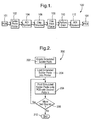
- a solder paste printer 102 is utilized to apply a solder paste to a substrate 101, such as a PCB.
- a substrate 101 such as a PCB.
- the substrate 101 (with the applied solder paste) is provided to an automated optical inspection (AOI) system 104, which is utilized to verify that the paste is deposited on the substrate 101 in an appropriate manner.
- AOI automated optical inspection
- the substrate 101 is transferred to a chip shooter 106, which is utilized to provide appropriate components, e.g., integrated circuits (ICs), for mounting on the substrate 101.
- ICs integrated circuits
- the populated substrate 101 is then supplied to a fine pitch placer 108, which further positions the components on the substrate 101 in an appropriate position.
- the populated substrate 101 is then supplied to a reflow oven 110, which heats the substrate 101 and its associated components to cause the solder paste to reflow and electrically connect the components to the traces of the substrate 101.
- the substrate 101 is then supplied to an automated optical inspection (AOI) system 112, which verifies that the substrate 101 has been manufactured according to specification.
- AOI automated optical inspection
- solder paste is not a stable material, as printed, and slumps and changes with time and, as such, a board with solder paste cannot be utilized over a long period of time to retest the inspection system.
- a reference test board process 200 is implemented that applies a simulated solder paste to a production printed circuit board (PCB) in a desired pattern.
- PCB production printed circuit board
- the PCB is then utilized as a reference test board, which is used to ensure that the inspection system 104 remains stable over a relatively long period of time, e.g., months to years.
- the test board process 200 is initiated in step 202, where a simulated solder paste material is created. It is desirable that the simulated solder paste, after a curing step, form a hard and/or permanent matrix.
- the simulated solder paste material is made of an organic resin (that cures with time) and a solder powder.
- the simulated solder paste material may be twenty percent resin (by weight) and eighty percent solder powder (by weight).
- a two-part epoxy resin and curative such as Stycast 1265, and a -325 mesh Sn 96.5/Ag 3.5 solder powder may be utilized.
- the simulated solder paste is manufactured by mixing the epoxy resin parts together and then adding the solder powder until a mixture with solder paste consistency is obtained.
- the simulated solder paste is then loaded into a solder paste printer in step 204 and printed in step 206 onto a PCB, which provides a reference test board for verifying operation of the AOI system at a later date.
- a number of reference test boards may be manufactured.
- a variety of reference test boards may be manufactured with a number of unacceptable conditions, e.g., missing paste, misregistered paste, smeared paste, insufficient paste and excessive paste.
- the test boards can then be run through the AOI system (e.g., the system 104) to determine if the system accepts good boards and rejects boards with known defects.
- decision step 208 it is determined whether more test boards are to be manufactured and, if so, control transfers to step 206. Otherwise, control transfers to step 210, where the process is terminated.
- it is desirable for the simulated solder paste material to print well and have a visual and optical appearance similar to solder. It is also desirable that the simulated solder paste material have a curing time that is relatively long, e.g., 48 hours at room temperature. However, it should be appreciated that simulated paste materials with curing times greater or less than 48 hours may be utilized.
- any number of organic resins can be utilized, depending upon a final desired hardness, the amount of working time, etc.
- a simulated solder paste material with a longer room temperature cure time will provide a material that has a longer working life.
- the following epoxy resin formulation provides a material with several hours of room temperature working life: an epoxy resin and curative mixture with 80 parts of a bisphenol-A epoxy resin, e.g., Epon 828 (manufactured and made commercially available by Shell), 20 parts of a flexible aliphatic diepoxide resin based on a polyglycol epoxy resin, e.g., DER 736 (manufactured and made commercially available by Dow Chemical), and 10 parts of an epoxy curative, such as TEDA triethylenediame.
- a bisphenol-A epoxy resin e.g., Epon 828 (manufactured and made commercially available by Shell)
- DER 736 manufactured and made commercially available by Dow Chemical
- an epoxy curative such as TEDA triethylenediame
Landscapes
- Engineering & Computer Science (AREA)
- Physics & Mathematics (AREA)
- General Physics & Mathematics (AREA)
- Computer Vision & Pattern Recognition (AREA)
- Theoretical Computer Science (AREA)
- Quality & Reliability (AREA)
- Health & Medical Sciences (AREA)
- Pathology (AREA)
- Life Sciences & Earth Sciences (AREA)
- Biochemistry (AREA)
- Chemical & Material Sciences (AREA)
- Manufacturing & Machinery (AREA)
- Microelectronics & Electronic Packaging (AREA)
- Analytical Chemistry (AREA)
- Immunology (AREA)
- General Health & Medical Sciences (AREA)
- Electromagnetism (AREA)
- Toxicology (AREA)
- General Engineering & Computer Science (AREA)
- Investigating Materials By The Use Of Optical Means Adapted For Particular Applications (AREA)
- Electric Connection Of Electric Components To Printed Circuits (AREA)
Applications Claiming Priority (1)
| Application Number | Priority Date | Filing Date | Title |
|---|---|---|---|
| US10/974,347 US20060086773A1 (en) | 2004-10-27 | 2004-10-27 | Technique for optical inspection system verification |
Publications (1)
| Publication Number | Publication Date |
|---|---|
| EP1653794A1 true EP1653794A1 (fr) | 2006-05-03 |
Family
ID=35735273
Family Applications (1)
| Application Number | Title | Priority Date | Filing Date |
|---|---|---|---|
| EP05077405A Withdrawn EP1653794A1 (fr) | 2004-10-27 | 2005-10-19 | Technique de vérification d'un système d'inspection optique |
Country Status (2)
| Country | Link |
|---|---|
| US (1) | US20060086773A1 (fr) |
| EP (1) | EP1653794A1 (fr) |
Cited By (1)
| Publication number | Priority date | Publication date | Assignee | Title |
|---|---|---|---|---|
| CN102495071A (zh) * | 2011-12-19 | 2012-06-13 | 景旺电子(深圳)有限公司 | 一种aoi检测系统及其检测方法 |
Families Citing this family (13)
| Publication number | Priority date | Publication date | Assignee | Title |
|---|---|---|---|---|
| JP4793187B2 (ja) * | 2006-09-11 | 2011-10-12 | パナソニック株式会社 | 電子部品実装システムおよび電子部品実装方法 |
| CN106998628B (zh) * | 2012-01-02 | 2019-12-03 | 穆特拉茨国际有限公司 | 阻挡计量 |
| US9243726B2 (en) | 2012-10-03 | 2016-01-26 | Aarne H. Reid | Vacuum insulated structure with end fitting and method of making same |
| US9791470B2 (en) * | 2013-12-27 | 2017-10-17 | Intel Corporation | Magnet placement for integrated sensor packages |
| US9463918B2 (en) | 2014-02-20 | 2016-10-11 | Aarne H. Reid | Vacuum insulated articles and methods of making same |
| US10497908B2 (en) | 2015-08-24 | 2019-12-03 | Concept Group, Llc | Sealed packages for electronic and energy storage devices |
| US10065256B2 (en) * | 2015-10-30 | 2018-09-04 | Concept Group Llc | Brazing systems and methods |
| CN109154641B (zh) | 2016-03-04 | 2021-09-17 | 概念集团有限责任公司 | 具有反射材料增强的真空隔热制品 |
| EP3541722A4 (fr) | 2016-11-15 | 2020-07-08 | Concept Group LLC | Ensembles à isolation multiple |
| US10823326B2 (en) | 2016-11-15 | 2020-11-03 | Concept Group Llc | Enhanced vacuum-insulated articles with controlled microporous insulation |
| CN107367682B (zh) * | 2017-06-26 | 2019-11-19 | 王俊 | 印制电路板检修方法及系统 |
| JP2020531764A (ja) | 2017-08-25 | 2020-11-05 | コンセプト グループ エルエルシー | 複合的ジオメトリおよび複合的材料の断熱部品 |
| CN110132960B (zh) * | 2018-02-09 | 2021-12-14 | 飞旭电子(苏州)有限公司 | 电路板组件的检测方法 |
Citations (5)
| Publication number | Priority date | Publication date | Assignee | Title |
|---|---|---|---|---|
| JPH0280193A (ja) * | 1988-09-14 | 1990-03-20 | Hitachi Chem Co Ltd | ソルダペースト |
| EP0385474A2 (fr) * | 1989-03-02 | 1990-09-05 | Omron Corporation | Méthode et appareil pour le contrôle de plaquettes à circuits imprimés |
| EP0706027A1 (fr) * | 1993-04-21 | 1996-04-10 | Omron Corporation | Appareil de support pour controle visuel, appareil de controle de substrat, et procedes de controle et de correction de soudure utilisant ces appareils |
| US5982927A (en) * | 1996-12-19 | 1999-11-09 | Cognex Corporation | Methods and apparatuses for in-line solder paste inspection |
| WO2005046297A2 (fr) * | 2003-10-31 | 2005-05-19 | Siemens Aktiengesellschaft | Etalon de controle pour controler des systemes de reconnaissance optiques utilises pour le montage de composants en surface (cms), et procede de realisation de cet etalon de controle |
Family Cites Families (9)
| Publication number | Priority date | Publication date | Assignee | Title |
|---|---|---|---|---|
| JPS61293657A (ja) * | 1985-06-21 | 1986-12-24 | Matsushita Electric Works Ltd | 半田付け外観検査方法 |
| JP3152834B2 (ja) * | 1993-06-24 | 2001-04-03 | 株式会社東芝 | 電子回路装置 |
| US5751910A (en) * | 1995-05-22 | 1998-05-12 | Eastman Kodak Company | Neural network solder paste inspection system |
| US5862973A (en) * | 1997-01-30 | 1999-01-26 | Teradyne, Inc. | Method for inspecting solder paste in printed circuit board manufacture |
| US6496270B1 (en) * | 2000-02-17 | 2002-12-17 | Gsi Lumonics, Inc. | Method and system for automatically generating reference height data for use in a three-dimensional inspection system |
| US6621566B1 (en) * | 2000-10-02 | 2003-09-16 | Teradyne, Inc. | Optical inspection system having integrated component learning |
| JP4502496B2 (ja) * | 2000-11-16 | 2010-07-14 | 富士通株式会社 | Bga実装時におけるはんだ形状評価方法及びbga実装時におけるはんだ形状評価装置及びbga実装時におけるはんだ形状評価プログラムを収納したコンピュータ読み取り可能な記録媒体 |
| JP3854103B2 (ja) * | 2001-06-28 | 2006-12-06 | 住友ベークライト株式会社 | 導電性ペースト及び該ペーストを用いてなる半導体装置 |
| US6746946B2 (en) * | 2002-03-19 | 2004-06-08 | N. Edward Berg | Process and apparatus for manufacturing printed circuit boards |
-
2004
- 2004-10-27 US US10/974,347 patent/US20060086773A1/en not_active Abandoned
-
2005
- 2005-10-19 EP EP05077405A patent/EP1653794A1/fr not_active Withdrawn
Patent Citations (5)
| Publication number | Priority date | Publication date | Assignee | Title |
|---|---|---|---|---|
| JPH0280193A (ja) * | 1988-09-14 | 1990-03-20 | Hitachi Chem Co Ltd | ソルダペースト |
| EP0385474A2 (fr) * | 1989-03-02 | 1990-09-05 | Omron Corporation | Méthode et appareil pour le contrôle de plaquettes à circuits imprimés |
| EP0706027A1 (fr) * | 1993-04-21 | 1996-04-10 | Omron Corporation | Appareil de support pour controle visuel, appareil de controle de substrat, et procedes de controle et de correction de soudure utilisant ces appareils |
| US5982927A (en) * | 1996-12-19 | 1999-11-09 | Cognex Corporation | Methods and apparatuses for in-line solder paste inspection |
| WO2005046297A2 (fr) * | 2003-10-31 | 2005-05-19 | Siemens Aktiengesellschaft | Etalon de controle pour controler des systemes de reconnaissance optiques utilises pour le montage de composants en surface (cms), et procede de realisation de cet etalon de controle |
Non-Patent Citations (1)
| Title |
|---|
| PATENT ABSTRACTS OF JAPAN vol. 014, no. 271 (M - 0983) 12 June 1990 (1990-06-12) * |
Cited By (1)
| Publication number | Priority date | Publication date | Assignee | Title |
|---|---|---|---|---|
| CN102495071A (zh) * | 2011-12-19 | 2012-06-13 | 景旺电子(深圳)有限公司 | 一种aoi检测系统及其检测方法 |
Also Published As
| Publication number | Publication date |
|---|---|
| US20060086773A1 (en) | 2006-04-27 |
Similar Documents
| Publication | Publication Date | Title |
|---|---|---|
| EP1653794A1 (fr) | Technique de vérification d'un système d'inspection optique | |
| US5553538A (en) | Method and apparatus for stencil printing printed circuit boards | |
| CN104584713B (zh) | 基板检查方法及利用此方法的基板检查系统 | |
| CN101513156B (zh) | 电子元件安装系统和电子元件安装方法 | |
| US11176635B2 (en) | Automatic programming of solder paste inspection system | |
| US8328074B2 (en) | Component-mounted board production apparatus and position control method for electronic components in component-mounted board production apparatus | |
| CN101283636B (zh) | 电子元件安装系统和电子元件安装方法 | |
| JP6329667B1 (ja) | 部品実装システム及び接着剤検査装置 | |
| US9681553B2 (en) | Changing printing control parameters based on measured solder paste deposits in certain subareas of a printed circuit board | |
| US20080083816A1 (en) | Statistical process control of solder paste stenciling using a replicated solder paste feature distributed across a printed circuit board | |
| JP7126122B2 (ja) | 実装システム、および生産管理装置 | |
| US20110155424A1 (en) | Producing electrical circuit patterns using multi-population transformation | |
| CN113508652B (zh) | 部件搭载装置以及部件搭载方法、安装基板制造系统以及安装基板制造方法、和搭载完毕部件检查装置 | |
| CN107454818A (zh) | 自动组装系统以及自动组装方法 | |
| CN110291357B (zh) | 焊料印刷检查装置、焊料印刷检查方法以及基板的制造方法 | |
| WO2019224534A1 (fr) | Appareil de surveillance d'un revêtement | |
| Zarrow | Reflow soldering of through-hole components | |
| JP2005030793A (ja) | 基板検査装置および検査方法 | |
| KR20240007406A (ko) | 부품 실장 장치 검사 방법 | |
| JP2004039873A (ja) | プリント回路板の製造装置および製造方法 | |
| US7439083B2 (en) | Technique for compensating for substrate shrinkage during manufacture of an electronic assembly | |
| JP7520463B2 (ja) | 基板生産システムおよび基板生産方法 | |
| CN114072744B (zh) | 安装基板制造系统和安装基板制造方法以及匹配性判定装置 | |
| JPH06232543A (ja) | プリント基板の部品実装方法 | |
| KR20260038056A (ko) | 부품 실장 장치의 장착 위치 보정 시스템 및 그 방법 |
Legal Events
| Date | Code | Title | Description |
|---|---|---|---|
| PUAI | Public reference made under article 153(3) epc to a published international application that has entered the european phase |
Free format text: ORIGINAL CODE: 0009012 |
|
| AK | Designated contracting states |
Kind code of ref document: A1 Designated state(s): AT BE BG CH CY CZ DE DK EE ES FI FR GB GR HU IE IS IT LI LT LU LV MC NL PL PT RO SE SI SK TR |
|
| AX | Request for extension of the european patent |
Extension state: AL BA HR MK YU |
|
| 17P | Request for examination filed |
Effective date: 20061103 |
|
| 17Q | First examination report despatched |
Effective date: 20061208 |
|
| AKX | Designation fees paid |
Designated state(s): AT BE BG CH CY CZ DE DK EE ES FI FR GB GR HU IE IS IT LI LT LU LV MC NL PL PT RO SE SI SK TR |
|
| STAA | Information on the status of an ep patent application or granted ep patent |
Free format text: STATUS: THE APPLICATION IS DEEMED TO BE WITHDRAWN |
|
| 18D | Application deemed to be withdrawn |
Effective date: 20070419 |