EP1654210B1 - Stilben-derivate und deren verwendung in arzneimitteln - Google Patents
Stilben-derivate und deren verwendung in arzneimitteln Download PDFInfo
- Publication number
- EP1654210B1 EP1654210B1 EP04737409A EP04737409A EP1654210B1 EP 1654210 B1 EP1654210 B1 EP 1654210B1 EP 04737409 A EP04737409 A EP 04737409A EP 04737409 A EP04737409 A EP 04737409A EP 1654210 B1 EP1654210 B1 EP 1654210B1
- Authority
- EP
- European Patent Office
- Prior art keywords
- cells
- resveratrol
- hexahydroxystilbene
- cox
- mmol
- Prior art date
- Legal status (The legal status is an assumption and is not a legal conclusion. Google has not performed a legal analysis and makes no representation as to the accuracy of the status listed.)
- Expired - Lifetime
Links
- PJANXHGTPQOBST-UHFFFAOYSA-N stilbene Chemical class C=1C=CC=CC=1C=CC1=CC=CC=C1 PJANXHGTPQOBST-UHFFFAOYSA-N 0.000 title claims abstract description 10
- 239000003814 drug Substances 0.000 title claims description 7
- PBRNOKNVNSKDQZ-UHFFFAOYSA-N (E)-1-(3,5-Dihydroxyphenyl)-2-(3,4,5-trihydroxyphenyl)ethylene Natural products OC1=CC(O)=CC(C=CC=2C=C(O)C(O)=C(O)C=2)=C1 PBRNOKNVNSKDQZ-UHFFFAOYSA-N 0.000 claims description 14
- ZUIXFZJBOJTTET-UHFFFAOYSA-N 5-[2-(3,4,5-trihydroxyphenyl)ethenyl]benzene-1,2,3-triol Chemical compound OC1=C(O)C(O)=CC(C=CC=2C=C(O)C(O)=C(O)C=2)=C1 ZUIXFZJBOJTTET-UHFFFAOYSA-N 0.000 claims description 6
- PYSIIZCKWCWZPP-UHFFFAOYSA-N 5-[2-(3,5-dimethoxyphenyl)ethenyl]-1,2,3-trimethoxybenzene Chemical compound COC1=CC(OC)=CC(C=CC=2C=C(OC)C(OC)=C(OC)C=2)=C1 PYSIIZCKWCWZPP-UHFFFAOYSA-N 0.000 claims description 6
- GRZOJEWQFCAKPF-UHFFFAOYSA-N 5-[2-(4-hydroxyphenyl)ethenyl]benzene-1,2,3-triol Chemical compound C1=CC(O)=CC=C1C=CC1=CC(O)=C(O)C(O)=C1 GRZOJEWQFCAKPF-UHFFFAOYSA-N 0.000 claims description 6
- DUESHOUIPOUGCU-UHFFFAOYSA-N 1,2,3-trimethoxy-5-[2-(3,4,5-trimethoxyphenyl)ethenyl]benzene Chemical compound COC1=C(OC)C(OC)=CC(C=CC=2C=C(OC)C(OC)=C(OC)C=2)=C1 DUESHOUIPOUGCU-UHFFFAOYSA-N 0.000 claims description 5
- NPUWPQJIMKMGDE-UHFFFAOYSA-N 5-[2-(3,5-dihydroxyphenyl)ethenyl]benzene-1,3-diol Chemical compound OC1=CC(O)=CC(C=CC=2C=C(O)C=C(O)C=2)=C1 NPUWPQJIMKMGDE-UHFFFAOYSA-N 0.000 claims description 5
- IIXHQGSINFQLRR-UHFFFAOYSA-N Piceatannol Natural products Oc1ccc(C=Cc2c(O)c(O)c3CCCCc3c2O)cc1O IIXHQGSINFQLRR-UHFFFAOYSA-N 0.000 claims description 5
- 230000002401 inhibitory effect Effects 0.000 claims description 5
- GGFQQRXTLIJXNY-UHFFFAOYSA-N 1,2,3-trimethoxy-5-[2-(4-methoxyphenyl)ethenyl]benzene Chemical compound C1=CC(OC)=CC=C1C=CC1=CC(OC)=C(OC)C(OC)=C1 GGFQQRXTLIJXNY-UHFFFAOYSA-N 0.000 claims description 4
- PTVAOGIYBMTHSN-UHFFFAOYSA-N 1-[2-(3,4-dimethoxyphenyl)ethenyl]-3,5-dimethoxybenzene Chemical compound COC1=CC(OC)=CC(C=CC=2C=C(OC)C(OC)=CC=2)=C1 PTVAOGIYBMTHSN-UHFFFAOYSA-N 0.000 claims description 4
- PVCLRSRSMZBWMF-UHFFFAOYSA-N 1-[2-(3,5-dimethoxyphenyl)ethenyl]-3,5-dimethoxybenzene Chemical compound COC1=CC(OC)=CC(C=CC=2C=C(OC)C=C(OC)C=2)=C1 PVCLRSRSMZBWMF-UHFFFAOYSA-N 0.000 claims description 4
- NHDCJIRSEKZXEL-UHFFFAOYSA-N 5-[2-(3,4-dihydroxyphenyl)ethenyl]benzene-1,2,3-triol Chemical compound C1=C(O)C(O)=CC=C1C=CC1=CC(O)=C(O)C(O)=C1 NHDCJIRSEKZXEL-UHFFFAOYSA-N 0.000 claims description 4
- 102000010907 Cyclooxygenase 2 Human genes 0.000 claims description 4
- 108010037462 Cyclooxygenase 2 Proteins 0.000 claims description 4
- 229940079593 drug Drugs 0.000 claims description 3
- GDHNBPHYVRHYCC-SNAWJCMRSA-N 1,3-dimethoxy-5-[(e)-2-(4-methoxyphenyl)ethenyl]benzene Chemical compound C1=CC(OC)=CC=C1\C=C\C1=CC(OC)=CC(OC)=C1 GDHNBPHYVRHYCC-SNAWJCMRSA-N 0.000 claims description 2
- GDHNBPHYVRHYCC-UHFFFAOYSA-N O-permethylated E-resveratrol Natural products C1=CC(OC)=CC=C1C=CC1=CC(OC)=CC(OC)=C1 GDHNBPHYVRHYCC-UHFFFAOYSA-N 0.000 claims description 2
- 238000004519 manufacturing process Methods 0.000 claims description 2
- CDRPUGZCRXZLFL-OWOJBTEDSA-N piceatannol Chemical compound OC1=CC(O)=CC(\C=C\C=2C=C(O)C(O)=CC=2)=C1 CDRPUGZCRXZLFL-OWOJBTEDSA-N 0.000 claims description 2
- 229910052739 hydrogen Inorganic materials 0.000 abstract description 8
- 230000000259 anti-tumor effect Effects 0.000 abstract description 6
- 239000003255 cyclooxygenase 2 inhibitor Substances 0.000 abstract description 5
- UFHFLCQGNIYNRP-UHFFFAOYSA-N Hydrogen Chemical compound [H][H] UFHFLCQGNIYNRP-UHFFFAOYSA-N 0.000 abstract description 2
- 239000001257 hydrogen Substances 0.000 abstract description 2
- 239000004480 active ingredient Substances 0.000 abstract 1
- 210000004027 cell Anatomy 0.000 description 48
- LUKBXSAWLPMMSZ-OWOJBTEDSA-N Trans-resveratrol Chemical compound C1=CC(O)=CC=C1\C=C\C1=CC(O)=CC(O)=C1 LUKBXSAWLPMMSZ-OWOJBTEDSA-N 0.000 description 29
- QNVSXXGDAPORNA-UHFFFAOYSA-N Resveratrol Natural products OC1=CC=CC(C=CC=2C=C(O)C(O)=CC=2)=C1 QNVSXXGDAPORNA-UHFFFAOYSA-N 0.000 description 24
- 235000021283 resveratrol Nutrition 0.000 description 23
- 229940016667 resveratrol Drugs 0.000 description 23
- XVXCIHIPMNJQIA-UHFFFAOYSA-N 6-(1-hydroxy-2-phenylethenyl)benzene-1,2,3,4,5-pentol Chemical compound OC=1C(O)=C(O)C(O)=C(O)C=1C(O)=CC1=CC=CC=C1 XVXCIHIPMNJQIA-UHFFFAOYSA-N 0.000 description 22
- 230000000694 effects Effects 0.000 description 15
- 239000000126 substance Substances 0.000 description 15
- 101150071146 COX2 gene Proteins 0.000 description 14
- 101100114534 Caenorhabditis elegans ctc-2 gene Proteins 0.000 description 14
- 101150000187 PTGS2 gene Proteins 0.000 description 14
- WQDUMFSSJAZKTM-UHFFFAOYSA-N Sodium methoxide Chemical compound [Na+].[O-]C WQDUMFSSJAZKTM-UHFFFAOYSA-N 0.000 description 12
- IAZDPXIOMUYVGZ-UHFFFAOYSA-N DMSO Substances CS(C)=O IAZDPXIOMUYVGZ-UHFFFAOYSA-N 0.000 description 11
- 230000005764 inhibitory process Effects 0.000 description 10
- 230000002265 prevention Effects 0.000 description 10
- YMWUJEATGCHHMB-UHFFFAOYSA-N Dichloromethane Chemical compound ClCCl YMWUJEATGCHHMB-UHFFFAOYSA-N 0.000 description 9
- 101000942305 Zea mays Cytokinin dehydrogenase 1 Proteins 0.000 description 7
- 238000005160 1H NMR spectroscopy Methods 0.000 description 6
- OPHQOIGEOHXOGX-UHFFFAOYSA-N 3,4,5-trimethoxybenzaldehyde Chemical compound COC1=CC(C=O)=CC(OC)=C1OC OPHQOIGEOHXOGX-UHFFFAOYSA-N 0.000 description 6
- XKRFYHLGVUSROY-UHFFFAOYSA-N Argon Chemical compound [Ar] XKRFYHLGVUSROY-UHFFFAOYSA-N 0.000 description 6
- CIWBSHSKHKDKBQ-JLAZNSOCSA-N Ascorbic acid Chemical compound OC[C@H](O)[C@H]1OC(=O)C(O)=C1O CIWBSHSKHKDKBQ-JLAZNSOCSA-N 0.000 description 6
- 208000037265 diseases, disorders, signs and symptoms Diseases 0.000 description 6
- 230000012010 growth Effects 0.000 description 6
- LFQSCWFLJHTTHZ-UHFFFAOYSA-N Ethanol Chemical compound CCO LFQSCWFLJHTTHZ-UHFFFAOYSA-N 0.000 description 5
- 238000003556 assay Methods 0.000 description 5
- 230000022131 cell cycle Effects 0.000 description 5
- 238000006243 chemical reaction Methods 0.000 description 5
- 150000001875 compounds Chemical class 0.000 description 5
- 201000010099 disease Diseases 0.000 description 5
- 238000009826 distribution Methods 0.000 description 5
- 230000003834 intracellular effect Effects 0.000 description 5
- 238000001644 13C nuclear magnetic resonance spectroscopy Methods 0.000 description 4
- VFZRZRDOXPRTSC-UHFFFAOYSA-N 3,5-Dimethoxybenzaldehyde Chemical compound COC1=CC(OC)=CC(C=O)=C1 VFZRZRDOXPRTSC-UHFFFAOYSA-N 0.000 description 4
- 108091003079 Bovine Serum Albumin Proteins 0.000 description 4
- 101000979342 Homo sapiens Nuclear factor NF-kappa-B p105 subunit Proteins 0.000 description 4
- 238000005481 NMR spectroscopy Methods 0.000 description 4
- 206010028980 Neoplasm Diseases 0.000 description 4
- 102100023050 Nuclear factor NF-kappa-B p105 subunit Human genes 0.000 description 4
- 230000001640 apoptogenic effect Effects 0.000 description 4
- 239000012894 fetal calf serum Substances 0.000 description 4
- XJMOSONTPMZWPB-UHFFFAOYSA-M propidium iodide Chemical compound [I-].[I-].C12=CC(N)=CC=C2C2=CC=C(N)C=C2[N+](CCC[N+](C)(CC)CC)=C1C1=CC=CC=C1 XJMOSONTPMZWPB-UHFFFAOYSA-M 0.000 description 4
- UCSJYZPVAKXKNQ-HZYVHMACSA-N streptomycin Chemical compound CN[C@H]1[C@H](O)[C@@H](O)[C@H](CO)O[C@H]1O[C@@H]1[C@](C=O)(O)[C@H](C)O[C@H]1O[C@@H]1[C@@H](NC(N)=N)[C@H](O)[C@@H](NC(N)=N)[C@H](O)[C@H]1O UCSJYZPVAKXKNQ-HZYVHMACSA-N 0.000 description 4
- 238000003786 synthesis reaction Methods 0.000 description 4
- VYWCMXXBAOVBSJ-UHFFFAOYSA-N 1-(diethoxyphosphorylmethyl)-3,5-dimethoxybenzene Chemical compound CCOP(=O)(OCC)CC1=CC(OC)=CC(OC)=C1 VYWCMXXBAOVBSJ-UHFFFAOYSA-N 0.000 description 3
- CDRPUGZCRXZLFL-UHFFFAOYSA-N 4-[2-(3,5-dihydroxyphenyl)ethenyl]benzene-1,2-diol Chemical compound OC1=CC(O)=CC(C=CC=2C=C(O)C(O)=CC=2)=C1 CDRPUGZCRXZLFL-UHFFFAOYSA-N 0.000 description 3
- ZZZCUOFIHGPKAK-UHFFFAOYSA-N D-erythro-ascorbic acid Natural products OCC1OC(=O)C(O)=C1O ZZZCUOFIHGPKAK-UHFFFAOYSA-N 0.000 description 3
- 101000573199 Homo sapiens Protein PML Proteins 0.000 description 3
- 108010044467 Isoenzymes Proteins 0.000 description 3
- 102000008299 Nitric Oxide Synthase Human genes 0.000 description 3
- 108010021487 Nitric Oxide Synthase Proteins 0.000 description 3
- 102000004005 Prostaglandin-endoperoxide synthases Human genes 0.000 description 3
- 108090000459 Prostaglandin-endoperoxide synthases Proteins 0.000 description 3
- 229930003268 Vitamin C Natural products 0.000 description 3
- 238000004458 analytical method Methods 0.000 description 3
- 230000006907 apoptotic process Effects 0.000 description 3
- 229910052786 argon Inorganic materials 0.000 description 3
- 230000015572 biosynthetic process Effects 0.000 description 3
- SUYVUBYJARFZHO-RRKCRQDMSA-N dATP Chemical compound C1=NC=2C(N)=NC=NC=2N1[C@H]1C[C@H](O)[C@@H](COP(O)(=O)OP(O)(=O)OP(O)(O)=O)O1 SUYVUBYJARFZHO-RRKCRQDMSA-N 0.000 description 3
- SUYVUBYJARFZHO-UHFFFAOYSA-N dATP Natural products C1=NC=2C(N)=NC=NC=2N1C1CC(O)C(COP(O)(=O)OP(O)(=O)OP(O)(O)=O)O1 SUYVUBYJARFZHO-UHFFFAOYSA-N 0.000 description 3
- 206010012601 diabetes mellitus Diseases 0.000 description 3
- 238000002474 experimental method Methods 0.000 description 3
- 230000009036 growth inhibition Effects 0.000 description 3
- 102000054896 human PML Human genes 0.000 description 3
- 230000006882 induction of apoptosis Effects 0.000 description 3
- 239000003112 inhibitor Substances 0.000 description 3
- 208000032839 leukemia Diseases 0.000 description 3
- 239000000203 mixture Substances 0.000 description 3
- 229940021182 non-steroidal anti-inflammatory drug Drugs 0.000 description 3
- 235000011178 triphosphate Nutrition 0.000 description 3
- 239000001226 triphosphate Substances 0.000 description 3
- 210000004881 tumor cell Anatomy 0.000 description 3
- 235000019154 vitamin C Nutrition 0.000 description 3
- 239000011718 vitamin C Substances 0.000 description 3
- NKARVHNAACNYGE-UHFFFAOYSA-N 1-(diethoxyphosphorylmethyl)-4-methoxybenzene Chemical compound CCOP(=O)(OCC)CC1=CC=C(OC)C=C1 NKARVHNAACNYGE-UHFFFAOYSA-N 0.000 description 2
- FLQOKJWUYDGZIT-UHFFFAOYSA-N 1-methoxy-2-(2-phenylethenyl)benzene Chemical class COC1=CC=CC=C1C=CC1=CC=CC=C1 FLQOKJWUYDGZIT-UHFFFAOYSA-N 0.000 description 2
- SIMYWHHAEQQGEH-UHFFFAOYSA-N 5-[2-(4-hydroxyphenyl)ethenyl]benzene-1,3-diol Chemical compound C1=CC(O)=CC=C1C=CC1=CC(O)=CC(O)=C1.C1=CC(O)=CC=C1C=CC1=CC(O)=CC(O)=C1 SIMYWHHAEQQGEH-UHFFFAOYSA-N 0.000 description 2
- 208000024172 Cardiovascular disease Diseases 0.000 description 2
- XEKOWRVHYACXOJ-UHFFFAOYSA-N Ethyl acetate Chemical compound CCOC(C)=O XEKOWRVHYACXOJ-UHFFFAOYSA-N 0.000 description 2
- 208000010412 Glaucoma Diseases 0.000 description 2
- 206010054272 Helicobacter gastritis Diseases 0.000 description 2
- 206010061218 Inflammation Diseases 0.000 description 2
- 208000001132 Osteoporosis Diseases 0.000 description 2
- 229930182555 Penicillin Natural products 0.000 description 2
- JGSARLDLIJGVTE-MBNYWOFBSA-N Penicillin G Chemical compound N([C@H]1[C@H]2SC([C@@H](N2C1=O)C(O)=O)(C)C)C(=O)CC1=CC=CC=C1 JGSARLDLIJGVTE-MBNYWOFBSA-N 0.000 description 2
- 201000004681 Psoriasis Diseases 0.000 description 2
- 239000012980 RPMI-1640 medium Substances 0.000 description 2
- 102000000505 Ribonucleotide Reductases Human genes 0.000 description 2
- 108010041388 Ribonucleotide Reductases Proteins 0.000 description 2
- 229940124639 Selective inhibitor Drugs 0.000 description 2
- GLNADSQYFUSGOU-GPTZEZBUSA-J Trypan blue Chemical compound [Na+].[Na+].[Na+].[Na+].C1=C(S([O-])(=O)=O)C=C2C=C(S([O-])(=O)=O)C(/N=N/C3=CC=C(C=C3C)C=3C=C(C(=CC=3)\N=N\C=3C(=CC4=CC(=CC(N)=C4C=3O)S([O-])(=O)=O)S([O-])(=O)=O)C)=C(O)C2=C1N GLNADSQYFUSGOU-GPTZEZBUSA-J 0.000 description 2
- 241000219094 Vitaceae Species 0.000 description 2
- CSCPPACGZOOCGX-WFGJKAKNSA-N acetone d6 Chemical compound [2H]C([2H])([2H])C(=O)C([2H])([2H])[2H] CSCPPACGZOOCGX-WFGJKAKNSA-N 0.000 description 2
- 230000003698 anagen phase Effects 0.000 description 2
- 208000006673 asthma Diseases 0.000 description 2
- ILAHWRKJUDSMFH-UHFFFAOYSA-N boron tribromide Chemical compound BrB(Br)Br ILAHWRKJUDSMFH-UHFFFAOYSA-N 0.000 description 2
- 238000004113 cell culture Methods 0.000 description 2
- 230000018486 cell cycle phase Effects 0.000 description 2
- 229940111134 coxibs Drugs 0.000 description 2
- 230000003247 decreasing effect Effects 0.000 description 2
- 238000012137 double-staining Methods 0.000 description 2
- 235000021021 grapes Nutrition 0.000 description 2
- 238000004128 high performance liquid chromatography Methods 0.000 description 2
- 238000011534 incubation Methods 0.000 description 2
- 230000006698 induction Effects 0.000 description 2
- 230000004054 inflammatory process Effects 0.000 description 2
- 239000000463 material Substances 0.000 description 2
- 230000017095 negative regulation of cell growth Effects 0.000 description 2
- 201000008482 osteoarthritis Diseases 0.000 description 2
- 229940094443 oxytocics prostaglandins Drugs 0.000 description 2
- 229940049954 penicillin Drugs 0.000 description 2
- 239000012071 phase Substances 0.000 description 2
- 150000003180 prostaglandins Chemical class 0.000 description 2
- 230000009467 reduction Effects 0.000 description 2
- 238000010186 staining Methods 0.000 description 2
- 229960005322 streptomycin Drugs 0.000 description 2
- 125000001424 substituent group Chemical group 0.000 description 2
- 210000001519 tissue Anatomy 0.000 description 2
- UNXRWKVEANCORM-UHFFFAOYSA-N triphosphoric acid Chemical compound OP(O)(=O)OP(O)(=O)OP(O)(O)=O UNXRWKVEANCORM-UHFFFAOYSA-N 0.000 description 2
- WJUFSDZVCOTFON-UHFFFAOYSA-N veratraldehyde Chemical compound COC1=CC=C(C=O)C=C1OC WJUFSDZVCOTFON-UHFFFAOYSA-N 0.000 description 2
- 230000035899 viability Effects 0.000 description 2
- XLYOFNOQVPJJNP-UHFFFAOYSA-N water Substances O XLYOFNOQVPJJNP-UHFFFAOYSA-N 0.000 description 2
- NVKAWKQGWWIWPM-ABEVXSGRSA-N 17-β-hydroxy-5-α-Androstan-3-one Chemical compound C1C(=O)CC[C@]2(C)[C@H]3CC[C@](C)([C@H](CC4)O)[C@@H]4[C@@H]3CC[C@H]21 NVKAWKQGWWIWPM-ABEVXSGRSA-N 0.000 description 1
- GIFDXZGQWPFOHP-UHFFFAOYSA-N 5-(diethoxyphosphorylmethyl)-1,2,3-trimethoxybenzene Chemical compound CCOP(=O)(OCC)CC1=CC(OC)=C(OC)C(OC)=C1 GIFDXZGQWPFOHP-UHFFFAOYSA-N 0.000 description 1
- 241001553178 Arachis glabrata Species 0.000 description 1
- BSYNRYMUTXBXSQ-UHFFFAOYSA-N Aspirin Chemical compound CC(=O)OC1=CC=CC=C1C(O)=O BSYNRYMUTXBXSQ-UHFFFAOYSA-N 0.000 description 1
- 208000020084 Bone disease Diseases 0.000 description 1
- 208000005623 Carcinogenesis Diseases 0.000 description 1
- 206010057248 Cell death Diseases 0.000 description 1
- 230000006820 DNA synthesis Effects 0.000 description 1
- 208000002249 Diabetes Complications Diseases 0.000 description 1
- 241000196324 Embryophyta Species 0.000 description 1
- 102000004190 Enzymes Human genes 0.000 description 1
- 108090000790 Enzymes Proteins 0.000 description 1
- 238000012413 Fluorescence activated cell sorting analysis Methods 0.000 description 1
- 241001295925 Gegenes Species 0.000 description 1
- 206010020649 Hyperkeratosis Diseases 0.000 description 1
- 206010030113 Oedema Diseases 0.000 description 1
- 208000018737 Parkinson disease Diseases 0.000 description 1
- 206010060862 Prostate cancer Diseases 0.000 description 1
- 208000000236 Prostatic Neoplasms Diseases 0.000 description 1
- 206010063837 Reperfusion injury Diseases 0.000 description 1
- 206010038923 Retinopathy Diseases 0.000 description 1
- 206010038934 Retinopathy proliferative Diseases 0.000 description 1
- 230000018199 S phase Effects 0.000 description 1
- 208000036029 Uterine contractions during pregnancy Diseases 0.000 description 1
- 229960001138 acetylsalicylic acid Drugs 0.000 description 1
- 208000009621 actinic keratosis Diseases 0.000 description 1
- 230000004913 activation Effects 0.000 description 1
- 230000001772 anti-angiogenic effect Effects 0.000 description 1
- 230000000844 anti-bacterial effect Effects 0.000 description 1
- 230000001833 anti-estrogenic effect Effects 0.000 description 1
- 230000000843 anti-fungal effect Effects 0.000 description 1
- 230000001754 anti-pyretic effect Effects 0.000 description 1
- 230000000840 anti-viral effect Effects 0.000 description 1
- 239000002246 antineoplastic agent Substances 0.000 description 1
- 239000003443 antiviral agent Substances 0.000 description 1
- 238000003782 apoptosis assay Methods 0.000 description 1
- 208000034615 apoptosis-related disease Diseases 0.000 description 1
- 239000008346 aqueous phase Substances 0.000 description 1
- 206010003246 arthritis Diseases 0.000 description 1
- 101150024147 bax gene Proteins 0.000 description 1
- 235000021028 berry Nutrition 0.000 description 1
- 210000004204 blood vessel Anatomy 0.000 description 1
- 230000036952 cancer formation Effects 0.000 description 1
- 231100000504 carcinogenesis Toxicity 0.000 description 1
- 230000010261 cell growth Effects 0.000 description 1
- 239000003795 chemical substances by application Substances 0.000 description 1
- 238000002512 chemotherapy Methods 0.000 description 1
- 238000009643 clonogenic assay Methods 0.000 description 1
- 231100000096 clonogenic assay Toxicity 0.000 description 1
- 208000029742 colonic neoplasm Diseases 0.000 description 1
- 208000018631 connective tissue disease Diseases 0.000 description 1
- 208000029078 coronary artery disease Diseases 0.000 description 1
- 239000013078 crystal Substances 0.000 description 1
- 231100000433 cytotoxic Toxicity 0.000 description 1
- 230000001472 cytotoxic effect Effects 0.000 description 1
- RGWHQCVHVJXOKC-SHYZEUOFSA-J dCTP(4-) Chemical compound O=C1N=C(N)C=CN1[C@@H]1O[C@H](COP([O-])(=O)OP([O-])(=O)OP([O-])([O-])=O)[C@@H](O)C1 RGWHQCVHVJXOKC-SHYZEUOFSA-J 0.000 description 1
- NHVNXKFIZYSCEB-XLPZGREQSA-N dTTP Chemical compound O=C1NC(=O)C(C)=CN1[C@@H]1O[C@H](COP(O)(=O)OP(O)(=O)OP(O)(O)=O)[C@@H](O)C1 NHVNXKFIZYSCEB-XLPZGREQSA-N 0.000 description 1
- 239000005549 deoxyribonucleoside Substances 0.000 description 1
- 238000011161 development Methods 0.000 description 1
- 230000018109 developmental process Effects 0.000 description 1
- 208000035475 disorder Diseases 0.000 description 1
- 230000003828 downregulation Effects 0.000 description 1
- 230000000437 effect on angiogenesis Effects 0.000 description 1
- 230000004821 effect on bone Effects 0.000 description 1
- 230000002900 effect on cell Effects 0.000 description 1
- 210000002919 epithelial cell Anatomy 0.000 description 1
- 235000019439 ethyl acetate Nutrition 0.000 description 1
- 239000000284 extract Substances 0.000 description 1
- 229930003935 flavonoid Natural products 0.000 description 1
- 150000002215 flavonoids Chemical class 0.000 description 1
- 235000017173 flavonoids Nutrition 0.000 description 1
- 230000002496 gastric effect Effects 0.000 description 1
- 230000014509 gene expression Effects 0.000 description 1
- 230000009422 growth inhibiting effect Effects 0.000 description 1
- 239000005457 ice water Substances 0.000 description 1
- 238000003018 immunoassay Methods 0.000 description 1
- 230000001939 inductive effect Effects 0.000 description 1
- 230000000302 ischemic effect Effects 0.000 description 1
- 201000010901 lateral sclerosis Diseases 0.000 description 1
- 210000002540 macrophage Anatomy 0.000 description 1
- 201000004792 malaria Diseases 0.000 description 1
- 230000036210 malignancy Effects 0.000 description 1
- 238000002483 medication Methods 0.000 description 1
- 230000001394 metastastic effect Effects 0.000 description 1
- 206010061289 metastatic neoplasm Diseases 0.000 description 1
- 238000000034 method Methods 0.000 description 1
- 208000005264 motor neuron disease Diseases 0.000 description 1
- 201000006417 multiple sclerosis Diseases 0.000 description 1
- 208000010125 myocardial infarction Diseases 0.000 description 1
- 230000001338 necrotic effect Effects 0.000 description 1
- 239000012074 organic phase Substances 0.000 description 1
- 108700025694 p53 Genes Proteins 0.000 description 1
- 235000020232 peanut Nutrition 0.000 description 1
- 150000002989 phenols Chemical class 0.000 description 1
- PHEDXBVPIONUQT-RGYGYFBISA-N phorbol 13-acetate 12-myristate Chemical compound C([C@]1(O)C(=O)C(C)=C[C@H]1[C@@]1(O)[C@H](C)[C@H]2OC(=O)CCCCCCCCCCCCC)C(CO)=C[C@H]1[C@H]1[C@]2(OC(C)=O)C1(C)C PHEDXBVPIONUQT-RGYGYFBISA-N 0.000 description 1
- 239000002644 phorbol ester Substances 0.000 description 1
- INAAIJLSXJJHOZ-UHFFFAOYSA-N pibenzimol Chemical compound C1CN(C)CCN1C1=CC=C(N=C(N2)C=3C=C4NC(=NC4=CC=3)C=3C=CC(O)=CC=3)C2=C1 INAAIJLSXJJHOZ-UHFFFAOYSA-N 0.000 description 1
- 239000000419 plant extract Substances 0.000 description 1
- 230000003389 potentiating effect Effects 0.000 description 1
- 239000002244 precipitate Substances 0.000 description 1
- 239000002243 precursor Substances 0.000 description 1
- 238000002360 preparation method Methods 0.000 description 1
- 230000000861 pro-apoptotic effect Effects 0.000 description 1
- 239000000047 product Substances 0.000 description 1
- 230000005522 programmed cell death Effects 0.000 description 1
- 239000002516 radical scavenger Substances 0.000 description 1
- 238000001959 radiotherapy Methods 0.000 description 1
- 230000002829 reductive effect Effects 0.000 description 1
- 230000008439 repair process Effects 0.000 description 1
- 206010039073 rheumatoid arthritis Diseases 0.000 description 1
- 229920006395 saturated elastomer Polymers 0.000 description 1
- 238000007423 screening assay Methods 0.000 description 1
- 238000000926 separation method Methods 0.000 description 1
- 208000007056 sickle cell anemia Diseases 0.000 description 1
- 208000017520 skin disease Diseases 0.000 description 1
- 239000011734 sodium Substances 0.000 description 1
- 239000002904 solvent Substances 0.000 description 1
- 235000013599 spices Nutrition 0.000 description 1
- 208000010110 spontaneous platelet aggregation Diseases 0.000 description 1
- 150000001629 stilbenes Chemical class 0.000 description 1
- 235000021286 stilbenes Nutrition 0.000 description 1
- 230000001629 suppression Effects 0.000 description 1
- RZWIIPASKMUIAC-VQTJNVASSA-N thromboxane Chemical compound CCCCCCCC[C@H]1OCCC[C@@H]1CCCCCCC RZWIIPASKMUIAC-VQTJNVASSA-N 0.000 description 1
- 230000000699 topical effect Effects 0.000 description 1
- 230000035897 transcription Effects 0.000 description 1
- 238000013518 transcription Methods 0.000 description 1
- 125000002264 triphosphate group Chemical class [H]OP(=O)(O[H])OP(=O)(O[H])OP(=O)(O[H])O* 0.000 description 1
- 230000004565 tumor cell growth Effects 0.000 description 1
- 230000004614 tumor growth Effects 0.000 description 1
Images


Classifications
-
- C—CHEMISTRY; METALLURGY
- C07—ORGANIC CHEMISTRY
- C07C—ACYCLIC OR CARBOCYCLIC COMPOUNDS
- C07C43/00—Ethers; Compounds having groups, groups or groups
- C07C43/02—Ethers
- C07C43/20—Ethers having an ether-oxygen atom bound to a carbon atom of a six-membered aromatic ring
- C07C43/215—Ethers having an ether-oxygen atom bound to a carbon atom of a six-membered aromatic ring having unsaturation outside the six-membered aromatic rings
-
- A—HUMAN NECESSITIES
- A61—MEDICAL OR VETERINARY SCIENCE; HYGIENE
- A61P—SPECIFIC THERAPEUTIC ACTIVITY OF CHEMICAL COMPOUNDS OR MEDICINAL PREPARATIONS
- A61P35/00—Antineoplastic agents
-
- C—CHEMISTRY; METALLURGY
- C07—ORGANIC CHEMISTRY
- C07C—ACYCLIC OR CARBOCYCLIC COMPOUNDS
- C07C37/00—Preparation of compounds having hydroxy or O-metal groups bound to a carbon atom of a six-membered aromatic ring
- C07C37/01—Preparation of compounds having hydroxy or O-metal groups bound to a carbon atom of a six-membered aromatic ring by replacing functional groups bound to a six-membered aromatic ring by hydroxy groups, e.g. by hydrolysis
- C07C37/055—Preparation of compounds having hydroxy or O-metal groups bound to a carbon atom of a six-membered aromatic ring by replacing functional groups bound to a six-membered aromatic ring by hydroxy groups, e.g. by hydrolysis the substituted group being bound to oxygen, e.g. ether group
-
- C—CHEMISTRY; METALLURGY
- C07—ORGANIC CHEMISTRY
- C07C—ACYCLIC OR CARBOCYCLIC COMPOUNDS
- C07C39/00—Compounds having at least one hydroxy or O-metal group bound to a carbon atom of a six-membered aromatic ring
- C07C39/205—Compounds having at least one hydroxy or O-metal group bound to a carbon atom of a six-membered aromatic ring polycyclic, containing only six-membered aromatic rings as cyclic parts with unsaturation outside the rings
- C07C39/21—Compounds having at least one hydroxy or O-metal group bound to a carbon atom of a six-membered aromatic ring polycyclic, containing only six-membered aromatic rings as cyclic parts with unsaturation outside the rings with at least one hydroxy group on a non-condensed ring
Definitions
- the invention relates to the use of selected stilbene derivatives, namely 3,5,4'-trimethoxystilbene, 3,3 ', 5,5'-Tetramethoxystilben, 3,4,4 ', 5-tetramethoxystilbene, 3,3 ', 4,5' tetramethoxystilbene, 3,3 ', 4,5,5'-pentamethoxystilbene, 3,3 ', 4,4', 5,5'-hexamethoxystilbene, 3,3 ', 5,5'-tetrahydroxystilbene, 3,4,4 ', 5-tetrahydroxystilbene, 3,3 ', 4,5'-tetrahydroxystilbene, 3,3 ', 4,4', 5-pentahydroxystilbene, 3,3 ', 4,5,5'-pentahydroxystilbene, 3,4,4 ', 5,5'-pentahydroxystilbene, 3,3 ', 4', 5,5'-pentahydroxystilbene, 3,3 ', 4', 5,5'-pent
- Medicaments containing the aforementioned stilbene derivatives are suitable for all conditional pictures and diseases that can be treated by the use of cyclooxygenase 2 inhibitors.
- Resveratrol (3,5,4'-trihydroxystilbene) is the most thoroughly studied polyphenolic substance. It is made of grapes and can be found in the wine. Resveratrol effectively inhibits the growth of tumor cells and is responsible for the so-called "French paradox" (the fact that the likelihood of developing coronary heart disease, compared with all other European countries in France is reduced by 40%).
- Resveratrol inhibits cyclooxygenase-2 transcription and activity in phorbol ester-treated human mammary epithelial cells, J. Biol. Chem. 1998 Aug 21; 273 (34): 21875-82 .), Inhibition of ribonucleotide reductase activity ( Fontecave M, Lepoivre M, Elleingand E, Gerez C, Guittet O. Resveratrol, a remarkable inhibitor of ribonucleotide reductase. FEBS Lett. 1998 Jan 16; 421 (3): 277-9 .) or induction of NFkappaB ( Tsai SH, Lin-Shiau SY, Lin JK.
- WO 01/21165 A1 Various analogues of resveratrol are used in the WO 01/21165 A1 called as antitumor substances. Not disclosed in the WO 01/21165 A1 is the substance, synthesis and use of 3,5,4,4 ', 5,5'-hexahydroxy, hexamethoxy and related analogues of resveratrol. However, the hexahydroxy compound was unexpectedly a very potent inhibitor of human tumor cell growth. In addition, this substance, but also the hexamethoxy compound, has shown selective inhibition of COX 2.
- COX 2 is the inducible form, which must also be inhibited to inhibit inflammation, pain, etc.
- the inhibition of COX 1 is partly attributed to the side effects of so-called non-steroidal anti-inflammatory drugs (NSAIDs), such as aspirin. Therefore, selective inhibitors of COX 2 have been developed. This can minimize the side effects of NSAIDs (mainly gastrointestinal problems) and improve the effectiveness of the medication. So far, a few highly selective inhibitors of COX 2 have been described. Some of the medications are approved. The indications for the use of COX 2 inhibitors are listed below. They now include a number of condition patterns and diseases.
- 3,3 ', 5,5' - tetramethoxystilbene was synthesized as described in Example 1 from: 10 mmol (2.88 g) of diethyl (3,5-dimethoxybenzyl) phosphonate, 20 mmol (1.12 g) of sodium methoxide and 10 mmol (1.661 g ) 3,5-Dimethoxybenzaldehyde. Yield: 1.56 g (52%).
- 3,3 ', 4', 5-tetramethoxystilbene was synthesized as described in Example 1 from: 10 mmol (2.48 g) of diethyl (3,5-dimethoxybenzyl) phosphonate, 20 mmol (1.12 g) of sodium methoxide and 10 mmol (1.661 g ) 3,4-Dimethoxybenzaldehyde. Yield: 1.65 g (55%).
- 3,3 ', 4,5,5'-Pentamethoxystilbene was synthesized as described in Example 1 from: 10 mmol (2.48 g) of diethyl (3,5-dimethoxybenzyl) phosphonate, 20 mmol (1.12 g) of sodium methoxide and 10 mmol ( 1.962 g) 3,4,5-trimethoxybenzaldehyde. Yield: 1.94 g (59%).
- 3,4,4 ', 5-Tetrahydroxystilbene In a dry reaction flask, 2.5 mmol (0.750 g) of 3,4,4', 5-tetramethoxystilbene was dissolved in under argon in methylene chloride and cooled to - 30 ° C. Then 15 mmol (15 mL 1 M solution in methylene chloride) boron tribromide solution was added dropwise. The solution was warmed to room temperature and stirred for 24 hours. The reaction was stopped by slow addition of saturated NaHCO 3 solution. Thereafter, the solution was stirred for additional 30 minutes and methylene chloride was evaporated; the aqueous phase was acidified with 2N HCl. After addition of EtOAc, the mixture was extracted.
- the human promyelocytic leukemia cell line HL-60 was purchased from ATCC (American Type Culture Collection, Rockville, MD, USA). The cells were cultured in RPMI 1640 medium with 10% heat-inactivated fetal calf serum (FCS) (GIBCO, Grand Island Biological Co., Grand Island, NY, USA) and 1% penicillin / streptomycin in humidified atmosphere at 5% CO 2 .
- FCS heat-inactivated fetal calf serum
- the cell numbers were determined by means of a microcell counter CC-108 (Sysmex, Kobe, Japan). For the experiments, cells were used in the logarithmic growth phase.
- HL-60 cells Logarithmically growing HL-60 cells were seeded at a density of 0.1 ⁇ 10 6 cells / ml in tissue culture flasks and incubated with various concentrations of the stilbene derivatives to be investigated. After 72 hours, the cells were counted by the microcell counter. The viability of the cells was determined by trypan blue staining. The results were calculated as the number of viable cells.
- COX 1 and COX 2 were indicated as so-called IC 50 , 50% enzyme inhibition, ie the substance concentration which inhibits 50% of the measured isoenzyme.
- Table 1 Inhibitory effects of stilbenes and resveratrol on COX 1 and COX 2 activity: material IC 50 ( ⁇ M) COX 2 / COX 1 COX 1 COX 2 relationship 3,3 ', 4,5,5'-Pentamethoxystilben 10 0.6 0.06 3,3 ', 4,4', 5,5'-Hexamethoxystilben 10 0.5 0.05 3,4,4 ', 5-tetrahydroxystilbene 5 0.01 0,002 3,3 ', 5,5'-tetrahydroxystilbene 0.01 ⁇ 0.001 ⁇ 0.1 3,3 ', 4', 5-tetrahydroxystilbene 5 0.005 0.001 3,3 ', 4', 5,5'-Pentahydroxystilben 0.01 0.005 0.5 3,3 ', 4,4', 5,5'-hexahydroxystilbene 0.5 0.001 0,002 3,4 ', 5-trihydroxystilbene (resveratrol) 0.5 0.5 1
- Table 1 Inhibitory effect of compounds of the invention on the growth of HL-60 human promyelocytic leukemia cells: material IC 50 ( ⁇ M) 3,3 ', 4,5,5'-Pentamethoxystilben 25 3,3 ', 4,4', 5,5'-Hexamethoxystilben > 100 3,4,4 ', 5-tetrahydroxystilbene 9 3,3 ', 5,5'-tetrahydroxystilbene 12.5 3,3 ', 4', 5-tetrahydroxystilbene 9 3,3 ', 4', 5,5'-Pentahydroxystilben 10 3,3 ', 4,4', 5,5'-hexahydroxystilbene 4 3,4 ', 5-trihydroxystilbene (resveratrol) 12
- the human promyelocytic leukemia cell line HL-60 was purchased from ATCC (American Type Culture Collection, Rockville, MD, USA). The cells were cultured in RPMI 1640 medium with 10% heat-inactivated fetal calf serum (FCS) (GIBCO, Grand Island Biological Co., Grand Island, NY, USA) and 1% penicillin / streptomycin in humidified atmosphere at 5% CO 2 .
- FCS heat-inactivated fetal calf serum
- the cell numbers were determined by means of a microcell counter CC-108 (Sysmex, Kobe, Japan). For the experiments, cells were used in the logarithmic growth phase.
- HL-60 cells Logarithmically growing HL-60 cells were seeded at a density of 0.1x10 6 cells / ml in tissue culture flasks and incubated with various concentrations of resveratrol analogs. After 72 hours, the cells were counted by the microcell counter. The viability of the cells was determined by trypan blue staining. The results were calculated as the number of viable cells.
- HL-60 cells (0.1 ⁇ 10 6 / ml) were sown in 25 cm 2 bottles and incubated for 24 hours with hexahydroxystilbene or resveratrol. The cells were then incubated with Hoechst 33258 (HO, Sigma, St. Louis, Mo., USA) and propidium iodide (PI, Sigma, St. Louis, Mo., USA) (5 ⁇ g / ml and 2 ⁇ g / ml) for one hour treated. Thereafter, the cells were photographed by a fluorescence microscope and the cells were morphologically subdivided into early apoptotic, late apoptotic and necrotic cells.
- Hoechst 33258 HO, Sigma, St. Louis, Mo., USA
- PI propidium iodide
- HL-60 cells were incubated in the presence of hexahydroxystilbene. After 24 hours, the cells were washed, centrifuged and fixed in alcohol. Then stained with propidium iodide and analyzed by FACS analysis. Afterwards, the cell cycle phase distribution was calculated.
- resveratrol or hexahydroxystilbene (M8) on HL-60 cells is in Fig. 1 shown. After 72 hours of incubation, resveratrol caused an IC50 (50% inhibition of cell growth) of 12 ⁇ M, while hexahydroxystilbene inhibited the growth of cells with an IC50 value of 6.25 ⁇ M.
- Vitamin C By adding 50 or 100 ⁇ M vitamin C, the growth-inhibiting potential of the two substances, as in Fig. 2 represented, still further strengthened.
- M8 hexahydroxystilbene
- Vitamin C itself has no effect on cell growth at the concentrations used.
- hexahydroxystilbene M8
- intracellular dNTP concentrations in HL-60 cells were investigated. The examination was carried out as described above. The cells were incubated with 6.25, 12.5 and 25 ⁇ M hexahydroxystilbene and then the dNTP pools were determined. The dCTP pools increased to 110, 137 and 199% of the control values, while the dTTP pools decreased to 84, 72 and 27% of baseline levels. The dATP concentrations decreased when treated with 12.5 and 25 ⁇ M hexahydroxystilbene to 27 and 41% of baseline values.
- resveratrol induces apoptosis in various tumor cells.
- HL-60 leukemia cells were treated with various concentrations of resveratrol or hexahydroxystilbene ("M8") for 24 hours; then the number of apoptotic cells was determined by means of maximum / propidium iodide double staining. The results are in Fig. 4 shown.
- Hexahydroxystilbene (“M8”) has shown to induce apoptosis at significantly lower levels than resveratrol in these cells, as shown in the figure. For example, treatment with 6.25 ⁇ M hexahydroxystilbene (“M8”) resulted in induction of apoptosis in 68.5% of cells.
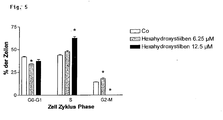
- hexahydroxystilbene (“M8”) has significant influence on the cell cycle distribution of HL-60 cells. Treatment with hexahydroxystilbene arrested the cells in S phase, thus causing inhibition of cell growth. Subsequently, after incubation with hexahydroxystilbene, a depletion of cells in G2-M phase of the cell cycle occurred.
- Table 3 shows the efficacies of resveratrol and selected compounds according to the invention:
- substituents R 1 to R 6 have a meaning other than hydrogen.
- the substituents are effective radical scavengers, antitumor agents and selective cyclooxygenase-2 inhibitors.
Landscapes
- Chemical & Material Sciences (AREA)
- Organic Chemistry (AREA)
- Health & Medical Sciences (AREA)
- Chemical Kinetics & Catalysis (AREA)
- General Chemical & Material Sciences (AREA)
- Medicinal Chemistry (AREA)
- Nuclear Medicine, Radiotherapy & Molecular Imaging (AREA)
- Pharmacology & Pharmacy (AREA)
- Life Sciences & Earth Sciences (AREA)
- Animal Behavior & Ethology (AREA)
- General Health & Medical Sciences (AREA)
- Public Health (AREA)
- Veterinary Medicine (AREA)
- Acyclic And Carbocyclic Compounds In Medicinal Compositions (AREA)
- Pharmaceuticals Containing Other Organic And Inorganic Compounds (AREA)
Description
- Die Erfindung betrifft die Verwendung ausgewählter Stilben-Derivate, nämlich
3,5,4'-Trimethoxystilben,
3,3',5,5'-Tetramethoxystilben,
3,4,4',5 -Tetramethoxystilben,
3,3',4,5' -Tetramethoxystilben,
3,3',4,5,5' -Pentamethoxystilben,
3,3',4,4',5,5' -Hexamethoxystilben,
3,3',5,5' -Tetrahydroxystilben,
3,4,4',5 -Tetrahydroxystilben,
3,3',4,5' -Tetrahydroxystilben,
3,3',4,4',5 -Pentahydroxystilben,
3,3',4,5,5' -Pentahydroxystilben,
3,4,4',5,5' -Pentahydroxystilben,
3,3',4',5,5' -Pentahydroxystilben,
3,3',4,4',5,5' -Hexahydroxystilben,
zum Herstellen von Arzneimitteln mit Cyclooxygenase-2 Hemmwirkung. - Arzneimittel, welche die vorgenannten Stilben-Derivate enthalten, sind für alle Zustandsbilder und Erkrankungen, die durch die Verwendung von Cyclooxygenase 2-Hemmem behandelt werden können, geeignet.
- Viele natürlich vorkommende Substanzen, wie Flavonoide oder Phenole können das Entstehen einer Reihe von Krankheiten verhindern oder bei der Behandlung verschiedener Erkrankungen, wie zum Beispiel Tumorerkrankungen oder Herz- Kreislauf-Erkrankungen, wirkungsvoll eingesetzt werden. Diese Substanzen können in verschiedenen Pflanzenextrakten, Gewürzmischungen oder Pflanzen, wie Beeren, Trauben, Erdnüssen, oder auch in Wein gefunden werden und wurden beispielsweise bereits in der Indischen oder Chinesischen Medizin eingesetzt.
- Resveratrol (3,5,4'-Trihydroxystilben) ist die am Genauesten untersuchte polyphenolische Substanz. Sie wird von Weintrauben gebildet und ist im Wein zu finden. Resveratrol hemmt wirksam das Wachstum von Tumorzellen und wird für das so genannte "französische Paradoxon" (die Tatsache, dass die Wahrscheinlichkeit an koronarer Herzkrankheit zu erkranken, verglichen mit allen anderen Europäischen Staaten in Frankreich um 40% reduziert ist), verantwortlich gemacht. Eine Reihe zellulärer Wirkungen, wie die Hemmung der Cyclooxygenase (COX)-Aktivität (Subbaramaiah K, Chung WJ, Michaluart P, Telang N, Tanabe T, Inoue H, Jang M, Pezzuto JM, Dannenberg AJ. Resveratrol inhibits cyclooxygenase-2 transcription and activity in phorbol ester-treated human mammary epithelial cells, J Biol Chem. 1998 Aug 21;273(34):21875-82.), Hemmung der Ribonukleotid Reduktase Aktivität (Fontecave M, Lepoivre M, Elleingand E, Gerez C, Guittet O. Resveratrol, a remarkable inhibitor of ribonucleotide reductase. FEBS Lett. 1998 Jan 16;421(3):277-9.) oder Induktion von NFkappaB (Tsai SH, Lin-Shiau SY, Lin JK. Suppression of nitric oxide synthase and the down-regulation of the activation of NFkappaB in macrophages by resveratrol. Br J Pharmacol. 1999 Feb;126(3):673-80.) wurden für Resveratrol beschrieben. Eine selektive Hemmung der Cyclooxygenase 2 (COX 2) konnte für Resveratrol nicht gezeigt werden. Dies ist auch nicht der Fall; Resveratrol hemmt beide Isoenzyme (COX 1 und COX 2) mit vergleichbarer Wirksamkeit.
- Verschiedene Analoga von Resveratrol werden in der
WO 01/21165 A1 WO 01/21165 A1 - Für andere Resveratrol-Analoga beschreiben Ghai et al. (
Ghai et al. WO 01/21165 A1 - Zwei Isoenzyme der Cyclooxygenase wurden während der letzten Jahre identifiziert. COX 2 ist die induzierbare Form, die auch gehemmt werden muß, um Entzündungen, Schmerzen etc. zu hemmen. Die Hemmung von COX 1 wird teilweise für die Nebenwirkungen von sogenannten nicht-steroidalen entzündungshemmenden Medikamenten (NSAIDs), wie zum Beispiel Aspirin, verantwortlich gemacht. Deshalb wurden selektive Inhibitoren der COX 2 entwickelt. Dadurch können die Nebenwirkungen der NSAIDs (hauptsächlich gastrointestinale Probleme) minimiert und die Effektivität der Medikamente verbessert werden. Bis jetzt wurden einige wenige hoch selektive Inhibitoren der COX 2 beschrieben. Einige der Medikamente sind zugelassen. Die Indikationen für die Verwendung von COX 2 Inhibitoren sind weiter unten aufgezählt. Sie umfassen inzwischen eine Reihe von Zustandsbildem und Erkrankungen.
- Hoch selektive COX 2-Inhibitoren können beispielsweise für die Behandlung folgender Zustandsbilder und Erkrankungen verwendet werden:
- Antitumor Wirkung
- Behandlung und Prävention von Malignomen
- Induktion von Apoptose (programmiertem Zelltod)
- Hemmung von NFkappaB
- Verwendung in der Kombination mit Strahlentherapie
- Verwendung in der Kombination mit anderen Substanzen in der Chemotherapie
- Reduktion der Invasivität und des metastatischen Potentials von Tumoren
- Fiebersenkende (antipyretische) Wirkung
- Hemmung der Gebärmutterkontraktion
- Entzündungshemmung
- Behandlung von Asthma
- Behandlung von Osteoarthritis und rheumatoider Arthritis
- Verbessernde Wirkung auf Knochen Reparatur
- Prävention und Behandlung von Bindegewebserkrankungen und Knochenerkrankungen einschließlich Osteoporose
- Antiöstrogene Effekte (Behandlung zur Tumorprävention und Behandlung von menopausalen und post-menopausalen Beschwerden)
- Behandlung von Glaukom
- Schmerzreduktion
- Reduktion von Ödemen
- Antiangiogenetische Wirkung d.h. Wirkung auf Angiogenese (Hemmung der Gefäßbildung)
- Hemmung der Plättchenaggregation
- Wirkung auf NO Synthase
- Prävention von Herz- Kreislauferkrankurigen (Blutgefäßerkrankungen)
- Prävention und Behandlung von Herzinfarkt
- Prävention und Behandlung von Diabetes und Diabetes Komplikationen
- Prävention der ischämisch proliferativen Retinopathie
- Prävention von Reperfusionsschäden
- Antivirale Aktivität
- Antibakterielle Aktivität
- Antimykotische Aktivität
- Behandlung gegen sonstige Erreger wie: Malariabehandlung
- Behandlung von Sichelzellanämie
- Behandlung verschiedener Hauterkrankungen (auch lokale topische Verwendung) wie z.B: Psoriasis
- Behandlung der Aktinischen Keratose
- Prävention und Behandlung der Helicobacter Pylori Gastritis
- Prävention und Behandlung von M. Parkinson
- Behandlung der Amytopen Lateralsklerose
- Behandlung von Multipler Sklerose
- Behandlung von M. Alzheimer
- Nachstehend werden Beispiele für das Herstellen ausgewählter Stilben-Derivate wiedergegeben, wobei für die Synthese von Methoxystilbenen die Homer-Emmons-Wadsworth-Reaktion angewendet wurde.
- Diese Synthese wird an 3',5-Trimethoxystilben gemäß Beispiel 1 erläutert: In einem trockenen Reaktionskolben wurde 10 mmol (2.58 g) Diethyl- (4-methoxybenzyl)phosphonat unter Argon auf 0° C gekühlt. Dann wurden 10 mL trockenes DMF, 20 mmol (1.12 g) Natriummethoxid und 10 mmol (1.661 g) 3,5-Dimethoxybenzaldehyd zugefügt. Das Gemisch wurde bei Zimmertemperatur eine Stunde lang gerührt und dann unter Argon 1,5 Stunden lang auf 100°C erhitzt. Dann wurde die Lösung in ein Becherglas mit 250 mL Eiswasser übergeführt. Der Niederschlag wurde abfiltriert und aus Ethanol (70%) umkristallisiert.
Ausbeute: 1.59 g (59%). - 3,4,4',5-Tetramethoxystilben wurde aus: 10 mmol (2.58 g) Diethyl-(4-methoxybenzyl)-phosphonat, 20 mmol (1.12 g) Natriummethoxid und 10 mmol (1.962 g) 3,4,5-Trimethoxybenzaldehyd auf die oben beschriebene Weise synthetisiert.
Ausbeute: 1.65 g (55%);
Fp=157°C.
1H-NMR (200 MHz, CDCl3): δ 7.44 (d, J = 8.8 Hz, 2H), 6.98 (d, J = 16.3 Hz, 1 H), 6.91-6.83 (m, 3H), 6.71 (s, 2H), 3.90 (s, 6H), 3.86 (s, 3H), 3.82 (s, 3H). 13C-NMR (50 MHz, CDCl3): δ 159.2, 153.3, 137.7, 133.3, 129.9, 127.6, 127.5, 126.4,114.1,103.2,60.9,56.0,55.2.
MS m/z 300 (M+, 100 %).
Anal (C18H20O4) C, H. - 3,3' ,5,5' - Tetramethoxystilben wurde wie in Beispiel 1 beschrieben synthetisiert aus: 10 mmol (2.88 g) Diethyl-(3,5-dimethoxybenzyl)phosphonat, 20 mmol (1.12 g) Natriummethoxid und 10 mmol (1.661 g) 3,5-Dimethoxybenzaldehyd.
Ausbeute: 1.56 g (52%). - 3,3',4',5-Tetramethoxystilben wurde wie in Beispiel 1 beschrieben synthetisiert aus: 10 mmol (2.48 g) Diethyl-(3,5-dimethoxybenzyl)phosphonat, 20 mmol (1.12 g) Natriummethoxid und 10 mmol (1.661 g) 3,4-Dimethoxybenzaldehyd.
Ausbeute: 1.65 g (55%). - 3,3',4,5,5'-Pentamethoxystilben wurde wie in Beispiel 1 beschrieben synthetisiert aus: 10 mmol (2.48 g) Diethyl-(3,5-dimethoxybenzyl)phosphonat, 20 mmol (1.12 g) Natriummethoxid und 10 mmol (1.962 g) 3,4,5-Trimethoxybenzaldehyd.
Ausbeute: 1.94 g (59%). - 3,3'4,4',5,5'-Hexamethoxystilben wurde wie in Beispiel 1 beschrieben synthetisiert aus: 10 mmol (3.18 g) Diethyl-(3,4,5-trimethoxybenzyl)phosphonat, 20 mmol (1.12 g) Natriummethoxid and 10 mmol (1.962 g) 3,4,5-Trimethoxybenzaldehyd.
Ausbeute: 1.76 g (49%);
Fp=215°C.
1H-NMR (200 MHz, CDCl3): δ 6.94 (s, 2H), 6.74 (s, 4H), 3.92 (s, 12H), 3.87 (s, 6H). 13C-NMR (50 MHz, CDCl3): δ153.3, 137.8, 132.8, 128.0, 103.3, 60.9, 56.0. MS m/z 360 (M+, 100%). Anal. (C20H24O6) C, H. - 3,4,4',5-Tetrahydroxystilben: In einem trockenen Reaktionskolben wurde 2.5 mmol (0.750 g) 3,4,4',5-Tetramethoxystilben in unter Argon in Methylenchlorid gelöst und auf - 30 °C abgekühlt. Dann wurde tropfenweise 15 mmol (15 mL 1 M-Lösung in Methylenchlorid) Bortribromid-Lösung zugegeben. Die Lösung wurde auf Raumtemperatur erwärmt und 24 Stunden lange gerührt. Die Reaktion wurde durch langsame Zugabe von gesättigter NaHCO3 Lösung gestoppt. Danach wurde die Lösung für weitere 30 Minuten gerührt und Methylenchlorid wurde abgedampft; die wässrige Phase wurde mit 2N HCl angesäuert. Nach Zugabe von EtOAc wurde das Gemisch extrahiert. Die organische Phase wurde über Na2SO4 getrocknet und das Lösungsmittel wurde durch Vakuum entfernt. Die Kristalle wurden aus EtOH/Wasser oder reinem Wasser umkristallisiert.
Ausbeute: 0.335 g (55%);
Fp = 240° C.
1H-NMR (200 MHz, d6-DMSO): δ 8.78 (s, 4H), 7.35 (d, J= 8.6 Hz, 2H), 6.76-6.72 (m, 4H), 6.47 (s, 2H). 13C-NMR (50 MHz, d6-DMSO): δ 156.7, 146.1, 132.9, 128.5, 128.2, 127.4, 125.9, 125.1, 115.5, 105.2.
MS m/z 244 (M+, 100 %).
Anal. (C14H12O4) C, H. - 3,3',5,5'-Tetrahydroxystilben wurde aus 2.5 mmol (0.750 g) 3,3',5,5'-Tetramethoxystilben wie in Beispiel 7 beschrieben synthetisiert.
Ausbeute: 0.366 g (60%);
Fp > 320° C.
1H-NMR (200 MHz, d6-DMSO): δ 9.24 (s, 4H), 6.84 (s, 2H), 6.41 (d, J= 2.0 Hz, 4H), 6.16 (t, J= 1.9 Hz, 2H). 13C-NMR (50 MHz, d6-DMSO): δ 158.5, 138.7, 128.4, 128.4, 104.6, 102.2.
MS m/z 244 (M+, 100%).
Anal. (C14H12O4) C, H. - 3,3',4',5-Tetrahydroxystilben wurde aus 2.5 Mmol (0.750 g) 3,3',4',5-Tetramethoxystilben wie in Beispiel 7 beschrieben, synthetisiert.
Ausbeute: 0.311 g (51 %);
Fp=236°C.
1H-NMR (200 MHz, d6-DMSO): δ 8.70 (s, 4H), 6.97 (s, 1H), 6.87- 6.63 (m, 4H), 6.40 (d, 1.9 Hz, 2H), 6.20-6.19 (m, 1H). 13C-NMR (50 MHz, d6-DMSO): δ 158.0, 144.9, 144.8, 138.9, 128.6, 127.8, 125.4, 118.3, 115.3, 112.7, 104.1,101.6.
MS m/z 244 (M+ , 100%).
Anal. (C14H12O4) C, H. - 3,3',4,5,5'-Pentahydroxystilben wurde aus 2.5 mmol (0.825 g) 3,3',4,5,5'-Pentamethoxystilben wie in Beispiel 7 beschrieben, synthetisiert.
Ausbeute: 0.370 g (57%);
Fp = 252° C.
1H-NMR (200 MHz, d6-acetone): δ 8.00 (s, 5H), 6.89 (d, J= 16.3 Hz, 1H), 6.76 (d, J= 16.3 Hz, 1 H), 6.64 (s, 2H), 6.51 (d, J= 2.1 Hz, 2H), 6.28-6.25 (m, 1 H). 13C-NMR (50 MHz, d6-acetone): δ 160.2, 147.4, 141.4, 134.7, 130.5, 130.3, 127.7, 107.3, 106.3, 103.3.
MS m/z 260 (M+, 100%).
Anal (C14H12O5). - 3,3',4,4',5,5'-Hexahydroxystilben wurde aus 2.5 mmol (0.900 g) 3,3',4,4',5,5'-Hexamethoxystilben wie in Beispiel 1 beschrieben, synthetisiert.
Ausbeute: 0.31 g (45%);
Fp=270°C.
1H-NMR (200 MHz, d6-DMSO): δ 8.66 (s, 6H), 6.57 (s, 2H), 6.44 (s, 4H). 13C-NMR (50 MHz, d6-DMSO): δ 146.1, 132.9, 128.1, 125.8, 105.2.
MS m/z 276 (M+, 100%).
Anal. (C14H12O6) C, H. - Literatur: Chemische Daten von Methoxystilbenen: J. Med. Chem. 45 (1), 1999, p 2671-2686
- Die pharmazeutische Wirksamkeit der erfindungsgemäß ausgewählten Stilben-Derivate wurde untersucht:
- Die humane Promyelozytenleukämiezellinie HL-60 wurde von der ATCC (American Type Culture Collection, Rockville, MD, USA) gekauft. Die Zellen wurden in RPMI 1640 Medium mit 10% Hitze inaktiviertem fetalem Kälberserum (FCS) (GIBCO, Grand Island Biological Co., Grand Island, NY, USA) und mit 1 % Penizillin/Streptomycin in angefeuchteter Atmosphäre bei 5% CO2 gezüchtet.
- Die Zellzahlen wurden mittels eines Mikrozellcounters CC-108 (Sysmex, Kobe, Japan) bestimmt. Für die Versuche wurden Zellen in der logarithmischen Wachstumsphase verwendet.
- Logarithmisch wachsende HL-60 Zellen wurden in einer Dichte von 0.1x10⁶ Zellen/ml in Gewebekulturflaschen angesetzt und mit verschiedenen Konzentrationen der zu untersuchenden Stilben-Derivate inkubiert. Nach 72 Stunden wurden die Zellen mittels des Mikrozellcounters gezählt. Die Viabilität der Zellen wurde mittels Trypanblau Färbung bestimmt. Als Resultate wurden als Anzahl viabler Zellen berechnet.
- Es wurde ein Immunoassay der Firma IBL Produkte, Hamburg, Deutschland für die Bestimmung der COX 1 und COX 2 Aktivitäten verwendet. Der Assay bestimmt quantitativ die Prostaglandine F, E und D sowie Thromboxan B artige Prostaglandine, die durch die Cyclooxygenase Reaktion gebildet werden. COX 1 und COX 2 wurden als so- genannte IC50, 50 % Enzym Hemmung, d.h. die Substanzkonzentration, welche 50 % des gemessenen Isoenzymes hemmt, angegeben.
Tabelle 1: Hemmende Wirkung von Stilbenen und von Resveratrol auf COX 1 und COX 2 Aktivität: Stoff IC50 (µM) COX 2/ COX 1 COX 1 COX 2 Verhältnis 3,3',4,5,5'-Pentamethoxystilben 10 0,6 0,06 3,3',4,4',5,5'-Hexamethoxystilben 10 0,5 0,05 3,4,4',5-Tetrahydroxystilben 5 0,01 0,002 3,3',5,5'-Tetrahydroxystilben 0,01 < 0,001 <0,1 3,3',4',5-Tetrahydroxystilben 5 0,005 0,001 3,3',4',5,5'-Pentahydroxystilben 0,01 0,005 0,5 3,3',4,4',5,5'-Hexahydroxystilben 0,5 0,001 0,002 3,4',5-Trihydroxystilben (Resveratrol) 0,5 0,5 1 - Wie aus der Tabelle 1 ersichtlich ist, sind nur die erfindungsgemäß ausgewählten Verbindungen, nicht aber Resveratrol selbst COX 2 selektiv (d.h. sie zeigen eine wesentlich effektivere Wirkung auf COX 2 als auf COX 1).
Tabelle 2: Hemmende Wirkung erfindungsgemäßer Verbindungen auf das Wachstum von HL-60 humane Promyelocyten Leukämie-Zellen: Stoff IC50 (µM) 3,3',4,5,5'-Pentamethoxystilben 25 3,3',4,4',5,5'-Hexamethoxystilben >100 3,4,4',5-Tetrahydroxystilben 9 3,3',5,5'-Tetrahydroxystilben 12,5 3,3',4',5-Tetrahydroxystilben 9 3,3',4',5,5'-Pentahydroxystilben 10 3,3',4,4',5,5'-Hexahydroxystilben 4 3,4',5-Trihydroxystilbene (Resveratrol) 12 - 3, 4, 5, 3`, 4', 5'- Hexahydroxystilben wurde gemäß Beispiel 11 synthetisiert und verwendet. Resveratrol stammt von Sigma-Aldrich GmbH, Vienna, Austria. Beide Substanzen wurden in DMSO verdünnt.
- Die humane Promyelozytenleukämiezellinie HL-60 wurde von der ATCC(American Type Culture Collection, Rockville, MD, USA) gekauft. Die Zellen wurden in RPMI 1640 Medium mit 10% Hitze inaktiviertem fetalem Kälberserum (FCS) (GIBCO, Grand Island Biological Co., Grand Island, NY, USA) und mit 1 % Penizillin/Streptomycin in angefeuchteter Atmosphäre bei 5% CO2 gezüchtet.
- Die Zellzahlen wurden mittels eines Mikrozellcounters CC-108 (Sysmex, Kobe, Japan) bestimmt. Für die Versuche wurden Zellen in der logarithmischen Wachstumsphase verwendet.
- Logarithmisch wachsende HL-60 Zellen wurden in einer Dichte von 0.1x10⁶ Zellen/ml in Gewebekulturflaschen angesetzt und mit verschiedenen Konzentrationen der Resveratrol Analoga inkubiert. Nach 72 Stunden wurden die Zellen mittels des Mikrozellcounters gezählt. Die Viabilität der Zellen wurde mittels Trypanblau Färbung bestimmt. Als Resultate wurden als Anzahl viabler Zellen berechnet.
- Analyse der intrazellulären dNTP (Deoxynukleosidtriphosphat) Pools mittels Hochdruckflüssigkeitschromatographie (HPLC)
- Die Analyse der intrazellulären dNTP Konzentrationen erfolgte nach der Methode von Garrett und Santi (Garrett C, Santi DV. A rapid and sensitive high pressure liquid chromatography assay for deoxyribonucleoside triphosphates in cell extracts. Anal Biochem. 1979 Nov 1;99(2):268-73.)
- HL-60 Zellen (0.1 x 10⁶/ml) wurden in 25 cm2 Flaschen gesät und 24 Stunden lange mit Hexahydroxystilben bzw. Resveratrol inkubiert. Dann wurden die Zellen mit Hoechst 33258 (HO, Sigma, St. Louis, MO, USA) und Propidium Iodid (PI, Sigma, St. Louis, MO, USA) (5 µg/ml und 2 µg/ml) eine Stunde lange behandelt. Danach wurden die Zellen mittels eines Fluoreszenz Mikroskops fotografiert und die Zellen wurden morphologisch in früh apoptoisch, spät apoptotisch und nekrotische Zellen unterteilt.
- HL-60 Zellen wurden in der Gegenwart von Hexahydroxystilben inkubiert. Nach 24 Stunden wurden die Zellen gewaschen, zentrifugiert und in Alkohol fixiert. Danach mit Propidium Iodid gefärbt und mittels FACS Analyse untersucht. Danach wurde die Zell Zyklus Phasen Verteilung berechnet.
- In unbehandelten Zellen waren 41.9% in GO-G1, 43.8% in S und 14.3% in G2-M Phase des Zell Zyklus.
- In der folgenden Beschreibung wird auf die
Fig. 1 bis 5 Bezug genommen. Diese zeigen: -
-
Fig. 1 : Zytotoxische Wirkungen von Resveratrol und Hexahydroxystilben in humanen HL-60 Leukämie Zellen -
Fig. 2 : Wirkung von Vitamin C und Hexahydroxystilben auf das Wachstum von HL-60 Zellen -
Fig. 3 : Wirkung von Hexahydroxystilben auf intrazelluläre dNTP Spiegel von HL-60 Zellen. -
Fig. 4 : Apoptose Induktion durch Resveratrol und Hexahydroxystilben in HL-60 Zellen -
Fig. 5 : Zell Zyklus Phasen Verteilung von HL-60 Zellen nach Behandlung mit Hexahydroxystilben - Die wachstumshemmende Wirkung von Resveratrol bzw. Hexahydroxystilben ("M8") auf HL-60 Zellen ist in
Fig. 1 dargestellt. Nach 72 Stunden Inkubation hat Resveratrol eine IC50 (50 % Hemmung des Zellwachstums) von 12 µM bewirkt, während Hexahydroxystilben die Zellen mit einem IC50 Wert von 6,25 µM an ihrem Wachstum gehemmt hat. - Durch Zugabe von 50 bzw. 100 µM Vitamin C konnte das wachstumshemmende Potential der beiden Substanzen, wie in
Fig. 2 dargestellt, noch weiter verstärkt werden. Für Hexahydroxystilben ("M8") z.B. auf einen IC50 Wert von 2 µM. Vitamin C selbst hat in den verwendeten Konzentrationen keine Wirkung auf das Zellwachstum gezeigt. - Untersucht wurde die Wirkung von Hexahydroxystilben ("M8") auf die intrazellulären dNTP Konzentrationen in HL-60 Zellen. Die Untersuchung wurde wie oben beschrieben durchgeführt. Die Zellen wurden mit 6,25, 12,5 und 25 µM Hexahydroxystilben inkubiert und dann wurden die dNTP Pools bestimmt. Die dCTP Pools erhöhten sich auf 110, 137 und 199 % der Kontroll- Werte, während die dTTP Pools auf 84, 72 und 27 % der Ausgangswerte sanken. Die dATP Konzentrationen sanken bei Behandlung mit 12,5 und 25 µM Hexahydroxystilben auf 27 und 41 % der Ausgangswerte. Besonders eindrucksvoll war die Depletion der dATP Pools, im Falle von HT-29 humanen Kolon Tumor Zellen, dort sanken die dATP Werte bereits nach Behandlung mit 4 µM der Substanz auf durchschnittlich 1,5 % der Ausgangswerte. Es gibt kaum eine antivirale bzw. in der Antitumorbehandlung eingesetzte Substanz, welche solche eindrucksvollen Wirkungen zeigt. Durch diese eindrucksvolle Inbalance der dNTP Pools, welche Prekursoren der DNA Synthese sind, kann auch die Wirkung der Substanz erklärt werden. Die Ergebnisse des Experimentes mit HL-60 Zellen sind in
Fig. 3 dargestellt. - Es ist bekannt, daß Resveratrol in verschiedenen Tumorzellen Apoptose induziert. Wir haben die apoptotische Wirkung von Resveratrol mit der von Hexahydroxystilben ("M8") verglichen. HL-60 Leukämie Zellen wurden 24 Stunden lange mit verschiedenen Konzentrationen von Resveratrol bzw. Hexahydroxystilben ("M8") behandelt; dann wurde die Anzahl von apoptotischen Zellen mittels Höchst/Propidium Jodid Doppelfärbung bestimmt. Die Resultate sind in
Fig. 4 dargestellt. Hexahydroxystilben ("M8") hat, wie aus der Abbildung ersichtlich bei signifikant niedrigeren Konzentration als Resveratrol in diesen Zellen Apoptose induziert. Behandlung mit 6.25 µM Hexahydroxystilben ("M8") führte zum Beispiel in 68.5% der Zellen zur Induktion von Apoptose. - Wirkung von Hexahydroxystilben auf die Zell Zyklus Verteilung von HL-60 Leukämie Zellen
- Wie aus
Fig. 5 ersichtlich, hat Hexahydroxystilben ("M8") signifikanten Einfluß auf die Zell Zyklus Verteilung von HL-60 Zellen. Behandlung mit Hexahydroxystilben hat die Zellen in S Phase arretiert und so eine Hemmung des Zellwachstums bewirkt. Es kam in der Folge nach Inkubation mit Hexahydroxystilben zu einer Depletion von Zellen in G2-M Phase des Zell Zyklus. - In der folgenden Tabelle 3 sind die Wirksamkeiten von Resveratrol und ausgewählter erfindungsgemäßer Verbindungen wiedergegeben:
- Wachstumstrennung (72h) von Stilben-Derivaten in HL-60 und klonogenen Testreihen (7d) in Prostata-Krebs-Zelllinien:
Verbindung Kode HL-60 PC-3 LNCAP* DU-145 Resveratrol 12 µM 16 µM 5 µM 10 µM 3,5,3',5'-tetramethoxy M1 über 100 µM 35 µM 21 µM 25 µM 3,4,5,3'5'-pentamethoxy M2 25 µM 21 µM über 100 µM 68 µM 3,4,5,3',4',5'-hexamethoxy M3 über 100 µM 5,5 µM 37 µM 12,5 µM 3,4,5,4'-tetramethoxy M4 20 µM 3 µM 0,4 µM 0,4 µM 3,5,4'-trimethoxy M5 5 µM 3 µM 6,25 µM 6 µM 3,4,3',5'-tetramethoxy M5A 25 µM 35 µM 6,25 µM 30 µM 3,5,3',5'-tetrahydroxy M6 12,5 µM 16 µM 84 µM 17 µM 3,4,5,3'5'-pentahydroxy M7 10 µM 5 µM 7,5 µM 23 µM 3,4,5,3',4',5'-hexahydroxy M8 4 µM 2,5 µM 3,4 µM 25 µM 3,4,5,4'-tetrahydroxy M9 9 µM 8 µM 9,5 µM 30 µM 3,4,3',5'-tetrahydroxy M10 9 µM 18 µM 33 µM 58 µM * LNCaP-Zellen sind zu 5-alpha-dihydrotestosterone responsiv.
** jeweils " -stilben" - Zusammenfassend kann ein Ausführungsbeispiel der Erfindung wie fölgt dargestellt werden:
- Beschrieben werden Stilbenderivate der alllgemeinen Formel 1

- In dieser haben wenigstens vier der Substituenten R1 bis R6 eine andere Bedeutung als Wasserstoff. Die Substituenten sind wirksame Radikalfänger, Antitumorwirkstoffe und selektive Cyclooxygenase-2-Inhibitoren.
Claims (1)
- Verwendung ausgewählter Stilben-Derivate, nämlich
3,5,4'-Trimethoxystilben,
3,3',5,5'-Tetramethoxystilben,
3,4,4',5 -Tetramethoxystilben,
3,3',4,5' -Tetramethoxystilben,
3,3',4,5,5' -Pentamethoxystilben,
3,3',4,4',5,5' -Hexamethoxystilben,
3,3',5,5' -Tetrahydroxystilben,
3,4,4',5 -Tetrahydroxystilben,
3,3',4,5' -Tetrahydroxystilben,
3,3',4,4',5 -Pentahydroxystilben,
3,3',4,5,5' -Pentahydroxystilben,
3,4,4',5,5' -Pentahydroxystilben,
3,3',4',5,5' -Pentahydroxystilben,
3,3',4;4',5,5' -Hexahydroxystilben,
zum Herstellen von Arzneimitteln mit Cyclooxygenase-2 Hemmwirkung.
Applications Claiming Priority (2)
| Application Number | Priority Date | Filing Date | Title |
|---|---|---|---|
| AT12852003 | 2003-08-14 | ||
| PCT/AT2004/000279 WO2005016860A2 (de) | 2003-08-14 | 2004-08-09 | Stilben-derivate und deren verwendung in arzneimitteln |
Publications (2)
| Publication Number | Publication Date |
|---|---|
| EP1654210A2 EP1654210A2 (de) | 2006-05-10 |
| EP1654210B1 true EP1654210B1 (de) | 2008-07-30 |
Family
ID=34140223
Family Applications (1)
| Application Number | Title | Priority Date | Filing Date |
|---|---|---|---|
| EP04737409A Expired - Lifetime EP1654210B1 (de) | 2003-08-14 | 2004-08-09 | Stilben-derivate und deren verwendung in arzneimitteln |
Country Status (5)
| Country | Link |
|---|---|
| US (1) | US20070191627A1 (de) |
| EP (1) | EP1654210B1 (de) |
| AT (1) | ATE402916T1 (de) |
| DE (1) | DE502004007738D1 (de) |
| WO (1) | WO2005016860A2 (de) |
Families Citing this family (10)
| Publication number | Priority date | Publication date | Assignee | Title |
|---|---|---|---|---|
| AT413262B (de) * | 2004-04-22 | 2006-01-15 | Thomas Dr Szekeres | Resveratrol enthaltende arzneistoffgemische sowie deren verwendung zur herstellung von arzneimitteln |
| WO2006029436A1 (de) * | 2004-09-17 | 2006-03-23 | Universität Wien | Cox-ii-inhibitorverbindungen |
| AT502078A1 (de) * | 2005-07-04 | 2007-01-15 | Univ Wien Med | Verwendung von stilbenderivaten zur herstellung von arzneimitteln für die behandlung solider tumore |
| JP6461138B2 (ja) * | 2013-10-29 | 2019-01-30 | 株式会社ブリヂストン | 新規なクラスのゴム製品用老化防止剤 |
| ITRM20130597A1 (it) * | 2013-10-29 | 2015-04-30 | Bridgestone Corp | Nuova classe di agenti anti-invecchiamento per prodotti in gomma |
| CN104974018B (zh) * | 2015-06-15 | 2016-08-24 | 沈阳药科大学 | 从中药猴耳环中提取的化合物及其用途 |
| EP4313010B1 (de) | 2021-03-25 | 2025-02-19 | Thomas Szekeres | Verbindungen zur verwendung in der behandlung und prävention von covid-19 |
| EP4516298A1 (de) | 2023-09-01 | 2025-03-05 | Thomas Szekeres | Stilben-verbindungen zur verwendung bei der behandlung und prävention von infektionen mit dem cytomegalovirus (cmv) |
| EP4678169A1 (de) | 2024-07-08 | 2026-01-14 | Thomas Szekeres | Verbindungen zur verwendung bei der behandlung und prävention von infektionen mit rsv |
| WO2026044308A1 (en) | 2024-08-26 | 2026-03-05 | Medizinische Universität Wien | Treatment and prevention of diseases caused by influenza virus with 3,3',4,4',5,5'-hexahydroxy-trans-stilbene |
Family Cites Families (2)
| Publication number | Priority date | Publication date | Assignee | Title |
|---|---|---|---|---|
| WO2002050007A2 (en) * | 2000-12-21 | 2002-06-27 | Cancer Research Technology Limited | Substituted stilbenes, their reactions and anticancer activity |
| AU2002319899A1 (en) * | 2002-06-25 | 2004-01-06 | Raju Gokaraju Ganga | Novel resveratrol analogs |
-
2004
- 2004-08-09 AT AT04737409T patent/ATE402916T1/de not_active IP Right Cessation
- 2004-08-09 DE DE502004007738T patent/DE502004007738D1/de not_active Expired - Lifetime
- 2004-08-09 US US10/567,774 patent/US20070191627A1/en not_active Abandoned
- 2004-08-09 EP EP04737409A patent/EP1654210B1/de not_active Expired - Lifetime
- 2004-08-09 WO PCT/AT2004/000279 patent/WO2005016860A2/de not_active Ceased
Also Published As
| Publication number | Publication date |
|---|---|
| US20070191627A1 (en) | 2007-08-16 |
| EP1654210A2 (de) | 2006-05-10 |
| WO2005016860A2 (de) | 2005-02-24 |
| ATE402916T1 (de) | 2008-08-15 |
| DE502004007738D1 (de) | 2008-09-11 |
| WO2005016860A3 (de) | 2005-04-28 |
Similar Documents
| Publication | Publication Date | Title |
|---|---|---|
| DE60107234T2 (de) | Antitubulinanordnung und zellenwachstumshemmstoff "dioxostatin" | |
| DE2501443C2 (de) | Pharmazeutische Mittel mit einem Gehalt an mindestens einer diphenylsubstituierten Verbindung | |
| DE69807349T2 (de) | Thyroxin-analoga ohne bedeutende hormonale wirkung zur behandlung von bösartigen tumoren | |
| DE602004012279T9 (de) | Katecholderivate zur behandlung von krebs | |
| Lin et al. | Cytotoxic compounds from the stems of Cinnamomum tenuifolium | |
| US20080233208A1 (en) | Use of erianin in preparing pharmaceutical for treating tumors | |
| DE3611194A1 (de) | Cancerostatisches mittel | |
| DE2658307C2 (de) | Di-O'-hydroxyphenyD-alkanverbindungen, Verfahren zu ihrer Herstellung und ihre Verwendung als Arzneimittel | |
| Rajamanickam et al. | Novel allylated monocarbonyl analogs of curcumin induce mitotic arrest and apoptosis by reactive oxygen species-mediated endoplasmic reticulum stress and inhibition of STAT3 | |
| DE60120962T2 (de) | Substituierte chalkone als arzneimittel | |
| EP1654210A2 (de) | Stilben-derivate und deren verwendung in arzneimitteln | |
| DE19842416A1 (de) | Sekundäre Amine zur Prävention und Therapie von Erkrankungen, die durch Oxidationsprozesse verursacht oder verstärkt werden | |
| Linh et al. | Glochidion species: A review on phytochemistry and pharmacology | |
| DE2546738C2 (de) | Substituierte 2-Hydroxy-benzophenone und sie enthaltende Arzneimittel | |
| Parvez et al. | Broad‐spectrum therapeutic potentials of the multifaceted triterpene lupeol and its derivatives | |
| Xie et al. | Hypertaxoids A and B, two unique meroterpenoids from Hypericum elatoides as microtubule stabilizers and their antiproliferative effects on cervical cancer | |
| EP2486026B1 (de) | Derivate von di(phenylpropanoid-)glycerol zur krebsbehandlung | |
| DE69911017T2 (de) | Arylsulfonanilid-phosphate | |
| DE69835966T2 (de) | Medizinische anwendungen von phenylalkanolen und derivaten davon | |
| Pottier et al. | Anti-melanogenesis effect of daniellic acid isolated from Daniellia oliveri (Rolfe) Hutch. & Dalziel (leguminosae) oleoresin of Burkina Faso | |
| DE3030802C2 (de) | ||
| EP1448179B1 (de) | Substituierte bicyclo 3.3.1 nonan-2,4,9-trione als pharmazeutische wirkstoffe | |
| Azman et al. | In vitro cytotoxic effect of dichloromethane extract of Prismatomeris glabra in human breast cancer cells | |
| KR100889806B1 (ko) | 사가퀴노익산을 함유하는 피부질환 및 피부암의 예방 또는치료용 약학적 조성물 | |
| DE905246C (de) | Verfahren zur Herstellung von Aminoalkoholen |
Legal Events
| Date | Code | Title | Description |
|---|---|---|---|
| PUAI | Public reference made under article 153(3) epc to a published international application that has entered the european phase |
Free format text: ORIGINAL CODE: 0009012 |
|
| 17P | Request for examination filed |
Effective date: 20060306 |
|
| AK | Designated contracting states |
Kind code of ref document: A2 Designated state(s): AT BE BG CH CY CZ DE DK EE ES FI FR GB GR HU IE IT LI LU MC NL PL PT RO SE SI SK TR |
|
| AX | Request for extension of the european patent |
Extension state: AL HR LT LV MK |
|
| 17Q | First examination report despatched |
Effective date: 20060425 |
|
| RIN1 | Information on inventor provided before grant (corrected) |
Inventor name: HANDLER, NORBERT Inventor name: MURIAS, ARKADIUSZ, MAREK Inventor name: JAEGER, WALTER Inventor name: ERKER, THOMAS Inventor name: SZEKERES, THOMAS |
|
| GRAP | Despatch of communication of intention to grant a patent |
Free format text: ORIGINAL CODE: EPIDOSNIGR1 |
|
| RAP1 | Party data changed (applicant data changed or rights of an application transferred) |
Owner name: SZEKERES, THOMAS |
|
| GRAS | Grant fee paid |
Free format text: ORIGINAL CODE: EPIDOSNIGR3 |
|
| GRAA | (expected) grant |
Free format text: ORIGINAL CODE: 0009210 |
|
| AK | Designated contracting states |
Kind code of ref document: B1 Designated state(s): AT BE BG CH CY CZ DE DK EE ES FI FR GB GR HU IE IT LI LU MC NL PL PT RO SE SI SK TR |
|
| AX | Request for extension of the european patent |
Extension state: AL HR LT LV MK |
|
| REG | Reference to a national code |
Ref country code: GB Ref legal event code: FG4D Free format text: NOT ENGLISH |
|
| REG | Reference to a national code |
Ref country code: CH Ref legal event code: EP |
|
| REF | Corresponds to: |
Ref document number: 502004007738 Country of ref document: DE Date of ref document: 20080911 Kind code of ref document: P |
|
| REG | Reference to a national code |
Ref country code: IE Ref legal event code: FG4D Free format text: LANGUAGE OF EP DOCUMENT: GERMAN |
|
| LTIE | Lt: invalidation of european patent or patent extension |
Effective date: 20080730 |
|
| PG25 | Lapsed in a contracting state [announced via postgrant information from national office to epo] |
Ref country code: ES Free format text: LAPSE BECAUSE OF FAILURE TO SUBMIT A TRANSLATION OF THE DESCRIPTION OR TO PAY THE FEE WITHIN THE PRESCRIBED TIME-LIMIT Effective date: 20081110 Ref country code: NL Free format text: LAPSE BECAUSE OF FAILURE TO SUBMIT A TRANSLATION OF THE DESCRIPTION OR TO PAY THE FEE WITHIN THE PRESCRIBED TIME-LIMIT Effective date: 20080730 Ref country code: PT Free format text: LAPSE BECAUSE OF FAILURE TO SUBMIT A TRANSLATION OF THE DESCRIPTION OR TO PAY THE FEE WITHIN THE PRESCRIBED TIME-LIMIT Effective date: 20081230 |
|
| PG25 | Lapsed in a contracting state [announced via postgrant information from national office to epo] |
Ref country code: SI Free format text: LAPSE BECAUSE OF FAILURE TO SUBMIT A TRANSLATION OF THE DESCRIPTION OR TO PAY THE FEE WITHIN THE PRESCRIBED TIME-LIMIT Effective date: 20080730 Ref country code: BG Free format text: LAPSE BECAUSE OF FAILURE TO SUBMIT A TRANSLATION OF THE DESCRIPTION OR TO PAY THE FEE WITHIN THE PRESCRIBED TIME-LIMIT Effective date: 20081030 Ref country code: FI Free format text: LAPSE BECAUSE OF FAILURE TO SUBMIT A TRANSLATION OF THE DESCRIPTION OR TO PAY THE FEE WITHIN THE PRESCRIBED TIME-LIMIT Effective date: 20080730 |
|
| REG | Reference to a national code |
Ref country code: IE Ref legal event code: FD4D |
|
| PG25 | Lapsed in a contracting state [announced via postgrant information from national office to epo] |
Ref country code: MC Free format text: LAPSE BECAUSE OF NON-PAYMENT OF DUE FEES Effective date: 20080831 |
|
| PG25 | Lapsed in a contracting state [announced via postgrant information from national office to epo] |
Ref country code: DK Free format text: LAPSE BECAUSE OF FAILURE TO SUBMIT A TRANSLATION OF THE DESCRIPTION OR TO PAY THE FEE WITHIN THE PRESCRIBED TIME-LIMIT Effective date: 20080730 Ref country code: IE Free format text: LAPSE BECAUSE OF FAILURE TO SUBMIT A TRANSLATION OF THE DESCRIPTION OR TO PAY THE FEE WITHIN THE PRESCRIBED TIME-LIMIT Effective date: 20080730 Ref country code: EE Free format text: LAPSE BECAUSE OF FAILURE TO SUBMIT A TRANSLATION OF THE DESCRIPTION OR TO PAY THE FEE WITHIN THE PRESCRIBED TIME-LIMIT Effective date: 20080730 |
|
| PG25 | Lapsed in a contracting state [announced via postgrant information from national office to epo] |
Ref country code: CZ Free format text: LAPSE BECAUSE OF FAILURE TO SUBMIT A TRANSLATION OF THE DESCRIPTION OR TO PAY THE FEE WITHIN THE PRESCRIBED TIME-LIMIT Effective date: 20080730 Ref country code: RO Free format text: LAPSE BECAUSE OF FAILURE TO SUBMIT A TRANSLATION OF THE DESCRIPTION OR TO PAY THE FEE WITHIN THE PRESCRIBED TIME-LIMIT Effective date: 20080730 Ref country code: SK Free format text: LAPSE BECAUSE OF FAILURE TO SUBMIT A TRANSLATION OF THE DESCRIPTION OR TO PAY THE FEE WITHIN THE PRESCRIBED TIME-LIMIT Effective date: 20080730 |
|
| PLBE | No opposition filed within time limit |
Free format text: ORIGINAL CODE: 0009261 |
|
| STAA | Information on the status of an ep patent application or granted ep patent |
Free format text: STATUS: NO OPPOSITION FILED WITHIN TIME LIMIT |
|
| 26N | No opposition filed |
Effective date: 20090506 |
|
| REG | Reference to a national code |
Ref country code: FR Ref legal event code: ST Effective date: 20090630 |
|
| PG25 | Lapsed in a contracting state [announced via postgrant information from national office to epo] |
Ref country code: BE Free format text: LAPSE BECAUSE OF NON-PAYMENT OF DUE FEES Effective date: 20080831 |
|
| PG25 | Lapsed in a contracting state [announced via postgrant information from national office to epo] |
Ref country code: IT Free format text: LAPSE BECAUSE OF FAILURE TO SUBMIT A TRANSLATION OF THE DESCRIPTION OR TO PAY THE FEE WITHIN THE PRESCRIBED TIME-LIMIT Effective date: 20080730 |
|
| PG25 | Lapsed in a contracting state [announced via postgrant information from national office to epo] |
Ref country code: FR Free format text: LAPSE BECAUSE OF NON-PAYMENT OF DUE FEES Effective date: 20080901 |
|
| PGFP | Annual fee paid to national office [announced via postgrant information from national office to epo] |
Ref country code: AT Payment date: 20090819 Year of fee payment: 6 Ref country code: CH Payment date: 20090811 Year of fee payment: 6 Ref country code: GB Payment date: 20090727 Year of fee payment: 6 |
|
| PG25 | Lapsed in a contracting state [announced via postgrant information from national office to epo] |
Ref country code: SE Free format text: LAPSE BECAUSE OF FAILURE TO SUBMIT A TRANSLATION OF THE DESCRIPTION OR TO PAY THE FEE WITHIN THE PRESCRIBED TIME-LIMIT Effective date: 20081030 |
|
| PGFP | Annual fee paid to national office [announced via postgrant information from national office to epo] |
Ref country code: DE Payment date: 20091027 Year of fee payment: 6 |
|
| PG25 | Lapsed in a contracting state [announced via postgrant information from national office to epo] |
Ref country code: PL Free format text: LAPSE BECAUSE OF FAILURE TO SUBMIT A TRANSLATION OF THE DESCRIPTION OR TO PAY THE FEE WITHIN THE PRESCRIBED TIME-LIMIT Effective date: 20080730 |
|
| PG25 | Lapsed in a contracting state [announced via postgrant information from national office to epo] |
Ref country code: CY Free format text: LAPSE BECAUSE OF FAILURE TO SUBMIT A TRANSLATION OF THE DESCRIPTION OR TO PAY THE FEE WITHIN THE PRESCRIBED TIME-LIMIT Effective date: 20080730 Ref country code: HU Free format text: LAPSE BECAUSE OF FAILURE TO SUBMIT A TRANSLATION OF THE DESCRIPTION OR TO PAY THE FEE WITHIN THE PRESCRIBED TIME-LIMIT Effective date: 20090131 Ref country code: LU Free format text: LAPSE BECAUSE OF NON-PAYMENT OF DUE FEES Effective date: 20080809 |
|
| PG25 | Lapsed in a contracting state [announced via postgrant information from national office to epo] |
Ref country code: TR Free format text: LAPSE BECAUSE OF FAILURE TO SUBMIT A TRANSLATION OF THE DESCRIPTION OR TO PAY THE FEE WITHIN THE PRESCRIBED TIME-LIMIT Effective date: 20080730 |
|
| PG25 | Lapsed in a contracting state [announced via postgrant information from national office to epo] |
Ref country code: GR Free format text: LAPSE BECAUSE OF FAILURE TO SUBMIT A TRANSLATION OF THE DESCRIPTION OR TO PAY THE FEE WITHIN THE PRESCRIBED TIME-LIMIT Effective date: 20081031 |
|
| REG | Reference to a national code |
Ref country code: CH Ref legal event code: PL |
|
| GBPC | Gb: european patent ceased through non-payment of renewal fee |
Effective date: 20100809 |
|
| PG25 | Lapsed in a contracting state [announced via postgrant information from national office to epo] |
Ref country code: LI Free format text: LAPSE BECAUSE OF NON-PAYMENT OF DUE FEES Effective date: 20100831 Ref country code: CH Free format text: LAPSE BECAUSE OF NON-PAYMENT OF DUE FEES Effective date: 20100831 |
|
| PG25 | Lapsed in a contracting state [announced via postgrant information from national office to epo] |
Ref country code: AT Free format text: LAPSE BECAUSE OF NON-PAYMENT OF DUE FEES Effective date: 20100809 |
|
| REG | Reference to a national code |
Ref country code: DE Ref legal event code: R119 Ref document number: 502004007738 Country of ref document: DE Effective date: 20110301 |
|
| PG25 | Lapsed in a contracting state [announced via postgrant information from national office to epo] |
Ref country code: DE Free format text: LAPSE BECAUSE OF NON-PAYMENT OF DUE FEES Effective date: 20110301 |
|
| PG25 | Lapsed in a contracting state [announced via postgrant information from national office to epo] |
Ref country code: GB Free format text: LAPSE BECAUSE OF NON-PAYMENT OF DUE FEES Effective date: 20100809 |