EP1655400A1 - Fasermate mit formaldehydfreien Bindemittel, Asphaltbeschichtete Mate und Verfahren zu deren Herstellung - Google Patents
Fasermate mit formaldehydfreien Bindemittel, Asphaltbeschichtete Mate und Verfahren zu deren Herstellung Download PDFInfo
- Publication number
- EP1655400A1 EP1655400A1 EP20050023835 EP05023835A EP1655400A1 EP 1655400 A1 EP1655400 A1 EP 1655400A1 EP 20050023835 EP20050023835 EP 20050023835 EP 05023835 A EP05023835 A EP 05023835A EP 1655400 A1 EP1655400 A1 EP 1655400A1
- Authority
- EP
- European Patent Office
- Prior art keywords
- resin
- mat
- binder
- urethane
- fibers
- Prior art date
- Legal status (The legal status is an assumption and is not a legal conclusion. Google has not performed a legal analysis and makes no representation as to the accuracy of the status listed.)
- Withdrawn
Links
- 239000000835 fiber Substances 0.000 title claims abstract description 55
- 239000010426 asphalt Substances 0.000 title claims abstract description 40
- 238000000034 method Methods 0.000 title claims abstract description 23
- 239000011230 binding agent Substances 0.000 title claims description 108
- WSFSSNUMVMOOMR-UHFFFAOYSA-N Formaldehyde Chemical compound O=C WSFSSNUMVMOOMR-UHFFFAOYSA-N 0.000 title claims description 72
- 239000000203 mixture Substances 0.000 claims abstract description 33
- 229920000647 polyepoxide Polymers 0.000 claims abstract description 30
- 239000004593 Epoxy Substances 0.000 claims abstract description 27
- 150000003673 urethanes Chemical class 0.000 claims abstract description 5
- 229920006015 heat resistant resin Polymers 0.000 claims abstract 6
- 229920005989 resin Polymers 0.000 claims description 52
- 239000011347 resin Substances 0.000 claims description 52
- 239000003365 glass fiber Substances 0.000 claims description 33
- 239000003822 epoxy resin Substances 0.000 claims description 23
- 239000002002 slurry Substances 0.000 claims description 22
- 229920002803 thermoplastic polyurethane Polymers 0.000 claims description 19
- 229920002125 Sokalan® Polymers 0.000 claims description 17
- JOYRKODLDBILNP-UHFFFAOYSA-N Ethyl urethane Chemical compound CCOC(N)=O JOYRKODLDBILNP-UHFFFAOYSA-N 0.000 claims description 15
- 239000011152 fibreglass Substances 0.000 claims description 14
- 239000004584 polyacrylic acid Substances 0.000 claims description 13
- 238000004519 manufacturing process Methods 0.000 claims description 11
- 239000003999 initiator Substances 0.000 claims description 9
- 239000003607 modifier Substances 0.000 claims description 8
- NIXOWILDQLNWCW-UHFFFAOYSA-N acrylic acid group Chemical group C(C=C)(=O)O NIXOWILDQLNWCW-UHFFFAOYSA-N 0.000 claims description 6
- 229920001187 thermosetting polymer Polymers 0.000 claims description 6
- IAYPIBMASNFSPL-UHFFFAOYSA-N Ethylene oxide Chemical group C1CO1 IAYPIBMASNFSPL-UHFFFAOYSA-N 0.000 claims description 5
- 229920001577 copolymer Polymers 0.000 claims description 5
- 229920001519 homopolymer Polymers 0.000 claims description 5
- 238000001035 drying Methods 0.000 claims description 4
- -1 heat resistant Polymers 0.000 claims description 2
- 239000011872 intimate mixture Substances 0.000 claims 2
- 238000000576 coating method Methods 0.000 abstract description 15
- 239000011248 coating agent Substances 0.000 abstract description 10
- 239000012768 molten material Substances 0.000 abstract description 5
- 125000003700 epoxy group Chemical group 0.000 abstract description 3
- 239000000047 product Substances 0.000 description 34
- XLYOFNOQVPJJNP-UHFFFAOYSA-N water Substances O XLYOFNOQVPJJNP-UHFFFAOYSA-N 0.000 description 7
- 229920000178 Acrylic resin Polymers 0.000 description 6
- 239000004925 Acrylic resin Substances 0.000 description 5
- 229920000877 Melamine resin Polymers 0.000 description 5
- 229920001807 Urea-formaldehyde Polymers 0.000 description 5
- IVJISJACKSSFGE-UHFFFAOYSA-N formaldehyde;1,3,5-triazine-2,4,6-triamine Chemical compound O=C.NC1=NC(N)=NC(N)=N1 IVJISJACKSSFGE-UHFFFAOYSA-N 0.000 description 5
- 238000009413 insulation Methods 0.000 description 5
- 239000004745 nonwoven fabric Substances 0.000 description 5
- 229920000642 polymer Polymers 0.000 description 5
- ODGAOXROABLFNM-UHFFFAOYSA-N polynoxylin Chemical compound O=C.NC(N)=O ODGAOXROABLFNM-UHFFFAOYSA-N 0.000 description 5
- 239000004372 Polyvinyl alcohol Substances 0.000 description 4
- 229920006397 acrylic thermoplastic Polymers 0.000 description 4
- 239000007864 aqueous solution Substances 0.000 description 4
- 230000008901 benefit Effects 0.000 description 4
- IISBACLAFKSPIT-UHFFFAOYSA-N bisphenol A Chemical compound C=1C=C(O)C=CC=1C(C)(C)C1=CC=C(O)C=C1 IISBACLAFKSPIT-UHFFFAOYSA-N 0.000 description 4
- 239000000839 emulsion Substances 0.000 description 4
- LNEPOXFFQSENCJ-UHFFFAOYSA-N haloperidol Chemical compound C1CC(O)(C=2C=CC(Cl)=CC=2)CCN1CCCC(=O)C1=CC=C(F)C=C1 LNEPOXFFQSENCJ-UHFFFAOYSA-N 0.000 description 4
- 238000005470 impregnation Methods 0.000 description 4
- 239000004816 latex Substances 0.000 description 4
- 229920000126 latex Polymers 0.000 description 4
- 229920003229 poly(methyl methacrylate) Polymers 0.000 description 4
- 229920002451 polyvinyl alcohol Polymers 0.000 description 4
- 235000019422 polyvinyl alcohol Nutrition 0.000 description 4
- 239000011342 resin composition Substances 0.000 description 4
- 238000004513 sizing Methods 0.000 description 4
- ISXSCDLOGDJUNJ-UHFFFAOYSA-N tert-butyl prop-2-enoate Chemical compound CC(C)(C)OC(=O)C=C ISXSCDLOGDJUNJ-UHFFFAOYSA-N 0.000 description 4
- 229920003043 Cellulose fiber Polymers 0.000 description 3
- 239000012736 aqueous medium Substances 0.000 description 3
- 239000003431 cross linking reagent Substances 0.000 description 3
- 239000006185 dispersion Substances 0.000 description 3
- 239000010419 fine particle Substances 0.000 description 3
- 239000011521 glass Substances 0.000 description 3
- 238000010438 heat treatment Methods 0.000 description 3
- 239000004014 plasticizer Substances 0.000 description 3
- 229920006395 saturated elastomer Polymers 0.000 description 3
- 239000007787 solid Substances 0.000 description 3
- 239000000725 suspension Substances 0.000 description 3
- 239000004634 thermosetting polymer Substances 0.000 description 3
- KXGFMDJXCMQABM-UHFFFAOYSA-N 2-methoxy-6-methylphenol Chemical compound [CH]OC1=CC=CC([CH])=C1O KXGFMDJXCMQABM-UHFFFAOYSA-N 0.000 description 2
- VTYYLEPIZMXCLO-UHFFFAOYSA-L Calcium carbonate Chemical compound [Ca+2].[O-]C([O-])=O VTYYLEPIZMXCLO-UHFFFAOYSA-L 0.000 description 2
- 238000007792 addition Methods 0.000 description 2
- 150000001412 amines Chemical class 0.000 description 2
- 229920006231 aramid fiber Polymers 0.000 description 2
- 229940106691 bisphenol a Drugs 0.000 description 2
- 238000004132 cross linking Methods 0.000 description 2
- 238000010586 diagram Methods 0.000 description 2
- 239000002657 fibrous material Substances 0.000 description 2
- 239000012467 final product Substances 0.000 description 2
- 229920001568 phenolic resin Polymers 0.000 description 2
- 239000005011 phenolic resin Substances 0.000 description 2
- 239000002952 polymeric resin Substances 0.000 description 2
- 239000002243 precursor Substances 0.000 description 2
- 238000011084 recovery Methods 0.000 description 2
- 230000003014 reinforcing effect Effects 0.000 description 2
- 238000009738 saturating Methods 0.000 description 2
- 239000000758 substrate Substances 0.000 description 2
- 229920003002 synthetic resin Polymers 0.000 description 2
- 229920005992 thermoplastic resin Polymers 0.000 description 2
- NLHHRLWOUZZQLW-UHFFFAOYSA-N Acrylonitrile Chemical compound C=CC#N NLHHRLWOUZZQLW-UHFFFAOYSA-N 0.000 description 1
- OKTJSMMVPCPJKN-UHFFFAOYSA-N Carbon Chemical compound [C] OKTJSMMVPCPJKN-UHFFFAOYSA-N 0.000 description 1
- 229920000459 Nitrile rubber Polymers 0.000 description 1
- 239000004952 Polyamide Substances 0.000 description 1
- 230000003213 activating effect Effects 0.000 description 1
- 239000000853 adhesive Substances 0.000 description 1
- 230000001070 adhesive effect Effects 0.000 description 1
- 229920003180 amino resin Polymers 0.000 description 1
- 239000004760 aramid Substances 0.000 description 1
- 239000010425 asbestos Substances 0.000 description 1
- HUMNYLRZRPPJDN-UHFFFAOYSA-N benzaldehyde Chemical compound O=CC1=CC=CC=C1 HUMNYLRZRPPJDN-UHFFFAOYSA-N 0.000 description 1
- 238000009435 building construction Methods 0.000 description 1
- LTMGJWZFKVPEBX-UHFFFAOYSA-N buta-1,3-diene;prop-2-enenitrile;prop-2-enoic acid Chemical compound C=CC=C.C=CC#N.OC(=O)C=C LTMGJWZFKVPEBX-UHFFFAOYSA-N 0.000 description 1
- 229910000019 calcium carbonate Inorganic materials 0.000 description 1
- 229920002678 cellulose Polymers 0.000 description 1
- 239000001913 cellulose Substances 0.000 description 1
- 239000000919 ceramic Substances 0.000 description 1
- 238000006243 chemical reaction Methods 0.000 description 1
- 239000002131 composite material Substances 0.000 description 1
- 238000010924 continuous production Methods 0.000 description 1
- QGBSISYHAICWAH-UHFFFAOYSA-N dicyandiamide Chemical class NC(N)=NC#N QGBSISYHAICWAH-UHFFFAOYSA-N 0.000 description 1
- 239000002270 dispersing agent Substances 0.000 description 1
- 229920001971 elastomer Polymers 0.000 description 1
- 238000005516 engineering process Methods 0.000 description 1
- 239000004744 fabric Substances 0.000 description 1
- 239000010881 fly ash Substances 0.000 description 1
- 230000009477 glass transition Effects 0.000 description 1
- 239000010439 graphite Substances 0.000 description 1
- 229910002804 graphite Inorganic materials 0.000 description 1
- 230000007062 hydrolysis Effects 0.000 description 1
- 238000006460 hydrolysis reaction Methods 0.000 description 1
- 239000007788 liquid Substances 0.000 description 1
- 239000000314 lubricant Substances 0.000 description 1
- 239000000463 material Substances 0.000 description 1
- 239000011159 matrix material Substances 0.000 description 1
- 239000012528 membrane Substances 0.000 description 1
- 239000004005 microsphere Substances 0.000 description 1
- 238000002156 mixing Methods 0.000 description 1
- 238000012986 modification Methods 0.000 description 1
- 230000004048 modification Effects 0.000 description 1
- 239000000178 monomer Substances 0.000 description 1
- 150000002924 oxiranes Chemical class 0.000 description 1
- 229920002647 polyamide Polymers 0.000 description 1
- 229920000728 polyester Polymers 0.000 description 1
- 229920005594 polymer fiber Polymers 0.000 description 1
- 230000000379 polymerizing effect Effects 0.000 description 1
- 235000013824 polyphenols Nutrition 0.000 description 1
- 229920002635 polyurethane Polymers 0.000 description 1
- 239000004814 polyurethane Substances 0.000 description 1
- 229920005749 polyurethane resin Polymers 0.000 description 1
- 230000005855 radiation Effects 0.000 description 1
- 230000002787 reinforcement Effects 0.000 description 1
- 229910052895 riebeckite Inorganic materials 0.000 description 1
- 150000004756 silanes Chemical class 0.000 description 1
- 238000003860 storage Methods 0.000 description 1
- 239000000126 substance Substances 0.000 description 1
- 229920001897 terpolymer Polymers 0.000 description 1
- 239000003981 vehicle Substances 0.000 description 1
- 229920001567 vinyl ester resin Polymers 0.000 description 1
- 125000000391 vinyl group Chemical group [H]C([*])=C([H])[H] 0.000 description 1
- 238000004078 waterproofing Methods 0.000 description 1
Images
Classifications
-
- D—TEXTILES; PAPER
- D04—BRAIDING; LACE-MAKING; KNITTING; TRIMMINGS; NON-WOVEN FABRICS
- D04H—MAKING TEXTILE FABRICS, e.g. FROM FIBRES OR FILAMENTARY MATERIAL; FABRICS MADE BY SUCH PROCESSES OR APPARATUS, e.g. FELTS, NON-WOVEN FABRICS; COTTON-WOOL; WADDING ; NON-WOVEN FABRICS FROM STAPLE FIBRES, FILAMENTS OR YARNS, BONDED WITH AT LEAST ONE WEB-LIKE MATERIAL DURING THEIR CONSOLIDATION
- D04H1/00—Non-woven fabrics formed wholly or mainly of staple fibres or like relatively short fibres
- D04H1/40—Non-woven fabrics formed wholly or mainly of staple fibres or like relatively short fibres from fleeces or layers composed of fibres without existing or potential cohesive properties
- D04H1/42—Non-woven fabrics formed wholly or mainly of staple fibres or like relatively short fibres from fleeces or layers composed of fibres without existing or potential cohesive properties characterised by the use of certain kinds of fibres insofar as this use has no preponderant influence on the consolidation of the fleece
- D04H1/4209—Inorganic fibres
- D04H1/4218—Glass fibres
-
- Y—GENERAL TAGGING OF NEW TECHNOLOGICAL DEVELOPMENTS; GENERAL TAGGING OF CROSS-SECTIONAL TECHNOLOGIES SPANNING OVER SEVERAL SECTIONS OF THE IPC; TECHNICAL SUBJECTS COVERED BY FORMER USPC CROSS-REFERENCE ART COLLECTIONS [XRACs] AND DIGESTS
- Y10—TECHNICAL SUBJECTS COVERED BY FORMER USPC
- Y10T—TECHNICAL SUBJECTS COVERED BY FORMER US CLASSIFICATION
- Y10T442/00—Fabric [woven, knitted, or nonwoven textile or cloth, etc.]
- Y10T442/60—Nonwoven fabric [i.e., nonwoven strand or fiber material]
-
- Y—GENERAL TAGGING OF NEW TECHNOLOGICAL DEVELOPMENTS; GENERAL TAGGING OF CROSS-SECTIONAL TECHNOLOGIES SPANNING OVER SEVERAL SECTIONS OF THE IPC; TECHNICAL SUBJECTS COVERED BY FORMER USPC CROSS-REFERENCE ART COLLECTIONS [XRACs] AND DIGESTS
- Y10—TECHNICAL SUBJECTS COVERED BY FORMER USPC
- Y10T—TECHNICAL SUBJECTS COVERED BY FORMER US CLASSIFICATION
- Y10T442/00—Fabric [woven, knitted, or nonwoven textile or cloth, etc.]
- Y10T442/60—Nonwoven fabric [i.e., nonwoven strand or fiber material]
- Y10T442/608—Including strand or fiber material which is of specific structural definition
- Y10T442/627—Strand or fiber material is specified as non-linear [e.g., crimped, coiled, etc.]
- Y10T442/631—Glass strand or fiber material
-
- Y—GENERAL TAGGING OF NEW TECHNOLOGICAL DEVELOPMENTS; GENERAL TAGGING OF CROSS-SECTIONAL TECHNOLOGIES SPANNING OVER SEVERAL SECTIONS OF THE IPC; TECHNICAL SUBJECTS COVERED BY FORMER USPC CROSS-REFERENCE ART COLLECTIONS [XRACs] AND DIGESTS
- Y10—TECHNICAL SUBJECTS COVERED BY FORMER USPC
- Y10T—TECHNICAL SUBJECTS COVERED BY FORMER US CLASSIFICATION
- Y10T442/00—Fabric [woven, knitted, or nonwoven textile or cloth, etc.]
- Y10T442/60—Nonwoven fabric [i.e., nonwoven strand or fiber material]
- Y10T442/647—Including a foamed layer or component
- Y10T442/652—Nonwoven fabric is coated, impregnated, or autogenously bonded
Definitions
- the present invention includes a wet laid glass fiber mat bound together with formaldehyde free and heat resistant binder, a method of making the mat the mat and the mat coated with asphalt.
- the mat is useful in a wide range of products including roofing products, carpet tiles and sound deadening products.
- Urea formaldehyde (UF) and/or melamine formaldehyde (MF) are commonly used as resin binders to bond glass fibers together to form nonwoven mats. Certain conditions, including elevated temperature, and high humidity, can cause release of formaldehyde vapor into the environment due to hydrolysis of the binders. This has caused concern to at least some users of the mat, particularly if it occurs in the customers process and if the products are intended for use on the inside of buildings or residences. Low free formaldehyde binders have been developed and used for some time, but the presence of formaldehyde in the binder still is a concern.
- binders such as those based on acrylic resins have been utilized in lieu of UF or MF binders in the search for a formaldehyde-free alternative in binding of non-woven mats, but often these binders do not have the heat resistance properties necessary for coating with hot asphalt (375-450 deg. F).
- US Patent 4,327,143 to Alvino et al. discloses moisture resistant laminates impregnated with an impregnating composition comprising epoxy resin and a dicyandiamide derivative. Disclosed is an epoxy cured glass fiber multilayer board suitable for printed circuit boards. It is a different type of product and is not coated with asphalt.
- US Patent No. 5,273,816 to Olson et al. discloses a laminate board possessing improved dimensional stability having applications in printed circuit boards.
- a woven glass or aramid fiber mat is coated with bisphenol-A type epoxy resin, brought to B stage, and cured.
- the laminated board is prepared by impregnating a reinforcing substrate (i.e. glass fibers and aramid fibers) with an epoxy resin having a molecular weight above 850 g/mol.
- the epoxy resin is a bisphenol-A type resin.
- the disclosed laminate board is not coated with hot asphalt and is not formed by solely using glass fiber mats that are wet laid.
- US Patent No. 5,614,126 to Gruber et al. discloses a solvent-less curable resin composition having particular applications in the fabrication of prepregs.
- Fibrous material is bonded by UV curable solids, or a mixture of liquid and solid epoxy composition, with an initiator sensitive to UV radiation.
- the fibrous material is not indicated to be a glass fiber. More specifically, the prepreg is UV cured at a later time. The prepreg is not intended to be coated with asphalt and the solid epoxy composition is not delivered via an aqueous system.
- US Patent No. 5,883,021 to Beer et al. discloses a glass monofilament and strand mats, vacuum-molded thermoset composites reinforced with the same and methods for making the same.
- the glass monofilament fiber bundles are mixed with a thermoset resin and vacuum molded to form a rigid mat.
- the thermosetting matrix material comprises a thermosetting film forming material selected from the group consisting of polyesters, vinyl esters, epoxides, phenolics, aminoplasts, polyurethanes, and derivatives and mixtures thereof.
- the mat is not aqueous laid utilizing an aqueous epoxy resin system as a binder.
- US Patent No. 6,140,259 to Ushida et al. discloses laminate, glass fiber non-woven fabric therefore and a method of producing glass fiber non-woven fabric using glass fiber mats bonded by a special epoxy composition.
- This special epoxy composition has a glass transition temperature higher than 120°C so that the laminated boards produced do not contract.
- Such laminated boards are likely printed circuit boards. They are free from porosity and are not coated with asphalt. The resin and the glass fibers are not laid using an aqueous system. Such laminated boards do not have applications as asphalt coated roofing products.
- US Patent No. 6,265,330 to Pennington et al. discloses non-Asbestos insulation for rocket motor casings.
- the insulation comprises a glass fiber blanket bonded by phenolic resin and a Buna-N rubber, which is an acrylonitrile-butadiene-acrylic acid terpolymer.
- Such insulation blanket is not a formaldehyde-free glass fiber mat and also phenolic resin is phenyl formaldehyde.
- US Patent No. 6,372,675 to Diehl discloses a nonwoven fabric of chemically bonded non-cellulose fibers, polymer fibers and graphite fibers having improved wet tensile strength.
- the fabric includes a random arrangement of non-cellulose fibers and an essentially formaldehyde free latex binder.
- the latex binder contains ⁇ 6.7 weight % of vinyl cyanide monomer to bond the non-cellulose fibers and form a nonwoven fabric.
- the binder is not reported as being capable of resisting hot asphalt in an asphalt coating process.
- US Patent 6,586,353 to Kiik et al. discloses a roofing underlayment comprising a fiberglass substrate containing a felt saturated with asphalt, fly ash, calcium carbonate, ceramic microspheres, and a binder of acrylic latex.
- the acrylic latex is a low temperature binder incapable of surviving a hot asphalt coating process.
- JP 11-012946 to Togawa et al. discloses a water-based resin composition for making a nonwoven fabric that has utility as an asphalt roofing sheet.
- the binder is an organic adhesive including polyvinyl alcohol, modified cellulose and polyurethane resin.
- Wet laid fibrous mats in which a cured formaldehyde containing binder, or a cured, non-heat resistant binder, is in direct contact with the fibers in the mat and which are later impregnated or coated with a formaldehyde-free, heat resistant binder are quite different than and not the same as a nonwoven, fibrous mat having a formaldehyde free, heat resistant binder in direct contact with the bare or sized fibers.
- the present invention includes a formaldehyde free, nonwoven, fiberglass, wet laid, mat comprised of glass fibers and a formaldehyde-free binder in direct contact with the fibers, or sized fibers, holding the fibers together in the mat, the binder comprising any formaldehyde-free binder that provides a tensile strength in the dry mat of at least about 31.8 kg/7.62 cm (70 Ibs./3 inch) width at room temperature, when having an LOI in the range of about 5 to about 30 wt. percent and that provides sufficient hot strength to perform satisfactorily in a hot molten material, like asphalt, having a temperature of at least about 148.9° C (300 deg. F) and up to at least about 232.2° C (450 deg. F.).
- Exemplary binders useful in the present invention contain one or more resins or resin precursors in an aqueous solution, emulsion or suspension, and can include a one-component epoxy, a two-component epoxy composition or two-component urethane.
- the epoxy and urethane containing binders can also contain up to about 20 wt. percent, based on the amount of epoxy and/or urethane resin, of a plasticizer or modifier such as an acrylic resin.
- the binder can also be a polyacrylic acid resin modified with up to about 20 wt. percent of an epoxy resin and/or a urethane resin to increase the heat resistance of the polyacrylic acid resin.
- any formaldehyde-free binder that provides a tensile strength in the dry mat of at least about 31.8 kg/7.62 cm (70 lbs./3 inch) width at room temperature, when having an LOI in the range of about 5 to about 30 wt. percent and that provides sufficient hot strength to perform satisfactorily in a hot molten material, like asphalt (up to about 232.2° C (450 deg. F.)) coating process is suitable for the invention.
- the polyacrylic acid resin can be a homopolymer or copolymer of polyacrylic acid.
- the average molecular weight of the polyacrylic acid polymer is less than 10,000, more preferably less than 5,000, and most preferably about 3,000 or less, with about 2000 being preferred.
- the binder composition can also include at least one additional polycarboxy polymer such as, for example, a polycarboxy polymer disclosed in U.S. Patent No. 6,331,350, the entire contents of which are incorporated by reference herein.
- additional polycarboxy polymer such as, for example, a polycarboxy polymer disclosed in U.S. Patent No. 6,331,350, the entire contents of which are incorporated by reference herein.
- formaldehyde free is meant that no significant amount of formaldehyde is released into the environment when the mat of the invention is subjected to temperatures of at least about 121.1° C (250 deg. F.) and up to about 232.2° C (450 deg. F.).
- formaldehyde free mats are achieved by using a binder system that contains no formaldehyde component, or that contains a fortified formaldehyde component, one that is so tied up that no formaldehyde is released when subjected up to about 232,2° C (450 deg. F.).
- the binder or resultant resin bond is in direct contact with the fiber(s)
- formaldehyde free resin bond is in direct contact with bare fibers, or with a size coating on the bare fiber, without a coating of another resin in between.
- size coating is meant a coating put onto the fibers by the fiber manufacturer to protect the fibers and to enhance the bond between the fibers and the bonding resin applied later as is well known.
- glass fiber products on the market are sized and usually sold wet, the sizing being an aqueous mixture of water, usually one or more silanes and one or more lubricants and sometimes one or more dispersants and sometimes one or more film formers.
- Many sizing compositions for fiber for wet forming into a mat are known in the art and many sized fibers for this use are available from the fiber manufacturers.
- the sizing composition is not essential to the present invention as bare fibers can be used as well as most, if not all, sized fibers suitable for wet forming.
- Exemplary formaldehyde-free binders include a two-component epoxy resins, urethane resins and mixtures thereof.
- cross-linking agents or initiators When cross-linking agents or initiators are used, the resin and the cross-linking agent, or initiator are intimately mixed in proper proportion, so that the fine particles react to provide strong bonds between the glass fibers.
- the resin composition should be selected so that the binder does not undergo significant cross-linking and curing in the aqueous medium.
- the cross-linking agent or initiator is normally heat activating so that any significant reaction does not take place until elevated temperatures are reached in the drying and curing oven.
- Epoxy binders useful in the invention may include minor additions of urethane or acrylics or in amounts approaching up to 20% and typically up to about 10 wt. percent. Both the epoxy and the urethane based polymeric resins used in the invention have high temperature resistance, i.e. able to maintain a good bond between the fibers in the mat allowing the mat to withstand asphalt impregnation temperatures of 190.6° C to 232.2° C (375 to 450°F) in asphalt shingle making processes. These binders can contain up to about 20 wt. percent of an acrylic resin modifier and the epoxy binders can contain up to about 20 wt. percent of a urethane as a modifier or plasticizer.
- the urethane and epoxy binders of the invention can also include polyacrylic acid amine thermoset resin and/or polyvinyl alcohol PVOH resin. These latter two types of resins do not alone have sufficient heat resistance to withstand hot asphalt, but binders containing urethane and/or epoxy resins and a minor portion of PVOH and/or polyacrylic acid amine resins will have sufficient heat resistance.
- the mat of the invention include lack of a formaldehyde component, or such a component that will release formaldehyde in the temperature range of the molten asphalt.
- the mat of the invention can have a lower binder content and a higher fiber, glass fiber for example, content.
- An additional advantage of the invention is that a lower binder content, such as less than 15 wt. percent, about 14 wt. percent and down to about 5 wt. percent, can be used to make roofing mats, heretofore not practical with binders now used in roofing mats. This makes the mat more flame resistant than conventional mats used in roofing products. Suitable binder contents for the mat are in the range of about 5 to about 30 wt.
- binder content will be in the range of about 10 to about 20 wt. percent, but can be in the range of about 5 to less than 15 wt. percent such as about 14 wt. percent and normally from about 8 to about 14 wt. percent for the best flame resistance.
- Also included in the invention is the process of manufacturing the above described formaldehyde-free, fiberglass nonwoven, wet laid mats of the invention comprising the steps of dispersing glass fibers in an aqueous medium to disperse the fibers, forming a wet laid web by applying the aqueous fiber dispersion onto a moving, water permeable belt, applying the above described aqueous, formaldehyde-free heat resistant resinous binder onto the wet web, adjusting the binder content to the desired amount, and heating the wet, binder containing web to dry the web and cure the binder resulting in a nonwoven, heat resistant fibrous mat.
- Wet laid forming processes useful in the present invention are disclosed in U.S. Pat. Nos. 4,129,674, 4,112,174, 4,681,802, 4,810,576, 5,484,653, 6,043,169, 6,187, 697 and 6,548,155, the disclosures of each being hereby incorporated herein by reference.
- the heat resistant, nonwoven fiberglass mats described above can then be impregnated or coated with hot, molten asphalt or hot, molten mixtures containing asphalt, at temperatures ranging from above 121.1° C (250 deg. F.), usually above 300 deg. F, and more usually from about 190.6° C to about 232.2° C (375 to about 450°F) or higher in known roofing product processes to form various products including building products such as roofing shingles, other roofing products including roll roofing, sound insulation products and waterproofing products.
- This, and the resultant asphalt coated or asphalt saturated mats are also a part of the invention.
- the mats of the invention can also be used in a wide variety of other products such as carpet tile, insulation products, etc. for dimensional stability and reinforcement.
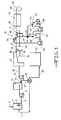
- FIG. 1 is a schematic diagram of a preferred wet forming manufacturing process for producing the mats of the present invention.
- Fibers 5 are fed continuously at a controlled rate into a pulper 1 along with a conventional whitewater through a pipe 7, also continuously and at a controlled rate.
- An agitator 3 in the pulper 1 mixes and disperses the fibers in the whitewater.
- the resultant concentrated fibrous slurry flows continuously through a pipe 9 into an optional pump 11 that pumps the concentrated slurry into a fiber slurry holding tank 13.
- the concentrated fiber slurry is preferably metered continuously from the holding tank 11 with a valve 14 and into a metered flow of desired whitewater 27 to form a diluted fibrous slurry.
- the valve 25 meters a correct rate of desired whitewater to the pulper 1 via pipe 7 and a correct rate of desired whitewater 27 to form the diluted fiber slurry.
- the diluted fibrous slurry flows into the diluted fiber slurry.
- the diluted fibrous slurry flows into pump 15 and is pumped to the mat forming machine 17, which can be of any width and typically is wide enough to make a finished mat 12 feet wide or wider.
- Alternative forming methods include the known paper or board making processes such as cylinder forming.
- the preferred processes for the production of mats of the present invention are those known processes using mat forming machines 17 like a HydroformerTM manufactured by Voith-Sulzer of Appleton, WS, or a DeltaformerTM manufactured by North County Engineers of Glens Falls, NY.
- the diluted slurry flows generally horizontally against an inclined moving permeable belt or forming wire (not shown) where the fiber is collected, building up in a random pattern to the desired thickness to form a wet web 28 while the whitewater passes through the forming wire and is transported to a deairing tank 21, or in the alternative, a deairing holding pit (not shown), via pipe 19.
- the wet web is dewatered to the desired extent with one or more suction boxes 29, and a foamy whitewater removed thereby is piped through pipe 32 also to the deairing tank 21, preferably through the pipe 19.
- This wet nonwoven web of fiber 30 is then preferably, but not necessarily, transferred to a second moving screen 33 and run through a binder application saturating station 31 where an aqueous binder is applied to the mat in any one of several known ways.
- the aqueous binder is pumped at a controlled rate with pump 46 such that more binder slurry is pumped than is needed and this slurry is fed to a binder applicator, via pipe 37, where the binder slurry is applied in excess to the wet web 30.
- the binder slurry is prepared by feeding an aqueous formaldehyde-free, heat resistant, binder 51, the binder comprising one or more resins or resin precursors, in an aqueous solution, emulsion or suspension, including a one-component epoxy, a two-component epoxy composition or two-component urethane binders, at a desired rate to a binder mix tank 47 having an agitator 49.
- the binder as purchased is often more concentrated than desired, and can be diluted to the desired concentration by also metering water 52, into the mix tank 47 and mixing with the agitator 49 to form a homogenous binder mixture.
- LOI loss-on-ignition in the mat
- the most used formaldehyde-free binders are a two-component epoxy resin system or urethane resin system, or a mixture of the epoxy resin and urethane resin. When these resins are used, it is important that the resin and the second component polymerizing initiator be intimately mixed in proper proportion, so that the fine particles of resin react to provide strong bonds between the glass fibers.
- the resin composition should be selected so that the binder does not undergo significant cross-linking and curing in the aqueous medium prior to the drying step in the mat making process.
- Epoxy compositions may include minor additions of urethane or acrylics in amounts up to about 20 wt. percent of an acrylic or urethane resin modifier or plasticizer.
- the urethane resin binders can also contain up to about 20 wt. percent of an acrylic resin modifier.
- Both the epoxy and the urethane based polymeric resins used in the invention have high temperature resistance, i.e. able to maintain a good bond between the fibers in the mat allowing the mat to withstand asphalt impregnation temperatures in the range of about 375 to 450°F in asphalt shingle making processes.
- thermoset resin useful in the invention is an epoxy resin aqueous emulsion called EPIREZTM 3510-W-60 available from Resolution Performance Products LLC Corp. of Houston, TX.
- EPIREZTM 3510-W-60 available from Resolution Performance Products LLC Corp. of Houston, TX.
- Other similar aqueous epoxy resins are also suitable in the invention.
- Some suitable aqueous urethane products include the SanCureTM family of waterborne urethane resins including 815 and 1601 products available from Noveon or Cleveland, OH. The higher softening point products are particularly useful in the invention.
- the binder can also be a polyacrylic acid resin modified with up to about 20 wt. percent of an epoxy resin and/or a urethane resin to increase the heat resistance of the polyacrylic acid resin.
- Any formaldehyde-free binder that provides a tensile strength in the dry mat of at least about 31.8 kg/7.62 cm (70 lbs./3 inch) width at room temperature, when having an LOI in the range of about 5 to about 30 wt. percent and that provides sufficient hot strength to perform satisfactorily in a hot molten material, like asphalt (up to about 232.2° C (450 deg. F.)) coating process is suitable for the invention.
- the polyacrylic acid resin is a homopolymer or copolymer of polyacrylic acid.
- the average molecular weight of the polyacrylic acid polymer is less than 10,000, more preferably less than 5,000, and most preferably about 3,000 or less, with about 2000 being preferred.
- Use of a low molecular weight polyacrylic acid polymer in a low-pH binder composition can result in a final product that exhibits excellent structural recovery and rigidity characteristics.
- the binder composition can also include at least one additional polycarboxy polymer such as, for example, a polycarboxy polymer disclosed in U.S. Patent No. 6,331,350, the entire contents of which are incorporated by reference herein.
- This binder mixture or slurry is then pumped to a binder holding tank 45 with a metering pump 53 and pipe 55 to maintain a desired level in the holding tank 45.
- a metering pump 46 controlled by the speed of the forming wire, pumps the binder slurry at the appropriate rate to the binder applicator 35. Shown here is a conventional curtain coater applicator, but many different types of applicators can be used instead as is well known.
- the binder slurry flows onto the wet web of fibers at the pumped rate and flows through the wet web of fibers coating at least some portions of the fibers, particularly at the points where the fibers contact one or more other fibers.
- the wet, bindered web of the invention is then transferred continuously to a dryer belt 42 and carried through an oven 57 to dry the web and cure the binder, forming a dry mat 58 that is usually wound into a roll 59, in a known manner, for storage, shipment, or use on a roofing manufacturing machine or other mat processing machine.
- Heating and drying of the web of fibers and curing of the binder to form the mats of the invention is preferably accomplished by moving hot air through the mat in a known manner, but other known ways of heating the wet, bindered web of fibers is also suitable.
- any type of glass fibers can be used in the present invention. Normally, bundles of glass fibers chopped to a desirable length from about 0.318 cm (1/8 inch) to about 7.62 cm (3 inches) and preferably from about 0.635 cm (1/4 inch) long to about 3.81 cm (1.5 inches) long are available from several suppliers for use in wet forming operations. Fibers from about 1.905 cm (3/4 inch) long to about 3.81 cm (1.5 inches) long are most commonly used for roofing mats. These fibers are normally coated with a chemical sizing composition that varies from supplier to supplier and from product to product and are normally tailored to a specific customer or whitewater system or to a kind of wet forming machine. The present invention is suitable to all types of glass fibers including unsized fibers.
- the binder or resultant resin bond is in direct contact with the fiber(s)
- formaldehyde free resin bond is in direct contact with the bare fiber, or the bare fiber size coating without a coating of another resin intermediate. This excludes a mat bound with a formaldehyde or thermoplastic resin later overcoated, or impregnated with a formaldehyde free epoxy or urethane resin.
- the mats of the present invention are useful in making products containing asphalt. These products are made in manufacturing processes in which the fiberglass mat is coated or saturated with hot, molten asphalt or a mixture containing hot, molten asphalt, to make roofing shingles, built-up roofing products, modified bitumen membranes or walking boards or other products. All of these processes subject the mat to temperatures ranging from 190.6° C - 232.2° C (375-450° F.) and higher, and to substantial tension at machine speeds ranging from 60.96 m/min. - 457.2 m/min. (200-1500 ft./min.) or higher.
- the binders used in the invention are in the form of fine particles dispersed in water, latexes, or aqueous solutions and are deposited upon the fibers in an aqueous mixture.
- the formaldehyde-free binder system for the aqueous laid glass fiber may be comprised of aqueous dispersible epoxies solely, or in combination with acrylics, urethanes, and/or polyamides. In each case, there results a one-part resin system that cures to create a bond.
- two part epoxies or two part urethanes may be used as a dispersion binder provided the resin and the initiator are well mixed and that the resin does not harden at temperatures typical in the wet sections of the wet forming and binder application zones of the forming machines.
- an aqueous dispersion of epoxy resin is used.
- the fiberglass mats may also be bonded using a two-part urethane resin binder composition.
- the epoxy resin may be a one-part epoxy or a two part epoxy system. In the two-part epoxy system, the resin and the initiator are intimately mixed and the cure temperature of the resin is selected to be well above that of the aqueous processing temperatures so that the two part resin does not harden or cure in the aqueous processing step.
- the epoxy resin may also include urethanes, acrylics and other modifiers in quantities up to about 20 wt. percent, preferably below 15 wt. percent and most preferably up to about 10 wt. percent.
- fiberglass mats can be bonded with high performance epoxy resins delivered in water, but it also yields a fiberglass mat with high performance properties.
- mats of the invention manifest greater heat resistance and can have improved tensile and tear strength properties, while also providing improved water resistance.
- the mats of the present invention can be coated with a hot, molten material, such as asphalt, having a temperature of at least about 148.9° C (300 degrees F.) and usually at least about 176.7° C (350 degrees F.) while under tension in a continuous process using any conventional technology for making shingles or other roofing products.
- a hot, molten material such as asphalt
- the mats will maintain their integrity during this critical part of the process, not distorting or failing that would cause a breakout and substantial downtime, due to the heat resistant bond between the fibers.
- Fiber glass mats of the invention are useful in many products for the building construction industry, as roofing shingles, commercial roofing sheets or roll roofing, carpet tiles and sound deadening products for land vehicles, such as automobiles, trucks and the like.
Landscapes
- Chemical & Material Sciences (AREA)
- Inorganic Chemistry (AREA)
- Engineering & Computer Science (AREA)
- Textile Engineering (AREA)
- Nonwoven Fabrics (AREA)
- Treatments For Attaching Organic Compounds To Fibrous Goods (AREA)
Applications Claiming Priority (1)
| Application Number | Priority Date | Filing Date | Title |
|---|---|---|---|
| US10/983,871 US20060099870A1 (en) | 2004-11-08 | 2004-11-08 | Fiber mat bound with a formaldehyde free binder, asphalt coated mat and method |
Publications (1)
| Publication Number | Publication Date |
|---|---|
| EP1655400A1 true EP1655400A1 (de) | 2006-05-10 |
Family
ID=35638476
Family Applications (1)
| Application Number | Title | Priority Date | Filing Date |
|---|---|---|---|
| EP20050023835 Withdrawn EP1655400A1 (de) | 2004-11-08 | 2005-11-02 | Fasermate mit formaldehydfreien Bindemittel, Asphaltbeschichtete Mate und Verfahren zu deren Herstellung |
Country Status (2)
| Country | Link |
|---|---|
| US (1) | US20060099870A1 (de) |
| EP (1) | EP1655400A1 (de) |
Cited By (5)
| Publication number | Priority date | Publication date | Assignee | Title |
|---|---|---|---|---|
| WO2008089851A1 (en) | 2007-01-25 | 2008-07-31 | Knauf Insulation Limited | Formaldehyde-free mineral fibre insulation product |
| US20140323618A1 (en) * | 2010-05-07 | 2014-10-30 | Knauf Insulation | Carbohydrate polyamine binders and materials made therewith |
| US8980774B2 (en) | 2012-06-15 | 2015-03-17 | Hexion Inc. | Compositions and methods for making polyesters and articles therefrom |
| US11286360B2 (en) | 2020-05-29 | 2022-03-29 | Bmic Llc | Polymer reinforced glass mat with enhanced nail shank shear resistance, shingles including the same, and methods of manufacturing the same |
| US11946252B2 (en) | 2020-10-27 | 2024-04-02 | Bmic Llc | Low penetration point asphalt reinforced glass mat and articles including the same |
Families Citing this family (36)
| Publication number | Priority date | Publication date | Assignee | Title |
|---|---|---|---|---|
| US6723670B2 (en) * | 2001-08-07 | 2004-04-20 | Johns Manville International, Inc. | Coated nonwoven fiber mat |
| US7842382B2 (en) | 2004-03-11 | 2010-11-30 | Knauf Insulation Gmbh | Binder compositions and associated methods |
| US8603631B2 (en) * | 2004-10-13 | 2013-12-10 | Knauf Insulation Gmbh | Polyester binding compositions |
| US20070012414A1 (en) * | 2005-07-12 | 2007-01-18 | Kajander Richard E | Multilayer nonwoven fibrous mats with good hiding properties, laminates and method |
| CA2615780C (en) * | 2005-07-26 | 2020-03-10 | Knauf Insulation Gmbh | Binders and materials made therewith |
| CN101668713B (zh) | 2007-01-25 | 2012-11-07 | 可耐福保温材料有限公司 | 矿物纤维板 |
| CN101720341B (zh) | 2007-01-25 | 2013-06-12 | 克瑙夫绝缘私人有限公司 | 复合木板 |
| PT2108006T (pt) | 2007-01-25 | 2020-12-21 | Knauf Insulation Gmbh | Ligantes e materiais feitos com os mesmos |
| EP2109594A1 (de) * | 2007-01-25 | 2009-10-21 | Knauf Insulation Limited | Mineralfaserisolierung |
| EP2137223B1 (de) | 2007-04-13 | 2019-02-27 | Knauf Insulation GmbH | Maillard-resol-verbundstoffbinder |
| BRPI0814014A2 (pt) * | 2007-07-05 | 2015-02-03 | Knauf Insulation Gmbh | Material colante de maillard de base ácido hidróxi-monocarboxílico |
| GB0715100D0 (en) | 2007-08-03 | 2007-09-12 | Knauf Insulation Ltd | Binders |
| US9297098B2 (en) * | 2007-12-19 | 2016-03-29 | Saint-Gobain Adfors Canada, Ltd. | Foldable reinforcing web |
| US20100040832A1 (en) * | 2008-08-13 | 2010-02-18 | Saint-Gobain Technical Fabrics America, Inc. | Formaldehyde free woven and non-woven fabrics having improved hot wet tensile strength and binder formulations for same |
| US20100197185A1 (en) * | 2009-01-30 | 2010-08-05 | Saint-Gobain Technical Fabrics America, Inc. | Low and ultra-low formaldehyde emission binders for non-woven glass mat |
| US8900495B2 (en) | 2009-08-07 | 2014-12-02 | Knauf Insulation | Molasses binder |
| MY160846A (en) | 2010-05-07 | 2017-03-31 | Knauf Insulation | Carbohydrate binders and materials made therewith |
| EP2576882B1 (de) | 2010-06-07 | 2015-02-25 | Knauf Insulation | Faserprodukte mit temperaturregelungzusätzen |
| US20120003472A1 (en) * | 2010-06-30 | 2012-01-05 | Coats American Inc. | Flame-resistant yarn |
| WO2012152731A1 (en) | 2011-05-07 | 2012-11-15 | Knauf Insulation | Liquid high solids binder composition |
| GB201206193D0 (en) | 2012-04-05 | 2012-05-23 | Knauf Insulation Ltd | Binders and associated products |
| US9190045B2 (en) * | 2012-06-20 | 2015-11-17 | Hyundai Motor Company | Noise-absorbent fabric for vehicle and method for manufacturing the same |
| GB201214734D0 (en) | 2012-08-17 | 2012-10-03 | Knauf Insulation Ltd | Wood board and process for its production |
| KR101438926B1 (ko) | 2012-11-29 | 2014-09-15 | 현대자동차주식회사 | 자동차용 고내열 흡음재 |
| CA2892900C (en) | 2012-12-05 | 2020-08-11 | Benedicte Pacorel | Method for manufacturing an article comprising a collection of matter bound by a cured binder |
| CA2938154C (en) | 2014-02-07 | 2022-11-01 | Knauf Insulation, Inc. | Uncured articles with improved shelf-life |
| GB201408909D0 (en) | 2014-05-20 | 2014-07-02 | Knauf Insulation Ltd | Binders |
| GB201412709D0 (en) | 2014-07-17 | 2014-09-03 | Knauf Insulation And Knauf Insulation Ltd | Improved binder compositions and uses thereof |
| GB201517867D0 (en) | 2015-10-09 | 2015-11-25 | Knauf Insulation Ltd | Wood particle boards |
| GB201610063D0 (en) | 2016-06-09 | 2016-07-27 | Knauf Insulation Ltd | Binders |
| CA2989709C (en) | 2016-12-21 | 2020-06-09 | Saint-Gobain Adfors Canada, Ltd. | A fiber mat, method of making the fiber mat, and bituminous roofing product |
| GB201701569D0 (en) | 2017-01-31 | 2017-03-15 | Knauf Insulation Ltd | Improved binder compositions and uses thereof |
| US11332881B2 (en) | 2018-01-05 | 2022-05-17 | Certainteed Llc | Fiber mat, method of making the fiber mat, and bituminous roofing product |
| GB201804908D0 (en) | 2018-03-27 | 2018-05-09 | Knauf Insulation Ltd | Binder compositions and uses thereof |
| GB201804907D0 (en) | 2018-03-27 | 2018-05-09 | Knauf Insulation Ltd | Composite products |
| US12320064B2 (en) * | 2019-06-05 | 2025-06-03 | Johns Manville | Carpet tile with wet laid dual layer nonwoven mat |
Citations (4)
| Publication number | Priority date | Publication date | Assignee | Title |
|---|---|---|---|---|
| US5116890A (en) * | 1989-06-26 | 1992-05-26 | Sequa Chemicals, Inc. | Non-formaldehyde self-crosslinking latex |
| EP0712953A2 (de) * | 1994-11-17 | 1996-05-22 | The B.F. Goodrich Company | Formaldehydfreies Latex zur Anwendung als Bindemittel oder Beschichtungsmittel |
| US20040163724A1 (en) * | 2001-09-06 | 2004-08-26 | Mark Trabbold | Formaldehyde-free duct liner |
| EP1582344A1 (de) * | 2004-03-31 | 2005-10-05 | Basf Aktiengesellschaft | Halbzeug aus Hanf, Kenaf und Bindemittel für die Automobilindustrie |
Family Cites Families (30)
| Publication number | Priority date | Publication date | Assignee | Title |
|---|---|---|---|---|
| US3922425A (en) * | 1970-09-14 | 1975-11-25 | Owens Corning Fiberglass Corp | Roofing board for integration in a built-up roofing structure |
| US4129674A (en) * | 1972-10-27 | 1978-12-12 | Johns-Manville Corporation | Fibrous mat especially suitable for roofing products and a method of making the mat |
| US4012553A (en) * | 1974-08-01 | 1977-03-15 | Minnesota Mining And Manufacturing Company | Resinous repair pad |
| US4395306A (en) * | 1980-01-31 | 1983-07-26 | The Dow Chemical Company | Method for preparing fibrous mats from a fibrous suspension |
| US4327143A (en) * | 1981-01-23 | 1982-04-27 | Westinghouse Electric Corp. | Moisture resistant laminates impregnated with an impregnating composition comprising epoxy resin and a dicyandiamide derivative |
| US4405680A (en) * | 1982-12-23 | 1983-09-20 | Shell Oil Company | Roofing shingle |
| US4879173A (en) * | 1988-01-06 | 1989-11-07 | Georgia-Pacific Corporation | Glass mat with reinforcing binder |
| US4904522A (en) * | 1988-07-26 | 1990-02-27 | Mobay Corporation | Process for the production of fiberglass mats |
| US5011712A (en) * | 1989-03-16 | 1991-04-30 | National Starch And Chemical Investment Holding Corporation | Formaldehyde-free heat resistant binders for nonwovens |
| US5108798A (en) * | 1989-06-08 | 1992-04-28 | American Cyanamid Company | Water soluble binder compositions containing beta-hydroxy urethanes and polyfunctional carboxylic acids |
| US5030507A (en) * | 1990-01-12 | 1991-07-09 | National Starch And Chemical Investment Holding Corporation | Formaldehyde-free nonwoven binder composition |
| US5143582A (en) * | 1991-05-06 | 1992-09-01 | Rohm And Haas Company | Heat-resistant nonwoven fabrics |
| US5273816A (en) * | 1991-08-30 | 1993-12-28 | Allied-Signal Inc. | Laminate board possessing improved dimensional stability |
| DE59209346D1 (de) * | 1991-10-28 | 1998-07-02 | Ciba Geigy Ag | Lösungsmittelfreie härtbare Harzzusammensetzung, insbesondere für die Herstellung von Prepregs |
| US5866487A (en) * | 1994-08-11 | 1999-02-02 | Shin-Kobe Electric Machinery Co.,Ltd. | Laminate, glass fiber non-woven fabric therefor and a method of producing glass fiber non-woven fabric |
| US6124220A (en) * | 1995-03-28 | 2000-09-26 | Sumitomo Bakelite Company Limited | Laminated board and process for production thereof |
| US6372675B1 (en) * | 1995-09-28 | 2002-04-16 | Omnova Solutins Inc. | Nonwoven fabric non-cellulose fibers having improved wet tensile strength |
| AT404835B (de) * | 1996-03-05 | 1999-03-25 | Danubia Petrochem Polymere | Zur herstellung lackierbarer teile geeignete glasmattenverstärkte thermoplasten und daraus hergestellte teile |
| US5837620A (en) * | 1996-10-10 | 1998-11-17 | Johns Manville International, Inc. | Fiber glass mats and method of making |
| US5883021A (en) * | 1997-03-21 | 1999-03-16 | Ppg Industries, Inc. | Glass monofilament and strand mats, vacuum-molded thermoset composites reinforced with the same and methods for making the same |
| US6290782B1 (en) * | 1998-03-27 | 2001-09-18 | Kabushiki Kaisha Toshiba | Magnetic material and manufacturing method thereof, and bonded magnet using the same |
| US6265330B1 (en) * | 1998-04-14 | 2001-07-24 | Atlantic Research Corporation | Non-Asbestos insulation for rocket motor casing |
| US6586353B1 (en) * | 1999-11-30 | 2003-07-01 | Elk Corp. Of Dallas | Roofing underlayment |
| FR2804677B1 (fr) * | 2000-02-09 | 2002-08-30 | Vetrotex France Sa | Voile de verre et son utilisation pour des revetements d'etancheite |
| US6641896B2 (en) * | 2000-12-21 | 2003-11-04 | The Garland Company, Inc. | Water resistant fire retardant roof underlayment sheet material |
| US6673727B2 (en) * | 2001-02-01 | 2004-01-06 | Ebi, L.P. | Orthopedic casts with controlled flexibility |
| DE10151411B4 (de) * | 2001-10-18 | 2006-09-14 | Johns Manville Europe Gmbh | Schichtstoff mit verbesserten Eigenschaften |
| AU2003245285A1 (en) * | 2002-06-06 | 2003-12-22 | Georgia-Pacific Resins, Inc. | Epoxide-type formaldehyde free insulation binder |
| US6811649B2 (en) * | 2002-06-08 | 2004-11-02 | Upf Corporation | Line faced marine insulation, and method of production |
| US20050214534A1 (en) * | 2004-03-29 | 2005-09-29 | Adamo Joseph R | Extended curable compositions for use as binders |
-
2004
- 2004-11-08 US US10/983,871 patent/US20060099870A1/en not_active Abandoned
-
2005
- 2005-11-02 EP EP20050023835 patent/EP1655400A1/de not_active Withdrawn
Patent Citations (4)
| Publication number | Priority date | Publication date | Assignee | Title |
|---|---|---|---|---|
| US5116890A (en) * | 1989-06-26 | 1992-05-26 | Sequa Chemicals, Inc. | Non-formaldehyde self-crosslinking latex |
| EP0712953A2 (de) * | 1994-11-17 | 1996-05-22 | The B.F. Goodrich Company | Formaldehydfreies Latex zur Anwendung als Bindemittel oder Beschichtungsmittel |
| US20040163724A1 (en) * | 2001-09-06 | 2004-08-26 | Mark Trabbold | Formaldehyde-free duct liner |
| EP1582344A1 (de) * | 2004-03-31 | 2005-10-05 | Basf Aktiengesellschaft | Halbzeug aus Hanf, Kenaf und Bindemittel für die Automobilindustrie |
Cited By (11)
| Publication number | Priority date | Publication date | Assignee | Title |
|---|---|---|---|---|
| WO2008089851A1 (en) | 2007-01-25 | 2008-07-31 | Knauf Insulation Limited | Formaldehyde-free mineral fibre insulation product |
| US7854980B2 (en) | 2007-01-25 | 2010-12-21 | Knauf Insulation Limited | Formaldehyde-free mineral fibre insulation product |
| EP2826903A1 (de) * | 2007-01-25 | 2015-01-21 | Knauf Insulation SA | Isolierprodukt aus Mineralfasern |
| US20140323618A1 (en) * | 2010-05-07 | 2014-10-30 | Knauf Insulation | Carbohydrate polyamine binders and materials made therewith |
| US9505883B2 (en) * | 2010-05-07 | 2016-11-29 | Knauf Insulation Sprl | Carbohydrate polyamine binders and materials made therewith |
| US8980774B2 (en) | 2012-06-15 | 2015-03-17 | Hexion Inc. | Compositions and methods for making polyesters and articles therefrom |
| US9550894B2 (en) | 2012-06-15 | 2017-01-24 | Hexion Inc. | Compositions and methods for making polyesters and articles therefrom |
| US11286360B2 (en) | 2020-05-29 | 2022-03-29 | Bmic Llc | Polymer reinforced glass mat with enhanced nail shank shear resistance, shingles including the same, and methods of manufacturing the same |
| US11834562B2 (en) | 2020-05-29 | 2023-12-05 | Bmic Llc | Polymer reinforced glass mat with enhanced nail shank shear resistance, shingles including the same, and methods of manufacturing the same |
| US12435196B2 (en) | 2020-05-29 | 2025-10-07 | Bmic Llc | Polymer reinforced glass mat with enhanced nail shank shear resistance, shingles including the same, and methods of manufacturing the same |
| US11946252B2 (en) | 2020-10-27 | 2024-04-02 | Bmic Llc | Low penetration point asphalt reinforced glass mat and articles including the same |
Also Published As
| Publication number | Publication date |
|---|---|
| US20060099870A1 (en) | 2006-05-11 |
Similar Documents
| Publication | Publication Date | Title |
|---|---|---|
| US20060099870A1 (en) | Fiber mat bound with a formaldehyde free binder, asphalt coated mat and method | |
| US7547375B2 (en) | Method of making tough, flexible mats for collapsable ceiling tile | |
| CA2701245C (en) | Fiber glass mat, method and laminate | |
| EP1584724B1 (de) | Faserflies mit glatter Oberfläche und Verfahren zu seiner Herstellung | |
| US5102728A (en) | Method and composition for coating mat and articles produced therewith | |
| US6187697B1 (en) | Multiple layer nonwoven mat and laminate | |
| CN101300204A (zh) | 具有改善的高温湿抗拉强度的湿成形毡垫 | |
| US12377633B2 (en) | Dual-reinforced construction board | |
| US20070246144A1 (en) | Fibrous nonwoven mat and method | |
| CN103221214A (zh) | 耐燃层压板 | |
| US20050142348A1 (en) | Method of making foam coated mat online and coated mat product | |
| US20080003903A1 (en) | Coated nonwoven mat | |
| EP4069900B1 (de) | Verbundvliesmatte mit überzugsschicht | |
| CN105369474B (zh) | 用于制造高填充非织造织物的方法 | |
| US20230373852A1 (en) | Coated nonwoven mat with coating layer | |
| WO2021061602A1 (en) | Uncoated nonwoven fiber mat | |
| CA2550500A1 (en) | Fiber mat and process for making same | |
| JPH1143543A (ja) | シート状不燃成形体 | |
| EP4320300A1 (de) | Beschichtete vliesmatte mit abgestimmten leistungseigenschaften | |
| US20050208861A1 (en) | Asphalt coated polyester glass mats | |
| US11084251B2 (en) | Method for producing laminate composite materials | |
| US20070059507A1 (en) | Fiber mat and process for making same | |
| EP4556214A1 (de) | Vliesstoff mit neuem thermoplastischem bindemittel |
Legal Events
| Date | Code | Title | Description |
|---|---|---|---|
| PUAI | Public reference made under article 153(3) epc to a published international application that has entered the european phase |
Free format text: ORIGINAL CODE: 0009012 |
|
| AK | Designated contracting states |
Kind code of ref document: A1 Designated state(s): AT BE BG CH CY CZ DE DK EE ES FI FR GB GR HU IE IS IT LI LT LU LV MC NL PL PT RO SE SI SK TR |
|
| AX | Request for extension of the european patent |
Extension state: AL BA HR MK YU |
|
| 17P | Request for examination filed |
Effective date: 20061102 |
|
| R17C | First examination report despatched (corrected) |
Effective date: 20061130 |
|
| AKX | Designation fees paid |
Designated state(s): AT BE BG CH CY CZ DE DK EE ES FI FR GB GR HU IE IS IT LI LT LU LV MC NL PL PT RO SE SI SK TR |
|
| STAA | Information on the status of an ep patent application or granted ep patent |
Free format text: STATUS: THE APPLICATION IS DEEMED TO BE WITHDRAWN |
|
| 18D | Application deemed to be withdrawn |
Effective date: 20070612 |