EP1656802B1 - Adaptateur de terminal permettant d'associer des composants utilisateurs et d'emuler une entite reseau - Google Patents
Adaptateur de terminal permettant d'associer des composants utilisateurs et d'emuler une entite reseau Download PDFInfo
- Publication number
- EP1656802B1 EP1656802B1 EP04744860A EP04744860A EP1656802B1 EP 1656802 B1 EP1656802 B1 EP 1656802B1 EP 04744860 A EP04744860 A EP 04744860A EP 04744860 A EP04744860 A EP 04744860A EP 1656802 B1 EP1656802 B1 EP 1656802B1
- Authority
- EP
- European Patent Office
- Prior art keywords
- user
- terminal adapter
- adapter
- interface
- emulator
- Prior art date
- Legal status (The legal status is an assumption and is not a legal conclusion. Google has not performed a legal analysis and makes no representation as to the accuracy of the status listed.)
- Expired - Lifetime
Links
- 238000004891 communication Methods 0.000 claims abstract description 14
- 230000011664 signaling Effects 0.000 claims description 16
- 238000003780 insertion Methods 0.000 claims description 3
- 230000037431 insertion Effects 0.000 claims description 3
- 238000001514 detection method Methods 0.000 claims description 2
- 238000012544 monitoring process Methods 0.000 claims description 2
- 230000001413 cellular effect Effects 0.000 abstract description 9
- 238000000034 method Methods 0.000 description 21
- 238000010586 diagram Methods 0.000 description 4
- 230000008901 benefit Effects 0.000 description 2
- 230000006870 function Effects 0.000 description 2
- 230000004913 activation Effects 0.000 description 1
- 230000008859 change Effects 0.000 description 1
- 238000010276 construction Methods 0.000 description 1
- 230000003993 interaction Effects 0.000 description 1
- 238000012423 maintenance Methods 0.000 description 1
- 238000010295 mobile communication Methods 0.000 description 1
- 230000008447 perception Effects 0.000 description 1
- 229920001690 polydopamine Polymers 0.000 description 1
- 230000002265 prevention Effects 0.000 description 1
- CSRZQMIRAZTJOY-UHFFFAOYSA-N trimethylsilyl iodide Substances C[Si](C)(C)I CSRZQMIRAZTJOY-UHFFFAOYSA-N 0.000 description 1
Images


Classifications
-
- H—ELECTRICITY
- H04—ELECTRIC COMMUNICATION TECHNIQUE
- H04W—WIRELESS COMMUNICATION NETWORKS
- H04W88/00—Devices specially adapted for wireless communication networks, e.g. terminals, base stations or access point devices
- H04W88/02—Terminal devices
-
- H—ELECTRICITY
- H04—ELECTRIC COMMUNICATION TECHNIQUE
- H04B—TRANSMISSION
- H04B7/00—Radio transmission systems, i.e. using radiation field
- H04B7/14—Relay systems
- H04B7/15—Active relay systems
- H04B7/185—Space-based or airborne stations; Stations for satellite systems
- H04B7/18502—Airborne stations
- H04B7/18506—Communications with or from aircraft, i.e. aeronautical mobile service
-
- H—ELECTRICITY
- H04—ELECTRIC COMMUNICATION TECHNIQUE
- H04W—WIRELESS COMMUNICATION NETWORKS
- H04W88/00—Devices specially adapted for wireless communication networks, e.g. terminals, base stations or access point devices
- H04W88/02—Terminal devices
- H04W88/06—Terminal devices adapted for operation in multiple networks or having at least two operational modes, e.g. multi-mode terminals
Definitions
- the invention relates to cellular networks particularly but not exclusively for vehicles such as ships and aircraft.
- wireless communications may interfere or may be perceived to interfere with other equipment internal to a craft.
- wireless communications may interfere or may be perceived to interfere with other wireless communications equipment external to a craft.
- a further problem is that there is limited bandwidth available for vehicle-to-earth communication, and so use of this bandwidth must be optimised. There is therefore a requirement for a system and method to allow convenient use of cellular identity by users on ships or aircraft. Systems according to the prior art are established by the published US-A-6 052 604 and WO 99/67960.
- a terminal adapter for a mobile network, the adapter comprising a plurality of user-side interfaces for communicating with user components, a terminal controller for dynamically associating user components connected to the interfaces to provide at least one mobile station in real time, and a mobile network entity emulator for communicating with a mobile network entity via a network-side interface.
- the adapter brings "logical" mobile stations of transiently associated components into the core of the mobile network. This avoids the mobile station to transceiver conventional link. It also allows a limited number of sets components to be used for providing mobile communication services to a larger number of potential users.
- the user-side interfaces comprise an interface to audio input/output components.
- said interface communicates with input/output devices of an in-flight entertainment system.
- the user-side interfaces include an interface to user display devices.
- said interface communicates with display devices of an in-flight entertainment system.
- the user-side interfaces include an interface to subscriber identity module readers.
- said user-side interfaces include an interface to a data input/output device.
- the terminal controller dynamically associates user components by establishing a context in real time upon detection of insertion of a subscriber identity module in a reader user component.
- the context includes binding to a user interface component.
- the terminal controller dynamically manages queues if the current usage requires more bandwidth than is available for the mobile network.
- the network side interface emulates a network entity so that the network entity with which it communicates operates in a conventional manner with internal network operations.
- the adapter dynamically links a mobile equipment unit with user devices to complete a mobile station.
- the mobile equipment units are encoded in software.
- the mobile equipment units are configured in hardware.
- the emulator comprises a physical interface and protocol stacks to handle signalling, voice streams, and data streams.
- the emulator further comprises application programming interfaces (APIs) to the protocol stacks and interface.
- APIs application programming interfaces
- the terminal controller communicates with the emulator via the APIs.
- the terminal controller dynamically binds to an API of the emulator as an operation of the context.
- the emulator comprises a signalling monitor for monitoring incoming network traffic, and communicating incoming traffic information to the emulator.
- the signalling monitor resides between mobile network elements.
- a mobile network communication system comprising a terminal adapter as described above and mobile network entities, at least one of which is linked with the emulator of the terminal adapter.
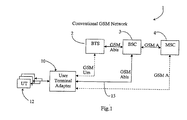
- a communication system 1 comprises:
- the system 1 further comprises a terminal adapter 10 interfacing on one side with user terminal devices 12 and on the other side with the BSC 3 via an Abis interface 15.
- a terminal adapter 10 interfacing on one side with user terminal devices 12 and on the other side with the BSC 3 via an Abis interface 15.
- an adapter is linked with the BTS 2 by a GSM Um interface
- an adapter is linked with the MSC 4 by a GSM A interface.
- the MSC communicates with an earth station via a satellite link, not shown.
- the system is essentially a mobile network which is movable with the vehicle or craft.
- the user devices 12 comprise:
- the adapter 10 comprises internal interfaces 25, 26, 27 and 28, for communicating with the audio i/o 20, the user interfaces 21, the readers 22, and the data i/o respectively.
- the interfaces 25-28 each comprise a hardware port and functionality in a software terminal controller 29.
- the controller 29 dynamically associates the various user-side devices to provide a number of mobile stations in real time, each comprising disparate parts which are only temporarily associated. For example, every seat in an aircraft may have a set of user devices 12, some of which are also in-flight entertainment equipment. However while there may therefore be 200 sets of user devices, the controller 29 will only have several mobile stations dynamically formed at any one time. This helps to optimise use of the available satellite earth link: every passenger having the option of making/receiving calls by inverting his SIM card in the reader 22, but only several stations being configured at any time.
- the terminal controller 29 continuously monitors the SIM reader interface 27 for events such as SIM Present and SIM Removed. Commands and data are exchanged between the SIM reader and the controller 29 using a hardware interface. Voice signals to and from the Audio I/O devices are transcoded to and from an appropriate format (such as GSM 16kBit/S or 64kBit/S PCM) depending on the interface used on the network side. Data streams to and from the Data I/O devices on the user side are transcoded to and from an appropriate format (such as GSM/GPRS or GSM/CSD) depending on the interface used on the network side.
- an appropriate format such as GSM 16kBit/S or 64kBit/S PCM
- Data streams to and from the Data I/O devices on the user side are transcoded to and from an appropriate format (such as GSM/GPRS or GSM/CSD) depending on the interface used on the network side.
- the controller 29 has an open interface for communicating with the user interface devices which can be customised to suit the user's environment. This communication is Web-based (i.e. HTTP/HTML) based. Each time a new SIM card is detected the controller 29 creates a context which identifies the particular user and network devices that need to be associated to handle the event. The controller 29 binds to any APIs that are needed such as an API to the BTS emulator 30 and an API to the user interface 21. The controller 29 uses this context and the API to route data and signalling information to and from the devices and APIs that have been associated. When the SIM is no longer present, the controller 29 releases the APIs and the devices and then deletes the context so that the devices can be used for a new session, possibly with a different SIM or user.
- This communication is Web-based (i.e. HTTP/HTML) based.
- a passenger in an aircraft can insert his or her SIM card in a conveniently-located reader 22 and use in-flight entertainment equipment to make and receive calls.
- the links between the user-side components and the adapter are wireless.
- the mobile stations are only “formed” as required and so there will be much fewer than the number of passengers. This optimises use of resources and of available bandwidth to ground.
- the adapter 10 comprises a BTS emulator 30 for communicating with the BSC 3.
- the BTS emulator 30 comprises:
- the above-mentioned APIs are used by the terminal controller 29 to exchange information between the user devices 12 and the BSC 3.
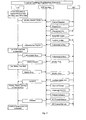
- An example of this interworking for a Location Updating Procedure is shown in the message sequence chart of Fig. 3.
- the messages exchanged between the BTS emulator 30 and the BSC 3 are standard GSM messages.
- a major advantage of emulating a network element within the adapter 10 is that it allows the wireless part of the GSM network to be bypassed thereby preventing potential radio frequency interference in sensitive environments such as aircraft. Furthermore, by emulating standardised network elements it is possible to connect to unmodified cellular network entities using standard interfaces.
- a terminal adapter 50 is similar to the adapter 10 on the user side and like parts are assigned the same reference numerals. However on its network side it has a BTS/BSC emulator 51. This comprises:
- the above-mentioned APIs are used by the terminal controller 29 to exchange information between the user devices 12 and the MSC.
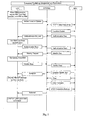
- An example of this interworking for a Location Updating Procedure is shown in the message sequence chart of Fig. 5.
- the messages exchanged between the BTS/BSC emulator 51 and the MSC 4 are standard GSM messages.
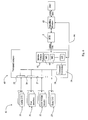
- a further terminal adapter 60 comprises a mobile station emulator 61.
- the emulator 61 comprises a number N of hardware mobile equipment units (MEs) 62 providing a GSM-Um interface to the network's BTS 2.
- the adapter 60 also comprises a signalling monitor 63 disposed between the BTS 2 and the BSC 3.
- MEs hardware mobile equipment units
- the mobile station emulator 61 comprises:
- the user inserts his/her SIM/USIM card into a SIM/USIM reader 22 slot. If activated on the SIM/USIM, the terminal adapter 10 prompts the user to enter the PIN number on the user interface 21. The adapter 10 detects the SIM/USIM insertion and initiates a registration procedure by sending a standard cellular registration message to the BSC 3.
- the registration request is handled by the GSM entities 3 and 4 in a conventional way.
- Authentication requests from the GSM network are handled by the terminal adapter 10 using the SIM/USIM in the associated SIM/USIM reader 22.
- the terminal adapter 10 registers the user as active.
- Any information provided by the network such as TMSI is stored on the SIM/USIM.
- the terminal adapter 10 will send an appropriate message to the user console. If the procedure is successful the terminal adapter 10 sends an indication to the user interface 21 which displays an appropriate message such as "Service Available".
- the user may now send and receive calls and messages.
- the user may also use services provided by the SIM/USIM such as phone-book.
- Mobile originated service requests include voice calls, SMS messages, data calls, and supplementary service requests.
- the user composes the code for the requested service (e.g. phone number, supplementary service code) on the user interface 21 and selects the "send" option.
- code for the requested service e.g. phone number, supplementary service code
- the adapter 10 receives the code from the user interface 21 and sends the standard service request to the GSM network.
- the service request is handled by the GSM network in a conventional way. If the procedure fails for whatever reason, the terminal adapter 10 will send an appropriate message to the user interface 12.
- Mobile Terminated service requests include voice calls, SMS messages, and data calls.
- the user is alerted to the incoming service request by the user interface 21.
- the user can choose to accept or reject the request.
- the message will be stored in the SIM/USIM. Any information provided by the network such as caller identity is stored on the SIM/USIM. If the procedure fails for whatever reason, the adapter 10 will send an appropriate message to the user interface 21.
- the user removes his/her SIM/USIM from the SIM/USIM reader 22 slot.
- the SIM/USIM reader 22 sends a SIM/USIM removal indication to the adapter 10.
- the user adapter 10 sends a standard detach request to the GSM network.
- the detach request is handled by the GSM network in a conventional way.
- the adapter 10 sends an indication to the user interface 21 which displays an appropriate message such as "Please Insert SIM/USIM".
- SIM/USIM services include, but are not limited to phone-book management, security functions (PUK, change PIN), SIM Toolkit applications, and Java applications.
- the adapter 10 interfaces directly with the MSC 4, and the operation is much as described above for the Fig. 2 embodiment having the Abis interface.
- the adapter has a MS emulator 61
- the following are the steps. It should be noted that in this embodiment there are multiple hardware mobile equipments (MES) 62, whereas in the embodiments of Figs. 2 and 4 this functionality is implemented in software.
- MES hardware mobile equipment
- the adapter 60 assigns an ME 62 to the user for the duration of the procedure. There are typically fewer ME 62 devices than user devices 12. If no ME 62 is available the adapter 60 queues the registration request until one becomes available and then continues with the procedure.
- the adapter 60 is configured to give priority to different requests (registration, SMS, MT call, MO call %) depending on the operator's preferences.
- the ME 62 is released and is made available for other operations.
- the adapter 60 assigns an ME 62 to the user for the duration of the procedure. There are typically fewer ME devices than user devices 12. If no ME 62 is available the adapter 60 queues the MO service request until one becomes available and then continues with the procedure.
- the adapter 60 can be configured to give priority to different requests (registration, SMS, MT call, MO call %) depending on the operator's preferences.
- Mobile Terminated service requests include voice calls, SMS messages, and data calls. All users logged onto the system are registered in the GSM network as being located and camping onto the adapter 10 which behaves like a conventional MS. Incoming service requests will therefore result in the GSM network sending a paging request to the adapter 60 in the conventional way.
- the paging request is intercepted in the signalling monitor 63 which sends a message to the adapter 60 indicating the pending paging request and associated IMSI. This message is sent on the link 64.
- the adapter 60 chooses an available mobile equipment 62 and associates this ME 62 with the device 12 associated with the IMSI for the duration of the procedure.
- the adapter 60 queues the request (for a configurable time) until one becomes available and then continues with the procedure. If an ME 62 does not become available before the timer expires, the adapter 60 instructs the signalling monitor 63 to discard the paging request.
- the adapter 60 can be configured to give priority to different requests (registration, SMS, MT call, MO call %) depending on the operator's preferences.
- the adapter 60 instructs the signalling monitor to forward the pending paging request to the BTS 2.
- the BTS 2 pages the ME 62 in the conventional way.
- the adapter 60 assigns an ME 61 to the user for the duration of the procedure. There are typically fewer ME devices than user devices 12. If no ME 61 is available the adapter 60 queues the registration request until one becomes available and then continues with the procedure.
- the adapter 60 can be configured to give priority to different requests (registration, SMS, MT call, MO call %) depending on the operator's preferences.
- the ME 62 is released and is made available for other operations.
- the user device is directly integrated with other entities to be part of a mobile network, rather than communicating wirelessly in the conventional mobile station (MS)-to-BTS interface. This is very advantageous for environments such as aircraft, where there is the perception that wireless interfaces cause interference.
- MS mobile station
- the adapter 10 coordinates operations across the user devices 12 (SIM/USIM reader, user interface, audio I/O device and data I/O port) and the GSM Abis, A, or Um interface.
- SIM/USIM reader SIM/USIM reader, user interface, audio I/O device and data I/O port
- GSM Abis, A, or Um interface GSM Abis, A, or Um interface.
- this constitutes a virtual combined mobile station and BSS elements without any of the conventional GSM radio frequency components. It is very important that the user can use his or her own SIM or USIM card. This provides identification capability for roaming and billing, authentication for security and fraud prevention, and the card storage facilities such as phone book and personalisation information. In many cases the virtual combined mobile station can be achieved using existing facilities such as in-flight entertainment systems.
- the invention is not limited to the embodiments described but may be varied in construction and detail.
- the user devices SIM/USIM Reader, User Interface, Audio I/O device and Data I/O device
- User Terminal Adapter 10 could be implemented as a single module.
- the system interfaces to any other conventional cellular network such as UMTS, CDMA, TDMA, etc. in a similar fashion.
- some communication links between devices may be wireless provided this does not introduce a risk of interference.
- the SIM readers may communicate with the adapter via a Bluetooth wireless interface.
Landscapes
- Engineering & Computer Science (AREA)
- Computer Networks & Wireless Communication (AREA)
- Signal Processing (AREA)
- Physics & Mathematics (AREA)
- Astronomy & Astrophysics (AREA)
- Aviation & Aerospace Engineering (AREA)
- General Physics & Mathematics (AREA)
- Mobile Radio Communication Systems (AREA)
- Telephone Function (AREA)
- Details Of Connecting Devices For Male And Female Coupling (AREA)
Claims (17)
- Un adaptateur de terminal destiné à un réseau mobile, l'adaptateur comprenant :une pluralité d'interfaces côté utilisateur (25 à 28) destinées à communiquer avec des composants utilisateur,un contrôleur de terminal destiné à associer dynamiquement des composants utilisateur connectés aux interfaces (25 à 28) afin de fournir au moins une station mobile en temps réel, etun émulateur d'entité de réseau mobile (30) destiné à communiquer avec une entité de réseau mobile via une interface côté réseau,où le contrôleur de terminal (29) est adapté de façon à associer dynamiquement des composants utilisateur en établissant un contexte en temps réel en cas de détection de l'insertion d'un module d'identification d'abonné dans composant utilisateur de lecture, le contexte incluant une liaison avec un composant interface utilisateur, l'adaptateur de terminal étant caractérisé par le fait qu'il est adapté à gérer dynamiquement des files d'attente si l'usage courant exige une bande passante plus large que celle disponible pour le réseau mobile.
- Un adaptateur de terminal selon la Revendication 1, où les interfaces côté utilisateur comprennent une interface (25) vers des composants d'entrée/sortie audio.
- Un adaptateur de terminal selon la Revendication 2, où ladite interface (25) est adaptée de façon à communiquer avec des dispositifs d'entrée/sortie d'un système de divertissement en vol.
- Un adaptateur de terminal selon l'une quelconque des Revendications précédentes, où les interfaces côté utilisateur incluent une interface (26) vers des dispositifs d'affichage utilisateur.
- Un adaptateur de terminal selon la Revendication 4, où ladite interface (26) est adaptée de façon à communiquer avec des dispositifs d'affichage d'un système de divertissement en vol.
- Un adaptateur de terminal selon l'une quelconque des Revendications précédentes, où les interfaces côté utilisateur incluent une interface (27) vers des lecteurs de module d'identification d'abonné.
- Un adaptateur de terminal selon l'une quelconque des Revendications précédentes, où lesdites interfaces côté utilisateur incluent une interface (28) vers un dispositif d'entrée/sortie de données.
- Un adaptateur de terminal selon l'une quelconque des Revendications précédentes, où l'adaptateur est adapté de façon à relier dynamiquement une unité d'équipement mobile à des composants utilisateur afin de réaliser une station mobile.
- Un adaptateur de terminal selon la Revendication 8, où l'unité d'équipement mobile est codée dans un logiciel.
- Un adaptateur de terminal selon la Revendication 8, où l'unité d'équipement mobile est configurée dans un matériel.
- Un adaptateur de terminal selon l'une quelconque des Revendications précédentes, où l'émulateur (30) comprend une interface physique et des piles de protocoles adaptées de façon à traiter une signalisation, des trains de données vocales et des trains de données.
- Un adaptateur de terminal selon la Revendication 11, où l'émulateur (30, 51, 61) comprend en outre des interfaces de programme d'application (API) vers les piles de protocole et l'interface.
- Un adaptateur de terminal selon la Revendication 12, où le contrôleur de terminal (29) est adapté de façon à communiquer avec l'émulateur (30, 51, 61) par l'intermédiaire des API.
- Un adaptateur de terminal selon l'une quelconque des Revendications précédentes, où le contrôleur de terminal (29) est adapté de façon à être relié dynamiquement à une API de l'émulateur en tant qu'opération du contexte.
- Un adaptateur de terminal selon l'une quelconque des Revendications précédentes, où l'émulateur comprend un moniteur de signalisation (63) destiné à surveiller le trafic réseau entrant et à communiquer des informations relatives au trafic entrant à l'émulateur.
- Un adaptateur de terminal selon la Revendication 15, où le moniteur de signalisation (63) réside entre les entités de réseau mobile.
- Un système de communication de réseau mobile comprenant un adaptateur de terminal selon l'une quelconque des Revendications précédentes et des entités de réseau mobile, dont l'une au moins est reliée à l'émulateur de l'adaptateur de terminal.
Applications Claiming Priority (3)
| Application Number | Priority Date | Filing Date | Title |
|---|---|---|---|
| US49347503P | 2003-08-08 | 2003-08-08 | |
| US51786503P | 2003-11-07 | 2003-11-07 | |
| PCT/IE2004/000109 WO2005015923A1 (fr) | 2003-08-08 | 2004-08-09 | Adaptateur de terminal permettant d'associer des composants utilisateurs et d'emuler une entite reseau |
Publications (2)
| Publication Number | Publication Date |
|---|---|
| EP1656802A1 EP1656802A1 (fr) | 2006-05-17 |
| EP1656802B1 true EP1656802B1 (fr) | 2007-03-21 |
Family
ID=34138754
Family Applications (1)
| Application Number | Title | Priority Date | Filing Date |
|---|---|---|---|
| EP04744860A Expired - Lifetime EP1656802B1 (fr) | 2003-08-08 | 2004-08-09 | Adaptateur de terminal permettant d'associer des composants utilisateurs et d'emuler une entite reseau |
Country Status (6)
| Country | Link |
|---|---|
| US (1) | US20060128431A1 (fr) |
| EP (1) | EP1656802B1 (fr) |
| JP (1) | JP2007502069A (fr) |
| AT (1) | ATE357818T1 (fr) |
| DE (1) | DE602004005469T2 (fr) |
| WO (1) | WO2005015923A1 (fr) |
Families Citing this family (13)
| Publication number | Priority date | Publication date | Assignee | Title |
|---|---|---|---|---|
| US7783299B2 (en) | 1999-01-08 | 2010-08-24 | Trueposition, Inc. | Advanced triggers for location-based service applications in a wireless location system |
| US8632580B2 (en) | 2004-12-29 | 2014-01-21 | Boston Scientific Scimed, Inc. | Flexible medical devices including metallic films |
| US8591568B2 (en) | 2004-03-02 | 2013-11-26 | Boston Scientific Scimed, Inc. | Medical devices including metallic films and methods for making same |
| US8992592B2 (en) | 2004-12-29 | 2015-03-31 | Boston Scientific Scimed, Inc. | Medical devices including metallic films |
| US8998973B2 (en) | 2004-03-02 | 2015-04-07 | Boston Scientific Scimed, Inc. | Medical devices including metallic films |
| US7901447B2 (en) | 2004-12-29 | 2011-03-08 | Boston Scientific Scimed, Inc. | Medical devices including a metallic film and at least one filament |
| US7854760B2 (en) | 2005-05-16 | 2010-12-21 | Boston Scientific Scimed, Inc. | Medical devices including metallic films |
| US20080142585A1 (en) * | 2006-12-19 | 2008-06-19 | Thales Avionics, Inc. | System and method for tendering payment on a vehicle, such as an aircraft |
| US8213957B2 (en) * | 2009-04-22 | 2012-07-03 | Trueposition, Inc. | Network autonomous wireless location system |
| CN101932142B (zh) * | 2009-06-19 | 2015-04-01 | 中兴通讯股份有限公司 | Ip接入的时分bts的用户面数据上下行传输方法 |
| US9247023B2 (en) | 2011-07-27 | 2016-01-26 | Qualcomm Incorporated | System and method for prioritizing requests to a SIM |
| US10554722B2 (en) | 2016-05-19 | 2020-02-04 | Panasonic Avionics Corporation | Methods and systems for secured remote browsing from a transportation vehicle |
| CN108123783B (zh) * | 2016-11-29 | 2020-12-04 | 华为技术有限公司 | 数据传输方法、装置及系统 |
Family Cites Families (7)
| Publication number | Priority date | Publication date | Assignee | Title |
|---|---|---|---|---|
| SE500443C2 (sv) * | 1993-05-26 | 1994-06-27 | Nordictel Ab | Mobilkommunikationssystem |
| US6052604A (en) * | 1997-10-03 | 2000-04-18 | Motorola, Inc. | Exchange which controls M SIMs and N transceivers and method therefor |
| FI107979B (fi) * | 1998-03-18 | 2001-10-31 | Nokia Mobile Phones Ltd | Järjestelmä ja laite matkaviestinverkon palvelujen hyödyntämiseksi |
| FI107110B (fi) * | 1998-06-24 | 2001-05-31 | Nokia Networks Oy | Menetelmä ja verkkoelementti tilaajan liittämiseksi matkaviestinverkkoon |
| GB0009359D0 (en) * | 2000-04-14 | 2000-05-31 | British Telecomm | Mobile cellular radio |
| JP3513596B2 (ja) * | 2001-03-06 | 2004-03-31 | 独立行政法人通信総合研究所 | 通信装置、通信方式、通信方法、プログラム、ならびに、情報記録媒体 |
| US7065203B1 (en) * | 2001-05-07 | 2006-06-20 | Cisco Technology, Inc. | Method and system for managing call requests in a limited bandwidth environment |
-
2004
- 2004-08-09 AT AT04744860T patent/ATE357818T1/de not_active IP Right Cessation
- 2004-08-09 DE DE602004005469T patent/DE602004005469T2/de not_active Expired - Lifetime
- 2004-08-09 JP JP2006523112A patent/JP2007502069A/ja active Pending
- 2004-08-09 WO PCT/IE2004/000109 patent/WO2005015923A1/fr not_active Ceased
- 2004-08-09 EP EP04744860A patent/EP1656802B1/fr not_active Expired - Lifetime
-
2006
- 2006-02-08 US US11/349,119 patent/US20060128431A1/en not_active Abandoned
Non-Patent Citations (1)
| Title |
|---|
| None * |
Also Published As
| Publication number | Publication date |
|---|---|
| EP1656802A1 (fr) | 2006-05-17 |
| WO2005015923A1 (fr) | 2005-02-17 |
| ATE357818T1 (de) | 2007-04-15 |
| US20060128431A1 (en) | 2006-06-15 |
| DE602004005469T2 (de) | 2007-11-29 |
| JP2007502069A (ja) | 2007-02-01 |
| DE602004005469D1 (de) | 2007-05-03 |
Similar Documents
| Publication | Publication Date | Title |
|---|---|---|
| AU724391B2 (en) | Using two SIM cards with same MSISDN number | |
| US5933785A (en) | Telephone and method for concurrent registration of two identification numbers using multi-number sim card | |
| EP1305963B1 (fr) | Procede d'acces a un reseau de communications cellulaire | |
| JP4608830B2 (ja) | 移動通信システム及び通信制御方法並びにこれに用いる移動端末及びその制御方法 | |
| CN100562152C (zh) | 无线电话系统 | |
| EP1074166B1 (fr) | Gestion des informations d'authentification et de cryptage relatives a l'usager d'un terminal numerique | |
| EP1656802B1 (fr) | Adaptateur de terminal permettant d'associer des composants utilisateurs et d'emuler une entite reseau | |
| WO1999059360A1 (fr) | Procede et conception relatifs a un systeme de radiocommunication | |
| EP1058466A2 (fr) | La réduction des couts d'appels pour les téléphones sans fil utilisant plusieurs numéros d'identifications | |
| WO2002019664A2 (fr) | Procede et appareil pour l'acces multiple a distance a des modules d'identite d'abonnes | |
| JP4282902B2 (ja) | ショートメッセージを送信する移動通信システム | |
| KR20010042024A (ko) | 통신 핸들링에서 보안 관련 기능을 제어하는 방법, 이동국및 무선 통신 시스템 | |
| US8099088B2 (en) | Providing location information for wireless devices using name service | |
| EP1365607B1 (fr) | Procédé pour mémoriser des messages courts SMS dans un terminal GSM | |
| EP2040424B1 (fr) | Gestion d'un dispositif de communication via une connexion GPRS et GSM | |
| US20040185888A1 (en) | Solving mobile station identity in a multi-SIM situation | |
| IES84000Y1 (en) | A communication system and method | |
| IE20040537A1 (en) | A communication system and method | |
| IE20040538U1 (en) | A communication system and method | |
| IE83999B1 (en) | A communication system and method | |
| IES20040538A2 (en) | A communication system and method | |
| EP1929817B1 (fr) | Procede permettant d'ameliorer la communication vocale entre un groupe d'utilisateurs dans un reseau | |
| EP1345403B1 (fr) | Facturation d'une station d'abonné sans module d'identification d'abonné | |
| KR20050018359A (ko) | Sms 수신 일시보류 서비스 방법 | |
| WO2022132548A1 (fr) | Blocage situationnel de mises à jour et/ou de demandes de carte sim |
Legal Events
| Date | Code | Title | Description |
|---|---|---|---|
| PUAI | Public reference made under article 153(3) epc to a published international application that has entered the european phase |
Free format text: ORIGINAL CODE: 0009012 |
|
| 17P | Request for examination filed |
Effective date: 20060210 |
|
| AK | Designated contracting states |
Kind code of ref document: A1 Designated state(s): AT BE BG CH CY CZ DE DK EE ES FI FR GB GR HU IE IT LI LU MC NL PL PT RO SE SI SK TR |
|
| DAX | Request for extension of the european patent (deleted) | ||
| 17Q | First examination report despatched |
Effective date: 20061205 |
|
| GRAP | Despatch of communication of intention to grant a patent |
Free format text: ORIGINAL CODE: EPIDOSNIGR1 |
|
| GRAS | Grant fee paid |
Free format text: ORIGINAL CODE: EPIDOSNIGR3 |
|
| RIN1 | Information on inventor provided before grant (corrected) |
Inventor name: SCANLON, PATRICK Inventor name: FITZGERALD, MICHAEL Inventor name: WAUGH, GUY Inventor name: KENNY, LIAM Inventor name: YOUNG, CHRISTOPHER Inventor name: GODLEY, MICHAEL Inventor name: LORD, RICHARD Inventor name: STEINMETZ-HERVE, GREGORY |
|
| GRAA | (expected) grant |
Free format text: ORIGINAL CODE: 0009210 |
|
| RBV | Designated contracting states (corrected) |
Designated state(s): AT BE BG CH CY CZ DE DK EE ES FI FR GB GR HU IT LI LU MC NL PL PT RO SE SI SK TR |
|
| AK | Designated contracting states |
Kind code of ref document: B1 Designated state(s): AT BE BG CH CY CZ DE DK EE ES FI FR GB GR HU IT LI LU MC NL PL PT RO SE SI SK TR |
|
| PG25 | Lapsed in a contracting state [announced via postgrant information from national office to epo] |
Ref country code: SI Free format text: LAPSE BECAUSE OF FAILURE TO SUBMIT A TRANSLATION OF THE DESCRIPTION OR TO PAY THE FEE WITHIN THE PRESCRIBED TIME-LIMIT Effective date: 20070321 Ref country code: CH Free format text: LAPSE BECAUSE OF FAILURE TO SUBMIT A TRANSLATION OF THE DESCRIPTION OR TO PAY THE FEE WITHIN THE PRESCRIBED TIME-LIMIT Effective date: 20070321 Ref country code: NL Free format text: LAPSE BECAUSE OF FAILURE TO SUBMIT A TRANSLATION OF THE DESCRIPTION OR TO PAY THE FEE WITHIN THE PRESCRIBED TIME-LIMIT Effective date: 20070321 Ref country code: FI Free format text: LAPSE BECAUSE OF FAILURE TO SUBMIT A TRANSLATION OF THE DESCRIPTION OR TO PAY THE FEE WITHIN THE PRESCRIBED TIME-LIMIT Effective date: 20070321 Ref country code: PL Free format text: LAPSE BECAUSE OF FAILURE TO SUBMIT A TRANSLATION OF THE DESCRIPTION OR TO PAY THE FEE WITHIN THE PRESCRIBED TIME-LIMIT Effective date: 20070321 Ref country code: AT Free format text: LAPSE BECAUSE OF FAILURE TO SUBMIT A TRANSLATION OF THE DESCRIPTION OR TO PAY THE FEE WITHIN THE PRESCRIBED TIME-LIMIT Effective date: 20070321 Ref country code: BE Free format text: LAPSE BECAUSE OF FAILURE TO SUBMIT A TRANSLATION OF THE DESCRIPTION OR TO PAY THE FEE WITHIN THE PRESCRIBED TIME-LIMIT Effective date: 20070321 Ref country code: LI Free format text: LAPSE BECAUSE OF FAILURE TO SUBMIT A TRANSLATION OF THE DESCRIPTION OR TO PAY THE FEE WITHIN THE PRESCRIBED TIME-LIMIT Effective date: 20070321 |
|
| REG | Reference to a national code |
Ref country code: GB Ref legal event code: FG4D |
|
| REG | Reference to a national code |
Ref country code: CH Ref legal event code: EP |
|
| RIN2 | Information on inventor provided after grant (corrected) |
Inventor name: WAUGH, GUY Inventor name: YOUNG, CHRISTOPHER Inventor name: SCANLON, PATRICK Inventor name: GODLEY, MICHAEL Inventor name: FITZGERALD, MICHAEL Inventor name: KENNY, LIAM Inventor name: STEINMETZ-HERVE, GREGORY Inventor name: LORD, RICHARD |
|
| REF | Corresponds to: |
Ref document number: 602004005469 Country of ref document: DE Date of ref document: 20070503 Kind code of ref document: P |
|
| PG25 | Lapsed in a contracting state [announced via postgrant information from national office to epo] |
Ref country code: SE Free format text: LAPSE BECAUSE OF FAILURE TO SUBMIT A TRANSLATION OF THE DESCRIPTION OR TO PAY THE FEE WITHIN THE PRESCRIBED TIME-LIMIT Effective date: 20070621 |
|
| PG25 | Lapsed in a contracting state [announced via postgrant information from national office to epo] |
Ref country code: ES Free format text: LAPSE BECAUSE OF FAILURE TO SUBMIT A TRANSLATION OF THE DESCRIPTION OR TO PAY THE FEE WITHIN THE PRESCRIBED TIME-LIMIT Effective date: 20070702 |
|
| PG25 | Lapsed in a contracting state [announced via postgrant information from national office to epo] |
Ref country code: PT Free format text: LAPSE BECAUSE OF FAILURE TO SUBMIT A TRANSLATION OF THE DESCRIPTION OR TO PAY THE FEE WITHIN THE PRESCRIBED TIME-LIMIT Effective date: 20070821 |
|
| ET | Fr: translation filed | ||
| REG | Reference to a national code |
Ref country code: CH Ref legal event code: PL |
|
| NLV1 | Nl: lapsed or annulled due to failure to fulfill the requirements of art. 29p and 29m of the patents act | ||
| PG25 | Lapsed in a contracting state [announced via postgrant information from national office to epo] |
Ref country code: SK Free format text: LAPSE BECAUSE OF FAILURE TO SUBMIT A TRANSLATION OF THE DESCRIPTION OR TO PAY THE FEE WITHIN THE PRESCRIBED TIME-LIMIT Effective date: 20070321 |
|
| PG25 | Lapsed in a contracting state [announced via postgrant information from national office to epo] |
Ref country code: CZ Free format text: LAPSE BECAUSE OF FAILURE TO SUBMIT A TRANSLATION OF THE DESCRIPTION OR TO PAY THE FEE WITHIN THE PRESCRIBED TIME-LIMIT Effective date: 20070321 Ref country code: RO Free format text: LAPSE BECAUSE OF FAILURE TO SUBMIT A TRANSLATION OF THE DESCRIPTION OR TO PAY THE FEE WITHIN THE PRESCRIBED TIME-LIMIT Effective date: 20070321 |
|
| PLBE | No opposition filed within time limit |
Free format text: ORIGINAL CODE: 0009261 |
|
| STAA | Information on the status of an ep patent application or granted ep patent |
Free format text: STATUS: NO OPPOSITION FILED WITHIN TIME LIMIT |
|
| PG25 | Lapsed in a contracting state [announced via postgrant information from national office to epo] |
Ref country code: DK Free format text: LAPSE BECAUSE OF FAILURE TO SUBMIT A TRANSLATION OF THE DESCRIPTION OR TO PAY THE FEE WITHIN THE PRESCRIBED TIME-LIMIT Effective date: 20070321 |
|
| 26N | No opposition filed |
Effective date: 20071227 |
|
| PG25 | Lapsed in a contracting state [announced via postgrant information from national office to epo] |
Ref country code: GR Free format text: LAPSE BECAUSE OF FAILURE TO SUBMIT A TRANSLATION OF THE DESCRIPTION OR TO PAY THE FEE WITHIN THE PRESCRIBED TIME-LIMIT Effective date: 20070622 Ref country code: MC Free format text: LAPSE BECAUSE OF NON-PAYMENT OF DUE FEES Effective date: 20070831 Ref country code: IT Free format text: LAPSE BECAUSE OF FAILURE TO SUBMIT A TRANSLATION OF THE DESCRIPTION OR TO PAY THE FEE WITHIN THE PRESCRIBED TIME-LIMIT Effective date: 20070321 |
|
| PG25 | Lapsed in a contracting state [announced via postgrant information from national office to epo] |
Ref country code: EE Free format text: LAPSE BECAUSE OF FAILURE TO SUBMIT A TRANSLATION OF THE DESCRIPTION OR TO PAY THE FEE WITHIN THE PRESCRIBED TIME-LIMIT Effective date: 20070321 |
|
| PG25 | Lapsed in a contracting state [announced via postgrant information from national office to epo] |
Ref country code: CY Free format text: LAPSE BECAUSE OF FAILURE TO SUBMIT A TRANSLATION OF THE DESCRIPTION OR TO PAY THE FEE WITHIN THE PRESCRIBED TIME-LIMIT Effective date: 20070321 |
|
| PG25 | Lapsed in a contracting state [announced via postgrant information from national office to epo] |
Ref country code: LU Free format text: LAPSE BECAUSE OF NON-PAYMENT OF DUE FEES Effective date: 20070809 Ref country code: BG Free format text: LAPSE BECAUSE OF FAILURE TO SUBMIT A TRANSLATION OF THE DESCRIPTION OR TO PAY THE FEE WITHIN THE PRESCRIBED TIME-LIMIT Effective date: 20070621 |
|
| PG25 | Lapsed in a contracting state [announced via postgrant information from national office to epo] |
Ref country code: HU Free format text: LAPSE BECAUSE OF FAILURE TO SUBMIT A TRANSLATION OF THE DESCRIPTION OR TO PAY THE FEE WITHIN THE PRESCRIBED TIME-LIMIT Effective date: 20070922 Ref country code: TR Free format text: LAPSE BECAUSE OF FAILURE TO SUBMIT A TRANSLATION OF THE DESCRIPTION OR TO PAY THE FEE WITHIN THE PRESCRIBED TIME-LIMIT Effective date: 20070321 |
|
| REG | Reference to a national code |
Ref country code: DE Ref legal event code: R081 Ref document number: 602004005469 Country of ref document: DE Owner name: ALTOBRIDGE LTD., TRALEE, IE Free format text: FORMER OWNER: SLIEVE MISH INVENTIONS LTD., TRALEE, COUNTY KERRY, IE Effective date: 20120117 |
|
| REG | Reference to a national code |
Ref country code: FR Ref legal event code: TP Owner name: ALTOBRIDGE LIMITED, IE Effective date: 20120209 |
|
| REG | Reference to a national code |
Ref country code: GB Ref legal event code: 732E Free format text: REGISTERED BETWEEN 20120216 AND 20120222 |
|
| PGFP | Annual fee paid to national office [announced via postgrant information from national office to epo] |
Ref country code: DE Payment date: 20130918 Year of fee payment: 10 |
|
| PGFP | Annual fee paid to national office [announced via postgrant information from national office to epo] |
Ref country code: GB Payment date: 20130919 Year of fee payment: 10 |
|
| PGFP | Annual fee paid to national office [announced via postgrant information from national office to epo] |
Ref country code: FR Payment date: 20130926 Year of fee payment: 10 |
|
| REG | Reference to a national code |
Ref country code: DE Ref legal event code: R119 Ref document number: 602004005469 Country of ref document: DE |
|
| GBPC | Gb: european patent ceased through non-payment of renewal fee |
Effective date: 20140809 |
|
| REG | Reference to a national code |
Ref country code: DE Ref legal event code: R079 Ref document number: 602004005469 Country of ref document: DE Free format text: PREVIOUS MAIN CLASS: H04Q0007200000 Ipc: H04W0084000000 |
|
| REG | Reference to a national code |
Ref country code: FR Ref legal event code: ST Effective date: 20150430 |
|
| PG25 | Lapsed in a contracting state [announced via postgrant information from national office to epo] |
Ref country code: GB Free format text: LAPSE BECAUSE OF NON-PAYMENT OF DUE FEES Effective date: 20140809 Ref country code: DE Free format text: LAPSE BECAUSE OF NON-PAYMENT OF DUE FEES Effective date: 20150303 |
|
| PG25 | Lapsed in a contracting state [announced via postgrant information from national office to epo] |
Ref country code: FR Free format text: LAPSE BECAUSE OF NON-PAYMENT OF DUE FEES Effective date: 20140901 |