EP1657351A2 - Trocknungssteuerverfahren für eine Waschmachine mit Wäschetrocknungfunktionen/Wäschetrockner - Google Patents
Trocknungssteuerverfahren für eine Waschmachine mit Wäschetrocknungfunktionen/Wäschetrockner Download PDFInfo
- Publication number
- EP1657351A2 EP1657351A2 EP05001445A EP05001445A EP1657351A2 EP 1657351 A2 EP1657351 A2 EP 1657351A2 EP 05001445 A EP05001445 A EP 05001445A EP 05001445 A EP05001445 A EP 05001445A EP 1657351 A2 EP1657351 A2 EP 1657351A2
- Authority
- EP
- European Patent Office
- Prior art keywords
- drying
- temperature
- air
- moisture content
- laundry
- Prior art date
- Legal status (The legal status is an assumption and is not a legal conclusion. Google has not performed a legal analysis and makes no representation as to the accuracy of the status listed.)
- Withdrawn
Links
Images

Classifications
-
- D—TEXTILES; PAPER
- D06—TREATMENT OF TEXTILES OR THE LIKE; LAUNDERING; FLEXIBLE MATERIALS NOT OTHERWISE PROVIDED FOR
- D06F—LAUNDERING, DRYING, IRONING, PRESSING OR FOLDING TEXTILE ARTICLES
- D06F58/00—Domestic laundry dryers
- D06F58/32—Control of operations performed in domestic laundry dryers
- D06F58/34—Control of operations performed in domestic laundry dryers characterised by the purpose or target of the control
- D06F58/36—Control of operational steps, e.g. for optimisation or improvement of operational steps depending on the condition of the laundry
- D06F58/38—Control of operational steps, e.g. for optimisation or improvement of operational steps depending on the condition of the laundry of drying, e.g. to achieve the target humidity
-
- D—TEXTILES; PAPER
- D06—TREATMENT OF TEXTILES OR THE LIKE; LAUNDERING; FLEXIBLE MATERIALS NOT OTHERWISE PROVIDED FOR
- D06F—LAUNDERING, DRYING, IRONING, PRESSING OR FOLDING TEXTILE ARTICLES
- D06F2103/00—Parameters monitored or detected for the control of domestic laundry washing machines, washer-dryers or laundry dryers
- D06F2103/02—Characteristics of laundry or load
-
- D—TEXTILES; PAPER
- D06—TREATMENT OF TEXTILES OR THE LIKE; LAUNDERING; FLEXIBLE MATERIALS NOT OTHERWISE PROVIDED FOR
- D06F—LAUNDERING, DRYING, IRONING, PRESSING OR FOLDING TEXTILE ARTICLES
- D06F2103/00—Parameters monitored or detected for the control of domestic laundry washing machines, washer-dryers or laundry dryers
- D06F2103/02—Characteristics of laundry or load
- D06F2103/04—Quantity, e.g. weight or variation of weight
-
- D—TEXTILES; PAPER
- D06—TREATMENT OF TEXTILES OR THE LIKE; LAUNDERING; FLEXIBLE MATERIALS NOT OTHERWISE PROVIDED FOR
- D06F—LAUNDERING, DRYING, IRONING, PRESSING OR FOLDING TEXTILE ARTICLES
- D06F2103/00—Parameters monitored or detected for the control of domestic laundry washing machines, washer-dryers or laundry dryers
- D06F2103/02—Characteristics of laundry or load
- D06F2103/08—Humidity
-
- D—TEXTILES; PAPER
- D06—TREATMENT OF TEXTILES OR THE LIKE; LAUNDERING; FLEXIBLE MATERIALS NOT OTHERWISE PROVIDED FOR
- D06F—LAUNDERING, DRYING, IRONING, PRESSING OR FOLDING TEXTILE ARTICLES
- D06F2103/00—Parameters monitored or detected for the control of domestic laundry washing machines, washer-dryers or laundry dryers
- D06F2103/28—Air properties
- D06F2103/32—Temperature
-
- D—TEXTILES; PAPER
- D06—TREATMENT OF TEXTILES OR THE LIKE; LAUNDERING; FLEXIBLE MATERIALS NOT OTHERWISE PROVIDED FOR
- D06F—LAUNDERING, DRYING, IRONING, PRESSING OR FOLDING TEXTILE ARTICLES
- D06F2103/00—Parameters monitored or detected for the control of domestic laundry washing machines, washer-dryers or laundry dryers
- D06F2103/38—Time, e.g. duration
-
- D—TEXTILES; PAPER
- D06—TREATMENT OF TEXTILES OR THE LIKE; LAUNDERING; FLEXIBLE MATERIALS NOT OTHERWISE PROVIDED FOR
- D06F—LAUNDERING, DRYING, IRONING, PRESSING OR FOLDING TEXTILE ARTICLES
- D06F2103/00—Parameters monitored or detected for the control of domestic laundry washing machines, washer-dryers or laundry dryers
- D06F2103/58—Parameters monitored or detected for the control of domestic laundry washing machines, washer-dryers or laundry dryers related to condensation, e.g. condensate water level
-
- D—TEXTILES; PAPER
- D06—TREATMENT OF TEXTILES OR THE LIKE; LAUNDERING; FLEXIBLE MATERIALS NOT OTHERWISE PROVIDED FOR
- D06F—LAUNDERING, DRYING, IRONING, PRESSING OR FOLDING TEXTILE ARTICLES
- D06F2105/00—Systems or parameters controlled or affected by the control systems of washing machines, washer-dryers or laundry dryers
- D06F2105/52—Changing sequence of operational steps; Carrying out additional operational steps; Modifying operational steps, e.g. by extending duration of steps
-
- D—TEXTILES; PAPER
- D06—TREATMENT OF TEXTILES OR THE LIKE; LAUNDERING; FLEXIBLE MATERIALS NOT OTHERWISE PROVIDED FOR
- D06F—LAUNDERING, DRYING, IRONING, PRESSING OR FOLDING TEXTILE ARTICLES
- D06F25/00—Washing machines with receptacles, e.g. perforated, having a rotary movement, e.g. oscillatory movement, the receptacle serving both for washing and for centrifugally separating water from the laundry and having further drying means, e.g. using hot air
Definitions
- the present invention relates to a washing machine with drying function or a drying machine, and, more particularly, to a drying control method for washing machines with drying functions/drying machines that is capable of calculating moisture content contained in the laundry using the change in temperature of circulating air to estimate drying time, thereby accurately controlling a drying operation of the washing machine with drying function or the drying machine.
- washing machines are classified into a washing machine that is only capable of washing the laundry and a washing machine with drying function that is capable of not only washing the laundry but also drying the laundry.
- drying machines are used exclusively to dry the laundry.
- FIG. 1 is a side view, in section, illustrating the inner structure of a conventional washing machine with drying function.
- the conventional washing machine with drying function comprises: a tub 10 disposed in a cabinet 2 while being supported by springs 4 and a damper 6; a drum 20 mounted inside the tub 10 for receiving the laundry; a door 22 hingedly connected to the cabinet 2 for opening and closing the front part of the drum 20; a heater duct 30 disposed on the tub 10, having a heater 26 and a blower 28 mounted therein, for supplying hot wind into the tub 10; and a condensing duct 40, having one end connected to the lower position of the side part of the tub 10 and the other end connected to the heater duct 30, for condensing moisture contained in circulating air.
- a gasket 12 which comes into tight contact with the door 22 when the door 22 is closed.
- the heater duct is connected to the gasket 12.
- a motor 14 for rotating the drum 20 is also attached to the tub 10 .
- a water supply unit 15 for supplying wash water or rinse water into the tub 10 when the laundry is washed or rinsed.
- a drainage unit 16 To the lower part of the tub 10 is connected a drainage unit 16.
- the drainage unit 16 comprises: a drain bellows 17 connected to the lower part of the tub 10; a drain pump 18 connected to the drain bellows 17; and a drain hose 19 connected to the drain pump 18.
- the drum 20 is provided at the circumferential part thereof or the rear part thereof with through holes 22 for allowing wash water or air to pass therethrough.
- the blower 27 comprises: a circulating fan 28 rotatably disposed in the heater duct 30; and a fan motor 29 mounted in the heater duct 30 for rotating the circulating fan 28.
- a cooling water supply unit 42 for supplying cooling water into the condensing duct 40 to condense moisture contained in circulating air, which dries the laundry.
- the cooling water supply unit 42 comprises: a cooling water valve 44 connected to an external hose 43 for allowing cooling water supplied through the external hose 43 to pass therethrough or stopping cooling water supplied through the external hose 43 from passing therethrough; and a cooling water hose 45 for guiding the cooling water having passed through the cooling water valve 44 into the condensing duct 40.
- wash water is supplied to the washing machine with drying function through the water supply unit 15.
- wash water is supplied into the tub 10 such that the wash water is filled in the tub 10, and is then introduced into the drum 22 through the through-holes 22 of the drum 20 such that the laundry in the drum 20 is wetted by the wash water.
- the drum 20 is rotated. As a result, the laundry in the drum 20 is shaken such that stains are removed from the laundry by the washing water.
- the contaminated wash water in the tub 10 is drained out of the washing machine with drying function through the drainage unit 16.
- rinsing operations of the washing machine with drying function are performed several times to rinse out bubbles left in the laundry.
- the water supply unit 15 and the motor 14 are controlled to rinse out the bubbles left in the laundry, as in the washing operation of the washing machine with drying function.
- the contaminated water, including the bubbles, is drained out of the washing machine with drying function through the drainage unit 16.
- a dewatering operation of the washing machine with drying function is performed to centrifugally separate moisture from the laundry.
- the motor 14 is rotated at high speed to centrifugally separate moisture from the laundry, and the moisture separated from the laundry is drained out of the washing machine with drying function through the drainage unit 16.
- the motor 14 is operated to rotate the drum 20.
- the laundry in the drum 20 is shaken.
- the heater 26 is turned on to increase the temperature of air around the heater 26, and the fan motor 29 is operated to rotate the circulating fan 28.
- the cooling water valve 44 and the drain pump 18 are alternately turned on and off at predetermined time intervals.
- the air in the drum 20 contacts the laundry in the drum 20 to remove heat and moisture from the laundry. As a result, the air is changed into low-temperature and high-humidity air.
- the low-temperature and high-humidity air passes through the through-holes 22, flows into the space between the drum 20 and the tub 10, and is then introduced into the condensing duct 30. While passing through the condensing duct 40, the air is condensed by cooling water.
- the air having passed through the condensing duct 40 is heated by the heater 26 while passing through the heater duct 30. As a result, the air is changed into hot wind.
- the hot wind passes through the gasket 12, is discharged to the inside of the gasket 16, and is then supplied into the drum 20. In this way, the air is repeatedly circulated to dry the laundry.
- the cooling water supplied to the condensing duct 30 is gathered in the tub 10 through the condensing duct 40, and is then periodically pumped out by the drain pump 18 such that the cooling water is drained out of the washing machine with drying function.
- the heater 26 is turned off. At this time, the drum 20 and the circulating fan 28 are still rotated to perform a cool wind drying operation of the washing machine with drying function.
- the drum 20 and the circulating fan 28 are stopped to finish the drying operation of the washing machine with drying function.
- the drying time may be set using drying degree based on the change in temperature that can be sensed at the last stage of the drying operation of the conventional washing machine with drying function.
- the amount of the laundry is small, the laundry in the drum is entangled, or new laundry is put into the drum, however, the temperature is sharply changed. Consequently, it is impossible to accurately determine the drying time using the drying degree.
- the conventional washing machine with drying function moisture content contained in the laundry, which constitutes load of the laundry to be dried is not separately calculated. Consequently, the conventional washing machine with drying function does not correspond to load conditions based on moisture content of the laundry with the result that more efficient drying operation is not performed.
- the present invention has been made in view of the above problems, and it is an object of the present invention to provide a drying control method for washing machines with drying functions/drying machines that is capable of sensing the change in temperature of air before and after a heater during a drying operation of the washing machine with drying function or the drying machine to calculate moisture content contained in the laundry, thereby more accurately estimating drying time, and controlling the drying operation more efficiently corresponding to various load conditions.
- a drying control method for washing machines with drying functions/drying machines comprising: an air temperature-measuring step of heating air passing through a heater duct by means of a heater during a drying operation of the washing machine with drying function or the drying machine, and measuring at least one of the temperature of air before being heated and the temperature of air after being heated about the heater; a load-calculating step of calculating total load, the sum of the amount of laundry and moisture content contained in the laundry, using a ratio of the change in temperature to the change in time at a specific section while the temperature of the air is measured at the air temperature-measuring step; a moisture content-calculating step of calculating the moisture content contained in the laundry using a ratio of the change in temperature to the change in time at another specific section next to the specific section of the load-calculating step; and a drying operation-controlling step of controlling the drying operation of the washing machine with drying function or the drying machine according to the total load and the moisture content calculated at the
- the air temperature-measuring step comprises measuring the temperature of the air heated by the heater.
- the specific sections of the load-calculating step and the moisture content-calculating step are set after the time when a ratio of the change in temperature of the air to the change in time is below a predetermined level after the drying operation of the washing machine with drying function or the drying machine is initiated.
- the specific sections of the load-calculating step and the moisture content-calculating step are set after the time when the difference between the temperature of air before being heated or the temperature of air after being heated about the heater is below a predetermined level after the drying operation of the washing machine with drying function or the drying machine is initiated.
- the transition from the specific section of the load-calculating step to the specific section of the moisture content-calculating step is carried out as the drying operation of the washing machine with drying function or the drying machine is progressed, and the division between the specific section of the load-calculating step and the specific section of the moisture content-calculating step is done based on a specific temperature where moisture is substantially removed from the laundry.
- the specific sections of the load-calculating step and the moisture content-calculating step are set based on specific time ranges.
- the specific sections of the load-calculating step and the moisture content-calculating step are set based on specific temperature ranges.
- the drying operation-controlling step comprises: estimating the drying time using the moisture content calculated at the load-calculating step and the moisture content-calculating step in consideration of capacity and real heating rate of the heater of the washing machine with drying function or the drying machine.
- the drying control method for washing machines with drying functions/drying machines further comprises: a drying degree-measuring step of measuring the temperature of the cooling water condensing the moisture contained in the air while the air used to dry the laundry passes through a condensing duct and the temperature of the air whose moisture has been removed while passing through the condensing duct, and the drying operation-controlling step comprises: a drying degree-determining step of determining drying degree of the laundry using the difference between the temperature of the cooling water and the temperature of the air.
- the drying operation-controlling step comprises: finishing the drying operation of the washing machine with drying function or the drying machine when the difference between the temperature of the cooling water and the temperature of the air is above a predetermined level.
- the drying operation-controlling step comprises: if an error between the time when the drying operation is finished according to the determination of the drying degree and the estimated drying time based on the moisture content is above a predetermined level, finishing the drying operation of the washing machine with drying function or the drying machine at the time when the estimated drying time based on the moisture content elapses or within the error range.
- the drying control method for washing machines with drying functions/drying machines senses the change in temperature of air before and after the heater during a drying operation of the washing machine with drying function or the drying machine to calculate moisture content contained in the laundry, thereby more accurately estimating drying time, and controlling the drying operation more efficiently corresponding to various load conditions.
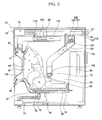
- FIG. 2 is a side view, in section, illustrating a washing machine with drying function, to which a drying control method according to the present invention is applied.
- the washing machine with drying function comprises: a cabinet 52 having a laundry inlet/outlet hole 51 for allowing the laundry m to pass therethrough; a tub 60 disposed in a cabinet 52; a drum 80 mounted inside the tub 60 for receiving the laundry to be washed and dried; a motor 90 attached to the tub 60 for rotating the drum 80; a door 100 hingedly connected to the cabinet 52 for opening and closing the front part of the drum 80; a heater duct 110 disposed on the tub 60, having a drying heater 103 and a blower 106 mounted therein, for supplying hot air into the tub 60; a condensing duct 120 connected to the heater duct 110 at the rear end of the tub 60 for condensing moisture contained in air used to dry the laundry m; and a cooling water supply unit 130 for supplying cooling water into the condensing duct 120.
- the cabinet 52 forms the external appearance of the washing machine with drying function.
- the cabinet 52 is provided at the upper front part thereof or the top part thereof with a control panel 53 for controlling operating modes and time of the washing machine with drying function.
- the tub 60 is disposed in the cabinet 52 while the tub 60 is supported by a damper 61 and springs 62 connected to the cabinet 52 in a shock-absorbing fashion.
- the tub 60 is provided with an opening hole 63, which is disposed at the rear of the laundry inlet/outlet hole 51.
- the tub 60 is horizontally disposed in the cabinet 52.
- a gasket 64 which is disposed between the opening hole 63 and the laundry inlet/outlet hole 51.
- the gasket 64 comes into tight contact with the door 100 when the door 100 is closed.
- the gasket 64 is provided with a tub inlet port 65, which is protruded from the gasket 64.
- the tub inlet port 65 is connected to the heater duct 110.
- a water supply unit 70 for supplying wash water.
- a drain port 72 At a predetermined position of the lower part of the tub 60 is formed a drain port 72, to which a drainage unit 74 is connected.
- a washing heater 76 for heating wash water in the tub during a washing operation of the Washing machine with drying function.
- a heater accommodating groove part 77 which is dented for accommodating the washing heater 76.
- a tub cooling water temperature sensor 78 for sensing the temperature of cooling water falling from the condensing duct 120 when a drying operation of the washing machine with drying function is performed.
- the tub cooling water temperature sensor 78 may serve as a sensor for measuring the temperature of wash water to stop electric current from being supplied to the washing heater 76 when the washing heater 76 is overheated.
- a duct communicating port 79 At the side of the tub 60 is formed a duct communicating port 79, to which the condensing duct 120 is connected.
- the drum 80 is provided with an opening hole 81, which is disposed at the rear of the laundry inlet/outlet hole 51.
- the drum 80 is horizontally disposed in the tub 60.
- the drum 80 is provided at the circumferential surface thereof or the rear surface thereof with through-holes 82.
- the blower 106 comprises: a circulating fan 107 rotatably disposed in the heater duct 110; and a fan motor 108 mounted in the heater duct 110 for rotating the circulating fan 107.
- a heated air temperature sensor 112 for measuring the temperature of air heated by the drying heater 103.
- the heated air temperature sensor 112 may serve to sense the temperature for preventing the laundry m from being damaged when air supplied to the drum 80 is overheated.
- a condensed air temperature sensor 122 for measuring the temperature of air whose moisture has been removed by the cooling water while the air passes through the condensing duct before the air is heated to perform various control of the drying operation of the washing machine with drying function.
- the condensed air temperature sensor 122 is disposed between the inlet part of the circulating fan 107 and a cooling water inlet port 134 of the cooling water supply unit 130 such that the temperature of the air sufficiently heat-exchanged with the cooling water can be measured by the condensed air temperature sensor 122 while the condensed air temperature sensor 122 does not contact water drops of the cooling water.
- a cooling water temperature sensor 123 Adjacent to the duct communicating port 79 in the lower part of the condensing duct 120 is mounted a cooling water temperature sensor 123 for measuring the temperature of cooling water used to condense moisture contained in the air passing through the condensing duct.
- the cooling water supply unit 130 comprises: a cooling water valve 132 connected to an external hose 131 for allowing cooling water supplied through the external hose 131 to pass therethrough or stopping cooling water supplied through the external hose 131 from passing therethrough; and a cooling water hose 133 for guiding the cooling water having passed through the cooling water valve 132 into the condensing duct 120.
- the cooling water inlet port 134 is formed at the end of the cooling water hose 133.
- the washing machine with drying function further comprises: a control unit (not shown) for controlling the drying operation of the laundry.
- the control unit receives temperature values sensed by the air temperature sensors 112 and 122 and the cooling water temperature sensors 78 and 123 to calculate total load and moisture content during the drying operation of the washing machine with drying function, and determines drying degree to fix the time when the drying operation is finished.
- the control unit is configured to control all the operations of the washing machine with drying function.
- the control unit is connected to the control panel 53 for inputting or outputting control signals to or from motors 90 and 108, the heaters 76 and 103, the sensors 78, 112, 122, and 123, and the valve 132 as well as the water supply and drainage units 70 and 74.
- the motor 90 When a drying operation of the washing machine with drying function is initiated, the motor 90 is operated according to a control signal of the control unit. As the motor 90 is operated, the drum 80 is rotated. At the same time, the circulating fan and the drying heater 103 in the heater duct 110 are operated, and the cooling water valve 132 is opened such that cooling water is supplied into the condensing duct 120.
- the air in the drum 80 passes through the condensing duct 120 and the heater duct 110, and is then supplied again into the drum 80. In this way, the air is circulated. At this time, the air contacting the laundry while passing through the drum 80 removes heat and moisture from the laundry. As a result, the air is changed into low-temperature and high-humidity air. The low-temperature and high-humidity air is introduced into the condensing duct 120. While passing through the condensing duct 120, the air is condensed by cooling water, and therefore, moisture is partially removed from the air. The air having passed through the condensing duct 120 is heated by the heater 103 while passing through the heater duct 110. As a result, the air is changed into hot wind. The hot wind is supplied into the drum 80. In this way, the air is repeatedly circulated to dry the laundry.
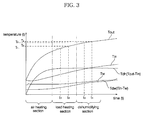
- FIG. 3 is a graph illustrating drying temperature change curves and differences in various sections of the washing machine with drying function according to the present invention
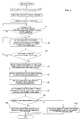
- FIG. 4 is a flow chart illustrating a drying control method for washing machines with drying functions according to the present invention
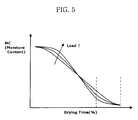
- FIG. 5 is a graph illustrating relations between the change in moisture content contained in the laundry and drying time in percent based on drying load of the washing machine with drying function according to the present invention.
- the drying operation of the washing machine with drying function is performed through an air heating section where the interior of the drum 80 and the circulating air are heated, a load heating section where the laundry and the moisture contained in the laundry are heated after the air heating section, and a dehumidifying section where moisture is removed from the laundry after the load heating section, based on drying progress time and change in temperature.
- the air heating section air in the washing machine with drying function is heated. Consequently, the temperature of the air is sharply increased as shown in FIG. 3.
- the load heating section heat exchange is performed between the heated air and the laundry or moisture contained in the laundry. Consequently, the temperature of the air is slowly increased.
- the dehumidifying section the moisture contained in the laundry is substantially evaporated such that the laundry is dried.
- Tout indicated in FIG. 3 is a curve illustrating the change in temperature of air heated by the heater 103, which is sensed by the heated air temperature sensor 112
- Tin indicated in FIG. 3 is a curve illustrating the change in temperature of air before being heated by the heater 103, which is sensed by the condensed air temperature sensor 122
- Tdh indicated in FIG. 3 is a curve illustrating the difference in temperature (Tout - Tin) between the heated air and the air before being heated.
- Tw indicated in FIG. 3 is a curve illustrating the change in temperature of cooling water, which is sensed by the tub cooling water temperature sensor 78.
- the temperature of cooling water may be sensed by the cooling water temperature sensor 123 disposed in the lower part of the condensing duct 120.
- Tdw indicated in FIG. 3 is a curve illustrating the difference in temperature (Tin - Tw) between the air before being heated by the heater 103 and the cooling water.
- total load which is the sum of the amount of the laundry and moisture content contained in the laundry, can be calculated using the fact that the temperatures are changed in the respective sections.
- the moisture content may be separately calculated from the total load.
- the total load and the moisture content may be calculated using not only the temperature (Tout) of air heated by the heater 103 but also the temperature (Tin) of air before being heated by the heater 103, since a ratio of the change in temperature of air heated by the heater 103 to the change in temperature of air before being heated by the heater 103 is nearly uniform.
- Tout temperature of air heated by the heater 103
- Tin temperature of air before being heated by the heater 103
- the determination at Step S1 is a standard for separating the air heating section from the load heating section, which is shown in FIG. 3. It is determined that transition from the air heating section to the load heating section is carried out if a slope of the change in temperature (Tout) of the heated air sensed by the heated air temperature sensor 112 or a slope of the change in temperature (Tdh) between the air before and after the heater 103 is below a predetermined level.
- the curve of the temperature (Tout) of the heated air and the curve of the difference in temperate (Tdh) between the air before and after being heated sharply ascend in the air heating section, and the curve of the temperature (Tout) of the heated air and the curve of the difference in temperate (Tdh) between the air before and after being heated slowly ascend or the difference in temperature is uniform in the load heating section. Consequently, it is determined that the drying operation of the washing machine with drying function is performed in the load heating section based on a slope of the change in temperature to the change in time.
- the slope of the change in temperature of the heated air to the change in time in the load heating section of FIG. 3 changes depending upon the dimensions of the total load. Consequently, the load is calculated using the slope of the change in temperature of the heated air to the change in time (S2).
- the load heating section is a section where air in the washing machine with drying function is heated to high temperature, and therefore, the laundry and the moisture contained in the laundry are substantially heated.
- a slope of the change in temperature (Tout) of the heated air to the change in time is relatively small in the load heating section.
- Tout change in temperature
- a slope of the change in temperature (Tout) of the heated air to the change in time is relatively large in the load heating section.
- M indicates masses of the laundry and water
- F specific heat ratio indicates masses of the laundry and water
- the fluctuation of the slope of the change in temperature of the heated air to the change in time is used at a specific region in the load heating section as described above, it is possible to calculate the total load, which is the sum of the amount of the laundry and the moisture content contained in the laundry.
- the specific region in the load heating section may be set based on a specific time range (t 1 - t 2 ) or a specific temperature range (T 1 - T 2 ). That is, the change in temperature is measured based on the specific time range (t 1 - t 2 ) in the load heating section to calculate a slope for calculating the total load, or the time required is measured based on the specific temperature range (T 1 - T 2 ) in the load heating section to calculate a slope for calculating the total load.
- the time is determined when transition from the load heating section to the dehumidifying section is carried out. At this time, it is determined, based on a specific temperature of approximately 100°C or more, whether moisture contained in the laundry is evaporated to substantially remove the moisture from the laundry (S3).
- the slope of the change in temperature of the heated air to the change in time in the dehumidifying section of FIG. 3 changes depending upon the moisture content contained in the laundry. Consequently, the moisture content is calculated using the slope of the change in temperature of the heated air to the change in time (S4).
- the dehumidifying section is a section where the total load in the drum (the amount of the laundry + the moisture content contained in the laundry) is sufficiently heated such that the moisture contained in the laundry is substantially evaporated and then removed.
- the dehumidifying section When the moisture content contained in the laundry is large, a slope of the change in temperature of the heated air to the change in time is relatively small in the dehumidifying section.
- a slope of the change in temperature of the heated air to the change in time is relatively large in the dehumidifying section.
- IMC indicates moisture content
- the calculation of the moisture content based on the fluctuation of the slope is possible by setting appropriate table values through several tests, as in the calculation of the total load as described above.
- the specific region in the dehumidifying section may be set based on a specific time range (t 3 - t 4 ) or a specific temperature range (T 3 - T 4 ), similarly to the setting of the specific region in the load heating section
- control unit controls the drying operation of the washing machine with drying function based on the calculated values.
- control unit estimates drying time using the calculated moisture content in consideration of the capacity and the real heating rate of the heater 103, and outputs the estimated drying time through the control panel 53 to inform a user of the estimated drying time (S5).
- the time necessary to dry the laundry during the drying operation of the washing machine with drying function is decided by the moisture content contained in the laundry, not the total load. Consequently, if the moisture content calculated as described above is used, the time is accurately estimated when the drying operation is finished. At this time, It is also possible to set control table values through several tests and to output estimated drying time based on the moisture content according to the table values.
- the drying time is estimated through the calculation of the total load and the moisture content as described above, and drying degree is determined using the difference (Tdw) between the temperature (Tin) of air before or after the heater 103 and the temperature (Tw) of the cooling water (S6).
- the temperature (Tw) of the cooling water condensing the moisture contained in the air while the air used to dry the laundry passes through the condensing duct 120 is measured by the cooling water temperature sensor 123 of the condensing duct 120 or the tub cooling water temperature sensor 78, and the temperature (Tin) of the air whose moisture has been removed while passing through the condensing duct 120 is measured by the heated air temperature sensor 112 or the condensed air temperature sensor 122.
- the drying degree of the laundry is determined, based on the difference (Tdw) between the temperature (Tw) of the cooling water and the temperature (Tin) of the air, to calculate the time when the drying operation is finished.
- the drying operation of the washing machine with drying function is finished at the time when the drying operation is finished according to the determination of the drying degree (S9).
- the drying operation of the washing machine with drying function is finished at the time when the estimated drying time based on the moisture content elapses or within the comparison error range (S10).
- the comparison error is below the predetermined level, it is determined that the determination of the drying degree is somewhat accurately performed, and the drying operation of the washing machine with drying function is finished according to the drying degree. Consequently, the drying operation of the washing machine with drying function is performed for a period of time, which almost corresponds to the estimated drying time based on the moisture content.
- the drying degree may be inaccurate when the door of the washing machine with drying function is opened, new laundry is put into the drum, or the amount of the laundry to be dried is small. It is determined that the calculation of the drying degree is not reliable when there is great difference between the time when the drying operation is finished according to the determination of the drying degree and the estimated drying time based on the moisture content. Consequently, the calculation of the drying degree is disregarded, or the drying operation of the washing machine with drying function is finished between the time when the estimated drying time elapses and the time when the drying operation is finished according to the determination of the drying degree.
- the drying control method for washing machines with drying functions/drying machines senses the change in temperature of air before and after the heater during a drying operation of the washing machine with drying function or the drying machine to calculate moisture content contained in the laundry, thereby more accurately estimating drying time, and controlling the drying operation more efficiently corresponding to various load conditions.
Landscapes
- Engineering & Computer Science (AREA)
- Textile Engineering (AREA)
- Control Of Washing Machine And Dryer (AREA)
- Main Body Construction Of Washing Machines And Laundry Dryers (AREA)
Applications Claiming Priority (1)
| Application Number | Priority Date | Filing Date | Title |
|---|---|---|---|
| KR1020040092561A KR100748963B1 (ko) | 2004-11-12 | 2004-11-12 | 세탁건조기/건조기의 건조 제어방법 |
Publications (2)
| Publication Number | Publication Date |
|---|---|
| EP1657351A2 true EP1657351A2 (de) | 2006-05-17 |
| EP1657351A3 EP1657351A3 (de) | 2009-01-21 |
Family
ID=35457979
Family Applications (1)
| Application Number | Title | Priority Date | Filing Date |
|---|---|---|---|
| EP05001445A Withdrawn EP1657351A3 (de) | 2004-11-12 | 2005-01-25 | Trocknungssteuerverfahren für eine Waschmachine mit Wäschetrocknungfunktionen/Wäschetrockner |
Country Status (4)
| Country | Link |
|---|---|
| US (1) | US20060101587A1 (de) |
| EP (1) | EP1657351A3 (de) |
| KR (1) | KR100748963B1 (de) |
| CN (1) | CN1773006A (de) |
Cited By (2)
| Publication number | Priority date | Publication date | Assignee | Title |
|---|---|---|---|---|
| WO2011019207A3 (ko) * | 2009-08-11 | 2012-05-10 | 엘지전자 주식회사 | 건조기 및 그 제어방법 |
| WO2013000904A1 (en) * | 2011-06-29 | 2013-01-03 | Electrolux Home Products Corporation N.V. | Method for operating a tumble dryer |
Families Citing this family (32)
| Publication number | Priority date | Publication date | Assignee | Title |
|---|---|---|---|---|
| KR100556503B1 (ko) * | 2002-11-26 | 2006-03-03 | 엘지전자 주식회사 | 건조기의 건조 시간제어 방법 |
| KR20060057779A (ko) * | 2004-11-24 | 2006-05-29 | 삼성전자주식회사 | 세탁기 |
| JP2006198149A (ja) * | 2005-01-20 | 2006-08-03 | Toshiba Corp | 乾燥機能付洗濯機 |
| KR100697020B1 (ko) | 2005-04-06 | 2007-03-20 | 엘지전자 주식회사 | 건조 겸용 세탁기 |
| KR101275553B1 (ko) * | 2006-06-09 | 2013-06-20 | 엘지전자 주식회사 | 세탁기 및 그 동작방법 |
| KR101085494B1 (ko) * | 2006-06-19 | 2011-11-23 | 삼성전자주식회사 | 세탁기 및 그 세탁제어방법 |
| US8312582B2 (en) * | 2006-06-19 | 2012-11-20 | Samsung Electronics Co., Ltd. | Washing machine and control method thereof |
| US8522380B2 (en) * | 2006-06-19 | 2013-09-03 | Samsung Electronics Co., Ltd. | Control method of washing machine |
| US7845199B2 (en) * | 2008-01-22 | 2010-12-07 | Bsh Home Appliances Corporation | Heating element retainer |
| CN101831781B (zh) * | 2009-03-10 | 2012-07-25 | 苏州三星电子有限公司 | 滚筒洗衣机的自动烘干方法 |
| KR101611270B1 (ko) * | 2009-03-19 | 2016-04-11 | 엘지전자 주식회사 | 무게감지장치를 갖는 건조기 및 이를 이용한 건조기제어방법 |
| KR101611276B1 (ko) * | 2009-08-05 | 2016-04-11 | 엘지전자 주식회사 | 무게감지장치를 갖는 건조기 및 이를 이용한 건조기 제어방법 |
| US8443527B2 (en) * | 2009-12-18 | 2013-05-21 | Whirlpool Corporation | Fabric temperature estimation for a laundry dryer |
| WO2011139097A2 (en) * | 2010-05-04 | 2011-11-10 | Lg Electronics Inc. | Control technology for clothes treatment apparatus |
| JP5793652B2 (ja) * | 2011-09-02 | 2015-10-14 | パナソニックIpマネジメント株式会社 | 衣類乾燥機および洗濯乾燥機 |
| US9080283B2 (en) * | 2011-10-06 | 2015-07-14 | Whirlpool Corporation | Method to control a drying cycle of a laundry treating appliance |
| AU2013244150B2 (en) | 2012-04-06 | 2016-02-11 | Lg Electronics Inc. | Laundry treating machine |
| CN102704238B (zh) * | 2012-06-13 | 2015-02-04 | 无锡小天鹅股份有限公司 | 一种滚筒洗衣机烘干判断方法 |
| DE102012216397A1 (de) * | 2012-09-14 | 2014-03-20 | BSH Bosch und Siemens Hausgeräte GmbH | Kondensationstrockner mit Ermittlung der Beladung sowie Verfahren zu seinem Betrieb |
| DE102014219379A1 (de) * | 2014-09-25 | 2016-03-31 | BSH Hausgeräte GmbH | Verfahren zum Betrieb eines Waschtrockners mit Schutz vor Temperaturschock sowie hierzu geeigneter Waschtrockner |
| US10301765B2 (en) | 2014-12-09 | 2019-05-28 | Lg Electronics Inc. | Dryer and control method thereof |
| CN104652089B (zh) * | 2015-02-03 | 2017-01-18 | 海信(山东)冰箱有限公司 | 一种获取洗衣机负载的方法和洗衣机 |
| CN106149331B (zh) * | 2015-04-17 | 2019-08-09 | 青岛海尔洗衣机有限公司 | 干衣机烘干时间的判断方法 |
| CN105926253B (zh) * | 2016-06-08 | 2018-11-20 | 海信(山东)冰箱有限公司 | 一种干衣机及其控制方法 |
| CN107541919B (zh) * | 2016-06-27 | 2020-05-22 | 青岛海尔滚筒洗衣机有限公司 | 一种根据干衣机出筒空气温度变化调节冷凝介质量的方法 |
| CN106854827B (zh) * | 2016-08-29 | 2020-11-03 | 青岛海尔滚筒洗衣机有限公司 | 一种干衣机判干方法 |
| CN108004718B (zh) * | 2016-10-27 | 2021-08-03 | 博西华电器(江苏)有限公司 | 衣物护理机及检测衣物护理机内衣物量的方法 |
| CN109402990B (zh) * | 2017-08-18 | 2022-04-22 | 青岛海尔滚筒洗衣机有限公司 | 衣物处理方法及衣物处理装置 |
| US20220341083A1 (en) * | 2019-09-04 | 2022-10-27 | Lg Electronics Inc. | Artificial intelligence dryer |
| US11028527B2 (en) * | 2019-09-27 | 2021-06-08 | Whirlpool Corporation | Laundry treating appliance for drying laundry |
| CN112575523B (zh) * | 2020-11-12 | 2022-03-29 | 珠海格力电器股份有限公司 | 一种洗干机烘干温度的控制方法、洗干机 |
| CN113062094B (zh) * | 2021-02-26 | 2022-06-14 | 无锡小天鹅电器有限公司 | 一种烘干控制方法、装置、衣物处理设备及存储介质 |
Family Cites Families (15)
| Publication number | Priority date | Publication date | Assignee | Title |
|---|---|---|---|---|
| CA1024240A (en) * | 1974-10-10 | 1978-01-10 | Gsw Limited - Gsw Limitee | Automatic regulation of drying time in a clothes drying machine |
| JPS58221996A (ja) * | 1982-06-17 | 1983-12-23 | 松下電器産業株式会社 | 衣類乾燥機 |
| US4738034A (en) * | 1985-12-16 | 1988-04-19 | Kabushiki Kaisha Toshiba | Drying machine |
| EP0573703A1 (de) * | 1992-06-10 | 1993-12-15 | Whirlpool Europe B.V. | Verfahren zum Optimieren der Trocknung in einem Wäschetrockner oder dergleichen und Maschine unter Verwendung dieses Verfahrens |
| KR950009117B1 (ko) * | 1993-01-11 | 1995-08-14 | 주식회사금성사 | 의류건조기의 건조시간 제어장치 및 방법 |
| DE4447270A1 (de) * | 1994-12-30 | 1996-07-04 | Bosch Siemens Hausgeraete | Verfahren zum Steuern von Trockenvorgängen in Haushalt-Wäschetrocknern |
| US5887456A (en) * | 1995-08-30 | 1999-03-30 | Sharp Kabushiki Kaisha | Drum type drying/washing machine |
| US6079121A (en) * | 1998-08-03 | 2000-06-27 | Ther-O-Disc, Incorporated | Humidity-modulated dual-setpoint temperature controller |
| US6199300B1 (en) * | 2000-03-01 | 2001-03-13 | Whirlpool Corporation | Method for energy efficient control of a dryer of clothes |
| US6401284B1 (en) * | 2000-04-04 | 2002-06-11 | Lg Electronics Inc. | Method for controlling washing during spinning in tilt-type washing machine for attenuation of vibration |
| KR100662768B1 (ko) * | 2001-01-20 | 2007-01-02 | 주식회사 엘지이아이 | 제습식 건조기의 건조정도 감지 장치 및 방법 |
| CA2364219C (en) * | 2001-11-29 | 2007-01-09 | Camco Inc. | Dryer control circuit |
| KR100480929B1 (ko) * | 2003-08-12 | 2005-04-07 | 엘지전자 주식회사 | 의류건조기의 건조 제어방법 |
| KR100803119B1 (ko) * | 2003-08-26 | 2008-02-14 | 엘지전자 주식회사 | 건조 겸용 드럼세탁기의 건조행정 제어방법 |
| US20050132599A1 (en) * | 2003-12-18 | 2005-06-23 | Lg Electronics Inc. | Drying method of washing machine and apparatus thereof |
-
2004
- 2004-11-12 KR KR1020040092561A patent/KR100748963B1/ko not_active Expired - Fee Related
-
2005
- 2005-01-11 US US11/032,168 patent/US20060101587A1/en not_active Abandoned
- 2005-01-25 EP EP05001445A patent/EP1657351A3/de not_active Withdrawn
- 2005-03-04 CN CNA2005100531321A patent/CN1773006A/zh active Pending
Cited By (5)
| Publication number | Priority date | Publication date | Assignee | Title |
|---|---|---|---|---|
| WO2011019207A3 (ko) * | 2009-08-11 | 2012-05-10 | 엘지전자 주식회사 | 건조기 및 그 제어방법 |
| AU2010283087B2 (en) * | 2009-08-11 | 2013-04-18 | Lg Electronics Inc. | Dryer and control method of the same |
| WO2013000904A1 (en) * | 2011-06-29 | 2013-01-03 | Electrolux Home Products Corporation N.V. | Method for operating a tumble dryer |
| CN103732823A (zh) * | 2011-06-29 | 2014-04-16 | 伊莱克斯家用产品股份有限公司 | 用于操作滚筒干燥机的方法 |
| US9695547B2 (en) | 2011-06-29 | 2017-07-04 | Electrolux Home Products Corporation N.V. | Method for operating a tumble dryer |
Also Published As
| Publication number | Publication date |
|---|---|
| US20060101587A1 (en) | 2006-05-18 |
| CN1773006A (zh) | 2006-05-17 |
| KR20060046995A (ko) | 2006-05-18 |
| EP1657351A3 (de) | 2009-01-21 |
| KR100748963B1 (ko) | 2007-08-13 |
Similar Documents
| Publication | Publication Date | Title |
|---|---|---|
| EP1657351A2 (de) | Trocknungssteuerverfahren für eine Waschmachine mit Wäschetrocknungfunktionen/Wäschetrockner | |
| EP2857576B1 (de) | Trocknungsvorrichtung und Verfahren zur Steuerung der Trocknungsvorrichtung | |
| KR100480930B1 (ko) | 의류건조기의 건조 잔류시간 검출방법 | |
| KR101235193B1 (ko) | 세탁기 및 그 제어방법 | |
| JP2006136730A (ja) | 洗濯乾燥機の乾燥制御装置およびその方法 | |
| KR20130064268A (ko) | 의류 건조기 및 그 제어방법 | |
| JP6104571B2 (ja) | 衣類乾燥機 | |
| US11773531B2 (en) | Method of operating a dryer appliance based on the remaining moisture content of a load of clothes | |
| EP1813706A1 (de) | Waschtrockner und Verfahren zur Steuerung derselben | |
| KR20250101994A (ko) | 의류처리장치 | |
| KR100748962B1 (ko) | 세탁건조기/건조기의 건조 제어 방법 | |
| KR100588741B1 (ko) | 세탁기의 자동 건조방법 | |
| JP7431103B2 (ja) | 洗濯乾燥機 | |
| JP5677825B2 (ja) | 洗濯乾燥機 | |
| KR100539540B1 (ko) | 건조 겸용 드럼세탁기 및 그를 이용한 자동 건조 방법 | |
| KR100539541B1 (ko) | 세탁기의 자동 건조 장치 및 그를 이용한 자동 건조 방법 | |
| JP7345082B2 (ja) | 衣類乾燥機 | |
| KR101155486B1 (ko) | 건조겸용 세탁기의 건조방법 | |
| JP2004344238A (ja) | 衣類乾燥機 | |
| JP4497063B2 (ja) | ドラム式洗濯機 | |
| JP4194411B2 (ja) | 乾燥装置 | |
| KR102808501B1 (ko) | 의류처리장치 | |
| KR20050111135A (ko) | 세탁기의 자동 건조방법 | |
| KR950004292B1 (ko) | 의류건조기의 건조방법 | |
| KR102828730B1 (ko) | 의류처리장치 |
Legal Events
| Date | Code | Title | Description |
|---|---|---|---|
| PUAI | Public reference made under article 153(3) epc to a published international application that has entered the european phase |
Free format text: ORIGINAL CODE: 0009012 |
|
| 17P | Request for examination filed |
Effective date: 20050125 |
|
| AK | Designated contracting states |
Kind code of ref document: A2 Designated state(s): AT BE BG CH CY CZ DE DK EE ES FI FR GB GR HU IE IS IT LI LT LU MC NL PL PT RO SE SI SK TR |
|
| AX | Request for extension of the european patent |
Extension state: AL BA HR LV MK YU |
|
| PUAL | Search report despatched |
Free format text: ORIGINAL CODE: 0009013 |
|
| AK | Designated contracting states |
Kind code of ref document: A3 Designated state(s): AT BE BG CH CY CZ DE DK EE ES FI FR GB GR HU IE IS IT LI LT LU MC NL PL PT RO SE SI SK TR |
|
| AX | Request for extension of the european patent |
Extension state: AL BA HR LV MK YU |
|
| RIC1 | Information provided on ipc code assigned before grant |
Ipc: D06F 58/28 20060101AFI20060309BHEP |
|
| AKX | Designation fees paid |
Designated state(s): DE FR GB |
|
| 17Q | First examination report despatched |
Effective date: 20110118 |
|
| STAA | Information on the status of an ep patent application or granted ep patent |
Free format text: STATUS: THE APPLICATION IS DEEMED TO BE WITHDRAWN |
|
| 18D | Application deemed to be withdrawn |
Effective date: 20110531 |