EP1657542A1 - Filtrage non-linéaire du décalage temporel de résonances de plasmon de surface - Google Patents
Filtrage non-linéaire du décalage temporel de résonances de plasmon de surface Download PDFInfo
- Publication number
- EP1657542A1 EP1657542A1 EP05014291A EP05014291A EP1657542A1 EP 1657542 A1 EP1657542 A1 EP 1657542A1 EP 05014291 A EP05014291 A EP 05014291A EP 05014291 A EP05014291 A EP 05014291A EP 1657542 A1 EP1657542 A1 EP 1657542A1
- Authority
- EP
- European Patent Office
- Prior art keywords
- spr sensorgram
- filter
- spr
- nonlinear
- sensorgram
- Prior art date
- Legal status (The legal status is an assumption and is not a legal conclusion. Google has not performed a legal analysis and makes no representation as to the accuracy of the status listed.)
- Withdrawn
Links
- 238000001914 filtration Methods 0.000 title claims abstract description 45
- 238000002198 surface plasmon resonance spectroscopy Methods 0.000 title description 130
- 230000036962 time dependent Effects 0.000 title 1
- 230000000877 morphologic effect Effects 0.000 claims description 15
- 238000005259 measurement Methods 0.000 description 22
- 238000000034 method Methods 0.000 description 19
- 230000003287 optical effect Effects 0.000 description 18
- 230000002463 transducing effect Effects 0.000 description 17
- 239000003446 ligand Substances 0.000 description 9
- 230000003851 biochemical process Effects 0.000 description 6
- 230000000630 rising effect Effects 0.000 description 6
- 230000006870 function Effects 0.000 description 4
- 239000000470 constituent Substances 0.000 description 3
- 238000001514 detection method Methods 0.000 description 3
- 238000010494 dissociation reaction Methods 0.000 description 3
- 230000005593 dissociations Effects 0.000 description 3
- 238000005070 sampling Methods 0.000 description 3
- 230000007704 transition Effects 0.000 description 3
- 238000010586 diagram Methods 0.000 description 2
- 230000003993 interaction Effects 0.000 description 2
- 239000012528 membrane Substances 0.000 description 2
- 102000004169 proteins and genes Human genes 0.000 description 2
- 108090000623 proteins and genes Proteins 0.000 description 2
- 230000004044 response Effects 0.000 description 2
- 230000006978 adaptation Effects 0.000 description 1
- 238000004458 analytical method Methods 0.000 description 1
- 230000008859 change Effects 0.000 description 1
- 238000012512 characterization method Methods 0.000 description 1
- 239000000084 colloidal system Substances 0.000 description 1
- 238000004590 computer program Methods 0.000 description 1
- 239000011521 glass Substances 0.000 description 1
- PCHJSUWPFVWCPO-UHFFFAOYSA-N gold Chemical compound [Au] PCHJSUWPFVWCPO-UHFFFAOYSA-N 0.000 description 1
- 239000010931 gold Substances 0.000 description 1
- 229910052737 gold Inorganic materials 0.000 description 1
- 238000009499 grossing Methods 0.000 description 1
- 238000012482 interaction analysis Methods 0.000 description 1
- 238000012986 modification Methods 0.000 description 1
- 230000004048 modification Effects 0.000 description 1
- 238000005457 optimization Methods 0.000 description 1
- 238000001847 surface plasmon resonance imaging Methods 0.000 description 1
Images


Classifications
-
- G—PHYSICS
- G01—MEASURING; TESTING
- G01N—INVESTIGATING OR ANALYSING MATERIALS BY DETERMINING THEIR CHEMICAL OR PHYSICAL PROPERTIES
- G01N21/00—Investigating or analysing materials by the use of optical means, i.e. using sub-millimetre waves, infrared, visible or ultraviolet light
- G01N21/17—Systems in which incident light is modified in accordance with the properties of the material investigated
- G01N21/55—Specular reflectivity
- G01N21/552—Attenuated total reflection
- G01N21/553—Attenuated total reflection and using surface plasmons
Definitions
- SPR Surface plasmon resonance
- An SPR measurement system relates detected changes in the resonant incidence angle or resonant optical wavelength to corresponding changes in the refractive index of the sample, typically in the form of an SPR sensorgram, which is a plot of the relative refractive index of the sample versus time.
- While SPR sensorgrams can be used to characterize biochemical processes within the samples based on relationships between the biochemical processes and refractive indices of the samples, the SPR sensorgrams include noise components that can mask or otherwise distort features of the SPR sensorgrams. Typically, the noise components are attributed to uncertainty in the measurement of relative refractive index of the samples by the SPR measurement system, or to mechanical events in the SPR measurement system, such as the opening or closing of valves that control the flow of buffer and analytes in the samples.
- Linear filtering is commonly used in signal processing to reduce noise components that are present on a signal.
- linear filtering such as lowpass filtering
- high frequency features such as sharp transitions in the SPR sensorgram are smoothed out, or eliminated.
- the sharp transitions may be indicative of a critical biochemical process or event, such as the onset of a binding event between analytes and ligands within the sample. Smoothing out or eliminating the sharp transitions in the SPR sensorgram may make it difficult to determine association/dissociation rates and other important indicators of biochemical processes.
- Linear filtering can also result in ringing when a signal includes outlying data points, discontinuities, or other anomalies, making biochemical processes or events depicted in the SPR sensorgram difficult to interpret.
- Filters based on Fourier Transforms, FIR (finite impulse response) filters, IIR (infinite impulse response) filters, and numerous other classes of linear filters may not be well-suited for reducing noise components in SPR sensorgrams due to the signal features of the SPR sensorgrams and the resulting shortcomings of the linear filters when applied to the SPR sensorgrams.
- a nonlinear filtering system determines the duration of a designated event in an SPR sensorgram, selects a filter length based on the determined duration of the designated event in the SPR sensorgram, and applies a nonlinear filter, having the selected filter length, to the SPR sensorgram to establish an output signal.
- FIG. 1 shows a conventional SPR measurement system 10.
- the SPR measurement system 10 includes an optical source 12 that provides optical stimuli 13 to an SPR transducer 14 and an optical detection/processing unit 16 that intercepts optical signals 15 that are reflected from the SPR transducer 14. Based on detection and processing of the reflected optical signals 15, the optical detection/processing unit 16 provides an SPR sensorgram 20 at an output device 18.
- the SPR measurement system 10 typically establishes SPR sensorgrams 20 using angle-based SPR wherein the optical source 12 provides optical stimuli 13 at various angles of incidence ⁇ INC relative to the SPR transducer 14, or the SPR sensorgrams 20 are established using wavelength-based SPR wherein the optical source 12 provides optical stimuli 13 to the SPR transducer 14 that include multiple optical wavelengths.
- the SPR transducers 14 included in the SPR measurement system 10 are well know in the art and can be constructed in a variety of ways.
- the SPR transducer 14 includes a prism 2, a glass slide 4 with a thin optically reflective backing 6, such as a gold film, and a dielectric, such as binding layer 8 that includes ligands L.
- the thin optically reflective backing 6 and binding layer 8 form a transducing interface 17 in the SPR transducer 14.
- Buffer B and analytes A are alternatively flowed past the binding layer 8 in a channel 9, typically formed in an elastomeric membrane, such as a polydimethylsilicone membrane.
- the flow of the buffer B and the analytes A is controlled according to a valve V that is coupled to the channel 9.
- the positions of the transducing interface 17 wherein the optical stimuli 13 are incident are referred to as targets Z.
- targets Z The positions of the transducing interface 17 wherein the optical stimuli 13 are incident.
- the SPR sensorgram 20 corresponds to the single target Z.
- multiple SPR sensorgrams 20 can be provided by the SPR measurement system 10, wherein each SPR sensorgram 20 corresponds to a designated one of the multiple targets Z.
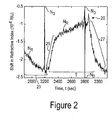
- FIG 2 shows one example of an SPR sensorgram 20 provided by the SPR measurement system 10 shown in Figure 1.
- the SPR sensorgram 20 represents the refractive index at the binding layer 8 of the transducing interface 17 versus time t.
- the refractive index is typically a relative refractive index, that indicates a shift or change in refractive index, depicted for example in micro-refractive index units (10 -6 RIU).
- a shift in refractive index represented in the SPR sensorgram 20 of Figure 2 is typically derived from a correspondence to a shift in resonance angle of the SPR transducer or to a shift in resonant wavelength of the SPR transducer 14, depending on the type of SPR measurement system 10 used to provide the SPR sensorgram 20.
- FIG. 2 shows one example of an SPR sensorgram
- SPR sensorgrams 20 are well known in the art and are shown in references such as Characterization and Optimization of a Real-Time, Parallel, Label-Free, Polypyrrole-Based DNA Sensor by Surface Plasmon Resonance Imaging, by Guedon et al., Analytical Chemistry, Vol. 72, No. 24, December 15, 2000, pages 6003-6009.
- SPR sensorgrams 20 depict.various physical or biochemical events that occur at the transducing interface 17 of the SPR transducer 14.
- a first portion 23 of the SPR sensorgram 20 shown in Figure 2 represents a time during which buffer B is flowing in the channel 9 past the transducing interface 17.
- a rising edge 25 on the SPR sensorgram 20 represents a biochemical event wherein analytes A flow in the channel 9 past the transducing interface 17 and bind to the ligands L at the transducing interface 17.
- the slope or steepness of the rising edge 25 of the SPR sensorgram 20 indicates the binding rates between the ligands L and the analytes A at the transducing interface 17.
- a trailing edge 27 of the SPR sensorgram 20 indicates dissociation of the analytes A and the ligands L.
- the rising edge 25 and falling edge 27 of the SPR sensorgram 20 depict the binding kinetics at the transducing interface 17, and can provide association/dissociation constants at the transducing interface 17 of the SPR transducer 14.
- An event interval T between the rising edge 25 and the falling edge 27 of the SPR sensorgram 20 corresponds to a gating interval during which the valve V is set to a flow position that directs analytes A to the channel 9.
- the event interval T is offset in time from the gating interval by a delay that is based on the flow rate of the buffer B and the analytes A through the channel 9, and the distance between the valve V and the transducing interface 17.
- Figure 2 also indicates the various noise components that are present on the SPR sensorgram 20.
- One noise component is statistical or random noise N R .
- This random noise N R is related to uncertainty in the measurements of refractive indices at the transducing interface 17 and produces the jitter that is present on the SPR sensorgram 20.
- Outlying data points N D are another noise component on the SPR sensorgram 20.
- the outlying data points N D are typically one or more switching transients due to the opening or closing of the valve V. However, the outlying data points N D can be due to any other type of perturbations or disruptions in the SPR measurement system 10.
- the length or duration of the outlying data points N D is typically shorter than the event interval T, between the rising edge 25 and the falling edge 27 of the SPR sensorgram 20.
- This length or duration can be expressed in units of time t, or as a number of data points n.
- the outlying data points N D in the SPR sensorgram 20 show up as narrow spikes that are typically less than several data points in length or duration.
- the random noise N R has constituents or components of various length or duration.
- the nonlinear filtering system 40 according to embodiments of the present invention provides filtering of the noise components N R , N D on the SPR sensorgram 20 that are shorter in length or duration than the event interval T.
- the outlying data points N D and random noise N R that have shorter duration than the event interval T can be reduced, or eliminated from the SPR sensorgram 20 by application of the nonlinear filtering system 30 to the SPR sensorgram 20
- FIG 3 shows a flow diagram of the nonlinear filtering system 30.
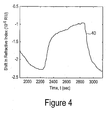
- the nonlinear filtering system 30 includes determining the duration of a designated event in an SPR sensorgram 20 (step 32), selecting a filter length F based on the determined duration of the designated event in the SPR sensorgram 20 (step 34), and applying a nonlinear filter having the selected filter length F to the SPR sensorgram 20 to establish an output signal 40 (step 36).
- the designated event in the SPR sensorgram 20 occurs within the event interval T between the rising edge 25 and the falling edge 27 of the SPR sensorgram 20 shown in Figure 2.
- the event interval T corresponds to the time duration within which ligands L and analytes A interact at the transducing interface 17 of the SPR transducer 14.
- the designated event interval T has a duration in time of approximately 600 seconds, and the sampling rate or data acquisition rate R S is approximately one sample per three seconds.
- the event interval T of the designated event, or the designated event in the SPR sensorgram 20 can vary depending on the configuration of the SPR measurement system 10, the type of SPR transducer 14, the characteristics of the buffer B, the analytes A and the ligands L, the flow rate of the buffer B and analytes A in the channel 9, the configuration of the channel 9, the gating interval during which the valve V is set to a flow position that directs analytes A to the channel 9, or any of a variety of parameters or factors that influence the SPR sensorgram 20.
- the filter length F in the nonlinear filtering system 30 is typically expressed in terms of a number of data points. Typically, the filter length F is selected to not exceed 2*N 1 , or twice the duration N 1 of the designated event, expressed as a number of data points. In the example where the duration N 1 of the event interval T is 200 data points, the filter length F is selected to be less than 401 data points. Generally, a longer filter length provides greater filtering of the SPR sensorgram 20 than a shorter filter length provides. However, selecting the filter length F to be greater than or equal to 2N 1 +1 would result in filtering that reduces or eliminates the event interval T of duration N 1 as well as the noise components N S , N D of shorter length or duration.
- the filter length F is selected not to exceed twice the duration N 1 of the designated event, but longer than twice the length or duration of the outlying data points N D .
- This selection of the filter length F provides for adequate filtering of the outlying data points N D of the SPR sensorgram 20 and also reduces or eliminates constituents or components of the random noise N R that are less than half the filter length F.
- the filter length F can be adjusted within the selected range previously indicated, based on the length or duration of the outlying data points N D , the constituents of the random noise N R , and the duration of designated events within the SPR sensorgram 20.
- applying the nonlinear filter having the selected filter length F to the SPR sensorgram 20 in step 36 of the nonlinear filtering system 30 includes applying a median filter to the SPR sensorgram 20.
- the data points X(i) of the SPR sensorgram 20 can be left unchanged in the output signal 40, or the sample points of the SPR sensorgram 20 can be set to a constant in the output signal 40.
- smaller median filters that is median filters with a filter length substantially less than the selected filter length F, can be applied within the undefined portions i ⁇ N or i>S-N of the signal Y.
- the values Y(i) of the signal Y representing the output signal 40 can be obtained using comparisons, such as the " ⁇ " operation, to order successive sets of data points within the SPR sensorgram 20. Once ordered, the median of the data points can be readily selected, enabling the values Y(i) to be obtained using a computer program, an FPGA (field programmable gate array), an ASIC (application-specific integrated circuit), or any other suitable signal processor.
- the values Y(i) of the signal Y are obtained using a running median filter, such as "median 1" available in MatlabTM, to provide the output signal 40.
- applying the nonlinear filter to the SPR sensorgram 20 as in step 46 includes applying any of a variety of morphological filters to the data points X(i) within the SPR sensorgram 20 to provide the output signal 40.
- Morphological filters are known in the art and are described in references such as Signal Analysis: Time, Frequency, Scale and Structure, by Ronald L. Allen and Duncan W. Mills, IEEE Press, ISBN 0-471-23441-9, pages 321-326.
- the filter length F of the morphological filter is also established in step 34 based on the duration of the designated event that is determined in step 32.
- Applying the morphological filter includes selecting a discrete function, called a structuring element h(i), where the index i is in the range - N ⁇ i ⁇ N.
- the values of the structuring element h(i) are typically designated to be greater than zero to provide adequate nonlinear filtering of the SPR sensorgram 20.
- Applying the morphological filter to the SPR sensorgram 20 also includes defining an ERODE procedure ERODE(s, h) and a DILATE procedure DILATE(s,h) for a designated signal s(i), with 0 ⁇ i ⁇ P, and the structuring element h(i), with -N ⁇ i ⁇ N.
- ERODE procedure and the DILATE procedure are typically implemented as functions, subroutines, procedures or methods in C, JAVA, MatlabTM or other suitable computer language or program.
- E(i) min ⁇ s(i-N)-h(-N), s(i-N+1)-h(-N+1),..., s(i)-h(0),..., s(i+N-1)-h(N-1), s(i+N)-h(N) ⁇ .
- D(i) max ⁇ s(i-N)+h(-N), s(i-N+1)+h(-N+1),..., s(i)+h(0),..., s(i+N-1)+h(N-1), s(i+N)+h(N) ⁇ .
- OPEN procedure OPEN(s,h) and a CLOSE procedure CLOSE(s,h) are also defined in the application of the morphological filter to the SPR sensorgram 20 in step 46.
- the OPEN procedure and the CLOSE procedure are typically implemented as functions, subroutines, procedures or methods in C, JAVA, MATLAB or other suitable computer language or program.
- O the output of the OPEN procedure OPEN(s,h), the output E of ERODE(s, h) and the output D of DILATE(E,h) are computed. Then, the output D is assigned to O, the output of the OPEN procedure OPEN(s,h).
- Applying the morphological filtering to the signal X that represents the SPR sensorgram 20 to produce the output signal 40 includes establishing M, the output of the morphologically filtered signal MORPH(X,h). Then, the signal Y is set to M.
- the output D of DILATE(s,h) and the output E of ERODE(s, h) being undefined for 0 ⁇ i ⁇ N or P-N ⁇ i ⁇ P, there are values Y(i) of the signal Y that are undefined.
- the data points X(i) of the SPR sensorgram 20 can be left unchanged in the output signal 40, or the sample points of the SPR sensorgram 20 can be set to a constant in the output signal 40.
- smaller morphological filters that is morphological filters with a filter length substantially less than the selected filter length F, can be applied within the undefined portions of the signal Y.
- applying the nonlinear filter to the SPR sensorgram 20 includes applying any suitable function to the data points X(i) of the SPR sensorgram 20 that nonlinear filters the SPR sensorgram 20 according to the duration of events within the SPR sensorgram 20.
- the nonlinear filtering system 30 provides an output signal 40 from an SPR sensorgram 20, wherein outlying data points N D and random noise N R are eliminated or substantially reduced.
- the output signal 40 is a processed SPR sensorgram that accurately indicates biochemical processes or conditions at the transducing interface 17 of the SPR transducer 14, enabling binding kinetics, even for ligands and analytes with weak interactions, to be accurately determined.
- the nonlinear filtering system 30 is readily implemented in software or hardware, or using a computer or other processor, either internal or external to the SPR measurement system 10.
- the nonlinear filtering system 30 can be stored on a computer readable medium.
Landscapes
- Physics & Mathematics (AREA)
- Health & Medical Sciences (AREA)
- Life Sciences & Earth Sciences (AREA)
- Chemical & Material Sciences (AREA)
- Analytical Chemistry (AREA)
- Biochemistry (AREA)
- General Health & Medical Sciences (AREA)
- General Physics & Mathematics (AREA)
- Immunology (AREA)
- Pathology (AREA)
- Investigating Or Analysing Materials By Optical Means (AREA)
Applications Claiming Priority (1)
| Application Number | Priority Date | Filing Date | Title |
|---|---|---|---|
| US10/971,604 US7230714B2 (en) | 2004-10-22 | 2004-10-22 | Nonlinear filtering for events in SPR sensing |
Publications (1)
| Publication Number | Publication Date |
|---|---|
| EP1657542A1 true EP1657542A1 (fr) | 2006-05-17 |
Family
ID=35115854
Family Applications (1)
| Application Number | Title | Priority Date | Filing Date |
|---|---|---|---|
| EP05014291A Withdrawn EP1657542A1 (fr) | 2004-10-22 | 2005-06-30 | Filtrage non-linéaire du décalage temporel de résonances de plasmon de surface |
Country Status (3)
| Country | Link |
|---|---|
| US (1) | US7230714B2 (fr) |
| EP (1) | EP1657542A1 (fr) |
| CN (1) | CN1763506A (fr) |
Cited By (3)
| Publication number | Priority date | Publication date | Assignee | Title |
|---|---|---|---|---|
| WO2011016769A1 (fr) * | 2009-08-04 | 2011-02-10 | General Electric Company | Filtre linéaire adaptatif pour réduction de bruit en temps réel dans des systèmes de résonance à plasmons de surface |
| WO2011123026A1 (fr) * | 2010-03-29 | 2011-10-06 | Ge Healthcare Bio-Sciences Ab | Filtre linéaire adaptable destiné à la diminution en temps réel du bruit dans des sensorgrammes de résonance plasmonique de surface |
| CN110702642A (zh) * | 2019-10-29 | 2020-01-17 | 西南大学 | 一种微井结构SPRi芯片的制备方法及其产品和应用 |
Families Citing this family (7)
| Publication number | Priority date | Publication date | Assignee | Title |
|---|---|---|---|---|
| JP4664298B2 (ja) * | 2004-08-24 | 2011-04-06 | 富士フイルム株式会社 | 表面プラズモン共鳴分析における解離定数の算出方法 |
| EP4053546A1 (fr) * | 2007-12-06 | 2022-09-07 | Genalyte, Inc. | Dispositif et procédé pour effectuer une surveillance sans étiquette des procédés. |
| US8557184B2 (en) | 2008-01-09 | 2013-10-15 | University Of Florida Research Foundation, Inc. | Devices and methods for measuring the acidity of airborne matter using UV-visible spectrometry |
| EP2237022B1 (fr) * | 2008-01-16 | 2020-05-06 | Nippon Telegraph and Telephone Corporation | Dispositif et methode de mesure d'un debit |
| EP3572796B8 (fr) | 2008-10-27 | 2023-01-18 | Genalyte, Inc. | Biocapteurs basés sur le sondage et la détection optiques |
| EP2635710B1 (fr) | 2010-11-05 | 2017-08-09 | Genalyte, Inc. | Systèmes optiques de détection d'analytes et leurs procédés d'utilisation |
| WO2014143637A1 (fr) | 2013-03-15 | 2014-09-18 | The Board Of Trustees Of The University Of Illinois | Procédés et compositions pour améliorer les tests immunologiques |
Citations (3)
| Publication number | Priority date | Publication date | Assignee | Title |
|---|---|---|---|---|
| EP0969283A1 (fr) * | 1998-06-25 | 2000-01-05 | Hewlett-Packard Company | Procédé de traitement de données de mesures |
| US20020063208A1 (en) * | 2000-11-27 | 2002-05-30 | Surromed, Inc. | Median filter for liquid chromatography-mass spectrometry data |
| WO2003081245A1 (fr) * | 2002-03-27 | 2003-10-02 | Biacore Ab | Procede, systeme et programme de detection des interactions de liaison moleculaire impliquant le controle de qualite exprime par des courbes de reponse |
-
2004
- 2004-10-22 US US10/971,604 patent/US7230714B2/en not_active Expired - Lifetime
-
2005
- 2005-06-30 EP EP05014291A patent/EP1657542A1/fr not_active Withdrawn
- 2005-10-24 CN CN200510114534.8A patent/CN1763506A/zh active Pending
Patent Citations (3)
| Publication number | Priority date | Publication date | Assignee | Title |
|---|---|---|---|---|
| EP0969283A1 (fr) * | 1998-06-25 | 2000-01-05 | Hewlett-Packard Company | Procédé de traitement de données de mesures |
| US20020063208A1 (en) * | 2000-11-27 | 2002-05-30 | Surromed, Inc. | Median filter for liquid chromatography-mass spectrometry data |
| WO2003081245A1 (fr) * | 2002-03-27 | 2003-10-02 | Biacore Ab | Procede, systeme et programme de detection des interactions de liaison moleculaire impliquant le controle de qualite exprime par des courbes de reponse |
Non-Patent Citations (1)
| Title |
|---|
| C. L. DO LAGO, V. F. JULIANO, C. KASCHERES: "Applying moving median digital filter to mass spectrometry and potentiometric titration", ANALYTICA CHIMICA ACTA, vol. 310, no. 2, 30 June 1995 (1995-06-30), pages 281 - 288, XP002365093 * |
Cited By (10)
| Publication number | Priority date | Publication date | Assignee | Title |
|---|---|---|---|---|
| WO2011016769A1 (fr) * | 2009-08-04 | 2011-02-10 | General Electric Company | Filtre linéaire adaptatif pour réduction de bruit en temps réel dans des systèmes de résonance à plasmons de surface |
| JP2013501236A (ja) * | 2009-08-04 | 2013-01-10 | ゼネラル・エレクトリック・カンパニイ | 表面プラズモン共鳴システムでのリアルタイムのノイズ低減のための適応線形フィルタ |
| EP2462427A4 (fr) * | 2009-08-04 | 2013-03-27 | Gen Electric | Filtre linéaire adaptatif pour réduction de bruit en temps réel dans des systèmes de résonance à plasmons de surface |
| WO2011123026A1 (fr) * | 2010-03-29 | 2011-10-06 | Ge Healthcare Bio-Sciences Ab | Filtre linéaire adaptable destiné à la diminution en temps réel du bruit dans des sensorgrammes de résonance plasmonique de surface |
| CN102884418A (zh) * | 2010-03-29 | 2013-01-16 | 通用电气健康护理生物科学股份公司 | 自适应线性滤波器用于表面等离子共振传感图中实时降噪 |
| JP2015227886A (ja) * | 2010-03-29 | 2015-12-17 | ジーイー・ヘルスケア・バイオサイエンス・アクチボラグ | 表面プラズモン共鳴センサグラムのリアルタイムノイズ低減のための適応線形フィルタ |
| US9377403B2 (en) | 2010-03-29 | 2016-06-28 | Ge Healthcare Bio-Sciences Ab | Adaptive linear filter for real time noise reduction in surface plasmon resonance sensorgrams |
| CN102884418B (zh) * | 2010-03-29 | 2016-08-03 | 通用电气健康护理生物科学股份公司 | 自适应线性滤波器用于表面等离子共振传感图中实时降噪 |
| CN110702642A (zh) * | 2019-10-29 | 2020-01-17 | 西南大学 | 一种微井结构SPRi芯片的制备方法及其产品和应用 |
| CN110702642B (zh) * | 2019-10-29 | 2022-03-18 | 西南大学 | 一种微井结构SPRi芯片的制备方法及其产品和应用 |
Also Published As
| Publication number | Publication date |
|---|---|
| CN1763506A (zh) | 2006-04-26 |
| US7230714B2 (en) | 2007-06-12 |
| US20060087656A1 (en) | 2006-04-27 |
Similar Documents
| Publication | Publication Date | Title |
|---|---|---|
| US7230714B2 (en) | Nonlinear filtering for events in SPR sensing | |
| US7623246B2 (en) | Optical sensing devices with SPR sensors based on differential phase interrogation and measuring method using the same | |
| EP2237022B1 (fr) | Dispositif et methode de mesure d'un debit | |
| JP6059772B2 (ja) | 表面プラズモン共鳴センサグラムのリアルタイムノイズ低減のための適応線形フィルタ | |
| US8045173B2 (en) | Adaptive linear filter for real time noise reduction in surface plasmon resonance systems | |
| Roy | Surface plasmon resonance spectroscopy of dielectric coated gold and silver films on supporting metal layers: reflectivity formulas in the Kretschmann formalism | |
| JP2013524210A5 (fr) | ||
| CN101059436A (zh) | 非扫描式智能数字化集成spr检测器 | |
| WO2011065913A1 (fr) | Procédé et système pour l'analyse d'un comportement de liaison | |
| EP1893978A2 (fr) | Procede et systeme d'analyse par affinite | |
| EP3619519B1 (fr) | Dispositif et procede de mesure et de suivi de la quantite ou concentration d'un composant dans un fluide | |
| WO2017055461A1 (fr) | Procédé et système permettant d'améliorer l'évaluation d'une interaction entre un analyte et un ligand à l'aide d'un biocapteur | |
| US7219528B2 (en) | Sample flow positioning method and analytical system using the method | |
| CN104237169B (zh) | 一种基于外场调制的spr检测系统的检测方法 | |
| Chinowsky et al. | Data analysis and calibration for a bulk-refractive-index-compensated surface plasmon resonance affinity sensor | |
| CN1119645C (zh) | 相位/光强复合型生物分子相互作用实时检测方法及系统 | |
| RU2416803C2 (ru) | Лазерный доплеровский анализатор | |
| JP2003172694A (ja) | 全反射減衰を利用したセンサー | |
| WO2024122130A1 (fr) | Puce de mesure, dispositif de mesure et procédé de mesure | |
| AU2004297498B2 (en) | Sample flow positioning method and analytical system using the method | |
| CN1337573A (zh) | 基于液滴体积的光谱液滴分析系统 | |
| WO2024165605A1 (fr) | Procédé et système d'analyse d'interaction analyte-ligand | |
| Huang et al. | Subsection-filtering method applied in optoelectronic signal processing of the liquid drop analyzer |
Legal Events
| Date | Code | Title | Description |
|---|---|---|---|
| PUAI | Public reference made under article 153(3) epc to a published international application that has entered the european phase |
Free format text: ORIGINAL CODE: 0009012 |
|
| AK | Designated contracting states |
Kind code of ref document: A1 Designated state(s): AT BE BG CH CY CZ DE DK EE ES FI FR GB GR HU IE IS IT LI LT LU MC NL PL PT RO SE SI SK TR |
|
| AX | Request for extension of the european patent |
Extension state: AL BA HR LV MK YU |
|
| 17P | Request for examination filed |
Effective date: 20060816 |
|
| 17Q | First examination report despatched |
Effective date: 20060911 |
|
| STAA | Information on the status of an ep patent application or granted ep patent |
Free format text: STATUS: THE APPLICATION HAS BEEN WITHDRAWN |
|
| 18W | Application withdrawn |
Effective date: 20061213 |