EP1657649A2 - Procédé de lecture de documents comprenant des séquences altérées, et dispositif de lecture associé - Google Patents
Procédé de lecture de documents comprenant des séquences altérées, et dispositif de lecture associé Download PDFInfo
- Publication number
- EP1657649A2 EP1657649A2 EP05256906A EP05256906A EP1657649A2 EP 1657649 A2 EP1657649 A2 EP 1657649A2 EP 05256906 A EP05256906 A EP 05256906A EP 05256906 A EP05256906 A EP 05256906A EP 1657649 A2 EP1657649 A2 EP 1657649A2
- Authority
- EP
- European Patent Office
- Prior art keywords
- schema
- document
- conversion
- xml
- local
- Prior art date
- Legal status (The legal status is an assumption and is not a legal conclusion. Google has not performed a legal analysis and makes no representation as to the accuracy of the status listed.)
- Granted
Links
Images

Classifications
-
- G—PHYSICS
- G06—COMPUTING OR CALCULATING; COUNTING
- G06F—ELECTRIC DIGITAL DATA PROCESSING
- G06F16/00—Information retrieval; Database structures therefor; File system structures therefor
- G06F16/80—Information retrieval; Database structures therefor; File system structures therefor of semi-structured data, e.g. markup language structured data such as SGML, XML or HTML
- G06F16/84—Mapping; Conversion
- G06F16/88—Mark-up to mark-up conversion
-
- G—PHYSICS
- G06—COMPUTING OR CALCULATING; COUNTING
- G06F—ELECTRIC DIGITAL DATA PROCESSING
- G06F40/00—Handling natural language data
- G06F40/10—Text processing
- G06F40/12—Use of codes for handling textual entities
- G06F40/14—Tree-structured documents
- G06F40/143—Markup, e.g. Standard Generalized Markup Language [SGML] or Document Type Definition [DTD]
-
- G—PHYSICS
- G06—COMPUTING OR CALCULATING; COUNTING
- G06F—ELECTRIC DIGITAL DATA PROCESSING
- G06F40/00—Handling natural language data
- G06F40/10—Text processing
- G06F40/12—Use of codes for handling textual entities
- G06F40/151—Transformation
- G06F40/154—Tree transformation for tree-structured or markup documents, e.g. XSLT, XSL-FO or stylesheets
-
- Y—GENERAL TAGGING OF NEW TECHNOLOGICAL DEVELOPMENTS; GENERAL TAGGING OF CROSS-SECTIONAL TECHNOLOGIES SPANNING OVER SEVERAL SECTIONS OF THE IPC; TECHNICAL SUBJECTS COVERED BY FORMER USPC CROSS-REFERENCE ART COLLECTIONS [XRACs] AND DIGESTS
- Y10—TECHNICAL SUBJECTS COVERED BY FORMER USPC
- Y10S—TECHNICAL SUBJECTS COVERED BY FORMER USPC CROSS-REFERENCE ART COLLECTIONS [XRACs] AND DIGESTS
- Y10S707/00—Data processing: database and file management or data structures
- Y10S707/99941—Database schema or data structure
- Y10S707/99943—Generating database or data structure, e.g. via user interface
Definitions
- This disclosure relates generally to systems and methods for converting legacy documents into XML format.
- XML is the modern industry standard for data exchange across service and enterprise boundaries. It is becoming a significantly common practice to use XML as the underlying data model for information organization, exchange and reuse.
- DTDs Data Type Definitions
- W3C XML Schemas Relax NG
- Data-oriented XML refers to well-structured data and storage systems such as databases and transactional systems. Migration of this kind of data toward XML poses no serious problems, since data is already well-structured and ready for machine-oriented processing. However, problems associated with migrating documents toward XML are more serious and numerous. Documents of the type that often form corporate or group or personal knowledge bases, are unstructured or semi-structured, i.e., they are stored in generic or specialized file systems, in a multitude of formats and forms.
- Transformation or conversion of legacy documents into XML documents may be seen as close to the wrapping of Web sources (since it addresses the migration of semi-structured Web documents into the global target schema). While wrapping copes with the extraction of (10 or fewer) elements from simple and regular Web pages and presenting them as plain tuples, conversion or transformation of other kinds of legacy documents in electronic formats must deal with hundreds of elements interrelated in a complex manner (guided by the target schema) and no unique method (including wrapper writing or induction) would work well.
- a method for converting a legacy document into an eXtended Markup Language (XML) document includes decomposing the legacy document into a plurality of document portions; providing a targetXML schema comprising a plurality of schema components for defining an output XML document; generating a plurality of local schema from the target XML schema, each local schema comprising at least one of the schema components; generating a plurality of conversion tasks by associating a local schema and an applicable document portion, wherein each conversion task associates data from the applicable document portion with the applicable schema component in the local schema; for each conversion task, selecting a conversion method and performing the conversion method; and assembling results from the conversion tasks and the target XML schema into the output XML document.
- XML eXtended Markup Language
- XML schemas define the structure, content and semantics of XML documents.
- An XML schema is a set of schema components.
- a schema component is the generic term for the building blocks that make up the abstract data model of the schema. Schemas describe what types of nodes may appear in documents and which hierarchical relationships such nodes may have.
- a schema is typically represented by an extended context-free grammar. A tree is an instance of this schema if it is a parse tree of that grammar.
- the purpose of a target XML schema is to define and describe a class of XML documents by using schema components to constrain and document the meaning, usage and relationships of their constituent parts: data types, elements and their content and attributes and their values.
- Schemas may also provide for the specification of additional document information, such as normalization and defaulting of attribute and element values. Schemas have facilities for self-documentation. Thus XML schema can be used to define, describe and catalogue XML vocabularies for classes of XML documents.
- an XML schema specifies constraints on the structures and types of elements in an XML document.
- the basic schema for XML is the DTD (Document Type Definition).
- Other XML schema definitions are also being developed, such as DCD (Document Content Definition), W3C XML Schema, etc.
- DTD Document Type Definition
- DCD Document Content Definition
- W3C XML Schema W3C XML Schema is similar to DCD in this respect.
- the goals and constraint semantics for all these XML schema languages are the same. Their commonality is that they all describe schema for XML documents. This means that they assume the common XML structure, and provide a description language to say how these elements are laid out and are related to each other.
- the legacy document may be first converted into a standard representation format, such as (X)HTML, prior to decomposing it into document portions.
- a standard representation format such as (X)HTML
- Many commercially available products are available for converting Word, PDF, etc. documents into (X)HTML.
- the method for converting a legacy document into an XML document may be thought of as including a global decomposition task T.
- each conversion task T i is a pair (D i , S i ) where D i is the document portion associated with local schema S i .
- Validating the plurality of conversion tasks T i includes determining if T is complete, wherein T is complete if all T i are data disjoint and schema independent, wherein T i is data disjoint if all D i and D j do not overlap and T i is schema independent if all S i and S j have no joint components.
- Selecting a conversion method may include selecting a method from a library of methods including ad hoc converters, structure recognizers, machine learning methods and intra-document clustering methods.
- a system for converting a legacy document into an XML document includes a decomposer for decomposing the legacy document into a plurality of document portions; a memory storing a target XML schema for defining an output XML document, comprising a plurality of schema components, and storing a plurality of conversion methods; a local schema generator for generating a plurality of local schema from the target XML schema, each local schema comprising at least one of the schema components; a conversion task generator for generating a plurality of conversion tasks by associating a local schema and an applicable document portion, wherein each conversion task associates data from the applicable document portion with the applicable schema component in the local schema; a task processor, for each conversion task, for selecting a conversion method from memory and for performing the conversion method; and an assembler for assembling output from the task processor into the output XML document.
- the system and method provides a general framework for decomposing complex XML transformations into smaller, easier to handle tasks (local transformations), and recombining the results. It also defines a simple declarative language for expressing the decomposition/assembly process. Because of the complexity of source legacy documents and target XML schema, the conversion can be achieved not by means of a unique method to the entire document, but by application of various methods and techniques to portions of the legacy document.
- the initial complex transformation/conversion problem is decomposed in a number of smaller sub-problems, where each sub-problem can be treated with one or a few appropriate methods from a library of available tools and techniques.
- a decomposition/assembly framework is provided.
- source documents are typically available either in proprietary, rendering-oriented format like PDF and PS (Microsoft Word, PowerPoint, Excel, etc. documents may be stored as PDF or PS documents), or their "save-as-HTML" versions.
- the results of a desired migration or transformation from the source documents are XML documents that should fit a user-defined or domain-oriented schema in the form of DTD, W3C XML Schema, etc.
- the target XML documents preserve all or an important part of document content of the source documents. In the following, we assume that all source legacy documents have first been converted to (X)HTML format for the sake of convenience.
- Legacy documents include rendering- or layout-oriented documents, such as found in MS Word, PS, PDF, RTF, TIFF and (X)HTML.
- Legacy documents are popular because they are designed for ease of viewing and use by humans.
- XML documents represent a relatively new paradigm of semantic-oriented tagging of document content. The differences between the two may come up on all levels, including text segmentation, but overall, the differences can be found in tag vocabularies (where a tag is defined as an XML element name) and their relationships (grouping of content segments) given by corresponding XML schema constraints, etc.
- An XML document is defined using a target XML schema.
- the target XML schema is the set of schema components used to define the metadata, layout and general structure of the output XML document.
- the target XML schema and the document "content" are used to generate the output XML document.
- Target DTD or W3C XML Schema definitions are complex objects, too; they include controlled vocabularies (element or tag names), terms and relationships between them.
- NewsML one of the most widely used Data Type Definitions used over the Internet, includes 119 elements and 37 entities.
- Other domain-specific DTDs (SportML and other DTDs from ICSR, DTDs from ebXML, DocBook, etc.) count 70 to 160 elements and 20 to 50 entities each.
- an XML schema is different from an XML Schema.
- the XML community distinguishes between an XML schema (small 's') which is a schema definition for XML documents (and their validation) in any of the existing schema languages (like DTD, DCD) and W3C XML Schema (capital 'S') which is one specific language for defining XML schema and validating XML documents.
- the schema is defined as a plurality of element (and entity) definitions.
- W3C XML Schema a schema is a plurality of schema components, like simple and complex types, which in turn describe the elements, their attributes, content and relationship.
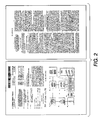
- FIG. 2 shows two sample pages of a US patent, which is typically provided in PDF format. From Figure 2, it can be seen that a patent has a complex structure, with a variety of issues to consider when transforming the PDF (or equivalent (X)HTML) into an XML document.
- the legacy document has rich metadata, including title, registration number, inventor names, affiliation, bibliography and many other fields.
- the logical structure of the legacy document includes the conventional entities like sections, paragraph and tables, as well as some special ones, like multi-level lists, math and chemical formulas, etc.
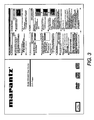
- Figure 3 illustrates an example of technical document.
- This legacy document has few metadata fields (first page) but a large variety of different layout issues for structuring the text and image in the body of the document, including one-, two-, three-column pages, nested two-columns, etc. Certain elements of content (illustrated in Figure 3 in bold) represent dictionary index entries.
- the system and method disclosed herein manages this complexity by decomposing the conversion task into a set of smaller conversion tasks. In this way, different methods and techniques can be tested and then applied to the different individual conversion tasks.
- the individual methods can be chosen to best facilitate transformation of the individual conversion task and can vary from ad-hoc manual rules, to the automatic generation of conversion/transformation rules, to using methods of supervised and unsupervised machine learning, inner- and extra-document clustering, etc.
- the decomposition principle allows the user to deploy all available techniques to achieve the conversion goal, where the initial complex conversion task is decomposed into a number of smaller and essentially easier-to-handle conversion sub-tasks, where each sub-task can be solved with an appropriate and often specialized method, such as bibliography extraction, list or table recognition and transformation, etc.
- the framework includes the following issues: Mechanism for defining the decomposition tasks; 2. Verification of the validity of the desired decomposition; 3. Creation of local schemas for the sub-problems that should produce the valid target fragments; and 4. Automation of the assembly of converted fragments into target XML documents.
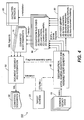
- FIG. 4 is a block diagram of a system 100 for converting legacy documents into XML documents.
- source legacy documents which are provided in their original format of PDF/PS/MSWord files are first transformed into standard formats such (X)HTML (using any of the commercially available PDF-to-HTML converters, such as pdf2html, CambridgeDoc, etc).
- the target schema (which is described in DTD, W3C XML Schema, Relax NG, etc.) which will be used to generate the output XML document is provide in block 20.
- a library of specific (ad hoc) converters, structure recognizer and machine learning methods is available in library 30 for deployment on specific portions of source data. The converters and methods can be prepared in advance or during the conversion contract.
- a source document is converted to (X)HTML, it is provided to block 40 for decomposition into document portions.
- the target schema is also provided to block 40 where it is input to a local schema generator.
- the local schema generator generates small schema using the individual schema components from the target schema.
- a decomposition request is composed using a high level script language and submitted to block 40. The request decomposes the initial conversion task into a set of individual tasks, where each task is defined on a certain source document portion and a corresponding local schema.
- the decomposition request can be created by a user or automatically by the system.
- Each individual conversion task is tested with one or many converters, recognizers or methods from the library 30 in order to achieve the best accuracy of conversion for that document portion. Once the best method is selected, that method should produce XML fragments validated with the corresponding local schema. Once all conversion tasks have performed their conversions in conversion sub-tasks block 60, the converted body fragments in block 70 and extracted metadata in block 80 are provided to an document assembly and integration 50, where the target XML document 90 is recomposed from local fragments and metadata generated by the individual conversion tasks using the target schema.
- XML target documents generally include three main groups of annotation elements which may be used during the conversion scenarios, namely: semantic annotations, logical annotations and layout annotations.
- Semantic annotations include metadata, which are content fragments/fields that concern the entire document. Metadata have historically been addressed by document annotation; it conventionally includes title/author/date/Bibliography/creationDate/etc. Semantic annotations also include entities, which are low-granularity textual elements, such as index entry points, company names, etc.
- Logical annotations include paragraphs, different types of lists, sections and subsections, images, formulas, multi-column tables, etc.
- Layout annotations include font, highlighting such as bold and italics, etc.
- the conversion framework assumes that the library offers a number of alternative and complementary techniques to cope with different types of annotations. Beyond manual methods, adaptive methods of information extraction are often most beneficial for semantic annotations, both metadata and entities. On other side, the recognition of logical annotations works well when using generic and/or adaptive heuristics such as those found in A3128-US-NP.
- Conversion management components To enable the decomposition and assembly framework and manage various issues associated with the task definition and validation, consider the following components: (1) Decomposition language (allows expression of the decomposition request in a declarative form); (2) Validator for the decomposition query (allows validation of the correctness of the decomposition queries, that is, the tasks are well-defined and they together completely define the conversion toward the target schema); (3) Generator of local schemas (decomposes the main schema into a set of smaller schemas, where each schema is associated with a specific task); (4) Validator for local components (verifies that the XML annotation generated by tasks match corresponding local schemas, any standard validator can be used at this stage); (5) Generator of assembly queries (validates the correctness of transformed components before initiating the assembly; the assembly query can be in a conventional format, for example, XQuery or XSLT languages; and (6) Assembly engine (applies the assembly query to integrate the components into valid target XML documents; standard XQuery or XSLT engine can be used).
- the target XML schema requires the annotation of document metadata (title, author, year, bibliography), the logical structure of the document (section and paragraphs) and domain-specific entities (such as gene names or company tickets in the body of the document).
- This structure of target documents is given by the following XML target schema written in DTD: ⁇ ELEMENT document (title, author*, year, (BiblioEntry)*, (section)+)> ⁇ ELEMENT BiblioEntry (bib-title, bib-author*, bib-year, source)> ⁇ ELEMENT Section paragraph+ > ⁇ ELEMENT Paragraph (PCDATA
- Elements title, author, year, bib-author, bib-year and source are all textual elements (PCDATA).
- the order of elements in the XML does not necessary follow that in (X)HTML; the bibliography occupies the last page in the (X)HTML document, but should be placed in target XML document before the body.
- Figure 5 illustrates the process of conversion by decomposition and assembly.
- Source (X)HTML document is decomposed into document portions: page 1, page 2, document content, pages N-1 and page N.
- the overall conversion task is decomposed into four individual conversion tasks.
- the defined four tasks are named Metadata, Structure, Entities and Biblio, with corresponding data fragments and local schemas assigned to each.
- Each task is defined by providing the data (fragment in the source document) and a local schema.
- the local schema for the Metadata task includes title, author and year (taken from the target XML schema).
- the local schema for the Structure task includes section and paragraph.
- the local schema for the Entities task include entity and the local schema for the Biblio task includes bib-author, bib-title. Year, source.
- the language support for the conversion decomposition and assembly consists of a set of high-level instructions which allows a user to create step-by-step the set of tasks, validate the decomposition they define, check out the results of conversions carried out by each tasks, and assemble the results into valid output.
- the decomposition request can be automated.
- An exemplary list of instructions include:
- Steps 3 to 6 define four conversion tasks that represent the first part of the process.
- the second part is given by steps 7, 8, 10 and 11 that validate the decomposition, decompose the documents, and assemble the target documents from converted components.
- task Entities should be executed after tasks Structure and Biblio. This means that the task finds entities in the document content by preserving the boundaries of sections, paragraphs and Biblio items determined by the two mentioned tasks. This avoids conflicts due to the overlapping annotations that can arise during the executed of the assembly procedure.
- Decomposition T creates a set of conversion tasks, T 1 , T 2 , ..., T n , where T i is a pair (D i , S i ), D i is a fragment of source documents D and S i is a local schema.
- Two tasks T i and T j are data-disjoint if D i and D j do not overlap; the two tasks are schema-disjoint if S i and S j have no joint (same) elements.
- Some schema-disjoint tasks are schema independent if elements of their local schemas are independent in the global target schema (no element includes another).
- the decomposition T is data-disjoint if all tasks it creates are data-disjoint.
- T is schema-disjoint or schema-independent if all its tasks are schema-disjoint or schema-independent.
- a decomposition is complete if the defined tasks cover all elements in the target schema. In the Example, tasks 1, 2 and 4 are data-disjoint and schema independent; tasks 2 and 3 (as well as tasks 3 and 4) are data-dependent, schema-disjoint but not schema independent. These four tasks define a complete decomposition.
- the generation of local schema for defined tasks can be performed in automatic manner, by the projection of the target schema on the element sets associated with the tasks. This works as follows. The user first defines all tasks with the help of Define instructions, specifying for each task all relevant elements in the "with" clause.
- the system then automatically generates local schema, one local schemata for each task.
- This allows the system on the assembly step to control the output produced by local converters associated with the tasks (by validating their XML output against the local schema).
- the projection operation is straightforward for DTD schema definitions where each element has exactly one definition, so the projection can be achieved by selecting definitions for the given element set.
- the projection can be achieved at the cost of certain schema generalization.
- the assembly procedure is initiated when all the tasks have successfully implemented their local conversions.
- assembly can be validated statically, by observing only the declared document fragments and local schemas. It can be show that the static validation is possible for data-disjoint and schema-independent decompositions. However, the static validation is not feasible when source document fragments and local schema of the conversion tasks do overlap. In these cases, the assembly procedure is applied to the components and is successful if it terminates with the valid target XML.
- Target schema S is order-preserving if the leaf order (in-depth left-to-right tree traversal) matches the order of the data in the source documents, that is, if any item A precedes an item B in target document iff it does so in the source document.
- Schema S is equivalent to order-matching, or order-safe if there exists a) such schema S' that S' is order-matching and b) a bi-jective mapping between target schema S and S'.
- the schema S in Example 1 is order-safe. For it, there exists schema S' with the top element defined as ⁇ ELEMENT document' (title, author*, year, (section)+,(BiblioEntry)*) > that is, where sections precede the bibliographic entries. Schema S' is order-preserving and mapping between schemas S and S' is straightforward.
Landscapes
- Engineering & Computer Science (AREA)
- Theoretical Computer Science (AREA)
- Physics & Mathematics (AREA)
- General Engineering & Computer Science (AREA)
- General Physics & Mathematics (AREA)
- Health & Medical Sciences (AREA)
- Artificial Intelligence (AREA)
- Audiology, Speech & Language Pathology (AREA)
- Computational Linguistics (AREA)
- General Health & Medical Sciences (AREA)
- Databases & Information Systems (AREA)
- Data Mining & Analysis (AREA)
- Document Processing Apparatus (AREA)
- Information Retrieval, Db Structures And Fs Structures Therefor (AREA)
Applications Claiming Priority (1)
| Application Number | Priority Date | Filing Date | Title |
|---|---|---|---|
| US10/986,490 US7440967B2 (en) | 2004-11-10 | 2004-11-10 | System and method for transforming legacy documents into XML documents |
Publications (3)
| Publication Number | Publication Date |
|---|---|
| EP1657649A2 true EP1657649A2 (fr) | 2006-05-17 |
| EP1657649A3 EP1657649A3 (fr) | 2007-08-22 |
| EP1657649B1 EP1657649B1 (fr) | 2010-06-09 |
Family
ID=35929694
Family Applications (1)
| Application Number | Title | Priority Date | Filing Date |
|---|---|---|---|
| EP05256906A Ceased EP1657649B1 (fr) | 2004-11-10 | 2005-11-08 | Procédé de lecture de documents comprenant des séquences altérées, et dispositif de lecture associé |
Country Status (3)
| Country | Link |
|---|---|
| US (1) | US7440967B2 (fr) |
| EP (1) | EP1657649B1 (fr) |
| DE (1) | DE602005021737D1 (fr) |
Cited By (7)
| Publication number | Priority date | Publication date | Assignee | Title |
|---|---|---|---|---|
| WO2010126804A2 (fr) | 2009-04-30 | 2010-11-04 | Microsoft Corporation | Support de fusion rapide pour documents existants |
| WO2011036499A1 (fr) * | 2009-09-28 | 2011-03-31 | Nats (Services) Limited | Traitement d'informations aéronautiques |
| US20140373108A1 (en) | 2007-12-14 | 2014-12-18 | Microsoft Corporation | Collaborative authoring modes |
| US8990150B2 (en) | 2007-11-09 | 2015-03-24 | Microsoft Technology Licensing, Llc | Collaborative authoring |
| US9760862B2 (en) | 2008-04-28 | 2017-09-12 | Microsoft Technology Licensing, Llc | Conflict resolution |
| US10528806B2 (en) | 2005-07-08 | 2020-01-07 | Cynsight, Llc | Data format conversion |
| KR20220013082A (ko) * | 2020-07-24 | 2022-02-04 | 주식회사 한글과컴퓨터 | 문서의 포맷을 변환하는 포맷 변환 엔진이 탑재되어 있는 문서 변환 서버들에 대해, 문서의 포맷 변환을 위한 작업 할당을 수행하는 문서 변환 작업 할당 스케줄링 장치 및 그 동작 방법 |
Families Citing this family (99)
| Publication number | Priority date | Publication date | Assignee | Title |
|---|---|---|---|---|
| US11388451B2 (en) | 2001-11-27 | 2022-07-12 | Comcast Cable Communications Management, Llc | Method and system for enabling data-rich interactive television using broadcast database |
| US8042132B2 (en) | 2002-03-15 | 2011-10-18 | Tvworks, Llc | System and method for construction, delivery and display of iTV content |
| US8365230B2 (en) | 2001-09-19 | 2013-01-29 | Tvworks, Llc | Interactive user interface for television applications |
| US8413205B2 (en) | 2001-09-19 | 2013-04-02 | Tvworks, Llc | System and method for construction, delivery and display of iTV content |
| US8707354B1 (en) | 2002-06-12 | 2014-04-22 | Tvworks, Llc | Graphically rich, modular, promotional tile interface for interactive television |
| US7703116B1 (en) | 2003-07-11 | 2010-04-20 | Tvworks, Llc | System and method for construction, delivery and display of iTV applications that blend programming information of on-demand and broadcast service offerings |
| US8352983B1 (en) | 2002-07-11 | 2013-01-08 | Tvworks, Llc | Programming contextual interactive user interface for television |
| US11070890B2 (en) | 2002-08-06 | 2021-07-20 | Comcast Cable Communications Management, Llc | User customization of user interfaces for interactive television |
| US8220018B2 (en) | 2002-09-19 | 2012-07-10 | Tvworks, Llc | System and method for preferred placement programming of iTV content |
| US11381875B2 (en) | 2003-03-14 | 2022-07-05 | Comcast Cable Communications Management, Llc | Causing display of user-selectable content types |
| US8578411B1 (en) | 2003-03-14 | 2013-11-05 | Tvworks, Llc | System and method for controlling iTV application behaviors through the use of application profile filters |
| US10664138B2 (en) | 2003-03-14 | 2020-05-26 | Comcast Cable Communications, Llc | Providing supplemental content for a second screen experience |
| US8416952B1 (en) | 2003-07-11 | 2013-04-09 | Tvworks, Llc | Channel family surf control |
| US8819734B2 (en) | 2003-09-16 | 2014-08-26 | Tvworks, Llc | Contextual navigational control for digital television |
| US7620641B2 (en) * | 2004-12-22 | 2009-11-17 | International Business Machines Corporation | System and method for context-sensitive decomposition of XML documents based on schemas with reusable element/attribute declarations |
| US7937653B2 (en) | 2005-01-10 | 2011-05-03 | Xerox Corporation | Method and apparatus for detecting pagination constructs including a header and a footer in legacy documents |
| US7467149B2 (en) * | 2005-03-14 | 2008-12-16 | Microsoft Corporation | Complex syntax validation and business logic validation rules, using VAXs (value-added XSDs) compliant with W3C-XML schema specification |
| US7587415B2 (en) * | 2005-03-14 | 2009-09-08 | Microsoft Corporation | Single-pass translation of flat-file documents into XML format including validation, ambiguity resolution, and acknowledgement generation |
| US7761481B2 (en) * | 2005-03-14 | 2010-07-20 | Microsoft Corporation | Schema generator: quick and efficient conversion of healthcare specific structural data represented in relational database tables, along with complex validation rules and business rules, to custom HL7XSD with applicable annotations |
| KR101251686B1 (ko) * | 2005-04-19 | 2013-04-05 | 마이크로소프트 코포레이션 | 표시 가능 파일의 필드 및 참조 문헌 및 인용문에 대한확장형 마크업 언어 스키마의 결정 |
| US7818668B2 (en) * | 2005-04-19 | 2010-10-19 | Microsoft Corporation | Determining fields for presentable files |
| US7730399B2 (en) * | 2005-04-22 | 2010-06-01 | Microsoft Corporation | Journal file reader |
| US7818667B2 (en) * | 2005-05-03 | 2010-10-19 | Tv Works Llc | Verification of semantic constraints in multimedia data and in its announcement, signaling and interchange |
| US20060259456A1 (en) * | 2005-05-10 | 2006-11-16 | Alexander Falk | System for describing text file formats in a flexible, reusable way to facilitate text file transformations |
| US7461335B2 (en) * | 2005-05-31 | 2008-12-02 | Sap Ag | Dynamic conversion of data into markup language format |
| JP4110154B2 (ja) * | 2005-06-10 | 2008-07-02 | キヤノン株式会社 | 情報処理装置、情報処理装置の制御方法、コンピュータプログラム、記憶媒体 |
| CN101369268B (zh) * | 2007-08-15 | 2011-08-24 | 北京书生国际信息技术有限公司 | 一种文档库系统中文档数据的存储方法 |
| US7707488B2 (en) * | 2006-02-09 | 2010-04-27 | Microsoft Corporation | Analyzing lines to detect tables in documents |
| US7529758B2 (en) * | 2006-02-10 | 2009-05-05 | International Business Machines Corporation | Method for pre-processing mapping information for efficient decomposition of XML documents |
| US8407585B2 (en) * | 2006-04-19 | 2013-03-26 | Apple Inc. | Context-aware content conversion and interpretation-specific views |
| US7818665B1 (en) * | 2006-06-22 | 2010-10-19 | Advanced Micro Devices, Inc. | Method and system for schema version transform verification |
| US7814045B2 (en) * | 2006-10-04 | 2010-10-12 | Sap Ag | Semantical partitioning of data |
| US7797622B2 (en) * | 2006-11-15 | 2010-09-14 | Xerox Corporation | Versatile page number detector |
| US7778983B2 (en) * | 2007-03-06 | 2010-08-17 | Microsoft Corporation | Application migration file scanning and conversion |
| US20080222517A1 (en) * | 2007-03-09 | 2008-09-11 | Task Performance Group, Inc. | Applying Patterns to XSD for Extending Functionality to Both XML and non-XML Data Data Structures |
| JP5187308B2 (ja) * | 2007-08-01 | 2013-04-24 | 日本電気株式会社 | 変換プログラム探索システムおよび変換プログラム探索方法 |
| US7890438B2 (en) | 2007-12-12 | 2011-02-15 | Xerox Corporation | Stacked generalization learning for document annotation |
| US7991709B2 (en) * | 2008-01-28 | 2011-08-02 | Xerox Corporation | Method and apparatus for structuring documents utilizing recognition of an ordered sequence of identifiers |
| US8626720B2 (en) | 2008-02-11 | 2014-01-07 | International Business Machines Corporation | System and method of reconstructing complex custom objects |
| US7996444B2 (en) * | 2008-02-18 | 2011-08-09 | International Business Machines Corporation | Creation of pre-filters for more efficient X-path processing |
| US20090249178A1 (en) * | 2008-04-01 | 2009-10-01 | Ambrosino Timothy J | Document linking |
| US8954474B2 (en) * | 2008-04-21 | 2015-02-10 | The Boeing Company | Managing data systems to support semantic-independent schemas |
| JP5111242B2 (ja) * | 2008-06-04 | 2013-01-09 | キヤノン株式会社 | 画像処理装置及び方法 |
| WO2010025572A1 (fr) * | 2008-09-08 | 2010-03-11 | Greg Waite | Système et procédé informatisés pour offrir une plate-forme communautaire et collaborative centrée sur le transfert de connaissances, l’expertise, l’innovation, les biens tangibles, les biens intangibles et les biens informationnels |
| US11832024B2 (en) | 2008-11-20 | 2023-11-28 | Comcast Cable Communications, Llc | Method and apparatus for delivering video and video-related content at sub-asset level |
| EP2194465B1 (fr) * | 2008-11-21 | 2011-07-27 | Software AG | Procédé, extension de serveur et système de gestion de base de données pour conserver des annotations de documents non XML dans une base de données XML |
| US8204848B2 (en) * | 2009-11-17 | 2012-06-19 | Business Objects Software Limited | Detecting and applying database schema changes to reports |
| US9063932B2 (en) | 2009-12-18 | 2015-06-23 | Vertafore, Inc. | Apparatus, method and article to manage electronic or digital documents in a networked environment |
| US8700682B2 (en) * | 2009-12-24 | 2014-04-15 | Vertafore, Inc. | Systems, methods and articles for template based generation of markup documents to access back office systems |
| GB2481191A (en) | 2010-02-25 | 2011-12-21 | Sita Information Networking Computing Ireland Ltd | Graphical development tool for software application development |
| JP5100820B2 (ja) * | 2010-11-25 | 2012-12-19 | 株式会社東芝 | 問合せ式変換装置、方法およびプログラム |
| WO2012076376A2 (fr) * | 2010-12-09 | 2012-06-14 | Alcatel Lucent | Génération de documents structurés sémantiques à partir de documents textes |
| US9384198B2 (en) | 2010-12-10 | 2016-07-05 | Vertafore, Inc. | Agency management system and content management system integration |
| SG190038A1 (en) | 2010-12-21 | 2013-06-28 | Sita N V | Reservation system and method |
| US8731973B2 (en) | 2011-04-19 | 2014-05-20 | Vertafore, Inc. | Overlaying images in automated insurance policy form generation |
| US9690770B2 (en) | 2011-05-31 | 2017-06-27 | Oracle International Corporation | Analysis of documents using rules |
| US9112623B2 (en) | 2011-06-06 | 2015-08-18 | Comcast Cable Communications, Llc | Asynchronous interaction at specific points in content |
| US9753699B2 (en) | 2011-06-16 | 2017-09-05 | Microsoft Technology Licensing, Llc | Live browser tooling in an integrated development environment |
| US9563714B2 (en) | 2011-06-16 | 2017-02-07 | Microsoft Technology Licensing Llc. | Mapping selections between a browser and the original file fetched from a web server |
| US9460224B2 (en) | 2011-06-16 | 2016-10-04 | Microsoft Technology Licensing Llc. | Selection mapping between fetched files and source files |
| SG188579A1 (en) | 2011-08-03 | 2013-04-30 | Sita Inf Networking Computing Usa Inc | Item handling and tracking system and method therefor |
| EP2568398B1 (fr) * | 2011-09-07 | 2018-07-25 | Tata Consultancy Services Limited | Système et procédé pour convertir un fichier d'outil existant à un fichier de langage de balisage |
| US8910039B2 (en) * | 2011-09-09 | 2014-12-09 | Accenture Global Services Limited | File format conversion by automatically converting to an intermediate form for manual editing in a multi-column graphical user interface |
| CN102541829B (zh) * | 2012-01-17 | 2014-01-01 | 中国工商银行股份有限公司 | 一种多用户并发的电子文档生成装置及方法 |
| GB2499288A (en) | 2012-02-09 | 2013-08-14 | Sita Inf Networking Computing Usa Inc | Path determination |
| US20130246376A1 (en) * | 2012-03-16 | 2013-09-19 | Infosys Limited | Methods for managing data intake and devices thereof |
| US9087204B2 (en) | 2012-04-10 | 2015-07-21 | Sita Information Networking Computing Ireland Limited | Airport security check system and method therefor |
| US9632990B2 (en) | 2012-07-19 | 2017-04-25 | Infosys Limited | Automated approach for extracting intelligence, enriching and transforming content |
| US11115722B2 (en) | 2012-11-08 | 2021-09-07 | Comcast Cable Communications, Llc | Crowdsourcing supplemental content |
| KR101319966B1 (ko) * | 2012-11-12 | 2013-10-18 | 한국과학기술정보연구원 | 전자 서식 변환 장치 및 방법 |
| US9672521B1 (en) * | 2012-12-07 | 2017-06-06 | The Boeing Company | Reformatting legacy system work orders with highlighted process compliance |
| US9553927B2 (en) | 2013-03-13 | 2017-01-24 | Comcast Cable Communications, Llc | Synchronizing multiple transmissions of content |
| US10880609B2 (en) | 2013-03-14 | 2020-12-29 | Comcast Cable Communications, Llc | Content event messaging |
| US10320908B2 (en) | 2013-03-25 | 2019-06-11 | Sita Information Networking Computing Ireland Limited | In-flight computing device for aircraft cabin crew |
| GB2515142B (en) | 2013-06-14 | 2020-12-16 | Sita Information Networking Computing Ireland Ltd | Portable user control system and method therefor |
| US9740995B2 (en) * | 2013-10-28 | 2017-08-22 | Morningstar, Inc. | Coordinate-based document processing and data entry system and method |
| US9507814B2 (en) | 2013-12-10 | 2016-11-29 | Vertafore, Inc. | Bit level comparator systems and methods |
| US9367435B2 (en) | 2013-12-12 | 2016-06-14 | Vertafore, Inc. | Integration testing method and system for web services |
| GB2523441A (en) | 2014-02-19 | 2015-08-26 | Sita Information Networking Computing Ireland Ltd | Reservation system and method therefor |
| US20160004685A1 (en) * | 2014-07-02 | 2016-01-07 | IGATE Global Solutions Ltd. | Insurance Data Archiving and Retrieval System |
| US9747556B2 (en) | 2014-08-20 | 2017-08-29 | Vertafore, Inc. | Automated customized web portal template generation systems and methods |
| US11783382B2 (en) | 2014-10-22 | 2023-10-10 | Comcast Cable Communications, Llc | Systems and methods for curating content metadata |
| US10353955B2 (en) | 2014-11-06 | 2019-07-16 | Lexisnexis, A Division Of Reed Elsevier Inc. | Systems and methods for normalized schema comparison |
| US10001546B2 (en) | 2014-12-02 | 2018-06-19 | Sita Information Networking Computing Uk Limited | Apparatus for monitoring aircraft position |
| US10331650B2 (en) * | 2014-12-31 | 2019-06-25 | International Business Machines Corporation | Updating web files based on detected legacy model file changes |
| US11106760B2 (en) * | 2015-05-01 | 2021-08-31 | Einstein Industries, Inc. | Enhanced metadata collection and output |
| US9600400B1 (en) | 2015-10-29 | 2017-03-21 | Vertafore, Inc. | Performance testing of web application components using image differentiation |
| US10296846B2 (en) * | 2015-11-24 | 2019-05-21 | Xerox Corporation | Adapted domain specific class means classifier |
| US10650065B2 (en) * | 2016-02-26 | 2020-05-12 | Rovi Guides, Inc. | Methods and systems for aggregating data from webpages using path attributes |
| CN107423271B (zh) * | 2017-08-01 | 2020-08-21 | 北京信息科技大学 | 文档生成方法和装置 |
| WO2019169205A1 (fr) * | 2018-02-28 | 2019-09-06 | Rocky Kahn | Visionneur de document alignant pdf et xml |
| US11314807B2 (en) | 2018-05-18 | 2022-04-26 | Xcential Corporation | Methods and systems for comparison of structured documents |
| WO2020191028A1 (fr) * | 2019-03-18 | 2020-09-24 | Siraj Technologies Ltd. | Convertisseur universel, dispositifs d'alimentation et poussoirs destinés à la connectivité de l'internet des objets industriel |
| CN111125441A (zh) * | 2019-11-08 | 2020-05-08 | 广东电网有限责任公司 | 一种Xml文件信息处理系统 |
| CN111581948B (zh) * | 2020-04-03 | 2024-02-09 | 北京百度网讯科技有限公司 | 文档解析方法、装置、设备及存储介质 |
| US11341318B2 (en) * | 2020-07-07 | 2022-05-24 | Kudzu Software Llc | Interactive tool for modifying an automatically generated electronic form |
| CN116450571A (zh) * | 2022-01-10 | 2023-07-18 | 晨星公司 | Ai增强的到人类可读且机器可解析的html的pdf转换 |
| CN114707514B (zh) * | 2022-03-28 | 2024-10-01 | 北京信息科技大学 | 语义文档存储方法、装置 |
| US12332911B1 (en) * | 2022-04-13 | 2025-06-17 | ClearDox LLC | Automatic intake and processing system and method |
Family Cites Families (13)
| Publication number | Priority date | Publication date | Assignee | Title |
|---|---|---|---|---|
| US212698A (en) * | 1879-02-25 | Improvement in cooking-stoves | ||
| US126556A (en) * | 1872-05-07 | Improvement in awning-frames | ||
| US167445A (en) * | 1875-09-07 | Improvement in machines for making split keys | ||
| US10754A (en) * | 1854-04-11 | Improvement in mills for grinding ores | ||
| US5560006A (en) * | 1991-05-15 | 1996-09-24 | Automated Technology Associates, Inc. | Entity-relation database |
| US6675353B1 (en) * | 1999-07-26 | 2004-01-06 | Microsoft Corporation | Methods and systems for generating XML documents |
| US6694325B2 (en) * | 2000-10-16 | 2004-02-17 | Frank Jas | Database method implementing attribute refinement model |
| US6785685B2 (en) | 2001-08-22 | 2004-08-31 | International Business Machines Corporation | Approach for transforming XML document to and from data objects in an object oriented framework for content management applications |
| US8032828B2 (en) | 2002-03-04 | 2011-10-04 | Hewlett-Packard Development Company, L.P. | Method and system of document transformation between a source extensible markup language (XML) schema and a target XML schema |
| US7480856B2 (en) | 2002-05-02 | 2009-01-20 | Intel Corporation | System and method for transformation of XML documents using stylesheets |
| US7076729B2 (en) | 2002-05-09 | 2006-07-11 | International Business Machines Corporation | Graphical specification of XML to XML transformation rules |
| JP2006503351A (ja) * | 2002-09-20 | 2006-01-26 | ボード オブ リージェンツ ユニバーシティ オブ テキサス システム | 情報の発見と関係分析のためのコンピュータプログラム製品、システム及び方法 |
| GB0306610D0 (en) * | 2003-03-21 | 2003-04-30 | British Telecomm | Conversion of structured information |
-
2004
- 2004-11-10 US US10/986,490 patent/US7440967B2/en not_active Expired - Lifetime
-
2005
- 2005-11-08 EP EP05256906A patent/EP1657649B1/fr not_active Ceased
- 2005-11-08 DE DE602005021737T patent/DE602005021737D1/de not_active Expired - Lifetime
Non-Patent Citations (1)
| Title |
|---|
| YASUTO ISHITANI, DOCUMENT TRANSFORMATION SYSTEM FROM PAPERS TO XML DATA BASED ON PIVOT XML DOCUMENT METHOD, 3 August 2003 (2003-08-03) |
Cited By (12)
| Publication number | Priority date | Publication date | Assignee | Title |
|---|---|---|---|---|
| US10528806B2 (en) | 2005-07-08 | 2020-01-07 | Cynsight, Llc | Data format conversion |
| US8990150B2 (en) | 2007-11-09 | 2015-03-24 | Microsoft Technology Licensing, Llc | Collaborative authoring |
| US9547635B2 (en) | 2007-11-09 | 2017-01-17 | Microsoft Technology Licensing, Llc | Collaborative authoring |
| US10394941B2 (en) | 2007-11-09 | 2019-08-27 | Microsoft Technology Licensing, Llc | Collaborative authoring |
| US20140373108A1 (en) | 2007-12-14 | 2014-12-18 | Microsoft Corporation | Collaborative authoring modes |
| US10057226B2 (en) | 2007-12-14 | 2018-08-21 | Microsoft Technology Licensing, Llc | Collaborative authoring modes |
| US9760862B2 (en) | 2008-04-28 | 2017-09-12 | Microsoft Technology Licensing, Llc | Conflict resolution |
| WO2010126804A2 (fr) | 2009-04-30 | 2010-11-04 | Microsoft Corporation | Support de fusion rapide pour documents existants |
| KR20120014896A (ko) * | 2009-04-30 | 2012-02-20 | 마이크로소프트 코포레이션 | 레거시 문서에 대한 빠른 병합 지원 |
| EP2425358A4 (fr) * | 2009-04-30 | 2014-07-30 | Microsoft Corp | Support de fusion rapide pour documents existants |
| WO2011036499A1 (fr) * | 2009-09-28 | 2011-03-31 | Nats (Services) Limited | Traitement d'informations aéronautiques |
| KR20220013082A (ko) * | 2020-07-24 | 2022-02-04 | 주식회사 한글과컴퓨터 | 문서의 포맷을 변환하는 포맷 변환 엔진이 탑재되어 있는 문서 변환 서버들에 대해, 문서의 포맷 변환을 위한 작업 할당을 수행하는 문서 변환 작업 할당 스케줄링 장치 및 그 동작 방법 |
Also Published As
| Publication number | Publication date |
|---|---|
| EP1657649A3 (fr) | 2007-08-22 |
| EP1657649B1 (fr) | 2010-06-09 |
| DE602005021737D1 (de) | 2010-07-22 |
| US7440967B2 (en) | 2008-10-21 |
| US20060101058A1 (en) | 2006-05-11 |
Similar Documents
| Publication | Publication Date | Title |
|---|---|---|
| EP1657649B1 (fr) | Procédé de lecture de documents comprenant des séquences altérées, et dispositif de lecture associé | |
| US10929598B2 (en) | Validating an XML document | |
| US6487566B1 (en) | Transforming documents using pattern matching and a replacement language | |
| US7991802B2 (en) | Method and system for creation and reuse of concise business schemas using a canonical library | |
| Salminen et al. | Requirements for XML document database systems | |
| US20060156220A1 (en) | System and method for managing dynamic content assembly | |
| CN100565521C (zh) | 用于从数据库生成xml文档的动态方法 | |
| US20120310868A1 (en) | Method and system for extracting and managing information contained in electronic documents | |
| US7953714B2 (en) | Method for maintaining parallelism in database processing using record identifier substitution assignment | |
| Dattolo et al. | Structural patterns for descriptive documents | |
| Simic et al. | Prospects of encoding Java source code in XML | |
| Bulajic et al. | Implementation of the Tree Structure in the XML and Relational Database | |
| Psaila | ERX: A data model for collections of XML documents | |
| Widlocher et al. | Combining advanced information retrieval and text-mining for digital humanities | |
| Eito-Brun | XML-based Content Management: Integration, Methodologies and Tools | |
| Sarasa-Cabezuelo et al. | Building XML-driven application generators with compiler construction tools | |
| Komvoteas | XML Diff and patch tool | |
| Algosaibi et al. | Web Documents Structures as Source for Machine-Understandable Document | |
| Kabisch et al. | Wrapping of web sources with restricted query interfaces by query tunneling | |
| Zhaojun | Research on language expression query method based on XML | |
| Gervers et al. | Managing Meta data in a Research Collection of Medieval Latin Charters | |
| Chatvichienchai et al. | An effective document search technique by semantic relationship approach | |
| Wu et al. | Design and implementation of data-driven based universal data editing framework | |
| Rovan et al. | Migrating web-based applications into semantic web | |
| Tao | An XML deployment and search framework |
Legal Events
| Date | Code | Title | Description |
|---|---|---|---|
| PUAI | Public reference made under article 153(3) epc to a published international application that has entered the european phase |
Free format text: ORIGINAL CODE: 0009012 |
|
| AK | Designated contracting states |
Kind code of ref document: A2 Designated state(s): AT BE BG CH CY CZ DE DK EE ES FI FR GB GR HU IE IS IT LI LT LU LV MC NL PL PT RO SE SI SK TR |
|
| AX | Request for extension of the european patent |
Extension state: AL BA HR MK YU |
|
| PUAL | Search report despatched |
Free format text: ORIGINAL CODE: 0009013 |
|
| AK | Designated contracting states |
Kind code of ref document: A3 Designated state(s): AT BE BG CH CY CZ DE DK EE ES FI FR GB GR HU IE IS IT LI LT LU LV MC NL PL PT RO SE SI SK TR |
|
| AX | Request for extension of the european patent |
Extension state: AL BA HR MK YU |
|
| RIC1 | Information provided on ipc code assigned before grant |
Ipc: G06F 17/22 20060101AFI20060309BHEP Ipc: G06F 17/30 20060101ALI20070717BHEP |
|
| 17P | Request for examination filed |
Effective date: 20080222 |
|
| 17Q | First examination report despatched |
Effective date: 20080326 |
|
| AKX | Designation fees paid |
Designated state(s): DE FR GB |
|
| GRAP | Despatch of communication of intention to grant a patent |
Free format text: ORIGINAL CODE: EPIDOSNIGR1 |
|
| GRAS | Grant fee paid |
Free format text: ORIGINAL CODE: EPIDOSNIGR3 |
|
| GRAA | (expected) grant |
Free format text: ORIGINAL CODE: 0009210 |
|
| AK | Designated contracting states |
Kind code of ref document: B1 Designated state(s): DE FR GB |
|
| REF | Corresponds to: |
Ref document number: 602005021737 Country of ref document: DE Date of ref document: 20100722 Kind code of ref document: P |
|
| PLBE | No opposition filed within time limit |
Free format text: ORIGINAL CODE: 0009261 |
|
| STAA | Information on the status of an ep patent application or granted ep patent |
Free format text: STATUS: NO OPPOSITION FILED WITHIN TIME LIMIT |
|
| 26N | No opposition filed |
Effective date: 20110310 |
|
| REG | Reference to a national code |
Ref country code: DE Ref legal event code: R097 Ref document number: 602005021737 Country of ref document: DE Effective date: 20110309 |
|
| REG | Reference to a national code |
Ref country code: FR Ref legal event code: PLFP Year of fee payment: 11 |
|
| REG | Reference to a national code |
Ref country code: FR Ref legal event code: PLFP Year of fee payment: 12 |
|
| REG | Reference to a national code |
Ref country code: FR Ref legal event code: PLFP Year of fee payment: 13 |
|
| PGFP | Annual fee paid to national office [announced via postgrant information from national office to epo] |
Ref country code: FR Payment date: 20171020 Year of fee payment: 13 Ref country code: DE Payment date: 20171019 Year of fee payment: 13 |
|
| PGFP | Annual fee paid to national office [announced via postgrant information from national office to epo] |
Ref country code: GB Payment date: 20171020 Year of fee payment: 13 |
|
| REG | Reference to a national code |
Ref country code: DE Ref legal event code: R119 Ref document number: 602005021737 Country of ref document: DE |
|
| GBPC | Gb: european patent ceased through non-payment of renewal fee |
Effective date: 20181108 |
|
| PG25 | Lapsed in a contracting state [announced via postgrant information from national office to epo] |
Ref country code: FR Free format text: LAPSE BECAUSE OF NON-PAYMENT OF DUE FEES Effective date: 20181130 Ref country code: DE Free format text: LAPSE BECAUSE OF NON-PAYMENT OF DUE FEES Effective date: 20190601 |
|
| PG25 | Lapsed in a contracting state [announced via postgrant information from national office to epo] |
Ref country code: GB Free format text: LAPSE BECAUSE OF NON-PAYMENT OF DUE FEES Effective date: 20181108 |