EP1658024B1 - Implantat zum verschluss einer öffnung des annulus fibrosus - Google Patents
Implantat zum verschluss einer öffnung des annulus fibrosus Download PDFInfo
- Publication number
- EP1658024B1 EP1658024B1 EP04763651A EP04763651A EP1658024B1 EP 1658024 B1 EP1658024 B1 EP 1658024B1 EP 04763651 A EP04763651 A EP 04763651A EP 04763651 A EP04763651 A EP 04763651A EP 1658024 B1 EP1658024 B1 EP 1658024B1
- Authority
- EP
- European Patent Office
- Prior art keywords
- implant
- plug
- accordance
- opening
- annulus
- Prior art date
- Legal status (The legal status is an assumption and is not a legal conclusion. Google has not performed a legal analysis and makes no representation as to the accuracy of the status listed.)
- Expired - Lifetime
Links
- 239000007943 implant Substances 0.000 title claims abstract description 66
- 238000004873 anchoring Methods 0.000 claims abstract description 7
- 239000000463 material Substances 0.000 claims description 31
- 238000003780 insertion Methods 0.000 claims description 11
- 230000037431 insertion Effects 0.000 claims description 11
- 239000012528 membrane Substances 0.000 claims description 6
- 239000011148 porous material Substances 0.000 claims description 6
- 239000003795 chemical substances by application Substances 0.000 claims description 2
- 238000004113 cell culture Methods 0.000 description 4
- 206010050296 Intervertebral disc protrusion Diseases 0.000 description 3
- 208000003618 Intervertebral Disc Displacement Diseases 0.000 description 2
- 208000012287 Prolapse Diseases 0.000 description 2
- 230000015572 biosynthetic process Effects 0.000 description 2
- 210000005036 nerve Anatomy 0.000 description 2
- 231100000241 scar Toxicity 0.000 description 2
- 238000007789 sealing Methods 0.000 description 2
- 108010010803 Gelatin Proteins 0.000 description 1
- 208000027418 Wounds and injury Diseases 0.000 description 1
- 230000006978 adaptation Effects 0.000 description 1
- 230000032683 aging Effects 0.000 description 1
- 230000009286 beneficial effect Effects 0.000 description 1
- 230000001413 cellular effect Effects 0.000 description 1
- 230000006378 damage Effects 0.000 description 1
- 230000007423 decrease Effects 0.000 description 1
- 239000012530 fluid Substances 0.000 description 1
- 239000000499 gel Substances 0.000 description 1
- 239000008273 gelatin Substances 0.000 description 1
- 229920000159 gelatin Polymers 0.000 description 1
- 235000019322 gelatine Nutrition 0.000 description 1
- 235000011852 gelatine desserts Nutrition 0.000 description 1
- 238000002347 injection Methods 0.000 description 1
- 239000007924 injection Substances 0.000 description 1
- 208000014674 injury Diseases 0.000 description 1
- 239000002184 metal Substances 0.000 description 1
- 230000002980 postoperative effect Effects 0.000 description 1
- 230000008929 regeneration Effects 0.000 description 1
- 238000011069 regeneration method Methods 0.000 description 1
- 230000009919 sequestration Effects 0.000 description 1
- 239000007787 solid Substances 0.000 description 1
- 239000007921 spray Substances 0.000 description 1
- 238000001356 surgical procedure Methods 0.000 description 1
Images




Classifications
-
- A—HUMAN NECESSITIES
- A61—MEDICAL OR VETERINARY SCIENCE; HYGIENE
- A61F—FILTERS IMPLANTABLE INTO BLOOD VESSELS; PROSTHESES; DEVICES PROVIDING PATENCY TO, OR PREVENTING COLLAPSING OF, TUBULAR STRUCTURES OF THE BODY, e.g. STENTS; ORTHOPAEDIC, NURSING OR CONTRACEPTIVE DEVICES; FOMENTATION; TREATMENT OR PROTECTION OF EYES OR EARS; BANDAGES, DRESSINGS OR ABSORBENT PADS; FIRST-AID KITS
- A61F2/00—Filters implantable into blood vessels; Prostheses, i.e. artificial substitutes or replacements for parts of the body; Appliances for connecting them with the body; Devices providing patency to, or preventing collapsing of, tubular structures of the body, e.g. stents
- A61F2/02—Prostheses implantable into the body
- A61F2/30—Joints
- A61F2/46—Special tools for implanting artificial joints
- A61F2/4603—Special tools for implanting artificial joints for insertion or extraction of endoprosthetic joints or of accessories thereof
- A61F2/4611—Special tools for implanting artificial joints for insertion or extraction of endoprosthetic joints or of accessories thereof of spinal prostheses
-
- A—HUMAN NECESSITIES
- A61—MEDICAL OR VETERINARY SCIENCE; HYGIENE
- A61F—FILTERS IMPLANTABLE INTO BLOOD VESSELS; PROSTHESES; DEVICES PROVIDING PATENCY TO, OR PREVENTING COLLAPSING OF, TUBULAR STRUCTURES OF THE BODY, e.g. STENTS; ORTHOPAEDIC, NURSING OR CONTRACEPTIVE DEVICES; FOMENTATION; TREATMENT OR PROTECTION OF EYES OR EARS; BANDAGES, DRESSINGS OR ABSORBENT PADS; FIRST-AID KITS
- A61F2/00—Filters implantable into blood vessels; Prostheses, i.e. artificial substitutes or replacements for parts of the body; Appliances for connecting them with the body; Devices providing patency to, or preventing collapsing of, tubular structures of the body, e.g. stents
- A61F2/02—Prostheses implantable into the body
- A61F2/30—Joints
- A61F2/44—Joints for the spine, e.g. vertebrae, spinal discs
- A61F2/442—Intervertebral or spinal discs, e.g. resilient
-
- A—HUMAN NECESSITIES
- A61—MEDICAL OR VETERINARY SCIENCE; HYGIENE
- A61B—DIAGNOSIS; SURGERY; IDENTIFICATION
- A61B17/00—Surgical instruments, devices or methods
- A61B2017/00004—(bio)absorbable, (bio)resorbable or resorptive
-
- A—HUMAN NECESSITIES
- A61—MEDICAL OR VETERINARY SCIENCE; HYGIENE
- A61F—FILTERS IMPLANTABLE INTO BLOOD VESSELS; PROSTHESES; DEVICES PROVIDING PATENCY TO, OR PREVENTING COLLAPSING OF, TUBULAR STRUCTURES OF THE BODY, e.g. STENTS; ORTHOPAEDIC, NURSING OR CONTRACEPTIVE DEVICES; FOMENTATION; TREATMENT OR PROTECTION OF EYES OR EARS; BANDAGES, DRESSINGS OR ABSORBENT PADS; FIRST-AID KITS
- A61F2/00—Filters implantable into blood vessels; Prostheses, i.e. artificial substitutes or replacements for parts of the body; Appliances for connecting them with the body; Devices providing patency to, or preventing collapsing of, tubular structures of the body, e.g. stents
- A61F2/0077—Special surfaces of prostheses, e.g. for improving ingrowth
- A61F2002/009—Special surfaces of prostheses, e.g. for improving ingrowth for hindering or preventing attachment of biological tissue
-
- A—HUMAN NECESSITIES
- A61—MEDICAL OR VETERINARY SCIENCE; HYGIENE
- A61F—FILTERS IMPLANTABLE INTO BLOOD VESSELS; PROSTHESES; DEVICES PROVIDING PATENCY TO, OR PREVENTING COLLAPSING OF, TUBULAR STRUCTURES OF THE BODY, e.g. STENTS; ORTHOPAEDIC, NURSING OR CONTRACEPTIVE DEVICES; FOMENTATION; TREATMENT OR PROTECTION OF EYES OR EARS; BANDAGES, DRESSINGS OR ABSORBENT PADS; FIRST-AID KITS
- A61F2/00—Filters implantable into blood vessels; Prostheses, i.e. artificial substitutes or replacements for parts of the body; Appliances for connecting them with the body; Devices providing patency to, or preventing collapsing of, tubular structures of the body, e.g. stents
- A61F2/02—Prostheses implantable into the body
- A61F2/30—Joints
- A61F2002/30001—Additional features of subject-matter classified in A61F2/28, A61F2/30 and subgroups thereof
- A61F2002/30003—Material related properties of the prosthesis or of a coating on the prosthesis
- A61F2002/30004—Material related properties of the prosthesis or of a coating on the prosthesis the prosthesis being made from materials having different values of a given property at different locations within the same prosthesis
- A61F2002/30014—Material related properties of the prosthesis or of a coating on the prosthesis the prosthesis being made from materials having different values of a given property at different locations within the same prosthesis differing in elasticity, stiffness or compressibility
-
- A—HUMAN NECESSITIES
- A61—MEDICAL OR VETERINARY SCIENCE; HYGIENE
- A61F—FILTERS IMPLANTABLE INTO BLOOD VESSELS; PROSTHESES; DEVICES PROVIDING PATENCY TO, OR PREVENTING COLLAPSING OF, TUBULAR STRUCTURES OF THE BODY, e.g. STENTS; ORTHOPAEDIC, NURSING OR CONTRACEPTIVE DEVICES; FOMENTATION; TREATMENT OR PROTECTION OF EYES OR EARS; BANDAGES, DRESSINGS OR ABSORBENT PADS; FIRST-AID KITS
- A61F2/00—Filters implantable into blood vessels; Prostheses, i.e. artificial substitutes or replacements for parts of the body; Appliances for connecting them with the body; Devices providing patency to, or preventing collapsing of, tubular structures of the body, e.g. stents
- A61F2/02—Prostheses implantable into the body
- A61F2/30—Joints
- A61F2002/30001—Additional features of subject-matter classified in A61F2/28, A61F2/30 and subgroups thereof
- A61F2002/30003—Material related properties of the prosthesis or of a coating on the prosthesis
- A61F2002/30004—Material related properties of the prosthesis or of a coating on the prosthesis the prosthesis being made from materials having different values of a given property at different locations within the same prosthesis
- A61F2002/30032—Material related properties of the prosthesis or of a coating on the prosthesis the prosthesis being made from materials having different values of a given property at different locations within the same prosthesis differing in absorbability or resorbability, i.e. in absorption or resorption time
-
- A—HUMAN NECESSITIES
- A61—MEDICAL OR VETERINARY SCIENCE; HYGIENE
- A61F—FILTERS IMPLANTABLE INTO BLOOD VESSELS; PROSTHESES; DEVICES PROVIDING PATENCY TO, OR PREVENTING COLLAPSING OF, TUBULAR STRUCTURES OF THE BODY, e.g. STENTS; ORTHOPAEDIC, NURSING OR CONTRACEPTIVE DEVICES; FOMENTATION; TREATMENT OR PROTECTION OF EYES OR EARS; BANDAGES, DRESSINGS OR ABSORBENT PADS; FIRST-AID KITS
- A61F2/00—Filters implantable into blood vessels; Prostheses, i.e. artificial substitutes or replacements for parts of the body; Appliances for connecting them with the body; Devices providing patency to, or preventing collapsing of, tubular structures of the body, e.g. stents
- A61F2/02—Prostheses implantable into the body
- A61F2/30—Joints
- A61F2002/30001—Additional features of subject-matter classified in A61F2/28, A61F2/30 and subgroups thereof
- A61F2002/30003—Material related properties of the prosthesis or of a coating on the prosthesis
- A61F2002/3006—Properties of materials and coating materials
- A61F2002/30062—(bio)absorbable, biodegradable, bioerodable, (bio)resorbable, resorptive
-
- A—HUMAN NECESSITIES
- A61—MEDICAL OR VETERINARY SCIENCE; HYGIENE
- A61F—FILTERS IMPLANTABLE INTO BLOOD VESSELS; PROSTHESES; DEVICES PROVIDING PATENCY TO, OR PREVENTING COLLAPSING OF, TUBULAR STRUCTURES OF THE BODY, e.g. STENTS; ORTHOPAEDIC, NURSING OR CONTRACEPTIVE DEVICES; FOMENTATION; TREATMENT OR PROTECTION OF EYES OR EARS; BANDAGES, DRESSINGS OR ABSORBENT PADS; FIRST-AID KITS
- A61F2/00—Filters implantable into blood vessels; Prostheses, i.e. artificial substitutes or replacements for parts of the body; Appliances for connecting them with the body; Devices providing patency to, or preventing collapsing of, tubular structures of the body, e.g. stents
- A61F2/02—Prostheses implantable into the body
- A61F2/30—Joints
- A61F2002/30001—Additional features of subject-matter classified in A61F2/28, A61F2/30 and subgroups thereof
- A61F2002/30316—The prosthesis having different structural features at different locations within the same prosthesis; Connections between prosthetic parts; Special structural features of bone or joint prostheses not otherwise provided for
- A61F2002/30535—Special structural features of bone or joint prostheses not otherwise provided for
- A61F2002/30563—Special structural features of bone or joint prostheses not otherwise provided for having elastic means or damping means, different from springs, e.g. including an elastomeric core or shock absorbers
-
- A—HUMAN NECESSITIES
- A61—MEDICAL OR VETERINARY SCIENCE; HYGIENE
- A61F—FILTERS IMPLANTABLE INTO BLOOD VESSELS; PROSTHESES; DEVICES PROVIDING PATENCY TO, OR PREVENTING COLLAPSING OF, TUBULAR STRUCTURES OF THE BODY, e.g. STENTS; ORTHOPAEDIC, NURSING OR CONTRACEPTIVE DEVICES; FOMENTATION; TREATMENT OR PROTECTION OF EYES OR EARS; BANDAGES, DRESSINGS OR ABSORBENT PADS; FIRST-AID KITS
- A61F2/00—Filters implantable into blood vessels; Prostheses, i.e. artificial substitutes or replacements for parts of the body; Appliances for connecting them with the body; Devices providing patency to, or preventing collapsing of, tubular structures of the body, e.g. stents
- A61F2/02—Prostheses implantable into the body
- A61F2/30—Joints
- A61F2002/30001—Additional features of subject-matter classified in A61F2/28, A61F2/30 and subgroups thereof
- A61F2002/30316—The prosthesis having different structural features at different locations within the same prosthesis; Connections between prosthetic parts; Special structural features of bone or joint prostheses not otherwise provided for
- A61F2002/30535—Special structural features of bone or joint prostheses not otherwise provided for
- A61F2002/30604—Special structural features of bone or joint prostheses not otherwise provided for modular
- A61F2002/30616—Sets comprising a plurality of prosthetic parts of different sizes or orientations
-
- A—HUMAN NECESSITIES
- A61—MEDICAL OR VETERINARY SCIENCE; HYGIENE
- A61F—FILTERS IMPLANTABLE INTO BLOOD VESSELS; PROSTHESES; DEVICES PROVIDING PATENCY TO, OR PREVENTING COLLAPSING OF, TUBULAR STRUCTURES OF THE BODY, e.g. STENTS; ORTHOPAEDIC, NURSING OR CONTRACEPTIVE DEVICES; FOMENTATION; TREATMENT OR PROTECTION OF EYES OR EARS; BANDAGES, DRESSINGS OR ABSORBENT PADS; FIRST-AID KITS
- A61F2/00—Filters implantable into blood vessels; Prostheses, i.e. artificial substitutes or replacements for parts of the body; Appliances for connecting them with the body; Devices providing patency to, or preventing collapsing of, tubular structures of the body, e.g. stents
- A61F2/02—Prostheses implantable into the body
- A61F2/30—Joints
- A61F2002/30001—Additional features of subject-matter classified in A61F2/28, A61F2/30 and subgroups thereof
- A61F2002/30667—Features concerning an interaction with the environment or a particular use of the prosthesis
- A61F2002/30677—Means for introducing or releasing pharmaceutical products, e.g. antibiotics, into the body
-
- A—HUMAN NECESSITIES
- A61—MEDICAL OR VETERINARY SCIENCE; HYGIENE
- A61F—FILTERS IMPLANTABLE INTO BLOOD VESSELS; PROSTHESES; DEVICES PROVIDING PATENCY TO, OR PREVENTING COLLAPSING OF, TUBULAR STRUCTURES OF THE BODY, e.g. STENTS; ORTHOPAEDIC, NURSING OR CONTRACEPTIVE DEVICES; FOMENTATION; TREATMENT OR PROTECTION OF EYES OR EARS; BANDAGES, DRESSINGS OR ABSORBENT PADS; FIRST-AID KITS
- A61F2/00—Filters implantable into blood vessels; Prostheses, i.e. artificial substitutes or replacements for parts of the body; Appliances for connecting them with the body; Devices providing patency to, or preventing collapsing of, tubular structures of the body, e.g. stents
- A61F2/02—Prostheses implantable into the body
- A61F2/30—Joints
- A61F2/30767—Special external or bone-contacting surface, e.g. coating for improving bone ingrowth
- A61F2/30771—Special external or bone-contacting surface, e.g. coating for improving bone ingrowth applied in original prostheses, e.g. holes or grooves
- A61F2002/30878—Special external or bone-contacting surface, e.g. coating for improving bone ingrowth applied in original prostheses, e.g. holes or grooves with non-sharp protrusions, for instance contacting the bone for anchoring, e.g. keels, pegs, pins, posts, shanks, stems, struts
- A61F2002/30884—Fins or wings, e.g. longitudinal wings for preventing rotation within the bone cavity
-
- A—HUMAN NECESSITIES
- A61—MEDICAL OR VETERINARY SCIENCE; HYGIENE
- A61F—FILTERS IMPLANTABLE INTO BLOOD VESSELS; PROSTHESES; DEVICES PROVIDING PATENCY TO, OR PREVENTING COLLAPSING OF, TUBULAR STRUCTURES OF THE BODY, e.g. STENTS; ORTHOPAEDIC, NURSING OR CONTRACEPTIVE DEVICES; FOMENTATION; TREATMENT OR PROTECTION OF EYES OR EARS; BANDAGES, DRESSINGS OR ABSORBENT PADS; FIRST-AID KITS
- A61F2/00—Filters implantable into blood vessels; Prostheses, i.e. artificial substitutes or replacements for parts of the body; Appliances for connecting them with the body; Devices providing patency to, or preventing collapsing of, tubular structures of the body, e.g. stents
- A61F2/02—Prostheses implantable into the body
- A61F2/30—Joints
- A61F2/30767—Special external or bone-contacting surface, e.g. coating for improving bone ingrowth
- A61F2/30907—Nets or sleeves applied to surface of prostheses or in cement
- A61F2002/30919—Sleeves
-
- A—HUMAN NECESSITIES
- A61—MEDICAL OR VETERINARY SCIENCE; HYGIENE
- A61F—FILTERS IMPLANTABLE INTO BLOOD VESSELS; PROSTHESES; DEVICES PROVIDING PATENCY TO, OR PREVENTING COLLAPSING OF, TUBULAR STRUCTURES OF THE BODY, e.g. STENTS; ORTHOPAEDIC, NURSING OR CONTRACEPTIVE DEVICES; FOMENTATION; TREATMENT OR PROTECTION OF EYES OR EARS; BANDAGES, DRESSINGS OR ABSORBENT PADS; FIRST-AID KITS
- A61F2/00—Filters implantable into blood vessels; Prostheses, i.e. artificial substitutes or replacements for parts of the body; Appliances for connecting them with the body; Devices providing patency to, or preventing collapsing of, tubular structures of the body, e.g. stents
- A61F2/02—Prostheses implantable into the body
- A61F2/30—Joints
- A61F2/30767—Special external or bone-contacting surface, e.g. coating for improving bone ingrowth
- A61F2002/30932—Special external or bone-contacting surface, e.g. coating for improving bone ingrowth for retarding or preventing ingrowth of bone tissue
-
- A—HUMAN NECESSITIES
- A61—MEDICAL OR VETERINARY SCIENCE; HYGIENE
- A61F—FILTERS IMPLANTABLE INTO BLOOD VESSELS; PROSTHESES; DEVICES PROVIDING PATENCY TO, OR PREVENTING COLLAPSING OF, TUBULAR STRUCTURES OF THE BODY, e.g. STENTS; ORTHOPAEDIC, NURSING OR CONTRACEPTIVE DEVICES; FOMENTATION; TREATMENT OR PROTECTION OF EYES OR EARS; BANDAGES, DRESSINGS OR ABSORBENT PADS; FIRST-AID KITS
- A61F2/00—Filters implantable into blood vessels; Prostheses, i.e. artificial substitutes or replacements for parts of the body; Appliances for connecting them with the body; Devices providing patency to, or preventing collapsing of, tubular structures of the body, e.g. stents
- A61F2/02—Prostheses implantable into the body
- A61F2/30—Joints
- A61F2/44—Joints for the spine, e.g. vertebrae, spinal discs
- A61F2/442—Intervertebral or spinal discs, e.g. resilient
- A61F2002/4435—Support means or repair of the natural disc wall, i.e. annulus, e.g. using plates, membranes or meshes
-
- A—HUMAN NECESSITIES
- A61—MEDICAL OR VETERINARY SCIENCE; HYGIENE
- A61F—FILTERS IMPLANTABLE INTO BLOOD VESSELS; PROSTHESES; DEVICES PROVIDING PATENCY TO, OR PREVENTING COLLAPSING OF, TUBULAR STRUCTURES OF THE BODY, e.g. STENTS; ORTHOPAEDIC, NURSING OR CONTRACEPTIVE DEVICES; FOMENTATION; TREATMENT OR PROTECTION OF EYES OR EARS; BANDAGES, DRESSINGS OR ABSORBENT PADS; FIRST-AID KITS
- A61F2/00—Filters implantable into blood vessels; Prostheses, i.e. artificial substitutes or replacements for parts of the body; Appliances for connecting them with the body; Devices providing patency to, or preventing collapsing of, tubular structures of the body, e.g. stents
- A61F2/02—Prostheses implantable into the body
- A61F2/30—Joints
- A61F2/46—Special tools for implanting artificial joints
- A61F2/4603—Special tools for implanting artificial joints for insertion or extraction of endoprosthetic joints or of accessories thereof
- A61F2002/4625—Special tools for implanting artificial joints for insertion or extraction of endoprosthetic joints or of accessories thereof with relative movement between parts of the instrument during use
- A61F2002/4627—Special tools for implanting artificial joints for insertion or extraction of endoprosthetic joints or of accessories thereof with relative movement between parts of the instrument during use with linear motion along or rotating motion about the instrument axis or the implantation direction, e.g. telescopic, along a guiding rod, screwing inside the instrument
-
- A—HUMAN NECESSITIES
- A61—MEDICAL OR VETERINARY SCIENCE; HYGIENE
- A61F—FILTERS IMPLANTABLE INTO BLOOD VESSELS; PROSTHESES; DEVICES PROVIDING PATENCY TO, OR PREVENTING COLLAPSING OF, TUBULAR STRUCTURES OF THE BODY, e.g. STENTS; ORTHOPAEDIC, NURSING OR CONTRACEPTIVE DEVICES; FOMENTATION; TREATMENT OR PROTECTION OF EYES OR EARS; BANDAGES, DRESSINGS OR ABSORBENT PADS; FIRST-AID KITS
- A61F2210/00—Particular material properties of prostheses classified in groups A61F2/00 - A61F2/26 or A61F2/82 or A61F9/00 or A61F11/00 or subgroups thereof
- A61F2210/0004—Particular material properties of prostheses classified in groups A61F2/00 - A61F2/26 or A61F2/82 or A61F9/00 or A61F11/00 or subgroups thereof bioabsorbable
-
- A—HUMAN NECESSITIES
- A61—MEDICAL OR VETERINARY SCIENCE; HYGIENE
- A61F—FILTERS IMPLANTABLE INTO BLOOD VESSELS; PROSTHESES; DEVICES PROVIDING PATENCY TO, OR PREVENTING COLLAPSING OF, TUBULAR STRUCTURES OF THE BODY, e.g. STENTS; ORTHOPAEDIC, NURSING OR CONTRACEPTIVE DEVICES; FOMENTATION; TREATMENT OR PROTECTION OF EYES OR EARS; BANDAGES, DRESSINGS OR ABSORBENT PADS; FIRST-AID KITS
- A61F2250/00—Special features of prostheses classified in groups A61F2/00 - A61F2/26 or A61F2/82 or A61F9/00 or A61F11/00 or subgroups thereof
- A61F2250/0014—Special features of prostheses classified in groups A61F2/00 - A61F2/26 or A61F2/82 or A61F9/00 or A61F11/00 or subgroups thereof having different values of a given property or geometrical feature, e.g. mechanical property or material property, at different locations within the same prosthesis
- A61F2250/0018—Special features of prostheses classified in groups A61F2/00 - A61F2/26 or A61F2/82 or A61F9/00 or A61F11/00 or subgroups thereof having different values of a given property or geometrical feature, e.g. mechanical property or material property, at different locations within the same prosthesis differing in elasticity, stiffness or compressibility
-
- A—HUMAN NECESSITIES
- A61—MEDICAL OR VETERINARY SCIENCE; HYGIENE
- A61F—FILTERS IMPLANTABLE INTO BLOOD VESSELS; PROSTHESES; DEVICES PROVIDING PATENCY TO, OR PREVENTING COLLAPSING OF, TUBULAR STRUCTURES OF THE BODY, e.g. STENTS; ORTHOPAEDIC, NURSING OR CONTRACEPTIVE DEVICES; FOMENTATION; TREATMENT OR PROTECTION OF EYES OR EARS; BANDAGES, DRESSINGS OR ABSORBENT PADS; FIRST-AID KITS
- A61F2250/00—Special features of prostheses classified in groups A61F2/00 - A61F2/26 or A61F2/82 or A61F9/00 or A61F11/00 or subgroups thereof
- A61F2250/0014—Special features of prostheses classified in groups A61F2/00 - A61F2/26 or A61F2/82 or A61F9/00 or A61F11/00 or subgroups thereof having different values of a given property or geometrical feature, e.g. mechanical property or material property, at different locations within the same prosthesis
- A61F2250/003—Special features of prostheses classified in groups A61F2/00 - A61F2/26 or A61F2/82 or A61F9/00 or A61F11/00 or subgroups thereof having different values of a given property or geometrical feature, e.g. mechanical property or material property, at different locations within the same prosthesis differing in adsorbability or resorbability, i.e. in adsorption or resorption time
Definitions
- the invention relates to an implant for closing an opening of the annulus fibrosus in the form of a plug.
- the human spine especially the intervertebral discs, are subject to a natural aging process.
- the fluid content of the gelatinous nucleus of the intervertebral disc decreases.
- the intervertebral disc loses its height and the fibrous ring surrounding the nucleus (annulus fibrosus) becomes increasingly strained.
- initially bulges arise in which the nucleus material still remains within the intervertebral disc.
- the nucleus material has completely escaped from the annulus, it is called a sequester. Prolapse and sequestration can cause varying degrees of pain, depending on how much the adjacent nerve roots or spinal canal are affected.
- nucleus material In an intervertebral disk operation, therefore, first all leaked nucleus material is removed. In order to be sure that no new herniated disc occurs, part of the nucleus still in the intervertebral disc is also removed (nucleotomy). The removed material can be used to restore or regenerate the nucleus. Namely, a part of the nucleus material taken from the patient at the time of nucleotomy is used to biotechnologically re-culture cells. A spinal disc cell transplant is made from endogenous cells which is given to the patient about two weeks after spinal disc surgery is injected back into the disc. The injected cells settle again and contribute to a regeneration of the remaining nucleus.
- annulus seals WO 01/10316 A1, WO 99/04720, WO 02/080821, WO 02/058599 A WO 01/28464.
- the closure body used here is supported directly on the annulus tissue and is sewn, glued or otherwise connected thereto. Since the annulus tissue is a very flexible tissue, the closure is also exposed to the movements of the annulus, and there is a risk that this closure unintentionally dissolves.
- the closure body is also fixed to the adjacent vertebral bodies, but then it is exclusively net-like or membrane-like closures that are to close the annulus opening in the manner of a film. In this case, a secure seal is not guaranteed.
- an implant in the form of a plug which is inserted into the opening of the annulus and which has a deformable structure substantially so that it adapts to the structure of the annulus and in particular in the sealing area at the edge of the opening to be closed on the other hand, does not affect the free mobility of the annulus tissue.
- this deformable plug can be determined by the dimensionally stable anchoring elements at the top and at the bottom of the plug on the end plates of the adjacent vertebral bodies, so that the vertebral bodies ensure the positioning of the plug so that it does not move out of position by the movement of the annulus becomes.
- the dimensionally stable anchoring elements can be formed, for example, in that, according to a preferred embodiment, the upper side and / or lower side are more dimensionally stable than the region of the plug lying between upper side and lower side.
- the top and bottom act as anchoring elements and form abutment surfaces which abut the end plates and thereby fix the plug in position.
- the implant consists of resorbable material, so that the plug dissolves after some time. Once the implanted cell cultures have grown, they close the annulus again, so that then the plug can be replaced by endogenous tissue.
- the plug may in particular consist of a porous material, the pore size may for example be between 150 .mu.m and 200 .mu.m. It is thus possible to inject cell cultures into the stopper, so that they also grow in this area and close the opening accelerated.
- the upper side and the lower side carry at least one projection which can be inserted into the end plate of the adjacent vertebra.
- These projections can engage in the material of the adjacent vertebrae and thereby fix the plug in the desired position. For example, it is possible to work out corresponding depressions in the vertebral body into which these projections engage.
- the projection is a longitudinal rib.
- the line of the projections or the longitudinal direction of the longitudinal rib extends parallel to the insertion direction of the plug. In this way, it is possible to insert the stopper into the opening, and at the same time the projections arranged in line with one another or the correspondingly aligned longitudinal rib engage in a groove extending in the direction of advance in the vertebral body, which is incorporated into the vertebral body prior to insertion. This gives a very secure fixing of the plug.
- An additional fixation of the plug can be achieved in that the projection has a toothing.
- the projections are set back relative to the side surface of the plug, so that the laterally projecting parts of the plug can optimally adapt to the tissue of the annulus, since this tissue is flexible and optionally elastic.
- the plug has the shape of a cube or cuboid, but there are also other forms of plug possible, for example, plugs can be used in cylindrical shape, whose longitudinal axis is parallel to the insertion direction.
- the plug is covered with a membrane, which also consists of resorbable material, this seals the plug from the outside in addition, so that in him cells injected safely remain in the stopper.
- the plug is provided on its outer side with an anti-adhesion agent in order to avoid the formation of scar tissue in this area.
- the implant is part of a set of plugs of different height and / or width, so that during operation the surgeon can select from this set a plug of suitable dimensions and thereby achieve optimal sealing of the opening of the annulus fibrosus.
- an intervertebral disc 3 which consists of the central nucleus 4 and the annulus fibrosus 5 surrounding it, is arranged between two vertebral bodies 1, 2.
- the upper vertebral body 1 is omitted for better visibility, but it is understood that this upper vertebral body 1 rests with its lower end plate 6 as well as the lower vertebral body 2 with its upper end plate 7 flat on the disc 3.
- FIG. 4 shows diagrammatically that, through an opening 8 in the annulus fibrosus, which may for example take the form of a tear, nucleus material 9 exits the nucleus 4 to the outside, this exiting material may press on adjacent nerve roots and cause pain.
- the nucleus material 9 emerging from the opening 8 is removed in an operation, for example by means of a forceps-shaped instrument 10 which separates the gelatinous nucleus material 9 and can also be used to enlarge or open the opening 8 at the edges ( Figure 5).
- the thereby removed nucleus material 9 can be used to grow an endogenous cell culture, in this way it is possible to produce for example within two weeks a cell culture, which can then be used in the manner described below.
- the opening 8 must be closed.
- a trial implant 11 is first used in the opening 8, which consists for example of a biocompatible metal and is chosen in proportion to the size of the opening 8 so that upon insertion of the trial implant 11 into the opening 8, this is not unnecessarily increased.
- the trial implant 11 may, for example, have the shape of a relatively narrow cuboid.
- the trial implant 11 is connected via a rod 12 with a handle, not shown in the drawing ( Figure 6) and has lateral projections 13 which limit the insertion depth into the opening 8.
- a central groove 14 parallel to the rod 12 is incorporated in the trial implant 11, this forms a guide groove for a chisel 15.
- This chisel 15 is held at the end of a tubular shaft 16, after removal of the handle from the rod 12 can be pushed over this ( Figure 7). In this case, the chisel 15 is guided in the groove 14 and protrudes with its cutting edge 17 from this. If the bit 15 is driven along the rod 12, he cuts with his 17 cut a groove 18 in the adjacent end plate 6 of the vertebral body 1, this groove then runs parallel to the groove 14 in the trial implant eleventh
- an implant 20 occluding it can now be inserted into the opening 8, which in the exemplary embodiment shown in FIG. 8 has the shape of a cuboid which carries centrally extending webs or ribs 21, 22 on its upper side and on its underside that run parallel to the edges of the implant 20.
- the implant 20 is inserted into the opening 8 by means of a suitable insertion instrument 23 releasably engaging the implant 20, the feed direction being parallel to the longitudinal direction of the ribs 21, 22 which enter into the grooves 18 and 19, respectively, when inserted.
- the implant 20 now closes the opening 8 and supports with its upper side against the end plate 6 of the vertebral body 1 and with its underside against the end plate 7 of the vertebral body 2, the ribs 21 and 22 engage in the grooves 18 and 19, thereby placing the implant 20 in this position.
- the implant 20 is made of a resorbable material and is porous, the size of the pores is between 150 and 200 microns.
- the material of the plug-shaped implant 20 is flexible and elastic, so that it optimally adapts to the contour of the opening 8 and also the movements of the Material of the annulus fibrosus readily participates.
- the ribs 21 and 22 are dimensionally stable, that is substantially harder and not deformable or elastic in the same way as the rest of the material of the implant 20. This results in the region of fixing the implant 20 to the adjacent vertebrae 1, 2, a dimensionally stable connection, in between, however, the material of the implant 20 adapts to the mobility of the material of the annulus fibrosus and closes the opening 8 reliably.
- the entire material of the plug between the ribs 21, 22 may be flexible or elastic in this way, but it is also possible that the material of the plug to the ribs 21, 22 is increasingly solid, for example, could be the top and bottom the plug in a similar manner be dimensionally stable as the ribs 21, 22, so that they form dimensionally stable contact surfaces of the end plates of the vertebral bodies. It is important only that the material of the plug in the middle region is flexible and elastic, to ensure an adaptation to the mobility of the annulus fibrosus tissue.
- the opening 8 in the annulus fibrosus 5 is closed in this way, it is possible to fill the cell material grown outside the body into the interior of the disc 3. This usually occurs about two weeks after the operation described above.
- the filling can take place with the aid of an injection needle 24 (FIG. 10), which is inserted through the implant 20 into the interior of the intervertebral disk 3 and injects the material both into this interior space and into the porous area of the implant 20.
- the injected body cells grow in the interior of the disc 3 and in the implant 20 and finally close the opening 8 reliably, so that the opening remains closed even when the implant 20 is gradually decomposed and absorbed by the body.
- the implant 20 is substantially cube-shaped or cuboid-shaped and carries on its upper side and on its underside a central web.
- the implant 20 is also substantially cuboid, but wider, and accordingly two mutually parallel ribs 21 and 22 are arranged on the top and bottom, which maintain a distance from the side surfaces of the implant 20 so that in the area of the side surfaces, the implant can adapt optimally to the tissue of the annulus fibrosus due to the compliant and elastic structure, while the implant 20 by the parallel ribs 21, 22 in corresponding double grooves 18, 19 in the end plates of the vertebral bodies is fixed.
- a plurality of pin-shaped projections could also be provided, which lie next to one another in a row. It is also possible to better define the implant in the vertebral bodies, to provide the ribs or projections with a toothing, which engage in the side walls of the grooves 18, 19.
- the implant 20 On its outer side, the implant 20 may be covered with a membrane 25 (FIG. 1b), which is sealed and seals the porous implant 20 to the outside. Also, this membrane 25 may be made of resorbable material, preferably this material decomposes more slowly than the material of the rest of the implant 20 and is accordingly absorbed later.
- an anti-adhesion layer not shown in the drawing can be applied in this area, this can for example consist of a gelatin-containing gel or spray. As a result, a postoperative formation of scar tissue can be prevented.
Landscapes
- Health & Medical Sciences (AREA)
- Engineering & Computer Science (AREA)
- Biomedical Technology (AREA)
- Orthopedic Medicine & Surgery (AREA)
- Transplantation (AREA)
- Neurology (AREA)
- Heart & Thoracic Surgery (AREA)
- Oral & Maxillofacial Surgery (AREA)
- Cardiology (AREA)
- Vascular Medicine (AREA)
- Life Sciences & Earth Sciences (AREA)
- Animal Behavior & Ethology (AREA)
- General Health & Medical Sciences (AREA)
- Public Health (AREA)
- Veterinary Medicine (AREA)
- Physical Education & Sports Medicine (AREA)
- Prostheses (AREA)
Description
- Die Erfindung betrifft ein Implantat zum Verschluß einer Öffnung des Annulus fibrosus in Form eines Stopfens.
- Die menschliche Wirbelsäule, insbesondere die Bandscheiben, sind einem natürlichen Alterungsprozeß unterworfen. Dabei verringert sich der Flüssigkeitsgehalt des gelartigen Kerns der Bandscheibe (Nucleus pulposus). Dadurch verliert die Bandscheibe an Höhe, und der faserartige Ring, der den Nucleus umgibt (Annulus fibrosus), wird immer stärker beansprucht. Es können Risse im Annulus entstehen, durch welche Nucleusmaterial nach außen gedrückt wird. So entstehen zunächst Vorwölbungen (Prolaps), bei denen das Nucleusmaterial noch innerhalb der Bandscheibe bleibt. Ist das Nucleusmaterial vollständig aus dem Annulus ausgetreten, spricht man von einem Sequester. Prolaps und Sequester können Schmerzen von unterschiedlichem Ausmaß hervorrufen, je nachdem wie stark die benachbarten Nervenwurzeln oder der Spinalkanal beeinträchtigt werden.
- Bei einer Bandscheibenoperation wird deshalb zunächst alles ausgetretene Nucleusmaterial entfernt. Um sicherzugehen, daß es zu keinem erneuten Bandscheibenvorfall kommt, wird auch ein Teil des noch in der Bandscheibe befindlichen Nucleus entfernt (Nucleotomie). Das dabei entfernte Material kann zur Wiederherstellung oder Regeneration des Nucleus verwendet werden. Es wird nämlich ein Teil des Nucleusmaterials, welches dem Patienten bei der Nucleotomie entnommen wurde, dazu benutzt, um biotechnologisch Zellen neu anzuzüchten. Es wird ein Bandscheibenzelltransplatat aus körpereigenen Zellen hergestellt, welches dem Patienten etwa zwei Wochen nach der Bandscheibenoperation wieder in die Bandscheibe injiziert wird. Die injizierten Zellen siedeln sich wieder an und tragen zu einer Regeneration des noch vorhandenen Nucleus bei.
- Allerdings ergibt sich dadurch ein Problem, daß der Annulus nicht mehr intakt ist, durch die bei der Nucleotomie erzeugte Öffnung und durch Risse im Annulus können die injizierten Zellen wieder entweichen und absterben, noch bevor sie anwachsen konnten.
- Es ist bekannt, Öffnungen im Annulus durch Einsetzen von Annulusverschlüssen zu verschließen (WO 01/10316 A1; WO 99/04720; WO 02/080821; WO 02/058599 A WO 01/28464). In der Mehrzahl der Fälle stützt sich dabei der verwendete Verschlußkörper direkt am Annulusgewebe ab und ist mit diesem vernäht, verklebt oder in anderer Weise verbunden. Da das Annulusgewebe ein sehr flexibles Gewebe ist, ist auch der Verschluß den Bewegungen des Annulus ausgesetzt, und es besteht die Gefahr, daß dieser Verschluß sich unbeabsichtigt löst. In Ausnahmefällen wird der Verschlußkörper auch an den benachbarten Wirbelkörpern festgelegt, es handelt sich dann aber ausschließlich um netzartige oder membranartige Verschlüsse, die nach Art einer Folie die Annulusöffnung verschließen sollen. Dabei ist eine sichere Abdichtung nicht gewährleistet.
- Es ist Aufgabe der Erfindung, ein gattungsgemäßes Implantat so auszubilden, daß einerseits eine sichere Festlegung des Implantates sichergestellt ist und andererseits ein zuverlässiger Verschluß der Annulusöffnung, wobei die Beweglichkeit des Annulus erhalten bleiben soll.
- Diese Aufgabe wird bei einem Implantat der eingangs beschriebenen Art erfindungsgemäß dadurch gelöst, daß der Stopfen an seiner Oberseite und an seiner Unterseite formstabile Verankerungselemente für die Endplatten benachbarter Wirbelkörper und im Bereich zwischen Oberseite und Unterseite eine verformbare Struktur aufweist.
- Es wird also ein Implantat in Form eines Stopfens verwendet, welcher in die Öffnung des Annulus eingesetzt wird und welcher im wesentlichen eine verformbare Struktur aufweist, so daß er sich an die Struktur des Annulus anpaßt und sich insbesondere im Abdichtungsbereich am Rand der zu verschließenden Öffnung dicht an das Annulusgewebe anlegt, während er andererseits die freie Beweglichkeit des Annulusgewebes nicht beeinträchtigt. Andererseits läßt sich dieser verformbare Stopfen durch die formstabilen Verankerungselemente an der Oberseite und an der Unterseite des Stopfens an den Endplatten der benachbarten Wirbelkörper festlegen, so daß die Wirbelkörper die Positionierung des Stopfens gewährleisten, so daß dieser durch die Bewegung des Annulus nicht aus seiner Position entfernt wird.
- Die formstabilen Verankerungselemente können beispielsweise dadurch gebildet werden, daß gemäß einer bevorzugten Ausführungsform die Oberseite und/oder die Unterseite formstabiler sind als der zwischen Oberseite und Unterseite liegende Bereich des Stopfens. In diesem Falle wirken die Oberseite und die Unterseite als Verankerungselemente und bilden Anlageflächen, die an den Endplatten anliegen und dadurch den Stopfen in seiner Lage fixieren.
- Es ist günstig, wenn das Implantat aus resorbierbarem Material besteht, so daß sich der Stopfen nach einiger Zeit auflöst. Sobald die implantierten Zellkulturen angewachsen sind, verschließen sie den Annulus wieder, so daß dann der Stopfen durch körpereigenes Gewebe ersetzt werden kann.
- Der Stopfen kann insbesondere aus einem porösen Material bestehen, die Porengröße kann beispielsweise zwischen 150 µm und 200 µm liegen. Es ist dadurch möglich, Zellkulturen auch in den Stopfen zu injizieren, so daß diese auch in diesem Bereich anwachsen und die Öffnung beschleunigt verschließen.
- Besonders vorteilhaft ist es, wenn die Oberseite und die Unterseite mindestens einen in die Endplatte des benachbarten Wirbel körpers einsetzbaren Vorsprung tragen. Diese Vorsprünge können in das Material der benachbarten Wirbelkörper eingreifen und fixieren dadurch den Stopfen in der gewünschten Lage. Beispielsweise ist es möglich, im Wirbelkörper entsprechende Vertiefungen auszuarbeiten, in die diese Vorsprünge eingreifen.
- Günstig ist es, wenn mehrere Vorsprünge in einer Linie nebeneinander liegen, diese Vorsprünge können dann beispielsweise in eine linienförmige Vertiefung der Endplatte eingreifen.
- Bei einer anderen Ausführungsform ist vorgesehen, daß der Vorsprung eine Längsrippe ist.
- Dabei ist es vorteilhaft, wenn die Linie der Vorsprünge bzw. die Längsrichtung der Längsrippe parallel zur Einschubrichtung des Stopfens verläuft. Man kann auf diese Weise den Stopfen in die Öffnung einschieben, und gleichzeitig greifen die in einer Linie hintereinander angeordneten Vorsprünge oder die entsprechend ausgerichtete Längsrippe in eine in Vorschubrichtung verlaufende Rinne im Wirbelkörper ein, die vor dem Einsetzen in den Wirbelkörper eingearbeitet wird. Man erhält auf diese Weise eine sehr sichere Festlegung des Stopfens.
- Eine zusätzliche Fixierung des Stopfens kann man dadurch erreichen, daß der Vorsprung eine Zahnung aufweist.
- Insbesondere bei größeren Stopfen ist es günstig, wenn quer zur Einschubrichtung des Stopfens nebeneinander mehrere Vorsprünge angeordnet sind, so daß eine besonders homogene Festlegung des Stopfens in den benachbarten Wirbelkörpern erfolgen kann.
- Dabei ist es vorteilhaft, wenn die Vorsprünge gegenüber der Seitenfläche des Stopfens zurückgesetzt sind, so daß die seitlich überstehenden Teile des Stopfens sich optimal an das Gewebe des Annulus anpassen können, da dieses Gewebe flexibel und gegebenenfalls elastisch ausgebildet ist.
- Bei einer bevorzugten Ausführungsform ist vorgesehen, daß der Stopfen die Form eines Würfels oder Quaders hat, es sind aber auch andere Formen des Stopfens möglich, beispielsweise können Stopfen in Zylinderform verwendet werden, deren Längsachse parallel zur Einschubrichtung verläuft.
- Bei einer besonders bevorzugten Ausführungsform ist der Stopfen mit einer Membran abgedeckt, die ebenfalls aus resorbierbarem Material besteht, dies dichtet den Stopfen nach außen zusätzlich ab, so daß in ihn injizierte Zellen sicher im Stopfen verbleiben.
- Günstig ist es dabei, wenn die Membran langsamer resorbierbar ist als der Stopfen.
- Weiterhin kann vorgesehen sein, daß der Stopfen an seiner Außenseite mit einem Anti-Adhäsionsmittel versehen ist, um in diesem Bereich die Bildung von Narbengewebe zu vermeiden.
- Es ist vorteilhaft, wenn das Implantat Teil eines Satzes von Stopfen mit unterschiedlicher Höhe und/oder Breite ist, so daß der Operateur während der Operation aus diesem Satz einen Stopfen der geeigneten Abmessungen auswählen kann und dadurch eine optimale Abdichtung der Öffnung des Annulus fibrosus erreicht.
- Die nachfolgende Beschreibung bevorzugter Ausführungsformen der Erfindung dient im Zusammenhang mit der Zeichnung der näheren Erläuterung. Es zeigen:
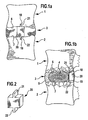
- Figur 1a:
- eine schematische Draufsicht auf den zwischen zwei Wirbelkörpern angeordneten Annulus fibrosus mit einem eingesetzten Implantat zum Verschluß einer Öffnung in diesem;
- Figur 1b:
- eine Seitenansicht auf die Wirbelkörper der Figur 1;
- Figur 2:
- eine perspektivische Ansicht des Implantates der Figuren 1a und 1b mit geänderten Abmessungen;
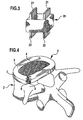
- Figur 3:
- ein abgewandeltes Ausführungsbeispiel eines Implantates mit mehreren Stegen zur Verankerung in den benachbarten Wirbelkörpern;
- Figur 4:
- eine schematische Ansicht eines Wirbelkörpers und eines Annulus fibrosus mit einem Bandscheibenvorfall;
- Figur 5:
- eine Darstellung ähnlich Figur 4 beim Eröffnen des Annulus fibrosus und beim Entfernen von überschüssigem Nucleusgewebe;
- Figur 6:
- eine Ansicht ähnlich Figur 1 beim Einsetzen eines Probeimplantats in die Annulusöffnung;
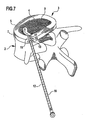
- Figur 7:
- eine Ansicht ähnlich Figur 6 beim Einsetzen eines Meißels zur Vorbereitung der Endplatten des benachbarten Wirbelkörpers;
- Figur 8:
- eine Ansicht ähnlich Figur 1 beim Einsetzen eines Implantates zum Verschluß des Annulus;
- Figur 9:
- eine Ansicht ähnlich Figur 4 mit eingesetztem Implantat und
- Figur 10:
- eine Ansicht ähnlich Figur 9 beim Injizieren von Zellmaterial in das Implantat und in den Nucleus.
- Wie aus der Zeichnung, insbesondere aus den Figuren 1a, 1b und 4 deutlich wird, ist zwischen zwei Wirbelkörpern 1, 2 eine Bandscheibe 3 angeordnet, die aus dem zentralen Nucleus 4 und dem sie umgebenden Annulus fibrosus 5 besteht. In der Darstellung der Figur 4 ist der obere Wirbelkörper 1 der besseren Sichtbarkeit wegen weggelassen, es versteht sich aber, daß dieser obere Wirbelkörper 1 mit seiner unteren Endplatte 6 ebenso wie der untere Wirbelkörper 2 mit seiner oberen Endplatte 7 flächig an der Bandscheibe 3 anliegt.
- In Figur 4 ist schematisch dargestellt, daß durch eine Öffnung 8 im Annulus fibrosus, die beispielsweise die Form eines Risses haben kann, Nucleusmaterial 9 aus dem Nucleus 4 nach außen austritt, dieses austretende Material kann auf benachbarte Nervenwurzeln drücken und Schmerzen verursachen.
- Um diese Verletzung zu beheben, wird in einer Operation das aus der Öffnung 8 austretende Nucleusmaterial 9 entfernt, dies kann beispielsweise mit Hilfe eines zangenförmigen Instrumentes 10 erfolgen, welches das gallertartige Nucleusmaterial 9 abtrennt und auch dazu verwendet werden kann, die Öffnung 8 zu vergrößern bzw. an den Rändern zu glätten (Figur 5). Das dabei entfernte Nucleusmaterial 9 kann zur Anzucht einer körpereigenen Zellkultur verwendet werden, auf diese Weise gelingt es, beispielsweise innerhalb von zwei Wochen eine Zellkultur herzustellen, die dann in der nachstehend beschriebenen Weise verwendet werden kann.
- In einem weiteren Operationsschritt muß die Öffnung 8 verschlossen werden. Dazu wird zunächst in die Öffnung 8 ein Probeimplantat 11 eingesetzt, welches beispielsweise aus einem körperverträglichen Metall besteht und im Verhältnis zur Größe der Öffnung 8 so gewählt wird, daß beim Einführen des Probeimplantates 11 in die Öffnung 8 diese nicht unnötig vergrößert wird. Das Probeimplantat 11 kann beispielsweise die Form eines relativ schmalen Quaders haben. Das Probeimplantat 11 ist über eine Stange 12 mit einem in der Zeichnung nicht dargestellten Handgriff verbindbar (Figur 6) und weist seitliche Vorsprünge 13 auf, die die Einschubtiefe in die Öffnung 8 begrenzen.
- An seiner Oberseite und an seiner Unterseite ist in das Probeimplantat 11 eine zur Stange 12 parallele, mittige Nut 14 eingearbeitet, diese bildet eine Führungsnut aus für einen Meißel 15. Dieser Meißel 15 ist am Ende eines rohrförmigen Schaftes 16 gehalten, der nach Abnahme des Handgriffes von der Stange 12 über diese geschoben werden kann (Figur 7). Dabei wird der Meißel 15 in der Nut 14 geführt und steht mit seiner Schneide 17 aus dieser hervor. Wird der Meißel 15 längs der Stange 12 vorgetrieben, schneidet er mit seiner Schneide 17 eine Nut 18 in die benachbarte Endplatte 6 des Wirbelkörpers 1, diese Nut verläuft dann parallel zur Nut 14 im Probeimplantat 11.
- In gleicher Weise kann auf der Unterseite des Probeimplantats 11 vorgegangen werden, auf diese Weise wird dort eine entsprechende Nut 19 in die Endplatte 7 des Wirbelkörpers 2 eingearbeitet.
- Nach Entnahme des Probeimplantates 11 kann in die Öffnung 8 nunmehr ein diese verschließendes Implantat 20 eingesetzt werden, welches in dem in Figur 8 dargestellten Ausführungsbeispiel die Form eines Quaders aufweist, der an seiner Oberseite und an seiner Unterseite mittig verlaufende Stege oder Rippen 21, 22 trägt, die parallel zu den Kanten des Implantates 20 verlaufen. Das Implantat 20 wird mittels eines geeigneten, das Implantat 20 lösbar ergreifenden Einsetzinstrumentes 23 in die Öffnung 8 eingeschoben, die Vorschubrichtung verläuft dabei parallel zur Längsrichtung der Rippen 21, 22, die beim Einschieben in die Nuten 18 bzw. 19 eintreten. Sobald das Implantat 20 vollständig in die Öffnung 8 eingeschoben ist, kann das Einsetzinstrument gelöst und abgenommen werden.
- Wie aus der Darstellung der Figur 9 erkennbar ist, verschließt nunmehr das Implantat 20 die Öffnung 8 und stützt sich mit seiner Oberseite an der Endplatte 6 des Wirbelkörpers 1 und mit seiner Unterseite an der Endplatte 7 des Wirbelkörpers 2 ab, die Rippen 21 und 22 greifen in die Nuten 18 bzw. 19 ein und legen dadurch das Implantat 20 in dieser Position fest.
- Das Implantat 20 besteht aus einem resorbierbaren Material und ist porös ausgebildet, die Größe der Poren liegt zwischen 150 und 200 µm. Das Material des stopfenförmigen Implantates 20 ist flexibel und elastisch, so daß es sich optimal an die Kontur der Öffnung 8 anpaßt und auch die Bewegungen des Materials des Annulus fibrosus ohne weiteres mitmacht. Dagegen sind die Rippen 21 und 22 formstabil ausgebildet, also wesentlich härter und nicht in gleicher Weise verformbar oder elastisch wie das übrige Material des Implantates 20. Dadurch ergibt sich im Bereich der Festlegung des Implantates 20 an den benachbarten Wirbelkörpern 1, 2 eine formstabile Verbindung, dazwischen jedoch paßt sich das Material des Implantates 20 an die Beweglichkeit des Materials des Annulus fibrosus an und verschließt die Öffnung 8 zuverlässig.
- Das gesamte Material des Stopfens zwischen den Rippen 21, 22 kann in dieser Weise flexibel oder elastisch ausgebildet sein, es ist aber auch möglich, daß das Material des Stopfens zu den Rippen 21, 22 hin zunehmend fester wird, beispielsweise könnte die Oberseite und die Unterseite des Stopfens in ähnlicher Weise formstabil ausgebildet sein wie die Rippen 21, 22, so daß sie formstabile Anlageflächen an die Endplatten der Wirbelkörper ausbilden. Wichtig ist lediglich, daß das Material des Stopfens im mittleren Bereich flexibel und elastisch ist, um eine Anpassung an die Beweglichkeit des Annulus-fibrosus-Gewebes zu gewährleisten.
- Wenn die Öffnung 8 im Annulus fibrosus 5 auf diese Weise verschlossen ist, kann man das außerhalb des Körpers angezüchtete Zellmaterial in das Innere der Bandscheibe 3 einfüllen. Dies erfolgt in der Regel etwa zwei Wochen nach der vorstehend beschriebenen Operation. Die Einfüllung kann mit Hilfe einer Injektionsnadel 24 erfolgen (Figur 10), die durch das Implantat 20 hindurch in den Innenraum der Bandscheibe 3 eingeführt wird und das Material sowohl in diesen Innenraum als auch in den porösen Bereich des Implantates 20 injiziert. Die injizierten Körperzellen wachsen im Innenraum der Bandscheibe 3 und im Implantat 20 an und verschließen schließlich die Öffnung 8 zuverlässig, so daß die Öffnung auch dann verschlossen bleibt, wenn sich das Implantat 20 allmählich zersetzt und vom Körper resorbiert wird.
- Bei dem in den Figuren 1 bis 10 dargestellten Ausführungsbeispiel ist das Implantat 20 im wesentlichen würfelförmig oder quaderförmig ausgebildet und trägt an seiner Oberseite und an seiner Unterseite jeweils einen mittig angeordneten Steg.
- Bei dem abgewandelten Ausführungsbeispiel der Figur 3 ist das Implantat 20 auch im wesentlichen quaderförmig ausgebildet, jedoch breiter, und dementsprechend sind auf der Oberseite und der Unterseite zwei parallel zueinander verlaufende Rippen 21 bzw. 22 angeordnet, die von den Seitenflächen des Implantates 20 einen Abstand einhalten, so daß im Bereich der Seitenflächen das Implantat aufgrund der nachgiebigen und elastischen Struktur sich optimal an das Gewebe des Annulus fibrosus anpassen kann, während das Implantat 20 durch die parallel verlaufenden Rippen 21, 22 in entsprechenden doppelten Nuten 18, 19 in den Endplatten der Wirbelkörper fixiert wird.
- Anstelle der Rippen 21, 22 könnten auch mehrere stiftförmige Vorsprünge vorgesehen werden, die in einer Reihe nebeneinander liegen. Außerdem ist es zur besseren Festlegung des Implantates in den Wirbelkörpern möglich, die Rippen oder Vorsprünge mit einer Zahnung zu versehen, die in die Seitenwände der Nuten 18, 19 eingreifen.
- An seiner Außenseite kann das Implantat 20 mit einer Membran 25 abgedeckt sein (Figur 1b), die dicht ausgebildet ist und das poröse Implantat 20 nach außen hin abdichtet. Auch diese Membran 25 kann aus resorbierbarem Material bestehen, vorzugsweise zersetzt sich dieses Material langsamer als das Material des übrigen Implantates 20 und wird dementsprechend später resorbiert.
- Außerdem kann in diesem Bereich eine in der Zeichnung nicht näher dargestellte Anti-Adhäsionsschicht aufgetragen werden, diese kann beispielsweise aus einem gelatinehaltigen Gel oder Spray bestehen. Dadurch kann eine postoperative Entstehung von Narbengewebe verhindert werden.
Claims (17)
- Implantat zum Verschluß einer Öffnung (8) des Annulus fibrosus (5) in Form eines Stopfens (20), dadurch gekennzeichnet, daß der Stopfen (20) an seiner Oberseite und an seiner Unterseite formstabile Verankerungselemente (21, 22) für die Endplatten (6, 7) benachbarter Wirbelkörper (1, 2) und im Bereich zwischen Oberseite und Unterseite eine verformbare Struktur aufweist
- Implantat nach Anspruch 1, dadurch gekennzeichnet, daß die Oberseite und/oder die Unterseite formstabiler sind als die zwischen Oberseite und Unterseite liegenden Bereiche des Stopfens (20).
- Implantat nach Anspruch 1 oder 2, dadurch gekennzeichnet, daß es aus resorbierbarem Material besteht.
- Implantat nach einem der voranstehenden Ansprüche, dadurch gekennzeichnet, daß der Stopfen (20) aus porösem Material besteht.
- Implantat nach Anspruch 4, dadurch gekennzeichnet, daß die Porengröße des porösen Materials zwischen 150 µm und 200 µm liegt.
- Implantat nach einem der voranstehenden Ansprüche, dadurch gekennzeichnet, daß die Oberseite und die Unterseite mindestens einen in die Endplatte (6, 7) des benachbarten Wirbelkörpers (1, 2) einsetzbaren Vorsprung (21, 22) tragen.
- Implantat nach Anspruch 6, dadurch gekennzeichnet, daß mehrere Vorsprünge in einer Linie nebeneinander liegen.
- Implantat nach Anspruch 6, dadurch gekennzeichnet, daß der Vorsprung eine Längsrippe (21, 22) ist.
- Implantat nach einem der Ansprüche 7 oder 8, dadurch gekennzeichnet, daß die Linie der Vorsprünge bzw. die Längsrichtung der Längsrippen (21, 22) parallel zur Einschubrichtung des Stopfens (20) verläuft.
- Implantat nach einem der Ansprüche 6 bis 9, dadurch gekennzeichnet, daß der Vorsprung (21, 22) eine Zahnung aufweist.
- Implantat nach einem der Ansprüche 6 bis 10, dadurch gekennzeichnet, daß quer zur Einschubrichtung des Stopfens (20) nebeneinander mehrere Vorsprünge (21, 22) angeordnet sind.
- Implantat nach Anspruch 11, dadurch gekennzeichnet, daß die Vorsprünge (21, 22) gegenüber der Seitenfläche des Stopfens (20) zurückgesetzt sind.
- Implantat nach einem der voranstehenden Ansprüche, dadurch gekennzeichnet, daß der Stopfen (20) die Form eines Würfels oder Quaders hat.
- Implantat nach einem der Ansprüche 3 bis 13, dadurch gekennzeichnet, daß der Stopfen (20) mit einer Membran (25) abgedeckt ist, die ebenfalls aus resorbierbarem Material besteht.
- Implantat nach Anspruch 14, dadurch gekennzeichnet, daß die Membran (25) langsamer resorbierbar ist als der Stopfen (20).
- Implantat nach einem der voranstehenden Ansprüche, dadurch gekennzeichnet, daß der Stopfen (20) an seiner Außenseite mit einem Anti-Adhäsionsmittel versehen ist.
- Implantat nach einem der voranstehenden Ansprüche, dadurch gekennzeichnet, daß es Teil eines Satzes von Stopfen (20) mit unterschiedlicher Höhe und/oder Breite ist.
Applications Claiming Priority (2)
| Application Number | Priority Date | Filing Date | Title |
|---|---|---|---|
| DE10340150A DE10340150A1 (de) | 2003-08-26 | 2003-08-26 | Implantat zum Verschluss einer Öffnung des Annulus Fibrosus |
| PCT/EP2004/008567 WO2005020859A1 (de) | 2003-08-26 | 2004-07-30 | Implantat zum verschluss einer öffnung des annulus fibrosus |
Publications (2)
| Publication Number | Publication Date |
|---|---|
| EP1658024A1 EP1658024A1 (de) | 2006-05-24 |
| EP1658024B1 true EP1658024B1 (de) | 2006-11-22 |
Family
ID=34223249
Family Applications (1)
| Application Number | Title | Priority Date | Filing Date |
|---|---|---|---|
| EP04763651A Expired - Lifetime EP1658024B1 (de) | 2003-08-26 | 2004-07-30 | Implantat zum verschluss einer öffnung des annulus fibrosus |
Country Status (6)
| Country | Link |
|---|---|
| US (1) | US20060195193A1 (de) |
| EP (1) | EP1658024B1 (de) |
| AT (1) | ATE345754T1 (de) |
| DE (2) | DE10340150A1 (de) |
| ES (1) | ES2277282T3 (de) |
| WO (1) | WO2005020859A1 (de) |
Families Citing this family (28)
| Publication number | Priority date | Publication date | Assignee | Title |
|---|---|---|---|---|
| US8632590B2 (en) | 1999-10-20 | 2014-01-21 | Anulex Technologies, Inc. | Apparatus and methods for the treatment of the intervertebral disc |
| US7052516B2 (en) | 1999-10-20 | 2006-05-30 | Anulex Technologies, Inc. | Spinal disc annulus reconstruction method and deformable spinal disc annulus stent |
| US7935147B2 (en) * | 1999-10-20 | 2011-05-03 | Anulex Technologies, Inc. | Method and apparatus for enhanced delivery of treatment device to the intervertebral disc annulus |
| US20030153976A1 (en) * | 1999-10-20 | 2003-08-14 | Cauthen Joseph C. | Spinal disc annulus reconstruction method and spinal disc annulus stent |
| US6592625B2 (en) * | 1999-10-20 | 2003-07-15 | Anulex Technologies, Inc. | Spinal disc annulus reconstruction method and spinal disc annulus stent |
| US7951201B2 (en) | 1999-10-20 | 2011-05-31 | Anulex Technologies, Inc. | Method and apparatus for the treatment of the intervertebral disc annulus |
| US7615076B2 (en) | 1999-10-20 | 2009-11-10 | Anulex Technologies, Inc. | Method and apparatus for the treatment of the intervertebral disc annulus |
| US7004970B2 (en) * | 1999-10-20 | 2006-02-28 | Anulex Technologies, Inc. | Methods and devices for spinal disc annulus reconstruction and repair |
| AR038680A1 (es) | 2002-02-19 | 2005-01-26 | Synthes Ag | Implante intervertebral |
| DE50313446D1 (de) | 2003-02-06 | 2011-03-10 | Synthes Gmbh | Zwischenwirbelimplantat |
| US7879103B2 (en) * | 2005-04-15 | 2011-02-01 | Musculoskeletal Transplant Foundation | Vertebral disc repair |
| US8795364B2 (en) | 2005-05-06 | 2014-08-05 | Kensey Nash Corporation | System and devices for the repair of a vertebral disc defect |
| US7824414B2 (en) | 2005-07-22 | 2010-11-02 | Kensey Nash Corporation | System and devices for the repair of a vertebral disc defect |
| US20070067036A1 (en) * | 2005-09-20 | 2007-03-22 | Zimmer Spine, Inc. | Hydrogel total disc prosthesis |
| DE102005056824A1 (de) | 2005-11-24 | 2007-05-31 | Aesculap Ag & Co. Kg | Chirurgisches Führungsinstrument |
| US20100305704A1 (en) | 2006-02-27 | 2010-12-02 | Synthes Gmbh | Intervertebral implant with fixation geometry |
| US7959683B2 (en) | 2006-07-25 | 2011-06-14 | Musculoskeletal Transplant Foundation | Packed demineralized cancellous tissue forms for disc nucleus augmentation, restoration, or replacement and methods of implantation |
| US20080172126A1 (en) * | 2006-10-03 | 2008-07-17 | Reynolds Martin A | Nucleus pulposus injection devices and methods |
| DE102007008184A1 (de) * | 2007-02-13 | 2008-08-14 | Aesculap Ag & Co. Kg | Implantat zur Fixierung von Knochenteilen |
| KR20100105580A (ko) | 2007-11-16 | 2010-09-29 | 신세스 게엠바하 | 낮은 프로파일 추간 임플란트 |
| BRPI0921485A2 (pt) | 2008-11-07 | 2016-01-12 | Synthes Gmbh | montagem de placa acoplada e espaçador de intercorpo vertebral |
| US8182533B2 (en) * | 2009-01-19 | 2012-05-22 | Richard Perkins | Annular repair device and method |
| US9220604B2 (en) | 2010-12-21 | 2015-12-29 | DePuy Synthes Products, Inc. | Intervertebral implants, systems, and methods of use |
| US9433404B2 (en) | 2012-10-31 | 2016-09-06 | Suture Concepts Inc. | Method and apparatus for closing fissures in the annulus fibrosus |
| US10786235B2 (en) | 2012-10-31 | 2020-09-29 | Anchor Innovation Medical, Inc. | Method and apparatus for closing a fissure in the annulus of an intervertebral disc, and/or for effecting other anatomical repairs and/or fixations |
| US10070969B2 (en) | 2013-01-17 | 2018-09-11 | Stryker European Holdings I, Llc | Annulus plug for intervertebral disc repair |
| AU2014306454B2 (en) | 2013-08-16 | 2019-06-13 | Suture Concepts Inc. | Method and apparatus for closing a fissure in the annulus of an intervertebral disc, and/or for effecting other anatomical repairs and/or fixations |
| US9867718B2 (en) | 2014-10-22 | 2018-01-16 | DePuy Synthes Products, Inc. | Intervertebral implants, systems, and methods of use |
Family Cites Families (14)
| Publication number | Priority date | Publication date | Assignee | Title |
|---|---|---|---|---|
| WO1998020939A2 (en) * | 1996-11-15 | 1998-05-22 | Advanced Bio Surfaces, Inc. | Biomaterial system for in situ tissue repair |
| US5571189A (en) * | 1994-05-20 | 1996-11-05 | Kuslich; Stephen D. | Expandable fabric implant for stabilizing the spinal motion segment |
| GB9713330D0 (en) * | 1997-06-25 | 1997-08-27 | Bridport Gundry Plc | Surgical implant |
| WO1999004720A1 (en) * | 1997-07-11 | 1999-02-04 | Reprogenesis Inc. | Repair of intervertebral disks |
| US6245107B1 (en) * | 1999-05-28 | 2001-06-12 | Bret A. Ferree | Methods and apparatus for treating disc herniation |
| US6371990B1 (en) * | 1999-10-08 | 2002-04-16 | Bret A. Ferree | Annulus fibrosis augmentation methods and apparatus |
| US6340369B1 (en) * | 1999-08-13 | 2002-01-22 | Bret A. Ferree | Treating degenerative disc disease with harvested disc cells and analogues of the extracellular matrix |
| US20030040796A1 (en) * | 1999-10-08 | 2003-02-27 | Ferree Bret A. | Devices used to treat disc herniation and attachment mechanisms therefore |
| WO2001028464A1 (en) * | 1999-10-20 | 2001-04-26 | Anulex Technologies, Inc. | Spinal disc annulus reconstruction method and spinal disc annulus stent |
| AU2002246816B2 (en) * | 2000-10-27 | 2006-03-09 | Warsaw Orthopedic, Inc. | Annulus repair systems and methods |
| US20020147461A1 (en) * | 2001-04-06 | 2002-10-10 | Aldrich William N. | Apparatus and methods for closing openings in spinal discs |
| US20030078579A1 (en) * | 2001-04-19 | 2003-04-24 | Ferree Bret A. | Annular repair devices and methods |
| US20030114930A1 (en) * | 2001-12-18 | 2003-06-19 | Lim Kit Yeng | Apparatus and method to stabilize and repair an intervertebral disc |
| US7223289B2 (en) * | 2002-04-16 | 2007-05-29 | Warsaw Orthopedic, Inc. | Annulus repair systems and techniques |
-
2003
- 2003-08-26 DE DE10340150A patent/DE10340150A1/de not_active Withdrawn
-
2004
- 2004-07-30 EP EP04763651A patent/EP1658024B1/de not_active Expired - Lifetime
- 2004-07-30 DE DE502004002123T patent/DE502004002123D1/de not_active Expired - Lifetime
- 2004-07-30 ES ES04763651T patent/ES2277282T3/es not_active Expired - Lifetime
- 2004-07-30 WO PCT/EP2004/008567 patent/WO2005020859A1/de not_active Ceased
- 2004-07-30 AT AT04763651T patent/ATE345754T1/de active
-
2006
- 2006-02-22 US US11/360,986 patent/US20060195193A1/en not_active Abandoned
Also Published As
| Publication number | Publication date |
|---|---|
| ATE345754T1 (de) | 2006-12-15 |
| WO2005020859A1 (de) | 2005-03-10 |
| DE10340150A1 (de) | 2005-03-31 |
| DE502004002123D1 (de) | 2007-01-04 |
| ES2277282T3 (es) | 2007-07-01 |
| EP1658024A1 (de) | 2006-05-24 |
| US20060195193A1 (en) | 2006-08-31 |
Similar Documents
| Publication | Publication Date | Title |
|---|---|---|
| EP1658024B1 (de) | Implantat zum verschluss einer öffnung des annulus fibrosus | |
| DE69429579T2 (de) | Prothese für eine intervertebrale fusion | |
| DE60320464T2 (de) | Wirbelkörper-Distraktor | |
| DE69837883T2 (de) | Wirbelsäulenimplantat und Schneidwerkzeugvorbereitungszubehör zum Einsetzen des Implantats | |
| DE60023284T2 (de) | Zwischenwirbel-discuspulposus-prothese mit formveränderungseigenschaften | |
| DE60212648T2 (de) | Transplantathaltende implantate für laminoplastie | |
| DE69102369T2 (de) | Bandscheibenprothese und instrumente für ihre implantation. | |
| EP1635743A1 (de) | Implantat für den zwischenwirbelraum | |
| EP2781206B1 (de) | Zweiteiliger Kniespacer mit Aussparungen | |
| EP1720492A1 (de) | Zervikale bandscheibenprothese mit luxationssicherung und instrumentarium | |
| DE202005021741U1 (de) | Implantat zur transforaminalen interkorporellen Fusion | |
| DE29913200U1 (de) | Implantat aus Knochenmaterial | |
| WO2005004756A2 (de) | Bandscheibenprothese | |
| WO2004043304A2 (de) | Implantat zum einsatz bei versteifungsoperationen an der wirbelsäule | |
| EP1049430A1 (de) | Implantat | |
| DE69634255T2 (de) | Elemente für gelenkprothese und verfahren zu deren herstellung | |
| WO2012041914A1 (de) | Lamina-implantatsatz | |
| EP3331472B1 (de) | Implantat zum verschliessen eines defekts im anulus fibrosus einer bandscheibe | |
| DE10326534A1 (de) | Knochenersatzmaterial | |
| WO2006111174A1 (de) | Bandscheibenentlastungsimplantat und verfahren zum aufrichten und entlasten eines bandscheibenfachs | |
| WO2022179835A1 (de) | Mehrteiliges implantat mit stützelement und funktionselement | |
| DE68907714T2 (de) | Kniegelenksprothese. | |
| EP1809211B1 (de) | Prothese zur überbrückung eines wirbelkörpers | |
| DE20313512U1 (de) | Implantat zum Verschluss einer Öffnung des Annulus Fibrosus | |
| DE102023102881B4 (de) | Zervikaler Cage |
Legal Events
| Date | Code | Title | Description |
|---|---|---|---|
| PUAI | Public reference made under article 153(3) epc to a published international application that has entered the european phase |
Free format text: ORIGINAL CODE: 0009012 |
|
| 17P | Request for examination filed |
Effective date: 20051122 |
|
| AK | Designated contracting states |
Kind code of ref document: A1 Designated state(s): AT BE BG CH CY CZ DE DK EE ES FI FR GB GR HU IE IT LI LU MC NL PL PT RO SE SI SK TR |
|
| GRAP | Despatch of communication of intention to grant a patent |
Free format text: ORIGINAL CODE: EPIDOSNIGR1 |
|
| GRAS | Grant fee paid |
Free format text: ORIGINAL CODE: EPIDOSNIGR3 |
|
| GRAA | (expected) grant |
Free format text: ORIGINAL CODE: 0009210 |
|
| AK | Designated contracting states |
Kind code of ref document: B1 Designated state(s): AT BE BG CH CY CZ DE DK EE ES FI FR GB GR HU IE IT LI LU MC NL PL PT RO SE SI SK TR |
|
| DAX | Request for extension of the european patent (deleted) | ||
| PG25 | Lapsed in a contracting state [announced via postgrant information from national office to epo] |
Ref country code: NL Free format text: LAPSE BECAUSE OF FAILURE TO SUBMIT A TRANSLATION OF THE DESCRIPTION OR TO PAY THE FEE WITHIN THE PRESCRIBED TIME-LIMIT Effective date: 20061122 Ref country code: FI Free format text: LAPSE BECAUSE OF FAILURE TO SUBMIT A TRANSLATION OF THE DESCRIPTION OR TO PAY THE FEE WITHIN THE PRESCRIBED TIME-LIMIT Effective date: 20061122 Ref country code: PL Free format text: LAPSE BECAUSE OF FAILURE TO SUBMIT A TRANSLATION OF THE DESCRIPTION OR TO PAY THE FEE WITHIN THE PRESCRIBED TIME-LIMIT Effective date: 20061122 Ref country code: RO Free format text: LAPSE BECAUSE OF FAILURE TO SUBMIT A TRANSLATION OF THE DESCRIPTION OR TO PAY THE FEE WITHIN THE PRESCRIBED TIME-LIMIT Effective date: 20061122 Ref country code: IE Free format text: LAPSE BECAUSE OF FAILURE TO SUBMIT A TRANSLATION OF THE DESCRIPTION OR TO PAY THE FEE WITHIN THE PRESCRIBED TIME-LIMIT Effective date: 20061122 Ref country code: CZ Free format text: LAPSE BECAUSE OF FAILURE TO SUBMIT A TRANSLATION OF THE DESCRIPTION OR TO PAY THE FEE WITHIN THE PRESCRIBED TIME-LIMIT Effective date: 20061122 Ref country code: SI Free format text: LAPSE BECAUSE OF FAILURE TO SUBMIT A TRANSLATION OF THE DESCRIPTION OR TO PAY THE FEE WITHIN THE PRESCRIBED TIME-LIMIT Effective date: 20061122 Ref country code: SK Free format text: LAPSE BECAUSE OF FAILURE TO SUBMIT A TRANSLATION OF THE DESCRIPTION OR TO PAY THE FEE WITHIN THE PRESCRIBED TIME-LIMIT Effective date: 20061122 |
|
| REG | Reference to a national code |
Ref country code: GB Ref legal event code: FG4D Free format text: NOT ENGLISH |
|
| REG | Reference to a national code |
Ref country code: CH Ref legal event code: EP Ref country code: CH Ref legal event code: NV Representative=s name: ISLER & PEDRAZZINI AG |
|
| REG | Reference to a national code |
Ref country code: IE Ref legal event code: FG4D Free format text: LANGUAGE OF EP DOCUMENT: GERMAN |
|
| REF | Corresponds to: |
Ref document number: 502004002123 Country of ref document: DE Date of ref document: 20070104 Kind code of ref document: P |
|
| PG25 | Lapsed in a contracting state [announced via postgrant information from national office to epo] |
Ref country code: SE Free format text: LAPSE BECAUSE OF FAILURE TO SUBMIT A TRANSLATION OF THE DESCRIPTION OR TO PAY THE FEE WITHIN THE PRESCRIBED TIME-LIMIT Effective date: 20070222 Ref country code: DK Free format text: LAPSE BECAUSE OF FAILURE TO SUBMIT A TRANSLATION OF THE DESCRIPTION OR TO PAY THE FEE WITHIN THE PRESCRIBED TIME-LIMIT Effective date: 20070222 Ref country code: BG Free format text: LAPSE BECAUSE OF FAILURE TO SUBMIT A TRANSLATION OF THE DESCRIPTION OR TO PAY THE FEE WITHIN THE PRESCRIBED TIME-LIMIT Effective date: 20070222 |
|
| GBT | Gb: translation of ep patent filed (gb section 77(6)(a)/1977) |
Effective date: 20070213 |
|
| PG25 | Lapsed in a contracting state [announced via postgrant information from national office to epo] |
Ref country code: PT Free format text: LAPSE BECAUSE OF FAILURE TO SUBMIT A TRANSLATION OF THE DESCRIPTION OR TO PAY THE FEE WITHIN THE PRESCRIBED TIME-LIMIT Effective date: 20070423 |
|
| NLV1 | Nl: lapsed or annulled due to failure to fulfill the requirements of art. 29p and 29m of the patents act | ||
| ET | Fr: translation filed | ||
| REG | Reference to a national code |
Ref country code: IE Ref legal event code: FD4D |
|
| REG | Reference to a national code |
Ref country code: ES Ref legal event code: FG2A Ref document number: 2277282 Country of ref document: ES Kind code of ref document: T3 |
|
| PLBE | No opposition filed within time limit |
Free format text: ORIGINAL CODE: 0009261 |
|
| REG | Reference to a national code |
Ref country code: CH Ref legal event code: PCAR Free format text: ISLER & PEDRAZZINI AG;POSTFACH 1772;8027 ZUERICH (CH) |
|
| STAA | Information on the status of an ep patent application or granted ep patent |
Free format text: STATUS: NO OPPOSITION FILED WITHIN TIME LIMIT |
|
| 26N | No opposition filed |
Effective date: 20070823 |
|
| BERE | Be: lapsed |
Owner name: AESCULAP A.G. & CO. KG Effective date: 20070731 |
|
| PG25 | Lapsed in a contracting state [announced via postgrant information from national office to epo] |
Ref country code: GR Free format text: LAPSE BECAUSE OF FAILURE TO SUBMIT A TRANSLATION OF THE DESCRIPTION OR TO PAY THE FEE WITHIN THE PRESCRIBED TIME-LIMIT Effective date: 20070223 Ref country code: MC Free format text: LAPSE BECAUSE OF NON-PAYMENT OF DUE FEES Effective date: 20070731 |
|
| PG25 | Lapsed in a contracting state [announced via postgrant information from national office to epo] |
Ref country code: BE Free format text: LAPSE BECAUSE OF NON-PAYMENT OF DUE FEES Effective date: 20070731 |
|
| PG25 | Lapsed in a contracting state [announced via postgrant information from national office to epo] |
Ref country code: EE Free format text: LAPSE BECAUSE OF FAILURE TO SUBMIT A TRANSLATION OF THE DESCRIPTION OR TO PAY THE FEE WITHIN THE PRESCRIBED TIME-LIMIT Effective date: 20061122 |
|
| PG25 | Lapsed in a contracting state [announced via postgrant information from national office to epo] |
Ref country code: CY Free format text: LAPSE BECAUSE OF FAILURE TO SUBMIT A TRANSLATION OF THE DESCRIPTION OR TO PAY THE FEE WITHIN THE PRESCRIBED TIME-LIMIT Effective date: 20061122 Ref country code: LU Free format text: LAPSE BECAUSE OF NON-PAYMENT OF DUE FEES Effective date: 20070730 |
|
| PG25 | Lapsed in a contracting state [announced via postgrant information from national office to epo] |
Ref country code: TR Free format text: LAPSE BECAUSE OF FAILURE TO SUBMIT A TRANSLATION OF THE DESCRIPTION OR TO PAY THE FEE WITHIN THE PRESCRIBED TIME-LIMIT Effective date: 20061122 Ref country code: HU Free format text: LAPSE BECAUSE OF FAILURE TO SUBMIT A TRANSLATION OF THE DESCRIPTION OR TO PAY THE FEE WITHIN THE PRESCRIBED TIME-LIMIT Effective date: 20070523 |
|
| PGFP | Annual fee paid to national office [announced via postgrant information from national office to epo] |
Ref country code: IT Payment date: 20140728 Year of fee payment: 11 |
|
| REG | Reference to a national code |
Ref country code: DE Ref legal event code: R082 Ref document number: 502004002123 Country of ref document: DE Representative=s name: HOEGER, STELLRECHT & PARTNER PATENTANWAELTE MB, DE |
|
| REG | Reference to a national code |
Ref country code: FR Ref legal event code: PLFP Year of fee payment: 12 |
|
| PGFP | Annual fee paid to national office [announced via postgrant information from national office to epo] |
Ref country code: DE Payment date: 20150722 Year of fee payment: 12 Ref country code: ES Payment date: 20150723 Year of fee payment: 12 Ref country code: CH Payment date: 20150723 Year of fee payment: 12 Ref country code: GB Payment date: 20150724 Year of fee payment: 12 |
|
| PGFP | Annual fee paid to national office [announced via postgrant information from national office to epo] |
Ref country code: FR Payment date: 20150730 Year of fee payment: 12 Ref country code: AT Payment date: 20150722 Year of fee payment: 12 |
|
| PG25 | Lapsed in a contracting state [announced via postgrant information from national office to epo] |
Ref country code: IT Free format text: LAPSE BECAUSE OF NON-PAYMENT OF DUE FEES Effective date: 20150730 |
|
| REG | Reference to a national code |
Ref country code: DE Ref legal event code: R119 Ref document number: 502004002123 Country of ref document: DE |
|
| REG | Reference to a national code |
Ref country code: CH Ref legal event code: PL |
|
| REG | Reference to a national code |
Ref country code: AT Ref legal event code: MM01 Ref document number: 345754 Country of ref document: AT Kind code of ref document: T Effective date: 20160730 |
|
| GBPC | Gb: european patent ceased through non-payment of renewal fee |
Effective date: 20160730 |
|
| PG25 | Lapsed in a contracting state [announced via postgrant information from national office to epo] |
Ref country code: DE Free format text: LAPSE BECAUSE OF NON-PAYMENT OF DUE FEES Effective date: 20170201 Ref country code: CH Free format text: LAPSE BECAUSE OF NON-PAYMENT OF DUE FEES Effective date: 20160731 Ref country code: LI Free format text: LAPSE BECAUSE OF NON-PAYMENT OF DUE FEES Effective date: 20160731 Ref country code: FR Free format text: LAPSE BECAUSE OF NON-PAYMENT OF DUE FEES Effective date: 20160801 |
|
| REG | Reference to a national code |
Ref country code: FR Ref legal event code: ST Effective date: 20170331 |
|
| PG25 | Lapsed in a contracting state [announced via postgrant information from national office to epo] |
Ref country code: GB Free format text: LAPSE BECAUSE OF NON-PAYMENT OF DUE FEES Effective date: 20160730 Ref country code: AT Free format text: LAPSE BECAUSE OF NON-PAYMENT OF DUE FEES Effective date: 20160730 |
|
| PG25 | Lapsed in a contracting state [announced via postgrant information from national office to epo] |
Ref country code: ES Free format text: LAPSE BECAUSE OF NON-PAYMENT OF DUE FEES Effective date: 20160731 |
|
| REG | Reference to a national code |
Ref country code: ES Ref legal event code: FD2A Effective date: 20180626 |