EP1658593B1 - Procede et dispositif d'identification et d'authentification utilisateur personnalisees a fonctionnement pictographique - Google Patents
Procede et dispositif d'identification et d'authentification utilisateur personnalisees a fonctionnement pictographique Download PDFInfo
- Publication number
- EP1658593B1 EP1658593B1 EP03818398A EP03818398A EP1658593B1 EP 1658593 B1 EP1658593 B1 EP 1658593B1 EP 03818398 A EP03818398 A EP 03818398A EP 03818398 A EP03818398 A EP 03818398A EP 1658593 B1 EP1658593 B1 EP 1658593B1
- Authority
- EP
- European Patent Office
- Prior art keywords
- picture
- user
- pictures
- passkey
- electronic device
- Prior art date
- Legal status (The legal status is an assumption and is not a legal conclusion. Google has not performed a legal analysis and makes no representation as to the accuracy of the status listed.)
- Expired - Lifetime
Links
Images

Classifications
-
- G—PHYSICS
- G07—CHECKING-DEVICES
- G07F—COIN-FREED OR LIKE APPARATUS
- G07F7/00—Mechanisms actuated by objects other than coins to free or to actuate vending, hiring, coin or paper currency dispensing or refunding apparatus
- G07F7/08—Mechanisms actuated by objects other than coins to free or to actuate vending, hiring, coin or paper currency dispensing or refunding apparatus by coded identity card or credit card or other personal identification means
- G07F7/10—Mechanisms actuated by objects other than coins to free or to actuate vending, hiring, coin or paper currency dispensing or refunding apparatus by coded identity card or credit card or other personal identification means together with a coded signal, e.g. in the form of personal identification information, like personal identification number [PIN] or biometric data
- G07F7/1008—Active credit-cards provided with means to personalise their use, e.g. with PIN-introduction/comparison system
-
- G—PHYSICS
- G06—COMPUTING OR CALCULATING; COUNTING
- G06F—ELECTRIC DIGITAL DATA PROCESSING
- G06F21/00—Security arrangements for protecting computers, components thereof, programs or data against unauthorised activity
- G06F21/30—Authentication, i.e. establishing the identity or authorisation of security principals
- G06F21/31—User authentication
- G06F21/36—User authentication by graphic or iconic representation
-
- G—PHYSICS
- G06—COMPUTING OR CALCULATING; COUNTING
- G06Q—INFORMATION AND COMMUNICATION TECHNOLOGY [ICT] SPECIALLY ADAPTED FOR ADMINISTRATIVE, COMMERCIAL, FINANCIAL, MANAGERIAL OR SUPERVISORY PURPOSES; SYSTEMS OR METHODS SPECIALLY ADAPTED FOR ADMINISTRATIVE, COMMERCIAL, FINANCIAL, MANAGERIAL OR SUPERVISORY PURPOSES, NOT OTHERWISE PROVIDED FOR
- G06Q20/00—Payment architectures, schemes or protocols
- G06Q20/30—Payment architectures, schemes or protocols characterised by the use of specific devices or networks
- G06Q20/34—Payment architectures, schemes or protocols characterised by the use of specific devices or networks using cards, e.g. integrated circuit [IC] cards or magnetic cards
- G06Q20/346—Cards serving only as information carrier of service
-
- G—PHYSICS
- G06—COMPUTING OR CALCULATING; COUNTING
- G06Q—INFORMATION AND COMMUNICATION TECHNOLOGY [ICT] SPECIALLY ADAPTED FOR ADMINISTRATIVE, COMMERCIAL, FINANCIAL, MANAGERIAL OR SUPERVISORY PURPOSES; SYSTEMS OR METHODS SPECIALLY ADAPTED FOR ADMINISTRATIVE, COMMERCIAL, FINANCIAL, MANAGERIAL OR SUPERVISORY PURPOSES, NOT OTHERWISE PROVIDED FOR
- G06Q20/00—Payment architectures, schemes or protocols
- G06Q20/38—Payment protocols; Details thereof
- G06Q20/40—Authorisation, e.g. identification of payer or payee, verification of customer or shop credentials; Review and approval of payers, e.g. check credit lines or negative lists
- G06Q20/401—Transaction verification
- G06Q20/4014—Identity check for transactions
-
- H—ELECTRICITY
- H04—ELECTRIC COMMUNICATION TECHNIQUE
- H04M—TELEPHONIC COMMUNICATION
- H04M1/00—Substation equipment, e.g. for use by subscribers
- H04M1/66—Substation equipment, e.g. for use by subscribers with means for preventing unauthorised or fraudulent calling
Definitions
- the present invention relates to a method of personal and personalized authentication for mobile terminals. It also relates to personalized authentication to mobile terminals that provides significant benefits in security, reliability, usability and cost over traditional password or personal identification number (PIN) based systems.
- PIN personal identification number
- a common method to authenticate a user to an entity that requires authentication is a username and password pair.
- the user enters the usemame and corresponding password and if these match a pre-stored counterpart the user is granted access to, for example, a mobile device.
- passwords have been character strings of varying length.
- the PIN code of a mobile device is a four-digit string.
- humans are not extremely good at recalling names and even worse, at recalling random sets of characters or numbers that typify PIN codes today. Because of this, it is quite common that users select simple passwords that are vulnerable to e.g. dictionary attacks, where simple words or numerical combinations are tried at high-speed time after time.
- passwords systems that use pictures (e.g. faces) instead of characters have been developed.
- the present invention provides a method with the features of claim 1, a computer grogram product with the features of claim 7 and a device having the features of claims 8. Preferred embodiments of the present invention are disclosed in the dependent claims.
- the method comprises retrieving a number of pictures from a picture passkey library and displaying at least a subset of them on a display of said user device.
- the method further comprises receiving user input representing an input code by which at least one of said pictures is selected and comparing said selected picture(s) /code with a pre-stored identification or access data. If said received code matches with said pre-stored data an unlocking or authorizing operation is performed.
- said pictures in said picture passkey library comprise user-generated pictures, that have been received from a built-in camera.
- the pictures are made accessible to the device.
- a pre-defined selection of pictures can be presented to the user. It may be necessary to select a subset of the pictures e.g. in case that more pictures are stored in said picture passkey library than actually can be displayed simultaneously.
- the user By receiving a user input that represents e.g. a code or a sequence comprising at least one marked or selected picture, the user enters an identification, to proof his access rights.
- the code or sequence can comprise only pictures or can comprise a combination of characters and pictures.
- the code length can be determined to comprise at least 1, 2, 3, 4 or more code elements/pictures.
- the code length may be prescribed by the system or may be selectable by a user. The code may have to be terminated or confirmed by pressing an 'enter' key.
- a conventional unlocking procedure By comparing said identification input with a pre-stored identification/access data, a conventional unlocking procedure can be used, wherein the elements to be compared can differ from conventional ID-number procedures.
- the device If said received identification input matches with said pre-stored identification data, the device performs an unlocking or authorizing operation, to grant access to the device.
- the method of the present invention provides that said pictures in said picture passkey library, are at least partially user-generated.
- the user can use pictures generated by him.
- the user remembers the pictures generated by himself better than a number of arbitrary pictures of a default library. It is more likely that a user can make up mnemonics for a sequel of self-generated pictures that can help memorize his personal identification or access input sequence.
- the method further preferably comprises receiving an unlock input.
- receiving an unlock input at said electronic device when said electronic device is in a locked state the user can start the unlocking or authorizing procedure.
- the unlocking may also refer only to parts of a system such as certain applications or the access to a network or services located therein.
- the unlock-input can represent a power switch input or an unlock input in case of an electronic multi-user device
- said method further comprises receiving a user identification and retrieving a number of pictures from a picture passkey library according to said entered user identification.
- each user can access a definable selection of passkey pictures for an unlocking or authorizing operation.
- a user identification such as e.g. username to be entered, or a depicted user icon or photo that can be selected
- each user can access a definable selection of passkey pictures for an unlocking or authorizing operation.
- customized passkey picture libraries different users may prefer different sets of passkey pictures to be displayed for entering a user identification/authentication input or input code.
- user specific passkey pictures or user specific passkey picture libraries even devices with small displays can provide personalized passkey picture sets to different users.
- every user can specifically benefit from the present invention independently from an actual selection of passkey picture sets of other users.
- said method further comprises retrieving at least one character being allocated to said pictures related to said input.
- the pictures and maybe also other user input can be replaced by shorter sequence of digital (e.g. ASCII code). It is assumed that by translating the pictures e.g. in a one or two digit code the comparing operation can be accelerated.
- the pictures can be used in addition to a normal set of input characters such as the alphabet, numerals and entities.
- a method for generating a picture in a picture passkey library by a user is provided.
- the picture is to be used in a picture-identification based unlocking or authorizing procedure of a locked electronic device.
- the method comprises receiving a picture at said electronic device, rendering said received picture to obtain an optimized rendered version of said picture/photo and storing said rendered version of said photo in said picture passkey library.
- the picture may be received via a network connection at said electronic device or from a connected storage comprising user-generated pictures.
- the pictures can be received from a connected digital camera.
- the method can also comprise the deletion of another picture from said passkey picture library.
- the present invention enables the user to utilize any picture database in their electronic device to add new images to the passkey library. By allowing the user to take new pictures and add these to the library, it is even easier for the user to remember the correct passcode. The user will surely remember the faces of his friends, family, pets or other creatures or items better than e.g. the faces of some strangers of a default library.
- the rendering process can provide a data compression thereby reducing the required storage space for the passkey picture library.
- said picture is received from an electronic camera.
- the camera can be a built in camera or a connectable camera as known e.g. from headset cameras.
- the picture can be received by user input inducing a camera to take a photo.
- the present invention enables the user to utilize a camera in his electronic device e.g. a mobile phone to add new images to the passkey library. This can also provide a fun feature for example to a mobile phone that has an integrated camera.
- the user can change the passcode any time by taking new pictures and adding those to the library.
- the present invention provides an additional incentive to use and buy electronic devices with built in cameras.
- said method further comprises generating at least one character related to said rendered picture and storing said generated at least one character in relation to said rendered/processed version of said photo.
- a character code that is related to said rendered picture is generated. Then follows storing said at least one character in relation with said rendered version of said photo in said picture passkey library.
- the character code can facilitate the comparing operation, as a conventional comparing operation can be used for a sequel of characters or entities representing a picture.
- said method comprises the above mentioned procedures for generating a passcode picture by a user and using said passcode picture in an unlocking operation.
- the combination of both methods provides the possibility to generate and use a custom-made picture passkey library for the maximum benefit of the user.
- the picture passkey library can be selected according to an entered username.
- a software tool comprising program code means for carrying out the method of the preceding description when said program product is run on a computer or a network device.
- a computer program product downloadable from a server for carrying out the method of the preceding description, which comprises program code means for performing all of the steps of the preceding methods when said program is run on a computer or a network device.
- a computer program product comprising program code means stored on a computer readable medium for carrying out the methods of the preceding description, when said program product is run on a computer or a network device.
- an electronic device is provided that is capable of being unlocked by picture identification.
- the device comprises a user-input interface, a picture passkey library, a display, a processing unit and a component to receive pictures.
- the user input interface is for receiving an unlocking input or an input for authorizing the use of an electronic device and a user identification input.
- the unlock input can comprise e.g. the activation of a power switch or in case of a personal computer the ⁇ Strg-Alt-Del' key combination or any device-specific user input to start an identification or authorization procedure.
- the picture passkey library according to the invention is user editable and enables the user to add, delete and change passkey pictures.
- the display is provided for displaying pictures from said picture passkey library.
- the display can be combined with said user input interface in e.g. a touch screen display.
- the display can also provide other functionality combined with said user input interface in e.g. a touch screen display.
- the processing unit is connected to said user input interface, picture passkey library and said display.
- the processing unit receives the input from said user input interface and controls the picture library and the display accordingly to perform the above mentioned unlock and picture passkey library editing procedures.
- the device according to the invention further comprises a component to receive pictures that can be stored in said picture passkey library, this implements that the picture passkey library is user editable. Thus, the user can choose the passkey pictures that are going to be presented in the next unlocking procedure.
- said electronic device comprises a memory and a lock.
- Said memory is provided for storing predetermined identification data and is connected to said processing unit.
- said processing unit is configured to compare a user input with said predetermined identification data, and to perform an unlocking operation at said lock, if they match.
- Said predetermined identification data stored in said memory can comprise e.g. a key sequence or a unlocking code, to be used in a comparing or matching operation to determine if a received user unlocking code is valid or not.
- the identification data can comprise also a 'hash value' as used in the case of computers to perform said matching operation.
- the input sequence is translated or referred to another base of numbers to facilitate the matching operation. Any known base of numbers or characters can be used.
- Said lock can be an electro-mechanic or an electronic lock.
- an electro-mechanic lock this can be embodied as a padlock, a lock of a safe, or the like.
- An electro-mechanic lock can be embodied as a lock for a clamshell type portable computer such as a communicator, to prevent an unauthorized opening of said computer. In these cases an unlock operation will be performed by drawing back a bolt or releasing catch.
- An electronic lock can be embodied as an electronically operated switch, to grant access to a keyboard or other hardware components by electrically connecting said keyboard to e.g. said processing unit.
- An electronic lock can also be embodied as a software implementation, to grant access e.g. to a keyboard or other hardware components by activating/de-activating an input interpreter.
- Said software embodiment can also be used to lock or unlock the access to certain software applications. Such software locks are known from the area of computer and mobile phone technology.
- said component to receive pictures comprises an electronic camera.
- the processing unit is configured to render a picture taken with said camera and to add it to the passkey picture library.
- the present invention enables a user to utilize the camera in or connected to their device to add new images to the passkey library.
- the user will surely remember the pictures taken by himself better than a default picture set of a default library.
- the present invention also provides a fun feature for example to a mobile phone that has an integrated camera. The user can change the passcode any time by taking new pictures and adding those to the library. Unlike other conventional applications for mobile device incorporated cameras the passkey picture feature is free of charge.
- said electronic device comprises user-specific picture passkey libraries, connected to said processing unit.
- said processing unit has to be configured to select said user specific passkey library according to a received user identifying input, such as e.g. a usemame. This embodiment is especially useful in the case of multi-user devices.
- said electronic device is portable.
- the present invention can be applied to any kind of display and input enabled devices that require a locking or unlocking functionality such as e.g. mobile telephones, personal digital assistants (PDAs), communicators, palm- and laptop computers and the like.
- said electronic device is a mobile phone.
- the mobile phone is a camera phone that has a built in camera module so that a user can take photos and implement them instantaneously in the passkey library.
- Figure 1 is a flowchart of a picture-based user identification device-unlocking procedure according to one embodiment of the present invention.
- the flow chart there are three elements 34,36 and 54 inserted, which may be economized and therefore are outlined with a broken line.
- the method starts with a device in a locked mode 30.
- the locked mode 30 can also comprise a powered down state of the device.
- an unlock event or input is detected 32, e.g. a power up input, or a 'log in' input.
- a usemame or other user identification can be requested from the user.
- the user is supposed to enter a user identification, which is then detected 34 from the device.
- the user identification can be entered as a usemame, as a selection of a user-related icon or even by biometric data such as fingerprint input.
- the user identification is only required for selecting the right passkey picture library for the user to perform a login.
- the elements 32 and 34 of the flowchart represent only a user identification such as usemame abbreviation or a shorthand symbol, as known from usemame and corresponding password combinations.
- the device can select 36 passkey library that comprises user generated passkey pictures. It is also possible to select a subset of all pictures in the passkey library for display.
- a selection of passkey pictures is then displayed 44 to the user.
- the user then enters a picture and/or character sequence as password 46. Tapping on a touch screen display displaying said passkey pictures could perform this.
- Touch-screen displays have the advantage that the number of inputs to be performed by the user can be reduced to a minimum. Cursor, touch-pad, mouse or tack-ball inputs are also possible.
- the entered sequence of is compared with the actual pre-stored pass sequence 48.
- a lock event can be induces by e.g. a user input to lock said device or a timer controlled auto-lock function.
- Figure 2 is an example of the generation of a new picture for the picture passkey library.
- the method starts with taking or the receiving of a picture 56.
- the device receives a user input indicating that the picture is to be added to the picture passkey library 58.
- the device then renders the picture to be compatible said picture passkey library.
- the storage format of the picture may be adapted to a storage structure used in the picture passkey library.
- the rendered version is stored in the picture passkey library.
- the passkey library can be located in a secure element (e.g. smart card) and in order to ensure the integrity of the passkey library various additional security related steps can be performed before anything can be added, modified or deleted in the library.
- a user may further select the position said picture is to be displayed on a display during the picture unlocking operation.
- the picture can be stored with a corresponding character or a corresponding code used during the matching operation to speed up the matching process.
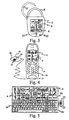
- FIG. 3 shows an embodiment of an electronic lock according to one embodiment of the present invention.
- the electronic device is embodied as an electronic padlock.
- the padlock 2 comprises a touch screen display 4 depicting nine passkey pictures 6, a bolt 8,8' a keyhole 10 and an interface 12.
- An electronic lock is the most basic implementation of the present invention.
- the numeral keys are replaced by the touch screen and the passkey pictures. Instead of typing in a numeral combination a user touches a sequence of pictures as the unlock code. If the right sequence of e.g. four pictures is touched the bolt 8 is unlocked and it can be opened as indicated by position of bolt 8'.
- the keyhole 10 refers to a mechanic lock to mechanically unlock the padlock e.g.
- the padlock 2 further comprises an interface to connect the padlock 2 to a computer or a camera to upload new user generated pictures.
- the format how the pictures are used is not important. It is also possible to implement the invention in a nearly full mechanic way, if the lock is provided with keys in which miniature photos or pictures can be inserted in a way that each of said photos is visible on a single key. When the access to said key photos is only granted if the lock is in an open position, the photos are protected against unauthorized exchange.
- the mobile phone is provided with a plug in camera module 18, connected to an interface 12.
- the user can take photos using the viewfinder 20, the lens 22 and the shutter release 24.
- the photo can be transferred to the mobile phone 14 and can be added to the passkey picture library.
- the portable computer device can receive the input sequence via the touch screen and via the keyboard.
- the user can input a sequence with a length of e.g. four entities, i.e. pictures and numerals and characters. There are 29 characters, ten numerals and 31 passkey
- the 11x3 grid comprises at the lower right side two areas 28 denoted 32# and 33#. These are passkey picture areas the user has not yet filled with his photographs. To fill these areas, the user simply has to use the built in camera 18, with the lens 22 to take a photo and add it to the passkey picture library.
- the user benefits from the present invention as he need not longer to memorize a four digit PIN code but can use a mnemonic such as e.g. ⁇ go sailing with Jack and Suzie at the lighthouse' to memorize a passkey picture sequence.
- a mnemonic such as e.g. ⁇ go sailing with Jack and Suzie at the lighthouse' to memorize a passkey picture sequence.
- the main idea is to allow the user to add new pictures to the picture library (and possibly by using a camera integrated to the device that requires authentication).
- the format how the pictures are used can vary. For example, the user can select a number of pictures in any order (or in dedicated order if a more secure system is needed) from a grid of pictures (e.g. 4 pictures from a 3x3 grid). Also it is possible to perform a step by step authentication where the user is shown e.g. four different grids successively and the user selects one picture from each grid.
- the passcode is a combination of pictures and characters. For example, the user is first shown a set of pictures and after choosing the correct one, he has to type a numerical code too. There could be some sort of link between the picture and the code, so that if the user recognizes the picture, then it would be easier for him to remember the code too.
- the rendering process also provides a data compression so the amount of data required to be stored for each new picture in the picture library is reduced.
- the principle behind the invention is that people are extremely good at recognizing faces or images, even though they may be bad at recalling names and even worse, at recalling random sets of characters or numbers that typify PIN codes today.
- the present invention utilizes this natural human ability as follows.
- the picture passkey facility already contains a default library of photo images that the user can select a sequence therefrom as a new passkey, but this invention also allows the user to take photos with a camera and add optimized rendered versions of those photos to the picture passkey library.
- This invention substantially improves the ability of users to remember their terminal authentication passkeys and also permits the users of camera enabled devices to personalize their own picture passkey.
Landscapes
- Engineering & Computer Science (AREA)
- Business, Economics & Management (AREA)
- Computer Security & Cryptography (AREA)
- Theoretical Computer Science (AREA)
- General Physics & Mathematics (AREA)
- Physics & Mathematics (AREA)
- Accounting & Taxation (AREA)
- General Business, Economics & Management (AREA)
- Strategic Management (AREA)
- Computer Networks & Wireless Communication (AREA)
- Microelectronics & Electronic Packaging (AREA)
- Signal Processing (AREA)
- Finance (AREA)
- Computer Hardware Design (AREA)
- Software Systems (AREA)
- General Engineering & Computer Science (AREA)
- Telephone Function (AREA)
- Input From Keyboards Or The Like (AREA)
- Mobile Radio Communication Systems (AREA)
Claims (12)
- Procédé pour autoriser l'usage d'un dispositif électronique au moyen d'une identification pictographique, comportant les étapes consistant à:- récupérer (36) un nombre d'images (6) à partir d'une bibliothèque de clés d'accès pictographiques (58), dans laquelle lesdites images dans ladite bibliothèque de clés d'accès pictographiques comportent des images générées par l'utilisateur ;- afficher (44) un sous-ensemble desdites images générées par l'utilisateur (6) sur un écran d'affichage dudit dispositif électronique ;- recevoir (46) une entrée d'utilisateur par laquelle au moins l'une desdites images générées par l'utilisateur affichées (6) est sélectionnée, ladite entrée d'utilisateur représentant un code d'entrée comportant ladite au moins une image sélectionnée (6) ;- comparer (48) ledit code d'entrée comportant ladite au moins une image sélectionnée (6) à des données d'identification prédéterminées ; et- mettre en oeuvre une opération d'autorisation (52) pour l'usage du dispositif électronique si ladite au moins une image sélectionnée (6) correspond auxdites données d'identification prédéterminées,dans lequel au moins l'une desdites images générées par l'utilisateur sélectionnées est reçue à partir d'une caméra électronique intégrée.
- Procédé selon la revendication 1, comportant en outre l'étape consistant à recevoir (32) une entrée de déverrouillage.
- Procédé selon la revendication 1 ou 2, comportant en outre les étapes consistant à:- recevoir (34) une identification d'utilisateur ; et- dans lequel l'étape consistant à récupérer ledit nombre d'images (6) à partir d'une bibliothèque de clés d'accès pictographiques (58) est mise en oeuvre selon ladite identification d'utilisateur entrée.
- Procédé selon la revendication 1, 2 ou 3, comportant en outre l'étape consistant à:- récupérer au moins un caractère étant attribué auxdites images (6) connexes à ladite entrée.
- Procédé selon l'une quelconque des revendications précédentes, comportant en outre les étapes consistant à :- recevoir (56) une image (6) au niveau dudit dispositif électronique,- traiter (60) ladite image reçue pour obtenir une version optimisée de ladite image (6) ;- stocker (62) ladite version optimisée de ladite image (6) dans ladite bibliothèque de clés d'accès pictographiques (58).
- Procédé selon l'une quelconque desdites revendications précédentes, comportant en outre les étapes consistant à :- générer au moins un caractère connexe à ladite image optimisée (6) ; et- stocker ledit au moins un caractère en relation avec ladite version optimisée de ladite image (6) dans ladite bibliothèque de clés d'accès pictographiques (58).
- Produit-programme informatique comportant des moyens de code de programme stockés sur un support lisible par ordinateur pour mettre en oeuvre le procédé selon l'une quelconque des revendications 1 à 6 lorsque ledit produit-programme est exécuté sur un ordinateur ou un dispositif de réseau.
- Dispositif électronique configuré pour autoriser l'usage dudit dispositif au moyen d'une identification pictographique, comportant :- une bibliothèque de clés d'accès pictographiques (58), où des images dans ladite bibliothèque de clés d'accès pictographiques comportent des images générées par l'utilisateur ;- une interface d'entrée d'utilisateur (16) apte à récupérer (36) un nombre d'images (6) à partir de ladite bibliothèque de clés d'accès pictographiques (58) ;- un écran d'affichage (4) apte à afficher (44) un sous-ensemble desdites images générées par l'utilisateur (6) sur ledit écran d'affichage dudit dispositif électronique ;caractérisé en ce que- ledit dispositif électronique est apte à recevoir une entrée d'utilisateur par laquelle au moins l'une desdites images générées par l'utilisateur est sélectionnée, ladite entrée d'utilisateur représentant un code d'entrée comportant ladite image sélectionnée,- une unité de traitement étant apte à comparer (48) ledit code d'entrée comportant au moins une image sélectionnée (6) à des données d'identification prédéterminées; et- ledit dispositif électronique étant apte à mettre en oeuvre une opération d'autorisation (52) pour l'usage du dispositif électronique si ladite au moins une image sélectionnée (6) correspond auxdites données d'identification prédéterminées, dans lequel ledit caméra est apte à recevoir au moins l'une desdites images générées par l'utilisateur, lesdites données d'identification prédéterminées correspondant à au moins l'une desdites images générées par l'utilisateur reçues par ladite caméra intégrée.
- Dispositif électronique selon la revendication 8, dans lequel ledit dispositif électronique comporte- une mémoire pour stocker des données d'identification prédéterminées, ladite mémoire étant connectée à ladite unité de traitement ; et- un verrou connecté à ladite unité de traitement,dans lequel ladite unité de traitement est configurée pour comparer une entrée d'utilisateur auxdites données d'identification prédéterminées, et pour mettre en oeuvre une opération de déverrouillage au niveau dudit verrou, en cas de correspondance.
- Dispositif électronique selon l'une quelconque des revendications 8 ou 9, caractérisé par des bibliothèques de clés d'accès pictographiques spécifiques à l'utilisateur (58), connectées à ladite unité de traitement.
- Dispositif électronique selon l'une quelconque des revendications 8 à 10, caractérisé en ce que ledit dispositif électronique est un dispositif utilisateur électronique portable.
- Dispositif électronique selon la revendication 11, caractérisé en ce que ledit dispositif électronique comprend un téléphone mobile (14).
Applications Claiming Priority (1)
| Application Number | Priority Date | Filing Date | Title |
|---|---|---|---|
| PCT/IB2003/003604 WO2005022473A1 (fr) | 2003-08-29 | 2003-08-29 | Procede et dispositif d'identification et d'authentification utilisateur personnalisees a fonctionnement pictographique |
Publications (2)
| Publication Number | Publication Date |
|---|---|
| EP1658593A1 EP1658593A1 (fr) | 2006-05-24 |
| EP1658593B1 true EP1658593B1 (fr) | 2008-12-24 |
Family
ID=34259869
Family Applications (1)
| Application Number | Title | Priority Date | Filing Date |
|---|---|---|---|
| EP03818398A Expired - Lifetime EP1658593B1 (fr) | 2003-08-29 | 2003-08-29 | Procede et dispositif d'identification et d'authentification utilisateur personnalisees a fonctionnement pictographique |
Country Status (6)
| Country | Link |
|---|---|
| US (1) | US20050060554A1 (fr) |
| EP (1) | EP1658593B1 (fr) |
| CN (1) | CN1820288A (fr) |
| AU (1) | AU2003259396A1 (fr) |
| DE (1) | DE60325514D1 (fr) |
| WO (1) | WO2005022473A1 (fr) |
Cited By (1)
| Publication number | Priority date | Publication date | Assignee | Title |
|---|---|---|---|---|
| US10089450B2 (en) | 2014-04-17 | 2018-10-02 | Huawei Technologies Co., Ltd. | User authentication method, authentication apparatus, and terminal |
Families Citing this family (104)
| Publication number | Priority date | Publication date | Assignee | Title |
|---|---|---|---|---|
| CA2857208C (fr) | 2003-05-30 | 2018-09-04 | Privaris, Inc. | Systeme de securite en-circuit et procedes de commande d'acces a et d'utilisation de donnees sensibles |
| US7636855B2 (en) * | 2004-01-30 | 2009-12-22 | Panasonic Corporation | Multiple choice challenge-response user authorization system and method |
| US20070003036A1 (en) * | 2005-06-28 | 2007-01-04 | International Business Machines Corporation | Identifying a caller who uses an unrecognized terminal |
| US7480870B2 (en) * | 2005-12-23 | 2009-01-20 | Apple Inc. | Indication of progress towards satisfaction of a user input condition |
| US7657849B2 (en) | 2005-12-23 | 2010-02-02 | Apple Inc. | Unlocking a device by performing gestures on an unlock image |
| US8078990B2 (en) | 2006-02-01 | 2011-12-13 | Research In Motion Limited | Secure device sharing |
| CN101047629A (zh) * | 2006-03-30 | 2007-10-03 | 华为技术有限公司 | 一种用户多媒体标识业务的实现方法 |
| EP1868131A1 (fr) * | 2006-06-14 | 2007-12-19 | Vodafone Holding GmbH | Procédé et système de sécurisation de l'authentification de l'utilisateur |
| US7706837B2 (en) | 2006-09-01 | 2010-04-27 | Research In Motion Limited | Disabling operation of a camera on a handheld mobile communication device based upon enabling or disabling devices |
| EP1895764B1 (fr) * | 2006-09-01 | 2009-12-02 | Research In Motion Limited | Opération désactivante de la caméra d'un appareil de communication portable basée sur des éléments (dés-)activants |
| US7266693B1 (en) * | 2007-02-13 | 2007-09-04 | U.S. Bancorp Licensing, Inc. | Validated mutual authentication |
| US7986921B2 (en) * | 2007-03-06 | 2011-07-26 | Qualcomm Incorporated | Wireless device with privacy screen |
| CN101360215A (zh) * | 2007-07-30 | 2009-02-04 | 鸿富锦精密工业(深圳)有限公司 | 投影机密码系统及投影机密码系统的使用方法 |
| EP2203865A2 (fr) * | 2007-09-24 | 2010-07-07 | Apple Inc. | Systèmes d'authentification incorporés dans un dispositif électronique |
| WO2009043661A1 (fr) * | 2007-10-04 | 2009-04-09 | International Business Machines Corporation | Procédé et système d'authentification |
| US8600120B2 (en) | 2008-01-03 | 2013-12-03 | Apple Inc. | Personal computing device control using face detection and recognition |
| TWI428814B (zh) * | 2008-04-15 | 2014-03-01 | Htc Corp | 在螢幕鎖定狀態下切換背景圖的方法、其行動電子裝置與儲存媒體 |
| US8174503B2 (en) * | 2008-05-17 | 2012-05-08 | David H. Cain | Touch-based authentication of a mobile device through user generated pattern creation |
| US8132255B2 (en) * | 2008-06-16 | 2012-03-06 | Intel Corporation | Generating a challenge response image including a recognizable image |
| KR20100010860A (ko) * | 2008-07-23 | 2010-02-02 | 엘지전자 주식회사 | 이동 단말기 및 그의 이벤트 제어방법 |
| US20100186074A1 (en) * | 2009-01-16 | 2010-07-22 | Angelos Stavrou | Authentication Using Graphical Passwords |
| US8130075B1 (en) * | 2009-01-23 | 2012-03-06 | Intuit Inc. | System and method for touchscreen combination lock |
| US8326358B2 (en) | 2009-01-30 | 2012-12-04 | Research In Motion Limited | System and method for access control in a portable electronic device |
| US8638939B1 (en) | 2009-08-20 | 2014-01-28 | Apple Inc. | User authentication on an electronic device |
| KR20110047398A (ko) * | 2009-10-30 | 2011-05-09 | 삼성전자주식회사 | 영상제공시스템 및 그 영상제공방법 |
| US8306504B1 (en) * | 2009-12-17 | 2012-11-06 | Sprint Communications Company L.P. | Determining access to a feature of a mobile device |
| US8843755B2 (en) * | 2009-12-22 | 2014-09-23 | Nokia Corporation | User authentication |
| CN102714676B (zh) * | 2009-12-29 | 2014-09-10 | 诺基亚公司 | 用于访问功能的设备和方法以及用户接口 |
| CN102207809A (zh) * | 2010-03-30 | 2011-10-05 | 国基电子(上海)有限公司 | 手持装置及其解锁方法 |
| TWI406552B (zh) * | 2010-04-06 | 2013-08-21 | Hon Hai Prec Ind Co Ltd | 手持裝置及其解鎖方法 |
| US8788834B1 (en) * | 2010-05-25 | 2014-07-22 | Symantec Corporation | Systems and methods for altering the state of a computing device via a contacting sequence |
| WO2011149424A1 (fr) * | 2010-05-25 | 2011-12-01 | Jsb Tech Private Limited | Cadenas à combinaison électronique |
| US20110307831A1 (en) * | 2010-06-10 | 2011-12-15 | Microsoft Corporation | User-Controlled Application Access to Resources |
| US8528072B2 (en) | 2010-07-23 | 2013-09-03 | Apple Inc. | Method, apparatus and system for access mode control of a device |
| US8587547B2 (en) | 2010-11-05 | 2013-11-19 | Apple Inc. | Device, method, and graphical user interface for manipulating soft keyboards |
| US8754860B2 (en) | 2010-11-05 | 2014-06-17 | Apple Inc. | Device, method, and graphical user interface for manipulating soft keyboards |
| CN102096546A (zh) * | 2010-12-29 | 2011-06-15 | 华为终端有限公司 | 一种操作系统的解锁方法及装置 |
| US9250798B2 (en) | 2011-01-24 | 2016-02-02 | Apple Inc. | Device, method, and graphical user interface with a dynamic gesture disambiguation threshold |
| US10089606B2 (en) | 2011-02-11 | 2018-10-02 | Bytemark, Inc. | System and method for trusted mobile device payment |
| US20120296826A1 (en) | 2011-05-18 | 2012-11-22 | Bytemark, Inc. | Method and system for distributing electronic tickets with visual display |
| US10453067B2 (en) | 2011-03-11 | 2019-10-22 | Bytemark, Inc. | Short range wireless translation methods and systems for hands-free fare validation |
| US8494967B2 (en) | 2011-03-11 | 2013-07-23 | Bytemark, Inc. | Method and system for distributing electronic tickets with visual display |
| US10360567B2 (en) | 2011-03-11 | 2019-07-23 | Bytemark, Inc. | Method and system for distributing electronic tickets with data integrity checking |
| US10762733B2 (en) | 2013-09-26 | 2020-09-01 | Bytemark, Inc. | Method and system for electronic ticket validation using proximity detection |
| CN103477297B (zh) * | 2011-03-16 | 2017-07-25 | 索尼移动通信公司 | 用于在解锁消费电子设备时直接访问应用的系统和方法 |
| GB201106943D0 (en) * | 2011-04-27 | 2011-06-01 | Burkill Vance | Improvements in or relating to password generation, recall and protection |
| JP5643716B2 (ja) * | 2011-05-31 | 2014-12-17 | 楽天株式会社 | 情報処理システム、情報処理方法、情報処理装置、情報処理端末、プログラム及び記録媒体 |
| US11165963B2 (en) | 2011-06-05 | 2021-11-02 | Apple Inc. | Device, method, and graphical user interface for accessing an application in a locked device |
| DE202012013343U1 (de) * | 2011-06-23 | 2016-08-01 | Tms Global Services Pty Ltd | Neue Spieltechniken |
| WO2013032187A1 (fr) * | 2011-09-01 | 2013-03-07 | Samsung Electronics Co., Ltd. | Terminal mobile pour effectuer un déverrouillage d'écran sur la base d'un mouvement et procédé associé |
| US9002322B2 (en) | 2011-09-29 | 2015-04-07 | Apple Inc. | Authentication with secondary approver |
| US8769624B2 (en) | 2011-09-29 | 2014-07-01 | Apple Inc. | Access control utilizing indirect authentication |
| US20130097416A1 (en) * | 2011-10-18 | 2013-04-18 | Google Inc. | Dynamic profile switching |
| US20130139226A1 (en) * | 2011-11-30 | 2013-05-30 | Patrick Welsch | Secure Authorization |
| US9372978B2 (en) | 2012-01-20 | 2016-06-21 | Apple Inc. | Device, method, and graphical user interface for accessing an application in a locked device |
| US9697346B2 (en) * | 2012-03-06 | 2017-07-04 | Cisco Technology, Inc. | Method and apparatus for identifying and associating devices using visual recognition |
| CN111178332A (zh) | 2012-05-18 | 2020-05-19 | 苹果公司 | 用于操纵用户界面的设备、方法和图形用户界面 |
| JP5994390B2 (ja) * | 2012-05-24 | 2016-09-21 | 株式会社バッファロー | 認証方法および無線接続装置 |
| KR102049999B1 (ko) | 2012-06-11 | 2019-11-28 | 삼성전자주식회사 | 쇼핑 서비스를 제공하는 사용자 단말 장치, 이를 포함하는 쇼핑 시스템 및 그 서비스 방법 |
| EP3588342B1 (fr) | 2012-06-11 | 2022-10-12 | Samsung Electronics Co., Ltd. | Dispositif mobile et son procédé de commande |
| US11284251B2 (en) * | 2012-06-11 | 2022-03-22 | Samsung Electronics Co., Ltd. | Mobile device and control method thereof |
| US8782398B2 (en) * | 2012-06-26 | 2014-07-15 | Intel Corporation | Secure user presence detection and authentication |
| US8813219B2 (en) * | 2012-08-23 | 2014-08-19 | Alejandro V Natividad | Method for producing dynamic data structures for authentication and/or password identification |
| JP6099348B2 (ja) * | 2012-10-10 | 2017-03-22 | オリンパス株式会社 | 頭部装着型表示装置、ロック解除処理システム、プログラム及びロック解除の制御方法 |
| US9092612B2 (en) * | 2012-11-15 | 2015-07-28 | Google Technology Holdings LLC | Method and system for secure access to data files copied onto a second storage device from a first storage device |
| US9135416B2 (en) | 2013-02-25 | 2015-09-15 | International Business Machines Corporation | GUI-based authentication for a computing system |
| US9300645B1 (en) * | 2013-03-14 | 2016-03-29 | Ip Holdings, Inc. | Mobile IO input and output for smartphones, tablet, and wireless devices including touch screen, voice, pen, and gestures |
| US9336779B1 (en) * | 2013-04-10 | 2016-05-10 | Google Inc. | Dynamic image-based voice entry of unlock sequence |
| GB2519065A (en) * | 2013-08-27 | 2015-04-15 | Access Defender Ltd | Password fraud protection apparatus |
| US9898642B2 (en) | 2013-09-09 | 2018-02-20 | Apple Inc. | Device, method, and graphical user interface for manipulating user interfaces based on fingerprint sensor inputs |
| US9137666B1 (en) | 2013-09-13 | 2015-09-15 | Sprint Communications Company L.P. | Mobile security using graphical images |
| CN104580111B (zh) * | 2013-10-25 | 2019-05-24 | 华为技术有限公司 | 一种对用户进行认证的方法及终端 |
| DE102013223949B4 (de) * | 2013-11-22 | 2023-07-06 | BSH Hausgeräte GmbH | Verfahren zum Ermöglichen einer Fernsteuerung und/oder Fernüberwachung des Betriebs von Haushaltsgeräten mithilfe einer Kommunikationseinrichtung und entsprechendes System |
| US9171143B2 (en) * | 2013-12-19 | 2015-10-27 | Verizon Patent And Licensing Inc. | System for and method of generating visual passwords |
| US9292678B2 (en) | 2014-03-19 | 2016-03-22 | International Business Machines Corporation | Unlocking a computing device via images |
| US9483763B2 (en) | 2014-05-29 | 2016-11-01 | Apple Inc. | User interface for payments |
| CN104091114A (zh) * | 2014-07-04 | 2014-10-08 | 泛意创作有限公司 | 移动终端传输认证密码方法、获取认证密码方法 |
| CN105468276B (zh) * | 2014-09-12 | 2019-08-13 | 南京中兴软件有限责任公司 | 解锁处理方法、装置及终端 |
| CN104573444B (zh) * | 2015-01-20 | 2018-01-23 | 广东欧珀移动通信有限公司 | 一种终端的解锁方法及装置 |
| CN104751045B (zh) * | 2015-04-14 | 2017-11-03 | 广东欧珀移动通信有限公司 | 屏幕解锁方法及装置 |
| US11803784B2 (en) | 2015-08-17 | 2023-10-31 | Siemens Mobility, Inc. | Sensor fusion for transit applications |
| CA2989051C (fr) | 2015-08-17 | 2024-05-28 | Bytemark, Inc. | Procedes de traduction sans fil a courte portee et systemes pour validation de tarif de transport mains libres |
| US10956544B1 (en) | 2016-04-01 | 2021-03-23 | Massachusetts Mutual Life Insurance Company | Access control through head imaging and biometric authentication |
| US10733275B1 (en) * | 2016-04-01 | 2020-08-04 | Massachusetts Mutual Life Insurance Company | Access control through head imaging and biometric authentication |
| DK179186B1 (en) | 2016-05-19 | 2018-01-15 | Apple Inc | REMOTE AUTHORIZATION TO CONTINUE WITH AN ACTION |
| CN106341403B (zh) * | 2016-08-30 | 2018-05-11 | 竞技世界(北京)网络技术有限公司 | 一种验证码防刷的方法 |
| DK179978B1 (en) | 2016-09-23 | 2019-11-27 | Apple Inc. | Image data for enhanced user interactions |
| CN107026842B (zh) * | 2016-11-24 | 2020-04-24 | 阿里巴巴集团控股有限公司 | 一种安全问题的生成以及身份验证的方法及装置 |
| KR102037419B1 (ko) | 2017-09-05 | 2019-10-28 | 삼성전자주식회사 | 영상 표시 장치 및 그 동작 방법 |
| KR102143148B1 (ko) | 2017-09-09 | 2020-08-10 | 애플 인크. | 생체측정 인증의 구현 |
| KR102185854B1 (ko) | 2017-09-09 | 2020-12-02 | 애플 인크. | 생체측정 인증의 구현 |
| CN108109110B (zh) * | 2017-12-25 | 2023-03-28 | 努比亚技术有限公司 | 图片加密方法、移动终端和计算机可读存储介质 |
| TWI664553B (zh) * | 2018-03-16 | 2019-07-01 | 義守大學 | 手機解鎖方法 |
| US11170085B2 (en) | 2018-06-03 | 2021-11-09 | Apple Inc. | Implementation of biometric authentication |
| US11100349B2 (en) | 2018-09-28 | 2021-08-24 | Apple Inc. | Audio assisted enrollment |
| US10860096B2 (en) | 2018-09-28 | 2020-12-08 | Apple Inc. | Device control using gaze information |
| CN109635535A (zh) * | 2018-12-14 | 2019-04-16 | 泰康保险集团股份有限公司 | 用于验证用户身份的方法 |
| US11550896B2 (en) * | 2020-07-07 | 2023-01-10 | International Business Machines Corporation | Password strength |
| EP4264460B1 (fr) | 2021-01-25 | 2025-12-24 | Apple Inc. | Mise en oeuvre d'une authentification biométrique |
| US12210603B2 (en) | 2021-03-04 | 2025-01-28 | Apple Inc. | User interface for enrolling a biometric feature |
| US12216754B2 (en) | 2021-05-10 | 2025-02-04 | Apple Inc. | User interfaces for authenticating to perform secure operations |
| CN113792283A (zh) * | 2021-08-06 | 2021-12-14 | 联想(北京)有限公司 | 一种信息处理方法、电子设备以及存储介质 |
| US11880181B2 (en) | 2021-09-09 | 2024-01-23 | Fieldcomm Group, Inc. | Digital safety locks in industrial process plants |
| CN119622706A (zh) * | 2023-09-14 | 2025-03-14 | 中兴通讯股份有限公司 | 密码设置方法、解锁方法、电子设备和存储介质 |
Citations (3)
| Publication number | Priority date | Publication date | Assignee | Title |
|---|---|---|---|---|
| US6307541B1 (en) * | 1999-04-29 | 2001-10-23 | Inventec Corporation | Method and system for inputting chinese-characters through virtual keyboards to data processor |
| US20030064688A1 (en) * | 2001-10-03 | 2003-04-03 | Nec Corporation | Slide-type portable communication apparatus |
| EP1315072A1 (fr) * | 2001-11-23 | 2003-05-28 | Siemens Information and Communication Networks S.p.A. | Appareil polyvalente d'exécution d'applications multimédia |
Family Cites Families (6)
| Publication number | Priority date | Publication date | Assignee | Title |
|---|---|---|---|---|
| US7222134B1 (en) * | 1998-09-30 | 2007-05-22 | Ricoh Company, Ltd. | Filing system which provides increased availability of image data stored therein |
| US6842533B1 (en) * | 1999-12-28 | 2005-01-11 | Eastman Kodak Company | Printing verified pre-approved images |
| JP2002259028A (ja) * | 2001-03-02 | 2002-09-13 | Canon Inc | オブジェクトベース符号化されたマルチメディアコンテンツのオブジェクト選択方法及び該方法を適用した情報処理装置 |
| US6526351B2 (en) * | 2001-07-09 | 2003-02-25 | Charles Lamont Whitham | Interactive multimedia tour guide |
| DE60115627T2 (de) * | 2001-07-10 | 2006-08-03 | Sony United Kingdom Ltd., Brooklands | Sende-Empfänger und Verfahren zum Bereitstellen von züsatzlichen Diensten |
| US20030053662A1 (en) * | 2001-09-19 | 2003-03-20 | Koninklijke Philips Electronics N.V. | Method and apparatus for digital encoding and operator identification using stored user image |
-
2003
- 2003-08-29 EP EP03818398A patent/EP1658593B1/fr not_active Expired - Lifetime
- 2003-08-29 WO PCT/IB2003/003604 patent/WO2005022473A1/fr not_active Ceased
- 2003-08-29 AU AU2003259396A patent/AU2003259396A1/en not_active Abandoned
- 2003-08-29 DE DE60325514T patent/DE60325514D1/de not_active Expired - Lifetime
- 2003-08-29 CN CNA038269570A patent/CN1820288A/zh active Pending
-
2004
- 2004-08-30 US US10/930,741 patent/US20050060554A1/en not_active Abandoned
Patent Citations (3)
| Publication number | Priority date | Publication date | Assignee | Title |
|---|---|---|---|---|
| US6307541B1 (en) * | 1999-04-29 | 2001-10-23 | Inventec Corporation | Method and system for inputting chinese-characters through virtual keyboards to data processor |
| US20030064688A1 (en) * | 2001-10-03 | 2003-04-03 | Nec Corporation | Slide-type portable communication apparatus |
| EP1315072A1 (fr) * | 2001-11-23 | 2003-05-28 | Siemens Information and Communication Networks S.p.A. | Appareil polyvalente d'exécution d'applications multimédia |
Cited By (1)
| Publication number | Priority date | Publication date | Assignee | Title |
|---|---|---|---|---|
| US10089450B2 (en) | 2014-04-17 | 2018-10-02 | Huawei Technologies Co., Ltd. | User authentication method, authentication apparatus, and terminal |
Also Published As
| Publication number | Publication date |
|---|---|
| AU2003259396A1 (en) | 2005-03-16 |
| US20050060554A1 (en) | 2005-03-17 |
| WO2005022473A1 (fr) | 2005-03-10 |
| EP1658593A1 (fr) | 2006-05-24 |
| CN1820288A (zh) | 2006-08-16 |
| DE60325514D1 (de) | 2009-02-05 |
Similar Documents
| Publication | Publication Date | Title |
|---|---|---|
| EP1658593B1 (fr) | Procede et dispositif d'identification et d'authentification utilisateur personnalisees a fonctionnement pictographique | |
| US7240367B2 (en) | User interface and method for inputting password and password system using the same | |
| US5657388A (en) | Method and apparatus for utilizing a token for resource access | |
| CN102638447B (zh) | 基于用户自主产生的动态口令对系统登录的方法和装置 | |
| US8561174B2 (en) | Authorization method with hints to the authorization code | |
| EP1338940A1 (fr) | Générateur universel de mots de passe | |
| JP2005537574A (ja) | 強化パスワードを有するユーザー認証システムおよび方法 | |
| CN101802834A (zh) | 终端设备认证方法、终端设备和程序 | |
| US20060215360A1 (en) | Password input and verification method | |
| EP1676393B1 (fr) | Système d'authentification | |
| JP2006191245A (ja) | ダイヤルロック機能認証装置及びその方法並びにそれを用いた携帯端末 | |
| CN110663041A (zh) | 用于提供用户通过其能够操作计算设备的用户账户的系统和方法 | |
| JP2022002103A (ja) | モバイル端末のプライバシー保護方法および保護装置、並びにモバイル端末 | |
| US20170155635A1 (en) | Password Generation System and Its Associated Method of Operation | |
| KR20190017315A (ko) | 이미지 터치 사용자 인증 방법 및 이를 실행하는 시스템 | |
| KR20060052975A (ko) | 맞춤형 영상-기반 사용자 신분인증 방법 및 장치 | |
| EP1708110A1 (fr) | Procédé d'entrée et vérification de mot de passe | |
| CN106355078A (zh) | 基于多功能按键行为识别的智能密码保护系统 | |
| CN108701183B (zh) | 利用垃圾数据是否一致的用户认证方法及认证系统 | |
| Kaushik et al. | A novel graphical password scheme to avoid shoulder-surfing attacks in android devices | |
| KR101063523B1 (ko) | 2개 이상의 문자로 구성되는 사용자 인증 패스워드를 이용한 사용자 인증 방법 | |
| KR20080011362A (ko) | 그래픽 오티피의 해킹 방지 방법 | |
| KR100617540B1 (ko) | 보안성이 강화된 비밀번호 입력방법 | |
| JP2001344058A (ja) | 暗証番号入力装置及び暗証番号認証方法 | |
| US20220129529A1 (en) | Biometric-validated character password authentication procedure |
Legal Events
| Date | Code | Title | Description |
|---|---|---|---|
| PUAI | Public reference made under article 153(3) epc to a published international application that has entered the european phase |
Free format text: ORIGINAL CODE: 0009012 |
|
| 17P | Request for examination filed |
Effective date: 20060116 |
|
| AK | Designated contracting states |
Kind code of ref document: A1 Designated state(s): DE ES FR GB IT |
|
| DAX | Request for extension of the european patent (deleted) | ||
| RBV | Designated contracting states (corrected) |
Designated state(s): DE ES FR GB IT |
|
| 17Q | First examination report despatched |
Effective date: 20061221 |
|
| GRAP | Despatch of communication of intention to grant a patent |
Free format text: ORIGINAL CODE: EPIDOSNIGR1 |
|
| GRAS | Grant fee paid |
Free format text: ORIGINAL CODE: EPIDOSNIGR3 |
|
| GRAA | (expected) grant |
Free format text: ORIGINAL CODE: 0009210 |
|
| AK | Designated contracting states |
Kind code of ref document: B1 Designated state(s): DE ES FR GB IT |
|
| REG | Reference to a national code |
Ref country code: GB Ref legal event code: FG4D |
|
| REF | Corresponds to: |
Ref document number: 60325514 Country of ref document: DE Date of ref document: 20090205 Kind code of ref document: P |
|
| PG25 | Lapsed in a contracting state [announced via postgrant information from national office to epo] |
Ref country code: ES Free format text: LAPSE BECAUSE OF FAILURE TO SUBMIT A TRANSLATION OF THE DESCRIPTION OR TO PAY THE FEE WITHIN THE PRESCRIBED TIME-LIMIT Effective date: 20090404 |
|
| PLBE | No opposition filed within time limit |
Free format text: ORIGINAL CODE: 0009261 |
|
| STAA | Information on the status of an ep patent application or granted ep patent |
Free format text: STATUS: NO OPPOSITION FILED WITHIN TIME LIMIT |
|
| PGFP | Annual fee paid to national office [announced via postgrant information from national office to epo] |
Ref country code: DE Payment date: 20090827 Year of fee payment: 7 |
|
| 26N | No opposition filed |
Effective date: 20090925 |
|
| GBPC | Gb: european patent ceased through non-payment of renewal fee |
Effective date: 20090829 |
|
| REG | Reference to a national code |
Ref country code: FR Ref legal event code: ST Effective date: 20100430 |
|
| PG25 | Lapsed in a contracting state [announced via postgrant information from national office to epo] |
Ref country code: FR Free format text: LAPSE BECAUSE OF NON-PAYMENT OF DUE FEES Effective date: 20090831 |
|
| PG25 | Lapsed in a contracting state [announced via postgrant information from national office to epo] |
Ref country code: GB Free format text: LAPSE BECAUSE OF NON-PAYMENT OF DUE FEES Effective date: 20090829 |
|
| PG25 | Lapsed in a contracting state [announced via postgrant information from national office to epo] |
Ref country code: IT Free format text: LAPSE BECAUSE OF FAILURE TO SUBMIT A TRANSLATION OF THE DESCRIPTION OR TO PAY THE FEE WITHIN THE PRESCRIBED TIME-LIMIT Effective date: 20081224 |
|
| REG | Reference to a national code |
Ref country code: DE Ref legal event code: R119 Ref document number: 60325514 Country of ref document: DE Effective date: 20110301 |
|
| PG25 | Lapsed in a contracting state [announced via postgrant information from national office to epo] |
Ref country code: DE Free format text: LAPSE BECAUSE OF NON-PAYMENT OF DUE FEES Effective date: 20110301 |