EP1659104B1 - Vorläufermaterial für Bi-basierte Oxidsupraleiter und Verfahren zur Herstellung eines derartigen Materials - Google Patents
Vorläufermaterial für Bi-basierte Oxidsupraleiter und Verfahren zur Herstellung eines derartigen Materials Download PDFInfo
- Publication number
- EP1659104B1 EP1659104B1 EP05300954A EP05300954A EP1659104B1 EP 1659104 B1 EP1659104 B1 EP 1659104B1 EP 05300954 A EP05300954 A EP 05300954A EP 05300954 A EP05300954 A EP 05300954A EP 1659104 B1 EP1659104 B1 EP 1659104B1
- Authority
- EP
- European Patent Office
- Prior art keywords
- precursor material
- equilibrium
- phase
- precursor
- intergrowths
- Prior art date
- Legal status (The legal status is an assumption and is not a legal conclusion. Google has not performed a legal analysis and makes no representation as to the accuracy of the status listed.)
- Expired - Lifetime
Links
Images


Classifications
-
- C—CHEMISTRY; METALLURGY
- C04—CEMENTS; CONCRETE; ARTIFICIAL STONE; CERAMICS; REFRACTORIES
- C04B—LIME, MAGNESIA; SLAG; CEMENTS; COMPOSITIONS THEREOF, e.g. MORTARS, CONCRETE OR LIKE BUILDING MATERIALS; ARTIFICIAL STONE; CERAMICS; REFRACTORIES; TREATMENT OF NATURAL STONE
- C04B35/00—Shaped ceramic products characterised by their composition; Ceramics compositions; Processing powders of inorganic compounds preparatory to the manufacturing of ceramic products
- C04B35/01—Shaped ceramic products characterised by their composition; Ceramics compositions; Processing powders of inorganic compounds preparatory to the manufacturing of ceramic products based on oxide ceramics
- C04B35/45—Shaped ceramic products characterised by their composition; Ceramics compositions; Processing powders of inorganic compounds preparatory to the manufacturing of ceramic products based on oxide ceramics based on copper oxide or solid solutions thereof with other oxides
- C04B35/4521—Shaped ceramic products characterised by their composition; Ceramics compositions; Processing powders of inorganic compounds preparatory to the manufacturing of ceramic products based on oxide ceramics based on copper oxide or solid solutions thereof with other oxides containing bismuth oxide
-
- C—CHEMISTRY; METALLURGY
- C04—CEMENTS; CONCRETE; ARTIFICIAL STONE; CERAMICS; REFRACTORIES
- C04B—LIME, MAGNESIA; SLAG; CEMENTS; COMPOSITIONS THEREOF, e.g. MORTARS, CONCRETE OR LIKE BUILDING MATERIALS; ARTIFICIAL STONE; CERAMICS; REFRACTORIES; TREATMENT OF NATURAL STONE
- C04B35/00—Shaped ceramic products characterised by their composition; Ceramics compositions; Processing powders of inorganic compounds preparatory to the manufacturing of ceramic products
- C04B35/622—Forming processes; Processing powders of inorganic compounds preparatory to the manufacturing of ceramic products
- C04B35/626—Preparing or treating the powders individually or as batches ; preparing or treating macroscopic reinforcing agents for ceramic products, e.g. fibres; mechanical aspects section B
- C04B35/62605—Treating the starting powders individually or as mixtures
- C04B35/6261—Milling
- C04B35/6262—Milling of calcined, sintered clinker or ceramics
-
- C—CHEMISTRY; METALLURGY
- C04—CEMENTS; CONCRETE; ARTIFICIAL STONE; CERAMICS; REFRACTORIES
- C04B—LIME, MAGNESIA; SLAG; CEMENTS; COMPOSITIONS THEREOF, e.g. MORTARS, CONCRETE OR LIKE BUILDING MATERIALS; ARTIFICIAL STONE; CERAMICS; REFRACTORIES; TREATMENT OF NATURAL STONE
- C04B35/00—Shaped ceramic products characterised by their composition; Ceramics compositions; Processing powders of inorganic compounds preparatory to the manufacturing of ceramic products
- C04B35/622—Forming processes; Processing powders of inorganic compounds preparatory to the manufacturing of ceramic products
- C04B35/626—Preparing or treating the powders individually or as batches ; preparing or treating macroscopic reinforcing agents for ceramic products, e.g. fibres; mechanical aspects section B
- C04B35/62605—Treating the starting powders individually or as mixtures
- C04B35/62645—Thermal treatment of powders or mixtures thereof other than sintering
- C04B35/62655—Drying, e.g. freeze-drying, spray-drying, microwave or supercritical drying
-
- C—CHEMISTRY; METALLURGY
- C04—CEMENTS; CONCRETE; ARTIFICIAL STONE; CERAMICS; REFRACTORIES
- C04B—LIME, MAGNESIA; SLAG; CEMENTS; COMPOSITIONS THEREOF, e.g. MORTARS, CONCRETE OR LIKE BUILDING MATERIALS; ARTIFICIAL STONE; CERAMICS; REFRACTORIES; TREATMENT OF NATURAL STONE
- C04B35/00—Shaped ceramic products characterised by their composition; Ceramics compositions; Processing powders of inorganic compounds preparatory to the manufacturing of ceramic products
- C04B35/622—Forming processes; Processing powders of inorganic compounds preparatory to the manufacturing of ceramic products
- C04B35/64—Burning or sintering processes
-
- C—CHEMISTRY; METALLURGY
- C04—CEMENTS; CONCRETE; ARTIFICIAL STONE; CERAMICS; REFRACTORIES
- C04B—LIME, MAGNESIA; SLAG; CEMENTS; COMPOSITIONS THEREOF, e.g. MORTARS, CONCRETE OR LIKE BUILDING MATERIALS; ARTIFICIAL STONE; CERAMICS; REFRACTORIES; TREATMENT OF NATURAL STONE
- C04B35/00—Shaped ceramic products characterised by their composition; Ceramics compositions; Processing powders of inorganic compounds preparatory to the manufacturing of ceramic products
- C04B35/622—Forming processes; Processing powders of inorganic compounds preparatory to the manufacturing of ceramic products
- C04B35/653—Processes involving a melting step
-
- H—ELECTRICITY
- H10—SEMICONDUCTOR DEVICES; ELECTRIC SOLID-STATE DEVICES NOT OTHERWISE PROVIDED FOR
- H10N—ELECTRIC SOLID-STATE DEVICES NOT OTHERWISE PROVIDED FOR
- H10N60/00—Superconducting devices
- H10N60/01—Manufacture or treatment
- H10N60/0268—Manufacture or treatment of devices comprising copper oxide
- H10N60/0772—Processes including the use of non-gaseous precursors
-
- C—CHEMISTRY; METALLURGY
- C04—CEMENTS; CONCRETE; ARTIFICIAL STONE; CERAMICS; REFRACTORIES
- C04B—LIME, MAGNESIA; SLAG; CEMENTS; COMPOSITIONS THEREOF, e.g. MORTARS, CONCRETE OR LIKE BUILDING MATERIALS; ARTIFICIAL STONE; CERAMICS; REFRACTORIES; TREATMENT OF NATURAL STONE
- C04B2235/00—Aspects relating to ceramic starting mixtures or sintered ceramic products
- C04B2235/02—Composition of constituents of the starting material or of secondary phases of the final product
- C04B2235/30—Constituents and secondary phases not being of a fibrous nature
- C04B2235/32—Metal oxides, mixed metal oxides, or oxide-forming salts thereof, e.g. carbonates, nitrates, (oxy)hydroxides, chlorides
- C04B2235/3205—Alkaline earth oxides or oxide forming salts thereof, e.g. beryllium oxide
-
- C—CHEMISTRY; METALLURGY
- C04—CEMENTS; CONCRETE; ARTIFICIAL STONE; CERAMICS; REFRACTORIES
- C04B—LIME, MAGNESIA; SLAG; CEMENTS; COMPOSITIONS THEREOF, e.g. MORTARS, CONCRETE OR LIKE BUILDING MATERIALS; ARTIFICIAL STONE; CERAMICS; REFRACTORIES; TREATMENT OF NATURAL STONE
- C04B2235/00—Aspects relating to ceramic starting mixtures or sintered ceramic products
- C04B2235/02—Composition of constituents of the starting material or of secondary phases of the final product
- C04B2235/30—Constituents and secondary phases not being of a fibrous nature
- C04B2235/32—Metal oxides, mixed metal oxides, or oxide-forming salts thereof, e.g. carbonates, nitrates, (oxy)hydroxides, chlorides
- C04B2235/3205—Alkaline earth oxides or oxide forming salts thereof, e.g. beryllium oxide
- C04B2235/3208—Calcium oxide or oxide-forming salts thereof, e.g. lime
-
- C—CHEMISTRY; METALLURGY
- C04—CEMENTS; CONCRETE; ARTIFICIAL STONE; CERAMICS; REFRACTORIES
- C04B—LIME, MAGNESIA; SLAG; CEMENTS; COMPOSITIONS THEREOF, e.g. MORTARS, CONCRETE OR LIKE BUILDING MATERIALS; ARTIFICIAL STONE; CERAMICS; REFRACTORIES; TREATMENT OF NATURAL STONE
- C04B2235/00—Aspects relating to ceramic starting mixtures or sintered ceramic products
- C04B2235/02—Composition of constituents of the starting material or of secondary phases of the final product
- C04B2235/30—Constituents and secondary phases not being of a fibrous nature
- C04B2235/32—Metal oxides, mixed metal oxides, or oxide-forming salts thereof, e.g. carbonates, nitrates, (oxy)hydroxides, chlorides
- C04B2235/3205—Alkaline earth oxides or oxide forming salts thereof, e.g. beryllium oxide
- C04B2235/3213—Strontium oxides or oxide-forming salts thereof
-
- C—CHEMISTRY; METALLURGY
- C04—CEMENTS; CONCRETE; ARTIFICIAL STONE; CERAMICS; REFRACTORIES
- C04B—LIME, MAGNESIA; SLAG; CEMENTS; COMPOSITIONS THEREOF, e.g. MORTARS, CONCRETE OR LIKE BUILDING MATERIALS; ARTIFICIAL STONE; CERAMICS; REFRACTORIES; TREATMENT OF NATURAL STONE
- C04B2235/00—Aspects relating to ceramic starting mixtures or sintered ceramic products
- C04B2235/02—Composition of constituents of the starting material or of secondary phases of the final product
- C04B2235/30—Constituents and secondary phases not being of a fibrous nature
- C04B2235/32—Metal oxides, mixed metal oxides, or oxide-forming salts thereof, e.g. carbonates, nitrates, (oxy)hydroxides, chlorides
- C04B2235/3281—Copper oxides, cuprates or oxide-forming salts thereof, e.g. CuO or Cu2O
-
- C—CHEMISTRY; METALLURGY
- C04—CEMENTS; CONCRETE; ARTIFICIAL STONE; CERAMICS; REFRACTORIES
- C04B—LIME, MAGNESIA; SLAG; CEMENTS; COMPOSITIONS THEREOF, e.g. MORTARS, CONCRETE OR LIKE BUILDING MATERIALS; ARTIFICIAL STONE; CERAMICS; REFRACTORIES; TREATMENT OF NATURAL STONE
- C04B2235/00—Aspects relating to ceramic starting mixtures or sintered ceramic products
- C04B2235/02—Composition of constituents of the starting material or of secondary phases of the final product
- C04B2235/30—Constituents and secondary phases not being of a fibrous nature
- C04B2235/32—Metal oxides, mixed metal oxides, or oxide-forming salts thereof, e.g. carbonates, nitrates, (oxy)hydroxides, chlorides
- C04B2235/3281—Copper oxides, cuprates or oxide-forming salts thereof, e.g. CuO or Cu2O
- C04B2235/3282—Cuprates
-
- C—CHEMISTRY; METALLURGY
- C04—CEMENTS; CONCRETE; ARTIFICIAL STONE; CERAMICS; REFRACTORIES
- C04B—LIME, MAGNESIA; SLAG; CEMENTS; COMPOSITIONS THEREOF, e.g. MORTARS, CONCRETE OR LIKE BUILDING MATERIALS; ARTIFICIAL STONE; CERAMICS; REFRACTORIES; TREATMENT OF NATURAL STONE
- C04B2235/00—Aspects relating to ceramic starting mixtures or sintered ceramic products
- C04B2235/02—Composition of constituents of the starting material or of secondary phases of the final product
- C04B2235/30—Constituents and secondary phases not being of a fibrous nature
- C04B2235/32—Metal oxides, mixed metal oxides, or oxide-forming salts thereof, e.g. carbonates, nitrates, (oxy)hydroxides, chlorides
- C04B2235/3298—Bismuth oxides, bismuthates or oxide forming salts thereof, e.g. zinc bismuthate
-
- C—CHEMISTRY; METALLURGY
- C04—CEMENTS; CONCRETE; ARTIFICIAL STONE; CERAMICS; REFRACTORIES
- C04B—LIME, MAGNESIA; SLAG; CEMENTS; COMPOSITIONS THEREOF, e.g. MORTARS, CONCRETE OR LIKE BUILDING MATERIALS; ARTIFICIAL STONE; CERAMICS; REFRACTORIES; TREATMENT OF NATURAL STONE
- C04B2235/00—Aspects relating to ceramic starting mixtures or sintered ceramic products
- C04B2235/02—Composition of constituents of the starting material or of secondary phases of the final product
- C04B2235/30—Constituents and secondary phases not being of a fibrous nature
- C04B2235/44—Metal salt constituents or additives chosen for the nature of the anions, e.g. hydrides or acetylacetonate
- C04B2235/449—Organic acids, e.g. EDTA, citrate, acetate, oxalate
-
- C—CHEMISTRY; METALLURGY
- C04—CEMENTS; CONCRETE; ARTIFICIAL STONE; CERAMICS; REFRACTORIES
- C04B—LIME, MAGNESIA; SLAG; CEMENTS; COMPOSITIONS THEREOF, e.g. MORTARS, CONCRETE OR LIKE BUILDING MATERIALS; ARTIFICIAL STONE; CERAMICS; REFRACTORIES; TREATMENT OF NATURAL STONE
- C04B2235/00—Aspects relating to ceramic starting mixtures or sintered ceramic products
- C04B2235/65—Aspects relating to heat treatments of ceramic bodies such as green ceramics or pre-sintered ceramics, e.g. burning, sintering or melting processes
- C04B2235/66—Specific sintering techniques, e.g. centrifugal sintering
- C04B2235/661—Multi-step sintering
- C04B2235/662—Annealing after sintering
- C04B2235/663—Oxidative annealing
-
- C—CHEMISTRY; METALLURGY
- C04—CEMENTS; CONCRETE; ARTIFICIAL STONE; CERAMICS; REFRACTORIES
- C04B—LIME, MAGNESIA; SLAG; CEMENTS; COMPOSITIONS THEREOF, e.g. MORTARS, CONCRETE OR LIKE BUILDING MATERIALS; ARTIFICIAL STONE; CERAMICS; REFRACTORIES; TREATMENT OF NATURAL STONE
- C04B2235/00—Aspects relating to ceramic starting mixtures or sintered ceramic products
- C04B2235/70—Aspects relating to sintered or melt-casted ceramic products
- C04B2235/74—Physical characteristics
- C04B2235/76—Crystal structural characteristics, e.g. symmetry
- C04B2235/761—Unit-cell parameters, e.g. lattice constants
-
- C—CHEMISTRY; METALLURGY
- C04—CEMENTS; CONCRETE; ARTIFICIAL STONE; CERAMICS; REFRACTORIES
- C04B—LIME, MAGNESIA; SLAG; CEMENTS; COMPOSITIONS THEREOF, e.g. MORTARS, CONCRETE OR LIKE BUILDING MATERIALS; ARTIFICIAL STONE; CERAMICS; REFRACTORIES; TREATMENT OF NATURAL STONE
- C04B2235/00—Aspects relating to ceramic starting mixtures or sintered ceramic products
- C04B2235/70—Aspects relating to sintered or melt-casted ceramic products
- C04B2235/80—Phases present in the sintered or melt-cast ceramic products other than the main phase
-
- C—CHEMISTRY; METALLURGY
- C04—CEMENTS; CONCRETE; ARTIFICIAL STONE; CERAMICS; REFRACTORIES
- C04B—LIME, MAGNESIA; SLAG; CEMENTS; COMPOSITIONS THEREOF, e.g. MORTARS, CONCRETE OR LIKE BUILDING MATERIALS; ARTIFICIAL STONE; CERAMICS; REFRACTORIES; TREATMENT OF NATURAL STONE
- C04B2235/00—Aspects relating to ceramic starting mixtures or sintered ceramic products
- C04B2235/70—Aspects relating to sintered or melt-casted ceramic products
- C04B2235/94—Products characterised by their shape
-
- H—ELECTRICITY
- H10—SEMICONDUCTOR DEVICES; ELECTRIC SOLID-STATE DEVICES NOT OTHERWISE PROVIDED FOR
- H10N—ELECTRIC SOLID-STATE DEVICES NOT OTHERWISE PROVIDED FOR
- H10N60/00—Superconducting devices
- H10N60/01—Manufacture or treatment
- H10N60/0268—Manufacture or treatment of devices comprising copper oxide
- H10N60/0801—Manufacture or treatment of filaments or composite wires
-
- Y—GENERAL TAGGING OF NEW TECHNOLOGICAL DEVELOPMENTS; GENERAL TAGGING OF CROSS-SECTIONAL TECHNOLOGIES SPANNING OVER SEVERAL SECTIONS OF THE IPC; TECHNICAL SUBJECTS COVERED BY FORMER USPC CROSS-REFERENCE ART COLLECTIONS [XRACs] AND DIGESTS
- Y10—TECHNICAL SUBJECTS COVERED BY FORMER USPC
- Y10T—TECHNICAL SUBJECTS COVERED BY FORMER US CLASSIFICATION
- Y10T29/00—Metal working
- Y10T29/49—Method of mechanical manufacture
- Y10T29/49002—Electrical device making
- Y10T29/49014—Superconductor
Definitions
- the present invention relates to a precursor material for the preparation of a Bi-based oxide superconductor, a process for preparing such precursor material and use of the precursor material for the preparation of the superconductor.
- x stands for the appropriate oxygen content at which the respective compound exhibits superconductivity.
- other phases can be found within the superconductor material such as 2201, copper oxides, oxides of alkaline earth metals etcetera.
- intergrowths of other members of homologous series can be found, e.g. short sequences of 2201 and 2223 atomic layers in the 2212 grains.
- the content of such second phases and intergrowths should be as small as possible and, further, well connected and aligned grains of the superconductor material are required.
- 2212 superconductors are widely used since the 2212 phase is more stable than the 2213 phase and can be, in general, obtained by a simpler processing technique. Further, 2212 superconductors can be fabricated in more diverse shapes such as tapes and wires with a great variation of cross sections, for instance of round, square or rectangular geometry, in form of Ag-sheathed monocore and multifilamentary tapes and wires, thick films on various substrates, bulk plates etcetera.
- the final microstructure and superconductor performance strongly depend on the properties of the precursor material used for preparing the superconductor.
- the precursor material a powder mixture of appropriate compounds of the constituent elements with the atomic ratio of the desired superconductor material is used, that is in case of Bi2212 of Bi:Sr:Ca:Cu of 2:2:1:2.
- Techniques for preparing the powder mixtures are generally known, e.g. by chemical mixing the constituent elements in solutions in form of nitrates and their subsequent decomposition via, e.g. aerosol spray pyrolysis, oxalate coprecipitation followed by spray-drying, freeze-drying etcetera.
- the properties of the superconductor material can be improved if a precursor powder is used having high homogeneity of composition and small particle size.
- the so called oxide-powder-in-tube (OPIT) technique can be advantageously used.
- the precursor powder is inserted into a tube of normal conducting material, commonly Ag or an Ag-alloy are used, so called billets.
- the filled billets are deformed, e.g. by drawing, to produce monofilamentary wires.
- These monofilamentary wires are usually assembled in new billets of Ag or Ag-alloy, that are deformed, e.g. by drawing and/or rolling, into multifilamentary wires and tapes, respectively.
- This process can be repeated several times leading to superconductor geometries of different complexity.
- a typical final filament diameter in the resulting multifilamentary wires is 10 to 20 ⁇ m.
- the resulting Bi2212/Ag superconductors are then subjected to a heat treatment, the so called partial melt processing (PMP).
- PMP partial melt processing
- the PMP of Bi2212 superconductors aims to obtain well connected, phase-pure and well aligned Bi2212 material.
- the superconductor is heated above the decomposition temperature of the 2212 phase in order to eliminate porosity and random grain orientation and then is slowly cooled down to crystallize new 2212 grains.
- This inverse peritectic reaction of 2212 formation is difficult to complete because of problems resulting from consuming second phases grown during the melting step.
- Optimal processing is usually considered to be a compromise between good connectivity which requires longer time in the melt state and phase purity which requires dissolution of the second phases which grow while in the partial melt state.
- Commonly used precursor material has high homogeneity in composition and usually a particle size of 1 to 5 ⁇ m. Further, the Bi2212 grains of the commonly used precursor material show 10 to 20 % intergrowths of 2201.
- such material is referred to as "equilibrium material”.
- microstructure equilibration (particularly decreasing the density of 2201 intergrowths in 2212 phase) was considered as an issue in application to the final product only.
- these were zone-melt processed bulk 2212 in Heeb et al and partially melt processed Ag-sheathed 2212 conductors in Rikel et al.
- the issue of material equilibration was usually not considered at all.
- the precursor material of the present invention includes single phase materials as well as multiphase materials, preferably in case of multiphase materials the content of second phases is 15 % or less, more preferably 10 % or less.
- the present invention relates to a process for preparing the precursor material as used in the present invention.
- the present invention is also directed to the use of a precursor material with less than 5 % in average intergrowths of 2201 in the 2212 phase for the production of a 2212 high temperature superconductor, in particular, for the production by a melt cast technique, more preferably by partial melt cast technique.
- a material of a given chemical composition is said to be at "thermodynamic equilibrium” under given external conditions of pressure and temperature when its free energy is minimum. Physically this means a state that once reached never changes when the material is stored under given pressure and temperature. Since a material being really in equilibrium is almost impossible to produce and, further, determination of the state of equilibrium requires an infinite-time experiment, which is also clearly not possible, within the meaning of the present invention the term "precursor material in its equilibrium state” means a precursor material that is as close to equilibrium as possible. For determining the state of equilibrium of precursor material, in the present invention such a characteristic as the density of Bi2201 intergrowths in the Bi2212 phase is used.
- a “precursor material in its equilibrium state”, also referred to “equilibrium precursor material”, is a material that is close to equilibrium in terms of its phase composition.
- the precursor material of the present invention is, thus, characterized in that the Bi2212 phase in it comprises less than 5 %, preferably less than 3 % and more preferably less than 1 %, Bi2201 intergrowths in average.
- the present inventors observed, that when a superconductor body made of a homogeneous precursor material is subjected to partial melt processing, the precursor material comprising a high content of 2201 intergrowths such as of more than 5 %, renders inhomogeneous well before partial melting. That is, even when a homogeneous precursor material is used for preparing the superconductor body the material is inhomogeneous when reaching its melting region. Due to this inhomogeneity the melting event is broadened, that is, melting occurs over a temperature range broader than in case of homogeneous material. As a result of this broad melting range large phase separation occurs during melting and, as a consequence, the performance of the final superconductor is deteriorated.
- inhomogeneity in a precursor material comprising more than 5 % 2201 intergrowths is that such a material is not at equilibrium.
- the material Upon heating a superconductor made of such non-equilibrium material, the material undergoes reactions in order to reach equilibrium.
- the approach to equilibrium or degree of equilibrium reached can be different in different parts of the superconductor. Due to this different approach to equilibrium in different parts of the superconductor the material is rendered inhomogeneous during the heating.
- the Bi2212 phase comprises less than 5 % in average intergrowths of Bi2201, that is the material is already close to equilibrium.
- a superconductor made of such an equilibrium precursor material is heated, there is no driving force for any chemical reaction and as a result the material remains homogeneous during heating up and partial melting. Consequently, the melting range is narrow and phase separation during heating is avoided or at least minimized.
- the precursor material of the present invention can have the form of a powder or bulk material.
- the particle size can be selected according to need.
- the same particle size can be applied as in the prior art, for instance a particle size distribution with d 50 about 1 to 5 ⁇ m.
- parts of Bi can be substituted by Pb.
- the precursor material of the present invention may contain SrSO 4 and/or BaSO 4 as auxiliaries in an amount up to 20 % by weight or when BaSO 4 is used, preferably only up to about 10 % by weight, based on the mixture of the components with the constituent elements Bi, optionally Pb, Sr, Ca, Cu, for instance a mixture of oxides of these constituent elements.
- the density of 2201 intergrowths in 2212 phase and, thus, the degree of equilibrium, can be determined using x-ray diffraction patterns (XRD). Presence of intergrowths of density f results in shifts of centroid positions and broadening of 00/ reflections in the XRD patterns.
- XRD x-ray diffraction patterns
- c 1 and c 2 are the lattice parameters of Bi2201 and Bi2212, respectively; ⁇ is the diffraction angle, / is the Miller index of reflection and FWHM means Full Width at Half Maximum; brackets ⁇ ...> mean averaging.
- the equilibrium precursor material of the present invention which contains less than 5 % 2201 intergrowths in the 2212 grains has an XRD patterns satisfying the condition I 008 I 00.10 ⁇ A 00.10 A 008 > 0.77 , wherein I 008 and I 00 .
- any known starting material can be used applied for the preparation of 2212 superconductors.
- the starting material can be produced by melt casting, melt quenching, aerosol pyrolysis or spray drying of oxalates, melt casting being preferred.
- a Bi2212 powder can be used wherein the oxides of the constituent elements are admixed in an appropriate atomic ratio for obtaining the desired Bi2212 superconductor. It is well known that the atomic ratio of 2:2:1:2 is an ideal stoichiometry, and it is to be understood that this ratio can vary, for instance, for a precursor material of formula I or of a composition being arithmetically equivalent to the precursor material in accordance to formula I.
- the equilibrium precursor material of the present invention can be obtained by annealing the resulting powdery mixture or shaped article at a temperature as close as possible at the peritectic melting temperature (T p ) of said material but without melting the material.
- the equilibrium precursor material of the present invention can be obtained by annealing the resulting powdery mixture or shaped article at a temperatures of 20 to 5 °C below the peritectic melting temperature (T p ) of said material, for example above 850 °C in air. That is, when the precursor material is heated up for annealing no melting step is included.
- T p peritectic melting temperature
- a precursor material By annealing in this temperature range without melting a precursor material can be obtained wherein the 2212 phase contains less than 5 % in average 2201 intergrowths.
- Tp precursor materials At a temperature of more than 20 °C, in particular at 40 °C or more, below Tp precursor materials are obtained wherein the density of 2201 intergrowths in 2212 phase exceeds 5 %.
- equilibration annealing heat treatments are preferably done using agglomerated materials, preferably, pressed rods or bulk lumps (in case of melt-cast material). Annealing at temperatures close to melting is usually avoided because of the material sintering and grain growth resulting in large particle sizes whereas for the production of superconductors small particle sizes are preferred.
- this problem can be solved by controlling and adjusting the particle size using comminution of the annealed material.
- an equilibrium precursor material of the present invention is compared with a non-equilibrium precursor material having the same nominal composition.
- the presented XRD patterns were measured at the X'PRT diffractometer (Philips) using CuK ⁇ radiation (secondary monochromator), automatic divergence slit, and 0.4° receiving slit; the conditions that provide the FWHM of K ⁇ 1 line of LaB 6 NIST (National Institute of Standards of USA) reference sample of 0.11 ⁇ 0.01°(2 ⁇ ) for 18 ⁇ 2 ⁇ 90°.
- the SEM images backscattered electron mode
- Precursor materials are prepared having a nominal composition of Bi2.00Sr2.00Ca1.00Cu2.00Ox.
- Bi2O3, SrO, CaO and CuO-powders are taken in an amount appropriate for Bi2.00Sr2.00CaCu2.00Ox stoichiometry and were thoroughly mixed and molten in air in Pt crucibles for 0.5 hours at 1100 °C. The melt was then poured on a Cu base and solidified.
- the resulting bulk plates were 3 to 7 mm thick and consist of crystalline phases Bi2201, (Sr,Ca)CuO 2 alkaline-earth cuprate [1:1AEC] phase, Bi2(Sr,Ca)3O6 Cu-free [2:3CF] phase, and Cu2O with a morphology varying along the plate thickness.
- the melt cast plates were first oxidized at 740 °C in artificial air for 10 hours to avoid melting upon heating above 750 °C.
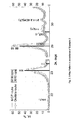
- the XRD-patterns of both precursor materials are shown in figure 1 .
- the 2212 phase in the non-equilibrium precursor material contains much more 2201 intergrowths, namely 8 % versus less than 1 % in the equilibrium material of the present invention. This means that the equilibrium precursor material of the present invention is much closer to the equilibrium state.
- the equilibrium precursor contains approximately 30 % more Cu-free 2:4CF-phase. This looks like disadvantage. It has to be noted however, that the absent part of Cu-free phase will be in any case formed during heating the conductor made using the non-equilibrium precursor close to melting as can be seen in Example 3.
- Precursor materials were prepared having an overall composition of Bi2.19Sr1.90Ca0.98Cu1.93Ox.
- the starting material for the non-equilibrium precursor was prepared using the oxalate route. Solutions of Bi, Sr, Ca and Cu nitrates were mixed in amounts appropriate for Bi 2.19 Sr 1.90 Ca 0.98 Cu 1.93 O x stoichiometry. After adding oxalic acid, the solution was spray dried to produce a mixture of Bi, Sr, Ca and Cu oxalates.
- the oxalate powder thus obtained was decomposed in flowing gas (13 % O 2 /ballance O 2 ) by slow heating to 820 °C and annealing at 820°C for about 8 hours with subsequent furnace cooling. As a result an extremely non-equilibrium phase mixture of 2212, 2201 and some minor phases was obtained. From the resulting powder, rods were pressed and annealed at 865 °C for 16 hours. The annealed rods were crashed and jet-milled. The resulting material was finally annealed at 675 °C for 36 hours in flowing artificial air.
- the XRD patterns of the powdery precursor materials obtained are shown in figure 2 .
- the analysis data are summarised in Table 1 below.
- Table 1 the content of 2201 as separate phase as well as intergrowths in 2212 grains is given.
- the equilibrium precursor contains 2212 phase with less intergrowths than the less equilibrium one, but in expense of having more 2201 as a separate phase. It is worth noting that the sum of 2201 as a separate phase and as intergrowths is almost the same in both precursor materials.
- Example 1 The powdery precursor materials obtained in Example 1 are used for producing tapes in accordance to OPIT technique using Ag billets.
- FIG. 3 The SEM images of the tapes are shown in figure 3 wherein figure 3a and 3c , respectively represent the green tapes prepared using equilibrium precursor material of the present invention ( figure 3a ) and non-equilibrium precursor material ( figure 3c).
- Figures 3b and 3d are the SEM images of the tapes after annealing close to the melting temperature at 865 °C for 64 hours in 100 % oxygen.
- the equilibrium precursor material of the present invention can be advantageously used for obtaining superconductors prepared in accordance to the OPIT-technique, that is, for melt processing superconductors prepared by the OPIT technique.
Landscapes
- Engineering & Computer Science (AREA)
- Chemical & Material Sciences (AREA)
- Ceramic Engineering (AREA)
- Manufacturing & Machinery (AREA)
- Materials Engineering (AREA)
- Structural Engineering (AREA)
- Organic Chemistry (AREA)
- Inorganic Chemistry (AREA)
- Thermal Sciences (AREA)
- Physics & Mathematics (AREA)
- Inorganic Compounds Of Heavy Metals (AREA)
- Superconductors And Manufacturing Methods Therefor (AREA)
- Compositions Of Oxide Ceramics (AREA)
Claims (8)
- Bi2212-Vorläufermaterial, das als Ausgangsmaterial für die Herstellung von Bi2212-basierten Supraleitern durch partielles Aufschmelzen geeignet ist,
dadurch gekennzeichnet, dass das Vorläufermaterial in der 2212-Phase im Durchschnitt weniger als 5 % 2201-Verwachsungen aufweist, und dass das Vorläufermaterial eine nominelle Zusammensetzung von Bi2+xSr2-yCa1-zCu2O8+δ aufweist, wobei -0, 1 ≤ x ≤ 0,4; -0, 1 ≤ y ≤ 1,6; -0, 4 ≤ z ≤ 0,2 und x + y + z = 0 ist. - Bi2212-Vorläufermaterial nach Anspruch 1,
dadurch gekennzeichnet, dass das Vorläufermaterial ein schmelzgegossenes Material ist. - Verfahren zur Herstellung eines Bi2212-Verläufermaterials, das in der 2212-Phase im Durchschnitt weniger als 5 % 2201-Verwachsungen aufweist und als Ausgangsmaterial für die Herstellung von Bi2212-basierten Supraleitern durch partielles Aufschmelzen geeignet ist,
dadurch gekennzeichnet, dass eine Ausgangsmischung für das Vorläufermaterial mit den Bestandteilen im gewünschten Atomverhältnis auf eine Temperatur von 20 bis 5°C unterhalb der peritektischen Temperatur (Tp) der Ausgangsmischung erhitzt und bei dieser Temperatur geglüht wird. - Verfahren nach Anspruch 3,
dadurch gekennzeichnet, dass ein Massivteil ("bulk part") oder eine gepresste Stange der Ausgangsmischung einem Glühen bei einer Temperatur von 20 bis 5°C unterhalb Tp ausgesetzt wird. - Verfahren nach einem der Ansprüche 3 oder 4,
dadurch gekennzeichnet, dass das Vorläufermaterial eine nominelle Zusammensetzung von Bi2+xSr2-yCa1-zCu2O8+δ aufweist, wobei -0,1 ≤ x ≤ 0,4; -0,1 ≤ y ≤ 1,6; -0,4 ≤ z ≤ 0,2 und x + y + z = 0 ist. - Verfahren nach einem der Ansprüche 3 bis 5,
dadurch gekennzeichnet, dass die Ausgangsmischung durch Schmelzgießen erhalten wird. - Verwendung eines Bi2212-Vorläufermaterials nach einem der Ansprüche 1 und 2 zur Herstellung eines Bi2212-basierten Supraleiters.
- Verwendung nach Anspruch 7,
dadurch gekennzeichnet, dass der Bi2212-basierte Supraleiter durch die "Oxide Powder in Tube"-Methode hergestellt und partiellem Aufschmelzen ausgesetzt wird.
Priority Applications (1)
| Application Number | Priority Date | Filing Date | Title |
|---|---|---|---|
| EP05300954A EP1659104B1 (de) | 2004-11-22 | 2005-11-22 | Vorläufermaterial für Bi-basierte Oxidsupraleiter und Verfahren zur Herstellung eines derartigen Materials |
Applications Claiming Priority (2)
| Application Number | Priority Date | Filing Date | Title |
|---|---|---|---|
| EP04300807 | 2004-11-22 | ||
| EP05300954A EP1659104B1 (de) | 2004-11-22 | 2005-11-22 | Vorläufermaterial für Bi-basierte Oxidsupraleiter und Verfahren zur Herstellung eines derartigen Materials |
Publications (2)
| Publication Number | Publication Date |
|---|---|
| EP1659104A1 EP1659104A1 (de) | 2006-05-24 |
| EP1659104B1 true EP1659104B1 (de) | 2010-10-13 |
Family
ID=34931734
Family Applications (1)
| Application Number | Title | Priority Date | Filing Date |
|---|---|---|---|
| EP05300954A Expired - Lifetime EP1659104B1 (de) | 2004-11-22 | 2005-11-22 | Vorläufermaterial für Bi-basierte Oxidsupraleiter und Verfahren zur Herstellung eines derartigen Materials |
Country Status (6)
| Country | Link |
|---|---|
| US (1) | US8946126B2 (de) |
| EP (1) | EP1659104B1 (de) |
| JP (1) | JP2006176396A (de) |
| CN (1) | CN1970454A (de) |
| AT (1) | ATE484488T1 (de) |
| DE (1) | DE602005024096D1 (de) |
Families Citing this family (3)
| Publication number | Priority date | Publication date | Assignee | Title |
|---|---|---|---|---|
| CN101417875B (zh) * | 2008-11-28 | 2012-12-19 | 江苏大学 | 一种高温超导材料在减摩耐磨和润滑方面的用途 |
| CN101481244B (zh) * | 2009-02-11 | 2012-02-08 | 中国科学技术大学 | 一种正巨磁电阻复合功能陶瓷材料及其制备方法 |
| CN114068098B (zh) * | 2021-11-30 | 2022-11-29 | 西北有色金属研究院 | 一种显著提高Bi2212超导材料临界电流密度的方法 |
Family Cites Families (9)
| Publication number | Priority date | Publication date | Assignee | Title |
|---|---|---|---|---|
| US5242896A (en) * | 1990-03-07 | 1993-09-07 | Agency For Industrial Science And Technology | Superconductor crystal and process for preparing the same |
| US5324712A (en) * | 1991-08-16 | 1994-06-28 | Gte Laboratories Incorporated | Formation of the high TC 2223 phase in BI-SR-CA-CU-O by seeding |
| DE4218950A1 (de) | 1992-06-10 | 1993-12-16 | Hoechst Ag | Verfahren zur Herstellung eines Hochtemperatursupraleiters und daraus gebildeter Formkörper |
| ES2132266T3 (es) * | 1993-02-17 | 1999-08-16 | Hoechst Ag | Procedimiento de preparacion de un superconductor de alta tc como material precursor para el metodo oxide power in tube (opit). |
| US5635456A (en) * | 1993-04-01 | 1997-06-03 | American Superconductor Corporation | Processing for Bi/Sr/Ca/Cu/O-2223 superconductors |
| JP2782594B2 (ja) * | 1995-12-08 | 1998-08-06 | 工業技術院長 | 超電導繊維状結晶の製造方法 |
| US5958842A (en) * | 1996-02-28 | 1999-09-28 | The Regents Of The Uniersity Of California | Melt processing of Bi--2212 superconductors using alumina |
| WO2001012557A1 (en) * | 1999-07-30 | 2001-02-22 | Merck Patent Gmbh | A Pb-Bi-Sr-Ca-Cu-OXIDE POWDER MIX WITH ENHANCED REACTIVITY AND PROCESS FOR ITS MANUFACTURE |
| US6960554B2 (en) * | 2001-04-27 | 2005-11-01 | American Superconductor Corporation | Method of making a BSCCO superconductor article |
-
2005
- 2005-11-21 US US11/284,096 patent/US8946126B2/en not_active Expired - Fee Related
- 2005-11-21 CN CNA2005101267472A patent/CN1970454A/zh active Pending
- 2005-11-22 DE DE602005024096T patent/DE602005024096D1/de not_active Expired - Lifetime
- 2005-11-22 EP EP05300954A patent/EP1659104B1/de not_active Expired - Lifetime
- 2005-11-22 JP JP2005337020A patent/JP2006176396A/ja not_active Withdrawn
- 2005-11-22 AT AT05300954T patent/ATE484488T1/de not_active IP Right Cessation
Also Published As
| Publication number | Publication date |
|---|---|
| CN1970454A (zh) | 2007-05-30 |
| DE602005024096D1 (de) | 2010-11-25 |
| US8946126B2 (en) | 2015-02-03 |
| US20060154828A1 (en) | 2006-07-13 |
| ATE484488T1 (de) | 2010-10-15 |
| EP1659104A1 (de) | 2006-05-24 |
| JP2006176396A (ja) | 2006-07-06 |
Similar Documents
| Publication | Publication Date | Title |
|---|---|---|
| Macmanus‐Driscoll | Materials chemistry and thermodynamics of REBa2Cu3O7− x | |
| Balkin et al. | The effect of Er211 additions on the microstructure and magnetic properties of zone-melt textured Y123 | |
| WO1988010237A1 (en) | Improved process for making 90 k superconductors | |
| Shibata et al. | Crystallization mechanism of Nd1+ xBa2− xCu3O7− y and YBa2Cu3O7− y films deposited by metalorganic deposition method using trifluoroacetates | |
| Bag et al. | Travelling-solvent floating-zone growth of the dilutely Co-doped spin-ladder compound Sr14 (Cu, Co) 24O41 | |
| US5591698A (en) | Low temperature (T lower than 950° C.) preparation of melt texture YBCO superconductors | |
| US8946126B2 (en) | Precursor material for bi-based oxide superconductor and process for preparing such material | |
| EP0869563B1 (de) | Supraleiter, Stromzuführung und Verfahren zum Herstellen des Supraleiters | |
| McHale et al. | Simplified preparation of REBa2Cu3O7− x via the acetate method | |
| LT et al. | Vorläufermaterial für Bi-basierte Oxidsupraleiter und Verfahren zur Herstellung eines derartigen Materials Matériau précurseur pour un oxyde supraconducteur à base de Bi et procédé de fabrication d’un tel matériau | |
| Giannini et al. | Partial melting and HIP processing of Bi (2223): bulk and tapes | |
| JP2920001B2 (ja) | 希土類系酸化物超電導体の製造方法 | |
| Athur et al. | Phase formation and melt processing of Yb-123 | |
| JP2931446B2 (ja) | 希土類系酸化物超電導体の製造方法 | |
| JP3174847B2 (ja) | 超電導ウィスカーおよびその製造方法 | |
| JPH0687611A (ja) | 酸化物系超電導体、その製造方法及び線材 | |
| Mao et al. | Optimization of a new modified wet-chemistry process for thesynthesis of BPSCCO superconductor precursor powders with specificstoichiometr | |
| Su et al. | Microstructural effects on superconducting properties of sintered YBa2Cu3O7− x wires | |
| Rikel et al. | Introduction to Bulk Firing Techniques | |
| Dzul-Kifli et al. | A Modified Thermal Decomposition Approach for The Synthesis of Phase-Pure YBa₂Cu₃O₇− δ Superconductor | |
| Gulian | Deposition and investigation of lanthanum–cerium hexaboride thin films | |
| EP0436723B1 (de) | Oxyde supraleitfahiges mittel und verfahren zur herstellung | |
| Fischer et al. | Evolution of the microstructure in (Bi, Pb)/sub 2/Sr/sub 2/Ca/sub 2/Cu/sub 3/O/sub x//Ag wires and its influence on the critical current density | |
| Ginley et al. | Rapid thermal processing of YBa2Cu3O7 spun wires | |
| JP2709000B2 (ja) | 超電導体及びその製造方法 |
Legal Events
| Date | Code | Title | Description |
|---|---|---|---|
| PUAI | Public reference made under article 153(3) epc to a published international application that has entered the european phase |
Free format text: ORIGINAL CODE: 0009012 |
|
| AK | Designated contracting states |
Kind code of ref document: A1 Designated state(s): AT BE BG CH CY CZ DE DK EE ES FI FR GB GR HU IE IS IT LI LT LU LV MC NL PL PT RO SE SI SK TR |
|
| AX | Request for extension of the european patent |
Extension state: AL BA HR MK YU |
|
| 17P | Request for examination filed |
Effective date: 20061124 |
|
| AKX | Designation fees paid |
Designated state(s): AT BE BG CH CY CZ DE DK EE ES FI FR GB GR HU IE IS IT LI LT LU LV MC NL PL PT RO SE SI SK TR |
|
| 17Q | First examination report despatched |
Effective date: 20081126 |
|
| GRAP | Despatch of communication of intention to grant a patent |
Free format text: ORIGINAL CODE: EPIDOSNIGR1 |
|
| GRAS | Grant fee paid |
Free format text: ORIGINAL CODE: EPIDOSNIGR3 |
|
| GRAA | (expected) grant |
Free format text: ORIGINAL CODE: 0009210 |
|
| AK | Designated contracting states |
Kind code of ref document: B1 Designated state(s): AT BE BG CH CY CZ DE DK EE ES FI FR GB GR HU IE IS IT LI LT LU LV MC NL PL PT RO SE SI SK TR |
|
| REG | Reference to a national code |
Ref country code: GB Ref legal event code: FG4D |
|
| REG | Reference to a national code |
Ref country code: CH Ref legal event code: EP |
|
| REG | Reference to a national code |
Ref country code: IE Ref legal event code: FG4D |
|
| REF | Corresponds to: |
Ref document number: 602005024096 Country of ref document: DE Date of ref document: 20101125 Kind code of ref document: P |
|
| REG | Reference to a national code |
Ref country code: NL Ref legal event code: VDEP Effective date: 20101013 |
|
| RAP2 | Party data changed (patent owner data changed or rights of a patent transferred) |
Owner name: NEXANS |
|
| LTIE | Lt: invalidation of european patent or patent extension |
Effective date: 20101013 |
|
| PG25 | Lapsed in a contracting state [announced via postgrant information from national office to epo] |
Ref country code: LT Free format text: LAPSE BECAUSE OF FAILURE TO SUBMIT A TRANSLATION OF THE DESCRIPTION OR TO PAY THE FEE WITHIN THE PRESCRIBED TIME-LIMIT Effective date: 20101013 |
|
| PG25 | Lapsed in a contracting state [announced via postgrant information from national office to epo] |
Ref country code: AT Free format text: LAPSE BECAUSE OF FAILURE TO SUBMIT A TRANSLATION OF THE DESCRIPTION OR TO PAY THE FEE WITHIN THE PRESCRIBED TIME-LIMIT Effective date: 20101013 Ref country code: FI Free format text: LAPSE BECAUSE OF FAILURE TO SUBMIT A TRANSLATION OF THE DESCRIPTION OR TO PAY THE FEE WITHIN THE PRESCRIBED TIME-LIMIT Effective date: 20101013 Ref country code: IS Free format text: LAPSE BECAUSE OF FAILURE TO SUBMIT A TRANSLATION OF THE DESCRIPTION OR TO PAY THE FEE WITHIN THE PRESCRIBED TIME-LIMIT Effective date: 20110213 Ref country code: LV Free format text: LAPSE BECAUSE OF FAILURE TO SUBMIT A TRANSLATION OF THE DESCRIPTION OR TO PAY THE FEE WITHIN THE PRESCRIBED TIME-LIMIT Effective date: 20101013 Ref country code: NL Free format text: LAPSE BECAUSE OF FAILURE TO SUBMIT A TRANSLATION OF THE DESCRIPTION OR TO PAY THE FEE WITHIN THE PRESCRIBED TIME-LIMIT Effective date: 20101013 Ref country code: PT Free format text: LAPSE BECAUSE OF FAILURE TO SUBMIT A TRANSLATION OF THE DESCRIPTION OR TO PAY THE FEE WITHIN THE PRESCRIBED TIME-LIMIT Effective date: 20110214 Ref country code: SE Free format text: LAPSE BECAUSE OF FAILURE TO SUBMIT A TRANSLATION OF THE DESCRIPTION OR TO PAY THE FEE WITHIN THE PRESCRIBED TIME-LIMIT Effective date: 20101013 Ref country code: SI Free format text: LAPSE BECAUSE OF FAILURE TO SUBMIT A TRANSLATION OF THE DESCRIPTION OR TO PAY THE FEE WITHIN THE PRESCRIBED TIME-LIMIT Effective date: 20101013 Ref country code: BG Free format text: LAPSE BECAUSE OF FAILURE TO SUBMIT A TRANSLATION OF THE DESCRIPTION OR TO PAY THE FEE WITHIN THE PRESCRIBED TIME-LIMIT Effective date: 20110113 |
|
| PG25 | Lapsed in a contracting state [announced via postgrant information from national office to epo] |
Ref country code: MC Free format text: LAPSE BECAUSE OF NON-PAYMENT OF DUE FEES Effective date: 20101130 Ref country code: BE Free format text: LAPSE BECAUSE OF FAILURE TO SUBMIT A TRANSLATION OF THE DESCRIPTION OR TO PAY THE FEE WITHIN THE PRESCRIBED TIME-LIMIT Effective date: 20101013 Ref country code: GR Free format text: LAPSE BECAUSE OF FAILURE TO SUBMIT A TRANSLATION OF THE DESCRIPTION OR TO PAY THE FEE WITHIN THE PRESCRIBED TIME-LIMIT Effective date: 20110114 |
|
| REG | Reference to a national code |
Ref country code: CH Ref legal event code: PL |
|
| PG25 | Lapsed in a contracting state [announced via postgrant information from national office to epo] |
Ref country code: ES Free format text: LAPSE BECAUSE OF FAILURE TO SUBMIT A TRANSLATION OF THE DESCRIPTION OR TO PAY THE FEE WITHIN THE PRESCRIBED TIME-LIMIT Effective date: 20110124 Ref country code: LI Free format text: LAPSE BECAUSE OF NON-PAYMENT OF DUE FEES Effective date: 20101130 Ref country code: EE Free format text: LAPSE BECAUSE OF FAILURE TO SUBMIT A TRANSLATION OF THE DESCRIPTION OR TO PAY THE FEE WITHIN THE PRESCRIBED TIME-LIMIT Effective date: 20101013 Ref country code: CH Free format text: LAPSE BECAUSE OF NON-PAYMENT OF DUE FEES Effective date: 20101130 Ref country code: CZ Free format text: LAPSE BECAUSE OF FAILURE TO SUBMIT A TRANSLATION OF THE DESCRIPTION OR TO PAY THE FEE WITHIN THE PRESCRIBED TIME-LIMIT Effective date: 20101013 |
|
| PLBE | No opposition filed within time limit |
Free format text: ORIGINAL CODE: 0009261 |
|
| REG | Reference to a national code |
Ref country code: FR Ref legal event code: ST Effective date: 20110801 |
|
| STAA | Information on the status of an ep patent application or granted ep patent |
Free format text: STATUS: NO OPPOSITION FILED WITHIN TIME LIMIT |
|
| PG25 | Lapsed in a contracting state [announced via postgrant information from national office to epo] |
Ref country code: DK Free format text: LAPSE BECAUSE OF FAILURE TO SUBMIT A TRANSLATION OF THE DESCRIPTION OR TO PAY THE FEE WITHIN THE PRESCRIBED TIME-LIMIT Effective date: 20101013 Ref country code: PL Free format text: LAPSE BECAUSE OF FAILURE TO SUBMIT A TRANSLATION OF THE DESCRIPTION OR TO PAY THE FEE WITHIN THE PRESCRIBED TIME-LIMIT Effective date: 20101013 Ref country code: SK Free format text: LAPSE BECAUSE OF FAILURE TO SUBMIT A TRANSLATION OF THE DESCRIPTION OR TO PAY THE FEE WITHIN THE PRESCRIBED TIME-LIMIT Effective date: 20101013 Ref country code: RO Free format text: LAPSE BECAUSE OF FAILURE TO SUBMIT A TRANSLATION OF THE DESCRIPTION OR TO PAY THE FEE WITHIN THE PRESCRIBED TIME-LIMIT Effective date: 20101013 |
|
| 26N | No opposition filed |
Effective date: 20110714 |
|
| GBPC | Gb: european patent ceased through non-payment of renewal fee |
Effective date: 20110113 |
|
| PG25 | Lapsed in a contracting state [announced via postgrant information from national office to epo] |
Ref country code: FR Free format text: LAPSE BECAUSE OF NON-PAYMENT OF DUE FEES Effective date: 20101213 Ref country code: IE Free format text: LAPSE BECAUSE OF NON-PAYMENT OF DUE FEES Effective date: 20101122 |
|
| REG | Reference to a national code |
Ref country code: DE Ref legal event code: R097 Ref document number: 602005024096 Country of ref document: DE Effective date: 20110714 |
|
| PG25 | Lapsed in a contracting state [announced via postgrant information from national office to epo] |
Ref country code: GB Free format text: LAPSE BECAUSE OF NON-PAYMENT OF DUE FEES Effective date: 20110113 |
|
| PG25 | Lapsed in a contracting state [announced via postgrant information from national office to epo] |
Ref country code: IT Free format text: LAPSE BECAUSE OF FAILURE TO SUBMIT A TRANSLATION OF THE DESCRIPTION OR TO PAY THE FEE WITHIN THE PRESCRIBED TIME-LIMIT Effective date: 20101013 |
|
| PG25 | Lapsed in a contracting state [announced via postgrant information from national office to epo] |
Ref country code: CY Free format text: LAPSE BECAUSE OF FAILURE TO SUBMIT A TRANSLATION OF THE DESCRIPTION OR TO PAY THE FEE WITHIN THE PRESCRIBED TIME-LIMIT Effective date: 20101013 |
|
| PG25 | Lapsed in a contracting state [announced via postgrant information from national office to epo] |
Ref country code: HU Free format text: LAPSE BECAUSE OF FAILURE TO SUBMIT A TRANSLATION OF THE DESCRIPTION OR TO PAY THE FEE WITHIN THE PRESCRIBED TIME-LIMIT Effective date: 20110414 Ref country code: LU Free format text: LAPSE BECAUSE OF NON-PAYMENT OF DUE FEES Effective date: 20101122 |
|
| PG25 | Lapsed in a contracting state [announced via postgrant information from national office to epo] |
Ref country code: TR Free format text: LAPSE BECAUSE OF FAILURE TO SUBMIT A TRANSLATION OF THE DESCRIPTION OR TO PAY THE FEE WITHIN THE PRESCRIBED TIME-LIMIT Effective date: 20101013 |
|
| PGFP | Annual fee paid to national office [announced via postgrant information from national office to epo] |
Ref country code: DE Payment date: 20141119 Year of fee payment: 10 |
|
| REG | Reference to a national code |
Ref country code: DE Ref legal event code: R119 Ref document number: 602005024096 Country of ref document: DE |
|
| PG25 | Lapsed in a contracting state [announced via postgrant information from national office to epo] |
Ref country code: DE Free format text: LAPSE BECAUSE OF NON-PAYMENT OF DUE FEES Effective date: 20160601 |