EP1659512A2 - Kiosque de station d'urgence et procédés associés - Google Patents
Kiosque de station d'urgence et procédés associés Download PDFInfo
- Publication number
- EP1659512A2 EP1659512A2 EP05111113A EP05111113A EP1659512A2 EP 1659512 A2 EP1659512 A2 EP 1659512A2 EP 05111113 A EP05111113 A EP 05111113A EP 05111113 A EP05111113 A EP 05111113A EP 1659512 A2 EP1659512 A2 EP 1659512A2
- Authority
- EP
- European Patent Office
- Prior art keywords
- medical
- customer
- document
- interface
- computer
- Prior art date
- Legal status (The legal status is an assumption and is not a legal conclusion. Google has not performed a legal analysis and makes no representation as to the accuracy of the status listed.)
- Withdrawn
Links
Images



Classifications
-
- G—PHYSICS
- G06—COMPUTING OR CALCULATING; COUNTING
- G06Q—INFORMATION AND COMMUNICATION TECHNOLOGY [ICT] SPECIALLY ADAPTED FOR ADMINISTRATIVE, COMMERCIAL, FINANCIAL, MANAGERIAL OR SUPERVISORY PURPOSES; SYSTEMS OR METHODS SPECIALLY ADAPTED FOR ADMINISTRATIVE, COMMERCIAL, FINANCIAL, MANAGERIAL OR SUPERVISORY PURPOSES, NOT OTHERWISE PROVIDED FOR
- G06Q20/00—Payment architectures, schemes or protocols
- G06Q20/08—Payment architectures
- G06Q20/18—Payment architectures involving self-service terminals [SST], vending machines, kiosks or multimedia terminals
-
- A—HUMAN NECESSITIES
- A61—MEDICAL OR VETERINARY SCIENCE; HYGIENE
- A61B—DIAGNOSIS; SURGERY; IDENTIFICATION
- A61B5/00—Measuring for diagnostic purposes; Identification of persons
- A61B5/0002—Remote monitoring of patients using telemetry, e.g. transmission of vital signals via a communication network
-
- A—HUMAN NECESSITIES
- A61—MEDICAL OR VETERINARY SCIENCE; HYGIENE
- A61B—DIAGNOSIS; SURGERY; IDENTIFICATION
- A61B5/00—Measuring for diagnostic purposes; Identification of persons
- A61B5/02—Detecting, measuring or recording for evaluating the cardiovascular system, e.g. pulse, heart rate, blood pressure or blood flow
- A61B5/0205—Simultaneously evaluating both cardiovascular conditions and different types of body conditions, e.g. heart and respiratory condition
-
- A—HUMAN NECESSITIES
- A61—MEDICAL OR VETERINARY SCIENCE; HYGIENE
- A61B—DIAGNOSIS; SURGERY; IDENTIFICATION
- A61B5/00—Measuring for diagnostic purposes; Identification of persons
- A61B5/41—Detecting, measuring or recording for evaluating the immune or lymphatic systems
- A61B5/411—Detecting or monitoring allergy or intolerance reactions to an allergenic agent or substance
-
- A—HUMAN NECESSITIES
- A61—MEDICAL OR VETERINARY SCIENCE; HYGIENE
- A61B—DIAGNOSIS; SURGERY; IDENTIFICATION
- A61B5/00—Measuring for diagnostic purposes; Identification of persons
- A61B5/68—Arrangements of detecting, measuring or recording means, e.g. sensors, in relation to patient
- A61B5/6887—Arrangements of detecting, measuring or recording means, e.g. sensors, in relation to patient mounted on external non-worn devices, e.g. non-medical devices
- A61B5/6888—Cabins
-
- G—PHYSICS
- G07—CHECKING-DEVICES
- G07F—COIN-FREED OR LIKE APPARATUS
- G07F17/00—Coin-freed apparatus for hiring articles; Coin-freed facilities or services
- G07F17/0092—Coin-freed apparatus for hiring articles; Coin-freed facilities or services for assembling and dispensing of pharmaceutical articles
-
- G—PHYSICS
- G16—INFORMATION AND COMMUNICATION TECHNOLOGY [ICT] SPECIALLY ADAPTED FOR SPECIFIC APPLICATION FIELDS
- G16H—HEALTHCARE INFORMATICS, i.e. INFORMATION AND COMMUNICATION TECHNOLOGY [ICT] SPECIALLY ADAPTED FOR THE HANDLING OR PROCESSING OF MEDICAL OR HEALTHCARE DATA
- G16H40/00—ICT specially adapted for the management or administration of healthcare resources or facilities; ICT specially adapted for the management or operation of medical equipment or devices
- G16H40/60—ICT specially adapted for the management or administration of healthcare resources or facilities; ICT specially adapted for the management or operation of medical equipment or devices for the operation of medical equipment or devices
- G16H40/63—ICT specially adapted for the management or administration of healthcare resources or facilities; ICT specially adapted for the management or operation of medical equipment or devices for the operation of medical equipment or devices for local operation
-
- G—PHYSICS
- G16—INFORMATION AND COMMUNICATION TECHNOLOGY [ICT] SPECIALLY ADAPTED FOR SPECIFIC APPLICATION FIELDS
- G16H—HEALTHCARE INFORMATICS, i.e. INFORMATION AND COMMUNICATION TECHNOLOGY [ICT] SPECIALLY ADAPTED FOR THE HANDLING OR PROCESSING OF MEDICAL OR HEALTHCARE DATA
- G16H40/00—ICT specially adapted for the management or administration of healthcare resources or facilities; ICT specially adapted for the management or operation of medical equipment or devices
- G16H40/60—ICT specially adapted for the management or administration of healthcare resources or facilities; ICT specially adapted for the management or operation of medical equipment or devices for the operation of medical equipment or devices
- G16H40/67—ICT specially adapted for the management or administration of healthcare resources or facilities; ICT specially adapted for the management or operation of medical equipment or devices for the operation of medical equipment or devices for remote operation
-
- A—HUMAN NECESSITIES
- A61—MEDICAL OR VETERINARY SCIENCE; HYGIENE
- A61B—DIAGNOSIS; SURGERY; IDENTIFICATION
- A61B2560/00—Constructional details of operational features of apparatus; Accessories for medical measuring apparatus
- A61B2560/04—Constructional details of apparatus
- A61B2560/0431—Portable apparatus, e.g. comprising a handle or case
-
- A—HUMAN NECESSITIES
- A61—MEDICAL OR VETERINARY SCIENCE; HYGIENE
- A61B—DIAGNOSIS; SURGERY; IDENTIFICATION
- A61B5/00—Measuring for diagnostic purposes; Identification of persons
- A61B5/02—Detecting, measuring or recording for evaluating the cardiovascular system, e.g. pulse, heart rate, blood pressure or blood flow
- A61B5/021—Measuring pressure in heart or blood vessels
- A61B5/022—Measuring pressure in heart or blood vessels by applying pressure to close blood vessels, e.g. against the skin; Ophthalmodynamometers
-
- A—HUMAN NECESSITIES
- A61—MEDICAL OR VETERINARY SCIENCE; HYGIENE
- A61B—DIAGNOSIS; SURGERY; IDENTIFICATION
- A61B5/00—Measuring for diagnostic purposes; Identification of persons
- A61B5/145—Measuring characteristics of blood in vivo, e.g. gas concentration or pH-value ; Measuring characteristics of body fluids or tissues, e.g. interstitial fluid or cerebral tissue
-
- A—HUMAN NECESSITIES
- A61—MEDICAL OR VETERINARY SCIENCE; HYGIENE
- A61B—DIAGNOSIS; SURGERY; IDENTIFICATION
- A61B5/00—Measuring for diagnostic purposes; Identification of persons
- A61B5/145—Measuring characteristics of blood in vivo, e.g. gas concentration or pH-value ; Measuring characteristics of body fluids or tissues, e.g. interstitial fluid or cerebral tissue
- A61B5/14532—Measuring characteristics of blood in vivo, e.g. gas concentration or pH-value ; Measuring characteristics of body fluids or tissues, e.g. interstitial fluid or cerebral tissue for measuring glucose, e.g. by tissue impedance measurement
-
- A—HUMAN NECESSITIES
- A61—MEDICAL OR VETERINARY SCIENCE; HYGIENE
- A61B—DIAGNOSIS; SURGERY; IDENTIFICATION
- A61B7/00—Instruments for auscultation
- A61B7/02—Stethoscopes
- A61B7/04—Electric stethoscopes
-
- G—PHYSICS
- G16—INFORMATION AND COMMUNICATION TECHNOLOGY [ICT] SPECIALLY ADAPTED FOR SPECIFIC APPLICATION FIELDS
- G16H—HEALTHCARE INFORMATICS, i.e. INFORMATION AND COMMUNICATION TECHNOLOGY [ICT] SPECIALLY ADAPTED FOR THE HANDLING OR PROCESSING OF MEDICAL OR HEALTHCARE DATA
- G16H10/00—ICT specially adapted for the handling or processing of patient-related medical or healthcare data
- G16H10/60—ICT specially adapted for the handling or processing of patient-related medical or healthcare data for patient-specific data, e.g. for electronic patient records
-
- G—PHYSICS
- G16—INFORMATION AND COMMUNICATION TECHNOLOGY [ICT] SPECIALLY ADAPTED FOR SPECIFIC APPLICATION FIELDS
- G16H—HEALTHCARE INFORMATICS, i.e. INFORMATION AND COMMUNICATION TECHNOLOGY [ICT] SPECIALLY ADAPTED FOR THE HANDLING OR PROCESSING OF MEDICAL OR HEALTHCARE DATA
- G16H20/00—ICT specially adapted for therapies or health-improving plans, e.g. for handling prescriptions, for steering therapy or for monitoring patient compliance
- G16H20/10—ICT specially adapted for therapies or health-improving plans, e.g. for handling prescriptions, for steering therapy or for monitoring patient compliance relating to drugs or medications, e.g. for ensuring correct administration to patients
Definitions
- aspects of this disclosure relate generally to medical stations and kiosks and to related methods for distributing medical documents. Aspects relate more specifically to implementations of a medical kiosk through which medical services and medical documents are provided, and to implementations of a mobile emergency medical station.
- Wireless communication technologies such as cellular telephones, satellites, WiFi, WiMax, Bluetooth, and the like have significantly spread in availability and improved in connectivity over the past year.
- communication technologies such as cellular telephones, satellites, WiFi, WiMax, Bluetooth, and the like have significantly spread in availability and improved in connectivity over the past year.
- aspects of this disclosure relate to methods and systems for distributing medical documents and/or medical services through a medical station or kiosk. Aspects of the disclosure include a station that contains a user interface. Other aspects of the disclosure relate to a mobile medical station.
- the interface allows station users to communicate with medical professionals to obtain medical documents.
- medical documents include prescriptions, letters concerning the health of the customer, referrals, test requests and the like. Specific implementations are particularly useful for providing medical services conveniently and at remote locations.
- a photograph is taken of the customer requesting the medical document and that photograph is then attached to the medical document so that the identity of the customer to which the medical document corresponds can be confirmed.
- Station users may approach or enter a medical station and access the medical interface.
- the medical interface may consist of audio and visual capabilities such as a monitor which allows the station user to see and hear a medical professional. It may also contain a video camera which allows a remote medical professional to see and hear the station user or someone near the station user.
- the medical interface may also have medical implements, such as a stethoscope, attached or attachable. This allows the station user to conduct a medical examination of him/herself or someone near the station user while being supervised by the medical professional. The data from the examination is then transmitted to the medical professional or otherwise stored in a local or remote in order to allow the medical professional to determine the health and/or condition of the patient. The medical professional may then issue a medical document to the station user if appropriate.
- a photograph may be taken of the station user or other patient.
- This photograph may be associated with the medical document in order to provide anyone presented with the document a way to determine whether or not the person presenting the document is the patient who was actually examined, or to identify a particular condition of the patient or a portion of the patient. This helps to prevent fraud and mistreatment of medical patients, and to obtain fleeting condition information relating to the patient.
- the medical station is formed as a mobile kit with wireless communication capabilities to permit the medical station to be used for remote locations and for emergency situations where a medical professional is needed but not immediately available.
- Mobile implementations may include a collection of medical implementations conveniently stored within a carrying case and selectively connectable to a station terminal with remote communication capabilities.
- Particular implementations of the mobile medical station kit include, among others, uses for automobile, airplane, retail store, and traveling doctor implementations.
- the invention also provides for a mobile emergency medical kit/response system and a method using same in accordance with the following statements of invention:
- implementations of particular aspects in this disclosure may relate to methods for distributing medical documents and services through the use of a medical kiosk.
- Other implementations may relate to mobile medical stations. Some aspects relate to all implementations and others relate to only some.
- Examples of medical documents include prescriptions, letters concerning the health of the customer, medical referrals, test requests and the like.
- "kiosk” and "station” may be used broadly and interchangeably to refer to any location through which information may be provided or received.
- broadband streaming data service with sufficient bandwidth now enables reliable transfer of significant amounts of data over wireless or partially wireless networks where previously such transfer was not possible or unreliable. Accordingly, those of ordinary skill in the data communications art will readily understand without further explanation that the systems and implementations described herein are examples of both wired and wireless systems and that the examples of wired systems may be implemented as wireless systems.
- FIG. 5 illustrates a first implementation of a system for distributing prescription medications and medical services through the use of a medical kiosk 138.
- the medical kiosk 138 communicates with a system processor 130 which also communicates with a medical professional terminal 134. This allows a medical professional to communicate with a customer at a kiosk 138.
- the kiosk 138 allows a medical professional to conduct a remote medical examination and to issue medical documents from a remote location.
- the system may also include access to the internet 132, or other information network, and to a medical information database 136. Communications with a medical professional may be accomplished through a medical kiosk 138, whether stationary or mobile.
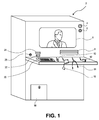
- FIG. 1 illustrates a particular example of a medical kiosk 2.
- Kiosks having a fixed connection to a computer network or for connection to the Internet are known in the art and are available for purchase through kiosk companies such as Affordable Kiosks on the Internet at affordablekiosks.com.
- Adapting a system to enable wireless access to a computer network or for connection to the Internet is known to those of ordinary skill in the art familiar with recent wireless communication technologies such as WiFi and WiMax.
- Conventional kiosks include an input device such as a computer keyboard 20, which may also include a cursor controller 10 such as a mouse, touch-pad or track ball.
- the kiosk 2 of the present invention also includes a display 6, a credit card reader 24 and/or a currency acceptor 22, and a camera 4.
- the kiosk 2 may also contain an emergency button 26, a portable video camera 12, an emergency first aid kit 18 and other portable medical implements such as a stethoscope 14, blood pressure cuff 16, otoscope, ophthalmoscope, tuning fork and the like.
- An x-ray machine and a MRI machine may also be attached to the kiosk 2 for rapid data transfer to the doctor.
- the display 6, credit card reader 24, currency acceptor 22, emergency button 26, medical implements 14 and 16, portable video camera 12, camera 4 and the like, are all parts of a customer interface.
- the customer interface consists of any devices through which the customer interacts with the kiosk, a computer or the distribution system.
- the display 6 may be of a kind typical to kiosks for viewing images transmitted to the display 6. Additionally, as is common with kiosks, the display 6 may be a touch sensitive screen for interacting with the kiosk 2. In particular implementations using a touch screen, it may not be necessary to include a keyboard because simple interaction may be accomplished through the touch screen. In other implementations, however, both a touch sensitive display 6 and a keyboard 20 and/or a cursor controller 10, will be used in combination to enable interaction. In some other more simple implementations, a simple 12 to 20 key keypad may be all that is needed. Some form of verbal interaction or sound receiving and/or transmitting device (e.g.
- a speaker or microphone on the kiosk or a telephone handset may be used to enable a customer to verbally interact with a person or system associated with the kiosk 2.
- instructions may be given and questions asked to the customer through the display 6, a verbal interaction device, a touch screen display 6 or a keyboard 20. Numerous combinations of interaction using these interaction tools may also be used to accomplish various purposes and achieve desired advantages.
- a verbal interaction device gives the particular ability to enable easy interaction with the system or a live person, such as a pharmacist, doctor, medical professional or help desk, to ask questions, or for the doctor or medical professional to ask questions and examine the customer.
- the camera 4 may be included in the kiosk 2 of implementations to capture a facial image of the customer requesting the medical document proximate the time the customer requests the document. Capturing a facial image of the customer who requested the medical document and of whom the medical examination was taken may be accomplished in a number of ways known to those of ordinary skill in the art and may include, without limitation stationary or moving digital or analog photography as well as other forms of capturing an image of the customer.
- capturing an image of the customer "proximate" the time the customer requests the medical document means capturing the image of the customer at or around the time the customer requests the document, is examined, and/or reviews the information at the terminal, and does not include capturing an image of the customer which was taken at a previous time, such as a drivers license photo, or merely transferring a previously captured image of the customer on file.
- the picture feature of the invention is intended to provide added security and, therefore, should be an image of the actual customer of the medical document.
- a video camera 5 may also be included in the kiosk 2 in particular implementations.
- the video camera 5 allows the customer to be viewed by a medical professional such as a doctor, emergency medical technician or nurse practitioner, among others.
- the video camera 5 may also be moveable and zoomable. It allows the customer and the medical professional to interact, the customer showing the medical professional various symptoms and the medical professional asking questions and giving directions to the customer.
- the video camera 5 would also allow the medical professional to supervise the customer's use of any medical implements attached to the kiosk 2 in order to assure that the customer takes the readings appropriately and gathers the correct information.
- the video camera 5 and other electronically recorded implement data would also provide a record of the examination that may be stored electronically and recalled later.
- the camera 4 and the video camera 5 may be combined into a single camera that takes videos but is also capable of capturing still images.
- the kiosk 2 may also include an emergency button 26.
- the emergency button 26 signals a remote medical professional that a medical emergency is underway. Medical professionals then immediately report to a remote terminal which allows them to interact with the customer.
- the kiosk 2 may contain an emergency first aid kit 18. This first aid kit 18 may be stored in a compartment in the kiosk 2. The remote medical professional would then be able to direct the treatment of the customer undergoing the medical emergency. While any of the implementations described herein may be adapted for use in emergency situations, the implementations described with reference to FIGs. 7a to 11 are particularly advantageous to emergency situations because of the mobile nature of those implementations and the ability to quickly transport those implementations to areas where a stationary kiosk or booth may not be available or practical.
- Medical implements such as a stethoscope 14, a blood pressure cuff 16, otoscope, ophthalmoscope, tuning fork, x-ray machine, MRI machine and the like may be attached to the kiosk 2. These medical implements allow the customer to conduct a self examination with the readings from the implements being electronically recorded and sent to a medical professional for evaluation. Medical implements that can be attached to and read by a computer system are available through AMD of Sunnyvale, California.
- the kiosk 2 may also have a credit card reader 24 and a cash acceptor 22 in order to allow the customer to pay for medical services at the time they are rendered through the kiosk.
- a printer 8 is attached to the kiosk 2 so that the requested medical documents may be printed instantly on the appropriate paper.
- a portable video camera 12 may also be attached so that the customer may focus in on a rash, emergency condition, or other ailment that the medical professional would need to view.
- the kiosk 2 also includes a power supply (not shown) to supply power to the kiosk 2, and a network connection (also not shown) to enable the transfer of data to and from the kiosk 2.
- Power supplies may include for example, a plug plugged into a standard outlet, or may include a battery or other power supply which does not require external connection.
- the network connection to the kiosk 2 may include a direct connection to a data source, such as through a co-axial, telephone, network or other cable connection, or may include, without limitation, a wireless connection, such as Bluetooth transmissions, satellite transmissions, WiFi or WiMax transmissions, cellular transmissions, radio or other frequency transmissions, and the like. Power and network connection possibilities and configurations are well known in the art and those of ordinary skill in the art will readily be able to properly configure implementations for power and network connection from the description provided herein.
- FIG. 2 illustrates the medical examination kiosk of FIG. 1 configured as a booth to provide privacy for customers receiving medical examinations.
- the kiosk 2 contains a seat 30 and a curtain 28 that may be closed to provide privacy.
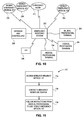
- FIG. 5 is a block diagram of a simplified example of the connectivity of an implementation of a medical services and prescription distribution system.
- the implementation shown in FIG. 5 includes a medical kiosk 138, a medical professional terminal 134, a medical information database 136 and an internet connection 132, each coupled to a system processor 130.
- Each of these connections may be accomplished by any combination of wired or wireless connection.
- Each or any of the components 138, 134, 136, 132 and 130 of the system may be located in a pharmacy, or in other remote location such as a doctor's home or office, particularly in cases where the kiosk 138 allows access to experts in certain medical fields, or even in a retail store, such as a grocery store, shopping mall, or any other place where it is desirable to have customers come.
- a retail store such as a grocery store, shopping mall, or any other place where it is desirable to have customers come.
- Customer requests for medical documents and medical examinations made through the kiosk 138 are transmitted electronically to and processed by the system processor 130.
- Information contained within the document request is compared with previous medical data within the medical information database 136, and is approved by a doctor reviewing the circumstances of each request and each medical examination through the medical professional terminal 134.
- Return customers may be given a user ID and password to avoid the need to reenter basic personal information.
- any or all of the components of the system may be implemented using conventional personal computers associated as a network, provided the medical kiosk 138 includes a camera associated therewith and programmed to take a facial image of the user proximate the time of the examination.
- the medical kiosk 138 may also include a video camera and voice interaction device to allow the customer and the medical professional to interact. It is possible, however, that a customer could conduct a medical self examination, following instructions provided through the kiosk 138, and that the doctor could review the information received at a later time. In most implementations, however, the kiosk 138 will be configured for general public use as a kiosk, and the medical professional terminal 134 will more likely be configured as a personal computer. The doctor may approve the request and issue the medical document which is sent to a pharmacy or other entity if requested by the customer, or the document may simply be issued and printed at the kiosk 138.
- FIG. 6 is a block diagram illustrating a more complex example of the connectivity of a medical services or document distribution system.
- the system comprises a plurality of medical kiosks 138 that may be located at one or more physical locations, such as at a plurality of remote pharmacies, or two or more may be located in close proximity such as within a shopping mall where many people may desire to use the kiosks 138 simultaneously.
- the system of FIG. 6 comprises a plurality of medical professional terminals 134 through which a plurality of doctors or medical professionals may issue and approve medical documents or conduct medical examinations.
- a plurality of entities 140 may be associated with the system so that customers may select the pharmacy or other entity to which the medical document will be sent.
- a pharmacy or other entity 140 need only have a fax machine or email to receive a medical document.
- the processor 130 may be configured to electronically fax a medical document to any entity 134.
- the entity 134 may include a computer for receiving and reviewing the medical document electronically, and/or a printer, copier or fax machine for creating a hard copy of the medical document depending upon the needs of the entity.
- the entities 140 of the various implementations may be pharmacies, doctor's offices, hospitals, employers, schools, government offices, emergency response or treatment groups or any other entity to which the customer may need to send medical documents.
- the entities 140 may be adapted to send requested pharmaceuticals by carrier, such as is currently done with cyber-pharmacies but with the added security of comparing the customer's requests with the medical information database 136 (including the shipping address and the customer's picture).
- Software such as that distributed by IQ Biometrix, Inc. of Fremont, California, exists to compare facial images and determine identity like a finger print. Use of this software to compare faces of each requestor of medical documents may help to eliminate fraud and situations where a customer requests multiple prescriptions using different names, and even different mailing addresses. Nevertheless, a visual comparison may also be sufficient to verify the requestor.
- the customer's picture may be included on a shipping label if prescription drugs are sent through the mail. This allows the delivery person to ensure the drugs were delivered to the correct person.
- Conventional cyber-pharmacy systems require a signature by the requestor when the delivery is made. This, however, does not ensure security as the signator may be signing a different name. Use of this system, for example, would enable customers to have their prescriptions forwarded to and filled by a Canadian or other out-of-country pharmacy for shipment to the customers' homes in the United States.
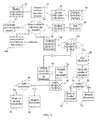
- FIG. 3 includes a flow chart of a method of distributing medical documents and medical services illustrating one example implementation.
- the method of the implementation in FIG. 3 may be accomplished through a system having components such as those shown and described with reference to FIGs. 1-2 and 5-9.
- Instructions on how to begin a medical examination through the kiosk may be displayed on the kiosk or otherwise be provided through the kiosk (Step 32).
- the customer initiates, and the system receives, an examination and medical document request (Step 34).
- a camera associated with the system will capture an image of the customer.
- Part of making the request for a medical examination and medical documents for particular embodiments of the invention involves sliding a credit card through a credit card reader and approving the charge to the credit card or putting cash in the cash acceptor in order to pay for the services and documents to be provided.
- the customer's credit card billing address may be compared against the customer's indicated home address, or a possible shipping address in certain implementations, as a form of confirmation as to the identity of the customer.
- the customer is then presented instructions on operating the medical implements attached to the kiosk (Step 36).
- the customer may operate the medical implements under the supervision of a medical professional through the interactive kiosk, or a medical professional, such as a nurse, may be present at the kiosk to assist or perform the examination for a doctor.
- the implement readings are then sent to the medical professional terminal (Step 38).
- the customer is presented with a questionnaire as part of the requesting process during which the customer is asked a series of questions necessary for the particular medical document requested (Step 40). There are typically a set of questions general to most document requests, i.e. customer's date of birth, height, weight, known allergies, current medications, known medical problems, alcohol and cigarette intake, past surgeries, and the like.
- the questions may include:
- Additional validation information may be requested to ensure that the customer is legally eligible to receive the requested medication.
- the validations may include, with a Yes or No response required for each one:
- Additional information questions regarding the identity of the customer may also be asked such as billing information, address, gender, etc., or for previous users of the system this information may be loaded from an associated database.
- the computerized medical questionnaire may be interactive, in that some answers from the consumer may determine which question will be asked next.
- the questions may also be formulated by a medical professional conducting the medical examination.
- the responses to the questions are analyzed (Step 42) as the questions are answered or when the answers are submitted. This is particularly the case when a medical professional is conducting the medical examination.
- the questions may also be analyzed by a medical professional at some later time.
- the medical professional determines whether or not the medical document should be issued (Step 44). The customer should be informed if the medical document will not issue (Step 46). Otherwise, if it is determined that the medical document should be issued, the type of medical document that was requested comes into play. It is also possible that more information may be needed by the medical professional to issue the medical document (Step 48). If this is the case, more questions should be asked to clarify any concerns the medical professional may have.
- the customer may be given the option to have the document printed from the kiosk and/or forwarded directly to some other entity (Step 52 and 54). If the customer wants the document printed from the kiosk, it can be printed immediately (Step 60). Though, if a medical professional is not present during the examination, the customer may need to return for the document or for a follow up.
- the medical document is printed with the customer's image attached in order to allow verification of the identity of the person to whom the medical document relates. When someone is presented with the medical document, that person may verify that the person presenting the document is the person to whom the document was issued (Step 64 and 68). Once the identity of the customer is verified, the document can be accepted (Step 70).
- Step 72 the document is not accepted (Step 72).
- biometric comparisons may include comparing fingerprints, DNA, retinal scans, or any other unique identifier.
- Step 56 information is gathered about that entity (Step 56), such as where the entity is located, an email address or fax number, and the like.
- the document is then forwarded with the customer's image attached (Step 58). This allows the entity to which the document is presented, to verify that the customer is the person to whom the document was issued (Steps 62 and 66). If the identity of the customer is verified, the entity may accept the document otherwise, the entity can reject it (Steps 74 and 76).
- Information gathered by the kiosk is stored in a medical database for further reference.
- the customer's request establishes a specific record of who requested the medical document and who was examined. It provides not only a confirmation that the customer was asked all of the appropriate questions and answered them appropriately, but also that a specific photo record was made of who requested the document, answered the questions and participated in the examination. This record is one that is generally not created in a conventional doctor's office when a medical document is requested.
- An initial determination may be made from the response received from the medical database as to whether the customer should receive the medical document and pass that along with the customer's responses. For example, and without limitation, if the customer has frequently requested the same prescription medication without just cause, the same facial image is associated with more than one name, or more than one facial image is associated with the same name, software associated with the system may identify the inconsistency. This may be indicated to the doctor along with the medical document request. Also, if the database is aware of a conflicting prescription previously received by the customer that is not identified in the customer's responses, if previous responses are inconsistent with current responses, or if the indications otherwise indicate that the customer should not be using the requested medication, this too may be identified and indicated to the doctor along with the medical document request.
- the medical information database used in particular implementations included in this description may be configured in many different ways and may include any number of different types of information. Those of ordinary skill in the art will be readily able to design and build an appropriate database depending upon the needs of a particular system and the information desired to be stored and retrieved by system administrators.
- each request for a medical document along with all responses and all relationships between requests may be tracked, queried and searched.
- Such a system would increase the usefulness of the database in providing security against fraudulent prescription requests is dependent, in part, upon the ability to search and compare existing records.
- FIG. 4 illustrates an example of a prescription 100 generated by a particular implementation of a medical document system.
- a prescription 100 may include any or all of the elements described with reference to FIG. 4, in whatever combination is necessary or desired for a particular system.
- the prescription 100 shown and described with regard to this particular implementation is intended as a non-limiting example.
- a prescription 100, or conditional prescription includes an image of the customer 102, the customer's contact information 104, information regarding the pharmacy 106 to which the customer indicated the prescription should be sent, and pertinent medical data 108 relating to the customer.
- the prescription 100 also includes a section for comments from the doctor 112, a section for specific instructions to the pharmacist and comments by the pharmacist 114, and a section for payment and perhaps delivery receipt information for the customer 116.
- the prescription 100 may also include a doctor's signature 118, prescription information 120 regarding the medication, dosage information, refills prescribed, and a date 122 for the prescription.
- Particular implementations of the prescription may also include the doctor's full contact information 124, license number 126, and title below the signature 128 for clarity.
- Other medical documents may have similar fields for follow-up questions and other information.
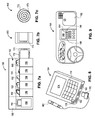
- FIGs. 7a to 7c illustrate views of an implementation of a mobile emergency medical kit 150.
- This implementation includes a carrier 152 in which various medical implements may be stored.
- Medical implements are implements that may be used to assess information about a physiological or other medical condition of a patient. There are many various medical implements known and used. Many are already disclosed in this disclosure.
- the medical implements shown in FIG. 7a are electronic medical implements configured to receive stimuli and convert the stimuli into electronic data for transmission to an electronic data collector 154. Examples of electronic medical implements included in FIG. 7a are a stethoscope, 158, a blood pressure gauge 160, a pen light or video or still camera 162, and a blood composition monitor 164, such as an oxygen level sensor or a blood sugar (glucose) level sensor.
- an identification card reader 166 configured to scan or otherwise read information from an identification card such as a credit card, driver's license or other identifying card.
- an identification card such as a credit card, driver's license or other identifying card.
- Other medical implements such as a thermometer, an ultrasound generator, and any other medical implementation commonly used in the industry for gathering physiological data may also be included.
- the medical implements may be programmed to gather and transmit the data to the electronic data collector 154 for analysis, some of the data may be analyzed by the electronic medical implement, and/or some of the data may be transmitted to the emergency response system for final analysis.
- the medical implements may be programmed to gather and transmit the data to the electronic data collector 154 for analysis, some of the data may be analyzed by the electronic medical implement, and/or some of the data may be transmitted to the emergency response system for final analysis.
- Those of ordinary skill in the art are readily aware of electronic versions of common medical implements, how to adapt those electronic medical implements to associate with electronic data collectors, and how to best interpret and analyze the data received from the implements.
- FIG. 7a includes a fold-over flap 168 to help in retaining the implements in the carrier 152 when the carrier is rolled or folded shut.
- the handle 170 of this particular implementation is adapted to include hook and loop fasteners (such as Velcro®) along a section 172 of the handle to coordinate with corresponding components on the carrier 152 when the carrier 152 is rolled.
- FIG. 7b illustrates a side view and FIG. 7c illustrates an end view of the mobile emergency medical kit 150 implementation rolled with the handle fastened.
- the carrier is provided as a convenience for packaging and/or maintaining the assembled unit as a kit. It is contemplated that each of the medical implements may be individually wrapped and sealed in sterile packaging typical of medical implements prior to use. Such medical implements may be created as disposable, recyclable, or reusable implements as is also common in the art of medical implements. As will be clear to those of ordinary skill in the art, the kit may include other electronic and non-electronic medical implements as well. For example, a conventional first aid kit may be included in the mobile emergency medical kit. Additionally, more complex medical devices such as, and without limitation, a heart defibrillator may be included.
- FIG. 8 illustrates an implementation of an electronic data collector 154.
- the electronic data collector 154 includes a display 174, a plurality of function buttons 176, and an emergency button 178.
- the emergency "E" button may be configured to indicate a medical emergency so that connection to a medical professional will be accelerated.
- Data ports 180 such as USB ports or other data connector ports 182 may be used to allow connection between medical implements, such as the pen camera 162 shown, and the electronic data collector 154.
- One benefit of USB ports is that power may be supplied to the medical implement through the USB port instead of requiring the medical implement to provide its own power supply.
- a USB connector 182 or other suitable cable connector may be used to interface with the electronic data collector 154.
- wireless communication may be used.
- wireless communication devices include, but are not limited to, Bluetooth, radio frequency, WiFi, WiMAX, satellite or cellular signals, or other wireless frequency signals known in the art.
- the communications used by the kit are described as being incorporated into the electronic data collector 154.
- the communications electronics may be fully incorporated within the electronics for the electronic data collector, or may simply be associated with the electronic data collector.
- Power may be provided to the electronic data collector 154 through any number of known power sources such as rechargeable or non-rechargeable batteries, an electrical outlet, an automobile power connector such as a cigarette lighter, and the like. Because particular implementations of aspects relating to mobile emergency medical kits involve the kits being stored in an automobile or an airplane, power supplies conventionally located on such vehicles are a logical choice for adaptation. Similar to smoke detectors used to protect homes from fire, the electronic data collector 154 may be adapted to include a warning light or sound that activates when the battery is running low.
- the electronic data collector 154 transmits, with data it gathers from a medical implement attached thereto, a unique identifier to an emergency response system.
- This allows the emergency response system to identify the kit being used, possibly identify who owns it, and determine whether there are electronic methods of identifying the location of the kit being used, such as through the On-Star® System or Lo-Jack® System installed on the vehicle or perhaps installed as part of the electronic data collector 154 or elsewhere in the kit.
- WiMAX wireless access control
- FIG. 9 illustrates a mobile emergency medical kit incorporated into a vehicle dash board 184.
- the electronic data collection portion of the kit is mounted in the dash board 184 and includes a display 186, one or more function buttons 188, an emergency button 190, and one or more data ports 194.
- a medical implement carrier including medical implements may be stored in the glove compartment 192, under a car seat, or at some other location in the vehicle.
- FIG. 10 illustrates an implementation of a Mobile Emergency Response System.
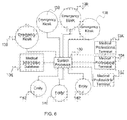
- a plurality of mobile emergency medical kits 200 for example the mobile emergency medical kit implementations described with reference to FIGs. 7 to 9, is each configured for wireless communication with a central Emergency Response System 202. Distinct from a conventional call center, the Emergency Response System 202 is configured to receive data indicative of physiological conditions of patients through the medical implements associated with each of the mobile emergency medical kits 200.
- the Emergency Response System 202 is further associated with a plurality of Medical Professional Terminals 204 that are locally or remotely coupled to the Emergency Response System 202.
- a 911 operator terminal 206 may be one of the medical professional terminals coupled to the Emergency Response System 202 in the case that a medical professional cannot provide an adequate response.
- a customer, medical information, informational, or other database and whatever additional controllers are needed 208 may also be coupled to the Emergency Response System 202.
- Incoming communications are routed to the appropriate Medical Professional Terminal for best assistance to the incoming communication, much like a 911 call center.
- One significant advantage of a mobile emergency medical kit 200 is that it has the additional benefit of providing laypersons with medical implements that may be used to assist the medical professional by providing physiological data not previously available to medical professionals during a remote diagnosis for a medical emergency.
- a medical professional associated with the Medical Professional Terminal 204 can further instruct the user communicating through the electronic data collector to use the medical implements appropriately to collect relevant data to answer the medical professional's questions.
- instruction in use of the medical implements may be provided to the customer at the time the medical kit is provided to the customer.
- mobile emergency medical kits and associated emergency response systems configured to receive data from remote electronic medical implements are useful and advantageous in all locations where a large number of people exist or emergencies may occur.
- a medical emergency response network that not only assists in the medical emergency through analyzing an observer's verbal explanation of the emergency, but also collects physiological data relating to the patient, more accurate medical information can be collected more quickly, and better medical procedures can be provided more quickly.
- FIG. 11 illustrates an implementation of a method of using a mobile emergency medical kit 212.
- a person who is experiencing or witnessing a medical emergency (“user") first accesses a mobile emergency medical kit (Step 214).
- the kit may be stored in the kitchen or other convenient location.
- the kit may be in the glove compartment or other storage compartment or under a seat of the vehicle.
- the electronic data collector may be incorporated into or placed adjacent to the On-Star® system on the console or dash board of the vehicle. Because the electronic data collector is configured for wireless communication to a remote location, it is particularly advantageous for use in a variety of locations with the same kit; thus enabling endless adaptation to various use environments and locations with the same kit equipment.
- the user After accessing the kit, the user contacts the Emergency Response Center (Step 216) through the wireless communications portion of the electronic data collector. Contacting the Emergency Response Center may simply involve pressing an emergency button on the electronic data collector. Alternatively, it may involve pressing a "non-emergency" button on the device or even pressing a sequence of buttons to complete the contact connection. Once the Emergency Response Center is contacted, the user can inform the medical professional of the medical emergency, follow instructions from the medical professional on how to use the medical implements associated with the mobile emergency medical kit to get the physiological data needed (if any), and collect the needed data using the kit (Step 218).
- the Emergency Response Center's customer database may include a call history and even a medical history associated with the unique identifier associated with the call to ensure the customer's previous needs that may be relevant to the present call are known to the medical professional.
- Using the medical implement may involve associating a medical implement with the electronic data collector by plugging it into the device or turning it on.
- the medical professional can provide more meaningful assistance to the user for assisting in the medical emergency.
- the physiological data may then be transmitted by the emergency response system or by the mobile emergency medical kit to the emergency medical personnel who arrive at the scene to assist in their diagnosis and treatment, and/or transmitted to the hospital to which the patient is transferred if desired.
Landscapes
- Health & Medical Sciences (AREA)
- Engineering & Computer Science (AREA)
- Life Sciences & Earth Sciences (AREA)
- Biomedical Technology (AREA)
- Public Health (AREA)
- General Health & Medical Sciences (AREA)
- Medical Informatics (AREA)
- Physics & Mathematics (AREA)
- Business, Economics & Management (AREA)
- Pathology (AREA)
- Surgery (AREA)
- Veterinary Medicine (AREA)
- Animal Behavior & Ethology (AREA)
- Biophysics (AREA)
- Heart & Thoracic Surgery (AREA)
- Molecular Biology (AREA)
- General Business, Economics & Management (AREA)
- Accounting & Taxation (AREA)
- General Physics & Mathematics (AREA)
- Primary Health Care (AREA)
- Physiology (AREA)
- Cardiology (AREA)
- Epidemiology (AREA)
- Theoretical Computer Science (AREA)
- Strategic Management (AREA)
- Finance (AREA)
- Computer Networks & Wireless Communication (AREA)
- Pulmonology (AREA)
- Immunology (AREA)
- Vascular Medicine (AREA)
- Medical Treatment And Welfare Office Work (AREA)
Applications Claiming Priority (1)
| Application Number | Priority Date | Filing Date | Title |
|---|---|---|---|
| US10/996,296 US20050075907A1 (en) | 2003-03-14 | 2004-11-22 | Emergency station kiosk and related methods |
Publications (2)
| Publication Number | Publication Date |
|---|---|
| EP1659512A2 true EP1659512A2 (fr) | 2006-05-24 |
| EP1659512A3 EP1659512A3 (fr) | 2006-05-31 |
Family
ID=36097276
Family Applications (1)
| Application Number | Title | Priority Date | Filing Date |
|---|---|---|---|
| EP05111113A Withdrawn EP1659512A3 (fr) | 2004-11-22 | 2005-11-22 | Kiosque de station d'urgence et procédés associés |
Country Status (3)
| Country | Link |
|---|---|
| US (1) | US20050075907A1 (fr) |
| EP (1) | EP1659512A3 (fr) |
| CA (1) | CA2527412A1 (fr) |
Cited By (3)
| Publication number | Priority date | Publication date | Assignee | Title |
|---|---|---|---|---|
| EP3455807A4 (fr) * | 2016-05-09 | 2020-01-15 | Global Tel*Link Corporation | Système et procédé d'intégration de télémédecine dans des systèmes de visite vidéo multimédia dans des établissements correctionnels |
| DE102021109073A1 (de) | 2020-07-01 | 2022-01-05 | BNP Paribas S.A. Niederlassung Deutschland | Verfahren zur Durchführung einer Transaktion an einem tragbaren Terminal |
| US20240395381A1 (en) * | 2023-05-22 | 2024-11-28 | Rachel Rivera | Interactive PREP Dispensers and Methods of Using Interactive PREP Dispensers |
Families Citing this family (33)
| Publication number | Priority date | Publication date | Assignee | Title |
|---|---|---|---|---|
| US8626668B2 (en) * | 2007-07-05 | 2014-01-07 | Jon Butler | Individualized digital media delivery systems |
| US20070129610A1 (en) * | 2005-12-06 | 2007-06-07 | Eastman Kodak Company | Method of providing automated medical assistance |
| RU2452994C2 (ru) | 2007-11-08 | 2012-06-10 | ГЛЭКСОСМИТКЛАЙН ЭлЭлСи | Системы и способы выдачи медицинской продукции |
| US20090222318A1 (en) * | 2008-02-29 | 2009-09-03 | Fastrak Isp Inc. | Method, system and kiosk for connecting a customer to an expert at a remote location |
| ES2326019B1 (es) * | 2008-03-26 | 2010-07-07 | Tuylek, S.L. | "equipo multifuncion de medicion de datos vitales dotado de un sistema de tratamiento de datos centralizado". |
| US7775424B1 (en) * | 2008-08-21 | 2010-08-17 | Helzer Scott C | Variable height interactive kiosk |
| US8130904B2 (en) * | 2009-01-29 | 2012-03-06 | The Invention Science Fund I, Llc | Diagnostic delivery service |
| US8249218B2 (en) * | 2009-01-29 | 2012-08-21 | The Invention Science Fund I, Llc | Diagnostic delivery service |
| US8526573B2 (en) * | 2009-11-25 | 2013-09-03 | Merge Healthcare Incorporated | Systems and methods for remote diagnostic imaging |
| US9536046B2 (en) * | 2010-01-12 | 2017-01-03 | Microsoft Technology Licensing, Llc | Automated acquisition of facial images |
| US20140330579A1 (en) * | 2011-03-31 | 2014-11-06 | Healthspot, Inc. | Medical Kiosk and Method of Use |
| US9043217B2 (en) | 2011-03-31 | 2015-05-26 | HealthSpot Inc. | Medical kiosk and method of use |
| US11978552B2 (en) | 2012-03-02 | 2024-05-07 | Md Health Rx Solutions, Llc | Medical services kiosk |
| US11984228B1 (en) | 2012-03-02 | 2024-05-14 | Md Health Rx Solutions, Llc | Medical service kiosk having an integrated scale |
| US20200168331A1 (en) | 2012-03-02 | 2020-05-28 | Leonard Solie | Clinician station for providing medical services remotely |
| TW201347727A (zh) * | 2012-05-31 | 2013-12-01 | Ibm | 自動上傳非連接式醫療檢測裝置之量測資料的方法與電腦裝置 |
| EP2885759A4 (fr) * | 2012-08-15 | 2016-02-10 | Healthspot Inc | Kiosque vétérinaire avec dispositifs médicaux vétérinaires intégrés |
| US20140228648A1 (en) * | 2013-02-13 | 2014-08-14 | Bag Enterprises, Inc. | Pet scale kiosk with interactive client information software |
| EP2779681A3 (fr) * | 2013-03-13 | 2015-05-13 | New Technologies Ltd. | Kiosque vidéo interactif unifié pour la gestion des informations et procédé pour celui-ci |
| US8842156B1 (en) * | 2013-06-28 | 2014-09-23 | NewTech Systems Inc | Unified interactive video kiosk for information management and method for the same |
| TWI526976B (zh) * | 2013-11-21 | 2016-03-21 | 動聯國際股份有限公司 | 監控系統、方法及醫療監控系統 |
| EP2899961A1 (fr) * | 2014-01-22 | 2015-07-29 | Phonetica Lab S.R.L. | Totem multimédia multifonction pour une utilisation à distance |
| CN105095622A (zh) * | 2014-05-13 | 2015-11-25 | 伦纳德·索力 | 医疗辅助方法和系统 |
| US10861604B2 (en) | 2016-05-05 | 2020-12-08 | Advinow, Inc. | Systems and methods for automated medical diagnostics |
| US11164679B2 (en) | 2017-06-20 | 2021-11-02 | Advinow, Inc. | Systems and methods for intelligent patient interface exam station |
| EP3441000A1 (fr) * | 2017-08-08 | 2019-02-13 | Davis, Edwin | Dispositif de détection, de traitement et de présentation d'informations de détail sur l'état du corps |
| US11081220B2 (en) * | 2018-02-02 | 2021-08-03 | Carefusion 303, Inc. | System and method for dispensing medication |
| US10939806B2 (en) | 2018-03-06 | 2021-03-09 | Advinow, Inc. | Systems and methods for optical medical instrument patient measurements |
| US11348688B2 (en) * | 2018-03-06 | 2022-05-31 | Advinow, Inc. | Systems and methods for audio medical instrument patient measurements |
| US11222721B2 (en) | 2018-05-04 | 2022-01-11 | Carefusion 303, Inc. | Peer community based anomalous behavior detection |
| EP4004939A1 (fr) | 2019-07-24 | 2022-06-01 | CareFusion 303, Inc. | Station d'élimination intelligente pour médicaments |
| US12333924B2 (en) * | 2020-04-16 | 2025-06-17 | IKE Smart City, LLC | Interactive kiosk with emergency call module |
| IT202100027677A1 (it) * | 2021-10-28 | 2023-04-28 | Samuele Innocenti | Macchinario per realizzare iniezioni |
Citations (1)
| Publication number | Priority date | Publication date | Assignee | Title |
|---|---|---|---|---|
| US5801755A (en) | 1996-04-09 | 1998-09-01 | Echerer; Scott J. | Interactive communciation system for medical treatment of remotely located patients |
Family Cites Families (39)
| Publication number | Priority date | Publication date | Assignee | Title |
|---|---|---|---|---|
| US4051522A (en) * | 1975-05-05 | 1977-09-27 | Jonathan Systems | Patient monitoring system |
| JPS6180222A (ja) * | 1984-09-28 | 1986-04-23 | Asahi Glass Co Ltd | メガネ合せ方法及びメガネ合せ装置 |
| JPH05168013A (ja) * | 1991-12-16 | 1993-07-02 | Matsushita Electric Ind Co Ltd | 在宅診療システム |
| US5441047A (en) * | 1992-03-25 | 1995-08-15 | David; Daniel | Ambulatory patient health monitoring techniques utilizing interactive visual communication |
| US5390238A (en) * | 1992-06-15 | 1995-02-14 | Motorola, Inc. | Health support system |
| US6283761B1 (en) * | 1992-09-08 | 2001-09-04 | Raymond Anthony Joao | Apparatus and method for processing and/or for providing healthcare information and/or healthcare-related information |
| US5280570A (en) * | 1992-09-11 | 1994-01-18 | Jordan Arthur J | Spectacle imaging and lens simulating system and method |
| US6101478A (en) * | 1997-04-30 | 2000-08-08 | Health Hero Network | Multi-user remote health monitoring system |
| US5502944A (en) * | 1993-12-03 | 1996-04-02 | Owen Healthcare, Inc. | Medication dispenser system |
| US5845255A (en) * | 1994-10-28 | 1998-12-01 | Advanced Health Med-E-Systems Corporation | Prescription management system |
| US5797515A (en) * | 1995-10-18 | 1998-08-25 | Adds, Inc. | Method for controlling a drug dispensing system |
| US5597995A (en) * | 1995-11-08 | 1997-01-28 | Automated Prescription Systems, Inc. | Automated medical prescription fulfillment system having work stations for imaging, filling, and checking the dispensed drug product |
| US6003991A (en) * | 1996-02-17 | 1999-12-21 | Erik Scott Viirre | Eye examination apparatus and method for remote examination of a patient by a health professional |
| US5842976A (en) * | 1996-05-16 | 1998-12-01 | Pyxis Corporation | Dispensing, storage, control and inventory system with medication and treatment chart record |
| US6032155A (en) * | 1997-04-14 | 2000-02-29 | De La Huerga; Carlos | System and apparatus for administering prescribed medication to a patient |
| US5907493A (en) * | 1997-01-31 | 1999-05-25 | Innovation Associates, Inc. | Pharmaceutical dispensing system |
| KR100388566B1 (ko) * | 1997-05-16 | 2003-06-25 | 호야 가부시키가이샤 | 안경의 주문제작 시스템 |
| US5970462A (en) * | 1997-10-31 | 1999-10-19 | Reichert; Richard R. | On-line pharmacy automated refill system |
| CN1105980C (zh) * | 1998-02-03 | 2003-04-16 | 西乡刚 | 眼镜试戴模拟方法 |
| US7860725B2 (en) * | 1998-05-26 | 2010-12-28 | Ineedmd.Com, Inc. | Method for remote medical consultation and care |
| US6401085B1 (en) * | 1999-03-05 | 2002-06-04 | Accenture Llp | Mobile communication and computing system and method |
| US6234343B1 (en) * | 1999-03-26 | 2001-05-22 | Papp Enterprises, Llc | Automated portable medication radial dispensing apparatus and method |
| US6330491B1 (en) * | 1999-07-21 | 2001-12-11 | Nicholas Lion | Integrated system and method of vending prescription medications using a network of remotely distributed, automated dispensing units |
| US6202923B1 (en) * | 1999-08-23 | 2001-03-20 | Innovation Associates, Inc. | Automated pharmacy |
| US6564121B1 (en) * | 1999-09-22 | 2003-05-13 | Telepharmacy Solutions, Inc. | Systems and methods for drug dispensing |
| US7016752B1 (en) * | 1999-12-17 | 2006-03-21 | Rxperts, Inc. | Method of and system for labeling containers of prescribed medicine |
| ATE326205T1 (de) * | 2000-01-31 | 2006-06-15 | Engelhard Corp | Tensidfreietopische zusammensetzungen und verfahren zur schnelle herstellung davon |
| US20020046061A1 (en) * | 2000-02-11 | 2002-04-18 | Wright Kenneth L. | Personal information system |
| US6892941B2 (en) * | 2000-06-08 | 2005-05-17 | Mendota Healthcare, Inc. | Automatic prescription drug dispenser |
| WO2002000297A2 (fr) * | 2000-06-23 | 2002-01-03 | Medtronic, Inc. | Dispositif d'extension portatif permettant la transmission de donnees a l'interieur d'un systeme de communication de dispositifs medicaux |
| US20020111832A1 (en) * | 2000-10-23 | 2002-08-15 | Robert Judge | Method and apparatus for delivering a pharmaceutical prescription copay counselor over an internet protocol network |
| US6792401B1 (en) * | 2000-10-31 | 2004-09-14 | Diamond Visionics Company | Internet-based modeling kiosk and method for fitting and selling prescription eyeglasses |
| EP2384782A1 (fr) * | 2000-11-30 | 2011-11-09 | Canon Kabushiki Kaisha | Terminal portable |
| US20020143434A1 (en) * | 2001-03-29 | 2002-10-03 | John Greeven | Method and apparatus for delivering and refilling pharmaceuticals |
| US20020147615A1 (en) * | 2001-04-04 | 2002-10-10 | Doerr Thomas D. | Physician decision support system with rapid diagnostic code identification |
| US20020188467A1 (en) * | 2001-05-02 | 2002-12-12 | Louis Eke | Medical virtual resource network |
| JP4177598B2 (ja) * | 2001-05-25 | 2008-11-05 | 株式会社東芝 | 顔画像記録装置、情報管理システム、顔画像記録方法、及び情報管理方法 |
| US20030120513A1 (en) * | 2001-10-15 | 2003-06-26 | Samaquial Michael Rey | Method of facilitating access to remote health-related services, practitioners, and information |
| BR0200290A (pt) * | 2002-01-29 | 2003-10-14 | Bussiness Solucoees Interativa | Sistema interativo de informação e otimização de atendimento nas áreas de saúde e correlatas |
-
2004
- 2004-11-22 US US10/996,296 patent/US20050075907A1/en not_active Abandoned
-
2005
- 2005-11-21 CA CA002527412A patent/CA2527412A1/fr not_active Abandoned
- 2005-11-22 EP EP05111113A patent/EP1659512A3/fr not_active Withdrawn
Patent Citations (2)
| Publication number | Priority date | Publication date | Assignee | Title |
|---|---|---|---|---|
| US5801755A (en) | 1996-04-09 | 1998-09-01 | Echerer; Scott J. | Interactive communciation system for medical treatment of remotely located patients |
| US6046761A (en) | 1996-04-09 | 2000-04-04 | Medcom Technology Associates, Inc | Interactive communication system for medical treatment of remotely located patients |
Cited By (5)
| Publication number | Priority date | Publication date | Assignee | Title |
|---|---|---|---|---|
| EP3455807A4 (fr) * | 2016-05-09 | 2020-01-15 | Global Tel*Link Corporation | Système et procédé d'intégration de télémédecine dans des systèmes de visite vidéo multimédia dans des établissements correctionnels |
| US10936698B2 (en) | 2016-05-09 | 2021-03-02 | Global Tel*Link Corporation | System and method for integration of telemedicine into multimedia video visitation systems in correctional facilities |
| US12251188B2 (en) | 2016-05-09 | 2025-03-18 | Global Tel*Link Corporation | System and method for integration of telemedicine into multimedia video visitation systems in correctional facilities |
| DE102021109073A1 (de) | 2020-07-01 | 2022-01-05 | BNP Paribas S.A. Niederlassung Deutschland | Verfahren zur Durchführung einer Transaktion an einem tragbaren Terminal |
| US20240395381A1 (en) * | 2023-05-22 | 2024-11-28 | Rachel Rivera | Interactive PREP Dispensers and Methods of Using Interactive PREP Dispensers |
Also Published As
| Publication number | Publication date |
|---|---|
| US20050075907A1 (en) | 2005-04-07 |
| CA2527412A1 (fr) | 2006-05-22 |
| EP1659512A3 (fr) | 2006-05-31 |
Similar Documents
| Publication | Publication Date | Title |
|---|---|---|
| EP1659512A2 (fr) | Kiosque de station d'urgence et procédés associés | |
| US20020188467A1 (en) | Medical virtual resource network | |
| US7412396B1 (en) | Virtual clinic for medical practice | |
| US8793142B2 (en) | Methods and apparatuses for remote diagnosis and prescription | |
| US7860725B2 (en) | Method for remote medical consultation and care | |
| US20140074501A1 (en) | Methods and systems for assuring compliance | |
| JP2008521130A (ja) | 複数の入力源を有する医療キオスク | |
| US20080275311A1 (en) | Virtual Clinic For Medical Practice | |
| WO1999004043A1 (fr) | Telemedecine | |
| US20100204596A1 (en) | Method and system for providing remote healthcare | |
| JP6570691B1 (ja) | 個人医療情報集約システム | |
| CN105095622A (zh) | 医疗辅助方法和系统 | |
| WO2014080081A1 (fr) | Unité médicale en libre-service, et système et procédé associés | |
| WO2015072165A1 (fr) | Système d'aide à l'utilisation d'un hôpital | |
| Liu et al. | Drug information–seeking intention and behavior after exposure to direct-to-consumer advertisement of prescription drugs | |
| JP2002049693A (ja) | 病気のチェックシステム | |
| CN210667817U (zh) | 智能诊疗屋 | |
| JP2004258978A (ja) | バーチャルペーシェントシステム、情報提供システム及び医療情報提供方法 | |
| JP2019160029A (ja) | 店舗内等での血液検査等に基づく薬剤の処方箋情報等提供システム | |
| JP2003141251A (ja) | 診断投薬方法及び診断投薬システム | |
| KR100684007B1 (ko) | 인터넷 망을 통한 원격 진료 시스템과 그 운용방법 | |
| JP6530896B2 (ja) | 診療記録転送システム及び診療記録転送方法 | |
| JP2022158719A (ja) | オンライン診療システム | |
| Prinz et al. | inSERT--an NFC-based self reporting questionnaire for patients with impaired fine motor skills | |
| KR102816627B1 (ko) | 전자의무 기록장치와 연계된 모바일 문진 시스템 및 그 방법 |
Legal Events
| Date | Code | Title | Description |
|---|---|---|---|
| PUAI | Public reference made under article 153(3) epc to a published international application that has entered the european phase |
Free format text: ORIGINAL CODE: 0009012 |
|
| PUAL | Search report despatched |
Free format text: ORIGINAL CODE: 0009013 |
|
| AK | Designated contracting states |
Kind code of ref document: A2 Designated state(s): AT BE BG CH CY CZ DE DK EE ES FI FR GB GR HU IE IS IT LI LT LU LV MC NL PL PT RO SE SI SK TR |
|
| AX | Request for extension of the european patent |
Extension state: AL BA HR MK YU |
|
| AK | Designated contracting states |
Kind code of ref document: A3 Designated state(s): AT BE BG CH CY CZ DE DK EE ES FI FR GB GR HU IE IS IT LI LT LU LV MC NL PL PT RO SE SI SK TR |
|
| AX | Request for extension of the european patent |
Extension state: AL BA HR MK YU |
|
| AKX | Designation fees paid | ||
| REG | Reference to a national code |
Ref country code: DE Ref legal event code: 8566 |
|
| STAA | Information on the status of an ep patent application or granted ep patent |
Free format text: STATUS: THE APPLICATION IS DEEMED TO BE WITHDRAWN |
|
| 18D | Application deemed to be withdrawn |
Effective date: 20061201 |