EP1659614A2 - Gasentladung mit Emission im UV-A-Gebiet und Fluoreszenzlampe die diese Gasentladung enthält - Google Patents
Gasentladung mit Emission im UV-A-Gebiet und Fluoreszenzlampe die diese Gasentladung enthält Download PDFInfo
- Publication number
- EP1659614A2 EP1659614A2 EP05255050A EP05255050A EP1659614A2 EP 1659614 A2 EP1659614 A2 EP 1659614A2 EP 05255050 A EP05255050 A EP 05255050A EP 05255050 A EP05255050 A EP 05255050A EP 1659614 A2 EP1659614 A2 EP 1659614A2
- Authority
- EP
- European Patent Office
- Prior art keywords
- radical
- radiation
- group
- generating
- radicals
- Prior art date
- Legal status (The legal status is an assumption and is not a legal conclusion. Google has not performed a legal analysis and makes no representation as to the accuracy of the status listed.)
- Withdrawn
Links
- 230000005855 radiation Effects 0.000 claims abstract description 50
- 239000000463 material Substances 0.000 claims abstract description 15
- QVGXLLKOCUKJST-UHFFFAOYSA-N atomic oxygen Chemical compound [O] QVGXLLKOCUKJST-UHFFFAOYSA-N 0.000 claims abstract description 10
- OKTJSMMVPCPJKN-UHFFFAOYSA-N Carbon Chemical compound [C] OKTJSMMVPCPJKN-UHFFFAOYSA-N 0.000 claims abstract description 6
- 229910052799 carbon Inorganic materials 0.000 claims abstract description 6
- 239000007789 gas Substances 0.000 claims description 17
- IJGRMHOSHXDMSA-UHFFFAOYSA-N Atomic nitrogen Chemical compound N#N IJGRMHOSHXDMSA-UHFFFAOYSA-N 0.000 claims description 16
- XKRFYHLGVUSROY-UHFFFAOYSA-N Argon Chemical compound [Ar] XKRFYHLGVUSROY-UHFFFAOYSA-N 0.000 claims description 12
- 229910052757 nitrogen Inorganic materials 0.000 claims description 8
- 239000001301 oxygen Substances 0.000 claims description 8
- 229910052760 oxygen Inorganic materials 0.000 claims description 8
- OAICVXFJPJFONN-UHFFFAOYSA-N Phosphorus Chemical compound [P] OAICVXFJPJFONN-UHFFFAOYSA-N 0.000 claims description 7
- 229910002091 carbon monoxide Inorganic materials 0.000 claims description 7
- 239000011261 inert gas Substances 0.000 claims description 7
- 229910052786 argon Inorganic materials 0.000 claims description 6
- 239000000203 mixture Substances 0.000 claims description 5
- COHDHYZHOPQOFD-UHFFFAOYSA-N arsenic pentoxide Chemical compound O=[As](=O)O[As](=O)=O COHDHYZHOPQOFD-UHFFFAOYSA-N 0.000 claims description 4
- YBMRDBCBODYGJE-UHFFFAOYSA-N germanium dioxide Chemical compound O=[Ge]=O YBMRDBCBODYGJE-UHFFFAOYSA-N 0.000 claims description 4
- 229910052743 krypton Inorganic materials 0.000 claims description 4
- DNNSSWSSYDEUBZ-UHFFFAOYSA-N krypton atom Chemical compound [Kr] DNNSSWSSYDEUBZ-UHFFFAOYSA-N 0.000 claims description 4
- 238000000034 method Methods 0.000 claims description 4
- 229910052724 xenon Inorganic materials 0.000 claims description 4
- FHNFHKCVQCLJFQ-UHFFFAOYSA-N xenon atom Chemical compound [Xe] FHNFHKCVQCLJFQ-UHFFFAOYSA-N 0.000 claims description 4
- 229910052754 neon Inorganic materials 0.000 claims description 3
- GKAOGPIIYCISHV-UHFFFAOYSA-N neon atom Chemical compound [Ne] GKAOGPIIYCISHV-UHFFFAOYSA-N 0.000 claims description 3
- 229910052791 calcium Inorganic materials 0.000 claims description 2
- 229910052749 magnesium Inorganic materials 0.000 claims description 2
- 238000001429 visible spectrum Methods 0.000 claims 1
- QJGQUHMNIGDVPM-UHFFFAOYSA-N nitrogen(.) Chemical compound [N] QJGQUHMNIGDVPM-UHFFFAOYSA-N 0.000 abstract description 2
- 150000003254 radicals Chemical class 0.000 description 15
- QSHDDOUJBYECFT-UHFFFAOYSA-N mercury Chemical compound [Hg] QSHDDOUJBYECFT-UHFFFAOYSA-N 0.000 description 11
- XLYOFNOQVPJJNP-UHFFFAOYSA-N water Chemical compound O XLYOFNOQVPJJNP-UHFFFAOYSA-N 0.000 description 10
- 238000000295 emission spectrum Methods 0.000 description 9
- 239000011521 glass Substances 0.000 description 7
- 229910052753 mercury Inorganic materials 0.000 description 6
- QGZKDVFQNNGYKY-UHFFFAOYSA-N Ammonia Chemical compound N QGZKDVFQNNGYKY-UHFFFAOYSA-N 0.000 description 2
- 150000001722 carbon compounds Chemical class 0.000 description 2
- 238000010494 dissociation reaction Methods 0.000 description 2
- 230000005593 dissociations Effects 0.000 description 2
- 238000010894 electron beam technology Methods 0.000 description 2
- 230000005281 excited state Effects 0.000 description 2
- 239000002245 particle Substances 0.000 description 2
- 238000001228 spectrum Methods 0.000 description 2
- WFKWXMTUELFFGS-UHFFFAOYSA-N tungsten Chemical compound [W] WFKWXMTUELFFGS-UHFFFAOYSA-N 0.000 description 2
- 229910052721 tungsten Inorganic materials 0.000 description 2
- 239000010937 tungsten Substances 0.000 description 2
- -1 Ca(OH)2 or Mg(OH)2 Chemical class 0.000 description 1
- 150000005325 alkali earth metal hydroxides Chemical class 0.000 description 1
- 150000008044 alkali metal hydroxides Chemical class 0.000 description 1
- 229910000287 alkaline earth metal oxide Inorganic materials 0.000 description 1
- 229910021529 ammonia Inorganic materials 0.000 description 1
- AXCZMVOFGPJBDE-UHFFFAOYSA-L calcium dihydroxide Chemical compound [OH-].[OH-].[Ca+2] AXCZMVOFGPJBDE-UHFFFAOYSA-L 0.000 description 1
- 239000000920 calcium hydroxide Substances 0.000 description 1
- 229910001861 calcium hydroxide Inorganic materials 0.000 description 1
- 238000010276 construction Methods 0.000 description 1
- 238000000605 extraction Methods 0.000 description 1
- 230000005283 ground state Effects 0.000 description 1
- 230000006698 induction Effects 0.000 description 1
- VTHJTEIRLNZDEV-UHFFFAOYSA-L magnesium dihydroxide Chemical compound [OH-].[OH-].[Mg+2] VTHJTEIRLNZDEV-UHFFFAOYSA-L 0.000 description 1
- 239000000347 magnesium hydroxide Substances 0.000 description 1
- 229910001862 magnesium hydroxide Inorganic materials 0.000 description 1
- 239000012780 transparent material Substances 0.000 description 1
Images




Classifications
-
- H—ELECTRICITY
- H01—ELECTRIC ELEMENTS
- H01J—ELECTRIC DISCHARGE TUBES OR DISCHARGE LAMPS
- H01J61/00—Gas-discharge or vapour-discharge lamps
- H01J61/02—Details
- H01J61/12—Selection of substances for gas fillings; Specified operating pressure or temperature
- H01J61/14—Selection of substances for gas fillings; Specified operating pressure or temperature having one or more carbon compounds as the principal constituents
-
- H—ELECTRICITY
- H01—ELECTRIC ELEMENTS
- H01J—ELECTRIC DISCHARGE TUBES OR DISCHARGE LAMPS
- H01J61/00—Gas-discharge or vapour-discharge lamps
- H01J61/02—Details
- H01J61/38—Devices for influencing the colour or wavelength of the light
- H01J61/42—Devices for influencing the colour or wavelength of the light by transforming the wavelength of the light by luminescence
- H01J61/44—Devices characterised by the luminescent material
-
- H—ELECTRICITY
- H01—ELECTRIC ELEMENTS
- H01J—ELECTRIC DISCHARGE TUBES OR DISCHARGE LAMPS
- H01J61/00—Gas-discharge or vapour-discharge lamps
- H01J61/70—Lamps with low-pressure unconstricted discharge having a cold pressure < 400 Torr
- H01J61/76—Lamps with low-pressure unconstricted discharge having a cold pressure < 400 Torr having a filling of permanent gas or gases only
Definitions
- the present invention relates to discharge lamps having a source of emission in the wavelength range in the UV-A radiation.
- the present invention relates to fluorescent lamps having a gas discharge UV-A radiation source and emitting in the visible electromagnetic spectrum.
- Mercury vapor discharge fluorescent lamps have been used extensively for lighting purposes.
- a small amount of mercury and an inert gas such as argon, krypton, or xenon, are contained in a sealed glass tube having an electrode at each of its ends.
- an inert gas such as argon, krypton, or xenon
- a discharge is generated between the electrodes, and the mercury atoms are excited to a high-energy state.
- the mercury atoms Upon returning to the ground state, the mercury atoms produce ultraviolet (“UV") radiation, which consists essentially of emission at 254 nm and 185 nm.
- UV radiation ultraviolet
- one or more phosphors are provided on the inner wall of the glass tube to absorb this UV radiation and emit in the wavelength range.
- UV-A means UV radiation having wavelengths in the range from about 300 nm to about 400 nm.
- mercury vapor discharge fluorescent lamps are low because of the large difference between the wavelengths of radiation emitted by mercury and those of light emitted by the phosphors. In addition, mercury in lamps that are finally discarded presents a source of pollution.
- US Patent 6,040,658 describes a mercury-free discharge lamp wherein UV-A emission having wavelength of about 306 nm is obtained from excited OH radicals, which are formed from dissociation of alkali earth metal hydroxides, such as Ca(OH) 2 or Mg(OH) 2 , or of water vapor. Although the emission of excited OH radicals is closer to the visible emission of most useful phosphors than that of mercury, there still is a large difference.
- the present invention provides a mercury-free EM radiation source emitting radiation in the wavelength range from about 254 nm to about 410 nm.
- the radiation source emits in the wavelength range from about 300 nm to about 400 nm.
- a light source comprises an EM radiation source emitting first EM radiation in the wavelength range from about 254 nm to about 410 nm, and at least a photoluminescent material excitable by the first EM radiation to emit a second EM radiation in the visible wavelength range.
- visible light is generated by a method that comprises: (a) providing an EM radiation source emitting first EM radiation in the wavelength range from about 254 nm to about 410 nm; and (b) disposing at least a photoluminescent material that absorbs the first EM radiation and emits a second EM radiation in the visible wavelength range.
- the present invention provides a mercury-free EM radiation source emitting radiation in the wavelength range from about 254 nm to about 410 nm.
- the radiation source emits in the wavelength range from about 300 nm to about 400 nm.
- the radiation source is a gas discharge containing materials that are capable of generating at least one of oxygen-, nitrogen-, and carbon-containing radicals.
- these radicals are generated by bombarding materials containing oxygen, nitrogen, or carbon with charged species that may be generated by, for example, an electrical discharge or a high-frequency EM field.
- the radicals in the discharge are in high-energy excited state, emitting EM radiation upon returning to a lower energy state.
- Non-limiting examples of high-energy radicals that emit EM radiation in the range from about 254 nm to about 400 nm are OH, CO, CO + , CO 2 + , CN, CN + , NH, NO, N 2 O + , and C 2 . These radicals exhibit strong emission at the wavelength shown in Table 1, which also shows exemplary sources for the particular species.
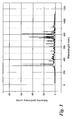
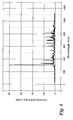
- a fluorescent lamp tube with associated electrodes was evacuated, and then filled with argon, nitrogen, and water vapor, each having an individual vapor pressure of about 2 torr (or 267 Pa), 0.2 torr (or 26.7 Pa), and 0.2 torr (or 26.7 Pa), respectively.
- An electrical discharge was established in the tube, and emission spectra were obtained at time 0, 5, 7, 9, 25, 30, and 35 minutes after an electrical potential of 200 V was applied to the electrodes.
- the emission spectra are shown in Figures 1-7. Strong emission is observed at wavelengths of about 306 nm and 336 nm, characteristic of emission from OH and NH radicals, respectively. Emission from these excited radicals continued well after the emission from high-energy argon had essentially stopped.
- Mercury-free fluorescent lamps using at least one of the excited radicals disclosed above as the source of exciting radiation for photoluminescent materials (or phosphors) can improve the energy efficiency of fluorescent lamps because the wavelength of exciting radiation is closer to the phosphor emission wavelength (smaller Stokes shift) than the wavelength of mercury vapor discharge.
- phosphors can be selected that strongly absorb exciting radiation from a particular high-energy radical, further increasing the lamp energy efficiency. Many such phosphors absorb strongly in the wavelength range from about 300 nm to about 410 nm, and thus have not been optimally used in conjunction with the mercury emission at 254 nm in conventional mercury discharge-based fluorescent lamps.
- Non-limiting examples of such phosphors are (1) the blue emitting phosphors (Sr,Ca) 10 (PO 4 ) 6 Cl 2 :Eu 2+ ; Sr 2 P 2 O 7 :Eu 2+ ; (Sr,Mg) 2 P 2 O 7 :Eu 2+ ; and Ba 0.07 Mg 2 Al z O 3/2z+3 :Eu 0.13 2+ , where 14 ⁇ z ⁇ 25; (2) the green emitting phosphors 2SrO ⁇ 0.84P 2 O 5 ⁇ 0.16B 2 O 3 :Eu 2+ ; Sr 2 Si 3 O 8 ⁇ 2SrCl 2 :Eu 2+ ; Sr 4 Al 4 O 25 :Eu 2+ ; and Ba 0.8 Mg 1.93 Al 16 O 27 :EU 0.2 2+ , Mn 2 + ; (3) the green-yellow emitting phosphor Y 2 SiO 5 :Ce 3+ ,Tb 3+ ; and (4) the red emit
- the construction of a mercury-free fluorescent lamp of the present invention is similar to that of a conventional fluorescent lamp.
- Figure 8 schematically shows such a lamp.
- An envelope 10 comprising an optically transparent material, such as glass, is provided with electrodes 20 and 30 comprising a material capable of emitting electrons, such as tungsten, and an end cap 25 at each end.
- the term "optically transparent" in this disclosure means allowing at least 80 percent of light having wavelengths in the range from about 400 nm to about 800 nm to pass through a specimen having a thickness of 1 mm at an incident angle of less than 10 degrees.
- Electrical leads 27 are connected to electrodes 20 and 30 to supply a voltage thereto.
- the tungsten electrode is typically coated with a mixture of alkaline earth oxides to enhance electron emission.
- a layer 50 of particles of at least a selected phosphor is deposited on the inner surface of the glass envelope to absorb the radiation emitted by the discharge.
- a layer 40 of scattering particles can be deposited between the inner wall of glass envelope 10 and phosphor layer 50 to enhance light extraction.
- Glass envelope 10 is evacuated and then charged with an inert gas, such as argon, at a pressure up to about 4000 Pa.
- an inert gas such as argon
- Other inert gases such as neon, krypton, and xenon, also may be used.
- one or more gases that are capable of generating at least one of the radicals disclosed above when such gases are bombarded by charged species of the discharge are disposed in the glass tube at a pressure up to about 2 torr (or 267 Pa). The tube is sealed and is then ready for use.
- the electrical discharge that provides charged species for generating excited mercury-free charged radicals of the present invention is generated by an induction coil at high frequency.
- the coil generates a high-frequency magnetic field, which produces a magnetically induced plasma discharge.
- Such a source of discharge has been put into practice in electrodeless discharge lamps.
- One or more of the materials, which are listed in Table 1 above, that can generate excited radical species when bombarded by other species of the plasma, which excited radical species emit EM radiation in the UV range upon returning to a less excited state, can be used as a component of the filling gas in such electrodeless lamps to practice the present invention.
- Frequencies in the range of greater than about 2 MHz, preferably greater than about 2.5 MHz, can be used to generate the magnetically induced plasma discharge.
Landscapes
- Luminescent Compositions (AREA)
- Vessels And Coating Films For Discharge Lamps (AREA)
Applications Claiming Priority (2)
| Application Number | Priority Date | Filing Date | Title |
|---|---|---|---|
| RU2004125185/09A RU2336592C2 (ru) | 2004-08-17 | 2004-08-17 | Газовые разряды, излучающие в ультрафиолетовом диапазоне, и люминесцентные лампы, содержащие такие газовые разряды |
| US11/077,567 US20060038496A1 (en) | 2004-08-17 | 2005-03-11 | Gas discharges having emission in UV-A range and fluorescent lamps incorporating same |
Publications (2)
| Publication Number | Publication Date |
|---|---|
| EP1659614A2 true EP1659614A2 (de) | 2006-05-24 |
| EP1659614A3 EP1659614A3 (de) | 2009-06-10 |
Family
ID=36087579
Family Applications (1)
| Application Number | Title | Priority Date | Filing Date |
|---|---|---|---|
| EP05255050A Withdrawn EP1659614A3 (de) | 2004-08-17 | 2005-08-16 | Gasentladung mit Emission im UV-A-Gebiet und Fluoreszenzlampe die diese Gasentladung enthält |
Country Status (1)
| Country | Link |
|---|---|
| EP (1) | EP1659614A3 (de) |
Citations (6)
| Publication number | Priority date | Publication date | Assignee | Title |
|---|---|---|---|---|
| US4262231A (en) | 1978-10-25 | 1981-04-14 | General Electric Company | Helical wire coil in solenoidal lamp tip-off region wetted by alloy forming an amalgam with mercury |
| US5952791A (en) | 1995-10-17 | 1999-09-14 | International Business Machines Corporation | Apparatus for detecting abnormal states in a discharge tube circuit and information processing system |
| US5959405A (en) | 1996-11-08 | 1999-09-28 | General Electric Company | Electrodeless fluorescent lamp |
| US6040658A (en) | 1995-08-01 | 2000-03-21 | Aktsionernoe Obschestvo Zakkytogo Tipa Nauchno-Tekhniches Koe Agentstvo "Intellekt" | Discharge lamp with HO radicals as radiating additives |
| US6051922A (en) | 1994-03-25 | 2000-04-18 | U.S. Philips Corporation | Electrodeless low-pressure mercury vapour discharge lamp employing a high frequency magnetic field having a layer of aluminum oxide particles |
| US6137236A (en) | 1997-12-03 | 2000-10-24 | U.S. Philips Corporation | Low-pressure discharge lamp and method of manufacturing a low-pressure discharge lamp |
Family Cites Families (2)
| Publication number | Priority date | Publication date | Assignee | Title |
|---|---|---|---|---|
| JP2002020745A (ja) * | 2000-07-13 | 2002-01-23 | Nec Kansai Ltd | 弗化物蛍光体及びこれを使用した蛍光ランプ |
| GB0105492D0 (en) * | 2001-03-06 | 2001-04-25 | Univ Sheffield | Discharge lamps using near-UV emitters |
-
2005
- 2005-08-16 EP EP05255050A patent/EP1659614A3/de not_active Withdrawn
Patent Citations (6)
| Publication number | Priority date | Publication date | Assignee | Title |
|---|---|---|---|---|
| US4262231A (en) | 1978-10-25 | 1981-04-14 | General Electric Company | Helical wire coil in solenoidal lamp tip-off region wetted by alloy forming an amalgam with mercury |
| US6051922A (en) | 1994-03-25 | 2000-04-18 | U.S. Philips Corporation | Electrodeless low-pressure mercury vapour discharge lamp employing a high frequency magnetic field having a layer of aluminum oxide particles |
| US6040658A (en) | 1995-08-01 | 2000-03-21 | Aktsionernoe Obschestvo Zakkytogo Tipa Nauchno-Tekhniches Koe Agentstvo "Intellekt" | Discharge lamp with HO radicals as radiating additives |
| US5952791A (en) | 1995-10-17 | 1999-09-14 | International Business Machines Corporation | Apparatus for detecting abnormal states in a discharge tube circuit and information processing system |
| US5959405A (en) | 1996-11-08 | 1999-09-28 | General Electric Company | Electrodeless fluorescent lamp |
| US6137236A (en) | 1997-12-03 | 2000-10-24 | U.S. Philips Corporation | Low-pressure discharge lamp and method of manufacturing a low-pressure discharge lamp |
Non-Patent Citations (1)
| Title |
|---|
| R.W.B. PEARSE; A.G. GAYDON: "THE IDENTIFICATION OF MOLECULAR SPECTRA", 1976, CHAPMAN AND HALL |
Also Published As
| Publication number | Publication date |
|---|---|
| EP1659614A3 (de) | 2009-06-10 |
Similar Documents
| Publication | Publication Date | Title |
|---|---|---|
| US6734631B2 (en) | Low-pressure gas discharge lamp with phosphor coating | |
| US8946993B2 (en) | Fluorescent excimer lamps | |
| KR100910442B1 (ko) | 녹색 형광체 및 이를 이용한 장치 | |
| US6628088B2 (en) | Plasma display panel using excimer gas | |
| US20110301672A1 (en) | Uv-emitting discharge lamp | |
| US7468145B2 (en) | Phosphor and treatment method for the same | |
| WO1989010046A1 (en) | Fluorescent light source based on a phosphor excited by a molecular discharge | |
| US7030549B2 (en) | Display device having reduced color shift during life | |
| US7884535B2 (en) | Low-pressure gas discharge lamp comprising a UV-B phosphor | |
| US20060038496A1 (en) | Gas discharges having emission in UV-A range and fluorescent lamps incorporating same | |
| US20080042577A1 (en) | Mercury-free compositions and radiation sources incorporating same | |
| US6940216B2 (en) | Gas discharge lamp for dielectrically impeded discharges comprising a blue phosphor | |
| EP0331738B1 (de) | Grünlichtausstrahlende entladungsbirne mit seltenem gas | |
| KR20000035222A (ko) | 산화물을 함유하는 발광 물질 조성물을 가지는 발광 스크린 | |
| US7847484B2 (en) | Mercury-free and sodium-free compositions and radiation source incorporating same | |
| JP2005535102A (ja) | 改善された演色性を有する誘電体バリア放電ランプ | |
| US8415869B1 (en) | Fluorescent lamp with underlying yttrium vanadate phosphor layer and protective phosphor layer | |
| US4099089A (en) | Fluorescent lamp utilizing terbium-activated rare earth oxyhalide phosphor material | |
| US6777867B2 (en) | Highly loaded fluorescent lamp | |
| EP4125112A1 (de) | Quecksilberfreie kaltkathodenlampe, die innen mit einer lumineszierenden, nach unten gerichteten schicht beschichtet ist | |
| US20060033070A1 (en) | Quantum-splitting fluoride-based phosphors, method of producing, and devices incorporating the same | |
| WO2002071440A1 (en) | Discharge lamps using near-uv emitters | |
| JP2010192259A (ja) | 無電極放電灯 | |
| Mayr | J uestel et al. | |
| WO2007080649A1 (ja) | 緑色蛍光体及びプラズマディスプレイパネル |
Legal Events
| Date | Code | Title | Description |
|---|---|---|---|
| PUAI | Public reference made under article 153(3) epc to a published international application that has entered the european phase |
Free format text: ORIGINAL CODE: 0009012 |
|
| AK | Designated contracting states |
Kind code of ref document: A2 Designated state(s): AT BE BG CH CY CZ DE DK EE ES FI FR GB GR HU IE IS IT LI LT LU LV MC NL PL PT RO SE SI SK TR |
|
| AX | Request for extension of the european patent |
Extension state: AL BA HR MK YU |
|
| PUAL | Search report despatched |
Free format text: ORIGINAL CODE: 0009013 |
|
| AK | Designated contracting states |
Kind code of ref document: A3 Designated state(s): AT BE BG CH CY CZ DE DK EE ES FI FR GB GR HU IE IS IT LI LT LU LV MC NL PL PT RO SE SI SK TR |
|
| AX | Request for extension of the european patent |
Extension state: AL BA HR MK YU |
|
| AKX | Designation fees paid | ||
| REG | Reference to a national code |
Ref country code: DE Ref legal event code: 8566 |
|
| STAA | Information on the status of an ep patent application or granted ep patent |
Free format text: STATUS: THE APPLICATION IS DEEMED TO BE WITHDRAWN |
|
| 18D | Application deemed to be withdrawn |
Effective date: 20091211 |