EP1660414B1 - Matériau d'isolation thermique et phonique à faible taineur en liant - Google Patents
Matériau d'isolation thermique et phonique à faible taineur en liant Download PDFInfo
- Publication number
- EP1660414B1 EP1660414B1 EP04786234.7A EP04786234A EP1660414B1 EP 1660414 B1 EP1660414 B1 EP 1660414B1 EP 04786234 A EP04786234 A EP 04786234A EP 1660414 B1 EP1660414 B1 EP 1660414B1
- Authority
- EP
- European Patent Office
- Prior art keywords
- cement
- insulating composition
- composition according
- water
- water retention
- Prior art date
- Legal status (The legal status is an assumption and is not a legal conclusion. Google has not performed a legal analysis and makes no representation as to the accuracy of the status listed.)
- Expired - Lifetime
Links
Images
Classifications
-
- C—CHEMISTRY; METALLURGY
- C04—CEMENTS; CONCRETE; ARTIFICIAL STONE; CERAMICS; REFRACTORIES
- C04B—LIME, MAGNESIA; SLAG; CEMENTS; COMPOSITIONS THEREOF, e.g. MORTARS, CONCRETE OR LIKE BUILDING MATERIALS; ARTIFICIAL STONE; CERAMICS; REFRACTORIES; TREATMENT OF NATURAL STONE
- C04B28/00—Compositions of mortars, concrete or artificial stone, containing inorganic binders or the reaction product of an inorganic and an organic binder, e.g. polycarboxylate cements
- C04B28/02—Compositions of mortars, concrete or artificial stone, containing inorganic binders or the reaction product of an inorganic and an organic binder, e.g. polycarboxylate cements containing hydraulic cements other than calcium sulfates
- C04B28/06—Aluminous cements
- C04B28/065—Calcium aluminosulfate cements, e.g. cements hydrating into ettringite
-
- C—CHEMISTRY; METALLURGY
- C04—CEMENTS; CONCRETE; ARTIFICIAL STONE; CERAMICS; REFRACTORIES
- C04B—LIME, MAGNESIA; SLAG; CEMENTS; COMPOSITIONS THEREOF, e.g. MORTARS, CONCRETE OR LIKE BUILDING MATERIALS; ARTIFICIAL STONE; CERAMICS; REFRACTORIES; TREATMENT OF NATURAL STONE
- C04B28/00—Compositions of mortars, concrete or artificial stone, containing inorganic binders or the reaction product of an inorganic and an organic binder, e.g. polycarboxylate cements
- C04B28/02—Compositions of mortars, concrete or artificial stone, containing inorganic binders or the reaction product of an inorganic and an organic binder, e.g. polycarboxylate cements containing hydraulic cements other than calcium sulfates
-
- C—CHEMISTRY; METALLURGY
- C04—CEMENTS; CONCRETE; ARTIFICIAL STONE; CERAMICS; REFRACTORIES
- C04B—LIME, MAGNESIA; SLAG; CEMENTS; COMPOSITIONS THEREOF, e.g. MORTARS, CONCRETE OR LIKE BUILDING MATERIALS; ARTIFICIAL STONE; CERAMICS; REFRACTORIES; TREATMENT OF NATURAL STONE
- C04B28/00—Compositions of mortars, concrete or artificial stone, containing inorganic binders or the reaction product of an inorganic and an organic binder, e.g. polycarboxylate cements
- C04B28/02—Compositions of mortars, concrete or artificial stone, containing inorganic binders or the reaction product of an inorganic and an organic binder, e.g. polycarboxylate cements containing hydraulic cements other than calcium sulfates
- C04B28/06—Aluminous cements
-
- C—CHEMISTRY; METALLURGY
- C04—CEMENTS; CONCRETE; ARTIFICIAL STONE; CERAMICS; REFRACTORIES
- C04B—LIME, MAGNESIA; SLAG; CEMENTS; COMPOSITIONS THEREOF, e.g. MORTARS, CONCRETE OR LIKE BUILDING MATERIALS; ARTIFICIAL STONE; CERAMICS; REFRACTORIES; TREATMENT OF NATURAL STONE
- C04B2111/00—Mortars, concrete or artificial stone or mixtures to prepare them, characterised by specific function, property or use
- C04B2111/20—Resistance against chemical, physical or biological attack
- C04B2111/28—Fire resistance, i.e. materials resistant to accidental fires or high temperatures
-
- C—CHEMISTRY; METALLURGY
- C04—CEMENTS; CONCRETE; ARTIFICIAL STONE; CERAMICS; REFRACTORIES
- C04B—LIME, MAGNESIA; SLAG; CEMENTS; COMPOSITIONS THEREOF, e.g. MORTARS, CONCRETE OR LIKE BUILDING MATERIALS; ARTIFICIAL STONE; CERAMICS; REFRACTORIES; TREATMENT OF NATURAL STONE
- C04B2111/00—Mortars, concrete or artificial stone or mixtures to prepare them, characterised by specific function, property or use
- C04B2111/52—Sound-insulating materials
-
- C—CHEMISTRY; METALLURGY
- C04—CEMENTS; CONCRETE; ARTIFICIAL STONE; CERAMICS; REFRACTORIES
- C04B—LIME, MAGNESIA; SLAG; CEMENTS; COMPOSITIONS THEREOF, e.g. MORTARS, CONCRETE OR LIKE BUILDING MATERIALS; ARTIFICIAL STONE; CERAMICS; REFRACTORIES; TREATMENT OF NATURAL STONE
- C04B2111/00—Mortars, concrete or artificial stone or mixtures to prepare them, characterised by specific function, property or use
- C04B2111/60—Flooring materials
Definitions
- the invention relates to insulating materials for thermal and impact sound insulation, which are formulated on the basis of foam granules and cementitious binders.
- foams have good insulating properties. Widely used are foams based on polystyrene or polyurethane, as well as rockwool or mineral wool slabs. Usually, these boards are then covered with a cover layer, for example, earth-moist processed undercoat mortar, or concrete (called “screed”) or flow screeds or slab constructions (wood, etc.), as a support layer.
- the substructure under these base courses therefore consists mainly at the moment of two separate parts to be processed. First, a bed of, for example, chippings (bound or unbound) is introduced as level compensation, then plates are laid very costly by cutting.
- EP 0 819 662 describes an insulating material for heat and impact sound insulation of a floor, in addition to a foam granules and a cementitious binder, a proportion of amorphous silica of at least 10 wt .-%, based on the cement. The mode of action is explained here by the pozzolanic effect of the silica used.
- the thermal conductivity [W / mK] and on the other hand the impact sound reduction [dB] or, with that, the dynamic stiffness [MN / m 3 ] are determined.
- Bonded granular beds according to the prior art typically have thermal conductivities of greater than 0.044 W / mK and dynamic stiffness of about 20 MN / m 3 after loading.
- Object of the present invention was to develop insulating materials based on a cementitious binder, which have the lowest possible proportion of cement and still have a high intrinsic strength and excellent thermal and impact sound insulation after curing with water, especially after mechanical stress.
- an insulating composition which, in addition to a polymeric closed cell foam granule and a cementitious binder, additionally comprises at least one water retention agent and at least one dispersion plastic.
- inventive cured insulating composition is highly elasticized compared to the prior art, which manifests itself in an increased restoring behavior, since the bonds between the foam balls no longer break under normal load.
- the increase in the elasticity of the cured insulation is accompanied by excellent insulation properties against heat or impact sound energy.
- When loading such an elasticized insulating material as done for example by committing a screed floor, remain - despite a greatly reduced proportion of cement - the binding forces within the insulating material obtained significantly longer.
- the present invention relates to an insulation composition for impact sound insulation, comprising a polymeric closed-cell foam granules, a cementitious binder and at least one water retention agent and at least one dispersion plastic.
- the insulation composition contains a cementitious binder which contains at least one cement, in particular at least one cement according to Euronorm EN 197.
- Portland cements, sulfoaluminate cements and high-alumina cements, in particular Portland cement, are preferred. Cements of cements can lead to particularly good properties.
- Particularly suitable are mixtures of at least one Portland cement with at least one Sulfoaluminatzement or at least one Tonerdeschmelzzement.
- cementitious rapid binder preferably at least one alumina cement or other aluminate source, such as aluminate clinker, and optionally calcium sulfate, in the form of anhydrite, hemihydrate or dihydrate gypsum; and / or calcium hydroxide.
- alumina cement or other aluminate source such as aluminate clinker
- calcium sulfate in the form of anhydrite, hemihydrate or dihydrate gypsum
- the proportion of the cement is limited upwards with 100 kg / m 3 of the water-applied insulating material composition.
- the cementitious binder may further contain ingredients selected from the group of gypsum and calcium hydroxide.
- the insulation composition further contains a polymeric closed-cell foam granules.
- This foam granules points preferably a bulk density between 10 and 20 kg / m 3 , in particular between 12 and 18 kg / m 3 .
- the foam granules are used such that the ratio of the foam granules to cement between 20 wt .-% and 120 wt .-% is.
- this ratio is between 30 wt .-% and 100 wt .-%, in particular between 50 wt .-% and 75 wt .-%.
- Particularly preferred is a ratio of 60 to 75 wt .-%.
- the foam granules used always have a certain particle size distribution.
- the particle size is between 0 and 8 mm.
- the proportion below 1 mm is preferably less than 10% by weight and the proportion above 2 mm is more than 75% by weight, since the binder requirement is additionally increased by smaller particles.
- a cellulose filter paper (Schleicher & Schuell, D-37582 Dassel, No. 2294 0 11 cm) is then placed on a flat glass plate, then a thin cellulose fleece (Schleicher & Schuell, D-37582 Dassel, No. 0980/1 ⁇ 11 cm). placed on it and put a plastic ring (inside diameter 90 mm and height 15 mm).
- the dosage of the substance to be tested for this test must be between 0.4% and 5% by weight for an organic water retention agent and between 12% and 15% for an inorganic water retention agent.
- the dosage is between 0.4% and 5% by weight for the organic water retention agent and between 12% and 15% for the inorganic water retention agent.
- the water retention agent may be an organic or an inorganic compound.
- Inorganic water retention agents can typically be found in the multilayer silicates such as bentonite, smectite, montomorillonite, or even in calcined kaolins, in particular metakaolin. Metakaolin has proven to be a particularly suitable inorganic water retention agent.
- Organic water retention agents are typically present in cellulose ethers, methylcelluloses, hydroxypropylmethylcelluloses, Hydroxyethylcellulosen, carboxymethylcelluloses, and other cellulose derivatives, starch ethers, welan gum or synthetic thickeners such as polyacrylic acid or PU acrylates find. Hydroxyalkylmethylcelluloses, in particular hydroxypropylmethylcelluloses and hydroxyethylmethylcelluloses, have proven to be particularly suitable.
- the weight fraction of the sum of all water retention agents used depends strongly on the desired insulating and mechanical properties of the cured insulation composition and the water retention agent used, and typically ranges between 0.1 and 25% by weight, based on the cement.
- Inorganic water retention agents are advantageously used in a concentration of between 0.2 and 25% by weight, preferably between 0.5 and 9% by weight, in particular between 0.5 and 3% by weight, based on the cement.
- Organic water retention agents are advantageously used in a concentration of between 0.1 and 9% by weight, preferably between 0.5 and 5% by weight, in particular between 1 and 4% by weight, based on the cement.
- organic water retention agents are particularly preferred.
- the insulating composition further contains at least one dispersion plastic.
- a dispersion plastic is understood throughout the present specification to mean an organic copolymer which is present in an aqueous dispersion or as a redispersible powder, for example obtained by spray-drying a dispersion. Such powders are also known to the skilled person as plastic dispersion powders.
- This copolymer is in particular a copolymer of at least two, preferably of two, different ethylenically unsaturated monomers, of which at least one comonomer, preferably all comonomers, are selected from the group comprising ethylene, butadiene, methacrylic acid, acrylic acid, methacrylic acid esters, acrylic acid esters , Styrene, vinyl acetate and acrylonitrile.
- the copolymers acrylic acid / styrene, methacrylic acid / styrene, styrene / butadiene and vinyl acetate / ethylene have been shown to be suitable. However, under certain circumstances, it is advantageous to use vinyl acetate-free polymers.
- acrylic acid / styrene and methacrylic acid / styrene copolymers are particularly preferred.
- copolymers are prepared by the usual polymerization processes known to those skilled in the art.
- the dispersion plastic typically has a molecular weight in the range between 30,000 and 10,000,000 g / mol, in particular between 100,000 and 5,000,000 g / mol. Particular preference is given to molecular weights of between 200,000 and 2,000,000 g / mol.
- the particles of the dispersion plastic are in a finely divided aqueous plastic dispersion advantageously between 0.04 to 0.5 .mu.m, in particular between 0.1 to 0.2 .mu.m, or in a coarsely dispersed aqueous dispersion advantageously between 2 to 5 .mu.m, and as Kunststoffoffdispersionspulver 0.5 to 10 microns after redispersion.
- the dispersion plastic is used in a proportion of 2 to 15 wt .-% solids based on the cement. Particularly preferred are amounts of the dispersion plastic between 5 and 15 wt .-%.
- the insulation composition additionally comprises at least one filler which is not a closed-cell foam granule, cement-free binder, water retention agent and dispersion polymer and whose average particle size is chosen such that the ratio of the mean particle size of the filler to the mean particle size of the closed-cell foam granules is less than 1, especially between 0.01 and 0.5, in particular between 0.02 and 0.25.
- Such fillers may be elastic or rigid. However, preferred are elastic fillers. For example, as rigid fillers Glass balls, glass bubbles, blown glass balls, sand, quartz powder into consideration. As elastic fillers are in particular rubber or rubber, preferably in granular or powder form, into consideration.
- fillers are particularly advantageous when an insulating material with a low content of cementitious binder, typically in the range of between 15 and 30 kg per m 3 of the composition, is to be achieved.
- the insulating composition may contain special solid particles such as mica platelets, recycled scraped granules, water-absorbent plastic fibers, hydrophobic plastic particles such as shreds of Polyethylene or polypropylene films.
- special solid particles such as mica platelets, recycled scraped granules, water-absorbent plastic fibers, hydrophobic plastic particles such as shreds of Polyethylene or polypropylene films.
- the insulation composition may further contain other ingredients.
- Such constituents are, for example, pigments, flame retardants, UV stabilizers, complexing agents, hardening and / or setting accelerators, film-forming aids, hardening and / or setting retarders, corrosion inhibitors, water repellents, air entraining agents, defoamers, dyes, surfactants, odorous substances or biocides.
- the insulation composition is free of amorphous silica.
- One skilled in the art can use his expertise in granulometry to optimize the insulation composition to the particle size of the individual components.
- dispersion plastic both as a powder or as an aqueous dispersion
- insulating materials with higher mechanical values under load can be achieved.
- this required on the one hand, a very high use of dispersion plastics, typically from 30 to 200% by weight of dispersion plastic, based on the cement content.
- these cured bodies did not show any appreciable reduction in dynamic stiffness after curing, ie values below 25 MN / m 3 , and no marked improvement in the insulating properties was achieved.
- These high dynamic stiffnesses are explained by very strong bonds between the granules, with simultaneous stiffening of the normally elastic grains by the thick, solid binder layer around the grains.
- An insulating material based on the technology of the prior art has - especially at lower cement content - a significantly poorer composite in the cured insulation, which means that when its loads, such as those caused by a walk, break the bonds between the granules and in Large quantities of foam granulate particles break out, and consequently the insulating material "crumbles".
- the beneficial effect of the water retention agent is explained by the fact that in the insulating materials of the prior art, the water used, which is required for the hydraulic curing of the cement, is usually absorbed by the foam to a considerable extent, so that on the surface of the cement hardening is disturbed , and therefore on the foam surface no proper bond is formed. This is all the more pronounced the smaller the proportion of the cement based on the foam and the smaller the amount of mixing water. By using water retention agents this is prevented and the cement forms an excellent bond after curing with the foam surface, even if the proportion of the cement compared to the foam is small. It has been shown that instead of water retention agents only more water is used, that is, by increasing the w / c, the problem can not be solved satisfactorily, because it massively retards the curing and leads to poor mechanical properties.
- the mode of action of the dispersion plastic is explained by the fact that the dispersion plastic particles substantially improve the adhesive strength of the hardened, rigid cement binder to the elastic polymer foam granules particles.
- a microscope analysis has shown that the binder layer, which is only about 20-30 ⁇ m thick, is present on the granules itself Upset the elastic balls to a fraction of the original thickness does not peel off.
- insulating compositions which have a very fast strength build-up and drying times, so that, for example, a Dämm passingung made from it can be committed after one to two days. Especially in these cases, the already mentioned cementitious quick binders are used.
- the amount of cement paste which solidifies the foam granule particles is reduced so that the layers of the cement paste become very thin and hence the composite becomes relatively brittle.
- Even a relatively small addition of a polymeric dispersion plastic in amounts of, for example, 3 to 15%, based on the cementitious binder leads to a sufficient solidification of the bonds between the foam granules. If such a cementitious binder composition is merely mixed with water, that is to say in the absence of the foam granules, a rigid concrete-like mortar results. Such a mortar is the more rigid the less plastic dispersion it contains.
- the insulation composition is mixed with water used.
- the amount of water used depends heavily on the amount of cement.
- the water / cement ratio may differ from that which the cement or concrete technologist usually applies.
- the water / cement ratio is typically in the range of 0.7 to 3, in particular in the range of 0.7 to 2.5, preferably in the range of 1.1 to 2.5.
- the insulation composition can be prepared immediately prior to use of the individual components or semi-finished products or It can be manufactured industrially and / or mixed transported to the location of the application.
- the water is mixed with it immediately before application to Dämmstoffzusammen für or mixing the individual components thereof.
- the cementitious binder is mixed with the water retention agent together with the majority, typically about 90%, of the foam granules.
- the water, then the dispersion plastic and then the rest of the foam granules are then added first.
- a plastic dispersion it can be pre-mixed with the water and thus added simultaneously with the water.
- a plastic dispersion powder it can also be mixed with the cementitious binder, the water retention agent and the foam granules before the addition of water. It may prove to be advantageous if the water and the plastic dispersion are added not in one shot but in portions with stirring.
- foam granules are introduced, then the water, then the water retention agent, then the cementitious binder and then the dispersion plastic, optionally mixed in the form of a dispersion.
- the cementitious binder is premixed with the water retention agent and the dispersion plastic, then the binder is mixed with the water and finally the foam granules are added. It may also be advantageous here if the components are not added at one go, but in portions with stirring.
- a further preferred variant of the preparation consists in first admixing the cementitious binder with which water retention agents are mixed, part of the water and then this premix to the foam granules in at least two stages with metered addition of the water.
- the mixing vessel is first with about three quarters the total amount of foam granules is charged before the premixed binder content is added with the metered mixing water. Subsequently, or mixed with the mixing water, the dispersion plastic is added. The remaining foam granules are then filled during the mixing process.
- foam granules are mixed with the cementitious binder, water retention agents and the dispersion plastic, and then the water is mixed.
- the mixing process is advantageously carried out in a mixing tank designed for compressed air delivery of the mixed material. After the mixing process, the mixture can then be discharged by means of compressed air and transported via a hose to the place of introduction.
- Another possibility for the production consists in the fact that the individual components in the correct ratio continuously metered and continuously mixed and conveyed in a short mixing section.
- the insulation composition is placed between two different temperature materials and has the function of preventing the heat energy transfer between them. It is clear that therefore this insulation composition can be used on the one hand for thermal insulation or even for cold insulation.
- thermal insulation it is important to acoustically decouple the surface, which is typically arranged substantially horizontally, on which the steps are made, or a structure directly connected thereto, from the rest of the building structure by attaching an insulation composition therebetween.
- the insulation compositions described have excellent insulating properties even in small layer thicknesses of a few centimeters.
- the insulation composition is used in particular in the production of screed floor. In addition, however, it can also be used as backfilling of cavities which pass through substantially vertically arranged surfaces are limited, can be used. An example of such an application is the isolation between two walls.
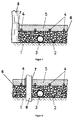
- a screed floor construction is typically as in FIG. 1 and FIG. 2 shown schematically.
- the mixed with water insulation composition 2 is applied in a conventional layer thickness between 7 and 10 cm. If necessary, installation tubes 3 are present in this layer. If such pipes are present, care must be taken to ensure that they are well wrapped by the insulation composition 2 so that no bridges for sound or heat energy can form.
- a thin release film 6, usually made of polyethylene, and, if appropriate, underfloor heating pipes 4 may optionally be laid. Subsequently, a cement screed 5 is applied.
- the insulating layer also has the function of a leveling layer to compensate for unevenness in the floor and facilitates the installation of ducting and installation pipes. This is particularly important in renovation work, where for the insertion of the pipes and pipes of consuming and - especially in a concrete floor troublesome step of Aufspitzens or milled along the floor.
- the greatly reduced weight compared to a conventional leveling ground, makes it possible to efficiently block even soils with a small load-bearing capacity.
- the inventive insulating composition hardens with water to a mass in which the foam granules are connected to each other by the cement matrix.
- the layer thickness of the cement is small and is typically less than 0.1 mm.
- the largest possible proportion of foam granules should be sought as acceptable from the inherent strength of the cured insulation composition.
- the insulation composition according to the invention After curing with water, the insulation composition according to the invention has surprisingly good thermal and impact sound insulation properties. Thermal insulation properties can be achieved below 0.045 W / mK. Dynamic stiffnesses of less than 20 MN / m 3 , in particular lower than 10 MN / m 3 can be achieved. Experience has shown that such values lead to an impact sound reduction of more than 30 dB.
- the insulating materials are already resilient after a short time.
- the strength structure with cementitious rapid binder is such that they can be walked on after just one to two days.
- the cured insulation materials are characterized essentially by the fact that they are less destroyed by a mechanical load, or not remain highly compressed, but have a high recovery behavior. This ensures that the dynamic stiffness and thus the impact sound insulation remains essentially unchanged after a mechanical load. This statement also applies accordingly to the thermal insulation.
- this restoring behavior is influenced by the speed and the extent of the mechanical stress.
- the restoring behavior is therefore preferably optimized for the areas of the loads that occur when laying a screed floor.
- the novel ( B1, B2 ) and comparative ( Ref.1 to Ref. 4) compositions according to Table 3 were prepared.
- the amounts of the water-mixed insulation compositions given there are based on kg / m 3 of the uncured wet mix.
- the blends were prepared in a 10L Hobart mixer as follows. Recycled polystyrene granules (0-8 mm, bulk density 15 kg / m 3 ) and the cementitious binder with at most water retention agent and dispersion plastic was introduced and then add the water during mixing. The mixture was mixed for 5 minutes, allowed to rest for 10 minutes and then filled into 20 x 20 x 8 cm molds under light compression. All samples were slightly compacted, corresponding to 15 kg Polystyrene granules per m 3 of bed. In each case 3 specimens of the above dimensions were prepared and allowed to harden for 28 days.
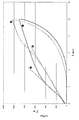
- the modulus of elasticity [N / mm 2 ] was calculated from the slope of the curve applied to the curve Equalization line determined by multiplying by the thickness (80mm) and dividing by the area (200mm * 200mm) of the specimen, as indicated in the measurement diagram in FIG. 3 for B2, for example. So the first equalizer line ( ) for the first compression ( ) and the second equalizer line ( ) for the second compression ( ). In this force ( f ) path ( f ) diagram, the first compression with ( ) and the second compression with ( ) designated. For a better comparison, Table 4 also shows the percentage increase relative to the respective reference containing neither water retention agent nor dispersion vehicle.
- the dispersion-only sample ( ref 5) showed a marked decrease in the modulus of elasticity at the second loading, indicating the destruction of the bonds by the first load. This is not the case with sample B2 and shows that the bonds are not destroyed or massively less destroyed.
- compositions according to the invention mechanically resilient insulating materials are obtainable which have an extremely high polystyrene / cement ratio and thus extremely high insulating properties, such as are not achievable with the cementitious systems according to the prior art.
- Table 5 shows that increasing the dispersion plastic content in the composition does not result in a reduction in dynamic stiffness, that is, in an improvement in the insulating property, but in an increase in dynamic stiffness. Table 5. Insulation compositions mixed with water and results. B3 Ref. 7 Ref.
Landscapes
- Chemical & Material Sciences (AREA)
- Engineering & Computer Science (AREA)
- Ceramic Engineering (AREA)
- Chemical Kinetics & Catalysis (AREA)
- Inorganic Chemistry (AREA)
- Materials Engineering (AREA)
- Structural Engineering (AREA)
- Organic Chemistry (AREA)
- Curing Cements, Concrete, And Artificial Stone (AREA)
- Road Paving Structures (AREA)
Claims (22)
- Composition isolante pour l'insonorisation et l'isolation thermique, comprenant un granulé de polymère de mousse à cellules fermées et un promoteur d'adhérence de ciment, caractérisée en ce que la composition isolante comprend au moins un agent de rétention d'eau et au moins un plastique de dispersion, la fraction de ciment se situe en-dessous de 100 kg/m3 de la composition isolante préparée avec de l'eau, la quantité du plastique de dispersion est de 2 à 15 % en poids de la masse sèche par rapport au ciment, et la composition isolante est exempte d'acide silicique amorphe.
- Composition isolante selon la revendication 1, caractérisée en ce que la fraction en poids de la somme de tous les agents de rétention d'eau, par rapport au ciment, se situe entre 0,1 % en poids et 25 % en poids.
- Composition isolante selon la revendication 1 ou 2, caractérisée en ce que l'agent de rétention d'eau est un composé organique et la fraction en poids de la somme de tous les agents de rétention d'eau organiques se situe entre 0,1 et 9 % en poids, de préférence entre 0,5 et 5 % en poids, en particulier entre 0,7 et 4 % en poids, par rapport au ciment.
- Composition isolante selon l'une des revendications 1 à 3, caractérisée en ce que l'agent de rétention d'eau est un éther d'amidon, un dérivé de cellulose, une gomme welan ou un épaississant synthétique, en particulier un hydroxyalkylméthyle cellulose, de préférence un hydroxypropylméthyle cellulose ou un hydroxyéthylméthyle cellulose.
- Composition isolante selon la revendication 1 ou 2, caractérisée en ce que l'agent de rétention d'eau est un composé inorganique et la fraction en poids de la somme de tous les agents de rétention d'eau inorganiques se situe entre 0,2 et 25 % en poids, en particulier entre 0,5 et 9 % en poids, par rapport au ciment.
- Composition isolante selon la revendication 5, caractérisée en ce que l'agent de rétention d'eau est un phyllosilicate ou un kaolin calciné, de préférence un métakaolin.
- Composition isolante selon l'une des revendications précédentes, caractérisée en ce que le rapport du granulé de mousse par rapport au ciment se situe entre 20 % en poids et 120 % en poids, de préférence entre 30 % en poids et 100 % en poids, en particulier entre 50 % en poids et 75 % en poids, en particulier de préférence entre 60 % en poids et 75 % en poids.
- Composition isolante selon l'une des revendications précédentes, caractérisée en ce que le plastique de dispersion est un copolymère d'au moins deux monomères d'éthylène insaturés, en particulier choisis dans le groupe constitué d'éthylène, de butadiène, d'acide méthacrylique, d'acide acrylique, d'esters d'acide méthacrylique, d'esters d'acide acrylique, de styrène, d'acétate de vinyle et d'acrylonitrile.
- Composition isolante selon la revendication 8, caractérisée en ce que le plastique de dispersion est un copolymère d'acide acrylique et de styrène, ou d'acide méthacrylique et de styrène, ou d'acétate de vinyle et d'éthylène, en particulier un copolymère d'acide acrylique et de styrène ou d'acide méthacrylique et de styrène.
- Composition isolante selon l'une des revendications précédentes, caractérisée en ce que le plastique de dispersion a un poids moléculaire situé entre 30 000 et 10 000 000 g/mol, en particulier entre 100 000 et 5 000 000 g/mol, de préférence entre 200 000 et 2 000 000 g/mol.
- Composition isolante selon l'une des revendications précédentes, caractérisée en ce que le promoteur d'adhérence de ciment contient au moins un ciment Portland.
- Composition isolante selon la revendication 11, caractérisée en ce que le promoteur d'adhérence de ciment contient, en plus d'au moins un ciment Portland, également au moins un ciment de sulfoaluminate ou au moins un ciment d'aluminate de calcium.
- Composition isolante selon l'une des revendications précédentes, caractérisée en ce que le promoteur d'adhérence de ciment contient au moins un ciment d'aluminate de calcium ou une autre source d'aluminate et éventuellement du sulfate de calcium, sous la forme d'anhydrite, de gypse semi-hydraté ou dihydraté, et/ou d'hydroxyde de calcium.
- Composition isolante selon l'une des revendications précédentes, caractérisée en ce que le granulé de polymère de mousse à cellules fermées est un granulé de polystyrène.
- Composition isolante selon l'une des revendications précédentes, caractérisée en ce que le granulé de polymère de mousse à cellules fermées a une densité en vrac entre 10 et 20 kg/m3, en particulier entre 12 et 18 kg/m3.
- Composition isolante selon l'une des revendications précédentes, caractérisée en ce que la composition [contient] en outre au moins une charge supplémentaire, qui n'est pas un granulé de mousse à cellules fermées, ni un promoteur d'adhérence de ciment, ni un agent de rétention d'eau et ni un plastique de dispersion, et dont la taille moyenne de particule est choisie de sorte à ce que le rapport de la taille de particule moyenne de la charge à la taille de particule moyenne du granulé de mousse à cellules fermées soit inférieur à 1, en particulier entre 0,02 et 0,25.
- Composition isolante selon la revendication 16, caractérisée en ce que la charge est une charge élastique, en particulier un caoutchouc synthétique ou naturel.
- Isolant, caractérisé en ce qu'il est obtenu à partir d'une composition isolante selon l'une des revendications 1 à 17 et de l'eau dans une quantité correspondant à un rapport eau/ciment de 0,7 à 3, en particulier 0,7 à 2,5, de préférence 1,1 à 2,5.
- Procédé de durcissement d'une composition isolante selon l'une des revendications 1 à 17, caractérisé en ce qu'il comprend une étape consistant à ajouter de l'eau pour le mélange et le durcissement.
- Procédé selon la revendication 19, caractérisé en ce que la quantité totale est obtenue correspondant à un rapport eau/ciment de 0,7 à 3, en particulier 0,7 à 2,5, de préférence 1,1 à 2,5.
- Utilisation d'une composition isolante selon l'une des revendications 1 à 17, caractérisée en ce que la composition isolante, avoir été mélangée à de l'eau, est appliquée sur un sol et durcie.
- Utilisation d'une composition isolante selon l'une des revendications 1 à 17 dans une chape supérieure.
Priority Applications (1)
| Application Number | Priority Date | Filing Date | Title |
|---|---|---|---|
| EP04786234.7A EP1660414B1 (fr) | 2003-08-26 | 2004-08-26 | Matériau d'isolation thermique et phonique à faible taineur en liant |
Applications Claiming Priority (3)
| Application Number | Priority Date | Filing Date | Title |
|---|---|---|---|
| EP03019269A EP1510508A1 (fr) | 2003-08-26 | 2003-08-26 | Matériau d isolation thermique et phonique à faible taineur en liant |
| PCT/EP2004/051913 WO2005021460A2 (fr) | 2003-08-26 | 2004-08-26 | Materiau calorifuge et amortissant les bruits de pas presentant de faibles teneurs en liants |
| EP04786234.7A EP1660414B1 (fr) | 2003-08-26 | 2004-08-26 | Matériau d'isolation thermique et phonique à faible taineur en liant |
Publications (2)
| Publication Number | Publication Date |
|---|---|
| EP1660414A2 EP1660414A2 (fr) | 2006-05-31 |
| EP1660414B1 true EP1660414B1 (fr) | 2015-04-15 |
Family
ID=34089611
Family Applications (2)
| Application Number | Title | Priority Date | Filing Date |
|---|---|---|---|
| EP03019269A Withdrawn EP1510508A1 (fr) | 2003-08-26 | 2003-08-26 | Matériau d isolation thermique et phonique à faible taineur en liant |
| EP04786234.7A Expired - Lifetime EP1660414B1 (fr) | 2003-08-26 | 2004-08-26 | Matériau d'isolation thermique et phonique à faible taineur en liant |
Family Applications Before (1)
| Application Number | Title | Priority Date | Filing Date |
|---|---|---|---|
| EP03019269A Withdrawn EP1510508A1 (fr) | 2003-08-26 | 2003-08-26 | Matériau d isolation thermique et phonique à faible taineur en liant |
Country Status (2)
| Country | Link |
|---|---|
| EP (2) | EP1510508A1 (fr) |
| WO (1) | WO2005021460A2 (fr) |
Families Citing this family (7)
| Publication number | Priority date | Publication date | Assignee | Title |
|---|---|---|---|---|
| DE102004043837A1 (de) * | 2004-09-08 | 2006-03-30 | Basf Ag | Wärme- und schalldämmende Bodenausgleichsschüttung |
| AU2005306588B2 (en) * | 2004-11-22 | 2010-12-23 | Acoustic Space Pty Limited | Composition for sound insulating sheet material with gelatine, glycerine and other materials |
| EP2014625A1 (fr) * | 2007-07-03 | 2009-01-14 | Sika Technology AG | Matière isolant de chaleur et des bruits de chocs à faible teneur en liant hydraulique et à teneur élevée en polystyrène expansée |
| CA2781692A1 (fr) * | 2009-11-25 | 2011-06-03 | Lasso Financial Ltd. | Beton thermiquement isolant, resistant au feu et a l'eau, permeable a l'air, flexible et leger |
| CN102653973A (zh) * | 2011-03-04 | 2012-09-05 | 安徽先飞新型建材有限公司 | 一种具有保温隔热功能的低吸水率免烧结外墙饰面砖 |
| CN106003885B (zh) * | 2016-04-22 | 2018-08-10 | 苏州宏久航空防热材料科技有限公司 | 一种具有泡沫-粉末夹芯结构的高温隔热复合材料 |
| BE1028231B1 (nl) * | 2020-10-21 | 2021-11-23 | Aerobel Bv | Samenstelling van een isolatiemateriaal en een vast isolatiemateriaal op zich |
Family Cites Families (8)
| Publication number | Priority date | Publication date | Assignee | Title |
|---|---|---|---|---|
| GB2028299B (en) * | 1978-05-31 | 1982-09-29 | Blundell Permoglaze Ltd | Thermal insulating material and method of producing same |
| DE2836855A1 (de) * | 1978-08-21 | 1980-03-13 | Koch Kalk & Bau Gmbh | Waermedaemmschicht fuer waermeuebertragende umfassungsflaechen |
| DE2930615A1 (de) * | 1979-07-27 | 1981-02-19 | Rhodius Geb | Mischung fuer schnell haertenden estrich, deren herstellung und verwendung |
| DE3345550A1 (de) * | 1983-12-16 | 1985-07-04 | Heinz 7411 Sonnenbühl Wolf | Waermedaemmputz |
| JPH06183814A (ja) * | 1992-12-17 | 1994-07-05 | Bridgestone Corp | ゴムチップを混合した弾性軽量モルタル |
| AT404588B (de) * | 1996-07-19 | 1998-12-28 | Wimberger Franz | Dämmstoff und verfahren zu seiner herstellung |
| DE19731485C2 (de) * | 1996-07-25 | 1999-12-16 | Wulff Gmbh U Co | Verfahren zum Verlegen von Belägen auf Untergründe und Spachtelmassen-Trockenmörtelmischung |
| DE20017460U1 (de) * | 2000-10-09 | 2001-01-18 | Wiegand, Thomas, 08301 Schlema | Trockenmischgut aushärtbarer Dickstoffe |
-
2003
- 2003-08-26 EP EP03019269A patent/EP1510508A1/fr not_active Withdrawn
-
2004
- 2004-08-26 WO PCT/EP2004/051913 patent/WO2005021460A2/fr not_active Ceased
- 2004-08-26 EP EP04786234.7A patent/EP1660414B1/fr not_active Expired - Lifetime
Also Published As
| Publication number | Publication date |
|---|---|
| WO2005021460A3 (fr) | 2005-06-23 |
| WO2005021460A2 (fr) | 2005-03-10 |
| EP1660414A2 (fr) | 2006-05-31 |
| EP1510508A1 (fr) | 2005-03-02 |
Similar Documents
| Publication | Publication Date | Title |
|---|---|---|
| US6528151B1 (en) | Extruded fiber reinforced cement matrix composites and method of making same | |
| DE3751633T2 (de) | Verfahren zur Herstellung zementhaltiger Produkte | |
| EP0675089B1 (fr) | Adjuvant pour des systèmes de liant minéral | |
| EP2014625A1 (fr) | Matière isolant de chaleur et des bruits de chocs à faible teneur en liant hydraulique et à teneur élevée en polystyrène expansée | |
| EP3997048B1 (fr) | Mélange d'enduit à sec pour une isolation pulvérisable | |
| DE60209311T2 (de) | Hydraulische Zusammensetzung zum Stangpressen | |
| EP0162354A2 (fr) | Eléments de construction à deux ou à plusieurs couches et procédé pour leur fabrication | |
| DE102008047160A9 (de) | Porenbetonformsteine sowie Verfahren zu ihrer Herstellung | |
| EP1660416B1 (fr) | Materiau d'isolation thermique et phonique | |
| EP1510508A1 (fr) | Matériau d isolation thermique et phonique à faible taineur en liant | |
| DE10227629C1 (de) | Baustoffmischung mit Schaumstoffteilchen, Verfahren zur Herstellung der Baustoffmischung und ihre Verwendung | |
| EP2028170B1 (fr) | Procédé de fabrication de béton léger | |
| DE69124091T2 (de) | Zusammensetzung zur beschichtung eines substrats | |
| EP3854762A1 (fr) | Préparation comprenant un liant hydraulique et un éther de cellulose | |
| EP4472938A1 (fr) | Charge légère à séchage rapide | |
| AT401173B (de) | Dämmputz | |
| EP0522209B1 (fr) | Matériau de construction lié par du ciment | |
| EP4380908B1 (fr) | Mortier de maçonnerie préparé en usine, corps façonné à base de mortier sec, couche de mortier de joint d'assise, ouvrage de maçonnerie présentant une telle couche de mortier de joint d'assise et procédé de fabrication d'une telle couche de mortier de joint d'assise et d'un ouvrage de maçonnerie | |
| EP4271660A1 (fr) | Panneau multicouche lié hydrauliquement | |
| EP1452503A1 (fr) | Dalle liée au ciment | |
| DE202026000106U1 (de) | Leichte zementgebundene Verbundwerkstoff-Kernkörper, vorgefertigte Sandwichpaneele mit diesen Kernkörpern und daraus gebildete Wandsysteme | |
| EP4119520A1 (fr) | Mortier de couche d'égalisation à fonction d'étanchéité | |
| DE102023207658A1 (de) | Bindemittelmischung für eine gebundene Dämmstoffschüttung, gebundene Dämmstoffschüttung mit der Bindemittelmischung und deren Verwendung, Verfahren zur Herstellung eines Poren- und/oder Schaumbetongranulats für die Dämmstoffschüttung und dessen Verwendung sowie Verfahren zur Herstellung einer verfestigten Dämmstoffschüttung | |
| DE202024107197U1 (de) | Anhydritfreier Schaumbeton und dessen Verwendung | |
| DE202024107198U1 (de) | Schaumbeton und dessen Verwendung |
Legal Events
| Date | Code | Title | Description |
|---|---|---|---|
| PUAI | Public reference made under article 153(3) epc to a published international application that has entered the european phase |
Free format text: ORIGINAL CODE: 0009012 |
|
| 17P | Request for examination filed |
Effective date: 20060327 |
|
| AK | Designated contracting states |
Kind code of ref document: A2 Designated state(s): AT BE BG CH CY CZ DE DK EE ES FI FR GB GR HU IE IT LI LU MC NL PL PT RO SE SI SK TR |
|
| DAX | Request for extension of the european patent (deleted) | ||
| 17Q | First examination report despatched |
Effective date: 20090204 |
|
| GRAP | Despatch of communication of intention to grant a patent |
Free format text: ORIGINAL CODE: EPIDOSNIGR1 |
|
| RIC1 | Information provided on ipc code assigned before grant |
Ipc: C04B 28/02 20060101ALI20141020BHEP Ipc: C04B 111/52 20060101ALN20141020BHEP Ipc: C04B 16/08 20060101AFI20141020BHEP Ipc: C04B 111/28 20060101ALN20141020BHEP |
|
| INTG | Intention to grant announced |
Effective date: 20141105 |
|
| GRAS | Grant fee paid |
Free format text: ORIGINAL CODE: EPIDOSNIGR3 |
|
| GRAA | (expected) grant |
Free format text: ORIGINAL CODE: 0009210 |
|
| AK | Designated contracting states |
Kind code of ref document: B1 Designated state(s): AT BE BG CH CY CZ DE DK EE ES FI FR GB GR HU IE IT LI LU MC NL PL PT RO SE SI SK TR |
|
| REG | Reference to a national code |
Ref country code: GB Ref legal event code: FG4D Free format text: NOT ENGLISH Ref country code: CH Ref legal event code: EP |
|
| REG | Reference to a national code |
Ref country code: IE Ref legal event code: FG4D Free format text: LANGUAGE OF EP DOCUMENT: GERMAN |
|
| REG | Reference to a national code |
Ref country code: AT Ref legal event code: REF Ref document number: 721855 Country of ref document: AT Kind code of ref document: T Effective date: 20150515 |
|
| REG | Reference to a national code |
Ref country code: DE Ref legal event code: R096 Ref document number: 502004014884 Country of ref document: DE Effective date: 20150528 |
|
| REG | Reference to a national code |
Ref country code: NL Ref legal event code: T3 |
|
| PG25 | Lapsed in a contracting state [announced via postgrant information from national office to epo] |
Ref country code: PT Free format text: LAPSE BECAUSE OF FAILURE TO SUBMIT A TRANSLATION OF THE DESCRIPTION OR TO PAY THE FEE WITHIN THE PRESCRIBED TIME-LIMIT Effective date: 20150817 Ref country code: ES Free format text: LAPSE BECAUSE OF FAILURE TO SUBMIT A TRANSLATION OF THE DESCRIPTION OR TO PAY THE FEE WITHIN THE PRESCRIBED TIME-LIMIT Effective date: 20150415 Ref country code: FI Free format text: LAPSE BECAUSE OF FAILURE TO SUBMIT A TRANSLATION OF THE DESCRIPTION OR TO PAY THE FEE WITHIN THE PRESCRIBED TIME-LIMIT Effective date: 20150415 |
|
| PG25 | Lapsed in a contracting state [announced via postgrant information from national office to epo] |
Ref country code: GR Free format text: LAPSE BECAUSE OF FAILURE TO SUBMIT A TRANSLATION OF THE DESCRIPTION OR TO PAY THE FEE WITHIN THE PRESCRIBED TIME-LIMIT Effective date: 20150716 |
|
| REG | Reference to a national code |
Ref country code: DE Ref legal event code: R097 Ref document number: 502004014884 Country of ref document: DE |
|
| PG25 | Lapsed in a contracting state [announced via postgrant information from national office to epo] |
Ref country code: EE Free format text: LAPSE BECAUSE OF FAILURE TO SUBMIT A TRANSLATION OF THE DESCRIPTION OR TO PAY THE FEE WITHIN THE PRESCRIBED TIME-LIMIT Effective date: 20150415 Ref country code: DK Free format text: LAPSE BECAUSE OF FAILURE TO SUBMIT A TRANSLATION OF THE DESCRIPTION OR TO PAY THE FEE WITHIN THE PRESCRIBED TIME-LIMIT Effective date: 20150415 |
|
| PLBE | No opposition filed within time limit |
Free format text: ORIGINAL CODE: 0009261 |
|
| STAA | Information on the status of an ep patent application or granted ep patent |
Free format text: STATUS: NO OPPOSITION FILED WITHIN TIME LIMIT |
|
| PG25 | Lapsed in a contracting state [announced via postgrant information from national office to epo] |
Ref country code: SK Free format text: LAPSE BECAUSE OF FAILURE TO SUBMIT A TRANSLATION OF THE DESCRIPTION OR TO PAY THE FEE WITHIN THE PRESCRIBED TIME-LIMIT Effective date: 20150415 Ref country code: RO Free format text: LAPSE BECAUSE OF NON-PAYMENT OF DUE FEES Effective date: 20150415 Ref country code: PL Free format text: LAPSE BECAUSE OF FAILURE TO SUBMIT A TRANSLATION OF THE DESCRIPTION OR TO PAY THE FEE WITHIN THE PRESCRIBED TIME-LIMIT Effective date: 20150415 Ref country code: CZ Free format text: LAPSE BECAUSE OF FAILURE TO SUBMIT A TRANSLATION OF THE DESCRIPTION OR TO PAY THE FEE WITHIN THE PRESCRIBED TIME-LIMIT Effective date: 20150415 |
|
| 26N | No opposition filed |
Effective date: 20160118 |
|
| PG25 | Lapsed in a contracting state [announced via postgrant information from national office to epo] |
Ref country code: LU Free format text: LAPSE BECAUSE OF FAILURE TO SUBMIT A TRANSLATION OF THE DESCRIPTION OR TO PAY THE FEE WITHIN THE PRESCRIBED TIME-LIMIT Effective date: 20150826 Ref country code: MC Free format text: LAPSE BECAUSE OF FAILURE TO SUBMIT A TRANSLATION OF THE DESCRIPTION OR TO PAY THE FEE WITHIN THE PRESCRIBED TIME-LIMIT Effective date: 20150415 |
|
| GBPC | Gb: european patent ceased through non-payment of renewal fee |
Effective date: 20150826 |
|
| PG25 | Lapsed in a contracting state [announced via postgrant information from national office to epo] |
Ref country code: IT Free format text: LAPSE BECAUSE OF FAILURE TO SUBMIT A TRANSLATION OF THE DESCRIPTION OR TO PAY THE FEE WITHIN THE PRESCRIBED TIME-LIMIT Effective date: 20150415 |
|
| PG25 | Lapsed in a contracting state [announced via postgrant information from national office to epo] |
Ref country code: SI Free format text: LAPSE BECAUSE OF FAILURE TO SUBMIT A TRANSLATION OF THE DESCRIPTION OR TO PAY THE FEE WITHIN THE PRESCRIBED TIME-LIMIT Effective date: 20150415 |
|
| REG | Reference to a national code |
Ref country code: IE Ref legal event code: MM4A |
|
| PG25 | Lapsed in a contracting state [announced via postgrant information from national office to epo] |
Ref country code: IE Free format text: LAPSE BECAUSE OF NON-PAYMENT OF DUE FEES Effective date: 20150826 Ref country code: GB Free format text: LAPSE BECAUSE OF NON-PAYMENT OF DUE FEES Effective date: 20150826 |
|
| REG | Reference to a national code |
Ref country code: FR Ref legal event code: PLFP Year of fee payment: 13 |
|
| PG25 | Lapsed in a contracting state [announced via postgrant information from national office to epo] |
Ref country code: HU Free format text: LAPSE BECAUSE OF FAILURE TO SUBMIT A TRANSLATION OF THE DESCRIPTION OR TO PAY THE FEE WITHIN THE PRESCRIBED TIME-LIMIT; INVALID AB INITIO Effective date: 20040826 Ref country code: BG Free format text: LAPSE BECAUSE OF FAILURE TO SUBMIT A TRANSLATION OF THE DESCRIPTION OR TO PAY THE FEE WITHIN THE PRESCRIBED TIME-LIMIT Effective date: 20150415 |
|
| PG25 | Lapsed in a contracting state [announced via postgrant information from national office to epo] |
Ref country code: CY Free format text: LAPSE BECAUSE OF FAILURE TO SUBMIT A TRANSLATION OF THE DESCRIPTION OR TO PAY THE FEE WITHIN THE PRESCRIBED TIME-LIMIT Effective date: 20150415 Ref country code: SE Free format text: LAPSE BECAUSE OF FAILURE TO SUBMIT A TRANSLATION OF THE DESCRIPTION OR TO PAY THE FEE WITHIN THE PRESCRIBED TIME-LIMIT Effective date: 20150415 |
|
| REG | Reference to a national code |
Ref country code: FR Ref legal event code: PLFP Year of fee payment: 14 |
|
| PG25 | Lapsed in a contracting state [announced via postgrant information from national office to epo] |
Ref country code: TR Free format text: LAPSE BECAUSE OF FAILURE TO SUBMIT A TRANSLATION OF THE DESCRIPTION OR TO PAY THE FEE WITHIN THE PRESCRIBED TIME-LIMIT Effective date: 20150415 |
|
| REG | Reference to a national code |
Ref country code: FR Ref legal event code: PLFP Year of fee payment: 15 |
|
| PGFP | Annual fee paid to national office [announced via postgrant information from national office to epo] |
Ref country code: CH Payment date: 20190814 Year of fee payment: 16 |
|
| PGFP | Annual fee paid to national office [announced via postgrant information from national office to epo] |
Ref country code: NL Payment date: 20200727 Year of fee payment: 17 |
|
| PGFP | Annual fee paid to national office [announced via postgrant information from national office to epo] |
Ref country code: FR Payment date: 20200721 Year of fee payment: 17 Ref country code: DE Payment date: 20200721 Year of fee payment: 17 |
|
| PGFP | Annual fee paid to national office [announced via postgrant information from national office to epo] |
Ref country code: AT Payment date: 20200723 Year of fee payment: 17 Ref country code: BE Payment date: 20200724 Year of fee payment: 17 |
|
| REG | Reference to a national code |
Ref country code: CH Ref legal event code: PL |
|
| PG25 | Lapsed in a contracting state [announced via postgrant information from national office to epo] |
Ref country code: CH Free format text: LAPSE BECAUSE OF NON-PAYMENT OF DUE FEES Effective date: 20200831 Ref country code: LI Free format text: LAPSE BECAUSE OF NON-PAYMENT OF DUE FEES Effective date: 20200831 |
|
| REG | Reference to a national code |
Ref country code: DE Ref legal event code: R119 Ref document number: 502004014884 Country of ref document: DE |
|
| REG | Reference to a national code |
Ref country code: NL Ref legal event code: MM Effective date: 20210901 |
|
| REG | Reference to a national code |
Ref country code: AT Ref legal event code: MM01 Ref document number: 721855 Country of ref document: AT Kind code of ref document: T Effective date: 20210826 |
|
| REG | Reference to a national code |
Ref country code: BE Ref legal event code: MM Effective date: 20210831 |
|
| PG25 | Lapsed in a contracting state [announced via postgrant information from national office to epo] |
Ref country code: AT Free format text: LAPSE BECAUSE OF NON-PAYMENT OF DUE FEES Effective date: 20210826 |
|
| PG25 | Lapsed in a contracting state [announced via postgrant information from national office to epo] |
Ref country code: NL Free format text: LAPSE BECAUSE OF NON-PAYMENT OF DUE FEES Effective date: 20210901 |
|
| PG25 | Lapsed in a contracting state [announced via postgrant information from national office to epo] |
Ref country code: FR Free format text: LAPSE BECAUSE OF NON-PAYMENT OF DUE FEES Effective date: 20210831 Ref country code: DE Free format text: LAPSE BECAUSE OF NON-PAYMENT OF DUE FEES Effective date: 20220301 Ref country code: BE Free format text: LAPSE BECAUSE OF NON-PAYMENT OF DUE FEES Effective date: 20210831 |