EP1660422B1 - Methode de production de sels d'hydrocarbures hydroxy-substitues - Google Patents
Methode de production de sels d'hydrocarbures hydroxy-substitues Download PDFInfo
- Publication number
- EP1660422B1 EP1660422B1 EP04782009A EP04782009A EP1660422B1 EP 1660422 B1 EP1660422 B1 EP 1660422B1 EP 04782009 A EP04782009 A EP 04782009A EP 04782009 A EP04782009 A EP 04782009A EP 1660422 B1 EP1660422 B1 EP 1660422B1
- Authority
- EP
- European Patent Office
- Prior art keywords
- bis
- hydroxyphenyl
- hydroxy
- salt
- solvent
- Prior art date
- Legal status (The legal status is an assumption and is not a legal conclusion. Google has not performed a legal analysis and makes no representation as to the accuracy of the status listed.)
- Expired - Lifetime
Links
- 0 *C(I)=C(c(cc1)ccc1O)c(cc1)ccc1O Chemical compound *C(I)=C(c(cc1)ccc1O)c(cc1)ccc1O 0.000 description 1
Classifications
-
- C—CHEMISTRY; METALLURGY
- C07—ORGANIC CHEMISTRY
- C07C—ACYCLIC OR CARBOCYCLIC COMPOUNDS
- C07C29/00—Preparation of compounds having hydroxy or O-metal groups bound to a carbon atom not belonging to a six-membered aromatic ring
- C07C29/68—Preparation of metal alcoholates
- C07C29/70—Preparation of metal alcoholates by converting hydroxy groups to O-metal groups
-
- C—CHEMISTRY; METALLURGY
- C07—ORGANIC CHEMISTRY
- C07C—ACYCLIC OR CARBOCYCLIC COMPOUNDS
- C07C37/00—Preparation of compounds having hydroxy or O-metal groups bound to a carbon atom of a six-membered aromatic ring
- C07C37/68—Purification; separation; Use of additives, e.g. for stabilisation
- C07C37/70—Purification; separation; Use of additives, e.g. for stabilisation by physical treatment
-
- C—CHEMISTRY; METALLURGY
- C07—ORGANIC CHEMISTRY
- C07C—ACYCLIC OR CARBOCYCLIC COMPOUNDS
- C07C29/00—Preparation of compounds having hydroxy or O-metal groups bound to a carbon atom not belonging to a six-membered aromatic ring
-
- C—CHEMISTRY; METALLURGY
- C07—ORGANIC CHEMISTRY
- C07C—ACYCLIC OR CARBOCYCLIC COMPOUNDS
- C07C37/00—Preparation of compounds having hydroxy or O-metal groups bound to a carbon atom of a six-membered aromatic ring
- C07C37/64—Preparation of O-metal compounds with O-metal group bound to a carbon atom belonging to a six-membered aromatic ring
- C07C37/66—Preparation of O-metal compounds with O-metal group bound to a carbon atom belonging to a six-membered aromatic ring by conversion of hydroxy groups to O-metal groups
Definitions
- This invention relates to methods for making salts of hydroxy-substituted alkyl or aromatic hydrocarbons.
- the invention relates to the preparation of alkali metal salts of hydroxy-substituted alkyl or aromatic hydrocarbons.
- Salts of hydroxy-substituted hydrocarbons are frequently required for synthesis of hydroxy-substituted hydrocarbon derivatives or for use as bases in chemical reactions to name just two of their many uses.
- salts of hydroxy-substituted aromatic hydrocarbons (sometimes referred to as phenate salts) are frequently required for synthesis of hydroxy-substituted aromatic hydrocarbon derivatives.
- salts of dihydroxy-substituted aromatic hydrocarbons are used in the preparation of monomers for use in condensation polymerization to form polymers with structural units derived from said dihydroxy-substituted aromatic hydrocarbons.
- alkali metal salts of dihydroxy-substituted aromatic hydrocarbons may be employed in displacement reactions with appropriately substituted phthalimides to prepare monomers for use in synthesis of polyetherimides. Salts of dihydroxy-substituted aromatic hydrocarbons may also be used themselves as monomers in condensation polymerization.
- alkali metal salts of dihydroxy-substituted aromatic hydrocarbons may participate in polymerization reactions with appropriately substituted aromatic bis(substituted phthalimide)s to prepare polyetherimides directly.
- Patent 5,229,482 discloses a displacement method for the preparation of polyetherimides from bis(chlorophthalimides) and alkali metal salts of dihydroxy-substituted aromatic hydrocarbons using a solvent of low polarity such as o-dichlorobenzene in the presence of a thermally stable phase transfer catalyst such as a hexaalkylguanidinium halide.
- U.S. Patent 5,830,974 discloses a similar method using a monoalkoxybenzene such as anisole as solvent.
- U.S. Patent 4,520,204 describes the manufacture of salts such as bisphenol A disodium salt by forming the salt in an aqueous solution with sodium hydroxide and adding the aqueous solution to refluxing ortho-dichlorobenzene with removal of water to afford a salt slurry.
- the salt slurry in organic solvent is further dried by refluxing over calcium hydride or by azeotropic removal of water with an organic solvent.
- the procedure is problematic in that foaming may occur during the addition of the aqueous salt solution to the refluxing ortho-dichlorobenzene.
- U.S. Patent 4,546,207 describes the manufacture of anhydrous salts of dihydroxyaromatic compounds by forming the salt in an aqueous solution with excess sodium hydroxide and then isolating the solid salt from the reaction mixture. The solid salt is then treated with an organic solvent and the mixture evaporated to dry the salt. In this procedure the salt may be obtained as a hydrate with varying degree of hydration making it difficult to do stoichiometry calculation in subsequent reactions.
- the present invention is based on a series of studies that have identified solutions for the problems associated with the preparation of alkali metal salts of hydroxy-substituted hydrocarbons using previous methods.
- the present invention is a method for preparing an alkali metal salt of a hydroxy-substituted hydrocarbon which comprises the steps of (i) contacting in a solvent media at least one hydroxy-substituted hydrocarbon with a base comprising an alkali metal cation; and (ii) devolatilizing the solvent media comprising alkali metal salt by spraying the solvent media into a substantially water-immiscible organic solvent, said organic solvent being at a temperature greater than the boiling point of said solvent media at the prevailing pressure.
- alkyl as used in the various embodiments of the present invention is intended to designate moieties which may be normal alkyl, branched alkyl, aralkyl, cycloalkyl, bicycloalkyl and tricycloalkyl radicals containing from 1 to about 30 carbon atoms.
- normal and branched alkyl radicals include as illustrative non-limiting examples methyl, ethyl, n-propyl, isopropyl, n-butyl, sec-butyl, tertiary-butyl, pentyl, neopentyl, hexyl, heptyl, octyl, nonyl, decyl, undecyl and dodecyl.
- cycloalkyl radicals are those containing from 3 to about 12 ring carbon atoms.
- cycloalkyl radicals include cyclobutyl, cyclopentyl, cyclohexyl, methylcyclohexyl, and cycloheptyl.
- bicycloalkyl and tricycloalkyl radicals include bicyclo[2.2.1]heptyl and adamantyl.
- aralkyl radicals are those containing from 7 to about 14 carbon atoms; these include, but are not limited to, benzyl, phenylbutyl, phenylpropyl, and phenylethyl.
- Aryl radicals used in the various embodiments of the present invention comprise those containing from 6 to 18 ring carbon atoms.
- Some illustrative non-limiting examples of these aryl radicals include phenyl, toluyl, xylyl, biphenyl, and naphthyl.
- Suitable hydroxy-substituted hydrocarbons for use in the present invention include both hydroxy-substituted alkyl hydrocarbons and hydroxy-substituted aromatic hydrocarbons.
- Hydroxy-substituted alkyl hydrocarbons for use in the present invention may optionally bear at least one other substituent and include monohydroxy-substituted alkyl hydrocarbons.
- Illustrative examples of monohydroxy-substituted alkyl hydrocarbons include, but are not limited to, methanol, ethanol, n-propanol, isopropanol, 1-butanol, 2-butanol, cyclohexanol, 2-norbornanemethanol, benzyl alcohol, and the like.
- Suitable hydroxy-substituted alkyl hydrocarbons also include dihydroxy-substituted alkyl hydrocarbons and alkyl hydrocarbons with multiple hydroxy groups, such as, but not limited to, trihydroxy-substituted alkyl hydrocarbons and tetrahydroxy-substituted alkyl hydrocarbons.
- suitable dihydroxy-substituted alkyl hydrocarbons comprise alpha,omega-alkyl diols, ethylene glycol, 1,2-propanediol, 1,3-propanediol, 1,4-butanediol, cyclohexanedimethanol, 1,4-cyclohexanedimethanol, benzenedimethanol, 1,4-benzenedimethanol, and the like.
- Suitable hydroxy-substituted alkyl hydrocarbons also include thiohydroxy-substituted alkyl hydrocarbons and in particular thiohydroxy-substituted alkyl hydrocarbons corresponding to any hydroxy-substituted alkyl hydrocarbon described herein obtained by replacing one or more hydroxy groups with thiohydroxy groups.
- Suitable hydroxy-substituted aromatic hydrocarbons for use in the present invention may optionally bear at least one other substituent and include monohydroxy-substituted aromatic hydrocarbons.
- monohydroxy-substituted aromatic hydrocarbons include, but are not limited to, phenol, alkyl phenols, o-cresol, m-cresol, p-cresol, p-cumylphenol, resorcinol monomethyl ether, 1-naphthol, 2-naphthol, p-chlorophenol, o-chlorophenol and other monohydroxy-substituted aromatic hydrocarbons described herein.
- Suitable hydroxy-substituted aromatic hydrocarbons also include dihydroxy-substituted aromatic hydrocarbons and aromatic hydrocarbons with multiple hydroxy groups, such as, but not limited to, trihydroxy-substituted aromatic hydrocarbons and tetrahydroxy-substituted aromatic hydrocarbons.
- Suitable hydroxy-substituted aromatic hydrocarbons also include thiohydroxy-substituted aromatic hydrocarbons and in particular thiohydroxy-substituted aromatic hydrocarbons corresponding to any hydroxy-substituted aromatic hydrocarbon described herein obtained by replacing one or more hydroxy groups with thiohydroxy groups.
- suitable hydroxy-substituted aromatic hydrocarbons comprise dihydroxy-substituted aromatic hydrocarbons represented by the formula (I): (I) HO---D---OH wherein D is a divalent aromatic radical.
- D has the structure of formula (II): wherein A 1 represents an aromatic group including, but not limited to, phenylene, biphenylene, naphthylene, etc.
- E may be an alkylene or alkylidene group including, but not limited to, methylene, ethylene, ethylidene, propylene, propylidene, isopropylidene, butylene, butylidene, isobutylidene, amylene, amylidene, isoamylidene, etc.
- E when E is an alkylene or alkylidene group, it may also consist of two or more alkylene or alkylidene groups connected by a moiety different from alkylene or alkylidene, including, but not limited to, an aromatic linkage; a tertiary nitrogen linkage; an ether linkage; a carbonyl linkage; a silicon-containing linkage, including, but not limited to, a silane; or a sulfur-containing linkage including, but not limited to, sulfide, sulfoxide, sulfone, etc.; or a phosphorus-containing linkage including, but not limited to, phosphinyl, phosphonyl, etc.
- E may be a cycloaliphatic group including, but not limited to, cyclopentylidene, 3,3,5-trimethyleyclopentylidene, cyclohexylidene, 3,3-dimethylcyclohexylidene, 3,3,5-trimethylcyclohexylidene, methylcyclohexylidene, 2-[2.2.1]-bicycloheptylidene, neopentylidene, cyclopentadecylidene, cyclododecylidene, adamantylidene, etc.; a sulfur-containing linkage, including, but not limited to, sulfide, sulfoxide or sulfone; a phosphorus-containing linkage, including, but not limited to, phosphinyl or phosphonyl; an ether linkage; a carbonyl group; a tertiary nitrogen group; or a silicon-containing linkage
- R 1 represents hydrogen or a monovalent hydrocarbon group including, but not limited to, alkenyl, allyl, alkyl, aryl, aralkyl, alkaryl, or cycloalkyl.
- a monovalent hydrocarbon group of R 1 may be halogen-substituted, particularly fluoro- or chloro-substituted, for example as in dichloroalkylidene, particularly gem-dichloroalkylidene.
- Y 1 independently at each occurrence is selected from the group consisting of an inorganic atom including, but not limited to, halogen (fluorine, bromine, chlorine, iodine); an inorganic group containing more than one inorganic atom including, but not limited to, nitro; an organic group including, but not limited to, a monovalent hydrocarbon group including, but not limited to, alkenyl, allyl, alkyl, aryl, aralkyl, alkaryl, or cycloalkyl, or an oxy group including, but not limited to, OR 2 wherein R 2 is a monovalent hydrocarbon group including, but not limited to, alkyl, aryl, aralkyl, alkaryl, or cycloalkyl, it being only necessary that Y 1 be inert to and unaffected by the reactants and reaction conditions used to prepare the polymer.
- halogen fluorine, bromine, chlorine, iodine
- Y 1 comprises a halo group or C 1 -C 6 alkyl group.
- the letter “m” represents any integer from and including zero through the number of positions on A 1 available for substitution; “p” represents an integer from and including zero through the number of positions on E available for substitution; “t” represents an integer equal to at least one; “s” represents an integer equal to either zero or one; and “u” represents any integer including zero.
- dihydroxy-substituted aromatic hydrocarbons in which D is represented by formula (II) above when more than one Y 1 substituent is present, they may be the same or different. The same holds true for the R 1 substituent.
- "s" is zero in formula (II) and "u” is not zero, the aromatic rings are directly joined by a covalent bond with no intervening alkylidene or other bridge.
- the positions of the hydroxyl groups and Y 1 on the aromatic nuclear residues A 1 can be varied in the ortho, meta, or para positions and the groupings can be in vicinal, asymmetrical or symmetrical relationship, where two or more ring carbon atoms of the hydrocarbon residue are substituted with Y 1 and hydroxyl groups.
- both A 1 radicals are unsubstituted phenylene radicals; and E is an alkylidene group such as isopropylidene.
- both A 1 radicals are p-phenylene, although both may be o- or m-phenylene or one o- or m-phenylene and the other p-phenylene.
- dihydroxy-substituted aromatic hydrocarbons E in formula (II) may be an unsaturated alkylidene group.
- Suitable dihydroxy-substituted aromatic hydrocarbons of this type include, but are not limited to, those of the formula (III): where independently each R 5 is hydrogen, chlorine, bromine or a C 1-30 monovalent hydrocarbon or hydrocarbonoxy group, each Z 1 is hydrogen, chlorine or bromine, subject to the provision that at least one Z 1 is chlorine or bromine.
- Suitable dihydroxy-substituted aromatic hydrocarbons also include those of the formula (IV): where independently each R 5 is as defined hereinbefore, and independently R g and R h are hydrogen or a C 1-30 hydrocarbon group.
- dihydroxy-substituted aromatic hydrocarbons that may be used include those disclosed by name or formula (generic or specific) in U.S. Patents 2,991,273 , 2,999,835 , 3,028,365 , 3,148,172 , 3,271,367 , 3,271,368 , and 4,217,438 .
- hydroxy-substituted aromatic hydrocarbons include 4,4'-(cyclopentylidene)diphenol; 4,4'-(3,3,5-trimethylcyclopentylidene)diphenol; 4,4'-(cyclohexylidene)diphenol; 4,4'-(3,3-dimethylcyclohexylidene)diphenol; 4,4'-(3,3,5-trimethylcyclohexylidene)diphenol; 4,4'-(methylcyclobexylidene)diphenol; 4,4'-bis(3,5-dimethyl)diphenol; 1,1-bis(4-hydroxy-3-methylphenyl)cyclohexane; 4,4-bis(4-hydroxyphenyl)heptane; 2,4'-dihydroxydiphenylmethane; bis(2-hydroxyphenyl)methane; bis(4-hydroxyphenyl)methane; bis(4-hydroxy-5-nitrophenyl)methane;
- dihydroxy-substituted aromatic hydrocarbons when E in formula (II) is an alkylene or alkylidene group, said group may be part of one or more fused rings attached to one or more aromatic groups bearing one hydroxy substituent.
- Suitable dihydroxy-substituted aromatic hydrocarbons of this type include those containing indane structural units such as represented by the formula (V), which compound is 3-(4-hydroxyphenyl)-1,1,3-trimethylindan-5-ol, and by the formula (VI), which compound is 1-(4-hydroxyphenyl)-1,3,3-trimethylindan-5-ol:
- Suitable dihydroxy-substituted aromatic hydrocarbons of the type comprising one or more alkylene or alkylidene groups as part of fused rings are the 2,2,2',2'-tetrahydro-1,1'-spirobi[1H-indene]diols having formula (VII) : wherein each R 6 is independently selected from monovalent hydrocarbon radicals and halogen radicals; each R 7 , R 8 , R 9 , and R 10 is independently C 1-6 alkyl; each R 11 and R 12 is independently H or C 1-6 alkyl; and each n is independently selected from positive integers having a value of from 0 to 3 inclusive.
- 2,2,2',2'-tetrahydro-1,1'-spirobi[1H-indene]diol is 2,2,2',2'-tetrahydro-3,3,3',3'-tetramethyl-1,1'-spirobi[1H-indene]-6,6'-diol (sometimes known as "SBI").
- Mixtures comprising two or more hydroxy-substituted hydrocarbons may also be employed.
- alkali metal salts comprising cations of either lithium, sodium, potassium, rubidium or cesium.
- alkali metal salts of hydroxy-substituted hydrocarbons are sodium or potassium salts.
- Sodium salts are often used in some particular embodiments by reason of their availability and relatively low cost.
- the salt of a hydroxy-substituted hydrocarbon may be prepared by a method which includes a step of contacting in solvent media at least one hydroxy-substituted hydrocarbon and at least one base.
- Solvent media in the present context refers to media comprising at least one solvent in which a hydroxy-substituted hydrocarbon reacts to form salt in the presence of base.
- said solvent media comprises at least one solvent in which a hydroxy-substituted hydrocarbon is at least partially soluble or said solvent media comprises at least one solvent in which the salt of a hydroxy-substituted hydrocarbon is at least partially soluble.
- said solvent media is such that a hydroxy-substituted hydrocarbon is essentially completely soluble therein.
- said solvent media is such that the salt of a hydroxy-substituted hydrocarbon is essentially completely soluble therein, in which case a clear solution of salt in solvent media may be obtained.
- said hydroxy-substituted hydrocarbon is solubilized in the presence of base with formation of salt.
- said solvent media is a hydroxy-substituted hydrocarbon.
- said solvent media comprises water and, optionally, at least one substantially water-soluble protic organic solvent.
- said solvent media comprises at least one substantially water-soluble protic organic solvent and, optionally, water.
- Substantially water-soluble in the present context refers to a solubility of the protic organic solvent in water of greater than about 90% or greater than about 95% or greater than about 98% or greater than about 99% by weight under the reactions conditions, or to a solubility of water in protic organic solvent of greater than about 90% or greater than about 95% or greater than about 98% or greater than about 99% by weight under the reactions conditions.
- Water-soluble protic organic solvents are well-known in the art and comprise alkyl alcohols such as, but not limited to, methanol, ethanol, propanol, butanol, ethylene glycol, propylene glycol, and the like. Mixtures of protic organic solvents may also be employed.
- the amount of said protic organic solvent may be in a range of between about 1% and about 99%, or in a range of between about 10% and about 90%, in a range of between about 20% and about 80%, or in a range of between about 30% and about 70%, or in a range of between about 40% and about 60%, by weight based on the total weight of protic organic solvent and water.
- the amount of said protic organic solvent, when present, may be sufficient to effect essentially complete solubility of hydroxy-substituted hydrocarbon in a mixture with water.
- solvent media comprises water and at least one substantially water-soluble protic organic solvent
- solvent media comprising salt may be added to an organic solvent for devolatilization by spraying, semi continuously or continuously.
- solvent media comprising water and at least one substantially water-soluble protic organic solvent may result in little or no foaming during addition of solvent media comprising salt to organic solvent and also may result in salt with less tendency to cake than when at least one substantially water-soluble protic organic solvent is absent.
- the order of combining hydroxy-substituted hydrocarbon, solvent media and base may be accomplished by any convenient method.
- the hydroxy-substituted hydrocarbon may be combined with water and treated with aqueous base, or the hydroxy-substituted hydrocarbon may be combined with at least one water-soluble protic organic solvent and treated with aqueous base, or the hydroxy-substituted hydrocarbon may be combined with at least one water-soluble protic organic solvent and treated with non-aqueous base, or the hydroxy-substituted hydrocarbon may be combined with water and at least one water-soluble protic organic solvent and treated with aqueous base, or the hydroxy-substituted hydrocarbon may be treated with solid base.
- an alkali metal salt of a dihydroxy-substituted aromatic hydrocarbon may be prepared by contacting at least one dihydroxy-substituted aromatic hydrocarbon and at least one alkali metal hydroxide in a solvent media comprising water and, optionally, methanol.
- the alkali metal hydroxide is sodium hydroxide.
- the base may be employed in any convenient form. In some embodiments the base is employed as an aqueous solution. In an illustrative example an aqueous solution containing about 30-70% by weight of an alkali metal hydroxide is suitable. Solutions comprising about 50% by weight concentration of alkali metal hydroxide are readily available and their use may be preferred.
- the base is employed as a solution comprising at least one water-soluble protic organic solvent, illustrative examples of which comprise those described herein above.
- suitable bases comprise alkali metal salts of at least one water-soluble protic organic solvent.
- a solid base is used.
- solid bases comprise alkali metal elements such as, but not limited to, sodium metal; alkali metal hydrides such as, but not limited to, sodium hydride; alkali metal alkoxides such as, but not limited to, sodium alkoxides and sodium methoxide; and alkali metal hydroxides such as, but not limited to, sodium hydroxide and potassium hydroxide.
- alkali metal elements such as, but not limited to, sodium metal
- alkali metal hydrides such as, but not limited to, sodium hydride
- alkali metal alkoxides such as, but not limited to, sodium alkoxides and sodium methoxide
- alkali metal hydroxides such as, but not limited to, sodium hydroxide and potassium hydroxide.
- Contact may be performed using amounts of hydroxy-substituted hydrocarbon and base which in various embodiments are stoichiometric, or deviate from stoichiometry by an amount in a range of between about 0.01 and about 1.2 mole %, or by an amount in a range of between about 0.05 and about 1.2 mole %. A deviation from stoichiometry of 0.01 mole % or less is considered to be essentially stoichiometric.
- the amounts of hydroxy-substituted hydrocarbon and base deviate from stoichiometry by no more than plus/minus 1 mole %, or by no more than plus/minus 0.9 mole %, or by no more than plus/minus 0.8 mole %, or by no more than plus/minus 0.7 mole %, or by no more than plus/minus 0.6 mole %.
- the amounts of hydroxy-substituted hydrocarbon and base deviate from stoichiometry by no more than plus/minus 0.1 mole %, or by no more than plus/minus 0.2 mole %, or by no more than plus/minus 0.3 mole %, or by no more than plus/minus 0.4 mole %.
- Said contact may be performed in solvent media at a temperature in various embodiments of above about 20°C, or of above about 30°C, or of above about 40°C, or of above about 50°C, or of above about 60°C, or of above about 70°C, or of above about 80°C, or of above about 90°C.
- said contact is performed at a temperature in a range of between about 90°C and about 100°C.
- a hydroxy-substituted hydrocarbon may be contacted with base at one temperature whereupon the mixture may exotherm to a higher temperature and may optionally be heated to still a higher temperature until the desired degree of conversion to salt is obtained.
- a hydroxy-substituted hydrocarbon may be diluted with water or with water-soluble protic organic solvent or with both water and water-soluble protic organic solvent before contact with base. Said contact may typically be effected for a period of time sufficient to form the desired degree of conversation to alkali metal salt.
- the said contact time depends upon a number of factors including, but not limited to, the amounts of hydroxy-substituted hydrocarbon and base reactants. Often, contact for a sufficient time to mix the reactants or for greater than about 10 minutes or for greater than about 0.5 hours or for greater than about 1 hour or for about 1.5-3 hours is sufficient. In a particular embodiment contact is for a time sufficient to form a clear solution of salt in solvent media. Appropriate contact times depend upon reaction temperatures and the nature of the reactants among other factors and may be determined by one skilled in the art without undue experimentation. Said contact may be performed under an inert atmosphere, such as under nitrogen.
- Said contact may be performed at a solids level of in various embodiments greater than about 5%, or greater than about 10%, or greater than about 15%, or greater than about 20%, or greater than about 25%, wherein solids level is weight reactants divided by the sum of weight reactants and weight solvent.
- said contact is performed at a solids level in a range of between about 26% and about 31 %, or at a solids level in a range of between about 27% and about 30%.
- the course of the reaction may be monitored by known methods.
- the salt reaction product in solvent media may be substantially devolatilized and prepared typically as a slurry at least partially insoluble in an organic solvent by spraying the solvent media comprising the salt reaction product into a substantially water-immiscible organic solvent having a boiling point above that of solvent media, and substantially removing the solvent media.
- the salt reaction product is at least partially insoluble in the organic solvent at the temperature of devolatilizing.
- the salt reaction product is substantially insoluble in the organic solvent at the temperature of devolatilizing, meaning that said salt reaction product is less than about 10 wt.% soluble, or less than about 5 wt.% soluble, or less than about 2 wt.% soluble, or less than about 1 wt.% soluble in said organic solvent.
- Substantially devolatilized in the present context means that greater than about 90 wt.%; or greater than about 95 wt.%; or greater than about 98 wt.%; or greater than about 99 wt.%; or greater than about 99.4 wt.%; or greater than about 99.6 wt.%; or greater than about 99.9 wt.% of the solvent media in the solvent media comprising salt is removed, based on the weight of solvent media originally present in the solvent media comprising salt.
- Substantially water-immiscible means that the organic solvent dissolves to the extent of less than about 10% by weight or less than about 5% by weight or less than about 1% by weight in water; or that water dissolves to the extent of less than about 10% by weight or less than about 5% by weight or less than about 1% by weight in the organic solvent.
- Suitable water-immiscible organic solvents in the present context are those which have a boiling point at atmospheric pressure of greater than about 75°C, or greater than about 100°C, or greater than about 110°C, or greater than about 125°C.
- suitable solvents also have a density which is in a ratio of about 0.75-1.5 to the density of water at 20-25°C (wherein the density of water is 0.997 grams per cubic centimeter).
- suitable organic solvents have a density which is in a ratio of greater than 1.1:1, or greater than 1.15:1, or greater than 1.2:1 compared to the density of water at 20-25°C.
- solvents are aromatic hydrocarbons, and particularly halogenated aromatic hydrocarbons.
- solvents comprise cyclohexane, benzene, alkylated benzenes, toluene, xylene, phenetole, anisole, veratrole, diphenylsulfone, halogenated benzenes, chlorinated benzenes such as chlorobenzene, chlorotoluene, dichlorotoluene, 1,2,4-trichlorobenzene, dichlorobenzene, para-dichlorobenzene, and ortho-dichlorobenzene (hereinafter often referred to as ODCB).
- suitable organic solvents are those which form an azeotrope with solvent media or with water.
- the organic solvent is ortho-dichlorobenzene.
- the organic solvent is toluene.
- Said contact of the solvent media comprising salt with a substantially water-immiscible organic solvent may be performed under an inert atmosphere, such as under nitrogen.
- the salt reaction product may be substantially devolatilized by spraying the solvent media comprising the salt reaction product into an organic solvent at a temperature above the boiling point of solvent media in such a manner that solvent media is removed from the mixture during the addition and a slurry of salt product in organic solvent results.
- the salt reaction product may be substantially devolatilized by spraying of the solvent media comprising the salt reaction product into an organic solvent at a temperature above the boiling point of solvent media under the prevailing pressure.
- said solvent media is sprayed at a solids level concentration similar to the solids level at which the salt was prepared.
- said solvent media may be diluted before spraying. It has been unexpectedly found that spraying of the solvent media (sometimes referred to as atomization of the solvent media) into an organic solvent tends to prevent agglomeration of salt during removal of solvent and also helps prevent foaming of the mixture.
- the said organic solvent is contained in a vessel (sometimes referred to hereinafter as a dryer).
- said vessel is agitated for at least a portion of the time of any salt devolatilizing step or during the entire time of any salt devolatilizing step.
- said vessel comprises a stirred tank with at least one stirring shaft agitator.
- the degree of agitation is typically such as not to favor formation of salt cake in or on any part of the vessel or agitator which may be difficult to remove.
- the vessel comprises baffles beneath the surface of said organic solvent. At least two baffles may be present. In some embodiments greater than two baffles are present and in other embodiments between two and four baffles may be present.
- the design of the baffles is such that build-up of salt is not facilitated.
- the baffles are substantially vertical and are attached to the sides of the vessel, optionally starting at the tangent line from a curved surface at the bottom of the vessel should said vessel possess a curved bottom.
- Any baffle is attached to the side of the vessel at only 1, 2, or 3 or more spots on the baffle so that there is at least a partial gap between any baffle and the side of the vessel such that salt may pass through said gap and not collect to a significant extent against any baffle.
- Said vessel containing organic solvent may be fitted with equipment comprising at least one pipe and at least one spray nozzle for introduction of solvent media comprising salt into said vessel.
- at least one pipe fitted with at least one spray nozzle conveys solvent media comprising salt from the vessel in which the salt was prepared into the vessel containing organic solvent.
- One, two, three, four or more spray nozzles may be employed for introduction of solvent media comprising salt into said vessel.
- 1-10 or 2-4 spray nozzles for introduction of solvent media comprising salt are employed.
- said spray nozzle or nozzles may project into the vessel from the vessel's top.
- said spray nozzle or nozzles may be mounted flush with the top of the vessel to help prevent caking of salt.
- the spray of solvent media comprising salt is directed to the top of the organic solvent within the vessel, and preferably away from any agitator shaft and the sides of the vessel.
- the distance between any spray nozzle and the top of organic solvent level may be any convenient distance to provide for spraying of solvent media comprising salt into the vessel and devolatilization of solvent media with efficient use of the vessel space.
- a spray nozzle is at a distance of between about 0.15 and 3.0 meters or between about 0.3 and 2.5 meters or between about 0.3 and 1.5 meters or between about 0.3 and 1 meter above the top of the organic solvent level. Any dead space cavities in the vessel may be heated externally or flushed with dry solvent to prevent any accumulation of water or salt cake therein.
- the vessel sides and top are traced with heating element to provide external heating.
- provision may be made for contacting the top of the vessel and any dead spaces with hot organic solvent by spraying organic solvent therein.
- the organic solvent may comprise fresh solvent or solvent returned from condensate which was originally distilled from the vessel along with solvent media, or both fresh and returned solvent.
- Said spraying of organic solvent may be performed with equipment comprising at least one pipe and at least one spray nozzle for introduction of organic solvent.
- One, two, three, four or more spray nozzles may be employed for introduction of organic solvent into said vessel.
- 1-10 or 2-4 spray nozzles for introduction of organic solvent are employed.
- said spray nozzle or nozzles for introduction of organic solvent may project into the vessel from the vessel's top.
- said spray nozzle or nozzles for introduction of organic solvent may be mounted flush with the top of the vessel to help prevent caking of salt.
- Organic solvent may be sprayed into the vessel as desired and in one embodiment is sprayed into the vessel simultaneously with spraying of solvent media comprising salt through separate spray nozzles.
- the rate of introduction of solvent media comprising salt into the vessel containing organic solvent depends upon a number of factors, including, but not limited to, vessel size, temperature of the organic solvent, and the like, and may be determined by one skilled in the art without undue experimentation. In some embodiments, if the rate of introduction is too high, then the temperature of the organic solvent may fall and alkali metal salt may tend to cake. In other embodiments, if the rate of introduction is too low, then process economics are less favorable. In general, the rate of introduction of solvent media comprising salt into the vessel containing organic solvent is as fast as possible to promote rapid devolatilization without excessive caking of the salt. In particular embodiments solvent media comprising salt is introduced into the vessel in such a manner that said media does not impact the walls of the vessel or any stirrer shaft.
- the temperature of the organic solvent into which the solvent media comprising salt is sprayed (sometimes referred to hereinafter as devolatilization temperature) is in various embodiments greater than the boiling point of said solvent media under the prevailing pressure; or greater than the boiling point of water under the prevailing pressure; or in a range of between about 75°C and about 220°C; or in a range of between about 100°C and about 200°C; or in a range of between about 110°C and about 200°C; or in a range of between about 130°C and about 180°C; or in a range of between about 140°C and about 160°C.
- Heat may be provided to the organic solvent using any convenient method. In some embodiments heat is provided to the organic solvent by circulating said solvent through a heat exchanger.
- the heat exchanger is a tube-shell heat exchanger. In another particular embodiment the heat exchanger is a spiral heat exchanger or a self-cleaning reboiler.
- the rate of flow of the organic solvent-salt mixture through the heat exchanger is such that turbulent flow is achieved to prevent fouling of the heat exchanger by solid salt. Said rate of flow depends upon a number of factors, including, but not limited to, the concentration of salt therein and the temperature, and may be determined without undue experimentation by one skilled in the art.
- the vessel holding organic solvent into which the solvent media comprising salt is introduced may be under a positive pressure so that the temperature of organic solvent may be above its normal boiling point at atmospheric pressure.
- Said vessel may be at a pressure in various embodiments in a range of between about 0 kilopascals (kPa) and about 1400 kPa, or in a range of between about 30 kPa and about 700 kPa, or in a range of between about 30 kPa and about 420 kPa, or in a range of between about 30 kPa and about 350 kPa, or in a range of between about 30 kPa and about 280 kPa, or in a range of between about 65 kPa and about 240 kPa, or in a range of between about 100 kPa and about 210 kPa.
- kPa kilopascals
- said vessel may be at a pressure in a range of between about 0 kPa and about 350 kPa.
- the vessel holding organic solvent into which the solvent media comprising salt is introduced may be under reduced pressure. Operating at reduced pressure tends to lower the distillation temperature of the mixture for devolatilization, and may help limit decomposition of the salt product which may occur at least to some extent at elevated temperatures depending upon the identity of the salt.
- any organic solvent exiting the vessel may optionally be replaced by adding additional organic solvent to the vessel.
- additional organic solvent is added to the vessel simultaneously with devolatilization to keep the total volume of organic solvent substantially the same.
- some precipitated salt may be entrained in the distillate.
- entrained salt may be recovered using any known means.
- entrained salt may be knocked out of the distillate by a spray of organic solvent introduced into a vent through which the distillate with entrained salt passes upon exiting the vessel. The spray of organic solvent may be introduced at an angle to the flow of distillate that is convenient for knocking out at least a portion of entrained salt.
- At least one spray of organic solvent is introduced at an angle to the flow of distillate such that entrained salt is substantially removed
- substantially removed in the present context means that at least about 80 wt.%, or at least about 85 wt.%, or at least about 90 wt.%; or at least about 95 wt.%, or at least about 97 wt.%, or at least about 98 wt.%, or at least about 99 wt.% of salt is removed, based on the weight of salt originally entrained.
- Said salt in organic solvent may then be passed back to the vessel.
- the salt reaction product may be obtained at a solids level in organic solvent of between about 5% and about 35%, or between about 10% and about 30%, or between about 20% and about 30%. In particular embodiments the salt reaction product may be obtained at a solids level in organic solvent of between about 22% and about 30%, or between about 23% and about 30%, or between about 24% and about 30%.
- the salt product slurry in organic solvent may optionally be subjected to at least one drying step to remove any residual water.
- Said drying step may include, but is not limited to, combination with additional organic solvent and distillation, optionally at reduced pressure, or distillation of organic solvent from the mixture comprising organic solvent and salt product, optionally with concomitant addition of dry organic solvent at approximately the same rate so as to keep the solvent amount roughly constant.
- Dry organic solvent in the context of the present process means solvent with less than about 100 ppm water.
- at least one drying step takes place in the vessel containing organic solvent into which the salt in solvent media was introduced.
- the salt in organic solvent may be transferred from said vessel to at least one other vessel for a drying step.
- the amount of water remaining in the salt-containing organic solvent after one or more drying steps may be less than about 100 ppm, or less than about 60 ppm, or less than about 40 ppm, or less than about 30 ppm, or less than about 20 ppm with respect to the weight of the dry salt present.
- the amount of water in the salt-containing organic solvent may be determined using known methods. In some embodiments the amount of water in the salt-containing organic solvent may be determined indirectly by measuring the water content of an overhead distillate resulting from distillation of organic solvent.
- the amount of water in the salt-containing organic solvent before use in a subsequent application is less than about 40 ppm, or less than about 30 ppm, or less than about 20 ppm.
- the steps of devolatilizing and drying may take place in one vessel, or at least one drying step may take place in a vessel different from the vessel used for the step of devolatilizing.
- the salt product may be separated from the organic solvent using any known method. In particular embodiments separation may be effected by filtration, or centrifugation, or like methods. Remaining traces of organic solvent in the salt may be removed, if desired, by methods such as vacuum drying, air drying or similar operation. It is, however, often convenient to employ the salt in a slurry form in the organic solvent without isolation of the salt. For example, the salt may be employed in slurry form in a subsequent reaction in which said salt is a reactant.
- the salt in organic solvent may be held in the vessel containing organic solvent into which the salt in solvent media was introduced or in a separate vessel, optionally at a lower temperature (for example, at about 120°C to about 150°C), and then transferred to a separate vessel for subsequent reaction.
- a lower temperature for example, at about 120°C to about 150°C
- the salt may be advantageously in a certain particle size range.
- the alkali metal salt has an average particle size below about 100 microns, as determined by laser diffraction using, for example, a Lasentec Size Analyzer.
- the percentage of particles with diameter greater than about 200 nm is in one embodiment less than about 30%, in another embodiment less than about 25%, and in still another embodiment less than about 20% of the total particles.
- the percentage of particles with diameter greater than about 500 nm is in one embodiment less than about 5%, in another embodiment less than about 2%, and in still another embodiment less than about 1% of the total particles.
- the percentage of particles with diameter greater than about 200 nm is less than about 25%, and the percentage of particles with diameter greater than about 500 nm is less than about 1%.
- the desired particle size range may be achieved either before, during or after transfer from the vessel containing organic solvent into which the salt in solvent media was introduced to another vessel, such as a polymerization vessel, or following isolation of salt reaction product, by subjecting salt reaction product to at least one particle size reduction step.
- the salt reaction product may be subjected to at least one particle size reduction step while comprising organic solvent.
- Said particle size reduction step may employ commercially available equipment, including, but not limited to, one or more centrifugal pumps, grinders, drop-down blenders, particle size reduction homogenizers or delumpers.
- Particle size reduction equipment may also comprise at least one homogenizer available from Silverson Machines, Inc., East Longmeadow, MA.
- Embodiments of the process for making salt described herein may be performed in batch, continuous or semi-continuous mode.
- the hydroxy-substituted hydrocarbon salt product may be used in one or more subsequent reactions to form hydroxy-substituted hydrocarbon derivatives.
- a slurry of salt in organic solvent may be used in a reaction to form a monomer for use in condensation polymerization.
- a slurry of hydroxy-substituted hydrocarbon salt in organic solvent may be used directly as a monomer in condensation polymerization.
- a slurry of hydroxy-substituted aromatic hydrocarbon salt in organic solvent may be used directly as a monomer in the preparation of polyethers such as, but not limited to, polyetherimides, polyethersulfones, polyetherimidesulfones, polyetherketones, polyetheretherketones, and the like.
- polyethers such as, but not limited to, polyetherimides, polyethersulfones, polyetherimidesulfones, polyetherketones, polyetheretherketones, and the like.
- the bis(sodium) salt of a dihydroxy-substituted aromatic hydrocarbon may be used as a monomer to form a polyetherimide through reaction with at least one bis(N-(substituted phthalimido))aromatic compound.
- Suitable substituents on said bis(N-(substituted phthalimido))aromatic compounds include any that can be displaced in a polymerization reaction with the salt of a hydroxy-substituted aromatic hydrocarbon.
- suitable substituents include, but are not limited to, nitro, halogen, chloro and bromo.
- Said polymerization reaction involving the displacement of reactive substituents may be performed in the presence of catalysts known to catalyze said reaction including, but not limited to, at least one hexa-substituted guanidinium salt, such as hexaethylguanidinium chloride.
- Said polymerization reaction may be performed in at least one solvent of low polarity, usually a solvent substantially lower in polarity than that of the dipolar aprotic solvents previously employed for the preparation of aromatic polyethers.
- said solvent has a boiling point above about 150°C in order to facilitate the displacement reaction which typically requires temperatures in the range of between about 125°C and about 250°C.
- Suitable solvents of this type include, but are not limited to, ortho-dichlorobenzene, para-dichlorobenzene, dichlorotoluene, 1,2,4-trichlorobenzene, diphenyl sulfone, phenetole, anisole, veratrole and mixtures thereof.
- said polymerization reaction is performed under conditions such that less than about 50 ppm water is present with respect to dry weight of hydroxy-substituted aromatic hydrocarbon salt.
- a vessel (sometimes referred to herein as a dryer) is a tank comprising at least one agitator.
- the agitator design and rate of agitation may be optimized to produce as small a particle size as feasible of the precipitated salt product, and also to facilitate water removal.
- the agitator design and rate of agitation can be readily determined by one skilled in the art without undue experimentation.
- the vessel further comprises at least one pressure indicator; at least one temperature indicator; at least one solvent introduction line and at least one solvent return line optionally comprising spray nozzles; inert gas connections; at least one spray nozzle to spray in salt in solvent media; an overheads line leading to at least one and preferably more than one cooled condenser; a back-pressure control valve in the overheads line; an accumulator to receive and decant water, if water is present, from organic solvent; and a pump-around loop for organic solvent, said solvent optionally comprising salt product, leading out of and back into the dryer, said loop comprising a spiral heat exchanger for transferring heat to the organic solvent and a centrifugal pump in the loop.
- the discharge of organic solvent (optionally containing salt) from the spiral heat exchanger back into the dryer may be through at least one return inlet at the liquid level surface, above the liquid surface level or below the liquid surface level in the dryer.
- the discharge of organic solvent (optionally containing salt) from the spiral heat exchanger back into the dryer is at the liquid level surface in the dryer.
- the flow rate through the pump-around loop can be optimized to facilitate water removal and heat transfer to organic solvent and in one embodiment is coordinated with the flow rate of solvent media comprising salt into vessel so that the said flow rates are held in a range of specific ratios.
- a back-pressure is maintained in the pump-around loop to prevent boiling in the heat-exchanger.
- the pump-around loop comprises at least one back pressure control valve between the exit of the spiral heat exchanger and the return inlet to the dryer. Additional temperature and pressure indicators may be located at appropriate points.
- the vessel also comprises subsurface baffles to reduce fouling by precipitated salt.
- an optional device or piece of equipment for reducing the particle size of the salt product may be present. If desired, the said particle size reduction device can be placed in the pump-around loop or can simply grind the salt product from the vessel as it is transferred to another vessel, such as to a polymerization reaction vessel. Alternatively, the said particle size reduction device (such as a drop-down blender) can be employed in the vessel itself.
- salt in solvent media such as water optionally comprising methanol
- water optionally comprising methanol
- the time period will depend upon factors which may include, but are not limited to, the volume of the vessel, the amount of salt to be sprayed and the spray rate. Said time period can readily be determined by one skilled in the art without undue experimentation.
- the organic solvent comprises ODCB or toluene, and the devolatilizing step removes both water and organic solvent from the dryer.
- the organic solvent/solvent media distillate may be condensed and collected in the accumulator.
- Condensed organic solvent may be pumped back into the dryer, for example after separation from a water layer, to maintain a constant operating level of liquid in the dryer.
- This organic solvent may also be used to knock down entrained salt in the overhead line, and to spray the sides of the dryer to reduce dryer fouling with precipitated salt product.
- salt reaction product in the dryer may be optionally subjected to at least one drying step to remove residual water using various methods.
- extra organic solvent is added in one portion to the dryer after devolatilization is complete.
- the organic solvent and residual water are then removed by distillation until one obtains salt in organic solvent at a desired solids level and a desired level of dryness. No organic solvent is returned to the dryer during this distillation cycle.
- dry organic solvent is fed to the dryer as organic solvent and water are distilled therefrom.
- the amount of organic solvent supplied to the dryer may be matched to the rate of distillation.
- the drying process is run at a temperature of about the boiling point of ortho-dichlorobenzene or toluene.
- the moisture content of the salt may be inferred by measuring the water content in the organic solvent distilled from the vessel. In some embodiments the level of water in the overhead distillate is less than 20 ppm.
- the dryer may be treated to remove extraneous water.
- the spray nozzle or nozzles and any valves on the vessel may be plumbed such that organic solvent can be distilled through them to remove moisture that may be retained in these dead spaces.
- said spray nozzle or nozzles and any valves may comprise a vent through which organic solvent can be distilled.
- any and all valves and nozzles on the vessel are flush mounted in a position to ensure water cannot linger in dead spaces therein. Dead spaces in the head of the dryer are minimized using techniques known in the art, wherein the head of the dryer is defined as that volume of the dryer above the tangent line from a curved surface at the top of the vessel.
Landscapes
- Chemical & Material Sciences (AREA)
- Organic Chemistry (AREA)
- Organic Low-Molecular-Weight Compounds And Preparation Thereof (AREA)
Claims (10)
- Procédé de préparation d'un sel de métal alcalin d'un hydrocarbure à substitution hydroxy qui comprend les étapes de :(i) mise en contact dans un milieu solvant d'au moins un hydrocarbure à substitution hydroxy avec une base comprenant un cation de métal alcalin ; et(ii) dévolatilisation du milieu solvant comprenant du sel de métal alcalin par pulvérisation du milieu solvant dans un solvant organique sensiblement non miscible dans l'eau, ledit solvant étant à une température supérieure au point d'ébullition du milieu solvant à la pression existante.
- Procédé selon la revendication 1, dans lequel l'hydrocarbure à substitution hydroxy est un hydrocarbure à substitution hydroxy sélectionné à partir du groupe constitué par des hydrocarbures aromatiques à substitution monohydroxy ; des hydrocarbures à substitution dihydroxy ; des hydrocarbures aromatiques substitués par des groupes hydroxy multiples ; des hydrocarbures aromatiques à substitution trihydroxy ; des hydrocarbures aromatiques à substitution tétrahydroxy ; des hydrocarbures aromatiques à substitution thiohydroxy obtenus en remplaçant un ou plusieurs groupes hydroxy d'hydrocarbures aromatiques à substitution hydroxy par des groupes thiohydroxy et des mélanges de ces hydrocarbures aromatiques substitués.
- Procédé selon la revendication 2, dans lequel l'hydrocarbure aromatique à substitution hydroxy est au moins l'un d'au moins un hydrocarbure aromatique à substitution monohydroxy sélectionné à partir du groupe constitué par le phénol, les phénols alkyles, le o-crésol, le m-crésol, le p-crésol, le p-cumylphénol, l'éther de résorcinol monométhyle, le 1-naphthol, le 2-naphthol, le p-chlorophénol, le o-chlorophénol et des mélanges de ceux-ci.
- Procédé selon la revendication 2, dans lequel l'hydrocarbure aromatique à substitution hydroxy est au moins un hydrocarbure aromatique à substitution dihydroxy de la formule (I) :
(I) HO---D---OH
dans laquelle D présente la structure selon la formule (II) :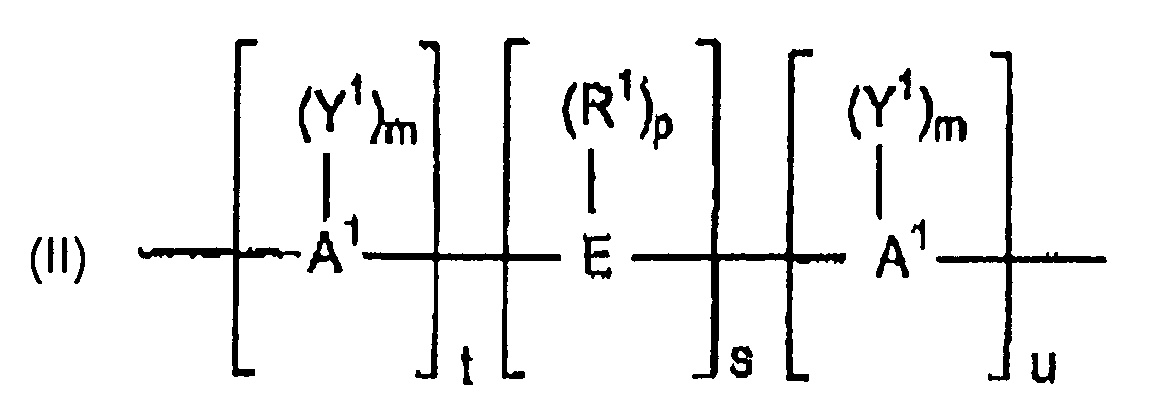
E comprend une liaison contenant du soufre, un sulfure, un sulfoxyde, un sulfone ; une liaison contenant du phosphore, un phosphinyle, un phosphonyle ; une liaison éther ; un groupe carbonyle ; un groupe azote tertiaire ; une liaison contenant du silicium ; du silane ; un groupe cycloaliphatique ; du cyclopentylidène, du 3,3,5-triméthylcyclopentylidène, du cyclohexylidène, du 3,3-diméthylcyclohexylidène, du 3,3,5-triméthylcyclohexylidène, du méthylcyclohexylidène, du 2-[2,2.1]-bicycloheptylidène, du néopentylidène, du cyclopentadécylidène, du cyclododécylidène, de l'adamantylidène ; un groupe alkylène ou alkylidène, lequel groupe peut, en variante, être une partie d'un ou plusieurs cycles fusionnés liés à un ou plusieurs groupes aromatiques portant un substituant hydroxy ; un groupe alkylidène insaturé ; ou deux ou plusieurs groupes alkylène ou alkylidène liés par une fraction différente de l'alkylène ou de l'alkylidène et sélectionnés à partir du groupe constitué par une liaison aromatique, une liaison azote tertiaire, une liaison éther, une liaison carbonyle ; une liaison contenant du silicone, un silane, un siloxy ; une liaison contenant du soufre, un sulfure, un sulfoxyde, un sulfone, une liaison contenant du phosphore, un phosphinyle et un phosphonyle ;
R1 comprend l'hydrogène ; un groupe hydrocarbure monovalent, alkényle, allyle, alkyle, aryle, aralkyle, alkaryle ou cycloalkyle ;
Y1, de manière indépendante à chaque occurrence, est sélectionné à partir du groupe constitué par un atome non organique, un halogène ; un groupe non organique, un groupe nitro ; un groupe organique, un groupe hydrocarbure monovalent, alkényle, allyle, alkyle, aryle, aralkyle, alkaryle, cycloalkyle, et un groupe alkoxy ;
la lettre "m" représente un entier quelconque supérieur ou égal à zéro jusqu'au nombre de positions sur A1 disponibles pour une substitution ;
la lettre "p" représente un entier supérieur ou égal à zéro jusqu'au nombre de positions sur E disponibles pour une substitution ;
la lettre "t" représente un entier au moins égal à un ;
la lettre "s" représente un entier soit nul soit égal à un ; et
la lettre "u" représente un entier quelconque comprenant zéro. - Procédé selon la revendication 2, dans lequel l'hydrocarbure aromatique à substitution hydroxy est au moins un hydrocarbure aromatique à substitution dihydroxy sélectionné à partir du groupe constitué par le 4,4'-(cyclopentylidène)diphénol ; le 4,4'-(3,3,5-triméthylcyclopentylidène)diphénol ; le 4,4'-(cyclohexylidène)diphénol ; le 4,4'-(3,3-diméthylcyclohexylidène)diphénol ; le 4,4'-(3,3,5-triméthylcyclohexylidène)diphénol ; le 4,4'-(méthylcyclohexylidène)diphénol ; le 4,4'-bis(3,5-diméthyl)diphénol, le 1,1-bis(4-hydroxy-3-méthylphényl)cyclohexane ; le 4,4-bis(4-hydroxyphényl)heptane ; le 2,4'-dihydroxydiphénylméthane ; le bis(2-hydroxyphényl)méthane ; le bis(4-hydroxyphényl)méthane ; le bis(4-hydroxy-5-nitrophényl)méthane ; le bis(4-hydroxy-2,6-diméthyl-3-méthoxyphényl)méthane ; le 1,1-bis(4-hydroxyphényl)éthane ; le 1,2-bis(4-hydroxyphényl)éthane ; le 1,1-bis(4-hydroxy-2-chlorophényl)éthane ; le 2,2-bis(4-hydroxyphényl)propane ; le 2,2-bis(3-phényl-4-hydroxyphényl)propane ; le 2,2-bis(4-hydroxy-3-méthylphényl)propane ; le 2,2-bis(4-hydroxy-3-éthylphényl)propane ; le 2,2-bis(4-hydroxy-3-isopropylphényl)propane ; le 2,2-bis(4-hydroxy-3,5-diméthylphényl)propane ; 3,5,3',5'-tétrachloro-4,4'-dihydroxyphénylpropane ; le bis(4-hydroxyphényl)cyclohexylméthane ; le 2,2-bis(4-hydroxyphényl)-l-phénylpropane ; le 2,4'-dihydroxyphényl sulfone ; le dihydroxy naphthalène, le 2,6-dihydroxy naphthalène ; le catéchol ; l'hydroquinone ; le résorcinol ; les résorcinols à substitution alkyle en C1-3 ; le 2,2-bis(4-hydroxyphényl)butane ; le 2,2-bis(4-hydroxyphényl)-2-méthylbutane ; le 1,1-bis(4-hydroxyphényl)cyclohexane ; le bisphénol ; le bis(4-hydroxyphényl) ; le bis(4-hydroxyphényl)éther ; le bis(4-hydroxyphényl)sulfure ; le 2-(3-méthyl-4-hydroxyphényl-2-(4-hydroxyphényl)propane ; le 2-(3,5-diméthyl-4-hydroxyphényl)-2-(4-hydroxyphényl)propane ; le 2-(3-méthyl-4-hydroxyphényl)-2-(3,5-diméthyl-4-hydroxyphényl)propane ; le bis(3,5-diméthylphényl-4-hydroxyphényl)méthane ; le 1,1-bis(3,5-diméthylphényl-4-hydroxyphényl)éthane ; le 2,2-bis(3,5-diméthylphényl-4-hydroxyphényl)propane ; le 2,4-bis(3,5-diméthylphényl-4-hydroxyphényl)-2-méthylbutane ; le 3,3-bis(3,5-diméthylphényl-4-hydroxyphényl)pentane ; le 1,1-bis(3,5-diméthylphényl-4-hydroxyphényl)cyclopentane ; le 1,1-bis(3,5-diméthylphényl-4-hydroxyphényl)cyclohexane ; le bis(3,5-diméthylphényi-4-hydroxyphényl)sulfure, le 3-(4-hydroxyphényl)-1,1,3-triméthylindan-5-ol, le 1-(4-hydroxyphényl)-1,3,3-triméthylindan-5-ol, le 2,2,2',2'-tétrahydro-3,3,3',3'-tétraméthyl-1,1-spirobi[1H-indène]-6,6'-diol, et des mélanges de ceux-ci, ou dans lequel l'hydrocarbure aromatique à substitution hydroxy est du tris(4-hydroxyphényl)éthane.
- Procédé selon la revendication 2, dans lequel l'hydrocarbure aromatique à substitution hydroxy est au moins l'un d'un hydrocarbure aromatique à substitution dihydroxy sélectionné à partir du groupe constitué par ceux de la formule (111) :


- Procédé de préparation d'un sel de disodium d'un hydrocarbure aromatique à substitution dihydroxy qui comprend les étapes de :(i) mise en contact d'au moins un hydrocarbure aromatique à substitution dihydroxy avec de l'hydroxyde de sodium dans un milieu solvant comprenant de l'eau, dans lequel les quantités d'hydrocarbure aromatique à substitution dihydroxy et d'hydroxyde de sodium ne s'écartent du rapport stoechiométrique pas plus de plus/moins 0,4 mole %, et dans lequel le sel de métal alcalin est sensiblement soluble dans le milieu solvant ;(ii) dévolatilisation du milieu solvant comprenant le sel de disodium par pulvérisation du milieu solvant dans un solvant organique sensiblement non miscible dans l'eau dans une cuve comprenant des chicanes immergées, au moins un agitateur et au moins un injecteur de pulvérisation afin d'assurer l'introduction d'un milieu solvant, dans lequel ledit solvant organique est à une température comprise dans une plage de 110°C environ à 200°C environ, dans lequel de la chaleur est délivrée au solvant organique en faisant circuler ledit solvant, comprenant, en variante, un sel de disodium, à travers une boucle de pompage à recirculation comprenant une pompe centrifuge, et un échangeur thermique en spirale ou un réchauffeur autonettoyant, dans lequel la quantité d'eau extraite au cours de la dévolatilisation est supérieure à 99 % en poids ; et dans lequel ledit sel est à un niveau solide dans une plage comprise entre 10 % environ et 20 % environ après dévolatilisation ; et(iii) réduction de la taille de particule du sel de disodium au moins une fois dans une pâte du solvant organique.
- Procédé de préparation d'un sel de disodium de bisphénol A qui comprend les étapes de :(i) mise en contact d'un bisphénol A avec de l'hydroxyde de sodium dans un milieu solvant comprenant de l'eau, dans lequel les quantités de bisphénol A et d'hydroxyde de sodium ne s'écartent du rapport stoechiométrique pas plus de plus/moins 0,4 mole % ;(ii) dévolatilisation du milieu solvant comprenant le sel de disodium par pulvérisation du milieu solvant dans de l'ortho-dichlorobenzène dans une cuve comprenant des chicanes immergées, au moins un agitateur et au moins un injecteur de pulvérisation afin d'assurer l'introduction d'un milieu solvant, dans lequel ledit ortho-dichlorobenzène est à une température dans une plage comprise entre 130°C environ et 180°C environ, dans lequel de la chaleur est délivrée à l'ortho-dichlorobenzène en mettant ledit ortho-dichlorobenzène en circulation, comprenant, en variante, un sel de disodium, à travers une boucle de pompage à recirculation comprenant une pompe centrifuge, et un échangeur thermique en spirale ou un dispositif de réchauffage autonettoyant ; dans lequel la quantité d'eau éliminée au cours de la dévolatilisation est supérieure à 99 % en poids ; et dans lequel ledit sel est à un niveau solide dans une plage comprise entre 10 % environ et 20 % environ à la suite de la dévolatilisation ;(iii) réduction de la taille de particule de sel de disodium au moins une fois dans une pâte d'ortho-dichlorobenzène afin de former ledit sel de disodium comprenant moins de 25 % de particules avec un diamètre supérieur à 200 nm environ ; et moins de 2 % de particules avec un diamètre supérieur à 500 nm, dans lequel la taille de particule est réduite en utilisant un équipement qui comprend une ou plusieurs pompes centrifuges, broyeur, mélangeur à gravité, dispositif d'homogénéisation par réduction de taille de particule et dispositif de désagrégation ; et(iv) séchage au moins une fois afin d'éliminer l'eau résiduelle après l'étape (iii), dans lequel ladite étape de séchage comprend la distillation d'ortho-dichlorobenzène et d'eau à partir de la cuve soit avec soit sans introduction d'ortho-dichlorobenzène pur dans la cuve afin de produire ledit sel de disodium avec une quantité d'au résiduelle inférieure à 20 ppm environ après une ou plusieurs étapes de séchage.
- Procédé de préparation d'un sel de métal alcalin d'un hydrocarbure aromatique à substitution hydroxy qui comprend les étapes de :(i) mise en contact d'au moins un hydrocarbure aromatique à substitution hydroxy avec une base dans un milieu solvant comprenant de l'eau et au moins un solvant organique protique soluble dans l'eau, dans lequel les quantités d'hydrocarbure aromatique à substitution hydroxy et de base ne s'écartent du rapport stoechiométrique pas plus de plus/moins 0,4 mole % et dans lequel le sel de métal alcalin est sensiblement soluble dans le milieu solvant ;(ii) dévolatilisation du milieu solvant comprenant le sel par pulvérisation du milieu solvant dans un solvant organique sensiblement non miscible dans l'eau dans une cuve comprenant des chicanes immergées, au moins un agitateur et au moins une entrée afin d'assurer l'introduction de milieu solvant, dans lequel ledit solvant organique est à une température dans une plage comprise entre 110°C environ et 200°C environ, dans lequel la chaleur est délivrée au solvant organique par mise en circulation du solvant, comprenant, en variante, un sel de disodium, par l'intermédiaire d'une boucle de pompage à recirculation comprenant une pompe centrifuge, et un échangeur thermique en spirale ou un réchauffeur autonettoyant ; dans lequel la quantité d'eau éliminée au cours de la dévolatilisation est supérieure à 99 % en poids, et dans lequel ledit sel est à un niveau solide dans une plage comprise entre 10 % environ et 20 % environ suite à la dévolatilisation ; et(iii) réduction de la taille de particule de sel d'au moins une fois dans le solvant organique.
- Procédé de préparation de sel de disodium de bisphénol A qui comprend les étapes de :(i) mise en contact de bisphénol A avec de l'hydroxyde de sodium dans un milieu solvant comprenant de l'eau et du méthanol, dans lequel les quantités de bisphénol A et d'hydroxyde de sodium ne s'écartent du rapport stoechiométrique pas plus de plus/moins 0,4 mole % ;(ii) dévolatilisation du milieu solvant comprenant le sel de disodium par pulvérisation du milieu solvant dans de l'ortho-dichlorobenzène dans une cuve comprenant des chicanes immergées, au moins un agitateur et au moins une entrée afin d'assurer l'introduction de milieu solvant, dans lequel ledit ortho-dichlorobenzène est à une température dans une plage comprise entre 130°C environ et 180°C environ, dans lequel la chaleur est délivrée à l'ortho-dichlorobenzène par mise en circulation dudit ortho-dichlorobenzène comprenant, en variante, un sel de disodium, par l'intermédiaire d'une boucle de pompage à recirculation comprenant une pompe centrifuge et un échangeur thermique en spirale ou un réchauffeur autonettoyant, dans lequel la quantité d'eau éliminée au cours de la dévolatilisation est supérieure à 99 % en poids ; et dans lequel ledit sel est à un niveau solide dans une plage comprise entre 10 % environ et 20 % environ à la suite de la dévolatilisation ;(iii) réduction de la taille de particule de sel de disodium au moins une fois dans une pâte d'ortho-dichlorobenzène afin de former ledit sel de disodium comprenant moins de 25 % de particules avec un diamètre supérieur à 200 nm ; et moins de 2 % de particules avec un diamètre supérieur à 500 nm, dans lequel la taille de particule est réduite en utilisant un équipement qui comprend une ou plusieurs pompes centrifuges, un broyeur, un mélangeur à gravité, un homogénéisateur par réduction de taille de particule et un dispositif de désagrégation ; et(iv) séchage au moins une fois afin d'éliminer l'eau résiduelle restant après l'étape (iii) dans lequel ladite étape de séchage comprend la distillation d'ortho-dichlorobenzène et d'eau à partir de la cuve soit avec soit sans introduction d'ortho-dichlorobenzène pur dans la cuve afin de produire ledit sel de disodium avec une quantité d'eau résiduelle inférieure à 20 ppm environ après une ou plusieurs étapes de séchage.
Priority Applications (2)
| Application Number | Priority Date | Filing Date | Title |
|---|---|---|---|
| SI200430633T SI1660422T1 (sl) | 2003-08-25 | 2004-08-24 | Postopek za pripravo soli hidroksi-substituiranihogljikovodikov |
| PL04782009T PL1660422T3 (pl) | 2003-08-25 | 2004-08-24 | Sposób otrzymywania hydroksy - podstawionych węglowodorów |
Applications Claiming Priority (2)
| Application Number | Priority Date | Filing Date | Title |
|---|---|---|---|
| US10/647,890 US7115785B2 (en) | 2003-08-25 | 2003-08-25 | Method for making salts hydroxy-substituted hydrocarbons |
| PCT/US2004/027433 WO2005021477A2 (fr) | 2003-08-25 | 2004-08-24 | Methode de production de sels d'hydrocarbures hydroxy-substitues |
Publications (2)
| Publication Number | Publication Date |
|---|---|
| EP1660422A2 EP1660422A2 (fr) | 2006-05-31 |
| EP1660422B1 true EP1660422B1 (fr) | 2007-12-19 |
Family
ID=34216624
Family Applications (1)
| Application Number | Title | Priority Date | Filing Date |
|---|---|---|---|
| EP04782009A Expired - Lifetime EP1660422B1 (fr) | 2003-08-25 | 2004-08-24 | Methode de production de sels d'hydrocarbures hydroxy-substitues |
Country Status (13)
| Country | Link |
|---|---|
| US (1) | US7115785B2 (fr) |
| EP (1) | EP1660422B1 (fr) |
| JP (1) | JP2007503446A (fr) |
| KR (1) | KR20060079199A (fr) |
| CN (1) | CN1871195A (fr) |
| AT (1) | ATE381526T1 (fr) |
| AU (1) | AU2004268988A1 (fr) |
| DE (1) | DE602004010823T2 (fr) |
| DK (1) | DK1660422T3 (fr) |
| ES (1) | ES2298825T3 (fr) |
| PL (1) | PL1660422T3 (fr) |
| PT (1) | PT1660422E (fr) |
| WO (1) | WO2005021477A2 (fr) |
Families Citing this family (21)
| Publication number | Priority date | Publication date | Assignee | Title |
|---|---|---|---|---|
| US7902407B2 (en) * | 2005-03-30 | 2011-03-08 | Sabic Innovative Plastics Ip B.V. | Method for preparation of salts of hydroxy-substituted aromatic compounds |
| US7772435B2 (en) * | 2006-12-28 | 2010-08-10 | Sabic Innovative Plastics Ip B.V. | Method of forming a dry quaternary ammonium salt mixture |
| US7655004B2 (en) | 2007-02-15 | 2010-02-02 | Ethicon Endo-Surgery, Inc. | Electroporation ablation apparatus, system, and method |
| US8888792B2 (en) | 2008-07-14 | 2014-11-18 | Ethicon Endo-Surgery, Inc. | Tissue apposition clip application devices and methods |
| US8157834B2 (en) | 2008-11-25 | 2012-04-17 | Ethicon Endo-Surgery, Inc. | Rotational coupling device for surgical instrument with flexible actuators |
| US20110098704A1 (en) | 2009-10-28 | 2011-04-28 | Ethicon Endo-Surgery, Inc. | Electrical ablation devices |
| US9254169B2 (en) | 2011-02-28 | 2016-02-09 | Ethicon Endo-Surgery, Inc. | Electrical ablation devices and methods |
| US9233241B2 (en) | 2011-02-28 | 2016-01-12 | Ethicon Endo-Surgery, Inc. | Electrical ablation devices and methods |
| US9427255B2 (en) | 2012-05-14 | 2016-08-30 | Ethicon Endo-Surgery, Inc. | Apparatus for introducing a steerable camera assembly into a patient |
| US9545290B2 (en) | 2012-07-30 | 2017-01-17 | Ethicon Endo-Surgery, Inc. | Needle probe guide |
| US10314649B2 (en) | 2012-08-02 | 2019-06-11 | Ethicon Endo-Surgery, Inc. | Flexible expandable electrode and method of intraluminal delivery of pulsed power |
| US9277957B2 (en) | 2012-08-15 | 2016-03-08 | Ethicon Endo-Surgery, Inc. | Electrosurgical devices and methods |
| US9127127B2 (en) | 2012-10-03 | 2015-09-08 | Sabic Global Technologies B.V. | Polyetherimide compositions, methods of manufacture, and articles formed therefrom |
| US10098527B2 (en) | 2013-02-27 | 2018-10-16 | Ethidcon Endo-Surgery, Inc. | System for performing a minimally invasive surgical procedure |
| US10676571B2 (en) | 2013-12-02 | 2020-06-09 | Sabic Global Technologies B.V. | Polyetherimides with improved melt stability |
| CN106164029B (zh) * | 2014-04-15 | 2018-06-29 | 沙特基础工业全球技术有限公司 | 制造羟基取代的芳香族化合物的盐和聚醚酰亚胺的方法 |
| US20170029568A1 (en) * | 2014-04-15 | 2017-02-02 | Sabic Global Technologies B.V. | Methods of manufacture of salts of hydroxy-substituted aromatic compounds and polyetherimides |
| CN106232677B (zh) | 2014-04-15 | 2019-01-15 | 沙特基础工业全球技术有限公司 | 制备聚醚酰亚胺的方法 |
| JP6416008B2 (ja) * | 2015-02-12 | 2018-10-31 | 三井化学株式会社 | p−クミルフェノールの精製方法および製造方法 |
| WO2016138388A1 (fr) * | 2015-02-27 | 2016-09-01 | Sabic Global Technologies B.V. | Procédé de production d'un polyétherimide faiblement coloré par substitution d'halogène et polyétherimide faiblement coloré |
| JP6798636B1 (ja) * | 2019-10-31 | 2020-12-09 | 三菱ケミカル株式会社 | フェノール化合物のナトリウム塩の製造方法 |
Family Cites Families (54)
| Publication number | Priority date | Publication date | Assignee | Title |
|---|---|---|---|---|
| US45716A (en) * | 1865-01-03 | Improved molder s sprue | ||
| US49286A (en) * | 1865-08-08 | Improvement in gates | ||
| US37838A (en) * | 1863-03-03 | Improved composition for restoring colors to cloth | ||
| US45715A (en) * | 1865-01-03 | Improvement in self-loading hay-carts | ||
| US1955080A (en) | 1932-05-18 | 1934-04-17 | Dow Chemical Co | Method of preparing anhydrous alkali metal phenoxides |
| NL104015C (fr) | 1953-10-16 | |||
| DE1007996B (de) | 1955-03-26 | 1957-05-09 | Bayer Ag | Verfahren zur Herstellung thermoplastischer Kunststoffe |
| US2991273A (en) | 1956-07-07 | 1961-07-04 | Bayer Ag | Process for manufacture of vacuum moulded parts of high molecular weight thermoplastic polycarbonates |
| US3148172A (en) | 1956-07-19 | 1964-09-08 | Gen Electric | Polycarbonates of dihydroxyaryl ethers |
| US2999835A (en) | 1959-01-02 | 1961-09-12 | Gen Electric | Resinous mixture comprising organo-polysiloxane and polymer of a carbonate of a dihydric phenol, and products containing same |
| US3205198A (en) | 1961-09-12 | 1965-09-07 | Allied Chem | Di-(bisphenol) ethers, their polycarbonates, and processes for the production thereof |
| US3247164A (en) | 1961-09-14 | 1966-04-19 | Eastman Kodak Co | Solubilization of salts of bisphenols in manufacture of polycarbonates |
| US3271368A (en) | 1963-05-02 | 1966-09-06 | Borg Warner | Sulfonate-thiocarbonate copolymers |
| DE1545106C3 (de) | 1963-07-16 | 1979-05-31 | Union Carbide Corp., New York, N.Y. (V.St.A.) | Verfahren zur Herstellung von linearen Polyarylenpolyäthern |
| US4175175A (en) | 1963-07-16 | 1979-11-20 | Union Carbide Corporation | Polyarylene polyethers |
| DE1645580A1 (de) | 1965-04-08 | 1970-10-22 | Union Carbide Corp | Verfahren zur Herstellung von Polyarylenpolyaethern |
| DE2233940A1 (de) | 1972-07-11 | 1974-01-31 | Hoechst Ag | Verfahren zur herstellung wasserfreier loesungen von alkaliarylaten und zur abtrennung dieser arylate von alkalisulfit |
| FR2206760A6 (en) | 1972-11-14 | 1974-06-07 | Rhone Poulenc Sa | Neutral aromatic bis-sulphates prepn. - from metal phenoxides and chlorosulphates |
| US3879428A (en) | 1973-03-30 | 1975-04-22 | Gen Electric | Method for making aromatic bis(ether anhydride)s |
| GB1414424A (en) | 1973-05-25 | 1975-11-19 | Ici Ltd | Bisphenol derivative |
| US3960968A (en) | 1973-07-13 | 1976-06-01 | Bayer Aktiengesellschaft | Method for the continuous production of aqueous dialkali salt solutions of aromatic dihydroxy compounds |
| US3847869A (en) | 1973-09-28 | 1974-11-12 | Gen Electric | Method for preparing polyetherimides |
| US3852242A (en) | 1973-12-03 | 1974-12-03 | Gen Electric | Method for making polyetherimide |
| DE2456446A1 (de) | 1974-11-29 | 1976-08-12 | Bayer Ag | Verfahren zur herstellung von aromatischen cyansaeureestern |
| US4183874A (en) | 1976-04-30 | 1980-01-15 | Union Carbide Corporation | Silane end-capped polyarylene shaped articles and mixed resins |
| US4093600A (en) | 1976-04-30 | 1978-06-06 | Union Carbide Corporation | Silane end-capped polyarylene polyethers |
| US4217438A (en) | 1978-12-15 | 1980-08-12 | General Electric Company | Polycarbonate transesterification process |
| US4273712A (en) | 1979-05-09 | 1981-06-16 | General Electric Company | Method for making aromatic ether imides |
| US4202993A (en) | 1979-05-09 | 1980-05-13 | General Electric Company | Method for making substantially anhydrous alkali metal bisphenol salts |
| US4302616A (en) | 1979-05-09 | 1981-11-24 | General Electric Company | Method for making alkali metal bisphenoxide salts and bisimides derived therefrom |
| US4257953A (en) | 1979-05-09 | 1981-03-24 | General Electric Company | Method for making bisphenoxide salts and bisimides derived therefrom |
| US4410735A (en) | 1981-11-30 | 1983-10-18 | General Electric Company | Method for making bisphenoxide salts |
| US4363892A (en) | 1982-03-05 | 1982-12-14 | E. I. Du Pont De Nemours And Company | Thermoplastic copolyester elastomers modified with salts of phenolic compounds |
| US4451330A (en) | 1982-09-13 | 1984-05-29 | Kalama Chemical, Inc. | Process for the recovery of alkali metal salts from aqueous solutions thereof |
| EP0117459B1 (fr) | 1983-02-28 | 1989-09-06 | General Electric Company | Procédé de préparation de sels anhydres de composés aromatiques dihydroxylés |
| US4546207A (en) | 1983-02-28 | 1985-10-08 | General Electric Company | Process for preparing anhydrous salts of dihydroxyaromatic compounds |
| US4520204A (en) | 1983-04-25 | 1985-05-28 | General Electric Company | Method for preparation of aromatic ether imides and for catalyst recovery therein |
| US4492806A (en) | 1983-11-28 | 1985-01-08 | General Electric Company | Process for preparing alkali metal salts of hydroxyaromatic compounds |
| JPS6327448A (ja) | 1986-07-17 | 1988-02-05 | Daicel Chem Ind Ltd | 高純度ビスフエノ−ルアルカリ金属二塩の製造方法 |
| US4740330A (en) | 1986-09-03 | 1988-04-26 | The Dow Chemical Company | Method for allylating aromatic hydroxyl-containing compounds |
| JPH0674228B2 (ja) | 1986-12-24 | 1994-09-21 | 宇部興産株式会社 | ヒドロキシ芳香族化合物のアルカリ金属塩の製造方法 |
| US5068353A (en) | 1986-12-31 | 1991-11-26 | General Electric Company | Synthesis of aromatic bis(ether phthalimide) compounds |
| JPH0345629A (ja) | 1989-07-14 | 1991-02-27 | Shin Etsu Chem Co Ltd | ビス―シリルアルコキシアリーレン化合物 |
| US5194570A (en) | 1990-11-05 | 1993-03-16 | Rutgers, The State University Of New Jersey | Poly(N-substituted iminocarbonate) |
| US5242997A (en) | 1990-11-05 | 1993-09-07 | Rutgers, The State University Of New Jersey | Poly(N-phenyl urethane) from poly(N-substituted iminocarbonate) |
| US5229482A (en) | 1991-02-28 | 1993-07-20 | General Electric Company | Phase transfer catalyzed preparation of aromatic polyether polymers |
| US5157105A (en) | 1991-05-17 | 1992-10-20 | Shell Oil Company | Bisbenzocyclobutene/bisimide/dicyanate ester composition |
| DE4129546C1 (fr) | 1991-09-05 | 1993-04-15 | Bayer Ag, 5090 Leverkusen, De | |
| DE19611141A1 (de) | 1996-03-21 | 1997-09-25 | Bayer Ag | Reinigung von p,p-Bisphenolat-Lösungen |
| US5663275A (en) | 1996-07-05 | 1997-09-02 | General Electric Company | Preparation of polyether polymers using bisphenol hydrate as intermediate |
| US5851837A (en) | 1997-02-06 | 1998-12-22 | General Electric Company | Method for determination of salt stoichiometry |
| US5830974A (en) | 1997-02-13 | 1998-11-03 | General Electric Company | Method for preparing aromatic polyether polymers |
| JP3681529B2 (ja) | 1997-12-26 | 2005-08-10 | 日本ジーイープラスチックス株式会社 | ポリカーボネートの製造方法 |
| US6369170B1 (en) | 1999-12-10 | 2002-04-09 | General Electric Company | Method for preparing polyether copolymers with polycarbonates and polyarylates |
-
2003
- 2003-08-25 US US10/647,890 patent/US7115785B2/en not_active Expired - Lifetime
-
2004
- 2004-08-24 KR KR1020067003897A patent/KR20060079199A/ko not_active Withdrawn
- 2004-08-24 WO PCT/US2004/027433 patent/WO2005021477A2/fr not_active Ceased
- 2004-08-24 PL PL04782009T patent/PL1660422T3/pl unknown
- 2004-08-24 EP EP04782009A patent/EP1660422B1/fr not_active Expired - Lifetime
- 2004-08-24 AU AU2004268988A patent/AU2004268988A1/en not_active Abandoned
- 2004-08-24 DK DK04782009T patent/DK1660422T3/da active
- 2004-08-24 AT AT04782009T patent/ATE381526T1/de not_active IP Right Cessation
- 2004-08-24 JP JP2006524790A patent/JP2007503446A/ja not_active Withdrawn
- 2004-08-24 ES ES04782009T patent/ES2298825T3/es not_active Expired - Lifetime
- 2004-08-24 PT PT04782009T patent/PT1660422E/pt unknown
- 2004-08-24 DE DE602004010823T patent/DE602004010823T2/de not_active Expired - Lifetime
- 2004-08-24 CN CNA2004800315434A patent/CN1871195A/zh active Pending
Also Published As
| Publication number | Publication date |
|---|---|
| US20050049439A1 (en) | 2005-03-03 |
| WO2005021477A2 (fr) | 2005-03-10 |
| PL1660422T3 (pl) | 2008-05-30 |
| KR20060079199A (ko) | 2006-07-05 |
| CN1871195A (zh) | 2006-11-29 |
| US7115785B2 (en) | 2006-10-03 |
| DE602004010823T2 (de) | 2008-12-04 |
| JP2007503446A (ja) | 2007-02-22 |
| AU2004268988A1 (en) | 2005-03-10 |
| DE602004010823D1 (de) | 2008-01-31 |
| ATE381526T1 (de) | 2008-01-15 |
| EP1660422A2 (fr) | 2006-05-31 |
| WO2005021477A3 (fr) | 2005-05-19 |
| ES2298825T3 (es) | 2008-05-16 |
| DK1660422T3 (da) | 2008-05-05 |
| PT1660422E (pt) | 2008-03-28 |
Similar Documents
| Publication | Publication Date | Title |
|---|---|---|
| EP1660422B1 (fr) | Methode de production de sels d'hydrocarbures hydroxy-substitues | |
| CZ2008492A3 (cs) | Zpusob katalýzy fázovým prenosem pro prípravu polyeterimidu | |
| EP1233997B1 (fr) | Procede de purification de polyethers aromatiques | |
| US20050049384A1 (en) | Novel approach to reduce cyclics formation in 3-CIPA based polyetherimide polymers | |
| TWI229100B (en) | A method for depolymerization of an aromatic polycarbonate | |
| JPH0428709B2 (fr) | ||
| JPS6135172B2 (fr) | ||
| US7902407B2 (en) | Method for preparation of salts of hydroxy-substituted aromatic compounds | |
| EP0292211A2 (fr) | Production et/ou traîtement de polymères | |
| JPS60142934A (ja) | ビスフエノールのアルカリ金属塩の製造方法 | |
| JP2007503507A (ja) | 相間移動触媒を用いるポリエーテルイミドの製造方法 | |
| JP3174067B2 (ja) | 芳香族ポリカーボネート樹脂の製造方法 | |
| US20170029568A1 (en) | Methods of manufacture of salts of hydroxy-substituted aromatic compounds and polyetherimides | |
| HK1093484A (en) | Method for making salts of hydroxy-substituted hydrocarbons | |
| CA2124055A1 (fr) | Methode de preparation d'acides hydroxycarboxyliques aromatiques | |
| US20160251291A1 (en) | Method for producing alkoxyhydroxybenzaldehyde | |
| US9777118B2 (en) | Methods of manufacture of salts of hydroxy-substituted aromatic compounds and polyetherimides | |
| JPH02502830A (ja) | ポリアリールエーテル及びその製法 | |
| JPH0774270B2 (ja) | N−メチル−2−ピロリドンの回収方法 | |
| JP2981281B2 (ja) | フェノール重合体の製造方法 | |
| JP2004107252A (ja) | 4,4’−ビフェノールの製造法 | |
| KR820002003B1 (ko) | 디하이드록시디페닐 알칸의 분해법 |
Legal Events
| Date | Code | Title | Description |
|---|---|---|---|
| PUAI | Public reference made under article 153(3) epc to a published international application that has entered the european phase |
Free format text: ORIGINAL CODE: 0009012 |
|
| 17P | Request for examination filed |
Effective date: 20060327 |
|
| AK | Designated contracting states |
Kind code of ref document: A2 Designated state(s): AT BE BG CH CY CZ DE DK EE ES FI FR GB GR HU IE IT LI LU MC NL PL PT RO SE SI SK TR |
|
| DAX | Request for extension of the european patent (deleted) | ||
| GRAP | Despatch of communication of intention to grant a patent |
Free format text: ORIGINAL CODE: EPIDOSNIGR1 |
|
| RIN1 | Information on inventor provided before grant (corrected) |
Inventor name: KHOURI, FARID, FOUAD Inventor name: LITTLEJOHN, MATTHEW, HAL Inventor name: JOHNSON, NORMAN, ENOCH Inventor name: BERGMAN, LEE, HARRIS Inventor name: WOODRUFF, DAVID, WINFIELD Inventor name: BRUNELLE, DANIEL, JOSEPH Inventor name: GUGGENHEIM, THOMAS, LINK |
|
| GRAS | Grant fee paid |
Free format text: ORIGINAL CODE: EPIDOSNIGR3 |
|
| GRAA | (expected) grant |
Free format text: ORIGINAL CODE: 0009210 |
|
| AK | Designated contracting states |
Kind code of ref document: B1 Designated state(s): AT BE BG CH CY CZ DE DK EE ES FI FR GB GR HU IE IT LI LU MC NL PL PT RO SE SI SK TR |
|
| REG | Reference to a national code |
Ref country code: GB Ref legal event code: FG4D |
|
| REG | Reference to a national code |
Ref country code: IE Ref legal event code: FG4D |
|
| REG | Reference to a national code |
Ref country code: CH Ref legal event code: EP |
|
| REF | Corresponds to: |
Ref document number: 602004010823 Country of ref document: DE Date of ref document: 20080131 Kind code of ref document: P |
|
| REG | Reference to a national code |
Ref country code: RO Ref legal event code: EPE |
|
| REG | Reference to a national code |
Ref country code: PT Ref legal event code: SC4A Free format text: AVAILABILITY OF NATIONAL TRANSLATION Effective date: 20080318 |
|
| REG | Reference to a national code |
Ref country code: CH Ref legal event code: NV Representative=s name: WILLIAM BLANC & CIE CONSEILS EN PROPRIETE INDUSTRI |
|
| REG | Reference to a national code |
Ref country code: SE Ref legal event code: TRGR |
|
| REG | Reference to a national code |
Ref country code: GR Ref legal event code: EP Ref document number: 20080400714 Country of ref document: GR |
|
| REG | Reference to a national code |
Ref country code: DK Ref legal event code: T3 |
|
| REG | Reference to a national code |
Ref country code: ES Ref legal event code: FG2A Ref document number: 2298825 Country of ref document: ES Kind code of ref document: T3 |
|
| REG | Reference to a national code |
Ref country code: PL Ref legal event code: T3 |
|
| REG | Reference to a national code |
Ref country code: EE Ref legal event code: FG4A Ref document number: E001974 Country of ref document: EE Effective date: 20080430 |
|
| REG | Reference to a national code |
Ref country code: HU Ref legal event code: AG4A Ref document number: E003048 Country of ref document: HU |
|
| ET | Fr: translation filed | ||
| RAP2 | Party data changed (patent owner data changed or rights of a patent transferred) |
Owner name: SABIC INNOVATIVE PLASTICS IP B.V. |
|
| PLBE | No opposition filed within time limit |
Free format text: ORIGINAL CODE: 0009261 |
|
| STAA | Information on the status of an ep patent application or granted ep patent |
Free format text: STATUS: NO OPPOSITION FILED WITHIN TIME LIMIT |
|
| PGFP | Annual fee paid to national office [announced via postgrant information from national office to epo] |
Ref country code: BG Payment date: 20080828 Year of fee payment: 5 Ref country code: CH Payment date: 20080825 Year of fee payment: 5 Ref country code: DK Payment date: 20080826 Year of fee payment: 5 Ref country code: EE Payment date: 20080804 Year of fee payment: 5 Ref country code: ES Payment date: 20080826 Year of fee payment: 5 Ref country code: LU Payment date: 20080829 Year of fee payment: 5 Ref country code: NL Payment date: 20080824 Year of fee payment: 5 Ref country code: PT Payment date: 20080731 Year of fee payment: 5 Ref country code: SI Payment date: 20080731 Year of fee payment: 5 |
|
| 26N | No opposition filed |
Effective date: 20080922 |
|
| PGFP | Annual fee paid to national office [announced via postgrant information from national office to epo] |
Ref country code: AT Payment date: 20080801 Year of fee payment: 5 Ref country code: CZ Payment date: 20080813 Year of fee payment: 5 Ref country code: FI Payment date: 20080828 Year of fee payment: 5 Ref country code: FR Payment date: 20080818 Year of fee payment: 5 Ref country code: IE Payment date: 20080828 Year of fee payment: 5 Ref country code: IT Payment date: 20080825 Year of fee payment: 5 Ref country code: MC Payment date: 20080801 Year of fee payment: 5 Ref country code: PL Payment date: 20080811 Year of fee payment: 5 Ref country code: RO Payment date: 20080804 Year of fee payment: 5 Ref country code: SK Payment date: 20080806 Year of fee payment: 5 |
|
| NLT2 | Nl: modifications (of names), taken from the european patent patent bulletin |
Owner name: SABIC INNOVATIVE PLASTICS IP B.V. Effective date: 20080924 |
|
| PGFP | Annual fee paid to national office [announced via postgrant information from national office to epo] |
Ref country code: GB Payment date: 20080827 Year of fee payment: 5 |
|
| PGFP | Annual fee paid to national office [announced via postgrant information from national office to epo] |
Ref country code: TR Payment date: 20080804 Year of fee payment: 5 |
|
| PGFP | Annual fee paid to national office [announced via postgrant information from national office to epo] |
Ref country code: SE Payment date: 20080827 Year of fee payment: 5 Ref country code: HU Payment date: 20080828 Year of fee payment: 5 Ref country code: BE Payment date: 20080922 Year of fee payment: 5 |
|
| PGFP | Annual fee paid to national office [announced via postgrant information from national office to epo] |
Ref country code: GR Payment date: 20080827 Year of fee payment: 5 |
|
| PG25 | Lapsed in a contracting state [announced via postgrant information from national office to epo] |
Ref country code: CY Free format text: LAPSE BECAUSE OF NON-PAYMENT OF DUE FEES Effective date: 20080824 |
|
| BERE | Be: lapsed |
Owner name: GENERAL ELECTRIC CY Effective date: 20090831 |
|
| REG | Reference to a national code |
Ref country code: PT Ref legal event code: MM4A Free format text: LAPSE DUE TO NON-PAYMENT OF FEES Effective date: 20100224 |
|
| PG25 | Lapsed in a contracting state [announced via postgrant information from national office to epo] |
Ref country code: MC Free format text: LAPSE BECAUSE OF NON-PAYMENT OF DUE FEES Effective date: 20090831 |
|
| REG | Reference to a national code |
Ref country code: CH Ref legal event code: PL Ref country code: NL Ref legal event code: V1 Effective date: 20100301 |
|
| REG | Reference to a national code |
Ref country code: DK Ref legal event code: EBP |
|
| REG | Reference to a national code |
Ref country code: EE Ref legal event code: MM4A Ref document number: E001974 Country of ref document: EE Effective date: 20090831 |
|
| GBPC | Gb: european patent ceased through non-payment of renewal fee |
Effective date: 20090824 |
|
| PG25 | Lapsed in a contracting state [announced via postgrant information from national office to epo] |
Ref country code: EE Free format text: LAPSE BECAUSE OF NON-PAYMENT OF DUE FEES Effective date: 20090831 Ref country code: LI Free format text: LAPSE BECAUSE OF NON-PAYMENT OF DUE FEES Effective date: 20090831 Ref country code: CH Free format text: LAPSE BECAUSE OF NON-PAYMENT OF DUE FEES Effective date: 20090831 Ref country code: CZ Free format text: LAPSE BECAUSE OF NON-PAYMENT OF DUE FEES Effective date: 20090824 Ref country code: RO Free format text: LAPSE BECAUSE OF NON-PAYMENT OF DUE FEES Effective date: 20090824 Ref country code: PT Free format text: LAPSE BECAUSE OF NON-PAYMENT OF DUE FEES Effective date: 20100224 Ref country code: FI Free format text: LAPSE BECAUSE OF NON-PAYMENT OF DUE FEES Effective date: 20090824 |
|
| REG | Reference to a national code |
Ref country code: SK Ref legal event code: MM4A Ref document number: E 3307 Country of ref document: SK Effective date: 20090824 |
|
| REG | Reference to a national code |
Ref country code: FR Ref legal event code: ST Effective date: 20100430 |
|
| PG25 | Lapsed in a contracting state [announced via postgrant information from national office to epo] |
Ref country code: SK Free format text: LAPSE BECAUSE OF NON-PAYMENT OF DUE FEES Effective date: 20090824 |
|
| REG | Reference to a national code |
Ref country code: SI Ref legal event code: KO00 Effective date: 20100416 |
|
| PG25 | Lapsed in a contracting state [announced via postgrant information from national office to epo] |
Ref country code: BE Free format text: LAPSE BECAUSE OF NON-PAYMENT OF DUE FEES Effective date: 20090831 Ref country code: AT Free format text: LAPSE BECAUSE OF NON-PAYMENT OF DUE FEES Effective date: 20090824 |
|
| PG25 | Lapsed in a contracting state [announced via postgrant information from national office to epo] |
Ref country code: HU Free format text: LAPSE BECAUSE OF NON-PAYMENT OF DUE FEES Effective date: 20090825 Ref country code: BG Free format text: LAPSE BECAUSE OF THE APPLICANT RENOUNCES Effective date: 20100228 Ref country code: NL Free format text: LAPSE BECAUSE OF NON-PAYMENT OF DUE FEES Effective date: 20100301 Ref country code: DK Free format text: LAPSE BECAUSE OF NON-PAYMENT OF DUE FEES Effective date: 20090831 Ref country code: IE Free format text: LAPSE BECAUSE OF NON-PAYMENT OF DUE FEES Effective date: 20090824 Ref country code: FR Free format text: LAPSE BECAUSE OF NON-PAYMENT OF DUE FEES Effective date: 20090831 |
|
| PG25 | Lapsed in a contracting state [announced via postgrant information from national office to epo] |
Ref country code: SI Free format text: LAPSE BECAUSE OF NON-PAYMENT OF DUE FEES Effective date: 20090825 |
|
| REG | Reference to a national code |
Ref country code: ES Ref legal event code: FD2A Effective date: 20090825 |
|
| PG25 | Lapsed in a contracting state [announced via postgrant information from national office to epo] |
Ref country code: GR Free format text: LAPSE BECAUSE OF NON-PAYMENT OF DUE FEES Effective date: 20100303 |
|
| PG25 | Lapsed in a contracting state [announced via postgrant information from national office to epo] |
Ref country code: GB Free format text: LAPSE BECAUSE OF NON-PAYMENT OF DUE FEES Effective date: 20090824 |
|
| PG25 | Lapsed in a contracting state [announced via postgrant information from national office to epo] |
Ref country code: IT Free format text: LAPSE BECAUSE OF NON-PAYMENT OF DUE FEES Effective date: 20090824 |
|
| PG25 | Lapsed in a contracting state [announced via postgrant information from national office to epo] |
Ref country code: LU Free format text: LAPSE BECAUSE OF NON-PAYMENT OF DUE FEES Effective date: 20090824 |
|
| PG25 | Lapsed in a contracting state [announced via postgrant information from national office to epo] |
Ref country code: SE Free format text: LAPSE BECAUSE OF NON-PAYMENT OF DUE FEES Effective date: 20090825 Ref country code: PL Free format text: LAPSE BECAUSE OF NON-PAYMENT OF DUE FEES Effective date: 20090824 |
|
| REG | Reference to a national code |
Ref country code: PL Ref legal event code: LAPE |
|
| PG25 | Lapsed in a contracting state [announced via postgrant information from national office to epo] |
Ref country code: ES Free format text: LAPSE BECAUSE OF NON-PAYMENT OF DUE FEES Effective date: 20090825 |
|
| PG25 | Lapsed in a contracting state [announced via postgrant information from national office to epo] |
Ref country code: TR Free format text: LAPSE BECAUSE OF NON-PAYMENT OF DUE FEES Effective date: 20090824 |
|
| REG | Reference to a national code |
Ref country code: DE Ref legal event code: R081 Ref document number: 602004010823 Country of ref document: DE Owner name: SABIC GLOBAL TECHNOLOGIES B.V., NL Free format text: FORMER OWNER: GENERAL ELECTRIC CO., SCHENECTADY, N.Y., US Ref country code: DE Ref legal event code: R082 Ref document number: 602004010823 Country of ref document: DE Representative=s name: OFFICE FREYLINGER S.A., LU |
|
| PGFP | Annual fee paid to national office [announced via postgrant information from national office to epo] |
Ref country code: DE Payment date: 20190813 Year of fee payment: 16 |
|
| REG | Reference to a national code |
Ref country code: DE Ref legal event code: R119 Ref document number: 602004010823 Country of ref document: DE |
|
| PG25 | Lapsed in a contracting state [announced via postgrant information from national office to epo] |
Ref country code: DE Free format text: LAPSE BECAUSE OF NON-PAYMENT OF DUE FEES Effective date: 20210302 |