EP1660493B1 - Heterocyclische peptidylketonderivate und herstellungsverfahren - Google Patents
Heterocyclische peptidylketonderivate und herstellungsverfahren Download PDFInfo
- Publication number
- EP1660493B1 EP1660493B1 EP04780047A EP04780047A EP1660493B1 EP 1660493 B1 EP1660493 B1 EP 1660493B1 EP 04780047 A EP04780047 A EP 04780047A EP 04780047 A EP04780047 A EP 04780047A EP 1660493 B1 EP1660493 B1 EP 1660493B1
- Authority
- EP
- European Patent Office
- Prior art keywords
- formula
- compound
- yield
- protecting group
- group
- Prior art date
- Legal status (The legal status is an assumption and is not a legal conclusion. Google has not performed a legal analysis and makes no representation as to the accuracy of the status listed.)
- Expired - Lifetime
Links
- 0 *NC(NCCC=C[C@@](C(c1nc(cccc2)c2[s]1)=O)N)=N Chemical compound *NC(NCCC=C[C@@](C(c1nc(cccc2)c2[s]1)=O)N)=N 0.000 description 6
- VMKJWLXVLHBJNK-UHFFFAOYSA-N Fc1nc(F)nc(F)n1 Chemical compound Fc1nc(F)nc(F)n1 VMKJWLXVLHBJNK-UHFFFAOYSA-N 0.000 description 1
Images
Classifications
-
- C—CHEMISTRY; METALLURGY
- C07—ORGANIC CHEMISTRY
- C07D—HETEROCYCLIC COMPOUNDS
- C07D277/00—Heterocyclic compounds containing 1,3-thiazole or hydrogenated 1,3-thiazole rings
- C07D277/60—Heterocyclic compounds containing 1,3-thiazole or hydrogenated 1,3-thiazole rings condensed with carbocyclic rings or ring systems
- C07D277/62—Benzothiazoles
- C07D277/64—Benzothiazoles with only hydrocarbon or substituted hydrocarbon radicals attached in position 2
-
- A—HUMAN NECESSITIES
- A61—MEDICAL OR VETERINARY SCIENCE; HYGIENE
- A61P—SPECIFIC THERAPEUTIC ACTIVITY OF CHEMICAL COMPOUNDS OR MEDICINAL PREPARATIONS
- A61P1/00—Drugs for disorders of the alimentary tract or the digestive system
-
- A—HUMAN NECESSITIES
- A61—MEDICAL OR VETERINARY SCIENCE; HYGIENE
- A61P—SPECIFIC THERAPEUTIC ACTIVITY OF CHEMICAL COMPOUNDS OR MEDICINAL PREPARATIONS
- A61P11/00—Drugs for disorders of the respiratory system
- A61P11/06—Antiasthmatics
-
- A—HUMAN NECESSITIES
- A61—MEDICAL OR VETERINARY SCIENCE; HYGIENE
- A61P—SPECIFIC THERAPEUTIC ACTIVITY OF CHEMICAL COMPOUNDS OR MEDICINAL PREPARATIONS
- A61P17/00—Drugs for dermatological disorders
-
- A—HUMAN NECESSITIES
- A61—MEDICAL OR VETERINARY SCIENCE; HYGIENE
- A61P—SPECIFIC THERAPEUTIC ACTIVITY OF CHEMICAL COMPOUNDS OR MEDICINAL PREPARATIONS
- A61P17/00—Drugs for dermatological disorders
- A61P17/06—Antipsoriatics
-
- A—HUMAN NECESSITIES
- A61—MEDICAL OR VETERINARY SCIENCE; HYGIENE
- A61P—SPECIFIC THERAPEUTIC ACTIVITY OF CHEMICAL COMPOUNDS OR MEDICINAL PREPARATIONS
- A61P27/00—Drugs for disorders of the senses
- A61P27/02—Ophthalmic agents
-
- A—HUMAN NECESSITIES
- A61—MEDICAL OR VETERINARY SCIENCE; HYGIENE
- A61P—SPECIFIC THERAPEUTIC ACTIVITY OF CHEMICAL COMPOUNDS OR MEDICINAL PREPARATIONS
- A61P27/00—Drugs for disorders of the senses
- A61P27/16—Otologicals
-
- A—HUMAN NECESSITIES
- A61—MEDICAL OR VETERINARY SCIENCE; HYGIENE
- A61P—SPECIFIC THERAPEUTIC ACTIVITY OF CHEMICAL COMPOUNDS OR MEDICINAL PREPARATIONS
- A61P29/00—Non-central analgesic, antipyretic or antiinflammatory agents, e.g. antirheumatic agents; Non-steroidal antiinflammatory drugs [NSAID]
-
- A—HUMAN NECESSITIES
- A61—MEDICAL OR VETERINARY SCIENCE; HYGIENE
- A61P—SPECIFIC THERAPEUTIC ACTIVITY OF CHEMICAL COMPOUNDS OR MEDICINAL PREPARATIONS
- A61P43/00—Drugs for specific purposes, not provided for in groups A61P1/00-A61P41/00
-
- A—HUMAN NECESSITIES
- A61—MEDICAL OR VETERINARY SCIENCE; HYGIENE
- A61P—SPECIFIC THERAPEUTIC ACTIVITY OF CHEMICAL COMPOUNDS OR MEDICINAL PREPARATIONS
- A61P9/00—Drugs for disorders of the cardiovascular system
-
- C—CHEMISTRY; METALLURGY
- C07—ORGANIC CHEMISTRY
- C07D—HETEROCYCLIC COMPOUNDS
- C07D417/00—Heterocyclic compounds containing two or more hetero rings, at least one ring having nitrogen and sulfur atoms as the only ring hetero atoms, not provided for by group C07D415/00
- C07D417/02—Heterocyclic compounds containing two or more hetero rings, at least one ring having nitrogen and sulfur atoms as the only ring hetero atoms, not provided for by group C07D415/00 containing two hetero rings
- C07D417/12—Heterocyclic compounds containing two or more hetero rings, at least one ring having nitrogen and sulfur atoms as the only ring hetero atoms, not provided for by group C07D415/00 containing two hetero rings linked by a chain containing hetero atoms as chain links
Definitions
- the present invention relates to a novel process for the preparation of peptidyl heterocyclic ketone derivatives of the general formula (I) wherein A, R, R 1 , E and n are as herein defined.
- the present invention is further directed to pharmaceutically acceptable salts of the compound of formula (IIa)
- the present invention is further directed to processes for the preparation of the compound of formula (IIa) and its pharmaceutically acceptable salts thereof.
- the peptidyl heterocyclic ketone derivatives of formula (I) are potent and selective inhibitors of tryptase, useful for the treatment and prevention of inflammatory diseases associated with the respiratory tract, such as asthma and allergic rhinitis, as well as other immunomediated inflammatory disorders such as rheumatoid arthritis, conjunctivitis, psoriasis, inflammatory bowel disease, various vascular and dermatological conditions.
- the process of the present invention avoids toxic and/or explosive materials, does not require cryogenic temperatures, and/or does not require chromatographic separations.
- the process of the present invention may also be applied to yield a final product wherein one stereoisomer predominates.
- the present invention is directed to a novel process for the preparation of the compound of formula (IIa) comprising reacting a suitably substituted compound of formula (IIIa), wherein Pg 1 is a first nitrogen protecting group and Pg 2 is a second nitrogen protecting group; and wherein Pg 1 and Pg 2 are selected such that the Pg 1 protecting group may be removed under conditions which do not remove the Pg 2 protecting group; with a suitable activating agent; to yield the corresponding compound of formula (IVa), wherein Q 1 is a leaving group; reacting the compound of formula (IVa) with a solution or suspension of a suitably substituted compound of formula (Va), wherein X is selected from the group consisting of Cl, Br and I; in an anhydrous organic solvent which is inert to the compound of formula (Va); to yield the corresponding compound of formula (VIa); subjecting the compound of formula (VIa) to selective de-protection, to yield the corresponding compound of formula (VIIa) or its corresponding acid addition salt; reacting the compound
- the present invention is further directed to a process for the preparation of a compound of formula (IIa) comprising reacting a suitably substituted compound of formula (IIIa), wherein Pg 1 is a first nitrogen protecting group and Pg 2 is a second nitrogen protecting group; and wherein Pg 1 and Pg 2 are selected such that the Pg 1 protecting group may be removed under conditions which do not remove the Pg 2 protecting group; with an activating agent capable of cyclizing the compound of formula (XIIa), to yield the corresponding compound of formula (XIa); reacting the compound of formula (XIa) with a solution or suspension of a suitably substituted compound of formula (Va), wherein X is selected from the group consisting of Cl, Br and I; in an anhydrous organic solvent which is inert to the compound of formula (Va); to yield the corresponding compound of formula (VIa); subjecting the compound of formula (VIa) to selective de-protection, to yield the corresponding compound of formula (VIIa) or its corresponding acid addition salt
- Illustrative of the invention is a pharmaceutical composition comprising a pharmaceutically acceptable carrier and a compound prepared according to any of the processes described herein.
- An illustration of the invention is a pharmaceutical composition made by mixing a compound prepared according to any of the processes described herein and a pharmaceutically acceptable carrier.
- Illustrating the invention is a process for making a pharmaceutical composition comprising mixing a compound prepared according to any of the processes described herein and a pharmaceutically acceptable carrier.
- Exemplifying the invention are methods of treating inflammatory disorders or trypsin mediated disorders in a subject in need thereof comprising administering to the subject a therapeutically effective amount of a compound prepared according to any of the processes described herein or a pharmaceutical composition as described above.
- Another example of the invention is the use of a compound prepared according to any of the processes described herein in the preparation of a medicament for treating: (a) asthma, (b) allergic rhinitis, (c) rheumatoid arthritis, (d) rheumatoid spondylitis, (e) osteoarthritis, (f) gouty arthritis, (g) arthritis, (h) peptic ulcers, (i) ocular conjunctivitis, (j) vernal conjunctivitis, (k) inflammatory bowel disease, (1) Crohn's disease, (m) chronic obstructive pulmonary disease (COPD), (n) urticaria, (o) bullous pemphigoid, (p) scleroderma, (q) fibrosis, (r) dermatitis, (s) psoriasis, (t) angiodema, (u) eczematous dermatitis, (v) anaphylaxis
- the processes of the instant invention are advantageous over previously disclosed methods in that they avoid toxic and/or explosive materials, do not require cryogenic temperatures, and/or do not require chromatographic separations.
- the processes of the present invention may also be applied to yield a final product wherein one stereo-isomer predominates.
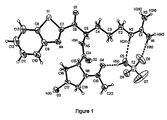
- Figure 1 illustrates a perspective drawing of the solid-state structure for the crystalline sulfate salt of the compound of formula (IIa) (i.e. (2S,4R)-1-Acetyl-N-[(1S)-1-(2-benzothiazolylcarbonyl)-4-[[imino(amino)methyl]amino]butyl]-4-hydroxypyrrolidine-2-carboxamide sulfate salt).
- Nonhydrogen atoms are represented by 50% probability thermal vibration ellipsoids and hydrogen atoms are represented by arbitrarily small spheres that are in no way representative of their true thermal motion.
- halogen shall mean chlorine, bromine, fluorine and iodine.
- alkyl whether used alone or as part of a substituent group, include straight and branched chains having 1 to 8 carbon atoms, or any number within this range.
- alkyl radicals include methyl, ethyl, propyl, isopropyl, butyl, isobutyl, sec-butyl, t-butyl, pentyl and the like.
- alkenyl and alkynyl shall include straight and branched chain alkene and alkyne groups, respectively, having 2 to 8 carbon atoms, or any number within this range.
- alkoxy shall denote an oxygen ether radical of the above described straight or branched chain alkyl groups. For example, methoxy, ethoxy, n-propoxy, sec-butoxy, t-butoxy, n-hexyloxy and the like.
- cycloalkyl denotes groups containing 3 to 8 ring carbon atoms and preferably 5 to 7 ring carbon atoms.
- aryl shall refer to an aromatic group such as phenyl, naphthyl, and the like.
- aralkyl shall mean an alkyl group substituted with an aryl group. Suitable examples include, but are not limited to, benzyl, phenylethyl, naphthylmethyl, and the like.
- aralkyloxy shall mean an alkoxy group substituted with an aryl group. Suitable examples include, but are not limited to, benzyloxy, phenylethoxy, naphthylmethoxy, and the like.
- heteroaryl shall denote any stable five or six membered monocyclic aromatic ring structure or a nine or ten membered benzo-fused heteroaromatic ring system which consists of carbon atoms and from one to six heteroatoms (preferably one to four heteroatoms) selected from N, O or S.
- the heteroaryl group may be attached at any heteroatom or carbon atom which results in the creation of a stable structure.
- heteroaryl groups include, but are not limited to, pyrrolyl, pyridyl, pyrazinyl, pyrimidinyl, pyrazolyl, pyridazinyl, furanyl, imidazolyl, thienyl, oxazolyl, isoxazolyl, thiazolyl, thiadiazolyl, triazolyl, tetrazolyl, purinyl, benzimidazolyl, benzofuranyl, benzothienyl, benzisoxazolyl, benzoxazolyl, benzopyranyl, indolyl, benzothiazolyl, benzothiadiazolyl, benzotriazolyl, quinolinyl, and the like.
- aminoalkyl shall mean an alkyl group substituted with an amino group (i.e. -alkyl-NH 2 ).
- alkylamino shall mean an amino group substituted with an alkyl group (i.e. - NH-alkyl).
- dialkylamino shall mean an amino group substituted with two alkyl groups, wherein the alkyl groups may be the same or different (i.e. -N-(alkyl) 2 ).
- the term “amido” shall mean -C(O)-NH 2 .
- the term “alkylamido” shall mean -C(O)-NH(alkyl) and the term “dialkylamido” shall mean -C(O)-N(alkyl) 2 .
- the term “sulfonamido” shall mean - SO 2 -NH 2 .
- the term “alkylsulfonamido” shall mean - SO 2 -NH(alkyl) and the term “dialkylsulfonamido” shall mean - SO 2 -N(alkyl) 2 .
- diastereomeric ratio shall mean the molar ratio of the (1R) to the (1S) diastereomers of the compound of formula (II) wherein the (1R) and (1S) configurations are at the "*" (starred) stereo-center.
- activating agent or “activating reagent” shall mean an agent or reagent which reacts with a chemical species so that the chemical species undergoes a chemical reaction more rapidly or completely.
- Suitable examples of activating agents or reagents include, but are not limited to CDI, isobutylchloroformate, Ph 2 POCl, a mixture of Ph 2 POCl and PhSH, thionyl chloride (to form the corresponding acid chloride), a lower alkyl alcohol in the presence of an acid (to form the corresponding lower alkyl ester), and the like.
- Other suitable activating agents and methods for using them may be found in texts such as Bodanszky, M., Principles of Peptide Synthesis, 2nd Ed., Springer-Verlag, 1993 .
- aprotic organic solvent shall mean any solvent that does not yield a proton. Suitable examples include, but are not limited to DMF, dioxane, THF, acetonitrile, pyridine, dichloroethane, dichloromethane, MTBE, toluene, and the like.
- the term "leaving group” shall mean a charged or uncharged substituent group on an activated compound which leaves during a substitution or displacement reaction. Suitable examples include, but are not limited to, -Cl, -O-C(O)-O-isobutyl, imidazolyl, -S-phenyl, -S-(2-pyridyl), and the like.
- nitrogen protecting group shall mean a group which may be attached to a nitrogen atom to protect said nitrogen atom from participating in a reaction and which may be readily removed following the reaction.
- oxygen protecting group shall mean a group which may be attached to a oxygen atom to protect said oxygen atom from participating in a reaction and which may be readily removed following the reaction.
- Suitable oxygen protecting groups include, but are not limited to, t-butyl-dimethylsilyl, trimethylsilyl (TMS), MOM, THP, and the like.
- TMS trimethylsilyl
- Other suitable oxygen protecting groups may be found in texts such as T.W. Greene & P.G.M. Wuts, Protective Groups in Organic Synthesis, John Wiley & Sons, 1991 .
- anti-solvent shall refer to a solvent which does not dissolve a specific substance and is added to a solution of said substance, directly or by vapor diffusion, to cause precipitation of said substance.
- substituents e.g., phenyl, aryl, aralkyl, heteroaryl
- that group may have one or more substituents, preferably from one to five, more preferably one to three, most preferably, one to two substituents, independently selected from the list of substituents.
- the inflammatory disorder is an immunomediated inflammatory disorder, more preferably a mast cell mediated inflammatory disorder.
- immunomediated inflammatory disorders include, but are not limited to asthma, allergic rhinitis, rheumatoid arthritis, rheumatoid spondylitis, osteoarthritis, gouty arthritis, arthritic conditions in general (i.e.
- the compound of formula (IIIa) may be reacted with CDI in an aprotic organic solvent such as THF, dioxane, ethyl acetate, and the like, to yield the corresponding compound of formula (IVa) wherein Q 1 is imidazolyl.
- an aprotic organic solvent such as THF, dioxane, ethyl acetate, and the like
- the compound of formula (IIIa) may be reacted with isobutylchloroformate, in the presence of an organic base, preferably in the presence of a tertiary amine base such as diisopropylethylamine, N-methylmorpholine, triethylamine, pyridine, and the like, in a chlorinated solvent such as DCE, DCM, and the like, at a temperature in the range of about -20 to about 10°C, followed by addition of N,O-dimethylhydroxyamine HCl salt and a tertiary amine base such as diisopropylethylamine, N-methylmorpholine, and the like, to yield the corresponding compound of formula (IVa) wherein Q 1 is - N(CH 3 ) (OCH 3 ).
- an organic base preferably in the presence of a tertiary amine base such as diisopropylethylamine, N-methylmorpholine, triethylamine, pyridine
- the compound of formula (IIIa) may be reacted with Ph 2 POCl, in the presence of an organic base, preferably in the presence of a tertiary amine base such as TEA, DIPEA, pyridine, and the like, in an anhydrous, aprotic organic solvent such as THF, dioxane, MTBE, DCM, DCE, and the like, preferably at a temperature in the range of about -20 to about 15°C, to yield the corresponding compound of formula (IVa) wherein Q 1 is -O-POPh 2 .
- an organic base preferably in the presence of a tertiary amine base such as TEA, DIPEA, pyridine, and the like
- aprotic organic solvent such as THF, dioxane, MTBE, DCM, DCE, and the like
- the compound of formula (IVa) is reacted with a solution or suspension of a suitably substituted compound of formula (Va), wherein X is selected from the group consisting of Cl, Br and I; preferably Cl or Br, more preferably Cl; in an anhydrous organic solvent which is inert to the compound of formula (Va) (i.e.
- anhydrous organic solvent which does not react with the compound of formula (Va) such as THF, diethyl ether, glyme, MTBE, and the like; preferably the anhydrous organic solvent which is inert to the compound of formula (Va) is the solvent in which the compound of formula (IVa) was prepared; preferably, the compound of formula (IVa) is added to the compound of formula (Va); preferably, the temperature of the reaction is maintained in the range of about -20°C to about 15°C, more preferably the temperature of the reaction is maintained in the range of about -10 to about 5°C, to yield the corresponding compound of formula (VIa).
- anhydrous organic solvent which is inert to the compound of formula (Va) is the solvent in which the compound of formula (IVa) was prepared; preferably, the compound of formula (IVa) is added to the compound of formula (Va); preferably, the temperature of the reaction is maintained in the range of about -20°C to about 15°C, more preferably the temperature of the
- the compound of formula (VIa) is reacted with an acid such as hydrochloric acid, hydrobromic acid, sulfuric acid, trifluoroacetic acid (TFA), and the like, preferably hydrochloric acid, in an organic solvent such as methanol, ethyl acetate, glyme, THF, and the like, or a mixture thereof, preferably a mixture of methanol and ethyl acetate, to yield the corresponding compound of formula (VIIa) as the acid addition salt.
- an acid such as hydrochloric acid, hydrobromic acid, sulfuric acid, trifluoroacetic acid (TFA), and the like, preferably hydrochloric acid
- organic solvent such as methanol, ethyl acetate, glyme, THF, and the like, or a mixture thereof, preferably a mixture of methanol and ethyl acetate
- the compound of formula (VIa) is redacted with hydrogen gas, in the presence of a catalytic amount of a catalyst such as Pd on carbon, and the like, in the presence of an acid such as hydrochloric acid, sulfuric acid, trifluoroacetic acid, and the like, to yield the corresponding compound of formula (VIIa).
- a catalytic amount of a catalyst such as Pd on carbon, and the like
- an acid such as hydrochloric acid, sulfuric acid, trifluoroacetic acid, and the like
- the compound of formula (VIa) is reacted with a secondary amine base such as piperidine, morpholine, dicyclohexylamine, and the like, preferably piperidine, in an organic solvent such as ethyl acetate, glyme, THF, and the like, to yield the corresponding compound of formula (VIIa).
- a secondary amine base such as piperidine, morpholine, dicyclohexylamine, and the like, preferably piperidine
- organic solvent such as ethyl acetate, glyme, THF, and the like
- Pg 1 is a nitrogen protecting group which may be removed under acidic conditions or under catalytic hydrogenation conditions.
- the compound of formula (VIa) is deprotected under conditions which yield the corresponding compound of formula (VIIa) as an acid addition salt.
- the compound of formula (VIIa) is isolated according to known methods, more preferably, the compound of formula (VIIa) is isolated as an acid addition salt.
- the compound of formula (VIIa), in the form of the free amine is not stable over time. Therefore, it is preferred that the compound of formula (VIIa), as the free amine, is reacted in the next step within a short period of time, e.g. before significant degradation.
- the compound of formula (VIIa) is isolated as an acid addition salt, according to known methods (e.g. by reacting with a suitable acid such as HCl).
- the compound of formula (VIIa) is reacted with a suitably substituted compound of formula (VIIIa), wherein Pg 3 is a suitable oxygen protecting group such as t-butyldimethylsilyl, benzyl, MOM, and the like; preferably t-butyl-dimethylsilyl; and wherein Q 2 is a leaving group such as -O-C(O)-O-isobutyl, imidazolyl, and the like, preferably Q 2 is -O-C(O)-O-isobutyl; in the presence of a tertiary amine base such as DIPEA, TEA, N-methylmorpholine, and the like; in an aprotic organic solvent such as acetonitrile, ethyl acetate, MTBE, THF, and the like, preferably acetonitrile or THF; preferably under anhydrous conditions; preferably, the compound of formula (VIIa) is added to the compound of
- the compound of formula (IXa) is subjected to de-protection to remove the Pg 2 and Pg 3 protecting groups, according to known methods, to yield the corresponding compound of formula (IIa).
- the compound of formula (VIIa) may be reacted with a compound of formula (VIIIb) wherein Q 2 is a leaving group, such as -O-C(O)-O-isobutyl, imidazolyl, and the like, preferably Q 2 is -O-C(O)-O-isobutyl, a known compound or compound prepared by known methods; an aprotic organic solvent such as acetonitrile, ethyl acetate, MTBE, THF, and the like; preferably under anhydrous conditions; preferably in acetonitrile or water; preferably, the compound of formula (VIIa) is added to the compound of formula (VIIIb); wherein the temperature of the reaction is maintained in the range of about -20°C to about 15°C; to yield the corresponding compound of formula (IXc)
- Q 2 is a leaving group, such as -O-C(O)-O-isobutyl, imidazolyl, and the like,
- the compound of formula (IXc) is then subjected to de-protection to remove the Pg 2 protecting group according to known methods, to yield the corresponding compound of formula (IIa).
- the present invention is further directed to a process for the preparation of the compound of formula (IIa), as outlined in Scheme 7.
- a suitably substituted compound of formula (IIIa) wherein Pg 1 is a first suitable nitrogen protecting group such as t-butoxycarbonyl (BOC), benzyloxycarbonyl (CBz), N-(9-fluorenylmethoxycarbonyl) (Fmoc) and the like, preferably BOC; and Pg 2 is a second suitably nitrogen protecting group such as 4-methoxy-2,3,6-trimethyl-phenylsulfonyl (MTr), benzyloxycarbonyl (CBz), p-toluene-sulfonyl, t-butoxycarbonyl (BOC) and the like, preferably CBz; and wherein Pg 1 and Pg 2 are selected such that the Pg 1 protecting group may be removed under conditions which do not remove the Pg 2 protecting group; a known compound or compound prepared by known methods; is reacted with an activating agent capable of cyclizing the compound of formula (IIIa), such as isobutyl
- the compound of formula (IIIa) is reacted with isobutylchloroformate, a known compound, in an organic solvent such as THF, diethyl ether, glyme, MTBE, ethyl acetate, methylene chloride, and the like; or a mixture of an organic solvent and water, such as a 1:1 mixture of THF:water, and the like; in the presence of an organic amine base, preferably a tertiary amine base such as TEA, DIPEA, pyridine, and the like; preferably at a temperature in the range of about -15 to about 10°C, more preferably at a temperature in the range of -5 and 5°C; to yield the corresponding compound of formula (XIa).
- organic solvent such as THF, diethyl ether, glyme, MTBE, ethyl acetate, methylene chloride, and the like
- a mixture of an organic solvent and water such as a 1:1 mixture of THF:
- the compound of formula (IIIa) is reacted with SOCl 2 , in an aprotic organic solvent which is inert to the compound of formula (IIIa) such as DCM.
- DCE, toluene, and the like preferably at a temperature in the range of about -20 to about 15°C, more preferably at a temperature in the range of about -5 to about 5°C, to yield the corresponding compound of formula (XIa).
- the compound of formula (IIIa) is reacted with 2,4,6-trifluoro-[1,3,5]triazine (also known as cyanuric fluoride), in an aprotic organic solvent which is inert to the compound of formula (IIIa) such as DCM.
- DCE, toluene, and the like preferably at a temperature in the range of about -20 to about 15°C, more preferably at a temperature in the range of about -5 to about 5°C, to yield the corresponding compound of formula (XIa).
- the compound of formula (XIa) is reacted with a solution or suspension of a suitably substituted compound of formula (Va), wherein X is selected from the group consisting of Cl, Br and I; preferably Cl or Br, more preferably Cl, a known compound or compound prepared by known methods; in an anhydrous organic solvent which is inert to the compound of formula (Va) (i.e.
- anhydrous organic solvent which does not react with the compound of formula (Va) such as THF, diethyl ether, glyme, MTBE, and the like; preferably the anhydrous organic solvent which is inert to the compound of formula (Va) is the solvent in which the compound of formula (XIa) was prepared; preferably, the compound of formula (XIa) is added to the compound of formula (Va); preferably, the temperature of the reaction is maintained in the range of about -20°C to about 15°C, more preferably the temperature of the reaction is maintained in the range of about -10 to about 0°C, more preferably still, the temperature of the reaction is maintained in the range of about -10 to about -5°C; to yield the corresponding compound of formula (VIa).
- anhydrous organic solvent which is inert to the compound of formula (Va) is the solvent in which the compound of formula (XIa) was prepared; preferably, the compound of formula (XIa) is added to the compound of formula (Va);
- the compound of formula (VIa) is reacted with an acid such as hydrochloric acid, hydrobromic acid, sulfuric acid, trifluoroacetic acid (TFA), and the like, preferably hydrochloric acid, in an organic solvent such as methanol, ethyl acetate, glyme, THF, and the like, or a mixture thereof, preferably a mixture of methanol and ethyl acetate, to yield the corresponding compound of formula (VIIa) as the acid addition salt.
- an acid such as hydrochloric acid, hydrobromic acid, sulfuric acid, trifluoroacetic acid (TFA), and the like, preferably hydrochloric acid
- organic solvent such as methanol, ethyl acetate, glyme, THF, and the like, or a mixture thereof, preferably a mixture of methanol and ethyl acetate
- the compound of formula (VIa) is reacted with hydrogen gas, in the presence of a catalytic amount of a catalyst such as Pd on carbon, and the like, in the presence of an acid such as hydrochloric acid, sulfuric acid, trifluoroacetic acid, and the like, to yield the corresponding compound of formula (VIIa).
- a catalytic amount of a catalyst such as Pd on carbon, and the like
- an acid such as hydrochloric acid, sulfuric acid, trifluoroacetic acid, and the like
- the compound of formula (VIa) is reacted with a secondary amine base such as piperidine, morpholine, dicyclohexylamine, and the like, preferably piperidine, in an organic solvent such as ethyl acetate, glyme, THF, and the like, to yield the corresponding compound of formula (VIIa).
- a secondary amine base such as piperidine, morpholine, dicyclohexylamine, and the like, preferably piperidine
- organic solvent such as ethyl acetate, glyme, THF, and the like
- Pg 1 is a nitrogen protecting group which may be removed under acidic conditions or under catalytic hydrogenation conditions.
- the compound of formula (VIa) is deprotected under conditions which yield the corresponding compound of formula (VIIa) as an acid addition salt.
- the compound of formula (VIIa) is isolated according to known methods, more preferably, the compound of formula (VIIa) is isolated as an acid addition salt.
- the compound of formula (VIIa), in the form of the free amine is not stable over time. Therefore, it is preferred that the compound of formula (VIIa), as the free amine, is reacted in the next step within a short period of time, e.g. before significant degradation.
- the compound of formula (VIIa) is isolated as an acid addition salt, according to known methods (e.g. by reacting with a suitable acid such as HCl).
- the compound of formula (VIIa) is reacted with a compound of formula (VIIIb), wherein Q 2 is a leaving group such as -O-C(O)-O-isobutyl, imidazolyl, and the like, preferably Q 2 is -O-C(O)-O-isobutyl, a known compound or compound prepared by known methods; in an aprotic organic solvent such as acetonitrile, ethyl acetate, MTBE, THF, and the like, preferably acetonitrile or THF; preferably under anhydrous conditions; preferably, the compound of formula (VIIIb) is added to the compound of formula (VIIa); preferably, the temperature of the reaction is maintained in the range of about -20°C to about 15°C, more preferably the temperature of the reaction is maintained in the range of about -15 to about 0°C; to yield the corresponding compound of formula (IXc).
- Q 2 is a leaving group such as -O-C
- Suitable protecting groups include, but are not limited to silyl containing protecting group such as t-butyl-dimethyl-silyl, and the like; a benzyl group; a MOM group; and the like.
- the protecting group is t-butyl-dimethyl-silyl.
- the compound of formula (IXc) is subjected to de-protection to remove the Pg 2 protecting group (and wherein the compound of formula (VIIIb) is protected, the oxygen protecting group) according to known methods, to yield the corresponding compound of formula (IIa).
- the compound of formula (IIa) is preferably isolated by known methods, for example by column chromatography, by crystallization, by recrystallization, and the like.
- the compound of formula (IIa) may be reacted with a suitable acid such as hydrochloric, trifluoroacetic, nitric, sulfuric, and the like, in an organic solvent or mixture thereof such as methanol, acetonitrile, ethanol, 1-butanol, acetone, IPA, THF, methanol/IPA, methanol/THF, and the like, to form the corresponding acid addition salt of the compound of formula (IIa).
- a suitable acid such as hydrochloric, trifluoroacetic, nitric, sulfuric, and the like
- organic solvent or mixture thereof such as methanol, acetonitrile, ethanol, 1-butanol, acetone, IPA, THF, methanol/IPA, methanol/THF, and the like
- the processes for the preparation of the compounds according to the invention give rise to mixture of stereoisomers
- these isomers may be separated by conventional techniques such as preparative chromatography.
- the compounds may be prepared in racemic form, or individual enantiomers may be prepared either by enantiospecific synthesis or by resolution.
- the compounds may, for example, be resolved into their component enantiomers by standard techniques, such as the formation of diastereomeric pairs by salt formation with an optically active acid, such as (-)-di-p-toluoyl-d-tartaric acid and/or (+)-di-p-toluoyl-1-tartaric acid followed by fractional crystallization and regeneration of the free base.
- the compounds may also be resolved by formation of diastereomeric esters or amides, followed by chromatographic separation and removal of the chiral auxiliary. Alternatively, the compounds may be resolved using a chiral or an enatioselective HPLC column.
- any of the processes for preparation of the compounds of the present invention it may be necessary and/or desirable to protect sensitive or reactive groups on any of the molecules concerned. This may be achieved by means of conventional protecting groups, such as those described in Protective Groups in Organic Chemistry, ed. J.F.W. McOmie, Plenum Press, 1973 ; and T.W. Greene & P.G.M. Wuts, Protective Groups in Organic Synthesis, John Wiley & Sons, 1991 .
- the protecting groups may be removed at a convenient subsequent stage using methods known from the art.
- N-(4-Amino-5-benzothiazol-2-yl-5-oxo-pentyl)-guanidine (1.06 g, 3.6 mmol) was dissolved in THF (20 mL) and water (5 mL). To the reaction mixture was added hydroxyl acetyl proline (0.63 g, 3.6 mmol) to yield a pH 1.2 solution, which was cooled to 0°C. To the reaction mixture was then added 4% of NaHCO 3 (3.5 mL) to adjust the solution pH to 6.
- the crude reaction mixture was purified by reverse phase chromatography (Kromasil C18 eluted with the gradient of 5 to 22% in 30 min of acetonitrile in a mixture of acetonitrile and water with 0.1 % TFA) to yield the TFA salt of 1-acetyl-4-hydroxy-pyrrolidine-2-carboxylic acid [1-(benzothiazole-2-carbonyl)-4-guanidino-butyl]-amide.
Landscapes
- Health & Medical Sciences (AREA)
- Chemical & Material Sciences (AREA)
- Organic Chemistry (AREA)
- General Health & Medical Sciences (AREA)
- Animal Behavior & Ethology (AREA)
- Veterinary Medicine (AREA)
- Chemical Kinetics & Catalysis (AREA)
- General Chemical & Material Sciences (AREA)
- Medicinal Chemistry (AREA)
- Nuclear Medicine, Radiotherapy & Molecular Imaging (AREA)
- Public Health (AREA)
- Pharmacology & Pharmacy (AREA)
- Life Sciences & Earth Sciences (AREA)
- Bioinformatics & Cheminformatics (AREA)
- Engineering & Computer Science (AREA)
- Dermatology (AREA)
- Pulmonology (AREA)
- Heart & Thoracic Surgery (AREA)
- Cardiology (AREA)
- Ophthalmology & Optometry (AREA)
- Pain & Pain Management (AREA)
- Rheumatology (AREA)
- Pharmaceuticals Containing Other Organic And Inorganic Compounds (AREA)
- Medicines That Contain Protein Lipid Enzymes And Other Medicines (AREA)
- Peptides Or Proteins (AREA)
- Epoxy Compounds (AREA)
- Plural Heterocyclic Compounds (AREA)
- Organic Low-Molecular-Weight Compounds And Preparation Thereof (AREA)
- Acyclic And Carbocyclic Compounds In Medicinal Compositions (AREA)
- Hydrogenated Pyridines (AREA)
Claims (2)
- Verfahren für die Herstellung einer Verbindung der Formel (IIa)


- Verfahren für die Herstellung einer Verbindung der Formel (IIa)


Applications Claiming Priority (3)
| Application Number | Priority Date | Filing Date | Title |
|---|---|---|---|
| US49264603P | 2003-08-05 | 2003-08-05 | |
| US56637404P | 2004-04-29 | 2004-04-29 | |
| PCT/US2004/025143 WO2005023804A1 (en) | 2003-08-05 | 2004-08-02 | Peptidyl heterocyclic ketone derivatives and preparation processes |
Publications (2)
| Publication Number | Publication Date |
|---|---|
| EP1660493A1 EP1660493A1 (de) | 2006-05-31 |
| EP1660493B1 true EP1660493B1 (de) | 2008-10-08 |
Family
ID=34278487
Family Applications (1)
| Application Number | Title | Priority Date | Filing Date |
|---|---|---|---|
| EP04780047A Expired - Lifetime EP1660493B1 (de) | 2003-08-05 | 2004-08-02 | Heterocyclische peptidylketonderivate und herstellungsverfahren |
Country Status (8)
| Country | Link |
|---|---|
| US (1) | US7205384B2 (de) |
| EP (1) | EP1660493B1 (de) |
| JP (1) | JP2007501250A (de) |
| AT (1) | ATE410425T1 (de) |
| AU (1) | AU2004270648A1 (de) |
| DE (1) | DE602004017023D1 (de) |
| ES (1) | ES2314449T3 (de) |
| WO (1) | WO2005023804A1 (de) |
Families Citing this family (6)
| Publication number | Priority date | Publication date | Assignee | Title |
|---|---|---|---|---|
| CN101443348A (zh) | 2006-05-23 | 2009-05-27 | Irm责任有限公司 | 作为通道活化蛋白酶抑制剂的化合物和组合物 |
| US7951823B2 (en) * | 2006-05-23 | 2011-05-31 | Irm Llc | Compounds and compositions as channel activating protease inhibitors |
| EA016327B1 (ru) | 2007-02-09 | 2012-04-30 | Айрм Ллк | Соединения и композиции в качестве ингибиторов протеазы, активирующей каналы |
| MX378266B (es) | 2014-10-06 | 2025-03-10 | Lighthouse Pharmaceuticals Inc | Inhibidores de gingipaina de lisina. |
| CN108602787A (zh) | 2015-11-09 | 2018-09-28 | 库特克希米公司 | 精氨酸牙龈卟啉菌蛋白酶的抑制剂 |
| CN109983012B (zh) | 2016-09-16 | 2023-12-01 | 莱特豪斯制药公司 | 赖氨酸牙龈蛋白酶的酮抑制剂 |
Family Cites Families (2)
| Publication number | Priority date | Publication date | Assignee | Title |
|---|---|---|---|---|
| NZ332740A (en) | 1996-06-18 | 2000-05-26 | Warner Lambert Co | heterocyclically substituted carbamate or sulphonamide derivatives |
| CZ20012722A3 (cs) | 1999-01-27 | 2002-08-14 | Ortho-Mcneil Pharmaceutical, Inc. | Peptidylové heterocyklické ketony pouľitelné jako inhibitory typtasy |
-
2004
- 2004-07-29 US US10/902,755 patent/US7205384B2/en not_active Expired - Fee Related
- 2004-08-02 JP JP2006522693A patent/JP2007501250A/ja not_active Withdrawn
- 2004-08-02 WO PCT/US2004/025143 patent/WO2005023804A1/en not_active Ceased
- 2004-08-02 AT AT04780047T patent/ATE410425T1/de not_active IP Right Cessation
- 2004-08-02 DE DE602004017023T patent/DE602004017023D1/de not_active Expired - Fee Related
- 2004-08-02 ES ES04780047T patent/ES2314449T3/es not_active Expired - Lifetime
- 2004-08-02 EP EP04780047A patent/EP1660493B1/de not_active Expired - Lifetime
- 2004-08-02 AU AU2004270648A patent/AU2004270648A1/en not_active Abandoned
Also Published As
| Publication number | Publication date |
|---|---|
| US7205384B2 (en) | 2007-04-17 |
| EP1660493A1 (de) | 2006-05-31 |
| US20050059607A1 (en) | 2005-03-17 |
| ATE410425T1 (de) | 2008-10-15 |
| WO2005023804A1 (en) | 2005-03-17 |
| ES2314449T3 (es) | 2009-03-16 |
| JP2007501250A (ja) | 2007-01-25 |
| DE602004017023D1 (de) | 2008-11-20 |
| AU2004270648A1 (en) | 2005-03-17 |
Similar Documents
| Publication | Publication Date | Title |
|---|---|---|
| CA2440559C (en) | Novel non-imidazole compounds | |
| EP3199517B1 (de) | Neprilysininhibitoren | |
| EP0974576B1 (de) | Verfahren zur Herstellung von Benzamid-Derivaten | |
| EP3376870B1 (de) | Verfahren zur herstellung von kinaseinhibitoren und zwischenprodukten davon | |
| EP2380877A1 (de) | Pyridin-3-carbons?ureamidderivat | |
| EP2593429A1 (de) | Verfahren zur herstellung einer biphenyl-2-yl-carbaminsäure | |
| CN103254213A (zh) | 类美登素酯的制备方法及用于所述方法的组合物 | |
| US20170204065A1 (en) | Process for the preparation of kinase inhibitors and intermediates thereof | |
| JP2008533141A (ja) | オピオイド調節物質の製造方法 | |
| WO2009082526A2 (en) | Ortho pyrrolidine, benzyl-substituted heterocycle ccr1 antagonists for autoimmune diseases & inflammation | |
| EP1660493B1 (de) | Heterocyclische peptidylketonderivate und herstellungsverfahren | |
| EP2483246B1 (de) | Verfahren zur herstellung von biphenylimidazolverbindungen | |
| US20240262805A1 (en) | Method for producing compound or pharmaceutically acceptable salt thereof | |
| JP2019524750A (ja) | 置換n−[2−(4−フェノキシピペリジン−1−イル)−2−(1,3−チアゾール−5−イル)エチル]ベンズアミドおよびn−[2−(4−ベンジルオキシピペリジン−1−イル)−2−(1,3−チアゾール−5−イル)エチル]ベンズアミド誘導体p2x7受容体アンタゴニスト | |
| KR20030050412A (ko) | 레바미피드의 제조방법 | |
| TW202237594A (zh) | 製造5-(4-((2s,5s)-5-(4-氯芐基)-2-甲基嗎啉基)哌啶-1-基)-1h-1,2,4-三唑-3-胺的方法 | |
| AU2022433635B2 (en) | Synthetic intermediates and improved processes for preparing rock inhibitors | |
| AU2010310653A1 (en) | Processes for preparing a polymeric compound | |
| JP2000095780A (ja) | カーバメート体類結晶の製造方法 | |
| HK40111936A (en) | Method for producing compound or pharmaceutically acceptable salt thereof | |
| WO2001002364A1 (en) | New npy antagonists | |
| CA2996819C (en) | Non-steroidal glucocorticoid receptor modulators for local drug delivery | |
| CN120289428A (zh) | 一种1-氧代异吲哚啉衍生物及其应用 | |
| KR20250113239A (ko) | 멜라노코르틴-4 수용체 효능제의 제조방법 | |
| KR100360181B1 (ko) | 시사프라이드의 제조방법 및 이에 사용되는 중간체 |
Legal Events
| Date | Code | Title | Description |
|---|---|---|---|
| PUAI | Public reference made under article 153(3) epc to a published international application that has entered the european phase |
Free format text: ORIGINAL CODE: 0009012 |
|
| 17P | Request for examination filed |
Effective date: 20060303 |
|
| AK | Designated contracting states |
Kind code of ref document: A1 Designated state(s): AT BE BG CH CY CZ DE DK EE ES FI FR GB GR HU IE IT LI LU MC NL PL PT RO SE SI SK TR |
|
| DAX | Request for extension of the european patent (deleted) | ||
| 17Q | First examination report despatched |
Effective date: 20061208 |
|
| GRAP | Despatch of communication of intention to grant a patent |
Free format text: ORIGINAL CODE: EPIDOSNIGR1 |
|
| GRAS | Grant fee paid |
Free format text: ORIGINAL CODE: EPIDOSNIGR3 |
|
| GRAA | (expected) grant |
Free format text: ORIGINAL CODE: 0009210 |
|
| AK | Designated contracting states |
Kind code of ref document: B1 Designated state(s): AT BE BG CH CY CZ DE DK EE ES FI FR GB GR HU IE IT LI LU MC NL PL PT RO SE SI SK TR |
|
| REG | Reference to a national code |
Ref country code: GB Ref legal event code: FG4D |
|
| REG | Reference to a national code |
Ref country code: CH Ref legal event code: EP |
|
| REG | Reference to a national code |
Ref country code: IE Ref legal event code: FG4D |
|
| REF | Corresponds to: |
Ref document number: 602004017023 Country of ref document: DE Date of ref document: 20081120 Kind code of ref document: P |
|
| PG25 | Lapsed in a contracting state [announced via postgrant information from national office to epo] |
Ref country code: SI Free format text: LAPSE BECAUSE OF FAILURE TO SUBMIT A TRANSLATION OF THE DESCRIPTION OR TO PAY THE FEE WITHIN THE PRESCRIBED TIME-LIMIT Effective date: 20081008 |
|
| REG | Reference to a national code |
Ref country code: ES Ref legal event code: FG2A Ref document number: 2314449 Country of ref document: ES Kind code of ref document: T3 |
|
| NLV1 | Nl: lapsed or annulled due to failure to fulfill the requirements of art. 29p and 29m of the patents act | ||
| PG25 | Lapsed in a contracting state [announced via postgrant information from national office to epo] |
Ref country code: AT Free format text: LAPSE BECAUSE OF FAILURE TO SUBMIT A TRANSLATION OF THE DESCRIPTION OR TO PAY THE FEE WITHIN THE PRESCRIBED TIME-LIMIT Effective date: 20081008 Ref country code: BG Free format text: LAPSE BECAUSE OF FAILURE TO SUBMIT A TRANSLATION OF THE DESCRIPTION OR TO PAY THE FEE WITHIN THE PRESCRIBED TIME-LIMIT Effective date: 20090108 |
|
| PG25 | Lapsed in a contracting state [announced via postgrant information from national office to epo] |
Ref country code: FI Free format text: LAPSE BECAUSE OF FAILURE TO SUBMIT A TRANSLATION OF THE DESCRIPTION OR TO PAY THE FEE WITHIN THE PRESCRIBED TIME-LIMIT Effective date: 20081008 Ref country code: NL Free format text: LAPSE BECAUSE OF FAILURE TO SUBMIT A TRANSLATION OF THE DESCRIPTION OR TO PAY THE FEE WITHIN THE PRESCRIBED TIME-LIMIT Effective date: 20081008 Ref country code: PL Free format text: LAPSE BECAUSE OF FAILURE TO SUBMIT A TRANSLATION OF THE DESCRIPTION OR TO PAY THE FEE WITHIN THE PRESCRIBED TIME-LIMIT Effective date: 20081008 Ref country code: PT Free format text: LAPSE BECAUSE OF FAILURE TO SUBMIT A TRANSLATION OF THE DESCRIPTION OR TO PAY THE FEE WITHIN THE PRESCRIBED TIME-LIMIT Effective date: 20090218 |
|
| PG25 | Lapsed in a contracting state [announced via postgrant information from national office to epo] |
Ref country code: BE Free format text: LAPSE BECAUSE OF FAILURE TO SUBMIT A TRANSLATION OF THE DESCRIPTION OR TO PAY THE FEE WITHIN THE PRESCRIBED TIME-LIMIT Effective date: 20081008 Ref country code: EE Free format text: LAPSE BECAUSE OF FAILURE TO SUBMIT A TRANSLATION OF THE DESCRIPTION OR TO PAY THE FEE WITHIN THE PRESCRIBED TIME-LIMIT Effective date: 20081008 Ref country code: RO Free format text: LAPSE BECAUSE OF FAILURE TO SUBMIT A TRANSLATION OF THE DESCRIPTION OR TO PAY THE FEE WITHIN THE PRESCRIBED TIME-LIMIT Effective date: 20081008 Ref country code: DK Free format text: LAPSE BECAUSE OF FAILURE TO SUBMIT A TRANSLATION OF THE DESCRIPTION OR TO PAY THE FEE WITHIN THE PRESCRIBED TIME-LIMIT Effective date: 20081008 |
|
| PLBE | No opposition filed within time limit |
Free format text: ORIGINAL CODE: 0009261 |
|
| STAA | Information on the status of an ep patent application or granted ep patent |
Free format text: STATUS: NO OPPOSITION FILED WITHIN TIME LIMIT |
|
| PG25 | Lapsed in a contracting state [announced via postgrant information from national office to epo] |
Ref country code: CZ Free format text: LAPSE BECAUSE OF FAILURE TO SUBMIT A TRANSLATION OF THE DESCRIPTION OR TO PAY THE FEE WITHIN THE PRESCRIBED TIME-LIMIT Effective date: 20081008 Ref country code: SE Free format text: LAPSE BECAUSE OF FAILURE TO SUBMIT A TRANSLATION OF THE DESCRIPTION OR TO PAY THE FEE WITHIN THE PRESCRIBED TIME-LIMIT Effective date: 20090108 |
|
| 26N | No opposition filed |
Effective date: 20090709 |
|
| PG25 | Lapsed in a contracting state [announced via postgrant information from national office to epo] |
Ref country code: SK Free format text: LAPSE BECAUSE OF FAILURE TO SUBMIT A TRANSLATION OF THE DESCRIPTION OR TO PAY THE FEE WITHIN THE PRESCRIBED TIME-LIMIT Effective date: 20081008 |
|
| PG25 | Lapsed in a contracting state [announced via postgrant information from national office to epo] |
Ref country code: MC Free format text: LAPSE BECAUSE OF NON-PAYMENT OF DUE FEES Effective date: 20090831 |
|
| REG | Reference to a national code |
Ref country code: CH Ref legal event code: PL |
|
| GBPC | Gb: european patent ceased through non-payment of renewal fee |
Effective date: 20090802 |
|
| PG25 | Lapsed in a contracting state [announced via postgrant information from national office to epo] |
Ref country code: LI Free format text: LAPSE BECAUSE OF NON-PAYMENT OF DUE FEES Effective date: 20090831 Ref country code: CH Free format text: LAPSE BECAUSE OF NON-PAYMENT OF DUE FEES Effective date: 20090831 |
|
| REG | Reference to a national code |
Ref country code: FR Ref legal event code: ST Effective date: 20100430 |
|
| REG | Reference to a national code |
Ref country code: IE Ref legal event code: MM4A |
|
| PG25 | Lapsed in a contracting state [announced via postgrant information from national office to epo] |
Ref country code: FR Free format text: LAPSE BECAUSE OF NON-PAYMENT OF DUE FEES Effective date: 20090831 Ref country code: IE Free format text: LAPSE BECAUSE OF NON-PAYMENT OF DUE FEES Effective date: 20090802 Ref country code: DE Free format text: LAPSE BECAUSE OF NON-PAYMENT OF DUE FEES Effective date: 20100302 |
|
| REG | Reference to a national code |
Ref country code: ES Ref legal event code: FD2A Effective date: 20090803 |
|
| PG25 | Lapsed in a contracting state [announced via postgrant information from national office to epo] |
Ref country code: GR Free format text: LAPSE BECAUSE OF FAILURE TO SUBMIT A TRANSLATION OF THE DESCRIPTION OR TO PAY THE FEE WITHIN THE PRESCRIBED TIME-LIMIT Effective date: 20090109 |
|
| PG25 | Lapsed in a contracting state [announced via postgrant information from national office to epo] |
Ref country code: GB Free format text: LAPSE BECAUSE OF NON-PAYMENT OF DUE FEES Effective date: 20090802 |
|
| PG25 | Lapsed in a contracting state [announced via postgrant information from national office to epo] |
Ref country code: IT Free format text: LAPSE BECAUSE OF NON-PAYMENT OF DUE FEES Effective date: 20090802 |
|
| PG25 | Lapsed in a contracting state [announced via postgrant information from national office to epo] |
Ref country code: LU Free format text: LAPSE BECAUSE OF NON-PAYMENT OF DUE FEES Effective date: 20090802 |
|
| PG25 | Lapsed in a contracting state [announced via postgrant information from national office to epo] |
Ref country code: HU Free format text: LAPSE BECAUSE OF FAILURE TO SUBMIT A TRANSLATION OF THE DESCRIPTION OR TO PAY THE FEE WITHIN THE PRESCRIBED TIME-LIMIT Effective date: 20090409 |
|
| PG25 | Lapsed in a contracting state [announced via postgrant information from national office to epo] |
Ref country code: TR Free format text: LAPSE BECAUSE OF FAILURE TO SUBMIT A TRANSLATION OF THE DESCRIPTION OR TO PAY THE FEE WITHIN THE PRESCRIBED TIME-LIMIT Effective date: 20081008 |
|
| PG25 | Lapsed in a contracting state [announced via postgrant information from national office to epo] |
Ref country code: CY Free format text: LAPSE BECAUSE OF FAILURE TO SUBMIT A TRANSLATION OF THE DESCRIPTION OR TO PAY THE FEE WITHIN THE PRESCRIBED TIME-LIMIT Effective date: 20081008 |
|
| PG25 | Lapsed in a contracting state [announced via postgrant information from national office to epo] |
Ref country code: ES Free format text: LAPSE BECAUSE OF NON-PAYMENT OF DUE FEES Effective date: 20090803 |