EP1660559B1 - Nouvelle approche permettant de reduire la formation de composes cycliques lors de la production de polyetherimides - Google Patents
Nouvelle approche permettant de reduire la formation de composes cycliques lors de la production de polyetherimides Download PDFInfo
- Publication number
- EP1660559B1 EP1660559B1 EP04756509A EP04756509A EP1660559B1 EP 1660559 B1 EP1660559 B1 EP 1660559B1 EP 04756509 A EP04756509 A EP 04756509A EP 04756509 A EP04756509 A EP 04756509A EP 1660559 B1 EP1660559 B1 EP 1660559B1
- Authority
- EP
- European Patent Office
- Prior art keywords
- bis
- chlorophthalimido
- group
- diamine
- toluene
- Prior art date
- Legal status (The legal status is an assumption and is not a legal conclusion. Google has not performed a legal analysis and makes no representation as to the accuracy of the status listed.)
- Expired - Lifetime
Links
- WZCQRUWWHSTZEM-UHFFFAOYSA-N Nc1cc(N)ccc1 Chemical compound Nc1cc(N)ccc1 WZCQRUWWHSTZEM-UHFFFAOYSA-N 0.000 description 1
Images

Classifications
-
- C—CHEMISTRY; METALLURGY
- C07—ORGANIC CHEMISTRY
- C07D—HETEROCYCLIC COMPOUNDS
- C07D209/00—Heterocyclic compounds containing five-membered rings, condensed with other rings, with one nitrogen atom as the only ring hetero atom
- C07D209/02—Heterocyclic compounds containing five-membered rings, condensed with other rings, with one nitrogen atom as the only ring hetero atom condensed with one carbocyclic ring
- C07D209/44—Iso-indoles; Hydrogenated iso-indoles
- C07D209/48—Iso-indoles; Hydrogenated iso-indoles with oxygen atoms in positions 1 and 3, e.g. phthalimide
-
- C—CHEMISTRY; METALLURGY
- C08—ORGANIC MACROMOLECULAR COMPOUNDS; THEIR PREPARATION OR CHEMICAL WORKING-UP; COMPOSITIONS BASED THEREON
- C08G—MACROMOLECULAR COMPOUNDS OBTAINED OTHERWISE THAN BY REACTIONS ONLY INVOLVING UNSATURATED CARBON-TO-CARBON BONDS
- C08G73/00—Macromolecular compounds obtained by reactions forming a linkage containing nitrogen with or without oxygen or carbon in the main chain of the macromolecule, not provided for in groups C08G12/00 - C08G71/00
-
- C—CHEMISTRY; METALLURGY
- C08—ORGANIC MACROMOLECULAR COMPOUNDS; THEIR PREPARATION OR CHEMICAL WORKING-UP; COMPOSITIONS BASED THEREON
- C08G—MACROMOLECULAR COMPOUNDS OBTAINED OTHERWISE THAN BY REACTIONS ONLY INVOLVING UNSATURATED CARBON-TO-CARBON BONDS
- C08G73/00—Macromolecular compounds obtained by reactions forming a linkage containing nitrogen with or without oxygen or carbon in the main chain of the macromolecule, not provided for in groups C08G12/00 - C08G71/00
- C08G73/06—Polycondensates having nitrogen-containing heterocyclic rings in the main chain of the macromolecule
- C08G73/10—Polyimides; Polyester-imides; Polyamide-imides; Polyamide acids or similar polyimide precursors
- C08G73/12—Unsaturated polyimide precursors
-
- C—CHEMISTRY; METALLURGY
- C08—ORGANIC MACROMOLECULAR COMPOUNDS; THEIR PREPARATION OR CHEMICAL WORKING-UP; COMPOSITIONS BASED THEREON
- C08G—MACROMOLECULAR COMPOUNDS OBTAINED OTHERWISE THAN BY REACTIONS ONLY INVOLVING UNSATURATED CARBON-TO-CARBON BONDS
- C08G73/00—Macromolecular compounds obtained by reactions forming a linkage containing nitrogen with or without oxygen or carbon in the main chain of the macromolecule, not provided for in groups C08G12/00 - C08G71/00
- C08G73/06—Polycondensates having nitrogen-containing heterocyclic rings in the main chain of the macromolecule
- C08G73/10—Polyimides; Polyester-imides; Polyamide-imides; Polyamide acids or similar polyimide precursors
- C08G73/12—Unsaturated polyimide precursors
- C08G73/124—Unsaturated polyimide precursors the unsaturated precursors containing oxygen in the form of ether bonds in the main chain
Definitions
- the present disclosure is directed to methods for reducing the levels of cyclic oligomers produced during the formation of polyetherimide resins. More particularly, sterically hindered substituted aromatic diamines are utilized which result in lower formation of undesirable cyclic oligomer by-products. Polyetherimides produced in accordance with the methods disclosed herein are also provided.
- Aromatic polyethers are important engineering resins because of their excellent properties.
- One route for the synthesis of these polymers is by the reaction of salts of dihydroxyaromatic compounds, such as bisphenol A disodium salt (BPA.Na 2 ), with dihaloaromatic molecules.
- BPA.Na 2 bisphenol A disodium salt
- polyetherimides are conveniently prepared by the reaction of salts of dihydroxyaromatic compounds with bis(halophthalimides) as illustrated by 1,3-bis[N-(4-chlorophthalimido)]benzene (hereinafter sometimes "CIPAMI”), which has the structure:
- the bis(halophthalimides), in turn, are frequently produced by reacting at least one diamino compound, preferably an aromatic diamine such as m-phenylenediamine (mPD) or p-phenylenediamine (pPD), and at least one halophthalic anhydride such as 3-chlorophthalic anhydride (3-CIPA), 4-chlorophthalic anhydride (4-CIPA), dichlorophthalic anhydride, or mixtures thereof.
- mPD m-phenylenediamine
- pPD p-phenylenediamine
- halophthalic anhydride such as 3-chlorophthalic anhydride (3-CIPA), 4-chlorophthalic anhydride (4-CIPA), dichlorophthalic anhydride, or mixtures thereof.
- the preparation of aromatic polyethers may be conducted in solution in relatively non-polar solvents, using a phase transfer catalyst which is substantially stable under the temperature conditions employed.
- Solvents disclosed in U.S. Pat. No. 5,229,482 include o-dichlorobenzene, dichlorotoluene, 1,2,4-trichlorobenzene and diphenyl sulfone.
- monoalkoxybenzenes such as anisole, diphenylether, or phenetole are employed.
- Solvents of the same types may be used for the preparation of the bis(halophthalimide) intermediates.
- the polyetherimides produced by these displacement polymerizations have a relatively high polydispersivity, ranging from about 2.6 to about 3.6, depending upon the amount of 3-CIPA and 4-CIPA used in preparing the CIPAMI monomer.
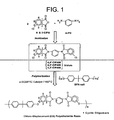
- the general scheme for the production of bis(halophthalimide) and the subsequent production of polyetherimide is set forth in Figure 1 .
- High levels of these cyclic oligomers can have adverse effects on the properties of the resulting polymer.
- Such negative effects include a lower glass transition temperature (Tg), reduced ductility, and problems with processing including surface appearance, as demonstrated by reduced glossiness.
- 3-CIPA in combination with other bisphenols and diamines can produce polyetherimides possessing higher Tg (about 15° to about 20° C higher), and improved flow at high shear. It is therefore desirable to use 3-CIPA as a starting material, at least in part, in the production of polyetherimides, but means for reducing the levels of cyclic oligomers are desirable.
- the present disclosure provides a method for producing bis(phthalimides) which, in turn, may be utilized to produce polyetherimide resins with decreased amounts of undesirable cyclic oligomer by-products.
- an imidization catalyst is added to enhance production of the bis(halophthalimide).
- the bis(halophthalimide) is a bis[N-(3-chlorophtalimide)] derivative of a diamine made by contacting at a temperature of at least 110 °C. a 3-chlorophthalic anhydride with a 1,3-diamine having at least one substituent ortho to one of its amine functionalities in the presence of an organic liquid selected from the group consisting of o-dichlorobenzene, dichlorotoluene, 1,2,4-trichlorobenzene, diphenyl sulfone, anisole and veratrole.
- the bis[N-(3-3 chlorophthalimide)] derivative can be 2,4- bis[N-(3-chlorophthalimido)]toluene, 2,6-bis[N-(3-chlorophthalimido)]toluene, 2,4-bis[N-(3-chlorophthalimido)]-3,5-diethyltoluene, or 2,6-bis[N-(3-chlorophthalimido)]-3,5-diethyl toluene.
- Another aspect of the present disclosure is directed to methods for preparing polyetherimides by combining the above bis(halophthalimides) with at least one alkali metal salt of a dihydroxy-substituted aromatic compound in the presence of a phase transfer catalyst.
- the polyetherimides so produced have low levels of undesirable cyclic oligomer by-products.
- the anhydride is 3-chlorophthalic anhydride.
- the CIPAMI monomer is made from either substantially pure 3-CIPA or a mixture of 3-CIPA combined with other phthalic anhydride monomers selected from the group consisting of 4-chlorophthalic anhydride, dichlorophthalic anhydride, and substituted analogs thereof where the other positions on the aromatic ring of the anhydride are either hydrogen atoms or substituted with nonreactive groups such as alkyl or aryl groups, and mixtures thereof.
- phthalic anhydride i.e., a compound having the structure of formula (II) wherein X is hydrogen
- the addition of phthalic anhydride to the reaction mixture will provide a mixture comprising both polymerizable monomer and end-capping monomer, i.e., a halophthalimide having only one reactive site which is thus capable of end-capping a growing polymer chain in a polymerization reaction.
- the use of phthalic anhydride to form end-capping monomers may be used to control the molecular weight of the polyetherimide produced in the subsequent polymerization reaction.
- other anhydrides may be utilized to form end-capping monomers.
- 1,3-diamines that have at least one substituent ortho to one of the amine functionalities can be used to make CIPAMI monomers capable of reacting with BPA disodium salt to provide polymers with reduced levels of undesirable cyclic oligomer by-products.
- These diamines are commercially available and are relatively inexpensive.
- Preferred diamines have the following structure (III): where n is 1 to 4 and G can be any group that is stable at high temperatures and is compatible with phenoxide displacement polymerization. Examples of G include, but are not limited to, -R, -OR, -SR, -Ar, -OAr, -SAr, -CN etc.
- Suitable R groups include, but are not limited to, C 1 to C 30 aliphatic hydrocarbons, C 1 to C 30 unsaturated cycloaliphatic hydrocarbons, aralkyl hydrocarbons, and their substituted derivatives, e.g., substituted with methyl, ethyl, cyclopentyl, benzyl, etc.
- Suitable aromatic moieties include, but are not limited to, monocyclic, polycyclic and fused aromatic compounds having from 6 to 30, and preferably from 6 to 18 ring carbon atoms, and their substituted derivatives.
- Polycyclic aromatic moieties may be directly linked (such as, for example, biphenyl) or may be separated by 1 or 2 atoms comprising linking moieties.
- Illustrative non-limiting examples of aromatic moieties include phenyl, diphenyl, naphthyl, and their substituted derivatives.
- G n can include structures which are part of another fused ring including, but not limited to,
- the ortho steric effects may also be extended to other bisaromatic diamines to examine if there is a similar effect on increasing the polymers' thermal properties (e.g., Tg).
- other positions on the ring may be substituted with the same substituents described above for G.
- Preferred substituents include one or more aromatic groups, preferably phenyl groups, alkoxy or aryloxy groups, their sulfur analogues, halogen-substituted phenyl groups, or mixtures thereof.
- the production of the bis(halophthalimide) occurs in the presence of a non-polar organic liquid selected from the group consisting of o-dichlorobenzene, dichlorotoluene, 1,2,4-trichlorobenzene, diphenyl sulfone and anisole and veratrole.
- a non-polar organic liquid selected from the group consisting of o-dichlorobenzene, dichlorotoluene, 1,2,4-trichlorobenzene, diphenyl sulfone and anisole and veratrole.
- Anisole and o-dichlorobenzene are usually preferred.
- the bis(halophthalimide) preparation method of the invention typically employs temperatures of at least 110° C., preferably in the range from 15.0° to about 275° C., preferably about 175-225° C. At temperatures below 110° C., reaction rates are for the most part too slow for economical operation. It is within the scope of the invention to employ super-atmospheric pressures, typically up to about 5 atm, to facilitate the use of high temperatures without causing liquid to be lost by evaporation through boiling.
- a further feature for the same reason, is a solids content in the reaction mixture of at least about 5%, preferably at least about 12% and most preferably about 15-25%, by weight.
- solids content is meant the proportion of bishalophthalimide product as a percentage of the total weight of the bishalophthalimide and solvent. It is further within the scope of the invention to change the solids content during the reaction, for such reasons as to effectuate transfer of the reaction mixture from one vessel to another.
- reaction mixture preferably include, a molar ratio of anhydride to diamine in the range of from about 1.98:1 to about 2.04:1, with a ratio of about 2:1 being most preferred. While other ratios may be employed, a slight excess of anhydride or diamine may be desirable.
- Catalyst if used, is present in an amount effective to accelerate the reaction, usually about 0.1-0.3% by weight based on the weight of diamine.
- Suitable imidization catalysts include, but are not limited to, sodium phenyl phosphinate, acetic acid, benzoic acid, phthalic acid, or substituted derivatives thereof. In one embodiment, sodium phenyl phosphinate is utilized as the imidization catalyst.
- phthalimides of formula (I) The reaction between at least one amine reactant and at least one anhydride reactant by the methods of the present invention results in products generally comprising phthalimides of formula (I).
- Bis(halophthalimides) similar to formula (I) which may be produced from substituted 1,3-diamines include bis[N-(3-chlorophalimide)] derivatives of diamines such as 2,4-bis[N-(3-chlorophthalimido)]toluene, 2,6-bis[N-(3-chlorophthalimido)]toluene, 2,4-bis[N-(3-chlorophthalimido)]-3,5-diethyltoluene, 2,6-bis[N-(3-chlorophthalimido)]-3,5-diethyltoiuene.
- a 3-3'-CIPAMI as depicted in reaction scheme (II) is produced and then subsequently reacted with additional components to produce the desired polyetherimide.
- a mixture of 3-CIPA with other phthalic anhydrides, including 4-CIPA, dichlorophthalic anhydride, and phthalic anhydride may be utilized to produce the desired halophthalimide which, in turn, is then utilized to produce the desired polyetherimide.
- At least one dihydroxy-substituted aromatic hydrocarbon is then reacted with the CIPAMI to produce the desired polyetherimide.
- Suitable dihydroxy-substituted aromatic hydrocarbons include those having the formula HO--A 2 --OH, (IV) wherein A 2 is a divalent aromatic hydrocarbon radical.
- Suitable A 2 radicals include m-phenylene, p-phenylene, 4,4'-biphenylene, 4,4'-bi(3,5-dimethyl)phenylene, 2,2-bis(4-phenylene)propane and similar radicals such as those which correspond to the dihydroxy-substituted aromatic hydrocarbons disclosed by name or formula (generic or specific) in U.S. Patent No. 4,217,438 .
- the A 2 radical preferably has the formula --A 3 --Y--A 4 --, (V) wherein each of A 3 and A 4 is a monocyclic divalent aromatic hydrocarbon radical and Y is a bridging hydrocarbon radical in which one or two atoms separate A 3 from A 4 .
- the free valence bonds in formula V are usually in the meta or para positions of A 3 and A 4 in relation to Y.
- Compounds in which A 2 has formula V are bisphenols, and for the sake of brevity the term "bisphenol" is sometimes used herein to designate the dihydroxy-substituted aromatic hydrocarbons; it should be understood, however, that non-bisphenol compounds of this type may also be employed as appropriate.
- the A 3 and A 4 values may be unsubstituted phenylene or halo or hydrocarbon-substituted derivatives thereof, illustrative substituents (one or more) being alkyl, alkenyl, bromo, chloro. Unsubstituted phenylene radicals are preferred. Both A 3 and A 4 are preferably p-phenylene, although both may be o- or m-phenylene or one o- or m-phenylene and the other p-phenylene.
- the bridging radical, Y is one in which one or two atoms, preferably one, separate A 3 from A 4 .
- Illustrative radicals of this type are methylene, cyclohexylmethylene, 2-[2.2.1]-bicycloheptylmethylene, ethylene, isopropylidene, neopentylidene, cyclohexylidene, cyclopentadecylidene, cyclododecylidene and adamantylidene; gemalkylene (alkylidene) radicals are preferred. Also included, however, are unsaturated radicals.
- dihydric phenols which may be utilized include 6-hydroxy-1-(4'-hydroxyphenyl)-1,3,3-trimethylindane, 4,4'-(3,3,5-trimethylcyclohexylidene)diphenol; 1,1-bis(4-hydroxy-3-methylphenyl)cyclohexane; 2,2-bis(4-hydroxyphenyl)propane (commonly known as bisphenol-A); 2,2-bis(4-hydroxy-3,5-dimethylphenyl)propane; 2,2-bis(4-hydroxy-3-methylphenyl)propane; 2,2-bis(4hydroxy-3-ethylphenyl)propane; 2,2-bis(4-hydroxy-3-isopropylphenyl)propane; 2,4'-dihyroxydiphenylmethane; bis(2-hydroxyphenyl)methane; bis(4-hydroxyphenyl)methane; bis(4-hydroxy-5-nitrophenyl)methane; bis(4-
- the preferred dihydric phenol is bisphenol A in which the radical of formula V is the 2,2-bis(4-phenylene)propane radical and in which Y is isopropylidene and A 3 and A 4 are each p-phenylene.
- Alkali metal salts of dihydroxy-substituted aromatic hydrocarbons are employed. These alkali metal salts are typically sodium or potassium salts, with sodium salts frequently preferred by reason of their availability and relatively low cost. Most preferably, bisphenol A disodium salt (BPA.NA 2 ) is utilized.
- bisphenol A disodium salt is added to the organic solvent and the mixture azeotroped to a dry condition.
- a second co-monomer for example a bis[N-(3-chlorophthalimide)] of a 1,3-diamine, may be added and the mixture azeotroped to a dry condition.
- a catalyst may be added as a pre-dried solution in organic solvent. The process is expedited when predried solvent and comonomers are used.
- the molar ratio of bisphenol A disodium salt to the bis[N-(3-chlorophthalimide)] of a 1,3-diamine ranges from about 1.0:0.9 to 0.9:1.0.
- One class of preferred solvents utilized in producing the polyetherimide includes those of low polarity. Suitable solvents of this type include halogenated aromatic compounds such as o-dichlorobenzene, dichlorotoluene and 1,2,4-trichlorobenzene; and diphenyl sulfone. Solvents of similar polarity but lower boiling points, such as chlorobenzene, may be employed at superatmospheric pressures. Another class of preferred solvents includes aromatic ethers such as diphenyl ether, phenetole (ethoxybenzene), and anisole (methoxybenzene). O-dichlorobenzene and alkoxybenzenes, most preferably anisole, are particularly preferred.
- halogenated aromatic solvents are preferred over alkoxybenzenes since the former have less tendency than the latter to interact with and inactivate the phase transfer catalyst described below.
- Another class of solvents suitable for the present invention is polar aprotic solvents, illustrative examples of which include dimethylformamide (DMF), dimethylacetamide (DMAc), dimethylsulfoxide (DMSO), and N-methylpyrrolidinone (NMP).
- phase transfer catalysts by reason of their exceptional stability at high temperatures and their effectiveness to produce high molecular weight aromatic polyether polymers in high yield are the hexaalkylguanidinium and ⁇ , ⁇ -bis(pentaalkylguanidinium)alkane salts.
- hexaalkylguanidinium and ⁇ , ⁇ -bis(pentaalkylguanidinium)alkane salts are hereinafter sometimes designated "guanidinium salt".
- guanidinium salts are illustrated by those of the formula wherein:
- the alkyl radicals suitable as R 2-6 include primary alkyl radicals, generally containing about 1-12 carbon atoms.
- R 7 is usually an alkyl radical of the same structure as R 2-6 or a C 2-12 alkylene radical in which the terminal carbons are primary; most preferably, it is C 2-6 alkyl or C 4-8 straight chain alkylene.
- any combination of R 2-7 and the corresponding nitrogen atom(s) may form a heterocyclic radical such as piperidino, pyrrolo or morpholino.
- the X 2 value may be any anion and is preferably an anion of a strong acid; examples are chloride, bromide and methanesulfonate. Chloride and bromide ions are usually preferred.
- the value of n will be 1 or 2 depending on whether R 7 is alkyl or alkylene.
- the positive charge in the guanidinium salt is delocalized over one carbon and three nitrogen atoms. This is believed to contribute to the salts' stability under the relatively high temperature conditions encountered in embodiments of the invention.
- the reaction is typically sensitive to water and it is preferable to dry the solvent-comprising reaction mixture by known methods, for example by boiling or azeotroping water from the mixture, typically prior to delivering the catalyst.
- water removal from the system can be accomplished in either batch, semi-continuous or continuous processes using means well-known in the art such as a distillation column in conjunction with one or more reactors.
- a mixture of water and non-polar organic liquid distilling from a reactor is sent to a distillation column where water is taken off overhead and solvent is recycled back into the reactor at a rate to maintain or increase the desired solids concentration.
- Other methods for water removal include, but are not limited to, passing the condensed distillate through a drying bed for chemical or physical adsorption of water.
- the sterically hindered substituted 1,3-aromatic diamines restricts rotation of the imide ring around the C-N bond of attachment to the diamine ring, thus preventing the bisimide molecule from assuming the coplanarity and structure conducive to the formation of cyclic oligomers, especially the 1:1 monocyclic adduct.
- the unfavorable interaction between the imide carbonyl/s and the adjacent alkyl group/s is avoided.
- While the present disclosure has focused on 1,3-diamines, other diamines may be substituted with compounds which result in sterically hindered diamines which, in turn, may be utilized in forming monomers that are polymerized to produce polyetherimides.
- the resulting polyetherimides have lower levels of cyclic by-products than polymers obtained by using nonsubstituted monomers.
- Polyetherimide resins produced in accordance with the methods of the present disclosure have improved thermomechanical performance characteristics such as glass transition temperature (Tg) or heat deflection temperature (HDT).
- Tg glass transition temperature
- HDT heat deflection temperature
- CIPAMI monomers were prepared from 3-CIPA and substituted 1,3-diamines.
- the substituted 1,3-diamines utilized were as follows: 2,4-toluene diamine (2,4-TDA), 2,6-toluene diamine (2,6-TDA), and diethyl toluene diamine (Ethacure 100).
- m-phenylene diamine (mPD) is the parent unsubstituted 1,3-diamine.
- p-Phenylene diamine (pPD), diaminodiphenyl sulfones ( 3,3'-DDS and 4,4'-DDS) and 4,4'-oxydianiline (ODA) were included for comparison.
- the % solids in the CIPAMI monomers prepared from these various diamines was determined by dividing the theoretical weight of the sample by the weight of the sample and solvent.
- the CIPAMI monomers prepared with 2,4-toluene diamine, 2,6-toluene diamine, and diethyl toluene diamine had enhanced solubility compared with the mPD and pPD.
- CIPAMI monomers produced in accordance with the methods set forth above in Example 1 were then utilized to produce polyetherimides.
- the glass transition temperature (Tg) of each resin were obtained were obtained by Differential Scanning Calorimetry using a Perkin Elmer DSC7 machine.
- the % cyclic monomer and % total cyclics were determined by Gel Permeation Chromatography (GPC).
- GPC analysis was performed by using chloroform as eluent (elution rate of 0.8 ml•min-1) on a HP 1100 Series apparatus equipped with a PL gel 5 um Mixed-C column and a UV detector utilizing the manufacturer's software. Elution rate on 0.7 mL/min on a Polymer Labs HT-120 GPC system equipped with a PL gel Mixed-C column and UV detector, utilizing Perkin Elmer Turbochrom software.
Landscapes
- Chemical & Material Sciences (AREA)
- Organic Chemistry (AREA)
- Health & Medical Sciences (AREA)
- Chemical Kinetics & Catalysis (AREA)
- Medicinal Chemistry (AREA)
- Polymers & Plastics (AREA)
- Macromolecular Compounds Obtained By Forming Nitrogen-Containing Linkages In General (AREA)
- Indole Compounds (AREA)
- Polyethers (AREA)
Claims (7)
- Procédé de préparation d'un dérivé de bis[N-(3-chlorophtalimide)] d'une diamine comprenant la mise en contact à une température d'au moins 110°C d'un anhydride 3-chlorophtalique avec une 1,3-diamine ayant au moins un substituant ortho à une de ses fonctions amine en présence d'un liquide organique choisi parmi le groupe consistant en le o-dichlorobenzène, le dichlorotoluène, le 1,2,4-trichlorobenzène, le diphénylsulfone, l'anisole, et le vératrole
- Procédé selon la revendication 1 dans lequel la mise en contact comprend en outre la combinaison de l'anhydride 3-chlorophtalique avec un autre anhydride phtalique choisi parmi le groupe consistant en l'anhydride 4-chlorophtalique, l'anhydride dichlorophtalique, l'anhydride phtalique, et des mélanges de ceux-ci
- Procédé selon la revendication 1 dans lequel la 1,3-diamine a la formule

- Procédé selon la revendication 1 dans lequel le dérivé de bis[N-(3-chlorophtalimide)] est choisi parmi le groupe consistant en le 2,4-bis[N-(3-chlorophtalimido)]toluène, le 2,6-bis[N-(3-chlorophtalimido)]toluène, le 2,4-bis[N-(3-chlorophtalimido)]-3,5-diéthyltoluène, et le 2,6-bis[N-(3-chlorophtalimido)]-3,5-diéthyltoluène
- Procédé de préparation d'un polymère polyéther aromatique qui comprend la combinaison du dérivé de bis[N-(3-chlorophtalimide)] d'une 1,3-diamine produit conformément au procédé selon la revendication 1 avec au moins un sel d'un métal alcalin d'un composé aromatique substitué avec un dihydroxy en présence d'un catalyseur de transfert de phase, et l'obtention d'un polymère polyéther.
- Procédé selon la revendication 5 dans lequel ledit dérivé de bis[N-(3-chlorophtalimide)] comprend le produit de réaction d'un mélange comprenant un anhydride 3-chlorophtalique ; une 1,3-diamine de la formule

dans lequel l'au moins un sel d'un métal alcalin d'un composé aromatique substitué avec un dihydroxy est un sel disodique de bisphénol A ;
et comprenant en outre un diluant choisi parmi le groupe consistant en le o-dichlorobenzène et l'anisole. - Procédé selon la revendication 6 dans lequel le dérivé de bis[N-(3-chlorophtalimide)] est choisi parmi le groupe consistant en le 2,4-bis[N-(3-chlorophtalimido)]toluène, le 2,6-bis[N-(3-chlorophtalimido)]toluène, le 2,4-bis[N-(3-chlorophtalimido)]-3,5-diéthyltoluène, et le 2,6-bis[N-(3-chlorophtalimido)]-3,5-diéthyltoluéne
Applications Claiming Priority (2)
| Application Number | Priority Date | Filing Date | Title |
|---|---|---|---|
| US10/647,679 US6919418B2 (en) | 2003-08-25 | 2003-08-25 | Approach to reduce cyclics formation in 3-CIPA based polyetherimide polymers |
| PCT/US2004/021181 WO2005023903A1 (fr) | 2003-08-25 | 2004-07-01 | Nouvelle approche permettant de reduire la formation de composes cycliques lors de la production de polyetherimides |
Publications (2)
| Publication Number | Publication Date |
|---|---|
| EP1660559A1 EP1660559A1 (fr) | 2006-05-31 |
| EP1660559B1 true EP1660559B1 (fr) | 2009-09-02 |
Family
ID=34216562
Family Applications (1)
| Application Number | Title | Priority Date | Filing Date |
|---|---|---|---|
| EP04756509A Expired - Lifetime EP1660559B1 (fr) | 2003-08-25 | 2004-07-01 | Nouvelle approche permettant de reduire la formation de composes cycliques lors de la production de polyetherimides |
Country Status (10)
| Country | Link |
|---|---|
| US (1) | US6919418B2 (fr) |
| EP (1) | EP1660559B1 (fr) |
| JP (1) | JP2007503437A (fr) |
| KR (1) | KR101238588B1 (fr) |
| CN (1) | CN100549066C (fr) |
| AT (1) | ATE441686T1 (fr) |
| AU (1) | AU2004270624A1 (fr) |
| DE (1) | DE602004022954D1 (fr) |
| ES (1) | ES2331612T3 (fr) |
| WO (1) | WO2005023903A1 (fr) |
Cited By (2)
| Publication number | Priority date | Publication date | Assignee | Title |
|---|---|---|---|---|
| US9382382B2 (en) | 2013-09-13 | 2016-07-05 | Sabic Global Technologies B.V. | Polyetherimides, methods of manufacture, and articles formed therefrom |
| US10377860B2 (en) | 2013-09-13 | 2019-08-13 | Sabic Global Technologies B.V. | Polyetherimides, methods of manufacture, and articles formed therefrom |
Families Citing this family (19)
| Publication number | Priority date | Publication date | Assignee | Title |
|---|---|---|---|---|
| US7981996B2 (en) | 2004-12-22 | 2011-07-19 | Sabic Innovative Plastics Ip B.V. | Method of making bisimides |
| US8592548B2 (en) * | 2004-12-22 | 2013-11-26 | Sabic Innovative Plastics Ip B.V. | Method to prepare bis(haloimides) |
| EP2519561B1 (fr) | 2009-12-31 | 2014-01-22 | SABIC Innovative Plastics IP B.V. | Polyétherimides substitués par chloro ayant un indice thermique relatif amélioré |
| US8907042B2 (en) * | 2011-10-28 | 2014-12-09 | Sabic Global Technologies B.V. | Polyetherimides, methods of manufacture, and articles formed therefrom |
| US9127128B2 (en) | 2011-10-28 | 2015-09-08 | Sabic Global Technologies B.V. | Polyetherimides, methods of manufacture, and articles formed therefrom |
| EP2644641B1 (fr) * | 2012-03-30 | 2015-11-04 | SABIC Global Technologies B.V. | Polyétherimides, procédés de fabrication et articles formés à partir de ceux-ci |
| US9127127B2 (en) | 2012-10-03 | 2015-09-08 | Sabic Global Technologies B.V. | Polyetherimide compositions, methods of manufacture, and articles formed therefrom |
| US10676571B2 (en) | 2013-12-02 | 2020-06-09 | Sabic Global Technologies B.V. | Polyetherimides with improved melt stability |
| US9777118B2 (en) | 2014-04-15 | 2017-10-03 | Sabic Global Technologies B.V. | Methods of manufacture of salts of hydroxy-substituted aromatic compounds and polyetherimides |
| CN106232677B (zh) | 2014-04-15 | 2019-01-15 | 沙特基础工业全球技术有限公司 | 制备聚醚酰亚胺的方法 |
| WO2016108668A1 (fr) * | 2014-12-31 | 2016-07-07 | 코오롱인더스트리 주식회사 | Procédé pour la synthèse de polyétherimide |
| US10526449B2 (en) | 2015-02-27 | 2020-01-07 | Sabic Global Technologies B.V. | Process to make low color polyetherimide by halo-displacement and low color polyetherimide |
| EP3262101A1 (fr) | 2015-02-27 | 2018-01-03 | SABIC Global Technologies B.V. | Polyétherimide à couleur améliorée, et ses procédés de fabrication |
| WO2016196268A1 (fr) | 2015-05-29 | 2016-12-08 | Sabic Global Technologies B.V. | Polyétherimide de couleur améliorée et procédé de préparation |
| CN108137797A (zh) | 2015-10-14 | 2018-06-08 | 沙特基础工业全球技术有限公司 | 热塑性聚合物的制造方法 |
| EP3408310A1 (fr) | 2016-01-29 | 2018-12-05 | SABIC Global Technologies B.V. | Polyimides thermoplastiques, leur procédé de fabrication, et articles préparés à partir de ceux-ci |
| US11692062B2 (en) | 2016-12-31 | 2023-07-04 | Shpp Global Technologies B.V. | Methods of manufacture for polyetherimide |
| WO2018126105A1 (fr) * | 2016-12-31 | 2018-07-05 | Sabic Global Technologies B.V. | Synthèse d'intermédiaires réactifs pour polyétherimides et leurs utilisations |
| CN113383032A (zh) | 2019-01-31 | 2021-09-10 | 高新特殊工程塑料全球技术有限公司 | 聚(醚酰亚胺)、用于制造其的法和包含聚(醚酰亚胺)的制品 |
Family Cites Families (11)
| Publication number | Priority date | Publication date | Assignee | Title |
|---|---|---|---|---|
| US3847869A (en) * | 1973-09-28 | 1974-11-12 | Gen Electric | Method for preparing polyetherimides |
| US4217438A (en) * | 1978-12-15 | 1980-08-12 | General Electric Company | Polycarbonate transesterification process |
| US4988544A (en) * | 1988-12-23 | 1991-01-29 | General Electric Company | Bisphenol-A dianhydride-based polyimide matrix resins and method of preparation |
| US5229482A (en) * | 1991-02-28 | 1993-07-20 | General Electric Company | Phase transfer catalyzed preparation of aromatic polyether polymers |
| EP0634437B1 (fr) * | 1993-07-16 | 1999-04-14 | General Electric Company | Préparation d'oligomères macrocycliques de polyétherimide |
| US5830974A (en) * | 1997-02-13 | 1998-11-03 | General Electric Company | Method for preparing aromatic polyether polymers |
| US5917005A (en) | 1997-07-14 | 1999-06-29 | General Electric Company | Polyetherimides with resistance to high temperatures |
| US5908915A (en) * | 1997-10-06 | 1999-06-01 | General Electric Company | Copolyetherimides and phase catalyzed method for their preparation |
| US6066743A (en) * | 1999-05-07 | 2000-05-23 | General Electric Company | Solventless preparation of phthalimides |
| US6235866B1 (en) * | 1999-10-06 | 2001-05-22 | General Electric Company | Slurry preparation of bis (halophthalimides) and of polyether polymers |
| US6498224B1 (en) * | 2001-12-05 | 2002-12-24 | General Electric Company | Methods for the preparation poly(etherimide)s |
-
2003
- 2003-08-25 US US10/647,679 patent/US6919418B2/en not_active Expired - Lifetime
-
2004
- 2004-07-01 AU AU2004270624A patent/AU2004270624A1/en not_active Abandoned
- 2004-07-01 JP JP2006524631A patent/JP2007503437A/ja not_active Withdrawn
- 2004-07-01 ES ES04756509T patent/ES2331612T3/es not_active Expired - Lifetime
- 2004-07-01 DE DE602004022954T patent/DE602004022954D1/de not_active Expired - Lifetime
- 2004-07-01 CN CNB2004800298481A patent/CN100549066C/zh not_active Expired - Fee Related
- 2004-07-01 WO PCT/US2004/021181 patent/WO2005023903A1/fr not_active Ceased
- 2004-07-01 AT AT04756509T patent/ATE441686T1/de not_active IP Right Cessation
- 2004-07-01 KR KR1020067003906A patent/KR101238588B1/ko not_active Expired - Fee Related
- 2004-07-01 EP EP04756509A patent/EP1660559B1/fr not_active Expired - Lifetime
Cited By (2)
| Publication number | Priority date | Publication date | Assignee | Title |
|---|---|---|---|---|
| US9382382B2 (en) | 2013-09-13 | 2016-07-05 | Sabic Global Technologies B.V. | Polyetherimides, methods of manufacture, and articles formed therefrom |
| US10377860B2 (en) | 2013-09-13 | 2019-08-13 | Sabic Global Technologies B.V. | Polyetherimides, methods of manufacture, and articles formed therefrom |
Also Published As
| Publication number | Publication date |
|---|---|
| DE602004022954D1 (de) | 2009-10-15 |
| CN100549066C (zh) | 2009-10-14 |
| US20050049384A1 (en) | 2005-03-03 |
| KR101238588B1 (ko) | 2013-02-28 |
| KR20060069849A (ko) | 2006-06-22 |
| JP2007503437A (ja) | 2007-02-22 |
| WO2005023903A1 (fr) | 2005-03-17 |
| US6919418B2 (en) | 2005-07-19 |
| EP1660559A1 (fr) | 2006-05-31 |
| AU2004270624A1 (en) | 2005-03-17 |
| ES2331612T3 (es) | 2010-01-11 |
| ATE441686T1 (de) | 2009-09-15 |
| CN1867613A (zh) | 2006-11-22 |
Similar Documents
| Publication | Publication Date | Title |
|---|---|---|
| US6919418B2 (en) | Approach to reduce cyclics formation in 3-CIPA based polyetherimide polymers | |
| EP1660543B1 (fr) | Procede de fractionnement/concentration afin de reduire la polydispersivite des polyetherimides | |
| EP1426358B1 (fr) | Préparation de bouillie de bis(halophthalimides) et de polymères de polyéther | |
| US6265521B1 (en) | Method for preparing polyether polymers of predetermined molecular | |
| CA1197345A (fr) | Preparation de polyetherimides | |
| AU2007221392A1 (en) | Phase transfer catalyzed method for preparation of polyetherimides | |
| EP1660560B1 (fr) | Procede catalyse par transfert de phase pour preparation de polyetehrimides | |
| US5212277A (en) | Polyetherimideimides and a method for manufacturing them | |
| JP2012530789A (ja) | ジフェニルエチニル終端を有するオリゴマー | |
| HK1093996A (en) | Novel approach to reduce cyclics formation in the production of polyetherimides | |
| EP3790855B1 (fr) | Procédé de préparation et d'isolation d'un dianhydride aromatique | |
| US11142643B2 (en) | Methods of manufacture of thermoplastic polymers | |
| CN108495883A (zh) | 在有机溶剂中的高固体含量聚醚酰亚胺和其组分以及制备方法 | |
| HK1093993A (en) | Process for fractionation/concentration to reduce the polydispersivity of polymers |
Legal Events
| Date | Code | Title | Description |
|---|---|---|---|
| PUAI | Public reference made under article 153(3) epc to a published international application that has entered the european phase |
Free format text: ORIGINAL CODE: 0009012 |
|
| 17P | Request for examination filed |
Effective date: 20060327 |
|
| AK | Designated contracting states |
Kind code of ref document: A1 Designated state(s): AT BE BG CH CY CZ DE DK EE ES FI FR GB GR HU IE IT LI LU MC NL PL PT RO SE SI SK TR |
|
| DAX | Request for extension of the european patent (deleted) | ||
| 17Q | First examination report despatched |
Effective date: 20070307 |
|
| RAP1 | Party data changed (applicant data changed or rights of an application transferred) |
Owner name: SABIC INNOVATIVE PLASTICS IP B.V. |
|
| GRAP | Despatch of communication of intention to grant a patent |
Free format text: ORIGINAL CODE: EPIDOSNIGR1 |
|
| GRAS | Grant fee paid |
Free format text: ORIGINAL CODE: EPIDOSNIGR3 |
|
| GRAA | (expected) grant |
Free format text: ORIGINAL CODE: 0009210 |
|
| AK | Designated contracting states |
Kind code of ref document: B1 Designated state(s): AT BE BG CH CY CZ DE DK EE ES FI FR GB GR HU IE IT LI LU MC NL PL PT RO SE SI SK TR |
|
| REG | Reference to a national code |
Ref country code: CH Ref legal event code: EP |
|
| REG | Reference to a national code |
Ref country code: IE Ref legal event code: FG4D |
|
| REF | Corresponds to: |
Ref document number: 602004022954 Country of ref document: DE Date of ref document: 20091015 Kind code of ref document: P |
|
| REG | Reference to a national code |
Ref country code: ES Ref legal event code: FG2A Ref document number: 2331612 Country of ref document: ES Kind code of ref document: T3 |
|
| PG25 | Lapsed in a contracting state [announced via postgrant information from national office to epo] |
Ref country code: SE Free format text: LAPSE BECAUSE OF FAILURE TO SUBMIT A TRANSLATION OF THE DESCRIPTION OR TO PAY THE FEE WITHIN THE PRESCRIBED TIME-LIMIT Effective date: 20090902 Ref country code: FI Free format text: LAPSE BECAUSE OF FAILURE TO SUBMIT A TRANSLATION OF THE DESCRIPTION OR TO PAY THE FEE WITHIN THE PRESCRIBED TIME-LIMIT Effective date: 20090902 |
|
| NLV1 | Nl: lapsed or annulled due to failure to fulfill the requirements of art. 29p and 29m of the patents act | ||
| PG25 | Lapsed in a contracting state [announced via postgrant information from national office to epo] |
Ref country code: SI Free format text: LAPSE BECAUSE OF FAILURE TO SUBMIT A TRANSLATION OF THE DESCRIPTION OR TO PAY THE FEE WITHIN THE PRESCRIBED TIME-LIMIT Effective date: 20090902 Ref country code: PL Free format text: LAPSE BECAUSE OF FAILURE TO SUBMIT A TRANSLATION OF THE DESCRIPTION OR TO PAY THE FEE WITHIN THE PRESCRIBED TIME-LIMIT Effective date: 20090902 Ref country code: NL Free format text: LAPSE BECAUSE OF FAILURE TO SUBMIT A TRANSLATION OF THE DESCRIPTION OR TO PAY THE FEE WITHIN THE PRESCRIBED TIME-LIMIT Effective date: 20090902 |
|
| PG25 | Lapsed in a contracting state [announced via postgrant information from national office to epo] |
Ref country code: CY Free format text: LAPSE BECAUSE OF FAILURE TO SUBMIT A TRANSLATION OF THE DESCRIPTION OR TO PAY THE FEE WITHIN THE PRESCRIBED TIME-LIMIT Effective date: 20090902 |
|
| PG25 | Lapsed in a contracting state [announced via postgrant information from national office to epo] |
Ref country code: CZ Free format text: LAPSE BECAUSE OF FAILURE TO SUBMIT A TRANSLATION OF THE DESCRIPTION OR TO PAY THE FEE WITHIN THE PRESCRIBED TIME-LIMIT Effective date: 20090902 Ref country code: RO Free format text: LAPSE BECAUSE OF FAILURE TO SUBMIT A TRANSLATION OF THE DESCRIPTION OR TO PAY THE FEE WITHIN THE PRESCRIBED TIME-LIMIT Effective date: 20090902 Ref country code: EE Free format text: LAPSE BECAUSE OF FAILURE TO SUBMIT A TRANSLATION OF THE DESCRIPTION OR TO PAY THE FEE WITHIN THE PRESCRIBED TIME-LIMIT Effective date: 20090902 Ref country code: PT Free format text: LAPSE BECAUSE OF FAILURE TO SUBMIT A TRANSLATION OF THE DESCRIPTION OR TO PAY THE FEE WITHIN THE PRESCRIBED TIME-LIMIT Effective date: 20100104 |
|
| PG25 | Lapsed in a contracting state [announced via postgrant information from national office to epo] |
Ref country code: SK Free format text: LAPSE BECAUSE OF FAILURE TO SUBMIT A TRANSLATION OF THE DESCRIPTION OR TO PAY THE FEE WITHIN THE PRESCRIBED TIME-LIMIT Effective date: 20090902 |
|
| PG25 | Lapsed in a contracting state [announced via postgrant information from national office to epo] |
Ref country code: BE Free format text: LAPSE BECAUSE OF FAILURE TO SUBMIT A TRANSLATION OF THE DESCRIPTION OR TO PAY THE FEE WITHIN THE PRESCRIBED TIME-LIMIT Effective date: 20090902 Ref country code: AT Free format text: LAPSE BECAUSE OF FAILURE TO SUBMIT A TRANSLATION OF THE DESCRIPTION OR TO PAY THE FEE WITHIN THE PRESCRIBED TIME-LIMIT Effective date: 20090902 |
|
| PLBE | No opposition filed within time limit |
Free format text: ORIGINAL CODE: 0009261 |
|
| STAA | Information on the status of an ep patent application or granted ep patent |
Free format text: STATUS: NO OPPOSITION FILED WITHIN TIME LIMIT |
|
| PG25 | Lapsed in a contracting state [announced via postgrant information from national office to epo] |
Ref country code: DK Free format text: LAPSE BECAUSE OF FAILURE TO SUBMIT A TRANSLATION OF THE DESCRIPTION OR TO PAY THE FEE WITHIN THE PRESCRIBED TIME-LIMIT Effective date: 20090902 |
|
| 26N | No opposition filed |
Effective date: 20100603 |
|
| PG25 | Lapsed in a contracting state [announced via postgrant information from national office to epo] |
Ref country code: GR Free format text: LAPSE BECAUSE OF FAILURE TO SUBMIT A TRANSLATION OF THE DESCRIPTION OR TO PAY THE FEE WITHIN THE PRESCRIBED TIME-LIMIT Effective date: 20091203 |
|
| PG25 | Lapsed in a contracting state [announced via postgrant information from national office to epo] |
Ref country code: MC Free format text: LAPSE BECAUSE OF NON-PAYMENT OF DUE FEES Effective date: 20100731 |
|
| REG | Reference to a national code |
Ref country code: CH Ref legal event code: PL |
|
| GBPC | Gb: european patent ceased through non-payment of renewal fee |
Effective date: 20100701 |
|
| PG25 | Lapsed in a contracting state [announced via postgrant information from national office to epo] |
Ref country code: IT Free format text: LAPSE BECAUSE OF FAILURE TO SUBMIT A TRANSLATION OF THE DESCRIPTION OR TO PAY THE FEE WITHIN THE PRESCRIBED TIME-LIMIT Effective date: 20090902 |
|
| REG | Reference to a national code |
Ref country code: FR Ref legal event code: ST Effective date: 20110331 |
|
| PG25 | Lapsed in a contracting state [announced via postgrant information from national office to epo] |
Ref country code: CH Free format text: LAPSE BECAUSE OF NON-PAYMENT OF DUE FEES Effective date: 20100731 Ref country code: LI Free format text: LAPSE BECAUSE OF NON-PAYMENT OF DUE FEES Effective date: 20100731 |
|
| PG25 | Lapsed in a contracting state [announced via postgrant information from national office to epo] |
Ref country code: FR Free format text: LAPSE BECAUSE OF NON-PAYMENT OF DUE FEES Effective date: 20100802 |
|
| PG25 | Lapsed in a contracting state [announced via postgrant information from national office to epo] |
Ref country code: GB Free format text: LAPSE BECAUSE OF NON-PAYMENT OF DUE FEES Effective date: 20100701 Ref country code: IE Free format text: LAPSE BECAUSE OF NON-PAYMENT OF DUE FEES Effective date: 20100701 |
|
| PG25 | Lapsed in a contracting state [announced via postgrant information from national office to epo] |
Ref country code: LU Free format text: LAPSE BECAUSE OF NON-PAYMENT OF DUE FEES Effective date: 20100701 Ref country code: HU Free format text: LAPSE BECAUSE OF FAILURE TO SUBMIT A TRANSLATION OF THE DESCRIPTION OR TO PAY THE FEE WITHIN THE PRESCRIBED TIME-LIMIT Effective date: 20100303 Ref country code: BG Free format text: LAPSE BECAUSE OF FAILURE TO SUBMIT A TRANSLATION OF THE DESCRIPTION OR TO PAY THE FEE WITHIN THE PRESCRIBED TIME-LIMIT Effective date: 20090902 |
|
| PG25 | Lapsed in a contracting state [announced via postgrant information from national office to epo] |
Ref country code: TR Free format text: LAPSE BECAUSE OF FAILURE TO SUBMIT A TRANSLATION OF THE DESCRIPTION OR TO PAY THE FEE WITHIN THE PRESCRIBED TIME-LIMIT Effective date: 20090902 |
|
| REG | Reference to a national code |
Ref country code: ES Ref legal event code: PC2A Owner name: SABIC GLOBAL TECHNOLOGIES B.V. Effective date: 20160126 |
|
| REG | Reference to a national code |
Ref country code: DE Ref legal event code: R081 Ref document number: 602004022954 Country of ref document: DE Owner name: SABIC GLOBAL TECHNOLOGIES B.V., NL Free format text: FORMER OWNER: SABIC INNOVATIVE PLASTICS IP B.V., BERGEN OP ZOOM, NL |
|
| PGFP | Annual fee paid to national office [announced via postgrant information from national office to epo] |
Ref country code: DE Payment date: 20190618 Year of fee payment: 16 Ref country code: ES Payment date: 20190801 Year of fee payment: 16 |
|
| REG | Reference to a national code |
Ref country code: DE Ref legal event code: R119 Ref document number: 602004022954 Country of ref document: DE |
|
| PG25 | Lapsed in a contracting state [announced via postgrant information from national office to epo] |
Ref country code: DE Free format text: LAPSE BECAUSE OF NON-PAYMENT OF DUE FEES Effective date: 20210202 |
|
| REG | Reference to a national code |
Ref country code: ES Ref legal event code: FD2A Effective date: 20211126 |
|
| PG25 | Lapsed in a contracting state [announced via postgrant information from national office to epo] |
Ref country code: ES Free format text: LAPSE BECAUSE OF NON-PAYMENT OF DUE FEES Effective date: 20200702 |