EP1661824A2 - Conteneur pour le transport de marchandises en vrac - Google Patents
Conteneur pour le transport de marchandises en vrac Download PDFInfo
- Publication number
- EP1661824A2 EP1661824A2 EP05023670A EP05023670A EP1661824A2 EP 1661824 A2 EP1661824 A2 EP 1661824A2 EP 05023670 A EP05023670 A EP 05023670A EP 05023670 A EP05023670 A EP 05023670A EP 1661824 A2 EP1661824 A2 EP 1661824A2
- Authority
- EP
- European Patent Office
- Prior art keywords
- sea container
- sea
- container
- container according
- bulk
- Prior art date
- Legal status (The legal status is an assumption and is not a legal conclusion. Google has not performed a legal analysis and makes no representation as to the accuracy of the status listed.)
- Withdrawn
Links
- 239000000463 material Substances 0.000 title claims abstract description 92
- 239000013590 bulk material Substances 0.000 claims abstract description 52
- 238000011049 filling Methods 0.000 claims abstract description 20
- 238000011068 loading method Methods 0.000 claims abstract description 12
- 229910000831 Steel Inorganic materials 0.000 claims description 20
- 239000010959 steel Substances 0.000 claims description 20
- 229910052782 aluminium Inorganic materials 0.000 claims description 15
- XAGFODPZIPBFFR-UHFFFAOYSA-N aluminium Chemical compound [Al] XAGFODPZIPBFFR-UHFFFAOYSA-N 0.000 claims description 15
- 239000011120 plywood Substances 0.000 claims description 15
- 238000010276 construction Methods 0.000 claims description 5
- 239000011152 fibreglass Substances 0.000 claims description 5
- 229910052751 metal Inorganic materials 0.000 claims description 4
- 239000002184 metal Substances 0.000 claims description 4
- 239000002023 wood Substances 0.000 claims description 4
- 230000007246 mechanism Effects 0.000 claims description 3
- 239000004033 plastic Substances 0.000 claims description 3
- 229920003023 plastic Polymers 0.000 claims description 3
- 238000007599 discharging Methods 0.000 claims description 2
- 238000007650 screen-printing Methods 0.000 claims description 2
- 238000011144 upstream manufacturing Methods 0.000 claims description 2
- 238000007664 blowing Methods 0.000 claims 1
- 238000002347 injection Methods 0.000 claims 1
- 239000007924 injection Substances 0.000 claims 1
- 238000013461 design Methods 0.000 description 9
- 230000001070 adhesive effect Effects 0.000 description 7
- 230000005484 gravity Effects 0.000 description 7
- 239000011324 bead Substances 0.000 description 3
- 238000011161 development Methods 0.000 description 3
- 230000018109 developmental process Effects 0.000 description 3
- 238000009434 installation Methods 0.000 description 3
- 238000004519 manufacturing process Methods 0.000 description 3
- 239000007787 solid Substances 0.000 description 3
- 229920005830 Polyurethane Foam Polymers 0.000 description 2
- 238000004026 adhesive bonding Methods 0.000 description 2
- 238000006243 chemical reaction Methods 0.000 description 2
- 238000004140 cleaning Methods 0.000 description 2
- 239000011248 coating agent Substances 0.000 description 2
- 238000000576 coating method Methods 0.000 description 2
- 239000000428 dust Substances 0.000 description 2
- 229920001971 elastomer Polymers 0.000 description 2
- 230000009969 flowable effect Effects 0.000 description 2
- 239000008187 granular material Substances 0.000 description 2
- 238000003780 insertion Methods 0.000 description 2
- 230000037431 insertion Effects 0.000 description 2
- 239000002245 particle Substances 0.000 description 2
- 239000002985 plastic film Substances 0.000 description 2
- 230000002829 reductive effect Effects 0.000 description 2
- 239000005060 rubber Substances 0.000 description 2
- 230000007704 transition Effects 0.000 description 2
- 238000009825 accumulation Methods 0.000 description 1
- 230000015572 biosynthetic process Effects 0.000 description 1
- 239000000969 carrier Substances 0.000 description 1
- 230000001413 cellular effect Effects 0.000 description 1
- 230000001419 dependent effect Effects 0.000 description 1
- 238000001035 drying Methods 0.000 description 1
- 238000005516 engineering process Methods 0.000 description 1
- 238000002474 experimental method Methods 0.000 description 1
- 239000003337 fertilizer Substances 0.000 description 1
- 210000004907 gland Anatomy 0.000 description 1
- 239000012535 impurity Substances 0.000 description 1
- 230000002401 inhibitory effect Effects 0.000 description 1
- 230000000670 limiting effect Effects 0.000 description 1
- 238000012423 maintenance Methods 0.000 description 1
- 239000000203 mixture Substances 0.000 description 1
- 230000008520 organization Effects 0.000 description 1
- 239000011496 polyurethane foam Substances 0.000 description 1
- 238000002360 preparation method Methods 0.000 description 1
- 230000009467 reduction Effects 0.000 description 1
- 230000000284 resting effect Effects 0.000 description 1
- 238000009420 retrofitting Methods 0.000 description 1
- 238000007789 sealing Methods 0.000 description 1
- 239000002689 soil Substances 0.000 description 1
- 229910001220 stainless steel Inorganic materials 0.000 description 1
- 239000010935 stainless steel Substances 0.000 description 1
Images


Classifications
-
- B—PERFORMING OPERATIONS; TRANSPORTING
- B65—CONVEYING; PACKING; STORING; HANDLING THIN OR FILAMENTARY MATERIAL
- B65D—CONTAINERS FOR STORAGE OR TRANSPORT OF ARTICLES OR MATERIALS, e.g. BAGS, BARRELS, BOTTLES, BOXES, CANS, CARTONS, CRATES, DRUMS, JARS, TANKS, HOPPERS, FORWARDING CONTAINERS; ACCESSORIES, CLOSURES, OR FITTINGS THEREFOR; PACKAGING ELEMENTS; PACKAGES
- B65D88/00—Large containers
- B65D88/54—Large containers characterised by means facilitating filling or emptying
- B65D88/56—Large containers characterised by means facilitating filling or emptying by tilting
-
- B—PERFORMING OPERATIONS; TRANSPORTING
- B65—CONVEYING; PACKING; STORING; HANDLING THIN OR FILAMENTARY MATERIAL
- B65D—CONTAINERS FOR STORAGE OR TRANSPORT OF ARTICLES OR MATERIALS, e.g. BAGS, BARRELS, BOTTLES, BOXES, CANS, CARTONS, CRATES, DRUMS, JARS, TANKS, HOPPERS, FORWARDING CONTAINERS; ACCESSORIES, CLOSURES, OR FITTINGS THEREFOR; PACKAGING ELEMENTS; PACKAGES
- B65D88/00—Large containers
- B65D88/02—Large containers rigid
- B65D88/12—Large containers rigid specially adapted for transport
- B65D88/121—ISO containers
-
- B—PERFORMING OPERATIONS; TRANSPORTING
- B65—CONVEYING; PACKING; STORING; HANDLING THIN OR FILAMENTARY MATERIAL
- B65D—CONTAINERS FOR STORAGE OR TRANSPORT OF ARTICLES OR MATERIALS, e.g. BAGS, BARRELS, BOTTLES, BOXES, CANS, CARTONS, CRATES, DRUMS, JARS, TANKS, HOPPERS, FORWARDING CONTAINERS; ACCESSORIES, CLOSURES, OR FITTINGS THEREFOR; PACKAGING ELEMENTS; PACKAGES
- B65D90/00—Component parts, details or accessories for large containers
- B65D90/02—Wall construction
- B65D90/04—Linings
- B65D90/041—Rigid liners fixed to the container
-
- B—PERFORMING OPERATIONS; TRANSPORTING
- B65—CONVEYING; PACKING; STORING; HANDLING THIN OR FILAMENTARY MATERIAL
- B65D—CONTAINERS FOR STORAGE OR TRANSPORT OF ARTICLES OR MATERIALS, e.g. BAGS, BARRELS, BOTTLES, BOXES, CANS, CARTONS, CRATES, DRUMS, JARS, TANKS, HOPPERS, FORWARDING CONTAINERS; ACCESSORIES, CLOSURES, OR FITTINGS THEREFOR; PACKAGING ELEMENTS; PACKAGES
- B65D88/00—Large containers
- B65D88/54—Large containers characterised by means facilitating filling or emptying
- B65D88/64—Large containers characterised by means facilitating filling or emptying preventing bridge formation
- B65D88/66—Large containers characterised by means facilitating filling or emptying preventing bridge formation using vibrating or knocking devices
-
- B—PERFORMING OPERATIONS; TRANSPORTING
- B65—CONVEYING; PACKING; STORING; HANDLING THIN OR FILAMENTARY MATERIAL
- B65D—CONTAINERS FOR STORAGE OR TRANSPORT OF ARTICLES OR MATERIALS, e.g. BAGS, BARRELS, BOTTLES, BOXES, CANS, CARTONS, CRATES, DRUMS, JARS, TANKS, HOPPERS, FORWARDING CONTAINERS; ACCESSORIES, CLOSURES, OR FITTINGS THEREFOR; PACKAGING ELEMENTS; PACKAGES
- B65D88/00—Large containers
- B65D88/54—Large containers characterised by means facilitating filling or emptying
- B65D88/72—Fluidising devices
Definitions
- the invention relates to an adapted for the filling, transport and emptying dust and pourable bulk cargo shipping container.
- the sea container which is to be modified according to the invention, corresponds to the relevant standards of the International Standardization Organization (ISO) or the relevant European standards for the transport of the load carriers standardized by the European transport companies and known as Euro or Europool pallets with a size of 800 ⁇ 1200 mm 2 and has sufficient stability for stacking in container ships and for vertical handling, in order to be used in multimodal transport (ship, rail, truck).
- ISO International Standardization Organization
- Euro or Europool pallets with a size of 800 ⁇ 1200 mm 2 and has sufficient stability for stacking in container ships and for vertical handling, in order to be used in multimodal transport (ship, rail, truck).
- Such a sea container can also be as a rewrite suitable standard or standard containers for the transport of bulk goods in multimodal transport.
- the so-called container handbook (CHB) of the Intel notion der Deutschenmony ocean eV (GDV) distinguishes between different types according to the coding of DIN ISO 4346 of January 1996.
- the manufacturing technology simplest and therefore most cost-effective design, from which the invention proceeds, is the all-sided closed standard container.
- the width is uniform 2,438 m.
- Typical lengths are 6,058 m (20 '), 8,128 m (30') or 12,192 m (40 ').
- the usual height is 2.591 m.
- Such containers are commonly used, inter alia, to transport palletized or bagged goods (piece goods).
- the container dimensions may differ slightly from the above-mentioned ISO dimensions.
- the essential components of a sea container are a box or cuboid frame, which carries the longitudinal side walls and end walls and the floor cross member and the roof.
- Frame and floor cross members are usually made of steel profiles, while for the longitudinal and front side walls steel sheet (“steel container”), aluminum sheet in conjunction with stiffening profiles and possibly a lining made of plywood (“aluminum container”) or plywood with glass fiber reinforced plastic coating (“plywood container “or” plywood container ”) are used.
- steel sheet should have an estimated quota of 85%.
- the floor is usually made of wood, usually made of planks or plywood.
- Such sea containers are at best for filling, transport and emptying easily pourable bulk materials, ie of bulk materials from a certain grain size, such as grain.
- a certain grain size such as grain.
- Such shipping containers namely wells or pockets in which charged bulk material can settle under a certain grain size, resulting in a complete filling or a complete emptying (Residual material in the container after emptying below 1%) would be impossible or only possible with additional precautions.
- Difficult to pour or dusty bulk materials can also be due to their often adhesive properties in loose state with conventional sea containers only inefficient and therefore not satisfactory to transport with conventional sea containers.
- silo containers or bulk containers also known as bulk containers
- the design of which may differ from the aforementioned box or cuboidal design examples include the known under the brand Silotainer® or Bulktainer® bulk containers of the company Zeppelin silo and Apparatetechnik GmbH in Friedrichshafen called.
- inlays also known as inlets or liner bags
- inlays By the introduction of such foldable, bag-shaped inner linings normal sea containers should also be used as bulk containers.
- inlays are shown and described for example in DE 698 04 647 T2.
- a disadvantage of such inlays on the one hand is their time-consuming operation, since they are initially unfolded for filling usually at least partially by hand and aligned with appropriate filling and emptying connections on the side of the container and must be merged again by hand after emptying.
- the invention is based on the object of developing a standard box or cuboid standard sea container of the type described above with the least possible financial expense so that it for the filling, transport and emptying of bulk materials of any kind, especially dusty and free-flowing Goods with adhesive properties, is suitable.
- the cargo space of a conventional sea container at least on the side of the bottom and the longitudinal and end side walls, preferably on all sides, each with an inner lining.
- the inner linings are made of dimensionally stable, i. permanently and dimensionally stable to the container walls (longitudinal and end walls, floor, roof) attachable surface elements formed from a suitable for the filling, transport and emptying of dusty and / or free flowing bulk materials, reaction-inert and adhesion-reducing material.
- sea containers are understood to be standard commercial containers, which in terms of dimensions comply with the relevant ISO standards or Euro pallet standards and have a sufficient standard Stability for stacking in container ships and for vertical handling, in order to be used in multimodal transport (ship, rail, truck).
- the bulk materials generally include coarse-grained granules to the finest dusts with a particle diameter in the ⁇ m range and adhesive properties.
- a standard standard cuboidal container is used in the usual 2,991 m (10 ') to 12,192 m (40') lengths with a steel frame construction, preferably steel beaded sheeting on the longitudinal and end walls, preferably a plywood bottom - or screen printing plates and / or a roof are preferably mounted from steel bead sheet.
- the surface elements of the inner linings are preferably attached to the sea container walls, the floor and / or the roof in such a way that they substantially seamlessly merge into one another, i. bordered on each other without any noticeable, run-off-inhibiting interfaces.
- Suitable materials for use as an inner lining are metal sheets, preferably aluminum sheets, plastic sheets, preferably glass fiber reinforced plastic sheets, and / or wood sheets, preferably plywood sheets.
- metal sheets preferably aluminum sheets, plastic sheets, preferably glass fiber reinforced plastic sheets, and / or wood sheets, preferably plywood sheets.
- other common reaction inert and adhesion-reducing materials such as rubber plates or coated or lakkêt steel plates, or combinations of the materials mentioned are possible.
- the reaction-inert surface is of course on the side of the loaded piece goods.
- the other parameters of the inner lining are selected depending on the nature of the bulk material to be received in the sea container.
- the inner liners are to be mounted in particular on the longitudinal and end walls, on the floor and possibly on the roof of the sea container that the loading space limiting side of the inner lining a substantially continuous, smooth surface without significant unevenness be a leakage of the bulk material be - or even prevent forms. This ensures that the bulk material to be filled or unloaded smoothly along the affected side walls, i. the floor, the longitudinal and end walls and possibly the roof, runs.
- the inner lining is formed as an integrally manageable, cuboid inner container.
- the outer dimensions of this inner container are matched to the inner dimensions of the sea container.
- This inner container is inserted over one of the two end faces in the shipping container and in this state on the shipping container in a suitable manner, for example by screws, rivets, gluing, etc., is attached.
- the preparation of the cuboid inner container outside and independent of the shipping container and the subsequent installation and attachment of this inner container in sea containers has been found to be particularly cost-effective to provide the sea container with a dimensionally stable inner lining.
- Intermediate spaces after the insertion of the inner container in the sea container between the inner container and the sea container walls are present, especially in steel bead walls, are preferably foamed with PU foam.
- PU foam preferably foamed with PU foam.
- correspondingly dimensioned or curved surface elements preferably aluminum sheets with a thickness of 3 mm, as floor, ceiling and side walls can be easily form a dimensionally stable inner container that has almost no the bulk material outlet obstructing interfaces after installation in the shipping container.
- the invention modified sea container allows for certain bulk solids substantially complete emptying already by being pivoted by means of a corresponding tilting chassis from a horizontal transport position in an inclined position up to a vertical position, so that certain bulk materials , such as Blue grain fertilizer, via a material spout, a flap or just a door on the lower end wall of the lake container alone under the influence of gravity can leak out in a satisfactory manner.
- certain bulk materials such as Blue grain fertilizer
- the inner lining is preferably permanently attached, in contrast to the above-mentioned inlays on the ground, the longitudinal and end walls and the roof of the lake container.
- a material outlet On a front wall of the sea container, a material outlet is preferably provided.
- the material outlet allows a controlled and metered emptying of the sea container.
- the material outlet it is possible to resort to conventional material outlets with, for example, a rotary valve, a screw conveyor, a compressed air inlet system, a vibrator, etc.
- the material spout consists of, for example, a tubular spigot for connection to an external unloading device, e.g. Bulk alley.
- the material outlet is preferably followed by a rotary feeder.
- the rotary valve is preferably followed by a pneumatically operated air conveyor system for further promotion of discharged from the sea container via the rotary feeder bulk goods.
- an airlock for example in the form of blow-through or injector, arranged, which blows the discharged from the rotary valve bulk material to the air conveyor, from where the bulk material are finally transported can.
- the airlock Since the airlock uses to transport the discharged from the feeder bulk material of a flowing at a certain pressure in the direction of the air conveyor airflow, it may, for. B. happen in bulk material congestion in the rotary valve and / or on the way to the air conveyor that extends from the airlock on the rotary feeder in the direction of material outlet and thus in the direction of the cargo space build up too much pressure, which could break down as overpressure in the hold.
- the rotary valve is connected to the airlock, preferably the inlet region of the airlock, via a connecting line in which a controllable pressure relief valve is arranged, via which a possible overpressure can be reduced. This entrained bulk material is returned to the airlock and thus the air conveyor.
- the outlet hopper or the outlet pot can be connected via suitable brackets for cleaning purposes or generally for the purpose of access to the hold releasably connected to the maritime container.
- the discharge funnel is preferably integrally attached to the inner container. In this state, the inner container and the discharge funnel can then be inserted as a dimensionally stable unit easily in the sea container and fasten.
- a compressed air inlet system for introducing compressed air into the hold for loosening the bulk material received in the hold in the vicinity of the material outlet can be provided on one end wall.
- the compressed air inlet system is preferably provided on the outlet funnel in such a way that the bulk material to be discharged is "fluidizable" by compressed air in the direction of material outlet.
- a plurality of Lucaseinblasdüsen arrangements can be provided at an axial distance of the truncated pyramid or conically tapered discharge funnel, each having a plurality of circumferentially uniformly spaced Heileinblasdüsen.
- a vibrator for generating vibrations in the bulk material received in the cargo space can be provided in the vicinity of the material outlet on the one end wall.
- the inventively modified sea container is preferably used in conjunction with a mobile chassis on which the sea container is pivotally mounted via a tilting mechanism.
- Sea containers and chassis thus form a system for the transport of bulk materials.
- the chassis may be the chassis of a towing vehicle, a semitrailer towed by a towing vehicle, or a trailer towed by a towing vehicle. It is advantageous if the sea container is hinged to the chassis in such a way that it is pivotable from a substantially horizontal transport position by a tilt angle in the range of 45 ° to 90 ° in an inclined position or substantially vertical position.
- the maritime container In order to park the maritime container in the vertical position on a non-system support, the maritime container is preferably unlocked via a power-operated locking system from the chassis.
- the locking system can be operated hydraulically, electrically or electropneumatically.
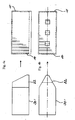
- the left and right longitudinal side wall 12 and 13 and the front and rear end side wall 14 and 15 and the roof 16 are preferably made of steel sheet steel for cost reasons, which is indicated in Fig. 1a, 1b and 1d drawing.
- steel sheet steel for cost reasons, which is indicated in Fig. 1a, 1b and 1d drawing.
- aluminum sheet possibly in conjunction with stiffening profiles, or plywood boards with glass fiber reinforced plastic coating can be used.
- the above-described construction of the base frame and the longitudinal side walls 12, 13, the end walls 14, 15, the roof 16 and the bottom 17 corresponds to the usual structure of conventional ISO or Euro pallet standard sea containers.
- the outer dimensions, i. Length, width and height of the sea container 10 therefore correspond to the relevant standard dimensions.
- the conventional sea container 10 described so far is suitable for transporting piece goods in loose, palletized or bagged form, but not for the transport of dusty and / or pourable bulk materials with adhesive properties.
- the surface elements are attached to the container wall in question in such a way that they essentially merge seamlessly with one another, ie without interfaces, which would substantially hinder the flow of the bulk material.
- the surface elements can for example be arranged and attached to the relevant container wall in such a way that they butt against each other. In the practical experiment, however, an overlapping arrangement of the surface elements has also proven to be efficient. For example, 1.5 mm thick aluminum sheets were arranged overlapping at the edges in the bulk material discharge direction and soldered together in the region of the overlap region.
- substantially continuous, smooth container wall inner surfaces can be obtained by the inner linings, ie without significant unevenness which would prevent or even prevent the bulk material from flowing out in the emptying position of the sea container 10 shown in FIG.
- any surface elements made of materials other than aluminum can be used, provided they have reaction-inert and adhesion-reducing properties with regard to the bulk material to be charged and thus for the filling, transport and emptying of dust-like and / or free-flowing bulk solids are suitable.
- suitable materials for use as inner lining are, for example, coated or painted stainless steel sheets, plastic sheets, preferably glass fiber reinforced plastic sheets, and / or wood sheets, preferably plywood sheets.
- other common reaction-inert and adhesion-reducing materials such as reinforced rubber sheets, or combinations of the aforementioned materials are possible.
- the reaction-inert surface is of course on the side of the loaded piece goods.
- the inner lining per container wall may in principle also consist of a single, continuous surface element which lines the relevant container wall.
- a material outlet 20 is provided at the rear end wall 15 .
- the material spout 20 is a tubular spigot substantially centered on the rear end wall 15 for connection to an external discharge device (not shown).
- the material outlet 20 is closed by a (not shown) obturator.
- the material spout 20 allows for controlled and metered emptying of the sea container 10.
- the spout 20 may contain conventional metering systems, such as e.g. a rotary valve or the like, have.
- the diameter d of the material spout 20 is about 0.25 m in the first embodiment.
- a discharge hopper 22 upstream tapers the loading space 11 in the direction of the rear end wall 15 or the material outlet 20 in the manner of a truncated pyramid. As shown in FIGS.
- the way as well Dimenstechnik of the stiffening or support used is determined depending on the size of the load and the strength of the material used for the triangular elements.
- the triangular elements 22a, 22b, 22c and 22d define, as they limit the cargo space 11 to the rear, an inner lining 15 'of the cargo space 11 on the side of the rear end wall 15th
- a tapered outlet funnel may in principle be used, for example, a cone-shaped or a through a corresponding multiple fold of a metal sheet in an approximately conical shape brought outfeed funnel.
- the discharge hopper 22 is also formed of aluminum sheets in the first embodiment. But it can also be formed from another of the aforementioned materials. It is only decisive that the material used for the outlet funnel 22 with respect to the bulk material to be charged has reaction-inert and adhesion-reducing properties and is compatible with the material for the interior linings.
- the material outlet 20 is accessible via a provided on the rear end wall 15 (not shown) flap from the outside and is thus within the outer dimensions of the sea container 10. Furthermore, in the first embodiment, the loading space 11 is accessible via a provided on the front end wall 14 double doors , which is indicated in Fig. 1c on the width and height dimensions BT and HT. Deviating from or in addition to the front end wall 14, a material inlet, for example in the form of an inlet nozzle, be provided.
- the sea container modified according to the invention can be used as a so-called silo or buffer store in a vertical arrangement resting on a support frame.
- a the material outlet 20 downstream rotary feeder which allows a metered discharge of transported in the sea container bulk material.
- the rotary feeder is followed by a pneumatically operated air conveyor system, also not shown, for the further conveyance of the bulk material discharged from the sea container via the rotary feeder.
- a pneumatically operated air conveyor system for transporting the discharged via the rotary feeder bulk material to the air conveyor system is preferably between cellular feeder and air conveyor an airlock, for example of the type designed as a blow-through or injector, which blows the discharged from the rotary feeder bulk material to the airframe, from where the bulk material is finally transported.
- the rotary valve In order to prevent accumulation of bulk material in the area of the rotary valve being able to build up an overpressure which acts in the direction of the loading space and could impede the further outflow of the bulk material, the rotary valve, in particular the outlet area of the rotary valve, is with the airlock, preferably the inlet area of the airlock , Connected via a connecting line, in which a controllable pressure relief valve is arranged, via which a possible overpressure can be reduced. This entrained bulk material is returned to the airlock and thus the air conveyor.
- a compressed air inlet system 24 is furthermore provided in the region of the outlet funnel 22 in the first embodiment.
- the compressed air inlet system in the first embodiment consists of four nozzles, of which only the nozzles 24a and 24b can be seen in Figs. 1a and 1d.
- the nozzles of the compressed air inlet system 24 are arranged in the first embodiment at a distance z of about 0.4 to 0.5 m from the rear end wall 15 at an angular distance of 90 ° around the material outlet 20 around and blow compressed air in a direction to the material spout 20th
- Each triangular surface 22a, 22b, 22c, 22d of the outlet funnel 22 is associated with a nozzle.
- the arrangement and number of nozzles can be selected depending on the characteristics of the bulk material to be emptied.
- the sea container 10 is preferably used in conjunction with a (not shown) mobile chassis on which the sea container is pivotally mounted via a tilting mechanism. While Fig. 1a indicates a substantially horizontal position of the sea container 10 on the chassis, in Fig. 1d the sea container 10 is shown in a substantially 90 ° from the horizontal, rotated in a clockwise, vertical position. In the first embodiment, the shipping container 10 is therefore hinged to the chassis in such a way that it from the substantially horizontal transport position, which can be seen in Fig. 1a, for gravity evacuation by a tilt angle ⁇ of about 90 ° in the in Fig. 1d shown emptying position is pivotable. Of course, the sea container 10 can also be pivoted about an arbitrary swivel angle ⁇ in the range of 0 ° to 90 °.
- Chassis and inventive sea container 10 form a system for the transport of bulk materials.
- the chassis may be the chassis of the chassis of a towing vehicle, a semi-trailer pulled by a towing vehicle, or a trailer towed by a towing vehicle.
- FIGS. 2a to 2d the second embodiment of the sea container according to the invention is explained below.
- the longitudinal, width and height directions are indicated by arrows L, B or H specified.
- the arrow L points in the forward direction
- the arrow H points in the upward direction
- the arrow B points in a direction from left to right.
- the directional information refers to the usual transport position of the sea container on a (not shown) chassis.
- the material spout 30 is arranged in the second embodiment at the level of the inner lining 17 'of the bottom 17, it is sufficient if the sea container 10 for gravity discharge from the horizontal position shown in Fig. 2a, by a tilt angle ⁇ of about 60 ° the tilting position shown in Fig. 2d is pivoted.
- the inner lining is designed as a one-piece, cuboidal inner container 30 '.
- the sea container corresponds to the sea containers shown in FIGS. 1a to 1c and FIGS. 2a to 2c.
- the outer dimensions of this inner container 30 ' are matched to the inner dimensions of the sea container.
- This inner container 30 ' is on the front end side wall 14th provided double wing door inserted into the sea container and in this state on sea container, for example, at appropriate locations of the longitudinal side walls 12, 13, the front end wall 14, the bottom 17 and the roof 16, here z. B.
Landscapes
- Engineering & Computer Science (AREA)
- Mechanical Engineering (AREA)
- Filling Or Emptying Of Bunkers, Hoppers, And Tanks (AREA)
Applications Claiming Priority (1)
| Application Number | Priority Date | Filing Date | Title |
|---|---|---|---|
| DE200410053546 DE102004053546A1 (de) | 2004-11-05 | 2004-11-05 | Seecontainer zum Transport von Schüttgütern |
Publications (2)
| Publication Number | Publication Date |
|---|---|
| EP1661824A2 true EP1661824A2 (fr) | 2006-05-31 |
| EP1661824A3 EP1661824A3 (fr) | 2006-08-02 |
Family
ID=36061406
Family Applications (1)
| Application Number | Title | Priority Date | Filing Date |
|---|---|---|---|
| EP05023670A Withdrawn EP1661824A3 (fr) | 2004-11-05 | 2005-10-28 | Conteneur pour le transport de marchandises en vrac |
Country Status (2)
| Country | Link |
|---|---|
| EP (1) | EP1661824A3 (fr) |
| DE (1) | DE102004053546A1 (fr) |
Cited By (8)
| Publication number | Priority date | Publication date | Assignee | Title |
|---|---|---|---|---|
| WO2007061310A1 (fr) * | 2005-11-25 | 2007-05-31 | Terje Yttersian | Contenant |
| DE202009015902U1 (de) | 2009-11-20 | 2010-02-25 | Dirnhofer, Rainer | Schüttgutbehälter zum Einschieben in einen ISO-Seecontainer vorgegebener Größe, ISO-Seecontainer mit eingeschobenem Schüttgutbehälter und Schüttguttransportsystem |
| EP2607275A1 (fr) | 2011-12-20 | 2013-06-26 | Rainer Dirnhofer | Système de vidage gravitationnel d'un récipient de produits en vrac |
| DE102014208969A1 (de) * | 2014-05-13 | 2015-11-19 | Heinz Buse | Übergabestation zur Übergabe von Stückgütern zwischen einem Fahrzeug und einem Lager |
| CN112478468A (zh) * | 2020-11-17 | 2021-03-12 | 北京鸿通供应链管理有限公司 | 干散货集装箱及其卸货方法 |
| FR3104556A1 (fr) * | 2019-12-13 | 2021-06-18 | So Bag | Système de stockage et de transport de matière granulaire en vrac |
| CN115289853A (zh) * | 2022-07-27 | 2022-11-04 | 安徽楚江高精铜带有限公司 | 一种黄铜熔炼炉移动加料装置 |
| US12291413B2 (en) | 2021-12-17 | 2025-05-06 | Signifi Solutions Inc. | Automatic bulk material dispensing system |
Families Citing this family (2)
| Publication number | Priority date | Publication date | Assignee | Title |
|---|---|---|---|---|
| DE202006010375U1 (de) | 2006-07-03 | 2007-09-06 | Neuss-Düsseldorfer Häfen GmbH & Co. KG | Schüttgutcontainer in Quaderform, insbesondere als ISO-Container |
| DE202012012906U1 (de) * | 2012-09-29 | 2014-04-07 | Pool Invest Gmbh | Entladevorrichtung für Schüttgut aus einem Transportbehältnis, insbesondere einem Container |
Citations (1)
| Publication number | Priority date | Publication date | Assignee | Title |
|---|---|---|---|---|
| DE1953049A1 (de) * | 1969-10-22 | 1971-05-13 | Interservice Ltd | Container-Behaelter |
Family Cites Families (12)
| Publication number | Priority date | Publication date | Assignee | Title |
|---|---|---|---|---|
| DE8115622U1 (de) * | 1981-10-15 | Thyssen Industrie Ag, 4300 Essen | Container | |
| AT292541B (de) * | 1969-01-13 | 1971-08-25 | Schoeller Bleckmann Stahlwerke | Transportbehälter für Flüssigkeiten |
| DD79449A1 (de) * | 1970-03-09 | 1971-01-20 | Wilhelm Melang | Container für Schüttgut |
| DE2012071A1 (de) * | 1970-03-13 | 1971-09-23 | International Ferry Freight Ltd., Ilford, Essex (Großbritannien) | Transportcontainer |
| US4232803A (en) * | 1978-11-06 | 1980-11-11 | A.I.R. Foundation | Bulk material retaining system having plural retainers |
| DE2915279A1 (de) * | 1979-04-14 | 1980-10-16 | Eberhard Dipl Kfm Fischer | Container und verfahren zum befuellen |
| DE9200602U1 (de) * | 1992-01-20 | 1992-03-26 | Isenmann Siebe GmbH, 7500 Karlsruhe | Auskleidung für Behälter, Wannen und Rinnen |
| DE4406345C2 (de) * | 1994-02-26 | 1997-04-17 | Manfred Sirch Gmbh & Co Kg | Container zum Transportieren von Gütern |
| US5492747A (en) * | 1994-04-21 | 1996-02-20 | Kemp; David A. | Cargo vessel sidewall having a seamless interior liner and method for making the same |
| NL1013796C2 (nl) * | 1999-12-08 | 2001-06-25 | Jansens & Dieperink Bv | Stalen container, in het bijzonder bestemd voor het vervoer van bulkgoederen. |
| ATE361858T1 (de) * | 2000-10-24 | 2007-06-15 | Du Pont | Systen und verfahren zum entladen von mit pulverförmigen produkt gefüllten schüttgutbehältern |
| WO2003066478A1 (fr) * | 2002-02-08 | 2003-08-14 | William Morton | Conteneur a identite preservee |
-
2004
- 2004-11-05 DE DE200410053546 patent/DE102004053546A1/de not_active Withdrawn
-
2005
- 2005-10-28 EP EP05023670A patent/EP1661824A3/fr not_active Withdrawn
Patent Citations (1)
| Publication number | Priority date | Publication date | Assignee | Title |
|---|---|---|---|---|
| DE1953049A1 (de) * | 1969-10-22 | 1971-05-13 | Interservice Ltd | Container-Behaelter |
Cited By (8)
| Publication number | Priority date | Publication date | Assignee | Title |
|---|---|---|---|---|
| WO2007061310A1 (fr) * | 2005-11-25 | 2007-05-31 | Terje Yttersian | Contenant |
| DE202009015902U1 (de) | 2009-11-20 | 2010-02-25 | Dirnhofer, Rainer | Schüttgutbehälter zum Einschieben in einen ISO-Seecontainer vorgegebener Größe, ISO-Seecontainer mit eingeschobenem Schüttgutbehälter und Schüttguttransportsystem |
| EP2607275A1 (fr) | 2011-12-20 | 2013-06-26 | Rainer Dirnhofer | Système de vidage gravitationnel d'un récipient de produits en vrac |
| DE102014208969A1 (de) * | 2014-05-13 | 2015-11-19 | Heinz Buse | Übergabestation zur Übergabe von Stückgütern zwischen einem Fahrzeug und einem Lager |
| FR3104556A1 (fr) * | 2019-12-13 | 2021-06-18 | So Bag | Système de stockage et de transport de matière granulaire en vrac |
| CN112478468A (zh) * | 2020-11-17 | 2021-03-12 | 北京鸿通供应链管理有限公司 | 干散货集装箱及其卸货方法 |
| US12291413B2 (en) | 2021-12-17 | 2025-05-06 | Signifi Solutions Inc. | Automatic bulk material dispensing system |
| CN115289853A (zh) * | 2022-07-27 | 2022-11-04 | 安徽楚江高精铜带有限公司 | 一种黄铜熔炼炉移动加料装置 |
Also Published As
| Publication number | Publication date |
|---|---|
| DE102004053546A1 (de) | 2006-05-11 |
| EP1661824A3 (fr) | 2006-08-02 |
Similar Documents
| Publication | Publication Date | Title |
|---|---|---|
| DE102007032017B4 (de) | Verfahren zum Befüllen und Entleeren von Transport-Containern mit Kunststoffgranulaten | |
| DE69121529T2 (de) | Anhänger für Containertransport | |
| DE2622051A1 (de) | Container mit einer auskleidung zur aufnahme von schuettgut | |
| EP2900576B1 (fr) | Système pour décharger du matériau en vrac d' un réceptacle de transport , en particulier d' un conteneur | |
| EP2102083A1 (fr) | Dispositif de chargement et de déchargement pour contenants, tels que conteneurs, silos et autres espaces de remplissage | |
| DE102008009131A1 (de) | Ladeeinheit für intermodalen Transport und Umschlag von Gütern | |
| EP2607275B1 (fr) | Système de vidage gravitationnel d'un récipient de produits en vrac | |
| DE102004053546A1 (de) | Seecontainer zum Transport von Schüttgütern | |
| EP0949161A1 (fr) | Procédé et dispositif pour un système de manipulation de fret | |
| WO2018202608A1 (fr) | Jupe de guidage d'écoulement | |
| DE202009012642U1 (de) | Silobehälter für Staub- oder Schüttgut | |
| DE2911802A1 (de) | Verfahren zum entleeren eines pulverfoermiges melamin enthaltenden iso-containers, container und trichter zur durchfuehrung des verfahrens | |
| DE202009015902U1 (de) | Schüttgutbehälter zum Einschieben in einen ISO-Seecontainer vorgegebener Größe, ISO-Seecontainer mit eingeschobenem Schüttgutbehälter und Schüttguttransportsystem | |
| EP0677424B1 (fr) | Véhicule de transport de matériaux en plaque | |
| DE2308029A1 (de) | Fahrzeug zur befoerderung von guetern unterschiedlicher art | |
| EP1992576B1 (fr) | Procédé de remplissage et de vidage de conteneurs de transport contenant des granulés de matière synthétique | |
| DE3029021A1 (de) | Lastfahrzeugaufbau fuer verschiedene transportaufgaben | |
| DE102005038701A1 (de) | Vorrichtung zum Transport von Schüttgütern und Kuppelstück | |
| EP3529176B1 (fr) | Caisses mobiles dotées d'un système intégré de chargement et de déchargement, dispositif de chargement et/ou de déchargement, procédé de chargement, procédé de déchargement, procédé de fabrication | |
| DE2248154C3 (de) | Vorrichtung zur Entleerung von Schüttgut aus Transport-Containern | |
| DE2915279A1 (de) | Container und verfahren zum befuellen | |
| DE202004000312U1 (de) | Fahrzeug zum Transport von Gütern | |
| EP2650187B1 (fr) | Unité de transport, wagon et procédé pour alimenter des chantiers ferroviaires avec de la matière | |
| EP0904978B1 (fr) | Espace de chargement pour les produits en vrac pour des véhicules de transport. | |
| DE9212000U1 (de) | Lastfahrzeug mit Schüttgut-Container |
Legal Events
| Date | Code | Title | Description |
|---|---|---|---|
| PUAI | Public reference made under article 153(3) epc to a published international application that has entered the european phase |
Free format text: ORIGINAL CODE: 0009012 |
|
| AK | Designated contracting states |
Kind code of ref document: A2 Designated state(s): AT BE BG CH CY CZ DE DK EE ES FI FR GB GR HU IE IS IT LI LT LU LV MC NL PL PT RO SE SI SK TR |
|
| AX | Request for extension of the european patent |
Extension state: AL BA HR MK YU |
|
| PUAL | Search report despatched |
Free format text: ORIGINAL CODE: 0009013 |
|
| AK | Designated contracting states |
Kind code of ref document: A3 Designated state(s): AT BE BG CH CY CZ DE DK EE ES FI FR GB GR HU IE IS IT LI LT LU LV MC NL PL PT RO SE SI SK TR |
|
| AX | Request for extension of the european patent |
Extension state: AL BA HR MK YU |
|
| 17P | Request for examination filed |
Effective date: 20070129 |
|
| AKX | Designation fees paid |
Designated state(s): AT BE BG CH CY CZ DE DK EE ES FI FR GB GR HU IE IS IT LI LT LU LV MC NL PL PT RO SE SI SK TR |
|
| 17Q | First examination report despatched |
Effective date: 20070328 |
|
| STAA | Information on the status of an ep patent application or granted ep patent |
Free format text: STATUS: THE APPLICATION IS DEEMED TO BE WITHDRAWN |
|
| 18D | Application deemed to be withdrawn |
Effective date: 20080722 |