EP1662151B1 - Dispositif a commande hydraulique - Google Patents
Dispositif a commande hydraulique Download PDFInfo
- Publication number
- EP1662151B1 EP1662151B1 EP04771548A EP04771548A EP1662151B1 EP 1662151 B1 EP1662151 B1 EP 1662151B1 EP 04771548 A EP04771548 A EP 04771548A EP 04771548 A EP04771548 A EP 04771548A EP 1662151 B1 EP1662151 B1 EP 1662151B1
- Authority
- EP
- European Patent Office
- Prior art keywords
- cylinder
- arm
- hydraulic
- hydraulic cylinder
- boom
- Prior art date
- Legal status (The legal status is an assumption and is not a legal conclusion. Google has not performed a legal analysis and makes no representation as to the accuracy of the status listed.)
- Expired - Lifetime
Links
- 230000001133 acceleration Effects 0.000 description 18
- 238000010586 diagram Methods 0.000 description 8
- 230000006870 function Effects 0.000 description 7
- 238000010276 construction Methods 0.000 description 6
- 238000011144 upstream manufacturing Methods 0.000 description 3
- 239000012530 fluid Substances 0.000 description 1
- 230000035807 sensation Effects 0.000 description 1
Images


Classifications
-
- F—MECHANICAL ENGINEERING; LIGHTING; HEATING; WEAPONS; BLASTING
- F15—FLUID-PRESSURE ACTUATORS; HYDRAULICS OR PNEUMATICS IN GENERAL
- F15B—SYSTEMS ACTING BY MEANS OF FLUIDS IN GENERAL; FLUID-PRESSURE ACTUATORS, e.g. SERVOMOTORS; DETAILS OF FLUID-PRESSURE SYSTEMS, NOT OTHERWISE PROVIDED FOR
- F15B11/00—Servomotor systems without provision for follow-up action; Circuits therefor
- F15B11/02—Systems essentially incorporating special features for controlling the speed or actuating force of an output member
- F15B11/024—Systems essentially incorporating special features for controlling the speed or actuating force of an output member by means of differential connection of the servomotor lines, e.g. regenerative circuits
-
- E—FIXED CONSTRUCTIONS
- E02—HYDRAULIC ENGINEERING; FOUNDATIONS; SOIL SHIFTING
- E02F—DREDGING; SOIL-SHIFTING
- E02F9/00—Component parts of dredgers or soil-shifting machines, not restricted to one of the kinds covered by groups E02F3/00 - E02F7/00
- E02F9/20—Drives; Control devices
-
- E—FIXED CONSTRUCTIONS
- E02—HYDRAULIC ENGINEERING; FOUNDATIONS; SOIL SHIFTING
- E02F—DREDGING; SOIL-SHIFTING
- E02F9/00—Component parts of dredgers or soil-shifting machines, not restricted to one of the kinds covered by groups E02F3/00 - E02F7/00
- E02F9/20—Drives; Control devices
- E02F9/22—Hydraulic or pneumatic drives
-
- E—FIXED CONSTRUCTIONS
- E02—HYDRAULIC ENGINEERING; FOUNDATIONS; SOIL SHIFTING
- E02F—DREDGING; SOIL-SHIFTING
- E02F9/00—Component parts of dredgers or soil-shifting machines, not restricted to one of the kinds covered by groups E02F3/00 - E02F7/00
- E02F9/20—Drives; Control devices
- E02F9/22—Hydraulic or pneumatic drives
- E02F9/2221—Control of flow rate; Load sensing arrangements
- E02F9/2225—Control of flow rate; Load sensing arrangements using pressure-compensating valves
-
- E—FIXED CONSTRUCTIONS
- E02—HYDRAULIC ENGINEERING; FOUNDATIONS; SOIL SHIFTING
- E02F—DREDGING; SOIL-SHIFTING
- E02F9/00—Component parts of dredgers or soil-shifting machines, not restricted to one of the kinds covered by groups E02F3/00 - E02F7/00
- E02F9/20—Drives; Control devices
- E02F9/22—Hydraulic or pneumatic drives
- E02F9/2278—Hydraulic circuits
- E02F9/2296—Systems with a variable displacement pump
-
- F—MECHANICAL ENGINEERING; LIGHTING; HEATING; WEAPONS; BLASTING
- F15—FLUID-PRESSURE ACTUATORS; HYDRAULICS OR PNEUMATICS IN GENERAL
- F15B—SYSTEMS ACTING BY MEANS OF FLUIDS IN GENERAL; FLUID-PRESSURE ACTUATORS, e.g. SERVOMOTORS; DETAILS OF FLUID-PRESSURE SYSTEMS, NOT OTHERWISE PROVIDED FOR
- F15B11/00—Servomotor systems without provision for follow-up action; Circuits therefor
-
- F—MECHANICAL ENGINEERING; LIGHTING; HEATING; WEAPONS; BLASTING
- F15—FLUID-PRESSURE ACTUATORS; HYDRAULICS OR PNEUMATICS IN GENERAL
- F15B—SYSTEMS ACTING BY MEANS OF FLUIDS IN GENERAL; FLUID-PRESSURE ACTUATORS, e.g. SERVOMOTORS; DETAILS OF FLUID-PRESSURE SYSTEMS, NOT OTHERWISE PROVIDED FOR
- F15B11/00—Servomotor systems without provision for follow-up action; Circuits therefor
- F15B11/16—Servomotor systems without provision for follow-up action; Circuits therefor with two or more servomotors
-
- F—MECHANICAL ENGINEERING; LIGHTING; HEATING; WEAPONS; BLASTING
- F15—FLUID-PRESSURE ACTUATORS; HYDRAULICS OR PNEUMATICS IN GENERAL
- F15B—SYSTEMS ACTING BY MEANS OF FLUIDS IN GENERAL; FLUID-PRESSURE ACTUATORS, e.g. SERVOMOTORS; DETAILS OF FLUID-PRESSURE SYSTEMS, NOT OTHERWISE PROVIDED FOR
- F15B21/00—Common features of fluid actuator systems; Fluid-pressure actuator systems or details thereof, not covered by any other group of this subclass
- F15B21/14—Energy-recuperation means
-
- F—MECHANICAL ENGINEERING; LIGHTING; HEATING; WEAPONS; BLASTING
- F15—FLUID-PRESSURE ACTUATORS; HYDRAULICS OR PNEUMATICS IN GENERAL
- F15B—SYSTEMS ACTING BY MEANS OF FLUIDS IN GENERAL; FLUID-PRESSURE ACTUATORS, e.g. SERVOMOTORS; DETAILS OF FLUID-PRESSURE SYSTEMS, NOT OTHERWISE PROVIDED FOR
- F15B2211/00—Circuits for servomotor systems
- F15B2211/20—Fluid pressure source, e.g. accumulator or variable axial piston pump
- F15B2211/205—Systems with pumps
- F15B2211/20507—Type of prime mover
- F15B2211/20523—Internal combustion engine
-
- F—MECHANICAL ENGINEERING; LIGHTING; HEATING; WEAPONS; BLASTING
- F15—FLUID-PRESSURE ACTUATORS; HYDRAULICS OR PNEUMATICS IN GENERAL
- F15B—SYSTEMS ACTING BY MEANS OF FLUIDS IN GENERAL; FLUID-PRESSURE ACTUATORS, e.g. SERVOMOTORS; DETAILS OF FLUID-PRESSURE SYSTEMS, NOT OTHERWISE PROVIDED FOR
- F15B2211/00—Circuits for servomotor systems
- F15B2211/20—Fluid pressure source, e.g. accumulator or variable axial piston pump
- F15B2211/205—Systems with pumps
- F15B2211/2053—Type of pump
- F15B2211/20546—Type of pump variable capacity
-
- F—MECHANICAL ENGINEERING; LIGHTING; HEATING; WEAPONS; BLASTING
- F15—FLUID-PRESSURE ACTUATORS; HYDRAULICS OR PNEUMATICS IN GENERAL
- F15B—SYSTEMS ACTING BY MEANS OF FLUIDS IN GENERAL; FLUID-PRESSURE ACTUATORS, e.g. SERVOMOTORS; DETAILS OF FLUID-PRESSURE SYSTEMS, NOT OTHERWISE PROVIDED FOR
- F15B2211/00—Circuits for servomotor systems
- F15B2211/20—Fluid pressure source, e.g. accumulator or variable axial piston pump
- F15B2211/205—Systems with pumps
- F15B2211/20576—Systems with pumps with multiple pumps
-
- F—MECHANICAL ENGINEERING; LIGHTING; HEATING; WEAPONS; BLASTING
- F15—FLUID-PRESSURE ACTUATORS; HYDRAULICS OR PNEUMATICS IN GENERAL
- F15B—SYSTEMS ACTING BY MEANS OF FLUIDS IN GENERAL; FLUID-PRESSURE ACTUATORS, e.g. SERVOMOTORS; DETAILS OF FLUID-PRESSURE SYSTEMS, NOT OTHERWISE PROVIDED FOR
- F15B2211/00—Circuits for servomotor systems
- F15B2211/30—Directional control
- F15B2211/305—Directional control characterised by the type of valves
- F15B2211/30525—Directional control valves, e.g. 4/3-directional control valve
-
- F—MECHANICAL ENGINEERING; LIGHTING; HEATING; WEAPONS; BLASTING
- F15—FLUID-PRESSURE ACTUATORS; HYDRAULICS OR PNEUMATICS IN GENERAL
- F15B—SYSTEMS ACTING BY MEANS OF FLUIDS IN GENERAL; FLUID-PRESSURE ACTUATORS, e.g. SERVOMOTORS; DETAILS OF FLUID-PRESSURE SYSTEMS, NOT OTHERWISE PROVIDED FOR
- F15B2211/00—Circuits for servomotor systems
- F15B2211/30—Directional control
- F15B2211/305—Directional control characterised by the type of valves
- F15B2211/3056—Assemblies of multiple valves
- F15B2211/30565—Assemblies of multiple valves having multiple valves for a single output member, e.g. for creating higher valve function by use of multiple valves like two 2/2-valves replacing a 5/3-valve
- F15B2211/3058—Assemblies of multiple valves having multiple valves for a single output member, e.g. for creating higher valve function by use of multiple valves like two 2/2-valves replacing a 5/3-valve having additional valves for interconnecting the fluid chambers of a double-acting actuator, e.g. for regeneration mode or for floating mode
-
- F—MECHANICAL ENGINEERING; LIGHTING; HEATING; WEAPONS; BLASTING
- F15—FLUID-PRESSURE ACTUATORS; HYDRAULICS OR PNEUMATICS IN GENERAL
- F15B—SYSTEMS ACTING BY MEANS OF FLUIDS IN GENERAL; FLUID-PRESSURE ACTUATORS, e.g. SERVOMOTORS; DETAILS OF FLUID-PRESSURE SYSTEMS, NOT OTHERWISE PROVIDED FOR
- F15B2211/00—Circuits for servomotor systems
- F15B2211/30—Directional control
- F15B2211/31—Directional control characterised by the positions of the valve element
- F15B2211/3105—Neutral or centre positions
- F15B2211/3116—Neutral or centre positions the pump port being open in the centre position, e.g. so-called open centre
-
- F—MECHANICAL ENGINEERING; LIGHTING; HEATING; WEAPONS; BLASTING
- F15—FLUID-PRESSURE ACTUATORS; HYDRAULICS OR PNEUMATICS IN GENERAL
- F15B—SYSTEMS ACTING BY MEANS OF FLUIDS IN GENERAL; FLUID-PRESSURE ACTUATORS, e.g. SERVOMOTORS; DETAILS OF FLUID-PRESSURE SYSTEMS, NOT OTHERWISE PROVIDED FOR
- F15B2211/00—Circuits for servomotor systems
- F15B2211/30—Directional control
- F15B2211/315—Directional control characterised by the connections of the valve or valves in the circuit
- F15B2211/3157—Directional control characterised by the connections of the valve or valves in the circuit being connected to a pressure source, an output member and a return line
- F15B2211/31576—Directional control characterised by the connections of the valve or valves in the circuit being connected to a pressure source, an output member and a return line having a single pressure source and a single output member
-
- F—MECHANICAL ENGINEERING; LIGHTING; HEATING; WEAPONS; BLASTING
- F15—FLUID-PRESSURE ACTUATORS; HYDRAULICS OR PNEUMATICS IN GENERAL
- F15B—SYSTEMS ACTING BY MEANS OF FLUIDS IN GENERAL; FLUID-PRESSURE ACTUATORS, e.g. SERVOMOTORS; DETAILS OF FLUID-PRESSURE SYSTEMS, NOT OTHERWISE PROVIDED FOR
- F15B2211/00—Circuits for servomotor systems
- F15B2211/30—Directional control
- F15B2211/32—Directional control characterised by the type of actuation
- F15B2211/329—Directional control characterised by the type of actuation actuated by fluid pressure
-
- F—MECHANICAL ENGINEERING; LIGHTING; HEATING; WEAPONS; BLASTING
- F15—FLUID-PRESSURE ACTUATORS; HYDRAULICS OR PNEUMATICS IN GENERAL
- F15B—SYSTEMS ACTING BY MEANS OF FLUIDS IN GENERAL; FLUID-PRESSURE ACTUATORS, e.g. SERVOMOTORS; DETAILS OF FLUID-PRESSURE SYSTEMS, NOT OTHERWISE PROVIDED FOR
- F15B2211/00—Circuits for servomotor systems
- F15B2211/40—Flow control
- F15B2211/405—Flow control characterised by the type of flow control means or valve
- F15B2211/40507—Flow control characterised by the type of flow control means or valve with constant throttles or orifices
-
- F—MECHANICAL ENGINEERING; LIGHTING; HEATING; WEAPONS; BLASTING
- F15—FLUID-PRESSURE ACTUATORS; HYDRAULICS OR PNEUMATICS IN GENERAL
- F15B—SYSTEMS ACTING BY MEANS OF FLUIDS IN GENERAL; FLUID-PRESSURE ACTUATORS, e.g. SERVOMOTORS; DETAILS OF FLUID-PRESSURE SYSTEMS, NOT OTHERWISE PROVIDED FOR
- F15B2211/00—Circuits for servomotor systems
- F15B2211/40—Flow control
- F15B2211/405—Flow control characterised by the type of flow control means or valve
- F15B2211/40515—Flow control characterised by the type of flow control means or valve with variable throttles or orifices
-
- F—MECHANICAL ENGINEERING; LIGHTING; HEATING; WEAPONS; BLASTING
- F15—FLUID-PRESSURE ACTUATORS; HYDRAULICS OR PNEUMATICS IN GENERAL
- F15B—SYSTEMS ACTING BY MEANS OF FLUIDS IN GENERAL; FLUID-PRESSURE ACTUATORS, e.g. SERVOMOTORS; DETAILS OF FLUID-PRESSURE SYSTEMS, NOT OTHERWISE PROVIDED FOR
- F15B2211/00—Circuits for servomotor systems
- F15B2211/40—Flow control
- F15B2211/415—Flow control characterised by the connections of the flow control means in the circuit
- F15B2211/41527—Flow control characterised by the connections of the flow control means in the circuit being connected to an output member and a directional control valve
- F15B2211/41545—Flow control characterised by the connections of the flow control means in the circuit being connected to an output member and a directional control valve being connected to multiple output members
-
- F—MECHANICAL ENGINEERING; LIGHTING; HEATING; WEAPONS; BLASTING
- F15—FLUID-PRESSURE ACTUATORS; HYDRAULICS OR PNEUMATICS IN GENERAL
- F15B—SYSTEMS ACTING BY MEANS OF FLUIDS IN GENERAL; FLUID-PRESSURE ACTUATORS, e.g. SERVOMOTORS; DETAILS OF FLUID-PRESSURE SYSTEMS, NOT OTHERWISE PROVIDED FOR
- F15B2211/00—Circuits for servomotor systems
- F15B2211/40—Flow control
- F15B2211/42—Flow control characterised by the type of actuation
- F15B2211/428—Flow control characterised by the type of actuation actuated by fluid pressure
-
- F—MECHANICAL ENGINEERING; LIGHTING; HEATING; WEAPONS; BLASTING
- F15—FLUID-PRESSURE ACTUATORS; HYDRAULICS OR PNEUMATICS IN GENERAL
- F15B—SYSTEMS ACTING BY MEANS OF FLUIDS IN GENERAL; FLUID-PRESSURE ACTUATORS, e.g. SERVOMOTORS; DETAILS OF FLUID-PRESSURE SYSTEMS, NOT OTHERWISE PROVIDED FOR
- F15B2211/00—Circuits for servomotor systems
- F15B2211/60—Circuit components or control therefor
- F15B2211/635—Circuits providing pilot pressure to pilot pressure-controlled fluid circuit elements
- F15B2211/6355—Circuits providing pilot pressure to pilot pressure-controlled fluid circuit elements having valve means
-
- F—MECHANICAL ENGINEERING; LIGHTING; HEATING; WEAPONS; BLASTING
- F15—FLUID-PRESSURE ACTUATORS; HYDRAULICS OR PNEUMATICS IN GENERAL
- F15B—SYSTEMS ACTING BY MEANS OF FLUIDS IN GENERAL; FLUID-PRESSURE ACTUATORS, e.g. SERVOMOTORS; DETAILS OF FLUID-PRESSURE SYSTEMS, NOT OTHERWISE PROVIDED FOR
- F15B2211/00—Circuits for servomotor systems
- F15B2211/70—Output members, e.g. hydraulic motors or cylinders or control therefor
- F15B2211/71—Multiple output members, e.g. multiple hydraulic motors or cylinders
- F15B2211/7114—Multiple output members, e.g. multiple hydraulic motors or cylinders with direct connection between the chambers of different actuators
-
- F—MECHANICAL ENGINEERING; LIGHTING; HEATING; WEAPONS; BLASTING
- F15—FLUID-PRESSURE ACTUATORS; HYDRAULICS OR PNEUMATICS IN GENERAL
- F15B—SYSTEMS ACTING BY MEANS OF FLUIDS IN GENERAL; FLUID-PRESSURE ACTUATORS, e.g. SERVOMOTORS; DETAILS OF FLUID-PRESSURE SYSTEMS, NOT OTHERWISE PROVIDED FOR
- F15B2211/00—Circuits for servomotor systems
- F15B2211/80—Other types of control related to particular problems or conditions
- F15B2211/88—Control measures for saving energy
Definitions
- This invention relates to a hydraulic drive systemmounted on a construction machine such as a hydraulic excavator to permit a combined operation of plural hydraulic cylinders.
- the bottom pressure of the arm cylinder may not become high upon performing a combined boom-arm operation as in work involving a crowding operation of a bucket in the air. Even in such work, it is desired to realize an acceleration of the arm cylinder, that is, a second hydraulic cylinder.
- the present invention has as an object the provision of a hydraulic drive system which, in a combined operation to be performed by feeding pressure oil to both of bottomcombers of a first hydraulic cylinder and second hydraulic cylinder, can effectively use pressure oil in a rod chamber of the first hydraulic cylinder, which was conventionally drained into a reservoir, irrespective of the level of a bottompressure in the second hydraulic cylinder.
- the present invention is characterized in that, in a hydraulic drive system provided with a main hydraulic pump, a first hydraulic cylinder and second hydraulic cylinder driven by pressure oil delivered from the main hydraulic pump, a first directional control valve for controlling a flow of pressure oil to be fed from the main hydraulic pump to the first hydraulic cylinder, a second directional control valve for controlling a flow of pressure oil to be fed from the main hydraulic pump to the second hydraulic cylinder, a first control device for selectively controlling the first directional control valve, and a second control device for selectively controlling the second directional control valve, the hydraulic drive system is provided with a communication control means for communicating a rod chamber of the first hydraulic cylinder and a bottom chamber of the second hydraulic cylinder with each other when a stroke of the second control device has increased to at least a predetermined amount.
- the communication control means is actuated to feed the pressure oil in a rod chamber of the first hydraulic cylinder to the bottom chamber of the second hydraulic cylinder.
- the pressure oil delivered from the main hydraulic pump and fed via the second directional control valve and the pressure oil fed from the rod chamber of the first hydraulic cylinder are combined and fed to the bottom chamber of the second hydraulic cylinder, and as a result, an acceleration can be achieved in the extending direction of the second hydraulic cylinder irrespective of the level of pressure oil in the bottom chamber of the second hydraulic cylinder.
- the pressure oil in the rod chamber of the first hydraulic cylinder which was conventionally drained into the reservoir, can be effectively used for the selective acceleration of the second hydraulic cylinder.
- the communication control means may comprise a communication line capable of communicating the rod chamber of the first hydraulic cylinder and the bottom chamber of the second hydraulic cylinder with each other, a check valve arranged on the communication line to prevent a flow of pressure oil from the bottom chamber of the second hydraulic cylinder toward the rod chamber of the first hydraulic cylinder, and a selector valve for feeding pressure oil in the rod chamber of the first hydraulic cylinder to the bottom chamber of the second hydraulic cylinder via the communication line.
- the selector valve is switched to maintain the communication line in a communicating state, and as a result, the pressure oil in the rod chamber of the first hydraulic cylinder is fed to the bottom chamber of the second hydraulic cylinder via the communication line and check valve.
- the pressure oil fed to the bottom chamber of the second hydraulic cylinder via the second directional control valve and the pressure oil fed from the rod chamber of the first hydraulic cylinder are combined and fed to the bottom chamber of the second hydraulic cylinder, and as a result, an acceleration can be achieved in the extending direction of the second hydraulic cylinder.
- the selector valve is held to communicate the communication line with the reservoir, and a result, the pressure oil in the rod chamber of the first hydraulic cylinder is drained into the reservoir.
- pressure oil is fed only via the second directional control valve so that no acceleration is achieved in the extending direction of the second hydraulic cylinder.
- the present invention can also be characterized in that in the above-described invention, the selector valve may include a variable restrictor.
- the opening of the variable restrictor included in the selector valve changes depending upon the stroke of the second control device. Described specifically, when the stroke of the second control device is relatively small although it is equal to or greater than the predetermined amount, the opening of the variable restrictor in the selector valve becomes smaller so that the flow rate of pressure oil from the rod chamber of the first hydraulic cylinder, which is to be fed to the communication line via the variable restrictor, is reduced.
- the opening of the variable restrictor in the selector valve becomes large so that the flow rate of pressure oil from the rod chamber of the first hydraulic cylinder, which is to be fed to the communication line via the variable restrictor, can be increased.
- the present invention can also be characterized that the above-described invention may further comprise a branch line connected at an end thereof to a main line, which connects the first directional control valve and the rod chamber of the first hydraulic cylinder with each other, and at an opposite end thereof to the selector valve.
- the pressure oil in the rod chamber of the first hydraulic cylinder is fed to the bottom chamber of the second hydraulic cylinder from the communication line without going through the first directional control valve. It is, therefore, possible to reduce a pressure loss compared with feeding the pressure oil through the first directional control valve insofar as the diameter of the branch line is set sufficiently large.
- the present invention can also be characterized in that the above-described invention may further comprise a stroke detector for detecting a stroke of the second control device and outputting an electrical signal, and a controller for outputting, responsive to the signal outputted from the stroke detector, a control signal to selectively control the selector valve.
- the electrical signal outputted from the stroke detector is inputted to the controller.
- a control signal for switching the selector valve is outputted from the controller so that the selector valve is switched to maintain the communication line in the communicating state.
- the pressure oil in the rod chamber of the first hydraulic cylinder is, therefore, fed to the bottom chamber of the second hydraulic cylinder via the communication line and check valve.
- the present invention can also be characterized in that in the above-described invention, the controller may include a function generator for outputting a value which becomes gradually greater as the stroke of the second control device increases.
- a value which becomes gradually greater as the stroke of the second control device increases is determined at the function generator, and a control signal corresponding to the thus-determined value is outputted from the controller to control the amount of switching of the selector valve. It is, therefore, possible to control the speed of the second hydraulic cylinder which is in a state accelerated corresponding to the stroke of the second control device.
- the present invention can also be characterized in that in the above-described invention, the selector valve may be a pilot-controlled selector valve, and the hydraulic drive system may be provided with an electric-hydraulic converter for outputting a control pressure corresponding to the control signal outputted from the controller and a control line communicating the electric-hydraulic converter and the pilot-controlled selector valve with each other.
- the selector valve may be a pilot-controlled selector valve
- the hydraulic drive system may be provided with an electric-hydraulic converter for outputting a control pressure corresponding to the control signal outputted from the controller and a control line communicating the electric-hydraulic converter and the pilot-controlled selector valve with each other.
- a pilot pressure corresponding to the value of the control signal is applied from the electric-hydraulic converter to the control chamber of the pilot-controlled selector valve via the control line so that the amount of switching of the selector valve is controlled depending upon the level of the pilot pressure.
- the present invention can also be characterized in that in the above-described invention, the first hydraulic cylinder and second hydraulic cylinder may comprise a boom cylinder and arm cylinder, respectively, the first directional control valve and second directional control valve may comprise a center-bypass-type, directional control valve for a boom and directional control valve for an arm, respectively, and the first control device and second control device may comprise a boom control device and arm control device, respectively.
- the communication control means is actuated such that the pressure oil in the rod chamber of the boom cylinder is fed to the bottom chamber of the arm cylinder.
- the pressure oil delivered from the main hydraulic pump and fed via the directional control valve for the arm and the pressure oil fed from the rod chamber of the boom cylinder are combined and fed to the bottom chamber of the arm cylinder, and as a result, an acceleration in the extending direction of the arm cylinder, that is, an acceleration in arm crowding can be realized.
- the pressure oil in the rod chamber of the first hydraulic cylinder which was conventionally drained into the reservoir, can be effectively used depending upon the stroke of the second control device, which controls the second hydraulic cylinder, irrespective of the level of the bottom pressure of the second hydraulic cylinder, and compared with the conventional art, it is thus possible to perform more work with effective use of pressure oil.
- FIG. 1 is a circuit diagram showing the first embodiment of the hydraulic drive system according to the present invention.
- each comprises a hydraulic drive system of the center bypass type for driving, for example, a boom cylinder 6 as a first hydraulic cylinder and an arm cylinder 7 as a second hydraulic cylinder.
- the boom cylinder 6 is provided with a bottom chamber 6a and a rod chamber 6b
- the arm cylinder 7 is likewise provided with a bottom chamber 7a and a rod chamber 7b.
- the first embodiment is also provided with an engine 20, a main hydraulic pump 21 and pilot pump 22 driven by the engine 20, a first directional control valve for controlling a flow of pressure oil to be fed to the boom cylinder 6, i.e., a center-bypass-type directional control valve 23 for the boom, a second directional control valve for controlling a flow of pressure oil to be fed to the arm cylinder 7, i.e., a center-bypass-type directional control valve 24 for the arm. Also provided are a first control device for selectively controlling the directional control valve 23 for the boom, i.e., a boom control device 25 and a second control device for selectively controlling the directional control valve 24 for the arm, i.e., an arm control device 26.
- Lines 27,28 are connected to a delivery line of the main hydraulic pump 21, the directional control valve 24 for the arm is arranged on the line 27, and the directional control valve 23 for the boom is arranged on the line 28.
- the directional control valve 23 for the boom and the bottom chamber 6a of the boom cylinder 6 are connected via a main line 29a, while the directional control valve 23 for the boom and the rod chamber 6b of the boom cylinder 6 are connected via a main line 29b.
- the directional control valve 24 for the arm and the bottom chamber 7a of the arm cylinder 7 are connected via a main line 30a, while the directional control valve 24 for the arm and the rod chamber 7b of the arm cylinder 7 are connected via a main line 30b.
- the boom control device 25 and arm control device 26 are composed, for example, of pilot control devices which produce pilotpressures, andareconnectedtothepilotpump22. Further, the boom control device 25 is connected to control chambers of the directional control valve 23 for the boom via pilot lines 25a,25b, respectively, while the arm control device 26 is connected to control chambers of the directional control valve 24 for the arm via pilot lines 26a,26b, respectively.
- This first embodiment is provided with a communication control means for communicating the rod chamber 6b of the boom cylinder 6, which makes up the first hydraulic cylinder, and the bottom chamber 7a of the arm cylinder 7, which makes up the second hydraulic cylinder, with each other especially when the stroke of the arm control device as the second control device has increased to a predetermined amount S or greater.
- this communication control means comprises a communication line 40 capable of communicating the rod chamber 6b of the boom cylinder 6 and the bottom chamber 7a of the arm cylinder 7 with each other, a check valve 41 arranged on the communication line 40 to prevent a flow of pressure oil from the bottom chamber 7a of the arm cylinder 7 toward the rod chamber 6b of the boom cylinder 6, and a selector valve 52 for feeding pressure fluid in the rod chamber 6b of the boom cylinder 6 to the bottom chamber 7a of the arm cylinder 7 via the communication line 40 when the stroke of the arm control device 26 has increased to the predetermined amount S or greater.
- This selector valve 52 comprises a pilot control device which is switched by an arm pilot pressure guided via a control line 52a connected to the pilot line 26a.
- a line 46 connected at an end thereof to the part of the communication line 40 located on an upstream side of the check valve 41 and at an opposite end thereof to a reservoir 43, and a pilot-controlled check valve 47 arranged on the line 46 such that responsive to a predetermined control of the boom control device as the first control device, for example, an operation to feed pressure oil to the pilot line 25b to perform boom lowering, the line 46 is opened.
- the above-described pilot line 25b and pilot-controlled check valve 47 are connected together by a control line 48.
- the pilot line 25b of the boom operating system is not fed with the pilot pressure, and remains under the same pressure as the reservoir pressure. Therefore, the control line 48 takes the reservoir pressure so that the pilot-controlled check valve 47 remains in a closed position to prevent communication between the communication line 40 and the reservoir 43 via the line 46.
- the flow rate at which the predetermined portion of the pressure oil is fed at this time increases with the arm pilot pressure which corresponds to the stroke of the arm control device 26.
- "S" indicates the above-mentioned predetermined stroke and "F” indicates the stroke at the time of a full stroke.
- the pressure oil fed to the communication line 40 is fed to the bottom chamber 7a of the arm cylinder 7 via the main line 30a. Described specifically, the pressure oil delivered from the main hydraulic pump 21 and fed via the directional control valve 24 for the arm and the pressure oil fed from the rod chamber 6b of the boom cylinder 6 are combined and fed to the bottom chamber 7a of the arm cylinder 7. As a result, an acceleration of the arm cylinder 6 in the extending direction can be realized. In other words, the operating speed of arm crowding can be rendered faster.
- the selector valve 52 tends to be switched toward the left position in FIG. 1 as mentioned above.
- the part of the communication line 40 is, however, in communication with the reservoir 43 via the pilot-controlled check valve 47 and the line 46 as mentioned above. Consequently, the bottom chamber 6a of the boom cylinder 6 is brought into a state communicated with the reservoir 43.
- the pressure oil in the rod chamber 6a of the boom cylinder 6 can be combined to the bottom chamber 7a of the arm cylinder 7 as a result of a control of the second control device 26 irrespective of the level of the bottom pressure in the arm cylinder 7.
- This makes it possible to effectively use the pressure oil in the rod chamber 6a of the boom cylinder 6, the pressure oil having heretofore been simply drained into the reservoir 43, for the acceleration of the arm cylinder 7 and hence, to achieve an improvement in the efficiency of the work.
- FIG. 3 is a hydraulic circuit diagram showing a second embodiment of the present invention.
- This second embodiment is provided with a branch line 56, which is connected at an end thereof to the main line 29b communicating the directional control valve 23 for the boom and the rod chamber 6b of the boom cylinder 6 with each other, and at an opposite end thereof to a selector valve 64 which constitutes the communication control means.
- the selector valve 64 has a variable restrictor 64a, is arranged on a reservoir line 42, and is interposed at a point of connection between the branch line 56 and the communication line 40.
- the second embodiment is also provided with a bypass line 61, a pilot-controlled check valve 62 arranged on the bypass line 61, and a control line 63 connected at an end thereof to the pilot line 25b in the boom control system and at an opposite end thereof to the pilot-controlled check valve 62.
- the bypass line 61 communicates a part of the reservoir line 42, said part being located on an upstream side of the selector valve 64, and another part of the reservoir line 42, said part being located on a downstream side of the selector valve 64, with each other.
- a control chamber which is arranged opposite a spring case of the selector valve 64, and the pilot line 26a in the arm control system, are connected with each other by a control line 64b. Further, the control chamber, which is arranged opposite the spring case of the selector valve 64, and the pilot line 25a in the boom control system, are connected with each other by a control line 65.
- the remaining construction is similar to that in the above-described first embodiment.
- the pressure oil in the rod chamber 6b of the boom cylinder 6 can be fed at a relatively low flow rate to the bottom chamber 7a of the arm cylinder 7 via the branch line 56, the variable restrictor 64a of the selector valve 64, the check valve 41 and the communication line 40.
- the speed of the arm cylinder 7 which is in an accelerated state can be made relatively slow.
- the control pressure to be fed to the control chamber of the selector valve 64 via the control line 65 as a result of the control of the boom control device 25 becomes higher, and as a result, the opening of the variable restrictor 64a in the selector valve 64 becomes large.
- the pressure oil in the rod chamber 6b of the boom cylinder 6 can be fed at a high flow rate to the bottom chamber 7a of the arm cylinder 7.
- the speed of the arm cylinder 7 which is in an accelerated state can be made still faster.
- the stroke of the arm control device 26 has increased to the predetermined amount S or greater and the selector valve 64 becomes prone to be switched into the right position in FIG. 3 and further, the boom control device 25 is controlled and a control pressure is applied to the pilot-controlled variable restrictor 62 via the pilot line 25b and control line 63, the pilot-controlled variable restrictor 62 is opened, the pressure oil in the bottom chamber 6a of the boom cylinder 6 is returned to the reservoir 43 via the main line 29a, the directional control valve 23 for the boom, the reservoir line 42, the line 61 and the pilot-controlled check valve 62. It, therefore, becomes possible to perform the desired retracting operation of the boom cylinder 6, namely, the boom lowering operation.
- the pressure oil in the rod chamber 6a of the boom cylinder 6, as in the above-described first embodiment, can be combined into the bottom chamber 7a of the arm cylinder 7 irrespective of the level of the bottom pressure of the arm cylinder 7 as a result of a control of the second control device 26 upon performing a combined operation of boom raising and arm crowding.
- the pressure oil in the rod chamber 6b of the boom cylinder 6 is fed from the communication line 40 to the bottom chamber 7a of the arm cylinder 7 via the branch line 56, that is, without going through the directional control valve 23 for the boom.
- the branch line 56 that is, without going through the directional control valve 23 for the boom.
- FIG. 4 is a hydraulic circuit showing a third embodiment of the present invention
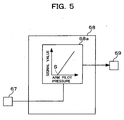
- FIG. 5 is a diagram illustrating the construction of an essential part of a controller which the third embodiment shown in FIG. 4 is provided with.
- the third embodiment shown in these FIGS. 4 and 5 is constructed that a communication control means for communicating the rod chamber 6b of the boom cylinder as the first hydraulic cylinder and the bottom chamber 7a of the arm cylinder 7 with each other when the stroke of the arm control device 26 as the second control device has increased the predetermined amount S or greater is arranged on the pilot line 26a, and that the third embodiment includes a stroke detector, i.e., an arm pilot pressure detector 67 for detecting an arm pilot pressure, which corresponds to the stroke of the arm control device 26, and outputting an electrical signal, a controller 68 for outputting a control signal to selectively control a selector valve 44 responsive to the signal outputted from the arm pilot pressure detector 67, an electric-hydraulic converter 69 for outputting a control pressure corresponding to the value of the control signal outputted from the controller 68, and a control line 57a communicating the electric-hydraulic converter 69 and the control chamber of the selector valve 44 with each other.
- a stroke detector i.e., an arm pilot
- the controller 68 includes a function generator 68a for outputting a value which becomes gradually greater as the arm pilot pressure corresponding to the stroke of the arm control device 26 increases.
- the remaining elements of the construction are similar to the corresponding elements in the above-described first embodiment shown in FIG. 1 .
- the boom control device 25 is controlled to feed a pilot pressure to the pilot line 25a and to switch the directional control valve 23 into the left position and the arm control device 26 is controlled to feed a pilot pressure to the pilot line 26a and to switch the directional control valve 24 for the arm into the left position, as illustrated in FIG. 4 , the pressure oil delivered from the main hydraulic pump 1 is fed to the bottom chamber 6a of the boom cylinder 6 and the bottom chamber 7a of the arm cylinder 7.
- the boom cylinder 6 and arm cylinder 7 both operate in their extending directions so that the combined operation of boom raising and arm crowding is performed.
- the pilot pressure is not fed to the pilot line 25b in the boom control system so that the pilot line 25b is brought to the reservoir pressure. Accordingly, the control line 48 is brought to the reservoir pressure, the pilot-controlled check valve 47 is maintained in a closed state, and the communication of the communication line 40 with the reservoir 43 via the line 46 is prevented.
- the signal value detected by the arm pilot pressure detector 67 is small so that the signal value outputted from the function generator 68a of the controller 68 shown in FIG. 5 becomes smaller.
- the control signal of the small value is outputted from the controller 68 to the electric-hydraulic converter 69.
- the electric-hydraulic converter 69 outputs a relatively low control pressure to the control line 57a.
- the force by the control pressure applied to the control chamber of the selector value 44 is smaller than the spring force so that the selector valve 44 is held in the right position depicted in FIG. 4 . Accordingly, the pressure oil in the rod chamber 6b of the boom cylinder 6 is not fed to the communication line 40 during the extending operation of the boom cylinder 6.
- the signal value detected by the arm pilot pressure detector 67 becomes large so that the signal value outputted from the function generator 68a of the controller 68 depicted in FIG. 5 becomes greater.
- the control signal of this large value is outputted from the controller 68 to the electric-hydraulic converter 69.
- the electric-hydraulic converter 69 outputs a high control pressure to the control line 57a.
- the force by the control pressure applied to the control chamber of the selector valve 44 becomes greater than the spring force so that the selector valve 44 tends to be switched into the left position in FIG. 4 .
- the reservoir line 42 is cut off by the selector valve 44 so that the pressure oil, which has been guided from the rod chamber 6b of the boom cylinder 6 to the main line 29a, the directional control valve 23 for the boom and the reservoir line 42, is fed to the communication line 40 via the check valve 41.
- the pressure oil fed from the communication line 40 is fed to the bottom chamber 7a of the arm cylinder 7 via the main line 30a. Described specifically, the pressure oil fed via the directional control valve 24 for the arm and the pressure oil fed from the rod chamber 6b of the boom cylinder 6 are combined and fed to the bottom chamber 7a of the arm cylinder 7. As a result, an acceleration can be realized in the extending direction of the arm cylinder 6, and therefore, the operating speed of arm crowding can be made faster.
- the pressure oil in the rod chamber 6a of the boom cylinder 6, which was conventionally drained into the reservoir 43, can also be effectively used for the acceleration of the arm cylinder 7 irrespective of the level of the bottom pressure of the arm cylinder 7, and therefore, an improvement can be realized in the efficiency of work.
- this third embodiment can also achieve an acceleration of the arm cylinder 7 based on the function relation in the function generator 68a of the controller 68 so that in conformity with the operator's control sensation, the arm cylinder 7 can be smoothly accelerated to perform an arm crowding operation.
Landscapes
- Engineering & Computer Science (AREA)
- General Engineering & Computer Science (AREA)
- Physics & Mathematics (AREA)
- Fluid Mechanics (AREA)
- Mechanical Engineering (AREA)
- Mining & Mineral Resources (AREA)
- Civil Engineering (AREA)
- Structural Engineering (AREA)
- Chemical & Material Sciences (AREA)
- Analytical Chemistry (AREA)
- Fluid-Pressure Circuits (AREA)
- Operation Control Of Excavators (AREA)
Abstract
Claims (8)
- Système d'entraînement hydraulique pourvu d'une pompe hydraulique principale, un premier vérin hydraulique et un deuxième vérin hydraulique entraînés par de l'huile sous pression distribuée par ladite pompe hydraulique principale, un premier distributeur pour commander un flux d'huile sous pression à transmettre de ladite pompe hydraulique principale audit premier vérin hydraulique, un deuxième distributeur pour commander un flux d'huile sous pression à transmettre de ladite pompe hydraulique principale audit deuxième vérin hydraulique, un premier dispositif de commande pour commander de manière sélective ledit premier distributeur, et un deuxième dispositif de commande pour commander de manière sélective ledit deuxième distributeur, caractérisé en ce que ledit système d'entraînement hydraulique est pourvu d'un moyen de commande de communication pour faire communiquer entre elles une chambre de tige dudit premier vérin hydraulique et une chambre inférieure dudit deuxième vérin hydraulique, ledit moyen de commande de communication est activé en conséquence d'un signal de commande dudit deuxième dispositif de commande, quel que soit le niveau de pression de chambre inférieure dans ledit deuxième vérin hydraulique, quand une course dudit deuxième dispositif de commande a augmenté au moins jusqu'à une valeur prédéterminée.
- Système d'entraînement hydraulique selon la revendication 1, dans lequel ledit moyen de commande de communication comprend une ligne de communication capable de faire communiquer entre elles ladite chambre de tige dudit premier vérin hydraulique et ladite chambre inférieure dudit deuxième vérin hydraulique, un clapet antiretour placé sur ladite ligne de communication pour empêcher un flux d'huile sous pression de ladite chambre inférieure du deuxième vérin hydraulique vers ladite chambre de tige du premier vérin hydraulique, et une vanne directionnelle pour envoyer l'huile sous pression présente dans ladite chambre de tige du premier vérin hydraulique vers ladite chambre inférieure du deuxième vérin hydraulique via ladite ligne de communication.
- Système d'entraînement hydraulique selon la revendication 2, dans lequel la vanne directionnelle comprend un étrangleur variable.
- Système d'entraînement hydraulique selon la revendication 2, comprenant en outre un embranchement connecté en une de ses extrémités à une conduite principale, qui relie entre elles ledit premier distributeur et ladite chambre de tige du premier vérin hydraulique, et connecté, en une extrémité opposée, à ladite vanne directionnelle.
- Système d'entraînement hydraulique selon la revendication 2, comprenant en outre un détecteur de course pour détecter une course dudit deuxième dispositif de commande et délivrer en sortie un signal électrique, et un contrôleur pour délivrer en sortie, en réponse au signal délivré par ledit détecteur de course, un signal de commande pour commander de façon sélective ladite vanne directionnelle.
- Système d'entraînement hydraulique selon la revendication 5, dans lequel le contrôleur comprend un générateur de fonction pour délivrer en sortie une valeur qui devient progressivement plus grande à mesure que la course du deuxième dispositif de commande augmente.
- Système d'entraînement hydraulique selon la revendication 5, dans lequel ladite vanne directionnelle est une vanne directionnelle pilotée, et ledit système d'entraînement hydraulique est muni d'un convertisseur électrique-hydraulique pour délivrer en sortie une pression de commande correspondant au signal de commande délivré par ledit contrôleur et d'une ligne de commande faisant communiquer entre eux ledit convertisseur électrique-hydraulique et ladite vanne directionnelle pilotée.
- Système d'entraînement hydraulique selon la revendication 1, dans lequel ledit premier vérin hydraulique et ledit deuxième vérin hydraulique comprennent respectivement un vérin de flèche et un vérin de bras, ledit premier distributeur et ledit deuxième distributeur comprennent respectivement un distributeur du type à dérivation centrale pour une flèche et un distributeur pour un bras, et ledit premier dispositif de commande et ledit deuxième dispositif de commande comprennent respectivement un dispositif de commande de flèche et un dispositif de commande de bras.
Applications Claiming Priority (2)
| Application Number | Priority Date | Filing Date | Title |
|---|---|---|---|
| JP2003290485A JP4410512B2 (ja) | 2003-08-08 | 2003-08-08 | 油圧駆動装置 |
| PCT/JP2004/011564 WO2005015029A1 (fr) | 2003-08-08 | 2004-08-05 | Dispositif a commande hydraulique |
Publications (3)
| Publication Number | Publication Date |
|---|---|
| EP1662151A1 EP1662151A1 (fr) | 2006-05-31 |
| EP1662151A4 EP1662151A4 (fr) | 2009-11-11 |
| EP1662151B1 true EP1662151B1 (fr) | 2011-11-30 |
Family
ID=34131589
Family Applications (1)
| Application Number | Title | Priority Date | Filing Date |
|---|---|---|---|
| EP04771548A Expired - Lifetime EP1662151B1 (fr) | 2003-08-08 | 2004-08-05 | Dispositif a commande hydraulique |
Country Status (6)
| Country | Link |
|---|---|
| US (1) | US7895833B2 (fr) |
| EP (1) | EP1662151B1 (fr) |
| JP (1) | JP4410512B2 (fr) |
| KR (1) | KR101061668B1 (fr) |
| CN (1) | CN1833108B (fr) |
| WO (1) | WO2005015029A1 (fr) |
Families Citing this family (22)
| Publication number | Priority date | Publication date | Assignee | Title |
|---|---|---|---|---|
| JP4766950B2 (ja) * | 2005-08-11 | 2011-09-07 | 日立建機株式会社 | 作業機械の油圧駆動装置 |
| JP4827789B2 (ja) * | 2007-04-18 | 2011-11-30 | カヤバ工業株式会社 | 油圧アクチュエータ速度制御装置 |
| JP5078552B2 (ja) * | 2007-10-29 | 2012-11-21 | 清之 細田 | 複数の駆動シリンダを含むシステム |
| JP5427370B2 (ja) * | 2008-06-16 | 2014-02-26 | ナブテスコ株式会社 | バケット平行移動機能を有する多連方向切換弁 |
| CN102094600B (zh) * | 2011-01-24 | 2013-11-20 | 浙江海洋学院 | 具有能量回收作用的液压抽油装置 |
| JP5301601B2 (ja) * | 2011-03-31 | 2013-09-25 | 住友建機株式会社 | 建設機械 |
| US9187297B2 (en) * | 2011-05-13 | 2015-11-17 | Kabushiki Kaisha Kobe Seiko Sho | Hydraulic driving apparatus for working machine |
| CN102995697B (zh) * | 2011-09-15 | 2015-02-11 | 住友建机株式会社 | 施工机械的液压回路 |
| CN102442528B (zh) * | 2011-09-19 | 2013-09-04 | 大连维乐液压制造有限公司 | 进料小车液压站 |
| DE102011119945A1 (de) * | 2011-12-01 | 2013-06-06 | Liebherr-Hydraulikbagger Gmbh | Hydrauliksystem |
| KR101908135B1 (ko) | 2012-01-30 | 2018-10-15 | 두산인프라코어 주식회사 | 하이브리드 굴삭기의 붐 구동시스템 및 그 제어방법 |
| JP5901381B2 (ja) * | 2012-03-26 | 2016-04-06 | Kyb株式会社 | 建設機械の制御装置 |
| JP6003229B2 (ja) * | 2012-05-24 | 2016-10-05 | コベルコ建機株式会社 | 建設機械のブーム駆動装置 |
| JP6220227B2 (ja) * | 2013-10-31 | 2017-10-25 | 川崎重工業株式会社 | 油圧ショベル駆動システム |
| CN104006018A (zh) * | 2014-05-22 | 2014-08-27 | 江苏大学 | 一种分流集流阀控制的折弯机液压同步系统 |
| US10352335B2 (en) * | 2015-12-22 | 2019-07-16 | Kubota Corporation | Hydraulic system of work machine |
| JP6360824B2 (ja) * | 2015-12-22 | 2018-07-18 | 日立建機株式会社 | 作業機械 |
| JP6495857B2 (ja) * | 2016-03-31 | 2019-04-03 | 日立建機株式会社 | 建設機械 |
| CN105971946B (zh) * | 2016-06-30 | 2018-07-20 | 张枫 | 一种通过储能装置快速开启关闭的液压井盖 |
| JP6941517B2 (ja) * | 2017-09-15 | 2021-09-29 | 川崎重工業株式会社 | 建設機械の油圧駆動システム |
| CN114017405B (zh) * | 2021-11-18 | 2022-07-01 | 燕山大学 | 救援车辆起重机械臂的应急驱动液压系统及其驱动方法 |
| CN114352587A (zh) * | 2021-12-27 | 2022-04-15 | 江苏指南润滑液压科技有限公司 | 智能化定日镜液压驱动系统 |
Family Cites Families (13)
| Publication number | Priority date | Publication date | Assignee | Title |
|---|---|---|---|---|
| JPS55119838A (en) * | 1979-03-09 | 1980-09-13 | Sanyo Kiki Kk | Hydraulic control circuit in loader |
| JPS60179504A (ja) | 1984-02-28 | 1985-09-13 | Mitsubishi Heavy Ind Ltd | エネルギ再生回路 |
| JPS60208610A (ja) * | 1984-03-30 | 1985-10-21 | Toshiba Mach Co Ltd | 油圧シリンダの動力回生油圧回路 |
| DK167322B1 (da) * | 1991-10-28 | 1993-10-11 | Danfoss As | Hydraulisk kredsloeb |
| US5797310A (en) * | 1997-01-29 | 1998-08-25 | Eaton Corporation | Dual self level valve |
| US6389953B1 (en) * | 1998-09-24 | 2002-05-21 | Delta Power Company | Hydraulic leveling control system for a loader type vehicle |
| JP3923242B2 (ja) * | 2000-07-14 | 2007-05-30 | 株式会社小松製作所 | 油圧駆動機械のアクチュエータ制御装置 |
| JP4562948B2 (ja) * | 2001-05-17 | 2010-10-13 | 日立建機株式会社 | 油圧駆動装置 |
| JP2003120604A (ja) * | 2001-10-11 | 2003-04-23 | Shin Caterpillar Mitsubishi Ltd | 流体圧回路 |
| US6715403B2 (en) * | 2001-10-12 | 2004-04-06 | Caterpillar Inc | Independent and regenerative mode fluid control system |
| US7127888B2 (en) * | 2002-07-09 | 2006-10-31 | Hitachi Construction Machinery Co., Ltd. | Hydraulic drive unit |
| JP3816893B2 (ja) * | 2003-04-17 | 2006-08-30 | 日立建機株式会社 | 油圧駆動装置 |
| JP3992644B2 (ja) * | 2003-05-19 | 2007-10-17 | ナブテスコ株式会社 | バケット平行移動機能を有する多連方向切換弁 |
-
2003
- 2003-08-08 JP JP2003290485A patent/JP4410512B2/ja not_active Expired - Fee Related
-
2004
- 2004-08-05 KR KR1020067002585A patent/KR101061668B1/ko not_active Expired - Fee Related
- 2004-08-05 EP EP04771548A patent/EP1662151B1/fr not_active Expired - Lifetime
- 2004-08-05 CN CN2004800226040A patent/CN1833108B/zh not_active Expired - Fee Related
- 2004-08-05 WO PCT/JP2004/011564 patent/WO2005015029A1/fr not_active Ceased
- 2004-08-05 US US10/567,583 patent/US7895833B2/en not_active Expired - Fee Related
Also Published As
| Publication number | Publication date |
|---|---|
| KR20060063935A (ko) | 2006-06-12 |
| CN1833108B (zh) | 2010-05-26 |
| EP1662151A4 (fr) | 2009-11-11 |
| JP2005061477A (ja) | 2005-03-10 |
| US7895833B2 (en) | 2011-03-01 |
| EP1662151A1 (fr) | 2006-05-31 |
| CN1833108A (zh) | 2006-09-13 |
| WO2005015029A1 (fr) | 2005-02-17 |
| US20080223205A1 (en) | 2008-09-18 |
| KR101061668B1 (ko) | 2011-09-01 |
| JP4410512B2 (ja) | 2010-02-03 |
Similar Documents
| Publication | Publication Date | Title |
|---|---|---|
| US7895833B2 (en) | Hydraulic drive apparatus | |
| EP0887476B1 (fr) | Système hydraulique de commande pour machines de chantier | |
| EP0781888B1 (fr) | Circuit hydraulique pour une pelle hydraulique | |
| EP2660478B1 (fr) | Système de commande hydraulique d'entraînement combiné flèche/pivot pour machine de construction | |
| EP2711559A1 (fr) | Dispositif à entraînement hydraulique destiné à une machine-outil | |
| EP2530208A1 (fr) | Machine de travail hydraulique | |
| CN1789571B (zh) | 具有改良斜坡装载性能的挖土机的液压控制装置 | |
| EP1630303B1 (fr) | Dispositif de commande hydraulique | |
| EP2354331A2 (fr) | Dispositif à commande hydraulique pour excavateur hydraulique | |
| EP1541872B1 (fr) | Entrainement hydraulique | |
| EP3885586B1 (fr) | Dispositif d'entraînement pour vérin hydraulique dans une machine de travail | |
| EP1388670B1 (fr) | Unite d'entrainement hydraulique | |
| JP2024025818A (ja) | ショベル | |
| JPH04194405A (ja) | ロードセンシングシステムにおける複数ポンプの分・合流切換装置 | |
| EP1069316B1 (fr) | Procede et dispositif d'alimentation regulee en huile hydraulique | |
| JPS6323401B2 (fr) | ||
| US8763388B2 (en) | Hydraulic system having a backpressure control valve | |
| JP2707413B2 (ja) | 可変容量型油圧ポンプが装備された油圧式建設機械 | |
| KR100592545B1 (ko) | 굴삭기의 붐하강 속도제어장치 | |
| JPS58193906A (ja) | 作業機械の油圧回路 | |
| KR200257578Y1 (ko) | 굴삭기의붐작동용유량제어장치 | |
| US20260125877A1 (en) | Working machine | |
| JP2001039672A (ja) | クレーン機能付建設機械 | |
| KR20260068454A (ko) | 작업기계 | |
| JP2749317B2 (ja) | 油圧駆動装置 |
Legal Events
| Date | Code | Title | Description |
|---|---|---|---|
| PUAI | Public reference made under article 153(3) epc to a published international application that has entered the european phase |
Free format text: ORIGINAL CODE: 0009012 |
|
| 17P | Request for examination filed |
Effective date: 20060306 |
|
| AK | Designated contracting states |
Kind code of ref document: A1 Designated state(s): BE DE GB IT SE |
|
| DAX | Request for extension of the european patent (deleted) | ||
| RBV | Designated contracting states (corrected) |
Designated state(s): BE DE GB IT SE |
|
| RIN1 | Information on inventor provided before grant (corrected) |
Inventor name: KAJITA, YUSUKE,HITACHI CONSTRUCTION MACHINERY CO Inventor name: KARASAWA, HIDEO Inventor name: ISHIKAWA, KOJI |
|
| A4 | Supplementary search report drawn up and despatched |
Effective date: 20090903 |
|
| 17Q | First examination report despatched |
Effective date: 20110121 |
|
| GRAP | Despatch of communication of intention to grant a patent |
Free format text: ORIGINAL CODE: EPIDOSNIGR1 |
|
| GRAS | Grant fee paid |
Free format text: ORIGINAL CODE: EPIDOSNIGR3 |
|
| GRAA | (expected) grant |
Free format text: ORIGINAL CODE: 0009210 |
|
| AK | Designated contracting states |
Kind code of ref document: B1 Designated state(s): BE DE GB IT SE |
|
| REG | Reference to a national code |
Ref country code: GB Ref legal event code: FG4D |
|
| REG | Reference to a national code |
Ref country code: DE Ref legal event code: R096 Ref document number: 602004035545 Country of ref document: DE Effective date: 20120301 |
|
| REG | Reference to a national code |
Ref country code: SE Ref legal event code: TRGR |
|
| PG25 | Lapsed in a contracting state [announced via postgrant information from national office to epo] |
Ref country code: BE Free format text: LAPSE BECAUSE OF FAILURE TO SUBMIT A TRANSLATION OF THE DESCRIPTION OR TO PAY THE FEE WITHIN THE PRESCRIBED TIME-LIMIT Effective date: 20111130 |
|
| PLBE | No opposition filed within time limit |
Free format text: ORIGINAL CODE: 0009261 |
|
| STAA | Information on the status of an ep patent application or granted ep patent |
Free format text: STATUS: NO OPPOSITION FILED WITHIN TIME LIMIT |
|
| 26N | No opposition filed |
Effective date: 20120831 |
|
| REG | Reference to a national code |
Ref country code: DE Ref legal event code: R097 Ref document number: 602004035545 Country of ref document: DE Effective date: 20120831 |
|
| PGFP | Annual fee paid to national office [announced via postgrant information from national office to epo] |
Ref country code: GB Payment date: 20150805 Year of fee payment: 12 |
|
| PGFP | Annual fee paid to national office [announced via postgrant information from national office to epo] |
Ref country code: SE Payment date: 20150811 Year of fee payment: 12 |
|
| PGFP | Annual fee paid to national office [announced via postgrant information from national office to epo] |
Ref country code: IT Payment date: 20150827 Year of fee payment: 12 |
|
| REG | Reference to a national code |
Ref country code: SE Ref legal event code: EUG |
|
| GBPC | Gb: european patent ceased through non-payment of renewal fee |
Effective date: 20160805 |
|
| PG25 | Lapsed in a contracting state [announced via postgrant information from national office to epo] |
Ref country code: SE Free format text: LAPSE BECAUSE OF NON-PAYMENT OF DUE FEES Effective date: 20160806 |
|
| PG25 | Lapsed in a contracting state [announced via postgrant information from national office to epo] |
Ref country code: GB Free format text: LAPSE BECAUSE OF NON-PAYMENT OF DUE FEES Effective date: 20160805 |
|
| PG25 | Lapsed in a contracting state [announced via postgrant information from national office to epo] |
Ref country code: IT Free format text: LAPSE BECAUSE OF NON-PAYMENT OF DUE FEES Effective date: 20160805 |
|
| PGFP | Annual fee paid to national office [announced via postgrant information from national office to epo] |
Ref country code: DE Payment date: 20210630 Year of fee payment: 18 |
|
| REG | Reference to a national code |
Ref country code: DE Ref legal event code: R119 Ref document number: 602004035545 Country of ref document: DE |
|
| PG25 | Lapsed in a contracting state [announced via postgrant information from national office to epo] |
Ref country code: DE Free format text: LAPSE BECAUSE OF NON-PAYMENT OF DUE FEES Effective date: 20230301 |