EP1662494A2 - Informationsspeichermedium, Matrize, Plattengerät, und Wiedergabeverfahren für Verwaltungsinformation - Google Patents
Informationsspeichermedium, Matrize, Plattengerät, und Wiedergabeverfahren für Verwaltungsinformation Download PDFInfo
- Publication number
- EP1662494A2 EP1662494A2 EP05107834A EP05107834A EP1662494A2 EP 1662494 A2 EP1662494 A2 EP 1662494A2 EP 05107834 A EP05107834 A EP 05107834A EP 05107834 A EP05107834 A EP 05107834A EP 1662494 A2 EP1662494 A2 EP 1662494A2
- Authority
- EP
- European Patent Office
- Prior art keywords
- management information
- bca
- circumferential direction
- patterns
- area
- Prior art date
- Legal status (The legal status is an assumption and is not a legal conclusion. Google has not performed a legal analysis and makes no representation as to the accuracy of the status listed.)
- Withdrawn
Links
- 238000003860 storage Methods 0.000 title claims abstract description 15
- 238000000034 method Methods 0.000 title claims description 27
- 238000001514 detection method Methods 0.000 claims description 8
- 238000000465 moulding Methods 0.000 claims description 6
- 230000001678 irradiating effect Effects 0.000 claims description 2
- 238000002310 reflectometry Methods 0.000 claims 6
- 230000003287 optical effect Effects 0.000 description 70
- PCLCDPVEEFVAAQ-UHFFFAOYSA-N BCA 1 Chemical compound CC(CO)CCCC(C)C1=CCC(C)(O)C1CC2=C(O)C(O)CCC2=O PCLCDPVEEFVAAQ-UHFFFAOYSA-N 0.000 description 10
- 101150056798 bca-1 gene Proteins 0.000 description 10
- 230000008901 benefit Effects 0.000 description 8
- 230000007246 mechanism Effects 0.000 description 8
- 238000010586 diagram Methods 0.000 description 6
- 230000008859 change Effects 0.000 description 4
- 230000008569 process Effects 0.000 description 4
- 239000000758 substrate Substances 0.000 description 4
- 238000005520 cutting process Methods 0.000 description 3
- 238000004519 manufacturing process Methods 0.000 description 3
- 238000012986 modification Methods 0.000 description 3
- 230000004048 modification Effects 0.000 description 3
- 238000001914 filtration Methods 0.000 description 2
- 229920002120 photoresistant polymer Polymers 0.000 description 2
- 239000000049 pigment Substances 0.000 description 2
- 230000007423 decrease Effects 0.000 description 1
- 239000011521 glass Substances 0.000 description 1
- 238000001746 injection moulding Methods 0.000 description 1
- 229910010272 inorganic material Inorganic materials 0.000 description 1
- 239000011147 inorganic material Substances 0.000 description 1
- 239000012860 organic pigment Substances 0.000 description 1
- 230000002093 peripheral effect Effects 0.000 description 1
- 229920000515 polycarbonate Polymers 0.000 description 1
- 239000004417 polycarbonate Substances 0.000 description 1
- 239000011347 resin Substances 0.000 description 1
- 229920005989 resin Polymers 0.000 description 1
- 238000006467 substitution reaction Methods 0.000 description 1
Images



Classifications
-
- G—PHYSICS
- G11—INFORMATION STORAGE
- G11B—INFORMATION STORAGE BASED ON RELATIVE MOVEMENT BETWEEN RECORD CARRIER AND TRANSDUCER
- G11B7/00—Recording or reproducing by optical means, e.g. recording using a thermal beam of optical radiation by modifying optical properties or the physical structure, reproducing using an optical beam at lower power by sensing optical properties; Record carriers therefor
- G11B7/24—Record carriers characterised by shape, structure or physical properties, or by the selection of the material
- G11B7/26—Apparatus or processes specially adapted for the manufacture of record carriers
-
- G—PHYSICS
- G11—INFORMATION STORAGE
- G11B—INFORMATION STORAGE BASED ON RELATIVE MOVEMENT BETWEEN RECORD CARRIER AND TRANSDUCER
- G11B7/00—Recording or reproducing by optical means, e.g. recording using a thermal beam of optical radiation by modifying optical properties or the physical structure, reproducing using an optical beam at lower power by sensing optical properties; Record carriers therefor
- G11B7/007—Arrangement of the information on the record carrier, e.g. form of tracks, actual track shape, e.g. wobbled, or cross-section, e.g. v-shaped; Sequential information structures, e.g. sectoring or header formats within a track
- G11B7/00736—Auxiliary data, e.g. lead-in, lead-out, Power Calibration Area [PCA], Burst Cutting Area [BCA], control information
-
- G—PHYSICS
- G11—INFORMATION STORAGE
- G11B—INFORMATION STORAGE BASED ON RELATIVE MOVEMENT BETWEEN RECORD CARRIER AND TRANSDUCER
- G11B7/00—Recording or reproducing by optical means, e.g. recording using a thermal beam of optical radiation by modifying optical properties or the physical structure, reproducing using an optical beam at lower power by sensing optical properties; Record carriers therefor
- G11B7/004—Recording, reproducing or erasing methods; Read, write or erase circuits therefor
- G11B7/005—Reproducing
-
- G—PHYSICS
- G11—INFORMATION STORAGE
- G11B—INFORMATION STORAGE BASED ON RELATIVE MOVEMENT BETWEEN RECORD CARRIER AND TRANSDUCER
- G11B7/00—Recording or reproducing by optical means, e.g. recording using a thermal beam of optical radiation by modifying optical properties or the physical structure, reproducing using an optical beam at lower power by sensing optical properties; Record carriers therefor
- G11B7/004—Recording, reproducing or erasing methods; Read, write or erase circuits therefor
- G11B7/005—Reproducing
- G11B7/0053—Reproducing non-user data, e.g. wobbled address, prepits, BCA
-
- G—PHYSICS
- G11—INFORMATION STORAGE
- G11B—INFORMATION STORAGE BASED ON RELATIVE MOVEMENT BETWEEN RECORD CARRIER AND TRANSDUCER
- G11B7/00—Recording or reproducing by optical means, e.g. recording using a thermal beam of optical radiation by modifying optical properties or the physical structure, reproducing using an optical beam at lower power by sensing optical properties; Record carriers therefor
- G11B7/007—Arrangement of the information on the record carrier, e.g. form of tracks, actual track shape, e.g. wobbled, or cross-section, e.g. v-shaped; Sequential information structures, e.g. sectoring or header formats within a track
-
- G—PHYSICS
- G11—INFORMATION STORAGE
- G11B—INFORMATION STORAGE BASED ON RELATIVE MOVEMENT BETWEEN RECORD CARRIER AND TRANSDUCER
- G11B7/00—Recording or reproducing by optical means, e.g. recording using a thermal beam of optical radiation by modifying optical properties or the physical structure, reproducing using an optical beam at lower power by sensing optical properties; Record carriers therefor
- G11B7/24—Record carriers characterised by shape, structure or physical properties, or by the selection of the material
- G11B7/2407—Tracks or pits; Shape, structure or physical properties thereof
- G11B7/24073—Tracks
- G11B7/24076—Cross sectional shape in the radial direction of a disc, e.g. asymmetrical cross sectional shape
-
- G—PHYSICS
- G11—INFORMATION STORAGE
- G11B—INFORMATION STORAGE BASED ON RELATIVE MOVEMENT BETWEEN RECORD CARRIER AND TRANSDUCER
- G11B7/00—Recording or reproducing by optical means, e.g. recording using a thermal beam of optical radiation by modifying optical properties or the physical structure, reproducing using an optical beam at lower power by sensing optical properties; Record carriers therefor
- G11B7/24—Record carriers characterised by shape, structure or physical properties, or by the selection of the material
- G11B7/26—Apparatus or processes specially adapted for the manufacture of record carriers
- G11B7/263—Preparing and using a stamper, e.g. pressing or injection molding substrates
Definitions
- the present invention relates to a disc-like information storage medium such as a DVD-ROM, DVD-R, DVD-RW, or DVD-RAM.
- the present invention also relates to a stamper for forming a disc-like information storage medium by press-molding.
- the present invention also relates to a disc apparatus and management information playback method for playing back management information from a plurality of grooves formed in a concentric management information area or a plurality of marks recorded in the concentric management information area.
- An optical disc such as a DVD has a region called a BCA (Burst Cutting Area) in which a barcode pattern is recorded.
- BCA Burst Cutting Area
- a technique of recording the barcode pattern on the disc upon synchronizing a modulation signal corresponding to the barcode pattern with a signal from a disc rotating motor In order to play back a next-generation optical disc whose recording density is higher than that of a current-generation optical disc, a light beam having a beam spot diameter smaller than that for playing back the current-generation optical disc is used. That is, when a large BCA pattern applied to the current-generation optical disc is directly applied to the next-generation optical disc, the following problem arises.
- the beam spot diameter for playing back the next-generation optical disc is extremely smaller than the size of the BCA pattern on the current-generation optical disc.
- an information storage medium comprising a concentric management information area, wherein the management information area has a plurality of bar-like patterns in a circumferential direction which include an aggregate of a plurality of grooves or a plurality of marks aligned in a radial direction, and the plurality of bar-like patterns aligned in the circumferential direction form management information.
- an information storage medium comprising a concentric management information area, wherein the management information area has a plurality of bar-like patterns in a circumferential direction which include an aggregate of a plurality of marks aligned in a radial direction and a circumferential direction, and the plurality of bar-like patterns aligned in the circumferential direction form management information.
- a stamper comprising a management information stamp area to form a concentric management information area by press-molding, wherein the management information stamp area has a plurality of bar-like patterns in a circumferential direction which include an aggregate of a plurality of grooves aligned in a radial direction, and the plurality of bar-like patterns aligned in the circumferential direction form management information.
- a disc apparatus which plays back management information from a disc-like information storage medium having a management information area which includes a plurality of bar-like patterns in a circumferential direction each having an aggregate of a plurality of grooves or a plurality of marks in a radial direction, the plurality of bar-like patterns aligned in the circumferential direction forming the management information, comprising an irradiation unit configured to irradiate the management information area with a light beam, and a playback unit configured to play back the management information on the basis of reflected light of the light beam applied from the irradiation unit.
- a management information playback method for playing back management information from a disc-like information storage medium having a management information area which includes a plurality of bar-like patterns in a circumferential direction each having an aggregate of a plurality of grooves or a plurality of marks in a radial direction, the plurality of bar-like patterns aligned in the circumferential direction forming the management information, comprising irradiating the management information area with a light beam, detecting reflected light of the applied light beam, and playing back the management information on the basis of a detected detection signal.
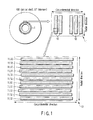
- FIG. 1 is a view showing a BCA (Burst Cutting Area) structure on an optical disc (read-only optical disc, WORM optical disc, or rewritable optical disc) according to an embodiment of the invention
- FIG. 2 is a view showing an example of the flow of an optical disc manufacturing method according to an embodiment of the invention
- FIG. 3 is a view showing the first example of a BCA pattern in the BCA formed on the optical disc according to an embodiment of the invention
- FIG. 4 is a view showing the second example of the BCA pattern in the BCA formed on the optical disc according to an embodiment of the invention
- FIG. 5 is a block diagram showing the schematic arrangement of the first example of a BCA recording apparatus (management information recording apparatus) according to an embodiment of the invention
- FIG. 6 is a block diagram showing the schematic arrangement of the second example of the BCA recording apparatus (management information recording apparatus) according to an embodiment of the invention.
- FIG. 7 is a block diagram showing an example of a schematic arrangement of an optical disc apparatus which plays back the BCA pattern (management information) recorded in the BCA on the optical disc OD according to an embodiment of the invention
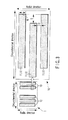
- FIG. 8 is a view for explaining an example of a motion of a beam spot in the BCA according to an embodiment of the invention.
- FIG. 9 is a graph for explaining an example of a playback signal which is directly obtained from the BCA according to an embodiment of the invention.
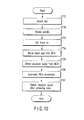
- FIG. 10 is a flowchart for explaining an example of a playback method of playing back the BCA pattern (management information) recorded in the BCA on the optical disc OD according to an embodiment of the invention.
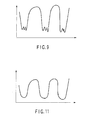
- FIG. 11 is a graph for explaining an example of a playback signal from the BCA which has undergone filtering processing according to an embodiment of the invention.
- FIG. 1 is a view showing a BCA (Burst Cutting Area) structure on an optical disc (read-only optical disc, WORM optical disc, or rewritable optical disc) according to an embodiment of the invention.
- FIG. 2 is a view showing the flow of an optical disc manufacturing method.
- FIG. 3 is a view showing the first example of a BCA pattern in the BCA formed on the optical disc.
- FIG. 4 is a view showing the second example of the BCA pattern in the BCA formed on the optical disc.
- FIG. 1 is a view showing the BCA structure on a stamper according to the embodiment of the invention.
- FIG. 3 is a view showing the first example of the BCA pattern in the BCA formed on this stamper.
- FIG. 4 is a view showing the second example of the BCA pattern in the BCA formed on this stamper. Note that the stamper is used to form the optical disc by press-molding.
- disc unique information or management information is recorded in an optical disc OD in advance.
- the disc unique information is, e.g., copy protection information.
- the copy protection information is used to identify each disc.
- the disc unique information or the management information is formed in advance as a barcode pattern in the BCA in the inner peripheral portion of the disc.
- the barcode pattern to be formed in the BCA can be formed on the stamper serving as a mold tool when the optical disc is to be manufactured.
- the barcode pattern can be formed upon burning out a reflecting film on the manufactured disc using a laser beam, or can be formed on a recording layer made of an inorganic material or an organic pigment on the manufactured disc.
- the barcode pattern in the BCA is read as follows. First, the disc is rotated, and a laser beam from an optical disc recording/playback apparatus is focused on a disc surface. When the laser beam strikes the BCA, the barcode pattern in the BCA is reflected to the reflected light of this laser beam. That is, the barcode pattern in the BCA can be played back by detecting the reflected light of the laser beam.
- a laser beam spot diameter which is applied to a high-density optical disc such as the HD-DVD (next-generation DVD) is about 0.5 ⁇ m, while the width (in the circumferential direction) of one barcode in the BCA which is applied to the current-generation optical disc is about 10 ⁇ m. That is, the laser beam spot diameter is extremely small with respect to the width of the barcode pattern to be read out. Hence, the distortion of the playback signal of the barcode pattern can occur. For example, although the signal can be set at low level at the central portion of the barcode, the signal is undesirably set almost at high level since the laser beam spot is apart from a barcode edge.
- the BCA pattern is formed as follows.
- the optical disc (information storage medium) OD includes a concentric BCA (management information area) 1.
- the BCA 1 has a plurality of elements 11, 12.
- the elements 11, 12 can be grooves 11 formed in the circumferential and radial directions, or a plurality of marks 12 recorded in the circumferential and radial directions.
- Each of the marks 12 can have a convex or concave shape, or can be recorded by a phase change or a pigment change.
- the reflectance of the mark 12 can be lower than that of a portion other than the mark 12. Alternatively, the reflectance of the mark 12 can be higher than that of the portion other than the mark 12.
- the aggregate of the grooves 11 or the marks 12 aligned in the radial direction forms a BCA pattern (bar-like pattern) 10.
- the aggregate of the BCA patterns 10 aligned in the circumferential direction forms disc unique information or management information.
- the BCA 1 includes the plurality of BCA patterns 10 aligned in the circumferential direction, each of which has the aggregate of the plurality of grooves 11 or marks 12 aligned in the radial direction.
- the plurality of BCA patterns 10 aligned in the circumferential direction form the management information.
- a width W (length in the radial direction) of the groove 11 or mark 12 satisfies 0.15 ⁇ m ⁇ W ⁇ 0.5 ⁇ m.
- a distance D between the grooves 11 or marks 12 (between edges) which are adjacent to each other in the radial direction satisfies D ⁇ 0.5 ⁇ m.
- a deviation S in the circumferential direction between the grooves 11 or between the marks 12 which are adjacent to each other in the radial direction satisfies 0.5 ⁇ m ⁇ S ⁇ 5.0 ⁇ m.
- the distance between the BCA patterns 10 adjacent to each other in the circumferential direction is sufficiently larger than the distance D between the grooves 11 or marks 12 (between edges) which are adjacent to each other in the radial direction.
- the BCA patterns 10 arranged at such distance intervals form the disc unique information or the management information.
- the width of the groove 11 or the mark 12 and the distance between the grooves I 1 or marks 12 are determined in consideration of the beam spot diameter (about 0.5 ⁇ m). Accordingly, the distortion of the playback signal obtained when the optical disc recording/playback apparatus plays back the BCA 1 on the optical disc OD can be sufficiently suppressed.
- the optical disc OD has a diameter of 120 mm and a thickness of 1.2 mm (adhering two layers including a polycarbonate molded substrates each having a thickness of 0.6 mm), and the BCA is formed to have a ring shape with a radius of 22.3 to 23.1 mm.
- recording/playback light having a wavelength of 405 nm is employed as recording/playback light, and an optical system having an NA of 0.65 is employed. Note that the optical disc OD in this embodiment is not limited to these numerical values.
- a master is made of glass, and has a surface which is polished and cleaned (ST21).
- a photoresist is applied to the surface of the master (ST22), and the photoresist surface is exposed to the laser beam and the like to record the information (ST23).
- the exposed master is developed to form convex and concave portions such as the pits or grooves (ST24).
- the master is plated to form a stamper ST (ST25).
- the stamper ST as a mold, the molded substrate made of a resin is formed by injection molding (ST26).
- a recording layer and a reflection layer are formed on a rewritable disc or a WORM disc, or only reflection layer is formed on a read-only disc (ST27). After that, these substrates are adhered to form the optical disc (ST28).
- the grooves 11 are recorded in a master exposure step (ST23).
- the stamper ST having the grooves 11 can be obtained by recording the grooves 11 on the master once. Accordingly, the BCA-recorded discs can be mass-produced by the stamper ST. That is, in this first method, the mass-productivity of the disc is improved.
- the stamper ST includes the concentric BCA (management information area) 1.
- the BCA 1 has the plurality of grooves 11 formed in the circumferential and radial directions.
- the aggregate of the grooves 11 aligned in the radial direction forms a BCA pattern 10.
- the aggregate of the BCA patterns 10 aligned in the circumferential direction forms management information.
- the BCA 1 includes the plurality of BCA patterns 10 aligned in the circumferential direction, each of which has the aggregate of the plurality of grooves 11 or marks 12 aligned in the radial direction.
- the plurality of BCA patterns 10 aligned in the circumferential direction form the management information.
- the width W of the groove 11 satisfies 0.15 ⁇ m ⁇ W ⁇ 0.5 ⁇ m.
- the distance D between the grooves 11 (between edges) which are adjacent to each other in the radial direction satisfies D ⁇ 0.5 ⁇ m.
- the deviation S in the circumferential direction between the grooves 11 which are adjacent to each other in the radial direction satisfies 0.5 ⁇ m ⁇ S ⁇ 5.0 ⁇ m.
- the distance between the BCA patterns 10 adjacent to each other in the circumferential direction is sufficiently larger than the distance D between the grooves 11 (between edges) which are adjacent to each other in the radial direction.
- the BCA patterns 10 arranged at such distance intervals form the disc unique information or the management information.
- the sizes, arrangement intervals, and the like of the grooves 11 are not extremely large, but adequate to a beam spot diameter of about 0.5 ⁇ m.
- the edge of the pattern appears in the beam spot.
- the edge of the pattern always appears in the beam spot.
- an upper limit value of 5.0 ⁇ m of the deviation S is obtained by converting an allowable deviation of 0.75 ⁇ s of the playback signal from the BCA 1 (the length at low level can be 1.56 ⁇ 0.75 ⁇ s when the disc is rotated at 2,760 rpm) into distance.
- the BCA 1 can be correctly played back even if the groove arrangement deviates.
- the edge of the pattern can appear in the beam spot as frequently as possible. Accordingly, the distortion of the playback signal can be suppressed.
- the pattern of the grooves 11 or marks 12 is recorded in the BCA on the manufactured optical disc OD by a BCA recording apparatus (management information recording apparatus).
- the grooves 11 are formed by burning out the reflecting film of the disc using the laser beam from the BCA recording apparatus (read-only disc).
- the marks 12 are recorded on the recording layer on the disc using the laser beam from the BCA recording apparatus (rewritable disc or WORM disc).
- a long time is needed for recording information on each disc, and the productivity slightly decreases.
- individual information can be recorded on each disc. For example, it is suited to record the disc identification information which is effective for copy protection.
- the BCA pattern shown in FIG. 4 is also available. That is, as shown in FIG. 4, the optical disc (information storage medium) OD includes a concentric BCA (management information area) 1a.
- the BCA 1a has a plurality of marks 12a formed in the circumferential and radial directions. The marks 12a are recorded by the phase change or the pigment change.
- the aggregate of the marks 12a aligned in the radial direction and some of the marks 12a aligned in the circumferential direction forms a BCA pattern (bar-like pattern) 10a.
- the aggregate of the BCA patterns 10a aligned in the circumferential direction forms the disc unique information or the management information.
- the BCA 1a includes the plurality of BCA patterns 10a aligned in the circumferential direction, each of which has the aggregate of the plurality of marks 12a aligned in the radial and circumferential directions.
- the plurality of BCA patterns 10a aligned in the circumferential direction form the management information.
- the width W (length in the radial direction) of the mark 12a satisfies 0.15 ⁇ m ⁇ W ⁇ 0.5 ⁇ m.
- the distance D between the marks 12a (between edges) which are included in one BCA pattern 10a and adjacent to each other in the radial direction satisfies D ⁇ 0.5 ⁇ m.
- the distortion of the playback signal from the BCA can be suppressed.
- FIG. 5 is a block diagram showing the schematic arrangement of the first example of the BCA recording apparatus (management information recording apparatus).
- FIG. 6 is a block diagram showing the schematic arrangement of the second example of the BCA recording apparatus (management information recording apparatus).
- the BCA recording apparatus includes a controller 31, laser output control unit 32, feed mechanism 33, optical head 34, spindle driving unit 35, random delay circuit 36, and spindle motor 37.
- the controller 31 generates a BCA signal corresponding to the BCA pattern, a feed mechanism control signal, and a sync signal.
- the laser output control unit 32 controls to drive a laser 34a included in the optical head 34, on the basis of the BCA signal. That is, the laser 34a irradiates the BCA with a laser beam corresponding to the BCA pattern.
- the feed mechanism 33 moves the optical head 34 in the radial direction of the disc.
- An actuator 34b included in the optical head 34 makes fine adjustment of the irradiation position of the beam spot using the laser 34a.
- the spindle driving unit 35 generates a spindle driving signal on the basis of the sync signal.
- the random delay circuit 36 adds a random delay component to the spindle driving signal.
- the spindle motor 37 is rotated on the basis of the spindle driving signal having the random delay component. Upon rotation of the spindle motor 37, the optical disc OD is also rotated. As a result, the BCA pattern 10 or 10a shown in FIGS. 1, 3, and 4 can be formed on the disc.
- the BCA recording apparatus includes a controller 41, laser output control unit 42, feed mechanism 43, optical head 44, spindle driving unit 45, spindle motor 37, and high-frequency ON/OFF circuit 48.
- the controller 41 generates the BCA signal corresponding to the BCA pattern, the feed mechanism control signal, and the sync signal.
- the high-frequency ON/OFF circuit 48 divides the BCA signal into a mark string.
- the laser output control unit 42 controls to drive a laser 44a included in the optical head 44, on the basis of the BCA signal. That is, the laser 44a irradiates the BCA with the laser beam corresponding to the BCA pattern.
- the feed mechanism 43 moves the optical head 44 in the radial direction of the disc.
- An actuator 44b included in the optical head 44 makes fine adjustment of the irradiation position of the beam spot using the laser driver 44a.
- the spindle driving unit 45 generates a spindle driving signal on the basis of the sync signal.
- the spindle motor 47 is rotated on the basis of the spindle driving signal.
- the optical disc OD is also rotated.
- the BCA pattern 10 or 10a shown in FIGS. 1, 3, and 4 can be formed on the disc.
- FIG. 7 is a block diagram showing a schematic arrangement of an optical disc apparatus which plays back the BCA pattern (management information) recorded in the BCA on the optical disc OD.
- FIG. 8 is a view for explaining a motion of a beam spot in the BCA.
- FIG. 9 is a graph for explaining a playback signal which is directly obtained from the BCA.
- FIG. 10 is a flowchart for explaining a playback method of playing back the BCA pattern (management information) recorded in the BCA on the optical disc OD.
- FIG. I 1 is a graph for explaining a playback signal from the BCA which has undergone filtering processing.
- the optical disc apparatus includes a controller 51, recording signal processing circuit 52, laser driver (LD) 53, optical pick up head (PUH) 54, pre-amplifier 55, servo circuit 56, BCA signal processing circuit 57, RF signal processing circuit 58, and address signal processing circuit 59.
- the optical pick up head 54 also includes a laser 54a, actuator (ACT) 54b, and photodetector (PD) 54c.
- the controller 51 When the information is to be recorded, the controller 51 outputs a recording signal.
- the recording signal processing circuit 52 modulates this recording signal.
- the laser driver (LD) 53 drives the laser 54a. Then, the laser 54a irradiates the optical disc with the laser beam corresponding to the recording signal. With this operation, the information is recorded on the optical disc OD.
- the laser driver (LD) 53 drives the laser 54a on the basis of the playback signal.
- the laser 54a irradiates the optical disc with a playback laser beam.
- the reflected light from the optical disc is detected by the photodetector 54c.
- the photodetector 54c outputs a reflected light component as an electrical signal.
- the photodetector 54c includes a plurality of light detection elements (e.g., four light detection elements). A signal obtained by adding the signal components detected by the respective light detection elements is called a sum signal, and a signal obtained by subtracting the signal components detected by some light detection elements from those detected by the remaining light detection elements is called a difference signal.
- the pre-amplifier 55 amplifies the electrical signal output from the photodetector 54c.
- the servo circuit 56 generates a servo signal on the basis of a servo control signal from the controller 51 and the electrical signal which is detected by the photodetector 54c and amplified by the pre-amplifier.
- the actuator (ACT) 54b controls focus, tracking, and tilt on the basis of the servo signal.
- the BCA signal processing circuit 57 processes the electrical signal (sum signal) which is detected by the photodetector 54c and amplified by the pre-amplifier, to play back the BCA pattern.
- the BCA signal processing circuit 57 includes the low-pass filter 57a to remove high-frequency component noise.
- the RF signal processing circuit 58 processes the electrical signal (sum signal) which is detected by the photodetector 54c and amplified by the pre-amplifier, to play back contents information.
- the address signal processing circuit 59 processes the electrical signal (sum signal) which is detected by the photodetector 54c and amplified by the pre-amplifier, to play back physical address information.
- the playback-light beam spot when the BCA signal is played back, tracking control of a playback-light beam spot is not performed. Accordingly, the playback-light beam spot sometimes obliquely passes through the BCA pattern 10 or 10a in the BCA.
- the playback signal directly obtained from the BCA includes a small signal as noise from the gap between the patterns.
- the low-pass filter 57a of the BCA signal processing circuit 57 shown in FIG. 7 removes this noise.
- the optical disc OD is mounted (ST31), the spindle motor 37 is rotated (ST32), the focus is set on (ST33), and the beam spot moves to the BCA (ST34).
- the playback signal is obtained from the BCA (ST35), and the playback signal undergoes the low-pass filter process (ST36), and the playback signal without high-frequency component noise shown in FIG. 11 can be obtained (ST37). Since this high-frequency component noise is removed, the BCA can be correctly played back.
Landscapes
- Engineering & Computer Science (AREA)
- Manufacturing & Machinery (AREA)
- Optical Recording Or Reproduction (AREA)
- Management Or Editing Of Information On Record Carriers (AREA)
- Signal Processing For Digital Recording And Reproducing (AREA)
Applications Claiming Priority (1)
| Application Number | Priority Date | Filing Date | Title |
|---|---|---|---|
| JP2004347156A JP2006155802A (ja) | 2004-11-30 | 2004-11-30 | 情報記憶媒体、スタンパー、管理情報記録装置、ディスク装置、管理情報再生方法 |
Publications (2)
| Publication Number | Publication Date |
|---|---|
| EP1662494A2 true EP1662494A2 (de) | 2006-05-31 |
| EP1662494A3 EP1662494A3 (de) | 2006-12-20 |
Family
ID=35079447
Family Applications (1)
| Application Number | Title | Priority Date | Filing Date |
|---|---|---|---|
| EP05107834A Withdrawn EP1662494A3 (de) | 2004-11-30 | 2005-08-26 | Informationsspeichermedium, Matrize, Plattengerät, und Wiedergabeverfahren für Verwaltungsinformation |
Country Status (7)
| Country | Link |
|---|---|
| US (1) | US20060114803A1 (de) |
| EP (1) | EP1662494A3 (de) |
| JP (1) | JP2006155802A (de) |
| KR (1) | KR100705378B1 (de) |
| CN (1) | CN100378810C (de) |
| BR (1) | BRPI0503824A (de) |
| TW (1) | TWI270065B (de) |
Cited By (1)
| Publication number | Priority date | Publication date | Assignee | Title |
|---|---|---|---|---|
| EP2079082A4 (de) * | 2006-11-02 | 2010-01-13 | Kobe Steel Ltd | Optisches informationsaufzeichnungsmedium, verfahren zur herstellung eines optischen informationsaufzeichnungsmediums und bca-(burst cutting area-) markierungsverfahren |
Families Citing this family (4)
| Publication number | Priority date | Publication date | Assignee | Title |
|---|---|---|---|---|
| US20060274617A1 (en) * | 2005-06-03 | 2006-12-07 | Musto James J | Techniques for forming burst cutting area mark |
| US8369196B1 (en) | 2010-05-04 | 2013-02-05 | Cinram International Inc. | BCA recording on optical recording medium |
| US8526282B1 (en) | 2010-07-07 | 2013-09-03 | Cinram Group, Inc. | Method for replicating media using unique identifiers |
| JP2012064299A (ja) * | 2010-08-19 | 2012-03-29 | Sony Corp | 光記録媒体、光記録媒体の製造方法 |
Citations (1)
| Publication number | Priority date | Publication date | Assignee | Title |
|---|---|---|---|---|
| JP2004152429A (ja) | 2002-10-31 | 2004-05-27 | Matsushita Electric Ind Co Ltd | 光ディスクのコード記録方法及びコード記録装置 |
Family Cites Families (16)
| Publication number | Priority date | Publication date | Assignee | Title |
|---|---|---|---|---|
| US5553051A (en) * | 1987-09-04 | 1996-09-03 | Hitachi, Ltd. | Increased intensity optical recording medium with adjacent grooves of different optical depth and a method and apparatus for reproducing the same |
| JP2752190B2 (ja) * | 1989-09-29 | 1998-05-18 | 株式会社東芝 | ディスク装置 |
| JP4086913B2 (ja) * | 1995-10-09 | 2008-05-14 | 松下電器産業株式会社 | 光ディスクおよび光ディスクの再生装置 |
| DE69610861T2 (de) * | 1995-10-09 | 2001-03-15 | Matsushita Electric Industrial Co., Ltd. | Optische Scheibe und optisches Wiedergabegerät |
| JPH09259576A (ja) * | 1996-03-25 | 1997-10-03 | Toshiba Corp | 複数管理領域を持つ情報記録ディスク |
| US5972459A (en) * | 1997-04-25 | 1999-10-26 | Sony Corporation | Optical recording medium and optical disk apparatus |
| EP1152402B1 (de) * | 1999-07-15 | 2006-11-15 | Matsushita Electric Industrial Co., Ltd. | Optisches aufzeichnungsmedium und verfahren zur aufzeichnung auf einem optischen aufzeichnungsmedium |
| AU2002326095A1 (en) * | 2001-09-05 | 2003-03-18 | Koninklijke Philips Electronics N.V. | Optical data storage medium and methods for reading and writing such a medium |
| ATE397266T1 (de) * | 2002-02-18 | 2008-06-15 | Koninkl Philips Electronics Nv | Optisches aufzeichnungsmedium und dessen wiedergabeverfahren |
| JP2004030860A (ja) * | 2002-04-30 | 2004-01-29 | Pioneer Electronic Corp | 記録ディスク及び記録情報再生装置並びに記録情報再生方法 |
| ES2294284T3 (es) * | 2002-05-30 | 2008-04-01 | Lg Electronics Inc. | Disco optico de alta densidad y metodo para reproducir y grabar datos del mismo. |
| KR100716966B1 (ko) * | 2002-11-04 | 2007-05-10 | 삼성전자주식회사 | 트랙킹 극성 정보가 기록된 광 디스크, 그 기록 장치 및기록 방법, 및 그 재생 장치 및 재생 방법 |
| JP2004164758A (ja) * | 2002-11-14 | 2004-06-10 | Pioneer Electronic Corp | 再生専用の光ディスク、再生装置、再生方法、並びに、再生プログラムおよびそれを記録した記録媒体 |
| JP2004326857A (ja) * | 2003-04-22 | 2004-11-18 | Sony Corp | 光磁気ディスクおよびその記録再生方法 |
| US8339920B2 (en) * | 2003-07-10 | 2012-12-25 | Hewlett-Packard Development Company, L.P. | Optical storage medium with optically detectable marks |
| JP2005174528A (ja) * | 2003-11-18 | 2005-06-30 | Hitachi Maxell Ltd | 光ディスク及びその製造方法並びに記録再生装置 |
-
2004
- 2004-11-30 JP JP2004347156A patent/JP2006155802A/ja active Pending
-
2005
- 2005-08-26 TW TW094129329A patent/TWI270065B/zh not_active IP Right Cessation
- 2005-08-26 EP EP05107834A patent/EP1662494A3/de not_active Withdrawn
- 2005-09-07 US US11/219,916 patent/US20060114803A1/en not_active Abandoned
- 2005-09-13 KR KR1020050085136A patent/KR100705378B1/ko not_active Expired - Fee Related
- 2005-09-14 BR BRPI0503824-3A patent/BRPI0503824A/pt not_active IP Right Cessation
- 2005-09-14 CN CNB2005101096445A patent/CN100378810C/zh not_active Expired - Fee Related
Patent Citations (1)
| Publication number | Priority date | Publication date | Assignee | Title |
|---|---|---|---|---|
| JP2004152429A (ja) | 2002-10-31 | 2004-05-27 | Matsushita Electric Ind Co Ltd | 光ディスクのコード記録方法及びコード記録装置 |
Cited By (1)
| Publication number | Priority date | Publication date | Assignee | Title |
|---|---|---|---|---|
| EP2079082A4 (de) * | 2006-11-02 | 2010-01-13 | Kobe Steel Ltd | Optisches informationsaufzeichnungsmedium, verfahren zur herstellung eines optischen informationsaufzeichnungsmediums und bca-(burst cutting area-) markierungsverfahren |
Also Published As
| Publication number | Publication date |
|---|---|
| US20060114803A1 (en) | 2006-06-01 |
| KR20060060546A (ko) | 2006-06-05 |
| KR100705378B1 (ko) | 2007-04-12 |
| CN1783236A (zh) | 2006-06-07 |
| EP1662494A3 (de) | 2006-12-20 |
| BRPI0503824A (pt) | 2006-07-11 |
| TWI270065B (en) | 2007-01-01 |
| TW200634772A (en) | 2006-10-01 |
| JP2006155802A (ja) | 2006-06-15 |
| CN100378810C (zh) | 2008-04-02 |
Similar Documents
| Publication | Publication Date | Title |
|---|---|---|
| US7215620B2 (en) | Information recording medium with management area having recording identification information | |
| JP2005502152A (ja) | 光データ記憶媒体並びにこのような媒体の読取り及び書込みを行うための方法 | |
| JP4226184B2 (ja) | 情報記録媒体判別装置及び情報記録媒体判別方法 | |
| EP1662494A2 (de) | Informationsspeichermedium, Matrize, Plattengerät, und Wiedergabeverfahren für Verwaltungsinformation | |
| JP4348744B2 (ja) | 光学的情報記録媒体および光学的情報記録媒体の作成方法 | |
| JP4821774B2 (ja) | 光学的情報記録媒体 | |
| KR100722752B1 (ko) | 정보 기억 매체, 스탬퍼, 디스크 장치, 관리 정보 재생방법 | |
| EP2092521B1 (de) | Optisches speichermedium und entsprechende vorrichtung zum aufzeichnen und/oder lesen von daten | |
| JP2006338718A (ja) | 光ディスク媒体および光ディスク装置 | |
| EP1748436A2 (de) | Informationsspeichermedium, Wiedergabeverfahren, Aufzeichnungsverfahren und Aufzeichnungsgerät | |
| US8331213B2 (en) | Information recording medium, information reproducing device and method, and apparatus and method for manufacturing information recording medium | |
| US7911895B2 (en) | Method for restoring data stored on an optical disc and optical disc drive suitable therefore | |
| JP2004005916A (ja) | 光学式情報記録媒体、その記録再生装置、記録再生方法および光学式情報記録媒体の製造方法 | |
| US8369196B1 (en) | BCA recording on optical recording medium | |
| JP2006268906A (ja) | 情報記憶媒体及び光ディスク記録再生装置 | |
| JP2009176337A (ja) | 光ディスク装置 | |
| WO2005081241A1 (ja) | 光情報記録媒体及び情報記録再生装置 | |
| JP2002197673A (ja) | 光ディスク及び光ディスク記録再生装置 | |
| JP2002197672A (ja) | 光ディスク及び光ディスク記録再生装置 | |
| JPWO2000023990A1 (ja) | 光学情報記録媒体及びその記録・再生方法と記録再生装置 | |
| WO2007010824A2 (ja) | 情報記録媒体、情報再生装置及び方法、並びに、情報記録媒体の製造装置及び方法 |
Legal Events
| Date | Code | Title | Description |
|---|---|---|---|
| PUAI | Public reference made under article 153(3) epc to a published international application that has entered the european phase |
Free format text: ORIGINAL CODE: 0009012 |
|
| 17P | Request for examination filed |
Effective date: 20050826 |
|
| AK | Designated contracting states |
Kind code of ref document: A2 Designated state(s): AT BE BG CH CY CZ DE DK EE ES FI FR GB GR HU IE IS IT LI LT LU LV MC NL PL PT RO SE SI SK TR |
|
| AX | Request for extension of the european patent |
Extension state: AL BA HR MK YU |
|
| PUAL | Search report despatched |
Free format text: ORIGINAL CODE: 0009013 |
|
| AK | Designated contracting states |
Kind code of ref document: A3 Designated state(s): AT BE BG CH CY CZ DE DK EE ES FI FR GB GR HU IE IS IT LI LT LU LV MC NL PL PT RO SE SI SK TR |
|
| AX | Request for extension of the european patent |
Extension state: AL BA HR MK YU |
|
| 17Q | First examination report despatched |
Effective date: 20070405 |
|
| AKX | Designation fees paid |
Designated state(s): DE FR GB |
|
| STAA | Information on the status of an ep patent application or granted ep patent |
Free format text: STATUS: THE APPLICATION IS DEEMED TO BE WITHDRAWN |
|
| 18D | Application deemed to be withdrawn |
Effective date: 20100302 |