EP1663982B1 - Derives d'aminoquinoline et leur utilisation comme ligands d'adenosine a3 - Google Patents
Derives d'aminoquinoline et leur utilisation comme ligands d'adenosine a3 Download PDFInfo
- Publication number
- EP1663982B1 EP1663982B1 EP04769079A EP04769079A EP1663982B1 EP 1663982 B1 EP1663982 B1 EP 1663982B1 EP 04769079 A EP04769079 A EP 04769079A EP 04769079 A EP04769079 A EP 04769079A EP 1663982 B1 EP1663982 B1 EP 1663982B1
- Authority
- EP
- European Patent Office
- Prior art keywords
- group
- branched
- straight
- stands
- alkyl group
- Prior art date
- Legal status (The legal status is an assumption and is not a legal conclusion. Google has not performed a legal analysis and makes no representation as to the accuracy of the status listed.)
- Expired - Lifetime
Links
- 0 C*c1c(cc(*(*)*)cc2)c2nc(NC(*)=*)c1C#N Chemical compound C*c1c(cc(*(*)*)cc2)c2nc(NC(*)=*)c1C#N 0.000 description 1
- OSIGJGFTADMDOB-UHFFFAOYSA-N Cc1cc(OC)ccc1 Chemical compound Cc1cc(OC)ccc1 OSIGJGFTADMDOB-UHFFFAOYSA-N 0.000 description 1
Classifications
-
- C—CHEMISTRY; METALLURGY
- C07—ORGANIC CHEMISTRY
- C07D—HETEROCYCLIC COMPOUNDS
- C07D405/00—Heterocyclic compounds containing both one or more hetero rings having oxygen atoms as the only ring hetero atoms, and one or more rings having nitrogen as the only ring hetero atom
- C07D405/02—Heterocyclic compounds containing both one or more hetero rings having oxygen atoms as the only ring hetero atoms, and one or more rings having nitrogen as the only ring hetero atom containing two hetero rings
- C07D405/12—Heterocyclic compounds containing both one or more hetero rings having oxygen atoms as the only ring hetero atoms, and one or more rings having nitrogen as the only ring hetero atom containing two hetero rings linked by a chain containing hetero atoms as chain links
-
- A—HUMAN NECESSITIES
- A61—MEDICAL OR VETERINARY SCIENCE; HYGIENE
- A61K—PREPARATIONS FOR MEDICAL, DENTAL OR TOILETRY PURPOSES
- A61K31/00—Medicinal preparations containing organic active ingredients
- A61K31/33—Heterocyclic compounds
- A61K31/395—Heterocyclic compounds having nitrogen as a ring hetero atom, e.g. guanethidine or rifamycins
- A61K31/435—Heterocyclic compounds having nitrogen as a ring hetero atom, e.g. guanethidine or rifamycins having six-membered rings with one nitrogen as the only ring hetero atom
- A61K31/47—Quinolines; Isoquinolines
-
- A—HUMAN NECESSITIES
- A61—MEDICAL OR VETERINARY SCIENCE; HYGIENE
- A61K—PREPARATIONS FOR MEDICAL, DENTAL OR TOILETRY PURPOSES
- A61K31/00—Medicinal preparations containing organic active ingredients
- A61K31/33—Heterocyclic compounds
- A61K31/395—Heterocyclic compounds having nitrogen as a ring hetero atom, e.g. guanethidine or rifamycins
- A61K31/435—Heterocyclic compounds having nitrogen as a ring hetero atom, e.g. guanethidine or rifamycins having six-membered rings with one nitrogen as the only ring hetero atom
- A61K31/47—Quinolines; Isoquinolines
- A61K31/4706—4-Aminoquinolines; 8-Aminoquinolines, e.g. chloroquine, primaquine
-
- A—HUMAN NECESSITIES
- A61—MEDICAL OR VETERINARY SCIENCE; HYGIENE
- A61P—SPECIFIC THERAPEUTIC ACTIVITY OF CHEMICAL COMPOUNDS OR MEDICINAL PREPARATIONS
- A61P1/00—Drugs for disorders of the alimentary tract or the digestive system
-
- A—HUMAN NECESSITIES
- A61—MEDICAL OR VETERINARY SCIENCE; HYGIENE
- A61P—SPECIFIC THERAPEUTIC ACTIVITY OF CHEMICAL COMPOUNDS OR MEDICINAL PREPARATIONS
- A61P1/00—Drugs for disorders of the alimentary tract or the digestive system
- A61P1/04—Drugs for disorders of the alimentary tract or the digestive system for ulcers, gastritis or reflux esophagitis, e.g. antacids, inhibitors of acid secretion, mucosal protectants
-
- A—HUMAN NECESSITIES
- A61—MEDICAL OR VETERINARY SCIENCE; HYGIENE
- A61P—SPECIFIC THERAPEUTIC ACTIVITY OF CHEMICAL COMPOUNDS OR MEDICINAL PREPARATIONS
- A61P11/00—Drugs for disorders of the respiratory system
-
- A—HUMAN NECESSITIES
- A61—MEDICAL OR VETERINARY SCIENCE; HYGIENE
- A61P—SPECIFIC THERAPEUTIC ACTIVITY OF CHEMICAL COMPOUNDS OR MEDICINAL PREPARATIONS
- A61P11/00—Drugs for disorders of the respiratory system
- A61P11/06—Antiasthmatics
-
- A—HUMAN NECESSITIES
- A61—MEDICAL OR VETERINARY SCIENCE; HYGIENE
- A61P—SPECIFIC THERAPEUTIC ACTIVITY OF CHEMICAL COMPOUNDS OR MEDICINAL PREPARATIONS
- A61P13/00—Drugs for disorders of the urinary system
- A61P13/12—Drugs for disorders of the urinary system of the kidneys
-
- A—HUMAN NECESSITIES
- A61—MEDICAL OR VETERINARY SCIENCE; HYGIENE
- A61P—SPECIFIC THERAPEUTIC ACTIVITY OF CHEMICAL COMPOUNDS OR MEDICINAL PREPARATIONS
- A61P17/00—Drugs for dermatological disorders
- A61P17/06—Antipsoriatics
-
- A—HUMAN NECESSITIES
- A61—MEDICAL OR VETERINARY SCIENCE; HYGIENE
- A61P—SPECIFIC THERAPEUTIC ACTIVITY OF CHEMICAL COMPOUNDS OR MEDICINAL PREPARATIONS
- A61P25/00—Drugs for disorders of the nervous system
-
- A—HUMAN NECESSITIES
- A61—MEDICAL OR VETERINARY SCIENCE; HYGIENE
- A61P—SPECIFIC THERAPEUTIC ACTIVITY OF CHEMICAL COMPOUNDS OR MEDICINAL PREPARATIONS
- A61P25/00—Drugs for disorders of the nervous system
- A61P25/14—Drugs for disorders of the nervous system for treating abnormal movements, e.g. chorea, dyskinesia
- A61P25/16—Anti-Parkinson drugs
-
- A—HUMAN NECESSITIES
- A61—MEDICAL OR VETERINARY SCIENCE; HYGIENE
- A61P—SPECIFIC THERAPEUTIC ACTIVITY OF CHEMICAL COMPOUNDS OR MEDICINAL PREPARATIONS
- A61P25/00—Drugs for disorders of the nervous system
- A61P25/24—Antidepressants
-
- A—HUMAN NECESSITIES
- A61—MEDICAL OR VETERINARY SCIENCE; HYGIENE
- A61P—SPECIFIC THERAPEUTIC ACTIVITY OF CHEMICAL COMPOUNDS OR MEDICINAL PREPARATIONS
- A61P27/00—Drugs for disorders of the senses
- A61P27/02—Ophthalmic agents
-
- A—HUMAN NECESSITIES
- A61—MEDICAL OR VETERINARY SCIENCE; HYGIENE
- A61P—SPECIFIC THERAPEUTIC ACTIVITY OF CHEMICAL COMPOUNDS OR MEDICINAL PREPARATIONS
- A61P27/00—Drugs for disorders of the senses
- A61P27/02—Ophthalmic agents
- A61P27/06—Antiglaucoma agents or miotics
-
- A—HUMAN NECESSITIES
- A61—MEDICAL OR VETERINARY SCIENCE; HYGIENE
- A61P—SPECIFIC THERAPEUTIC ACTIVITY OF CHEMICAL COMPOUNDS OR MEDICINAL PREPARATIONS
- A61P29/00—Non-central analgesic, antipyretic or antiinflammatory agents, e.g. antirheumatic agents; Non-steroidal antiinflammatory drugs [NSAID]
-
- A—HUMAN NECESSITIES
- A61—MEDICAL OR VETERINARY SCIENCE; HYGIENE
- A61P—SPECIFIC THERAPEUTIC ACTIVITY OF CHEMICAL COMPOUNDS OR MEDICINAL PREPARATIONS
- A61P3/00—Drugs for disorders of the metabolism
- A61P3/08—Drugs for disorders of the metabolism for glucose homeostasis
- A61P3/10—Drugs for disorders of the metabolism for glucose homeostasis for hyperglycaemia, e.g. antidiabetics
-
- A—HUMAN NECESSITIES
- A61—MEDICAL OR VETERINARY SCIENCE; HYGIENE
- A61P—SPECIFIC THERAPEUTIC ACTIVITY OF CHEMICAL COMPOUNDS OR MEDICINAL PREPARATIONS
- A61P35/00—Antineoplastic agents
-
- A—HUMAN NECESSITIES
- A61—MEDICAL OR VETERINARY SCIENCE; HYGIENE
- A61P—SPECIFIC THERAPEUTIC ACTIVITY OF CHEMICAL COMPOUNDS OR MEDICINAL PREPARATIONS
- A61P37/00—Drugs for immunological or allergic disorders
-
- A—HUMAN NECESSITIES
- A61—MEDICAL OR VETERINARY SCIENCE; HYGIENE
- A61P—SPECIFIC THERAPEUTIC ACTIVITY OF CHEMICAL COMPOUNDS OR MEDICINAL PREPARATIONS
- A61P37/00—Drugs for immunological or allergic disorders
- A61P37/02—Immunomodulators
-
- A—HUMAN NECESSITIES
- A61—MEDICAL OR VETERINARY SCIENCE; HYGIENE
- A61P—SPECIFIC THERAPEUTIC ACTIVITY OF CHEMICAL COMPOUNDS OR MEDICINAL PREPARATIONS
- A61P37/00—Drugs for immunological or allergic disorders
- A61P37/08—Antiallergic agents
-
- A—HUMAN NECESSITIES
- A61—MEDICAL OR VETERINARY SCIENCE; HYGIENE
- A61P—SPECIFIC THERAPEUTIC ACTIVITY OF CHEMICAL COMPOUNDS OR MEDICINAL PREPARATIONS
- A61P43/00—Drugs for specific purposes, not provided for in groups A61P1/00-A61P41/00
-
- A—HUMAN NECESSITIES
- A61—MEDICAL OR VETERINARY SCIENCE; HYGIENE
- A61P—SPECIFIC THERAPEUTIC ACTIVITY OF CHEMICAL COMPOUNDS OR MEDICINAL PREPARATIONS
- A61P5/00—Drugs for disorders of the endocrine system
- A61P5/38—Drugs for disorders of the endocrine system of the suprarenal hormones
- A61P5/40—Mineralocorticosteroids, e.g. aldosterone; Drugs increasing or potentiating the activity of mineralocorticosteroids
-
- A—HUMAN NECESSITIES
- A61—MEDICAL OR VETERINARY SCIENCE; HYGIENE
- A61P—SPECIFIC THERAPEUTIC ACTIVITY OF CHEMICAL COMPOUNDS OR MEDICINAL PREPARATIONS
- A61P9/00—Drugs for disorders of the cardiovascular system
-
- A—HUMAN NECESSITIES
- A61—MEDICAL OR VETERINARY SCIENCE; HYGIENE
- A61P—SPECIFIC THERAPEUTIC ACTIVITY OF CHEMICAL COMPOUNDS OR MEDICINAL PREPARATIONS
- A61P9/00—Drugs for disorders of the cardiovascular system
- A61P9/06—Antiarrhythmics
-
- A—HUMAN NECESSITIES
- A61—MEDICAL OR VETERINARY SCIENCE; HYGIENE
- A61P—SPECIFIC THERAPEUTIC ACTIVITY OF CHEMICAL COMPOUNDS OR MEDICINAL PREPARATIONS
- A61P9/00—Drugs for disorders of the cardiovascular system
- A61P9/10—Drugs for disorders of the cardiovascular system for treating ischaemic or atherosclerotic diseases, e.g. antianginal drugs, coronary vasodilators, drugs for myocardial infarction, retinopathy, cerebrovascula insufficiency, renal arteriosclerosis
-
- A—HUMAN NECESSITIES
- A61—MEDICAL OR VETERINARY SCIENCE; HYGIENE
- A61P—SPECIFIC THERAPEUTIC ACTIVITY OF CHEMICAL COMPOUNDS OR MEDICINAL PREPARATIONS
- A61P9/00—Drugs for disorders of the cardiovascular system
- A61P9/12—Antihypertensives
-
- C—CHEMISTRY; METALLURGY
- C07—ORGANIC CHEMISTRY
- C07C—ACYCLIC OR CARBOCYCLIC COMPOUNDS
- C07C229/00—Compounds containing amino and carboxyl groups bound to the same carbon skeleton
- C07C229/46—Compounds containing amino and carboxyl groups bound to the same carbon skeleton having amino or carboxyl groups bound to carbon atoms of rings other than six-membered aromatic rings of the same carbon skeleton
- C07C229/50—Compounds containing amino and carboxyl groups bound to the same carbon skeleton having amino or carboxyl groups bound to carbon atoms of rings other than six-membered aromatic rings of the same carbon skeleton with amino groups and carboxyl groups bound to carbon atoms being part of the same condensed ring system
-
- C—CHEMISTRY; METALLURGY
- C07—ORGANIC CHEMISTRY
- C07D—HETEROCYCLIC COMPOUNDS
- C07D215/00—Heterocyclic compounds containing quinoline or hydrogenated quinoline ring systems
- C07D215/02—Heterocyclic compounds containing quinoline or hydrogenated quinoline ring systems having no bond between the ring nitrogen atom and a non-ring member or having only hydrogen atoms or carbon atoms directly attached to the ring nitrogen atom
- C07D215/16—Heterocyclic compounds containing quinoline or hydrogenated quinoline ring systems having no bond between the ring nitrogen atom and a non-ring member or having only hydrogen atoms or carbon atoms directly attached to the ring nitrogen atom with hetero atoms or with carbon atoms having three bonds to hetero atoms with at the most one bond to halogen, e.g. ester or nitrile radicals, directly attached to ring carbon atoms
- C07D215/48—Carbon atoms having three bonds to hetero atoms with at the most one bond to halogen
-
- C—CHEMISTRY; METALLURGY
- C07—ORGANIC CHEMISTRY
- C07D—HETEROCYCLIC COMPOUNDS
- C07D215/00—Heterocyclic compounds containing quinoline or hydrogenated quinoline ring systems
- C07D215/02—Heterocyclic compounds containing quinoline or hydrogenated quinoline ring systems having no bond between the ring nitrogen atom and a non-ring member or having only hydrogen atoms or carbon atoms directly attached to the ring nitrogen atom
- C07D215/16—Heterocyclic compounds containing quinoline or hydrogenated quinoline ring systems having no bond between the ring nitrogen atom and a non-ring member or having only hydrogen atoms or carbon atoms directly attached to the ring nitrogen atom with hetero atoms or with carbon atoms having three bonds to hetero atoms with at the most one bond to halogen, e.g. ester or nitrile radicals, directly attached to ring carbon atoms
- C07D215/48—Carbon atoms having three bonds to hetero atoms with at the most one bond to halogen
- C07D215/54—Carbon atoms having three bonds to hetero atoms with at the most one bond to halogen attached in position 3
-
- C—CHEMISTRY; METALLURGY
- C07—ORGANIC CHEMISTRY
- C07D—HETEROCYCLIC COMPOUNDS
- C07D405/00—Heterocyclic compounds containing both one or more hetero rings having oxygen atoms as the only ring hetero atoms, and one or more rings having nitrogen as the only ring hetero atom
- C07D405/14—Heterocyclic compounds containing both one or more hetero rings having oxygen atoms as the only ring hetero atoms, and one or more rings having nitrogen as the only ring hetero atom containing three or more hetero rings
-
- C—CHEMISTRY; METALLURGY
- C07—ORGANIC CHEMISTRY
- C07D—HETEROCYCLIC COMPOUNDS
- C07D409/00—Heterocyclic compounds containing two or more hetero rings, at least one ring having sulfur atoms as the only ring hetero atoms
- C07D409/02—Heterocyclic compounds containing two or more hetero rings, at least one ring having sulfur atoms as the only ring hetero atoms containing two hetero rings
- C07D409/12—Heterocyclic compounds containing two or more hetero rings, at least one ring having sulfur atoms as the only ring hetero atoms containing two hetero rings linked by a chain containing hetero atoms as chain links
-
- C—CHEMISTRY; METALLURGY
- C07—ORGANIC CHEMISTRY
- C07D—HETEROCYCLIC COMPOUNDS
- C07D409/00—Heterocyclic compounds containing two or more hetero rings, at least one ring having sulfur atoms as the only ring hetero atoms
- C07D409/14—Heterocyclic compounds containing two or more hetero rings, at least one ring having sulfur atoms as the only ring hetero atoms containing three or more hetero rings
-
- C—CHEMISTRY; METALLURGY
- C07—ORGANIC CHEMISTRY
- C07D—HETEROCYCLIC COMPOUNDS
- C07D491/00—Heterocyclic compounds containing in the condensed ring system both one or more rings having oxygen atoms as the only ring hetero atoms and one or more rings having nitrogen atoms as the only ring hetero atoms, not provided for by groups C07D451/00 - C07D459/00, C07D463/00, C07D477/00 or C07D489/00
- C07D491/02—Heterocyclic compounds containing in the condensed ring system both one or more rings having oxygen atoms as the only ring hetero atoms and one or more rings having nitrogen atoms as the only ring hetero atoms, not provided for by groups C07D451/00 - C07D459/00, C07D463/00, C07D477/00 or C07D489/00 in which the condensed system contains two hetero rings
- C07D491/04—Ortho-condensed systems
Definitions
- the present invention relates to the adenosine A 3 receptor ligands of the general formula (I), within those preferably to the antagonists, as well as to their salts, solvates and isomers (tautomers, desmotrops, optically active isomers), to the pharmaceutical compositions containing them, to the use of the compounds of the general formula (I) and their salts, solvates and isomers, to the preparation of the compounds of the general formula (I) and their salts, solvates and isomers, to the partly novel intermediates of the general formula (II"), (III"), (IV"), (V"), (VI"), (VII"), (VIII") and (XIII") and to the preparation thereof.
- Adenosine is a well-known component of several endogenous molecules (ATP, NAD + , nucleic acids). It plays an important regulatory role in many physiological processes. The effect of adenosine on the heart function was described already in 1929 ( Drury and Szentgyörgyi, Physiol. 68:213, 1929 ). The identification of an increasing number of physiological functions mediated by adenosine and the discovery of new adenosine receptor subtypes are offering possibilities for the therapeutic application of specific ligands ( Poulse, S. A. and Quinn, R. J. Bioorganic and Medicinal Chemistry 6:619, 1998 ).
- the receptors for adenosine have been classified into three main classes: A 1 , A 2 and A 3 .
- the A 1 subtype is partly responsible for the inhibition of the adenylate cyclase by coupling to G i membrane protein, and partly influences other second messenger systems.
- the A 2 receptor subtype can be subdivided into two further subtypes -- A 2a and A 2b -, which stimulate the adenylate cyclase activity.
- the sequence of the adenosine A 3 receptors have been first identified from rat testis cDNA library. Later it was proved that it corresponds to a novel, functional adenosine receptor.
- the activation of the A 3 receptors is also connected with several second-messenger systems: inhibiting of adenylate cyclase, stimulating phospholipase C and D.
- the adenosine receptors are found in several organs and regulate their functions. Both A 1 and A 2a receptors play important role in the central nervous system and cardiovascular system. In the CNS, the adenosine inhibits the release of synaptic transmitters which effect is mediated by A 1 receptors. In the heart, the A 1 receptors also mediate the negative inotropic, chronotropic and dromotropic effects of adenosine.
- the adenosine A 2a receptors which are located in a relatively high amount in the striatum, display functional interaction with the dopamine receptors in regulating the synaptic transmission.
- the A 2a adenosine receptors on endothelial and smooth muscle cells are responsible for adenosine-induced vasodilation.
- RNA identification On the basis of RNA identification, the A 2b adenosine receptors are widely distributed in different tissues. They have been identified in almost every cell type, but its expression is the highest in the intestine and the bladder. This subtype probably also has important regulatory function in the regulation of the vascular tone and plays a role in the function of mast cells.
- a 3 adenosine receptors are rather low compared to other subtypes and they are highly species dependent.
- a 3 adenosine receptors are expressed primarily in the central nervous system, in the testis and in the immune system, and appear to be involved in the modulation of the mediator release from the mast cells in immediate hypersensitivity reaction.
- the molecule does not bind, or binds only in the case of very high concentration to the A 1 , A 2a and A 2b sub-types of the adenosine receptor.
- Our present invention relates to the compounds of the general formula (I) as well as their salts, solvates and isomers, which have high selectivity for the A 3 sub-type of the adenosine receptor.
- a 3 antagonists published so far in the literature belong to the groups of flavonoides, 1,4-dihydropyridine derivatives, triazoloquinazolines, thiazolonaphthyridines and thiazolopyrimidines. Most of the effective and for the adenosine subtypes selective antagonists, however posses strong lipophilic character, and they are therefore sparingly soluble in water. This feature hinders the in vivo applicability of the compounds. In the literature more and more studies are to find aiming the preparation of water soluble adenosine A3 receptor antagonists (Ch. E. Müller et al., J. Med. Chem. 45:3440, 2002 ; A. Maconi et al., J. Med. Chem. 45:3579, 2002 ).
- Patent application WO 02/096879 discloses 2-amino-3-cyanoquinoline derivatives as structurally novel type, effective A 3 antagonists.
- the compounds of the formula (1) described in patent application WO 02/096879 are A 3 antagonists with high selectivity.
- a 3 ligands within them preferably antagonists, with quinoline structure, which exert strong antagonistic effect and high selectivity for the A 3 receptor, i.e. they inhibit the A 3 receptor in much lower concentration than they inhibit the A 1 , A 2a and A 2b receptors.
- Further aims were to have stability, bioavailability, therapeutic index, toxicity and solubility data, which enable these new compounds to develop into drug substances, and that the new compounds possess favourable enteric absorption to be applied orally.
- the present invention also relates to the desmotropic isomers (IA) and (IB).
- the meanings of the substituents in the general formulae (IA) and (IB) are as defined for the general formula (I).
- the compounds of the general formula (I) may have a chiral centre depending for instance on the meaning of the set of substituents R 1 , R 2 , and R 3 .
- the invention also relates to the racemic and optically active forms of the compounds of the general formula (I) and their salts, tautomers and desmotrops.
- a straight or branched C 1-4 alkyl group we mean a methyl, ethyl, propyl, isopropyl, butyl, isobutyl, secondary-butyl or tertiary-butyl group, preferably ethyl or methyl group.
- a straight or branched C 1-4 alkoxy group we mean a methoxy, ethoxy, propoxy, isopropoxy, butoxy, isobutoxy, secondary-butoxy, tertiary-butoxy, preferably ethoxy or methoxy group.
- a C 3-6 cycloalkyl group we mean a cyclopropyl, cyclobutyl, cyclopentyl or cyclohexyl group.
- a straight or branched C 1-4 acyl group we mean a formyl, acetyl, propionyl, 2-methyl-propionyl, or butyryl group.
- heteroaromatic ring containing one, two or three nitrogen atoms we mean a pyrrole, imidazole, pyrazole, 1,2,3-triazole, 1,2,4-triazole, pyridine, pyrimidine, pyridazine, pyrazine or 1,2,4-triazine ring.
- the ring may optionally be substituted with a C 1-4 alkyl group, C 1-4 alkoxy group, or halogen atom.
- heteroaromatic ring containing one nitrogen atom and one oxygen- or one sulphur atom we mean an oxazole, isoxazole, thiazole or isothiazole ring.
- the ring may optionally be substituted with a C 14 alkyl group, C 1-4 alkoxy group, or halogen atom.
- the a.) group preferably represents a pyrrolidino, piperidino, piperazino, 4-methylpiperazino, 4-formylpiperazino, 4-sulfonylpiperazino or morpholino group.
- salts of the compounds of the general formula (I) we mean salts formed with inorganic or organic acids and bases.
- Preferred salts are given with pharmaceutically accepted acids, as for instance hydrochloric acid, sulphuric acid, ethanesulphonic acid, tartaric acid, malic acid, citric acid, fumaric acid, and with pharmaceutically accepted bases, as for instance sodium hydroxide, potassium hydroxide, and ethanolamine.
- Salts used for purification or isolation, as for instance the methanesulphonate or tetrafluoroborate salts are also subjects of the invention.
- solvates we mean solvates given with various solvents, as for instance with water or ethanol.
- the compounds of the general formula (I) according to the present invention as well as their salts, solvates, and isomers (tautomers, desmotrops, optically active isomers) and the salts, solvates thereof, display suitable solubility, therefore they can favourably be used as active substances of pharmaceutical compositions.
- the present invention also relates to pharmaceutical compositions containing as active principles the compounds of the general formula (I) or their isomers (tautomers, desmotrops, optically active isomers), salts or solvates, which are preferably oral compositions, but inhalable, parenteral and transdermal formulations are also subjects of the invention.
- the above pharmaceutical compositions may be solids or liquids, such as tablets, pellets, capsules, patches, solutions, suspensions or emulsions. Solid compositions, first of all tablets and capsules are preferred.
- compositions are prepared by applying usual pharmaceutical auxiliary materials and by using standard methods.
- the compounds of the general formula (I) can be used for the treatment of pathologies, where A 3 receptor plays a role in the development of the disease.
- the compounds of the present invention having selective activity on the A 3 receptor can be used in the therapeutic and/or preventive treatment of disfunctions of the heart, kidney, respiratory system, central nervous system. They inhibit the protective effect of adenosine in growing tumor cells, prevent mast cell degranulation, inhibit the cytokine production, reduce the inraocular pressure, inhibit the TNF ⁇ release, inhibit the migration of eosinophils, neutrophils and other immune cells, inhibit the bronchoconstriction and plasma extravasation.
- adenosine A 3 receptor antagonists of the present invention may be therapeutically useful as antiinflammatory, antiasthmatic, antiischemic, antidepressant, antiarrhytmic, renal protective, antitumor, antiparkinson and cognitive enhancing drugs. They also may be useful in the treatment or prevention of miocardial reperfusion injury, chronic obstructive pulmonary disease (COPD) and adult respiratory distress syndrome (ARDS) including chronic bronchitis, pulmonary emphysema or dyspnea, allergic reactions (e.g.
- COPD chronic obstructive pulmonary disease
- ARDS adult respiratory distress syndrome
- rhinitis poison ivy induced responses, urticaria, scleroderma, arthritis
- other autoimmune diseases inflammatory bowel disease, Addison's disease, Crohn's disease, psoriasis, rheumatism, hypertension, neurogical function disorders, glaucoma and diabetes
- K. N. Klotz Naunyn-Schmiedberg's Arch. Pharmacol. 362:382, 2000 ; P. G. Baraldi és P. A. Borea, TiPS 21:456, 2000 ).
- the compounds of the present invention may be preferably used for the manufacture of a pharmaceutical composition for the treatment of diseases such as asthma, COPD and ARDS, glaucoma, tumor, allergic and inflammatory diseases, ischemia, hypoxia, arrythmia and renal diseases.
- diseases such as asthma, COPD and ARDS, glaucoma, tumor, allergic and inflammatory diseases, ischemia, hypoxia, arrythmia and renal diseases.
- the present invention relates furthermore to the use of the compounds of the general formula (I) in the treatment of the above pathologies.
- the suggested daily dose is 0.1 - 1000 mg active ingredient, depending on the nature and severeness of the disease and on the sex, weight etc. of the patient.
- a further subject of the invention is the preparation of the compounds of the general formula (I).
- a further subject of the invention is the preparation of the compounds of the general formula (I) and of the partly novel intermediates of the general formulae (I"), (II"), (III"), (IV"), (V"), (VI"), (VII"), (VIII"), and (XIII").
- the bis-carboxamide of the general formula (II") is selectively hydrolysed and if desired the protective group removed, or v/i.) for the preparation of a compound of the general formula (I), wherein R 4 stands for hydrogen atom, a straight or branched C 1-4 alkyl group or benzyl group and R 5 stands for a straight or branched C 1-4 acyl group, or R 4 and R 5 together with the nitrogen atom form a group of the general formula a.), wherein Z stands for a -NR 11 group, where R 11 stands for a straight or branched C 1-4 acyl group and R 1 , R 2 , R 3 , R 6 , R 7 , R 8 , R 9 , X, n, m, o, p and r are as defined above, a compound of the general formula (I), wherein R 4 stands for hydrogen atom, a straight or branched C 1-4 alkyl group or benzyl group and R 5 stands for a
- alkali hydroxides preferably potassium hydroxide and/or sodium hydroxide dissolved in an alcohol, preferably in methanol
- an alcohol preferably in methanol
- agents for the selective hydrolysis alkali hydroxides, preferably potassium hydroxide and/or sodium hydroxide dissolved in an alcohol, preferably in methanol
- the selective hydrolysis can be carried out in a broad temperature range, preferable is the range between 20 °C and 100 °C.
- the reaction v/i.) can be performed using an ester derivative of the appropriate acid at elevated temperature or using an activated acid derivative (e.g. acid-halogenid) at room temperature or elevated temperature applying a suitable base (e.g. triethylamine).
- an activated acid derivative e.g. acid-halogenid
- a suitable base e.g. triethylamine
- the reaction v/ii.) can be performed using pyridine-SO 3 complex in a suitable solvent (preferably in pyridine) or using CISO 3 H in a suitable solvent (preferably in pyridine or chloroform) applying a strong organic base (like DBU) or an inorganic base (like K 2 CO 3 ) at room temperature or elevated temperature.
- a suitable solvent preferably in pyridine
- reaction v/iii. can be performed in an appropriate aqueous alkaline solution of the nitro compound using an excess of Na 2 S 2 O 4 or NaHSO 3 as reagent at room temperature or at elevated temperature (100°).
- the nitro derivative is reduced by any of the known methods and the resulting amino derivative is alkylated or benzylated first under known reductive alkylation or benzylation conditions and the alkylamino or benzylamino derivatives, thus obtained will be sulphated as described under ii.).
- the protective group may be any known protective group. Examples of protecting groups, as well as methods for protecting and deprotecting various functional groups are given in " Protective Groups in Organic Synthesis", Green et al., 2nd Edition *John Wiley & Sons, Inc, New York., 1991 .
- Preferred protective groups are Boc, ethoxycarbonyl, benzyloxycarbonyl, etc, most preferably benzyl group.
- the salts can be prepared by adding one equivalent of the acid to the alcoholic, preferably ethanol solution of the base and diluting the solution with diethyl ether and finally filtering off and drying the resulting crystals.
- the compounds of the general formula (II") can be prepared by several known methods, among them by the method demonstrated on reaction scheme 1., by acylation of the compounds of formula (III") by an acylation method known from the organic chemistry.
- acylating agent preferably an acid chloride, for acid binding agent triethyl amine and/or pyridine can be used, but other compounds known as acid binders can also be applied.
- R 1 and R 2 stand for hydrogen atom, R 3 for phenyl group, a.) for morpholino group, R 6 for 4-methoxyphenyl group, n is 1 and X stands for -NH-.
- R 1 and R 2 stand for hydrogen atom, R 3 for phenyl group, a.) for 4-methylpiperazin-1-yl group, R 6 for 4-methoxyphenyl group, n is 1 and X stands for -NH-.
- R 1 and R 2 stand for hydrogen atom, R 3 for phenyl group, R 4 and R 5 for methyl group, R 6 for 4-methoxyphenyl group, n is 1 and X stands for -NH-.
- R 1 and R 2 stand for hydrogen atom, R 3 for 2-furyl group, R 4 and R 5 for methyl group, R 6 for 4-methoxyphenyl group, n is 1 and X stands for -NH-.
- R 1 and R 2 stand for hydrogen atom, R 3 for 2-thienyl group, R 4 and R 5 for methyl group, R 6 for 4-methoxyphenyl group, n is 1 and X stands for -NH-.
- R 1 and R 2 stand for hydrogen atom, R 3 for phenyl group, a.) for piperazino group, R 6 for 4-methoxyphenyl group, n is 1 and X stands for -NH-.
- R 1 and R 2 stand for hydrogen atom, R 3 for phenyl group, NR 4 R 5 stands for NH 2 , R 6 for 4-methoxyphenyl group, n is 1 and X stands for -NH-.
- R 1 and R 2 stand for hydrogen atom
- R 3 for 2-thienyl group
- NR 4 R 5 stands for NH 2
- R 6 for 4-methoxyphenyl group
- n is 1
- X stands for -NH-.
- R 1 and R 2 stand for hydrogen atom
- R 3 for phenyl group
- R 4 stands for -CH 3
- R 5 stands for H and R 6 for 4-methoxyphenyl group
- n is 1
- X stands for -NH-.
- a suspension of 1 g of N - ⁇ 4-(benzylamino)-3-cyano-6-aminoquinolin-2-yl ⁇ -4-methoxybenzamide and 0.65 g of paraformaldehyde in a mixture of 48 ml of ethanol and 48 ml of CH 2 Cl 2 was refluxed with 0.5 ml of 54% HBF 4 solution in diethyl ether for 1.5 hours. After addition of 0.3 g of NaBH 4 the reflux was continued for 1.5 hours followed by addition of a further amount of 0.3 g of NaBH 4 and reflux for 2 hours. After repeated addition of 0.25 ml of 54% HBF 4 solution in diethyl ether and 0.3 g of NaBH 4 the reflux was continued for additional 1.5 hours.
- R 1 and R 2 stand for hydrogen atom
- R 3 for 2-thienyl group
- R 4 stands for hydrogen atom
- R 5 stands for CHO and R 6 for 4-methoxyphenyl group
- n is 1
- X stands for -NH-.
- R 1 and R 2 stand for hydrogen atom, R 3 for phenyl group, R 4 stands for H, R 5 stands for SO 2 OH and R 6 for 4-methoxyphenyl group, n is 1 and X stands for -NH-.
- R 1 and R 2 stand for hydrogen atom, R 3 for phenyl group, R 4 stands for Me, R 5 stands for SO 2 OH and R 6 for 4-methoxyphenyl group, n is 1 and stands for -NH-.
- R 1 and R 2 stand for hydrogen atom, R 3 for phenyl group, R 4 stands for Me, R 5 stands for CHO and R 6 for 4-methoxyphenyl group, n is 1 and X stands for -NH-.
- R 1 and R 2 stand for hydrogen atom, R 3 for phenyl group, a.) for 4-formylpiperazino group, R 6 for 4-methoxyphenyl group, n is 1 and X stands for -NH-.
- R 1 and R 2 stand for hydrogen atom, R 3 for phenyl group, a.) for 4-sulfonylpiperazino group, R 6 for 4-methoxyphenyl group, n is 1 and X stands for -NH-.
- Tablets of the following composition are prepared by known methods: Active ingredient: 25 mg Lactose 50 mg Avicel 21 mg Crospovidone 3 mg Magnesium stearate 1 mg
- Preparing membrane suspension ovarium cells of Chinese hamster expressing cloned human A 3 receptors (further: CHO-hA 3 ) are appropriately cultured and maintained. Achieving confluent cell layer, the medium is removed from the cells by washing them with 37 °C PBS, then the cell are suspended in ice cold PBS, centrifuged (1000 x g 10 min) (Sigma 3K30) and homogenized using teflon homogenizer (B.Braun Potter S) at 1500/min rotation speed, for 15 sec. in the following buffer: 50 mM Tris, 10 mM MgCl 2 , 1 mM EDTA, pH 8.0. The suspension is centrifuged (43.000 g, 10 min). The pellet is suspended in the above buffer, protein concentration 0.1 mg/ml (Bradford method). Aliquots of the membrane preparation are stored at -80 °C.
- Binding protocol incubate CHO-hA 3 membrane preparation (2 ⁇ g protein content) in incubation buffer (50 mM Tris, 10 mM MgCl 2 , 1 mM EDTA, 3 U/mL adenosine deaminase, pH 8.0), in the presence of 0.5 nM [ 125 I]AB-MECA ( p -amino-3-iodo-benzyl-5'- N -methylcarboxamido-adenosine) (100.000 cpm) and 100 ⁇ M R-PIA ( N 6 -[L-2-phenylisopropyl]adenosine) to define non-specific binding of test compound in a total volume of 50 ⁇ L for 1 hr at room temperature.
- incubation buffer 50 mM Tris, 10 mM MgCl 2 , 1 mM EDTA, 3 U/mL adenosine deaminase, pH 8.0
- Preparing membrane suspension ovarium cells of Chinese hamster expressing cloned human A 1 receptors (further: CHO-hA 1 ) are appropriately cultured and maintained. Achieving confluent cell layer, the medium is removed from the cells by washing them with 37 °C PBS, then the cell are suspended in ice cold PBS, centrifuged (1000 x g 10 min) (Sigma 3K30) and homogenized using teflon homogenizer (B.Braun Potter S) at 1500/min rotation speed, for 15 sec. in the following buffer: 50 mM Tris, 10 mM HCl, pH 7.4. The suspension is centrifuged (43.000 g, 10 min). The pellet is suspended in the above buffer, protein concentration 5 mg/ml (Bradford method). Aliquots of the membrane preparation are stored at -80 °C.
- Binding protocol incubate CHO-hA 1 membrane preparation (50 ⁇ g protein content) in incubation buffer (50 mM Tris, 3 U/mL adenosine deaminase, pH 7.4), 10 nM [ 3 H]CCPA (2-chloro- N 6 -cyclopenthyl-adenosine) (80.000 dpm) and 10 ⁇ M R-PIA ( N 6 -[L-2-phenylisopropyl]adenosine) to define the non-specific binding or test compound in a total volume of 100 ⁇ L for 3 hr at room temperature.
- Binding protocol Incubate 7 ⁇ g of membranes (human A 2a adenosine receptors transfected into HEK-293 cells, source: Receptor Biology, Inc.), buffer (50 mM Tris-HCl, 10 mM MgCl 2 , 1 mM EDTA, 2 U/mL adenosine deaminase, pH 7.4), 20 nM [ 3 H]CGS-21680 (2-[ p -(2-carbonylethyl)phenylethylamino]-5'- N -ethylcarboxamido-adenosine) (200.000 dpm) and 50 ⁇ M NECA (5'- N -ethylcarboxamido-adenosine) to define the non-specific binding of test compound, in a total volume of 100 ⁇ l for 90 min at room temperature.
- buffer 50 mM Tris-HCl, 10 mM MgCl 2 , 1 mM
- Binding protocol incubate 20:8 ⁇ g of membranes (human A 2b adenosine receptors transfected into HEK-293 cells, source: Receptor Biology, Inc.), buffer (50 mM Tris-HCl, 10 mM MgCl 2 , 1 mM EDTA, 0.1 mM benzamidine, 2 U/mL adenosine deaminase, pH 6.5), 32.4 nM [ 3 H]DPCPX (8-cyclopenthyl-1,3-dipropylxanthine) (800.000 dpm) and 100 ⁇ M NECA (5'- N -ethylcarboxamido-adenosine) to define non-specific binding or test compound in a total volume of 100 ⁇ L for 30 min at room temperature.
- membranes human A 2b adenosine receptors transfected into HEK-293 cells, source: Receptor Biology, Inc.
- buffer 50 mM Tri
- the dissociation constant (K d ) of [ 125 I]AB-MECA on CHO-hA 3 membrane preparation is determined by isotope saturation studies with the help of Scatchard analysis ( G. Scatchard, Ann. N. Y. Acad. Sci. 51:660, 1949 ).
- the IC 50 is converted to an affinity constant (K i ) by application of the Cheng-Prusoff equation ( Y. J. Cheng and W. H. Prusoff, Biochem. Pharmacol. 22:3099, 1973 ).
- K i values are in the range of 0.5 nM and 900 nM, preferably 0.5 nM and 700 nM.
- K i values of the most advantageous compounds are in the range of 0.5 nM 18 nM, most preferably 0.5 and 15 nM.
- the compounds possess good bioavailability and a selectivity of at least 3 order of magnitude, in respect to the human adenosine A 1 , A 2a and A 2b receptor subtypes.
Landscapes
- Chemical & Material Sciences (AREA)
- Organic Chemistry (AREA)
- Health & Medical Sciences (AREA)
- Animal Behavior & Ethology (AREA)
- Medicinal Chemistry (AREA)
- Pharmacology & Pharmacy (AREA)
- Life Sciences & Earth Sciences (AREA)
- General Health & Medical Sciences (AREA)
- Public Health (AREA)
- Veterinary Medicine (AREA)
- Bioinformatics & Cheminformatics (AREA)
- Engineering & Computer Science (AREA)
- Nuclear Medicine, Radiotherapy & Molecular Imaging (AREA)
- General Chemical & Material Sciences (AREA)
- Chemical Kinetics & Catalysis (AREA)
- Heart & Thoracic Surgery (AREA)
- Biomedical Technology (AREA)
- Cardiology (AREA)
- Pulmonology (AREA)
- Diabetes (AREA)
- Immunology (AREA)
- Neurosurgery (AREA)
- Neurology (AREA)
- Ophthalmology & Optometry (AREA)
- Urology & Nephrology (AREA)
- Epidemiology (AREA)
- Endocrinology (AREA)
- Pain & Pain Management (AREA)
- Emergency Medicine (AREA)
- Rheumatology (AREA)
- Obesity (AREA)
- Psychology (AREA)
- Psychiatry (AREA)
- Hematology (AREA)
- Dermatology (AREA)
- Vascular Medicine (AREA)
- Pharmaceuticals Containing Other Organic And Inorganic Compounds (AREA)
- Nitrogen Condensed Heterocyclic Rings (AREA)
- Saccharide Compounds (AREA)
- Quinoline Compounds (AREA)
Abstract
Claims (19)
- Composé de la formule générale (I),
 R1 représente un atome d'hydrogène ou un groupe alkyle en C1 à C4 linéaire ou ramifié ;R2 représente un atome d'hydrogène ou un groupe alkyle en C1 à C4 linéaire ou ramifié ;R3 représente un atome d'hydrogène ou un groupe alkyle en C1 à C4 linéaire ou ramifié, un groupe cycloalkyle en C3 à C6, un groupe phényle, thiényle ou furyle, éventuellement substitué par un ou plusieurs groupes alkyle en C1 à C4 linéaires ou ramifiés, groupes alcoxy en C1 à C4 linéaires ou ramifiés ou un atome d'halogène ; un noyau hétéroaromatique à cinq ou six chaînons comprenant un, deux ou trois atomes d'azote, ou un noyau hétéroaromatique à cinq chaînons comprenant d'azote et un atome de soufre, éventuellement substitué par un ou plusieurs groupes alkyle en C1 à C4 linéaires ou ramifiés, groupes alcoxy en C1 à C4 linéaires ou ramifiés ou atomes d'halogène ;R4 et R5 représentent indépendamment un atome d'hydrogène, un groupe cycloalkyle en C3 à C6, un groupe alkyle en C1 à C4 linéaire ou ramifié, comprenant éventuellement un groupe amino, ou un groupe amino substitué par un ou deux groupes alkyle en C1 à C4 linéaires ou ramifiés, un groupe hydroxy, un groupe carboxy ou un groupe alcoxy substitué par un groupe alkyle en C1 à C4 linéaire ou ramifié ;
ouR4 représente un atome d'hydrogène ou un groupe alkyle en C1 à C4 linéaire ou ramifié ou un groupe benzyle, etR5 représente un atome d'hydrogène, un groupe -SO2OH ou un groupe acyle en C1 à C4 linéaire ou ramifié, ouR4 et R5, pris ensemble avec l'atome d'azote, forment un groupe de la formule générale a.), dans laquelle R7 et R8 représentent indépendamment un atome d'hydrogène ou un groupe alkyle en C1 à C4 linéaire ou ramifié ou un groupe cycloalkyle en C3 à C6 iR6 représente un atome d'hydrogène ou un groupe alkyle en C1 à C4 linéaire ou ramifié, un groupe phényle, benzyle, thiényle ou furyle, éventuellement substitué par un groupe méthylènedioxy ou par un ou plusieurs groupes alkyle en C1 à C4 linéaires ou ramifiés, groupes alcoxy en C1 à C4 linéaires ou ramifiés, un groupe hydroxy, un groupe trifluorométhyle, un groupe cyano ou un atome d'halogène ; ou un noyau hétéroaromatique à cinq ou six chaînons comprenant un, deux ou trois atomes d'azote, ou un atome d'azote et un atome d'oxygène, ou un atome d'azote et un atome de soufre, éventuellement substitué par un ou plusieurs groupes alkyle en C1 à C4 linéaires ou ramifiés, groupes alcoxy en C1 à C4 linéaires ou ramifiés ou atomes d'halogène;X représente un groupe -CH2-, un groupe -NH-, un groupe -NR9- ou un atome de soufre, un atome d'oxygène, un groupe sulfo ou un groupe sulfoxy, dans lequel R9 représente un groupe alkyle en C1 à C4 linéaire ou ramifié ou un groupe cycloalkyle en C3 à C6 ;Z représente un atome d'oxygène, un atome de soufre, un groupe -CHR10- ou un groupe -NR11-, dans lequel R10 représente un atome d'hydrogène, un groupe alkyle en C1 à C4 linéaire ou ramifié ou un groupe cycloalkyle en C3 à C6, et R11 représente un atome d'hydrogène, un groupe alkyle en C1 à C4 linéaire ou ramifié, un groupe cycloalkyle en C3 à C6, un groupe -SO2OH ou un groupe acyle en C1 à C4 linéaire ou ramifié ;n vaut 0, 1 ou 2;m vaut 1, 2 ou 3;o vaut 1, 2 ou 3;p vaut 0 ou 1;r vaut 0 ou 1,et leurs sels, solvates, isomères (tautomères, desmotropes, isomères optiquement actifs), ainsi que les sels et solvates de ceux-ci.
 - Composés de la formule générale (I) selon la revendication 1, dans laquelleR1 représente un atome d'hydrogène ou un groupe alkyle en C1 à C4 linéaire ou ramifié ;R2 représente un atome d'hydrogène ou un groupe alkyle en C1 à C4 linéaire ou ramifié ;R3 représente un atome d'hydrogène ou un groupe alkyle en C1 à C4 linéaire ou ramifié, un groupe cycloalkyle en C3 à C6, un groupe phényle, thiényle ou furyle, éventuellement substitué par un ou plusieurs groupes alkyle en C1 à C4 linéaires ou ramifiés, groupes alcoxy en C1 à C4 linéaires ou ramifiés ou atomes d'halogène ;R4 et R5 représentent indépendamment un atome d'hydrogène, un groupe cycloalkyle en C3 à C6, un groupe alkyle en C1 à C4 linéaire ou ramifié, comprenant éventuellement un groupe amino, ou un groupe amino substitué par un ou deux groupes alkyle en C1 à C4 linéaires ou ramifiés, un groupe hydroxy, un groupe carboxy ou un groupe alcoxy substitué par un groupe alkyle en C1 à C4 linéaire ou ramifié ;
ouR4 représente un atome d'hydrogène ou un groupe alkyle en C1 à C4 linéaire ou ramifié ou un groupe benzyle, etR5 représente un atome d'hydrogène, un groupe -SO2OH ou un groupe acyle en C1 à C4 linéaire ou ramifié, ouR4 et R5, pris ensemble avec l'atome d'azote, forment un groupe de la formule générale a.), dans laquelle R7 etR8 représentent indépendamment un atome d'hydrogène, un groupe alkyle en C1 à C4 linéaire ou ramifié ou un groupe cycloalkyle en C3 à C6;R6 représente un atome d'hydrogène ou un groupe alkyle en C1 à C4 linéaire ou ramifié, un groupe phényle, benzyle, thiényle ou furyle, éventuellement substitué par un groupe méthylènedioxy ou par un ou plusieurs groupes alkyle en C1 à C4 linéaires ou ramifiés, groupes alcoxy en C1 à C4 linéaires ou ramifiés, un groupe hydroxy, un groupe trifluorométhyle, un groupe cyano ou un atome d'halogène ; ou un noyau hétéroaromatique à cinq ou six chaînons comprenant un, deux ou trois atomes d'azote, ou un atome d'azote et un atome d'oxygène, ou un atome d'azote et un atome de soufre, éventuellement substitué par un ou plusieurs groupes alkyle en C1 à C4 linéaires ou ramifiés, groupes alcoxy en C1 à C4 linéaires ou ramifiés ou atomes d'halogène;X représente un groupe -CH2-, un groupe -NH-, un groupe -NR9- ou un atome de soufre, un atome d'oxygène, un groupe sulfo ou un groupe sulfoxy, dans lequel R9 représente un groupe alkyle en C1 à C4 linéaire ou ramifié ou un groupe cycloalkyle en C3 à C6 ;Z représente un atome d'oxygène, un atome de soufre, un groupe -CHR10- ou un groupe -NR11-, dans lequel R10 représente un atome d'hydrogène, un groupe alkyle en C1 à C4 linéaire ou ramifié ou un groupe cycloalkyle en C3 à C6, et R11 représente un atome d'hydrogène, un groupe alkyle en C1 à C4 linéaire ou ramifié, un groupe cycloalkyle en C3 à C6, un groupe -SO2OH ou un groupe formyle ;n vaut 0, 1 ou 2 ;m vaut 1, 2 ou 3 ;o vaut 1, 2 ou 3 ;p vaut 0 ou 1 ;r vaut 0 ou 1,et leurs sels, solvates, isomères (tautomères, desmotropes, isomères optiquement actifs), ainsi que les sels et solvates de ceux-ci. - Composés de la formule générale (I) selon les revendications 1 et 2,
dans laquelle :R1 représente un atome d'hydrogène ou un groupe méthyle ;R2 représente un atome d'hydrogène ou un groupe méthyle ;R3 représente un groupe phényle, thiényle ou furyle ;R4 et R5 représentent indépendamment un atome d'hydrogène, un groupe cycloalkyle en C3 à C6, un groupe alkyle en C1 à C4 linéaire ou ramifié, comprenant éventuellement un groupe amino, ou un groupe amino substitué par un ou deux groupes alkyle en C1 à C4 linéaires ou ramifiés, un groupe hydroxy, un groupe carboxy ou un groupe alcoxy substitué par un groupe alkyle en C1 à C4 linéaire ou ramifié ;
ouR4 représente un atome d'hydrogène ou un groupe alkyle en C1 à C4 linéaire ou ramifié ou un groupe benzyle, etR5 représente un atome d'hydrogène, un groupe -SO2OH ou un groupe formyle, ouR4 et R5, pris ensemble avec l'atome d'azote, forment un groupe de la formule générale a.), dans laquelle R7 etR8 représentent indépendamment un atome d'hydrogène, un groupe alkyle en C1 à C4 linéaire ou ramifié ou un groupe cycloalkyle en C3 à C6 ;R6 représente un groupe 4-méthoxyphényle, un groupe 3-méthylphényle, un groupe 3-méthoxyphényle, un groupe 3,4-méthylènedioxyphényle, un groupe 4-fluorophényle, un groupe 2-thiényle ou un groupe 2-furyle ;X représente un groupe -NH- ou un atome d'oxygène ;Z représente un atome d'oxygène, un atome de soufre, un groupe -CH2-, un groupe -NH- ou un groupe -NR11, dans lequel R11 représente un groupe alkyle en C1 à C4 linéaire ou ramifié, un groupe cycloalkyle en C3 à C6, un groupe -SO2OH ou un groupe formyle et vaut 1 ;m vaut 2 ;o vaut 2 ;p vaut 0 ;r vaut 0 ;et leurs sels, solvates, isomères (tautomères, desmotropes, isomères optiquement actifs), ainsi que les sels et solvates de ceux-ci. - Composés suivants selon les revendications 1 à 3 :4-méthoxy-N-[6-(morpholine-4-yl)-4-benzylamino-3-cyanoquinolin-2-yl]-benzamide4-méthoxy-N-[6-(4-méthylpipérazin-1-yl)-4-benzylamino-3-cyanoquinolin-2-yl]-benzamide4-méthoxy-N-(6-diméthylamino-4-benzylamino-3-cyanoquinolin-2-yl)benzamide3,4-méthylènedioxy-N-(6-diméthylamino-4-benzylamino-3-cyanoquinolin-2-yl)benzamide4-fluoro-N-(6-dimétylamino-4-benzylamino-3-cyanoquinolin-2-yl)benzamide4-méthoxy-N-(6-(pipérazin-1-yl)-4-benzylamino-3-cyanoquinolin-2-yl)benzamide4-méthoxy-N-(6-amino-4-benzylamino-3-cyanoquinolin-2-yl)benzamideN-[4-(benzylamino)-3-cyano-6-(4-formylpipérazin-1-yl)quinolin-2-yl]-4-méthoxybenzamideAcide 4-{4-(benzylamino)-3-cyano-2-[(4-méthoxybenzoyl)amino]quinolin-6-yl}pipérazine-1-sulfoniqueN-{3-Cyano 6-(formylamino)-4-[(2-thiénylméthyl)amino]quinolin-2-yl}-4-méthoxybenzamideN-{3-Cyano 6-(formylamino)-4-[(2-thiénylméthyl)amino]quinolin-2-yl}-1,3-benzodioxole-5-carboxamideN-[4-(benzylamino)-3-cyano- 6-(formylamino)quinolin-2-yl]-1,3-benzodioxole-5-carboxamideN-[4-(benzylamino)-3-cyano- 6-(formylamino)quinolin-2-yl]-4-méthoxybenzamideN-{4-(benzylamino)-3-cyano- 6-[formyl(méthyl)amino]quinolin-2-yl}-4-méthoxybenzamideN-{3-Cyano- 6-[formyl(méthyl)amino]-4-[(2-thiénylméthyl)amino]quinolin-2-yl}-4-méthoxybenzamideAcide {3-Cyano-2-[(4-méthoxybenzoyl)amino]-4-[(2-thiénylméthyl)amino]quinolin-6-yl}méthylsulfamiqueAcide {4-(benzylamino)-3-cyano- 2-[(4-méthoxybenzoyl)amino]quinolin-6-yl}-méthylsulfamiqueAcide {4-(benzylamino)-3-cyano- 2-[(4-méthoxybenzoyl)amino]quinolin-6-yl}-sulfamiqueAcide [2-[(1,3-benzodioxol-5-ylcarbonyl) amino]-4-(benzylamino)3-cyanoquinolin-6-yl]-sulfamiqueAcide {2-[(1,3-benzodioxol-5-ylcarbonyl)amino]3-cyano-4-[(2-thiénylméthyl)amino]quinolin-6-yl}sulfamiqueAcide {3-cyano-2-[(4-méthoxybenzoyl)amino]-4-[(2-thiénylméthyl)amino]quinolin-6-yl}sulfamiqueet leurs sels, solvates, isomères (tautomères, desmotropes), ainsi que les sels et solvates de ceux-ci.
- Procédé de préparation des composés de la formule générale (I) et de leurs sels, solvates et isomères,

v) un bis-carboxamide de la formule générale (II"),
R1" représente un atome d'hydrogène ou un groupe alkyle en C1 à C4 linéaire ou ramifié ;
R2" représente un atome d'hydrogène ou un groupe alkyle en C1 à C4 linéaire ou ramifié ;
R3" représente un atome d'hydrogène ou un groupe alkyle en C1 à C4 linéaire ou ramifié, un groupe cycloalkyle en C3 à C6, un groupe phényle, thiényle ou furyle, éventuellement substitué par un ou plusieurs groupes alkyle en C1 à C4 linéaires ou ramifiés, groupes alcoxy en C1 à C4 linéaires ou ramifiés ou un atome d'halogène ; un noyau hétéroaromatique à cinq ou six chaînons comprenant un, deux ou trois atomes d'azote,
ou un noyau hétéroaromatique à cinq chaînons comprenant un atome d'azote et un atome d'oxygène, ou un atome d'azote et un atome de soufre, éventuellement substitué par un ou plusieurs groupes alkyle en C1 à C4 linéaires
ou ramifiés, groupes alcoxy en C1 à C4 linéaires ou ramifiés ou atomes d'halogène;
R4" et R5" représentent indépendamment un atome d'hydrogène, un groupe cycloalkyle en C3 à C6, un groupe alkyle en C1 à C4 linéaire ou ramifié, comprenant éventuellement un groupe amino, ou un groupe amino substitué par un ou deux groupes alkyle en C1 à C4 linéaires ou ramifiés, un groupe hydroxy, un groupe carboxy ou un groupe alcoxy substitué par un groupe alkyle en C1 à C4 linéaire ou ramifié ou un groupe protecteur ; ou
R4" représente un atome d'hydrogène ou un groupe alkyle en C1 à C4 linéaire ou ramifié ou un groupe benzyle, et
R5" représente un atome d'hydrogène, un groupe -SO2OH ou un groupe acyle en C1 à C4 linéaire ou ramifié ou un groupe protecteur, ou
R4" et R5", pris ensemble avec l'atome d'azote, forment un groupe nitro ou un groupe de la formule générale a".),
R6" représente un atome d'hydrogène ou un groupe alkyle en C1 à C4 linéaire ou ramifié, un groupe phényle, benzyle, thiényle ou furyle, éventuellement substitué par un groupe méthylènedioxy ou par un ou plusieurs groupes alkyle en C1 à C4 linéaires ou ramifiés, groupes alcoxy en C1 à C4 linéaires ou ramifiés, un groupe hydroxy, un groupe trifluorométhyle, un groupe cyano ou un atome d'halogène ; ou un noyau hétéroaromatique à cinq ou six chaînons comprenant un, deux ou trois atomes d'azote, ou un atome d'azote et un atome d'oxygène, ou un atome d'azote et un atome de soufre, éventuellement substitué par un ou plusieurs groupes alkyle en C1 à C4 linéaires ou ramifiés, groupes alcoxy en C1 à C4 linéaires ou ramifiés ou atomes d'halogène ;
X" représente un groupe -CH2-, un groupe -NH-, un groupe -NR9"- ou un atome de soufre, un atome d'oxygène, un groupe sulfo ou un groupe sulfoxy, dans lequel R9" représente un groupe alkyle en C1 à C4 linéaire ou ramifié ou un groupe cycloalkyle en C3 à C6 ;
Z" représente un atome d'oxygène, un atome de soufre, un groupe -CHR10"- ou un groupe -NR11"-, dans lequel R10" représente un atome d'hydrogène, un groupe alkyle en C1 à C4 linéaire ou ramifié ou un groupe cycloalkyle en C3 à C6, et R11" représente un atome d'hydrogène, un groupe alkyle en C1 à C4 linéaire ou ramifié, un groupe cycloalkyle en C3 à C6, un groupe -SO2OH, un groupe acyle en C1 à C4 linéaire ou ramifié ou un groupe protecteur ;
n" vaut 0 , 1 ou 2 ;
m" vaut 1, 2 ou 3 ;
o" vaut 1, 2 ou 3 ;
p" vaut 0 ou 1 ;
r" vaut 0 ou 1,
est sélectivement hydrolysé et, si souhaité, le groupe protecteur est retiré, ou
v/i) pour la préparation d'un composé de la formule générale (I), dans laquelle R4 représente un atome d'hydrogène, un groupe alkyle en C1 à C4 linéaire ou ramifié ou un groupe benzyle et R5 représente un groupe acyle en C1 à C4 linéaire ou ramifié, ou R4 et R5, pris ensemble avec l'atome d'azote, forment un groupe de la formule générale a.), dans laquelle Z représente un groupe -NR11, où R11 représente un groupe acyle en C1 à C4 linéaire ou ramifié et R1, R2, R3, R6, R7, R8, R9, X, n, m, o, p et r sont tels que définis dans la revendication 1,
un composé de la formule générale (I), dans laquelle R4 représente un atome d'hydrogène, un groupe alkyle en C1 à C4 linéaire ou ramifié ou un groupe benzyle et R5 représente un atome d'hydrogène, ou R4 et R5 pris ensemble avec l'atome d'azote, forment un groupe de la formule générale a.), dans laquelle Z représente un groupe -NH et R1, R2, R3 ,R6, R7, R8, R9, X, n, m, o, p et r sont tels que définis dans la revendication 1,
est acylé avec un composé de la formule générale R12"COY" , dans laquelle R12" est un groupe alkyle en C1 à C3 et Y" représente un groupe partant, ou
v/ii) pour la préparation d'un composé de la formule générale (I), dans laquelle R4 représente un atome d'hydrogène, un groupe alkyle en C1 à C4 linéaire ou ramifié ou un groupe benzyle et R5 représente un groupe -SO2OH, ou R4 et R5, pris ensemble avec l'atome d'azote, forment un groupe de la formule générale a.), dans laquelle Z représente un groupe -NR11, où R11 représente un groupe -SO2OH et R1, R 2, R3, R6, R7, R8, R9, X, n, m, o, p et r sont tels que définis dans la revendication 1,
un composé de la formule générale (I), dans laquelle R4 représente un atome d'hydrogène, un groupe alkyle en C1 à C4 linéaire ou ramifié ou un groupe benzyle et R5 représente un atome d'hydrogène, ou R4 et R5 pris ensemble avec l'atome d'azote, forment un groupe de la formule générale a.), dans laquelle Z représente un groupe -NH- et R1, R2, R3, R6, R7, R8, R9, X, n, m, o, p et r sont tels que définis dans la revendication 1,
est mis à réagir avec un complexe pyridine-SO3, ou avec du CISO3H, ou
v/iii) pour la préparation d'un composé de la formule générale (I), dans laquelle R4 représente un atome d'hydrogène, un groupe alkyle en C1 à C4 linéaire ou ramifié ou un groupe benzyle et R5 représente un groupe -SO2OH et R1, R2, R3, R6, R7, R8, R9, X, Z, n, m, o, p et r sont tels que définis dans la revendication 1,
un composé de la formule générale (XIII"),
est mis à réagir avec du Na2S2O4 ou du NaHSO3,
ou
est réduit et le composé de la formule générale (XIV"), ainsi obtenu,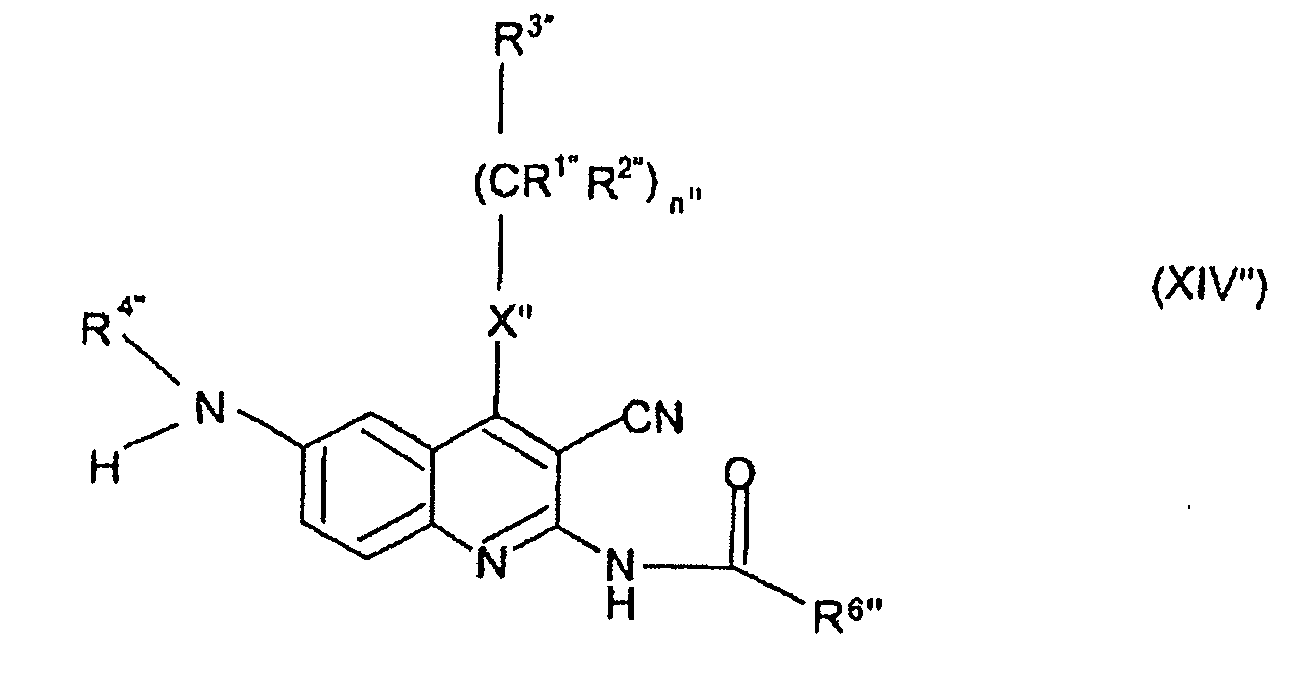
si souhaité après la transformation de l'atome d'hydrogène du R4" en un groupe alkyle en C1 à C4 linéaire ou ramifié ou un groupe benzyle, ou
v/iv) pour la préparation d'un composé de la formule générale (I), dans laquelle R4 représente un atome d'hydrogène, un groupe cycloalkyle en C3 à C6, un groupe benzyle, un groupe alkyle en C1 à C4 linéaire ou ramifié, comprenant éventuellement un groupe amino, ou un groupe amino substitué par un ou deux groupes alkyle en C1 à C4 linéaires ou ramifiés, un groupe hydroxy, un groupe carboxy ou un groupe alcoxy substitué par un groupe alkyle en C1 à C4 linéaire ou ramifié et R5 représente un atome d'hydrogène, ou R4 et R5, pris ensemble avec l'atome d'azote, forment un groupe de la formule générale a.), dans laquelle R7 et R8 représentent indépendamment un atome d'hydrogène, un groupe alkyle en C1 à C4 linéaire ou ramifié ou un groupe cycloalkyle en C3 à C6 et Z représente un groupe -NR11-, où R11 représente un atome d'hydrogène et R1, R2, R3, R6, R9, X, n, m, o, p et r sont tels que définis dans la revendication 1,
le retrait du groupe protecteur d'un composé de la formule générale (I"),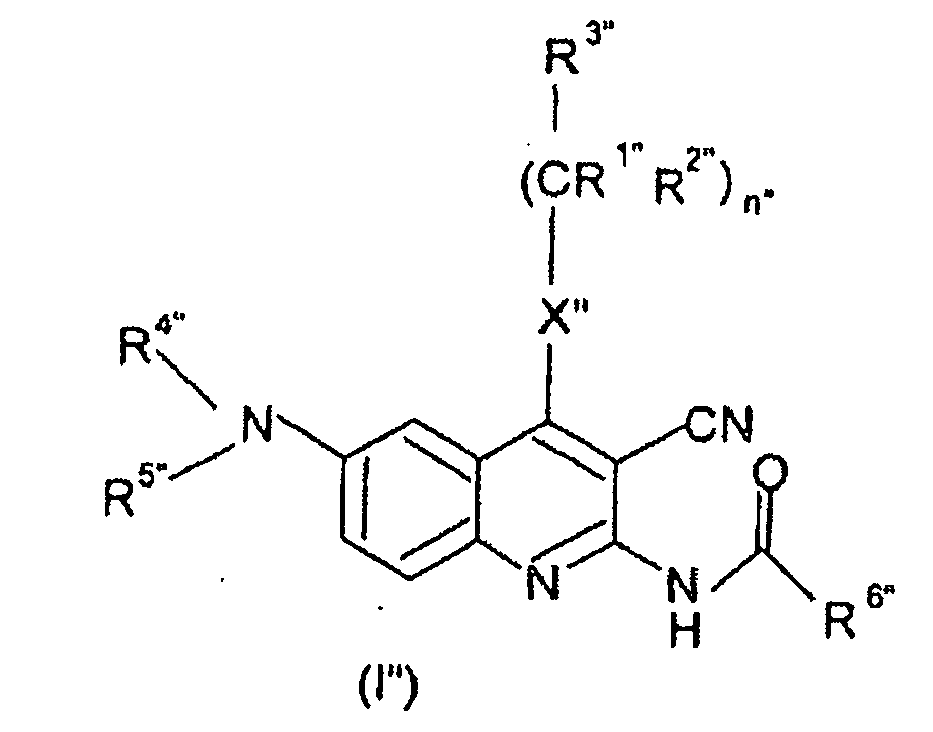
R4" représente un atome d'hydrogène, un groupe cycloalkyle en C3 à C6, un groupe benzyle, un groupe alkyle en C1 à C4 linéaire ou ramifié, comprenant éventuellement un groupe amino, ou un groupe amino substitué par un ou deux groupes alkyle en C1 à C4 linéaires ou ramifiés, un groupe hydroxy, un groupe carboxy ou un groupe alcoxy substitué par un groupe alkyle en C1 à C4 linéaire ou ramifié et R5" représente un groupe protecteur,
ou
R4" et R5", pris ensemble avec l'atome d'azote, forment un groupe de la formule générale a".), dans laquelle R7" et R8" représentent indépendamment un atome d'hydrogène, un groupe alkyle en C1 à C4 linéaire ou ramifié ou un groupe cycloalkyle en C3 à C6 et Z" représente un groupe -NR11", où R11" représente un groupe protecteur,
et R1", R2", R3", R6", R9", X", n", m", o", p" et r" sont tels que définis ci-dessus
et, si souhaité, les substituants du composé résultant de la formule générale (I) sont transformés l'un pour l'autre par des procédés connus, et/ou le composé de la formule générale (I) ainsi obtenu est transformé en son sel ou solvate, ou libéré de son sel ou solvate et, si souhaité, résolu dans ses isomères optiquement actifs et, si souhaité, un desmotrope donné est transformé en une autre forme desmotropique. - Procédé selon la revendication 5, caractérisé en ce que l'hydrolyse sélective soit réalisée avec un hydroxyde alcalin dissous dans un milieu alcoolisé, de préférence avec une solution de potassium méthanolique ou d'hydroxyde de sodium.
- Composition pharmaceutique, caractérisée en ce qu'elle comprend un ou plusieurs composés de la formule générale (I),
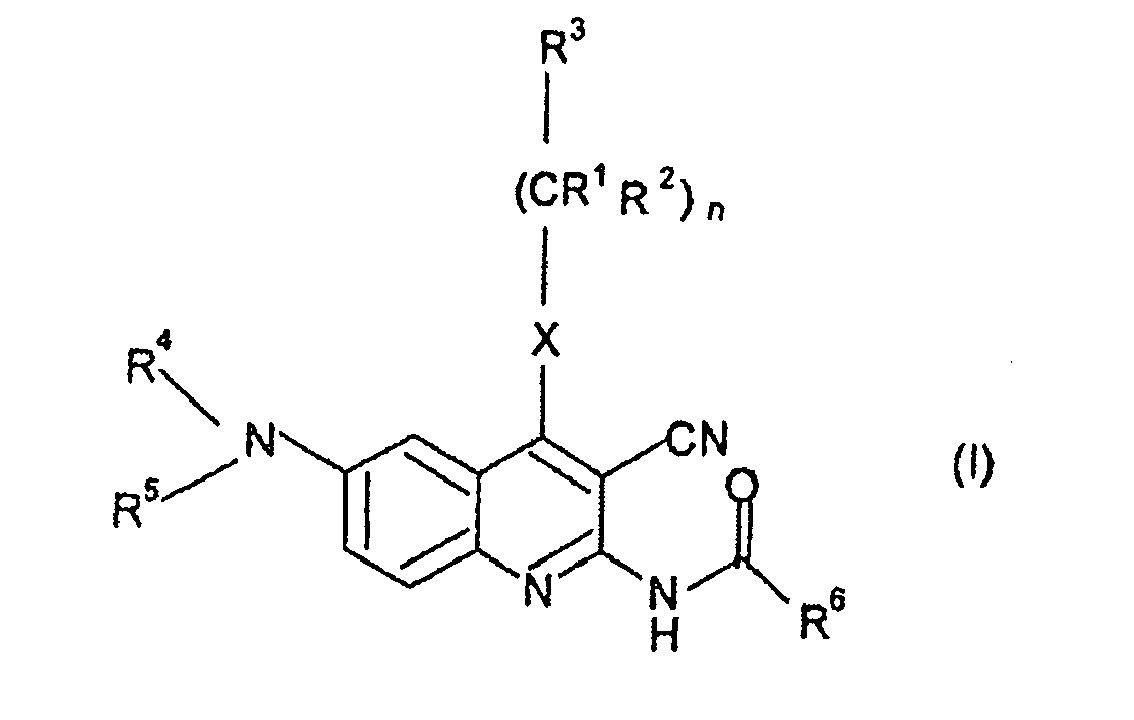
- Composition pharmaceutique telle que définie dans la revendication 7, caractérisée en ce qu'elle comprend comme substance active un ou plusieurs des composés définis dans la revendication 3.
- Utilisation des composés de la formule générale (I), de leurs sels, solvates et isomères,

- Utilisation des composés de la formule générale (I), de leurs sels, solvates et isomères, dans laquelle formule les significations de R1, R2, R3, R4, R5, R6, R7, R8, X, Z, n, m, o, p et r sont telles que définies dans la revendication 1, conformément à la revendication 9 comme un ligand A3 pour la fabrication d'une composition pharmaceutique pour le traitement de maladies du coeur, des reins, des organes respiratoires et du système nerveux central, et pour l'inhibition de la protection de l'adénosine, dans la croissance de cellules tumorales, la prévention de la dégranulation de mastocytes, l'inhibition de la production de cytokine, la réduction de la pression intraoculaire, l'inhibition de la libération de TNFα, l'inhibition de la migration d'éosinophiles, de neutrophiles et d'autres cellules immunitaires, l'inhibition de la bronchoconstriction et de l'extravasation de liquide plasmatique.
- Utilisation des composés de la formule générale (I), de leurs sels, solvates et isomères, dans laquelle formule les significations de R1, R2, R3, R4, R5, R6, R7, R8, X, Z, n, m, o, p et r sont telles que définies dans la revendication 1, conformément à la revendication 10 comme un antagoniste du récepteur A3 pour la fabrication de compositions pharmaceutiques anti-inflammatoires, antiasthmatiques, anti-ischémiques, antidépressives, antiarythmiques, de protection rénale, antitumeurs, antiparkinson et d'amélioration cognitive, et de compositions pour le traitement ou la prévention de lésions causées par une reperfusion myocardique, de la maladie pulmonaire obstructive chronique (MPOC) et du syndrome de détresse respiratoire chez l'adulte (SDRA), y compris la bronchite chronique, l'emphysème pulmonaire ou la dyspnée, les réactions allergiques (p. ex., la rhinite, les réactions induites par le sumac vénéneux, l'urticaire, la sclérodermie, l'arthrite), d'autres maladies immunes, une maladie intestinale inflammatoire, la maladie d'Addison, la maladie de Crohn, le psoriasis, les rhumatismes, l'hypertension, les troubles de fonctions neurologiques, le glaucome et le diabète.
- Utilisation des composés de la formule générale (I), de leurs sels, solvates et isomères, dans laquelle formule les significations de R1, R2, R3, R4, R5, R6, R7 R8 X, Z, n, m, o, p et r sont telles que définies dans la revendication 1, conformément aux revendications 10 et 11, comme un antagoniste du récepteur A3 pour la fabrication d'une composition pharmaceutique pour le traitement de maladies telles que l'asthme, la MPOC et le SDRA, le glaucome, les tumeurs, les réactions allergiques, les maladies inflammatoires, l'ischémie, l'hypoxie, l'arythmie et les maladies rénales.
- Composés de la formule générale (I"),
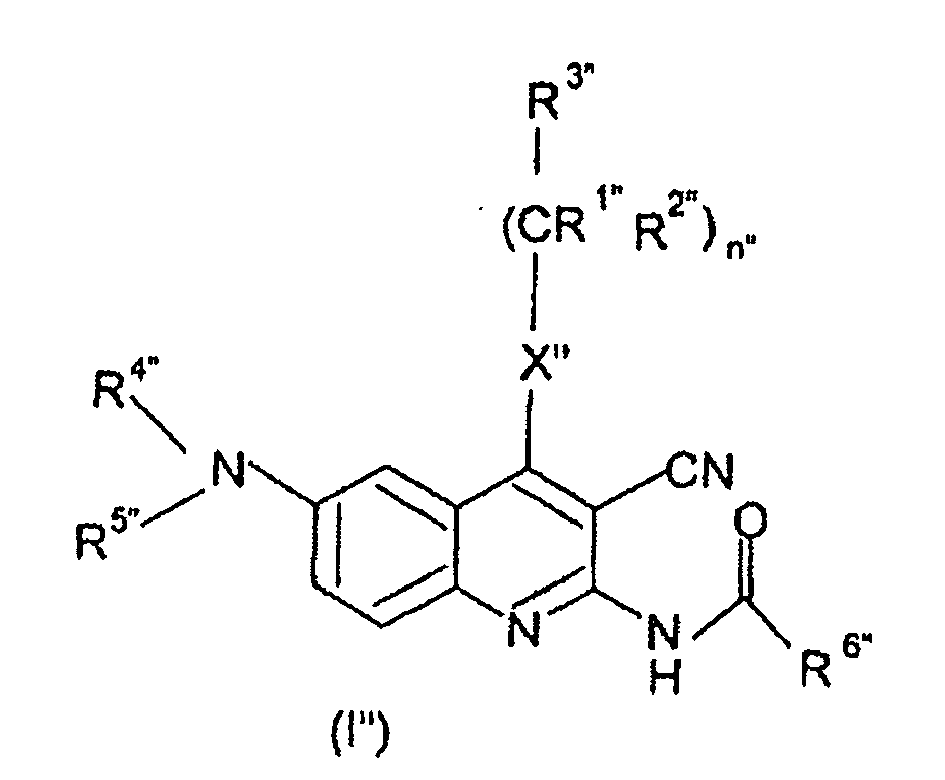
R4" représente un atome d'hydrogène, un groupe cycloalkyle en C3 à C6, un groupe benzyle, un groupe alkyle en C1 à C4 linéaire ou ramifié, comprenant éventuellement un groupe amino, ou un groupe amino substitué par un ou deux groupes alkyle en C1 à C4 linéaires ou ramifiés, un groupe hydroxy, un groupe carboxy ou un groupe alcoxy substitué par un groupe alkyle en C1 à C4 linéaire ou ramifié et R5" représente un groupe protecteur,
ou
R4" et R5", pris ensemble avec l'atome d'azote, forment un groupe de la formule générale a".), dans laquelle R7" et R8" représentent indépendamment un atome d'hydrogène, un groupe alkyle en C1 à C4 linéaire ou ramifié ou un groupe cycloalkyle en C3 à C6 et Z représente un groupe -NR11" , où R11" représente un groupe protecteur. - Composés de la formule générale (II"),

- Composés de la formule générale (III"),

- Composés de la formule générale (IV"),

- Composés de la formule générale (V"),

- Composés de la formule générale (VIII"),

- Composés de la formule générale (XIII"),

Priority Applications (3)
| Application Number | Priority Date | Filing Date | Title |
|---|---|---|---|
| SI200430575T SI1663982T1 (sl) | 2003-07-31 | 2004-07-23 | Aminokinolinski derivati in njihova uporaba kot adenozin A3 ligandi |
| PL04769079T PL1663982T3 (pl) | 2003-07-31 | 2004-07-23 | Pochodne aminochinoliny i ich zastosowanie jako ligandów adenozyny A3 |
| CY20081100135T CY1107875T1 (el) | 2003-07-31 | 2008-02-04 | Παραγωγα αμινοκινολινης και η χρηση τους ως συνδετες των α3 αδενοσινης |
Applications Claiming Priority (4)
| Application Number | Priority Date | Filing Date | Title |
|---|---|---|---|
| HU0302440A HUP0302440A3 (en) | 2003-07-31 | 2003-07-31 | Aminoquinoline derivatives, process for producing them and pharmaceutical compositions containing them |
| HU0401467A HUP0401467A3 (en) | 2004-07-21 | 2004-07-21 | Aminoquinoline derivatives, process for producing them and their use as adenosine a3 ligands |
| HU0401468A HUP0401468A3 (en) | 2004-07-21 | 2004-07-21 | Aminoquinoline derivatives and process for producing them |
| PCT/HU2004/000080 WO2005009969A1 (fr) | 2003-07-31 | 2004-07-23 | Derives d'aminoquinoline et leur utilisation comme ligands d'adenosine a3 |
Publications (2)
| Publication Number | Publication Date |
|---|---|
| EP1663982A1 EP1663982A1 (fr) | 2006-06-07 |
| EP1663982B1 true EP1663982B1 (fr) | 2007-11-21 |
Family
ID=90001697
Family Applications (1)
| Application Number | Title | Priority Date | Filing Date |
|---|---|---|---|
| EP04769079A Expired - Lifetime EP1663982B1 (fr) | 2003-07-31 | 2004-07-23 | Derives d'aminoquinoline et leur utilisation comme ligands d'adenosine a3 |
Country Status (24)
| Country | Link |
|---|---|
| US (4) | US7547696B2 (fr) |
| EP (1) | EP1663982B1 (fr) |
| JP (1) | JP2007500689A (fr) |
| KR (1) | KR20060065662A (fr) |
| AR (1) | AR045326A1 (fr) |
| AU (1) | AU2004259127B2 (fr) |
| BR (1) | BRPI0412577A (fr) |
| CA (1) | CA2534105C (fr) |
| CY (1) | CY1107875T1 (fr) |
| DE (1) | DE602004010284T2 (fr) |
| DK (1) | DK1663982T3 (fr) |
| ES (1) | ES2295923T3 (fr) |
| HR (1) | HRP20070584T3 (fr) |
| IL (1) | IL173416A (fr) |
| MA (1) | MA27991A1 (fr) |
| ME (1) | MEP19108A (fr) |
| MX (1) | MXPA06001254A (fr) |
| NO (1) | NO20060702L (fr) |
| NZ (1) | NZ545580A (fr) |
| PL (1) | PL1663982T3 (fr) |
| PT (1) | PT1663982E (fr) |
| RS (1) | RS20060072A (fr) |
| TW (1) | TW200510320A (fr) |
| WO (1) | WO2005009969A1 (fr) |
Families Citing this family (15)
| Publication number | Priority date | Publication date | Assignee | Title |
|---|---|---|---|---|
| HUP0400812A2 (en) * | 2004-04-19 | 2006-02-28 | Sanofi Aventis | Crystalline forms of 2-amino-3-cyano-quinoline derivatives, process for their preparation and pharmaceutical compositions containing them |
| WO2006010142A2 (fr) | 2004-07-14 | 2006-01-26 | Ligand Pharmaceuticals, Inc. | Composes de modulation des recepteurs des mineralocorticoides et methodes associees |
| WO2006023158A2 (fr) | 2004-07-14 | 2006-03-02 | Ligand Pharmaceuticals, Inc. | Composes modulateurs des recepteurs des mineralocorticoides et methodes |
| BRPI0611006A2 (pt) * | 2005-06-01 | 2010-08-10 | Clariant Produkte Deutschland | método para produção de compostos n,n-bis (piridin-2ilmetil)-1,1-bis (piridin-2-il)1-aminoalcano e sais de complexos de metais contendo esses compostos |
| US20070049559A1 (en) * | 2005-06-28 | 2007-03-01 | Bruce Pfeffer | Preparations comprising arylazine substituted with a carbonylic moiety to increase the activity of Gelatinase A in ocular cells |
| WO2008000743A2 (fr) * | 2006-06-27 | 2008-01-03 | Biovitrum Ab (Publ) | Composés thérapeutiques |
| CN101589028B (zh) | 2006-11-22 | 2014-02-19 | 味之素株式会社 | 具有喹唑啉二酮骨架的苯丙氨酸衍生物的制备方法及制备中间体 |
| HUP0700395A2 (en) * | 2007-06-07 | 2009-03-02 | Sanofi Aventis | Substituted [1,2,4] triazolo [1,5-a] quinolines, process for their preparation, pharmaceutical compositions thereof, and intermediates |
| JP2012051803A (ja) * | 2008-12-25 | 2012-03-15 | Kyorin Pharmaceutical Co Ltd | 環状アミノ安息香酸エステル誘導体の製造方法 |
| US9296698B2 (en) | 2009-11-23 | 2016-03-29 | Amgen Inc. | Amino heteroaryl compounds as beta-secretase modulators and methods of use |
| EP2504330A1 (fr) | 2009-11-23 | 2012-10-03 | Amgen Inc. | Composés amino hétéroaryliques comme modulateurs de bêta-sécrétase et procédés d'utilisation |
| AU2011207679B2 (en) | 2010-01-19 | 2013-10-10 | Amgen Inc. | Amino heteroaryl compounds as beta-secretase modulators and methods of use |
| ES2578363B1 (es) | 2015-01-22 | 2017-01-31 | Palobiofarma, S.L. | Moduladores de los receptores A3 de adenosina |
| PE20181366A1 (es) | 2015-08-03 | 2018-08-27 | Bristol Myers Squibb Co | Compuestos heterociclicos utiles como moduladores de factor de necrosis tumoral (tnf) alfa |
| ES2676535B1 (es) | 2017-01-20 | 2019-04-29 | Palobiofarma Sl | Moduladores de los receptores a3 de adenosina |
Family Cites Families (4)
| Publication number | Priority date | Publication date | Assignee | Title |
|---|---|---|---|---|
| AU661533B2 (en) | 1992-01-20 | 1995-07-27 | Astrazeneca Ab | Quinazoline derivatives |
| UA73073C2 (uk) | 1997-04-03 | 2005-06-15 | Уайт Холдінгз Корпорейшн | Заміщені 3-ціанохіноліни, спосіб їх одержання та фармацевтична композиція |
| WO2000061556A1 (fr) | 1999-04-09 | 2000-10-19 | Meiji Seika Kaisha, Ltd. | Composes heterocycliques contenant de l'azote et composes de benamide et medicaments contenant ces composes |
| KR100745307B1 (ko) | 2001-05-31 | 2007-08-01 | 사노피-아벤티스 | 아미노퀴놀린 유도체 및 아데노신 a3 리간드로서의 이의 용도 |
-
2004
- 2004-07-23 EP EP04769079A patent/EP1663982B1/fr not_active Expired - Lifetime
- 2004-07-23 RS YUP-2006/0072A patent/RS20060072A/sr unknown
- 2004-07-23 ES ES04769079T patent/ES2295923T3/es not_active Expired - Lifetime
- 2004-07-23 ME MEP-191/08A patent/MEP19108A/xx unknown
- 2004-07-23 PL PL04769079T patent/PL1663982T3/pl unknown
- 2004-07-23 BR BRPI0412577-0A patent/BRPI0412577A/pt not_active IP Right Cessation
- 2004-07-23 MX MXPA06001254A patent/MXPA06001254A/es active IP Right Grant
- 2004-07-23 CA CA2534105A patent/CA2534105C/fr not_active Expired - Fee Related
- 2004-07-23 PT PT04769079T patent/PT1663982E/pt unknown
- 2004-07-23 DE DE602004010284T patent/DE602004010284T2/de not_active Expired - Lifetime
- 2004-07-23 KR KR1020067002148A patent/KR20060065662A/ko not_active Ceased
- 2004-07-23 HR HR20070584T patent/HRP20070584T3/xx unknown
- 2004-07-23 NZ NZ545580A patent/NZ545580A/xx not_active IP Right Cessation
- 2004-07-23 AU AU2004259127A patent/AU2004259127B2/en not_active Ceased
- 2004-07-23 WO PCT/HU2004/000080 patent/WO2005009969A1/fr not_active Ceased
- 2004-07-23 JP JP2006521678A patent/JP2007500689A/ja active Pending
- 2004-07-23 DK DK04769079T patent/DK1663982T3/da active
- 2004-07-30 TW TW093122807A patent/TW200510320A/zh unknown
- 2004-07-30 AR ARP040102713A patent/AR045326A1/es not_active Application Discontinuation
-
2006
- 2006-01-29 IL IL173416A patent/IL173416A/en not_active IP Right Cessation
- 2006-01-31 US US11/344,440 patent/US7547696B2/en not_active Expired - Fee Related
- 2006-02-14 NO NO20060702A patent/NO20060702L/no not_active Application Discontinuation
- 2006-02-15 MA MA28810A patent/MA27991A1/fr unknown
-
2008
- 2008-02-04 CY CY20081100135T patent/CY1107875T1/el unknown
-
2009
- 2009-06-15 US US12/484,658 patent/US7799922B2/en not_active Expired - Fee Related
-
2010
- 2010-08-11 US US12/854,355 patent/US20110009626A1/en not_active Abandoned
-
2011
- 2011-01-18 US US13/008,398 patent/US8071601B2/en not_active Expired - Fee Related
Also Published As
Similar Documents
| Publication | Publication Date | Title |
|---|---|---|
| US8071601B2 (en) | Aminoquinoline derivatives and their use as adenosine A3 ligands | |
| EP2167470B1 (fr) | Triazolo[1, 5-a]quinoléines utilisés comme ligands du récepteur a3 de l'adénosine | |
| AU2002304358B2 (en) | Aminoquinoline and aminopyridine derivatives and their use as adenosine A3 ligands | |
| CA2505910C (fr) | Derives d'imidazoquinoline en tant que ligands recepteurs de l'adenosine a3 | |
| CA2470064C (fr) | Derives triazolo-quinoline utiles en tant que ligands recepteurs d'adenosine | |
| AU2002304358A1 (en) | Aminoquinoline and aminopyridine derivatives and their use as adenosine A3 ligands | |
| ZA200600854B (en) | Aminoquinoline derivatives and their use as adenosine A3 ligands | |
| RU2317290C2 (ru) | Производные аминохинолина и их применение в качестве лигандов аденозина а3 | |
| HK1088261B (en) | Aminoquinoline derivatives and their use as adenosine a3 ligands | |
| HUP0401467A2 (en) | Aminoquinoline derivatives, process for producing them and their use as adenosine a3 ligands | |
| ZA200308865B (en) | Aminoquinoline derivatives and their use as adenosine A3 ligands. | |
| KR20070020335A (ko) | 아미노퀴놀린 유도체 및 아데노신 a3 리간드로서의 이의용도 |
Legal Events
| Date | Code | Title | Description |
|---|---|---|---|
| PUAI | Public reference made under article 153(3) epc to a published international application that has entered the european phase |
Free format text: ORIGINAL CODE: 0009012 |
|
| 17P | Request for examination filed |
Effective date: 20060110 |
|
| AK | Designated contracting states |
Kind code of ref document: A1 Designated state(s): AT BE BG CH CY CZ DE DK EE ES FI FR GB GR HU IE IT LI LU MC NL PL PT RO SE SI SK TR |
|
| AX | Request for extension of the european patent |
Extension state: AL HR LT LV MK |
|
| 17Q | First examination report despatched |
Effective date: 20060725 |
|
| REG | Reference to a national code |
Ref country code: HK Ref legal event code: DE Ref document number: 1088261 Country of ref document: HK |
|
| GRAP | Despatch of communication of intention to grant a patent |
Free format text: ORIGINAL CODE: EPIDOSNIGR1 |
|
| RIN1 | Information on inventor provided before grant (corrected) |
Inventor name: GERBER, KATALIN Inventor name: KAPUI, ZOLTAN Inventor name: FINET, MICHEL Inventor name: ARANYI, PETER Inventor name: TIMARI , GEZA Inventor name: URBAN-SZABO , KATALIN Inventor name: VARGANE SZEREDI, JUDIT Inventor name: BOER, KINGA Inventor name: MIKUS, ENDRE Inventor name: BATORI, SANDOR |
|
| GRAS | Grant fee paid |
Free format text: ORIGINAL CODE: EPIDOSNIGR3 |
|
| GRAA | (expected) grant |
Free format text: ORIGINAL CODE: 0009210 |
|
| AK | Designated contracting states |
Kind code of ref document: B1 Designated state(s): AT BE BG CH CY CZ DE DK EE ES FI FR GB GR HU IE IT LI LU MC NL PL PT RO SE SI SK TR |
|
| AX | Request for extension of the european patent |
Extension state: AL HR LT LV MK |
|
| REG | Reference to a national code |
Ref country code: GB Ref legal event code: FG4D |
|
| REG | Reference to a national code |
Ref country code: IE Ref legal event code: FG4D |
|
| REG | Reference to a national code |
Ref country code: CH Ref legal event code: EP |
|
| REG | Reference to a national code |
Ref country code: HR Ref legal event code: TUEP Ref document number: P20070584 Country of ref document: HR |
|
| REF | Corresponds to: |
Ref document number: 602004010284 Country of ref document: DE Date of ref document: 20080103 Kind code of ref document: P |
|
| REG | Reference to a national code |
Ref country code: RO Ref legal event code: EPE |
|
| REG | Reference to a national code |
Ref country code: HR Ref legal event code: T1PR Ref document number: P20070584 Country of ref document: HR Ref country code: PT Ref legal event code: SC4A Free format text: AVAILABILITY OF NATIONAL TRANSLATION Effective date: 20080121 |
|
| REG | Reference to a national code |
Ref country code: GR Ref legal event code: EP Ref document number: 20080400147 Country of ref document: GR |
|
| REG | Reference to a national code |
Ref country code: SE Ref legal event code: TRGR |
|
| REG | Reference to a national code |
Ref country code: HK Ref legal event code: GR Ref document number: 1088261 Country of ref document: HK |
|
| REG | Reference to a national code |
Ref country code: DK Ref legal event code: T3 |
|
| REG | Reference to a national code |
Ref country code: PL Ref legal event code: T3 |
|
| REG | Reference to a national code |
Ref country code: ES Ref legal event code: FG2A Ref document number: 2295923 Country of ref document: ES Kind code of ref document: T3 |
|
| ET | Fr: translation filed | ||
| PLBE | No opposition filed within time limit |
Free format text: ORIGINAL CODE: 0009261 |
|
| STAA | Information on the status of an ep patent application or granted ep patent |
Free format text: STATUS: NO OPPOSITION FILED WITHIN TIME LIMIT |
|
| 26N | No opposition filed |
Effective date: 20080822 |
|
| REG | Reference to a national code |
Ref country code: HU Ref legal event code: AG4A Ref document number: E003654 Country of ref document: HU |
|
| PGFP | Annual fee paid to national office [announced via postgrant information from national office to epo] |
Ref country code: CY Payment date: 20100618 Year of fee payment: 7 |
|
| REG | Reference to a national code |
Ref country code: HR Ref legal event code: ODRP Ref document number: P20070584 Country of ref document: HR Payment date: 20110720 Year of fee payment: 8 |
|
| PGFP | Annual fee paid to national office [announced via postgrant information from national office to epo] |
Ref country code: CZ Payment date: 20110629 Year of fee payment: 8 Ref country code: GR Payment date: 20110610 Year of fee payment: 8 Ref country code: MC Payment date: 20110629 Year of fee payment: 8 |
|
| PGFP | Annual fee paid to national office [announced via postgrant information from national office to epo] |
Ref country code: EE Payment date: 20110615 Year of fee payment: 8 Ref country code: LU Payment date: 20110718 Year of fee payment: 8 Ref country code: RO Payment date: 20110614 Year of fee payment: 8 |
|
| PGFP | Annual fee paid to national office [announced via postgrant information from national office to epo] |
Ref country code: CH Payment date: 20110712 Year of fee payment: 8 Ref country code: IE Payment date: 20110712 Year of fee payment: 8 Ref country code: FR Payment date: 20110727 Year of fee payment: 8 Ref country code: DK Payment date: 20110712 Year of fee payment: 8 |
|
| PGFP | Annual fee paid to national office [announced via postgrant information from national office to epo] |
Ref country code: SE Payment date: 20110712 Year of fee payment: 8 Ref country code: HU Payment date: 20110718 Year of fee payment: 8 Ref country code: PL Payment date: 20110622 Year of fee payment: 8 Ref country code: TR Payment date: 20110704 Year of fee payment: 8 Ref country code: PT Payment date: 20110719 Year of fee payment: 8 Ref country code: SI Payment date: 20110617 Year of fee payment: 8 Ref country code: GB Payment date: 20110720 Year of fee payment: 8 Ref country code: SK Payment date: 20110712 Year of fee payment: 8 Ref country code: AT Payment date: 20110628 Year of fee payment: 8 Ref country code: FI Payment date: 20110712 Year of fee payment: 8 Ref country code: DE Payment date: 20110720 Year of fee payment: 8 Ref country code: ES Payment date: 20110817 Year of fee payment: 8 |
|
| PGFP | Annual fee paid to national office [announced via postgrant information from national office to epo] |
Ref country code: NL Payment date: 20110715 Year of fee payment: 8 Ref country code: BE Payment date: 20110712 Year of fee payment: 8 Ref country code: IT Payment date: 20110720 Year of fee payment: 8 |
|
| PGFP | Annual fee paid to national office [announced via postgrant information from national office to epo] |
Ref country code: BG Payment date: 20111114 Year of fee payment: 8 |
|
| REG | Reference to a national code |
Ref country code: HR Ref legal event code: PBON Ref document number: P20070584 Country of ref document: HR Effective date: 20120724 |
|
| REG | Reference to a national code |
Ref country code: PT Ref legal event code: MM4A Free format text: LAPSE DUE TO NON-PAYMENT OF FEES Effective date: 20130123 |
|
| BERE | Be: lapsed |
Owner name: SANOFI-AVENTIS Effective date: 20120731 |
|
| REG | Reference to a national code |
Ref country code: DE Ref legal event code: R119 Ref document number: 602004010284 Country of ref document: DE |
|
| REG | Reference to a national code |
Ref country code: NL Ref legal event code: V1 Effective date: 20130201 |
|
| REG | Reference to a national code |
Ref country code: LT Ref legal event code: MM9D Effective date: 20120723 |
|
| PG25 | Lapsed in a contracting state [announced via postgrant information from national office to epo] |
Ref country code: MC Free format text: LAPSE BECAUSE OF NON-PAYMENT OF DUE FEES Effective date: 20120731 |
|
| REG | Reference to a national code |
Ref country code: CH Ref legal event code: PL |
|
| REG | Reference to a national code |
Ref country code: GR Ref legal event code: ML Ref document number: 20080400147 Country of ref document: GR Effective date: 20130104 |
|
| REG | Reference to a national code |
Ref country code: SE Ref legal event code: EUG |
|
| REG | Reference to a national code |
Ref country code: AT Ref legal event code: MM01 Ref document number: 379013 Country of ref document: AT Kind code of ref document: T Effective date: 20120723 |
|
| GBPC | Gb: european patent ceased through non-payment of renewal fee |
Effective date: 20120723 |
|
| REG | Reference to a national code |
Ref country code: DE Ref legal event code: R081 Ref document number: 602004010284 Country of ref document: DE Owner name: SANOFI, FR Free format text: FORMER OWNER: SANOFI-AVENTIS, PARIS, FR Effective date: 20130205 Ref country code: DE Ref legal event code: R081 Ref document number: 602004010284 Country of ref document: DE Owner name: SANOFI-AVENTIS, FR Free format text: FORMER OWNER: SANOFI-AVENTIS, PARIS, FR Effective date: 20130205 |
|
| REG | Reference to a national code |
Ref country code: DK Ref legal event code: EBP |
|
| REG | Reference to a national code |
Ref country code: SK Ref legal event code: MM4A Ref document number: E 3014 Country of ref document: SK Effective date: 20120723 |
|
| REG | Reference to a national code |
Ref country code: EE Ref legal event code: MM4A Ref document number: E001813 Country of ref document: EE Effective date: 20120731 |
|
| REG | Reference to a national code |
Ref country code: FR Ref legal event code: ST Effective date: 20130329 |
|
| PG25 | Lapsed in a contracting state [announced via postgrant information from national office to epo] |
Ref country code: SE Free format text: LAPSE BECAUSE OF NON-PAYMENT OF DUE FEES Effective date: 20120724 Ref country code: HU Free format text: LAPSE BECAUSE OF NON-PAYMENT OF DUE FEES Effective date: 20120724 Ref country code: EE Free format text: LAPSE BECAUSE OF NON-PAYMENT OF DUE FEES Effective date: 20120731 Ref country code: LI Free format text: LAPSE BECAUSE OF NON-PAYMENT OF DUE FEES Effective date: 20120731 Ref country code: FR Free format text: LAPSE BECAUSE OF NON-PAYMENT OF DUE FEES Effective date: 20120731 Ref country code: CH Free format text: LAPSE BECAUSE OF NON-PAYMENT OF DUE FEES Effective date: 20120731 Ref country code: NL Free format text: LAPSE BECAUSE OF NON-PAYMENT OF DUE FEES Effective date: 20130201 Ref country code: CZ Free format text: LAPSE BECAUSE OF NON-PAYMENT OF DUE FEES Effective date: 20120723 Ref country code: GB Free format text: LAPSE BECAUSE OF NON-PAYMENT OF DUE FEES Effective date: 20120723 Ref country code: FI Free format text: LAPSE BECAUSE OF NON-PAYMENT OF DUE FEES Effective date: 20120723 Ref country code: DE Free format text: LAPSE BECAUSE OF NON-PAYMENT OF DUE FEES Effective date: 20130201 |
|
| REG | Reference to a national code |
Ref country code: SI Ref legal event code: KO00 Effective date: 20130312 |
|
| REG | Reference to a national code |
Ref country code: IE Ref legal event code: MM4A |
|
| PG25 | Lapsed in a contracting state [announced via postgrant information from national office to epo] |
Ref country code: GR Free format text: LAPSE BECAUSE OF NON-PAYMENT OF DUE FEES Effective date: 20130204 Ref country code: IT Free format text: LAPSE BECAUSE OF NON-PAYMENT OF DUE FEES Effective date: 20120723 Ref country code: BE Free format text: LAPSE BECAUSE OF NON-PAYMENT OF DUE FEES Effective date: 20120731 Ref country code: SK Free format text: LAPSE BECAUSE OF NON-PAYMENT OF DUE FEES Effective date: 20120723 Ref country code: PT Free format text: LAPSE BECAUSE OF NON-PAYMENT OF DUE FEES Effective date: 20130123 Ref country code: SI Free format text: LAPSE BECAUSE OF NON-PAYMENT OF DUE FEES Effective date: 20120724 |
|
| PG25 | Lapsed in a contracting state [announced via postgrant information from national office to epo] |
Ref country code: AT Free format text: LAPSE BECAUSE OF NON-PAYMENT OF DUE FEES Effective date: 20120723 |
|
| PG25 | Lapsed in a contracting state [announced via postgrant information from national office to epo] |
Ref country code: DK Free format text: LAPSE BECAUSE OF NON-PAYMENT OF DUE FEES Effective date: 20120731 Ref country code: CY Free format text: LAPSE BECAUSE OF NON-PAYMENT OF DUE FEES Effective date: 20120723 Ref country code: IE Free format text: LAPSE BECAUSE OF NON-PAYMENT OF DUE FEES Effective date: 20120723 |
|
| PG25 | Lapsed in a contracting state [announced via postgrant information from national office to epo] |
Ref country code: RO Free format text: LAPSE BECAUSE OF NON-PAYMENT OF DUE FEES Effective date: 20120723 |
|
| REG | Reference to a national code |
Ref country code: DE Ref legal event code: R119 Ref document number: 602004010284 Country of ref document: DE Effective date: 20130201 |
|
| REG | Reference to a national code |
Ref country code: ES Ref legal event code: FD2A Effective date: 20131021 |
|
| PG25 | Lapsed in a contracting state [announced via postgrant information from national office to epo] |
Ref country code: ES Free format text: LAPSE BECAUSE OF NON-PAYMENT OF DUE FEES Effective date: 20120724 |
|
| REG | Reference to a national code |
Ref country code: PL Ref legal event code: LAPE |
|
| PG25 | Lapsed in a contracting state [announced via postgrant information from national office to epo] |
Ref country code: PL Free format text: LAPSE BECAUSE OF NON-PAYMENT OF DUE FEES Effective date: 20120723 |
|
| PG25 | Lapsed in a contracting state [announced via postgrant information from national office to epo] |
Ref country code: TR Free format text: LAPSE BECAUSE OF NON-PAYMENT OF DUE FEES Effective date: 20120723 Ref country code: LU Free format text: LAPSE BECAUSE OF NON-PAYMENT OF DUE FEES Effective date: 20120723 |
|
| PG25 | Lapsed in a contracting state [announced via postgrant information from national office to epo] |
Ref country code: BG Free format text: LAPSE BECAUSE OF NON-PAYMENT OF DUE FEES Effective date: 20120731 |