EP1665123B1 - Verfahren und vorrichtungen zum reversiblen datenverbergen durch histogramm-modifikation - Google Patents
Verfahren und vorrichtungen zum reversiblen datenverbergen durch histogramm-modifikation Download PDFInfo
- Publication number
- EP1665123B1 EP1665123B1 EP04750047A EP04750047A EP1665123B1 EP 1665123 B1 EP1665123 B1 EP 1665123B1 EP 04750047 A EP04750047 A EP 04750047A EP 04750047 A EP04750047 A EP 04750047A EP 1665123 B1 EP1665123 B1 EP 1665123B1
- Authority
- EP
- European Patent Office
- Prior art keywords
- pixel
- value
- pixel value
- domain image
- data
- Prior art date
- Legal status (The legal status is an assumption and is not a legal conclusion. Google has not performed a legal analysis and makes no representation as to the accuracy of the status listed.)
- Expired - Lifetime
Links
Images



Classifications
-
- G—PHYSICS
- G06—COMPUTING OR CALCULATING; COUNTING
- G06T—IMAGE DATA PROCESSING OR GENERATION, IN GENERAL
- G06T1/00—General purpose image data processing
- G06T1/0021—Image watermarking
- G06T1/0092—Payload characteristic determination in a watermarking scheme, e.g. number of bits to be embedded
-
- G—PHYSICS
- G06—COMPUTING OR CALCULATING; COUNTING
- G06T—IMAGE DATA PROCESSING OR GENERATION, IN GENERAL
- G06T1/00—General purpose image data processing
- G06T1/0021—Image watermarking
- G06T1/0028—Adaptive watermarking, e.g. Human Visual System [HVS]-based watermarking
-
- H—ELECTRICITY
- H04—ELECTRIC COMMUNICATION TECHNIQUE
- H04N—PICTORIAL COMMUNICATION, e.g. TELEVISION
- H04N1/00—Scanning, transmission or reproduction of documents or the like, e.g. facsimile transmission; Details thereof
- H04N1/32—Circuits or arrangements for control or supervision between transmitter and receiver or between image input and image output device, e.g. between a still-image camera and its memory or between a still-image camera and a printer device
- H04N1/32101—Display, printing, storage or transmission of additional information, e.g. ID code, date and time or title
- H04N1/32144—Display, printing, storage or transmission of additional information, e.g. ID code, date and time or title embedded in the image data, i.e. enclosed or integrated in the image, e.g. watermark, super-imposed logo or stamp
- H04N1/32149—Methods relating to embedding, encoding, decoding, detection or retrieval operations
- H04N1/32203—Spatial or amplitude domain methods
- H04N1/32208—Spatial or amplitude domain methods involving changing the magnitude of selected pixels, e.g. overlay of information or super-imposition
-
- H—ELECTRICITY
- H04—ELECTRIC COMMUNICATION TECHNIQUE
- H04N—PICTORIAL COMMUNICATION, e.g. TELEVISION
- H04N1/00—Scanning, transmission or reproduction of documents or the like, e.g. facsimile transmission; Details thereof
- H04N1/32—Circuits or arrangements for control or supervision between transmitter and receiver or between image input and image output device, e.g. between a still-image camera and its memory or between a still-image camera and a printer device
- H04N1/32101—Display, printing, storage or transmission of additional information, e.g. ID code, date and time or title
- H04N1/32144—Display, printing, storage or transmission of additional information, e.g. ID code, date and time or title embedded in the image data, i.e. enclosed or integrated in the image, e.g. watermark, super-imposed logo or stamp
- H04N1/32149—Methods relating to embedding, encoding, decoding, detection or retrieval operations
- H04N1/32203—Spatial or amplitude domain methods
- H04N1/32251—Spatial or amplitude domain methods in multilevel data, e.g. greyscale or continuous tone data
-
- G—PHYSICS
- G06—COMPUTING OR CALCULATING; COUNTING
- G06T—IMAGE DATA PROCESSING OR GENERATION, IN GENERAL
- G06T2201/00—General purpose image data processing
- G06T2201/005—Image watermarking
- G06T2201/0051—Embedding of the watermark in the spatial domain
-
- G—PHYSICS
- G06—COMPUTING OR CALCULATING; COUNTING
- G06T—IMAGE DATA PROCESSING OR GENERATION, IN GENERAL
- G06T2201/00—General purpose image data processing
- G06T2201/005—Image watermarking
- G06T2201/0203—Image watermarking whereby the image with embedded watermark is reverted to the original condition before embedding, e.g. lossless, distortion-free or invertible watermarking
Definitions
- This application is directed to methods and apparatus for data hiding in an image and, more particularly, to lossless and reversible data hiding in the spatial domain.
- the data hiding process links two sets of data, a set of the embedded data and another set of the cover media data.
- the relationship between these two sets of data defines different applications. For instance in covert communications, the hidden data are irrelevant to the cover media. In authentication, however, the embedded data are closely related to the cover media. In these types of applications, invisibility of hidden data is an important requirement. In most cases, the cover media will experience some distortion due to data hiding and cannot be inverted back to the original media. Indeed, some permanent distortion occurs to the cover media even after the hidden data have been extracted.
- Reversible data hiding links two sets of data in such a way that the cover media can be losslessly recovered after the hidden data have been extracted. This provides an additional avenue of handling the two different sets of data.
- QIM quantization-index-modulation
- the technique is reversible because of the modulo 256 addition; however, the modulo 256 addition also may produce some annoying salt-and-pepper noise due to grayscale flipping over between 0 and 255 in either direction.
- the Fridrich approach also operates in the spatial domain and losslessly compresses some selected bit-plane(s) to leave space for data embedding. Since bookkeeping data are also embedded as overhead, the method is reversible. The amount of hidden data, however, is quite limited because the bias between binary bits, 0s and 1s (the tendecy the have more 0' s or more 1' s in the data) is not significant in the several lower levels that include the least significant bit-plane (LSB) in the spatial domain. The lack of bias was probably not a problem in the Fridrich approach because it is directed towards data authentication instead of data embedding.
- LSB least significant bit-plane
- a purportedly lossless marking technique has also been developed in the transform domain, as is discussed in detail in B. Macq and F. Deweyand, "Trusted Headers For Medical Images,” DFG VIII-D II Watermarking Workshop, Er Weg, Germany, (Oct. 1999 ).
- This reversible marking technique was developed in the transform domain and is based on a lossless multi-resolution transform and the patchwork theory. It also uses modulo 256 addition. Since each block, say, an 8x8 block can only be used to embed one bit, the amount of hidden data that may be achieved is quite limited. More details concerning the patchwork theory may be found in W. Bender, D. Gruhl, N. Morimoto and A. Lu, "Techniques for Data Hiding," IBM Systems Journal, Vol. 35, No. 3-4, pp. 313-336 (1996 ).
- the pay-load ranges from 3,000 bits to 24,000 bits for a 512 ⁇ 512 ⁇ 8 grayscale image, i.e., from 0.011 bits per pixel (bpp) to 0.092 bpp as the PSNR of the marked image versus the original image is 39 dB.
- This technique first segments an image into non-overlaloped blocks, and then introduces a discriminating function to classify these blocks into three groups: R(egular), S (ingular) and u(nusable). It further introduces a flipping operation, which can convert an R block to an S block and vice versa. A U block remains intact after the flipping operation.
- the payload is from 0.019 bpp to 0.31 bpp while the PSNR of the marked image versus the original image is guaranteed above 48 dB.
- the integer wavelet transform a second generation wavelet transform, helps to avoid round-off error.
- a histogram modification is applied during pre-processing to prevent over/underflow. This histogram modification causes, however, a lower PSNR of the marked image versus the original image though there are no annoying artifacts.
- a reversible data embedding technique may embed a relatively large amount of data (e.g., about 5K to 60K bits for a 512 ⁇ 512 ⁇ 8 grayscale image, equivalent to a payload from 0.019 bbp to 0.31 bpp) while keeping a very high visual quality (e.g., the PSNR of the marked image versus original image is at least 48 dB).
- the approach utilizes a zero or minimum point and a peak point of a histogram of the image to be marked and slightly modifies the pixel value to embed the data.
- the technique can be applied to virtually all types of images.
- the methods and apparatus are capable of: producing a histogram from a pixel domain image, the histogram establishing a relationship of possible pixel values versus respective aggregate numbers of pixels of the pixel domain image having such pixel values; modifying some of the pixel values of the pixel domain image to shift a portion of the histogram such that there no longer exists an aggregate number of pixels having a first possible pixel value; and modifying some of the pixel values of the pixel domain image such that an aggregate number of pixels exist having the first possible pixel value, where the aggregate number of pixels is a function of the data to be hidden.
- the methods and apparatus for marking images described thus far and/or described later in this document may be achieved utilizing suitable hardware, such as that shown in the drawings hereinbelow.
- suitable hardware such as that shown in the drawings hereinbelow.
- Such hardware may be implemented utilizing any of the known technologies, such as standard digital circuitry, analog circuitry, any of the known processors that are operable to execute software and/or firmware programs, one or more programmable digital devices or systems, such as programmable read only memories (PROMs), programmable array logic devices (PALs), any combination of the above, etc.
- PROMs programmable read only memories
- PALs programmable array logic devices
- the methods of the present invention may be embodied in a software program that may be stored on any of the known or hereinafter developed media.
- FIG. 1 is a flow diagram illustrating process steps that may be carried out to hide data in an image in accordance with one or more aspects of the present invention. It is noted that although FIG. 1 is a flow diagram of a preferred method, it may also enable apparatus for carrying out the actions of the method.
- the disclosed method for marking images may be achieved utilizing suitable hardware, such as digital circuitry, analog circuitry, any of the known processors that are operable to execute software and/or firmware programs, one or more programmable digital devices or systems, such as programmable read only memories (PROMs), programmable array logic devices (PALs), any combination of the above, etc.
- PROMs programmable read only memories
- PALs programmable array logic devices
- the present invention may be embodied in a software program that may be stored on any of the known or hereinafter developed media.
- the process flow of FIG. 1 starts with obtaining an original, pixel domain (or spatial domain) image (action 100).
- an original, pixel domain (or spatial domain) image (action 100).
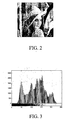
- the well known Lena image of FIG. 2 may be utilized, which a 512 ⁇ 512 ⁇ 8 gray scale image.
- a histogram of the image is produced (action 102).
- the histogram establishes a relationship of possible pixel values versus respective aggregate numbers of pixels of the pixel domain image having such pixel values.
- a histogram may be a collection (usually a graphical representation) of the gray scale values contained in an image.
- a histogram may be a collection of color values of an image. As illustrated in FIG.
- one embodiment of a histogram for the Lena image of FIG. 2 may be a collection of the gray scale values arranged in a Cartesian coordinate system, e.g., with the gray scale (0 - 255) along an ordinate axis and the aggregate number of pixel values having a given gray scale along the abscissa axis.
- the gray scale value of 0 is black and the gray scale value of 255 is white.
- the histogram is analyzed to determine whether any zero points exist, i.e., where no pixel of the image has the corresponding gray scale value (action 114). If the result of the determination is in the affirmative, then the process flow advances to action 116. If the result of the determination at action 114 is in the negative, then the process flow advances to action 122 (which will be discussed later in this description). In the histogram of FIG. 3 , a number of zero points exist, such as at the gray scale value of 255, where no pixel assumes that gray scale value. Thus, the process flow advances to action 116, where the histogram is shifted.
- a peak point is located, i.e., a gray scale value having a maximum number of pixel values.
- a peak point exists at gray scale value 154.
- the image is scanned in a defined order, e.g., row-by-row, from top to bottom, or column-by-column, from left to right, etc,. and certain pixel values are augmented by an amount (a shifting value) such that the gray scale values between the zero point and the peak point of the histogram are shifted.
- the number and the direction of the shift will depend on the shifting value. For example, a shifting value of +1 added to all pixel values in the image above a selected value will shift the histogram to the right by one gray scale value. If the shifting value is +2, the histogram will be shifted to the right by two gray scale values, etc. On the other hand, a shifting value of -1 added to all pixel values in the image below a selected value will shift the histogram to the left by one gray scale value. If the shifting value is -2, the histogram will be shifted to the left by two gray scale values, etc.
- the direction of the shift is preferably "two way" in that it is dependent on whether the gray scale value of the zero point is greater than or less than that of the peak point. For example, if the gray scale value of the zero point is greater than that of the peak point, then the shifting value is preferably a positive value (assuming the conventions discussed thus far), such as +1. This results in the histogram being shifted to the right by one place and opening up a gray scale value for which there are no associated pixel values. With reference to the Lena image of FIG. 2 and the histogram of FIG. 3 discussed above, the gray scale value of the zero point (255) is greater than that of the peak point (154).
- the gray scale values between the peak point and the zero point are shifted to the right by adding the shifting value (e.g., +1) to all of the pixel values of the histogram from gray scale value 155 to gray scale value 254. This leaves “empty" the gray scale value 155 of the histogram.
- the gray scale value of 155 may be considered an "embedded point.”
- the shifting value is preferably a negative value (assuming the conventions discussed thus far), such as -1. This results in the histogram being shifted to the left by one place and opening up a gray scale value for which there are no associated pixel values.
- the gray scale values between the peak point and the zero point are shifted to the left by adding the shifting value (e.g., -1) to all of the pixel values of the histogram from gray scale value 153 to gray scale value 20. This leaves "empty" the gray scale value 153 of the histogram.
- the process flow advances to action 118, where an embedding process is carried out.
- the original image is again scanned (preferably in the same defined order in the shifting action 116). It is noted that although this scan need not be in the same defined order as in the shifting process, whatever scanning approach is employed will result in a particular order in which the peak points of the image are encountered. As this order should be reproducible during decoding, it is preferred that the scanning definition is consistent during the shifting action 116 and the embedding action 118.
- the scan when a pixel having a gray scale value of 154 is encountered, the data sequence to be embedded is analyzed.
- the encountered pixel value of the image is augmented by the shifting value (e.g., +1 if the shift were to the right).
- a true bit may be a binary 1 (making the false bit a binary 0 by implication), or the true bit may be a binary 0 (making the false bit a binary 1).
- the next bit of the data to be embedded in the sequence is false, then the encountered pixel value of the image is not augmented. This fills the "empty" gray scale value(s) of the histogram with pixel values taken from the peak point gray scale value.
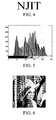
- FIG. 4 is an example of data that may be hidden in the original pixel image in accordance with the process discussed above.
- the NJIT data of FIG. 4 is characterized by a binary sequence of 15,903 bits.
- An example of the resultant modified histogram for the Lena image of FIG. 2 (assuming use of the hidden of FIG. 4 ) is shown in FIG. 5
- the resultant modified pixel image is shown in FIG. 6 .
- gray scale value of the zero point and the peak point are treated as side information that needs to be transmitted to the receiving side for data retrieval.
- the objective of finding the peak point in the unmodified histogram is to maximize the embedding capacity of the process.
- the capacity of the embedding process is equal to the maximum number of pixels associated with the peak point because each bit of the data to be embedded is associated with a respective one of the pixels of the peak gray scale value. While use of the peak point is preferred for the above reason, it is not a requirement to use the peak point to practice the invention. Indeed, if maximum data hiding capacity is not desired, then some other grey scale value (call it a "high point”) may be used in place of the peak point.
- the zero point is preferred, it is not a requirement to use the zero point to practice the invention.
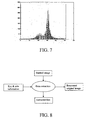
- there may not be any zero point such as the image associated with the unmodified histogram of FIG. 7 . This is the case where the result of the determination of action 114 ( FIG. 1 ) is negative.
- some other grey scale value (call it a "low point") may be used in place of the zero point (action 122).
- the low point is a minimum point. For instance, in the histogram shown of FIG. 7 , the gray scale value 7 is associated with only 23 pixels.
- This number of 23 is the minimum number since any other gray scale value is associated with more than 23 pixels.
- the gray scale value and the coordinates of pixels associated with the minimum point are recorded as overhead data, which may be included in the embedded data.
- the minimum point may be used in the same way as the zero point discussed above (124).
- FIG. 8 is a flow diagram illustrating process steps that may be carried out to extract hidden data from an image in accordance with one or more further aspects of the present invention.
- FIG. 8 is a flow diagram of a preferred method, it may also enable apparatus for carrying out the actions of the method.
- the disclosed method for extracting hidden data may be achieved utilizing suitable hardware, such as digital circuitry, analog circuitry, any of the known processors that are operable to execute software and/or firmware programs, one or more programmable digital devices or systems, such as programmable read only memories (PROMs), programmable array logic devices (PALs), any combination of the above, etc.
- PROMs programmable read only memories
- PALs programmable array logic devices
- the present invention may be embodied in a software program that may be stored on any of the known or hereinafter developed media.
- the marked image such as the marked Lena image of FIG. 6 is received at the decoder.
- the key and side information including the gray scale value of the zero point (255) and the peak point (154) were transmitted to the decoder for data extraction.
- the data extraction process produces both the hidden (extracted) data and the recovered original data, such as the Lena image of FIG. 2 .
- the data extraction process (which for simplicity involves only one zero point and peak point pair) is as follows:
- the marked image is scanned using the same or equivalent definition as in the embedding process (118 of FIG. 1 ). When a gray scale value associated with the maximum point is encountered, e.g., 154, then a "false" value is assigned to the extracted data sequence. When a gray scale value associated with the "embedded point" is encountered, e.g., 155, then a "true” value is assigned to the extracted data sequence. In this way, the hidden data are extracted from the marked image.
- the marked image is scanned again using the same or equivalent definition as in the embedding process.
- the gray scale value of such pixel is augmented by an equal but opposite amount as the shifting value.
- the peak point was 255
- the zero point was 154
- the shifting value was +1.
- the gray scale value of such pixel is augmented by - 1. In this way, the original image can be recovered without any distortion.
- the proposed reversible data hiding algorithm has been applied to many typical grayscale images and medical images, and has demonstrated its universal capability.
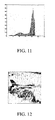
- the well known "Airplane" image (512x512x8) of FIG. 9 having a histogram shown in FIG. 10 was modified to include the hidden data of FIG. 4 (a binary sequence of 15,903 bits).
- FIGS. 11 and 12 illustrate the modified histogram and marked Airplane image, respectively.
- the gray scale values of two zero points are 0 and 255, respectively, and the gray scale values of two peak points are 210 and 211, respectively.
- the numbers of pixels associated with these two peak points are 8,016 and 8,155, respectively.
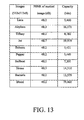
- FIG. 13 is a table illustrating further test results indicating peak signal to noise ratios (PSNR) and corresponding hidden data payload sizes for several test images in which hidden data have been embedded in accordance with one or more aspects of the present invention.
- FIG. 14 is an illustration of comparisons between hidden data payload sizes for several embedding techniques, including that in accordance with one or more aspects of the present invention.
- PSNR peak signal to noise ratios
- the reversible data hiding technique of the present invention is able to embed about 5k - 80k bits into a 512 ⁇ 512 ⁇ 8 grayscale image while keeping the PSNR constantly above 48 dB.
- the performance of the invention is better than most existing reversible data hiding algorithms.
- the techniques of the present invention may be applied to virtually all types of images and may be deployed for a wide range of applications in areas such as medical and law enforcement, In fact, it has been successfully applied to more than 1000 images in CorelDraw image database.
- various aspects of the present invention permit the hiding (embedding) of a relatively large amount of data in an image where the original image may be recovered without distortion from the marked image after the hidden data have been extracted.
Landscapes
- Engineering & Computer Science (AREA)
- Multimedia (AREA)
- Signal Processing (AREA)
- Physics & Mathematics (AREA)
- General Physics & Mathematics (AREA)
- Theoretical Computer Science (AREA)
- Image Processing (AREA)
- Facsimile Image Signal Circuits (AREA)
- Editing Of Facsimile Originals (AREA)
Claims (29)
- Verfahren, umfassend:Erzeugen (112) eines Histogramms aus einem Pixeldomain- bzw. -bereichsbild, wobei das Histogramm eine Beziehung möglicher Pixelwerte gegenüber jeweiligen Gesamtzahlen von Pixeln des Pixelbereichsbilds herstellt, die solche Pixelwerte aufweisen;Auswählen eines ersten Pixelwerts, der einem Pixelwert entspricht, für den die Gesamtzahl von Pixeln in dem Histogramm ein Maximum ist, eine einer Anzahl von Maxima ist, oder eine erste Schwellenzahl übersteigt;Auswählen eines zweiten Pixelwerts, der einem Pixelwert entspricht, für den die Gesamtzahl von Pixeln in dem Histogramm ein Minimum ist, eine einer Anzahl von Minima ist, oder unter einer zweiten Schwellenzahl liegt;Modifizieren einiger der Pixelwerte des Pixelbereichsbilds, um einen Abschnitt des Histogramms zwischen der Stelle des ersten Pixelwerts und der Stelle des zweiten Pixelwerts in einer Richtung zu der Stelle des zweiten Pixelwerts hin derart zu verschieben (116), dass es keine Gesamtzahl von Pixeln mehr gibt, die einen dritten Pixelwert aufweisen;Einbetten von Daten in das Pixelbereichsbild durch Modifizieren (118) einiger der Pixel des Pixelbereichsbilds, die den ersten Pixelwert aufweisen, um eine Anzahl von Pixeln durch Nehmen des dritten Pixelwerts derart bereitzustellen, dass die Anzahl von Pixeln eine Funktion von einzubettenden Daten ist, wobei die einzubettenden Daten Bits umfassen und wobei für jedes Bit eines der Pixel, die den ersten Pixelwert aufweisen, auf den dritten Pixelwert geändert wird, wenn das Bit einen möglichen Bitwert annimmt, und nicht geändert wird, wenn das Bit den anderen möglichen Bitwert annimmt; undÜbertragen des ersten Pixelwerts und des zweiten Pixelwerts zusammen mit dem modifizierten Pixelbereichsbild, um zu erlauben, dass zumindest ein Teil der eingebetteten Daten wiederhergestellt wird.
- Verfahren nach Anspruch 1, wobei der dritte Pixelwert nahe dem ersten Pixelwert ist.
- Verfahren nach Anspruch 1, wobei der zweite Pixelwert basierend auf seiner Gesamtzahl von Pixeln ausgewählt wird, die vor dem Verschieben in dem Histogramm Null ist.
- Verfahren nach Anspruch 2, ferner umfassend das Ausgleichen jedes Pixelwerts des Pixelbereichsbilds, der zwischen den dritten Pixelwert inklusive und den zweiten Pixelwert exklusive fällt, durch einen Verschiebungswert derart, dass sich das Historgramm von dem dritten Pixelwert zu dem zweiten Pixelwert verschiebt.
- Verfahren nach Anspruch 4, wobei zumindest eines zutrifft:der Verschiebungswert ist positiv, wenn der dritte Pixelwert kleiner als der zweite Pixelwert ist;der Verschiebungswert ist negativ, wenn der dritte Pixelwert größer ist als der zweite Pixelwert; undder Verschiebungswert ist +/-1.
- Verfahren nach Anspruch 1, wobei das Einbetten von Daten umfasst:a) Ausdrücken der in dem Pixelbereichsbild einzubettenden Daten als eine Reihe von richtigen bzw. wahren und falschen Logikwerten;b) Verknüpfen jedes wahren Logikwerts der einzubettenden Daten mit einem der Pixel des Pixelbereichsbilds, die dem ersten Pixelwert entsprechen; undc) Modifizieren der Pixelwerte des Pixelbereichsbilds, die mit wahren Logikwerten der einzubettenden Daten verknüpft sind, derart, dass sie den dritten Pixelwert aufweisen.
- Verfahren nach Anspruch 1, ferner umfassend:a) Ausdrücken der in dem Pixelbereichsbild einzubettenden Daten als eine Reihe von wahren und falschen Logikwerten;b) Scannen bzw. Abtasten zumindest einiger der Pixelwerte des Pixelbereichsbilds für Pixel, die dem ersten Pixelwert entsprechen, wobei der erste Pixelwert nahe dem dritten Pixelwert ist; undc) Ausgleichen jedes der gescannten Pixelwerte des Pixelbereichsbilds durch einen ersten Verschlüsselungswert, wenn ein nächster Logikwert der einzubettenden Daten wahr ist, und durch einen zweiten Verschlüsselungswert, wenn der nächste Logikwert der einzubettenden Daten falsch ist.
- Verfahren nach Anspruch 7, ferner umfassend das Wiederholen von zumindest einem der Schritte b) und c), bis alle der wahren und falschen Logikwerte der einzubettenden Daten in das Pixelbereichsbild verschlüsselt sind.
- Verfahren nach Anspruch 7, wobei der wahre Wert eine logische 1 ist, der falsche Wert eine logische 0 ist, der erste Verschlüsselungswert +/- 1 ist und der zweite Verschlüsselungswert Null ist.
- Verfahren zum Entschlüsseln eines Pixelbereichsbilds, das eingebettete Daten enthält, wobei das Pixelbereichsbild mit den eingebettenten Daten verschlüsselt wurde durchi) Erzeugen eines Histogramms, wobei das Histogramm eine Beziehung möglicher Pixelwerte gegenüber jeweiligen Gesamtzahlen von Pixeln des Pixelbereichsbilds herstellt, die solche Pixelwerte aufweisen;ii) Auswählen eines ersten Pixelwerts, der einem Pixelwert entspricht, für den die Gesamtzahl von Pixeln in dem Histogramm ein Maximum ist, eine einer Anzahl von Maxima ist, oder eine erste Schwellenzahl übersteigt;iii)Auswählen eines zweiten Pixelwerts, der einem Pixelwert entspricht, für den die Gesamtzahl von Pixeln in dem Histogramm ein Minimum ist, eine einer Anzahl von Minima ist, oder unter einer zweiten Schwellenzahl liegt;iv)Modifizieren einiger der Pixelwerte des Pixelbereichsbilds, um einen Abschnitt des Histogramms zwischen der Stelle des ersten Pixelwerts und der Stelle des zweiten Pixelwerts in einer Richtung zu der Stelle des zweiten Pixelwerts hin derart zu verschieben, dass es keine Gesamtzahl von Pixeln mehr gibt, die einen dritten Pixelwert aufweisen;v) Einbetten von Daten in das Pixelbereichsbild durch Modifizieren von Pixeln des Pixelbereichsbilds, die den ersten Pixelwert aufweisen, um eine Anzahl von Pixeln durch Nehmen des dritten Pixelwerts derart bereitzustellen, dass die Anzahl von Pixeln eine Funktion der einzubettenden Daten ist, wobei die einzubettenden Daten Bits umfassen und wobei für jedes Bit eines der Pixel, die den ersten Pixelwert aufweisen, auf den dritten Pixelwert geändert wird, wenn das Bit einen möglichen Bitwert annimmt, und nicht geändert wird, wenn das Bit den anderen möglichen Bitwert annimmt; undvi)Übertragen des ersten Pixelwerts und des zweiten Pixelwerts zusammen mit dem modifizierten Pixelbereichsbild,wobei das Verfahren umfasst:Empfangen des ersten und zweiten Pixelwerts; undVerwenden der modifizierten Pixelwerte des Pixelbereichsbilds, die den dritten Pixelwert aufweisen, um zumindest einen Teil der eingebetteten Daten basierend auf dem ersten und zweiten Pixelwert wiederherzustellen.
- Verfahren nach Anspruch 10, wobei das Pixelbereichsbild mit den eingebetteten Daten verschlüsselt wurde durch a) Ausdrücken der eingebetteten Daten als eine Reihe von richtigen bzw. wahren und falschen Logikwerten, b) Verknüpfen jedes wahren Logikwerts der eingebetteten Daten mit einem der Pixel des Pixelbereichsbilds, die den ersten Pixelwert aufweisen, und c) Modifizieren der Pixelwerte des Pixelbereichsbilds, die mit wahren Logikwerten der eingebetteten Daten verknüpft sind, derart, dass sie den dritten Pixelwert aufweisen; und
das Verfahren ferner das Extrahieren eines wahren Logikwerts der eingebetteten Daten basierend auf jedem Pixelwert des Pixelbereichsbilds umfasst, das einen Wert gleich dem dritten Pixelwert aufweist. - Verfahren nach Anspruch 10, wobei das Pixelbereichsbild mit den eingebetteten Daten verschlüsselt wurde durch a) Ausdrücken der eingebetteten Daten als eine Reihe von wahren und falschen Logikwerten, b) Scannen bzw. Abtasten von Pixeln des Pixelbereichsbilds für Pixelwerte des ersten Pixelwerts, wobei der erste Pixelwert nahe dem dritten Pixelwert ist, und c) Ausgleichen jedes der gescannten Pixelwerte des Pixelbereichsbilds durch einen ersten Verschlüsselungswert, wenn ein nächster Logikwert der eingebetteten Daten wahr ist, und durch einen zweiten Verschlüsselungswert, wenn der nächste Logikwert der eingebetteten Daten falsch ist; und
das Verfahren ferner umfasst:Scannen der zumindest einigen der Pixelwerte des Pixelbereichsbilds in der gleichen Reihenfolge wie in Schritt b);Zuweisen eines wahren Logikpegels zu einer extrahierten, eingebetteten Datensequenz jedes Mal, wenn ein gescannter Pixelwert gleich dem ersten Pixelwert ist, der durch den ersten Verschlüsselungswert ausgeglichen wird; undZuweisen eines falschen Logikpegels zu der extrahierten, eingebetteten Datensequenz jedes Mal, wenn ein gescannter Pixelwert gleich dem ersten Pixelwert ist, der durch den zweiten Verschlüsselungswert ausgeglichen wird. - Verfahren nach Anspruch 12, wobei der wahre Wert eine logische 1 ist, der falsche Wert eine logische 0 ist, der erste Verschlüsselungswert +/- 1 ist und der zweite Verschtüssetungswert Null ist.
- Verfahren nach Anspruch 12, wobei:das Pixelbereichsbild mit den eingebetteten Daten verschlüsselt wurde durch Ausgleichen jedes Pixelwerts des Pixelbereichsbilds, der zwischen den dritten Pixelwert inklusive und den zweiten Pixelwert exklusive fällt, durch einen Verschiebungswert derart, dass sich das Historgramm von dem dritten Pixelwert zu dem zweiten Pixelwert verschiebt, und zwar vor dem Schritt c); unddas Verfahren ferner das Ausgleichen jedes Pixelwerts des Pixelbereichsbilds, der zwischen den dritten Pixelwert inklusive und den zweiten Pixelwert inklusive fällt, durch einen gleichen aber entgegengesetzten bzw. umgekehrten Verschiebungswert derart umfasst, dass sich das Historgramm von dem zweiten Pixelwert zu dem dritten Pixelwert verschiebt.
- Verfahren nach Anspruch 14, wobei zumindest eines zutrifft:der Verschiebungswert gleicht dem ersten Verschlüsselungswert;der Verschiebungswert ist positiv, wenn der dritte Pixelwert kleiner als der zweite Pixelwert ist;der Verschiebungswert ist negativ, wenn der dritte Pixelwert größer ist als der zweite Pixelwert; undder Verschiebungswert ist +/-1.
- Vorrichtung, die einen Prozessor enthält, der unter bzw. gemäß den Instruktionen eines Software-Programms arbeitet, wobei das Software-Programm die Vorrichtung veranlasst, Aktionen durchzuführen, umfassend:Erzeugen (112) eines Histogramms aus einem Pixeldomain- bzw. -bereichsbild, wobei das Histogramm eine Beziehung möglicher Pixelwerte gegenüber jeweiligen Gesamtzahlen von Pixeln des Pixelbereichsbilds herstellt, die solche Pixelwerte aufweisen;Auswählen eines ersten Pixelwerts, der einem Pixelwert entspricht, für den die Gesamtzahl von Pixeln in dem Histogramm ein Maximum ist, eine einer Anzahl von Maxima ist, oder eine erste Schwellenzahl übersteigt;Auswählen eines zweiten Pixelwerts, der einem Pixelwert entspricht, für den die Gesamtzahl von Pixeln in dem Histogramm ein Minimum ist, eine einer Anzahl von Minima ist, oder unter einer zweiten Schwellenzahl liegt;Modifizieren einiger der Pixelwerte des Pixelbereichsbilds, um einen Abschnitt des Histogramms zwischen der Stelle des ersten Pixelwerts und der Stelle des zweiten Pixelwerts in einer Richtung zu der Stelle des zweiten Pixelwerts hin derart zu verschieben (116), dass es keine Gesamtzahl von Pixeln mehr gibt, die einen dritten Pixelwert aufweisen;Einbetten von Daten in das Pixelbereichsbild durch Modifizieren (118) einiger der Pixel des Pixelbereichsbilds, die den ersten Pixelwert aufweisen, um eine Anzahl von Pixeln durch Nehmen des dritten Pixelwerts derart bereitzustellen, dass die Anzahl von Pixeln eine Funktion von einzubettenden Daten ist, wobei die einzubettenden Daten Bits umfassen und wobei für jedes Bit eines der Pixel, die den ersten Pixelwert aufweisen, auf den dritten Pixelwert geändert wird, wenn das Bit einen möglichen Bitwert annimmt, und nicht geändert wird, wenn das Bit den anderen möglichen Bitwert annimmt; undÜbertragen des ersten Pixelwerts und des zweiten Pixelwerts zusammen mit dem modifizierten Pixelbereichsbild, um zu erlauben, dass zumindest ein Teil der eingebetteten Daten wiederhergestellt wird.
- Vorrichtung nach Anspruch 16, wobei der dritte Pixelwert nahe dem ersten Pixelwert ist.
- Vorrichtung nach Anspruch 17, ferner umfassend das Ausgleichen jedes Pixelwerts des Pixelbereichsbilds, der zwischen den dritten Pixelwert inklusive und den zweiten Pixelwert exklusive fällt, durch einen Verschiebungswert derart, dass sich das Historgramm von dem dritten Pixelwert zu dem zweiten Pixelwert verschiebt.
- Vorrichtung nach Anspruch 18, wobei zumindest eines zutrifft:der Verschiebungswert ist positiv, wenn der dritte Pixelwert kleiner als der zweite Pixelwert ist;der Verschiebungswert ist negativ, wenn der dritte Pixelwert größer ist als der zweite Pixelwert; undder Verschiebungswert ist +/-1.
- Vorrichtung nach Anspruch 16, wobei das Einbetten von Daten umfasst:a) Ausdrücken der in dem Pixelbereichsbild einzubettenden Daten als eine Reihe von richtigen bzw. wahren und falschen Logikwerten;b) Verknüpfen jedes wahren Logikwerts der einzubettenden Daten mit einem der Pixel des Pixelbereichsbilds, die dem ersten Pixelwert entsprechen; undc) Modifizieren der Pixelwerte des Pixelbereichsbilds, die mit wahren Logikwerten der einzubettenden Daten verknüpft sind, derart, dass sie den dritten Pixelwert aufweisen.
- Vorrichtung nach Anspruch 16, ferner umfassend:a) Ausdrücken der in dem Pixelbereichsbild einzubettenden Daten als eine Reihe von wahren und falschen Logikwerten;b) Scannen bzw. Abtasten zumindest einiger der Pixelwerte des Pixelbereichsbilds für Pixel, die dem ersten Pixelwert entsprechen, wobei der erste Pixelwert nahe dem dritten Pixelwert ist; undc) Ausgleichen jedes der gescannten Pixelwerte des Pixelbereichsbilds durch einen ersten Verschlüsselungswert, wenn ein nächster Logikwert der einzubettenden Daten wahr ist, und durch einen zweiten Verschlüsselungswert, wenn der nächste Logikwert der einzubettenden Daten falsch ist.
- Vorrichtung nach Anspruch 21, ferner umfassend das Wiederholen von zumindest einem der Schritte b) und c), bis alle der wahren und falschen Logikwerte der einzubettenden Daten in das Pixelbereichsbild verschlüsselt sind.
- Vorrichtung nach Anspruch 21, wobei der wahre Wert eine logische 1 ist, der falsche Wert eine logische 0 ist, der erste Verschlüsselungswert +/- 1 ist und der zweite Verschlüsselungswert Null ist.
- Vorrichtung zum Entschlüsseln eines Pixelbereichsbilds, das eingebettete Daten enthält, wobei das Pixelbereichsbild mit den eingebettenten Daten verschlüsselt wurde durchi) Erzeugen eines Histogramms, wobei das Histogramm eine Beziehung möglicher Pixelwerte gegenüber jeweiligen Gesamtzahlen von Pixeln des Pixelbereichsbilds herstellt, die solche Pixelwerte aufweisen;ii) Auswählen eines ersten Pixelwerts, der einem Pixelwert entspricht, für den die Gesamtzahl von Pixeln in dem Histogramm ein Maximum ist, eine einer Anzahl von Maxima ist, oder eine erste Schwellenzahl übersteigt;iii)Auswählen eines zweiten Pixelwerts, der einem Pixelwert entspricht, für den die Gesamtzahl von Pixeln in dem Histogramm ein Minimum ist, eine einer Anzahl von Minima ist, oder unter einer zweiten Schwellenzahl liegt;iv)Modifizieren einiger der Pixelwerte des Pixelbereichsbilds, um einen Abschnitt des Histogramms zwischen der Stelle des ersten Pixelwerts und der Stelle des zweiten Pixelwerts in einer Richtung zu der Stelle des zweiten Pixelwerts hin derart zu verschieben, dass es keine Gesamtzahl von Pixeln mehr gibt, die einen dritten Pixelwert aufweisen;v) Einbetten von Daten in das Pixelbereichsbild durch Modifizieren einiger der Pixel des Pixelbereichsbilds, die den ersten Pixelwert aufweisen, um eine Anzahl von Pixeln durch Nehmen des dritten Pixelwerts derart bereitzustellen, dass die Anzahl von Pixeln eine Funktion der einzubettenden Daten ist, wobei die einzubettenden Daten Bits umfassen und wobei für jedes Bit eines der Pixel, die den ersten Pixelwert aufweisen, auf den dritten Pixelwert geändert wird, wenn das Bit einen möglichen Bitwert annimmt, und nicht geändert wird, wenn das Bit den anderen möglichen Bitwert annimmt; undvi)Übertragen des ersten Pixelwerts und des zweiten Pixelwerts zusammen mit dem modifizierten Pixelbereichsbild,wobei die Vorrichtung einen Prozessor enthält, der unter bzw. gemäß den Instruktionen eines Software-Programms arbeitet, wobei das Software-Programm die Vorrichtung veranlasst, Aktionen durchzuführen, umfassend:Empfangen des ersten und zweiten Pixelwerts; undVerwenden der modifizierten Pixelwerte des Pixelbereichsbilds, die den dritten Pixelwert aufweisen, um zumindest einen Teil der eingebetteten Daten basierend auf dem ersten und zweiten Pixelwert wiederherzustellen.
- Vorrichtung nach Anspruch 24, wobei das Pixelbereichsbild mit den eingebetteten Daten verschlüsselt wurde durch a) Ausdrücken der eingebetteten Daten als eine Reihe von richtigen bzw. wahren und falschen Logikwerten, b) Verknüpfen jedes wahren Logikwerts der eingebetteten Daten mit einem der Pixel des Pixelbereichsbilds, die dem ersten Pixelwert entsprechen, und c) Modifizieren der Pixelwerte des Pixelbereichsbilds, die mit wahren Logikwerten der eingebetteten Daten verknüpft sind, derart, dass sie den dritten Pixelwert aufweisen; und
die Aktionen ferner das Extrahieren eines wahren Logikwerts der versteckten Daten basierend auf jedem Pixelwert des Pixelbereichsbilds umfassen, das einen Wert gleich dem dritten Pixelwert aufweist. - Verfahren nach Anspruch 24, wobei das Pixelbereichsbild mit den eingebetteten Daten verschlüsselt wurde durch a) Ausdrücken der eingebetteten Daten als eine Reihe von wahren und falschen Logikwerten, b) Scannen bzw. Abtasten zumindest einiger der Pixelwerte des Pixelbereichsbilds für Pixelwerte des ersten Pixelwerts, wobei der erste Pixelwert nahe dem dritten Pixelwert ist, und c) Ausgleichen jedes der gescannten Pixelwerte des Pixelbereichsbilds durch einen ersten Verschlüsselungswert, wenn ein nächster Logikwert der eingebetteten Daten wahr ist, und durch einen zweiten Verschlüsselungswert, wenn der nächste Logikwert der eingebetteten Daten falsch ist; und
die Aktionen ferner umfassen:Scannen der zumindest einigen der Pixelwerte des Pixelbereichsbilds in der gleichen Reihenfolge wie in Schritt b);Zuweisen eines wahren Logikpegels zu einer extrahierten, eingebetteten Datensequenz jedes Mal, wenn ein gescannter Pixelwert gleich dem ersten Pixelwert ist, der durch den ersten Verschlüsselungswert ausgeglichen wird; undZuweisen eines falschen Logikpegels zu der extrahierten, eingebetteten Datensequenz jedes Mal, wenn ein gescannter Pixelwert gleich dem ersten Pixelwert ist, der durch den zweiten Verschlüsselungswert ausgeglichen wird. - Vorrichtung nach Anspruch 26, wobei der wahre Wert eine logische 1 ist, der falsche Wert eine logische 0 ist, der erste Verschlüsselungswert +/- 1 ist und der zweite Verschlüsselungswert Null ist.
- Vorrichtung nach Anspruch 26, wobei:das Pixelbereichsbild mit den eingebetteten Daten verschlüsselt wurde durch Ausgleichen jedes Pixelwerts des Pixelbereichsbilds, der zwischen den dritten Pixelwert inklusive und den zweiten Pixelwert exklusive fällt, durch einen Verschiebungswert derart, dass sich das Historgramm von dem dritten Pixelwert zu dem zweiten Pixelwert verschiebt, und zwar vor dem Schritt c); unddie Aktionen ferner das Ausgleichen jedes Pixelwerts des Pixelbereichsbilds, der zwischen den dritten Pixelwert inklusive und den zweiten Pixelwert inklusive fällt, durch einen gleichen aber entgegengesetzten bzw. umgekehrten Verschiebungswert derart umfassen, dass sich das Historgramm von dem zweiten Pixelwert zu dem dritten Pixelwert verschiebt.
- Vorrichtung nach Anspruch 28, wobei zumindest eines zutrifft:der Verschiebungswert gleicht dem ersten Verschlüsselungswert;der Verschiebungswert ist positiv, wenn der dritte Pixelwert kleiner als der zweite Pixelwert ist;der Verschiebungswert ist negativ, wenn der dritte Pixelwert größer ist als der zweite Pixelwert; undder Verschiebungswert ist +/- 1.
Applications Claiming Priority (3)
| Application Number | Priority Date | Filing Date | Title |
|---|---|---|---|
| US46824303P | 2003-05-06 | 2003-05-06 | |
| US54942404P | 2004-03-02 | 2004-03-02 | |
| PCT/US2004/011331 WO2004102472A2 (en) | 2003-05-06 | 2004-04-12 | Methods and apparatus for reversible data hiding through histogram modification |
Publications (3)
| Publication Number | Publication Date |
|---|---|
| EP1665123A2 EP1665123A2 (de) | 2006-06-07 |
| EP1665123A4 EP1665123A4 (de) | 2010-01-06 |
| EP1665123B1 true EP1665123B1 (de) | 2011-05-18 |
Family
ID=33457072
Family Applications (1)
| Application Number | Title | Priority Date | Filing Date |
|---|---|---|---|
| EP04750047A Expired - Lifetime EP1665123B1 (de) | 2003-05-06 | 2004-04-12 | Verfahren und vorrichtungen zum reversiblen datenverbergen durch histogramm-modifikation |
Country Status (3)
| Country | Link |
|---|---|
| US (1) | US7415155B2 (de) |
| EP (1) | EP1665123B1 (de) |
| WO (1) | WO2004102472A2 (de) |
Families Citing this family (19)
| Publication number | Priority date | Publication date | Assignee | Title |
|---|---|---|---|---|
| EP1665123B1 (de) | 2003-05-06 | 2011-05-18 | New Jersey Institute of Technology | Verfahren und vorrichtungen zum reversiblen datenverbergen durch histogramm-modifikation |
| JP2006050551A (ja) * | 2004-06-30 | 2006-02-16 | Canon Inc | 画像処理装置及びその方法、並びにプログラム及び記憶媒体 |
| US7760938B1 (en) * | 2004-10-12 | 2010-07-20 | Melexis Tessenderlo Nv | Algorithm to enhance the contrast of a monochrome image |
| TWI384416B (zh) * | 2007-12-26 | 2013-02-01 | 僑光科技大學 | 一種植基於三像素區塊差異之可回復式資料隱藏技術 |
| US8270665B2 (en) * | 2008-02-01 | 2012-09-18 | New Jersey Institute Of Technology | System and method for reversible binary image data hiding using run-length histogram modification and logical operations |
| CN102411771B (zh) * | 2011-08-03 | 2013-02-13 | 北京航空航天大学 | 一种基于直方图峰值波动量的可逆图像隐写分析方法 |
| CN107818266B (zh) * | 2017-10-26 | 2020-07-14 | 浙江财经大学 | 基于像素置换的自适应可逆信息隐藏方法 |
| CN111343466B (zh) * | 2020-01-17 | 2021-09-21 | 华南理工大学 | 一种基于二维直方图平移的视频可逆数据隐藏方法 |
| CN114022336B (zh) * | 2020-10-12 | 2024-12-06 | 国际关系学院 | 基于块间预测误差直方图平移的可逆图像水印方法及装置 |
| CN113744112B (zh) * | 2021-09-07 | 2023-12-12 | 西安邮电大学 | 一种基于载体随机性的对称信息隐藏方法 |
| CN114037593B (zh) * | 2021-10-29 | 2022-07-29 | 淮阴工学院 | 基于逆向直方图平移的可逆图像水印算法 |
| CN114359006A (zh) * | 2021-12-02 | 2022-04-15 | 河海大学 | 一种基于可重叠区域的直方图平移数据嵌入方法 |
| CN114567710B (zh) * | 2021-12-03 | 2023-06-06 | 湖北工业大学 | 一种基于岭回归预测的可逆数据隐写方法及系统 |
| CN114202453B (zh) * | 2022-01-26 | 2025-01-21 | 北京奇艺世纪科技有限公司 | 一种信息隐藏方法、装置、设备和介质 |
| CN114979403B (zh) * | 2022-05-10 | 2023-05-30 | 北京交通大学 | 基于像素残差直方图修改的可逆信息隐藏方法及系统 |
| CN116109466B (zh) * | 2023-04-14 | 2023-07-04 | 济宁立德印务有限公司 | 一种印刷图像的防伪水印处理方法 |
| CN117978927B (zh) * | 2023-12-25 | 2024-07-12 | 雷拓(广东)科技有限公司 | 一种分布式音视频管理系统及方法 |
| WO2026030572A1 (en) * | 2024-07-31 | 2026-02-05 | Government Of The United States Of America, As Represented By The Secretary Of Commerce | Fully reversible image-based compression method for three-dimensional data |
| CN119583733A (zh) * | 2025-02-06 | 2025-03-07 | 北京建恒信安科技有限公司 | 视频流数据安全增强方法、装置、电子设备及存储介质 |
Family Cites Families (9)
| Publication number | Priority date | Publication date | Assignee | Title |
|---|---|---|---|---|
| DE69636084T2 (de) * | 1995-09-28 | 2006-09-14 | Nec Corp. | Verfahren und Vorrichtung zum Einfügen eines Spreizspektrumwasserzeichens in Multimediadaten |
| US6125201A (en) * | 1997-06-25 | 2000-09-26 | Andrew Michael Zador | Method, apparatus and system for compressing data |
| US6278791B1 (en) * | 1998-05-07 | 2001-08-21 | Eastman Kodak Company | Lossless recovery of an original image containing embedded data |
| US6483927B2 (en) * | 2000-12-18 | 2002-11-19 | Digimarc Corporation | Synchronizing readers of hidden auxiliary data in quantization-based data hiding schemes |
| JP3762655B2 (ja) * | 2001-04-06 | 2006-04-05 | インターナショナル・ビジネス・マシーンズ・コーポレーション | 情報埋め込み装置、検出装置、データ処理方法、プログラム及び記憶媒体 |
| US6973574B2 (en) * | 2001-04-24 | 2005-12-06 | Microsoft Corp. | Recognizer of audio-content in digital signals |
| US6650762B2 (en) * | 2001-05-31 | 2003-11-18 | Southern Methodist University | Types-based, lossy data embedding |
| US7006656B2 (en) * | 2001-10-15 | 2006-02-28 | The Research Foundation Of Suny | Lossless embedding of data in digital objects |
| EP1665123B1 (de) | 2003-05-06 | 2011-05-18 | New Jersey Institute of Technology | Verfahren und vorrichtungen zum reversiblen datenverbergen durch histogramm-modifikation |
-
2004
- 2004-04-12 EP EP04750047A patent/EP1665123B1/de not_active Expired - Lifetime
- 2004-04-12 WO PCT/US2004/011331 patent/WO2004102472A2/en not_active Ceased
- 2004-04-12 US US10/823,086 patent/US7415155B2/en active Active
Also Published As
| Publication number | Publication date |
|---|---|
| WO2004102472A3 (en) | 2006-02-16 |
| US20040223627A1 (en) | 2004-11-11 |
| WO2004102472A2 (en) | 2004-11-25 |
| EP1665123A2 (de) | 2006-06-07 |
| EP1665123A4 (de) | 2010-01-06 |
| US7415155B2 (en) | 2008-08-19 |
Similar Documents
| Publication | Publication Date | Title |
|---|---|---|
| EP1665123B1 (de) | Verfahren und vorrichtungen zum reversiblen datenverbergen durch histogramm-modifikation | |
| Shi et al. | Lossless data hiding: fundamentals, algorithms, and applications | |
| Weng et al. | Reversible watermarking based on invariability and adjustment on pixel pairs | |
| Tian | Reversible data embedding using a difference expansion | |
| Lee et al. | High-payload image hiding with quality recovery using tri-way pixel-value differencing | |
| Yang et al. | A contrast-sensitive reversible visible image watermarking technique | |
| Tian | High capacity reversible data embedding and content authentication | |
| Hong | An efficient prediction-and-shifting embedding technique for high quality reversible data hiding | |
| US7720305B2 (en) | System and method for robust lossless data hiding and recovering from the integer wavelet representation | |
| Mathews et al. | Histogram shifting based reversible data hiding using block division and pixel differences | |
| Rajesh et al. | Steganography algorithm based on discrete cosine transform for data embedding into raw video streams | |
| Chen et al. | Reversible image watermarking based on a generalized integer transform | |
| Xiao et al. | Reversible data hiding using histogram shifting in small blocks | |
| Yip et al. | Generalized lossless data hiding by multiple predictors | |
| JPH06178122A (ja) | カラー画像の適応符号化装置 | |
| Chandrasekaran et al. | Applying reversible data hiding for medical images in hybrid domain using haar and modified histogram | |
| Chang et al. | Reversible steganography for BTC-compressed images | |
| Luo et al. | Self embedding watermarking scheme using halftone image | |
| Lu et al. | A scalable and oblivious digital watermarking for images | |
| Ma et al. | An improved reversible watermarking scheme | |
| Tsai et al. | Adaptive multilayer reversible data hiding using the mean-to-pixel difference modification | |
| Vanmathi et al. | A novel dyadic multiresolution wavelet image steganography using N-ary | |
| Raju et al. | Reversible Image Data Hiding Based on Prediction-Error of Prediction Error Histogram (PPEH) | |
| Al-Qershi et al. | An overview of reversible data hiding schemes based on difference expansion technique | |
| Kim et al. | Robust lossless data hiding based on block gravity center for selective authentication |
Legal Events
| Date | Code | Title | Description |
|---|---|---|---|
| PUAI | Public reference made under article 153(3) epc to a published international application that has entered the european phase |
Free format text: ORIGINAL CODE: 0009012 |
|
| 17P | Request for examination filed |
Effective date: 20060327 |
|
| AK | Designated contracting states |
Kind code of ref document: A2 Designated state(s): AT BE BG CH CY CZ DE DK EE ES FI FR GB GR HU IE IT LI LU MC NL PL PT RO SE SI SK TR |
|
| AX | Request for extension of the european patent |
Extension state: AL HR LT LV MK |
|
| DAX | Request for extension of the european patent (deleted) | ||
| RBV | Designated contracting states (corrected) |
Designated state(s): DE FR GB |
|
| A4 | Supplementary search report drawn up and despatched |
Effective date: 20091208 |
|
| 17Q | First examination report despatched |
Effective date: 20100217 |
|
| GRAP | Despatch of communication of intention to grant a patent |
Free format text: ORIGINAL CODE: EPIDOSNIGR1 |
|
| RIC1 | Information provided on ipc code assigned before grant |
Ipc: G06T 1/00 20060101AFI20100920BHEP |
|
| GRAS | Grant fee paid |
Free format text: ORIGINAL CODE: EPIDOSNIGR3 |
|
| GRAA | (expected) grant |
Free format text: ORIGINAL CODE: 0009210 |
|
| AK | Designated contracting states |
Kind code of ref document: B1 Designated state(s): DE FR GB |
|
| REG | Reference to a national code |
Ref country code: GB Ref legal event code: FG4D |
|
| REG | Reference to a national code |
Ref country code: DE Ref legal event code: R096 Ref document number: 602004032750 Country of ref document: DE Effective date: 20110630 |
|
| PLBE | No opposition filed within time limit |
Free format text: ORIGINAL CODE: 0009261 |
|
| STAA | Information on the status of an ep patent application or granted ep patent |
Free format text: STATUS: NO OPPOSITION FILED WITHIN TIME LIMIT |
|
| 26N | No opposition filed |
Effective date: 20120221 |
|
| REG | Reference to a national code |
Ref country code: DE Ref legal event code: R097 Ref document number: 602004032750 Country of ref document: DE Effective date: 20120221 |
|
| REG | Reference to a national code |
Ref country code: FR Ref legal event code: PLFP Year of fee payment: 13 |
|
| REG | Reference to a national code |
Ref country code: FR Ref legal event code: PLFP Year of fee payment: 14 |
|
| REG | Reference to a national code |
Ref country code: FR Ref legal event code: PLFP Year of fee payment: 15 |
|
| REG | Reference to a national code |
Ref country code: DE Ref legal event code: R079 Ref document number: 602004032750 Country of ref document: DE Free format text: PREVIOUS MAIN CLASS: G06K0009000000 Ipc: G06V0010000000 |
|
| PGFP | Annual fee paid to national office [announced via postgrant information from national office to epo] |
Ref country code: GB Payment date: 20220325 Year of fee payment: 19 |
|
| PGFP | Annual fee paid to national office [announced via postgrant information from national office to epo] |
Ref country code: FR Payment date: 20220324 Year of fee payment: 19 |
|
| PGFP | Annual fee paid to national office [announced via postgrant information from national office to epo] |
Ref country code: DE Payment date: 20220318 Year of fee payment: 19 |
|
| REG | Reference to a national code |
Ref country code: DE Ref legal event code: R119 Ref document number: 602004032750 Country of ref document: DE |
|
| GBPC | Gb: european patent ceased through non-payment of renewal fee |
Effective date: 20230412 |
|
| PG25 | Lapsed in a contracting state [announced via postgrant information from national office to epo] |
Ref country code: GB Free format text: LAPSE BECAUSE OF NON-PAYMENT OF DUE FEES Effective date: 20230412 |
|
| PG25 | Lapsed in a contracting state [announced via postgrant information from national office to epo] |
Ref country code: GB Free format text: LAPSE BECAUSE OF NON-PAYMENT OF DUE FEES Effective date: 20230412 Ref country code: FR Free format text: LAPSE BECAUSE OF NON-PAYMENT OF DUE FEES Effective date: 20230430 Ref country code: DE Free format text: LAPSE BECAUSE OF NON-PAYMENT OF DUE FEES Effective date: 20231103 |