EP1667934B1 - Herstellung von silikat in einem ofen mit in ein reduzierendes medium getauchten brennern - Google Patents
Herstellung von silikat in einem ofen mit in ein reduzierendes medium getauchten brennern Download PDFInfo
- Publication number
- EP1667934B1 EP1667934B1 EP04816194A EP04816194A EP1667934B1 EP 1667934 B1 EP1667934 B1 EP 1667934B1 EP 04816194 A EP04816194 A EP 04816194A EP 04816194 A EP04816194 A EP 04816194A EP 1667934 B1 EP1667934 B1 EP 1667934B1
- Authority
- EP
- European Patent Office
- Prior art keywords
- silicate
- reactor
- fuel
- sulfur
- temperature
- Prior art date
- Legal status (The legal status is an assumption and is not a legal conclusion. Google has not performed a legal analysis and makes no representation as to the accuracy of the status listed.)
- Expired - Lifetime
Links
- BPQQTUXANYXVAA-UHFFFAOYSA-N Orthosilicate Chemical compound [O-][Si]([O-])([O-])[O-] BPQQTUXANYXVAA-UHFFFAOYSA-N 0.000 title claims abstract description 84
- 238000002360 preparation method Methods 0.000 title description 5
- VYPSYNLAJGMNEJ-UHFFFAOYSA-N Silicium dioxide Chemical compound O=[Si]=O VYPSYNLAJGMNEJ-UHFFFAOYSA-N 0.000 claims abstract description 65
- 239000000446 fuel Substances 0.000 claims abstract description 53
- 229910052760 oxygen Inorganic materials 0.000 claims abstract description 51
- 238000006243 chemical reaction Methods 0.000 claims abstract description 50
- 239000001301 oxygen Substances 0.000 claims abstract description 48
- QVGXLLKOCUKJST-UHFFFAOYSA-N atomic oxygen Chemical compound [O] QVGXLLKOCUKJST-UHFFFAOYSA-N 0.000 claims abstract description 47
- 238000000034 method Methods 0.000 claims abstract description 36
- QAOWNCQODCNURD-UHFFFAOYSA-L Sulfate Chemical compound [O-]S([O-])(=O)=O QAOWNCQODCNURD-UHFFFAOYSA-L 0.000 claims abstract description 34
- 239000000377 silicon dioxide Substances 0.000 claims abstract description 28
- 238000004519 manufacturing process Methods 0.000 claims abstract description 24
- 239000003638 chemical reducing agent Substances 0.000 claims abstract description 22
- 239000007789 gas Substances 0.000 claims abstract description 14
- 229910052784 alkaline earth metal Inorganic materials 0.000 claims abstract description 6
- 150000001342 alkaline earth metals Chemical class 0.000 claims abstract description 5
- 229910052783 alkali metal Inorganic materials 0.000 claims abstract description 3
- 150000001340 alkali metals Chemical class 0.000 claims abstract description 3
- NINIDFKCEFEMDL-UHFFFAOYSA-N Sulfur Chemical compound [S] NINIDFKCEFEMDL-UHFFFAOYSA-N 0.000 claims description 37
- 229910052717 sulfur Inorganic materials 0.000 claims description 34
- 239000011593 sulfur Substances 0.000 claims description 34
- QAOWNCQODCNURD-UHFFFAOYSA-N Sulfuric acid Chemical compound OS(O)(=O)=O QAOWNCQODCNURD-UHFFFAOYSA-N 0.000 claims description 27
- OKTJSMMVPCPJKN-UHFFFAOYSA-N Carbon Chemical compound [C] OKTJSMMVPCPJKN-UHFFFAOYSA-N 0.000 claims description 24
- 229910052799 carbon Inorganic materials 0.000 claims description 24
- 239000007788 liquid Substances 0.000 claims description 20
- 239000007787 solid Substances 0.000 claims description 18
- 238000007670 refining Methods 0.000 claims description 17
- XTQHKBHJIVJGKJ-UHFFFAOYSA-N sulfur monoxide Chemical class S=O XTQHKBHJIVJGKJ-UHFFFAOYSA-N 0.000 claims description 4
- 229910052815 sulfur oxide Inorganic materials 0.000 claims description 3
- XEEYBQQBJWHFJM-UHFFFAOYSA-N Iron Chemical compound [Fe] XEEYBQQBJWHFJM-UHFFFAOYSA-N 0.000 claims 2
- 229910016287 MxOy Inorganic materials 0.000 claims 2
- KKCBUQHMOMHUOY-UHFFFAOYSA-N Na2O Inorganic materials [O-2].[Na+].[Na+] KKCBUQHMOMHUOY-UHFFFAOYSA-N 0.000 claims 1
- 238000010306 acid treatment Methods 0.000 claims 1
- 229910052681 coesite Inorganic materials 0.000 claims 1
- 229910052906 cristobalite Inorganic materials 0.000 claims 1
- 229910052742 iron Inorganic materials 0.000 claims 1
- 229910052682 stishovite Inorganic materials 0.000 claims 1
- 229910052905 tridymite Inorganic materials 0.000 claims 1
- 239000011521 glass Substances 0.000 description 26
- 239000011734 sodium Substances 0.000 description 21
- 238000005755 formation reaction Methods 0.000 description 17
- 239000000463 material Substances 0.000 description 17
- 229910021653 sulphate ion Inorganic materials 0.000 description 15
- 230000015572 biosynthetic process Effects 0.000 description 14
- 239000002994 raw material Substances 0.000 description 12
- 150000004760 silicates Chemical class 0.000 description 12
- 238000002485 combustion reaction Methods 0.000 description 10
- 239000002737 fuel gas Substances 0.000 description 10
- 238000002844 melting Methods 0.000 description 10
- 230000008018 melting Effects 0.000 description 10
- 229910052708 sodium Inorganic materials 0.000 description 10
- 229910004298 SiO 2 Inorganic materials 0.000 description 8
- FAPWRFPIFSIZLT-UHFFFAOYSA-M Sodium chloride Chemical compound [Na+].[Cl-] FAPWRFPIFSIZLT-UHFFFAOYSA-M 0.000 description 8
- VNWKTOKETHGBQD-UHFFFAOYSA-N methane Chemical compound C VNWKTOKETHGBQD-UHFFFAOYSA-N 0.000 description 8
- -1 sodium silicate Chemical compound 0.000 description 8
- DGAQECJNVWCQMB-PUAWFVPOSA-M Ilexoside XXIX Chemical compound C[C@@H]1CC[C@@]2(CC[C@@]3(C(=CC[C@H]4[C@]3(CC[C@@H]5[C@@]4(CC[C@@H](C5(C)C)OS(=O)(=O)[O-])C)C)[C@@H]2[C@]1(C)O)C)C(=O)O[C@H]6[C@@H]([C@H]([C@@H]([C@H](O6)CO)O)O)O.[Na+] DGAQECJNVWCQMB-PUAWFVPOSA-M 0.000 description 7
- PMZURENOXWZQFD-UHFFFAOYSA-L Sodium Sulfate Chemical compound [Na+].[Na+].[O-]S([O-])(=O)=O PMZURENOXWZQFD-UHFFFAOYSA-L 0.000 description 7
- 239000003153 chemical reaction reagent Substances 0.000 description 7
- 239000003517 fume Substances 0.000 description 7
- 239000000203 mixture Substances 0.000 description 7
- 239000002245 particle Substances 0.000 description 7
- 239000004215 Carbon black (E152) Substances 0.000 description 6
- 239000004115 Sodium Silicate Substances 0.000 description 6
- 150000001875 compounds Chemical class 0.000 description 6
- 229930195733 hydrocarbon Natural products 0.000 description 6
- 150000002430 hydrocarbons Chemical class 0.000 description 6
- 239000000047 product Substances 0.000 description 6
- 239000004576 sand Substances 0.000 description 6
- 229910052911 sodium silicate Inorganic materials 0.000 description 6
- NTHWMYGWWRZVTN-UHFFFAOYSA-N sodium silicate Chemical compound [Na+].[Na+].[O-][Si]([O-])=O NTHWMYGWWRZVTN-UHFFFAOYSA-N 0.000 description 6
- 239000012429 reaction media Substances 0.000 description 5
- 239000004449 solid propellant Substances 0.000 description 5
- 150000003467 sulfuric acid derivatives Chemical class 0.000 description 5
- BVKZGUZCCUSVTD-UHFFFAOYSA-L Carbonate Chemical compound [O-]C([O-])=O BVKZGUZCCUSVTD-UHFFFAOYSA-L 0.000 description 4
- ATUOYWHBWRKTHZ-UHFFFAOYSA-N Propane Chemical compound CCC ATUOYWHBWRKTHZ-UHFFFAOYSA-N 0.000 description 4
- CDBYLPFSWZWCQE-UHFFFAOYSA-L Sodium Carbonate Chemical group [Na+].[Na+].[O-]C([O-])=O CDBYLPFSWZWCQE-UHFFFAOYSA-L 0.000 description 4
- 239000003513 alkali Substances 0.000 description 4
- 239000003245 coal Substances 0.000 description 4
- 239000000571 coke Substances 0.000 description 4
- 229920000642 polymer Polymers 0.000 description 4
- 229910052700 potassium Inorganic materials 0.000 description 4
- 229910052761 rare earth metal Inorganic materials 0.000 description 4
- 150000002910 rare earth metals Chemical class 0.000 description 4
- 239000011780 sodium chloride Substances 0.000 description 4
- 229910052938 sodium sulfate Inorganic materials 0.000 description 4
- 235000011152 sodium sulphate Nutrition 0.000 description 4
- 229910052684 Cerium Inorganic materials 0.000 description 3
- 238000013019 agitation Methods 0.000 description 3
- 239000006227 byproduct Substances 0.000 description 3
- 239000000470 constituent Substances 0.000 description 3
- 230000001186 cumulative effect Effects 0.000 description 3
- 239000003599 detergent Substances 0.000 description 3
- 239000003546 flue gas Substances 0.000 description 3
- 150000004820 halides Chemical class 0.000 description 3
- UQSXHKLRYXJYBZ-UHFFFAOYSA-N iron oxide Inorganic materials [Fe]=O UQSXHKLRYXJYBZ-UHFFFAOYSA-N 0.000 description 3
- 230000002829 reductive effect Effects 0.000 description 3
- 238000003756 stirring Methods 0.000 description 3
- 238000003786 synthesis reaction Methods 0.000 description 3
- MYMOFIZGZYHOMD-UHFFFAOYSA-N Dioxygen Chemical compound O=O MYMOFIZGZYHOMD-UHFFFAOYSA-N 0.000 description 2
- 240000008042 Zea mays Species 0.000 description 2
- 239000011203 carbon fibre reinforced carbon Substances 0.000 description 2
- 238000013461 design Methods 0.000 description 2
- 230000008034 disappearance Effects 0.000 description 2
- 229920001971 elastomer Polymers 0.000 description 2
- 238000005516 engineering process Methods 0.000 description 2
- 239000002360 explosive Substances 0.000 description 2
- 230000002349 favourable effect Effects 0.000 description 2
- 239000005357 flat glass Substances 0.000 description 2
- 230000004927 fusion Effects 0.000 description 2
- 239000001257 hydrogen Substances 0.000 description 2
- 229910052739 hydrogen Inorganic materials 0.000 description 2
- 239000003921 oil Substances 0.000 description 2
- 239000007800 oxidant agent Substances 0.000 description 2
- 230000001590 oxidative effect Effects 0.000 description 2
- 239000004033 plastic Substances 0.000 description 2
- 229920003023 plastic Polymers 0.000 description 2
- BWHMMNNQKKPAPP-UHFFFAOYSA-L potassium carbonate Chemical compound [K+].[K+].[O-]C([O-])=O BWHMMNNQKKPAPP-UHFFFAOYSA-L 0.000 description 2
- 239000001294 propane Substances 0.000 description 2
- 239000005060 rubber Substances 0.000 description 2
- 229910052710 silicon Inorganic materials 0.000 description 2
- LIVNPJMFVYWSIS-UHFFFAOYSA-N silicon monoxide Chemical compound [Si-]#[O+] LIVNPJMFVYWSIS-UHFFFAOYSA-N 0.000 description 2
- 229910000029 sodium carbonate Inorganic materials 0.000 description 2
- 239000000126 substance Substances 0.000 description 2
- 150000003464 sulfur compounds Chemical class 0.000 description 2
- 238000012546 transfer Methods 0.000 description 2
- 239000004636 vulcanized rubber Substances 0.000 description 2
- UGFAIRIUMAVXCW-UHFFFAOYSA-N Carbon monoxide Chemical compound [O+]#[C-] UGFAIRIUMAVXCW-UHFFFAOYSA-N 0.000 description 1
- 101100536354 Drosophila melanogaster tant gene Proteins 0.000 description 1
- UFHFLCQGNIYNRP-UHFFFAOYSA-N Hydrogen Chemical compound [H][H] UFHFLCQGNIYNRP-UHFFFAOYSA-N 0.000 description 1
- 206010021143 Hypoxia Diseases 0.000 description 1
- 235000019738 Limestone Nutrition 0.000 description 1
- 239000004698 Polyethylene Substances 0.000 description 1
- 239000004743 Polypropylene Substances 0.000 description 1
- ZLMJMSJWJFRBEC-UHFFFAOYSA-N Potassium Chemical compound [K] ZLMJMSJWJFRBEC-UHFFFAOYSA-N 0.000 description 1
- 239000004111 Potassium silicate Substances 0.000 description 1
- 238000009621 Solvay process Methods 0.000 description 1
- 239000002253 acid Substances 0.000 description 1
- 239000000654 additive Substances 0.000 description 1
- 239000003570 air Substances 0.000 description 1
- 229910052910 alkali metal silicate Inorganic materials 0.000 description 1
- 239000010426 asphalt Substances 0.000 description 1
- 239000001273 butane Substances 0.000 description 1
- 229910052791 calcium Inorganic materials 0.000 description 1
- 235000019577 caloric intake Nutrition 0.000 description 1
- 239000011111 cardboard Substances 0.000 description 1
- 239000000919 ceramic Substances 0.000 description 1
- ZMIGMASIKSOYAM-UHFFFAOYSA-N cerium Chemical compound [Ce][Ce][Ce][Ce][Ce][Ce][Ce][Ce][Ce][Ce][Ce][Ce][Ce][Ce][Ce][Ce][Ce][Ce][Ce][Ce][Ce][Ce][Ce][Ce][Ce][Ce][Ce][Ce][Ce][Ce][Ce][Ce][Ce][Ce][Ce][Ce][Ce][Ce] ZMIGMASIKSOYAM-UHFFFAOYSA-N 0.000 description 1
- 229910000420 cerium oxide Inorganic materials 0.000 description 1
- JIHMVMRETUQLFD-UHFFFAOYSA-N cerium(3+);dioxido(oxo)silane Chemical compound [Ce+3].[Ce+3].[O-][Si]([O-])=O.[O-][Si]([O-])=O.[O-][Si]([O-])=O JIHMVMRETUQLFD-UHFFFAOYSA-N 0.000 description 1
- 239000007795 chemical reaction product Substances 0.000 description 1
- 239000000567 combustion gas Substances 0.000 description 1
- 238000009841 combustion method Methods 0.000 description 1
- 230000000052 comparative effect Effects 0.000 description 1
- 230000000295 complement effect Effects 0.000 description 1
- 239000004567 concrete Substances 0.000 description 1
- 230000007797 corrosion Effects 0.000 description 1
- 238000005260 corrosion Methods 0.000 description 1
- 239000006063 cullet Substances 0.000 description 1
- 238000000354 decomposition reaction Methods 0.000 description 1
- 230000007547 defect Effects 0.000 description 1
- 238000011161 development Methods 0.000 description 1
- 238000010586 diagram Methods 0.000 description 1
- TXKMVPPZCYKFAC-UHFFFAOYSA-N disulfur monoxide Inorganic materials O=S=S TXKMVPPZCYKFAC-UHFFFAOYSA-N 0.000 description 1
- 229940082150 encore Drugs 0.000 description 1
- 238000005265 energy consumption Methods 0.000 description 1
- 238000005530 etching Methods 0.000 description 1
- 239000000945 filler Substances 0.000 description 1
- 238000005243 fluidization Methods 0.000 description 1
- 235000013305 food Nutrition 0.000 description 1
- 239000000295 fuel oil Substances 0.000 description 1
- 239000008187 granular material Substances 0.000 description 1
- 238000010438 heat treatment Methods 0.000 description 1
- 239000010763 heavy fuel oil Substances 0.000 description 1
- 238000000265 homogenisation Methods 0.000 description 1
- 150000002431 hydrogen Chemical class 0.000 description 1
- 238000007654 immersion Methods 0.000 description 1
- 238000009413 insulation Methods 0.000 description 1
- 239000013067 intermediate product Substances 0.000 description 1
- JEIPFZHSYJVQDO-UHFFFAOYSA-N iron(III) oxide Inorganic materials O=[Fe]O[Fe]=O JEIPFZHSYJVQDO-UHFFFAOYSA-N 0.000 description 1
- 239000006028 limestone Substances 0.000 description 1
- 230000000670 limiting effect Effects 0.000 description 1
- 229910052749 magnesium Inorganic materials 0.000 description 1
- 239000011159 matrix material Substances 0.000 description 1
- 235000012054 meals Nutrition 0.000 description 1
- 239000000155 melt Substances 0.000 description 1
- 238000010309 melting process Methods 0.000 description 1
- 239000011490 mineral wool Substances 0.000 description 1
- 238000002156 mixing Methods 0.000 description 1
- 239000006060 molten glass Substances 0.000 description 1
- 239000012768 molten material Substances 0.000 description 1
- IJDNQMDRQITEOD-UHFFFAOYSA-N n-butane Chemical compound CCCC IJDNQMDRQITEOD-UHFFFAOYSA-N 0.000 description 1
- OFBQJSOFQDEBGM-UHFFFAOYSA-N n-pentane Natural products CCCCC OFBQJSOFQDEBGM-UHFFFAOYSA-N 0.000 description 1
- 239000003345 natural gas Substances 0.000 description 1
- 235000019645 odor Nutrition 0.000 description 1
- BMMGVYCKOGBVEV-UHFFFAOYSA-N oxo(oxoceriooxy)cerium Chemical compound [Ce]=O.O=[Ce]=O BMMGVYCKOGBVEV-UHFFFAOYSA-N 0.000 description 1
- 150000002926 oxygen Chemical class 0.000 description 1
- 239000000123 paper Substances 0.000 description 1
- 238000005192 partition Methods 0.000 description 1
- 239000003208 petroleum Substances 0.000 description 1
- 229920000573 polyethylene Polymers 0.000 description 1
- 229920001155 polypropylene Polymers 0.000 description 1
- 239000011591 potassium Substances 0.000 description 1
- 229910000027 potassium carbonate Inorganic materials 0.000 description 1
- 229910052913 potassium silicate Inorganic materials 0.000 description 1
- NNHHDJVEYQHLHG-UHFFFAOYSA-N potassium silicate Chemical compound [K+].[K+].[O-][Si]([O-])=O NNHHDJVEYQHLHG-UHFFFAOYSA-N 0.000 description 1
- 235000019353 potassium silicate Nutrition 0.000 description 1
- 238000012545 processing Methods 0.000 description 1
- 238000011084 recovery Methods 0.000 description 1
- 238000004064 recycling Methods 0.000 description 1
- 230000002787 reinforcement Effects 0.000 description 1
- 239000011435 rock Substances 0.000 description 1
- 238000009666 routine test Methods 0.000 description 1
- 238000000926 separation method Methods 0.000 description 1
- 238000007493 shaping process Methods 0.000 description 1
- 229910052814 silicon oxide Inorganic materials 0.000 description 1
- 238000003860 storage Methods 0.000 description 1
- 238000006467 substitution reaction Methods 0.000 description 1
- 239000004753 textile Substances 0.000 description 1
- 231100000331 toxic Toxicity 0.000 description 1
- 230000002588 toxic effect Effects 0.000 description 1
- 238000011144 upstream manufacturing Methods 0.000 description 1
- 230000008016 vaporization Effects 0.000 description 1
- XLYOFNOQVPJJNP-UHFFFAOYSA-N water Substances O XLYOFNOQVPJJNP-UHFFFAOYSA-N 0.000 description 1
- 239000002023 wood Substances 0.000 description 1
- 238000004876 x-ray fluorescence Methods 0.000 description 1
Images

Classifications
-
- C—CHEMISTRY; METALLURGY
- C01—INORGANIC CHEMISTRY
- C01B—NON-METALLIC ELEMENTS; COMPOUNDS THEREOF; METALLOIDS OR COMPOUNDS THEREOF NOT COVERED BY SUBCLASS C01C
- C01B33/00—Silicon; Compounds thereof
- C01B33/20—Silicates
-
- C—CHEMISTRY; METALLURGY
- C01—INORGANIC CHEMISTRY
- C01B—NON-METALLIC ELEMENTS; COMPOUNDS THEREOF; METALLOIDS OR COMPOUNDS THEREOF NOT COVERED BY SUBCLASS C01C
- C01B33/00—Silicon; Compounds thereof
- C01B33/20—Silicates
- C01B33/24—Alkaline-earth metal silicates
-
- C—CHEMISTRY; METALLURGY
- C01—INORGANIC CHEMISTRY
- C01B—NON-METALLIC ELEMENTS; COMPOUNDS THEREOF; METALLOIDS OR COMPOUNDS THEREOF NOT COVERED BY SUBCLASS C01C
- C01B33/00—Silicon; Compounds thereof
- C01B33/20—Silicates
- C01B33/32—Alkali metal silicates
-
- C—CHEMISTRY; METALLURGY
- C03—GLASS; MINERAL OR SLAG WOOL
- C03B—MANUFACTURE, SHAPING, OR SUPPLEMENTARY PROCESSES
- C03B3/00—Charging the melting furnaces
- C03B3/02—Charging the melting furnaces combined with preheating, premelting or pretreating the glass-making ingredients, pellets or cullet
-
- C—CHEMISTRY; METALLURGY
- C03—GLASS; MINERAL OR SLAG WOOL
- C03B—MANUFACTURE, SHAPING, OR SUPPLEMENTARY PROCESSES
- C03B5/00—Melting in furnaces; Furnaces so far as specially adapted for glass manufacture
- C03B5/16—Special features of the melting process; Auxiliary means specially adapted for glass-melting furnaces
- C03B5/235—Heating the glass
- C03B5/2356—Submerged heating, e.g. by using heat pipes, hot gas or submerged combustion burners
-
- C—CHEMISTRY; METALLURGY
- C03—GLASS; MINERAL OR SLAG WOOL
- C03C—CHEMICAL COMPOSITION OF GLASSES, GLAZES OR VITREOUS ENAMELS; SURFACE TREATMENT OF GLASS; SURFACE TREATMENT OF FIBRES OR FILAMENTS MADE FROM GLASS, MINERALS OR SLAGS; JOINING GLASS TO GLASS OR OTHER MATERIALS
- C03C1/00—Ingredients generally applicable to manufacture of glasses, glazes, or vitreous enamels
- C03C1/02—Pretreated ingredients
-
- Y—GENERAL TAGGING OF NEW TECHNOLOGICAL DEVELOPMENTS; GENERAL TAGGING OF CROSS-SECTIONAL TECHNOLOGIES SPANNING OVER SEVERAL SECTIONS OF THE IPC; TECHNICAL SUBJECTS COVERED BY FORMER USPC CROSS-REFERENCE ART COLLECTIONS [XRACs] AND DIGESTS
- Y02—TECHNOLOGIES OR APPLICATIONS FOR MITIGATION OR ADAPTATION AGAINST CLIMATE CHANGE
- Y02P—CLIMATE CHANGE MITIGATION TECHNOLOGIES IN THE PRODUCTION OR PROCESSING OF GOODS
- Y02P40/00—Technologies relating to the processing of minerals
- Y02P40/50—Glass production, e.g. reusing waste heat during processing or shaping
Definitions
- the invention relates to a process for preparing silicate, such as sodium silicate, which can be used to manufacture glass or silica in the form of particles (precipitated silica).
- silicate such as sodium silicate
- raw materials is understood to mean all the materials, vitrifiable materials, natural ores or synthesized products, materials resulting from recycling of the cullet type, etc., which can enter into the composition supplying an oven glass.
- glass is meant any vitreous, vitroceramic or ceramic matrix material, of which silica is the main constituent.
- manufactured includes the necessary melting step of the raw materials and possibly all subsequent / complementary steps to refine / condition the molten glass for final shaping, especially in the form of flat glass (glazing ), hollow glass (bottles, bottles), glass in the form of mineral wool (glass or rock) used for its thermal or sound insulation properties or even possibly in the form of so-called textile son used in the reinforcement.
- the invention is particularly interested in the raw materials needed to manufacture glasses having a significant content of alkali, especially sodium, for example the glasses of the silico-soda-lime type used to make flat glass.
- the raw material currently most frequently used to provide sodium or potassium is sodium carbonate Na 2 CO 3 or potassium carbonate K 2 CO 3 , a choice that is not without drawbacks. Indeed, on the one hand, this compound only brings sodium as a constituent element of the glass, the entire carbon portion decomposing in the form of CO 2 emissions during melting. On the other hand, it is an expensive raw material, compared to the others, because it is a product of synthesis, obtained by the Solvay process from sodium chloride and limestone, a process imposing a certain number of manufacturing steps and consuming a lot of energy.
- a first mode of synthesis has been described in WO 0046161 it is a question of converting a halide, for example NaCl, and silica into silicate at high temperature, the thermal input being provided by means of submerged burners.
- Submerged burner combustion was already known, for example US 3627504 , US3260587 or US4539034 , to ensure the melting of vitrifiable materials to make glass.
- this mode of combustion causes strong turbulence in the materials during the reaction, strong convection movements around flames or gas jets submerged burners, which promotes a very efficient mixing reagents.
- the WO 03031357 teaches the manufacture of silicate in two distinct steps, the overall reaction involving a halide (such as NaCl) and silica to make a silicate, this overall reaction through the manufacture of a sulfate.
- a halide such as NaCl
- silica to make a silicate
- the invention firstly aims at the development of a silicate production process that is particularly productive and easy to use on a scale industrial. Incidentally, this new type of manufacturing can also be environmentally friendly insofar as all the reaction products involved can be recovered or recycled.
- submerged burners means burners configured in such a way that the "flames” they generate or the combustion gases resulting from these flames develop in the reactor where the conversion takes place, even within the reactor. mass of materials being processed (reaction mass). Generally, they are arranged so as to flush or slightly protrude from the side walls or the sole of the reactor used.
- the invention firstly relates to a process for the production of compounds based on alkali silicate (s), such as Na, K and / or alkaline earth metals, such as Ca, Mg, and / or rare earths such as Ce, optionally in the form of mixed silicates associating at least two of these elements.
- This process involves a conversion reaction of said sulfates with silica to the corresponding silicates, the heat input required for this conversion being provided, at least in part, by a combustion reaction using one or a plurality of submerged burner (s) (s).
- the submerged burner furnace is provided with sufficient heat energy to form the silicate and the silicate remains liquid and of sufficiently low viscosity to flow sufficiently quickly out of the furnace.
- submerged burners The advantage of submerged burners is to provide the necessary calories directly into the liquid reaction mass, this addition also causing effective stirring of the different materials in the oven due to turbulence caused by the gas stirring.
- electrical resistors Generally, a calorie intake of between 500 and 2500 KWh per ton of silicate produced is suitable.
- the combustion by the submerged burners requires a supply of oxygen, either in the form of pure oxygen, or in the form of a mixture of oxygen and at least one other gas as is the case for air.
- This oxygen is intended to react with the fuel to provide the necessary heat.
- the fuel can react more or less rapidly with oxygen.
- the fuel is a gas (a hydrocarbon such as methane, propane or butane or a sulfur gas such as H 2 S) directly supplying the immersed burner already supplied with oxygen, the combustion is rapid and it is estimated that it is complete (it is appropriate here of course that the fuel and the oxygen arrive at the same point of the submerged burner, for example by a premixing cell).
- solid fuel such as, for example, solid sulfur or solid carbon (coal).
- the solid fuel is generally introduced into the reaction vessel as vitrifiable materials, that is to say independently of the submerged burners but still as close as possible to said burners if it is desired that it reacts effectively. with oxygen passing through said burners.
- this solid fuel is introduced very close to the submerged burners, it is difficult to have a perfect combustion efficiency, which means that oxygen can generally pass through the reaction mass without reacting completely with the fuel and end up in the fumes (measurable quantity), even if the fuel was in stoichiometry or even in excess of oxygen.
- an excess of fuel is introduced relative to the oxygen actually consumed (and not with respect to the oxygen only introduced).
- the Applicant has discovered that if the reaction medium is in excess of fuel, the silicate formation reaction was activated and could even be carried out at a lower temperature than in the absence of this excess, which also amounts to say that the silicate formation reaction is activated at lower temperatures than in the absence of this excess. It seems that the excess fuel, which is not consumed by the oxygen from the submerged burners, in fact plays a direct role in the silicate formation reaction, a role of the reducing type.
- Oxygen that effectively reacts can be easily measured by measuring the oxygen that escapes into the flue gas.
- One skilled in the art can thus by routine tests, knowing the amounts of oxygen not reacting, evaluate the necessary quantities of fuel to be introduced to be in excess of fuel within the meaning of the invention.
- the subject of the invention is firstly a process for the preparation of a silicate of an element chosen from alkaline, alkaline earth or rare earth, comprising a reaction between silica and a sulphate of said element in a reactor equipped with at least one burner immersed in a melt, said submerged burner being fed with a gas comprising oxygen, an excess of reducing fuel being introduced into the reactor relative to the oxygen actually consumed.
- Excess fuel in the sense of the present invention plays a reducing role thanks to the carbon or sulfur it contains and which combines with sodium sulfate.
- a carbon equivalent or a sulfur equivalent corresponding to the mass of carbon or pure sulfur that the fuel actually provides as a reducing agent.
- a hydrocarbon polymer has a greater mass than the carbon it contains and which effectively plays a reducing role.
- the excess fuel within the meaning of the present invention preferably represents 0.1 to 2 moles (s) and more preferably 0.3 to 1 mole of carbon equivalent or sulfur per mole of sulfate.
- the excess of reducing fuel may be a solid or a source liquid of carbon or source of sulfur or both carbon source and sulfur.
- solid or liquid fuels supplying sulfur and / or carbon are: vulcanized rubbers, tires, wood, cardboard, paper, animal meal, oil-polluted sand (the latter subject being fuel source / reducer and silica), fuel oil.
- the excess fuel may also be a sulfur source gas such as H 2 S.
- a silica / sulphate molar ratio corresponding to the silicate that one wishes to obtain is used.
- This silicate can be represented by the formula M x O y n (SiO 2 ) in which M represents an alkali or alkaline earth metal or a rare earth, x and y represent integer or non-integer positive numbers and n represents a number positive whole or not whole.
- M x Oy may especially be Na 2 O, K 2 O, CeO 2 .
- n (molar ratio SiO 2 / M x O y ) is between 1 and 4 and more particularly between 1.3 and 4, especially when M represents an alkali metal or alkaline earth metal.
- M is Na
- n is more particularly between 1.5 and 3.8.
- M is a rare earth such as Ce
- n can generally be greater than 5 and generally less than 1000.
- the reaction medium therefore contains many distinct phases and the submerged burner technology is particularly effective for stirring vigorously and to advance the reaction.
- Liquid sulphate and liquid silicate form two distinct phases. Reaction conditions are sought (temperature, agitation by submerged burners, residence time, excess of reducing agent) such that the phase of the liquid sulphate disappears before leaving the reactor and is in any case as small as possible during manufacture. This amount of residual sulfate is usually expressed as SO 3 . The absence of sulfate at the outlet of the reactor shows that it reacts well. In the opposite case, undesirable sulphate inclusions are observed with the naked eye in the final silicate. In addition, hot, there may be projections of liquid sulphate more or less explosive output manufacturing. This defect can generally be remedied by increasing the excess of reducer.
- the excess of reducing agent is between one and two times the amount of excess necessary for the disappearance of the sulfate phase.
- an excess of fuel is preferably introduced in sufficient quantity so that the silicate does not contain sulphate inclusion.
- a sufficient temperature is chosen to advance the reaction and resulting in a suitable viscosity of the reaction medium. Indeed, if the viscosity is too high, the reaction mass freezes and the reaction does not advance. If the viscosity is too low, the projections are too large and this tends to erode the walls and the vault and can therefore cause undesirable foreign particles in the product of manufacture. In addition, what goes on the walls and the vault is no longer available to react with what is introduced. In fact, these two extremes both lead to a low agitation of the reagents, which reduces the yield. Proper agitation of the medium further leads to temperature homogeneity in the reaction mass.
- the silicate phase It is sought for the silicate phase to have a viscosity of between 50 and 3000 poises and more particularly between 100 and 1000 poises at room temperature. of the reaction medium. Generally, a temperature of between 1000 and 1500 ° C. and more particularly between 1200 and 1400 ° C. is suitable.
- the final silicate is a translucent solid at room temperature. It preferably does not contain any unmelted material, that is to say particles of the initial silica that did not participate in the reaction. The presence of unmelted can be remedied by increasing the residence time in the reactor.
- the refining tank is generally equipped with heating means such as at least one submerged burner.
- This (s) burner (s) has a more or less oxidizing flame depending on the redox target output.
- These burners can be supplied with fuel gas and air or oxygen with an excess of oxygen relative to the fuel gas.
- the temperature of the silicate in the refining vessel is generally between the same temperature as in the reactor and 150 ° C. below the temperature in the reactor, and preferably between 50 ° C. below the temperature in the reactor and 150 ° C. ° C below the temperature in the reactor.
- the separation between the melting reactor and the refining tank may be a groove or a weir or partitions on the sides.
- the "silica” can be brought into the reaction medium by any compound containing mainly silica (silicon oxide) SiO 2 , although it may also contain other elements, other minority compounds, which is particularly the case when using natural materials such as sand.
- Another advantage of submerged burners is that they allow the introduction of liquid / solid fuels in the same way as vitrifiable raw materials. In fact, this leads to obtaining various redox melt silicate in the reactor, ranging from 0.1 to 0.9 depending on the residence time (a longer residence time results in a lower redox). In fact, it is appropriate that at the reactor inlet, at the point where the various raw materials are charged, the redox is relatively high (between 0.35 and 0.9) because this is favorable to the reaction of the reactor. decomposition of sulphates. After the refining tank, the redox is generally in the range 0.1 to 0.9.
- the oxidizer chosen to supply the immersed burner (s) may simply be air.
- an oxidizer in the form of air enriched with oxygen is preferred, and even substantially in the form of oxygen alone.
- a high oxygen concentration is advantageous for various reasons: the volume of combustion flue gases is reduced, which is favorable in terms of energy and avoids any risk of excessive fluidization of the materials being reacted which may cause projections on the superstructures, in particular the vault of the reactor in which the conversion takes place.
- the "flames" obtained are shorter, more emissive, which allows a faster transfer of their energy to the materials being melted / converted.
- the concentration of sulfur oxide in the flue gases is greater, which facilitates the subsequent conversion to sulfuric acid.
- H 2 S no rejection of CO 2 in the atmosphere
- any compound predominantly in carbon and / or hydrocarbon and / or sulfur form including sulfur and carbon: as in the previous case, it may be by-products of the oil industry (heavy fuel oil, bitumen). It can also be polymer-based materials that we will be able to recycle (any material called plastic, pneumatic, vulcanized rubber ...), and even sand soiled with hydrocarbon, which will also provide the silica and fuel, which is an ingenious way of dealing with the problem of beach clean-up after oil spills, for example.
- sulfur-containing fuels such as sulfur-containing compounds such as used tires (which may contain, for example, 0.5 to 4% sulfur) or even pure sulfur.
- sulfur traces are found in all vulcanized polymers (pneumatic), it is also found in by-products of the petroleum industry, and the invention makes it possible to valorize them in an interesting way: in fact, the sulfur contained in the fuel supplied to make the combustion reaction will oxidize. However, these sulfur oxides (SO 2 and / or SO 3 ) can be converted into sulfuric acid by recovering them in the fumes and treating them appropriately.
- the invention also relates to a precipitated silica preparation process comprising a step a) of preparing a silicate according to one of the preceding claims, the reactor being equipped with a chimney, which is equipped with a recovery system sulfur oxides leading to sulfuric acid, a step b) acid etching of the silicate produced in a) by the sulfuric acid produced in a), leading to precipitated silica on the one hand and to sulfate said element on the other hand, the latter being recycled in a).
- the conversion reaction from sulphate to silicate also produces oxides of sulfur SO 2 and / or SO 3 .
- this sulfuric acid it is possible to use this sulfuric acid as reagent with respect to the silicate and / or to recover it as reagent for the chemical industry.
- the reactions brought about by the invention can produce more, and even significantly more, of sulfuric acid than is necessary for the conversion reaction of the halides to sulphates, which enhances the process according to the invention as a whole.
- a first outlet for the silicates manufactured according to the invention relates to the glass industry: they can replace, at least in part, traditional raw materials supplying alkali or rare earth, with, particularly with regard to sodium , at least partial substitution of Na 2 CO 3 and sand with silicate.
- Silicates manufactured according to the invention can therefore be used in particular to feed a glass furnace. Before further processing, for example in a glass furnace, the silicate can be converted into granules for temporary storage.
- the glass furnace can be of traditional design (for example electric submerged electro fusion furnace, air-fired furnace operating with side regenerators, loop furnace, and any type of furnace known in the glass industry, thus including the furnaces with burners immersed), possibly with a design and an operating mode slightly adapted to a melting process without carbonate or with less carbonate than for standard fusions.
- traditional design for example electric submerged electro fusion furnace, air-fired furnace operating with side regenerators, loop furnace, and any type of furnace known in the glass industry, thus including the furnaces with burners immersed
- the invention makes it possible to manufacture potassium silicate from K 2 SO 4 , which is economically at least very advantageous as a raw material carrying Si and K to manufacture so-called “mixed alkaline” glasses, that is to say containing both Na and K. These glasses are used in particular to make touch screens, television screen glasses, Plasma Display Panel (Plasma Display) glasses. .
- the invention makes it possible to manufacture more economically special glasses containing particular additives such as rare earths, for example cerium: the presence of cerium oxide conferring anti-U.V. to glasses, and the rare earths of this type also fall into the composition of special glasses with high elastic modulus for hard disk.
- the invention thus makes it possible to have a raw material carrying Si and Ce, cerium silicate, at a moderate cost.
- a second outlet for silicates manufactured according to the invention (apart from being used as raw materials for glass furnace), more particularly sodium silicate, concerns the detergent industry; sodium silicate frequently entering the composition of detergents / detergents.
- a third outlet for the silicates formed according to the invention relates to the preparation of particular silicas, commonly referred to as “precipitated silicas” entering for example into the composition of concretes or as a filler in rubbers, in particular tires for vehicles, or in food products. It is indeed possible to etch the silicates formed according to the invention, advantageously with sulfuric acid, so as to precipitate silica in the form of particles having a particular particle size: the particle size in question is generally nanometric ( 0.5 to 300 nm and more particularly 1 to 100 nm for example).
- a reactor equipped with submerged burner (s) and at least one means for introducing the silica and / or sulphates beneath the level of the molten materials, in particular in the form of one or more worm. It is the same, preferably, for any solid or liquid fuels used, such as carbon and / or hydrocarbon and / or sulfur compounds (including solid sulfur and solid carbon) previously mentioned. It is thus possible to introduce directly into the mass of products in the process of melting / reaction at least those of the starting reagents capable of vaporizing before having time to react.
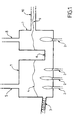
- the figure 1 represents a silicate manufacturing device comprising a reactor followed by a refining tank.
- the figure 2 is a diagram of a preferred variant of the process according to the invention, operating in a loop and leading to a precipitated silica.
- the figure 1 represents a reactor 1 equipped with submerged burners 2 and comprising a system 3 for introducing solids (sand, sulphate, coal, sulfur, etc.) below the level of the reaction mass 4, the fumes escaping through the stack 5.
- the crude silicate passes through the groove 6 in the refining tank 7 also equipped with at least one burner immersed in the flame more oxidizing than those of the reactor.
- the fumes generated in the refining tank escape through the chimney 8.
- the refined silicate 9 is recovered by the weir 10.
- the figure 2 shows how the silicate made according to the invention can be reacted with the sulfuric acid produced in the melting reactor to prepare precipitated silica at the calibrated particle size.
- Silicate on the one hand and sulphate on the other hand loop in this process. Sulfuric acid also turns in a loop, a surplus may possibly be created depending on the nature of the fuel and / or reducer used.
- a melting furnace equipped with a submerged burner is used followed by a refining vessel equipped with a submerged burner.
- Both the oven and the bowl are cylindrical (vertical axis) and both have a floor area of 0.07 m 2 .
- Submerged burners (furnace and tank) both work stoichiometrically with methane and pure oxygen (oxygen is consumed entirely in each burner flame).
- Sand and sodium sulphate are introduced into the oven in a ratio which makes it possible to obtain a sodium silicate having an SiO 2 / Na 2 O molar ratio of 3.5.
- coke acting as excess fuel / reducing agent, is introduced at a level of 0.5 mole of carbon per mole of sulphate introduced. The shot is 3 tons per day per m 2.
- the redox exiting the furnace is 0.7 (weight ratio FeO / Fe 2 O 3 total) and the residual SO 3 (SO 3 solubilized silicate) is 0.42% by weight (measured by X-ray fluorescence or by carbon / sulfur analyzer) which indicates that the efficiency of the reaction in the furnace is of the order of 98%.
- the residual sulphate will react with the residual reductant.
- the redox here is 0.20.
- Example 1 The procedure is as in Example 1 except that no excess in the form of coke is added. In the final silicate there are inclusions visible to the naked eye of sodium sulphate. The residual SO 3 is greater than 1%. This indicates a reaction yield well below that of Example 1. The sulfate introduced has not sufficiently decomposed. The silica enrichment is too strong, the reaction mass quickly becomes too viscous and the reactor must be stopped.
- Example 1 The procedure is as for Example 1 except that the excess reducer in the form of coke is replaced by an excess of reducing agent in the form of used tires whose composition is substantially: 2% by weight of sulfur, 80% by weight of carbon, 18% by weight of hydrogen.
- This reducing agent is introduced in an amount representing 5% of the mass of sodium sulphate introduced.
- a silicate containing 0.1% residual SO 3 and having a redox of 0.5 is obtained.
- the presence of sulfur in the reducing agent makes it possible to produce additional sulfuric acid.
Landscapes
- Chemical & Material Sciences (AREA)
- Organic Chemistry (AREA)
- Engineering & Computer Science (AREA)
- Inorganic Chemistry (AREA)
- Materials Engineering (AREA)
- Life Sciences & Earth Sciences (AREA)
- Geochemistry & Mineralogy (AREA)
- General Chemical & Material Sciences (AREA)
- Chemical Kinetics & Catalysis (AREA)
- Combustion & Propulsion (AREA)
- General Life Sciences & Earth Sciences (AREA)
- Geology (AREA)
- Silicon Compounds (AREA)
- Silicates, Zeolites, And Molecular Sieves (AREA)
- Glass Melting And Manufacturing (AREA)
- Glass Compositions (AREA)
- Detergent Compositions (AREA)
Claims (20)
- Verfahren zur Gewinnung von Silikat eines aus Alkalimetallen, Erdalkalimetallen oder Seltenerdmetall ausgewählten Elements, umfassend eine Reaktion zwischen Siliciumdioxid und einem Sulfat des Elements in einem Reaktor, der mit wenigstens einem in eine Schmelze eingetauchten Brenner ausgestattet ist, wobei der eingetauchte Brenner mit einem sauerstoffhaltigen Gas beaufschlagt wird, wobei ein Überschuss an Reduktionsbrennstoff bezogen auf den tatsächlich verbrauchten Sauerstoff in den Reaktor eingeleitet wird.
- Verfahren nach dem vorstehenden Anspruch, dadurch gekennzeichnet, dass der Überschuss an Reduktionsbrennstoff ein kohlenstoffhaltiger Feststoff oder eine kohlenstoffhaltige Flüssigkeit ist.
- Verfahren nach einem der vorstehenden Ansprüche, dadurch gekennzeichnet, dass der Überschuss an Reduktionsbrennstoff ein schwefelhaltiger Feststoff oder eine schwefelhaltige Flüssigkeit ist.
- Verfahren nach einem der vorstehenden Ansprüche, dadurch gekennzeichnet, dass der Überschuss an Reduktionsbrennstoff ein schwefelhaltiges Gas ist.
- Verfahren nach einem der vorstehenden Ansprüche, dadurch gekennzeichnet, dass die Silikatphase in der Reaktionsmasse eine Viskosität im Bereich zwischen 50 und 3000 Poise aufweist.
- Verfahren nach dem vorstehenden Anspruch, dadurch gekennzeichnet, dass die Silikatphase in der Reaktionsmasse eine Viskosität im Bereich zwischen 100 und 1000 Poise aufweist.
- Verfahren nach einem der vorstehenden Ansprüche, dadurch gekennzeichnet, dass die Reaktionsmasse eine Temperatur im Bereich zwischen 1000 und 1500 °C aufweist.
- Verfahren nach dem vorstehenden Anspruch, dadurch gekennzeichnet, dass die Reaktionsmasse eine Temperatur im Bereich zwischen 1200 und 1400 °C aufweist.
- Verfahren nach einem der vorstehenden Ansprüche, dadurch gekennzeichnet, dass der Brennstoffüberschuss ausreichend ist, damit das Silikat keinen Sulfateinschluss enthält.
- Verfahren nach einem der vorstehenden Ansprüche, dadurch gekennzeichnet, dass der Brennstoffüberschuss 0,1 bis 2 Moläquivalent(e) Kohlenstoff und/oder Schwefel pro Mol Sulfat ausmacht.
- Verfahren nach dem vorstehenden Anspruch, dadurch gekennzeichnet, dass der Brennstoffüberschuss 0,3 bis 1 Moläquivalent Kohlenstoff und/oder Schwefel pro Mol Sulfat ausmacht.
- Verfahren nach einem der vorstehenden Ansprüche, dadurch gekennzeichnet, dass sich an den Reaktor ein Behälter zum Raffinieren des den Reaktor verlassenden Silikats anschließt.
- Verfahren nach dem vorstehenden Anspruch, dadurch gekennzeichnet, dass die Temperatur des Silikats in dem Raffinationsbehälter zwischen der gleichen Temperatur wie in dem Reaktor und 150 °C unter der Temperatur in dem Reaktor liegt.
- Verfahren nach dem vorstehenden Anspruch, dadurch gekennzeichnet, dass die Temperatur des Silikats in dem Raffinationsbehälter zwischen 50 °C unter der Temperatur in dem Reaktor und 150 °C unter der Temperatur in dem Reaktor liegt.
- Verfahren nach einem der Ansprüche 12 bis 14, dadurch gekennzeichnet, dass der Behälter mit wenigstens einem eingetauchten Brenner ausgestattet ist.
- Verfahren nach einem der Ansprüche 12 bis 15, dadurch gekennzeichnet, dass der Redox des Eisens in dem aus dem Behälter kommenden Silikat unter 0,5 liegt.
- Verfahren nach einem der vorstehenden Ansprüche, dadurch gekennzeichnet, dass das Silikat die Formel MxOy.n(SiO2) hat, worin MxOy Na2O oder K2O ist und n eine Molzahl zwischen 1 und 4 darstellt.
- Verfahren nach dem vorstehenden Anspruch, dadurch gekennzeichnet, dass n zwischen 1,3 und 4 liegt.
- Verfahren zur Herstellung von Fällungskieselsäure, umfassend- einen Schritt a) zur Gewinnung eines Silikats nach einem der vorstehenden Ansprüche, wobei der Reaktor mit einem Schlot ausgestattet ist, welcher mit einem System zur Rückgewinnung der Schwefeloxide, die zu Schwefelsäure führen, ausgestattet ist,- einen Schritt b) zum sauren Angriff des bei a) hergestellten Silikats durch die bei a) erzeugte Schwefelsäure, was zu Fällungskieselsäure einerseits und zum Sulfat des Elements andererseits führt, wobei letzteres bei a) rückgeführt wird.
- Verfahren nach dem vorstehenden Anspruch, dadurch gekennzeichnet, dass die Fällungskieselsäure eine Größe im Bereich zwischen 0,5 und 300 nm aufweist.
Priority Applications (1)
| Application Number | Priority Date | Filing Date | Title |
|---|---|---|---|
| PL04816194T PL1667934T3 (pl) | 2003-09-19 | 2004-09-07 | Otrzymywanie krzemianu w piecu z palnikami zanurzeniowymi w środowisku redukcyjnym |
Applications Claiming Priority (4)
| Application Number | Priority Date | Filing Date | Title |
|---|---|---|---|
| FR0311006A FR2859991B1 (fr) | 2003-09-19 | 2003-09-19 | Preparation de silicate ou de verre dans un four a bruleurs immerges en milieu reducteur |
| FR0312383A FR2861384A1 (fr) | 2003-10-23 | 2003-10-23 | Preparation de silicate ou de verre dans un four a bruleurs immerges en milieu reducteur |
| FR0313272A FR2862300A3 (fr) | 2003-11-13 | 2003-11-13 | Preparation de silicate ou de verre dans un four a bruleurs immerges en milieu reducteur |
| PCT/FR2004/050416 WO2005028364A1 (fr) | 2003-09-19 | 2004-09-07 | Preparation de silicate ou de verre dans un four a bruleurs immerges en milieu reducteur |
Publications (2)
| Publication Number | Publication Date |
|---|---|
| EP1667934A1 EP1667934A1 (de) | 2006-06-14 |
| EP1667934B1 true EP1667934B1 (de) | 2011-02-16 |
Family
ID=34381625
Family Applications (1)
| Application Number | Title | Priority Date | Filing Date |
|---|---|---|---|
| EP04816194A Expired - Lifetime EP1667934B1 (de) | 2003-09-19 | 2004-09-07 | Herstellung von silikat in einem ofen mit in ein reduzierendes medium getauchten brennern |
Country Status (13)
| Country | Link |
|---|---|
| US (1) | US7578988B2 (de) |
| EP (1) | EP1667934B1 (de) |
| JP (1) | JP4709152B2 (de) |
| KR (1) | KR101173153B1 (de) |
| AT (1) | ATE498583T1 (de) |
| BR (1) | BRPI0414502B1 (de) |
| CA (1) | CA2539533C (de) |
| DE (1) | DE602004031439D1 (de) |
| EA (1) | EA009173B1 (de) |
| MX (1) | MXPA06002909A (de) |
| PL (1) | PL1667934T3 (de) |
| PT (1) | PT1667934E (de) |
| WO (1) | WO2005028364A1 (de) |
Cited By (32)
| Publication number | Priority date | Publication date | Assignee | Title |
|---|---|---|---|---|
| US8875544B2 (en) | 2011-10-07 | 2014-11-04 | Johns Manville | Burner apparatus, submerged combustion melters including the burner, and methods of use |
| US8973400B2 (en) | 2010-06-17 | 2015-03-10 | Johns Manville | Methods of using a submerged combustion melter to produce glass products |
| US8991215B2 (en) | 2010-06-17 | 2015-03-31 | Johns Manville | Methods and systems for controlling bubble size and bubble decay rate in foamed glass produced by a submerged combustion melter |
| US8997525B2 (en) | 2010-06-17 | 2015-04-07 | Johns Manville | Systems and methods for making foamed glass using submerged combustion |
| US9021838B2 (en) | 2010-06-17 | 2015-05-05 | Johns Manville | Systems and methods for glass manufacturing |
| US9096452B2 (en) | 2010-06-17 | 2015-08-04 | Johns Manville | Methods and systems for destabilizing foam in equipment downstream of a submerged combustion melter |
| US9481592B2 (en) | 2010-06-17 | 2016-11-01 | Johns Manville | Submerged combustion glass manufacturing system and method |
| US9492831B2 (en) | 2010-06-17 | 2016-11-15 | Johns Manville | Methods and systems for destabilizing foam in equipment downstream of a submerged combustion melter |
| US9533905B2 (en) | 2012-10-03 | 2017-01-03 | Johns Manville | Submerged combustion melters having an extended treatment zone and methods of producing molten glass |
| US9676644B2 (en) | 2012-11-29 | 2017-06-13 | Johns Manville | Methods and systems for making well-fined glass using submerged combustion |
| US9776903B2 (en) | 2010-06-17 | 2017-10-03 | Johns Manville | Apparatus, systems and methods for processing molten glass |
| US9815726B2 (en) | 2015-09-03 | 2017-11-14 | Johns Manville | Apparatus, systems, and methods for pre-heating feedstock to a melter using melter exhaust |
| US9926219B2 (en) | 2012-07-03 | 2018-03-27 | Johns Manville | Process of using a submerged combustion melter to produce hollow glass fiber or solid glass fiber having entrained bubbles, and burners and systems to make such fibers |
| US9982884B2 (en) | 2015-09-15 | 2018-05-29 | Johns Manville | Methods of melting feedstock using a submerged combustion melter |
| USRE46896E1 (en) | 2010-09-23 | 2018-06-19 | Johns Manville | Methods and apparatus for recycling glass products using submerged combustion |
| US10041666B2 (en) | 2015-08-27 | 2018-08-07 | Johns Manville | Burner panels including dry-tip burners, submerged combustion melters, and methods |
| US10081563B2 (en) | 2015-09-23 | 2018-09-25 | Johns Manville | Systems and methods for mechanically binding loose scrap |
| US10131563B2 (en) | 2013-05-22 | 2018-11-20 | Johns Manville | Submerged combustion burners |
| US10138151B2 (en) | 2013-05-22 | 2018-11-27 | Johns Manville | Submerged combustion burners and melters, and methods of use |
| US10144666B2 (en) | 2015-10-20 | 2018-12-04 | Johns Manville | Processing organics and inorganics in a submerged combustion melter |
| US10183884B2 (en) | 2013-05-30 | 2019-01-22 | Johns Manville | Submerged combustion burners, submerged combustion glass melters including the burners, and methods of use |
| US10196294B2 (en) | 2016-09-07 | 2019-02-05 | Johns Manville | Submerged combustion melters, wall structures or panels of same, and methods of using same |
| US10233105B2 (en) | 2016-10-14 | 2019-03-19 | Johns Manville | Submerged combustion melters and methods of feeding particulate material into such melters |
| US10246362B2 (en) | 2016-06-22 | 2019-04-02 | Johns Manville | Effective discharge of exhaust from submerged combustion melters and methods |
| US10301208B2 (en) | 2016-08-25 | 2019-05-28 | Johns Manville | Continuous flow submerged combustion melter cooling wall panels, submerged combustion melters, and methods of using same |
| US10337732B2 (en) | 2016-08-25 | 2019-07-02 | Johns Manville | Consumable tip burners, submerged combustion melters including same, and methods |
| US10442717B2 (en) | 2015-08-12 | 2019-10-15 | Johns Manville | Post-manufacturing processes for submerged combustion burner |
| US10670261B2 (en) | 2015-08-27 | 2020-06-02 | Johns Manville | Burner panels, submerged combustion melters, and methods |
| US10837705B2 (en) | 2015-09-16 | 2020-11-17 | Johns Manville | Change-out system for submerged combustion melting burner |
| US11142476B2 (en) | 2013-05-22 | 2021-10-12 | Johns Manville | Burner for submerged combustion melting |
| US11613488B2 (en) | 2012-10-03 | 2023-03-28 | Johns Manville | Methods and systems for destabilizing foam in equipment downstream of a submerged combustion melter |
| US11623887B2 (en) | 2013-05-22 | 2023-04-11 | Johns Manville | Submerged combustion burners, melters, and methods of use |
Families Citing this family (28)
| Publication number | Priority date | Publication date | Assignee | Title |
|---|---|---|---|---|
| FR2830528B1 (fr) * | 2001-10-08 | 2004-07-02 | Saint Gobain | Procede de preparation de matieres premieres pour la fabrication de verre |
| US9115017B2 (en) | 2013-01-29 | 2015-08-25 | Johns Manville | Methods and systems for monitoring glass and/or foam density as a function of vertical position within a vessel |
| US8707739B2 (en) | 2012-06-11 | 2014-04-29 | Johns Manville | Apparatus, systems and methods for conditioning molten glass |
| US9096453B2 (en) | 2012-06-11 | 2015-08-04 | Johns Manville | Submerged combustion melting processes for producing glass and similar materials, and systems for carrying out such processes |
| US8973405B2 (en) | 2010-06-17 | 2015-03-10 | Johns Manville | Apparatus, systems and methods for reducing foaming downstream of a submerged combustion melter producing molten glass |
| US9145319B2 (en) | 2012-04-27 | 2015-09-29 | Johns Manville | Submerged combustion melter comprising a melt exit structure designed to minimize impact of mechanical energy, and methods of making molten glass |
| US10322960B2 (en) | 2010-06-17 | 2019-06-18 | Johns Manville | Controlling foam in apparatus downstream of a melter by adjustment of alkali oxide content in the melter |
| RU2473474C1 (ru) * | 2011-12-08 | 2013-01-27 | Федеральное государственное автономное образовательное учреждение высшего профессионального образования "Национальный исследовательский технологический университет "МИСиС" | Способ варки стекломассы и стекловаренная печь с барботированием слоя стекломассы |
| FR2986605B1 (fr) * | 2012-02-08 | 2018-11-16 | Saint-Gobain Isover | Bruleur immerge a injecteurs multiples |
| FR2991759B1 (fr) * | 2012-06-12 | 2014-06-20 | Saint Gobain Isover | Installation de fusion de verre |
| US9643869B2 (en) | 2012-07-03 | 2017-05-09 | Johns Manville | System for producing molten glasses from glass batches using turbulent submerged combustion melting |
| WO2014189499A1 (en) | 2013-05-22 | 2014-11-27 | Johns Manville | Submerged combustion burners and melters, and methods of use |
| WO2014193388A1 (en) | 2013-05-30 | 2014-12-04 | Johns Manville | Submerged combustion glass melting systems and methods of use |
| US10858278B2 (en) | 2013-07-18 | 2020-12-08 | Johns Manville | Combustion burner |
| GB201501312D0 (en) | 2015-01-27 | 2015-03-11 | Knauf Insulation And Knauf Insulation Llc And Knauf Insulation Gmbh And Knauf Insulation Doo Skofja | Melter feeding system |
| GB201501315D0 (en) * | 2015-01-27 | 2015-03-11 | Knauf Insulation And Knauf Insulation Llc And Knauf Insulation Gmbh And Knauf Insulation Doo Skofja | Submerged combustion melters and methods |
| FR3087768B1 (fr) | 2018-10-29 | 2020-10-30 | Arc France | Preparation de fabrication de verre et installation de verrerie industrielle |
| CN110395740B (zh) * | 2019-07-12 | 2020-03-24 | 广州市飞雪材料科技有限公司 | 一种高流动性高吸油值洗衣粉用二氧化硅及其制备方法 |
| FR3099474A1 (fr) | 2019-07-30 | 2021-02-05 | Saint-Gobain Glass France | Preparation d’un silicate d’alcalin en combustion immergée |
| US11680005B2 (en) * | 2020-02-12 | 2023-06-20 | Owens-Brockway Glass Container Inc. | Feed material for producing flint glass using submerged combustion melting |
| US11667555B2 (en) | 2020-02-12 | 2023-06-06 | Owens-Brockway Glass Container Inc. | Glass redox control in submerged combustion melting |
| US11440829B2 (en) * | 2019-10-01 | 2022-09-13 | Owens-Brockway Glass Container Inc. | Utilization of sulfate in the fining of submerged combustion melted glass |
| US11912608B2 (en) | 2019-10-01 | 2024-02-27 | Owens-Brockway Glass Container Inc. | Glass manufacturing |
| FR3116815B1 (fr) * | 2020-11-30 | 2023-04-28 | Saint Gobain Isover | Procede de traitement de dechets verriers |
| US12084378B2 (en) * | 2021-04-16 | 2024-09-10 | Owens-Brockway Glass Container Inc. | Feeder tank for a glass melter |
| WO2023023791A1 (en) * | 2021-08-25 | 2023-03-02 | Iluka Resources Limited | Mineral sand particulate processing |
| EP4148024A1 (de) * | 2021-09-08 | 2023-03-15 | Schott Ag | Verfahren zur herstellung eines glasprodukts sowie glasprodukt |
| EP4442654A1 (de) * | 2023-04-06 | 2024-10-09 | Ankerpoort N.V. | Verfahren zur wiederverwertung von glasscherben und glasfaser |
Family Cites Families (16)
| Publication number | Priority date | Publication date | Assignee | Title |
|---|---|---|---|---|
| US1452048A (en) * | 1920-11-06 | 1923-04-17 | Ferdinand E Kauffmann | Hat-clipping machine |
| US1425048A (en) | 1920-12-18 | 1922-08-08 | Chauncey William Waggoner | Process of producing alkali metal silicates in blast furmaces |
| US2239880A (en) * | 1937-01-14 | 1941-04-29 | Philadelphia Quartz Co | Manufacture of silicates |
| US2211733A (en) * | 1938-03-18 | 1940-08-13 | J B Ford Company | Process of producing alkali silicates |
| US2352738A (en) * | 1940-01-15 | 1944-07-04 | Robert F Ruthruff | Manufacture of alkali metal silicates |
| US3260587A (en) * | 1962-12-05 | 1966-07-12 | Selas Corp Of America | Method of melting glass with submerged combustion heaters and apparatus therefor |
| DE3114493A1 (de) * | 1981-04-10 | 1982-10-28 | Degussa Ag, 6000 Frankfurt | "faellungskieselsaeuren und verfahren zu ihrer herstellung" |
| US4551161A (en) * | 1984-06-27 | 1985-11-05 | Ppg Industries, Inc. | Organic wetting of glass batch |
| US4545800A (en) * | 1984-07-19 | 1985-10-08 | Ppg Industries, Inc. | Submerged oxygen-hydrogen combustion melting of glass |
| US4681750A (en) * | 1985-07-29 | 1987-07-21 | Ppg Industries, Inc. | Preparation of amorphous, precipitated silica and siliceous filler-reinforced microporous polymeric separator |
| US5785940A (en) * | 1996-03-18 | 1998-07-28 | Pq Corporation | Silicate reactor with submerged burners |
| US6375735B1 (en) * | 1996-05-06 | 2002-04-23 | Agritec, Inc. | Precipitated silicas, silica gels with and free of deposited carbon from caustic biomass ash solutions and processes |
| JP4536932B2 (ja) * | 1999-02-05 | 2010-09-01 | サン−ゴバン グラス フランス | ガラス製造用バッチ原料の製造方法 |
| EG25130A (en) * | 1999-02-05 | 2011-09-18 | Saint Gobain Vitrage | Process and apparatus for preparing batch materials for the manufacture of glass. |
| US6717026B2 (en) * | 2001-02-27 | 2004-04-06 | Clean Technologies International Corporation | Molten metal reactor utilizing molten metal flow for feed material and reaction product entrapment |
| FR2830528B1 (fr) * | 2001-10-08 | 2004-07-02 | Saint Gobain | Procede de preparation de matieres premieres pour la fabrication de verre |
-
2004
- 2004-09-07 EA EA200600596A patent/EA009173B1/ru not_active IP Right Cessation
- 2004-09-07 AT AT04816194T patent/ATE498583T1/de not_active IP Right Cessation
- 2004-09-07 DE DE602004031439T patent/DE602004031439D1/de not_active Expired - Lifetime
- 2004-09-07 PT PT04816194T patent/PT1667934E/pt unknown
- 2004-09-07 EP EP04816194A patent/EP1667934B1/de not_active Expired - Lifetime
- 2004-09-07 BR BRPI0414502-0B1A patent/BRPI0414502B1/pt not_active IP Right Cessation
- 2004-09-07 JP JP2006526668A patent/JP4709152B2/ja not_active Expired - Fee Related
- 2004-09-07 US US10/572,452 patent/US7578988B2/en not_active Expired - Fee Related
- 2004-09-07 CA CA2539533A patent/CA2539533C/fr not_active Expired - Fee Related
- 2004-09-07 PL PL04816194T patent/PL1667934T3/pl unknown
- 2004-09-07 MX MXPA06002909A patent/MXPA06002909A/es active IP Right Grant
- 2004-09-07 WO PCT/FR2004/050416 patent/WO2005028364A1/fr not_active Ceased
-
2006
- 2006-03-14 KR KR1020067005174A patent/KR101173153B1/ko not_active Expired - Fee Related
Cited By (52)
| Publication number | Priority date | Publication date | Assignee | Title |
|---|---|---|---|---|
| US9492831B2 (en) | 2010-06-17 | 2016-11-15 | Johns Manville | Methods and systems for destabilizing foam in equipment downstream of a submerged combustion melter |
| US9533906B2 (en) | 2010-06-17 | 2017-01-03 | Johns Manville | Burner apparatus, submerged combustion melters including the burner, and methods of use |
| US8991215B2 (en) | 2010-06-17 | 2015-03-31 | Johns Manville | Methods and systems for controlling bubble size and bubble decay rate in foamed glass produced by a submerged combustion melter |
| US8997525B2 (en) | 2010-06-17 | 2015-04-07 | Johns Manville | Systems and methods for making foamed glass using submerged combustion |
| US9021838B2 (en) | 2010-06-17 | 2015-05-05 | Johns Manville | Systems and methods for glass manufacturing |
| US9096452B2 (en) | 2010-06-17 | 2015-08-04 | Johns Manville | Methods and systems for destabilizing foam in equipment downstream of a submerged combustion melter |
| US8973400B2 (en) | 2010-06-17 | 2015-03-10 | Johns Manville | Methods of using a submerged combustion melter to produce glass products |
| US9481592B2 (en) | 2010-06-17 | 2016-11-01 | Johns Manville | Submerged combustion glass manufacturing system and method |
| US9776903B2 (en) | 2010-06-17 | 2017-10-03 | Johns Manville | Apparatus, systems and methods for processing molten glass |
| US9481593B2 (en) | 2010-06-17 | 2016-11-01 | Johns Manville | Methods of using a submerged combustion melter to produce glass products |
| US10081565B2 (en) | 2010-06-17 | 2018-09-25 | Johns Manville | Systems and methods for making foamed glass using submerged combustion |
| US9573831B2 (en) | 2010-06-17 | 2017-02-21 | Johns Manville | Systems and methods for glass manufacturing |
| US10472268B2 (en) | 2010-06-17 | 2019-11-12 | Johns Manville | Systems and methods for glass manufacturing |
| US9840430B2 (en) | 2010-06-17 | 2017-12-12 | Johns Manville | Methods and systems for controlling bubble size and bubble decay rate in foamed glass produced by a submerged combustion melter |
| US9676652B2 (en) | 2010-06-17 | 2017-06-13 | Johns Manville | Systems and methods for making foamed glass using submerged combustion |
| USRE46896E1 (en) | 2010-09-23 | 2018-06-19 | Johns Manville | Methods and apparatus for recycling glass products using submerged combustion |
| US9580344B2 (en) | 2011-10-07 | 2017-02-28 | Johns Manville | Burner apparatus, submerged combustion melters including the burner, and methods of use |
| US9776901B2 (en) | 2011-10-07 | 2017-10-03 | Johns Manville | Submerged combustion glass manufacturing system and method |
| US9957184B2 (en) | 2011-10-07 | 2018-05-01 | Johns Manville | Submerged combustion glass manufacturing system and method |
| US8875544B2 (en) | 2011-10-07 | 2014-11-04 | Johns Manville | Burner apparatus, submerged combustion melters including the burner, and methods of use |
| US9650277B2 (en) | 2012-04-27 | 2017-05-16 | Johns Manville | Methods and systems for destabilizing foam in equipment downstream of a submerged combustion melter |
| US9926219B2 (en) | 2012-07-03 | 2018-03-27 | Johns Manville | Process of using a submerged combustion melter to produce hollow glass fiber or solid glass fiber having entrained bubbles, and burners and systems to make such fibers |
| US11233484B2 (en) | 2012-07-03 | 2022-01-25 | Johns Manville | Process of using a submerged combustion melter to produce hollow glass fiber or solid glass fiber having entrained bubbles, and burners and systems to make such fibers |
| US11613488B2 (en) | 2012-10-03 | 2023-03-28 | Johns Manville | Methods and systems for destabilizing foam in equipment downstream of a submerged combustion melter |
| US10392285B2 (en) | 2012-10-03 | 2019-08-27 | Johns Manville | Submerged combustion melters having an extended treatment zone and methods of producing molten glass |
| US9533905B2 (en) | 2012-10-03 | 2017-01-03 | Johns Manville | Submerged combustion melters having an extended treatment zone and methods of producing molten glass |
| US9676644B2 (en) | 2012-11-29 | 2017-06-13 | Johns Manville | Methods and systems for making well-fined glass using submerged combustion |
| US10131563B2 (en) | 2013-05-22 | 2018-11-20 | Johns Manville | Submerged combustion burners |
| US11142476B2 (en) | 2013-05-22 | 2021-10-12 | Johns Manville | Burner for submerged combustion melting |
| US11623887B2 (en) | 2013-05-22 | 2023-04-11 | Johns Manville | Submerged combustion burners, melters, and methods of use |
| US10138151B2 (en) | 2013-05-22 | 2018-11-27 | Johns Manville | Submerged combustion burners and melters, and methods of use |
| US11186510B2 (en) | 2013-05-30 | 2021-11-30 | Johns Manville | Submerged combustion burners, submerged combustion glass melters including the burners, and methods of use |
| US10183884B2 (en) | 2013-05-30 | 2019-01-22 | Johns Manville | Submerged combustion burners, submerged combustion glass melters including the burners, and methods of use |
| US10618830B2 (en) | 2013-05-30 | 2020-04-14 | Johns Manville | Submerged combustion burners, submerged combustion glass melters including the burners, and methods of use |
| US10442717B2 (en) | 2015-08-12 | 2019-10-15 | Johns Manville | Post-manufacturing processes for submerged combustion burner |
| US10670261B2 (en) | 2015-08-27 | 2020-06-02 | Johns Manville | Burner panels, submerged combustion melters, and methods |
| US10955132B2 (en) | 2015-08-27 | 2021-03-23 | Johns Manville | Burner panels including dry-tip burners, submerged combustion melters, and methods |
| US10041666B2 (en) | 2015-08-27 | 2018-08-07 | Johns Manville | Burner panels including dry-tip burners, submerged combustion melters, and methods |
| US9815726B2 (en) | 2015-09-03 | 2017-11-14 | Johns Manville | Apparatus, systems, and methods for pre-heating feedstock to a melter using melter exhaust |
| US9982884B2 (en) | 2015-09-15 | 2018-05-29 | Johns Manville | Methods of melting feedstock using a submerged combustion melter |
| US10837705B2 (en) | 2015-09-16 | 2020-11-17 | Johns Manville | Change-out system for submerged combustion melting burner |
| US10435320B2 (en) | 2015-09-23 | 2019-10-08 | Johns Manville | Systems and methods for mechanically binding loose scrap |
| US10081563B2 (en) | 2015-09-23 | 2018-09-25 | Johns Manville | Systems and methods for mechanically binding loose scrap |
| US10144666B2 (en) | 2015-10-20 | 2018-12-04 | Johns Manville | Processing organics and inorganics in a submerged combustion melter |
| US10793459B2 (en) | 2016-06-22 | 2020-10-06 | Johns Manville | Effective discharge of exhaust from submerged combustion melters and methods |
| US10246362B2 (en) | 2016-06-22 | 2019-04-02 | Johns Manville | Effective discharge of exhaust from submerged combustion melters and methods |
| US10337732B2 (en) | 2016-08-25 | 2019-07-02 | Johns Manville | Consumable tip burners, submerged combustion melters including same, and methods |
| US10301208B2 (en) | 2016-08-25 | 2019-05-28 | Johns Manville | Continuous flow submerged combustion melter cooling wall panels, submerged combustion melters, and methods of using same |
| US11248787B2 (en) | 2016-08-25 | 2022-02-15 | Johns Manville | Consumable tip burners, submerged combustion melters including same, and methods |
| US11396470B2 (en) | 2016-08-25 | 2022-07-26 | Johns Manville | Continuous flow submerged combustion melter cooling wall panels, submerged combustion melters, and methods of using same |
| US10196294B2 (en) | 2016-09-07 | 2019-02-05 | Johns Manville | Submerged combustion melters, wall structures or panels of same, and methods of using same |
| US10233105B2 (en) | 2016-10-14 | 2019-03-19 | Johns Manville | Submerged combustion melters and methods of feeding particulate material into such melters |
Also Published As
| Publication number | Publication date |
|---|---|
| EP1667934A1 (de) | 2006-06-14 |
| JP2007505811A (ja) | 2007-03-15 |
| CA2539533A1 (fr) | 2005-03-31 |
| WO2005028364A1 (fr) | 2005-03-31 |
| US7578988B2 (en) | 2009-08-25 |
| US20070122332A1 (en) | 2007-05-31 |
| ATE498583T1 (de) | 2011-03-15 |
| KR20060088877A (ko) | 2006-08-07 |
| CA2539533C (fr) | 2013-08-06 |
| KR101173153B1 (ko) | 2012-08-16 |
| JP4709152B2 (ja) | 2011-06-22 |
| DE602004031439D1 (de) | 2011-03-31 |
| BRPI0414502B1 (pt) | 2014-12-02 |
| EA200600596A1 (ru) | 2006-08-25 |
| MXPA06002909A (es) | 2006-05-31 |
| BRPI0414502A (pt) | 2006-11-07 |
| EA009173B1 (ru) | 2007-12-28 |
| PT1667934E (pt) | 2011-05-26 |
| PL1667934T3 (pl) | 2011-07-29 |
Similar Documents
| Publication | Publication Date | Title |
|---|---|---|
| CA2539533C (fr) | Preparation de silicate ou de verre dans un four a bruleurs immerges en milieu reducteur | |
| EP1609766B1 (de) | Verfahren zur Herstellung von Glasrohstoffen | |
| CA2324875C (fr) | Procede et dispositif de preparation de matieres premieres pour la fabrication de verre | |
| CA2283252C (fr) | Procede et dispositif de fusion et d'affinage de matieres vitrifiables | |
| KR100856813B1 (ko) | 급속 유리 용융 또는 예비-용융 | |
| CA2468177C (fr) | Dispositif et procede de fusion de matieres vitrifiables | |
| JPH0377132B2 (de) | ||
| TWI330241B (en) | Solid fuel combustion for industrial melting with a slagging combustor | |
| EP1068154B1 (de) | Verfahren zur vorbereitung von glasgemeng zum herstellen von glas | |
| EP4251576A1 (de) | Verfahren zur behandlung von glasabfall | |
| FR2859991A1 (fr) | Preparation de silicate ou de verre dans un four a bruleurs immerges en milieu reducteur | |
| FR2861384A1 (fr) | Preparation de silicate ou de verre dans un four a bruleurs immerges en milieu reducteur | |
| FR2862300A1 (fr) | Preparation de silicate ou de verre dans un four a bruleurs immerges en milieu reducteur | |
| WO2025181535A1 (fr) | Procédé de production d'un bain de verre silico-sodo-calcique et installation pour sa mise en œuvre | |
| FR2789384A1 (fr) | Procede de preparation de matieres premieres pour la fabrication de verre | |
| NO168240B (no) | Fremgangsmaate for smelting av en glassats eller lignende. |
Legal Events
| Date | Code | Title | Description |
|---|---|---|---|
| PUAI | Public reference made under article 153(3) epc to a published international application that has entered the european phase |
Free format text: ORIGINAL CODE: 0009012 |
|
| 17P | Request for examination filed |
Effective date: 20060419 |
|
| AK | Designated contracting states |
Kind code of ref document: A1 Designated state(s): AT BE BG CH CY CZ DE DK EE ES FI FR GB GR HU IE IT LI LU MC NL PL PT RO SE SI SK TR |
|
| DAX | Request for extension of the european patent (deleted) | ||
| GRAP | Despatch of communication of intention to grant a patent |
Free format text: ORIGINAL CODE: EPIDOSNIGR1 |
|
| RTI1 | Title (correction) |
Free format text: PREPARATION OF SILICATE IN A FURNACE WITH BURNERS IMMERSED IN A REDUCING MEDIUM |
|
| GRAS | Grant fee paid |
Free format text: ORIGINAL CODE: EPIDOSNIGR3 |
|
| GRAA | (expected) grant |
Free format text: ORIGINAL CODE: 0009210 |
|
| AK | Designated contracting states |
Kind code of ref document: B1 Designated state(s): AT BE BG CH CY CZ DE DK EE ES FI FR GB GR HU IE IT LI LU MC NL PL PT RO SE SI SK TR |
|
| REG | Reference to a national code |
Ref country code: GB Ref legal event code: FG4D Free format text: NOT ENGLISH |
|
| REG | Reference to a national code |
Ref country code: CH Ref legal event code: EP |
|
| REG | Reference to a national code |
Ref country code: IE Ref legal event code: FG4D Free format text: LANGUAGE OF EP DOCUMENT: FRENCH |
|
| REF | Corresponds to: |
Ref document number: 602004031439 Country of ref document: DE Date of ref document: 20110331 Kind code of ref document: P |
|
| REG | Reference to a national code |
Ref country code: DE Ref legal event code: R096 Ref document number: 602004031439 Country of ref document: DE Effective date: 20110331 |
|
| REG | Reference to a national code |
Ref country code: RO Ref legal event code: EPE |
|
| REG | Reference to a national code |
Ref country code: NL Ref legal event code: T3 |
|
| REG | Reference to a national code |
Ref country code: PT Ref legal event code: SC4A Free format text: AVAILABILITY OF NATIONAL TRANSLATION Effective date: 20110516 |
|
| REG | Reference to a national code |
Ref country code: SE Ref legal event code: TRGR |
|
| REG | Reference to a national code |
Ref country code: ES Ref legal event code: FG2A Ref document number: 2361265 Country of ref document: ES Kind code of ref document: T3 Effective date: 20110615 |
|
| PG25 | Lapsed in a contracting state [announced via postgrant information from national office to epo] |
Ref country code: GR Free format text: LAPSE BECAUSE OF FAILURE TO SUBMIT A TRANSLATION OF THE DESCRIPTION OR TO PAY THE FEE WITHIN THE PRESCRIBED TIME-LIMIT Effective date: 20110517 |
|
| REG | Reference to a national code |
Ref country code: PL Ref legal event code: T3 |
|
| PG25 | Lapsed in a contracting state [announced via postgrant information from national office to epo] |
Ref country code: CY Free format text: LAPSE BECAUSE OF FAILURE TO SUBMIT A TRANSLATION OF THE DESCRIPTION OR TO PAY THE FEE WITHIN THE PRESCRIBED TIME-LIMIT Effective date: 20110216 Ref country code: AT Free format text: LAPSE BECAUSE OF FAILURE TO SUBMIT A TRANSLATION OF THE DESCRIPTION OR TO PAY THE FEE WITHIN THE PRESCRIBED TIME-LIMIT Effective date: 20110216 Ref country code: FI Free format text: LAPSE BECAUSE OF FAILURE TO SUBMIT A TRANSLATION OF THE DESCRIPTION OR TO PAY THE FEE WITHIN THE PRESCRIBED TIME-LIMIT Effective date: 20110216 Ref country code: SI Free format text: LAPSE BECAUSE OF FAILURE TO SUBMIT A TRANSLATION OF THE DESCRIPTION OR TO PAY THE FEE WITHIN THE PRESCRIBED TIME-LIMIT Effective date: 20110216 Ref country code: BG Free format text: LAPSE BECAUSE OF FAILURE TO SUBMIT A TRANSLATION OF THE DESCRIPTION OR TO PAY THE FEE WITHIN THE PRESCRIBED TIME-LIMIT Effective date: 20110516 |
|
| REG | Reference to a national code |
Ref country code: IE Ref legal event code: FD4D |
|
| PG25 | Lapsed in a contracting state [announced via postgrant information from national office to epo] |
Ref country code: DK Free format text: LAPSE BECAUSE OF FAILURE TO SUBMIT A TRANSLATION OF THE DESCRIPTION OR TO PAY THE FEE WITHIN THE PRESCRIBED TIME-LIMIT Effective date: 20110216 Ref country code: EE Free format text: LAPSE BECAUSE OF FAILURE TO SUBMIT A TRANSLATION OF THE DESCRIPTION OR TO PAY THE FEE WITHIN THE PRESCRIBED TIME-LIMIT Effective date: 20110216 Ref country code: IE Free format text: LAPSE BECAUSE OF FAILURE TO SUBMIT A TRANSLATION OF THE DESCRIPTION OR TO PAY THE FEE WITHIN THE PRESCRIBED TIME-LIMIT Effective date: 20110216 |
|
| PG25 | Lapsed in a contracting state [announced via postgrant information from national office to epo] |
Ref country code: SK Free format text: LAPSE BECAUSE OF FAILURE TO SUBMIT A TRANSLATION OF THE DESCRIPTION OR TO PAY THE FEE WITHIN THE PRESCRIBED TIME-LIMIT Effective date: 20110216 |
|
| PLBE | No opposition filed within time limit |
Free format text: ORIGINAL CODE: 0009261 |
|
| STAA | Information on the status of an ep patent application or granted ep patent |
Free format text: STATUS: NO OPPOSITION FILED WITHIN TIME LIMIT |
|
| 26N | No opposition filed |
Effective date: 20111117 |
|
| REG | Reference to a national code |
Ref country code: DE Ref legal event code: R097 Ref document number: 602004031439 Country of ref document: DE Effective date: 20111117 |
|
| PG25 | Lapsed in a contracting state [announced via postgrant information from national office to epo] |
Ref country code: MC Free format text: LAPSE BECAUSE OF NON-PAYMENT OF DUE FEES Effective date: 20110930 |
|
| REG | Reference to a national code |
Ref country code: CH Ref legal event code: PL |
|
| PG25 | Lapsed in a contracting state [announced via postgrant information from national office to epo] |
Ref country code: CH Free format text: LAPSE BECAUSE OF NON-PAYMENT OF DUE FEES Effective date: 20110930 Ref country code: LI Free format text: LAPSE BECAUSE OF NON-PAYMENT OF DUE FEES Effective date: 20110930 |
|
| PG25 | Lapsed in a contracting state [announced via postgrant information from national office to epo] |
Ref country code: HU Free format text: LAPSE BECAUSE OF FAILURE TO SUBMIT A TRANSLATION OF THE DESCRIPTION OR TO PAY THE FEE WITHIN THE PRESCRIBED TIME-LIMIT Effective date: 20110216 |
|
| PG25 | Lapsed in a contracting state [announced via postgrant information from national office to epo] |
Ref country code: LU Free format text: LAPSE BECAUSE OF NON-PAYMENT OF DUE FEES Effective date: 20140907 |
|
| REG | Reference to a national code |
Ref country code: FR Ref legal event code: PLFP Year of fee payment: 13 |
|
| PGFP | Annual fee paid to national office [announced via postgrant information from national office to epo] |
Ref country code: GB Payment date: 20160907 Year of fee payment: 13 Ref country code: NL Payment date: 20160913 Year of fee payment: 13 Ref country code: IT Payment date: 20160921 Year of fee payment: 13 Ref country code: DE Payment date: 20160831 Year of fee payment: 13 Ref country code: LU Payment date: 20160926 Year of fee payment: 13 |
|
| PGFP | Annual fee paid to national office [announced via postgrant information from national office to epo] |
Ref country code: PT Payment date: 20160906 Year of fee payment: 13 Ref country code: FR Payment date: 20160922 Year of fee payment: 13 Ref country code: CZ Payment date: 20160811 Year of fee payment: 13 Ref country code: RO Payment date: 20160812 Year of fee payment: 13 Ref country code: PL Payment date: 20160816 Year of fee payment: 13 Ref country code: SE Payment date: 20160914 Year of fee payment: 13 |
|
| PGFP | Annual fee paid to national office [announced via postgrant information from national office to epo] |
Ref country code: ES Payment date: 20160811 Year of fee payment: 13 Ref country code: BE Payment date: 20160927 Year of fee payment: 13 Ref country code: TR Payment date: 20160823 Year of fee payment: 13 |
|
| REG | Reference to a national code |
Ref country code: DE Ref legal event code: R119 Ref document number: 602004031439 Country of ref document: DE |
|
| PG25 | Lapsed in a contracting state [announced via postgrant information from national office to epo] |
Ref country code: CZ Free format text: LAPSE BECAUSE OF NON-PAYMENT OF DUE FEES Effective date: 20170907 Ref country code: RO Free format text: LAPSE BECAUSE OF NON-PAYMENT OF DUE FEES Effective date: 20170907 |
|
| REG | Reference to a national code |
Ref country code: SE Ref legal event code: EUG |
|
| REG | Reference to a national code |
Ref country code: NL Ref legal event code: MM Effective date: 20171001 |
|
| GBPC | Gb: european patent ceased through non-payment of renewal fee |
Effective date: 20170907 |
|
| PG25 | Lapsed in a contracting state [announced via postgrant information from national office to epo] |
Ref country code: PT Free format text: LAPSE BECAUSE OF NON-PAYMENT OF DUE FEES Effective date: 20180307 |
|
| REG | Reference to a national code |
Ref country code: BE Ref legal event code: MM Effective date: 20170930 |
|
| PG25 | Lapsed in a contracting state [announced via postgrant information from national office to epo] |
Ref country code: LU Free format text: LAPSE BECAUSE OF NON-PAYMENT OF DUE FEES Effective date: 20170907 Ref country code: NL Free format text: LAPSE BECAUSE OF NON-PAYMENT OF DUE FEES Effective date: 20171001 |
|
| REG | Reference to a national code |
Ref country code: FR Ref legal event code: ST Effective date: 20180531 |
|
| PG25 | Lapsed in a contracting state [announced via postgrant information from national office to epo] |
Ref country code: DE Free format text: LAPSE BECAUSE OF NON-PAYMENT OF DUE FEES Effective date: 20180404 Ref country code: GB Free format text: LAPSE BECAUSE OF NON-PAYMENT OF DUE FEES Effective date: 20170907 |
|
| PG25 | Lapsed in a contracting state [announced via postgrant information from national office to epo] |
Ref country code: IT Free format text: LAPSE BECAUSE OF NON-PAYMENT OF DUE FEES Effective date: 20170907 Ref country code: FR Free format text: LAPSE BECAUSE OF NON-PAYMENT OF DUE FEES Effective date: 20171002 Ref country code: BE Free format text: LAPSE BECAUSE OF NON-PAYMENT OF DUE FEES Effective date: 20170930 |
|
| REG | Reference to a national code |
Ref country code: ES Ref legal event code: FD2A Effective date: 20181024 |
|
| PG25 | Lapsed in a contracting state [announced via postgrant information from national office to epo] |
Ref country code: ES Free format text: LAPSE BECAUSE OF NON-PAYMENT OF DUE FEES Effective date: 20170908 |
|
| PG25 | Lapsed in a contracting state [announced via postgrant information from national office to epo] |
Ref country code: PL Free format text: LAPSE BECAUSE OF NON-PAYMENT OF DUE FEES Effective date: 20170907 |
|
| PG25 | Lapsed in a contracting state [announced via postgrant information from national office to epo] |
Ref country code: SE Free format text: LAPSE BECAUSE OF NON-PAYMENT OF DUE FEES Effective date: 20170908 |
|
| PG25 | Lapsed in a contracting state [announced via postgrant information from national office to epo] |
Ref country code: TR Free format text: LAPSE BECAUSE OF NON-PAYMENT OF DUE FEES Effective date: 20170907 |