EP1669044A2 - Prothèse vasculaire de type mousse avec porosité ouverte angio-permissive bien définie - Google Patents
Prothèse vasculaire de type mousse avec porosité ouverte angio-permissive bien définie Download PDFInfo
- Publication number
- EP1669044A2 EP1669044A2 EP06006603A EP06006603A EP1669044A2 EP 1669044 A2 EP1669044 A2 EP 1669044A2 EP 06006603 A EP06006603 A EP 06006603A EP 06006603 A EP06006603 A EP 06006603A EP 1669044 A2 EP1669044 A2 EP 1669044A2
- Authority
- EP
- European Patent Office
- Prior art keywords
- prosthesis
- graft material
- range
- graft
- filler
- Prior art date
- Legal status (The legal status is an assumption and is not a legal conclusion. Google has not performed a legal analysis and makes no representation as to the accuracy of the status listed.)
- Withdrawn
Links
Images

Classifications
-
- A—HUMAN NECESSITIES
- A61—MEDICAL OR VETERINARY SCIENCE; HYGIENE
- A61F—FILTERS IMPLANTABLE INTO BLOOD VESSELS; PROSTHESES; DEVICES PROVIDING PATENCY TO, OR PREVENTING COLLAPSING OF, TUBULAR STRUCTURES OF THE BODY, e.g. STENTS; ORTHOPAEDIC, NURSING OR CONTRACEPTIVE DEVICES; FOMENTATION; TREATMENT OR PROTECTION OF EYES OR EARS; BANDAGES, DRESSINGS OR ABSORBENT PADS; FIRST-AID KITS
- A61F2/00—Filters implantable into blood vessels; Prostheses, i.e. artificial substitutes or replacements for parts of the body; Appliances for connecting them with the body; Devices providing patency to, or preventing collapsing of, tubular structures of the body, e.g. stents
- A61F2/02—Prostheses implantable into the body
- A61F2/04—Hollow or tubular parts of organs, e.g. bladders, tracheae, bronchi or bile ducts
- A61F2/06—Blood vessels
-
- A—HUMAN NECESSITIES
- A61—MEDICAL OR VETERINARY SCIENCE; HYGIENE
- A61F—FILTERS IMPLANTABLE INTO BLOOD VESSELS; PROSTHESES; DEVICES PROVIDING PATENCY TO, OR PREVENTING COLLAPSING OF, TUBULAR STRUCTURES OF THE BODY, e.g. STENTS; ORTHOPAEDIC, NURSING OR CONTRACEPTIVE DEVICES; FOMENTATION; TREATMENT OR PROTECTION OF EYES OR EARS; BANDAGES, DRESSINGS OR ABSORBENT PADS; FIRST-AID KITS
- A61F2/00—Filters implantable into blood vessels; Prostheses, i.e. artificial substitutes or replacements for parts of the body; Appliances for connecting them with the body; Devices providing patency to, or preventing collapsing of, tubular structures of the body, e.g. stents
- A61F2/0077—Special surfaces of prostheses, e.g. for improving ingrowth
-
- A—HUMAN NECESSITIES
- A61—MEDICAL OR VETERINARY SCIENCE; HYGIENE
- A61L—METHODS OR APPARATUS FOR STERILISING MATERIALS OR OBJECTS IN GENERAL; DISINFECTION, STERILISATION OR DEODORISATION OF AIR; CHEMICAL ASPECTS OF BANDAGES, DRESSINGS, ABSORBENT PADS OR SURGICAL ARTICLES; MATERIALS FOR BANDAGES, DRESSINGS, ABSORBENT PADS OR SURGICAL ARTICLES
- A61L27/00—Materials for grafts or prostheses or for coating grafts or prostheses
- A61L27/14—Macromolecular materials
- A61L27/18—Macromolecular materials obtained otherwise than by reactions only involving carbon-to-carbon unsaturated bonds
-
- A—HUMAN NECESSITIES
- A61—MEDICAL OR VETERINARY SCIENCE; HYGIENE
- A61L—METHODS OR APPARATUS FOR STERILISING MATERIALS OR OBJECTS IN GENERAL; DISINFECTION, STERILISATION OR DEODORISATION OF AIR; CHEMICAL ASPECTS OF BANDAGES, DRESSINGS, ABSORBENT PADS OR SURGICAL ARTICLES; MATERIALS FOR BANDAGES, DRESSINGS, ABSORBENT PADS OR SURGICAL ARTICLES
- A61L27/00—Materials for grafts or prostheses or for coating grafts or prostheses
- A61L27/50—Materials characterised by their function or physical properties, e.g. injectable or lubricating compositions, shape-memory materials, surface modified materials
- A61L27/507—Materials characterised by their function or physical properties, e.g. injectable or lubricating compositions, shape-memory materials, surface modified materials for artificial blood vessels
-
- A—HUMAN NECESSITIES
- A61—MEDICAL OR VETERINARY SCIENCE; HYGIENE
- A61L—METHODS OR APPARATUS FOR STERILISING MATERIALS OR OBJECTS IN GENERAL; DISINFECTION, STERILISATION OR DEODORISATION OF AIR; CHEMICAL ASPECTS OF BANDAGES, DRESSINGS, ABSORBENT PADS OR SURGICAL ARTICLES; MATERIALS FOR BANDAGES, DRESSINGS, ABSORBENT PADS OR SURGICAL ARTICLES
- A61L27/00—Materials for grafts or prostheses or for coating grafts or prostheses
- A61L27/50—Materials characterised by their function or physical properties, e.g. injectable or lubricating compositions, shape-memory materials, surface modified materials
- A61L27/56—Porous materials, e.g. foams or sponges
-
- A—HUMAN NECESSITIES
- A61—MEDICAL OR VETERINARY SCIENCE; HYGIENE
- A61L—METHODS OR APPARATUS FOR STERILISING MATERIALS OR OBJECTS IN GENERAL; DISINFECTION, STERILISATION OR DEODORISATION OF AIR; CHEMICAL ASPECTS OF BANDAGES, DRESSINGS, ABSORBENT PADS OR SURGICAL ARTICLES; MATERIALS FOR BANDAGES, DRESSINGS, ABSORBENT PADS OR SURGICAL ARTICLES
- A61L31/00—Materials for other surgical articles, e.g. stents, stent-grafts, shunts, surgical drapes, guide wires, materials for adhesion prevention, occluding devices, surgical gloves, tissue fixation devices
- A61L31/14—Materials characterised by their function or physical properties, e.g. injectable or lubricating compositions, shape-memory materials, surface modified materials
- A61L31/146—Porous materials, e.g. foams or sponges
-
- A—HUMAN NECESSITIES
- A61—MEDICAL OR VETERINARY SCIENCE; HYGIENE
- A61F—FILTERS IMPLANTABLE INTO BLOOD VESSELS; PROSTHESES; DEVICES PROVIDING PATENCY TO, OR PREVENTING COLLAPSING OF, TUBULAR STRUCTURES OF THE BODY, e.g. STENTS; ORTHOPAEDIC, NURSING OR CONTRACEPTIVE DEVICES; FOMENTATION; TREATMENT OR PROTECTION OF EYES OR EARS; BANDAGES, DRESSINGS OR ABSORBENT PADS; FIRST-AID KITS
- A61F2/00—Filters implantable into blood vessels; Prostheses, i.e. artificial substitutes or replacements for parts of the body; Appliances for connecting them with the body; Devices providing patency to, or preventing collapsing of, tubular structures of the body, e.g. stents
- A61F2/02—Prostheses implantable into the body
- A61F2/24—Heart valves ; Vascular valves, e.g. venous valves; Heart implants, e.g. passive devices for improving the function of the native valve or the heart muscle; Transmyocardial revascularisation [TMR] devices; Valves implantable in the body
- A61F2/2412—Heart valves ; Vascular valves, e.g. venous valves; Heart implants, e.g. passive devices for improving the function of the native valve or the heart muscle; Transmyocardial revascularisation [TMR] devices; Valves implantable in the body with soft flexible valve members, e.g. tissue valves shaped like natural valves
- A61F2/2415—Manufacturing methods
-
- B—PERFORMING OPERATIONS; TRANSPORTING
- B29—WORKING OF PLASTICS; WORKING OF SUBSTANCES IN A PLASTIC STATE IN GENERAL
- B29C—SHAPING OR JOINING OF PLASTICS; SHAPING OF MATERIAL IN A PLASTIC STATE, NOT OTHERWISE PROVIDED FOR; AFTER-TREATMENT OF THE SHAPED PRODUCTS, e.g. REPAIRING
- B29C48/00—Extrusion moulding, i.e. expressing the moulding material through a die or nozzle which imparts the desired form; Apparatus therefor
-
- B—PERFORMING OPERATIONS; TRANSPORTING
- B29—WORKING OF PLASTICS; WORKING OF SUBSTANCES IN A PLASTIC STATE IN GENERAL
- B29C—SHAPING OR JOINING OF PLASTICS; SHAPING OF MATERIAL IN A PLASTIC STATE, NOT OTHERWISE PROVIDED FOR; AFTER-TREATMENT OF THE SHAPED PRODUCTS, e.g. REPAIRING
- B29C48/00—Extrusion moulding, i.e. expressing the moulding material through a die or nozzle which imparts the desired form; Apparatus therefor
- B29C48/03—Extrusion moulding, i.e. expressing the moulding material through a die or nozzle which imparts the desired form; Apparatus therefor characterised by the shape of the extruded material at extrusion
- B29C48/09—Articles with cross-sections having partially or fully enclosed cavities, e.g. pipes or channels
- B29C48/10—Articles with cross-sections having partially or fully enclosed cavities, e.g. pipes or channels flexible, e.g. blown foils
-
- B—PERFORMING OPERATIONS; TRANSPORTING
- B29—WORKING OF PLASTICS; WORKING OF SUBSTANCES IN A PLASTIC STATE IN GENERAL
- B29K—INDEXING SCHEME ASSOCIATED WITH SUBCLASSES B29B, B29C OR B29D, RELATING TO MOULDING MATERIALS OR TO MATERIALS FOR MOULDS, REINFORCEMENTS, FILLERS OR PREFORMED PARTS, e.g. INSERTS
- B29K2021/00—Use of unspecified rubbers as moulding material
-
- B—PERFORMING OPERATIONS; TRANSPORTING
- B29—WORKING OF PLASTICS; WORKING OF SUBSTANCES IN A PLASTIC STATE IN GENERAL
- B29K—INDEXING SCHEME ASSOCIATED WITH SUBCLASSES B29B, B29C OR B29D, RELATING TO MOULDING MATERIALS OR TO MATERIALS FOR MOULDS, REINFORCEMENTS, FILLERS OR PREFORMED PARTS, e.g. INSERTS
- B29K2075/00—Use of PU, i.e. polyureas or polyurethanes or derivatives thereof, as moulding material
-
- B—PERFORMING OPERATIONS; TRANSPORTING
- B29—WORKING OF PLASTICS; WORKING OF SUBSTANCES IN A PLASTIC STATE IN GENERAL
- B29K—INDEXING SCHEME ASSOCIATED WITH SUBCLASSES B29B, B29C OR B29D, RELATING TO MOULDING MATERIALS OR TO MATERIALS FOR MOULDS, REINFORCEMENTS, FILLERS OR PREFORMED PARTS, e.g. INSERTS
- B29K2105/00—Condition, form or state of moulded material or of the material to be shaped
- B29K2105/04—Condition, form or state of moulded material or of the material to be shaped cellular or porous
-
- B—PERFORMING OPERATIONS; TRANSPORTING
- B29—WORKING OF PLASTICS; WORKING OF SUBSTANCES IN A PLASTIC STATE IN GENERAL
- B29K—INDEXING SCHEME ASSOCIATED WITH SUBCLASSES B29B, B29C OR B29D, RELATING TO MOULDING MATERIALS OR TO MATERIALS FOR MOULDS, REINFORCEMENTS, FILLERS OR PREFORMED PARTS, e.g. INSERTS
- B29K2105/00—Condition, form or state of moulded material or of the material to be shaped
- B29K2105/06—Condition, form or state of moulded material or of the material to be shaped containing reinforcements, fillers or inserts
-
- B—PERFORMING OPERATIONS; TRANSPORTING
- B29—WORKING OF PLASTICS; WORKING OF SUBSTANCES IN A PLASTIC STATE IN GENERAL
- B29K—INDEXING SCHEME ASSOCIATED WITH SUBCLASSES B29B, B29C OR B29D, RELATING TO MOULDING MATERIALS OR TO MATERIALS FOR MOULDS, REINFORCEMENTS, FILLERS OR PREFORMED PARTS, e.g. INSERTS
- B29K2105/00—Condition, form or state of moulded material or of the material to be shaped
- B29K2105/06—Condition, form or state of moulded material or of the material to be shaped containing reinforcements, fillers or inserts
- B29K2105/16—Fillers
Definitions
- This invention is directed to a vascular prosthesis having a well-defined pore structure to allow uninterrupted ingrowth of connective tissue into the wall of the prosthesis. Furthermore, mechanical properties of the prosthesis are matched with mechanical properties of a host vessel, thereby overcoming problems of compliance mismatch.
- thrombosis fibrous tissue build up
- kinking fibrous tissue build up
- anastomotic or neointimal hyperplasia extracellular muscle growth at the interface between artery and graft.
- Compliance mismatch between the host artery and the synthetic vascular prosthesis which may result in anastomotic rupture, disturbed flow patterns and increased stresses, is thought to be a causative factor in graft failure.
- Other causative factors may include the thrombogenicity of the grafts or the hydraulic roughness of the surface, especially in crimped grafts.
- polyurethanes Because of their unique combination of physical, chemical and biocompatible properties, polyurethanes have been studied and used in medical devices for over thirty years. Enzymatic hydrolysis, auto-oxidation, mineralization, and biologically induced environmental stress cracking of polyester- and polyetherurethanes have led manufacturers of medical polyurethanes to develop more specialized formulations to prevent these occurrences. These new generation polyurethane elastomers are being increasingly accepted as the biomaterials of choice in most applications, especially those requiring compliance. It is not surprising, therefor, that many researchers have used various polyurethane compositions (and other elastomers) to produce vascular grafts.
- Salt casting, phase inversion, spraying, and replamineform techniques have been used to produce sponge-like structures containing ill-defined pores, while filament winding and electrostatic spinning result in the formation of filamentous or fibrous structures.
- researchers have been able to approximate the compliance of natural blood vessels by careful manipulation of the process variables. Nevertheless, the performance of these experimental grafts is generally unsatisfactory. This indicates that compliance matching alone does not result in the desired healing patterns.
- the present invention is directed to a graft with a porous wall structure containing interconnecting, uniformly shaped pores (i.e. voids) having average diameters between 10 and 300 ⁇ m, more preferably 40-110 ⁇ m.
- the standard deviation of the diameters of the pores is typically less than 20 ⁇ m, more preferably less than 10 ⁇ m.
- the openings between the pores are typically in the order of 1-100 ⁇ m, more typically 20-50 ⁇ m, depending on the size of the pores.
- the pores (i.e. voids) in the structure have well-defined, preferably spherical shapes, and the sizes of the ingrowth spaces are readily optimized for uninterrupted tissue and vessel ingrowth.
- the problem of compliance mismatch encountered with conventional grafts is also addressed by matching mechanical properties of the graft with mechanical properties of a host vessel. These mechanical properties include smoothness, elasticity and structural integrity.
- a tube is fashioned from an elastomeric polymer, for example, by molding an admixture of polymer, solvent (for the polymer), and spherical, soluble microbeads of a desired diameter. Extraction of the beads and precipitation of the polymer renders a tubular structure containing well-defined pores (in the tube wall) suitable for use as a synthetic, small-diameter vascular graft prosthesis.
- a paste comprising a polymer solution, for example, and an extractable filler is prepared and either rolled onto a mandrel, deposited as layers onto a mandrel, or extruded through an annular orifice. The polymer is then precipitated and the filler is extracted.
- An alternative method for making the invention involves melt extrusion of a thermoplastic elastomer with blowing agents to create porosity.
- extractable filler means any polymeric or other filler material that is soluble and/or extractable by a solvent other than the solvent used for the graft material.
- the material is preferably spherical in shape with average diameters ranging in size from 10 to 300 micrometers, more preferably from 40 to 110 micrometers.
- the beads are fractionated according to size, for example by sieving so that the individual fractions have a narrow size distribution.
- One example would be beads with a diameter of 85 ⁇ 10 ⁇ m, where 85 indicates the average size and 10 ⁇ m indicates the standard deviation.
- suitable materials include protein beads, e.g. alginate, gelatin, carbohydrates (sugar, dextrose, etc.), inorganic and organic salts. Water soluble fillers are suitable when water is the precipitation solvent and the filler extractor.
- filler extraction solvent means any solvent capable of dissolving the extractable filler without adversely affecting the graft structure.
- water is a suitable filler extraction solvent for water soluble fillers.
- precipitation solvent means any solvent that is capable of precipitating the graft material from solution.
- the precipitation solvent and the graft material solvent are usually miscible in all proportions.
- suitable precipitation solvents include: water, ethanol, acetone, or combinations of any of these.
- the filler extraction solvent and the precipitation solvent may or may not be the same solvent.
- graft material means any polymeric or other material that can be dissolved in a suitable solvent and re-solidified after graft manufacture by air-drying, phase inversion, or combinations thereof.
- suitable graft materials include: thermoplastic elastomers including thermoplastic polyurethanes, e.g. Pellethane, Biomer type polyurethanes, Chronoflex, Hydrothane, Estane, Elast-Eon, Texin, Biomer, Surethane, Corethane, Carbothane, Techoflex, Tecothane and Biospan.
- a polyurethane developed by Medtronic and described in U.S. Patent No. 4,873,308 is an example of a suitable graft material.
- graft material solvent means any solvent capable of dissolving the graft material.
- suitable solvents for polyurethanes include: N-methyl pyrrolidone (NMP), N,N dimethyl diacetamide (DMAC), 1,4 dioxane, etc.
- graft material solution means a solution of the graft material in the graft material solvent in concentrations ranging from 1 to 40% by mass, more typically 5 to 30% by mass, usually 10 to 25% by mass.
- graft material paste means an admixture consisting of a graft material solution and an extractable filler.
- the ratio of filler to graft material in the solution can range from 20:1 to 1:1, more typically from 10:1 to 5:1 (ratios by mass).
- chemical blowing agent means any material that decomposes to form a gas, e.g. CO 2 or N 2 , wherein the gas creates pores in the graft material.
- chemical blowing agents include bicarbonates, N-nitroso compounds, azides, azodicarbonamides, and a variety of other agents.
- physical blowing agent means either a liquid or a gas that is introduced to molten graft material under pressure, wherein evaporation of the liquid or expansion of the gas creates bubbles that form pores in the graft material.
- physical blowing agents include: chloro-fluoro carbons (e.g. freon), pentane, and hexane.
- An improved prosthetic vascular graft can be created with a synthetic scaffold of transmural ingrowth channels which are characterized by a continuous, uninterrupted, well-defined dimension.
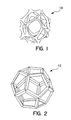
- a simulated cell structure with unit cells approximating pentagonal dodecahedrons allows such channels to be formed.
- a unit cell created in a foam type structure can be, and often is, represented by an idealized pentagonal dodecahedron.
- a process for producing such well-defined pores (i.e. voids) in a synthetic scaffold can be achieved using spherical, soluble microbeads as an extractable filler. The process is explained in detail below.
- Fig. 1 shows a typical unit cell 10 created in a foam type structure.
- Fig. 2 shows a pentagonal dodecahedron 12.
- a simulated unit cell 10 achieved in the present invention resembles the pentagonal dodecahedron 12, but may vary in the number of sides or the simulated unit cell 10 may be somewhat oblong.
- a structure containing such multi-sided unit cells in a very narrow size range is well-defined, and sizes of ingrowth channels are readily calculated.
- Fig. 3 shows two different possible direct routes which may be used as ingrowth channels in a pentagonal dodecahedron.
- Direct Route 1 enters the cell at an angle perpendicular to a face of the cell.
- Direct Route 2 enters the cell at an angle non-perpendicular to a face of the cell.
- Fig. 4 is a graphical representation of a correlation between a continuous ingrowth diameter (D) of each of the two routes in Fig. 3 as a function of the dodecahedron's height (H) in Fig. 3. As can be seen in Fig.
- the continuous ingrowth diameter increases more rapidly for routes entering the cell at an angle perpendicular to a face of the cell than for routes entering the cell at an angle non-perpendicular to a face of the cell. Whether the angle of entry is perpendicular or not, the cells provide ample ingrowth channels of continuous, uninterrupted, well-defined dimensions.
- Fig. 5 shows a structure 14 including a cluster of pentagonal dodecahedrons with a possible route indicated, along with an illustrated plane angle ( ⁇ ) measured against a line running through the cluster of dodecahedrons perpendicular to the face of the dodecahedron at which it enters.
- Fig. 6 is a graphical representation of a diameter of a path through the well-defined dodecahedron structure as the plane angle is altered for various bead sizes: 30, 60 and 100 microns. As can be seen in Fig. 6, when the plane angle is 0°, the diameter of a continuous pore is slightly larger than half the diameter of the bead. Thus, there is quite a large area in which continuous ingrowth of connective tissue can occur.
- the well-defined porosity is oriented in such a way as to allow for circumferential and longitudinal orientation from radial ingrowth.
- a "typical" artery includes three distinct layers, each performing specific basic functions.
- An intima which includes an endothelium attached to a basement membrane, provides a non-thrombogenic blood contacting surface.
- a media contains smooth muscle cells (SMC's) as well as elastic and other intercellular connective and matrix materials, and supplies two other important properties to the blood vessel, namely compliance and contractility.
- the tissues are oriented in a helical fashion in this medial layer.
- Another important property, namely structural integrity, is provided by an adventitia.
- the configuration of collagen fibers in this layer provides for "stiffening" of the vessel when subjected to high internal pressures, i.e. a decrease in compliance with increased strain.
- material for the scaffold should have biostability, processability, availability, and desirable mechanical properties.
- the porous scaffold should provide high porosity for maximal cell ingrowth and minimal bulk compressibility (to allow for compressibility associated with contractility).
- the prosthesis should have structural integrity and viscoelastic properties similar to those observed for natural vessels.
- the scaffold should also exhibit long-term in-vivo stability. Examples of suitable scaffold materials include thermoplastic elastomers, particularly thermoplastic polyurethanes.
- the well-defined porosity should be oriented in such a way as to allow for circumferential and longitudinal orientation from radial ingrowth to allow physiological contractility. Such orientation is provided by the pentagonal dodecahedron, as illustrated in Figs. 3-6. Furthermore, the prosthesis must have structural integrity and viscoelastic properties similar to those observed for natural vessels.
- a suitable filler material to create the pores requires careful consideration.
- the material should be: non-soluble in the solvent used to dissolve the scaffold material; readily soluble in the precipitation solution or other non-solvent for the scaffold material; crush resistant to withstand mixing and forming of pastes; and nontoxic.
- Fractionated salt crystals are a ready source of extractable fillers. However, their aspect ratios and fairly wide size distributions (even after careful sieving) make them less than ideal candidates for use in the production of foamed structures.
- Spherical, soluble microbeads can be manufactured to narrow tolerances. The use of these spherical beads contributes to the production of porous "foam" scaffolds that are much better defined than those obtainable from salt crystals.
- the extractable filler comprises uniformly shaped particles, preferably spherical in shape.
- the average diameters of the particles, as well as the resulting pores range in size from 10 to 300 micrometers, more preferably from 40 to 110 micrometers.
- the standard deviation of the particle diameters and corresponding pore sizes are preferably within a controlled range of 20 ⁇ m of one another, more preferably within 10 ⁇ m of one another. In an embodiment wherein the particles and pores are not spherical but are uniformly shaped, the particles and pores can still be maintained in a controlled range of volume.
- non-spherical particles and pores that are uniformly shaped can have volumes maintained in a controlled range where the standard deviation will be less than 4.2 x 10 -6 mm 3 .
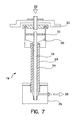
- the most preferred method for producing the grafts of the present invention is a vacuum impregnation technique. Referring to Fig. 7, this method involves assembling a mandrel 18 in a custom-designed casting device 16.
- the casting device includes a top manifold 20 that allows for application of air pressure 22 to a top portion of a mold or molds 24.
- a bottom manifold 26 of the device allows for application of a vacuum 28 to a bottom portion of the mold or molds 24.
- Any number of the molds 24 is clamped between the top and bottom manifolds 20 and 26.
- a manageable number of molds is in the range of 1-20 molds, while a preferred number of molds is in the range of 6-10 molds.
- the molds 24 are cylindrical tubes made of glass or other suitable materials with an inside diameter corresponding to a desired outside diameter of a resulting graft.
- the molds 24 are used in conjunction with cylindrical central rods 18.
- the cylindrical central rods 18 are made of stainless steel, glass or other suitable materials with an outside diameter corresponding to a desired inner diameter of a resulting graft.
- Also used in conjunction with the molds 24 is a reservoir 30 for graft material solution and a centralizing spacer 32.
- the grafts are formed by filling an annular space 34 between the central rod 18 and the tube 24 with an extractable filler.
- Suitable filler materials include alginate, gelatin, carbohydrates, inorganic and organic salts.
- the reservoir 30 is filled with a graft material solution comprising graft material in a graft material solvent.
- Suitable graft materials include thermoplastic elastomers including thermoplastic polyurethanes, such as Pellethane, Biomer type polyurethanes, Chronoflex and Hydrothane.
- a polyurethane developed by Medtronic and described in U.S. Patent No. 4,873,308 is an example of a suitable graft material.
- Suitable graft material solvents include N-methyl pyrrolidone (NMP), N,N dimethyl diacetamide (DMAC), 1,4 dioxane, etc. Concentration of the graft material in the graft material solvent ranges from 1 to 40% by mass, more typically 5 to 30% by mass, usually 10 to 25% by mass. The concentration depends on various factors, including composition of the graft material, composition of the graft material solvent, and viscosity of the solution.
- the top manifold 20 is then closed and pressure 22 is applied to the top manifold 20 and/or vacuum 28 is applied to the bottom manifold 26 to force the graft material solution into interstices between the packed extractable filler.
- the amount of pressure should be on the order of about atmospheric to 15 bar, more preferably 5 to 8 bar.
- the amount of vacuum should be on the order of about atmospheric to -1 bar, more typically about -0.9 bar.
- the tube 24, graft and rod 18 are removed from the device 16.
- Precipitation of the graft (defined as removal of the graft material solvent) is begun with immersion into precipitation solvent. Suitable precipitation solvents include water, ethanol, acetone, or combinations of any of these.
- the central rod 18 is then removed from the graft and the tube 24.
- Precipitation of the graft material and extraction of the graft material solvent are completed by extended immersion in the precipitation solvent.
- the precipitated graft is removed from the tube 24.
- the extractable filler is extracted from the precipitated graft material to produce the porous structure of the invention.
- the filler can be extracted using a filler extraction solvent, such as water. The precipitation and extraction may be effected either simultaneously or consecutively.
- Another method for producing the porous structure of the invention is a paste molding technique.
- a paste is prepared from an extractable filler and a graft material solution including graft material and graft material solvent, as described above.
- the paste contains the filler and the graft material in a ratio of mass between 20:1 and 1:1, respectively. More typically the ratio is between 10:1 1 and 5:1.
- a desired thickness of paste is rolled onto a mandrel, wherein the mandrel has an outer diameter equal to a desired internal diameter of a resulting graft.
- the internal diameter of the graft is preferably between 1 mm and 20 mm, more preferably in the range of 2 to 6 mm for small diameter vessel replacement.
- the thickness of the paste can vary from 0.1 to 5 mm, more preferably from 0.4 to 1.5 mm, depending on the diameter of the graft.
- the graft material solution is then precipitated by immersion in precipitation solvent, and the filler is extracted by immersion in a filler extraction solvent, as described above.
- the precipitation and extraction may be effected either simultaneously or consecutively.
- Yet another method for producing the porous structure of the invention is a paste extrusion technique.
- a paste is prepared from an extractable filler and a graft material solution comprising graft material and graft material solvent, as described above.
- the paste is extruded through an annular orifice.
- the graft material solution is then precipitated by immersion in precipitation solvent, and the filler is extracted by immersion in filler extraction solvent.
- the precipitation and extraction may be effected either simultaneously or consecutively.
- a further method for producing the porous structure of the invention is a dip coating technique.
- a paste is prepared (as described above) from an extractable filler and a graft material solution including graft material and graft material solvent.
- the paste is deposited in consecutive layers onto a mandrel.
- the graft material solution is then precipitated by immersion in precipitation solvent, and the filler is extracted by immersion in filler extraction solvent. The precipitation and extraction may be effected either simultaneously or consecutively.
- thermoplastic elastomer is extruded with the use of physical and/or chemical blowing agents to produce a foamed graft.
- Suitable thermoplastic elastomers include thermoplastic polyurethanes, such as Pellethane, Biomer type polyurethanes, Chronoflex, and Hydrothane.
- Suitable chemical blowing agents include sodium bicarbonate and azodicarbonamides.
- Suitable physical blowing agents include chloro-fluoro carbons (e.g. freon), pentane, and hexane.
- the foamed graft is then annealed and reticulated, where needed, to effect an open-cell structure.
- a method for converting closed cell foams to open cell foams involves heat treatment. By treating the closed cell foam in a controlled, elevated temperature environment, it is possible to melt the thin membrane without melting the rest of the material. The temperature depends on the graft material.
- Another method for converting closed cell foams to open cell foams is a mechanical method. By crushing the closed cell foam between rollers or a similar device, the thin membrane will rupture due to the pressure in the pore.
- a third method is another mechanical method wherein explosive gasses (e.g. stoichiometric ratios of O 2 /H 2 ) are infiltrated into the pores. The cells are ruptured by ignition of these gasses.
- Yet another method is a chemical method whereby the foam is subjected to hydrolysis, thereby destroying the thinner membranes more rapidly than the thicker ribs defining the pores. Any of these methods can be used alone or in combination to produce open cell foams.
- a final method of producing the graft involved the use of a process whereby the foamed tube is formed by the reaction of monomeric substances (e.g. diisocyanates and diols when polyurethanes are required) with suitable blowing agents (e.g. water).
- monomeric substances e.g. diisocyanates and diols when polyurethanes are required
- suitable blowing agents e.g. water
- the reaction of these reagents with one another in an enclosed cylindrical space (reaction injection molding or RIM process) or in a modified extruder assembly would yield the desired porous graft.
- Reticulation, removal of possible interior and/or exterior skin, and other post production techniques may be employed to produce the open-cell porosities needed for the ingrowth of living tissue.
- Reinforcing fibers can be incorporated into the graft design in any of the described methods to alleviate this problem.
- the reinforcing fibers can be incorporated into the grafts by winding the fibers around the scaffold while the graft material is in a paste or solution form, for example.
- Suitable fibers include either elastic or non-elastic non-degradable material, or a combination of elastic and non-elastic materials.
- a reinforcing material that is either elastic or non-elastic, and is degradable in vivo, can be used in combination with the non-degradable material to provide initial strength to the graft.
- the reinforcement material that is degradable in vivo degrades as the graft is populated by ingrowing cells and accompanying extracellular matrix material. Ingrowing material tends to stiffen the graft; therefore, a degradable fiber can be used to give initial strength to the graft without making the graft overly stiff after ingrowth.
- the non-extractable fiber typically has a diameter ranging in size from 10 to 100 micrometers.
- non-elastic, non-degradable materials include polyethylene terephthalate (PET, Dacron) and polytetrafluoroethylene (PTFE).
- suitable elastic non-degradable materials include thermoplastic polyurethanes, e.g. M48, Pellethane (or clones), Biomer (or clones), or any other biocompatible elastomer. Degradable polyurethanes can serve as degradable reinforcing fibers.
Landscapes
- Health & Medical Sciences (AREA)
- Life Sciences & Earth Sciences (AREA)
- Veterinary Medicine (AREA)
- Chemical & Material Sciences (AREA)
- Public Health (AREA)
- General Health & Medical Sciences (AREA)
- Animal Behavior & Ethology (AREA)
- Transplantation (AREA)
- Oral & Maxillofacial Surgery (AREA)
- Epidemiology (AREA)
- Vascular Medicine (AREA)
- Medicinal Chemistry (AREA)
- Dermatology (AREA)
- Heart & Thoracic Surgery (AREA)
- Engineering & Computer Science (AREA)
- Cardiology (AREA)
- Biomedical Technology (AREA)
- Dispersion Chemistry (AREA)
- Pulmonology (AREA)
- Gastroenterology & Hepatology (AREA)
- Surgery (AREA)
- Chemical Kinetics & Catalysis (AREA)
- Prostheses (AREA)
- Materials For Medical Uses (AREA)
Applications Claiming Priority (3)
| Application Number | Priority Date | Filing Date | Title |
|---|---|---|---|
| US14470499P | 1999-07-20 | 1999-07-20 | |
| US09/434,649 US6702848B1 (en) | 1999-07-20 | 1999-11-05 | Foam-type vascular prosthesis with well-defined anclio-permissive open porosity |
| EP99959063A EP1202683B1 (fr) | 1999-07-20 | 1999-11-19 | Prothese vasculaire de type mousse avec porosite ouverte angio-permissive bien definie |
Related Parent Applications (1)
| Application Number | Title | Priority Date | Filing Date |
|---|---|---|---|
| EP99959063A Division EP1202683B1 (fr) | 1999-07-20 | 1999-11-19 | Prothese vasculaire de type mousse avec porosite ouverte angio-permissive bien definie |
Publications (2)
| Publication Number | Publication Date |
|---|---|
| EP1669044A2 true EP1669044A2 (fr) | 2006-06-14 |
| EP1669044A3 EP1669044A3 (fr) | 2008-01-09 |
Family
ID=36284334
Family Applications (1)
| Application Number | Title | Priority Date | Filing Date |
|---|---|---|---|
| EP06006603A Withdrawn EP1669044A3 (fr) | 1999-07-20 | 1999-11-19 | Prothèse vasculaire de type mousse avec porosité ouverte angio-permissive bien définie |
Country Status (1)
| Country | Link |
|---|---|
| EP (1) | EP1669044A3 (fr) |
Cited By (1)
| Publication number | Priority date | Publication date | Assignee | Title |
|---|---|---|---|---|
| KR20200017435A (ko) * | 2017-05-30 | 2020-02-18 | 에보닉 캐나다 인크. | 개질된 표면을 갖는 혈관 이식편 |
Family Cites Families (3)
| Publication number | Priority date | Publication date | Assignee | Title |
|---|---|---|---|---|
| US4657544A (en) * | 1984-04-18 | 1987-04-14 | Cordis Corporation | Cardiovascular graft and method of forming same |
| DE3682734D1 (de) * | 1985-08-23 | 1992-01-16 | Kanegafuchi Chemical Ind | Kuenstliches gefaess. |
| CH673388A5 (fr) * | 1987-12-07 | 1990-03-15 | Sulzer Ag |
-
1999
- 1999-11-19 EP EP06006603A patent/EP1669044A3/fr not_active Withdrawn
Cited By (2)
| Publication number | Priority date | Publication date | Assignee | Title |
|---|---|---|---|---|
| KR20200017435A (ko) * | 2017-05-30 | 2020-02-18 | 에보닉 캐나다 인크. | 개질된 표면을 갖는 혈관 이식편 |
| EP3630212A4 (fr) * | 2017-05-30 | 2021-02-24 | Evonik Canada Inc. | Greffons vasculaires ayant une surface modifiée |
Also Published As
| Publication number | Publication date |
|---|---|
| EP1669044A3 (fr) | 2008-01-09 |
Similar Documents
| Publication | Publication Date | Title |
|---|---|---|
| US6616699B2 (en) | Foam-type vascular prosthesis with well-defined angio-permissive open porosity | |
| US7727274B2 (en) | Porous synthetic vascular grafts with oriented ingrowth channels | |
| EP1251890B1 (fr) | Matrice de croissance endogene transmurale a couches multiples concentriques au sein d'une porosite bien definie | |
| US4661530A (en) | Biocompatible, antithrombogenic materials suitable for reconstructive surgery | |
| US5549664A (en) | Artificial blood vessel | |
| US6926735B2 (en) | Multi-lumen vascular grafts having improved self-sealing properties | |
| EP0230635B1 (fr) | Prothèse tubulaire ayant une structure composite | |
| US20050222688A1 (en) | Transmural concentric multilayer ingrowth matrix within well-defined porosity | |
| EP1669044A2 (fr) | Prothèse vasculaire de type mousse avec porosité ouverte angio-permissive bien définie | |
| US5462704A (en) | Method for preparing a porous polyurethane vascular graft prosthesis | |
| EP0495127B1 (fr) | Vaisseau sanguin artificiel et procede de production associe | |
| US20260091160A1 (en) | Synthetic hemocompatible vascular grafts manufactured from polyvinyl alcohol-based biomaterials | |
| WO1993002637A1 (fr) | Prothese vasculaire | |
| JP2553522B2 (ja) | 医療用チユ−ブ及びその製造方法 | |
| CN121944245A (zh) | 可降解超材料结构管状纤维增强生物复合人工血管支架 |
Legal Events
| Date | Code | Title | Description |
|---|---|---|---|
| PUAI | Public reference made under article 153(3) epc to a published international application that has entered the european phase |
Free format text: ORIGINAL CODE: 0009012 |
|
| AC | Divisional application: reference to earlier application |
Ref document number: 1202683 Country of ref document: EP Kind code of ref document: P |
|
| AK | Designated contracting states |
Kind code of ref document: A2 Designated state(s): DE FR |
|
| RIN1 | Information on inventor provided before grant (corrected) |
Inventor name: BEZUIDENHOUT, DEON Inventor name: ZILLA, PETER PAUL |
|
| PUAL | Search report despatched |
Free format text: ORIGINAL CODE: 0009013 |
|
| AK | Designated contracting states |
Kind code of ref document: A3 Designated state(s): DE FR |
|
| 17P | Request for examination filed |
Effective date: 20080603 |
|
| AKX | Designation fees paid |
Designated state(s): DE FR |
|
| 17Q | First examination report despatched |
Effective date: 20110322 |
|
| STAA | Information on the status of an ep patent application or granted ep patent |
Free format text: STATUS: THE APPLICATION IS DEEMED TO BE WITHDRAWN |
|
| 18D | Application deemed to be withdrawn |
Effective date: 20130601 |