EP1669865A1 - Communication de message sur un reseau d'ordinateur contenant un depot de message - Google Patents
Communication de message sur un reseau d'ordinateur contenant un depot de message Download PDFInfo
- Publication number
- EP1669865A1 EP1669865A1 EP04257680A EP04257680A EP1669865A1 EP 1669865 A1 EP1669865 A1 EP 1669865A1 EP 04257680 A EP04257680 A EP 04257680A EP 04257680 A EP04257680 A EP 04257680A EP 1669865 A1 EP1669865 A1 EP 1669865A1
- Authority
- EP
- European Patent Office
- Prior art keywords
- computer
- message
- computers
- messages
- connections
- Prior art date
- Legal status (The legal status is an assumption and is not a legal conclusion. Google has not performed a legal analysis and makes no representation as to the accuracy of the status listed.)
- Withdrawn
Links
Images

Classifications
-
- H—ELECTRICITY
- H04—ELECTRIC COMMUNICATION TECHNIQUE
- H04L—TRANSMISSION OF DIGITAL INFORMATION, e.g. TELEGRAPHIC COMMUNICATION
- H04L63/00—Network architectures or network communication protocols for network security
- H04L63/02—Network architectures or network communication protocols for network security for separating internal from external traffic, e.g. firewalls
- H04L63/029—Firewall traversal, e.g. tunnelling or, creating pinholes
-
- H—ELECTRICITY
- H04—ELECTRIC COMMUNICATION TECHNIQUE
- H04L—TRANSMISSION OF DIGITAL INFORMATION, e.g. TELEGRAPHIC COMMUNICATION
- H04L67/00—Network arrangements or protocols for supporting network services or applications
- H04L67/01—Protocols
- H04L67/02—Protocols based on web technology, e.g. hypertext transfer protocol [HTTP]
-
- H—ELECTRICITY
- H04—ELECTRIC COMMUNICATION TECHNIQUE
- H04L—TRANSMISSION OF DIGITAL INFORMATION, e.g. TELEGRAPHIC COMMUNICATION
- H04L67/00—Network arrangements or protocols for supporting network services or applications
- H04L67/14—Session management
-
- H—ELECTRICITY
- H04—ELECTRIC COMMUNICATION TECHNIQUE
- H04L—TRANSMISSION OF DIGITAL INFORMATION, e.g. TELEGRAPHIC COMMUNICATION
- H04L67/00—Network arrangements or protocols for supporting network services or applications
- H04L67/50—Network services
- H04L67/56—Provisioning of proxy services
- H04L67/568—Storing data temporarily at an intermediate stage, e.g. caching
-
- H—ELECTRICITY
- H04—ELECTRIC COMMUNICATION TECHNIQUE
- H04L—TRANSMISSION OF DIGITAL INFORMATION, e.g. TELEGRAPHIC COMMUNICATION
- H04L69/00—Network arrangements, protocols or services independent of the application payload and not provided for in the other groups of this subclass
- H04L69/30—Definitions, standards or architectural aspects of layered protocol stacks
- H04L69/32—Architecture of open systems interconnection [OSI] 7-layer type protocol stacks, e.g. the interfaces between the data link level and the physical level
- H04L69/322—Intralayer communication protocols among peer entities or protocol data unit [PDU] definitions
- H04L69/329—Intralayer communication protocols among peer entities or protocol data unit [PDU] definitions in the application layer [OSI layer 7]
Definitions
- This invention relates to computer networks, in particular networks implementing protocols associated with the Internet.
- the Internet (implemented by means of the TCP/ IP protocol) is a rapidly developing subject with many applications, programming languages, etc., developed specifically for the Internet. Reference is made to a recent publication, for example, "Computer Networks", Fourth Edition, 2002, Andrew S. Tanenbaum for a review. Unless stated otherwise, an explanation of various well-known acronyms used herein are found in that textbook.
- HTTP HyperText Transfer Protocol
- client and server provide Connection Sockets for TCP connections. Data transfer may then take place using a defined procedure.
- Microsoft have developed an open networking standard "Windows Sockets: An Open Interface for Network Computing Under Microsoft Windows”.
- HTML HyperText Markup Language
- HTML pages may include scripts written in PHP language (Hypertext Preprocessor).
- Firewalls An important issue in using the Internet is security.
- a large commercial organisation possessing valuable data may have multiple strict firewalls in place.
- Such firewalls may only permit outgoing connections to be created from a machine behind the firewall, and will not allow incoming connections to be initiated from outside the firewall.
- the firewalls around the client may only permit outgoing connections to be initiated via HTTP port 80 (usually used for downloading web pages, etc).
- HTTP port 80 usually used for downloading web pages, etc.
- the invention provides a computer network comprising a first computer that may have a first firewall, a second computer that may have a second firewall, and a third computer, having a message store, coupled both to the first and second computer by means of respective first and second outgoing-only connections from the first and second computers (implementing an HTTP protocol), whereby communication is established between the first and second computers by placing messages via said connections in the message store of the third computer.
- the invention provides, in a computer network comprising a first computer and a second computer, a method for establishing communication between the first and second computers, comprising:
- the first and second computers may communicate by means of outgoing-only connections, so that firewalls around the computers will not affect communication.
- the third computer will be positioned outside the firewalls.
- the third computer contains a script written in PHP (or other appropriate language) that continually polls for messages placed in the message store by the first and second computers, to alert the intended recipient. This has proved a highly efficient way of controlling the communication process, since the alerting process does not require extensive network traffic.
- connection process at each of the first and second computers is preferably managed by a thread (a thread is a semi-process that has its own stack, but not its own memory allocation, and executes a given piece of code).
- the thread sends a request to the third computer, asking for any messages.
- the messages being sent are encoded into a textual form by the first computer and decoded by the third computer. This is due to restrictions in the acceptable format of HTTP messages.
- the present invention is well adapted for use in a network comprising a large number of computers that may wish to communicate with each other.
- a known arrangement for a typical networked application in which data is transferred from a server archive to a client application is by constructing sockets in an appropriate protocol.
- This programming model works well within a network. As each application sends data to the other, respective functions are signalled to let the applications know that there are data to be read.
- the problem arises when multiple strict firewalls are placed between the elements of the network. The firewall around the server application will not allow a client outside the firewall to seek a connection from the server. The firewall around the client will only allow a connection to be initiated via port 80, the http port.
- the present invention "replaces" the above connection process and manages the connection process. It is recognised that most organisations these days have basic web browsing capability on their desktops. So a mechanism based around HTTP and secure HTTP can easily be deployed without intrusive firewall configuration. However, the basic requirement of only using outgoing traffic is adhered to.
- the invention provides a method of communicating between machines, using standard network protocols and ports, i.e. HTTP, HTTPS.
- the architecture integrates easily with the existing socket-based code to ease migration.
- Sockets on both machines are assigned unique identifiers to ensure a message gets routed correctly from source to destination.
- Server S has a PHP script P that manipulates or queries the database D in a manner according to the parameters passed to it.
- Script P may alternatively be written in any suitable language, for example Java or ASP, or even the equivalent functionality may be provided directly in hardware.
- a client application in Machine A initiates a virtual connection C to machine B by sending a message over HTTP to the server S, giving the IP address of machine B and a port number as parameters. This is stored in database D by PHP script P.
- a connect function ConnB in a library L of functions on machine B, retrieves this message from the server S using another HTTP request.
- the connect function ConnB gives the socket a unique ID, timestamp (for ordering a sequence of messages) and also the name of the receiving application/machine B.
- the application on machine B then connects to the server S via HTTP, posting a message to database D to notify A that the virtual connection has been accepted.
- a connect function ConnA on machine A intercepts this.
- the applications on machines A and B have the standard functions associated with a socket e.g. OnReceive(), Receive(), Send() etc.
- the OnReceive is particularly important, as it is this listening function that signals that a message is available for collection; this function is triggered by a thread that constantly checks for data by transparently sending a request to the server S asking for any messages. This triggers PHP page P within server S to continuously poll and query database D for any messages for that particular application.
- page P If none are available within 20 seconds (as determined by the time-out of the firewall surrounding machine B), page P returns a code to B, triggering machine B to resend a request, thus effectively keeping the connection alive. If a message is detected by PHP page P, then machine B is notified by means of its OnReceive() function. The message is recovered from the database D in the correct time order (if the message is made up of several parts) by page P, returned to the destination application on machine B by means of appropriate Receive functions, and removed from the DB.
- the messages can be in any data form - e.g. binary data, images, and of any of the commonly used file types.
- the data may be encrypted.
- Server S is a low value stand-alone device and although still protected by a firewall, it has been configured to allow a server to run.
- the communication for Machine A to connect to Machine B can be split into three classes of messages:
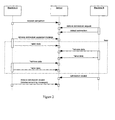
- Data messages 3) may then be transmitted and stored in the third table of database D, as an iterative procedure as shown in Figure 2, send data (A), retrieve data (B), send data (B), retrieve data (A), send data (A), etc.
- send data A
- retrieve data B
- send data B
- retrieve data A
- send data A
- send data etc.
- both machine B and machine A generate OnReceive functions that continually listen to the socket and retrieve data by means of further Receive functions.
- the present invention realises that continual polling to check for the presence of messages or connection requests may cause a lot of unnecessary network traffic.
- network traffic is reduced and hence the achievable transmission rate is increased, since only a few bytes are transferred every 20 seconds as a trigger signal.
- server S maintains the connections, i.e. "persistent" connections in a "connectionless” environment. Network failure can be tolerated in as much as messages stored in server S are available for future download.
- the big advantage of the invention is that multiple strong firewalls can be in place only allowing outgoing connections, and applications can still connect and pass information in a legitimate, controlled and transparent way.
- a communications library handle the processes described above, any application that normally communicates via sockets and work within a LAN can be extended to work via multiple firewalls by simply linking with the supplied library.
- the invention provides a means of networking that enables the collaborative working.
- a technology that can tunnel through the firewalls in a standard fashion that is acceptable from a security point of view is provided so that any new users do not need to modify their firewall settings.
- Secure HTTP provides sufficient security. This uses SSL, another protocol frequently used on the Internet. SSL provides not only secure data transfer but also client authentication, ensuring that only trusted individuals can successfully connect to networks.
Landscapes
- Engineering & Computer Science (AREA)
- Computer Networks & Wireless Communication (AREA)
- Signal Processing (AREA)
- Computer Hardware Design (AREA)
- Computer Security & Cryptography (AREA)
- Computing Systems (AREA)
- General Engineering & Computer Science (AREA)
- Computer And Data Communications (AREA)
Priority Applications (1)
| Application Number | Priority Date | Filing Date | Title |
|---|---|---|---|
| EP04257680A EP1669865A1 (fr) | 2004-12-10 | 2004-12-10 | Communication de message sur un reseau d'ordinateur contenant un depot de message |
Applications Claiming Priority (1)
| Application Number | Priority Date | Filing Date | Title |
|---|---|---|---|
| EP04257680A EP1669865A1 (fr) | 2004-12-10 | 2004-12-10 | Communication de message sur un reseau d'ordinateur contenant un depot de message |
Publications (1)
| Publication Number | Publication Date |
|---|---|
| EP1669865A1 true EP1669865A1 (fr) | 2006-06-14 |
Family
ID=34930902
Family Applications (1)
| Application Number | Title | Priority Date | Filing Date |
|---|---|---|---|
| EP04257680A Withdrawn EP1669865A1 (fr) | 2004-12-10 | 2004-12-10 | Communication de message sur un reseau d'ordinateur contenant un depot de message |
Country Status (1)
| Country | Link |
|---|---|
| EP (1) | EP1669865A1 (fr) |
Citations (4)
| Publication number | Priority date | Publication date | Assignee | Title |
|---|---|---|---|---|
| US20030009571A1 (en) * | 2001-06-28 | 2003-01-09 | Bavadekar Shailesh S. | System and method for providing tunnel connections between entities in a messaging system |
| EP1286513A1 (fr) * | 2001-08-14 | 2003-02-26 | Hewlett-Packard Company | Médiateur de message |
| US20040138835A1 (en) * | 1997-02-12 | 2004-07-15 | Power Measurement Ltd. | Push communications architecture for intelligent electronic devices |
| US6789119B1 (en) * | 1999-11-24 | 2004-09-07 | Webex Communication, Inc. | Emulating a persistent connection using http |
-
2004
- 2004-12-10 EP EP04257680A patent/EP1669865A1/fr not_active Withdrawn
Patent Citations (4)
| Publication number | Priority date | Publication date | Assignee | Title |
|---|---|---|---|---|
| US20040138835A1 (en) * | 1997-02-12 | 2004-07-15 | Power Measurement Ltd. | Push communications architecture for intelligent electronic devices |
| US6789119B1 (en) * | 1999-11-24 | 2004-09-07 | Webex Communication, Inc. | Emulating a persistent connection using http |
| US20030009571A1 (en) * | 2001-06-28 | 2003-01-09 | Bavadekar Shailesh S. | System and method for providing tunnel connections between entities in a messaging system |
| EP1286513A1 (fr) * | 2001-08-14 | 2003-02-26 | Hewlett-Packard Company | Médiateur de message |
Similar Documents
| Publication | Publication Date | Title |
|---|---|---|
| US7734756B2 (en) | Object oriented communication among platform independent systems over networks using soap | |
| US7743250B2 (en) | Traffic manager for distributed computing environments | |
| US6628965B1 (en) | Computer method and system for management and control of wireless devices | |
| US7254601B2 (en) | Method and apparatus for managing intelligent assets in a distributed environment | |
| US7587459B2 (en) | Remote application publication and communication system | |
| JP4307448B2 (ja) | 分散オブジェクトを単一表現として管理するシステムおよび方法 | |
| JP3071469B2 (ja) | リモート・サーバの単純で安全な管理を提供するための装置および方法 | |
| US6115744A (en) | Client object API and gateway to enable OLTP via the internet | |
| KR101120783B1 (ko) | 연결 촉진 응용 프로그램을 통하여 광역 컴퓨터 네트워크에 대해 로컬 컴퓨터 네트워크를 보호하는 방법 및 컴퓨터 판독 가능 기록 매체 | |
| US6490617B1 (en) | Active self discovery of devices that participate in a network | |
| US8037191B2 (en) | Low-level remote sharing of local devices in a remote access session across a computer network | |
| US7660845B2 (en) | Methods and apparatus for verifying context participants in a context management system in a networked environment | |
| WO2008147475A2 (fr) | Fournir une passerelle générique pour accéder à des ressources protégées | |
| US7523492B2 (en) | Secure gateway with proxy service capability servers for service level agreement checking | |
| US7689675B2 (en) | System and method for communicating with console ports | |
| EP1859597B1 (fr) | Procede de communication entre une application et un client | |
| US20030037102A1 (en) | Message broker | |
| EP1696627B1 (fr) | Appareil et système pour extraire des informations dans un réseau | |
| EP1286513B1 (fr) | Médiateur de message | |
| US20030149728A1 (en) | Remote application publication and communication system | |
| EP1669865A1 (fr) | Communication de message sur un reseau d'ordinateur contenant un depot de message | |
| EP1330082A2 (fr) | Réseau informatique pour fournir des services contrôlés par courier electronique | |
| US7007094B1 (en) | Object oriented communications system over the internet | |
| HK40036880A (en) | Method and system for remotely accessing a first device, and a related device | |
| KR20020085906A (ko) | 프리비에스디환경의 웹기반 서버 및 보안관리 시스템인비씨씨 |
Legal Events
| Date | Code | Title | Description |
|---|---|---|---|
| PUAI | Public reference made under article 153(3) epc to a published international application that has entered the european phase |
Free format text: ORIGINAL CODE: 0009012 |
|
| AK | Designated contracting states |
Kind code of ref document: A1 Designated state(s): AT BE BG CH CY CZ DE DK EE ES FI FR GB GR HU IE IS IT LI LT LU MC NL PL PT RO SE SI SK TR |
|
| AX | Request for extension of the european patent |
Extension state: AL BA HR LV MK YU |
|
| AKX | Designation fees paid | ||
| REG | Reference to a national code |
Ref country code: DE Ref legal event code: 8566 |
|
| STAA | Information on the status of an ep patent application or granted ep patent |
Free format text: STATUS: THE APPLICATION IS DEEMED TO BE WITHDRAWN |
|
| 18D | Application deemed to be withdrawn |
Effective date: 20061215 |