EP1670087A1 - Steuerung der Mikrorissbildung in Kohlenstoffbeschichtungen bei der Herstellung von Brennstoffzellen-Gasdiffusionelektrodenschichten - Google Patents
Steuerung der Mikrorissbildung in Kohlenstoffbeschichtungen bei der Herstellung von Brennstoffzellen-Gasdiffusionelektrodenschichten Download PDFInfo
- Publication number
- EP1670087A1 EP1670087A1 EP04028567A EP04028567A EP1670087A1 EP 1670087 A1 EP1670087 A1 EP 1670087A1 EP 04028567 A EP04028567 A EP 04028567A EP 04028567 A EP04028567 A EP 04028567A EP 1670087 A1 EP1670087 A1 EP 1670087A1
- Authority
- EP
- European Patent Office
- Prior art keywords
- carbon
- particulates
- coating
- fuel cell
- size
- Prior art date
- Legal status (The legal status is an assumption and is not a legal conclusion. Google has not performed a legal analysis and makes no representation as to the accuracy of the status listed.)
- Ceased
Links
- OKTJSMMVPCPJKN-UHFFFAOYSA-N Carbon Chemical compound [C] OKTJSMMVPCPJKN-UHFFFAOYSA-N 0.000 title claims abstract description 53
- 238000000576 coating method Methods 0.000 title claims abstract description 47
- 239000011248 coating agent Substances 0.000 title claims abstract description 39
- 229910052799 carbon Inorganic materials 0.000 title claims abstract description 30
- 239000000446 fuel Substances 0.000 title claims abstract description 18
- 238000004519 manufacturing process Methods 0.000 title description 2
- 239000006229 carbon black Substances 0.000 claims abstract description 19
- 229910002804 graphite Inorganic materials 0.000 claims abstract description 15
- 239000010439 graphite Substances 0.000 claims abstract description 15
- 238000005336 cracking Methods 0.000 claims abstract description 10
- 239000006185 dispersion Substances 0.000 claims abstract description 8
- 238000009792 diffusion process Methods 0.000 claims abstract description 7
- 229920002313 fluoropolymer Polymers 0.000 claims abstract description 7
- 239000004811 fluoropolymer Substances 0.000 claims abstract description 7
- 239000002245 particle Substances 0.000 claims abstract description 7
- 229920000049 Carbon (fiber) Polymers 0.000 claims abstract description 6
- 239000004917 carbon fiber Substances 0.000 claims abstract description 6
- 229910021393 carbon nanotube Inorganic materials 0.000 claims abstract description 4
- 239000002041 carbon nanotube Substances 0.000 claims abstract description 4
- 238000000034 method Methods 0.000 claims description 10
- 239000000758 substrate Substances 0.000 claims description 10
- 239000011203 carbon fibre reinforced carbon Substances 0.000 abstract description 2
- 235000012209 glucono delta-lactone Nutrition 0.000 description 12
- OKKJLVBELUTLKV-UHFFFAOYSA-N Methanol Chemical compound OC OKKJLVBELUTLKV-UHFFFAOYSA-N 0.000 description 6
- 239000007789 gas Substances 0.000 description 6
- 239000010410 layer Substances 0.000 description 6
- 239000012528 membrane Substances 0.000 description 6
- 239000003054 catalyst Substances 0.000 description 4
- 239000000835 fiber Substances 0.000 description 4
- 239000007787 solid Substances 0.000 description 4
- 238000001035 drying Methods 0.000 description 3
- 239000004744 fabric Substances 0.000 description 3
- 238000012986 modification Methods 0.000 description 3
- 230000004048 modification Effects 0.000 description 3
- 239000011230 binding agent Substances 0.000 description 2
- 230000001276 controlling effect Effects 0.000 description 2
- 238000011068 loading method Methods 0.000 description 2
- 239000000203 mixture Substances 0.000 description 2
- 239000002071 nanotube Substances 0.000 description 2
- UFHFLCQGNIYNRP-UHFFFAOYSA-N Hydrogen Chemical compound [H][H] UFHFLCQGNIYNRP-UHFFFAOYSA-N 0.000 description 1
- 229920006362 Teflon® Polymers 0.000 description 1
- 239000006230 acetylene black Substances 0.000 description 1
- 230000015572 biosynthetic process Effects 0.000 description 1
- 239000006231 channel black Substances 0.000 description 1
- 239000011247 coating layer Substances 0.000 description 1
- 150000001875 compounds Chemical class 0.000 description 1
- 238000007796 conventional method Methods 0.000 description 1
- 230000007547 defect Effects 0.000 description 1
- 238000010586 diagram Methods 0.000 description 1
- 238000003618 dip coating Methods 0.000 description 1
- 239000012530 fluid Substances 0.000 description 1
- 239000006232 furnace black Substances 0.000 description 1
- 229930195733 hydrocarbon Natural products 0.000 description 1
- 150000002430 hydrocarbons Chemical class 0.000 description 1
- 229910052739 hydrogen Inorganic materials 0.000 description 1
- 239000001257 hydrogen Substances 0.000 description 1
- 150000002500 ions Chemical class 0.000 description 1
- 239000006233 lamp black Substances 0.000 description 1
- 239000000463 material Substances 0.000 description 1
- VNWKTOKETHGBQD-UHFFFAOYSA-N methane Chemical compound C VNWKTOKETHGBQD-UHFFFAOYSA-N 0.000 description 1
- 239000004745 nonwoven fabric Substances 0.000 description 1
- 230000037361 pathway Effects 0.000 description 1
- 239000000049 pigment Substances 0.000 description 1
- 230000001105 regulatory effect Effects 0.000 description 1
- 239000007921 spray Substances 0.000 description 1
- 239000000126 substance Substances 0.000 description 1
- 239000004094 surface-active agent Substances 0.000 description 1
- 238000005979 thermal decomposition reaction Methods 0.000 description 1
- XLYOFNOQVPJJNP-UHFFFAOYSA-N water Substances O XLYOFNOQVPJJNP-UHFFFAOYSA-N 0.000 description 1
- 239000002759 woven fabric Substances 0.000 description 1
Images

Classifications
-
- H—ELECTRICITY
- H01—ELECTRIC ELEMENTS
- H01M—PROCESSES OR MEANS, e.g. BATTERIES, FOR THE DIRECT CONVERSION OF CHEMICAL ENERGY INTO ELECTRICAL ENERGY
- H01M8/00—Fuel cells; Manufacture thereof
- H01M8/02—Details
- H01M8/0202—Collectors; Separators, e.g. bipolar separators; Interconnectors
- H01M8/023—Porous and characterised by the material
- H01M8/0241—Composites
- H01M8/0245—Composites in the form of layered or coated products
-
- B—PERFORMING OPERATIONS; TRANSPORTING
- B82—NANOTECHNOLOGY
- B82Y—SPECIFIC USES OR APPLICATIONS OF NANOSTRUCTURES; MEASUREMENT OR ANALYSIS OF NANOSTRUCTURES; MANUFACTURE OR TREATMENT OF NANOSTRUCTURES
- B82Y30/00—Nanotechnology for materials or surface science, e.g. nanocomposites
-
- H—ELECTRICITY
- H01—ELECTRIC ELEMENTS
- H01M—PROCESSES OR MEANS, e.g. BATTERIES, FOR THE DIRECT CONVERSION OF CHEMICAL ENERGY INTO ELECTRICAL ENERGY
- H01M4/00—Electrodes
- H01M4/86—Inert electrodes with catalytic activity, e.g. for fuel cells
- H01M4/96—Carbon-based electrodes
-
- H—ELECTRICITY
- H01—ELECTRIC ELEMENTS
- H01M—PROCESSES OR MEANS, e.g. BATTERIES, FOR THE DIRECT CONVERSION OF CHEMICAL ENERGY INTO ELECTRICAL ENERGY
- H01M8/00—Fuel cells; Manufacture thereof
- H01M8/02—Details
- H01M8/0202—Collectors; Separators, e.g. bipolar separators; Interconnectors
- H01M8/023—Porous and characterised by the material
- H01M8/0234—Carbonaceous material
-
- H—ELECTRICITY
- H01—ELECTRIC ELEMENTS
- H01M—PROCESSES OR MEANS, e.g. BATTERIES, FOR THE DIRECT CONVERSION OF CHEMICAL ENERGY INTO ELECTRICAL ENERGY
- H01M4/00—Electrodes
- H01M4/86—Inert electrodes with catalytic activity, e.g. for fuel cells
- H01M4/8605—Porous electrodes
-
- H—ELECTRICITY
- H01—ELECTRIC ELEMENTS
- H01M—PROCESSES OR MEANS, e.g. BATTERIES, FOR THE DIRECT CONVERSION OF CHEMICAL ENERGY INTO ELECTRICAL ENERGY
- H01M4/00—Electrodes
- H01M4/86—Inert electrodes with catalytic activity, e.g. for fuel cells
- H01M4/8647—Inert electrodes with catalytic activity, e.g. for fuel cells consisting of more than one material, e.g. consisting of composites
- H01M4/8657—Inert electrodes with catalytic activity, e.g. for fuel cells consisting of more than one material, e.g. consisting of composites layered
-
- Y—GENERAL TAGGING OF NEW TECHNOLOGICAL DEVELOPMENTS; GENERAL TAGGING OF CROSS-SECTIONAL TECHNOLOGIES SPANNING OVER SEVERAL SECTIONS OF THE IPC; TECHNICAL SUBJECTS COVERED BY FORMER USPC CROSS-REFERENCE ART COLLECTIONS [XRACs] AND DIGESTS
- Y02—TECHNOLOGIES OR APPLICATIONS FOR MITIGATION OR ADAPTATION AGAINST CLIMATE CHANGE
- Y02E—REDUCTION OF GREENHOUSE GAS [GHG] EMISSIONS, RELATED TO ENERGY GENERATION, TRANSMISSION OR DISTRIBUTION
- Y02E60/00—Enabling technologies; Technologies with a potential or indirect contribution to GHG emissions mitigation
- Y02E60/30—Hydrogen technology
- Y02E60/50—Fuel cells
Definitions
- the present invention relates to a coating to be applied to the surface(s) of a gas diffusion layer or electrode of a fuel cell or battery containing carbon or graphite particulates.
- Gas diffusion layers of fuel cells or batteries, which may be carbon fibers in a nonwoven or woven form, are generally coated on one or more sides with a substance to form an electrical contact between the GDL and either a membrane or bipolar plate within the fuel cell.
- Such coatings may be fabricated from a mixture of carbon black (also known as Acetylene Black or amorphous black) and a fluoropolymer such as Teflon® .
- Other material such as particulates of varying size to control desired properties such as enhanced electrical conductivity or to support a catalyst may also be included.
- the porosity affects several functions including forming further pathways to control the flow of fuel to a catalyst and membrane, regulating the amount of water near the membrane, and supporting the catalysts themselves.
- the coatings are formed using aqueous dispersions having low solid loadings.
- cracks ("mud cracks") frequently occur in the coating on the surface of the GDL.
- Typical cracking involves a coating defect consisting of a break in the cured film, which exposes the bare substrate. It usually occurs during fabrication of the coated substrate when the coating is too brittle or the adhesiveness to the substrate is too low. The cracks may become more pronounced when heavier coatings are deposited on the surface of the GDL substrate. The more severe the cracking, the lower the effectiveness of the GDL to accomplish some of its functions.
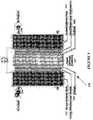
- An example of such cracks in the coating of the surface of the GDL is shown in Figure 1.
- a coating for a gas diffusion layer or electrode of a fuel cell or battery which minimizes cracking.
- the coating comprises an aqueous dispersion of carbon black, a fluoropolymer, and one of graphite and carbon particulates.
- the majority of the particulates are substantially larger in size than the particles of the carbon black which may be within the range of, for example, approximately 13-95 nm.
- the carbon particulates may be cut or chopped carbon fibers, carbon or graphite flakes or platelets, carbon nanotubes, carbon fibrils, or carbon whiskers.
- the carbon particulates may have a high length to diameter ratio.
- an aqueous dispersion is applied as a coating to the substrate of a GDL of a battery or fuel cell (such as a methanol type fuel cell).
- the dispersion may include carbon black, fluoropolymers, and either carbon or graphite particulates, which also may include a surfactant.
- the ratio of fluoropolymer to carbon black may fall within the range of 5/95 to 70/30 by weight.
- the particulates may comprise 25% to 70% of the total coating weight. The addition of these particulates allows for a greater structural integrity as well as increasing the dispersion solid loading without increasing the viscosity. As a result, the present coating minimizes cracking in the coating layer of the GDL.
- Carbon black is a black, amorphous, carbon pigment produced by the thermal decomposition of natural hydrocarbons.
- carbon black Generally, there are three different types of carbon black (i.e., furnace, channel, and lamp black). The nominal purity of it is roughly equivalent to 98.5% to 99.6%.
- the size of carbon black particles can be anywhere from 13 nm to 95 nm. Carbon black may have a spherical shape.
- the size of the majority of the particulates may be substantially larger than the size of the carbon black particles.
- the particulates may have a length that is greater than the diameter thereof. A ratio of the length to diameter may fall between 1.5 to 10000.
- the particulates may include short length fibers such as cut carbon or graphite fibers, carbon or graphite flakes or platelets, carbon or graphite nanotubes, carbon or graphite fibrils, or carbon or graphite whiskers.
- the fibers may be 6 to 20 microns in diameter and 10 to 500 microns in length.
- the flakes or platelets may be 1 to 500 microns in length.
- the nanotubes, fibrils, and whiskers may be 5 to 100 nm in diameter and 5 to a few hundred microns in length. The introduction of these fibers as a compound of the coating minimizes mud cracking during drying.
- Figure 2 depicts a coating on the surface of the GDL that includes chopped carbon fiber. As can be seen in the figure, there does not appear to be any visible cracks in the coating.
- the introduction of the particulates may also enhance electrical conductivity in the coating.
- the GDL substrate may be formed from fibrous carbon preforms that can be of short length; paper; unidirectional tape; woven and nonwoven fabric including knitted; and stitch bonded multi-axial fabric. Coating may be applied using a variety of techniques such as dip coating, doctor blade, knife, spray, roll or slot.
- the electrodes may be single bent pieces, which are adapted to be insertable into adjacent cells.
- an electrode can be made of two pieces and connected in a manner such that the two connected pieces act as a single electrode.
- a membrane In between the electrodes a membrane may be provided such that ions may be allowed to pass through the membrane.
- FIG. 3 shows a schematic of fuel cell 100.
- Fuel cell 100 may include, among other things, current collector 102, gas passage 104, GDL 105, catalyst layer 106 and a proton exchange membrane 107 arranged as shown in Figure 3.
- the introduction of the particulates may significantly reduce the amount of cracking in coatings prepared for GDL substrates.
- Total coating amounts of up to 300g/m 2 may be made with a minimum number of cracks as a result of these particulates. Since methanol fuel cells require heavier coatings than their hydrogen fueled counterpart, the above-described mixture is particularly advantageous in those instances.
Landscapes
- Chemical & Material Sciences (AREA)
- Engineering & Computer Science (AREA)
- Chemical Kinetics & Catalysis (AREA)
- Electrochemistry (AREA)
- General Chemical & Material Sciences (AREA)
- Sustainable Development (AREA)
- Life Sciences & Earth Sciences (AREA)
- Manufacturing & Machinery (AREA)
- Composite Materials (AREA)
- Sustainable Energy (AREA)
- Nanotechnology (AREA)
- Physics & Mathematics (AREA)
- Condensed Matter Physics & Semiconductors (AREA)
- General Physics & Mathematics (AREA)
- Materials Engineering (AREA)
- Crystallography & Structural Chemistry (AREA)
- Inert Electrodes (AREA)
- Fuel Cell (AREA)
Priority Applications (1)
| Application Number | Priority Date | Filing Date | Title |
|---|---|---|---|
| EP04028567A EP1670087A1 (de) | 2004-12-02 | 2004-12-02 | Steuerung der Mikrorissbildung in Kohlenstoffbeschichtungen bei der Herstellung von Brennstoffzellen-Gasdiffusionelektrodenschichten |
Applications Claiming Priority (1)
| Application Number | Priority Date | Filing Date | Title |
|---|---|---|---|
| EP04028567A EP1670087A1 (de) | 2004-12-02 | 2004-12-02 | Steuerung der Mikrorissbildung in Kohlenstoffbeschichtungen bei der Herstellung von Brennstoffzellen-Gasdiffusionelektrodenschichten |
Publications (1)
| Publication Number | Publication Date |
|---|---|
| EP1670087A1 true EP1670087A1 (de) | 2006-06-14 |
Family
ID=34927621
Family Applications (1)
| Application Number | Title | Priority Date | Filing Date |
|---|---|---|---|
| EP04028567A Ceased EP1670087A1 (de) | 2004-12-02 | 2004-12-02 | Steuerung der Mikrorissbildung in Kohlenstoffbeschichtungen bei der Herstellung von Brennstoffzellen-Gasdiffusionelektrodenschichten |
Country Status (1)
| Country | Link |
|---|---|
| EP (1) | EP1670087A1 (de) |
Cited By (1)
| Publication number | Priority date | Publication date | Assignee | Title |
|---|---|---|---|---|
| CN113241448A (zh) * | 2021-05-17 | 2021-08-10 | 中南大学 | 一种质子交换膜燃料电池梯度微孔气体扩散层及其制备方法 |
Citations (7)
| Publication number | Priority date | Publication date | Assignee | Title |
|---|---|---|---|---|
| EP1137089A2 (de) * | 2000-03-13 | 2001-09-26 | Toyota Jidosha Kabushiki Kaisha | Brennstoffzellen-Gasseparator, Verfahren zu ihrer Herstellung und Brennstofzelle |
| US20030134179A1 (en) * | 2000-04-17 | 2003-07-17 | Gascoyne John Malcolm | Gas diffusion substrate |
| US20030235711A1 (en) * | 2002-03-19 | 2003-12-25 | Hitachi Cable, Ltd. | Corrosive resistant metal material covered with conductive substance |
| US20040121122A1 (en) * | 2002-12-20 | 2004-06-24 | Graftech, Inc. | Carbonaceous coatings on flexible graphite materials |
| US20040211943A1 (en) * | 2001-11-21 | 2004-10-28 | Masahiro Okahara | Coating material for fuel cell separator |
| EP1480285A2 (de) * | 2003-05-21 | 2004-11-24 | HONDA MOTOR CO., Ltd. | Membranelektrodenanordnung für Polymerelektrolytbrennstoffzelle |
| WO2004102722A2 (en) * | 2003-05-09 | 2004-11-25 | Foamex L.P. | Gas diffusion layer having carbon particle mixture |
-
2004
- 2004-12-02 EP EP04028567A patent/EP1670087A1/de not_active Ceased
Patent Citations (7)
| Publication number | Priority date | Publication date | Assignee | Title |
|---|---|---|---|---|
| EP1137089A2 (de) * | 2000-03-13 | 2001-09-26 | Toyota Jidosha Kabushiki Kaisha | Brennstoffzellen-Gasseparator, Verfahren zu ihrer Herstellung und Brennstofzelle |
| US20030134179A1 (en) * | 2000-04-17 | 2003-07-17 | Gascoyne John Malcolm | Gas diffusion substrate |
| US20040211943A1 (en) * | 2001-11-21 | 2004-10-28 | Masahiro Okahara | Coating material for fuel cell separator |
| US20030235711A1 (en) * | 2002-03-19 | 2003-12-25 | Hitachi Cable, Ltd. | Corrosive resistant metal material covered with conductive substance |
| US20040121122A1 (en) * | 2002-12-20 | 2004-06-24 | Graftech, Inc. | Carbonaceous coatings on flexible graphite materials |
| WO2004102722A2 (en) * | 2003-05-09 | 2004-11-25 | Foamex L.P. | Gas diffusion layer having carbon particle mixture |
| EP1480285A2 (de) * | 2003-05-21 | 2004-11-24 | HONDA MOTOR CO., Ltd. | Membranelektrodenanordnung für Polymerelektrolytbrennstoffzelle |
Cited By (2)
| Publication number | Priority date | Publication date | Assignee | Title |
|---|---|---|---|---|
| CN113241448A (zh) * | 2021-05-17 | 2021-08-10 | 中南大学 | 一种质子交换膜燃料电池梯度微孔气体扩散层及其制备方法 |
| CN113241448B (zh) * | 2021-05-17 | 2023-03-21 | 中南大学 | 一种质子交换膜燃料电池梯度微孔气体扩散层及其制备方法 |
Similar Documents
| Publication | Publication Date | Title |
|---|---|---|
| CN101425583B (zh) | 燃料电池膜电极及其制备方法 | |
| EP2680352B1 (de) | Kohlenstoffsubstrat für eine Gasdiffusionsschicht, Gasdiffusionsschicht damit und Elektrode für Brennstoffzelle mit der Gasdiffusionsschicht | |
| JP5107050B2 (ja) | 固体高分子形燃料電池用膜電極接合体の製造方法 | |
| US20030091891A1 (en) | Catalyst composition for cell, gas diffusion layer, and fuel cell comprising the same | |
| US20030134179A1 (en) | Gas diffusion substrate | |
| US20070087120A1 (en) | Fluid diffusion layers | |
| US20050158612A1 (en) | Control of carbon coating microcrackings in fabrication of fuel cell GDL electrode layer(s) | |
| CN104831252B (zh) | 炭纤维纸单面原位气相生长碳纳米纤维复合结构的制备方法及其应用 | |
| US8435695B2 (en) | Gas diffusion electrode, fuel cell, and manufacturing method for the gas diffusion electrode | |
| CN110492109A (zh) | 一种宽幅湿度自适应的燃料电池气体扩散层 | |
| CN106159291A (zh) | 质子交换膜燃料电池催化电极、具有其的电池及制备方法 | |
| Dan et al. | In situ flame-synthesized carbon nanotubes on carbon paper as a microporous layer for proton exchange membrane fuel cells | |
| JP5464136B2 (ja) | ガス拡散電極基材の製造方法 | |
| CN101233636B (zh) | 气体扩散电极、膜电极组件及其制造方法 | |
| CN115315835B (zh) | 气体扩散电极基材的制造方法 | |
| JP2005310697A (ja) | 無機有機複合電解質膜の製造方法及び無機有機複合電解質膜並びにそれを用いる燃料電池 | |
| JP6291818B2 (ja) | 多孔質炭素電極とその製造方法 | |
| JP2006179263A (ja) | 燃料電池のgdl電極層を製造する際の炭素コーティングの微小ひび割れの制御 | |
| CN1780038A (zh) | 制备燃料电池单元gdl电极层时对碳涂层微裂纹的控制 | |
| JP5402662B2 (ja) | 膜電極接合体及び膜電極接合体の製造方法 | |
| KR20060065809A (ko) | 연료전지 gdl 전극층의 제조에서 카본 코팅마이크로크랙 발생의 제어 | |
| JP2016195060A (ja) | ガス拡散層とその製造方法 | |
| JP6183065B2 (ja) | 多孔質炭素電極とその製造方法 | |
| CN110875480A (zh) | 铂碳纳米纤维电极及其制备方法 | |
| JP6265028B2 (ja) | 多孔質炭素電極 |
Legal Events
| Date | Code | Title | Description |
|---|---|---|---|
| PUAI | Public reference made under article 153(3) epc to a published international application that has entered the european phase |
Free format text: ORIGINAL CODE: 0009012 |
|
| 17P | Request for examination filed |
Effective date: 20060203 |
|
| AK | Designated contracting states |
Kind code of ref document: A1 Designated state(s): AT BE BG CH CY CZ DE DK EE ES FI FR GB GR HU IE IS IT LI LT LU MC NL PL PT RO SE SI SK TR |
|
| AX | Request for extension of the european patent |
Extension state: AL BA HR LV MK YU |
|
| AKX | Designation fees paid |
Designated state(s): AT BE BG CH CY CZ DE DK EE ES FI FR GB GR HU IE IS IT LI LT LU MC NL PL PT RO SE SI SK TR |
|
| STAA | Information on the status of an ep patent application or granted ep patent |
Free format text: STATUS: THE APPLICATION HAS BEEN REFUSED |
|
| 18R | Application refused |
Effective date: 20070614 |