EP1672803A2 - Système pour la limitation des signaux audio de réception - Google Patents
Système pour la limitation des signaux audio de réception Download PDFInfo
- Publication number
- EP1672803A2 EP1672803A2 EP05027407A EP05027407A EP1672803A2 EP 1672803 A2 EP1672803 A2 EP 1672803A2 EP 05027407 A EP05027407 A EP 05027407A EP 05027407 A EP05027407 A EP 05027407A EP 1672803 A2 EP1672803 A2 EP 1672803A2
- Authority
- EP
- European Patent Office
- Prior art keywords
- microphone
- loudspeaker
- signal
- echo
- audio signal
- Prior art date
- Legal status (The legal status is an assumption and is not a legal conclusion. Google has not performed a legal analysis and makes no representation as to the accuracy of the status listed.)
- Granted
Links
Images

Classifications
-
- H—ELECTRICITY
- H04—ELECTRIC COMMUNICATION TECHNIQUE
- H04M—TELEPHONIC COMMUNICATION
- H04M9/00—Arrangements for interconnection not involving centralised switching
- H04M9/08—Two-way loud-speaking telephone systems with means for conditioning the signal, e.g. for suppressing echoes for one or both directions of traffic
- H04M9/082—Two-way loud-speaking telephone systems with means for conditioning the signal, e.g. for suppressing echoes for one or both directions of traffic using echo cancellers
-
- H—ELECTRICITY
- H04—ELECTRIC COMMUNICATION TECHNIQUE
- H04B—TRANSMISSION
- H04B3/00—Line transmission systems
- H04B3/02—Details
- H04B3/20—Reducing echo effects or singing; Opening or closing transmitting path; Conditioning for transmission in one direction or the other
-
- H—ELECTRICITY
- H04—ELECTRIC COMMUNICATION TECHNIQUE
- H04R—LOUDSPEAKERS, MICROPHONES, GRAMOPHONE PICK-UPS OR LIKE ACOUSTIC ELECTROMECHANICAL TRANSDUCERS; ELECTRIC HEARING AIDS; PUBLIC ADDRESS SYSTEMS
- H04R3/00—Circuits for transducers
- H04R3/04—Circuits for transducers for correcting frequency response
Definitions
- the invention provides improved echo cancellation in a communication system.
- audio signals are received from a remote location and played over a loudspeaker.
- sounds made locally are picked up by one or more microphones placed in the local environment in the vicinity of the loudspeaker.
- Audio signals transduced by the microphone(s) are transmitted back to the remote location where they are played out for the benefit of a remote party at the opposite end of the communication.
- the loudspeaker will be located very near the microphone.
- output from the loudspeaker may be picked up by the microphone and sounds that actually originated at the remote location may be incorporated into the audio signal that are transmitted back to the remote location.
- the remote party may hear an echo, slightly delayed, of what he or she has already spoken. This type of acoustic echo can greatly impair the quality of the communications between the parties.
- Echo cancellation is employed in communication systems to remove the loudspeaker output from the microphone pick-up signal.
- Typical echo cancellation systems use the Line-Out signal used to drive the loudspeaker as a reference for estimating what the loudspeaker output will look like after it has been played over the loudspeaker, traveled through the local environment; picked up by the microphone, and transduced back into an electrical audio signal. The echo signal estimate is then subtracted from the microphone pick-up signal. The closer the match between the echo signal estimate in the actual echo signal transduced at the microphone, the more accurate and complete the echo cancellation will be.
- Echo cancellation is typically a linear proposition. Variations in the loudspeaker output will be reflected in the microphone pick-up signal in a predictable manner. Complications arise, however, when non-linearities are introduced in the loudspeaker-enclosure-microphone (LEM) system.
- LEM loudspeaker-enclosure-microphone
- a common problem in echo cancellation systems is when the loudspeaker is placed too close to the microphone or when at the loudspeaker output is played too loud. In either case, the volume of sound present at the microphone may exceed the capabilities of the pick-up stage of the communication system. Excessive volume at the microphone may cause clipping, either at the microphone itself or at the A/D gain stage.
- an improved system for providing echo cancellation in communication systems is especially great in communication systems where the loudspeaker will be located very near the microphone. The need is further increased when the communication system is to be located in a confined space such as an office or automobile where there are many nearby surfaces that can reflect the loudspeaker output back toward the microphone.
- An improved echo cancellation system must be capable of anticipating loudspeaker output volumes that will lead to clipping at the microphone and limit the loudspeaker output to levels below an output power threshold at which clipping begins to occur.
- the loudspeaker dynamic range can be limited to the linear region of the LEM system's transfer function. Without the non-linearities caused by clipping of the loudspeaker out signal acoustic loudspeaker echo can be effectively removed from the microphone pick-up signal.
- This invention provides a system for limiting a received audio signal in a communication system for the purpose of improving acoustic echo cancellation.
- the invention is especially well adapted for use in communication systems that include a loudspeaker for playing audio signals received from a remote source, a microphone for transducing local sounds, and a transceiver for sending and receiving audio signals to and from a remote device.
- a system according to the invention acts to selectively limit received audio signals before they are played over the loudspeaker in order to ensure that the sound output from the loudspeaker is not clipped at the microphone when the loudspeaker output is picked up by the microphone.
- Clipping at the microphone injects non-linearities into the loudspeaker enclosure microphone system transfer function which prevent satisfactory echo cancellation.
- a communication system employing the present invention may also include an adaptive echo cancellation filter for removing the loudspeaker output from the microphone pickup signal to eliminate acoustic echo.
- a soft limiter is provided in the signal path of the received audio signal to selectively limit the received audio signal as needed.
- a low order infinite impulse response (IIR) filter models the LEM system transfer function and using the received audio signal as a reference generates an estimate of the echo signal that will be picked up by the microphone when the received audio signal is played over the loudspeaker.
- a short term power estimate is calculated from the echo signal estimate and is used to determine whether the received audio signal, if played over the loudspeaker, will cause clipping at the microphone. If so, the gain on the soft limiter is adjusted in order to attenuate the received audio signal sufficiently so that the loudspeaker output will not be clipped at the microphone.
- the invention also encompasses an improved method of canceling acoustic echo in a communication system.
- a short-term power estimate is generated based on the received signal.
- the short-term power estimate corresponds to the estimated audio power that would be received at the microphone were the received audio signal to be played over the loudspeaker without limitation.
- the short-term power estimate is then compared to a known power threshold, above which signals will be clipped by the microphone. If the short-term power exceeds the clipping threshold, the received audio signal is limited such that the audio power output by the loudspeaker and received at the microphone will fall below the known clipping threshold.
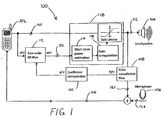
- FIG. 1 is a block diagram of a communication system employing a received audio limiter for improved echo cancellation.
- FIG. 2 is a chart comparing the frequency response of a loudspeaker-enclosure-microphone system, and a low order spectral model of the loudspeaker-enclosure-microphone system of an infinite impulse response filter.
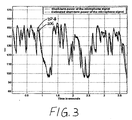
- FIG. 3 is a chart comparing the loudspeaker output power estimate from the infinite impulse response filter and the corresponding actual short term power of the loudspeaker output recorded at the microphone.
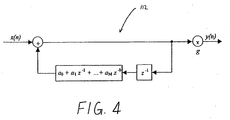
- FIG. 4 shows the structure of an infinite impulse response filter employed in an embodiment of the invention.
- a communications system 100 employing an improved echo cancellation system according to the invention is shown in Fig. 1.
- Communication system 100 includes a transceiver 102, a loudspeaker 104, and a microphone 106.
- Transceiver 102 is adapted to send and receive audio signals to and from similar remote transceiver devices.
- the two transceivers provide two-way communication between a local party associated with transceiver 102 and a remote party associated with the remote transceiver.
- Transceiver 102 may be, for example, a mobile telephone, a speaker-phone base unit, or some other device for providing two-way communications between local and remote parties.
- Audio signals received from the remote device are played over loudspeaker 104. Sounds picked up by microphone 106 are transduced into audio signals that are transmitted by transceiver 102 back to the remote device. Thus, the local and remote parties can audibly communicate with one another using communication system 100.
- the problem of echo arises in communications systems like communication system 100 when the output from loudspeaker 104 is picked up by microphone 106 and is re-transmitted back to its original source.
- the resulting echo heard by the remote party can have a significant negative impact on the quality of the communication experienced by the two parties.
- Echo cancellation filter 108 is provided to remove the effects of the loudspeaker 104 output from the audio signal transduced by microphone 106.
- Echo cancellation filter 108 is an adaptive filtered that models the characteristics of the loudspeaker-enclosure-microphone (LEM) system. Using the Line-Out signal 126 used to drive the loudspeaker 104, the echo cancellation filter 108 mimics the impulse response of the LEM system.
- Echo cancellation filter 108 creates an echo signal estimate 130 that represents the audio signal expected to be transduced by microphone 106.
- Echo cancellation filter 108 creates the echo signal estimate 130 based on the reference signal and the known characteristics of the LEM system. The echo signal estimate 130 is subtracted from the actual microphone pick-up signal 128 at summing junction 120.
- the echo signal estimate 130 will exactly match the actual echo signal picked up by microphone 106.
- the residual error signal will be zero and the loudspeaker echo will be completely eliminated from the transmit audio signal 124 sent transmitted by transceiver 102 to the remote transceiver at the opposite end of the communication.
- the echo signal estimate 130 will not exactly match the actual echo signal.
- the coefficients of the adaptive echo cancellation filter 108 must be recalculated frequently to improve and maintain the echo cancellation filter's model of the LEM system.
- the difference between the echo signal estimate and the actual echo signal forms an error signal that may be fed back into the adaptive echo cancellation filter 108 and used to recalculate the filter's coefficients and refine the echo cancellation filter's model of the LEM system.
- the adaptive echo cancellation filter's coefficients have been calibrated, the echo from the loudspeaker 104 output will be substantially eliminated from the transmit audio signal 124.
- the transmit audio signal 124 is received by the remote transceiver and re-produced for the remote party, the remote party will hear only the sounds that originated with the local party. All traces of echo will have been substantially removed.
- the echo cancellation features of communications system 100 described to this point are effective so long as the transfer function of the echo response path of the LEM system remains linear. If the loudspeaker output reaching the microphone is too great for the microphone to handle, however, the echo signal received by microphone 106 may be clipped. Non-linearities resulting from clipping at microphone 106 make it impossible for the echo cancellation filter 108 to predict the echo signal that will actually incorporated into the microphone pick-up signal 128. In this case, because the echo cancellation filter 108 can no longer accurately predict what the loudspeaker echo signal will be, it cannot effectively remove the loudspeaker echo from the microphone pick-up signal 128. A direct result of nonlinearities in the LEM system's transfer function is that echo can creep back into the audio transmit signal 124.
- Communications system 100 solves this problem by limiting the output of loudspeaker 104 to levels which are known not to cause clipping at microphone 106.
- Soft limiter 118 is placed in the signal path of the received audio signal 122 to limit the dynamic range of the Line-Out signal 126 and thus control the volume out of loudspeaker 104.
- Soft limiter 118 is controlled by the output of a low order infinite impulse response (IIR) filter 112.
- IIR infinite impulse response
- the low order IIR filter 112 models the gain and spectral envelope of the LEM system. As will be described below, the coefficients of the low order IIR filter 112 are derived from the echo cancellation filter 108.
- the IIR filter's spectral model of the LEM system need only be a course representation of the true frequency response of the LEM system.
- the first curve 200 is characterized by sharp peaks any steep declines. This level of detail in modeling the frequency response of the LEM system is necessary to accurately and completely remove loudspeaker echo from the microphone pick-up signal.
- the second curve 202 is much smoother than the detailed frequency response curve 200, but nonetheless maintains the same general shape as the detailed frequency response curve 200. This coarser model is sufficient to estimate the power of the loudspeaker output that will reach microphone 106 for purposes of limiting the loudspeaker output.
- low order IIR filter 112 like echo cancellation filter 108; outputs a loudspeaker output estimate signal 132 that represents an estimate of the loudspeaker output that will be picked up by microphone 106.
- loudspeaker output estimate 132 will be a much rougher estimate of the echo signal than the echo signal estimate 130 output by the adaptive echo cancellation filter 108.
- Soft limiter 118 includes a short-term power estimation stage 114 and a gain computation stage 116.
- the loudspeaker output estimate 132 output from the low order IIR filter 112 is applied first to the short-term power estimation stage 114.
- the short-term power estimation stage 114 calculates the short-term power of the loudspeaker output estimate 132.
- the short-term power estimation stage 114 squares the loudspeaker output estimate 132 and applies the squared estimate to a first order IIR filter for smoothing.
- the resulting signal provides a sufficiently accurate estimate of the output power of the loudspeaker 104 that will be received at microphone 106.
- FIG. 3 shows a comparison between a short-term power estimate 204 calculated as just described, and the corresponding actual short-term power 206 received at microphone 106. As can be seen, the two curves are closely matched, confirming the reliability of the described method for generating the loudspeaker output short-term power estimate.
- the gain computation stage 116 calculates the signal gain that must be applied by soft limiter 118 to the received audio signal 122 before it can be played over loudspeaker 104 without fear that it will be clipped at microphone 106.
- Soft limiter 118 attenuates the received audio signal 122 as determined by the gain computation stage 116.
- the soft limiter output supplies the Line-Out signal 126 to the loudspeaker 104 and the reference signal to echo cancellation filter 108.
- the output of loudspeaker 104 is limited to levels that will not cause clipping at microphone 106.
- the transfer function of the LEM system remains linear, and acoustic echo is effectively removed from the audio transmit signal 124 before it is sent to a remote device by transceiver 102.
- the coefficients for the low order IIR filter 112 can be derived from the adaptive echo cancellation filter 108. This is represented by the coefficient computation stage 110 in Fig. 1.
- the structure of the low order IIR filter 112 is shown in Fig 4.
- the IIR filter 112 has the structure of an inverse prediction error filter.
- the filter coefficients can be computed using the Levinson-Durbin recursion algorithm to guarantee filter stability.
- h ( n ) [ h 0 ( n ) , h 1 ( n ) , ... , h N ⁇ 1 ( n ) ] T
- the computation of the coefficients r i (n) start with computing the sum of the squared magnitudes of all coefficients in each sub-band of the echo cancellation filter 108.
- an alternative method for calculating the IIR filter coefficients may be considered.
- the IIR filter can be replaced with a scalar value.
- the scaler may be the sum of all squared filter coefficients in the echo cancellation filter 108.
- the structure of the soft limiter 18 remains the same as shown in Fig. 1, except that in this multi-band variation there are independent limiters configured for each low-order sub-band (e. g. psycho-acoustically motivated critical sub-bands).
- the LEM system would be represented by a scalar which is the sum of the squared echo cancellation filter coefficients of all sub-bands belonging to the critical band.
- independent limiters may be implemented for every sub-band computed in the frequency sub-band analysis of the reference signal.
- the LEM sub-band would then be a scalar which is a sum of the squared echo cancellation filter coefficients in the band.
Landscapes
- Engineering & Computer Science (AREA)
- Signal Processing (AREA)
- Physics & Mathematics (AREA)
- Acoustics & Sound (AREA)
- Computer Networks & Wireless Communication (AREA)
- Cable Transmission Systems, Equalization Of Radio And Reduction Of Echo (AREA)
- Circuit For Audible Band Transducer (AREA)
- Telephone Function (AREA)
Applications Claiming Priority (1)
| Application Number | Priority Date | Filing Date | Title |
|---|---|---|---|
| US11/012,079 US7894598B2 (en) | 2004-12-14 | 2004-12-14 | System for limiting receive audio |
Publications (3)
| Publication Number | Publication Date |
|---|---|
| EP1672803A2 true EP1672803A2 (fr) | 2006-06-21 |
| EP1672803A3 EP1672803A3 (fr) | 2007-06-13 |
| EP1672803B1 EP1672803B1 (fr) | 2011-04-06 |
Family
ID=35871208
Family Applications (1)
| Application Number | Title | Priority Date | Filing Date |
|---|---|---|---|
| EP05027407A Expired - Lifetime EP1672803B1 (fr) | 2004-12-14 | 2005-12-14 | Système pour la limitation des signaux audio de réception |
Country Status (7)
| Country | Link |
|---|---|
| US (1) | US7894598B2 (fr) |
| EP (1) | EP1672803B1 (fr) |
| JP (2) | JP5030420B2 (fr) |
| KR (1) | KR20060067881A (fr) |
| CN (1) | CN1798217B (fr) |
| CA (1) | CA2529593C (fr) |
| DE (1) | DE602005027304D1 (fr) |
Cited By (2)
| Publication number | Priority date | Publication date | Assignee | Title |
|---|---|---|---|---|
| WO2012105880A1 (fr) * | 2011-02-03 | 2012-08-09 | Telefonaktiebolaget L M Ericsson (Publ) | Estimation et suppression des non-linéarités de haut-parleur harmonique |
| WO2014147552A1 (fr) * | 2013-03-19 | 2014-09-25 | Koninklijke Philips N.V. | Procédé et appareil de traitement audio |
Families Citing this family (19)
| Publication number | Priority date | Publication date | Assignee | Title |
|---|---|---|---|---|
| US20080247535A1 (en) * | 2007-04-09 | 2008-10-09 | Microsoft Corporation | Method and apparatus for mitigating impact of nonlinear effects on the quality of audio echo cancellation |
| DK2148525T3 (da) * | 2008-07-24 | 2013-08-19 | Oticon As | Kodebogsbaseret estimering af tilbagekoblingsvej |
| US8626809B2 (en) * | 2009-02-24 | 2014-01-07 | Samsung Electronics Co., Ltd | Method and apparatus for digital up-down conversion using infinite impulse response filter |
| JP4843691B2 (ja) * | 2009-03-09 | 2011-12-21 | 株式会社東芝 | 信号特性変化装置 |
| US10980586B2 (en) * | 2011-03-14 | 2021-04-20 | DePuy Synthes Products, Inc. | Driver device with anti-rotation feature |
| GB2512022A (en) * | 2012-12-21 | 2014-09-24 | Microsoft Corp | Echo suppression |
| GB2510331A (en) | 2012-12-21 | 2014-08-06 | Microsoft Corp | Echo suppression in an audio signal |
| GB2509493A (en) | 2012-12-21 | 2014-07-09 | Microsoft Corp | Suppressing Echo in a received audio signal by estimating the echo power in the received audio signal based on an FIR filter estimate |
| CN105573398B (zh) * | 2014-10-11 | 2017-07-25 | 联想(北京)有限公司 | 功率控制方法以及电子设备 |
| US20180130482A1 (en) * | 2015-05-15 | 2018-05-10 | Harman International Industries, Incorporated | Acoustic echo cancelling system and method |
| US9655001B2 (en) * | 2015-09-24 | 2017-05-16 | Cisco Technology, Inc. | Cross mute for native radio channels |
| CN114286248B (zh) * | 2016-06-14 | 2025-08-12 | 杜比实验室特许公司 | 媒体补偿通过和模式切换 |
| JP6531776B2 (ja) * | 2017-04-25 | 2019-06-19 | トヨタ自動車株式会社 | 音声対話システムおよび音声対話方法 |
| US10153744B1 (en) | 2017-08-02 | 2018-12-11 | 2236008 Ontario Inc. | Automatically tuning an audio compressor to prevent distortion |
| CN109348327B (zh) * | 2018-08-15 | 2020-12-04 | 恒玄科技(上海)股份有限公司 | 一种主动降噪系统 |
| CN109979475A (zh) * | 2017-12-26 | 2019-07-05 | 深圳Tcl新技术有限公司 | 解决回声消除失效的方法、系统及存储介质 |
| EP3806489A4 (fr) * | 2018-06-11 | 2021-08-11 | Sony Group Corporation | Dispositif de traitement de signal, procédé de traitement de signal, et programme |
| CN111556408B (zh) * | 2020-05-06 | 2021-08-17 | 上海傅硅电子科技有限公司 | 扬声器智能功率控制系统及其控制方法 |
| CN112037808B (zh) * | 2020-09-01 | 2024-04-19 | 杭州岁丰信息技术有限公司 | 一种用于电梯轿厢的回音消除方法及其装置 |
Citations (1)
| Publication number | Priority date | Publication date | Assignee | Title |
|---|---|---|---|---|
| WO2004107724A2 (fr) | 2003-05-27 | 2004-12-09 | Koninklijke Philips Electronics N.V. | Systeme de haut-parleur-microphone pourvu d'un systeme d'annulation d'echo et son procede |
Family Cites Families (15)
| Publication number | Priority date | Publication date | Assignee | Title |
|---|---|---|---|---|
| JP2836277B2 (ja) * | 1991-03-14 | 1998-12-14 | 国際電信電話株式会社 | エコーキャンセル装置 |
| JPH05110694A (ja) * | 1991-10-14 | 1993-04-30 | Nec Corp | 音声加算装置 |
| JPH05183472A (ja) * | 1991-12-27 | 1993-07-23 | Nec Corp | エコーキャンセラ機能付音声加算装置 |
| JPH06216811A (ja) * | 1993-01-20 | 1994-08-05 | Toshiba Corp | エコーキャンセラを備えた音声通信装置 |
| US5680450A (en) | 1995-02-24 | 1997-10-21 | Ericsson Inc. | Apparatus and method for canceling acoustic echoes including non-linear distortions in loudspeaker telephones |
| US5612996A (en) * | 1995-09-21 | 1997-03-18 | Rockwell International Corporation | Loop gain processing system for speakerphone applications |
| US6766176B1 (en) * | 1996-07-23 | 2004-07-20 | Qualcomm Incorporated | Method and apparatus for automatically adjusting speaker and microphone gains within a mobile telephone |
| US5796819A (en) * | 1996-07-24 | 1998-08-18 | Ericsson Inc. | Echo canceller for non-linear circuits |
| JP3609611B2 (ja) * | 1998-03-31 | 2005-01-12 | 三洋電機株式会社 | エコー除去方法およびエコーキャンセラ |
| JP3220979B2 (ja) * | 1998-01-09 | 2001-10-22 | 日本電気株式会社 | 音声スイッチ |
| JP2000353989A (ja) * | 1999-06-11 | 2000-12-19 | Matsushita Electric Ind Co Ltd | エコーキャンセラ |
| JP2001094479A (ja) * | 1999-09-20 | 2001-04-06 | Nippon Telegr & Teleph Corp <Ntt> | 反響消去装置 |
| JP3406590B2 (ja) * | 2000-01-19 | 2003-05-12 | 三菱電機株式会社 | 音声通信装置、およびエコー処理プロセッサ |
| JP2002009677A (ja) * | 2000-06-23 | 2002-01-11 | Matsushita Electric Ind Co Ltd | 音響エコーキャンセラー装置 |
| JP2003125070A (ja) * | 2001-10-15 | 2003-04-25 | Fujitsu Ltd | 通話信号処理装置 |
-
2004
- 2004-12-14 US US11/012,079 patent/US7894598B2/en active Active
-
2005
- 2005-12-07 CA CA2529593A patent/CA2529593C/fr not_active Expired - Fee Related
- 2005-12-12 JP JP2005357794A patent/JP5030420B2/ja not_active Expired - Fee Related
- 2005-12-14 KR KR1020050123072A patent/KR20060067881A/ko not_active Ceased
- 2005-12-14 CN CN2005101343353A patent/CN1798217B/zh not_active Expired - Lifetime
- 2005-12-14 EP EP05027407A patent/EP1672803B1/fr not_active Expired - Lifetime
- 2005-12-14 DE DE602005027304T patent/DE602005027304D1/de not_active Expired - Lifetime
-
2011
- 2011-11-07 JP JP2011243843A patent/JP2012039666A/ja active Pending
Patent Citations (1)
| Publication number | Priority date | Publication date | Assignee | Title |
|---|---|---|---|---|
| WO2004107724A2 (fr) | 2003-05-27 | 2004-12-09 | Koninklijke Philips Electronics N.V. | Systeme de haut-parleur-microphone pourvu d'un systeme d'annulation d'echo et son procede |
Cited By (8)
| Publication number | Priority date | Publication date | Assignee | Title |
|---|---|---|---|---|
| WO2012105880A1 (fr) * | 2011-02-03 | 2012-08-09 | Telefonaktiebolaget L M Ericsson (Publ) | Estimation et suppression des non-linéarités de haut-parleur harmonique |
| CN103339671A (zh) * | 2011-02-03 | 2013-10-02 | 瑞典爱立信有限公司 | 谐波扬声器非线性的估计和抑制 |
| CN103339671B (zh) * | 2011-02-03 | 2016-05-04 | 瑞典爱立信有限公司 | 谐波扬声器非线性的估计和抑制 |
| US9420390B2 (en) | 2011-02-03 | 2016-08-16 | Telefonaktiebolaget Lm Ericsson (Publ) | Estimation and suppression of harmonic loudspeaker nonlinearities |
| WO2014147552A1 (fr) * | 2013-03-19 | 2014-09-25 | Koninklijke Philips N.V. | Procédé et appareil de traitement audio |
| JP2016515332A (ja) * | 2013-03-19 | 2016-05-26 | コーニンクレッカ フィリップス エヌ ヴェKoninklijke Philips N.V. | オーディオ処理のための方法及び装置 |
| US9674368B2 (en) | 2013-03-19 | 2017-06-06 | Koninklijke Philips N.V. | Method and apparatus for audio processing |
| RU2664717C2 (ru) * | 2013-03-19 | 2018-08-22 | Конинклейке Филипс Н.В. | Способ и устройство для аудиообработки |
Also Published As
| Publication number | Publication date |
|---|---|
| JP2012039666A (ja) | 2012-02-23 |
| CN1798217A (zh) | 2006-07-05 |
| US7894598B2 (en) | 2011-02-22 |
| JP5030420B2 (ja) | 2012-09-19 |
| DE602005027304D1 (de) | 2011-05-19 |
| EP1672803B1 (fr) | 2011-04-06 |
| US20060126822A1 (en) | 2006-06-15 |
| CA2529593C (fr) | 2012-03-13 |
| CA2529593A1 (fr) | 2006-06-14 |
| EP1672803A3 (fr) | 2007-06-13 |
| JP2006174456A (ja) | 2006-06-29 |
| CN1798217B (zh) | 2011-03-23 |
| KR20060067881A (ko) | 2006-06-20 |
Similar Documents
| Publication | Publication Date | Title |
|---|---|---|
| US7894598B2 (en) | System for limiting receive audio | |
| US8355511B2 (en) | System and method for envelope-based acoustic echo cancellation | |
| EP3791565B1 (fr) | Procédé et appareil utilisant des informations d'estimation d'écho résiduel pour déduire des paramètres de réduction d'écho secondaire | |
| EP1046273B1 (fr) | Procedes et appareil pour assurer un bruit de fond de confort dans des systemes de communications | |
| US9800734B2 (en) | Echo cancellation | |
| US8472616B1 (en) | Self calibration of envelope-based acoustic echo cancellation | |
| CN104158990B (zh) | 用于处理音频信号的方法和音频接收电路 | |
| US9992572B2 (en) | Dereverberation system for use in a signal processing apparatus | |
| US9386373B2 (en) | System and method for estimating a reverberation time | |
| KR101089481B1 (ko) | 스펙트럼 음향 특성에 기초한 더블 토크 검출 방법 | |
| US6510224B1 (en) | Enhancement of near-end voice signals in an echo suppression system | |
| US20130230184A1 (en) | Echo suppression comprising modeling of late reverberation components | |
| US20090225980A1 (en) | Gain and spectral shape adjustment in audio signal processing | |
| JPWO2002095975A1 (ja) | エコー処理装置 | |
| US20170078489A1 (en) | Nonlinear acoustic echo cancellation based on transducer impedance | |
| US8254590B2 (en) | System and method for intelligibility enhancement of audio information | |
| US8406430B2 (en) | Simulated background noise enabled echo canceller | |
| US20100272274A1 (en) | Methods and systems for robust approximations of impulse reponses in multichannel audio-communication systems | |
| JP2002064617A (ja) | 反響抑圧方法・反響抑圧装置 | |
| US7023986B2 (en) | Echo canceller in a communication system at a terminal | |
| CN119091902A (zh) | 回声消除方法、电子设备、计算机程序产品和存储介质 | |
| JP2012222389A (ja) | 反響消去装置とその方法とプログラム | |
| Fhager et al. | Nonlinear Acoustic Echo Cancellation for Mobile Phones: A Practical Approach |
Legal Events
| Date | Code | Title | Description |
|---|---|---|---|
| PUAI | Public reference made under article 153(3) epc to a published international application that has entered the european phase |
Free format text: ORIGINAL CODE: 0009012 |
|
| AK | Designated contracting states |
Kind code of ref document: A2 Designated state(s): AT BE BG CH CY CZ DE DK EE ES FI FR GB GR HU IE IS IT LI LT LU LV MC NL PL PT RO SE SI SK TR |
|
| AX | Request for extension of the european patent |
Extension state: AL BA HR MK YU |
|
| RAP1 | Party data changed (applicant data changed or rights of an application transferred) |
Owner name: QNX SOFTWARE SYSTEMS (WAVEMAKERS), INC. |
|
| PUAL | Search report despatched |
Free format text: ORIGINAL CODE: 0009013 |
|
| AK | Designated contracting states |
Kind code of ref document: A3 Designated state(s): AT BE BG CH CY CZ DE DK EE ES FI FR GB GR HU IE IS IT LI LT LU LV MC NL PL PT RO SE SI SK TR |
|
| AX | Request for extension of the european patent |
Extension state: AL BA HR MK YU |
|
| 17P | Request for examination filed |
Effective date: 20070914 |
|
| 17Q | First examination report despatched |
Effective date: 20071018 |
|
| AKX | Designation fees paid |
Designated state(s): DE FR GB IT |
|
| GRAP | Despatch of communication of intention to grant a patent |
Free format text: ORIGINAL CODE: EPIDOSNIGR1 |
|
| GRAS | Grant fee paid |
Free format text: ORIGINAL CODE: EPIDOSNIGR3 |
|
| GRAA | (expected) grant |
Free format text: ORIGINAL CODE: 0009210 |
|
| AK | Designated contracting states |
Kind code of ref document: B1 Designated state(s): DE FR GB IT |
|
| REG | Reference to a national code |
Ref country code: GB Ref legal event code: FG4D |
|
| REF | Corresponds to: |
Ref document number: 602005027304 Country of ref document: DE Date of ref document: 20110519 Kind code of ref document: P |
|
| REG | Reference to a national code |
Ref country code: DE Ref legal event code: R096 Ref document number: 602005027304 Country of ref document: DE Effective date: 20110519 |
|
| REG | Reference to a national code |
Ref country code: DE Ref legal event code: R082 Ref document number: 602005027304 Country of ref document: DE Representative=s name: GRUENECKER, KINKELDEY, STOCKMAIR & SCHWANHAEUS, DE |
|
| PLBE | No opposition filed within time limit |
Free format text: ORIGINAL CODE: 0009261 |
|
| STAA | Information on the status of an ep patent application or granted ep patent |
Free format text: STATUS: NO OPPOSITION FILED WITHIN TIME LIMIT |
|
| REG | Reference to a national code |
Ref country code: DE Ref legal event code: R082 Ref document number: 602005027304 Country of ref document: DE Representative=s name: GRUENECKER, KINKELDEY, STOCKMAIR & SCHWANHAEUS, DE Effective date: 20120117 Ref country code: DE Ref legal event code: R081 Ref document number: 602005027304 Country of ref document: DE Owner name: NUANCE COMMUNICATIONS, INC. (N.D.GES.D. STAATE, US Free format text: FORMER OWNER: QNX SOFTWARE SYSTEMS (WAVEMAKERS), INC., VANCOUVER, BRITISH COLUMBIA, CA Effective date: 20120117 Ref country code: DE Ref legal event code: R081 Ref document number: 602005027304 Country of ref document: DE Owner name: NUANCE COMMUNICATIONS, INC. (N.D.GES.D. STAATE, US Free format text: FORMER OWNER: HARMAN BECKER AUTOMOTIVE SYSTEMS-WAVEMAKERS, INC., VANCOUVER, CA Effective date: 20110310 Ref country code: DE Ref legal event code: R081 Ref document number: 602005027304 Country of ref document: DE Owner name: NUANCE COMMUNICATIONS, INC. (N.D.GES.D. STAATE, US Free format text: FORMER OWNER: QNX SOFTWARE SYSTEMS (WAVEMAKERS), INC., VANCOUVER, CA Effective date: 20120117 Ref country code: DE Ref legal event code: R082 Ref document number: 602005027304 Country of ref document: DE Representative=s name: GRUENECKER PATENT- UND RECHTSANWAELTE PARTG MB, DE Effective date: 20120117 Ref country code: DE Ref legal event code: R081 Ref document number: 602005027304 Country of ref document: DE Owner name: NUANCE COMMUNICATIONS, INC. (N.D.GES.D. STAATE, US Free format text: FORMER OWNER: HARMAN BECKER AUTOMOTIVE SYSTEMS-WAVEMAKERS, INC., VANCOUVER, BRITISH COLUMBIA, CA Effective date: 20110310 |
|
| 26N | No opposition filed |
Effective date: 20120110 |
|
| REG | Reference to a national code |
Ref country code: DE Ref legal event code: R097 Ref document number: 602005027304 Country of ref document: DE Effective date: 20120110 |
|
| PG25 | Lapsed in a contracting state [announced via postgrant information from national office to epo] |
Ref country code: IT Free format text: LAPSE BECAUSE OF FAILURE TO SUBMIT A TRANSLATION OF THE DESCRIPTION OR TO PAY THE FEE WITHIN THE PRESCRIBED TIME-LIMIT Effective date: 20110406 |
|
| REG | Reference to a national code |
Ref country code: FR Ref legal event code: PLFP Year of fee payment: 11 |
|
| REG | Reference to a national code |
Ref country code: FR Ref legal event code: PLFP Year of fee payment: 12 |
|
| REG | Reference to a national code |
Ref country code: FR Ref legal event code: PLFP Year of fee payment: 13 |
|
| PGFP | Annual fee paid to national office [announced via postgrant information from national office to epo] |
Ref country code: FR Payment date: 20181231 Year of fee payment: 14 |
|
| PG25 | Lapsed in a contracting state [announced via postgrant information from national office to epo] |
Ref country code: FR Free format text: LAPSE BECAUSE OF NON-PAYMENT OF DUE FEES Effective date: 20191231 |
|
| PGFP | Annual fee paid to national office [announced via postgrant information from national office to epo] |
Ref country code: DE Payment date: 20241001 Year of fee payment: 20 |
|
| PGFP | Annual fee paid to national office [announced via postgrant information from national office to epo] |
Ref country code: GB Payment date: 20241001 Year of fee payment: 20 |
|
| REG | Reference to a national code |
Ref country code: DE Ref legal event code: R071 Ref document number: 602005027304 Country of ref document: DE |
|
| REG | Reference to a national code |
Ref country code: GB Ref legal event code: PE20 Expiry date: 20251213 |