EP1672906A2 - Redirection de travail automatisé et gestion de l'organisation - Google Patents
Redirection de travail automatisé et gestion de l'organisation Download PDFInfo
- Publication number
- EP1672906A2 EP1672906A2 EP05257523A EP05257523A EP1672906A2 EP 1672906 A2 EP1672906 A2 EP 1672906A2 EP 05257523 A EP05257523 A EP 05257523A EP 05257523 A EP05257523 A EP 05257523A EP 1672906 A2 EP1672906 A2 EP 1672906A2
- Authority
- EP
- European Patent Office
- Prior art keywords
- printer
- redirection
- systems
- job
- matrix
- Prior art date
- Legal status (The legal status is an assumption and is not a legal conclusion. Google has not performed a legal analysis and makes no representation as to the accuracy of the status listed.)
- Withdrawn
Links
Images





Classifications
-
- H—ELECTRICITY
- H04—ELECTRIC COMMUNICATION TECHNIQUE
- H04N—PICTORIAL COMMUNICATION, e.g. TELEVISION
- H04N1/00—Scanning, transmission or reproduction of documents or the like, e.g. facsimile transmission; Details thereof
- H04N1/32—Circuits or arrangements for control or supervision between transmitter and receiver or between image input and image output device, e.g. between a still-image camera and its memory or between a still-image camera and a printer device
- H04N1/32609—Fault detection or counter-measures, e.g. original mis-positioned, shortage of paper
- H04N1/32646—Counter-measures
- H04N1/32678—Performing substitution, e.g. substitute reception or substituting a corrupted line of data
-
- G—PHYSICS
- G06—COMPUTING OR CALCULATING; COUNTING
- G06F—ELECTRIC DIGITAL DATA PROCESSING
- G06F3/00—Input arrangements for transferring data to be processed into a form capable of being handled by the computer; Output arrangements for transferring data from processing unit to output unit, e.g. interface arrangements
- G06F3/12—Digital output to print unit, e.g. line printer, chain printer
- G06F3/1201—Dedicated interfaces to print systems
- G06F3/1202—Dedicated interfaces to print systems specifically adapted to achieve a particular effect
- G06F3/1203—Improving or facilitating administration, e.g. print management
-
- G—PHYSICS
- G06—COMPUTING OR CALCULATING; COUNTING
- G06F—ELECTRIC DIGITAL DATA PROCESSING
- G06F3/00—Input arrangements for transferring data to be processed into a form capable of being handled by the computer; Output arrangements for transferring data from processing unit to output unit, e.g. interface arrangements
- G06F3/12—Digital output to print unit, e.g. line printer, chain printer
- G06F3/1201—Dedicated interfaces to print systems
- G06F3/1202—Dedicated interfaces to print systems specifically adapted to achieve a particular effect
- G06F3/1203—Improving or facilitating administration, e.g. print management
- G06F3/1204—Improving or facilitating administration, e.g. print management resulting in reduced user or operator actions, e.g. presetting, automatic actions, using hardware token storing data
-
- G—PHYSICS
- G06—COMPUTING OR CALCULATING; COUNTING
- G06F—ELECTRIC DIGITAL DATA PROCESSING
- G06F3/00—Input arrangements for transferring data to be processed into a form capable of being handled by the computer; Output arrangements for transferring data from processing unit to output unit, e.g. interface arrangements
- G06F3/12—Digital output to print unit, e.g. line printer, chain printer
- G06F3/1201—Dedicated interfaces to print systems
- G06F3/1223—Dedicated interfaces to print systems specifically adapted to use a particular technique
- G06F3/1237—Print job management
- G06F3/126—Job scheduling, e.g. queuing, determine appropriate device
- G06F3/1261—Job scheduling, e.g. queuing, determine appropriate device by using alternate printing
-
- G—PHYSICS
- G06—COMPUTING OR CALCULATING; COUNTING
- G06F—ELECTRIC DIGITAL DATA PROCESSING
- G06F3/00—Input arrangements for transferring data to be processed into a form capable of being handled by the computer; Output arrangements for transferring data from processing unit to output unit, e.g. interface arrangements
- G06F3/12—Digital output to print unit, e.g. line printer, chain printer
- G06F3/1201—Dedicated interfaces to print systems
- G06F3/1223—Dedicated interfaces to print systems specifically adapted to use a particular technique
- G06F3/1237—Print job management
- G06F3/1273—Print job history, e.g. logging, accounting, tracking
-
- G—PHYSICS
- G06—COMPUTING OR CALCULATING; COUNTING
- G06F—ELECTRIC DIGITAL DATA PROCESSING
- G06F3/00—Input arrangements for transferring data to be processed into a form capable of being handled by the computer; Output arrangements for transferring data from processing unit to output unit, e.g. interface arrangements
- G06F3/12—Digital output to print unit, e.g. line printer, chain printer
- G06F3/1201—Dedicated interfaces to print systems
- G06F3/1278—Dedicated interfaces to print systems specifically adapted to adopt a particular infrastructure
- G06F3/1285—Remote printer device, e.g. being remote from client or server
-
- H—ELECTRICITY
- H04—ELECTRIC COMMUNICATION TECHNIQUE
- H04N—PICTORIAL COMMUNICATION, e.g. TELEVISION
- H04N1/00—Scanning, transmission or reproduction of documents or the like, e.g. facsimile transmission; Details thereof
- H04N1/32—Circuits or arrangements for control or supervision between transmitter and receiver or between image input and image output device, e.g. between a still-image camera and its memory or between a still-image camera and a printer device
- H04N1/32609—Fault detection or counter-measures, e.g. original mis-positioned, shortage of paper
-
- G—PHYSICS
- G06—COMPUTING OR CALCULATING; COUNTING
- G06F—ELECTRIC DIGITAL DATA PROCESSING
- G06F11/00—Error detection; Error correction; Monitoring
- G06F11/30—Monitoring
- G06F11/34—Recording or statistical evaluation of computer activity, e.g. of down time, of input/output operation ; Recording or statistical evaluation of user activity, e.g. usability assessment
- G06F11/3466—Performance evaluation by tracing or monitoring
- G06F11/3476—Data logging
-
- G—PHYSICS
- G06—COMPUTING OR CALCULATING; COUNTING
- G06F—ELECTRIC DIGITAL DATA PROCESSING
- G06F3/00—Input arrangements for transferring data to be processed into a form capable of being handled by the computer; Output arrangements for transferring data from processing unit to output unit, e.g. interface arrangements
- G06F3/12—Digital output to print unit, e.g. line printer, chain printer
- G06F3/1201—Dedicated interfaces to print systems
- G06F3/1202—Dedicated interfaces to print systems specifically adapted to achieve a particular effect
- G06F3/121—Facilitating exception or error detection and recovery, e.g. fault, media or consumables depleted
-
- H—ELECTRICITY
- H04—ELECTRIC COMMUNICATION TECHNIQUE
- H04N—PICTORIAL COMMUNICATION, e.g. TELEVISION
- H04N1/00—Scanning, transmission or reproduction of documents or the like, e.g. facsimile transmission; Details thereof
- H04N1/00127—Connection or combination of a still picture apparatus with another apparatus, e.g. for storage, processing or transmission of still picture signals or of information associated with a still picture
- H04N1/00204—Connection or combination of a still picture apparatus with another apparatus, e.g. for storage, processing or transmission of still picture signals or of information associated with a still picture with a digital computer or a digital computer system, e.g. an internet server
- H04N1/00236—Connection or combination of a still picture apparatus with another apparatus, e.g. for storage, processing or transmission of still picture signals or of information associated with a still picture with a digital computer or a digital computer system, e.g. an internet server using an image reading or reproducing device, e.g. a facsimile reader or printer, as a local input to or local output from a computer
-
- H—ELECTRICITY
- H04—ELECTRIC COMMUNICATION TECHNIQUE
- H04N—PICTORIAL COMMUNICATION, e.g. TELEVISION
- H04N1/00—Scanning, transmission or reproduction of documents or the like, e.g. facsimile transmission; Details thereof
- H04N1/00127—Connection or combination of a still picture apparatus with another apparatus, e.g. for storage, processing or transmission of still picture signals or of information associated with a still picture
- H04N1/00347—Connection or combination of a still picture apparatus with another apparatus, e.g. for storage, processing or transmission of still picture signals or of information associated with a still picture with another still picture apparatus, e.g. hybrid still picture apparatus
-
- H—ELECTRICITY
- H04—ELECTRIC COMMUNICATION TECHNIQUE
- H04N—PICTORIAL COMMUNICATION, e.g. TELEVISION
- H04N2201/00—Indexing scheme relating to scanning, transmission or reproduction of documents or the like, and to details thereof
- H04N2201/0008—Connection or combination of a still picture apparatus with another apparatus
- H04N2201/0034—Details of the connection, e.g. connector, interface
- H04N2201/0037—Topological details of the connection
- H04N2201/0039—Connection via a network
-
- H—ELECTRICITY
- H04—ELECTRIC COMMUNICATION TECHNIQUE
- H04N—PICTORIAL COMMUNICATION, e.g. TELEVISION
- H04N2201/00—Indexing scheme relating to scanning, transmission or reproduction of documents or the like, and to details thereof
- H04N2201/0077—Types of the still picture apparatus
- H04N2201/0081—Image reader
-
- H—ELECTRICITY
- H04—ELECTRIC COMMUNICATION TECHNIQUE
- H04N—PICTORIAL COMMUNICATION, e.g. TELEVISION
- H04N2201/00—Indexing scheme relating to scanning, transmission or reproduction of documents or the like, and to details thereof
- H04N2201/0077—Types of the still picture apparatus
- H04N2201/0082—Image hardcopy reproducer
-
- H—ELECTRICITY
- H04—ELECTRIC COMMUNICATION TECHNIQUE
- H04N—PICTORIAL COMMUNICATION, e.g. TELEVISION
- H04N2201/00—Indexing scheme relating to scanning, transmission or reproduction of documents or the like, and to details thereof
- H04N2201/0077—Types of the still picture apparatus
- H04N2201/0093—Facsimile machine
-
- H—ELECTRICITY
- H04—ELECTRIC COMMUNICATION TECHNIQUE
- H04N—PICTORIAL COMMUNICATION, e.g. TELEVISION
- H04N2201/00—Indexing scheme relating to scanning, transmission or reproduction of documents or the like, and to details thereof
- H04N2201/32—Circuits or arrangements for control or supervision between transmitter and receiver or between image input and image output device, e.g. between a still-image camera and its memory or between a still-image camera and a printer device
- H04N2201/3201—Display, printing, storage or transmission of additional information, e.g. ID code, date and time or title
- H04N2201/3202—Display, printing, storage or transmission of additional information, e.g. ID code, date and time or title of communication or activity log or report
Definitions
- the invention relates generally to methods for managing the operational efficiency of systems, such printers, scanners, and faxes that are networked together within an organization.
- Network systems such as printers, tend to be redundant services at different physical locations within a network community that may have some or no functional variability (e.g., color versus black and white).
- printers tend to be redundant services at different physical locations within a network community that may have some or no functional variability (e.g., color versus black and white).
- another system may be available to provide identical or substantially similar services located near the unavailable system.
- some printing systems are adapted to redirect print jobs when a printer is or becomes unavailable.
- Windows 2000-based print servers and the Common UNIX Printing SystemTM ("CUPSTM") provide for the creation of printer pools or printer classes, respectively. Jobs sent to a pool (through a logical printer) or a class are sent to the first available printer in the class.
- a method, system and article of manufacture for managing a plurality of communicatively coupled systems forming part of an organization (or network neighborhood).
- the method includes the acts of: collecting job log data; determining a user community for each of the plurality of systems using the job log data; calculating overlapping communities for pairs of the plurality of systems; defining a redirection matrix using the overlapping communities for managing operation of the plurality of system of the organization.
- a method, system and article of manufacture for managing a plurality of communicatively coupled systems forming part of an organization.
- the method includes the acts of: collecting job redirection information; defining a redirection matrix using the job redirection information; and computing one or both of a network topology and clusters using the redirection matrix.
- the redirection matrix may be used as input for any number of system management visualization engines that may, for example, graphically represent the data to monitor interrelationships between elements of an organization's infrastructure; (c) the redirection matrix may be used to discover a customer's infrastructure, redundancies, and capacity; (d) redirection decisions are based on users habits and therefore tend to follow natural or expected and/or preferred user behavior; and (e) the redirection matrix can be used to determine clusters which may be in turn used to evaluate inter-cluster flows (i.e., inter-cluster dependencies).
- FIG. 1 is a simplified diagram showing the context of the embodiments described herein;
- Figure 2 sets forth a flow diagram of different operating embodiments for determining and using a redirection matrix
- Figure 3 illustrates example printer communities for two printers A and B ;
- Figure 4 illustrates example overlapping communities C AB and C BA of printers A and B;
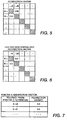
- Figure 5 illustrates an example redirection matrix for an organization
- Figure 6 illustrates an example of a filtered and normalized redirection matrix
- Figure 7 illustrates an example printer redirection vector for printer A selected from the first row of the redirection matrix shown in Figure 6;
- Figure 8 illustrates an example table of printers available in a community composed of three physical locations
- Figure 9 illustrates an example network topology and clusters computed using a redirection matrix for the printers listed in the table shown in Figure 8;
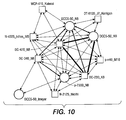
- Figure 10 illustrates an alternate representation of a network topology
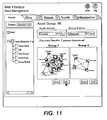
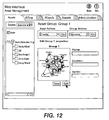
- Figures 11-13 illustrate a series of example screens of windows as would be generated by a user interface of a computer operating an asset manager for managing overlapping communities discovered using job redirection information.
- FIG. 1 is a simplified diagram showing the context of the embodiments described herein.
- a network 102 with an organization of a type familiar in the art. Existing on this network 102 is at least one computer 104 and, for purposes of the embodiments, a plurality of printers, such as here labeled 106A, 106B, 106C, and 106D.
- a print server 108 which acts as a virtual device to which all or some print requests on a network can be spooled before being sent to the physical device.
- the print server operates using an automated print job redirection system 110, which computes a redirection matrix and applies its values to automatically redirect print jobs in the event any of the printers 106 are or become unavailable, as more fully described herein.
- the computer 104 and/or printers 106 and/or print server 108 have operating within one or more of them, in a centralized or decentralized manner, an automated print redirection and/or organization management system as described herein.
- the word "printer” can for present purposes mean not only a printer, but any kind of device having printer-like features and/or functions and/or operational qualities (e.g., that operates as a shared resource on the network 102), such as a multifunction device (which includes one or more functions such as scanning, printing, and faxing), or a standalone device such as digital copier, input scanner, facsimile.
- the computer 104 in Figure 1 may be the computer of a systems administrator responsible for the activities of some or all of the printers on network 102. Such responsibilities may, for example, include making sure that a certain number of printers are available and operating on the network 102, making sure the printers 106 on network 102 are of particular types, and making sure that the installed printers are appropriately selected for the needs of the organization. In a real-world context, particularly when there are dozens or even hundreds of printers on a network, it is inevitable that printers from time to time become unavailable because of required maintenance or repair or because of a large number of jobs are waiting to be completed in a job queue.
- printers on the network may become temporarily unavailable for various reasons.
- a system administrator may evaluate the printers available on the network of an organization and determine: (a) what would be the best printer to redirect a print job to when another printer becomes temporarily unavailable on the network; and (b) how to define a network topology for evaluating print use on the network.
- the system administrator may inspect and manage the operation of the overall topology of the printer network to make sure the loads are balanced and they are effectively used.
- the management of the redirection of print jobs may be managed on the printer 106 or from the print server 108, or both.
- n printers such as printers 106 shown in Figure 1
- a computer network such as network 102 shown in Figure 1
- P network printer vector
- an n x n redirection matrix R is defined, where each element r ij in the redirection matrix R is a suitability measure of redirecting a print job from printer p i to printer p j , which is referred to herein as "redirectibility".
- the redirection process is modeled as a static markovian stochastic process in which each redirectibility element r ij in the redirectibility matrix R specifies the probability that a print job may be redirected from printer p i to printer p j when printer p i is unavailable and provided that printer p j is available.
- each printer p i is employed by a number m i of users.
- the number of users m is likely to differ between printers p since each printer may satisfy different needs of each user. For example, a printer may be more accessible because it is located proximate to the user while another printer may offer one or more functionalities that satisfy particular printing requirements (e.g., color printing).
- a printer's user community U i may be generally well defined
- a user u ik of the printer p i may occasionally print to another printer p j as a result of printer p i being unavailable or simply because printer p j provides functionalities (e.g., duplex or color printing) that satisfy exceptional print jobs. Therefore, a user u ik of the printer p i may appear in the user community U j community as user u jk' (i.e., external to the user community).
- This section generally outlines a method for computing a printer redirection matrix R followed by a discussion of certain aspects of the method.
- each user u ik in the community overlapping vector C ij directs a certain number of print jobs to printer p i , which in the event printer p i should become unavailable, could have been redirected to printer p j .
- This potential of redirecting a job from a first printer p i to a second printer p j should the first printer p i become unavailable is recorded in a printer redirection matrix R, which is computed by considering those common users in different user communities U.
- the general method for computing a printer redirection matrix R may be summarized in three general operations.
- all jobs that each overlapping community could have redirected are identified for each printer redirection combination (e.g., from printer p i to printer p j ).
- this first operation involves identifying the number of jobs that each user in an overlapping community has directed to printers p i and p j (i.e., "total overlapping jobs").
- the number of redirectable jobs for all redirection combinations are summed for each printer redirection combination (i.e., "total potentially redirectable jobs").
- the redirectibility element r ij in redirection matrix R is obtained for each redirection by dividing the total number of jobs potentially redirectable for a printer redirection combination ij by the total number of potentially redirectable jobs for all the redirection combinations from a source printer (i.e., printer from which a print job is redirected) to any other target printer (i.e., printer to which a print job is redirected) on a network.
- the redirectibility elements r are in effect weight parameters that reflect community habits, where the greater the weight indicates a greater likelihood that a proximity relation exists (or how natural a redirection is) between two printers.
- the method provides that the potential of redirectability from printer p i to printer p j is the total number of jobs that all the users in the community overlapping vector C ij have printed to printer p i and that is assumed could have been printed to printer p j .
- print logs of printers p i and p j may be used to calculate the community overlapping vector C ij for a pair of printers p i and p j by determining the number of jobs that each user c s in C ij could have printed.
- h ii represents the total number of print jobs printed from printer p i to printer p i which is in fact the total number of print jobs printed in p i .
- One advantage of such modeling of the redirection matrix R is that all information required to calculate its elements can be mined from a print job log stored, for example, on a centralized job spooler or from the reconstruction of a network print job log by means of the job log data exchange between printers operating on a network (e.g., via a defined negotiation protocol).
- the information required to calculate the elements of the redirection matrix R can be retrieved from client spooler logs (e.g., such as a user workstation).
- client spooler logs e.g., such as a user workstation.
- agents are installed on user workstations to capture information concerning print job submissions (e.g., printer and job properties). This embodiment is particularly suitable for situations when access to a central print server does not exist or is interrupted.
- a further advantage of such modeling of the redirection matrix R is that the redirection matrix R is asymmetrical.
- Each redirection value r ij that is calculated in the redirection matrix R is based in data from job logs of printers p i and p j which means that the redirection value of r ji is likely to be different to r ij .
- this asymmetrical nature of the redirection matrix R permits the data of the redirection matrix candidates to be readily filtered. That is, the asymmetry of the redirection matrix permits a further filtering or finer evaluation of the redirectibility between two printers.
- the redirection matrix R is asymmetrical because, for example, the parameters from which redirection value r ij is calculated depend only on calculations from printer p i .
- the number potential jobs redirectable from printer p i to printer p j will probably not be the same as the number potential jobs redirectable from printer p j to printer p i since in most cases the jobs submitted to a printer p i are most likely not to be the same as those sent to printer p j , which may be more generally set forth as: ⁇ i,j h i ⁇ h j and h ij ⁇ h ji .
- this example illustrates that the potential of jobs redirectable from any non-color printer to the color printer will be the complete set of jobs printed on the non-color printer which means that the redirectibility element from the non-color printer to the color printer will have the greatest potential redirection.
- the potential redirection of jobs from the color printer to the corresponding non-color printer will likely not be as great. This is because the total number of potential jobs redirectable from the color printer to any other non-color printer on the local network will in most cases be higher than the total potential of jobs redirectable from the non-color printer to any other non-color printer in the network as the color printer receives jobs from the largest community of possible users (i.e., all users on in the local network).
- this example illustrates one source of potential noise in a redirection matrix R may be defined as "different-functionality redirection noise".
- Different-functionality may include any one or more of the following printer functions: color, plex, finishing, stapling, paper size, etc. Accordingly, the redirection matrix is optionally filtered to eliminate relationships with little or no reciprocity and thereby eliminate or reduce different-functionality redirection noise.
- the example local network creates a biased environment where all users who print to a non-color printer only have the option to print color documents at the single color printer. It can thus be observed that the redirectibility from each non-color printer to the color printer is extremely high since any job printed by a user to a non-color printer who may occasionally print jobs at the color printer will be considered as redirectable to the color printer in the event the non-color printer is unavailable.
- different-functionality redirection noise may be filtered by evaluating printers in the community with comparable functionality. For example, documents that are directed to a black and white printer are selected for redirection to a functionally comparable black and white printer.
- such different-functionality redirection noise may be filtered using a trigger value for all redirectibility element r ij calculations of the redirection matrix R.
- the redirectibility elements r ij and r ji of the printers p i and p j are compared and if r ij or r ji is equal to zero then the printers p i and p j are not considered redirection candidates of each other.
- a redirection between printers p i and p j for redirectibility elements r ij or r ji that is less than a trigger value may be discarded since it will in most cases be the result of a source of a different-unctionality redirection noise (e.g., printer "HOLA" identified in Figure 8 does not appear to have any redirections in Figure 9).
- printer "HOLA" identified in Figure 8 does not appear to have any redirections in Figure 9.
- this second embodiment allows sources of different-functionality redirection noise to be filtered without applying comparable functionality filtering, which permits comparable functionality filtering to be used for other purposes such as for enforcing usage policy mechanisms (e.g., no printing black and white documents on color printers). Further this embodiment permits different-functionality redirection noise be accounted for independently and at an earlier stage than certain policy enforcement mechanisms that may only be applied (or evaluated) at the time the job is requested (e.g., usage permissions, cost constraints, percentage of color forming part of a document, paper loaded in a printer, etc.).
- This section sets forth an embodiment for computing the redirection matrix R. Computation in this embodiment may be performed, for example, by:
- Table 1 illustrates an example embodiment of the form of data or dataset recorded for each print job in a print job log of a computer network having a plurality of printers.
- the print job log may be recorded at a central location or at decentralized location (e.g., at each printer or print server).
- Table 1 Dataset job log Data Field Type User userID TEXT Destination Printer printer TEXT submission Date date DATE
- the information in Table 1 may be grouped together in a dataset called job log that records print job log information of all printing performed by printers throughout a defined network community.
- the dataset job log may include different levels of detail.
- the dataset job log does not contain a full set of information that a print spooler may contain but instead a partial set of information that includes only those jobs successfully printed.
- a printer In order for a printer to evaluate on its own its print redirection possibilities (e.g., assuming a printer may itself be adapted to redirect print jobs in the event it is partially disabled, such as, not being able to print while being able to receive print jobs), it must be able to have knowledge not only of its own job log information but also of the job log information of other printers in its network neighborhood or community.
- Such required information includes a list of: users printing to the printer p i who also print to other printers p j in order that the user community U i and community overlapping vector C ij may be computed; and the number of jobs printed by each user printing to printer p i to the other printers p j to compute the printing potential vector V ij .
- each printer p i may be adapted to either obtain the print job community data of other printers p j operating on the network from each printer individually or from a central location.
- Table 2 sets forth one embodiment of a possible print job community dataset of a printer p j obtained by a printer p i on the network seeking to evaluate its print redirection capabilities to printer p j .
- each printer p i offers to other printers p j on the network its p i -community by extracting its p i -community from its p i -job log using an SQL type request that may be expressed as set forth in Table 3.
- the printer p i may determine what other printers p j on the network are redirection candidates for its users.
- Table 3 Request Type: p i -community data extraction SELECT userID, Count(jobID) AS jobs FROM 'joblog' WHERE 'printer' ' p i ' GROUP BY userID
- Figure 2 sets forth a flow diagram of different operating embodiments for determining and using a redirection (or organizational) matrix.
- One embodiment begins at 202 where job log data is collected using a dataset as, for example, defined in Table 1.
- user communities are determined for each printer using a dataset as, for example, defined in Table 2.
- overlapping communities are calculated for printer pairs.
- Figure 3 illustrates example printer communities for printers A at 302 and B at 304.
- Figure 4 illustrates the corresponding overlapping communities C AB and C BA for the entries shown of the users 001, 006, and 008 forming part of the printer communities of printers A and B , respectively.
- the redirection matrix is (optionally) normalized.
- the redirection matrix is (optionally) filtered to eliminate relationships with little or no reciprocity.
- the redirection matrix is normalized such that each row of the matrix sums to one, where each row constitutes a printer redirection vector. Filtering to eliminate non-reciprocal relationships in the redirection matrix may be performed using either of the embodiments described herein. Continuing with the example shown in Figures 3 and 4, Figure 5 illustrates an example redirection matrix and Figure 6 illustrates an example filtered and normalized redirection matrix.
- a print-job redirection vector is computed at 212.
- the print-job redirection vector for each printer in one embodiment, is a row of the redirection matrix computed at 208 or 210.
- Figure 7 illustrates a printer redirection vector for the printer A selected from the first row of the redirection matrix shown in Figure 6.
- the print-job redirection vector is applied either individually by a printer (e.g., when it is partially disabled or overloaded) or more globally by a print server (e.g., when a printer is partially disabled, overloaded, or no longer functioning). Intermittently (on a predefined or random schedule), the redirection matrix and thus individual or plural printer redirection vectors may be updated by repeating the sequence of operations beginning at 202.
- the results may be optionally masked with an organizational policy vector that will enforce parameters on the class of jobs permitted at the redirected printer (e.g., following a Total Cost of Ownership (TCO) that defines the cost of ownership over a specific period of time).
- TCO Total Cost of Ownership
- the class parameters may, for example, limit the following: (a) the printing of sensitive information at specified printers (i.e., security management); (b) the printing of cost ineffective jobs at specified printers (i.e., cost management, e.g., large number of pages, large copy count, large expected color toner consumption); or (c) the printing jobs at printers with functionally superior features (i.e., operational management, e.g., printing black and white print jobs at color printers).
- a network printer topology is determined at 316 by evaluating printer reciprocity in the redirection matrix.
- the network topology produced using the redirection matrix may be adapted to provide a graphical outlay of proximate relationships between system elements operating within an organization.
- the network topology is produced using a graphing solution called "spring embedder” as described by Eades, in “A Heuristic for Graph Drawing,” Congressus Numerantium, vol. 42, pp. 149-160, 1984.
- An implementation of spring embedder is available in NetDraw that operates with UCINET 6.0 (available from Analytic Technologies at analytictech.com).
- the spring embedder graphing method which simulates a mechanical system with springs, may be adapted to produce a graph in which printers are positioned relative to each other depending on the attractive forces between the printers (where the redirectibility element r ij in the redirection matrix is used to specify weights of the springs between the printers).
- clusters of printers are computed at 218 by evaluating printer reciprocity in the redirection matrix.
- rows of the redirection matrix are clustered using the procedure CONCOR (CON currency of iterated CORrelations, which is available in Network Analysis Software offered by Analytic Technologies). More specifically, the procedure CONCOR is used to identify ties or relationships between blocks of printers by identifying structurally equivalent elements in a matrix. Structural equivalence provides that two printers are more likely to be in the same cluster if both are connected to the same users.
- clusters of printers are computed at 218 by evaluating "betweenness” scores as disclosed by Newman and Girvan, in “Finding And Evaluating Community Structure In Networks", Phys. Rev. E 69, 026113 (2004) and by Freeman, in “A Set Of Measures Of Centrality Based Upon Betweenness", Sociometry 40:35-41 (1977) or using a quality function or "modularity” as disclosed by Newman in “Fast Algorithm For Detecting Community Structures In Networks", Phys. Rev. E 69, 066133 (2004).
- clusters of printers can be discovered by, for example, testing the quality of different clusters of printers, where printer redirection is represented as the underlying social network of printer users.
- a cluster density matrix may be computed which provides metrics of interrelationships (or flows) between identified clusters.
- the cluster density matrix is computed using SNA analysis that operates with UCINET 6.0 (available from Analytic Technologies).
- the cluster density matrix identifies the extent to which clusters (for example, arranged by machine functionality, physical location, etc.) have a tendency to redirect print jobs between clusters.
- the cluster density matrix may therefore be advantageously used to identify logical separations in a system infrastructure and thereby measure user satisfaction, such as, for example, user satisfaction or performance of a cluster, by determining its dependency.
- self-sufficient clusters or independent clusters are assigned a high measure of user satisfaction (i.e., an arrangement that does not require access to other clusters to achieve desired results in the event that printer redirection is necessary).
- the printer topology computed at 216 and the clusters of printers computed at 218 are graphically overlaid at 220.
- Figure 8 illustrates a table of printers available in a community composed of three physical locations (i.e., quartz, chateau, and courcarree).
- Figure 9 illustrates the network topology and the clusters computed using a redirection matrix evaluated as set forth at 214 and 216, respectively, for the set of printers listed in the table shown in Figure 8.
- the computed redirection matrix may be used to identify three logical clusters A, B , and C overlaid on a network printer topology, where the three logical clusters correspond to the three physical locations of the printers listed in Figure 8 that are identified in ovals within the clusters.
- the topology and clusters may be used in a system for network administration, maintenance, and analysis.
- the network topology and clusters may be used to identify the importance of printers operating on a network, for example, should a determination be made to upgrade a printer.
- topology and clusters shown in Figure 9 show that job log data may be advantageously used to identify physical relationships between printers operating on a network without having any a priori information concerning the organization of the network.
- Alternate embodiments of the graphical representation shown in Figure 9 can use different shapes and/or colors to identify the class and/or functionality of the printer (e.g., color, black and white, etc.) and links and reciprocity between them (for example, using redirectability weights to specify line thicknesses to indicate relative reciprocal strengths).
- Figure 10 illustrates an alternate representation of a network topology based on a UCINET representation, where the shapes (i.e., circles and squares) represent printers of different types and where the thicknesses of the lines indicate a relative strength of the redirectabiliy strength between printers.
- shapes i.e., circles and squares
- determining the printer network topology at 216 and the print clusters at 218 begins at 222, which involves collecting either automatically or manually specified redirection information (that is optionally ranked and normalized) to define a redirection matrix.
- redirection information is collected by, for example, polling printers and/or print servers for user or system administrator specified redirection information.
- the various embodiments described herein be used together or singly within a network print management system or an asset management system to facilitate the service and administration of a community of networked printers.
- the computation of a redirection matrix, printer redirection vector, print network topology, and/or printer clusters, all or parts thereof form part of the asset and printer management systems described in U.S. Patent Application Serial Nos. 10/106,140 and 10/287,896.
- Such embodiments may be adapted to perform targeted capacity planning, detect a network infrastructure and its redundancies, and/or evaluate and enforce redirection decisions.
- Figures 11-13 illustrate a series of example screens of windows as would be generated by a user interface of a computer operating an asset manager for managing overlapping communities discovered using job redirection information. More specifically, Figure 11 shows discovery results in an asset manager user interface in which two groups or clusters of printers are discovered; Figure 12 illustrates how properties of one of the two discovered groups shown in Figure 11 may defined; and Figure 13 illustrates how the group shown in Figure 11 may be split into any number of subgroups.
- the asset manager provides that printer redirection vectors computed for the corresponding network may be limited to operate only within defined subgroups.
- printing may be performed using cryptography and digital signatures to insure the security of printed document, in the event of print job redirection.
- the various embodiment may therefore be used with secure non-encryption based secure release print systems, such as that described in "Printing Protocol", Xerox System Integration Standard, XNSS 118404, April 1984; and “Xerox Network Systems Architecture", General Information Manual, XNSG 068504.
- the various embodiment may be used with known secure print encryption based systems as known in the art.
- secure print release systems may be used such as that described in U.S. Patent Application Serial No. 11/013,323, entitled “Multifunction Device With Secure Job Release".
- secure print release may be maintained by using an authentication controller (e.g., LDAP/NT) to request permission for redirection from the network user before it is made automatically by the system.
- an authentication controller e.g., LDAP/NT
- the data set evaluated for each printer job logs may include additional information besides the information set forth in Table 1.
- the job log data set used to evaluate the redirection matrix may include information concerning the type, size, color, cost, and sensitivity of documents printed. This information and other information may be reflected graphically in network topologies and/or clusters generated using the redirection matrix, individually or together, to more fully administer and maintain shared network resources such as printers, fax machines, scanners, and multifunctional devices supporting combinations of such functionality.
- redirection of "print jobs" may occur either as a result of a print job submission received from a network computer and/or as a result of the following other submissions performed at a multifunction device, such as: (a) a scan and print job submission; (b) a send fax and print confirmation sheet job submission; and (c) a receive fax and print fax job submission.
- the redirection matrix may be job sensitive (i.e., different actions may be taken depending on the type of job redirection depending on the type of printing requested (e.g., redirection of a color document may be permitted to one printer but not another).
- the multifunction device may present the option of redirecting the print portion of a job submission after performing the part of the job submission not requiring any physical rendering (e.g., after scanning, receiving a fax, sending a fax, etc.).
- a general purpose computer (or a set thereof) may be used for implementing the different methods shown in Figure 2.
- Such a general purpose computer would include hardware and software.
- the hardware would comprise, for example, a processor (i.e., CPU), memory (ROM, RAM, etc.), persistent storage (e.g., CD-ROM, hard drive, floppy drive, tape drive, etc.), user I/O, and network I/O.
- the software of the general purpose computer would include an operating system.
Landscapes
- Engineering & Computer Science (AREA)
- Theoretical Computer Science (AREA)
- Human Computer Interaction (AREA)
- Physics & Mathematics (AREA)
- General Engineering & Computer Science (AREA)
- General Physics & Mathematics (AREA)
- Multimedia (AREA)
- Signal Processing (AREA)
- Accessory Devices And Overall Control Thereof (AREA)
Applications Claiming Priority (1)
| Application Number | Priority Date | Filing Date | Title |
|---|---|---|---|
| US11/013,322 US7623256B2 (en) | 2004-12-17 | 2004-12-17 | Automated job redirection and organization management |
Publications (2)
| Publication Number | Publication Date |
|---|---|
| EP1672906A2 true EP1672906A2 (fr) | 2006-06-21 |
| EP1672906A3 EP1672906A3 (fr) | 2006-08-23 |
Family
ID=36049817
Family Applications (1)
| Application Number | Title | Priority Date | Filing Date |
|---|---|---|---|
| EP05257523A Withdrawn EP1672906A3 (fr) | 2004-12-17 | 2005-12-07 | Redirection de travail automatisé et gestion de l'organisation |
Country Status (3)
| Country | Link |
|---|---|
| US (1) | US7623256B2 (fr) |
| EP (1) | EP1672906A3 (fr) |
| JP (1) | JP4823669B2 (fr) |
Cited By (1)
| Publication number | Priority date | Publication date | Assignee | Title |
|---|---|---|---|---|
| US10007870B2 (en) | 2015-03-27 | 2018-06-26 | Kyocera Document Solutions Inc. | Redirection of a file based on distance between physical ports of an intermediate device |
Families Citing this family (27)
| Publication number | Priority date | Publication date | Assignee | Title |
|---|---|---|---|---|
| US9374495B2 (en) * | 2005-02-22 | 2016-06-21 | Xerox Corporation | Printer with outsourcing capability for color copies |
| US7865089B2 (en) * | 2006-05-18 | 2011-01-04 | Xerox Corporation | Soft failure detection in a network of devices |
| US8902450B2 (en) * | 2007-04-04 | 2014-12-02 | Xerox Corporation | Methods and systems for soft failure detection for networked printers |
| US9329822B2 (en) * | 2007-04-04 | 2016-05-03 | Xerox Corporation | Methods and apparatus for improved operation of networked printing system |
| US7949740B2 (en) * | 2007-04-04 | 2011-05-24 | Xerox Corporation | Methods and systems for prioritized servicing or maintenance of networked printers |
| US8117486B2 (en) * | 2007-04-10 | 2012-02-14 | Xerox Corporation | Method and system for detecting an anomalous networked device |
| US8180642B2 (en) * | 2007-06-01 | 2012-05-15 | Xerox Corporation | Factorial hidden Markov model with discrete observations |
| US8090666B2 (en) | 2008-02-15 | 2012-01-03 | Your Net Works, Inc. | System, method, and computer program product for providing an association between a first participant and a second participant in a social network |
| US8773689B2 (en) * | 2008-04-14 | 2014-07-08 | Xerox Corporation | Resubmission to alternate printers to help efficient printing and space planning |
| US8559033B2 (en) * | 2008-04-14 | 2013-10-15 | Xerox Corporation | Intelligent recommendation of alternate printers to help efficient printing |
| US8270012B2 (en) | 2008-07-09 | 2012-09-18 | Xerox Corporation | Economic model for printing with a peer network of printing devices |
| US8074124B2 (en) * | 2008-08-29 | 2011-12-06 | Xerox Corporation | Visualization of user interactions in a system of networked devices |
| US8145073B2 (en) * | 2008-12-04 | 2012-03-27 | Xerox Corporation | System and method for improving failure detection using collective intelligence with end-user feedback |
| US8593670B2 (en) * | 2009-09-28 | 2013-11-26 | Xerox Corporation | Automatic generation of device-centric distribution lists |
| US8441660B2 (en) * | 2010-03-29 | 2013-05-14 | Xerox Corporation | Apparatus and method for print job redirection |
| US8719267B2 (en) * | 2010-04-19 | 2014-05-06 | Alcatel Lucent | Spectral neighborhood blocking for entity resolution |
| US8643876B2 (en) | 2010-04-26 | 2014-02-04 | Xerox Corporation | User and device localization using probabilistic device log trilateration |
| US8503016B2 (en) * | 2010-05-04 | 2013-08-06 | Xerox Corporation | System and method for providing environmental feedback to users of shared printers |
| US8384941B2 (en) | 2010-06-21 | 2013-02-26 | Xerox Corporation | System and method for enabling an environmentally informed printer choice at job submission time |
| US8400661B2 (en) | 2010-08-06 | 2013-03-19 | Xerox Corporation | Virtual printing currency for promoting environmental behavior of device users |
| US8537399B2 (en) | 2011-06-17 | 2013-09-17 | Hewlett-Packard Development Company, L.P. | Sharing content in a content database among printers via a request from a first printer |
| US8264725B1 (en) | 2011-06-17 | 2012-09-11 | Hewlett-Packard Development Company, L.P. | Providing printable content |
| US9372644B2 (en) | 2012-05-29 | 2016-06-21 | Hewlett-Packard Development Company, L.P. | Sending a job processing notice to a social network contact |
| US9524127B2 (en) | 2012-11-15 | 2016-12-20 | Xerox Corporation | Method and system for managing print jobs |
| DE202013100073U1 (de) * | 2012-12-21 | 2014-04-01 | Xerox Corp. | Benutzerprofilerstellung zum Schätzen der Druckleistung |
| US8879103B2 (en) | 2013-03-04 | 2014-11-04 | Xerox Corporation | System and method for highlighting barriers to reducing paper usage |
| US9216591B1 (en) | 2014-12-23 | 2015-12-22 | Xerox Corporation | Method and system for mutual augmentation of a motivational printing awareness platform and recommendation-enabled printing drivers |
Family Cites Families (15)
| Publication number | Priority date | Publication date | Assignee | Title |
|---|---|---|---|---|
| JPH07311665A (ja) * | 1994-05-19 | 1995-11-28 | Ricoh Co Ltd | プリンタ制御装置 |
| US5978560A (en) | 1997-11-07 | 1999-11-02 | Xerox Corporation | Load balancing of distributed printing systems using enhanced printer attributes |
| KR100363160B1 (ko) | 1998-10-21 | 2003-01-24 | 삼성전자 주식회사 | 네트웍 인쇄시스템 및 그 프린팅 에러시 대기작업 처리방법 |
| JP2001306286A (ja) * | 2000-04-19 | 2001-11-02 | Nec Corp | ネットワーク上のプリントジョブ管理システムおよびプリントジョブ管理方法 |
| JP3655533B2 (ja) * | 2000-05-22 | 2005-06-02 | シャープ株式会社 | プリントサーバ |
| US7685224B2 (en) | 2001-01-11 | 2010-03-23 | Truelocal Inc. | Method for providing an attribute bounded network of computers |
| JP2002342055A (ja) * | 2001-05-16 | 2002-11-29 | Canon Inc | 印刷制御方法、印刷制御システム、プログラム及び記憶媒体 |
| US7187461B2 (en) | 2001-06-25 | 2007-03-06 | Xerox Corporation | System for managing digital printers and servers via a network |
| US7200613B2 (en) | 2001-11-09 | 2007-04-03 | Xerox Corporation | Asset management system for network-based and non-network-based assets and information |
| US20030090697A1 (en) | 2001-11-09 | 2003-05-15 | Hewlett-Packard Co. | Printer that redirects jobs to buddy printer |
| US20040190042A1 (en) * | 2003-03-27 | 2004-09-30 | Ferlitsch Andrew Rodney | Providing enhanced utilization of printing devices in a cluster printing environment |
| JP4265262B2 (ja) * | 2003-04-08 | 2009-05-20 | 富士ゼロックス株式会社 | 印刷システムおよび印刷要求端末および印刷制御方法 |
| US7567946B2 (en) * | 2005-03-14 | 2009-07-28 | Xerox Corporation | Method, apparatus, and article of manufacture for estimating parameters of a probability model on shared device usage probabilistic semantic analysis |
| US7865089B2 (en) * | 2006-05-18 | 2011-01-04 | Xerox Corporation | Soft failure detection in a network of devices |
| US8180642B2 (en) * | 2007-06-01 | 2012-05-15 | Xerox Corporation | Factorial hidden Markov model with discrete observations |
-
2004
- 2004-12-17 US US11/013,322 patent/US7623256B2/en active Active
-
2005
- 2005-12-07 EP EP05257523A patent/EP1672906A3/fr not_active Withdrawn
- 2005-12-09 JP JP2005355646A patent/JP4823669B2/ja not_active Expired - Fee Related
Cited By (1)
| Publication number | Priority date | Publication date | Assignee | Title |
|---|---|---|---|---|
| US10007870B2 (en) | 2015-03-27 | 2018-06-26 | Kyocera Document Solutions Inc. | Redirection of a file based on distance between physical ports of an intermediate device |
Also Published As
| Publication number | Publication date |
|---|---|
| JP4823669B2 (ja) | 2011-11-24 |
| JP2006172455A (ja) | 2006-06-29 |
| US20060132826A1 (en) | 2006-06-22 |
| EP1672906A3 (fr) | 2006-08-23 |
| US7623256B2 (en) | 2009-11-24 |
Similar Documents
| Publication | Publication Date | Title |
|---|---|---|
| US7623256B2 (en) | Automated job redirection and organization management | |
| US20120120451A1 (en) | Image formation management system, image formation management method, and storage medium | |
| US8270007B2 (en) | Print job assignment method allowing user-prioritization | |
| US9329822B2 (en) | Methods and apparatus for improved operation of networked printing system | |
| US9395939B2 (en) | Method for managing re-assignment of print jobs in case of printer errors | |
| US7177034B2 (en) | Print managing apparatus and print managing method | |
| JP6315450B2 (ja) | セキュリティ要件に応じて印刷を行うシステム、コンピュータおよびプログラム | |
| US20100073705A1 (en) | Print job assignment method allowing user-prioritization | |
| CN100533366C (zh) | 装置管理系统、信息处理设备、管理设备、及其控制方法 | |
| US20100073712A1 (en) | Print job assignment method allowing user-prioritization | |
| US20060227363A1 (en) | Apparatus and method for managing print jobs among a plurality of printers | |
| JP2008165725A (ja) | 画像形成制限制御システム、画像形成制限制御プログラム及び記録媒体 | |
| US8488144B2 (en) | Print job management method and apparatus using virtual queues for handling print jobs using pre-defined job parameters | |
| JP2006309625A (ja) | 画像処理装置、画像処理方法、および画像処理プログラム | |
| US7929165B2 (en) | Method and system for controlling printer utilization in a networked environment | |
| EP1335276A2 (fr) | Système et méthode de contrôle d'accès | |
| US20080112010A1 (en) | Apparatus, system, method, and program for managing printing operations | |
| JP2012089058A (ja) | 印刷認証システム、印刷機器、機器管理装置、及びプログラム | |
| US9665327B1 (en) | Method for managing and routing print jobs | |
| JP2007188495A (ja) | 文書処理環境における使用管理項目を監視するシステムおよび方法 | |
| JP2008193675A (ja) | ドキュメント処理装置で使用されるリソースの管理システムおよび方法 | |
| JP2004318225A (ja) | 画像形成装置の部門管理システム | |
| CN105607876B (zh) | 作业处理装置及作业处理装置的控制方法 | |
| JP5693037B2 (ja) | 情報処理装置、情報処理方法及びプログラム | |
| US8780391B2 (en) | Image processing apparatus and image processing system with processability determining unit |
Legal Events
| Date | Code | Title | Description |
|---|---|---|---|
| PUAI | Public reference made under article 153(3) epc to a published international application that has entered the european phase |
Free format text: ORIGINAL CODE: 0009012 |
|
| AK | Designated contracting states |
Kind code of ref document: A2 Designated state(s): AT BE BG CH CY CZ DE DK EE ES FI FR GB GR HU IE IS IT LI LT LU LV MC NL PL PT RO SE SI SK TR |
|
| AX | Request for extension of the european patent |
Extension state: AL BA HR MK YU |
|
| PUAL | Search report despatched |
Free format text: ORIGINAL CODE: 0009013 |
|
| AK | Designated contracting states |
Kind code of ref document: A3 Designated state(s): AT BE BG CH CY CZ DE DK EE ES FI FR GB GR HU IE IS IT LI LT LU LV MC NL PL PT RO SE SI SK TR |
|
| AX | Request for extension of the european patent |
Extension state: AL BA HR MK YU |
|
| 17P | Request for examination filed |
Effective date: 20070223 |
|
| AKX | Designation fees paid |
Designated state(s): DE FR GB |
|
| 17Q | First examination report despatched |
Effective date: 20070604 |
|
| STAA | Information on the status of an ep patent application or granted ep patent |
Free format text: STATUS: THE APPLICATION IS DEEMED TO BE WITHDRAWN |
|
| 18D | Application deemed to be withdrawn |
Effective date: 20180703 |