EP1674432A1 - Materiau d'etancheite pour vitre a double vitrage comprenant une composition de resine presentant d'excellentes proprietes de permeabilite au gaz et de pouvoir adhesif a chaud - Google Patents
Materiau d'etancheite pour vitre a double vitrage comprenant une composition de resine presentant d'excellentes proprietes de permeabilite au gaz et de pouvoir adhesif a chaud Download PDFInfo
- Publication number
- EP1674432A1 EP1674432A1 EP04788147A EP04788147A EP1674432A1 EP 1674432 A1 EP1674432 A1 EP 1674432A1 EP 04788147 A EP04788147 A EP 04788147A EP 04788147 A EP04788147 A EP 04788147A EP 1674432 A1 EP1674432 A1 EP 1674432A1
- Authority
- EP
- European Patent Office
- Prior art keywords
- sealing material
- polymer block
- isobutylene
- insulating glass
- constituent monomer
- Prior art date
- Legal status (The legal status is an assumption and is not a legal conclusion. Google has not performed a legal analysis and makes no representation as to the accuracy of the status listed.)
- Withdrawn
Links
Images
Classifications
-
- C—CHEMISTRY; METALLURGY
- C03—GLASS; MINERAL OR SLAG WOOL
- C03C—CHEMICAL COMPOSITION OF GLASSES, GLAZES OR VITREOUS ENAMELS; SURFACE TREATMENT OF GLASS; SURFACE TREATMENT OF FIBRES OR FILAMENTS MADE FROM GLASS, MINERALS OR SLAGS; JOINING GLASS TO GLASS OR OTHER MATERIALS
- C03C27/00—Joining pieces of glass to pieces of other inorganic material; Joining glass to glass other than by fusing
- C03C27/06—Joining glass to glass by processes other than fusing
- C03C27/10—Joining glass to glass by processes other than fusing with the aid of adhesive specially adapted for that purpose
-
- B—PERFORMING OPERATIONS; TRANSPORTING
- B60—VEHICLES IN GENERAL
- B60C—VEHICLE TYRES; TYRE INFLATION; TYRE CHANGING; CONNECTING VALVES TO INFLATABLE ELASTIC BODIES IN GENERAL; DEVICES OR ARRANGEMENTS RELATED TO TYRES
- B60C5/00—Inflatable pneumatic tyres or inner tubes
- B60C5/12—Inflatable pneumatic tyres or inner tubes without separate inflatable inserts, e.g. tubeless tyres with transverse section open to the rim
- B60C5/14—Inflatable pneumatic tyres or inner tubes without separate inflatable inserts, e.g. tubeless tyres with transverse section open to the rim with impervious liner or coating on the inner wall of the tyre
- B60C2005/145—Inflatable pneumatic tyres or inner tubes without separate inflatable inserts, e.g. tubeless tyres with transverse section open to the rim with impervious liner or coating on the inner wall of the tyre made of laminated layers
Definitions
- the present invention relates to a sealing material for insulating glass composed of a novel resin composition with excellent gas-barrier, and in particular, excellent hot-melt adhesive properties.
- insulating glass attract a great deal of interest in view of energy saving and the demand for such insulating glass has been increasing. Since the production thereof requires many steps, the cost of insulating glass is higher than that of normal glass plates and further reduction in cost is desired. Most of the current insulating glass are formed by facing at least two glass plates with an aluminum spacer disposed there to forma hollow layer between the glass plates.
- Thehollow layer is shielded from the outside air by interposing a primary sealing material between the glass plates and the aluminum spacer, and a space (recess) formed by the inner faces of the peripheries of the facing glass plates and the outer circumferential surface of the spacer is sealed with a room-temperature setting secondary sealing material represented by a polysulfide-based or silicone-based sealing material.
- a material prepared by compounding a desiccant with a hard resin that can be processed by extrusion for example, a thermoplastic resin such as polyvinyl chloride or hot-melt butyl, the material having a JIS-A hardness of 95, is used as a spacer (Japanese Unexamined Patent Application Publication No. 7-17748).
- a spacer or the sealing material for insulating glass a high stress is applied to the sealed parts or the glass plates of insulating glass, resulting in problems of separation of the sealed parts, clack of the glass of insulating glass itself, and the like.
- a method using a triblock copolymer including a block containing an isobutylene unit and a block containing an aromatic vinyl compound unit as an elastic sealing material for insulating glass has been proposed (PCT Publication No. WO01/010969) . Since this triblock copolymer has a high gas-barrier property and does not have a cold-flow property, the deformation of the sealing material, which is observed in the above composition primarily composed of a butyl rubber, can be prevented. However, since the sealing material has a high melt viscosity in a temperature range in which the sealing material is applicated to a glass plate by hot-melting, sufficient adhesion strength cannot be provided. Therefore, the sealing material has a problem of long-term durability, resulting in the separation of the sealed parts.
- An object of the present invention is to provide a sealing material for insulating glass that eliminates the problem of the necessity of long-time curing after production and that has long-term adhesion strength, a high shape retention property, and a high gas-barrier property.
- the present invention relate to a sealing material for insulating glass that includes a resin composition containing an isobutylene-based diblock copolymer (A) composed of a polymer block (a) containing an aromatic vinyl compound as a constituent monomer and a polymer block (b) containing isobutylene as a constituent monomer.
- A an isobutylene-based diblock copolymer
- a preferred embodiment relates to the sealing material for insulating glass wherein the resin composition further contains a thermoplastic resin (B).
- a preferred embodiment relates to the sealing material for insulating glass wherein the resin composition further contains a tackifying resin (C).
- a preferred embodiment relates to the sealing material for insulating glass wherein the resin composition further contains a plasticizer (D).
- thermoplastic resin (B) is at least one selected from the group consisting of thermoplastic elastomers, polyethylene, ethylene- ⁇ -olefin copolymers, and isobutylene-isoprene copolymers.
- thermoplastic elastomer is either a styrenic thermoplastic elastomer or a thermoplastic polyurethane elastomer.
- a preferred embodiment relates to the sealing material for insulating glass wherein the styrenic thermoplastic elastomer is a triblock copolymer composed of (a polymer block containing an aromatic vinyl compound as a constituent monomer) - (a polymer block containing isobutylene as a constituent monomer) - (a polymer block containing an aromatic vinyl compound as a constituent monomer).
- a preferred embodiment relates to the sealing material for insulating glass wherein the styrenic thermoplastic elastomer is a triblock copolymer composed of (a polymer block containing an aromatic vinyl compound as a constituent monomer) - (a polymer block containing a conjugated diene as a constituent monomer) - (a polymer block containing an aromatic vinyl compound as a constituent monomer).
- a preferred embodiment relates to the sealing material for insulating glass wherein the styrenic thermoplastic elastomer is a triblock copolymer composed of (a polymer block containing an aromatic vinyl compound as a constituent monomer) - (a polymer block containing a hydrogenated conjugated diene as a constituent monomer) - (a polymer block containing an aromatic vinyl compound as a constituent monomer).
- the sealing material for insulating glass composed of the resin composition of the present invention has a satisfactory gas-barrier and hot-melt adhesive properties, and an excellent shape retention property.
- a sealing material for insulating glass composed of a resin composition of the present invention is composed of a resin composition that contains an isobutylene-based diblock copolymer (A) composed of a polymer block (a) containing an aromatic vinyl compound as a constituent monoiner and a polymer block (b) containing isobutylene as a constituent monomer and that has hot-melt adhesive property.
- A isobutylene-based diblock copolymer
- the isobutylene-based diblock copolymer (A) used in the present invention is composed of the polymer block (a) and the polymer block (b).
- the polymer block (a) is a polymer block containing an aromatic vinyl compound as a constituent monomer.
- the number-average molecular weight thereof is not particularly limited, but is preferably 30, 000 or less.
- a material that can be hot-melted i.e., a material that has low melt viscosity when heated at high temperatures
- the hot-melt applicating is difficult because the material is not easily melted even at high temperatures.
- the number-average molecular weight of the polymer block (a) is further preferably 15,000 or less, and more preferably 10,000 or less.
- the number-average molecular weight of the polymer block (a) is preferably 1, 000 or more and more preferably 2, 000 or more. Since the excessively low number-average molecular weight of the polymer block (a) increases the flowability at about room temperature and causes a cold-flow property, a problem regarding the shape retention property tends to occur.
- the calculation method for the number-average molecular weight of the polymer block (a) is different depending on the production (polymerization) method.
- the polymer block (a) is synthesized by polymerizing a monomer component containing an aromatic vinyl compound and then polymerizing a monomer component containing isobutylene
- the number-average molecular weight of thepolymerblock (a) isrepresentedasthenumber-average molecular weight of the polymer that is prepared after the polymerization of the monomer component containing the aromatic vinyl compound.
- the number-average molecular weight of the polymer block (a) is calculated as (the number-average molecular weight of the copolymer, i.e., the final product) - (the number-average molecular weight of the polymer that is prepared after the polymerization of the monomer component containing isobutylene).
- the number-average molecular weight of the polymer block (a) may be calculated as (the number-average molecular weight of the copolymer, i.e., the final product) x (the styrene content (weight percent) of the isobutylene-based diblock copolymer (A))/100.
- the number-average molecular weight represents a value that is measured in terms of polystyrene by gel permeation chromatography.
- the polymer block (a) is a polymer block containing an aromatic vinyl compound as a constituent monomer.
- the aromatic vinyl compound is not particularly limited as long as the compound has an aromatic ring and a carbon-carbon double bond that is cationically polymerizable. Examples thereof include styrene, p-methylstyrene, ⁇ -methylstyrene, p-chlorostyrene, p-tert-butylstyrene, p-methoxystyrene, p-chloromethylstyrene, p-bromomethylstyrene, silyl-substituted styrene derivatives, and indene. These may be used alone or in combinations of two or more.
- At least one selected from the group consisting of styrene, ⁇ -methylstyrene, p-methylstyrene, and indene is preferred.
- styrene, ⁇ -methylstyrene, or a mixture thereof is particularly preferably used.
- the polymer block (a) may or may not contain a monomer other than the aromatic vinyl compound.
- the polymer block (a) contains the aromatic vinyl compound in an amount of preferably at least 60 weight percent and more preferably at least 80 weight percent of the total of the polymer block (a).
- the monomer other than the aromatic vinyl compound in the polymer block (a) is not particularly limited as long as the monomer is cationically polymerizable with the aromatic vinyl compound. Examples of the monomer include isobutylene, aliphatic olefins, dienes, vinyl ethers, and ⁇ -pinene. These may be used alone or in combinations of two or more.
- the polymer block (b) constituting the isobutylene-based diblock copolymer (A) in the present invention is a polymer block containing isobutylene as a constituent monomer.
- the number-average molecular weight of the polymer block (b) is not particularly limited, and is preferably such a value that the number-average molecular weight of the whole of the isobutylene-based diblock copolymer (A) is a preferable value.
- the polymer block (b) contains isobutylene as a constituent monomer but may or may not contain a monomer other than isobutylene.
- the polymer block (b) contains isobutylene in an amount of preferably at least 60 weight percent and more preferably at least 80 weight percent of the total of the polymer block (b).
- the monomer other than isobutylene in the polymer block (b) is not particularly limited as long as the monomer is cationically polymerizable with isobutylene. Examples of the monomer include the above aromatic vinyl compounds, aliphatic olefins, dienes, vinyl ethers, and ⁇ -pinene. These may be used alone or in combinations of two or more.
- the ratio between the polymer block (a) containing an aromatic vinyl compound as a constituent monomer and the polymer block (b) containing isobutylene as a constituent monomer is not particularly limited.
- the ratio by weight of polymerblock (a) : polymer block (b) is preferably 5:95 to 40:60 and more preferably 10:90 to 40:60.
- the number-average molecular weight of the isobutylene-based diblock copolymer (A) is also not particularly limited. In view of hot-melt adhesive property and processability, the number-average molecular weight of the isobutylene-based diblock copolymer (A) is preferably 3,000 to 200,000 and more preferably 5,000 to 50,000. When the number-average molecular weight of the isobutylene-based diblock copolymer (A) is below the above range, the copolymer exhibits flowability at about room temperature. On the other hand, when the number-average molecular weight of the isobutylene-based diblock copolymer (A) exceeds the above range, the copolymer has a disadvantage in processability.
- the isobutylene-based diblock copolymer (A) used in the composition of the present invention may have a functional group in the molecular chain or at an end of the molecular chain.
- the functional group include epoxy group, hydroxyl group, amino group, alkylamino groups, ether groups such as alkoxyl groups, carboxyl group, alkoxycarbonyl groups, ester groups such as acyloxyl groups, carbamoyl group, alkylcarbamoyl groups, amido groups such as acylamino groups, acid anhydride groups such as maleic anhydride, silyl group, allyl group, and vinyl group.
- the isobutylene-based diblock copolymer (A) may have one of these functional groups or may have two or more of these functional groups.
- Preferred examples of the functional group include epoxy group, amino group, ether groups, ester groups, amido groups, silyl group, allyl group, and vinyl group.
- a method for producing the isobutylene-based diblock copolymer (A) is not particularly limited and any known polymerization method can be employed.
- the monomer component primarily composed of isobutylene and the monomer component primarily composed of an aromatic vinyl compound are polymerized in the presence of a compound represented by general formula (1) : R 1 R 2 R 3 CX (1) wherein X represents a substituent selected from the group consisting of a halogen atom, alkoxyl group having 1 to 6 carbon atoms, and acyloxyl group having 1 to 6 carbon atoms; each of R 1 , R 2 , and R 3 represents hydrogen atom, aliphatic hydrocarbon group, or aromatic hydrocarbon group; and R 1 , R 2 , and R 3 may be the same or different.
- Examples of the halogen atom include chlorine, fluorine, bromine, and iodine.
- Examples of the alkoxyl group having 1 to 6 carbon atoms include, but are not particularly limited to, methoxy group, ethoxy group, n-propoxy group, and isopropoxy group.
- Examples of the acyloxyl group having 1 to 6 carbon atoms include, but are not particularly limited to, acetyloxy group and propionyloxy group.
- Examples of the aliphatic hydrocarbon group include, but are not particularly limited to, methyl group, ethyl group, n-propyl group, and isopropyl group.
- Examples of the aromatic hydrocarbon group include, but are not particularly limited to, phenyl group and methylphenyl group.
- the compound represented by general formula (1) serves as an initiator. It is believed that the compound generates a carbocation in the presence of a Lewis acid or the like and becomes the initiation point of cationic polymerization.
- Examples of the compound represented by general formula (1) used in the present invention include 2-chloro-2-phenylpropane "C 6 H 5 C(CH 3 ) 2 Cl", 2-methoxy-2-phenylpropane “C 6 H 5 C(CH 3 ) 2 OCH 3 ", and 2-chloro-2,4,4-trimethylpropane "(CH 3 ) 3 CCH 2 C(CH 3 ) 2 Cl".
- the Lewis acid catalyst that can coexist may be Lewis acids usable for cationic polymerization.
- Lewis acid examples include metal halides such as TiCl 4 , TiBr 4 , BCl 3 , BF 3 , BF 3 ⁇ OEt 2 , SnCl 4 , SbCl 5 , SbF 5 , WCl 6 , TaCl 5 , VCl 5 , FeCl 3 , ZnBr 2 , AlCl 3 , and AlBr 3 ; and organometallichalides suchas Et 2 AlCl and EtAlCl 2 .
- metal halides such as TiCl 4 , TiBr 4 , BCl 3 , BF 3 , BF 3 ⁇ OEt 2 , SnCl 4 , SbCl 5 , SbF 5 , WCl 6 , TaCl 5 , VCl 5 , FeCl 3 , ZnBr 2 , AlCl 3 , and AlBr 3 .
- organometallichalides suchas Et 2 AlCl and EtAl
- the amount of the Lewis acid catalyst used is not particularly limited and may be determined in view of, for example, the polymerization property or the polymerization concentration of the monomers used.
- an electron donor component may further coexist according to need. It is believed that the electron donor component has an effect of stabilizing propagating carbocations during cationic polymerization.
- the addition of the electron donor can provide a polymer that has a small molecular weight distribution and a controlled structure.
- the usable electron donor component include, but are not limited to, pyridines, amines, amides, sulfoxides, esters, and metallic compounds each having an oxygen atom bonded to a metal atom.
- the polymerization reaction may be conducted in an organic solvent according to need.
- Any organic solvent maybe used wi thout particular limitations as long as the organic solvent does not essentially inhibit the cationic polymerization.
- Specific examples thereof include halogenated hydrocarbons such as methyl chloride, dichloromethane, chloroform, ethyl chloride, dichloroethane, n-propyl chloride, n-butyl chloride, and chlorobenzene; alkylbenzenes such as benzene, toluene, xylene, ethylbenzene, propylbenzene, and butylbenzene; straight chain aliphatic hydrocarbons such as ethane, propane, butane, pentane, hexane, heptane, octane, nonane, and decane; branched aliphatic hydrocarbons such as 2-methylpropane, 2-methylbutane, 2,3,3-trimethylpent
- solvents are used alone or in combination of two or more solvents in consideration of the balance between polymerization properties of the monomers constituting the isobutylene-based diblock copolymer (A), the solubility of the resulting polymer, and the like.
- the amount of the solvent used is determined such that the concentration of the polymer is 1 to 50 weight percent and preferably 3 to 35 weight percent in consideration of the viscosity of the resulting polymer solution and the ease of heat removal.
- the components are mixed under cooling, for example, at a temperature of -100°C or higher and less than 0°C.
- the particularly preferred temperature range is from -80°C to -30°C.
- the polymerization reaction may be conducted by a batch process (a batch process or a semi-batch process) or a continuous process in which each component required for polymerization reaction is continuously added to a polymerization container.
- the content of the isobutylene-based diblock copolymer (A) in the resin composition of the present invention is different depending on the components used in combination and cannot be unconditionally specified. However, the content is preferably at least 20 weight percent and more preferably at least 40 weight percent. When the content is below the above value, the gas-barrier property tends to degrade.
- the resin composition of the present invention is characterized by including the isobutylene-based diblock copolymer (A), but may include at least one selected from a thermoplastic resin (B), a tackifying resin (C), andaplasticizer (D). Furthermore, an inorganic filler and a desiccant may be incorporated.
- the thermoplastic resin (B) is not particularly limited.
- the plastics include polyolefins such as polypropylene and polyethylene, polystyrene, ABS, MBS, acrylics, polyurethane, polyvinyl chloride, polyesters, and polyamides.
- the rubbers include polyethers, polybutadiene, natural rubber, isobutylene-isoprene copolymers (butyl rubber), chloroprene rubber, and ethylene-propylene rubber.
- polyethylene and polyethylene- ⁇ -olefin copolymers which flow at lower temperatures and have high gas-barrier property, are preferred.
- polyethylene- ⁇ -olefin copolymers include ethylene-propylene copolymers, ethylene-butene copolymers, ethylene-hexene copolymers, ethylene-octene copolymers, ethylene-vinyl acetate copolymers, and ethylene-ethyl acrylate copolymers.
- isobutylene-isoprene copolymers are preferred in view of gas-barrier property.
- thermoplastic elastomers include styrenic thermoplastic elastomers that are block copolymers composed of a polystyrene block and a polybutadiene or polyisoprene block etc., olefin-based thermoplastic elastomers composed of a polyolefin component such as polypropylene and a rubber component such as ethylene-propylene rubber, vinyl chloride-based thermoplastic elastomers composed of crystalline and noncrystalline polyvinyl chlorides, thermoplastic polyurethane elastomers that are block copolymers composed of a polyurethane block and a polyether block etc., polyester-based thermoplastic elastomers that are block copolymers composed of a polyester block and a polyether block etc., and amide-based thermoplastic elastomers that are block
- thermoplastic elastomers in view of the softening point and the hot-melt adhesive property, the styrenic thermoplastic elastomers and the thermoplastic polyurethane elastomers are particularly preferred. Furthermore, the styrenic thermoplastic elastomers are preferred in view of high compatibility with the isobutylene-based diblock copolymer (A) of the present invention.
- triblock copolymers composed of (a polymer block containing an aromatic vinyl compound as a constituent monomer)-(a polymer block containing a conjugateddiene as a constituent monomer) - (a polymer block containing an aromatic vinyl compound as a constituent monomer), triblock copolymers composed of (a polymer block containing an aromatic vinyl compound as a constituent monomer) - (a polymer block containing a hydrogenated conjugated diene as a constituent monomer)-(a polymer block containing an aromatic vinyl compound as a constituent monomer), and triblock copolymers composed of (a polymer block containing an aromatic vinyl compound as a constituent monomer) - (a polymer block containing isobutylene as a constituent monomer) - (a polymer block containing an aromatic vinyl compound as a constituent monomer) are most preferredbecause these copolymers are easily commercially available.
- Examples of the polymer block containing a conjugated diene as a constituent monomer include a polybutadiene block, a polyisoprene block, and blocks consisting of a combination of butadiene and isoprene.
- Examples of the polymer block containing a hydrogenated conjugated diene as a constituent monomer include polymer blocks of partially hydrogenated conjugated dienes and polymer blocks of wholly hydrogenated conjugated dienes (such as ethylene-butylene copolymer blocks and ethylene-propylene copolymer blocks).
- Examples of the aromatic vinyl compound include compounds composed of at least one monomer selected from the group consisting of styrene, ⁇ -methylstyrene, p-methylstyrene, and indene. In view of the cost, styrene, ⁇ -methylstyrene, or a mixture thereof is preferred.
- thermoplastic resins may be used regardless of the classification of the plastics, the rubbers, and the thermoplastic elastomers.
- the amount blended is not particularly limited, but is preferably 1 to 100 parts by weight relative to 100 parts by weight of the isobutylene-based diblock copolymer (A).
- the tackifying resin (C) is a low molecular weight resin having a number-average molecular weight of 300 to 3,000 and a softening temperature of 60°C to 150°C, the softening temperature being based on a ring and ball method specified in Japanese Industrial Standard (JIS) K-2207.
- tackifying resin examples include rosin and rosin derivatives, polyterpene resins, aromatic modified terpene resins and hydrides thereof, terpene phenol resins, coumarone-indene resins, aliphatic petroleum resins, alicyclic petroleum resins and hydrides thereof, aromatic petroleum resins and hydrides thereof, aliphatic-aromatic copolymer-based petroleum resins, dicyclopentadiene-based petroleum resins and hydrides thereof, and low molecular weight polymers of styrene or a substituted styrene.
- Such a tackifying resin (C) has an effect of improving hot-melt adhesive property.
- a tackifying resin (C) that is compatible with the polymer block containing isobutylene as a constituent monomer in the isobutylene-based diblock copolymer (A) is blended.
- a tackifying resin (C) for example, alicyclic petroleum resins and hydrides thereof, aliphatic petroleum resins, hydrides of aromatic petroleum resins, and polyterpene resins are suitably used.
- the amount of the tackifying resin (C) blended is not particularly limited, but is 1 to 300 parts by weight relative to 100 parts by weight of the isobutylene-based diblock copolymer (A). In order to satisfy both gas-barrier property and tackiness, the amount is preferably 1 to 100 parts by weight.
- plasticizer (D) examples include mineral oil such as paraffin oil, naphthen oil, and aromatic oil; dialkyl esters such as diethylphthalate,dioctyl phthalate,and dibutyl adipate; and low molecular weight liquid polymers such as liquid polybutene and liquid polyisoprene, and any of these may be used.
- a plasticizer has an effect of improving the flowability during hot-melt processing.
- a plasticizer that is compatible with the polymer block containing isobutylene as a constituent monomer in the isobutylene-based diblock copolymer (A) is blended. Paraffin oil, liquid polybutene, and the like are suitably used.
- the amount of the plasticizer (D) blended is not particularly limited, but is generally 1 to 300 parts by weight and preferably 1 to 100 parts by weight relative to 100 parts by weight of the isobutylene-based diblock copolymer (A).
- An inorganic filler may be incorporated in the resin composition of the present invention.
- the inorganic filler is not particularly limited and any known inorganic filler can be used.
- at least one selected from the group consisting of calcium carbonate, magnesium carbonate, fused silica, crystalline silica, diatomaceous earth, clay, talc, mica, kaolin, titanium oxide, zinc oxide, carbon black, bentonite, aluminum hydroxide, magnesium hydroxide, barium sulfate, and calcium sulfate can be used.
- the inorganic f iller has an effect of improving the rigidity of the sealing material composition of the present invention, thus improving the shape retention property in the operation temperature range.
- the amount blended is preferably 1 to 100 parts by weight relative to 100 parts by weight of the isobutylene-based diblock copolymer (A).
- a desiccant may be incorporated in the resin composition of the present invention.
- the desiccant include zeolite, silica gel, and alumina, and any of these may be used.
- Such a desiccant decreases the water vapor permeability of the sealing material composition of the present invention and prevents the air space disposed between glass plates of insulating glass from clouding by humidity.
- the amount of the desiccant blended is preferably 1 to 50 parts by weight relative to 100 parts by weight of the isobutylene-based diblock copolymer (A).
- a hindered phenol-based or hindered amine-based antioxidant an ultraviolet absorber, a light stabilizer, a pigment, a surfactant, a fire retardant, and the like may be appropriately incorporated in the resin composition of the present invention to such an extent that does not impair physical properties.
- a known silane coupling agent, an anti-blocking agent, an antistatic agent, a coloring agent, an inorganic or organic antibacterial agent, a lubricant, and the like may also be incorporated.
- the method for producing the resin composition of the present invention is not particularly limited, and methods of mechanically mixing with a roller, a Banbury mixer, a kneader, a melting vessel equipped with a mixer, or a single- or twin-screw extruder can be employed. In this step, heating may be performed according to need. A method of feeding compounding agents in an appropriate solvent, stirring the mixture to prepare a homogeneous solution of the composition, and then removing the solvent by distillation can also be employed. Furthermore, according to need, the composition may be molded with an extruder, an injection molding machine, a press machine, or the like.
- the resin composition of the present invention can be suitably used as a sealing material.
- the resin composition of the present invention can be suitably used as a sealing material for glass, in particular, as a sealing material for insulating glass.
- the method for applying the resin composition of the present invention as a sealing material for insulating glass is not particularly limited.
- a molding operation is performed, and successively, a molding article is arranged on the edge of glasses in which two or more glass plates face each other, thus producing an insulating glass.
- high adhesiveness hot-melt adhesive property
- the composition maybe applied to a material for insulating glass while the decrease in the temperature of the composition is suppressed using an apparatus such as an applicator.
- An apparatus that can be heated is preferred for the above apparatus.
- the glass plates used in insulating glass including the resin composition of the present invention as a sealing material are not particularly limited. Examples thereof include glass plates of windows and doors etc. that are generally and widely usedinbuildingmaterials, vehicles, and the like; temperedglass; laminated glass; glass with a metal mesh; heat-absorbing glass; glass plates in which a thin film composed of a metal or other inorganic substance is coated on the inner surface, such as heat reflective glass and low reflectivity glass; and acrylic resin plates and polycarbonate plates, which are called organic glass.
- Insulating glass may include two glass plates or three or more glass plates.
- an adhesive or a primer that is dissolved in a solvent may be applied on the glass surface being in contact with the resin composition of the present invention, and is dried in air.
- the resin composition is then melted at a temperature of, for example, 100°C to 200°C with a general extruder having a cylinder with an appropriate diameter, and is extruded from a die with an appropriate shape of the leading end.
- the resin' composition is interposed between two glass plates and is cooled to form insulating glass.
- This method for producing insulating glass is an example and the method for producing insulating glass including a sealing material for insulating glass composed of the resin composition of the present invention is not limited to the above method.
- a spacer having a desired shape may be molded using the resin composition in advance. The spacer may be bonded, for example, to two glass plates by thermocompression, thereby producing insulating glass.
- the resulting isobutylene-based block copolymer had a number-average molecular weight of 48, 000 and a molecular weight distribution of 1.12.
- the number-average molecular weight was measured with a GPC system 510 manufactured by Waters Corporation (chloroform was used as the solvent and the flow rate was 1 mL/min) and values represented by polystyrene equivalent were described.
- a 2-L separable flask i.e., a polymerization reactor
- a polymerization reactor was purged with nitrogen, and 456.1 mL of n-hexane (dehydrated over molecular sieves) and 656.5 mL of butyl chloride (dehydrated over molecular sieves) were then added with an injection syringe.
- the polymerization reactor was cooled by immersing in a dry ice-methanol bath at -70°C.
- a feed tube composed of Teflon (registered trademark) was then connected to a pressure-resistant glass liquefaction tube equipped with a three-waycock containing 232 mL (2,871 mmol) of isobutylene monomer and the isobutylene monomer was fed to the polymerization reactor with a nitrogen pressure. Subsequently, 0.647 g (2.8 mmol) of p-dicumyl chloride and 1.22 g (14 mmol) of N,N-dimethylacetamide were added. Subsequently, 8.67 mL (79.1 mmol) of titanium tetrachloride was further added to start polymerization.
- the polymer was dissolved in toluene and was then washed twice with water.
- the toluene solution was added to a large amount of methanol to precipitate the polymer.
- the resulting polymer was dried under vacuum at 60°C for 24 hours, thereby producing the target block copolymer.
- the molecular weights of the resultingpolymers were measured with gel permeation chromatography (GPC).
- the isobutylene polymer obtained before the addition of styrene had an Mn of 50 , 000 and an Mw/Mn of 1.40 and the block copolymer obtained after styrene polymerization had an Mn of 67,000 and an Mw/Mn of 1.50.
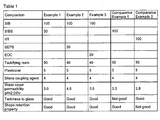
- the composition was compounded in the ratios shown in Table 1 so that each of the total weights was 40 g.
- the components were melt-kneaded with a Labo Plastomill (manufactured by Toyo Seiki Seisaku-Sho Ltd.) set at 170°C for 15 minutes to produce resin compositions used as sealing materials.
- Each of the resulting resin compositions was pressed under heating at 100°C to 170°C to produce sheets with a thickness of 1 mm.
- test pieces were produced.
- the water vapor permeability was measured at 40°C and 90% RH according to Japanese Industrial Standard (JIS) Z 0208 . Table 1 shows the results.
- test piece was left to stand under a temperature condition of 25°C for 15 minutes while the gap between the two glass plates was deformed by elongating by 10% relative to the initial state (after production). The degree of tackiness and adhesion at the interface between the glass and the material was observed. When the adhesion area was not changed as compared with that before the deformation (initial state), the test piece was evaluated as "Good”. When the separation was observed, the test piece was evaluated as "Not good”. Table 1 shows the results.
- SIB styrene-isobutylene-diblock copolymer
- SIBS styrene-isobutylene-styrene triblock copolymer
- IIR butyl rubber (Butyl 065, manufactured by JSR Corporation)
- SEPS styrene-ethylene propylene-styrene triblock copolymer
- EOC ethylene-octene copolymer (ENGAGE 8150, manufactured by The Dow Chemical Company)
- Tackifying resin (Arkon P-100, manufactured by Arakawa Chemical Industries, Ltd.)
- Plasticizer paraffin oil (PW-380, manufactured by Idemitsu Kosan Co., Ltd.)
- Silane coupling agent (A-171, manufactured by Nippon Unicar Co. , Ltd.)
- the sealing materials composed of the resin compositions each containing the isobutylene-based diblock copolymer of the present invention i.e., Examples 1 to 3, showed satisfactory values of water vapor permeability of 3.0 to 4.5 and had excellent adhesive property shape retention property.
- Comparative Example 1 i.e., a composition that did not contain the isobutylene-based diblock copolymer of the present invention and that was composed of SIBS, showed satisfactory water vapor permeability, but had low adhesive property, resulting in the separation easily.
- Comparative Example 2 i.e., a composition composed of a butyl rubber, was easily deformed and could not satisfactorily fulfill the role as a spacer.
- the resin composition of the present invention can be used for various applications as an alternative to conventional hot-melt products.
- the resin composition of the present invention is formed into sheets, moldings, pressure-sensitive adhesive articles, and foamed articles, and can be used as a pressure-sensitive adhesive material, an adhesive material, a gasket material, a sealing material, a base material for pressure-sensitive adhesives, a molding material, a rubber material, and the like. More specifically, examples thereof include sealing materials for architecture and vehicles, a sealing material for glass, a water-stop sealing material for automobiles, a water-stop tape for architecture, an electrical insulating tape, and various types of packing. Among these, the resin composition of the present invention can be preferably used as various sealing materials requiring gas-barrier property.
- the resin composition of the present invention can be preferably used as a sealing material for glass, in particular, as a sealing material for insulating glass.
- Examples of the effective application of the sealing material having hot-melt property of the present invention for insulating glass seal include an application in which the sealing material of the present invention is disposed between at least two glass plates as a spacer also serving as a sealing material and sealing is performed with the sealing material of the present invention alone, an application of combining the sealing material of the present invention with a metal or resin spacer containing a desiccant, an application of combining the sealing material of the present invention with a metal or resin spacer not containing any desiccant , and an application in which the sealing material of the present invention is used as a spacer also serving as a primary sealing material and a secondary sealing material is combined.
- excellent tackiness and shape retention property can be achieved and insulating glass can be easily produced.
Landscapes
- Chemical & Material Sciences (AREA)
- Engineering & Computer Science (AREA)
- Ceramic Engineering (AREA)
- Life Sciences & Earth Sciences (AREA)
- Chemical Kinetics & Catalysis (AREA)
- General Chemical & Material Sciences (AREA)
- Geochemistry & Mineralogy (AREA)
- Materials Engineering (AREA)
- Organic Chemistry (AREA)
- Sealing Material Composition (AREA)
- Compositions Of Macromolecular Compounds (AREA)
- Joining Of Glass To Other Materials (AREA)
Applications Claiming Priority (2)
| Application Number | Priority Date | Filing Date | Title |
|---|---|---|---|
| JP2003344179 | 2003-10-02 | ||
| PCT/JP2004/014043 WO2005033035A1 (fr) | 2003-10-02 | 2004-09-17 | Materiau d'etancheite pour vitre a double vitrage comprenant une composition de resine presentant d'excellentes proprietes de permeabilite au gaz et de pouvoir adhesif a chaud |
Publications (1)
| Publication Number | Publication Date |
|---|---|
| EP1674432A1 true EP1674432A1 (fr) | 2006-06-28 |
Family
ID=34419372
Family Applications (1)
| Application Number | Title | Priority Date | Filing Date |
|---|---|---|---|
| EP04788147A Withdrawn EP1674432A1 (fr) | 2003-10-02 | 2004-09-17 | Materiau d'etancheite pour vitre a double vitrage comprenant une composition de resine presentant d'excellentes proprietes de permeabilite au gaz et de pouvoir adhesif a chaud |
Country Status (5)
| Country | Link |
|---|---|
| US (1) | US20080249236A1 (fr) |
| EP (1) | EP1674432A1 (fr) |
| JP (1) | JPWO2005033035A1 (fr) |
| CA (1) | CA2539719A1 (fr) |
| WO (1) | WO2005033035A1 (fr) |
Cited By (7)
| Publication number | Priority date | Publication date | Assignee | Title |
|---|---|---|---|---|
| EP2166593A1 (fr) * | 2008-09-18 | 2010-03-24 | tesa SE | Procédé d'encapsulation d'un agencement électronique |
| WO2010063579A1 (fr) * | 2008-12-03 | 2010-06-10 | Tesa Se | Procédé d'encapsulage d'un dispositif électronique |
| EP2298577A1 (fr) * | 2009-09-04 | 2011-03-23 | Sumitomo Rubber Industries, Ltd. | Stratifié de polymère et pneu l'utilisant en tant que garniture interne |
| EP2502962A4 (fr) * | 2009-11-18 | 2014-04-30 | Ajinomoto Kk | Composition de résine |
| KR20140121843A (ko) * | 2012-01-16 | 2014-10-16 | 아지노모토 가부시키가이샤 | 밀봉용 수지 조성물 |
| US9676234B2 (en) | 2010-12-06 | 2017-06-13 | Sumitomo Rubber Industries, Ltd. | Strip, method for manufacturing the same, and method for manufacturing pneumatic tire |
| US10239271B2 (en) | 2010-11-05 | 2019-03-26 | Sumitomo Rubber Industries, Ltd. | Strip, method for manufacturing the same, and method for manufacturing pneumatic tire |
Families Citing this family (26)
| Publication number | Priority date | Publication date | Assignee | Title |
|---|---|---|---|---|
| US7750073B2 (en) * | 2005-12-21 | 2010-07-06 | Avon Products, Inc. | Use of thermoplastic elastomers in a composition and compositions thereof |
| WO2008004709A1 (fr) * | 2006-07-06 | 2008-01-10 | Nippon Sheet Glass Company, Limited | Panneau de verre à pression reduite et son procédé de fabrication |
| JP5254858B2 (ja) * | 2008-03-26 | 2013-08-07 | アイカ工業株式会社 | ホットメルト組成物、シール材、及び太陽電池 |
| JP5300679B2 (ja) * | 2009-09-30 | 2013-09-25 | 住友ゴム工業株式会社 | インナーライナー用ポリマー組成物およびそれを用いた空気入りタイヤ |
| WO2011094094A1 (fr) * | 2010-01-27 | 2011-08-04 | Kraton Polymers Us, Llc | Compositions contenant du styrène-isobutylène-styrène et copolymères à blocs styrène-éthylène/butylène-styrène |
| JP5243512B2 (ja) | 2010-06-29 | 2013-07-24 | 住友ゴム工業株式会社 | 空気入りタイヤの製造方法および空気入りタイヤ |
| JP5330350B2 (ja) | 2010-07-07 | 2013-10-30 | 住友ゴム工業株式会社 | インナーライナー用ポリマーシートおよびそれを用いた空気入りタイヤ |
| EP2415617B1 (fr) | 2010-07-30 | 2014-05-14 | Sumitomo Rubber Industries, Ltd. | Feuille en polymère pour revêtement interne, stratifié en polymère pour revêtement interne et pneu |
| US20130139941A1 (en) | 2010-08-25 | 2013-06-06 | Sumitomo Rubber Industries, Ltd. | Pneumatic tire and method for manufacturing the same, and tire vulcanizing bladder |
| JP5632684B2 (ja) * | 2010-09-03 | 2014-11-26 | 住友ゴム工業株式会社 | 空気入りタイヤおよびその製造方法 |
| JP5632686B2 (ja) * | 2010-09-07 | 2014-11-26 | 住友ゴム工業株式会社 | 空気入りタイヤ |
| JP5592217B2 (ja) * | 2010-09-30 | 2014-09-17 | 住友ゴム工業株式会社 | トラック・バス用タイヤ |
| JP4944239B1 (ja) | 2010-11-17 | 2012-05-30 | 住友ゴム工業株式会社 | 空気入りタイヤの製造方法 |
| JP5225364B2 (ja) | 2010-12-08 | 2013-07-03 | 住友ゴム工業株式会社 | ストリップ、その製造方法および空気入りタイヤの製造方法 |
| JP5758618B2 (ja) * | 2010-12-14 | 2015-08-05 | 住友ゴム工業株式会社 | 空気入りタイヤおよびその製造方法 |
| EP2708379A4 (fr) | 2011-05-13 | 2015-10-28 | Sumitomo Rubber Ind | Pneumatique |
| WO2013014983A1 (fr) | 2011-07-28 | 2013-01-31 | 住友ゴム工業株式会社 | Pneumatique |
| KR101706438B1 (ko) * | 2011-08-26 | 2017-02-13 | 미쓰비시 가가꾸 가부시키가이샤 | 접착성 밀봉 필름, 접착성 밀봉 필름의 제조 방법 및 접착성 밀봉 필름용 도포액 |
| BR112014006193A2 (pt) | 2011-09-16 | 2017-04-11 | Sumitomo Rubber Ind | tira, método para fabricação da mesma e método para fabricação de pneumático |
| JP5592420B2 (ja) * | 2012-02-15 | 2014-09-17 | 住友ゴム工業株式会社 | トラックまたはバス用タイヤ |
| JP5443554B2 (ja) | 2012-08-01 | 2014-03-19 | 住友ゴム工業株式会社 | インナーライナーを備えた空気入りタイヤ |
| JP5342684B1 (ja) | 2012-09-11 | 2013-11-13 | 住友ゴム工業株式会社 | インナーライナーを備えた空気入りタイヤ |
| JP2014146582A (ja) * | 2013-01-30 | 2014-08-14 | Furukawa Electric Co Ltd:The | 封止シートおよび有機電子デバイス用素子の封止方法 |
| CN104319927B (zh) * | 2014-10-11 | 2016-04-27 | 新疆金风科技股份有限公司 | 具有密封结构的电机槽楔以及组合装置 |
| WO2017010410A1 (fr) * | 2015-07-16 | 2017-01-19 | Jxエネルギー株式会社 | Composition d'élastomère thermoplastique, article moulé, matériau de construction, panneau de matériau de construction et matériau de plâtre |
| JP7804880B2 (ja) * | 2021-07-28 | 2026-01-23 | 東レ株式会社 | 軋み音防止用熱可塑性樹脂組成物および軋み音防止用成形品 |
Family Cites Families (5)
| Publication number | Priority date | Publication date | Assignee | Title |
|---|---|---|---|---|
| JP2000159550A (ja) * | 1998-11-25 | 2000-06-13 | Yokohama Rubber Co Ltd:The | 複層ガラスの製造用ノズル及びこの製造用ノズルを用いた複層ガラスの製造方法 |
| DE19937562A1 (de) * | 1999-08-09 | 2001-02-15 | Basf Ag | Elastische Dichtungsmaterialien auf der Basis von Blockcopolymeren aus Isobuten und vinylaromatischen Monomeren |
| JP4229575B2 (ja) * | 2000-06-12 | 2009-02-25 | 横浜ゴム株式会社 | シーリング材組成物およびそれを用いた複層ガラス |
| JP2002255596A (ja) * | 2001-02-27 | 2002-09-11 | Kanegafuchi Chem Ind Co Ltd | 複層ガラス用ゴム質スペーサおよび複層ガラス |
| JP3875551B2 (ja) * | 2001-12-21 | 2007-01-31 | リケンテクノス株式会社 | 熱可塑性エラストマー組成物 |
-
2004
- 2004-09-17 WO PCT/JP2004/014043 patent/WO2005033035A1/fr not_active Ceased
- 2004-09-17 JP JP2005514411A patent/JPWO2005033035A1/ja active Pending
- 2004-09-17 CA CA002539719A patent/CA2539719A1/fr not_active Abandoned
- 2004-09-17 EP EP04788147A patent/EP1674432A1/fr not_active Withdrawn
- 2004-09-17 US US10/571,984 patent/US20080249236A1/en not_active Abandoned
Non-Patent Citations (1)
| Title |
|---|
| See references of WO2005033035A1 * |
Cited By (13)
| Publication number | Priority date | Publication date | Assignee | Title |
|---|---|---|---|---|
| EP2166593A1 (fr) * | 2008-09-18 | 2010-03-24 | tesa SE | Procédé d'encapsulation d'un agencement électronique |
| US9627646B2 (en) | 2008-09-18 | 2017-04-18 | Tesa Se | Method for encapsulating an electronic arrangement |
| US8460969B2 (en) | 2008-12-03 | 2013-06-11 | Tesa Se | Method for encapsulating an electronic arrangement |
| WO2010063579A1 (fr) * | 2008-12-03 | 2010-06-10 | Tesa Se | Procédé d'encapsulage d'un dispositif électronique |
| EP2298577A1 (fr) * | 2009-09-04 | 2011-03-23 | Sumitomo Rubber Industries, Ltd. | Stratifié de polymère et pneu l'utilisant en tant que garniture interne |
| US8616255B2 (en) | 2009-09-04 | 2013-12-31 | Sumitomo Rubber Industries, Ltd. | Polymer laminate and pneumatic tire using the same as inner liner |
| EP2502962A4 (fr) * | 2009-11-18 | 2014-04-30 | Ajinomoto Kk | Composition de résine |
| US8809442B2 (en) | 2009-11-18 | 2014-08-19 | Ajinomoto Co., Inc. | Resin composition |
| US10239271B2 (en) | 2010-11-05 | 2019-03-26 | Sumitomo Rubber Industries, Ltd. | Strip, method for manufacturing the same, and method for manufacturing pneumatic tire |
| US9676234B2 (en) | 2010-12-06 | 2017-06-13 | Sumitomo Rubber Industries, Ltd. | Strip, method for manufacturing the same, and method for manufacturing pneumatic tire |
| KR20140121843A (ko) * | 2012-01-16 | 2014-10-16 | 아지노모토 가부시키가이샤 | 밀봉용 수지 조성물 |
| EP2805997A4 (fr) * | 2012-01-16 | 2015-09-09 | Ajinomoto Kk | Composition de résine pour faire étanchéité |
| US9676978B2 (en) | 2012-01-16 | 2017-06-13 | Ajinomoto Co., Ltd. | Resin composition for sealing |
Also Published As
| Publication number | Publication date |
|---|---|
| US20080249236A1 (en) | 2008-10-09 |
| CA2539719A1 (fr) | 2005-04-14 |
| JPWO2005033035A1 (ja) | 2006-12-14 |
| WO2005033035A1 (fr) | 2005-04-14 |
Similar Documents
| Publication | Publication Date | Title |
|---|---|---|
| EP1674432A1 (fr) | Materiau d'etancheite pour vitre a double vitrage comprenant une composition de resine presentant d'excellentes proprietes de permeabilite au gaz et de pouvoir adhesif a chaud | |
| CA2444534C (fr) | Composition elastomere thermoplastique | |
| JP6716612B2 (ja) | 水添共重合体、組成物及び成形体 | |
| CA2910452C (fr) | Composition de resine polyolefinique et corps moule | |
| JP6266762B2 (ja) | 熱可塑性エラストマー組成物、医療容器用栓体及び医療容器 | |
| JP7035086B2 (ja) | 架橋性組成物およびそれからなる成形可能な熱可塑性エラストマー製品 | |
| JP3946080B2 (ja) | 熱可塑性エラストマー組成物 | |
| WO2005093005A1 (fr) | Composition pour matériau d'étanchéité | |
| CN105246971A (zh) | 热塑性弹性体组合物和成型体 | |
| EP2634215A1 (fr) | Copolymère séquencé à base d'isobutylène | |
| JP2006273705A (ja) | 複層ガラス | |
| JP5271749B2 (ja) | タイヤ用インナーライナー | |
| CN100453575C (zh) | 嵌段共聚物及其制备方法 | |
| EP1900771A1 (fr) | Composition de résine | |
| CN103534104B (zh) | 充气轮胎 | |
| EP1584654B1 (fr) | Produit d'étanchéité à base de caoutchouc butyl | |
| JP2000038460A (ja) | シ―ト材料 | |
| JP2007308350A (ja) | 複層ガラス | |
| JP7323906B2 (ja) | ホットメルト組成物、シーリング材およびシリンジ | |
| JP4031226B2 (ja) | 熱可塑性重合体組成物 | |
| JP4689354B2 (ja) | エラストマー組成物 | |
| JP2000144087A (ja) | 粘着剤組成物及び粘着剤製品 | |
| EP1892265A1 (fr) | Composition de résine | |
| JP2008201931A (ja) | 樹脂組成物 | |
| JP2009269796A (ja) | 複層ガラス用樹脂スペーサ |
Legal Events
| Date | Code | Title | Description |
|---|---|---|---|
| PUAI | Public reference made under article 153(3) epc to a published international application that has entered the european phase |
Free format text: ORIGINAL CODE: 0009012 |
|
| 17P | Request for examination filed |
Effective date: 20060331 |
|
| AK | Designated contracting states |
Kind code of ref document: A1 Designated state(s): AT BE BG CH CY CZ DE DK EE ES FI FR GB GR HU IE IT LI LU MC NL PL PT RO SE SI SK TR |
|
| DAX | Request for extension of the european patent (deleted) | ||
| STAA | Information on the status of an ep patent application or granted ep patent |
Free format text: STATUS: THE APPLICATION HAS BEEN WITHDRAWN |
|
| 18W | Application withdrawn |
Effective date: 20090717 |