EP1674506A1 - Matte, biaxial orientierte Polyesterfolie - Google Patents
Matte, biaxial orientierte Polyesterfolie Download PDFInfo
- Publication number
- EP1674506A1 EP1674506A1 EP05027260A EP05027260A EP1674506A1 EP 1674506 A1 EP1674506 A1 EP 1674506A1 EP 05027260 A EP05027260 A EP 05027260A EP 05027260 A EP05027260 A EP 05027260A EP 1674506 A1 EP1674506 A1 EP 1674506A1
- Authority
- EP
- European Patent Office
- Prior art keywords
- film
- film according
- particles
- layer
- microns
- Prior art date
- Legal status (The legal status is an assumption and is not a legal conclusion. Google has not performed a legal analysis and makes no representation as to the accuracy of the status listed.)
- Granted
Links
- 229920006267 polyester film Polymers 0.000 title claims abstract description 12
- 239000002245 particle Substances 0.000 claims abstract description 40
- VYPSYNLAJGMNEJ-UHFFFAOYSA-N Silicium dioxide Chemical compound O=[Si]=O VYPSYNLAJGMNEJ-UHFFFAOYSA-N 0.000 claims abstract description 28
- 239000000377 silicon dioxide Substances 0.000 claims abstract description 10
- 235000012239 silicon dioxide Nutrition 0.000 claims abstract description 6
- 238000000034 method Methods 0.000 claims description 16
- 239000000203 mixture Substances 0.000 claims description 10
- 229920000728 polyester Polymers 0.000 claims description 9
- 229920000642 polymer Polymers 0.000 claims description 8
- 239000003054 catalyst Substances 0.000 claims description 5
- 239000000155 melt Substances 0.000 claims description 3
- 239000002244 precipitate Substances 0.000 claims description 2
- 239000012963 UV stabilizer Substances 0.000 claims 1
- 238000001816 cooling Methods 0.000 claims 1
- -1 polyethylene terephthalate Polymers 0.000 description 20
- LYCAIKOWRPUZTN-UHFFFAOYSA-N Ethylene glycol Chemical compound OCCO LYCAIKOWRPUZTN-UHFFFAOYSA-N 0.000 description 15
- 239000010410 layer Substances 0.000 description 13
- 229920000139 polyethylene terephthalate Polymers 0.000 description 13
- 239000005020 polyethylene terephthalate Substances 0.000 description 13
- 239000006096 absorbing agent Substances 0.000 description 11
- 229910004298 SiO 2 Inorganic materials 0.000 description 10
- 230000003287 optical effect Effects 0.000 description 6
- KKEYFWRCBNTPAC-UHFFFAOYSA-N Terephthalic acid Chemical compound OC(=O)C1=CC=C(C(O)=O)C=C1 KKEYFWRCBNTPAC-UHFFFAOYSA-N 0.000 description 5
- 238000001125 extrusion Methods 0.000 description 5
- 238000004519 manufacturing process Methods 0.000 description 5
- VTYYLEPIZMXCLO-UHFFFAOYSA-L Calcium carbonate Chemical compound [Ca+2].[O-]C([O-])=O VTYYLEPIZMXCLO-UHFFFAOYSA-L 0.000 description 4
- 239000004594 Masterbatch (MB) Substances 0.000 description 4
- 230000007423 decrease Effects 0.000 description 4
- 150000001991 dicarboxylic acids Chemical class 0.000 description 4
- 239000011888 foil Substances 0.000 description 4
- 230000000052 comparative effect Effects 0.000 description 3
- MTHSVFCYNBDYFN-UHFFFAOYSA-N diethylene glycol Chemical compound OCCOCCO MTHSVFCYNBDYFN-UHFFFAOYSA-N 0.000 description 3
- 150000002009 diols Chemical class 0.000 description 3
- RXOHFPCZGPKIRD-UHFFFAOYSA-N naphthalene-2,6-dicarboxylic acid Chemical compound C1=C(C(O)=O)C=CC2=CC(C(=O)O)=CC=C21 RXOHFPCZGPKIRD-UHFFFAOYSA-N 0.000 description 3
- 238000002360 preparation method Methods 0.000 description 3
- 229920001169 thermoplastic Polymers 0.000 description 3
- 239000004416 thermosoftening plastic Substances 0.000 description 3
- NEQFBGHQPUXOFH-UHFFFAOYSA-N 4-(4-carboxyphenyl)benzoic acid Chemical compound C1=CC(C(=O)O)=CC=C1C1=CC=C(C(O)=O)C=C1 NEQFBGHQPUXOFH-UHFFFAOYSA-N 0.000 description 2
- 241000196324 Embryophyta Species 0.000 description 2
- NBIIXXVUZAFLBC-UHFFFAOYSA-N Phosphoric acid Chemical compound OP(O)(O)=O NBIIXXVUZAFLBC-UHFFFAOYSA-N 0.000 description 2
- GWEVSGVZZGPLCZ-UHFFFAOYSA-N Titan oxide Chemical compound O=[Ti]=O GWEVSGVZZGPLCZ-UHFFFAOYSA-N 0.000 description 2
- 239000000654 additive Substances 0.000 description 2
- ADCOVFLJGNWWNZ-UHFFFAOYSA-N antimony trioxide Chemical compound O=[Sb]O[Sb]=O ADCOVFLJGNWWNZ-UHFFFAOYSA-N 0.000 description 2
- WERYXYBDKMZEQL-UHFFFAOYSA-N butane-1,4-diol Chemical compound OCCCCO WERYXYBDKMZEQL-UHFFFAOYSA-N 0.000 description 2
- 229910000019 calcium carbonate Inorganic materials 0.000 description 2
- 230000001186 cumulative effect Effects 0.000 description 2
- 239000000543 intermediate Substances 0.000 description 2
- 238000005259 measurement Methods 0.000 description 2
- 238000006068 polycondensation reaction Methods 0.000 description 2
- 229920002959 polymer blend Polymers 0.000 description 2
- YPFDHNVEDLHUCE-UHFFFAOYSA-N propane-1,3-diol Chemical compound OCCCO YPFDHNVEDLHUCE-UHFFFAOYSA-N 0.000 description 2
- 239000002994 raw material Substances 0.000 description 2
- 239000002356 single layer Substances 0.000 description 2
- 230000003746 surface roughness Effects 0.000 description 2
- 238000005809 transesterification reaction Methods 0.000 description 2
- 150000003918 triazines Chemical class 0.000 description 2
- PXGZQGDTEZPERC-UHFFFAOYSA-N 1,4-cyclohexanedicarboxylic acid Chemical compound OC(=O)C1CCC(C(O)=O)CC1 PXGZQGDTEZPERC-UHFFFAOYSA-N 0.000 description 1
- VPWNQTHUCYMVMZ-UHFFFAOYSA-N 4,4'-sulfonyldiphenol Chemical class C1=CC(O)=CC=C1S(=O)(=O)C1=CC=C(O)C=C1 VPWNQTHUCYMVMZ-UHFFFAOYSA-N 0.000 description 1
- 229930185605 Bisphenol Natural products 0.000 description 1
- OYPRJOBELJOOCE-UHFFFAOYSA-N Calcium Chemical compound [Ca] OYPRJOBELJOOCE-UHFFFAOYSA-N 0.000 description 1
- WHXSMMKQMYFTQS-UHFFFAOYSA-N Lithium Chemical compound [Li] WHXSMMKQMYFTQS-UHFFFAOYSA-N 0.000 description 1
- FYYHWMGAXLPEAU-UHFFFAOYSA-N Magnesium Chemical compound [Mg] FYYHWMGAXLPEAU-UHFFFAOYSA-N 0.000 description 1
- ALQSHHUCVQOPAS-UHFFFAOYSA-N Pentane-1,5-diol Chemical compound OCCCCCO ALQSHHUCVQOPAS-UHFFFAOYSA-N 0.000 description 1
- 241000170793 Phalaris canariensis Species 0.000 description 1
- 239000004743 Polypropylene Substances 0.000 description 1
- 229910010413 TiO 2 Inorganic materials 0.000 description 1
- HCHKCACWOHOZIP-UHFFFAOYSA-N Zinc Chemical compound [Zn] HCHKCACWOHOZIP-UHFFFAOYSA-N 0.000 description 1
- YIMQCDZDWXUDCA-UHFFFAOYSA-N [4-(hydroxymethyl)cyclohexyl]methanol Chemical compound OCC1CCC(CO)CC1 YIMQCDZDWXUDCA-UHFFFAOYSA-N 0.000 description 1
- 239000002253 acid Substances 0.000 description 1
- 150000007513 acids Chemical class 0.000 description 1
- 150000001335 aliphatic alkanes Chemical group 0.000 description 1
- 125000001931 aliphatic group Chemical group 0.000 description 1
- 229910000147 aluminium phosphate Inorganic materials 0.000 description 1
- 229920006378 biaxially oriented polypropylene Polymers 0.000 description 1
- 239000011127 biaxially oriented polypropylene Substances 0.000 description 1
- 239000011575 calcium Substances 0.000 description 1
- 229910052791 calcium Inorganic materials 0.000 description 1
- 125000004432 carbon atom Chemical group C* 0.000 description 1
- 238000012512 characterization method Methods 0.000 description 1
- 238000000576 coating method Methods 0.000 description 1
- QYQADNCHXSEGJT-UHFFFAOYSA-N cyclohexane-1,1-dicarboxylate;hydron Chemical class OC(=O)C1(C(O)=O)CCCCC1 QYQADNCHXSEGJT-UHFFFAOYSA-N 0.000 description 1
- PDXRQENMIVHKPI-UHFFFAOYSA-N cyclohexane-1,1-diol Chemical class OC1(O)CCCCC1 PDXRQENMIVHKPI-UHFFFAOYSA-N 0.000 description 1
- VKONPUDBRVKQLM-UHFFFAOYSA-N cyclohexane-1,4-diol Chemical compound OC1CCC(O)CC1 VKONPUDBRVKQLM-UHFFFAOYSA-N 0.000 description 1
- 230000003247 decreasing effect Effects 0.000 description 1
- 230000000593 degrading effect Effects 0.000 description 1
- 239000006185 dispersion Substances 0.000 description 1
- 238000009826 distribution Methods 0.000 description 1
- 230000032050 esterification Effects 0.000 description 1
- 238000005886 esterification reaction Methods 0.000 description 1
- 238000009998 heat setting Methods 0.000 description 1
- XXMIOPMDWAUFGU-UHFFFAOYSA-N hexane-1,6-diol Chemical compound OCCCCCCO XXMIOPMDWAUFGU-UHFFFAOYSA-N 0.000 description 1
- 229920001519 homopolymer Polymers 0.000 description 1
- 238000010348 incorporation Methods 0.000 description 1
- 229910052744 lithium Inorganic materials 0.000 description 1
- 239000011777 magnesium Substances 0.000 description 1
- 229910052749 magnesium Inorganic materials 0.000 description 1
- 150000002696 manganese Chemical class 0.000 description 1
- 239000000463 material Substances 0.000 description 1
- 238000000691 measurement method Methods 0.000 description 1
- 238000000048 melt cooling Methods 0.000 description 1
- 239000000178 monomer Substances 0.000 description 1
- KYTZHLUVELPASH-UHFFFAOYSA-N naphthalene-1,2-dicarboxylic acid Chemical class C1=CC=CC2=C(C(O)=O)C(C(=O)O)=CC=C21 KYTZHLUVELPASH-UHFFFAOYSA-N 0.000 description 1
- 150000003014 phosphoric acid esters Chemical class 0.000 description 1
- 150000003018 phosphorus compounds Chemical class 0.000 description 1
- XNGIFLGASWRNHJ-UHFFFAOYSA-N phthalic acid Chemical class OC(=O)C1=CC=CC=C1C(O)=O XNGIFLGASWRNHJ-UHFFFAOYSA-N 0.000 description 1
- 230000000704 physical effect Effects 0.000 description 1
- 238000003976 plant breeding Methods 0.000 description 1
- 239000002985 plastic film Substances 0.000 description 1
- 229920006255 plastic film Polymers 0.000 description 1
- 229920001155 polypropylene Polymers 0.000 description 1
- 238000012545 processing Methods 0.000 description 1
- 239000003381 stabilizer Substances 0.000 description 1
- 238000010561 standard procedure Methods 0.000 description 1
- 239000002344 surface layer Substances 0.000 description 1
- KKEYFWRCBNTPAC-UHFFFAOYSA-L terephthalate(2-) Chemical compound [O-]C(=O)C1=CC=C(C([O-])=O)C=C1 KKEYFWRCBNTPAC-UHFFFAOYSA-L 0.000 description 1
- 238000012360 testing method Methods 0.000 description 1
- 150000003608 titanium Chemical class 0.000 description 1
- 239000004408 titanium dioxide Substances 0.000 description 1
- 230000000007 visual effect Effects 0.000 description 1
- XLYOFNOQVPJJNP-UHFFFAOYSA-N water Substances O XLYOFNOQVPJJNP-UHFFFAOYSA-N 0.000 description 1
- 238000004804 winding Methods 0.000 description 1
- 229910052725 zinc Inorganic materials 0.000 description 1
- 239000011701 zinc Substances 0.000 description 1
Images
Classifications
-
- C—CHEMISTRY; METALLURGY
- C08—ORGANIC MACROMOLECULAR COMPOUNDS; THEIR PREPARATION OR CHEMICAL WORKING-UP; COMPOSITIONS BASED THEREON
- C08J—WORKING-UP; GENERAL PROCESSES OF COMPOUNDING; AFTER-TREATMENT NOT COVERED BY SUBCLASSES C08B, C08C, C08F, C08G or C08H
- C08J5/00—Manufacture of articles or shaped materials containing macromolecular substances
- C08J5/18—Manufacture of films or sheets
-
- C—CHEMISTRY; METALLURGY
- C08—ORGANIC MACROMOLECULAR COMPOUNDS; THEIR PREPARATION OR CHEMICAL WORKING-UP; COMPOSITIONS BASED THEREON
- C08K—Use of inorganic or non-macromolecular organic substances as compounding ingredients
- C08K5/00—Use of organic ingredients
- C08K5/04—Oxygen-containing compounds
- C08K5/07—Aldehydes; Ketones
- C08K5/08—Quinones
-
- C—CHEMISTRY; METALLURGY
- C08—ORGANIC MACROMOLECULAR COMPOUNDS; THEIR PREPARATION OR CHEMICAL WORKING-UP; COMPOSITIONS BASED THEREON
- C08K—Use of inorganic or non-macromolecular organic substances as compounding ingredients
- C08K5/00—Use of organic ingredients
- C08K5/04—Oxygen-containing compounds
- C08K5/10—Esters; Ether-esters
-
- C—CHEMISTRY; METALLURGY
- C08—ORGANIC MACROMOLECULAR COMPOUNDS; THEIR PREPARATION OR CHEMICAL WORKING-UP; COMPOSITIONS BASED THEREON
- C08K—Use of inorganic or non-macromolecular organic substances as compounding ingredients
- C08K5/00—Use of organic ingredients
- C08K5/16—Nitrogen-containing compounds
- C08K5/34—Heterocyclic compounds having nitrogen in the ring
-
- C—CHEMISTRY; METALLURGY
- C08—ORGANIC MACROMOLECULAR COMPOUNDS; THEIR PREPARATION OR CHEMICAL WORKING-UP; COMPOSITIONS BASED THEREON
- C08J—WORKING-UP; GENERAL PROCESSES OF COMPOUNDING; AFTER-TREATMENT NOT COVERED BY SUBCLASSES C08B, C08C, C08F, C08G or C08H
- C08J2367/00—Characterised by the use of polyesters obtained by reactions forming a carboxylic ester link in the main chain; Derivatives of such polymers
- C08J2367/02—Polyesters derived from dicarboxylic acids and dihydroxy compounds
-
- Y—GENERAL TAGGING OF NEW TECHNOLOGICAL DEVELOPMENTS; GENERAL TAGGING OF CROSS-SECTIONAL TECHNOLOGIES SPANNING OVER SEVERAL SECTIONS OF THE IPC; TECHNICAL SUBJECTS COVERED BY FORMER USPC CROSS-REFERENCE ART COLLECTIONS [XRACs] AND DIGESTS
- Y10—TECHNICAL SUBJECTS COVERED BY FORMER USPC
- Y10T—TECHNICAL SUBJECTS COVERED BY FORMER US CLASSIFICATION
- Y10T428/00—Stock material or miscellaneous articles
- Y10T428/24—Structurally defined web or sheet [e.g., overall dimension, etc.]
- Y10T428/24355—Continuous and nonuniform or irregular surface on layer or component [e.g., roofing, etc.]
Definitions
- the invention relates to a mono- or multilayer, mat, biaxially oriented polyester film containing SiO 2 particles in a total particle concentration of 0.2 to ⁇ 1.0 wt .-% (based on the weight of the film) and having an average particle size ( d 50 ) from 2.5 to 4.5 microns.
- the invention further relates to a process for producing the film and its use.
- the film of the invention is characterized by characteristic optical properties.
- the high turbidity of the film increases the proportion of scattered light.
- high transparency improves the film, for example when used as a greenhouse film, the growth of the plants and thereby increases the efficiency of plant breeding.
- the increased arithmetic roughness R a favors the processing of the film in the manufacturing process.
- the film is also well suited in the industrial sector.
- US-A-3,154,461 discloses a process for making a biaxially oriented thermoplastic film (e.g., polyethylene terephthalate, polypropylene) having a matte surface wherein the film comprises incompressible particles (e.g., calcium carbonate, silica) in a matte surface Size of 0.3 to 20 microns and in one Concentration of 1 to 25% contains. For many applications, the film made by this process is too rough.
- a biaxially oriented thermoplastic film e.g., polyethylene terephthalate, polypropylene
- incompressible particles e.g., calcium carbonate, silica
- EP-A-0 152 265 describes a polyester film comprising 0.01 to 1.0% by weight of silica and / or titanium dioxide with an average particle size of 0.01 to 0.5 ⁇ m and 0.02 to 0 Contains 5 wt .-% calcium carbonate having an average particle size of 0.04 to 0.48 microns. This film has a very low roughness due to the small particles, on the transparency no statements are made.
- the object of the present invention was to provide a biaxially oriented polyester film which has a uniform roughness and defined optical properties.
- the structure of the surface should cause the film to be coated well.
- the object is achieved by a single or multi-layer, matt, biaxially oriented polyester film, wherein at least one layer of silica for generating the surface roughness and for adjusting the turbidity contains high transparency.
- concentration of the silicon dioxide is 0.2 to ⁇ 1.0 wt .-%, preferably 0.4 to 0.9 wt .-%, particularly preferably 0.6 to 0.8 wt .-%, based on the Total weight of the film.
- the film may additionally contain a UV absorber.
- UV absorber are preferably triazines, z. B. ® Tinnuvin 1577 Ciba, Basel, Switzerland, used.
- the film is preferably constructed as a single layer and, in this case, comprises as layer only the base layer (B).
- the base layer (B) of the film preferably contains at least 70% by weight of thermoplastic polyester.
- aromatic dicarboxylic acids are preferably benzenedicarboxylic acids, naphthalenedicarboxylic acids, for example naphthalene-1,4- or 1,6-dicarboxylic acid, biphenyl-x, x'-dicarboxylic acids, in particular biphenyl-4,4'-dicarboxylic acid, diphenyl-acetylene-x, x '-dicarboxylic acids, in particular diphenylacetylene-4,4'-dicarboxylic acid, or stilbene-x, x'-dicarboxylic acids.
- cycloaliphatic dicarboxylic acids mention may be made of cyclohexanedicarboxylic acids, in particular cyclohexane-1,4-dicarboxylic acid.
- aliphatic dicarboxylic acids the (C 3 to C 19 ) alkanedioic acids are particularly suitable, it being possible for the alkane part to be straight-chain or branched.
- the selected type, concentration and particle size of the SiO 2 particles also causes the transparency of the film between 70 and 95%, preferably between 80 and 92% and particularly preferably between 82 and 90% and the haze of the film in the range between 38 and 60%, preferably between 40 to 58% and more preferably between 42 and 56% and the gloss of the film measured at 60 ° and 85 ° at both measuring angles between 10 and 100, preferably between 15 and 85 and more preferably between 20 and 70 is.
- the film according to the invention preferably contains no further particles which can influence or influence the surface properties and / or appearance of the film, such as CaCO 3 , TiO 2 , BaSO 4 particles, etc.
- conventional stabilizers may be included such as phosphorus compounds such as phosphoric acid or phosphoric acid esters derived from polyester raw material production and commonly referred to as "internal" particles or (catalyst) precipitates.
- the film according to the invention still contains 0 to 10 wt .-%, preferably between 1 and 8 wt .-%, particularly preferably 2 to 6%, of a UV absorber.
- a UV absorber are preferably triazines, z. B. ® Tinnuvin 1577 Ciba, Basel, Switzerland, used.
- the use of the UV absorber provides better weatherability, prevents UV rays from degrading the life of the film, and makes the film look good for outdoor applications, e.g. B. Use as a greenhouse film is suitable.
- the thickness of the polyester film according to the invention can vary within certain limits. It is advantageously in the range of 3 to 250 .mu.m, in particular from 4 to 100 .mu.m, preferably from 5 to 50 microns.
- the invention also relates to a process for the preparation of the polyester film according to the invention by the extrusion process known per se from the literature (see, for example: “Handbook of Thermoplastic Polyesters, Ed., S. Fakirov, Wiley-VCH, 2002” or in the chapter “Polyesters , Films “in the” Encyclopedia of Polymer Science and Engineering, Vol. 12, John Wiley & Sons, 1988 ").
- the biaxial stretching (orientation) is generally performed sequentially, with the successive biaxial stretching, which is usually stretched first longitudinally (in the machine direction) and then transversely (perpendicular to the machine direction), being preferred.
- the polymer or the polymer mixture for the film is compressed and liquefied in an extruder, wherein the optionally provided as additives additives such as particles may already be contained in the polymer or in the polymer mixture.
- the melt is then simultaneously pressed through a flat die (slot die) and the squeezed melt is drawn off on one or more cooled draw rolls, with the melt cooling and solidifying into a prefilm.
- the biaxial stretching is generally performed sequentially.
- the stretching in the longitudinal direction can be carried out with the aid of two rolls rotating at different speeds according to the desired stretch ratio.
- transverse stretching is generally used a corresponding clip frame in which the film is clamped on both edges and then pulled at elevated temperature to both sides.
- the film can be additionally coated.
- Typical coatings are adhesion-promoting, antistatic, slip-improving, hydrophilic or dehesive. It is advisable to apply these additional layers by means of aqueous dispersions in-line after the stretching step in the longitudinal direction and before the stretching step in the transverse direction on the film.
- the film of the invention is characterized by defined optical properties and a uniform roughness.
- Table 1 shows the properties of the films according to the invention.
- Table 1 shows the properties of the films according to the invention.
- Table 1 shows the properties of the films according to the invention.
- Table 1 shows the properties of the films according to the invention.
- Table 1 shows the properties of the films according to the invention.
- Table 1 shows the properties of the films according to the invention.
- Table 1 shows the properties of the films according to the invention.
- Table 1 shows the properties of the films according to the invention.
- Table 1 shows the properties of the films according to the invention.
- Table 1 shows the properties of the films according to the invention.
- Table 1 shows the properties of the films according to the invention.
- Table 1 shows the properties of the films according to the invention.
- Table 1 shows the properties of the films according to the invention.
- Table 1 shows the properties of the films according to the invention.
- Table 1 shows the properties of the films according to the invention.
- Table 1 shows the properties of the films
- the films of the invention are particularly suitable in the industrial sector, eg. As for greenhouses for diffuse scattering of light. This increases the growth rate of the plants and leads to a better economy.
- a UV absorber increases the weather resistance and thus the life of the film.
- the arithmetic mean roughness R a was determined according to DIN 4762.
- the gloss was determined according to DIN 67 530.
- the reflector value was measured as an optical parameter for the surface of a film. Based on the standards ASTM-D 523-78 and ISO 2813, the angle of incidence was set at 60 ° or 85 °. A light beam strikes the flat test surface under the set angle of incidence is reflected or scattered by this. The light rays incident on the photoelectronic receiver are displayed as a proportional electrical quantity. The measured value is dimensionless and must be specified with the angle of incidence.
- the determination of the mean diameter d 50 was carried out by laser on a Malvern Master Sizer according to the standard method (other measuring devices are for example Horiba LA 500 or Sympathec Helos, which use the same measuring principle).
- the samples were placed in a cuvette with water and then placed in the meter.
- the measuring process is automatic and includes the mathematical determination of the d 50 value.
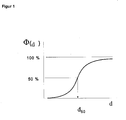
- the d 50 value is determined from the (relative) cumulative curve of the particle size distribution: the point of intersection of the 50% ordinate value with the cumulative curve immediately gives the desired d 50 value on the abscissa axis. How this is to be understood is illustrated in more detail in FIG .
- the measurement on the polyester films is carried out on Hazegard Hazemeter XL-211 of the Fa. BYK Gardner according to ASTM-D 1003-00.
- Chips of polyethylene terephthalate were fed at a temperature of 150 ° C to the extruder for the base layer (B). Then, by extrusion and subsequent stepwise orientation in the longitudinal and transverse direction, a single-layer film with the total thickness of 20 microns was prepared.
- Foil mixture of: 75 wt .-% polyethylene terephthalate with an SV value of 750 25% by weight of masterbatch of 96% by weight of polyethylene terephthalate, 3.0% by weight of silica particles having a d 50 value of 3.5 ⁇ m and 1.0% by weight of UV absorber ®Tinnuvin 1577 from Ciba , Switzerland.
- the film had the required haze and transparency.
- the achieved properties of the film are shown in Table 2.
- Example 2 Compared to Example 1, the composition of the film was changed as follows: Foil, mixture of: 67% by weight Polyethylene terephthalate with an SV value of 750 33% by weight Masterbatch of 96 wt .-% polyethylene terephthalate, 3.0 wt .-% silica particles having a d 50 value of 3.5 microns and 1.0 wt .-% UV absorber ®Tinnuvin 1577 Ciba, Switzerland.
- Foil mixture of: 67% by weight Polyethylene terephthalate with an SV value of 750 33% by weight Masterbatch of 96 wt .-% polyethylene terephthalate, 3.0 wt .-% silica particles having a d 50 value of 3.5 microns and 1.0 wt .-% UV absorber ®Tinnuvin 1577 Ciba, Switzerland.
- the haze of the film has increased over Example 1 by 12 percentage points, the transparency of 1 percentage point decrease and the arithmetic roughness R a has increased by 34 nm.
- the achieved properties of the film are shown in Table 2.
- Example 2 Compared to Example 1, the composition of the film was changed as follows: Foil, mixture of: 83% by weight Polyethylene terephthalate with an SV value of 750 17% by weight Masterbatch of 96 wt .-% polyethylene terephthalate, 3.0 wt .-% silica particles having a d 50 value of 3.5 microns and 1.0 wt .-% UV absorber ®Tinnuvin 1577 Ciba, Switzerland.
- Foil mixture of: 83% by weight Polyethylene terephthalate with an SV value of 750 17% by weight Masterbatch of 96 wt .-% polyethylene terephthalate, 3.0 wt .-% silica particles having a d 50 value of 3.5 microns and 1.0 wt .-% UV absorber ®Tinnuvin 1577 Ciba, Switzerland.
- the haze of the film has decreased by 12 percentage points compared to Example 1, the transparency increased by 2 percentage points and the arithmetic roughness R a is reduced by 49 nm.
- the achieved properties of the film are shown in Table 2.
- Example 1 Compared to Example 1, the film has now been modified with a different particle system. The haze of the film and the arithmetic roughness R a are too low.
- Foil mixture of: 75% by weight Polyethylene terephthalate with an SV value of 750 25% by weight Masterbatch of 96 wt .-% polyethylene terephthalate, 3.0 wt .-% silica particles with a d 50 value of 2.4 microns and 1.0 wt .-% UV absorber ®Tinnuvin 1577 Ciba, Switzerland
- Comparative Example 2 was taken from EP-A-1 197 326 (Example 1). The transparency of the film is too low.
Landscapes
- Chemical & Material Sciences (AREA)
- Organic Chemistry (AREA)
- Manufacturing & Machinery (AREA)
- Engineering & Computer Science (AREA)
- Health & Medical Sciences (AREA)
- Chemical Kinetics & Catalysis (AREA)
- Medicinal Chemistry (AREA)
- Polymers & Plastics (AREA)
- Materials Engineering (AREA)
- Manufacture Of Macromolecular Shaped Articles (AREA)
- Laminated Bodies (AREA)
- Shaping By String And By Release Of Stress In Plastics And The Like (AREA)
- Compositions Of Macromolecular Compounds (AREA)
Abstract
Description
- Die Erfindung betrifft eine ein- oder mehrschichtige, matte, biaxial orientierte Polyesterfolie, die SiO2-Partikel in einer Gesamtpartikelkonzentration von 0,2 bis < 1,0 Gew.-% (bezogen auf das Gewicht der Folie) und mit einer mittleren Teilchengröße (d50) von 2,5 bis 4,5 µm enthält. Die Erfindung betrifft weiterhin ein Verfahren zur Herstellung der Folie und ihre Verwendung.
- Die Industrie hat einen hohen Bedarf an Kunststofffolien wie z. B. biaxial orientierten Polypropylen- oder biaxial orientierten Polyesterfolien, die definierte Oberflächen und optische Eigenschaften aufweisen. Folien mit gleichmäßiger, nicht zu hoher Oberflächenrauheit sind von Interesse in speziellen Anwendungen. Insbesondere bei der Verwendung als Treibhausfolien ist eine Kombination von hoher Trübung bei gleichzeitiger hoher Transparenz gefordert. Die Realisierung dieser Anforderung ist besonders schwierig, da diese beiden Parameter gegenläufig sind. Durch die Einarbeitung von Partikeln kann zwar die Trübung heraufgesetzt werden, gleichzeitig erniedrigt sich damit aber auch die Transparenz, was nicht erwünscht ist. Die Lösung dieses Problems war nicht trivial.
- Die erfindungsgemäße Folie zeichnet sich durch charakteristische optische Eigenschaften aus. Die hohe Trübung der Folie erhöht den Streuanteil des Lichtes. Bei gleichzeitig hoher Transparenz verbessert die Folie, beispielsweise bei Verwendung als Treibhausfolie, das Wachstum der Pflanzen und erhöht dadurch die Wirtschaftlichkeit der Pflanzenaufzucht. Die erhöhte arithmetische Rauigkeit Ra begünstigt die Verarbeitung der Folie im Herstellungsprozess. Neben der Verwendung als Treibhausfolie ist die Folie auch im industriellen Sektor gut geeignet.
- In der US-A-3,154,461 wird ein Verfahren zur Herstellung einer biaxial orientierten Folie aus thermoplastischem Kunststoff (z. B. Polyethylenterephthalat, Polypropylen) mit matter Oberfläche beschrieben, bei dem die Folie inkompressible Partikel (z. B. Calciumcarbonat, Siliciumdioxid) in einer Größe von 0,3 bis 20 µm und in einer Konzentration von 1 bis 25 % enthält. Für viele Anwendungen ist die nach diesem Verfahren hergestellte Folie zu rau.
- In der EP-A-1 197 326 wird eine matte, biaxial orientierte Polyesterfolie beschrieben, die 1 bis 10 Gew.-% Partikel mit einer mittleren Partikelgröße von 2 bis 5 µm enthält. Die mittlere Rauigkeit Ra dieser Folien liegt im Bereich von 150 bis 1000 nm.
- In der EP-A-0 152 265 wird eine Polyesterfolie beschrieben, die 0,01 bis 1,0 Gew.-% Siliziumdioxid und/oder Titandioxid mit einer mittleren Teilchengröße von 0,01 bis 0,5 µm und 0,02 bis 0,5 Gew.-% Calciumcarbonat mit einer mittleren Teilchengröße von 0,04 bis 0,48 µm enthält. Diese Folie besitzt aufgrund der kleinen Partikel eine sehr niedrige Rauigkeit, über die Transparenz werden keine Aussagen getroffen.
- Aufgabe der vorliegenden Erfindung war es, eine biaxial orientierte Polyesterfolie bereitzustellen, die eine gleichmäßige Rauigkeit und definierte optische Eigenschaften aufweist. Die Struktur der Oberfläche soll dazu führen, dass sich die Folie gut beschichten lässt.
- Die Aufgabe wird erfindungsgemäß durch eine ein- oder mehrschichtige, matte, biaxial orientierte Polyesterfolie gelöst, wobei mindestens eine Schicht Siliziumdioxid zur Erzeugung der Oberflächenrauigkeit und zur Einstellung der Trübung bei hoher Transparenz enthält. Die Konzentration des Siliziumdioxids liegt bei 0,2 bis <1,0 Gew.-%, bevorzugt 0,4 bis 0,9 Gew.-%, besonders bevorzugt bei 0,6 bis 0,8 Gew.-%, bezogen auf das Gesamtgewicht der Folie. Sofern erforderlich kann die Folie darüber hinaus noch einen UV-Absorber enthalten. Als UV-Absorber werden dabei vorzugsweise Triazine, z. B. ®Tinnuvin 1577 der Firma Ciba, Basel, Schweiz, verwendet.
- Bevorzugt weist die erfindungsgemäße Folie folgende Eigenschaften auf:
- Die Trübung der Folie liegt im Bereich zwischen 38 und 60 %, bevorzugt zwischen 40 und 58 % und besonders bevorzugt zwischen 42 und 56 %; bevorzugt liegt gleichzeitig die Transparenz der Folie im Bereich zwischen 70 und 95 %, bevorzugt zwischen 80 und 92 % und besonders bevorzugt zwischen 82 und 90 %.
- Die SiO2-Partikel sind kleiner gleich 4,5 µm, bevorzugt kleiner gleich 4,0 µm und besonders bevorzugt kleiner gleich 3,9 µm (d50) und größer als 2,5 µm, bevorzugt größer 2,8 µm und besonders bevorzugt größer als 3,0 µm. Das Siliziumdioxid ist bevorzugt amorphe Kieselsäure.
- Der Glanz der Folie, gemessen bei 60° und 85°, liegt bei beiden Messwinkeln zwischen 10 und 100, bevorzugt zwischen 15 und 85 und besonders bevorzugt zwischen 20 und 70.
- Der arithmetische Mittenrauwert Ra (DIN 4762) liegt zwischen 170 und 1000 nm, bevorzugt zwischen 180 und 950 nm und besonders bevorzugt zwischen 200 und 800 nm.
- Erfindungsgemäß ist die Folie vorzugsweise einschichtig aufgebaut und umfasst in diesem Fall als Schicht nur die Basisschicht (B).
- Die Basisschicht (B) der Folie enthält bevorzugt mindestens 70 Gew.-% thermoplastischen Polyester. Dafür geeignet sind Polyester aus Ethylenglykol und Terephthalsäure (= Polyethylenterephthalat, PET), aus Ethylenglykol und Naphthalin-2,6-dicarbonsäure (= Polyethylen-2,6-naphthalat, PEN), aus 1,4-Bis-hydroxymethyl-cyclohexan und Terephthalsäure [= Poly(1,4-cyclohexandimethylenterephthalat), PCDT] sowie aus Ethylenglykol, Naphthalin-2,6-dicarbonsäure und Biphenyl-4,4'-dicarbonsäure (= Polyethylen-2,6-naphthalatbibenzoat, PENBB). Besonders bevorzugt sind Polyester, die zu mindestens 90 Mol-%, bevorzugt mindestens 95 Mol-%, aus Ethylenglykol- und Terephthalsäure-Einheiten oder aus Ethylenglykol- und Naphthalin-2,6-dicarbonsäure-Einheiten bestehen. Die restlichen Monomereinheiten stammen aus anderen aliphatischen, cycloaliphatischen oder aromatischen Diolen bzw. Dicarbonsäuren, wie sie weiter unten aufgeführt sind. In einer besonders bevorzugten Ausführungsform besteht die Basisschicht aus Polyethylenterephthalat-Homopolymer.
- Geeignete andere aliphatische Diole sind beispielsweise Diethylenglykol, Triethylenglykol, aliphatische Glykole der allgemeinen Formel HO-(CH2)n-OH, wobei n eine ganze Zahl von 3 bis 6 darstellt, (insbesondere Propan-1,3-diol, Butan-1,4-diol, Pentan-1,5-diol und Hexan-1,6-diol) oder verzweigte aliphatische Glykole mit bis zu 6 Kohlenstoff-Atomen. Von den cycloaliphatischen Diolen sind Cyclohexandiole (insbesondere Cyclohexan-1,4-diol) zu nennen. Geeignete andere aromatische Diole entsprechen beispielsweise der Formel HO-C6H4-X-C6H4-OH, wobei X für -CH2-, -C(CH3)2-, -C(CF3)2-, -O-, -S- oder -SO2- steht. Daneben sind auch Bisphenole der Formel HO-C6H4-C6H4-OH gut geeignet.
- Andere aromatische Dicarbonsäuren sind bevorzugt Benzoldicarbonsäuren, Naphthalindicarbonsäuren, beispielsweise Naphthalin-1,4- oder -1,6-dicarbonsäure, Biphenyl-x,x'-dicarbonsäuren, insbesondere Biphenyl-4,4'-dicarbonsäure, Diphenyl-acetylen-x,x'-dicarbonsäuren, insbesondere Diphenylacetylen-4,4'-dicarbonsäure, oder Stilben-x,x'-dicarbonsäuren. Von den cycloaliphatischen Dicarbonsäuren sind Cyclohexandicarbonsäuren, insbesondere Cyclohexan-1,4-dicarbonsäure, zu nennen. Von den aliphatischen Dicarbonsäuren sind die (C3 bis C19)-Alkandisäuren besonders geeignet, wobei der Alkanteil geradkettig oder verzweigt sein kann.
- Die gegebenenfalls vorhandene(n) zusätzliche(n) Schicht(en) (Zwischen- oder Deckschichten) der Folie bestehen bevorzugt ebenfalls aus einem Polyester, wie er oben für die Basisschicht beschrieben wurde, wobei die Zusammensetzung gleich oder verschieden ist von der der Basisschicht.
- Die Herstellung der Polyester kann z. B. nach dem Umesterungsverfahren erfolgen. Dabei geht man von Dicarbonsäureestern und Diolen aus, die mit den üblichen Umesterungskatalysatoren wie Zink-, Calcium-, Lithium-, Magnesium- und Mangan-Salzen umgesetzt werden. Die Zwischenprodukte werden dann in Gegenwart allgemein üblicher Polykondensationskatalysatoren wie Antimontrioxid oder Titan-Salzen polykondensiert. Die Herstellung kann ebenso gut nach dem Direktveresterungsverfahren in Gegenwart von Polykondensationskatalysatoren erfolgen. Dabei geht man direkt von den Dicarbonsäuren und den Diolen aus.
- Die Folie gemäß der Erfindung enthält SiO2-Partikel zur Erzeugung der gewünschten Oberflächeneigenschaften und Optik.
- Die Partikelkonzentration, bezogen auf das Gesamtgewicht der Folie, beträgt 0,2 bis <1,0 Gew.-%, bevorzugt 0,4 bis 0,9 Gew.-%, besonders bevorzugt 0,6 bis 0,8 Gew.-%. Sind weniger als 0,2 Gew.-% vorhanden, so erniedrigt sich die Trübung auf kleiner als 38 %. Sind 1,0 Gew.-% oder mehr Partikel vorhanden, so erhöht sich die Trübung auf größer als 60 %. Bevorzugt weisen die SiO2-Partikel eine mittlere Teilchengröße von 2,5 bis 4,5 µm, bevorzugt von 2,8 bis 4,2 µm und besonders bevorzugt von 3,0 bis 3,9 µm (d50) auf. Sind die Partikel größer als 4,5 µm, so erhöht sich bei gleicher SiO2-Konzentration die Trübung bei gleichzeitiger Erniedrigung der Transparenz. Sind die Partikel kleiner als 2,5 µm, so erniedrigt sich bei gleicher SiO2-Konzentration die Trübung und erhöht sich die Transparenz. Als Siliziumdioxidpartikel werden bevorzugt amorphe Kieselsäurepartikel eingesetzt.
- Dabei ist überraschend, dass der arithmetische Mittenrauwert Ra (DIN 4762) zwischen 170 und 1000 nm, bevorzugt zwischen 180 und 950 nm und besonders bevorzugt zwischen 200 und 800 nm liegt. Durch die höhere Rauheit wird das Blockverhalten der Folie reduziert und die Wicklung im technischen Prozess verbessert. Werden bei der gleichen SiO2-Konzentration kleinere Partikel eingesetzt, so sinken Ra und die Trübung.
- Die ausgewählte Art, Konzentration und Teilchengröße der SiO2-Partikel bewirkt außerdem, dass die Transparenz der Folie zwischen 70 und 95 %, bevorzugt zwischen 80 und 92 % und besonders bevorzugt zwischen 82 und 90 % liegt und die Trübung der Folie im Bereich zwischen 38 und 60 %, bevorzugt zwischen 40 bis 58 % und besonders bevorzugt zwischen 42 und 56 % und der Glanz der Folie, gemessen bei 60° und 85° bei beiden Messwinkeln zwischen 10 und 100, bevorzugt zwischen 15 und 85 und besonders bevorzugt zwischen 20 und 70 ist.
- Neben den oben beschriebenen SiO2-Partikeln enthält die erfindungsgemäße Folie bevorzugt keine weiteren Partikel, die die Oberflächeneigenschaften und/oder Optik der Folie beeinflussen bzw. beeinflussen können, wie CaCO3-, TiO2-, BaSO4-Partikel etc. Allenfalls können noch übliche Stabilisatoren enthalten sein wie Phosphorverbindungen wie Phosphorsäure oder Phosphorsäureester, die aus der Polyester-Rohstoffproduktion stammen und üblicherweise als "interne" Partikel oder (Katalysator) Präzipitate bezeichnet werden.
- Es hat sich darüber hinaus als zweckmäßig erwiesen, wenn die erfindungsgemäße Folie noch 0 bis 10 Gew.-%, bevorzugt zwischen 1 und 8 Gew.-%, besonders bevorzugt 2 bis 6 %, eines UV-Absorbers enthält. Als UV-Absorber werden dabei vorzugsweise Triazine, z. B. ®Tinnuvin 1577 der Firma Ciba, Basel, Schweiz, verwendet. Der Einsatz des UV-Absorbers ermöglicht eine bessere Witterungsbeständigkeit, verhindert, dass UV-Strahlen die Lebensdauer der Folie herabsetzen, und bewirkt, dass die Folie sich gut für Außenanwendungen, z. B. Verwendung als Treibhausfolie, eignet.
- Die Dicke der erfindungsgemäßen Polyesterfolie kann innerhalb bestimmter Grenzen variieren. Sie liegt vorteilhaft im Bereich von 3 bis 250 µm, insbesondere von 4 bis 100 µm, vorzugsweise von 5 bis 50 µm.
- Die Erfindung betrifft auch ein Verfahren zur Herstellung der erfindungsgemäßen Polyesterfolie nach dem an sich aus der Literatur bekannten Extrusionsverfahren (siehe z. B.: "Handbook of Thermoplastic Polyesters, Ed. S. Fakirov, Wiley-VCH, 2002" oder im Kapitel "Polyesters, Films" in der "Encyclopedia of Polymer Science and Engineering, Vol. 12, John Wiley & Sons, 1988").
- Im Rahmen dieses Verfahrens wird so vorgegangen, dass die der Folie entsprechende Schmelze durch eine Flachdüse extrudiert wird, die so erhaltene Folie zur Verfestigung auf einer oder mehreren Walze/n abgezogen wird, die Folie anschließend biaxial gestreckt (orientiert), die biaxial gestreckte Folie thermofixiert und gegebenenfalls an der zur Behandlung vorgesehenen Oberflächenschicht noch corona- oder flammbehandelt wird.
- Die biaxiale Streckung (Orientierung) wird im Allgemeinen aufeinander folgend durchgeführt, wobei die aufeinander folgende biaxiale Streckung, bei der gewöhnlich zuerst längs (in Maschinenrichtung) und dann quer (senkrecht zur Maschinenrichtung) gestreckt wird, bevorzugt ist.
- Zunächst wird, wie beim Extrusionsverfahren üblich, das Polymere bzw. die Polymermischung für die Folie in einem Extruder komprimiert und verflüssigt, wobei die gegebenenfalls als Zusätze vorgesehenen Additive wie Partikel bereits im Polymer bzw. in der Polymermischung enthalten sein können. Die Schmelze wird dann gleichzeitig durch eine Flachdüse (Breitschlitzdüse) gepresst, und die ausgepresste Schmelze wird auf einer oder mehreren gekühlten Abzugswalzen abgezogen, wobei die Schmelze abkühlt und sich zu einer Vorfolie verfestigt.
- Die biaxiale Streckung wird im Allgemeinen sequentiell durchgeführt. Dabei wird die Vorfolie vorzugsweise zuerst in Längsrichtung (d. h. in Maschinenrichtung = MD-Richtung) und anschließend in Querrichtung (d. h. senkrecht zur Maschinenrichtung = TD-Richtung) gestreckt. Dies führt zu einer räumlichen Ausrichtung (Orientierung) der Polymerketten. Das Strecken in Längsrichtung lässt sich mit Hilfe zweier entsprechend dem angestrebten Streckverhältnis verschieden schnell rotierender Walzen durchführen. Zum Querstrecken benutzt man allgemein einen entsprechenden Kluppenrahmen, in dem die Folie an beiden Rändern eingespannt und dann bei erhöhter Temperatur nach beiden Seiten gezogen wird.
- Die Temperatur, bei der die Streckung durchgeführt wird, kann in einem relativ großen Bereich variieren und richtet sich nach den gewünschten Eigenschaften der Folie. Im Allgemeinen wird die Längsstreckung bei einer Temperatur im Bereich von 80 bis 130 °C und die Querstreckung im Bereich von 80 bis 150 °C durchgeführt. Das Längsstreckverhältnis liegt allgemein im Bereich von 2,5:1 bis 6:1, bevorzugt von 3:1 bis 5,5:1. Das Querstreckverhältnis liegt allgemein im Bereich von 3,0:1 bis 5,0:1, bevorzugt von 3,5:1 bis 4,5:1.
- Bei der nachfolgenden Thermofixierung wird die Folie über eine Zeitdauer von etwa 0,1 bis 10 s bei einer Temperatur im Bereich von 150 bis 250 °C gehalten. Anschließend wird die Folie in üblicher Weise aufgewickelt.
- Nach der biaxialen Streckung können eine oder beide Oberfläche/n der Folie nach einer der bekannten Methoden corona- oder flammbehandelt werden. Die Behandlungsintensität wird so eingestellt, dass sich eine Oberflächenspannung im Bereich von über 45 mN/m einstellt.
- Zur Einstellung weiterer gewünschter Eigenschaften kann die Folie zusätzlich beschichtet werden. Typische Beschichtungen sind haftvermittelnd, antistatisch, schlupfverbessernd, hydrophil oder dehäsiv wirkend. Es bietet sich an, diese zusätzlichen Schichten über In-line-Beschichtung mittels wässriger Dispersionen nach dem Streckschritt in Längsrichtung und vor dem Streckschritt in Querrichtung auf die Folie aufzubringen.
- Bei der Herstellung der erfindungsgemäßen Folie ist gewährleistet, dass das Verschnittmaterial (Regenerat) in einer Menge im Bereich von 20 bis 70 Gew.-%, bezogen auf das Gesamtgewicht der Folie, wieder der Extrusion zugeführt werden kann, ohne dass dabei die physikalischen Eigenschaften der Folie nennenswert negativ beeinflusst werden, insbesondere nicht ihr optisches Erscheinungsbild.
- Die erfindungsgemäße Folie zeichnet sich durch definierte optische Eigenschaften und eine gleichmäßige Rauigkeit aus. Die folgende Tabelle 1 gibt die Eigenschaften der erfindungsgemäßen Folien wieder.
Tabelle 1 Folieneigenschaften erfindungsgemäßer Bereich bevorzugt besonders bevorzugt Einheit Messmethode Gehalt an SiO 2 0,2-<1,0 0,4-0,9 0,6-0,8 Gew.-% Partikelgröße SiO 2 (d 50 ) 2,5- 4,5 2,8- 4,0 3,0-3,9 µm Transparenz 70-95 80-92 82-90 % ASTM-D 1003-00 Glanz 60° 10-100 15-85 20-70 DIN 67 530 Glanz 85° 10-100 15-85 20-70 DIN 67 530 Trübung 38-60 40-58 42-56 % ASTM-D 1003-00 Arithmetische Mittenrauigkeit R a 170-1000 180-950 200-800 nm DIN 4762 Dicke 3-250 4-100 5-50 µm UV-Absorber 0-10 1-8 2-6 Gew.-% - Aufgrund ihrer optischen Eigenschaften eignen sich die erfindungsgemäßen Folien besonders im industriellen Sektor, z. B. für Treibhäuser zur diffuseren Streuung des Lichtes. Dadurch erhöht sich die Wachstumsgeschwindigkeit der Pflanzen und führt zu einer besseren Wirtschaftlichkeit. Bei Verwendung eines UV-Absorbers erhöht sich die Witterungsbeständigkeit und somit die Lebensdauer der Folie.
- Zur Charakterisierung der Rohstoffe und der Folien wurden im Rahmen der vorliegenden Erfindung die folgenden Messmethoden benutzt:
- Der arithmetische Mittenrauwert Ra wurde nach der DIN 4762 bestimmt.
- Der Glanz wurde nach DIN 67 530 bestimmt. Gemessen wurde der Reflektorwert als optische Kenngröße für die Oberfläche einer Folie. Angelehnt an die Normen ASTM-D 523-78 und ISO 2813 wurde der Einstrahlwinkel mit 60° oder 85° eingestellt. Ein Lichtstrahl trifft unter dem eingestellten Einstrahlwinkel auf die ebene Prüffläche und wird von dieser reflektiert bzw. gestreut. Die auf den photoelektronischen Empfänger auffallenden Lichtstrahlen werden als proportionale elektrische Größe angezeigt. Der Messwert ist dimensionslos und muss mit dem Einstrahlwinkel angegeben werden.
- Die Bestimmung des mittleren Durchmessers d50 wurde mittels Laser auf einem Malvern Master Sizer nach der Standardmethode durchgeführt (andere Messgeräte sind z. B. Horiba LA 500 oder Sympathec Helos, welche das gleiche Messprinzip verwenden). Die Proben wurden dazu in eine Küvette mit Wasser gegeben und diese dann in das Messgerät gestellt. Der Messvorgang ist automatisch und beinhaltet auch die mathematische Bestimmung des d50-Wertes.
- Der d50-Wert wird dabei definitionsgemäß aus der (relativen) Summenkurve der Partikelgrößenverteilung bestimmt: Der Schnittpunkt des 50 %-Ordinatenwertes mit der Summenkurve liefert auf der Abszissenachse sofort den gewünschten d50-Wert. Wie dies zu verstehen ist, wird in Figur 1 näher verdeutlicht.
- Die Messung an den Polyesterfolien erfolgt am Hazegard Hazemeter XL-211 der Fa.
BYK Gardner nach ASTM-D 1003-00. - Im Folgenden wird die Erfindung anhand von Beispielen näher erläutert.
- Chips aus Polyethylenterephthalat wurden bei einer Temperatur von 150 °C dem Extruder für die Basisschicht (B) zugeführt. Dann wurde durch Extrusion und anschließende stufenweise Orientierung in Längs- und Querrichtung eine einschichtige Folie mit der Gesamtdicke von 20 µm hergestellt.
- Folie, Mischung aus:
75 Gew.-% Polyethylenterephthalat mit einem SV-Wert von 750
25 Gew.-% Masterbatch aus 96 Gew.-% Polyethylenterephthalat, 3,0 Gew.-% Kieselsäurepartikel mit einem d50-Wert von 3,5 µm und 1,0 Gew.-% UV-Absorber ®Tinnuvin 1577 der Firma Ciba, Schweiz. - Die Herstellungsbedingungen in den einzelnen Verfahrensschritten waren:
Extrusion: Temperatur 290 °C Temperatur der Abzugswalze 30 °C Längsstreckung: Temperatur: 80-126 °C Längsstreckverhältnis: 3,5 Querstreckung: Temperatur: 80-135 °C Querstreckverhältnis 4,0 Fixierung: Temperatur: 230 °C Dauer: 3 s - Die Folie hatte die geforderte Trübung und Transparenz. Die erzielten Eigenschaften der Folie sind in Tabelle 2 wiedergegeben.
- Im Vergleich zu Beispiel 1 wurde die Zusammensetzung der Folie wie folgt geändert:
Folie, Mischung aus:67 Gew.-% Polyethylenterephthalat mit einem SV-Wert von 750 33 Gew.-% Masterbatch aus 96 Gew.-% Polyethylenterephthalat, 3,0 Gew.-% Kieselsäurepartikel mit einem d50-Wert von 3,5 µm und 1,0 Gew.-% UV-Absorber ®Tinnuvin 1577 der Firma Ciba, Schweiz. - Die Trübung der Folie hat sich gegenüber Beispiel 1 um 12 Prozentpunkte erhöht, die Transparenz um 1 Prozentpunkt verringert und die arithmetische Rauigkeit Ra hat sich um 34 nm erhöht. Die erzielten Eigenschaften der Folie sind in Tabelle 2 wiedergegeben.
- Im Vergleich zu Beispiel 1 wurde die Zusammensetzung der Folie wie folgt geändert:
Folie, Mischung aus:83 Gew.-% Polyethylenterephthalat mit einem SV-Wert von 750 17 Gew.-% Masterbatch aus 96 Gew.-% Polyethylenterephthalat, 3,0 Gew.-% Kieselsäurepartikel mit einem d50-Wert von 3,5 µm und 1,0 Gew.-% UV-Absorber ®Tinnuvin 1577 der Firma Ciba, Schweiz. - Die Trübung der Folie hat sich gegenüber Beispiel 1 um 12 Prozentpunkte erniedrigt, die Transparenz um 2 Prozentpunkte erhöht und die arithmetische Rauigkeit Ra um 49 nm erniedrigt. Die erzielten Eigenschaften der Folie sind in Tabelle 2 wiedergegeben.
- Im Vergleich zu Beispiel 1 wurde jetzt die Folie mit einem anderem Partikelsystem modifiziert. Die Trübung der Folie und die arithmetische Rauigkeit Ra sind zu niedrig.
Folie, Mischung aus:75 Gew.-% Polyethylenterephthalat mit einem SV-Wert von 750 25 Gew.-% Masterbatch aus 96 Gew.-% Polyethylenterephthalat, 3,0 Gew.-% Kieselsäurepartikel mit einem d50-Wert von 2,4 µm und 1,0 Gew.-% UV-Absorber ®Tinnuvin 1577 der Firma Ciba, Schweiz - Die erzielten Eigenschaften der Folie sind in Tabelle 2 wiedergegeben.
- Vergleichsbeispiel 2 wurde aus EP-A-1 197 326 (Beispiel 1) entnommen. Die Transparenz der Folie ist zu niedrig.

Claims (13)
- Ein- oder mehrschichtige, biaxial orientierte Polyesterfolie dadurch gekennzeichnet, dass mindestens eine Schicht Siliziumdioxidpartikel mit einer mittleren Teilchengröße (d50) von 2,5 bis 4,5 µm in einer Menge von 0,2 bis <1,0 Gew.-% (bezogen auf das Gesamtgewicht der Folie) enthält.
- Folie nach Anspruch 1, dadurch gekennzeichnet, dass ihre Trübung im Bereich zwischen 38 und 60 % liegt und gleichzeitig ihre Transparenz im Bereich zwischen 70 und 95 % (beide Werte gemessen nach ASTM D 1003-00).
- Folie nach Anspruch 1 oder 2, dadurch gekennzeichnet, dass ihr Glanz, gemessen bei 60° und 85° (nach DIN 67 530), bei beiden Messwinkeln zwischen 10 und 100 liegt.
- Folie nach einem der Ansprüche 1 bis 3, dadurch gekennzeichnet, dass der arithmetische Mittenrauwert Ra (gemessen nach DIN 4762) mindestens einer Oberfläche der Folie zwischen 170 und 1000 nm liegt.
- Folie nach einem der Ansprüche 1 bis 4, dadurch gekennzeichnet, dass sie einschichtig ist.
- Folie nach einem der Ansprüche 1 bis 5, dadurch gekennzeichnet, dass sie einen UV-Stabilisator enthält.
- Folie nach einem der Ansprüche 1 bis 6, dadurch gekennzeichnet, dass sie - abgesehen von gegebenenfalls vorhandenen Katalysatorpräzipitaten - keine weiteren Partikel enthält.
- Folie nach einem der Ansprüche 1 bis 7, dadurch gekennzeichnet, dass die Siliziumdioxidpartikel amorphe Kieselsäurepartikel sind.
- Folie nach einem der Ansprüche 1 bis 8, dadurch gekennzeichnet, dass sie eine Dicke von 3 bis 250 µm aufweist.
- Verfahren zur Herstellung einer Folie nach Anspruch 1, wobei man ein Polyesterpolymer in mindestens einem Extruder aufschmilzt und die erhaltene Polymerschmelze entsprechend der Zusammensetzung der Folienschicht einer Düse oder die erhaltenen Polymerschmelzen entsprechend der Zusammensetzungen der Deck- und Basisschichten einer Mehrschichtdüse zuführt, aus der Düse auf eine Abkühlwalze extrudiert und die so erhaltene Vorfolie anschließend biaxial verstreckt und hitzefixiert, wobei die Polymerschmelze(n) für die Basisschicht und/oder für die Deckschicht(en) Siliziumdioxidpartikel mit einer mittleren Teilchengröße (d50) von 2,5 bis 4,5 µm in einer Menge von 0,2 bis <1,0 Gew.-% enthalten.
- Verwendung einer Folie nach Anspruch 1 im industriellen Sektor.
- Verwendung nach Anspruch 11 als Treibhausfolie.
- Verwendung nach Anspruch 11 oder 12 im Außenbereich.
Applications Claiming Priority (1)
| Application Number | Priority Date | Filing Date | Title |
|---|---|---|---|
| DE102004061390A DE102004061390A1 (de) | 2004-12-21 | 2004-12-21 | Matte, biaxial orientierte Polyesterfolie |
Publications (2)
| Publication Number | Publication Date |
|---|---|
| EP1674506A1 true EP1674506A1 (de) | 2006-06-28 |
| EP1674506B1 EP1674506B1 (de) | 2012-06-13 |
Family
ID=35519862
Family Applications (1)
| Application Number | Title | Priority Date | Filing Date |
|---|---|---|---|
| EP05027260A Expired - Lifetime EP1674506B1 (de) | 2004-12-21 | 2005-12-14 | Matte, biaxial orientierte Polyesterfolie |
Country Status (5)
| Country | Link |
|---|---|
| US (1) | US20060134382A1 (de) |
| EP (1) | EP1674506B1 (de) |
| JP (1) | JP2006176774A (de) |
| KR (1) | KR20060071358A (de) |
| DE (1) | DE102004061390A1 (de) |
Families Citing this family (6)
| Publication number | Priority date | Publication date | Assignee | Title |
|---|---|---|---|---|
| TWI408044B (zh) * | 2010-12-31 | 2013-09-11 | Shinkong Materials Technology Corp | 多功能聚酯薄膜及其製造方法 |
| JP6779298B2 (ja) * | 2016-01-22 | 2020-11-04 | エービー ルドヴィグ スヴェンソンAb Ludvig Svensson | 温室スクリーン |
| FI3462839T4 (fi) * | 2016-05-30 | 2023-08-31 | Energiaa säästävä kasvihuoneen verhous | |
| PT3654756T (pt) * | 2017-07-17 | 2022-01-06 | Svensson Ludvig Ab | Tela de estufa |
| EA039581B1 (ru) * | 2017-11-02 | 2022-02-14 | Аб Людвиг Свенссон | Тепличный экран |
| TWI742994B (zh) * | 2021-01-29 | 2021-10-11 | 南亞塑膠工業股份有限公司 | 聚酯霧面膜及其製造方法 |
Citations (6)
| Publication number | Priority date | Publication date | Assignee | Title |
|---|---|---|---|---|
| US3154461A (en) | 1960-03-07 | 1964-10-27 | Minnesota Mining & Mfg | Matte-finish polymeric film and method of forming the same |
| EP0152265A2 (de) | 1984-02-09 | 1985-08-21 | Toyo Boseki Kabushiki Kaisha | Orientierter Polyesterfilm und seine Verwendung |
| EP1197327A1 (de) * | 2000-10-14 | 2002-04-17 | Mitsubishi Polyester Film GmbH | Koextrudierte, zumindest einseitig matte, biaxial orientierte Polyesterfolie |
| EP1197326A1 (de) | 2000-10-14 | 2002-04-17 | Mitsubishi Polyester Film GmbH | Matte, pigmentierte, biaxial orientierte Polyesterfolie |
| EP1234848A1 (de) * | 2001-02-26 | 2002-08-28 | Mitsubishi Polyester Film GmbH | Transparent, biaxial orientierte Polyesterfolie |
| EP1442875A1 (de) * | 2003-01-28 | 2004-08-04 | Mitsubishi Polyester Film GmbH | Einseitig matte, biaxial orientierte Polyesterfolie, Verfahren zu ihrer Herstellung und ihre Verwendung |
Family Cites Families (15)
| Publication number | Priority date | Publication date | Assignee | Title |
|---|---|---|---|---|
| GB1568704A (en) * | 1976-04-29 | 1980-06-04 | Ici Ltd | Polyester films |
| US4286018A (en) * | 1978-04-28 | 1981-08-25 | Toray Industries, Incorporated | Biaxially oriented poly-p-phenylene sulfide films |
| JPS61293832A (ja) * | 1985-06-21 | 1986-12-24 | Diafoil Co Ltd | 透明易滑二軸延伸ポリエステルフイルム |
| GB8616186D0 (en) * | 1986-07-02 | 1986-08-06 | Ici Plc | Electroconductive coating composition |
| US4990400A (en) * | 1987-02-12 | 1991-02-05 | Diafoil Company, Limited | Polyester films, magnetic recording media and film capacitors produced therefrom |
| KR960016597B1 (ko) * | 1993-06-09 | 1996-12-16 | 주식회사 에스·케이·씨 | 개선된 폴리에스테르 필름 및 그 제조방법 |
| JP3305557B2 (ja) * | 1995-04-10 | 2002-07-22 | 大日本印刷株式会社 | 研磨テープ、その製造方法および研磨テープ用塗工剤 |
| US6162527A (en) * | 1996-05-17 | 2000-12-19 | Teijin Limited | Biaxially oriented polyester film |
| US6270888B1 (en) * | 1997-08-07 | 2001-08-07 | Dupont Teijin Films Us Limited Partner | Polymeric film |
| WO1999037466A1 (en) * | 1998-01-21 | 1999-07-29 | Teijin Limited | Biaxially oriented polyester film for membrane switch |
| DE10007722A1 (de) * | 2000-02-19 | 2001-08-23 | Mitsubishi Polyester Film Gmbh | Einseitig matte, siegelfähige, UV stabilisierte, koextrudierte, biaxial orientierte Folie, Verfahren zu ihrer Herstellung und Verwendung |
| DE10013263A1 (de) * | 2000-03-17 | 2001-09-20 | Mitsubishi Polyester Film Gmbh | Biaxial orientierte Trägerfolie für magnetische Aufzeichnungen |
| DE10030235A1 (de) * | 2000-06-20 | 2002-01-03 | Mitsubishi Polyester Film Gmbh | Weiße, siegelfähige, thermoformbare, biaxial orientierte und koextrudierte Polyesterfolie mit Cycloolefincopolymer, Verfahren zu ihrer Herstellung und ihre Verwendung |
| KR20020030007A (ko) * | 2000-09-29 | 2002-04-22 | 힐커트 | 결정성 열가소성 수지로부터 제조된 내가수분해성 투명이축배향 필름 및 그 제조방법 |
| DE10302036A1 (de) * | 2003-01-21 | 2004-07-29 | Mitsubishi Polyester Film Gmbh | Polyesterfolie mit verbesserter Sauerstoffbarriere, enthaltend Poly(m-xylol-adipinamid) und eine Barrierebeschichtung, Verfahren zu ihrer Herstellung und ihre Verwendung |
-
2004
- 2004-12-21 DE DE102004061390A patent/DE102004061390A1/de not_active Withdrawn
-
2005
- 2005-11-22 US US11/285,131 patent/US20060134382A1/en not_active Abandoned
- 2005-12-14 EP EP05027260A patent/EP1674506B1/de not_active Expired - Lifetime
- 2005-12-19 JP JP2005364826A patent/JP2006176774A/ja not_active Withdrawn
- 2005-12-21 KR KR1020050127131A patent/KR20060071358A/ko not_active Withdrawn
Patent Citations (6)
| Publication number | Priority date | Publication date | Assignee | Title |
|---|---|---|---|---|
| US3154461A (en) | 1960-03-07 | 1964-10-27 | Minnesota Mining & Mfg | Matte-finish polymeric film and method of forming the same |
| EP0152265A2 (de) | 1984-02-09 | 1985-08-21 | Toyo Boseki Kabushiki Kaisha | Orientierter Polyesterfilm und seine Verwendung |
| EP1197327A1 (de) * | 2000-10-14 | 2002-04-17 | Mitsubishi Polyester Film GmbH | Koextrudierte, zumindest einseitig matte, biaxial orientierte Polyesterfolie |
| EP1197326A1 (de) | 2000-10-14 | 2002-04-17 | Mitsubishi Polyester Film GmbH | Matte, pigmentierte, biaxial orientierte Polyesterfolie |
| EP1234848A1 (de) * | 2001-02-26 | 2002-08-28 | Mitsubishi Polyester Film GmbH | Transparent, biaxial orientierte Polyesterfolie |
| EP1442875A1 (de) * | 2003-01-28 | 2004-08-04 | Mitsubishi Polyester Film GmbH | Einseitig matte, biaxial orientierte Polyesterfolie, Verfahren zu ihrer Herstellung und ihre Verwendung |
Non-Patent Citations (2)
| Title |
|---|
| "ENCYCLOPEDIA OF POLYMER SCIENCE AND ENGINEERING", vol. 12, 1988, JOHN WILEY & SONS, article "Kapitel Polyesters, Films" |
| "HANDBOOK OF THERMOPLASTIC POLYESTERS", 2002, WILEY-VCH |
Also Published As
| Publication number | Publication date |
|---|---|
| KR20060071358A (ko) | 2006-06-26 |
| EP1674506B1 (de) | 2012-06-13 |
| US20060134382A1 (en) | 2006-06-22 |
| DE102004061390A1 (de) | 2006-07-06 |
| JP2006176774A (ja) | 2006-07-06 |
Similar Documents
| Publication | Publication Date | Title |
|---|---|---|
| EP1197327B1 (de) | Koextrudierte, zumindest einseitig matte, biaxial orientierte Polyesterfolie | |
| EP1197326B1 (de) | Matte, pigmentierte, biaxial orientierte Polyesterfolie | |
| EP1274576B1 (de) | Matte, uv-stabile, thermoformbare, koextrudierte polyesterfolie, verfahren zu ihrer herstellung und ihre verwendung | |
| EP1380414B1 (de) | Mehrschichtige, transparente, siegelfähige, biaxial orientierte Polyesterfolie, Verfahren zu ihrer Herstellung und ihre Verwendung | |
| DE10051082A1 (de) | Matte, koextrudierte, biaxial orientierte Polyesterfolie | |
| DE10109217A1 (de) | Transparente, biaxial orientierte Polyesterfolie | |
| EP1125732A1 (de) | Transparente, siegelfähige, UV-stabilisierte Polyesterfolie, Verfahren zu ihrer Herstellung und ihre Verwendung | |
| EP1380415A1 (de) | Mehrschichtige, metallisierte oder keramisch beschichtete, siegelfähige, biaxial orientierte Polyesterfolie, Verfahren zu ihrer Herstellung und ihre Verwendung | |
| EP1442875B1 (de) | Einseitig matte, biaxial orientierte Polyesterfolie, Verfahren zu ihrer Herstellung und ihre Verwendung | |
| WO2001060613A1 (de) | Einseitig matte, siegelfähige, uv stabilisierte, koextrudierte, biaxial orientierte folie, verfahren zu ihrer herstellung und verwendung | |
| DE10109216A1 (de) | Mehrschichtige transparente, biaxial orientierte Polyesterfolie | |
| EP1219413B1 (de) | Einseitig matte, siegelfähige, biaxial orientierte Polyesterfolie | |
| EP1268206B1 (de) | Matte, uv-stabile, koextrudierte polyesterfolie, verfahren zu ihrer herstellung und ihre verwendung | |
| EP1674506B1 (de) | Matte, biaxial orientierte Polyesterfolie | |
| EP2404736B1 (de) | Biaxial orientierte matte Polyesterfolie mit hoher Rauheit | |
| EP1440116A1 (de) | Matte, biaxial orientierte polyesterfolie, verfahren zu ihrer herstellung und ihre verwendung | |
| EP1291168B1 (de) | Biaxial orientierte Polyesterfolie mit guter Metallhaftung, Verfahren zu ihrer Herstellung und ihre Verwendung | |
| EP1674507A1 (de) | Biaxial orientierte Polyesterfolie, die Siliziumdioxid und Titandioxid enthält | |
| DE10002151A1 (de) | Amorphe, mehrschichtige, matte, thermoformbare Polyesterfolie, Verfahren zu ihrer Herstellung und ihre Verwendung | |
| DE10043785A1 (de) | Matte, mehrschichtige Folie aus einem bibenzolmodifizierten Thermoplasten, Verfahren zu ihrer Herstellung und ihre Verwendung | |
| DE102005058918A1 (de) | Matte, UV-stabilisierte, biaxial orientierte Polyesterfolie mit hoher Siegelnahtfestigkeit | |
| DE10043778A1 (de) | Weiß-opake, funktionalisierte, kristalline Folie aus einem bibenzolmodifizierten Thermoplasten, Verfahren zu ihrer Herstellung und ihre Verwendung | |
| DE102005058919A1 (de) | Matte, siegelfähige und UV-stabilisierte, biaxial orientierte Polyesterfolie | |
| DE10043782A1 (de) | Teilkristalline Folie aus einem bibenzolmodifizierten Thermoplasten, Verfahren zu ihrer Herstellung und ihre Verwendung |
Legal Events
| Date | Code | Title | Description |
|---|---|---|---|
| PUAI | Public reference made under article 153(3) epc to a published international application that has entered the european phase |
Free format text: ORIGINAL CODE: 0009012 |
|
| AK | Designated contracting states |
Kind code of ref document: A1 Designated state(s): AT BE BG CH CY CZ DE DK EE ES FI FR GB GR HU IE IS IT LI LT LU LV MC NL PL PT RO SE SI SK TR |
|
| AX | Request for extension of the european patent |
Extension state: AL BA HR MK YU |
|
| 17P | Request for examination filed |
Effective date: 20061228 |
|
| AKX | Designation fees paid |
Designated state(s): AT BE BG CH CY CZ DE DK EE ES FI FR GB GR HU IE IS IT LI LT LU LV MC NL PL PT RO SE SI SK TR |
|
| 17Q | First examination report despatched |
Effective date: 20070215 |
|
| RAP1 | Party data changed (applicant data changed or rights of an application transferred) |
Owner name: MITSUBISHI POLYESTER FILM GMBH |
|
| GRAP | Despatch of communication of intention to grant a patent |
Free format text: ORIGINAL CODE: EPIDOSNIGR1 |
|
| GRAC | Information related to communication of intention to grant a patent modified |
Free format text: ORIGINAL CODE: EPIDOSCIGR1 |
|
| GRAJ | Information related to disapproval of communication of intention to grant by the applicant or resumption of examination proceedings by the epo deleted |
Free format text: ORIGINAL CODE: EPIDOSDIGR1 |
|
| GRAP | Despatch of communication of intention to grant a patent |
Free format text: ORIGINAL CODE: EPIDOSNIGR1 |
|
| GRAS | Grant fee paid |
Free format text: ORIGINAL CODE: EPIDOSNIGR3 |
|
| GRAA | (expected) grant |
Free format text: ORIGINAL CODE: 0009210 |
|
| AK | Designated contracting states |
Kind code of ref document: B1 Designated state(s): DE FR GB LU NL |
|
| RBV | Designated contracting states (corrected) |
Designated state(s): DE FR GB LU NL |
|
| REG | Reference to a national code |
Ref country code: GB Ref legal event code: FG4D Free format text: NOT ENGLISH |
|
| REG | Reference to a national code |
Ref country code: DE Ref legal event code: R096 Ref document number: 502005012809 Country of ref document: DE Effective date: 20120809 |
|
| REG | Reference to a national code |
Ref country code: NL Ref legal event code: T3 |
|
| PLBE | No opposition filed within time limit |
Free format text: ORIGINAL CODE: 0009261 |
|
| STAA | Information on the status of an ep patent application or granted ep patent |
Free format text: STATUS: NO OPPOSITION FILED WITHIN TIME LIMIT |
|
| 26N | No opposition filed |
Effective date: 20130314 |
|
| REG | Reference to a national code |
Ref country code: DE Ref legal event code: R097 Ref document number: 502005012809 Country of ref document: DE Effective date: 20130314 |
|
| PGFP | Annual fee paid to national office [announced via postgrant information from national office to epo] |
Ref country code: LU Payment date: 20131219 Year of fee payment: 9 Ref country code: NL Payment date: 20131220 Year of fee payment: 9 |
|
| PGFP | Annual fee paid to national office [announced via postgrant information from national office to epo] |
Ref country code: DE Payment date: 20140113 Year of fee payment: 9 |
|
| PGFP | Annual fee paid to national office [announced via postgrant information from national office to epo] |
Ref country code: FR Payment date: 20131220 Year of fee payment: 9 |
|
| PGFP | Annual fee paid to national office [announced via postgrant information from national office to epo] |
Ref country code: GB Payment date: 20131220 Year of fee payment: 9 |
|
| REG | Reference to a national code |
Ref country code: DE Ref legal event code: R119 Ref document number: 502005012809 Country of ref document: DE |
|
| REG | Reference to a national code |
Ref country code: NL Ref legal event code: V1 Effective date: 20150701 |
|
| REG | Reference to a national code |
Ref country code: NL Ref legal event code: V1 Effective date: 20150701 |
|
| PG25 | Lapsed in a contracting state [announced via postgrant information from national office to epo] |
Ref country code: LU Free format text: LAPSE BECAUSE OF NON-PAYMENT OF DUE FEES Effective date: 20141214 |
|
| GBPC | Gb: european patent ceased through non-payment of renewal fee |
Effective date: 20141214 |
|
| REG | Reference to a national code |
Ref country code: FR Ref legal event code: ST Effective date: 20150831 |
|
| PG25 | Lapsed in a contracting state [announced via postgrant information from national office to epo] |
Ref country code: NL Free format text: LAPSE BECAUSE OF NON-PAYMENT OF DUE FEES Effective date: 20150701 |
|
| PG25 | Lapsed in a contracting state [announced via postgrant information from national office to epo] |
Ref country code: DE Free format text: LAPSE BECAUSE OF NON-PAYMENT OF DUE FEES Effective date: 20150701 Ref country code: GB Free format text: LAPSE BECAUSE OF NON-PAYMENT OF DUE FEES Effective date: 20141214 |
|
| PG25 | Lapsed in a contracting state [announced via postgrant information from national office to epo] |
Ref country code: FR Free format text: LAPSE BECAUSE OF NON-PAYMENT OF DUE FEES Effective date: 20141231 |