EP1675337A1 - Egalisateur fonctionnant en domaine fréquentiel pour signaux à porteuse unique - Google Patents
Egalisateur fonctionnant en domaine fréquentiel pour signaux à porteuse unique Download PDFInfo
- Publication number
- EP1675337A1 EP1675337A1 EP04256383A EP04256383A EP1675337A1 EP 1675337 A1 EP1675337 A1 EP 1675337A1 EP 04256383 A EP04256383 A EP 04256383A EP 04256383 A EP04256383 A EP 04256383A EP 1675337 A1 EP1675337 A1 EP 1675337A1
- Authority
- EP
- European Patent Office
- Prior art keywords
- domain
- equalisation
- frequency
- symbols
- frequency domain
- Prior art date
- Legal status (The legal status is an assumption and is not a legal conclusion. Google has not performed a legal analysis and makes no representation as to the accuracy of the status listed.)
- Withdrawn
Links
Images


Classifications
-
- H—ELECTRICITY
- H04—ELECTRIC COMMUNICATION TECHNIQUE
- H04L—TRANSMISSION OF DIGITAL INFORMATION, e.g. TELEGRAPHIC COMMUNICATION
- H04L25/00—Baseband systems
- H04L25/02—Details ; arrangements for supplying electrical power along data transmission lines
- H04L25/03—Shaping networks in transmitter or receiver, e.g. adaptive shaping networks
- H04L25/03006—Arrangements for removing intersymbol interference
- H04L25/03159—Arrangements for removing intersymbol interference operating in the frequency domain
-
- H—ELECTRICITY
- H04—ELECTRIC COMMUNICATION TECHNIQUE
- H04L—TRANSMISSION OF DIGITAL INFORMATION, e.g. TELEGRAPHIC COMMUNICATION
- H04L25/00—Baseband systems
- H04L25/02—Details ; arrangements for supplying electrical power along data transmission lines
- H04L25/03—Shaping networks in transmitter or receiver, e.g. adaptive shaping networks
- H04L25/03006—Arrangements for removing intersymbol interference
- H04L25/03012—Arrangements for removing intersymbol interference operating in the time domain
- H04L25/03019—Arrangements for removing intersymbol interference operating in the time domain adaptive, i.e. capable of adjustment during data reception
- H04L25/03057—Arrangements for removing intersymbol interference operating in the time domain adaptive, i.e. capable of adjustment during data reception with a recursive structure
-
- H—ELECTRICITY
- H04—ELECTRIC COMMUNICATION TECHNIQUE
- H04L—TRANSMISSION OF DIGITAL INFORMATION, e.g. TELEGRAPHIC COMMUNICATION
- H04L25/00—Baseband systems
- H04L25/02—Details ; arrangements for supplying electrical power along data transmission lines
- H04L25/03—Shaping networks in transmitter or receiver, e.g. adaptive shaping networks
- H04L25/03006—Arrangements for removing intersymbol interference
- H04L2025/03433—Arrangements for removing intersymbol interference characterised by equaliser structure
- H04L2025/03439—Fixed structures
- H04L2025/03445—Time domain
- H04L2025/03471—Tapped delay lines
- H04L2025/03484—Tapped delay lines time-recursive
- H04L2025/0349—Tapped delay lines time-recursive as a feedback filter
-
- H—ELECTRICITY
- H04—ELECTRIC COMMUNICATION TECHNIQUE
- H04L—TRANSMISSION OF DIGITAL INFORMATION, e.g. TELEGRAPHIC COMMUNICATION
- H04L25/00—Baseband systems
- H04L25/02—Details ; arrangements for supplying electrical power along data transmission lines
- H04L25/03—Shaping networks in transmitter or receiver, e.g. adaptive shaping networks
- H04L25/03006—Arrangements for removing intersymbol interference
- H04L2025/03433—Arrangements for removing intersymbol interference characterised by equaliser structure
- H04L2025/03439—Fixed structures
- H04L2025/03522—Frequency domain
Definitions
- the invention relates to the processing of a received signal in a single carrier frequency domain equalised (SC-FDE) communication system.
- SC-FDE single carrier frequency domain equalised
- Wireless communication systems suffer from problems due to the distortions caused by the radio propagation channel conditions and external interference signals. To combat this, equalisation techniques are commonly used in receivers that aim to reverse the distortions. In general, the use of channel equalisers in wireless receivers will yield improved system performance but also lead to some added system complexity and cost.
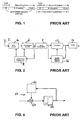
- FIG. 1 shows an example of the structure of the transmitted data.
- Each block, or frame comprises N symbols, the last P of which are identical to the symbols in a cyclic prefix CP which is normally inserted at the beginning of the block.
- Such a frame structure can be used in single or multi carrier based systems.
- the channel equalisation task can be conveniently and economically undertaken in the frequency domain through appropriate FFT (Fast Fourier Transform) operations.
- FFT Fast Fourier Transform
- a number of wireless LAN and digital broadcasting standards have adopted this frame structure and made use of the orthogonal frequency division multiplexing (OFDM) technique.
- OFDM orthogonal frequency division multiplexing
- the OFDM based technologies have a profoundly uneconomic shortcoming, i.e. a generally high peak-to-average-power-ratio (PAPR) due to the densely packed multi-carrier nature of the signals.
- PAPR peak-to-average-power-ratio
- single carrier with cyclic prefix insertion is an alternative signal format that can similarly benefit from the advantages of equalising the channel distortion in the frequency domain through computationally efficient FFT operations.
- the signal power envelope can be made virtually constant thus eliminating the requirement for backing-off the power amplifier as is typically done in OFDM systems.
- Single carrier based systems are also less sensitive to the nonlinearities that typically come with the power signal components, resulting potential cost reductions in end products.
- a cyclic prefix (or postfix) to a block structure, as shown in Figure 1, helps to make the fundamentally linear convolution between the transmitted signal frame and the channel impulse response (CIR) appear cyclic.
- This property has a corresponding frequency domain relationship that can be expressed as the multiplication of the discrete Fourier transform (DFT) of the transmitted signal with that of the channel frequency response.
- DFT discrete Fourier transform
- the distortions caused by the channel can be removed through division operations, or their equivalents, on the received signal. This can be carried out on the signal frequency bins using the inverse of the corresponding channel frequency response (i.e. de-convolution in the frequency domain).
- DFE decision feedback equalisation
- SC-FDE/DFE basic SC-FDE scheme
- the decision feedback equalisation (DFE) process involves a transversal filter which receives at its input the classified symbol values from a decision block and has an output which modifies the symbol values sent to the decision block.
- the preferred embodiment described below uses a decision correction based feedback (DCF) scheme for the generation of 'equalising' values for each of the received single carrier symbols, after frequency domain equalisation (FDE) has been accomplished.
- the decision correction based feedback scheme involves modifying the symbol values sent to a symbol classifier in accordance with the differences between the values from the FDE output and those of the decision output from the symbol classifier. This yields an improved system performance with lowered bit error rate (BER) in the recovered data stream.
- BER bit error rate
- This invention can thus improve the performance of a single carrier system operating with block data, decouple the parameters of the frequency and time domain equalisers, reduce the complexity of the parameter optimisation and adaptation processes and reduce the costs of implementation.
- the training and online adaptation tasks become simpler as well as flexible. For example, one may choose to optimise both sets of parameters during a training phase but undertake online adaptation only on the DCF parameters afterwards.
- FIG. 2 is a block diagram of a prior art receiver in which the techniques of the present invention can be incorporated.
- An antenna 2 receives a signal which is then delivered to a down-converter 4 for converting the signal to intermediate frequency (IF).
- IF intermediate frequency
- the signal is then converted to baseband by an IF-to-baseband converter 6.
- the output of the converter 6 is fed back to a sample clock and frequency synchronising circuit 8 which controls the operations of the down-converter 4 and the IF-to-baseband converter 6.
- the baseband signal is also delivered to a frame synchronisation circuit 8 in order to extract the blocks of symbols.
- the symbols are then subject to equalisation in an equalisation circuit 12, and then delivered to a decoder 14.
- the equalisation circuit 12 operates using equalisation coefficients which can be modified during a training operation and adapted during normal operation, using an equaliser training and adaptation circuit 16.
- the baseband operation of the receiver is illustrated in Figure 3, which also shows the operation on the transmitter side.
- binary input data d is delivered to a quadrature amplitude modulation circuit (QAM) 30 to perform QAM mapping.
- QAM quadrature amplitude modulation circuit
- the output symbols are then delivered to a block grouping circuit 32 which creates successive frames of symbols.
- a cyclic prefix is then added by circuit 34.
- the signal is transmitted to the receiver via a channel illustrated at block 40.
- the received signal which has been subjected to noise and interference, is converted into a digital signal by an analog-to-digital converter 42 and then passed to a synchronisation block 44, which determines the start of the received block of data.
- a synchronisation block 44 determines the start of the received block of data.
- the cyclic extension or guard interval is removed from a received block of data by a circuit 46 and then passed to a discrete Fourier transform stage, FFT block, to convert the signal into the frequency domain.
- Each bin of the output of this stage is, in block 49, multiplied by the complex conjugate of its corresponding frequency domain equaliser coefficient G i and then transformed back to the time domain in an IFFT block 50.
- the data is then converted to a serial stream of signal samples in a parallel-to-serial converter 52 block. This data stream is the frequency domain equalised signal y i .
- the symbols y i are then delivered a time domain equalisation circuit 54 for further equalisation.
- the equalised signals are then delivered to a symbol classifier 56.
- the symbol classifier 56 is arranged to convert each of the equalised symbol values at its input to the closest one of a set of predetermined symbol values. These predetermined values are then delivered to a QAM de-mapping circuit 58 in order to generate binary output data.
- FIG. 4 A prior art circuit for performing time domain equalisation using decision feedback is illustrated in Figure 4.
- the output of the symbol classifier 56 is delivered to a decision feedback equalisation circuit 60, which may be a transversal filter.
- the output of the decision feedback equalisation circuit 60 is delivered to a summer 64, which subtracts this output from the current symbol value in order to deliver to the classifier 56 symbol values which are both time domain and frequency domain equalised.
- Figure 5 shows a time domain equalisation circuit which operates using a decision correction based feedback (DCF) scheme according to the present invention.
- DCF decision correction based feedback
- a signal z is produced by a summer 66 which subtracts the output â i of the symbol classifier 56 from the frequency domain equalised (FDE) output signal y i during a single symbol clock period.
- a delay circuit 68 synchronises the timing of the FDE symbol y i to that of its corresponding decision output â i . The delay here is to account for the latency of the symbol classifier 56, which is assumed to be of one symbol cycle.
- the difference signal z i is delivered to a decision based correction feedback (DCF) block 70. This generates an output signal which is delivered to a summer 72 to modify a subsequent FDE output signal, e.g. y i+1 .
- DCF decision based correction feedback
- the DCF block 70 may be a transversal filter, as shown in Figure 6.
- the filter has multiple taps at each of which the input signal z i appears following a respective delay k 1 , k 2 ... or k L .
- the signal at each of the taps is multiplied by a respective one of a set of coefficients f* kl which are the complex conjugation of DCF parameters, and then delivered to a summer 74.
- the summer 74 sums the modified tap outputs to generate an equalisation value which is subtracted from the value of the current FDE symbol.
- the variable y i can be considered as a prediction of the transmitted symbol after frequency domain equalisation with coefficients ⁇ G i ⁇ .
- the feedback difference signal z i delivered to the DCF block 68 represents the amount required to 'correct' y i to its corresponding decision value. Accordingly, the scheme is referred to herein as "decision correction based feedback" equalisation.
- the delay values k 1 , k 2 , ... k L which are integral multiples of the symbol clock period, may be variable and alterable using a training or adaptation process. Alternatively, they may have fixed values, particularly if some pre-knowledge of the channel is available. Accordingly, the output of the DCF block 70 is the sum of quantities each of which is a weighted difference value z i for a respective earlier symbol.
- Figure 7 is a block diagram of the equalisation circuits of Figure 3, additionally incorporating the circuits used for training and adaptation of the parameters used for frequency domain equalisation and time domain equalisation.
- Two independent parameter adapters 80 and 82 are used respectively for the frequency domain equalisation parameters and the time domain equalisation parameters.
- Each adapter may be arranged to operate independently during a training phase and/or during normal operation.
- the output of the symbol classifier 56 is delivered via a switch 84 to a serial-to-parallel converter 92 and transformed into the frequency domain by an FFT block 94.
- the inputs of the frequency domain equalisation parameter adapter 80 are the outputs of the FFT block 48, i.e. the non-equalised symbols transformed into the frequency domain, and the corresponding outputs from the symbol classifier. Adaptation can be performed using a least squared error approach (or any other approach as deemed appropriate).
- the output of the symbol classifier 56 is also delivered, via switch 84 and summer 66, to both the DCF block 70 and the time domain equalisation parameter adapter 82 in DCF block 70.
- the parameter adapter 82 is arranged to adjust the coefficients f * kl (using, for example, a least squared error approach) in order to cause the equalised symbol values at the input of the symbol classifier 56 to approach, as closely as possible, the output value of the classifier, i.e. to minimise the difference values received by the adapter 82.
- the parameter adapter 82 may also be arranged to adjust the delay values k 1 , k 2 , ... k L .
- Adaptation can also take place in a training phase, in which known training symbols are transmitted.
- the switch 84 is operated to feed training data, stored in a memory 86, to the adapters in place of the output of the symbol classifier 56.
- the receiver operates at a sampling rate of L-times of that of the transmitter's symbol signalling rate 1/T, where L ⁇ 1 and T is the SC symbol period.
- the received time domain signal corresponding to a N -sized block of the transmitted symbols ⁇ a 0 , a 1 , ..., a m , ...,a N-1 ⁇ is a NL- sampled block: ⁇ r 0 , r 1 , ..., r m , ..., r NL-1 ⁇ .
- over-sampling rate ( L>1 ) case gives a fractionally spaced SC-FDE equalizer that is generally considered to be more robust against symbol sampling phase misalignment due to imperfect synchronisation. Fundamentally, this is a performance enhancement consideration rather than scheme necessity.
- this time domain cost function can be transformed into the frequency domain, i.e.
- ⁇ m 0 N ⁇ 1
- "*" represents conjugation and ⁇ i is the FFT result on e m :
- Equation (13a) indicates that the frequency domain equalisation parameters can be determined independently without referencing the time domain DCF feedback coefficients ⁇ f k ⁇ . If the transmitted symbols ⁇ a m ⁇ are independently identically distributed (i.i.d), by denoting the symbol power in the frequency domain as ⁇ s 2 and the noise variance as ⁇ n 2 , i.e.
- Equations (14) and (17) provide the decoupled least square error solution to the parameter optimisation problem of the SC-FDE/DCF scheme.
- MAC medium access control
- the initial transmitted preamble sequences (which are known to the receiver in advance) can be exploited to train the SC-FDE/DCF parameters.
- Online adaptation during service can also be based on these equations or their recursive versions, using the decoded data symbols as the guidance.
Landscapes
- Engineering & Computer Science (AREA)
- Power Engineering (AREA)
- Computer Networks & Wireless Communication (AREA)
- Signal Processing (AREA)
- Digital Transmission Methods That Use Modulated Carrier Waves (AREA)
Priority Applications (1)
| Application Number | Priority Date | Filing Date | Title |
|---|---|---|---|
| EP04256383A EP1675337A1 (fr) | 2004-10-15 | 2004-10-15 | Egalisateur fonctionnant en domaine fréquentiel pour signaux à porteuse unique |
Applications Claiming Priority (1)
| Application Number | Priority Date | Filing Date | Title |
|---|---|---|---|
| EP04256383A EP1675337A1 (fr) | 2004-10-15 | 2004-10-15 | Egalisateur fonctionnant en domaine fréquentiel pour signaux à porteuse unique |
Publications (1)
| Publication Number | Publication Date |
|---|---|
| EP1675337A1 true EP1675337A1 (fr) | 2006-06-28 |
Family
ID=34930738
Family Applications (1)
| Application Number | Title | Priority Date | Filing Date |
|---|---|---|---|
| EP04256383A Withdrawn EP1675337A1 (fr) | 2004-10-15 | 2004-10-15 | Egalisateur fonctionnant en domaine fréquentiel pour signaux à porteuse unique |
Country Status (1)
| Country | Link |
|---|---|
| EP (1) | EP1675337A1 (fr) |
Cited By (5)
| Publication number | Priority date | Publication date | Assignee | Title |
|---|---|---|---|---|
| CN101267410B (zh) * | 2007-03-16 | 2010-09-22 | 展讯通信(上海)有限公司 | 基于td-scdma实现单频网的频域均衡方法 |
| GB2472102A (en) * | 2009-07-24 | 2011-01-26 | Cambridge Consultants | Receiver for Single Carrier Frequency Division Multiple Access (SC-FDMA) wireless transmission |
| CN102412867A (zh) * | 2011-12-07 | 2012-04-11 | 清华大学 | 基于时频交织单载波频域均衡的直流分量克服方法和系统 |
| CN101237245B (zh) * | 2007-01-31 | 2012-07-04 | 展讯通信(上海)有限公司 | 基于td-scdma网络的单频广播接收方法 |
| WO2013112624A1 (fr) * | 2012-01-23 | 2013-08-01 | Qualcomm Incorporated | Système de communication sans fil multimode |
Citations (3)
| Publication number | Priority date | Publication date | Assignee | Title |
|---|---|---|---|---|
| EP0707401A2 (fr) * | 1994-10-13 | 1996-04-17 | AT&T Corp. | Egalisateur hybride pour un système de communication de données |
| DE10111496A1 (de) * | 2001-03-09 | 2002-09-19 | Siemens Ag | Verfahren zum Entzerren von Signalen und Vorrichtung zur Durchführung des Verfahrens |
| WO2004021657A2 (fr) * | 2002-08-30 | 2004-03-11 | Koninklijke Philips Electronics N.V. | Dispositif et procédé d'égalisation à décision rétroactive dans le domaine des fréquences |
-
2004
- 2004-10-15 EP EP04256383A patent/EP1675337A1/fr not_active Withdrawn
Patent Citations (3)
| Publication number | Priority date | Publication date | Assignee | Title |
|---|---|---|---|---|
| EP0707401A2 (fr) * | 1994-10-13 | 1996-04-17 | AT&T Corp. | Egalisateur hybride pour un système de communication de données |
| DE10111496A1 (de) * | 2001-03-09 | 2002-09-19 | Siemens Ag | Verfahren zum Entzerren von Signalen und Vorrichtung zur Durchführung des Verfahrens |
| WO2004021657A2 (fr) * | 2002-08-30 | 2004-03-11 | Koninklijke Philips Electronics N.V. | Dispositif et procédé d'égalisation à décision rétroactive dans le domaine des fréquences |
Non-Patent Citations (1)
| Title |
|---|
| FALCONER D: "FREQUENCY DOMAIN EQUALIZATION FOR SINGLE-CARRIER BROADBAND WIRELESS SYSTEMS", IEEE COMMUNICATIONS MAGAZINE, IEEE SERVICE CENTER. PISCATAWAY, N.J, US, vol. 40, no. 4, April 2002 (2002-04-01), pages 58 - 66, XP001102462, ISSN: 0163-6804 * |
Cited By (6)
| Publication number | Priority date | Publication date | Assignee | Title |
|---|---|---|---|---|
| CN101237245B (zh) * | 2007-01-31 | 2012-07-04 | 展讯通信(上海)有限公司 | 基于td-scdma网络的单频广播接收方法 |
| CN101267410B (zh) * | 2007-03-16 | 2010-09-22 | 展讯通信(上海)有限公司 | 基于td-scdma实现单频网的频域均衡方法 |
| GB2472102A (en) * | 2009-07-24 | 2011-01-26 | Cambridge Consultants | Receiver for Single Carrier Frequency Division Multiple Access (SC-FDMA) wireless transmission |
| GB2472102B (en) * | 2009-07-24 | 2015-05-20 | Cambridge Consultants | Receiver for wireless transmission |
| CN102412867A (zh) * | 2011-12-07 | 2012-04-11 | 清华大学 | 基于时频交织单载波频域均衡的直流分量克服方法和系统 |
| WO2013112624A1 (fr) * | 2012-01-23 | 2013-08-01 | Qualcomm Incorporated | Système de communication sans fil multimode |
Similar Documents
| Publication | Publication Date | Title |
|---|---|---|
| EP1523838B1 (fr) | Procede et appareil de pre-egalisation adaptative | |
| US5461640A (en) | Method and system for optimizing an equalizer in a data transmission system | |
| AU746030B2 (en) | A method of and an apparatus for training tap coefficients of an adaptive equalizer | |
| US5285474A (en) | Method for equalizing a multicarrier signal in a multicarrier communication system | |
| US10237095B2 (en) | Linear equalization for use in low latency high speed communication systems | |
| US7936851B2 (en) | Channel equalization | |
| US20050259727A1 (en) | Frequency-domain decision feedback equalizing device and method | |
| EP1525698A1 (fr) | Procede de modulation de prefixe de formation et recepteur correspondant | |
| JP6996496B2 (ja) | Los-mimo復調装置、通信装置、los-mimo伝送システム、los-mimo復調方法及びプログラム | |
| US8824539B2 (en) | System and method for OFDM reception in the presence of dooppler effect based on time domain windowing | |
| US20100046599A1 (en) | Apparatus and method for acquiring initial coefficient of decision feedback equalizer using fast fourier transform | |
| CN102821073A (zh) | 频域自适应反馈均衡器 | |
| KR102435821B1 (ko) | 통신 시스템에서 데이터를 송수신하는 장치 및 방법 | |
| CN108702221A (zh) | 用于解码光信号的方法和用于接收并解码光信号的接收器 | |
| JP2001148643A (ja) | ウィンドウ制御離散マルチトーン形モデム受信機におけるビン(bin)毎に適応する等化処理 | |
| EP1302017B1 (fr) | Procede et appareil destines a la mise a jour des coefficients d'un egalisateur et a la regulation de la vitesse d'echantillonnage | |
| US7321550B2 (en) | Method of equalization in an OFDM system | |
| US7933323B2 (en) | Method and system for performing timing recovery in a digital communication system | |
| JP5878803B2 (ja) | マルチキャリヤ変調信号受信装置 | |
| EP0959596A1 (fr) | Procédé et circuit d'apprentissage d'un égaliseur adaptatif | |
| KR20050001099A (ko) | 시간영역의 등화기를 사용하는 오에프디엠 수신장치 및 그수신방법 | |
| EP1303093B1 (fr) | Raccourciment de la réponse impulsionelle dans des modems de type DMT | |
| JPH0865210A (ja) | 等化器位置付けを安定化させる方法、およびその回路 | |
| TO | An Improved Decision Feedback Scheme for SC-FDE Wireless Communication Systems |
Legal Events
| Date | Code | Title | Description |
|---|---|---|---|
| PUAI | Public reference made under article 153(3) epc to a published international application that has entered the european phase |
Free format text: ORIGINAL CODE: 0009012 |
|
| AK | Designated contracting states |
Kind code of ref document: A1 Designated state(s): AT BE BG CH CY CZ DE DK EE ES FI FR GB GR HU IE IT LI LU MC NL PL PT RO SE SI SK TR |
|
| AX | Request for extension of the european patent |
Extension state: AL HR LT LV MK |
|
| AKX | Designation fees paid | ||
| REG | Reference to a national code |
Ref country code: DE Ref legal event code: 8566 |
|
| STAA | Information on the status of an ep patent application or granted ep patent |
Free format text: STATUS: THE APPLICATION IS DEEMED TO BE WITHDRAWN |
|
| 18D | Application deemed to be withdrawn |
Effective date: 20061229 |