EP1675362A2 - Klappbares Telefon mit einem drehbaren dritten Gehäuse zwischen den beiden Klappgehäusen - Google Patents
Klappbares Telefon mit einem drehbaren dritten Gehäuse zwischen den beiden Klappgehäusen Download PDFInfo
- Publication number
- EP1675362A2 EP1675362A2 EP05027901A EP05027901A EP1675362A2 EP 1675362 A2 EP1675362 A2 EP 1675362A2 EP 05027901 A EP05027901 A EP 05027901A EP 05027901 A EP05027901 A EP 05027901A EP 1675362 A2 EP1675362 A2 EP 1675362A2
- Authority
- EP
- European Patent Office
- Prior art keywords
- housing
- hinge
- portable apparatus
- housings
- previous
- Prior art date
- Legal status (The legal status is an assumption and is not a legal conclusion. Google has not performed a legal analysis and makes no representation as to the accuracy of the status listed.)
- Ceased
Links
Images





Classifications
-
- H—ELECTRICITY
- H04—ELECTRIC COMMUNICATION TECHNIQUE
- H04B—TRANSMISSION
- H04B1/00—Details of transmission systems, not covered by a single one of groups H04B3/00 - H04B13/00; Details of transmission systems not characterised by the medium used for transmission
- H04B1/38—Transceivers, i.e. devices in which transmitter and receiver form a structural unit and in which at least one part is used for functions of transmitting and receiving
-
- H—ELECTRICITY
- H04—ELECTRIC COMMUNICATION TECHNIQUE
- H04M—TELEPHONIC COMMUNICATION
- H04M1/00—Substation equipment, e.g. for use by subscribers
- H04M1/02—Constructional features of telephone sets
- H04M1/0202—Portable telephone sets, e.g. cordless phones, mobile phones or bar type handsets
- H04M1/0206—Portable telephones comprising a plurality of mechanically joined movable body parts, e.g. hinged housings
- H04M1/0247—Portable telephones comprising a plurality of mechanically joined movable body parts, e.g. hinged housings comprising more than two body parts
-
- H—ELECTRICITY
- H04—ELECTRIC COMMUNICATION TECHNIQUE
- H04M—TELEPHONIC COMMUNICATION
- H04M1/00—Substation equipment, e.g. for use by subscribers
- H04M1/02—Constructional features of telephone sets
-
- H—ELECTRICITY
- H04—ELECTRIC COMMUNICATION TECHNIQUE
- H04M—TELEPHONIC COMMUNICATION
- H04M1/00—Substation equipment, e.g. for use by subscribers
- H04M1/02—Constructional features of telephone sets
- H04M1/0202—Portable telephone sets, e.g. cordless phones, mobile phones or bar type handsets
- H04M1/0206—Portable telephones comprising a plurality of mechanically joined movable body parts, e.g. hinged housings
- H04M1/0208—Portable telephones comprising a plurality of mechanically joined movable body parts, e.g. hinged housings characterized by the relative motions of the body parts
- H04M1/021—Portable telephones comprising a plurality of mechanically joined movable body parts, e.g. hinged housings characterized by the relative motions of the body parts using combined folding and rotation motions
-
- H—ELECTRICITY
- H04—ELECTRIC COMMUNICATION TECHNIQUE
- H04M—TELEPHONIC COMMUNICATION
- H04M1/00—Substation equipment, e.g. for use by subscribers
- H04M1/02—Constructional features of telephone sets
- H04M1/0202—Portable telephone sets, e.g. cordless phones, mobile phones or bar type handsets
- H04M1/0206—Portable telephones comprising a plurality of mechanically joined movable body parts, e.g. hinged housings
- H04M1/0208—Portable telephones comprising a plurality of mechanically joined movable body parts, e.g. hinged housings characterized by the relative motions of the body parts
- H04M1/021—Portable telephones comprising a plurality of mechanically joined movable body parts, e.g. hinged housings characterized by the relative motions of the body parts using combined folding and rotation motions
- H04M1/0212—Portable telephones comprising a plurality of mechanically joined movable body parts, e.g. hinged housings characterized by the relative motions of the body parts using combined folding and rotation motions with a two degrees of freedom mechanism, i.e. folding around a first axis and rotating around a second axis perpendicular to the first
-
- H—ELECTRICITY
- H04—ELECTRIC COMMUNICATION TECHNIQUE
- H04M—TELEPHONIC COMMUNICATION
- H04M1/00—Substation equipment, e.g. for use by subscribers
- H04M1/02—Constructional features of telephone sets
- H04M1/0202—Portable telephone sets, e.g. cordless phones, mobile phones or bar type handsets
- H04M1/0206—Portable telephones comprising a plurality of mechanically joined movable body parts, e.g. hinged housings
- H04M1/0208—Portable telephones comprising a plurality of mechanically joined movable body parts, e.g. hinged housings characterized by the relative motions of the body parts
- H04M1/0214—Foldable telephones, i.e. with body parts pivoting to an open position around an axis parallel to the plane they define in closed position
-
- H—ELECTRICITY
- H04—ELECTRIC COMMUNICATION TECHNIQUE
- H04M—TELEPHONIC COMMUNICATION
- H04M1/00—Substation equipment, e.g. for use by subscribers
- H04M1/02—Constructional features of telephone sets
- H04M1/0202—Portable telephone sets, e.g. cordless phones, mobile phones or bar type handsets
- H04M1/026—Details of the structure or mounting of specific components
- H04M1/0266—Details of the structure or mounting of specific components for a display module assembly
-
- H—ELECTRICITY
- H04—ELECTRIC COMMUNICATION TECHNIQUE
- H04M—TELEPHONIC COMMUNICATION
- H04M2250/00—Details of telephonic subscriber devices
- H04M2250/18—Details of telephonic subscriber devices including more than one keyboard unit
-
- H—ELECTRICITY
- H04—ELECTRIC COMMUNICATION TECHNIQUE
- H04M—TELEPHONIC COMMUNICATION
- H04M2250/00—Details of telephonic subscriber devices
- H04M2250/52—Details of telephonic subscriber devices including functional features of a camera
Definitions
- the present invention relates to portable communication apparatuses including cellular phones, PDAs (personal digital assistants), HHPs (hand-held phones), TV phones for conveniently watching digital multimedia broadcasting (DMB) mobile images or TVs, game phones, and message transmission phones, and more particularly to a portable communication apparatus having a display device adapted to be watched in the horizontal position and to be retained with a slant for conveniently watching DMB mobile images and inputting complicated data using both hands.
- portable communication apparatuses including cellular phones, PDAs (personal digital assistants), HHPs (hand-held phones), TV phones for conveniently watching digital multimedia broadcasting (DMB) mobile images or TVs, game phones, and message transmission phones
- DMB digital multimedia broadcasting
- portable communication apparatus refers to an electronic apparatus that a user can carry to perform wireless communication with a desired partner.
- designs of such portable communication apparatuses tend not only to be compact, slim, and light, but are also moving toward providing multimedia availability, having a wider variety of functions.
- future portable communication apparatuses are expected to incorporate greater multi-functionality and be capable of multi-purpose utilization, being modified to be suitable for various multimedia or Internet environments.
- the bar-type communication apparatus have a single housing shaped like a bar.
- the flip-type communication apparatuses have a flip rotatably coupled to a bar-shaped housing by a hinge device.
- the folder-type communication apparatuses have a folder connected to a single bar-shaped housing by a hinge device in such a manner that the folder can be rotated to fold on or unfold from the housing.
- Portable communication apparatuses may also be classified into neck wearable type portable communication apparatuses and wrist wearable type portable communication apparatuses according to the position or way in which users put on the portable communication apparatuses.
- the neck wearable type portable communication apparatuses are worn around the users' neck using a string
- the wrist wearable type portable communication apparatuses are worn around the users' wrist.
- portable communication apparatuses may be classified into rotation-type portable communication apparatuses and sliding-type portable communication apparatuses according to the manner of opening and closing the portable communication apparatuses.
- rotation-type portable communication apparatuses two housings are coupled to each other in such a manner that one housing rotates to be opened or closed relative to the other while they face each other.
- sliding-type portable communication apparatuses two housings are coupled to each other in such a manner that one housing slides along a longitudinal direction to be opened or closed relative to the other housing.
- portable communication apparatuses now can transmit data at a high speed in addition to performing the basic voice communication function.
- portable communication apparatuses now provide a service using a wireless communication technology capable of transmitting data at a high speed.
- Recent portable communication apparatuses also can be equipped with a camera lens to obtain video signals for transmission.
- current portable communication apparatuses have an external or embedded camera lens module which enables users to perform video communication with desired partners or to photograph desired subjects.
- an object of the present invention is to provide a portable apparatus having a display device adapted to be watched in the horizontal position and capable of providing stereo sound for conveniently watching various mobile image media.
- Another object of the present invention is to provide a portable apparatus having a display device adapted to be watched in the horizontal position and to be retained with a slant for conveniently checking displayed data.
- Another object of the present invention is to provide a portable apparatus having at least thirty first and second keys for conveniently inputting complicated data using both hands.
- Another object of the present invention is to provide a portable apparatus having a camera lens positioned on the display device for convenient video communication with desired partners.
- Another object of the present invention is to provide a portable apparatus having a wide display device, at least sixty keys, and two speaker devices positioned in place while having a compact overall size.
- a portable apparatus including a first housing; a second housing adapted to fold on and unfold from the first housing; a hinge device adapted to connect the first and second housings about a first hinge axis; a third housing positioned between the first and second housings and adapted to rotate from the first housing about a second hinge axis, which is spaced from and perpendicular to the first hinge axis, in a direction moving away from the hinge device to be placed parallel to the longitudinal direction of the first and second housings; and a swing hinge device positioned on the first housing to connect the first and third housings in such a manner that they can rotate about the second hinge axis.
- a portable apparatus including a first housing having a first keyboard; a second housing having a second keyboard and adapted to fold on and unfold from the first housing; a hinge device adapted to connect the first and second housings about a first hinge axis; a third housing having a display device and a speaker device and positioned between the first and second housings while being adapted to rotate from the first housing about a second hinge axis, which is spaced from and perpendicular to the first hinge axis, to be placed parallel to the longitudinal direction of the first and second housings so that the display device can be watched in the horizontal position; and a swing hinge device positioned on the second housing to connect the first and third housings in such a manner that they can rotate about the second hinge axis.
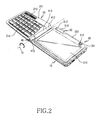
- a portable apparatus includes a first housing 10, a second housing 20, and a third housing 30 positioned between the first and second housings 10 and 20 and adapted to move towards or away from the first and second housings 10 and 20, respectively.
- the second housing 20 is rotated about a first hinge axis A1 to fold on and unfold from the first housing 10.
- the second housing 20 is rotatably connected to the first housing 10 by a hinge device 40.
- the first, second, and third housings 10, 20, and 30 preferably have the shape of plates.
- the portable apparatus includes the first housing 10; the second housing 20 adapted to fold on and unfold from the first housing 10; the hinge device 40 for connecting the first and second housings 10 and 20 about the first hinge axis A1; the third housing 30 adapted to swing away from the first housing 10 about a second hinge axis A2, which is spaced from and perpendicular to the first hinge axis A1, to be placed parallel to and along the longitudinal direction of the first and second housings 10 and 20; and a swing hinge device 50 for connecting the first and third housings 10 and 30 in such a manner that they can rotate about the second hinge axis A2.
- the third housing 30 initially rotates away from the hinge device 40. This is because the rotation of the third housing 30 is limited by the hinge device 40 and is directed away from it rather than towards it.
- the third housing 30 is connected to the first housing 10 by the swing hinge device 50 in such a manner that it can rotate towards the first housing 10 about a third hinge axis A3, which is perpendicular to and spaced from the first and second hinge axes A1 and A2, respectively, while being oriented along the longitudinal direction of the first and second housings 10 and 20.
- the third housing 30 is retained with a slant so that the user can conveniently watch the apparatus, particularly, the display device 310 in the horizontal position (described later).
- the second hinge axis A2 is perpendicular to and extends through the first housing 10 and the third hinge axis A3 extends along the longitudinal direction of the first housing 10.
- the first housing 10 has a first keyboard 110 positioned on the upper surface thereof, which is composed of an array of a number of keys
- the second housing 20 has a second keyboard 210 positioned on the upper surface thereof, which is composed of an array of a number of keys.
- the number of keys on each of the first and second keyboards 110 and 210 is greater or equal to 30.
- the first and second housings 10 and 20 have first and second speaker devices 112 and 212, respectively, to provide stereo sound.
- the first speaker device 112 is positioned on an outer corner of the first housing 10 and the second speaker 212 is positioned on an outer corner of the upper surface 201 of the second housing 20.
- the second hinge axis A2 is disposed adjacent to a lateral end of the first housing 10, and preferably adjacent to the hinge device 40. This is for the purpose of placing the third housing 30 in the middle between the first and second housings 10 and 20, when rotated about the second hinge axis A2.
- the third housing 30 has a display device 310, in the form of a screen displayed on the upper surface 301 thereof, and a camera lens 312.
- the third housing 30 is adapted to rotate 0-180° about the second hinge axis A2, while continuously facing the first housing 10, or not.
- the third housing 30 is placed parallel to the longitudinal direction of the first and second housings 10 and 20 after rotating 180° about the second hinge axis A2.
- the third housing 30 may further rotate a predetermined angle towards the first housing 10 about the third hinge axis A3 to be retained with a slant.
- Two swing hinge modules (not shown) included in the swing hinge device 50 hold third housing 30 in the slanted position.
- the amount of rotation of the third housing 30 about the second and third hinge axes A2 and A3 is set to be 180° or less.
- FIG. 2 shows the second housing 20 after completely rotated away from the first housing 10 about the first hinge axis A1.
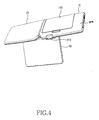
- FIG. 3 shows the third housing 30 after rotating towards the first housing 10 about the second hinge axis A2 and further rotating about the third hinge axis A3.
- the user can conveniently watch the display device 310 in the horizontal position while being provided with stereo sound from the first and second speaker devices 112 and 212.
- the user can conveniently input data using both hands through the first and second keyboards 110 and 210 positioned on the first and second housings, respectively.
- the hinge device 40 which provides the first hinge axis A1, includes a slanted center hinge arm 410 formed on an end of the first housing 10 and a pair of slanted side hinge arms 412 formed on the second housing 20 to be coupled to the slanted center hinge arm 410.
- the swing hinge device 50 which provides the second and third hinge axes A2 and A3, includes a semi-cylindrical swing member 510 positioned parallel to the bottom surface 102 of the first housing 10 and a cylindrical single hinge arm 512 extending along a lateral end 302 of the third housing 30.
- the swing member 510 and the single hinge arm 512 are integral with each other.
- the first housing 10 has a battery pack 120 positioned on the bottom surface thereof for power supply.
- the battery pack 120 is fastened/released by a locking knob in a direction perpendicular to the longitudinal direction of the first housing 10.
- a portable communication apparatus includes a first housing 60, a second housing 70, and a third housing 80 positioned between the first and second housings 60 and 70 and adapted to rotate towards or away from the first and second housings 60 and 70, respectively.
- the second housing 70 is adapted to rotate about a first hinge axis A1 towards or away from the first housing 60 to fold on or unfold from it.
- the second housing 70 is rotatably connected to the first housing 60 by a hinge device 90.
- the first, second, and third housings 60, 70, and 80 preferably have the shape of plates.
- the first, third, and second housings 60, 80, and 70 are successively laminated on one another.
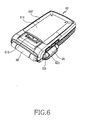
- the portable apparatus is in a second position, particularly, when the second housing 70 is completely unfolded from the first housing 60 as shown in FIG. 7, the second and third housings 70 and 80 are laminated on each other.
- the third housing 80 opposes the first housing 60 about the hinge device 90.
- the portable communication apparatus includes the first housing 60; the second housing 70 adapted to fold on and unfold from the first housing 60; the hinge device 90 for connecting the first and second housings 60 and 70 about the first hinge axis A1; the third housing 80 adapted to rotate away from the first housing 60 about a second hinge axis A2, which is spaced from and perpendicular to the first hinge axis A1, to be placed parallel to the longitudinal direction of the first and second housings 60 and 70; and a swing hinge device 95 for connecting the second and third housings 70 and 80 in such a manner that they can rotate about second and third hinge axes A2 and A3.
- the third housing 80 is connected to the second housing 70 by the swing hinge device 95 in such a manner that it can rotate away from the second housing 70 about the third hinge axis A3, which is perpendicular to the first and second hinge axes A1 and A2 while being spaced from the first hinge axis A1 and which is oriented along the longitudinal direction of the first and second housings 60 and 70.
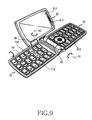
- the third housing 80 is retained with a slant as shown in FIG. 9 so that the user can conveniently watch various mobile images, particularly DMB mobile images such as TVs or videos, using the display device 812 in the horizontal position (described later).
- the second hinge axis A2 is perpendicular to and extends through the second housing 70 and the third hinge axis A3 extends along the longitudinal direction of the second housing 70, particularly along the longitudinal direction of the first and second housings 60 and 70.
- the first housing 60 has a first keyboard 610 positioned on the upper surface 601 thereof, which is composed of an array of a number of keys
- the second housing 70 has a second keyboard 718 positioned on the bottom surface thereof, which is composed of an array of a number of keys.
- the first and second keyboards 610 and 718 are symmetrically positioned about the hinge device 90 for convenient key operation using both hands.
- the number of keys on each of the first and second keyboards 610 and 718 is greater than or equal to 30.
- the first and second keyboards 610 and 718 are preferably composed of QWERTY keys.
- the second hinge axis A2 is disposed adjacent to a lateral end 703 of the second housing 70, and preferably adjacent to the hinge device 90. This is for the purpose of placing the third housing 80 in the middle between the first and second housings 60 and 70, when rotated about the second hinge axis A2.
- the third housing 80 has a speaker device 810 and a display device 812 disposed adjacent to the speaker device 810.
- the display device 812 has a screen displayed on the upper surface thereof.
- the third housing 80 is adapted to rotate 0-180°, preferably 180°, about the second hinge axis A2 while continuously facing the first housing 60 to be placed parallel to the longitudinal direction of the first and second housings 60 and 70. After the rotation, the third housing 80 may further rotate a predetermined angle towards the second housing 70 about the third hinge axis A3 to be retained with a slant.
- the amount of rotation of the third housing 80 about the second and third hinge axes A2 and A3 is set to be 180° or less.
- FIG. 7 shows the third housing 80 after completely rotating away from the first housing 60 about the first hinge axis A1 together with the second housing 70.
- FIG. 9 shows the third housing 80 after rotating away from the first housing 60 about the second hinge axis A2 and further rotating about the third hinge axis A3.
- the user can conveniently watch the display device 812 in the horizontal position while being retained with a slant.
- the user can conveniently input complicated data using both hands through the first and second keyboards 610 and 718 positioned on the first and second housings, respectively.
- the swing hinge device 95 is mounted between the second and third housings 70 and 80.
- the second housing 70 has a hinge supporter 720 formed thereon to structurally reinforce the mounting state of the swing hinge device 95.
- the hinge supporter 720 protrudes in the lateral direction from a lateral end of the second housing 70.
- the swing hinge device 95 is coupled between a pair of side hinge arms 820 of the third housing 80 to provide the third hinge axis A3. Particularly, the side hinge arms 820 are positioned adjacent to an outer corner of an end of the third housing 80.
- the second housing 70 may be provided with an auxiliary display device 710, a camera lens 712, and a lighting device 714 positioned on the upper surface 701 thereof while being adjacent to one another.
- the camera lens 712 is disposed adjacent to the auxiliary display device 710.
- the lighting device 714 is also disposed adjacent to the auxiliary display device 710.
- the auxiliary display device 710 and the hinge supporter 720 are disposed adjacent to each other.
- the first housing 60 has a battery pack 614 and a locking knob 616 positioned on the bottom surface 602 thereof, the locking knob 616 being used to fasten/release the battery pack 614.
- two stepped portions are provided about and adjacent to the hinge device 90, as shown in FIG. 7, so that the third housing 80 can be stably received by the first and second housings.
- an end of the third housing 80 is curved with a radius of curvature so that it can smoothly swing on the second housing 70 and the first and second housings 60 and 70 are provided with a mechanism for stably supporting the third housing 80.
- the portable apparatus is preferably used in a normal communication mode.
- it is preferably used in a mode wherein the display device 812 needs to be in the horizontal position for a wider screen, including when watching DMB mobile images such as TVs or VODs and when inputting complicated messages using both hands.
- the third housing is connected to the second housing in such a manner that it can rotate about the second and third hinge axes; the display device is adapted to be retained with a slant while being positioned in the longitudinal direction of the first and second housings; and at least sixty keys constitute the first and second keyboards so that the user can conveniently perform key operation using both hands.
- the portable communication apparatus still has a compact overall size, in spite of the components as enumerated above, for improved portability.
Landscapes
- Engineering & Computer Science (AREA)
- Signal Processing (AREA)
- Computer Networks & Wireless Communication (AREA)
- Telephone Set Structure (AREA)
Applications Claiming Priority (3)
| Application Number | Priority Date | Filing Date | Title |
|---|---|---|---|
| US63888504P | 2004-12-21 | 2004-12-21 | |
| US63920404P | 2004-12-21 | 2004-12-21 | |
| KR1020050038011A KR100663422B1 (ko) | 2004-12-21 | 2005-05-06 | 휴대 통신 장치 |
Publications (2)
| Publication Number | Publication Date |
|---|---|
| EP1675362A2 true EP1675362A2 (de) | 2006-06-28 |
| EP1675362A3 EP1675362A3 (de) | 2006-11-15 |
Family
ID=35810001
Family Applications (1)
| Application Number | Title | Priority Date | Filing Date |
|---|---|---|---|
| EP05027901A Ceased EP1675362A3 (de) | 2004-12-21 | 2005-12-20 | Klappbares Telefon mit einem drehbaren dritten Gehäuse zwischen den beiden Klappgehäusen |
Country Status (4)
| Country | Link |
|---|---|
| US (1) | US20060135222A1 (de) |
| EP (1) | EP1675362A3 (de) |
| KR (1) | KR100663422B1 (de) |
| CN (1) | CN100583659C (de) |
Cited By (3)
| Publication number | Priority date | Publication date | Assignee | Title |
|---|---|---|---|---|
| WO2009156571A1 (en) * | 2008-06-27 | 2009-12-30 | Nokia Corporation | Apparatus with display and speaker |
| US8243967B2 (en) | 2005-11-14 | 2012-08-14 | Nokia Corporation | Hand-held electronic device |
| FR3116171A1 (fr) | 2020-11-09 | 2022-05-13 | Alexandre Mazer | dispositif de téléphonie portable |
Families Citing this family (22)
| Publication number | Priority date | Publication date | Assignee | Title |
|---|---|---|---|---|
| TWM269695U (en) * | 2004-12-22 | 2005-07-01 | Lite On Technology Corp | Hand-held-type electronic data processor |
| USD565528S1 (en) * | 2004-12-27 | 2008-04-01 | Connexion 2 Limited | Personal electronic communications device |
| USD546795S1 (en) * | 2005-01-26 | 2007-07-17 | Samsung Electronics Co., Ltd. | Portable phone |
| USD563344S1 (en) * | 2005-09-24 | 2008-03-04 | Samsung Electronics Co., Ltd. | Mobile phone |
| CA115160S (en) | 2005-10-28 | 2007-05-29 | Nokia Corp | Handset |
| USD576131S1 (en) * | 2006-01-13 | 2008-09-02 | Lg Electronics Inc. | Cellular phone |
| US7653422B2 (en) * | 2006-02-28 | 2010-01-26 | Motorola, Inc. | Method and apparatus for a sliding hinge |
| USD585861S1 (en) * | 2006-06-05 | 2009-02-03 | Samsung Electronics Co., Ltd. | Cellular phone |
| USD581889S1 (en) * | 2006-06-05 | 2008-12-02 | Samsung Electronics Co., Ltd. | Cellular phone |
| EP1887762A2 (de) * | 2006-08-08 | 2008-02-13 | Samsung Electronics Co., Ltd. | Tragbares Endgerät mit Spielfunktion |
| US20080080919A1 (en) * | 2006-08-28 | 2008-04-03 | Research In Motion Limited | Three row qwerty keyboard layout for compact landscape portable handheld messaging devices |
| KR100800844B1 (ko) * | 2006-09-27 | 2008-02-04 | 삼성전자주식회사 | 멀티미디어용 폴더형 휴대 장치 |
| USD590365S1 (en) * | 2006-12-14 | 2009-04-14 | Samsung Electronics Co., Ltd. | Portable phone |
| US8447226B1 (en) * | 2007-01-05 | 2013-05-21 | The Directv Group, Inc. | Portable satellite earth station and methods of using the same |
| KR100800769B1 (ko) * | 2007-01-29 | 2008-02-01 | 삼성전자주식회사 | 멀티미디어 휴대 통신 장치 |
| US20080254843A1 (en) * | 2007-04-12 | 2008-10-16 | Nokia Corporation | Electronic device having different use positions |
| USD591258S1 (en) * | 2008-05-01 | 2009-04-28 | Wilson Keith H | Cellular phone and multimedia device |
| US8108016B2 (en) * | 2008-08-15 | 2012-01-31 | Sony Ericsson Mobile Communications Ab | Portable communication device having a dual sliding flip hinge assembly |
| USD612355S1 (en) * | 2009-03-03 | 2010-03-23 | Chi Mei Communications Systems, Inc. | Portable electronic device |
| USD641724S1 (en) * | 2010-08-17 | 2011-07-19 | Cox Communications, Inc. | Mobile communications device with handle members |
| CN102984893B (zh) * | 2011-09-02 | 2016-01-27 | 联想(北京)有限公司 | 终端设备 |
| TWI688270B (zh) * | 2015-04-24 | 2020-03-11 | 佳能企業股份有限公司 | 攝像裝置 |
Family Cites Families (28)
| Publication number | Priority date | Publication date | Assignee | Title |
|---|---|---|---|---|
| US6256017B1 (en) * | 1994-02-24 | 2001-07-03 | Edward T. Bullister | Collapsible keyboard and display mechanism for a computer system |
| FR2758671A1 (fr) * | 1997-01-17 | 1998-07-24 | Motorola Inc | Telephone cellulaire repliable en trois parties |
| JP3139741B2 (ja) * | 1997-04-25 | 2001-03-05 | 日本電気株式会社 | 携帯無線情報端末装置 |
| KR20000064177A (ko) * | 2000-05-01 | 2000-11-06 | 권용순 | 이동 단말기 |
| US6748242B1 (en) | 2000-08-04 | 2004-06-08 | Nokia Mobile Phones Ltd. | Personal communication device with full keyboard and gaming feature |
| JP4716238B2 (ja) * | 2000-09-27 | 2011-07-06 | 日本電気株式会社 | 携帯端末装置の音響再生システム及び方法 |
| JP2002218030A (ja) * | 2001-01-17 | 2002-08-02 | Hitachi Kokusai Electric Inc | 折り畳み式携帯端末機 |
| WO2002069511A1 (en) * | 2001-02-26 | 2002-09-06 | Yang-Ju Kim | Folder type cover of mobile communication apparatus |
| KR100665709B1 (ko) * | 2001-04-26 | 2007-01-10 | 피닉스코리아 주식회사 | 힌지장치 |
| KR100486611B1 (ko) * | 2001-12-18 | 2005-05-03 | 주식회사 팬택앤큐리텔 | 회전가능한 액정표시장치를 가지는 이동통신 단말기 |
| US20060165463A1 (en) * | 2002-01-04 | 2006-07-27 | Michael Katz | Wireless keyboard for hand-held computers |
| US6628508B2 (en) * | 2002-02-21 | 2003-09-30 | Mobicom Corporation | Portable terminal with foldable keyboard |
| US20050002158A1 (en) * | 2002-02-25 | 2005-01-06 | Robert Olodort | Mobile computer with foldable keyboard |
| JP4313545B2 (ja) * | 2002-05-15 | 2009-08-12 | 京セラ株式会社 | カメラ付き折畳式携帯電話装置 |
| JP2004056408A (ja) * | 2002-07-19 | 2004-02-19 | Hitachi Ltd | 携帯電話端末 |
| US7773957B2 (en) * | 2002-07-22 | 2010-08-10 | Samsung Electronics Co., Ltd | Mobile communication terminal with rotational display unit |
| JP2004112559A (ja) * | 2002-09-20 | 2004-04-08 | Hitachi Ltd | 携帯電話 |
| US7565182B2 (en) * | 2002-10-22 | 2009-07-21 | Samsung Electronics Co., Ltd. | Wireless cell phone |
| KR100506380B1 (ko) * | 2002-10-23 | 2005-08-04 | 정석홍 | 휴대용 표시장치 |
| US20040198416A1 (en) * | 2003-04-02 | 2004-10-07 | Gardner Michael R. | Adjustable detachable keyboard and electronic assembly using same |
| US20040224733A1 (en) * | 2003-05-06 | 2004-11-11 | Michael Kim | Self retracting and extending antenna for portable communicators |
| US7308733B2 (en) * | 2003-05-15 | 2007-12-18 | Lg Electronics Inc. | Swivel hinge assembly and electronic device having the same |
| JP4518536B2 (ja) * | 2003-07-29 | 2010-08-04 | ユーエムイー・インシュアランス・インク | パソコン兼用携帯電話機。 |
| US7283852B2 (en) * | 2003-09-10 | 2007-10-16 | Nokia Corporation | Movable functional elements for mobile communication device |
| US7031143B2 (en) * | 2003-09-12 | 2006-04-18 | Hewlett-Packard Development Company, L.P. | Portable computing device with foldable keyboard |
| US20050148375A1 (en) * | 2003-12-31 | 2005-07-07 | Sony Ericsson Mobile Communications Ab | Apparatus for mobile terminal display |
| US7616974B2 (en) * | 2004-08-13 | 2009-11-10 | Nokia Corporation | Keypad with pivotable sections |
| US20070049355A1 (en) * | 2005-08-24 | 2007-03-01 | Wen-An Wu | Portable wireless keyboard |
-
2005
- 2005-05-06 KR KR1020050038011A patent/KR100663422B1/ko not_active Expired - Fee Related
- 2005-11-03 US US11/265,817 patent/US20060135222A1/en not_active Abandoned
- 2005-12-12 CN CN200510130114A patent/CN100583659C/zh not_active Expired - Fee Related
- 2005-12-20 EP EP05027901A patent/EP1675362A3/de not_active Ceased
Cited By (3)
| Publication number | Priority date | Publication date | Assignee | Title |
|---|---|---|---|---|
| US8243967B2 (en) | 2005-11-14 | 2012-08-14 | Nokia Corporation | Hand-held electronic device |
| WO2009156571A1 (en) * | 2008-06-27 | 2009-12-30 | Nokia Corporation | Apparatus with display and speaker |
| FR3116171A1 (fr) | 2020-11-09 | 2022-05-13 | Alexandre Mazer | dispositif de téléphonie portable |
Also Published As
| Publication number | Publication date |
|---|---|
| CN100583659C (zh) | 2010-01-20 |
| KR100663422B1 (ko) | 2007-01-02 |
| EP1675362A3 (de) | 2006-11-15 |
| US20060135222A1 (en) | 2006-06-22 |
| KR20060071078A (ko) | 2006-06-26 |
| CN1794597A (zh) | 2006-06-28 |
Similar Documents
| Publication | Publication Date | Title |
|---|---|---|
| US20060135222A1 (en) | Portable communication apparatus | |
| US7526325B2 (en) | Triple-axis rotation folder-type portable apparatus | |
| US7574241B2 (en) | Sliding/folding-type portable apparatus | |
| US7353050B2 (en) | Portable digital communication apparatus with reversible dual-axis hinge | |
| KR100678189B1 (ko) | 삼각 거치가 가능한 와이드 타입 휴대 통신 장치 | |
| US7773957B2 (en) | Mobile communication terminal with rotational display unit | |
| EP1653713B1 (de) | Tragbares und klappbares Kommunikationsendgerät | |
| US20050124394A1 (en) | Sliding/folding-type portable digital communication apparatus | |
| US20040209645A1 (en) | Portable terminal | |
| US7610067B2 (en) | Swing hinge module for portable communication device | |
| US7702096B2 (en) | Self-cradling type portable terminal | |
| US20070146977A1 (en) | Sliding and folding type portable terminal | |
| US20060121959A1 (en) | Folding-type portable apparatus | |
| EP1710986B1 (de) | Faltbares und tragbares Kommunikationsgerät mit verschiebbarer Anzeige | |
| US7443979B2 (en) | Portable communication terminal having a housing capable of both sliding and swinging | |
| US20080125198A1 (en) | Portable multimedia communication apparatus | |
| US20070054522A1 (en) | Portable terminal | |
| KR100575935B1 (ko) | 이축 회전방식 휴대용 단말기 | |
| EP1594291B1 (de) | Verschiebbare, aufklappbare tragbare Vorrichtung | |
| KR101058737B1 (ko) | 슬라이딩/스윙 타입 휴대 단말기의 힌지 장치 | |
| KR20060119455A (ko) | 자기 거치 기능을 구비한 폴딩형 휴대 장치 | |
| KR20060131232A (ko) | 자기 거치 배터리 팩을 구비한 휴대 장치 |
Legal Events
| Date | Code | Title | Description |
|---|---|---|---|
| PUAI | Public reference made under article 153(3) epc to a published international application that has entered the european phase |
Free format text: ORIGINAL CODE: 0009012 |
|
| 17P | Request for examination filed |
Effective date: 20051220 |
|
| AK | Designated contracting states |
Kind code of ref document: A2 Designated state(s): AT BE BG CH CY CZ DE DK EE ES FI FR GB GR HU IE IS IT LI LT LU LV MC NL PL PT RO SE SI SK TR |
|
| AX | Request for extension of the european patent |
Extension state: AL BA HR MK YU |
|
| PUAL | Search report despatched |
Free format text: ORIGINAL CODE: 0009013 |
|
| AK | Designated contracting states |
Kind code of ref document: A3 Designated state(s): AT BE BG CH CY CZ DE DK EE ES FI FR GB GR HU IE IS IT LI LT LU LV MC NL PL PT RO SE SI SK TR |
|
| AX | Request for extension of the european patent |
Extension state: AL BA HR MK YU |
|
| RIC1 | Information provided on ipc code assigned before grant |
Ipc: H04M 1/03 20060101ALI20061011BHEP Ipc: E05D 3/10 20060101ALI20061011BHEP Ipc: H04M 1/02 20060101AFI20060401BHEP |
|
| 17Q | First examination report despatched |
Effective date: 20061229 |
|
| AKX | Designation fees paid |
Designated state(s): DE FR GB |
|
| RAP1 | Party data changed (applicant data changed or rights of an application transferred) |
Owner name: SAMSUNG ELECTRONICS CO., LTD. |
|
| STAA | Information on the status of an ep patent application or granted ep patent |
Free format text: STATUS: THE APPLICATION HAS BEEN REFUSED |
|
| 18R | Application refused |
Effective date: 20140924 |