EP1677152A1 - Rayonnement polarisé dans un appareil de lithographie et procédé de fabrication d'un dispositif - Google Patents
Rayonnement polarisé dans un appareil de lithographie et procédé de fabrication d'un dispositif Download PDFInfo
- Publication number
- EP1677152A1 EP1677152A1 EP05257710A EP05257710A EP1677152A1 EP 1677152 A1 EP1677152 A1 EP 1677152A1 EP 05257710 A EP05257710 A EP 05257710A EP 05257710 A EP05257710 A EP 05257710A EP 1677152 A1 EP1677152 A1 EP 1677152A1
- Authority
- EP
- European Patent Office
- Prior art keywords
- lithographic apparatus
- radiation beam
- polarization
- radiation
- linear polarization
- Prior art date
- Legal status (The legal status is an assumption and is not a legal conclusion. Google has not performed a legal analysis and makes no representation as to the accuracy of the status listed.)
- Granted
Links
Images







Classifications
-
- G—PHYSICS
- G03—PHOTOGRAPHY; CINEMATOGRAPHY; ANALOGOUS TECHNIQUES USING WAVES OTHER THAN OPTICAL WAVES; ELECTROGRAPHY; HOLOGRAPHY
- G03F—PHOTOMECHANICAL PRODUCTION OF TEXTURED OR PATTERNED SURFACES, e.g. FOR PRINTING, FOR PROCESSING OF SEMICONDUCTOR DEVICES; MATERIALS THEREFOR; ORIGINALS THEREFOR; APPARATUS SPECIALLY ADAPTED THEREFOR
- G03F7/00—Photomechanical, e.g. photolithographic, production of textured or patterned surfaces, e.g. printing surfaces; Materials therefor, e.g. comprising photoresists; Apparatus specially adapted therefor
- G03F7/70—Microphotolithographic exposure; Apparatus therefor
- G03F7/70483—Information management; Active and passive control; Testing; Wafer monitoring, e.g. pattern monitoring
- G03F7/7055—Exposure light control in all parts of the microlithographic apparatus, e.g. pulse length control or light interruption
- G03F7/70566—Polarisation control
-
- G—PHYSICS
- G03—PHOTOGRAPHY; CINEMATOGRAPHY; ANALOGOUS TECHNIQUES USING WAVES OTHER THAN OPTICAL WAVES; ELECTROGRAPHY; HOLOGRAPHY
- G03F—PHOTOMECHANICAL PRODUCTION OF TEXTURED OR PATTERNED SURFACES, e.g. FOR PRINTING, FOR PROCESSING OF SEMICONDUCTOR DEVICES; MATERIALS THEREFOR; ORIGINALS THEREFOR; APPARATUS SPECIALLY ADAPTED THEREFOR
- G03F7/00—Photomechanical, e.g. photolithographic, production of textured or patterned surfaces, e.g. printing surfaces; Materials therefor, e.g. comprising photoresists; Apparatus specially adapted therefor
- G03F7/70—Microphotolithographic exposure; Apparatus therefor
- G03F7/70058—Mask illumination systems
- G03F7/70083—Non-homogeneous intensity distribution in the mask plane
-
- G—PHYSICS
- G03—PHOTOGRAPHY; CINEMATOGRAPHY; ANALOGOUS TECHNIQUES USING WAVES OTHER THAN OPTICAL WAVES; ELECTROGRAPHY; HOLOGRAPHY
- G03F—PHOTOMECHANICAL PRODUCTION OF TEXTURED OR PATTERNED SURFACES, e.g. FOR PRINTING, FOR PROCESSING OF SEMICONDUCTOR DEVICES; MATERIALS THEREFOR; ORIGINALS THEREFOR; APPARATUS SPECIALLY ADAPTED THEREFOR
- G03F7/00—Photomechanical, e.g. photolithographic, production of textured or patterned surfaces, e.g. printing surfaces; Materials therefor, e.g. comprising photoresists; Apparatus specially adapted therefor
- G03F7/70—Microphotolithographic exposure; Apparatus therefor
- G03F7/70058—Mask illumination systems
- G03F7/70125—Use of illumination settings tailored to particular mask patterns
-
- G—PHYSICS
- G03—PHOTOGRAPHY; CINEMATOGRAPHY; ANALOGOUS TECHNIQUES USING WAVES OTHER THAN OPTICAL WAVES; ELECTROGRAPHY; HOLOGRAPHY
- G03F—PHOTOMECHANICAL PRODUCTION OF TEXTURED OR PATTERNED SURFACES, e.g. FOR PRINTING, FOR PROCESSING OF SEMICONDUCTOR DEVICES; MATERIALS THEREFOR; ORIGINALS THEREFOR; APPARATUS SPECIALLY ADAPTED THEREFOR
- G03F7/00—Photomechanical, e.g. photolithographic, production of textured or patterned surfaces, e.g. printing surfaces; Materials therefor, e.g. comprising photoresists; Apparatus specially adapted therefor
- G03F7/70—Microphotolithographic exposure; Apparatus therefor
- G03F7/70058—Mask illumination systems
- G03F7/70191—Optical correction elements, filters or phase plates for controlling intensity, wavelength, polarisation, phase or the like
-
- G—PHYSICS
- G03—PHOTOGRAPHY; CINEMATOGRAPHY; ANALOGOUS TECHNIQUES USING WAVES OTHER THAN OPTICAL WAVES; ELECTROGRAPHY; HOLOGRAPHY
- G03F—PHOTOMECHANICAL PRODUCTION OF TEXTURED OR PATTERNED SURFACES, e.g. FOR PRINTING, FOR PROCESSING OF SEMICONDUCTOR DEVICES; MATERIALS THEREFOR; ORIGINALS THEREFOR; APPARATUS SPECIALLY ADAPTED THEREFOR
- G03F7/00—Photomechanical, e.g. photolithographic, production of textured or patterned surfaces, e.g. printing surfaces; Materials therefor, e.g. comprising photoresists; Apparatus specially adapted therefor
- G03F7/70—Microphotolithographic exposure; Apparatus therefor
- G03F7/70216—Mask projection systems
- G03F7/70341—Details of immersion lithography aspects, e.g. exposure media or control of immersion liquid supply
-
- G—PHYSICS
- G03—PHOTOGRAPHY; CINEMATOGRAPHY; ANALOGOUS TECHNIQUES USING WAVES OTHER THAN OPTICAL WAVES; ELECTROGRAPHY; HOLOGRAPHY
- G03F—PHOTOMECHANICAL PRODUCTION OF TEXTURED OR PATTERNED SURFACES, e.g. FOR PRINTING, FOR PROCESSING OF SEMICONDUCTOR DEVICES; MATERIALS THEREFOR; ORIGINALS THEREFOR; APPARATUS SPECIALLY ADAPTED THEREFOR
- G03F7/00—Photomechanical, e.g. photolithographic, production of textured or patterned surfaces, e.g. printing surfaces; Materials therefor, e.g. comprising photoresists; Apparatus specially adapted therefor
- G03F7/70—Microphotolithographic exposure; Apparatus therefor
- G03F7/708—Construction of apparatus, e.g. environment aspects, hygiene aspects or materials
- G03F7/70858—Environment aspects, e.g. pressure of beam-path gas, temperature
- G03F7/70883—Environment aspects, e.g. pressure of beam-path gas, temperature of optical system
-
- G—PHYSICS
- G03—PHOTOGRAPHY; CINEMATOGRAPHY; ANALOGOUS TECHNIQUES USING WAVES OTHER THAN OPTICAL WAVES; ELECTROGRAPHY; HOLOGRAPHY
- G03F—PHOTOMECHANICAL PRODUCTION OF TEXTURED OR PATTERNED SURFACES, e.g. FOR PRINTING, FOR PROCESSING OF SEMICONDUCTOR DEVICES; MATERIALS THEREFOR; ORIGINALS THEREFOR; APPARATUS SPECIALLY ADAPTED THEREFOR
- G03F9/00—Registration or positioning of originals, masks, frames, photographic sheets or textured or patterned surfaces, e.g. automatically
- G03F9/70—Registration or positioning of originals, masks, frames, photographic sheets or textured or patterned surfaces, e.g. automatically for microlithography
- G03F9/7065—Production of alignment light, e.g. light source, control of coherence, polarization, pulse length, wavelength
Definitions
- the present invention relates to a lithographic apparatus and a method of using the apparatus in the manufacture of a device, for example such as an integrated circuit (IC).
- the present invention relates to using polarized light to improve the imaging properties, for example exposure latitude, while maintaining and extending the lifetime of an illumination system in a lithographic apparatus.
- a lithographic apparatus is a machine that applies a desired pattern onto a substrate, usually onto a target portion of the substrate.
- a lithographic apparatus can be used, for example, in the manufacture of integrated circuits (ICs).
- a patterning device which is alternatively referred to as a mask or a reticle, may be used to generate a circuit pattern to be formed on an individual layer of the IC.
- This pattern can be transferred onto a target portion (e.g. including part of, one, or several dies) on a substrate (e.g. a silicon wafer). Transfer of the pattern is typically via imaging onto a layer of radiation-sensitive material (resist) provided on the substrate.
- resist radiation-sensitive material
- a single substrate will contain a network of adjacent target portions that are successively patterned.
- lithographic apparatus include steppers, in which each target portion is irradiated by exposing an entire pattern onto the target portion at one time, and scanners, in which each target portion is irradiated by scanning the pattern through a radiation beam in a given direction (the "scanning" direction) while synchronously scanning the substrate parallel or anti-parallel to this direction. It is also possible to transfer the pattern from the patterning device to the substrate by imprinting the pattern onto the substrate.
- U.S. Patent 6,392,800 which is incorporated herein by reference, discloses an optical arrangement wherein an entering beam is converted into an exiting beam having a total cross section of light which is linearly polarized essentially in the radial direction by rotation.
- a lithographic apparatus includes an illumination system configured to condition a radiation beam; a support constructed to support a patterning device, the patterning device being configured to impart the radiation beam with a pattern in its cross-section to form a patterned radiation beam; a substrate table constructed to hold a substrate; and a projection system configured to project the patterned radiation beam onto a target portion of the substrate, wherein the lithographic apparatus includes an optical active element, the optical active element being capable of providing a first portion of the radiation beam with a linear polarization in the first direction, or being capable of providing a first portion of the radiation beam with a linear polarization in the first direction and being capable of providing a second portion of the radiation beam with a linear polarization in a second direction, the second direction being substantially perpendicular to the first direction.
- polarizing the radiation beam in a manner according to the present invention maintains and extends the lifetime of an illumination system while using polarized light.
- the polarized beam in the present invention having portions with a linear polarization in first and second directions, respectively, wherein the first and second directions are mutually perpendicular, is sometimes generally referred to as XY polarized radiation.
- Reference to XY polarized radiation hereinafter is therefore meant to mean radiation with portions having a linear polarization in the first and second directions, respectively, wherein the first and second directions are mutually perpendicular.
- the first direction of polarization may be either parallel or perpendicular to the scanning direction.
- the illumination modes may have multipole illumination.
- the poles in the multipole illumination may be chosen to maximize the amount of diffracted radiation within a pupil, whereas the choice of having either X or Y polarized light per pole may maximize the content of TE (i.e. transverse electric) polarization, thus maximizing the contrast.
- the illumination mode may be any segmented point-symmetric illumination mode or non-symmetric illumination mode.
- illumination modes include any of the following: conventional, dipole, a-symmetric, quadrupole, hexa-pole (i.e. six poles) and annular.
- Substantially all of the radiation beam is polarized into either the first or second direction modes of polarization. Desirably, at least 95% of the radiation beam is polarized in either the first or second direction.
- the ratio between the radiation polarized in the first and second direction may depend on polarization properties of the optical device. In general, about 50% of the radiation may be polarized in the first direction and about 50% in the second direction. Alternatively, either the polarization in the first or second directions may dominate.
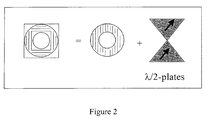
- the optical active element may include two half-wavelength plates.
- the half-wavelength plates may be any suitable shape and may preferably be substantially triangular in shape.
- the half-wavelength plates may be in any of the condensor (CO), adjustor (AD) and/or integrator (IN).
- the half-wavelength plates may be both in the condensor (CO), adjustor (AD) and/or integrator (IN).
- the half-wavelength plates may be in or near the pupil plane of any of the condensor (CO), adjusting device (AD) and/or integrator (IN).
- the half-wavelength plates may be formed from quartz silica or any other material with intrinsic or externally induced birefringence optical properties at the actinic wavelength.
- the half-wavelength plates may be oriented such that they impose the required optical polarization rotation onto incident radiation.
- the rotation of polarization orientation can be based on the physical principles of linear birefringence (half-wavelength plates) or circular birefringence (optical rotary activity).
- Linearly birefringent uniaxial crystalline materials are characterized by having a unique axis of symmetry, called the optical axis, which imposes constraints upon the propagation of light beams within the crystal.
- Two modes are permitted, either as an ordinary beam polarized in a plane normal to the optical axis, or as an extraordinary beam polarized in a plane containing the optical axis.
- Each of the beams has an associated refractive index, such that both the electric field (wave normal) velocities and the beam (ray) angles of refraction are different. It is this latter property that enables suitably cut and oriented prisms of birefringent materials to act as retarders, rotators, polarizers and polarizing beam splitters.
- a plane polarized beam propagates down the optical axis of a material exhibiting circular birefringence it is resolved into two collinear circularly polarized beams, each propagating with a slightly different velocity. When these two components emerge from the material, they recombine into a plane polarized beam whose plane of polarization is rotated from that of the incident beam. This effect of producing a progressive rotation of the plane of polarization with pathlength is called optical activity, and is used to produce optical rotators.
- imaging properties which may be improved include any of the following: an enhancement in the image contrast, an increment improvement of the exposure latititude, lower mask error enhancement factors (MEEF) and a reduced line-edge roughness.
- MEEF mask error enhancement factors
- the lifetime of the illumination system may be extended up to about 30 X 10 9 shots (i.e. 30 G shots), about 35 X 10 9 shots (i.e. 35 G shots), about 40 X 10 9 shots (i.e. 40 G shots) or up to about 110 X 10 9 shots (i.e. 110 G shots).
- the lifetime of the illuminator may be less than 20 X 10 9 shots (i.e. 20 G shots).
- the lifetime of the illumination system may be essentially infinite. Therefore, after a certain number of shots, material forming the illumination system may effectively saturate at a very low induced birefringence.
- the lithographic apparatus may include a numerical aperture (NA) greater than about 1.0.
- NA numerical aperture
- At least part of the lithographic apparatus may be immersed in an immersion fluid such as water.
- a lithographic apparatus includes an optical active element, the optical active element being capable of providing a first portion of the radiation beam with a linear polarization in the first direction, or the optical active element being capable of providing a first portion of the radiation beam with a linear polarization in the first direction and of providing a second portion of the radiation beam with a linear polarization in a second direction, the second direction being substantially perpendicular to the first direction.
- a lithographic apparatus includes an optical active element located between the radiation source and the illuminator, and the lithographic apparatus is provided with a further optical active element located between the illuminator and projection system, the further optical element being capable of changing the polarization state from the first portion of the radiation beam into a different polarization.
- the further optical active element may include a half-wavelength plate or a quarter-wavelength plate.
- a device manufacturing method includes providing a first portion of a radiation beam with a linear polarization in a first direction, or providing a first portion of a radiation beam with a linear polarization in a first direction and providing a second portion of the radiation beam with a linear polarization in a second direction, the second direction being substantially perpendicular to the first direction; patterning the radiation beam; and projecting the patterned beam of radiation onto a target portion of the substrate.
- a device manufacturing method includes providing a first portion of a radiation beam with a linear polarization in a first direction; or providing a first portion of a radiation beam with a linear polarization in a first direction and providing a second portion of the radiation beam with a linear polarization in a second direction, the second direction being substantially perpendicular to the first direction; patterning the radiation beam; and projecting the patterned beam of radiation onto a substrate.
- a device manufactured includes providing a first portion of a radiation beam with a linear polarization in a first direction, or providing a first portion of a radiation beam with a linear polarization in a first direction and providing a second portion of the radiation beam with a linear polarization in a second direction, the second direction being substantially perpendicular to the first direction; patterning the radiation beam; and projecting the patterned beam of radiation onto a target portion of the substrate.
- the manufactured device may, for example, be integrated circuits (ICs), integrated optical systems, guidance and detection patterns for magnetic domain memories, liquid crystal displays (LCDs) and thin-film magnetic heads.
- ICs integrated circuits
- LCDs liquid crystal displays
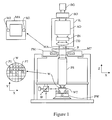
- FIG. 1 schematically depicts a lithographic apparatus according to an embodiment of the present invention.
- the apparatus includes an illumination system (illuminator) IL configured to condition a radiation beam B (e.g. UV radiation or DUV radiation).
- a support e.g. a mask table
- MT is constructed to support a patterning device (e.g. a mask) MA and is connected to a first positioning device PM configured to accurately position the patterning device in accordance with certain parameters.
- a substrate table (e.g. a wafer table) WT is constructed to hold a substrate (e.g. a resist-coated wafer) W and is connected to a second positioning device PW configured to accurately position the substrate in accordance with certain parameters.
- a projection system e.g. a refractive projection lens system
- PS is configured to project a pattern imparted to the radiation beam B by patterning device MA onto a target portion C (e.g. including one or more dies) of the substrate W.
- the illumination system may include various types of optical components, such as refractive, reflective, magnetic, electromagnetic, electrostatic or other types of optical components, or any combination thereof, to direct, shape, and/or control radiation.
- optical components such as refractive, reflective, magnetic, electromagnetic, electrostatic or other types of optical components, or any combination thereof, to direct, shape, and/or control radiation.
- the support supports, e.g. bears the weight of, the patterning device. It holds the patterning device in a manner that depends on the orientation of the patterning device, the design of the lithographic apparatus, and other conditions, for example whether or not the patterning device is held in a vacuum environment.
- the support can use mechanical, vacuum, electrostatic or other clamping techniques to hold the patterning device.
- the support may be a frame or a table, for example, which may be fixed or movable as required. The support may ensure that the patterning device is at a desired position, for example with respect to the projection system. Any use of the terms "reticle” or “mask” herein may be considered synonymous with the more general term "patterning device.”
- patterning device used herein should be broadly interpreted as referring to any device that can be used to impart a radiation beam with a pattern in its cross-section such as to create a pattern in a target portion of the substrate. It should be noted that the pattern imparted to the radiation beam may not exactly correspond to the desired pattern in the target portion of the substrate, for example if the pattern includes phase-shifting features or assist features. Generally, the pattern imparted to the radiation beam will correspond to a particular functional layer in a device being created in the target portion, such as an integrated circuit.
- the patterning device may be transmissive or reflective.
- Examples of patterning devices include masks, programmable mirror arrays, and programmable LCD panels.
- Masks are well known in lithography, and include mask types such as binary, alternating phase-shift, and attenuated phase-shift, as well as various hybrid mask types.
- An example of a programmable mirror array employs a matrix arrangement of small mirrors, each of which can be individually tilted so as to reflect an incoming radiation beam in different directions. The tilted mirrors impart a pattern in a radiation beam which is reflected by the mirror matrix.
- projection system used herein should be broadly interpreted as encompassing any type of projection system, including refractive, reflective, catadioptric, magnetic, electromagnetic and electrostatic optical systems, or any combination thereof, as appropriate for the exposure radiation being used, or for other factors such as the use of an immersion liquid or the use of a vacuum. Any use of the term “projection lens” herein may be considered as synonymous with the more general term “projection system”.
- the apparatus is of a transmissive type (e.g. employing a transmissive mask).
- the apparatus may be of a reflective type (e.g. employing a programmable mirror array of a type as referred to above, or employing a reflective mask).
- the lithographic apparatus may be of a type having two (dual stage) or more substrate tables (and/or two or more mask tables). In such "multiple stage” machines the additional tables may be used in parallel, or preparatory processes may be carried out on one or more tables while one or more other tables are being used for exposure.
- the lithographic apparatus may also be of a type wherein at least a portion of the substrate may be covered by a liquid having a relatively high refractive index, e.g. water, so as to fill a space between the projection system and the substrate.
- a liquid having a relatively high refractive index e.g. water
- An immersion liquid may also be applied to other spaces in the lithographic apparatus, for example, between the mask and the projection system. Immersion techniques are well known in the art for increasing the numerical aperture ofprojection systems.
- immersion as used herein does not mean that a structure, such as a substrate, must be submerged in liquid, but rather only means that liquid is located, for example, between the projection system and the substrate during exposure.
- the illuminator IL receives radiation from a radiation source SO.
- the source and the lithographic apparatus may be separate entities, for example when the source is an excimer laser. In such cases, the source is not considered to form part of the lithographic apparatus and the radiation is passed from the source SO to the illuminator IL with the aid of a beam delivery system BD including, for example, suitable directing mirrors and/or a beam expander. In other cases the source may be an integral part of the lithographic apparatus, for example when the source is a mercury lamp.
- the source SO and the illuminator IL, together with the beam delivery system BD if required, may be referred to as a radiation system.
- the illuminator IL may include an adjusting device AD configured to adjust the angular intensity distribution of the radiation beam. Generally, at least the outer and/or inner radial extent (commonly referred to as ⁇ -outer and ⁇ -inner, respectively) of the intensity distribution in a pupil plane of the illuminator can be adjusted.
- the illuminator IL may include various other components, such as an integrator IN and a condensor CO. The illuminator may be used to condition the radiation beam, to have a desired uniformity and intensity distribution in its cross-section.
- the radiation beam B is incident on the patterning device (e.g., mask MA), which is held on the support (e.g., mask table MT), and is patterned by the patterning device. Having traversed the mask MA, the radiation beam B passes through the projection system PS, which projects the beam onto a target portion C of the substrate W.
- the substrate table WT can be moved accurately, e.g. so as to position different target portions C in the path of the radiation beam B.
- the first positioning device PM and another position sensor can be used to accurately position the mask MA with respect to the path of the radiation beam B, e.g. after mechanical retrieval from a mask library, or during a scan.
- movement of the mask table MT may be realized with the aid of a long-stroke module (coarse positioning) and a short-stroke module (fine positioning), which form part of the first positioning device PM.
- movement of the substrate table WT may be realized using a long-stroke module and a short-stroke module, which form part of the second positioning device PW.
- the mask table MT may be connected to a short-stroke actuator only, or may be fixed.
- Mask MA and substrate W may be aligned using mask alignment marks M1, M2 and substrate alignment marks P1, P2.
- the substrate alignment marks as illustrated occupy dedicated target portions, they may be located in spaces between target portions (these are known as scribe-lane alignment marks).
- the mask alignment marks may be located between the dies.
- the depicted apparatus could be used in at least one of the following modes:
- polarized radiation enhances image contrast.
- An incremental improvement in exposure latitude (EL), lower mask error enhancement factors (MEEF) and reduced line-edge roughness may also be obtained.
- a problem which exists in the art is that due to polarization induced compaction, birefringence is burnt into fused silica material forming part of an illumination system. It has been found that if the polarization orientation is not parallel or orthogonal to the birefringence orientation, the polarization orientation is changed, thus leading to critical dimension (CD) errors. It has therefore been found that a mix of polarization states which are not substantially perpendicular to one another as set out in the present invention is limiting to the lifetime of an illumination system.
- CD critical dimension
- the present invention therefore relates to forming linearly polarized radiation, polarized in a first direction or polarized in the first direction and a second direction, the second direction being substantially perpendicular to the first direction.
- the last type of radiation as previously stated may generally be referred to as XY polarized radiation.
- the present invention relates to using an annular illumination mode with radiation polarized in a first and second direction.
- the first direction of polarization may be either parallel or perpendicular with the scanning direction. In this application the first direction is referred to as X- direction, the second direction as Y-direction.
- annular illumination with radiation in first and second directions is formed, the first and second directions being substantially perpendicular to each other.
- the ratio between the first and second directions of polarized radiation is 1:1. At least 95% of the radiation is polarized in either the first and second directions.
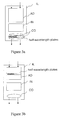
- Figure 3a depicts two half-wavelength plates (i.e. the rotator) in the condensor CO of the apparatus according to the present invention.
- Figure 3b depicts the two half wavelength plates (i.e. the rotator) in the adjusting device AD.
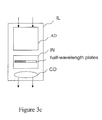
- Figure 3c depicts the two half-wavelength plates in the integrator IN.
- Figure 4 depicts the effects of polarization which shows that having a high numerical aperture NA has significant imaging polarization effects.
- Figure 4 shows that for TE (transverse electric) polarization the image contrast does not decrease with increasing numerical aperture NA.
- Figure 4 shows that for unpolarized and TM (transverse magnetic) polarization, there is a reduction in the image contrast with increasing numerical aperture NA.
- Figure 4 therefore shows that there may be an improvement in the image contrast and mask error factor (MEF) improvements when using TE polarization.
- MEF mask error factor
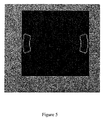
- Figure 5 represents a pupil image for a dipole illumination mode according to an embodiment of the present invention using an attenuated phase shift mask (att-PSM).
- att-PSM attenuated phase shift mask
- Figure 6 shows that the exposure latitude (EL) is higher for polarized light in comparison to unpolarized light.
- EL exposure latitude
- Figure 5 the dipole of Figure 5 is used, the polarization direction being chosen to be parallel to the Y direction of Figure 5.
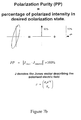
- Figures 7a and 7b are general representations which illustrate the description of polarized light.
- the quality of polarized light can be defined using two values. Firstly, the degree of polarization DOP may be used to quantify the polarized light which describes the fraction of light which is polarized. Secondly, polarization purity PP which relates to the fraction of the polarized light in the correct direction may also be used.
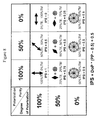
- Figure 8 represents a table for different polarization situations with different degrees of polarization and polarization purity PP.
- the degree of polarization DOP and polarization purity PP are combined to form an intensity in the desired polarized states IPS.
- the IPS measures the intensity of the chosen polarization direction.
- Figure 9 depicts a graph of birefringence versus lifetime in years for different illuminator materials using polarized irradiation. It shows fused silica degradation (i.e. birefringence burn in) as a function of different material grades.
- Figure 10 depicts the burn in birefringence with X-polarized light.
- Figure 11 depicts how a variation in IPS impacts the exposure latitude.
- IPS variation 0
- IPS variation 0
- a certain gain in EL by using polarization.
- IPS variation 0
- a different absolute energy is needed to expose a feature. This leads to overlapping exposure windows of all field points being smaller than the maximum gain without variation.
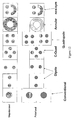
- Figure 12 depicts different illumination modes according to the present invention such as conventional, dipole, quadrupole, annular and non-symmetric.
- the conventional illumination mode has a linear polarization directed in either a first direction, X-direction or in a second direction, Y-direction, perpendicular to the first direction.
- the dipole illumination mode has two illumination poles located on axis in the X-direction, whereby the direction of linear polarization of the illumination poles is parallel to the Y-direction.
- the other dipole mode has two illumination poles located on an axis in the Y-direction, whereby the direction of linear polarization of the illumination poles is parallel to the X-direction.
- C-Quad has four illumination poles arranged in a square, whereby an axis through two opposite poles is parallel to the X- or Y-direction and the direction of linear polarization of the illumination of two poles on an axis parallel to the X-direction is directed parallel to the Y-direction and the direction of linear polarization of the illumination of the two poles on an axis parallel to the Y-direction is directed parallel to the X-direction.
- Figure 12 shows a quadrupole illumination mode, whereby an axis trough two opposite poles is under 45° with the X- or Y- direction and the linear polarization of the illumination of the poles is either parallel to the X-direction or parallel to the Y-direction.
- Two different configurations for quadrupole illumination are shown, one configuration is X polarized and the other is Y polarized.
- Fig. 12 shows an annular illumination mode, wherein the ring is divided in four portions and the direction of the linear polarization of the illumination of two opposite portions is parallel to the X- or Y-direction, and the direction of the linear polarization of two adjacent portions is mutual perpendicular.
- Fig. 12 shows a quadrupole illumination mode, whereby an axis trough two opposite poles is under 45° with the X- or Y- direction and the linear polarization of the illumination of the poles is either parallel to the X-direction or parallel to the Y-direction.
- an irregular illumination mode including a semi-annular portion having a direction of linear polarization parallel to the X-direction and two poles on an axis parallel to the Y-direction, the direction of the polarization of the illumination of the two poles is parallel to the Y-direction.
- Figure 13 represents further possible illumination modes. C-Quad, QuasarTM and a custom illumination mode are shown.
- Figure 14 depicts polarization lifetime effects for illuminator materials A and B irradiated with XY polarization according to the present invention (i.e. the radiation is polarized in a first and second direction, the second direction being substantially perpendicular to the first) and lifetime effects for conventional illumination with polarized light having a polarization direction making an angle of 45° with respect to the scanning direction.
- Figure 14 shows that using XY polarization that there is a significant reduction in the purity loss of the efficiency in the illuminator material i.e. the lifetime of the illumination system is increased.
- Two different silica types (A and B) are shown for the loss in polarization purity for 45° polarization which is the worst case.
- FIG. 15 shows a further embodiment of a lithographic apparatus.
- the lithographic apparatus LA includes a radiation source SO, an optical active element, for example a half-wave plate HWP1A, HWP1B, an illumination system IL and a further optical active element, for example a half-wave plate HWP2A, HWP2B and a projection system PS.
- the radiation source SO emits a radiation beam to the illumination system IL, whereby a first portion of the radiation beam is transmitted via the half-wave plate HWP1A, and a second portion of the radiation beam is transmitted via the half-wave plate HWP1B in order to bring about a radiation beam having an XY polarization.
- the illumination system IL adapts the cross-section and the intensity distribution of the radiation beam and transmits the radiation beam to the projection system PS via the further optical active element, for example a half-wave plate HWP2A, HWP2B.
- the half-wave plate HWP2A changes the direction of the polarization of the first portion of the beam in a different direction
- the half-plate HWP2B changes the direction of polarization of the second portion of the beam in a further different direction.
- half-wave plate HWP2A, HWP2B the polarization direction of the first and second portion of the beam can be set to optimize the exposure latitude for non-vertical and non-horizontal patterns while leaving the polarization in the illuminator unchanged for maximizing the illuminator lifetime.
- a quarter-wave plate can be used for the further optical element between the illumination system IS and the projection system PS.
- the quarter-wave plates transfers the linear polarization of the first and second portion of the radiation beam into a circular polarization with respectively a levorotary and a dextrorotary direction of the first and second portions.
- the optical active element can be a depolarizer.
- the present invention relates to using polarized light to improve the imaging properties, for example the exposure latitude, while maintaining and extending the lifetime of an illumination system in a lithographic apparatus.
- lithographic apparatus in the manufacture of ICs
- the lithographic apparatus described herein may have other applications, such as the manufacture of integrated optical systems, guidance and detection patterns for magnetic domain memories, flat-panel displays, liquid-crystal displays (LCDs), thin-film magnetic heads, etc.
- any use of the terms “wafer” or “die” herein may be considered as synonymous with the more general terms “substrate” or “target portion”, respectively.
- the substrate referred to herein may be processed, before or after exposure, in for example a track (a tool that applies a layer of resist to a substrate and develops the exposed resist), a metrology tool and/or an inspection tool. Where applicable, the disclosure herein may be applied to such and other substrate processing tools. Further, the substrate may be processed more than once, for example in order to create a multi-layer IC, so that the term substrate used herein may also refer to a substrate that already contains multiple processed layers.
- imprint lithography a topography in a patterning device defines the pattern created on a substrate.
- the topography of the patterning device may be pressed into a layer of resist supplied to the substrate whereupon the resist is cured by applying electromagnetic radiation, heat, pressure or a combination thereof.
- the patterning device is moved out of the resist leaving a pattern in it after the resist is cured.
- UV radiation e.g. having a wavelength of or about 365, 355, 248, 193, 157 or 126 nm
- EUV radiation e.g. having a wavelength in the range of 5-20 nm
- particle beams such as ion beams or electron beams.
- lens may refer to any one or combination of various types of optical components, including refractive, reflective, magnetic, electromagnetic and electrostatic optical components.
- the present invention may take the form of a computer program containing one or more sequences of machine-readable instructions describing a method as disclosed above, or a data storage medium (e.g. semiconductor memory, magnetic or optical disk) having such a computer program stored therein.
- a data storage medium e.g. semiconductor memory, magnetic or optical disk
Landscapes
- General Physics & Mathematics (AREA)
- Physics & Mathematics (AREA)
- Health & Medical Sciences (AREA)
- Toxicology (AREA)
- Engineering & Computer Science (AREA)
- Environmental & Geological Engineering (AREA)
- Epidemiology (AREA)
- Public Health (AREA)
- Atmospheric Sciences (AREA)
- Life Sciences & Earth Sciences (AREA)
- Exposure And Positioning Against Photoresist Photosensitive Materials (AREA)
- Exposure Of Semiconductors, Excluding Electron Or Ion Beam Exposure (AREA)
- Polarising Elements (AREA)
Applications Claiming Priority (2)
| Application Number | Priority Date | Filing Date | Title |
|---|---|---|---|
| US11/022,938 US7312852B2 (en) | 2004-12-28 | 2004-12-28 | Polarized radiation in lithographic apparatus and device manufacturing method |
| US11/101,630 US7345740B2 (en) | 2004-12-28 | 2005-04-08 | Polarized radiation in lithographic apparatus and device manufacturing method |
Publications (2)
| Publication Number | Publication Date |
|---|---|
| EP1677152A1 true EP1677152A1 (fr) | 2006-07-05 |
| EP1677152B1 EP1677152B1 (fr) | 2009-08-19 |
Family
ID=36182247
Family Applications (1)
| Application Number | Title | Priority Date | Filing Date |
|---|---|---|---|
| EP05257710A Expired - Lifetime EP1677152B1 (fr) | 2004-12-28 | 2005-12-15 | Rayonnement polarisé dans un appareil de lithographie et procédé de fabrication d'un dispositif |
Country Status (7)
| Country | Link |
|---|---|
| US (2) | US7345740B2 (fr) |
| EP (1) | EP1677152B1 (fr) |
| JP (1) | JP4532403B2 (fr) |
| KR (1) | KR100741046B1 (fr) |
| DE (1) | DE602005016066D1 (fr) |
| SG (1) | SG123768A1 (fr) |
| TW (1) | TWI304524B (fr) |
Cited By (1)
| Publication number | Priority date | Publication date | Assignee | Title |
|---|---|---|---|---|
| EP1744219A3 (fr) * | 2005-07-11 | 2008-08-13 | ASML Netherlands B.V. | Rayonnement polarisé dans un appareil lithographique, et procédé de fabrication d'un dispositif |
Families Citing this family (20)
| Publication number | Priority date | Publication date | Assignee | Title |
|---|---|---|---|---|
| KR20170018113A (ko) | 2003-04-09 | 2017-02-15 | 가부시키가이샤 니콘 | 노광 방법 및 장치, 그리고 디바이스 제조 방법 |
| TWI569308B (zh) * | 2003-10-28 | 2017-02-01 | 尼康股份有限公司 | 照明光學裝置、曝光裝置、曝光方法以及元件製造 方法 |
| TWI512335B (zh) * | 2003-11-20 | 2015-12-11 | 尼康股份有限公司 | 光束變換元件、光學照明裝置、曝光裝置、以及曝光方法 |
| US20070019179A1 (en) | 2004-01-16 | 2007-01-25 | Damian Fiolka | Polarization-modulating optical element |
| US8270077B2 (en) * | 2004-01-16 | 2012-09-18 | Carl Zeiss Smt Gmbh | Polarization-modulating optical element |
| KR101230757B1 (ko) | 2004-01-16 | 2013-02-06 | 칼 짜이스 에스엠티 게엠베하 | 편광변조 광학소자 |
| TWI395068B (zh) * | 2004-01-27 | 2013-05-01 | 尼康股份有限公司 | 光學系統、曝光裝置以及曝光方法 |
| TWI505329B (zh) | 2004-02-06 | 2015-10-21 | 尼康股份有限公司 | 光學照明裝置、曝光裝置、曝光方法以及元件製造方法 |
| US7324280B2 (en) | 2004-05-25 | 2008-01-29 | Asml Holding N.V. | Apparatus for providing a pattern of polarization |
| KR100614651B1 (ko) * | 2004-10-11 | 2006-08-22 | 삼성전자주식회사 | 회로 패턴의 노광을 위한 장치 및 방법, 사용되는포토마스크 및 그 설계 방법, 그리고 조명계 및 그 구현방법 |
| US7345740B2 (en) * | 2004-12-28 | 2008-03-18 | Asml Netherlands B.V. | Polarized radiation in lithographic apparatus and device manufacturing method |
| TWI453795B (zh) * | 2005-01-21 | 2014-09-21 | 尼康股份有限公司 | 照明光學裝置、曝光裝置、曝光方法以及元件製造方法 |
| DE102007043958B4 (de) * | 2007-09-14 | 2011-08-25 | Carl Zeiss SMT GmbH, 73447 | Beleuchtungseinrichtung einer mikrolithographischen Projektionsbelichtungsanlage |
| KR20100085974A (ko) * | 2007-10-12 | 2010-07-29 | 가부시키가이샤 니콘 | 조명 광학 장치, 및 노광 방법 및 장치 |
| DE102007055063A1 (de) * | 2007-11-16 | 2009-05-28 | Carl Zeiss Smt Ag | Beleuchtungseinrichtung einer mikrolithographischen Projektionsbelichtungsanlage |
| US20110037962A1 (en) * | 2009-08-17 | 2011-02-17 | Nikon Corporation | Polarization converting unit, illumination optical system, exposure apparatus, and device manufacturing method |
| US20110205519A1 (en) * | 2010-02-25 | 2011-08-25 | Nikon Corporation | Polarization converting unit, illumination optical system, exposure apparatus, and device manufacturing method |
| WO2013143594A1 (fr) * | 2012-03-29 | 2013-10-03 | Carl Zeiss Smt Gmbh | Appareil et procédé de compensation de défaut de canal de système d'exposition par projection microlithographique |
| US8612904B1 (en) | 2012-11-21 | 2013-12-17 | Global Foundries Inc. | Use of polarization and composite illumination source for advanced optical lithography |
| US10168273B1 (en) | 2017-07-01 | 2019-01-01 | Kla-Tencor Corporation | Methods and apparatus for polarizing reticle inspection |
Citations (5)
| Publication number | Priority date | Publication date | Assignee | Title |
|---|---|---|---|---|
| US5459000A (en) * | 1992-10-14 | 1995-10-17 | Canon Kabushiki Kaisha | Image projection method and device manufacturing method using the image projection method |
| EP0969327A2 (fr) * | 1998-06-30 | 2000-01-05 | Canon Kabushiki Kaisha | Procédé d'expositions multiples |
| US20010012154A1 (en) * | 1995-09-23 | 2001-08-09 | Carl-Zeiss-Stiftung | Radial polarization-rotating optical arrangement and microlithographic projection exposure system incorporating said arrangement |
| US20040057036A1 (en) * | 2002-09-19 | 2004-03-25 | Miyoko Kawashima | Exposure method |
| US20050128458A1 (en) * | 2003-12-03 | 2005-06-16 | Texas Instruments Incorporated | System and method for custom-polarized photolithography illumination |
Family Cites Families (21)
| Publication number | Priority date | Publication date | Assignee | Title |
|---|---|---|---|---|
| JP3246615B2 (ja) * | 1992-07-27 | 2002-01-15 | 株式会社ニコン | 照明光学装置、露光装置、及び露光方法 |
| JPH06118623A (ja) | 1992-10-07 | 1994-04-28 | Fujitsu Ltd | レチクル及びこれを用いた半導体露光装置 |
| JPH06124872A (ja) | 1992-10-14 | 1994-05-06 | Canon Inc | 像形成方法及び該方法を用いて半導体装置を製造する方法 |
| JPH06181167A (ja) | 1992-10-14 | 1994-06-28 | Canon Inc | 像形成方法及び該方法を用いてデバイスを製造する方法及び該方法に用いるフォトマスク |
| JPH06204121A (ja) * | 1992-12-28 | 1994-07-22 | Canon Inc | 照明装置及びそれを用いた投影露光装置 |
| JP3099933B2 (ja) * | 1993-12-28 | 2000-10-16 | 株式会社東芝 | 露光方法及び露光装置 |
| JPH09199394A (ja) | 1996-01-19 | 1997-07-31 | Sony Corp | 露光用照明装置 |
| DE10010131A1 (de) | 2000-03-03 | 2001-09-06 | Zeiss Carl | Mikrolithographie - Projektionsbelichtung mit tangentialer Polarisartion |
| DE10229614A1 (de) * | 2002-06-25 | 2004-01-15 | Carl Zeiss Smt Ag | Katadioptrisches Reduktionsobjektiv |
| WO2004012013A2 (fr) * | 2002-07-26 | 2004-02-05 | Massachusetts Institute Of Technology | Systemes et procedes d'imagerie optique mettant en application un eclairage polarise et un filtre pupille coordonne |
| US7511886B2 (en) * | 2003-05-13 | 2009-03-31 | Carl Zeiss Smt Ag | Optical beam transformation system and illumination system comprising an optical beam transformation system |
| EP1652972B1 (fr) * | 2003-07-10 | 2012-05-30 | Nikon Corporation | Procede de production d'un systeme d'exposition |
| US7408616B2 (en) * | 2003-09-26 | 2008-08-05 | Carl Zeiss Smt Ag | Microlithographic exposure method as well as a projection exposure system for carrying out the method |
| US7460206B2 (en) | 2003-12-19 | 2008-12-02 | Carl Zeiss Smt Ag | Projection objective for immersion lithography |
| US20050205108A1 (en) * | 2004-03-16 | 2005-09-22 | Taiwan Semiconductor Manufacturing Co., Ltd. | Method and system for immersion lithography lens cleaning |
| US7084960B2 (en) * | 2004-03-29 | 2006-08-01 | Intel Corporation | Lithography using controlled polarization |
| US7324280B2 (en) * | 2004-05-25 | 2008-01-29 | Asml Holding N.V. | Apparatus for providing a pattern of polarization |
| US7271874B2 (en) * | 2004-11-02 | 2007-09-18 | Asml Holding N.V. | Method and apparatus for variable polarization control in a lithography system |
| US7345740B2 (en) * | 2004-12-28 | 2008-03-18 | Asml Netherlands B.V. | Polarized radiation in lithographic apparatus and device manufacturing method |
| US7312852B2 (en) * | 2004-12-28 | 2007-12-25 | Asml Netherlands B.V. | Polarized radiation in lithographic apparatus and device manufacturing method |
| US7375799B2 (en) * | 2005-02-25 | 2008-05-20 | Asml Netherlands B.V. | Lithographic apparatus |
-
2005
- 2005-04-08 US US11/101,630 patent/US7345740B2/en not_active Expired - Lifetime
- 2005-12-15 DE DE602005016066T patent/DE602005016066D1/de not_active Expired - Lifetime
- 2005-12-15 EP EP05257710A patent/EP1677152B1/fr not_active Expired - Lifetime
- 2005-12-16 TW TW094144970A patent/TWI304524B/zh not_active IP Right Cessation
- 2005-12-23 SG SG200508371A patent/SG123768A1/en unknown
- 2005-12-27 JP JP2005375578A patent/JP4532403B2/ja not_active Expired - Fee Related
- 2005-12-28 KR KR1020050132116A patent/KR100741046B1/ko not_active Expired - Fee Related
-
2008
- 2008-01-30 US US12/010,819 patent/US7929116B2/en active Active
Patent Citations (5)
| Publication number | Priority date | Publication date | Assignee | Title |
|---|---|---|---|---|
| US5459000A (en) * | 1992-10-14 | 1995-10-17 | Canon Kabushiki Kaisha | Image projection method and device manufacturing method using the image projection method |
| US20010012154A1 (en) * | 1995-09-23 | 2001-08-09 | Carl-Zeiss-Stiftung | Radial polarization-rotating optical arrangement and microlithographic projection exposure system incorporating said arrangement |
| EP0969327A2 (fr) * | 1998-06-30 | 2000-01-05 | Canon Kabushiki Kaisha | Procédé d'expositions multiples |
| US20040057036A1 (en) * | 2002-09-19 | 2004-03-25 | Miyoko Kawashima | Exposure method |
| US20050128458A1 (en) * | 2003-12-03 | 2005-06-16 | Texas Instruments Incorporated | System and method for custom-polarized photolithography illumination |
Cited By (1)
| Publication number | Priority date | Publication date | Assignee | Title |
|---|---|---|---|---|
| EP1744219A3 (fr) * | 2005-07-11 | 2008-08-13 | ASML Netherlands B.V. | Rayonnement polarisé dans un appareil lithographique, et procédé de fabrication d'un dispositif |
Also Published As
| Publication number | Publication date |
|---|---|
| KR100741046B1 (ko) | 2007-07-20 |
| TW200632582A (en) | 2006-09-16 |
| DE602005016066D1 (de) | 2009-10-01 |
| US7929116B2 (en) | 2011-04-19 |
| US7345740B2 (en) | 2008-03-18 |
| EP1677152B1 (fr) | 2009-08-19 |
| US20080143992A1 (en) | 2008-06-19 |
| KR20060076748A (ko) | 2006-07-04 |
| US20060139612A1 (en) | 2006-06-29 |
| JP4532403B2 (ja) | 2010-08-25 |
| TWI304524B (en) | 2008-12-21 |
| JP2006191064A (ja) | 2006-07-20 |
| SG123768A1 (en) | 2006-07-26 |
Similar Documents
| Publication | Publication Date | Title |
|---|---|---|
| US7929116B2 (en) | Polarized radiation in lithographic apparatus and device manufacturing method | |
| US7317512B2 (en) | Different polarization in cross-section of a radiation beam in a lithographic apparatus and device manufacturing method | |
| US7312852B2 (en) | Polarized radiation in lithographic apparatus and device manufacturing method | |
| US8587766B2 (en) | Lithographic apparatus and device manufacturing method | |
| CN102402141B (zh) | 自参考干涉仪、对准系统和光刻设备 | |
| US7952685B2 (en) | Illuminator for a lithographic apparatus and method | |
| CN100541332C (zh) | 光刻装置及其应用方法 | |
| US7872731B2 (en) | Lithographic apparatus and device manufacturing method | |
| US7352443B2 (en) | Radially polarized light in lithographic apparatus | |
| CN102193336B (zh) | 光刻设备和方法 | |
| HK1130091A1 (en) | Exposure device of projector, exposure method and device manufacturing method | |
| HK1130091B (en) | Exposure device of projector, exposure method and device manufacturing method |
Legal Events
| Date | Code | Title | Description |
|---|---|---|---|
| PUAI | Public reference made under article 153(3) epc to a published international application that has entered the european phase |
Free format text: ORIGINAL CODE: 0009012 |
|
| AK | Designated contracting states |
Kind code of ref document: A1 Designated state(s): AT BE BG CH CY CZ DE DK EE ES FI FR GB GR HU IE IS IT LI LT LU LV MC NL PL PT RO SE SI SK TR |
|
| AX | Request for extension of the european patent |
Extension state: AL BA HR MK YU |
|
| 17P | Request for examination filed |
Effective date: 20061011 |
|
| 17Q | First examination report despatched |
Effective date: 20061208 |
|
| AKX | Designation fees paid |
Designated state(s): DE FR GB IT NL |
|
| RAP1 | Party data changed (applicant data changed or rights of an application transferred) |
Owner name: CARL ZEISS SMT AG Owner name: ASML NETHERLANDS BV |
|
| GRAP | Despatch of communication of intention to grant a patent |
Free format text: ORIGINAL CODE: EPIDOSNIGR1 |
|
| GRAS | Grant fee paid |
Free format text: ORIGINAL CODE: EPIDOSNIGR3 |
|
| GRAL | Information related to payment of fee for publishing/printing deleted |
Free format text: ORIGINAL CODE: EPIDOSDIGR3 |
|
| GRAS | Grant fee paid |
Free format text: ORIGINAL CODE: EPIDOSNIGR3 |
|
| GRAA | (expected) grant |
Free format text: ORIGINAL CODE: 0009210 |
|
| AK | Designated contracting states |
Kind code of ref document: B1 Designated state(s): DE FR GB IT NL |
|
| REG | Reference to a national code |
Ref country code: GB Ref legal event code: FG4D |
|
| REF | Corresponds to: |
Ref document number: 602005016066 Country of ref document: DE Date of ref document: 20091001 Kind code of ref document: P |
|
| NLV1 | Nl: lapsed or annulled due to failure to fulfill the requirements of art. 29p and 29m of the patents act | ||
| PG25 | Lapsed in a contracting state [announced via postgrant information from national office to epo] |
Ref country code: NL Free format text: LAPSE BECAUSE OF FAILURE TO SUBMIT A TRANSLATION OF THE DESCRIPTION OR TO PAY THE FEE WITHIN THE PRESCRIBED TIME-LIMIT Effective date: 20090819 |
|
| PLBE | No opposition filed within time limit |
Free format text: ORIGINAL CODE: 0009261 |
|
| STAA | Information on the status of an ep patent application or granted ep patent |
Free format text: STATUS: NO OPPOSITION FILED WITHIN TIME LIMIT |
|
| 26N | No opposition filed |
Effective date: 20100520 |
|
| GBPC | Gb: european patent ceased through non-payment of renewal fee |
Effective date: 20091215 |
|
| PG25 | Lapsed in a contracting state [announced via postgrant information from national office to epo] |
Ref country code: GB Free format text: LAPSE BECAUSE OF NON-PAYMENT OF DUE FEES Effective date: 20091215 |
|
| PG25 | Lapsed in a contracting state [announced via postgrant information from national office to epo] |
Ref country code: IT Free format text: LAPSE BECAUSE OF FAILURE TO SUBMIT A TRANSLATION OF THE DESCRIPTION OR TO PAY THE FEE WITHIN THE PRESCRIBED TIME-LIMIT Effective date: 20090819 |
|
| REG | Reference to a national code |
Ref country code: FR Ref legal event code: PLFP Year of fee payment: 11 |
|
| REG | Reference to a national code |
Ref country code: FR Ref legal event code: PLFP Year of fee payment: 12 |
|
| REG | Reference to a national code |
Ref country code: FR Ref legal event code: PLFP Year of fee payment: 13 |
|
| PGFP | Annual fee paid to national office [announced via postgrant information from national office to epo] |
Ref country code: FR Payment date: 20181220 Year of fee payment: 14 |
|
| PGFP | Annual fee paid to national office [announced via postgrant information from national office to epo] |
Ref country code: DE Payment date: 20191210 Year of fee payment: 15 |
|
| PG25 | Lapsed in a contracting state [announced via postgrant information from national office to epo] |
Ref country code: FR Free format text: LAPSE BECAUSE OF NON-PAYMENT OF DUE FEES Effective date: 20191231 |
|
| REG | Reference to a national code |
Ref country code: DE Ref legal event code: R119 Ref document number: 602005016066 Country of ref document: DE |
|
| PG25 | Lapsed in a contracting state [announced via postgrant information from national office to epo] |
Ref country code: DE Free format text: LAPSE BECAUSE OF NON-PAYMENT OF DUE FEES Effective date: 20210701 |