EP1677210A1 - Dispositif d'analyse de caracteristiques de document pour un document a etudier - Google Patents
Dispositif d'analyse de caracteristiques de document pour un document a etudier Download PDFInfo
- Publication number
- EP1677210A1 EP1677210A1 EP04792323A EP04792323A EP1677210A1 EP 1677210 A1 EP1677210 A1 EP 1677210A1 EP 04792323 A EP04792323 A EP 04792323A EP 04792323 A EP04792323 A EP 04792323A EP 1677210 A1 EP1677210 A1 EP 1677210A1
- Authority
- EP
- European Patent Office
- Prior art keywords
- documents
- document
- surveyed
- appearance frequency
- index term
- Prior art date
- Legal status (The legal status is an assumption and is not a legal conclusion. Google has not performed a legal analysis and makes no representation as to the accuracy of the status listed.)
- Withdrawn
Links
Images














Classifications
-
- G—PHYSICS
- G06—COMPUTING OR CALCULATING; COUNTING
- G06F—ELECTRIC DIGITAL DATA PROCESSING
- G06F16/00—Information retrieval; Database structures therefor; File system structures therefor
- G06F16/30—Information retrieval; Database structures therefor; File system structures therefor of unstructured textual data
- G06F16/31—Indexing; Data structures therefor; Storage structures
- G06F16/313—Selection or weighting of terms for indexing
-
- G—PHYSICS
- G06—COMPUTING OR CALCULATING; COUNTING
- G06F—ELECTRIC DIGITAL DATA PROCESSING
- G06F17/00—Digital computing or data processing equipment or methods, specially adapted for specific functions
Definitions
- the present invention relates to the extraction of index terms in a document-to-be-surveyed, and in particular to an automatic extraction device, extraction program and extraction method of the index terms, which enable to properly analyze the character of the document-to-be-surveyed and the positioning of the document-to-be-surveyed in a document group, as well as a character representative diagram employing the extracted index terms. Further, the present invention also relates to a document characteristic analysis device, and in particular to a document characteristic analysis device, analysis program, analysis method and document characteristic representative diagram which enable to analyze the general positioning of a document-to-be-surveyed included in a document-group-to-be-surveyed with respect to other document group and the character of the overall document-group-to-be-surveyed.
- Patent Document 1 compares the index terms contained in the document to be surveyed with the index terms contained in the other documents, calculates the similarity based on the type and number of appearances of the similar index terms, and outputs documents in order from those having the highest similarity.
- Patent Document 2 Japanese Patent Laid-Open Publication No. H11-34523 "Method and Device for Extracting Document Information and Storage Medium Stored with Document Information Extraction Program"
- Patent Document 2 Japanese Patent Laid-Open Publication No. H11-34523 "Method and Device for Extracting Document Information and Storage Medium Stored with Document Information Extraction Program”
- Patent Document 2 Japanese Patent Laid-Open Publication No. H11-345239
- a first object of the present invention is to provide an index term extraction device capable of properly comprehending the character of a document-to-be-surveyed when it is provided.
- a second object of the present invention is to provide an index term extraction device and character representative diagram enabling the multilateral analysis of the character of the document-to-be-surveyed.
- a third object of the present invention is to provide a document characteristic analysis device and document characteristic representative diagram enabling the analysis of the general positioning of a document-to-be-surveyed included in a document-group-to-be-surveyed, and the trend of the overall document-group-to-be-surveyed.
- the index term extraction device of the present invention includes: input means for inputting a document-to-be-surveyed, documents-to-be-compared to be compared with the document-to-be-surveyed, and source-documents-for-selection to become the selection source of similar documents that are similar to the document-to-be-surveyed; index term extraction means for extracting index terms from the document-to-be-surveyed; first appearance frequency calculation means for calculating a function value of an appearance frequency of each of the extracted index.terms in the documents-to-be-compared; similar documents selecting means for selecting the similar documents from the source-documents-for-selection based on data of the document-to-be-surveyed; second appearance frequency calculation means for calculating a function value of an appearance frequency of each of the extracted index terms in the similar documents; and output means for outputting each index term and positioning data thereof, based on the combination of the calculated function value of the appearance frequency in the documents-to-be-compared and the calculated function value of the appearance frequency in the
- the present invention enables the analysis of the character of the document-to-be-surveyed by observing the function value of the appearance frequency in the combination of each index term. According to the present invention, since the processing of extracting the index terms from the document-to-be-surveyed, processing for selecting similar documents from the source-documents-for-selection, processing for calculating the function value of the appearance frequency in the documents-to-be-compared or similar documents and so on are all performed with a computer, a person will not have to read the contents of documents at all in order to perform the foregoing processing.
- the similar documents are newly selected based on data of the document-to-be-surveyed, and each index term and the positioning data thereof are output based on the combination of the function value of the appearance frequency in the similar documents and the function value of the appearance frequency in the documents-to-be-compared. Therefore, the character of the document-to-be-surveyed can be properly analyzed.
- the documents-to-be-compared and the source-documents-for-selection need to be electronically retrievable data, there is no other limitation on the contents thereof and, for instance, these may be the same document group or different document groups. Further, one or both of these document groups can be randomly extracted or fully extracted under certain conditions from a certain document group.
- all patent documents in a certain country during a certain period will be the documents-to-be-compared and the source-documents-for-selection.
- a single document or a plurality of documents may be surveyed.
- the character of the document group as a whole will be represented rather than the character of the individual documents-to-be-surveyed.
- a document-to-be-surveyed may or may not be included in the documents-to-be-compared or the source-documents-for-selection. Extraction of the index terms by the index term extraction means is conducted by clipping words from the whole or a part of the document.
- the method of clipping the words there is no other limitation on the method of clipping the words, and, for instance, a method of extracting significant words excluding particles and conjunctions via conventional methods or with commercially available morphological analysis software, or a method of retaining an index term dictionary (thesaurus) database in advance and using index terms that can be obtained from such database may be adopted.
- the appearance frequency in the document group of the index term for instance, the number of document hits (document frequency; DF) when retrieving a certain index term among the document group is used, but this is not limited thereto, and, for example, the total number of hits of the index term may also be used.
- Output of the index terms by the output means may be the output of all index terms extracted by the index term extraction means, or the output of only a portion of the index terms that strongly show the character of.the document. Further, the positioning data to be output together with the index terms from the output means may be output as the function value of the appearance frequency in the documents-to-be-compared and in the similar documents as is, or output as a diagram which disposes the index terms on a coordinate system based thereon, or output as a list of index terms classified into groups based on the function value of the appearance frequency described above.
- index term extraction device it is preferable to use the documents-to-be-compared as the source-documents-for-selection. Thereby, there will be no need to input the source-documents-for-selection separately from the input of the documents-to-be-compared, and the configuration of the device can be simplified. Further, since the similar documents will become a subset of the documents-to-be-compared, analysis of data can be facilitated.
- the similar documents selecting means calculates, with respect to each document of the document-to-be-surveyed and the source-documents-for-selection, a vector having as its component a function value of an appearance frequency in each document of each index term contained in each document, or a function value of an appearance frequency in the source-documents-for-selection of each index term contained in each document; and selects from the source-documents-for-selection documents having a vector of a high degree of similarity to the vector calculated with respect to the document-to-be-surveyed, and makes the selected documents similar documents. Since the selection of similar documents is conducted based on the vector of each document, it is possible to secure high reliability.
- the number of cases in order from the highest degree of similarity can also be designated freely.
- Determination on the degree.of similarity between the vectors may employ the function of the product between vector components such as cosine or Tanimoto correlation (similarity) between the vectors, or the function of the difference between vector components such as distance (non-similarity) between the vectors.
- the output means outputs, based on the results of the respective calculation means, an index term of a first group having a low appearance frequency in the documents-to-be-compared and in the similar documents, an index term of a second group having a higher appearance frequency in the documents-to-be-compared in comparison to the index term of the first group, and an index term of a third group having a higher appearance frequency.in the similar documents in comparison to the index term of the first group.
- the character of the document-to-be-surveyed can be analyzed multilaterally.
- the index terms of the first group includes terms (specialty terms) representing the specialty of the contents included in the document-to-be-surveyed or representing the concept directly linked thereto.
- the second group includes terms (original concept terms) representing a concept that was not noted in similar fields even though the appearance frequency was high in the documents-to-be-compared.
- the third group includes terms (similar documents prescribed terms) that characterize the similar documents. For instance, when technical documents are the target of survey, the user will be able to know the technical field of the similar documents and document-to-be-surveyed when viewing the index terms of this third group.
- the output means outputs, based on the results of the respective calculation means, an index term of a third group having a lower appearance frequency in the documents-to-be-compared in comparison to an index term of a fourth group having a high appearance frequency in the documents-to-be-compared and in the similar documents, an index term of a second group having a lower appearance frequency in the similar documents in comparison to the index term of the fourth group, and an index term of a first group having a lower appearance frequency in the similar documents in comparison to the index term of the third group and further having a lower appearance frequency in the documents-to-be-compared in comparison to the index term of the second group.
- the character of the document-to-be-surveyed can be analyzed multilaterally.
- the index terms of the third group can be evaluated as terms (similar documents prescribed terms) that characterize the similar documents. For instance, when technical documents are the target of survey, the user will be able to know the technical field of the similar documents and document-to-be-surveyed when viewing the index terms of this third group.
- the index terms of the second group can be evaluated to be terms (original concept terms) representing a concept that was not noted in similar fields even though the appearance frequency was high in the documents-to-be-compared
- the index terms of the first group can be evaluated to be terms (specialty terms) representing the specialty of the contents included in the document-to-be-surveyed or representing the concept directly linked thereto.
- Highly proper analysis can be performed since the third group and second group do not include index terms (general terms) of the fourth group having a high appearance frequency in both the documents-to-be-compared and in the similar documents.
- the index term extraction device of the present invention includes: input means for inputting a document-to-be-surveyed, documents-to-be-compared to be compared with the document-to-be-surveyed, and similar documents that are similar to the document-to-be-surveyed; index term extraction means for extracting index terms from the document-to-be-surveyed; first appearance frequency calculation means for calculating a function value of an appearance frequency of each of the extracted index terms in the documents-to-be-compared; second appearance frequency calculation means for calculating a function value of an appearance frequency of each of the extracted index terms in the similar documents; and output means for outputting, based on the results of the respective calculation means, an index term of a first group having a low appearance frequency in the documents-to-be-compared and in the similar documents, an index term of a second group having a higher appearance frequency in the documents-to-be-compared in comparison to the index term of the first group, and an index term of a third group having a higher appearance frequency in the similar documents in comparison
- the character of the document-to-be-surveyed can be analyzed multilaterally.
- the index terms of the first group includes terms (specialty terms) representing the specialty of the contents included in the document-to-be-surveyed or representing the concept directly linked thereto.
- the second group includes terms (original concept terms) representing a concept that was not noted in similar fields even though the appearance frequency was high in the documents-to-be-compared.
- the third group includes terms (similar documents prescribed terms) that characterize the similar documents.
- the processing of extracting the index terms from the document-to-be-surveyed since the processing of extracting the index terms from the document-to-be-surveyed, processing for calculating the function value of the appearance frequency in the documents-to-be-compared or similar documents and so on are all performed with a computer, a person will not have to read the contents of documents at all in order to perform the foregoing processing.
- the documents-to-be-compared need to be electronically retrievable data, there is no other limitation on the contents thereof and, for instance, the documents-to-be-compared can be randomly extracted or fully extracted under certain conditions from a certain document group.
- index term extraction means is conducted by clipping words from the whole or a part of the document.
- index term dictionary thesaurus
- the appearance frequency in the document group of the index term for instance, the number of document hits (document frequency; DF) when retrieving a certain index term among the document group is used, but this is not limited thereto, and, for example, the total number of hits of the index term may also be used.
- Output of the index terms by the output means may be the output of all index terms extracted by the index term extraction means, or the output of only a portion of the index terms that strongly show the character of the document.
- the index term extraction device of the present invention includes: input means for inputting a document-to-be-surveyed, documents-to-be-compared to be compared with the document-to-be-surveyed, and similar documents that are similar to the document-to-be-surveyed; index term extraction means for extracting index terms from the document-to-be-surveyed; first appearance frequency calculation means for calculating a function value of an appearance frequency of each of the extracted index terms in the documents-to-be-compared; second appearance frequency calculation means for calculating a function value of an appearance frequency of each of the extracted index terms in the similar documents; and output means for outputting, based on the results of the respective calculation means, an index term of a third group having a lower appearance frequency in the documents-to-be-compared in comparison to an index term of a fourth group having a high appearance frequency in the documents-to-be-compared and in the similar documents, an index term of a second group having a lower appearance frequency in the similar documents in comparison to the index term of the fourth group, and an index term of a first
- the character of the document-to-be-surveyed can be analyzed multilaterally.
- the index terms of the third group can be evaluated as terms (similar documents prescribed terms) that characterize the similar documents. For instance, when technical documents are the target of survey, the user will be able to know the technical field of the similar documents and document-to-be-surveyed when viewing the index terms of this third group.
- the index terms of the second group can be evaluated to be terms (original concept terms) representing a concept that was not noted in similar fields even though the appearance frequency was high in the documents-to-be-compared.
- the index terms of the first group can be evaluated to be terms (specialty terms) representing the specialty of the contents included in the document-to-be-surveyed or representing the concept directly linked thereto. Highly proper analysis can be performed since the third group and second group do not include index terms (general terms) of the fourth group having a high appearance frequency in both the documents-to-be-compared and in the similar documents.
- the function value of the appearance frequency in the documents-to-be-compared or the similar documents is a logarithm of a value obtained by multiplying the total number of documents of the documents-to-be-compared or the similar documents to the reciprocal of the appearance frequency.
- the output means disposes and outputs each index term by taking the function value of the appearance frequency in the documents-to-be-compared as a first axis of a coordinate system and taking the function value of the appearance frequency in the similar documents as a second axis of the coordinate system. Positioning of each index term can be visually comprehended from the position of the index terms disposed on the coordinate system. In other words, the classification of the index terms of the first to third groups can be clearly comprehended at a glance based on the two-dimensional positioning on the coordinate system.
- a planar orthogonal coordinate system may be used as the coordinate system, and an X axis (horizontal axis) is used as the first axis and a Y axis (vertical axis) is used as the second axis.
- a three-dimensional coordinate system may also be used and an index other than the above may take the Z axis.
- the output means respectively lists and outputs the index term of the first group, the index term of the second group, and the index term of the third group.
- This list for instance, can be obtained by sorting the index terms in order according to the appearance frequency in each document group in order to realize a more accurate analysis of the character of the document-to-be-surveyed.
- the output means automatically creates and outputs supporting documentation of the document-to-be-surveyed through the use of the index term of the first group, the index term of the second group, and the index term of the third group.
- supporting documentation describing the character of the document-to-be-surveyed can be output.
- This supporting documentation for instance, is created as "a document in the technical field relating to **, **(index terms of third group), by using the specialized concept and technology relating to **, **(index terms of first group), and focusing on the perspective of **, **.(index terms of second group)".
- the supporting documentation can be created as "a document in the technical field relating to **, **(index terms of third group), and focusing on the perspective of **, **(index terms of second group)" upon excluding the description relating to the index terms of the first group.
- each of the similar documents is included in the documents-to-be-compared, the output means disposes.and outputs each index term by further transforming the function value of the appearance frequency in the documents-to-be-compared and taking the same as a first axis of a coordinate system and taking the function value of the appearance frequency in the similar documents as a second axis of the coordinate system, and the transformation is conducted such that a boundary line of an existable area of the index terms on the coordinate system, based on the similar documents being a subset of the documents-to-be-compared, approaches vertical line of the first axis.
- the similar documents will become a subset of the documents-to-be-compared. Accordingly, for example, the number of hit documents DF(P) when searching the documents-to-be-compared P with a certain index term will never be a number smaller than the number of hit documents DF(S) when searching the similar documents S with the same index term.
- the transformation is given according to the function with the appearance frequency in the similar documents.
- the coordinates of the points before transformation may be set at (X, Y)
- the displacement of the index term coordinates along the horizontal axis is made to differ based on the value of the vertical axis, and it is thereby possible to avoid the concentration of the index term coordinates near the origin of the coordinate system.
- index term extraction devices it is desirable to further include term frequency calculation means for calculating an appearance frequency, in the document-to-be-surveyed, of each index term in the document-to-be-surveyed, wherein the output means reflects and outputs the appearance frequency, in the document-to-be-surveyed, of each index term in the document-to-be-surveyed.
- the character of the document-to-be-surveyed can be analyzed by adding the weight of each index term in the document-to-be-surveyed.
- the method of reflection for instance, when disposing each index term on a coordinate system based on the function value of the appearance frequency in the documents-to-be-compared or in the similar documents, a method of displaying each index term using different colors based on the value of the appearance frequency (TF) in the document-to-be-surveyed of each index term in such document-to-be-surveyed, a method of displaying on a three-dimensional coordinate system with three-dimensional graphics taking the appearance frequency (TF) of each index term as the Z component, and so on may be adopted. Further, for example, a method of using so-called TFIDF and outputting positioning data of each index term may also be adopted.
- the appearance frequency of each index term in the document-to-be-surveyed calculated with the term frequency calculation means may also be used in determining the degree of similarity of documents upon selecting similar documents.
- the output means for each index term, takes the function value of the appearance frequency in the documents-to-be-compared as a first axis of a coordinate system and takes the function value of the appearance frequency in the similar documents as a second axis of the coordinate system, the output means disposes each index term so as to further approach a reference point that is the closest to the index term among a plurality of reference points on the coordinate system and outputs each index term on the coordinate system.
- the output on the coordinates will be easier to see.
- SOM self-organization map
- index term extraction devices it is desirable to further include: reference point setting means for setting coordinates of a plurality of reference points on a coordinate system; means.for updating a prescribed number of times the coordinate data of a reference point that is closest to the index term among the plurality of reference points so as to further approach the index term when, for each index term, the function value of the appearance frequency in the documents-to-be-compared is taken as the first axis of the coordinate system and the function value of the appearance frequency in the similar documents is taken as the second axis of the coordinate system; and coordinate calculation means for calculating coordinates for disposing the index term based on the updated reference point; wherein the output means disposes and outputs each index term on the coordinate system based on the coordinates calculated with the coordinate calculation means.
- a function value of an appearance frequency in documents-to-be-compared to be compared with the document-to-be-surveyed is taken as the first axis of a coordinate system
- a function value of an appearance frequency in similar documents that are similar to the document-to-be-surveyed is taken as the second axis of the coordinate system.
- a planar orthogonal coordinate system may be used as the coordinate system, and an X axis (horizontal axis) is used as the first axis and a Y axis (vertical axis) is used as the second axis.
- a three-dimensional coordinate system may also be used and an index other than the above may take the Z axis.
- Another character representative diagram of the present invention is a diagram having disposed therein index terms in the document-to-be-surveyed, wherein an index term of a first group having a low appearance frequency in documents-to-be-compared to be compared with the document-to-be-surveyed and in similar documents that are similar to the document-to-be-surveyed is disposed in a first area, an index term of a second group having a higher appearance frequency in the documents-to-be-compared in comparison to the index term of the first group is disposed in a second area, and an index term of a third group having a higher appearance frequency in the similar documents in comparison to the index term of the first group is disposed in a third area.
- the character of the document-to-be-surveyed can be multilaterally analyzed by disposing each index term in the first area to third area based on the function value of the appearance frequency.
- the index terms of the first group includes terms (specialty terms) representing the specialty of the contents included in the document-to-be-surveyed or representing the concept directly linked thereto.
- the second area includes terms (original concept terms) representing a concept that was not noted in similar fields even though the appearance frequency was high in the documents-to-be-compared.
- the third group includes terms (similar documents prescribed terms) that characterize the similar documents.
- This character representative diagram may be a diagram where index terms are disposed on a two-dimensional coordinate system, or a diagram which displays the index terms by allocating the respective columns of a table for listing the index terms to the respective areas.
- Still another character representative diagram of the present invention is a diagram having disposed therein index terms in the document-to-be-surveyed, wherein an index term of a third group having a lower appearance frequency in documents-to-be-compared to be compared with the document-to-be-surveyed in comparison to an index term of a fourth group having a high appearance frequency in the documents-to-be-compared and in similar documents that are similar to the document-to-be surveyed is disposed in a third area, an index term of a second group having a lower appearance frequency in the similar documents in comparison to the index term of the fourth group is disposed in a second area, and an index term of a first group having a lower appearance frequency in the similar documents in comparison to the index term of the third group and further having a lower appearance frequency in the documents-to-be-compared in comparison to the index term of the second group is disposed in a first area.
- the character of the document-to-be-surveyed can be multilaterally analyzed by disposing each index term in the first area to third area based on the function value of the appearance frequency.
- the index terms of the third group can be evaluated as terms (similar documents prescribed terms) that characterize the similar documents. For instance, when technical documents are the target of survey, the user will be able to know the technical field of the similar documents and document-to-be-surveyed when viewing the index terms of this third group.
- the index terms of the second group can be evaluated to be terms (original concept terms.) representing a concept that was not noted in similar fields even though the appearance frequency was high in the documents-to-be-compared.
- the.index terms of the first group can be evaluated to be terms (specialty terms) representing the specialty of the contents included in the document-to-be-surveyed or representing the concept directly linked thereto.
- Highly proper analysis can be performed since the third group and second group do not include index terms (general terms) of the fourth group having a high appearance frequency in both the documents-to-be-compared and in the similar documents.
- the document characteristic analysis device of the present invention includes: input means for inputting a document-group-to-be-surveyed including a plurality of documents-to-be-surveyed, documents-to-be-compared to be compared with each document-to-be-surveyed, and related documents having a common attribute with the document-group-to-be-surveyed; index term extraction means for extracting index terms in each document-to-be-surveyed; third appearance frequency.calculation means for calculating a function value of an appearance frequency of each of the extracted index terms in the documents-to-be-compared; fourth appearance frequency calculation means for calculating a function value of an appearance frequency of each of the extracted index terms in the related documents; central point calculation means for calculating a central point in each document-to-be-surveyed based on the combination of the calculated function value of the appearance frequency in the documents-to-be-compared and the calculated function value of the appearance frequency in the related documents, regarding each index term; and output means for outputting data of the central point in each document-to-be-surveyed including a plurality of documents-
- each document-to-be-surveyed included in the document-group-to-be-surveyed can be known in relation to the documents-to-be-compared and the related documents. For example, it will be possible to know whether the document-to-be-surveyed has general contents, original contents or specialized contents compared with the documents-to-be-compared and the related documents. Further, for instance, it will be possible to detect a document having general contents, original contents or specialized contents from the document-group-to-be-surveyed. Moreover, it will also be possible to evaluate the trend of the overall document-group-to-be-surveyed.
- a document group with many documents having general contents For instance, it will be possible to make an evaluation such as a document group with many documents having general contents, a document group with many documents having original contents, or a document group with many documents having specialized contents.
- a document group of companies to be surveyed for example, a document group of companies to be surveyed, or a document group of technical fields to be surveyed may be considered.
- all documents in which the company to be surveyed is the applicant can be retrieved from all patent documents, or further narrowed based on IPC or the like and made to be the document-group-to-be-surveyed.
- all documents given a specific IPC can be retrieved from all patent documents, or further narrowed based on the filing period or the like and made to be the document-group-to-be-surveyed. It is desirable that the foregoing document-group-to-be-surveyed are included in the documents-to-be-compared and in the related documents, but such inclusion is not essential.
- the documents-to-be-compared need to be electronically retrievable data, there is no particular limitation on the contents thereof and, for instance, the documents-to-be-compared may be randomly extracted or fully extracted under certain conditions.from a certain document group.
- all patent documents in a certain country during a certain period will be the documents-to-be-compared.
- the foregoing related documents also need to be electronically retrievable data, there is no particular limitation on the selection method thereof.
- the related documents maybe a document group of a plurality of companies selected by a user designation in the same industry as those of the company to be surveyed.
- the related documents may also be a document group of a plurality of companies selected in the same industry based on the company name and the industrial classification of the company to be surveyed.
- documents belonging to the same technical field as those of a company to be surveyed may also be retrieved based on IPC (International Patent Classification) or the like.
- the document group may be even further narrowed under certain conditions from such document group of the same industry or the document group of the same field.
- a document group in a broader technical field of a scope that was designated and retrieved up to an IPC main group, for instance
- the document-group-to-be-surveyed belonging to a specific technical field that was designated and retrieved up to an IPC subgroup, for instance
- the related documents can be.retrieved with a longer filing period. It is desirable that the related documents are selected from the documents-to be-compared, but this is not essential.
- a document group in which documents of the company to be surveyed have been narrowed based on IPC is to be made the document-group-to-be-surveyed, it is preferable to use the related documents which were also retrieved or narrowed based on the same IPC. Extraction of the index terms by the index term extraction means is conducted by.clipping words from the whole or a part of the document.
- the method of clipping the words there is no other limitation on the method of clipping the words, and, for instance, a method of extracting significant words excluding particles and. conjunctions via conventional methods or with commercially available morphological analysis software, or a method of retaining an index term dictionary (thesaurus) database in advance and using index terms that can be obtained from such database may be adopted.
- the appearance frequency in the document group of the index term for instance, the number of document hits (document frequency; DE) when retrieving a certain index term among the document group is used, but this is not limited thereto, and; for example, the total.number of hits of the index term may also be used.
- the function value of the appearance frequency is a logarithm (IDF) of a value obtained by multiplying the total number of documents of the documents-to-be-compared or the related documents to the reciprocal of the appearance frequency.
- the central point in each of the foregoing documents-to-be-surveyed, for instance, will be a point (provided " ⁇ > w " is the average value in each document) given in the coordinates ( ⁇ IDF(P)> w , ⁇ IDF (S) > w ) , but it is not limited thereto.
- the output means outputs the central point as a map disposed on a coordinate system.
- a planar orthogonal coordinate system is used as the coordinate system, and an X axis (horizontal axis) is used as the first axis and a Y axis (vertical axis) is used as the second axis.
- a three-dimensional coordinate system may be used and an index other than the above may take the Z axis.
- the calculation of the central point in each document-to-be-surveyed is conducted by calculating-the weighted average of the index term coordinates, which is an average value obtained by performing weighting to the coordinate value of each index term based on the function value of the appearance frequency in the documents-to-be-compared and the function value of the appearance frequency in the related documents regarding each index term with the ratio of term frequency value of each index term in relation to term frequency value total in the documents.
- weighting based on the term frequency can be reflected in the calculation of the central point.
- data of the central point is output by extracting documents each having high similarity with the document-group-to-be-surveyed..and documents each having low similarity with the document-group-to-be-surveyed, among the document-group-to-be-surveyed. Even when there are vast amounts of documents in the document-group-to-be-surveyed, the trend of the document-group-to-be-surveyed can be more easily comprehended by narrowing and outputting representative documents.
- Determination of similarity of each document in relation to the document-group-to-be-surveyed is made, for instance, by calculating for each document d, ( 1 / d N ) ⁇ D F ( w 1 , E 0 ) + D F ( w 2 , E 0 ) + ⁇ + D F ( w d N , E 0 ) ⁇ representing an average value of the number of hit documents DF (w i , E0) upon searching the document-group-to-be-surveyed (E0) with index terms w i of each document d (d N represents the number of index terms in the document d).
- a document with a high average value is determined to be "similar", and a document with a low average value is determined to be "non-similar".
- the.extraction method for instance, a method of extracting a fixed number in the ascending order and descending order of the average value may be considered.
- the extraction method for example, a method of calculating Z through dividing the average value by the number of documents-to-be-surveyed and extracting documents that has Z greater than "average value of every Z + standard deviation of every Z" and extracting documents that has Z less than "average number of every Z - standard deviation of every Z" may be considered.
- the document characteristic representative diagram of documents-to-be-surveyed of the present invention takes positioning of each of the documents-to-be-surveyed with respect to documents-to-be-compared to be compared with each document-to-be-surveyed as a first axis of a coordinate system and with respect to related documents having a common attribute with the documents-to-be-surveyed as a second axis of the coordinate system, wherein a coordinate value of each of the documents-to-be-surveyed in the coordinate system is set to be a central point, in each document-to-be-surveyed, of index term coordinate values each having as its component a function value of an appearance frequency in the documents-to-be-compared of each index term and a function value of an appearance frequency in the related documents of each index term.
- each document of the documents-to-be-surveyed will be a point (provided " ⁇ > w " is an average value in each document) given in the coordinates ( ⁇ IDF (P)> w , ⁇ IDF (S)> w ), it is not limited thereto. Further, for example, this may also be an average value subject to weighting based on a ratio of the term frequency value of each index term against the term frequency value total in the document-to-be-surveyed.
- the present invention is also an extraction method and analysis method including the same steps as those executed by the respective devices described above, as well as an extraction program and analysis program capable of causing a computer to perform the same processing steps as those executed by the respective devices described above.
- This program may be recorded in a recording medium such as a FD, CDROM or DVD, or be transmitted and received via network.
- an index term extraction device capable of properly representing the character of a document-to-be-surveyed when it is provided.
- an index term extraction device and character representative diagram enabling the multilateral analysis of the character of the document-to-be-surveyed.
- a document characteristic analysis device and document characteristic representative diagram enabling the analysis of the general positioning of a document-to-be-surveyed included in a document-group-to-be-surveyed, and the trend of the overall document-group-to-be-surveyed.
- Document-to-be-surveyed d A document or documents that is subject to the survey. For example, this would be a document or a document set of patent publications.
- Documents-to-be-compared P A document set to be compared with the document-to-be-surveyed d. For instance, all patent documents (such as unexamined patent publications) of a certain country during a certain period, or a document set randomly extracted therefrom. Although these are included in the document-to-be-surveyed d in the case explained below, they do not have to be included therein.
- Similar documents S A document set that is similar to the document-to-be-surveyed d. Although these include d in the case explained below, d does not have to be included therein. Further, although a case is explained where these are selected from the documents-to-be-compared P, they may be selected from a separate source-documents-for-selection.
- index term (d) refers to the index term of the document-to-be-surveyed d.
- TF calculation refers to the calculation of the term frequency, and is the calculation of the appearance frequency (term frequency) in a certain document of an index term included in such document.
- DF calculation refers to the calculation of the document frequency, and is the calculation of the number of hit documents (document frequency) when searching a document group with an index term.
- IDF calculation is the calculation of a reciprocal of a DF calculation result, or a logarithm of a value obtained by multiplying the number of documents of a search target document group P or S to the reciprocal.
- d Document-to-be-surveyed p: Each Document belong to the documents-to-be-compared P N: Total number of documents of the documents-to-be-compared P N': Number of documents in the similar documents S TF(d): Term frequency in d of the index term in d TF(P): Term frequency in p of the index term in p DF(P): Document frequency in P of the index term in d.or p DF(S): Document frequency in S of the index term in d IDF(P): Logarithm of [reciprocal of DF(P) x number of documents]: ln[N/DF(P)] IDF(S.): Logarithm of [reciprocal of DF(S) x number of documents] : In[N'/DF(S)] TFIDF: Product of TF and IDF which is calculated for each, index term of document Similarity (similarity ratio): Degree of similarity
- an index term is a so-called keyword, and is a word that is clipped from the whole or a part of the document.
- a method of extracting a significant word excluding particles and conjunctions via conventional methods or with commercially available morphological analysis software, or a method of retaining an index term dictionary (thesaurus) database in advance and using index terms that can be obtained from such database may be adopted.
- an index term dictionary thesaurus
- a natural logarithm is used here as the logarithm, a common logarithm or the like may also be used.
- FIG. 1 is a diagram showing a hardware configuration of a characteristic index term extraction device according to an embodiment of the present invention.
- the characteristic index term' extraction device of this embodiment is configured from a. processing device 1 having a CPU (Central Processing Unit) and memory (recording device), an input device 2 which is an input means such as a keyboard (manual input unit), a recording device 3 which is a recording means for storing the conditions of the document data or the processing results of the processing device 1, and an output device 4 which is an output means for displaying the extraction results of the characteristic index terms as a map or a list.
- a processing device 1 having a CPU (Central Processing Unit) and memory (recording device), an input device 2 which is an input means such as a keyboard (manual input unit), a recording device 3 which is a recording means for storing the conditions of the document data or the processing results of the processing device 1, and an output device 4 which is an output means for displaying the extraction results of the characteristic index terms as a map or a list.
- CPU Central Processing
- FIG. 2 is a diagram for explaining the details of the configuration and function of the characteristic index term extraction device.
- the processing device 1 is configured from a document-to-be-surveyed d reading unit 110, an index term (d) extraction unit 120, a TF(d) calculation unit 121, a documents-to-be-compared P reading unit 130, an index term (P) extraction unit 140, a TF(P) calculation unit 141, an IDF(P) calculation unit 142, a similarity calculation unit 150, a similar documents S selection unit 160, an index term (S) extraction unit 170, an IDF(S) calculation unit 171, a characteristic index term extraction unit 180, and so on.
- the input device 2 is configured from a document-to-be-surveyed d condition input unit 210, a documents-to-be-compared P condition input unit 220, an extracting condition and other information input unit 2.30, and so on.
- the recording device 3 is configured from a condition recording unit 310, a processing result storage unit 320, a document storage unit 330, and so on.
- the document storage unit 330 includes an external database and an internal database.
- An external database for instance, refers to a document database such as IPDL (Industrial Property Digital Library) provided by the Japanese Patent Office, and PATOLIS provided by PATOLIS Corporation.
- An internal database refers to a database personally storing commercially available data such as a patent JP-ROM, a device for reading documents stored in a medium such as a FD (Flexible Disk), CDROM (Compact Disk), MO (Optical-magnetic Disk), and DVD (Digital Video Disk):, an OCR (Optical Character Reader) device for reading documents output on paper or handwritten documents, and a device for converting the read data into electronic data such as text.
- FD Flexible Disk
- CDROM Compact Disk
- MO Optical-magnetic Disk
- DVD Digital Video Disk
- the output device 4 is configured from a map creating condition reading unit 410, a map data loading unit 412, a list output condition reading unit 420, a list data loading unit 422, a comment creating condition reading unit 430, a comment creating unit 432, a map-list-comment combined output unit 440, and so on.
- the communication means for exchanging signals and data among the..processing device 1, input device 2, recording device 3 and output device 4 may be realized through directly connecting via a USB (Universal Serial Bus) cable or the like, performing the transmission and reception via network such as a LAN (Local Area Network), or communicating via a medium storing documents such as an FD, CDROM, MO or DVD. A combination of a part or several of these may also be adopted.
- USB Universal Serial Bus
- LAN Local Area Network
- the document-to-be-surveyed d condition input unit 210 sets the conditions for reading the document-to-be-surveyed d based on an input screen or the like.
- the documents-to-be-compared P condition input unit 220 sets the conditions for reading the documents-to-be-compared P based on an input screen or the like.
- the extracting condition and other information input unit 230 sets the index term extracting condition of the document-to-be-surveyed d and the documents to be compared P, TF calculation condition, IDF calculation condition, similarity calculation condition, similar documents selecting condition, map creating condition, list output condition, comment creating condition and so on based on an input screen or the like.
- the document-to-be-surveyed d reading unit 110 reads the document to be surveyed from the document storage unit 330 based on the conditions of the condition recording unit 310.
- the read document-to-be-surveyed d is sent to the index term (d) extraction unit 120.
- the index term (d) extraction unit 120 extracts the index terms from the documents obtained with the document-to-be-surveyed d reading unit 110 based on the conditions of the condition recording unit 310, and stores this in the processing result storage unit 320.
- the documents-to-be-compared P reading unit 130 reads the plurality of documents to be compared from the document storage unit 330 based on the conditions of the condition recording unit 310.
- the read documents-to-be-compared P is sent to the index term (P) extraction unit 140.
- the index term (P) extraction unit 140 extracts the index terms from the documents obtained with the documents-to-be-compared P reading unit 130 based on the conditions of the condition recording unit 310, and stores this in the processing result storage unit 320.
- the TF(d) calculation unit 121 performs TF calculation to the processing result of the index term (d) extraction unit. 120 regarding the document-to-be-surveyed d stored in the processing result storage unit 320 based on the conditions of the condition recording unit 310.
- the obtained TF(d) data is stored in the processing result storage unit 320 or sent directly to the similarity calculation unit 150.
- the TF(P) calculation unit 141 performs TF calculation to the processing result of the index term (P) extraction unit 140 regarding the documents-to-be-compared P stored in the processing-result storage unit 320 based on the conditions of the condition recording unit 310.
- the obtained TF(P) data is stored in the processing result storage unit 320 or sent directly to the similarity calculation unit 150.
- the IDF(P) calculation unit 142 performs IDF calculation to the processing result of the index term (P) extraction unit 140 regarding the documents-to-be-compared P stored in the processing result storage unit 320.based on the conditions of the condition recording unit 310.
- the obtained IDF(P) data is stored in the processing result storage unit 320, sent directly to the similarity calculation unit 150 or sent directly to the characteristic index term extraction unit 180.
- the similarity calculation unit 150 obtains, based on the conditions of the condition recording unit 310, the results of the TF(d) calculation unit 121, TF (P) calculation unit 141 and IDF(P) calculation unit 142 directly therefrom or from the processing result storage unit 320, and calculates the similarity of each document of the documents-to-be-compared P in relation to the document-to-be-surveyed d.
- the obtained similarity is added.as.similarity data to each document of the documents-to-be-compared P, and sent to the processing result storage unit 320 or sent directly to the similar documents S. selection unit 160.
- the similarity calculation by the similarity calculation unit 150 is performed through calculation via TFIDF calculation or the like for each index term of each document, and the similarity of each document of the documents-to-be-compared P in relation to the document-to-be-surveyed d is thereby calculated.
- TFIDF calculation is the product of the TF calculation result and the IDF calculation result. The calculation method of similarity will.be described later in detail.
- the similar documents S selection unit 160 obtains the similarity calculation result of the documents-to-be-compared P from the processing result storage unit 320 or directly from the similarity calculation unit 150, and selects the similar documents S based on the conditions of the condition recording unit 310.
- the selection of the similar documents S for instance, is conducted by sorting the documents in order from the highest similarity, and selecting a required number indicated in the conditions.
- the selected similar documents S is output to the processing result storage unit 320 or output directly to the index term (S) extraction unit 170.
- the index term (S) extraction unit 170 obtains the data input of the similar documents S from the processing result storage unit 320 or directly from the similar documents S selection unit 160, and extracts the index terms (S) from the similar documents S based on the conditions of the condition recording unit 310.
- the extracted index terms (S) are sent to the processing result storage unit 320 or sent directly to the IDF(S) calculation unit 171.
- the IDF(S) calculation unit 171 obtains the index terms (S) from the processing result storage unit 320 or directly from the index term (S) extraction unit 170, and performs IDF calculation to the index terms (S) based on the conditions of the condition recording unit 310.
- the obtained IDF.(S) is stored in the processing result storage unit 320 or sent directly to the characteristic index term extraction unit 180.
- the characteristic index term extraction unit 180 extracts the index terms (d), based on the conditions of the condition recording unit 310, from the processing result storage unit. 320 or directly from the results of the IDF (S) calculation unit 171 and the results of the IDF (P) calculation unit 142, in a required number as indicated in the conditions, or in a number selected from the calculation result based on the conditions.
- the index term/terms extracted here is/are referred to as the "characteristic index term/terms".
- the extracted characteristic index terms (d) are sent to the processing result storage unit 320.
- the condition recording unit 310 records information such as the conditions obtained from the input device 2, and sends data to the processing device 1 or the output device 4, respectively, based on their requests.
- the processing result storage unit 320 stores the processing results of the respective constituent elements in the processing device 1, and sends necessary data based on the request from the processing device 1.
- the document storage unit 330 stores and provides the necessary document data obtained from the external database or internal database based on the request from the input device 2 or processing device 1.
- the map creating condition reading unit 410 based on the conditions of the condition recording unit 310, reads the map creating condition and sends this to the map data loading unit 412.
- the list output condition reading unit 420 based on the conditions of the condition recording.unit 310, reads the list output condition, and sends this to the list data loading unit 422.
- the comment creating condition reading unit 430 based on the conditions of the condition recording unit 310, reads the comment creating condition, and sends this to the comment creating unit 432.
- the map data loading unit 412 loads the processing result of the characteristic index term extraction unit 180 from the processing result storage unit 320.
- the loaded characteristic index term data is sent to the processing result storage unit 320 or sent directly to the map-list-comment combined output unit 440.
- the list data loading unit 422 according to the conditions of the list output condition reading unit.420, loads the processing result of the characteristic index term extraction unit.180 from the processing result storage unit 320.
- the loaded list data is sent to the processing result storage unit 320 or sent directly to the map-list-comment combined output unit 440.
- the comment creating unit 432 prepares data for creating a comment of the evaluation on the document-to-be-surveyed d.
- the data is provided directly from an external input device such as a keyboard or OCR, or prepared in advance in an internal database of the document storage unit 3.30.
- the prepared comment data is sent to the processing result storage unit 320 or sent directly to the map-list-comment combined output unit 440.
- the map-list-comment combined output unit 440 obtains the conditions and data output from the map data loading unit 412, conditions and data output from the list data loading unit 422, and conditions and data output from the comment creating unit 432 directly therefrom or from the processing result storage unit 320, and creates a field for compositely output the map-list-comment. Simultaneously, it also outputs the processing result of the characteristic index term extraction unit 180 so that it can be displayed on the map or output as a list or a comment, or so that a part thereof can be displayed, printed or stored as data.
- a characteristic example of the map output from the map-list-comment combined output unit 440 would be a map in which, with respect to each characteristic index term of the document-to-be-surveyed d extracted with the characteristic index term extraction unit 180, the result of the IDF(P) calculation unit 142 based on the documents-to-be-compared P is made to be a horizontal axis value, and the result of the IDF(S) calculation unit 171 based on the similar documents S that is similar to the document-to-be-surveyed d is made to be a vertical axis value, and these are distributed on a two-dimensional IDF(P)-IDF(S) plane (hereinafter referred to as the IDF plane). This will be explained in detail with reference to FIG. 11 onward.
- the character of the document-to-be-surveyed d can be perceived from the distribution status of the characteristic index terms represented on the IDF plane.
- FIG. 3, FIG. 4 and FIG. 5 are diagrams for explaining the operation of the characteristic index term extraction device.
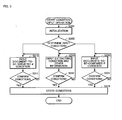
- FIG. 3 is a flowchart showing the operation of condition setting in the input device 2.
- FIG. 6 to FIG. 9 described later illustrate.the operating screen for the condition setting to be input with the input device.
- the input conditions are determined (step 5202).
- input of conditions.of the document-to-be-surveyed d is accepted'at the document-to-be-surveyed d condition input unit 210 (step S210).
- the input conditions are confirmed by the operator with a display screen shown in FIG. 6, and "Set” is selected on the screen if the input conditions are correct.
- the input conditions are stored in the condition recording unit 310 (step S310). Since "Back" will be selected if the input conditions are incorrect, the routine returns to step S210 (step S211).
- step S220 when the operator selects to input the conditions of the documents-to-be-compared P at step S202, input of conditions of the documents-to-be-compared P is accepted by the documents-to-be-compared P condition input unit 220 (step S220).
- the input conditions are confirmed by the operator with a display screen shown in FIG. 7, and "Set” is selected on the screen if the input conditions are correct.
- the input conditions are stored in the condition recording unit 310 (step S310). Since "Back" will be selected if the input conditions are incorrect, the routine returns to step S220 (step S221).
- step S230 input of extracting conditions and other conditions is accepted by the extracting condition and other information input unit 230 (step S230).
- the input conditions are confirmed by the operator with a display screen shown in FIG. 8 or FIG. 9, and "Set” is selected on the screen if the input conditions are correct.
- the input conditions are stored in the condition recording unit 310 (step S310). Since "Back” will be selected if the input conditions are incorrect, the routine returns to step S230 (step S231).
- step S230 the extracting condition of the index terms (d) and the selecting condition of the similar documents S, and the output condition of the characteristic index terms and the like are both set.
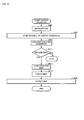
- FIG. 4 is a flowchart showing the operation of the processing device 1.
- documents to be read from the document storage unit 330 are determined whether a document-to-be-surveyed d or documents-to-be-compared P-(step S102).
- the document-to-be-surveyed d reading unit 110 reads the document-to-be-surveyed from the document storage unit 330 (step S110).
- the index.term (d) extraction .unit 120 extracts the index terms of the document-to-be-surveyed d (step S120).
- the TF(d) calculation unit 121 performs TF calculation to each of the extracted index terms (step S121).
- the documents to be read are documents-to-be-compared P at.step S102
- the documents-to-be-compared P reading unit 130 reads the documents-to-be-compared P (step S130).
- the index term (P) extraction unit 140 extracts the index terms of the documents-to-be-compared P (step S140).
- the TF(P) calculation unit 141 performs TF calculation to each of the extracted index terms (step S141), and the IDF(P) calculation unit 142 performs IDF calculation thereto (step S142).
- the similarity calculation unit 150 performs similarity calculation based on the TF(d) calculation result output from the TF(d) calculation unit 121, the TF(P) calculation result output from the TF.(P) calculation unit 141, and the IDF(P) calculation.result output from the IDF(P) calculation unit 142 (step S150).
- This similarity calculation is executed by calling a similarity calculation module for calculating the similarity from the external recording unit 310 based on the conditions input from the input device 2.
- the TFIDF(P) is calculated for each index term of each document in order to calculate the vector representation.
- the result, with respect to document vectors d and p, will be as follows:
- the similarity (or non-similarity) between the document vectors d and p can be obtained.
- greater the value of the cosine (similarity) between the vectors means that the degree of similarity is high, and lower the value of the distance (non-similarity) between vectors means that the degree of similarity is high.
- the obtained similarity is stored in the processing result storage unit 320 and also sent to the similar documents S selection unit 160.
- the similar documents S selection unit 160 rearranges the documents subject to the similarity calculation at step S150 in order of the similarity, and selects the similar documents S in a number along the conditions that have been set in the extracting condition and other information input unit 230 (step S160).
- the index term (S) extraction unit 170 of the similar documents S extracts the index terms (S) of the similar documents S selected at step S160.
- the IDF(S) calculation unit 171 performs IDF calculation to the similar documents S with respect to each index term (d) (step S171).
- step S180 the characteristic index terms are extracted based on the result of the IDF(S) calculation at step S171 and the result of the IDF(P) calculation at step S142.
- FIG. 5 is a flowchart showing the output operation of the map, list and comment in the output device 4. Foremost after initialization (step S401), the reading of conditions from the condition recording unit 310 is commenced for each of a map creating condition, a list output condition and a comment creating condition (step S402).
- map creating condition reading unit 410 of the output device reads the map creating condition from the condition recording unit 310 (step S410), if it is a condition requiring a map (step S411), map data is loaded from the processing result storage unit 320 to the map data loading unit 412 (step S412). Next, a map is created along the map creating condition of the map creating condition reading unit 410 (step S413), and this is sent to the map-list-comment combined output unit 440.
- step S420 when the list output condition reading unit 420 of the output device reads the list output condition from the condition recording unit 310 (step S420), if it is a condition requiring a list (step S421), list data is loaded from the processing result storage unit 320 to the list data loading unit 422 (step S422). Next, a list is created along the list output condition of the li.st output condition reading unit 420 (step S423), and this is thereafter sent to the map-list-comment combined output unit 440.
- the comment creating condition reading unit 430 of the output device reads the comment creating condition from the condition recording unit 310 (step S430), if it is a condition requiring a comment (step S431), the map-list-comment combined output unit 440 prepares a frame for creating the comment, and creates the comment in such frame with fixed phrase data prepared in advance through manual input via a keyboard or OCR or in the internal database of the document storage unit 330 (step S433), and this is thereafter sent to the map-list-comment combined output unit 440.
- the routine ends at such time, and data is not sent to the map-list-comment combined output unit 440.
- FIG. 6 is a diagram showing a display example of an input condition setting screen of a document-to-be-surveyed.
- FIG. 6 illustrates an example where "document-to-be-surveyed” is selected among the “document-to-be-surveyed” and the "documents-to-be-compared” in the "target document” window, then "unexamined patents” is selected among “unexamined patents,” “registered patents,” “utility models,” “academic documents” and so on in the “document type” window, and then “FD” is selected among “company DB1,” “company DB2,” “JPO IPDL,” “PATOLIS,” “other commercially available DB1,” “other commercially available DB2,” “FD,” “CD,” “MO,” “DVD,” “others” and so on in the “data read” window, and.further “document 3” is selected among “document 1,” “document 2,” “document 3,” “document 4,” “document 5,” “document 6” and so on of the “FD”.
- the setting condition in this kind of input condition setting screen is input with the document-to-be-surveyed d condition input unit 210.
- FIG. 7 is a diagram showing a display example of an input condition setting screen of documents-to-be-compared P.
- FIG. 7 illustrates an example where "documents-to-be-compared” is selected among the "document-to-be-surveyed” and the "documents-to-be-compared” in the "target document” window, then both "unexamined patents” and “registered patents” are selected among “unexamined patents,” “registered patents,” “utility models,” “academic documents” and so on in the “document type” window, then both “claims” and “abstract” are selected among “claims", “related art”, “object of the invention”, “means and effect”, “embodiments”, “description of the drawings”, “drawings", “abstract”, “Bibliographic items”, “procedural information”, “registration information”, “others” and so on in the “extraction content” window, and then "company DB1” is selected from the aforementioned items of the "data read” window
- FIG. 8 is a diagram showing a display example of an index term extracting condition setting screen and similar documents selecting condition setting screen.
- FIG. 8 illustrates an example where "internal keyword clipping 1" is selected among “internal keyword clipping 1", “internal keyword clipping 2", “external keyword clipping 1”, “external keyword clipping 2” and so on of the "index term extracting condition” window, then “similarity-1” is selected among “similarity 1", “similarity 2", “similarity 3", “similarity 4", “similarity 5", “similarity 6” and so on of the “similarity calculation method” window, then “number of similar documents” is selected among “number of similar documents”, “number of non-similar documents” and so on of the “similar documents selecting condition” window, and then “top 3:000 cases” is selected among “top 100 cases", “top 1000 cases", “top 3000 cases”, “top 5000 cases”, “numerical input” and so on.
- the setting condition in this kind of input condition setting screen is input
- FIG. 9 is a diagram showing a display example of an output condition setting screen of the characteristic index term extraction device.
- FIG. 9 illustrates an example where "X axis: IDF(P)" is selected as the “X axis” and "Y axis: IDF(S)” is selected as the “Y axis” in the "map calculation information” window, then "1 map” is selected among “1 map”, “2 maps”, “1 map with list”, “2 maps with list”, “1 map with comment”, “2 maps with comment”, “1 map with list and comment”, “2 maps with list and comment” and so on in the "map format” window, then "original concept terms” is selected among “original concept terms", “specialty terms", “similar documents prescribed terms” and so on of the "output data.” window, and then "top.
- FIG. 10 is a conceptual diagram for explaining the nature of a map output with the index term extraction device of the first embodiment.
- This map is for representing, with a display means, the index terms (hereinafter referred to as a "characteristic index terms") extracted with the characteristic index term extraction unit 180 among the index terms (d) of the document-to-be-surveyed d being output with the map-list-comment combined output unit 440.
- This map takes the calculation result of the IDF(P) calculation unit 142 based on the documents-to-be-compared P as the horizontal axis value, and takes the calculation result of the IDF(S) calculation unit 171 based on the similar documents S as the vertical axis value, and disposes these on the IDF plane.
- the quadrilateral ABCD is a parallelogram.
- B ( ⁇ 1 , ⁇ 2 )
- A ( ⁇ 2 , ⁇ 2 )
- C ( ⁇ , 0), respectively.
- the area where the X value is near 0 is an area where the index terms existing in nearly all of the documents-to-be-compared P are disposed.
- the Y coordinate is a value of IDF(S)
- the area where the Y value is near 0 is an area of the index terms existing in almost all of similar documents S.
- an index term having a small document frequency DF(P) in the documents-to-be-compared P namely a rare index term
- An index term having a large DF(P), namely a frequently used index term has a small IDF(P). Therefore, such index term appears near the Y axis in FIG. 10. Accordingly, rarer the index term in the documents-to-be-compared P, the more rightward it appears, and the more frequently an index term is used in the documents-to-be-compared P, the more leftward it appears.
- points of index terms only exist inside the area cut off with line segment BC on the right side of FIG. 10.
- an index term having a document frequency DF(S) value of only one (1) in the similar documents S namely an index term only included in the document-to-be-surveyed d
- DF(S) is greater than 1
- the/Index term will be positioned below the BA line.
- the meaning of "uniformly" is as follows: When changing the number of documents N Q of the document group Q to be measured, Q realizing. DF(Q) N Q /k (where k is a constant greater than 1), is a document group having spatial uniformity, and an index term having this property is referred to an index term having spatial uniformity.
- index terms that are not rare in the documents-to-be-compared P but which are rare in the similar documents S will appear in an area that is higher than roughly half the height of the line segment BA in FIG. 10. Based on this trend, the area near A can be referred to as an original concept term area.
- index terms could exist in an area fairly outside the left side of line segment AD.
- analysis of the nature of the document-to-be-surveyed d will not be hindered even if such area is treated as a non-existing area of index terms: Since this area is an area that is distant from the original concept term area A, even if an index term does appear, it will be an extremely exceptional index term.
- the characteristic index term extracted from the document-to-be-surveyed d has a lower document frequency in the documents-to-be-compared P if it is positioned at the farther right and has a lower document frequency in the similar documents S if it is positioned at the higher on the IDF plane in FIG. 10.
- index terms having the following properties are disposed in each area shown in FIG. 10, it is possible to perceive the positioning and character of the document-to-be-surveyed d in the documents-to-be-compared P from the distribution status of points on the IDF plane.
- Specialty term area b Area where index terms having a low usage frequency in both the documents-to-be-compared P and similar documents S appear. In other words, this is an area where index terms describing highly specialized matters included in the document-to-be-surveyed d or concepts directly linked thereto appear. This is included in the first area of the present invention.
- Original concept term area a Area where index terms having a relatively high appearance frequency in the documents-to-be-compared P but show concepts that were not noted in similar fields appear. This is included in the second area of the.present invention.
- Similar documents prescribed term area c Area where index terms existing in nearly all documents of the similar documents S and also existing in documents, the number of which is corresponding to the number of the similar documents S, in the documents-to-be-compared P, appear. These index terms are therefore extremely natural for representing the nature of the similar documents S. For example, in the case where technical documents are to be surveyed, when viewing the similar documents prescribed te.rms, it will be possible to know the technical field of the similar documents S and document-to-be-surveyed d. This is included in the.third area of the present invention.
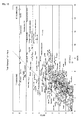
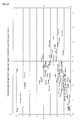
- FIG. 11 is a diagram showing a specific example of:a map display of an unexamined patent publication pertaining to an "external auxiliary storage device" as the document-to-be-surveyed d based on the characteristic index term extraction device of the first embodiment.
- This map corresponds to the character representative diagram of the present invention (the same applies to the following maps).
- characteristic index terms such as "picture”, “hologram”, “desire”, “plastic” and “exterior surface” in the original concept term area as shown in FIG. 10, it is not possible to find any corresponding characteristic index term in the specialty term area b, and it is possible to find characteristic index terms such as "contents" and "editing” in the similar documents prescribed term area c.
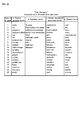
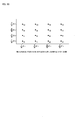
- FIG. 12 is a diagram showing a specific example of the list output concerning the same document-to-be-surveyed as in FIG. 11. This list corresponds to the character representative diagram of the present invention (the same applies to the following lists).
- the index terms to be output in the respective areas can be sought as follows.
- transformation M (X, Y) ⁇ (X', Y') is given with respect to each area, a point where ( s / 100 ) Exp [ Y ′ ] ⁇ 2 is extracted in descending order of X'; provided, however, that this shall be limited to a point where ( p / 100 ) Exp [ X ′ ] ⁇ 2.
- index terms where the document frequency DF(P) ratio in relation to the number of documents N in the documents-to-be-compared P is p/2 (%) or less, and where the document frequency DF(S) ratio in relation to the number of documents N' in the similar documents S exceeds s/2 (%) will be extracted.
- characteristic index terms such as "picture”, “hologram”, “create”, “plastic” and “exterior surface” in the original concept term area a shown in FIG. 10, it is not possible to find any corresponding characteristic index term in the specialty term area b, and it is possible to find characteristic index terms such as "contents" and "editing” in the similar documents prescribed term area c.
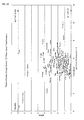
- FIG. 13 is a diagram showing a specific example of a map display of an unexamined patent publication pertaining to an "urgent message" as the document-to-be-surveyed d based on the same conditions as those for FIG. 11.
- characteristic index terms such as "well-known”, “differential”, “old age”, “base station” and “DGPS” in the original concept term area a
- characteristic index terms such as "fire department” in a location slightly away from point B in the specialty term area b
- characteristic index terms such as "message”, “urgent” and "situation” in the similar, documents prescribed term area c.
- FIG. 14 is a diagram showing a specific example of the list output concerning the same document-to-be-surveyed as in FIG. 13.
- characteristic index terms such as “differential”, “well-known” and “procedures” are included in the original concept term area a
- characteristic index terms such as "fire department” are included in the specialty term area b
- characteristic index terms such as "situation”, “message”, “urgent”, “center” and “telephone” are included in the similar documents prescribed term area c.
- FIG. 15 is a diagram showing a specific example of a map display when selecting ten (10) unexamined patent publications pertaining to "hair shampoo" as the documents-to-be-surveyed d based on the same conditions as those for FIG. 11.
- characteristic index terms such as "age”, “comb”, “act”, “ml”, “potassium”, “process”, “accumulation” and “brush” in the original concept term area a
- characteristic index terms such as “fly away”, “diallyl ammonium”, “methacryloylethyl” and “polyoxyethylene oleate” in the specialty term area b
- characteristic index terms such as "amphoteric”, “hair”, “anion”, “alkenyl” and "fatty acid” in the similar documents prescribed term area c.
- FIG. 16 is a diagram showing a specific example of the list output concerning the same documents-to-be-surveyed as in FIG. 15.
- characteristic index terms such as “comb”, “ml”, “potassium”, “medicinal effect”, “age”, “act” and “external use” are included in the original concept term area a
- characteristic index terms such as “fly away”, “polyoxyethylene oleate”, “methylcarboxybetaine” and “diallyl ammonium” are included in the specialty term area b
- characteristic index terms such as “amphoteric", “hair”, “hydroxyalkyl”, “bubbles”, “skin”, “anion”, “cation” and “fatty acid” are included in the similar documents prescribed term area c.
- the output of the characteristic index term extraction device of the present invention is not limited to the foregoing map or list.
- a comment for explaining the character of the document-to-be-surveyed d with a representative index term may also be automatically created and output.
- a comment is created, for instance, based on the several top index terms output and listed in FIG. 12, FIG. 14 or FIG. 16, as "a document in the technical field relating to **, **(index terms of similar documents prescribed term area c), by using the specialized concept and technology relating to **, **(index terms of specialty term area b), and focusing on the perspective of **, **(index terms of original concept term area a) ".
- a comment can be created as "a document in the technical field relating to **, **(index terms of area c), and focusing on the perspective of **, **(index terms of area a)" upon excluding the description relating to the specialty terms.
- a comment can be created as "a document in the technical field relating to **, **(index terms of area c), and by using the specialized concept and technology relating to **, **(index terms of specialty term area b) upon excluding the description relating to the original concept terms.
- a comment can be created as "a document in the technical field relating to **, **(index terms of area c) upon excluding the description relating to the original concept terms and specialty terms.
- This comment may be output together with the foregoing map or table, or the comment may be output alone.
- a plurality of index terms are output in each of the areas; only one may be output, and there may be 0 in an area where there are no corresponding index terms.
- FIG. 17 to FIG. 20 are diagrams showing an example of a map output with the characteristic index term extraction device of the second embodiment.
- the specific configuration of the characteristic index term extraction device is basically the same as those in the first embodiment, and the detailed explanation thereof is omitted. Thus, only the primary differences will be explained.
- the appearance frequency TF(d) of the characteristic index term in the document-to-be-surveyed d, or the TFIDF(S) which is the product of such appearance frequency TF(d) and IDF(S) is reflected in the positioning data of the index term.
- the visualization of the valued characteristic index term is sought by changing the size (display size) of the characteristic index term at the existing points on the map, changing the shape of display, or changing the color thereof.
- the appearance frequency TF(d) or TFIDF(S) of each index term may be a Z component, and a method of displaying three-dimensional coordinates with three-dimensional graphics can be considered.
- map:creating condition information for automatically assigning sizes or shapes or colors in the order of appearance frequency to different characteristic index terms may be stored in the condition recording unit 310.
- the characteristic index term extraction unit 180 may be used to read such information, and the characteristic index term extraction unit 180 may further be used to perform the processing of such assignment and output.
- This map output signal is an appearance frequency reflection signal reflecting the TF(d) or TFIDF(S).
- FIG. 17 and FIG. 18 show examples of performing such processing to the characteristic index terms illustrated in FIG. 11.
- FIG. 17 is a diagram showing an example of displaying a circle on characteristic index terms for the top 20 TFIDF values.
- FIG. 18 is a diagram showing an example of displaying a large diamond.mark to the characteristic index terms for the top 10 TF values.
- FIG. 19 and FIG. 20 show examples where one unexamined patent publication relating to an "external auxiliary storage device" as the document-to-be-surveyed d is selected as in FIG. 11, and output upon changing the method of acquiring the function value of the appearance frequency of each index term in the document group from the method described in the first embodiment.
- FIG. 19 is a diagram showing an example of taking the TFIDF (product of TF (d) and IDF(P)) in relation to the documents-to-be-compared P as the horizontal axis and taking the TFIDF (product of TF(d) and IDF(S)) in relation to the similar documents S as the vertical axis with respect to each index term (d) of the document-to-be-surveyed d, and distributing the result (hereinafter referred to as a TFIDF plan view).
- the IDF plan view of the first embodiment is -more preferable in easily and directly analyzing the nature of the document-to-be-surveyed d:
- the logarithm of TFIDF may be disposed on the coordinate system.
- FIG. 20 is a.diagram showing an example of taking the value obtained through dividing DF in the documents-to-be-compared P by the number of documents N as the horizontal axis and taking the value obtained through dividing DF in the similar documents S by the number of documents N' as the vertical axis with respect to each index term (d) of the document-to-be-surveyed d, and distributing the result (hereinafter referred to as a DF plan view).
- a DF plan view When making an evaluation based on DF of FIG. 20, "data”, “memory”, “information”, “medium”, “editing” and “contents” can be evaluated as being similar documents prescribed terms, “article”, “internal” and “plastic” can be evaluated as being original concept terms.
- the IDF plan view in which the DF value was transformed with the inverse power of a logarithm from the first embodiment is more preferable in easily and directly analyzing the nature of the document-to-be-surveyed d.
- the logarithm of DF itself may be disposed on the coordinate system.
- the appearance frequency of the index term in the document group is not limited to the foregoing DF, and, for instance, the total number hits of index term upon searching the target document group with the index term may also be used.
- FIG. 21 to FIG. 24 are diagrams showing an example of a map output with the characteristic index term extraction device of the third embodiment.
- the specific configuration of the characteristic index term extraction device is basically the same as those in the first embodiment, and the detailed explanation thereof is omitted. Thus, only the primary differences will be explained.
- a user who will evaluate the document-to-be-surveyed based on the foregoing first or second.embodiment will be able to perceive the character as the general trend of the document by observing the output result of the characteristic index term extraction device without having to read the contents of the document.
- FIG. 11 may be shown as a representative example below
- the number of document hits DF(P) upon searching the documents-to-be-compared P with a certain index term can never be a number that is smaller than the number of document hits DF(S) upon searching the similar documents S with the same index term.
- each index term when attempting to take the foregoing DF(P) as the X axis of the orthogonal coordinate system and attempting to take.the foregoing DF (S) as the Y axis, each index term.will only be disposed in an area where X ⁇ Y and N-X ⁇ N' -Y.
- the boundary line of the existable area will be inclined in a 45 degree angle.
- the boundary line of the existable area will be inclined in a 45 degree arigle.
- transformation is performed such that the terminal points A, B,C and D of the parallelogram in the map of FIG. 11 will be located.at the four corners of the rectangle ABCD.
- FIG. 21 is a diagram showing a transformation of the parallelogram ABCD of FIG. 11 into a rectangle ABCD without changing the conditions of FIG. 11.
- a line parallel to a straight line where Y X was transformed into a line parallel to the Y axis while retaining the Y axis value.
- coordinates of the point after transformation (X', Y') will be represented by Formula 1.
- ( X ′ , Y ′ ) ( X ⁇ Y + const , Y )
- const 0 in the formula, the original concept term area a among the parallelogram ABCD of FIG.
- FIG. 22 is a diagram showing an example where the X value of FIG. 11 was subject.to scale transformation in a ratio to the length along the X axis direction from the Y axis to the side BC without changing the conditions of FIG. 11.
- coordinates of the points before transformation are set to (X, Y)
- coordinates of the point after transformation (X', Y') will be represented by Formula 2.
- ( X ′ , Y ′ ) ( X ⁇ ( ⁇ + ⁇ 2 / 2 ) / ( Y + ⁇ ) , Y )
- ( X ′ , Y ′ ) ( const ⁇ X / ( Y + ⁇ ) , Y )
- FIG. 23 is a diagram showing an example where the formula of transformation example 1 is applied to the upper half of the parallelogram in the diagram and the formula of transformation example 2 is applied to the lower half thereof in order to perform another transformation (combined transformation) without changing the conditions of FIG. 11.
- the coordinates of the points before transformation are set to (X, Y)
- coordinates of the point after transformation (X', Y') will be represented by Formula 4.
- X ′ ⁇ X ( ⁇ + ⁇ 2 / 2 ) / ( Y + ⁇ ) ⁇ ⁇ ⁇ ( ⁇ 2 / 2 ⁇ Y ) + ( X ⁇ Y + ⁇ 2 / 2 ) ⁇ ⁇ ( Y ⁇ ⁇ 2 / 2 )
- ⁇ (x) 1
- x 0
- ⁇ (x) 1/2
- x ⁇ 0 0
- ⁇ (x) 0
- Y ′ Y
- FIG. 24 shows a specific example of a map display when two unexamined patent publications concerning "antitumor medicine" are selected as the documents-to-be-surveyed d, and subject to the transformation (combined transformation) with the same method as shown in FIG. 23.
- FIG. 24 also, as with FIG. 23, the non-existing area of the index term on the left and right sides of the map has been eliminated, and the boundaries on both sides of the area are vertical to the X axis. Therefore, it will be possible to more properly evaluate the characteristic index terms of the respective areas.
- FIG. 24 shows a frame of the positions of the original concept term area a, specialty term area b, similar documents prescribed term area.c, and general term area d.
- the mode of displaying the existing positions of the respective areas is not limited to such frame, and may be of other display modes, or a specific name such as "original concept term area" may be displayed in addition to the display of the existing positions of each area.
- to display the existing positions of each area on the map with the likes of a frame is not limited to the case of performing a transformation to the coordinate value as in the third embodiment, and this may also be conducted in the other embodiments.
- characteristic index terms such as "brittle”, “unique” and “accumulation” in the original concept term area a
- characteristic index terms such as "ZnPP”, “heme oxygenase” and “protoporphyrin” in the specialty term area b
- characteristic index terms such as "tumor”, “enzyme” and “cell” in the similar documents prescribed term area c.
- a method of standardizing data may be adopted.
- average of X is set to be m(X)
- standard deviation of X is ⁇ (X) (and also the same for Y)
- the coordinates, of points after transformation. (X', Y') will be represented by Formula 5.
- a self-organization map (SOM: Self-Organization Map) is technology for clustering numerous data without any advance knowledge.
- This SOM technique is disclosed in, for instance, the thesis: Self-Organization Semantic Maps, H.Ritter and T.Kohoneh, Biol. Cybern. 61(1989)241-254, or the book: Self-Organizing Maps, T. Kohonen (Springer-Verlag, 1995).
- FIG. 25 is a diagram in which FIG. 10 was rewritten for facilitating the understanding of the following explanation.
- each coordinate value is the coordinate value obtained with the same method described in FIG. 11.
- the middle point of AD is F
- the middle point of BC is G.
- the middle point of AB H
- the middle point of FG is I
- the middle point of DC is J.
- N s (i 1, ..., N s ) number of extracted characteristic index terms (keywords) w i .
- These N s number of characteristic index.terms w i are distributed and scattered in the area inside the parallelogram ABCD or the pentagon BCDTT'. Nevertheless, it will be difficult to know to which area these index terms belong or do not belong, or to classify them at a glance. Further; since this parallelogram is of an oblique shape, it will be difficult for the evaluator to instantaneously perceive the character of the characteristic index terms properly.
- the coordinates (X i , Y i ) of these characteristic index terms should be transformed into a map display that will enable the easy and proper perception of their characters.
- the characteristic index terms distributed in an area near the respective apexes A, B, C and D of this inclined parallelogram could automatically be separated into 4 areas and represented on the map, the character of these characteristic index terms would be obvious at a glance, and, therefore, the evaluator will be able to properly perceive the character of the characteristic index terms.
- the following transformation method applying SOM is employed.
- the coordinates (X i , Y i ) of the foregoing N s number of characteristic index terms are made to be the input vector K(w i ) of this mapping processing.
- an arbitrary number of reference points U j (W i ; t) are adopted as arbitrary coordinate values.
- the 11 points of U j (j: 0, 1, 2, 3, 4, 5, 6, 7, 8, 9, 10) are taken, and the reference points are considered at the coordinates of the 11-point orthorhombic lattice.
- the initial values of these 11 points are made to be the coordinate values (m1 j , m2 j ) corresponding to A, B, C, D, F, G, H, I, J, T, T' in FIG. 25, respectively.
- FIG. 26 is a diagram showing an example of the initial values of a reference points in the application example 1 of the self-organization map.
- the initial values of the reference points U j (w i ; t), in correspondence with j: 0 to 10 are respectively 0(0, 0), 1( ⁇ /2, 0), 2( ⁇ , 0), 3( ⁇ /2 + ⁇ 2 -/2, ⁇ 2 /2), 4( ⁇ + ⁇ 2 /2, ⁇ 2 /2), 5( ⁇ /2 + ⁇ 2 , ⁇ 2 ), 6( ⁇ 1 , ⁇ 2 ), 7( ⁇ 2 /2, ⁇ 2 /2), 8( ⁇ 2 , ⁇ 2 ), 9(0, ⁇ 2 /2), 10( ⁇ 2 /2, ⁇ 2 ).
- the coordinate of the reference point U j (w i ; t) nearest from each input point is updated to a value so as to approach each index term w i based on the following updating formula.
- the parenthetical reference of foregoing U j (w i ; t) represents the dependency against each index term w i and the dependency against the number'of updating steps t. This kind of update is repeated T F times; for instance, 1000 times.
- a map R j (r1 j (w i ), r2 j (w i )) is given.
- the map R j given based on the reference point U j (w i ; T F ) nearest from the coordinates of each index term w i will become the coordinate output to the map.
- t represents the dependency against the number of updating steps.
- ArgMin j (x) is a function for returning j with the smallest x.
- the map R j based on the nearest reference point U j will become new coordinate values (X', Y') mapped based on the coordinate values (X i , Y i ) of the characteristic index term.
- the foregoing transformation processing of the fourth embodiment is performed with the characteristic index term extraction unit 180.
- the updating formula is read from the condition storage unit 310.
- the coordinates of the IDF plane, obtained by the extraction method as in the first embodiment, is read from the processing result storage unit 320 and then displayed. While viewing the display screen, N s number of characteristic index terms distributed on the IDF plane is designated in order to set the input value. Further, based on the instructions from the input device 2, the number of updates T F is set.
- the operation of creating the map is started automatically or based on the operation start instructions from the input device, and the coordinate values (X i , Y i ) of N s number of characteristic index terms are ultimately mapped to the coordinate values of the R coordinates.
- FIG. 27 is a diagram showing an example of a map obtained by performing the foregoing transformation to the respective coordinates of FIG. 11. As evident from FIG. 27, each coordinate is separated into 4 rectangular areas divided by two straight lines a-a and b-b.
- This transformation is an example similar to the application example 1.
- the coordinates (X i , Y i ) of the characteristic index terms were used as is as the input vector K(w i ).
- K ( w i ) ( Y i , Y i ⁇ X i + ⁇ ) is used as the input vector.
- the initial value of this reference point is also distributed in this area.
- FIG. 28 is a diagram showing the placement of the reference points to be used in the application example 2, and these 11 reference points are given numbers from 0 to 10.
- the initial value of each reference point is the coordinate value of the 11 intersecting points of the straight lines passing through the respective points of ( ⁇ 2 /6, 0), ( ⁇ 2 /2, 0) and (5 ⁇ 2 /6, 0) on the horizontal axis and the straight lines passing through the respective points of (0, ⁇ /6), (0, ⁇ /2), (0, 5 ⁇ /6) and (0, ⁇ + ⁇ 2 /4) on the vertical axis.
- the reference points U j (w i ; t) are updated T F number of times for each index term w i .
- the map R j based on the nearest reference point U j will become new coordinate values (X', Y') mapped based on the coordinate values (X i , Y i ) of the characteristic index term.
- FIG. 29 is a diagram showing an example of the results of performing the foregoing transformation processing to the coordinate of each index term of FIG. 11.
- the respective coordinates obtained by this transformation processing are separated into four rectangular areas divided by two straight lines a-a and b-b. Further, as in the case of the new coordinate system of FIG. 27, it is evident that the blank area corresponding to the blank area shown in the upper left area of FIG. 11 has also been eliminated.
- This transformation is also an example similar to the application example 1.
- the scale transformation explained in the third embodiment is performed to the coordinate value (X i , Y i ) of each index term of FIG. 11 in order to obtain the input vector K (w i ).
- additional 16 reference points are used for performing the transformation processing similar to the application example 1.
- FIG. 30 shows the 16 reference points, and shows numbers 0 to 15 being given to these 16 reference points in this coordinate system.
- the coordinate values of the respective reference points are the 16 intersecting points of straight lines passing through the respective points of ( ⁇ 1 /8, 0), (3 ⁇ 1 /8, 0), (5 ⁇ 1 /8, 0) and (7 ⁇ 1 /8, 0) on the horizontal axis and the straight lines passing through the respective points of (0, ⁇ 2 /8), (0, 3 ⁇ 2 /8), (0, 5 ⁇ 2 /8) and (0, 7 ⁇ 2 /8) on the vertical axis.
- the map R j based on the nearest reference point U j will become a new coordinate value (X', Y') mapped based on the coordinate value (X i , Y i ) of each characteristic index term.
- FIG. 31 is a diagram showing an example of the results of performing the foregoing transformation processing using the 16-point reference value to the coordinate of each index term of FIG. 11.
- the respective coordinates obtained by this transformation processing are separated into four rectangular areas divided by two straight lines a2-a2 and b2-b2.
- This transformation is also an example similar to the application example 1.
- the input vector K(w i ) and reference point U j (w i ; t) in the application examples 1 to 3 were two dimensional, in this application example, the input vector and reference point are made to be 2 + N s dimensional.
- TF(w, sen) represents the appearance frequency of the index term w in a sentence sen
- ⁇ represents the power
- ⁇ represents the weight.
- TF(w, sen) will be a number of 1 or greater when an index term w appears in the sentence sen, and will be 0 when it does not appear.
- the foregoing TF(w i , sen) ⁇ ⁇ TF(w i' , sen) ⁇ ⁇ i ⁇ i' will be a number of 1 or greater when the characteristic index term w i and characteristic index term w i appear together (co-occur) in the same sentence sen, and will be 0 when one or both do not appear (do not co-occur).
- the total number for all sentences sen in the document-to-be-surveyed d will be the component Co(i, i') of the co-occurrence matrix.
- the co-occurrence data Co ⁇ ii' ⁇ which is the component of the co-occurrence vector V i , is obtained by standardizing the component Co(i, i') of the co-occurrence matrix with the average in the i', and then dividing this by the square root of the number of dimensions N s of V i , and is represented as follows.
- K (w i ) (X i , Y i , V i ) above, with respect to portions such as X i and Y i , those subject to the transformation of the application example 2 or the application example 3 may also be used.
- K(w i ) (X i , Y i , V i ) as is.
- the initial value of each reference point U j (w i ; t) is represented as: ( m 1 j , m 2 j , L j ) .
- L j is the N s dimension vector, and each component shall adopt the random value within intervals [0, 1].
- the coordinate of the reference point U j (w i ; t) nearest from each input point is updated T F times regarding each index term w i given by the input vector K(w i ).
- Formula 6 used in the application example 1 above may be used.
- map R j (r1 j (w i ), r2 j (w i )) is given based on the reference point nearest from the input vector of each index term w i .
- the coordinate transformation from the U coordinates to the R coordinates may also use Formula 7 above used in the application example 1.
- the primary objective of this embodiment is not to show the co-occurrence or its similarity, but rather to analyze the characteristics of the document-to-be-surveyed by using the relationship of IDF(P) and IDF(S). Thus, the influence of the co-occurrence in the final result.may be small.
- FIG. 32 is a diagram showing an example of the results upon performing transformation processing using the 2 + N s dimension vector, to which the foregoing co-occurrence was added, to the coordinate of each index term of FIG. 11.
- the respective coordinates obtained by this transformation processing are separated into four rectangular areas divided by two straight lines a-a and b-b.
- the data thereof can be used in the automatic creation of the index term list or comment as in the first embodiment. For instance, by conducting an AND search between the data of the index term obtained in the application examples 1 to 4 of the self-organization map and the data for creating the index term list shown in FIG. 12, FIG. 14.and FIG., 16, the index terms belonging to the respective areas can be narrowed down appropriately
- the source-documents-for-selection to become the selection source of the similar documents S may be a document group other than the documents-to-be-compared P.
- the similar documents S. will no longer be a subset of the documents-to-be-compared P, there is a possibility that the boundary line of the existing .area of the index term may not become vertical even when subject to the scale transformation of the third embodiment.
- index term information micro information
- macro information the document information
- the survey target will be expanded to a document group consisting of a plurality of documents.
- a document characteristic analysis device capable of analyzing the general positioning of a document-to-be-surveyed included in a document-group-to-be-surveyed in relation to other document groups, or trend of the overall document-group-to-be-surveyed from the perspective of specialty or originality has not been known to date, and this embodiment realizes such device.
- the document characteristic analysis device of this embodiment is configured the same as the characteristic index term extraction device described in the first to fourth embodiments other than as described below. Differences with the characteristic index term extraction device of the first embodiment are now mainly explained.
- the document characteristic analysis device of this embodiment introduces.a greater observation scale, and the analysis of a document-group-to-be-surveyed based on distribution of documents can be performed by conducting the following replacements:
- the document-group-to-be-surveyed are made to be a document group of a single company-to-be-surveyed, and the related documents S are made to be a document group of a company group belonging to the same industry as those of the company-to-be-surveyed.
- the documents-to-be-compared P are made to be a document group of all patents and the related documents S are made to be a patent document group of the company group belonging to the same industry as those of the company-to-be-surveyed.
- IDF calculation is performed in P and S for each index term, the central point based on the average value thereof in each document d is calculated, and this value is made to be the (X, Y) coordinate of each document d.
- the coordinates of documents d of the relevant company is mapped on an X-Y plane, the document distribution of this company can be obtained.
- FIG. 33 is a.diagram showing a hardware configuration of a document characteristic analysis device of the fifth embodiment.
- FIG. 34 is a flowchart showing the operation of the processing device 1 of the document characteristic analysis device; and
- FIG. 35 is a flowchart showing the operation of a map output in the output device 4 of the document characteristic analysis device.
- the related documents S of the fifth.embodiment are not selected based on similarity.
- the similarity calculation unit 150 illustrated in FIG. 2 is.no longer necessary, and, therefore, the TF(d) calculation unit 121 or the TF(P) calculation unit 141 of FIG. 2 is also not required.
- the similarity calculation step S150 in FIG. 4 is no longer required, and, therefore, the TF(d) calculation step S121 or the TF(P) calculation step S141 in FIG. 4 is also not required.
- Selection of the related documents S may be conducted, for instance, according to the conditions input with the extracting condition and other information input unit 230 of the input device 2.
- the names of major corporations and their "standard industry classification" or other industry classifications are stored in the condition recording unit 310.
- a same industry company search unit 155 searches for the name of the company belonging to the same industry as those of the company-to-be-surveyed.
- the related documents S selection unit 160 searches the documents-to-be-compared P with bibliographic data as the target, and the related documents S are selected thereby.
- the related documents S selection unit 160 may further narrow down the related documents S under certain conditions from the document group of the same industry.
- the related documents S selection unit 160 outputs the related documents S selected as described above to the index term (S) extraction unit 170 or the like.
- the index term (S) extraction unit 170 extracts index terms (S), and sends them to the IDF(S) calculation unit 171 or the like.
- the central point calculation unit 173 calculates the central point.
- the primary objective of the fifth embodiment is to output a document distribution map.
- the list.output condition reading unit 420 and the list data loading unit 422 illustrated in FIG. 2 will no longer be required.
- the respective steps from the list output condition reading step S420 to the list creation step S423 depicted in FIG. 5 will also become unnecessary.
- the comment creating condition reading unit 430 and the comment creating unit 432 illustrated in FIG. 2 will no longer be required.
- the respective steps from the comment creating condition reading step S430 to the comment creation step S433 depicted in FIG. 5 will also become unnecessary..
- ⁇ ( w i ) T F ( w i ; d ) / ⁇ T F ( w i ; d ) to the coordinate value of each index term w i .
- a plain average value may also be used.
- the extraction method for instance, a method of extracting a fixed number in the ascending order and descending order of the average value, or, for example, a method of extracting documents that adopt Z greater than "average value of every Z + standard deviation of every Z" and extracting documents that adopt Z less than "average number of every Z - standard deviation of every Z" when Z is a number obtained through dividing the average value by the number of documents of the document-group-to-be-surveyed, and so on may be considered.
- the narrowing to representative documents based on the determination of similarity described above can be used for narrowing the document-group-to-be-surveyed, as well.as for narrowing upon selecting the related documents S.
- the average value of the number of documents hits when searching the document group of the same industry regarding each index.term, and documents are narrowed to documents having a high average value (similar) and documents having a low average value (non-similar) for selecting the related documents S.
- the narrowing to be performed upon selecting the related documents S may be based on the determination of similarity as described above, or by randomly extracting documents from a document group of the same industry, or based on IPC.
- FIG. 36 is a diagram showing the document characteristic based on the positioning in the industry regarding 20 documents of high similarity and 20 documents of low similarity among all documents of single company as the document-group-to-be-surveyed.
- This FIG. 36 corresponds to the corporate document characteristic representative diagram of the present invention.
- a plain average value was used as the central value of each document.
- the document characteristic analysis device of this embodiment it will be possible to use the document characteristic analysis device of this embodiment to analyze the general positioning and trend of the documents-to-be-surveyed without a person reading the contents of the document-group-to-be-surveyed or related documents.
- the corporate document group as the document-group-to-be-surveyed it will be possible to know whether a specific document is a standard document in the industry, whether it is a document having a specialized character, or whether it is a document having an original character.
- the corporate document group as the document-group-to-be-surveyed it will be possible to detect the standard document, detect a document having a specialized character, or detect a document having an original character.
- the trend of the overall document-group-to-be-surveyed can be evaluated as a document group with many standard documents, a document group with many documents having originality, or a document group with many documents having specialty.
- FIG. 37 is a diagram showing the document characteristics of 3 companies by selecting document groups of the 3 companies belonging to.the same industry as the document-groups-to-be-surveyed. When comparing these, documents of Company A and Company C tend to be documents with numerous specialty terms, and documents of Company B tend to be documents with numerous original concept terms.
- FIG. 37 corresponds to the corporate document characteristic representative diagram of the present invention.
- the related documents S are not limited to the above.
- a document group belonging.to the same technical field as those of the document group of the company-to-be-surveyed may be retrieved with IPC and be used as the related documents S.
- an IPC extraction unit (not shown) is provided, and this IPC extraction unit is used to extract IPC from the bibliographic data of all patent documents of the company-to-be-surveyed.
- IPCs When several IPCs are to be extracted, only a prescribed number of upper-ranked IPCs with the most number of corresponding documents are extracted.
- the related documents S selection unit 160 conducts a search targeting the bibliographic data of the documents-to-be-compared P, and the related documents S are selected thereby.
- This selecting condition for example, is input with the extracting condition and other information input unit 230 of the input device 2.
- the document-group-to-be-surveyed are not limited to the above.
- a document group belonging to the same technical field among an unspecified patent document groups may be retrieved with IPC and be used as the document-group-to-be-surveyed.
- a document group filed in 2000 and given a certain IPC As the related documents S, for example, a document group filed between 1980 and 1999 and given the same IPC as the foregoing IPC is selected.
- the document-group-to-be-surveyed are analyzed with the other conditions.being the same.
- the analysis of applications filed in 2000 in the technical field given such IPC can also be compared with the analysis used in other document-group-to-be-surveyed.
- the filing period of the document-group-to-be-surveyed and the related documents S are set to be 2000 and between 1980 and 1999, respectively, as with the foregoing case in order to perform another analysis on a separate IPC.
- a document group filed in 2001 and given a certain IPC is used as the document-group-to-be-surveyed, and a document group filed between 1981 and 2000 and given the same IPC as the foregoing IPC is used as the related documents S in order to perform the analysis.
- This analysis is compared with the analysis in the case of targeting the year 2000 as the subject of survey. Thereby, the filing trend in 2000 and the filing trend in 2001 in the same technical field can be compared.
- a document group given an IPC e.g., designated up to a main group such as A61K6/
- the document-group-to-be-surveyed are analyzed with the other conditions being the same.
Landscapes
- Engineering & Computer Science (AREA)
- Theoretical Computer Science (AREA)
- Physics & Mathematics (AREA)
- Data Mining & Analysis (AREA)
- Databases & Information Systems (AREA)
- Software Systems (AREA)
- General Engineering & Computer Science (AREA)
- General Physics & Mathematics (AREA)
- Mathematical Physics (AREA)
- Information Retrieval, Db Structures And Fs Structures Therefor (AREA)
Applications Claiming Priority (3)
| Application Number | Priority Date | Filing Date | Title |
|---|---|---|---|
| JP2003393081 | 2003-10-21 | ||
| JP2004160401 | 2004-05-31 | ||
| PCT/JP2004/015082 WO2005038672A1 (fr) | 2003-10-21 | 2004-10-13 | Dispositif d'analyse de caracteristiques de document pour un document a etudier |
Publications (2)
| Publication Number | Publication Date |
|---|---|
| EP1677210A1 true EP1677210A1 (fr) | 2006-07-05 |
| EP1677210A4 EP1677210A4 (fr) | 2008-09-03 |
Family
ID=34467820
Family Applications (1)
| Application Number | Title | Priority Date | Filing Date |
|---|---|---|---|
| EP04792323A Withdrawn EP1677210A4 (fr) | 2003-10-21 | 2004-10-13 | Dispositif d'analyse de caracteristiques de document pour un document a etudier |
Country Status (12)
| Country | Link |
|---|---|
| US (1) | US20080250007A1 (fr) |
| EP (1) | EP1677210A4 (fr) |
| JP (1) | JPWO2005038672A1 (fr) |
| KR (1) | KR20060095565A (fr) |
| AU (1) | AU2004282733A1 (fr) |
| BR (1) | BRPI0415730A (fr) |
| CA (1) | CA2542438A1 (fr) |
| IS (1) | IS8407A (fr) |
| MX (1) | MXPA06004513A (fr) |
| NO (1) | NO20062273L (fr) |
| RU (1) | RU2006117318A (fr) |
| WO (1) | WO2005038672A1 (fr) |
Cited By (2)
| Publication number | Priority date | Publication date | Assignee | Title |
|---|---|---|---|---|
| EP3032439A1 (fr) * | 2014-12-10 | 2016-06-15 | Fujitsu Limited | Programme informatique de compression et programme informatique de recherche |
| EP3070615A1 (fr) * | 2015-03-16 | 2016-09-21 | Fujitsu Limited | Appareil de traitement d'informations, procédé de gestion de données et programme |
Families Citing this family (23)
| Publication number | Priority date | Publication date | Assignee | Title |
|---|---|---|---|---|
| US20070219987A1 (en) * | 2005-10-14 | 2007-09-20 | Leviathan Entertainment, Llc | Self Teaching Thesaurus |
| JP5108233B2 (ja) * | 2006-01-20 | 2012-12-26 | 株式会社エヌ・ティ・ティ・データ | 関連概念抽出装置、関連概念抽出方法、プログラムおよび記録媒体 |
| JP5165857B2 (ja) * | 2006-05-19 | 2013-03-21 | 株式会社東芝 | データ処理装置、データ処理方法およびデータ処理プログラム |
| JPWO2008053910A1 (ja) * | 2006-10-31 | 2010-02-25 | ヒューレット−パッカード デベロップメント カンパニー エル.ピー. | 語彙空間での語彙の相対位置を求める装置・方法・プログラム |
| US7818278B2 (en) | 2007-06-14 | 2010-10-19 | Microsoft Corporation | Large scale item representation matching |
| US20090063470A1 (en) * | 2007-08-28 | 2009-03-05 | Nogacom Ltd. | Document management using business objects |
| WO2009084757A1 (fr) * | 2007-12-31 | 2009-07-09 | Dki Technology Co., Ltd. | Procédé et appareil d'extraction de données de mot-clé |
| JP2011070291A (ja) * | 2009-09-24 | 2011-04-07 | Nec Biglobe Ltd | トピックワード抽出装置、トピックワード抽出システム、トピックワード抽出方法、及びプログラム |
| KR20140127360A (ko) * | 2009-10-30 | 2014-11-03 | 라쿠텐 인코포레이티드 | 특유 콘텐츠 판정 장치, 특유 콘텐츠 판정 방법, 기록 매체, 콘텐츠 생성 장치 및 관련 콘텐츠 삽입 장치 |
| US8566350B2 (en) * | 2009-11-02 | 2013-10-22 | Palo Alto Research Center Incorporated | Method and apparatus for facilitating document sanitization |
| KR101119318B1 (ko) * | 2009-11-05 | 2012-06-12 | 주식회사 청담러닝 | 키워드 좌표 생성 시스템, 문서 관점 분석 시스템, 문서 분석 시스템 및 그 방법 |
| US20110184984A1 (en) * | 2010-01-28 | 2011-07-28 | Huron Consoluting Group | Search term visualization tool |
| US20110295592A1 (en) * | 2010-05-28 | 2011-12-01 | Bank Of America Corporation | Survey Analysis and Categorization Assisted by a Knowledgebase |
| KR101331946B1 (ko) * | 2011-10-05 | 2013-11-21 | 주식회사 와이즈넛 | 와일드카드 매칭을 이용한 검색 방법 |
| KR101508849B1 (ko) * | 2013-10-24 | 2015-04-08 | 한양대학교 산학협력단 | 내용 정보 및 참조 정보를 활용하는 문서들 간의 유사도 측정 방법 및 장치 |
| KR101600870B1 (ko) | 2014-08-29 | 2016-03-08 | 고려대학교 산학협력단 | 통계적 방법을 이용한 핵심 키워드 추출방법 |
| KR20160085514A (ko) | 2015-01-08 | 2016-07-18 | 고려대학교 산학협력단 | 사회 네트워크 마이닝을 이용한 대표기술 선정에 관한 방법 |
| US10320797B2 (en) | 2015-09-25 | 2019-06-11 | International Business Machines Corporation | Enabling a multi-dimensional collaborative effort system |
| US10120552B2 (en) | 2015-09-25 | 2018-11-06 | International Business Machines Corporation | Annotating collaborative content to facilitate mining key content as a runbook |
| US11163811B2 (en) * | 2017-10-30 | 2021-11-02 | International Business Machines Corporation | Ranking of documents based on their semantic richness |
| US11113290B1 (en) | 2018-05-29 | 2021-09-07 | Cluster Communications, Inc. | Information visualization display using associative clustered tiling and tessellation |
| WO2022192771A1 (fr) * | 2021-03-12 | 2022-09-15 | The Trustees Of Princeton University | Procédé d'exploration de texte pour l'identification de tendance et la connexion de recherche |
| CN116089368B (zh) * | 2022-08-01 | 2023-12-19 | 荣耀终端有限公司 | 文件搜索方法和相关装置 |
Family Cites Families (8)
| Publication number | Priority date | Publication date | Assignee | Title |
|---|---|---|---|---|
| JP3270783B2 (ja) * | 1992-09-29 | 2002-04-02 | ゼロックス・コーポレーション | 複数の文書検索方法 |
| US6076051A (en) * | 1997-03-07 | 2000-06-13 | Microsoft Corporation | Information retrieval utilizing semantic representation of text |
| JP3703617B2 (ja) * | 1998-01-27 | 2005-10-05 | 三菱電機株式会社 | 文書情報解析方法、文書情報解析装置および記録媒体 |
| US6751621B1 (en) * | 2000-01-27 | 2004-06-15 | Manning & Napier Information Services, Llc. | Construction of trainable semantic vectors and clustering, classification, and searching using trainable semantic vectors |
| US6606620B1 (en) * | 2000-07-24 | 2003-08-12 | International Business Machines Corporation | Method and system for classifying semi-structured documents |
| US6654740B2 (en) * | 2001-05-08 | 2003-11-25 | Sunflare Co., Ltd. | Probabilistic information retrieval based on differential latent semantic space |
| NL1020670C2 (nl) * | 2002-05-24 | 2003-11-25 | Oce Tech Bv | Het bepalen van een semantische afbeelding. |
| JP4116329B2 (ja) * | 2002-05-27 | 2008-07-09 | 株式会社日立製作所 | 文書情報表示システム、文書情報表示方法及び文書検索方法 |
-
2004
- 2004-10-13 AU AU2004282733A patent/AU2004282733A1/en not_active Abandoned
- 2004-10-13 KR KR1020067007503A patent/KR20060095565A/ko not_active Withdrawn
- 2004-10-13 JP JP2005514757A patent/JPWO2005038672A1/ja not_active Withdrawn
- 2004-10-13 EP EP04792323A patent/EP1677210A4/fr not_active Withdrawn
- 2004-10-13 MX MXPA06004513A patent/MXPA06004513A/es unknown
- 2004-10-13 BR BRPI0415730-3A patent/BRPI0415730A/pt not_active IP Right Cessation
- 2004-10-13 US US10/575,357 patent/US20080250007A1/en not_active Abandoned
- 2004-10-13 RU RU2006117318/09A patent/RU2006117318A/ru not_active Application Discontinuation
- 2004-10-13 WO PCT/JP2004/015082 patent/WO2005038672A1/fr not_active Ceased
- 2004-10-13 CA CA002542438A patent/CA2542438A1/fr not_active Abandoned
-
2006
- 2006-04-10 IS IS8407A patent/IS8407A/is unknown
- 2006-05-19 NO NO20062273A patent/NO20062273L/no not_active Application Discontinuation
Cited By (5)
| Publication number | Priority date | Publication date | Assignee | Title |
|---|---|---|---|---|
| EP3032439A1 (fr) * | 2014-12-10 | 2016-06-15 | Fujitsu Limited | Programme informatique de compression et programme informatique de recherche |
| US10311034B2 (en) | 2014-12-10 | 2019-06-04 | Fujitsu Limited | Computer-readable recording medium |
| EP3070615A1 (fr) * | 2015-03-16 | 2016-09-21 | Fujitsu Limited | Appareil de traitement d'informations, procédé de gestion de données et programme |
| CN105988980A (zh) * | 2015-03-16 | 2016-10-05 | 富士通株式会社 | 信息处理设备和数据管理方法 |
| US10380240B2 (en) | 2015-03-16 | 2019-08-13 | Fujitsu Limited | Apparatus and method for data compression extension |
Also Published As
| Publication number | Publication date |
|---|---|
| IS8407A (is) | 2006-04-10 |
| CA2542438A1 (fr) | 2005-04-28 |
| RU2006117318A (ru) | 2007-12-10 |
| JPWO2005038672A1 (ja) | 2007-01-25 |
| NO20062273L (no) | 2006-06-21 |
| KR20060095565A (ko) | 2006-08-31 |
| MXPA06004513A (es) | 2006-09-04 |
| US20080250007A1 (en) | 2008-10-09 |
| EP1677210A4 (fr) | 2008-09-03 |
| AU2004282733A1 (en) | 2005-04-28 |
| WO2005038672A1 (fr) | 2005-04-28 |
| BRPI0415730A (pt) | 2006-12-19 |
Similar Documents
| Publication | Publication Date | Title |
|---|---|---|
| US20080250007A1 (en) | Document Characteristic Analysis Device for Document To Be Surveyed | |
| Seifert et al. | On the beauty and usability of tag clouds | |
| Kincaid et al. | Line graph explorer: scalable display of line graphs using focus+ context | |
| EP2278498B1 (fr) | Indexation extensible pour la récupération et le classement de document en fonction de la mise en page | |
| Keim et al. | Literature fingerprinting: A new method for visual literary analysis | |
| US6115717A (en) | System and method for open space metadata-based storage and retrieval of images in an image database | |
| Fidel | The image retrieval task: implications for the design and evaluation of image databases | |
| CN100476827C (zh) | 信息处理设备和信息处理方法 | |
| US8756219B2 (en) | Relevant navigation with deep links into query | |
| US20020091678A1 (en) | Multi-query data visualization processes, data visualization apparatus, computer-readable media and computer data signals embodied in a transmission medium | |
| US20100079464A1 (en) | Information processing apparatus capable of easily generating graph for comparing of a plurality of commercial products | |
| EP2490132A1 (fr) | Dispositif d'analyse de couleur, procédé d'analyse de couleur et programme d'analyse de couleur | |
| JP2004030122A (ja) | 図面検索支援装置および図面検索方法 | |
| US20090125487A1 (en) | Content based image retrieval system, computer program product, and method of use | |
| Suh et al. | Semi-automatic photo annotation strategies using event based clustering and clothing based person recognition | |
| JPWO2008143116A1 (ja) | 文書検索装置及び文書検索方法 | |
| US20070088748A1 (en) | Image display control device | |
| EP1881422A1 (fr) | Dispositif d'extraction de mot d'index dans un document a examiner et analyseur de caracteristique de document | |
| US20170242851A1 (en) | Non-transitory computer readable medium, information search apparatus, and information search method | |
| JP6144968B2 (ja) | 情報提示装置、方法、及びプログラム | |
| Streit et al. | 3D parallel coordinate systems—A new data visualization method in the context of microscopy‐based multicolor tissue cytometry | |
| Drori et al. | Using document classification for displaying search results lists | |
| JP4997892B2 (ja) | 検索システム、検索方法及び検索プログラム | |
| Kaugars | Integrated multi scale text retrieval visualization | |
| EP1876541A1 (fr) | Dispositif d'extraction d'un mot d'index dans un document a examiner |
Legal Events
| Date | Code | Title | Description |
|---|---|---|---|
| PUAI | Public reference made under article 153(3) epc to a published international application that has entered the european phase |
Free format text: ORIGINAL CODE: 0009012 |
|
| 17P | Request for examination filed |
Effective date: 20060331 |
|
| AK | Designated contracting states |
Kind code of ref document: A1 Designated state(s): AT BE BG CH CY CZ DE DK EE ES FI FR GB GR HU IE IT LI LU MC NL PL PT RO SE SI SK TR |
|
| DAX | Request for extension of the european patent (deleted) | ||
| A4 | Supplementary search report drawn up and despatched |
Effective date: 20080806 |
|
| 17Q | First examination report despatched |
Effective date: 20081103 |
|
| RAP1 | Party data changed (applicant data changed or rights of an application transferred) |
Owner name: INTELLECTUAL PROPERTY BANK CORP. |
|
| STAA | Information on the status of an ep patent application or granted ep patent |
Free format text: STATUS: THE APPLICATION IS DEEMED TO BE WITHDRAWN |
|
| 18D | Application deemed to be withdrawn |
Effective date: 20090514 |