EP1679059A2 - Utilisation de la vinpocetine permettant d'eviter les complications, particulierement celles associees a l'audition, accompagnant l'epilepsie et leur traitement - Google Patents
Utilisation de la vinpocetine permettant d'eviter les complications, particulierement celles associees a l'audition, accompagnant l'epilepsie et leur traitement Download PDFInfo
- Publication number
- EP1679059A2 EP1679059A2 EP03759058A EP03759058A EP1679059A2 EP 1679059 A2 EP1679059 A2 EP 1679059A2 EP 03759058 A EP03759058 A EP 03759058A EP 03759058 A EP03759058 A EP 03759058A EP 1679059 A2 EP1679059 A2 EP 1679059A2
- Authority
- EP
- European Patent Office
- Prior art keywords
- vinpocetine
- abr
- epilepsy
- induced
- ptz
- Prior art date
- Legal status (The legal status is an assumption and is not a legal conclusion. Google has not performed a legal analysis and makes no representation as to the accuracy of the status listed.)
- Ceased
Links
- DDNCQMVWWZOMLN-IRLDBZIGSA-N Vinpocetine Chemical compound C1=CC=C2C(CCN3CCC4)=C5[C@@H]3[C@]4(CC)C=C(C(=O)OCC)N5C2=C1 DDNCQMVWWZOMLN-IRLDBZIGSA-N 0.000 title claims abstract description 78
- 229960000744 vinpocetine Drugs 0.000 title claims abstract description 78
- 206010015037 epilepsy Diseases 0.000 title claims abstract description 30
- 238000011282 treatment Methods 0.000 title claims abstract description 15
- 239000001961 anticonvulsive agent Substances 0.000 claims abstract description 15
- 230000001709 ictal effect Effects 0.000 claims abstract description 15
- 230000001054 cortical effect Effects 0.000 claims abstract description 14
- 206010011878 Deafness Diseases 0.000 claims abstract description 12
- 230000010370 hearing loss Effects 0.000 claims abstract description 12
- 231100000888 hearing loss Toxicity 0.000 claims abstract description 12
- 208000016354 hearing loss disease Diseases 0.000 claims abstract description 12
- 230000001037 epileptic effect Effects 0.000 claims abstract description 7
- CWRVKFFCRWGWCS-UHFFFAOYSA-N Pentrazole Chemical compound C1CCCCC2=NN=NN21 CWRVKFFCRWGWCS-UHFFFAOYSA-N 0.000 claims description 46
- 229960005152 pentetrazol Drugs 0.000 claims description 46
- NUKYPUAOHBNCPY-UHFFFAOYSA-N 4-aminopyridine Chemical compound NC1=CC=NC=C1 NUKYPUAOHBNCPY-UHFFFAOYSA-N 0.000 claims description 42
- 229960004979 fampridine Drugs 0.000 claims description 41
- 230000004075 alteration Effects 0.000 claims description 16
- 239000003814 drug Substances 0.000 claims description 9
- 229940079593 drug Drugs 0.000 claims description 7
- 210000000133 brain stem Anatomy 0.000 claims description 4
- 230000005764 inhibitory process Effects 0.000 claims description 4
- 230000007774 longterm Effects 0.000 claims description 4
- 238000011321 prophylaxis Methods 0.000 claims description 4
- 239000002647 aminoglycoside antibiotic agent Substances 0.000 claims description 3
- 230000003556 anti-epileptic effect Effects 0.000 claims description 3
- 230000001681 protective effect Effects 0.000 claims description 3
- 230000004044 response Effects 0.000 claims description 2
- 208000012902 Nervous system disease Diseases 0.000 claims 2
- 208000025966 Neurological disease Diseases 0.000 claims 2
- 239000013043 chemical agent Substances 0.000 claims 1
- 238000004519 manufacturing process Methods 0.000 claims 1
- 230000000694 effects Effects 0.000 abstract description 13
- 239000003795 chemical substances by application Substances 0.000 abstract description 10
- 230000000985 convulsing effect Effects 0.000 abstract description 10
- 230000005856 abnormality Effects 0.000 abstract description 6
- 230000002411 adverse Effects 0.000 abstract description 4
- 238000001727 in vivo Methods 0.000 abstract description 4
- 230000009471 action Effects 0.000 abstract description 2
- 230000009291 secondary effect Effects 0.000 abstract description 2
- 229960003965 antiepileptics Drugs 0.000 abstract 1
- 230000007246 mechanism Effects 0.000 abstract 1
- 241001465754 Metazoa Species 0.000 description 55
- 238000002347 injection Methods 0.000 description 29
- 239000007924 injection Substances 0.000 description 29
- 230000007423 decrease Effects 0.000 description 10
- 206010010904 Convulsion Diseases 0.000 description 8
- 210000004556 brain Anatomy 0.000 description 6
- 241000700198 Cavia Species 0.000 description 5
- FAPWRFPIFSIZLT-UHFFFAOYSA-M Sodium chloride Chemical compound [Na+].[Cl-] FAPWRFPIFSIZLT-UHFFFAOYSA-M 0.000 description 4
- 230000005540 biological transmission Effects 0.000 description 4
- 230000002490 cerebral effect Effects 0.000 description 4
- 230000019771 cognition Effects 0.000 description 4
- 230000002829 reductive effect Effects 0.000 description 4
- 239000011780 sodium chloride Substances 0.000 description 4
- 241000700199 Cavia porcellus Species 0.000 description 3
- HEMHJVSKTPXQMS-UHFFFAOYSA-M Sodium hydroxide Chemical compound [OH-].[Na+] HEMHJVSKTPXQMS-UHFFFAOYSA-M 0.000 description 3
- 238000010171 animal model Methods 0.000 description 3
- 230000001965 increasing effect Effects 0.000 description 3
- 230000009467 reduction Effects 0.000 description 3
- 208000003078 Generalized Epilepsy Diseases 0.000 description 2
- VREFGVBLTWBCJP-UHFFFAOYSA-N alprazolam Chemical compound C12=CC(Cl)=CC=C2N2C(C)=NN=C2CN=C1C1=CC=CC=C1 VREFGVBLTWBCJP-UHFFFAOYSA-N 0.000 description 2
- 229960004821 amikacin Drugs 0.000 description 2
- LKCWBDHBTVXHDL-RMDFUYIESA-N amikacin Chemical compound O([C@@H]1[C@@H](N)C[C@H]([C@@H]([C@H]1O)O[C@@H]1[C@@H]([C@@H](N)[C@H](O)[C@@H](CO)O1)O)NC(=O)[C@@H](O)CCN)[C@H]1O[C@H](CN)[C@@H](O)[C@H](O)[C@H]1O LKCWBDHBTVXHDL-RMDFUYIESA-N 0.000 description 2
- 230000009286 beneficial effect Effects 0.000 description 2
- 230000008859 change Effects 0.000 description 2
- 238000003759 clinical diagnosis Methods 0.000 description 2
- 239000003179 convulsant agent Substances 0.000 description 2
- 230000036461 convulsion Effects 0.000 description 2
- 230000006735 deficit Effects 0.000 description 2
- 230000000763 evoking effect Effects 0.000 description 2
- 230000002964 excitative effect Effects 0.000 description 2
- 238000013401 experimental design Methods 0.000 description 2
- 238000002474 experimental method Methods 0.000 description 2
- 201000001993 idiopathic generalized epilepsy Diseases 0.000 description 2
- 230000002401 inhibitory effect Effects 0.000 description 2
- 230000008092 positive effect Effects 0.000 description 2
- 230000000750 progressive effect Effects 0.000 description 2
- 230000003252 repetitive effect Effects 0.000 description 2
- 230000035945 sensitivity Effects 0.000 description 2
- 238000012360 testing method Methods 0.000 description 2
- 239000003148 4 aminobutyric acid receptor blocking agent Substances 0.000 description 1
- 206010001497 Agitation Diseases 0.000 description 1
- 206010021143 Hypoxia Diseases 0.000 description 1
- WHUUTDBJXJRKMK-VKHMYHEASA-N L-glutamic acid Chemical compound OC(=O)[C@@H](N)CCC(O)=O WHUUTDBJXJRKMK-VKHMYHEASA-N 0.000 description 1
- 240000007817 Olea europaea Species 0.000 description 1
- CXOFVDLJLONNDW-UHFFFAOYSA-N Phenytoin Chemical compound N1C(=O)NC(=O)C1(C=1C=CC=CC=1)C1=CC=CC=C1 CXOFVDLJLONNDW-UHFFFAOYSA-N 0.000 description 1
- 238000000692 Student's t-test Methods 0.000 description 1
- 230000001154 acute effect Effects 0.000 description 1
- 210000003984 auditory pathway Anatomy 0.000 description 1
- 230000003542 behavioural effect Effects 0.000 description 1
- 230000008901 benefit Effects 0.000 description 1
- FFGPTBGBLSHEPO-UHFFFAOYSA-N carbamazepine Chemical compound C1=CC2=CC=CC=C2N(C(=O)N)C2=CC=CC=C21 FFGPTBGBLSHEPO-UHFFFAOYSA-N 0.000 description 1
- 229960000623 carbamazepine Drugs 0.000 description 1
- 208000015114 central nervous system disease Diseases 0.000 description 1
- DGBIGWXXNGSACT-UHFFFAOYSA-N clonazepam Chemical compound C12=CC([N+](=O)[O-])=CC=C2NC(=O)CN=C1C1=CC=CC=C1Cl DGBIGWXXNGSACT-UHFFFAOYSA-N 0.000 description 1
- 229960003120 clonazepam Drugs 0.000 description 1
- 230000001149 cognitive effect Effects 0.000 description 1
- 230000003920 cognitive function Effects 0.000 description 1
- 230000003247 decreasing effect Effects 0.000 description 1
- 230000002939 deleterious effect Effects 0.000 description 1
- 230000006866 deterioration Effects 0.000 description 1
- 230000008579 epileptogenesis Effects 0.000 description 1
- 125000001495 ethyl group Chemical group [H]C([H])([H])C([H])([H])* 0.000 description 1
- 238000011156 evaluation Methods 0.000 description 1
- 230000003203 everyday effect Effects 0.000 description 1
- 229930195712 glutamate Natural products 0.000 description 1
- 230000007954 hypoxia Effects 0.000 description 1
- 208000028867 ischemia Diseases 0.000 description 1
- 230000003902 lesion Effects 0.000 description 1
- 230000004807 localization Effects 0.000 description 1
- 238000000034 method Methods 0.000 description 1
- 210000001640 nerve ending Anatomy 0.000 description 1
- 230000003961 neuronal insult Effects 0.000 description 1
- 230000003957 neurotransmitter release Effects 0.000 description 1
- 230000007310 pathophysiology Effects 0.000 description 1
- 230000035699 permeability Effects 0.000 description 1
- DDBREPKUVSBGFI-UHFFFAOYSA-N phenobarbital Chemical compound C=1C=CC=CC=1C1(CC)C(=O)NC(=O)NC1=O DDBREPKUVSBGFI-UHFFFAOYSA-N 0.000 description 1
- 229960002695 phenobarbital Drugs 0.000 description 1
- 229960002036 phenytoin Drugs 0.000 description 1
- 230000003518 presynaptic effect Effects 0.000 description 1
- 230000000069 prophylactic effect Effects 0.000 description 1
- 230000001020 rhythmical effect Effects 0.000 description 1
- AEQFSUDEHCCHBT-UHFFFAOYSA-M sodium valproate Chemical compound [Na+].CCCC(C([O-])=O)CCC AEQFSUDEHCCHBT-UHFFFAOYSA-M 0.000 description 1
- 229940102566 valproate Drugs 0.000 description 1
- PJDFLNIOAUIZSL-UHFFFAOYSA-N vigabatrin Chemical compound C=CC(N)CCC(O)=O PJDFLNIOAUIZSL-UHFFFAOYSA-N 0.000 description 1
- 229960005318 vigabatrin Drugs 0.000 description 1
- 238000005303 weighing Methods 0.000 description 1
Images


Classifications
-
- A—HUMAN NECESSITIES
- A61—MEDICAL OR VETERINARY SCIENCE; HYGIENE
- A61K—PREPARATIONS FOR MEDICAL, DENTAL OR TOILETRY PURPOSES
- A61K31/00—Medicinal preparations containing organic active ingredients
- A61K31/33—Heterocyclic compounds
- A61K31/395—Heterocyclic compounds having nitrogen as a ring hetero atom, e.g. guanethidine or rifamycins
- A61K31/435—Heterocyclic compounds having nitrogen as a ring hetero atom, e.g. guanethidine or rifamycins having six-membered rings with one nitrogen as the only ring hetero atom
- A61K31/44—Non condensed pyridines; Hydrogenated derivatives thereof
-
- A—HUMAN NECESSITIES
- A61—MEDICAL OR VETERINARY SCIENCE; HYGIENE
- A61P—SPECIFIC THERAPEUTIC ACTIVITY OF CHEMICAL COMPOUNDS OR MEDICINAL PREPARATIONS
- A61P25/00—Drugs for disorders of the nervous system
- A61P25/08—Antiepileptics; Anticonvulsants
-
- A—HUMAN NECESSITIES
- A61—MEDICAL OR VETERINARY SCIENCE; HYGIENE
- A61P—SPECIFIC THERAPEUTIC ACTIVITY OF CHEMICAL COMPOUNDS OR MEDICINAL PREPARATIONS
- A61P27/00—Drugs for disorders of the senses
- A61P27/16—Otologicals
Definitions
- the present invention is related with the use of vinpocetine and the derivates developed from its formula that maintain the same effects for the treatment of epilepsy and its complications, particularly those related with the auditory pathway.
- the implication of the auditory brainstem nuclei in the pathophysiology of generalized epilepsy is indicated by the alterations in the latencies and/or amplitudes of the later waves of the auditory brainstem response (ABR) observed in patients with generalized epilepsy (Rodin et al. 1982 Clin. Electroencephalogr. 13: 154; Mervaala et al. 1986 Epilepsia 27: 542; Phillips et al. 1990 Clin. Electroencephalogr. 21: 135; Soliman et al. 1993 Ear Hear 14: 235; Kohsaka et al. 1999 Brain Res. 837: 277; Kohsaka et al. 2001 Brain Res. 903: 53).
- the acute epilepsy induced by two convulsive agents in non medicated animals is accompanied of abnormalities in the later waves of the ABR and by a marked hearing decline (Nekrassov and Sitges 2003 Epilepsy Res. 53: 245).
- ABRs are far field-evoked potentials that consist of several waves that occur within 10 ms after the auditory stimulus. Since changes in the later waves of the ABR indicate alterations of specific nuclei of the auditory brainstem (Hughes, J.R., Fino, J.J., 1985 J . Clin. Neurophysiol. 2: 355), ABRs are commonly used in the clinical diagnosis of retro-cochlear lesions.
- the ABR threshold is used in the clinical diagnosis of the hearing sensitivity, because stimuli of progressively higher intensity (in dB) are needed for evoking the ABR while the hearing sensitivity declines. Therefore elevations in the ABR thresholds are an objective determination of hearing deterioration.
- Antiepileptic drugs including carbamazepine, valproate, phenytoin, phenobarbital, clonazepam and vigabatrin, also cause abnormalities on the waves of the ABR as well as hearing deficits (Mervaala et al. 1987 Electroencephalogr. Clin. Neurophysiol. 68: 475; Armon et al. 1990 Neurology 40: 1896; Hirose et al. 1990 Electroencephalogr. Clin. Neurophysiol. 75: 543; Yuksel et al. 1995 Childs Nerv. Syst. 11: 474; De la Cruz and Bance 1999 Arch Otolaryngol Head Neck Surg. 125: 225; Zgorzalewicz and Galas-Zgorzalewicz 2000 Clin. Neurophysiol. 111:2150).
- Vinpocetine (ethyl apovincamine-22-oate) discovered during the late 1960s has successfully been used in the treatment of central nervous system disorders of cerebrovascular origin for decades. In animal models of hypoxia and ischemia vinpocetine exerts beneficial effects against neuronal damage (King 1987 Arch. Int. Pharmacodyn. Ther. 286:299; Araki et al. 1990 Res..Exp..Med. 190:19).
- Vinpocetine is a Na + channel blocker (Erdö et al. 1996 Europ. J. Pharmacol. 314:69).
- vinpocetine selectively inhibits neurotransmitter release induced by an increase in presynaptic Na + channels permeability (Sitges and Nekrassov, 1999 Neurochem. Res. 24:1587; Trejo et al. 2001 Brain Res. 909:59).
- in the guinea pig in vivo vinpocetine exerts a long term inhibition of the alterations in the ABR waves, the hearing loss and the mortality induced by amikacin (Nekrassov and Sitges 2000 Brain Res. 868: 222) and other aminoglycoside antibiotics (unpublished results).
- the antiepileptic drugs also cause alterations in the waves of the ABR (Mervaala et al. 1987 Electroencephalogr. Clin. Neurophysiol. 68: 475; Armon et al. 1990 Neurology 40: 1896; Hirose et al. 1990 Electroencephalogr. Clin. Neurophysiol. 75: 543; Yuksel et al. 1995 Childs Nerv. Syst. 11: 474; De la Cruz and Bance 1999 Arch Otolaryngol Head Neck Surg. 125: 225; Zgorzalewicz and Galas-Zgorzalewicz 2000 Clin. Neurophysiol.
- the present invention refers to the use of vinpocetine and the derivates developed from its formula that maintain the same effects for preparing a drug of choice in the treatment of epilepsies.
- the present invention describes the beneficial action of vinpocetine for preventing the epileptic cortical activity for the ictal and post-ictal periods and for preventing the most important disturbances caused by the illness and aggravated by the available antiepileptic drugs.
- the present invention demonstrates that vinpocetine inhibits the alterations in the amplitude and latency of the later ABR waves, as well as the hearing decline and the characteristic epileptic cortical activity observed in two models of experimental animal epilepsy in vivo.
- Epilepsy can be induced in experimental animals in vivo either by decreasing the cerebral inhibitory transmission or by increasing the cerebral excitatory transmission. This can be achieved the injection of the GABA antagonist, PTZ or the glutamate releaser, 4-aminopiridine (4-AP), respectively.
- GABA antagonist PTZ or the glutamate releaser, 4-aminopiridine (4-AP)
- 4-AP 4-aminopiridine
- Our results in the guinea pig show that when vinpocetine is administered at a concentration of 2 mg/kg i.p. 4 hours before the injection of PTZ or 1 hour before the injection of 4-AP, none of these convulsing agents is capable to induce the alterations in amplitude and latency of the later ABR waves, to provoke the hearing decline or to induce the epileptic cortical activity.
- the P3 and P4 waves of the ABR express the activity of the medial and the lateral superior olivary nuclei, respectively (Wada and Starr 1983 Electroencephalogr. Clin. Neurophysiol. 56: 326; 56: 340; 56: 352).
- the P4 generator is determinant in sound source localization (Tollin 2003 Neuroscientist 9: 127). Changes in these late waves of the ABR indicate retro-cochlear alterations. Vinpocetine cancels all the retro-cochlear abnormalities induced by PTZ or by 4-AP (evidenced by the changes in P3 and/or P4 parameters) and by this mean prevents the hearing decline induced by both convulsing agents.
- the available anti epileptic drugs induce alterations in the parameters of the ABR waves and hearing deficits that may aggravate the abnormalities and the hearing loss induced by the illness.
- Medication with antiepileptic drugs although exerts a positive effect on seizure control also causes secondary adverse effects, among which cognition decline and hearing loss are particularly important.
- Vinpocetine is well tolerated and without contraindications in humans at doses as high as 60 mg/day (Hindmarch et al. 1991 Int. Clin. Psychopharmacol. 6: 31).
- Our results indicate that vinpocetine at a reasonable dose (2 mg/kg) completely cancels the ictal and post-ictal cortical activity induced by PTZ and 4-AP, as well as the hearing loss induced by the two convulsing agents.
- ABR recordings were performed in the anaesthetized animals, namely the ABR recordings elicited by a stimulus of high intensity (100 dB), the ABR recordings for determination of the auditory threshold and the EEG recordings.
- ABR wave parameters The latency and amplitude of each wave component of the ABR elicited by a stimulus of 100 dB with pure tone frequencies of 4 and 8 kHz was measured in all the ABR recordings obtained under the different experimental conditions at the specified times.
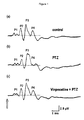
- the latency of each ABR wave (in ms) refers to the time interval between the onset of the auditory stimulus and the positive peak of the wave. The onset of the stimulus is indicated by the vertical arrow at the bottom of the recordings on Fig. 1.
- the peak amplitude (in ⁇ V) of each wave of the ABR is the difference between the positive peak of the wave and the reference baseline (trace between the stimulus and the appearance of the first ABR wave on Fig. 1).
- ABR thresholds ABR recordings elicited by stimuli of progressively lower intensity (in dB) were used for determining the hearing threshold. Threshold is defined as the lowest stimulus intensity (in dB) at which the P3 wave of the ABR could still be recorded in three consecutive trials.
- the next table shows that vinpocetine inhibits the reduction in P4 wave peak amplitude induced by PTZ .
- the amplitude of the P4 wave of the ABR induced by a stimulus of 100 dB at two tone frequencies (8 and 4 kHz) is progressively reduced by PTZ (left columns), whereas in the animals pre-injected with vinpocetine the reduction produced induced by PTZ in P4 amplitude is not observed (right columns).
- the values shown on the table are the mean ⁇ standard errors of the P4 wave amplitudes in ⁇ V obtained from 8 animals before and at the indicated times after the injection of the convulsing agent (PTZ).
- Vinpocetine also inhibits the increase produced after the injection of PTZ in the latencies of the ABR waves P2, P3 and P4 induced by a 100 dB stimulus at 4 and 8 kHz tone frequencies (Fig. 2).
- the next table shows that vinpocetine inhibits the hearing loss induced by the convulsing agent, PTZ.
- the marked increase on the auditory threshold at 4 and 8 kHz tone frequencies induced by PTZ (left columns) is not produced in the animals pre-injected with vinpocetine before PTZ administration (right columns).
- the values shown on the table are the mean ⁇ standard errors of the thresholds in dB obtained in 8 animals.
- Vinpocetine inhibits all the changes induced by PTZ on the EEG. All the anaesthetized animals injected with PTZ developed generalized seizures. The onset of seizure activity, characterized by repetitive high amplitude spike-sharp wave activity in the EEG tracing appears suddenly within the two first min after PTZ injection. This dramatic change on the cortical activity induced by PTZ in the anaesthetized animals during convulsions is followed by a typical pattern of cortical activity characterized by rhythmic spike bursts of high amplitude. The duration time of this typical pattern of cortical activity, that is not accompanied by convulsions is referred as the post-ictal period.
- Vinpocetine completely inhibits the changes on the cortical activity induced by PTZ for the ictal and post-ictal periods.
- the top traces on Figs. 3 and 4 show the characteristic EEG recordings under control conditions (i.e. before the injection of PTZ).
- the dramatic changes induced about two minutes after the injection of PTZ on the EEG (ictal period) in the animals pre-injected with vehicle are lost when PTZ is injected in the animals pre-injected with vinpocetine (Fig. 3).
- the changes induced by PTZ 10, 20, 30 and 50 min after its injection (Fig. 4a) are lost in the animals pre-injected with vinpocetine (Fig. 4b).
- guinea pigs Five guinea pigs were entered into the study. One hour after injecting guinea pigs with vehicle (acidified saline used to dissolve vinpocetine) the animals were anaesthetized and a first set of ABR and EEG recordings was taken before the injection (i.p) of the convulsing agent, 4-AP. The animals were injected with 4-AP (2 mg/kg) and about 20 min after injecting 4-AP (ictal period) the EEG recording was taken. Then the other series of ABR and EEG recordings were taken at specific times within the post-ictal period. After two weeks the same series of recordings were repeated but instead vehicle the animals were injected with vinpocetine (2 mg/kg) 1 hour before the injection of 4-AP.
- vehicle ascidified saline used to dissolve vinpocetine
- Vinpocetine also inhibits the changes in P3 and P4 waves amplitude induced by 4-AP. For instance, the progressive increase in the amplitude of the P3 wave of the ABR produced by 4-AP in control animals (Fig. 5a) is eliminated in the vinpocetine treated animals (Fig. 5b), and the reduction in P4 amplitude produced by 4-AP in control animals (Fig. 5c) is markedly reduced in the vinpocetine treated animals (Fig. 5d).
- Vinpocetine inhibits the hearing loss induced by 4-AP.
- the following table shows that the increase on the auditory threshold induced by 4-AP at 8 and 4 kHz tone frequencies in control animals (left columns) is lost in the vinpocetine treated animals (right columns).
- Vinpocetine inhibits all the changes induced by 4-AP on the EEG. All anaesthetized animals injected with 4-AP developed generalized seizures, characterized by a repetitive high amplitude spike-sharp wave activity in the EEG tracing that appears about 20 min after the injection of 4-AP. This change on the cortical activity elicited by 4-AP for the ictal period is followed by the post-ictal period characterized by isolated spikes of higher amplitude that appear on the EEG about one hour after the injection of 4-AP. Vinpocetine completely prevents the changes on the cortical activity induced by 4-AP for the ictal and post-ictal periods. The top traces of Fig.
- FIG. 6 show the characteristic EEG recordings taken before the injection of 4-AP in the animals pre-injected with vehicle (a) and in the animals pre-injected with vinpocetine (b).
- the changes induced by 4-AP on for the ictal period are shown in the second trace on Fig. 6a.
- 4-AP was unable to induce the ictal activity (second trace on Fig. 6b).
- Fig 7a shows the post-ictal activity induced by 4-AP, which is lost when the convulsing agent (4-AP) in injected in the animals pre-treated with vinpocetine (Fig. 7b).
Landscapes
- Health & Medical Sciences (AREA)
- General Health & Medical Sciences (AREA)
- Life Sciences & Earth Sciences (AREA)
- Chemical & Material Sciences (AREA)
- Veterinary Medicine (AREA)
- Pharmacology & Pharmacy (AREA)
- Medicinal Chemistry (AREA)
- Animal Behavior & Ethology (AREA)
- Public Health (AREA)
- Nuclear Medicine, Radiotherapy & Molecular Imaging (AREA)
- Epidemiology (AREA)
- Bioinformatics & Cheminformatics (AREA)
- General Chemical & Material Sciences (AREA)
- Organic Chemistry (AREA)
- Chemical Kinetics & Catalysis (AREA)
- Engineering & Computer Science (AREA)
- Biomedical Technology (AREA)
- Neurology (AREA)
- Neurosurgery (AREA)
- Pain & Pain Management (AREA)
- Acyclic And Carbocyclic Compounds In Medicinal Compositions (AREA)
- Pharmaceuticals Containing Other Organic And Inorganic Compounds (AREA)
- Medicines That Contain Protein Lipid Enzymes And Other Medicines (AREA)
- Nitrogen Condensed Heterocyclic Rings (AREA)
Applications Claiming Priority (1)
| Application Number | Priority Date | Filing Date | Title |
|---|---|---|---|
| PCT/MX2003/000089 WO2005039482A2 (fr) | 2003-10-28 | 2003-10-28 | Utilisation de la vinpocetine permettant d'eviter les complications, particulierement celles associees a l'audition, accompagnant l'epilepsie et leur traitement |
Publications (2)
| Publication Number | Publication Date |
|---|---|
| EP1679059A2 true EP1679059A2 (fr) | 2006-07-12 |
| EP1679059A4 EP1679059A4 (fr) | 2009-11-04 |
Family
ID=34511293
Family Applications (1)
| Application Number | Title | Priority Date | Filing Date |
|---|---|---|---|
| EP03759058A Ceased EP1679059A4 (fr) | 2003-10-28 | 2003-10-28 | Utilisation de la vinpocetine permettant d'eviter les complications, particulierement celles associees a l'audition, accompagnant l'epilepsie et leur traitement |
Country Status (10)
| Country | Link |
|---|---|
| US (1) | US20070135470A1 (fr) |
| EP (1) | EP1679059A4 (fr) |
| JP (1) | JP2007521241A (fr) |
| CN (1) | CN100500146C (fr) |
| AU (1) | AU2003274807A1 (fr) |
| BR (1) | BR0318588A (fr) |
| CA (1) | CA2544035C (fr) |
| MX (1) | MXPA06004690A (fr) |
| NZ (1) | NZ547508A (fr) |
| WO (1) | WO2005039482A2 (fr) |
Families Citing this family (3)
| Publication number | Priority date | Publication date | Assignee | Title |
|---|---|---|---|---|
| US8632475B2 (en) * | 2007-02-15 | 2014-01-21 | The Board Of Trustees Of The University Of Illinois | Non-invasive, bedside intra-cranial pressure and brain shift/herniation monitoring unit utilizing early onset auditory evoked responses |
| RU2697513C9 (ru) * | 2015-02-04 | 2019-12-19 | Харбин Фармасьютикал Груп Ко., Лтд. Дженерал Фармасьютикал Фэктори | Диазабензофторантреновые соединения |
| MX2018002786A (es) * | 2015-09-03 | 2018-12-17 | Neolpharma Inc | Composicion farmaceutica de vinpocetina. |
Family Cites Families (2)
| Publication number | Priority date | Publication date | Assignee | Title |
|---|---|---|---|---|
| HU201674B (en) * | 1987-08-26 | 1990-12-28 | Richter Gedeon Vegyeszet | Process for producing pharmaceutical composition suitable for curing autoimmune-type leukoencephalomyelitic diseases e.g. sclerosis multiplex |
| ATE212227T1 (de) * | 1995-02-15 | 2002-02-15 | Takeda Chemical Industries Ltd | Verwendung von kompocedinderivaten zur inhibierung der bildung oder sekretion von beta- amyloid-protein |
-
2003
- 2003-10-28 EP EP03759058A patent/EP1679059A4/fr not_active Ceased
- 2003-10-28 NZ NZ547508A patent/NZ547508A/en not_active IP Right Cessation
- 2003-10-28 BR BRPI0318588-5A patent/BR0318588A/pt not_active Application Discontinuation
- 2003-10-28 US US10/577,620 patent/US20070135470A1/en not_active Abandoned
- 2003-10-28 AU AU2003274807A patent/AU2003274807A1/en not_active Abandoned
- 2003-10-28 CA CA2544035A patent/CA2544035C/fr not_active Expired - Lifetime
- 2003-10-28 WO PCT/MX2003/000089 patent/WO2005039482A2/fr not_active Ceased
- 2003-10-28 JP JP2005509879A patent/JP2007521241A/ja active Pending
- 2003-10-28 CN CNB2003801109285A patent/CN100500146C/zh not_active Expired - Lifetime
-
2006
- 2006-04-27 MX MXPA06004690A patent/MXPA06004690A/es active IP Right Grant
Non-Patent Citations (5)
| Title |
|---|
| DUTOV A A ET AL: "[Cavinton in epilepsy treatment and prevention]" ZHURNAL NEVROLOGII I PSIKHIATRII IMENI S.S. KORSAKOVA / MINISTERSTVO ZDRAVOOKHRANENIIA I MEDITSINSKO PROMYSHLENNOSTI ROSSI SKO FEDERATSII, VSEROSSI SKOE OBSHCHESTVO NEVROLOGOV [I] VSEROSSI SKOE OBSHCHESTVO PSIKHIATROV 2001, vol. 101, no. 11, 2001, pages 59-61, XP008111627 ISSN: 1997-7298 * |
| DUTOV A A ET AL: "Cavinton (vinpocetin) in epilepsy treatment" ZHURNAL NEVROPATOLOGII I PSIKHIATRII IMENI S.S.KORSAKOVA 1986 SU, vol. 86, no. 6, 1986, pages 850-855, XP008111630 * |
| NEKRASSOV V ET AL: "Anti-epileptic potential of vinpocetine" JOURNAL OF NEUROCHEMISTRY, vol. 78, no. Supplement 1, September 2001 (2001-09), page 98, XP008111624 & EIGHTEENTH BIENNIAL MEETING OF THE INTERNATIONAL SOCIETY FOR NEUROCHEMISTRY AND THE THIRTY-SECOND AN; BUENOS AIRES, ARGENTINA; AUGUST 26-31, 2001 ISSN: 0022-3042 * |
| NEKRASSOV VLADIMIR ET AL: "Effects of pentylenetetrazole and 4-aminopyridine on the auditory brainstem response (ABR) and on the hearing sensitivity in the guinea pig in vivo." EPILEPSY RESEARCH MAR 2003, vol. 53, no. 3, March 2003 (2003-03), pages 245-254, XP002544987 ISSN: 0920-1211 * |
| See also references of WO2005039482A2 * |
Also Published As
| Publication number | Publication date |
|---|---|
| BR0318588A (pt) | 2006-10-17 |
| HK1100348A1 (zh) | 2007-09-21 |
| JP2007521241A (ja) | 2007-08-02 |
| CA2544035A1 (fr) | 2005-05-06 |
| MXPA06004690A (es) | 2006-07-05 |
| AU2003274807A8 (en) | 2005-05-11 |
| CN1909782A (zh) | 2007-02-07 |
| US20070135470A1 (en) | 2007-06-14 |
| EP1679059A4 (fr) | 2009-11-04 |
| CA2544035C (fr) | 2012-01-10 |
| WO2005039482A2 (fr) | 2005-05-06 |
| WO2005039482A3 (fr) | 2005-09-01 |
| NZ547508A (en) | 2010-04-30 |
| AU2003274807A1 (en) | 2005-05-11 |
| CN100500146C (zh) | 2009-06-17 |
Similar Documents
| Publication | Publication Date | Title |
|---|---|---|
| Fan et al. | Research progress of vagus nerve stimulation in the treatment of epilepsy | |
| McVicar et al. | Landau–Kleffner syndrome, electrical status epilepticus in slow wave sleep, and language regression in children | |
| Hartshorn et al. | Generalized periodic discharges with triphasic morphology | |
| CA2544035C (fr) | Utilisation de la vinpocetine permettant d'eviter les complications, particulierement celles associees a l'audition, accompagnant l'epilepsie et leur traitement | |
| Sitges et al. | Vinpocetine prevents 4-aminopyridine-induced changes in the EEG, the auditory brainstem responses and hearing | |
| Rampil et al. | Propofol sedation may disrupt interictal epilepiform activity from a seizure focus | |
| Nekrassov et al. | Vinpocetine inhibits the epileptic cortical activity and auditory alterations induced by pentylenetetrazole in the guinea pig in vivo | |
| Knott et al. | Effects of lactate-induced panic attacks on brain stem auditory evoked potentials | |
| RU2376990C2 (ru) | Применение винпоцетина для предупреждения осложнений, в частности осложнений, связанных со слухом, которые сопутствуют эпилепсии и ее лечению | |
| Hosford-Dunn | Auditory Bainstem Response Audiometry: Applications in Central Disorders | |
| Male et al. | Methohexitone-induced convulsions in epileptics | |
| KR20060125756A (ko) | 간질과 함께 발생하는 합병증, 특히 청력 관련 합병증의예방 및 치료를 위한 빈포세틴의 용도 | |
| Miller et al. | Eyelid twitching seizures and generalized tonic‐clonic convulsions: A syndrome of idiopathic generalized epilepsy | |
| Foreman | Generalized periodic discharges with triphasic morphology | |
| Vyas et al. | Rem behavior disorder (RBD) as an early marker for development of neurodegenerative diseases | |
| HK1100348B (en) | Utilization of vinpocetine to avoid complications in particular those associated to hearing which occur with epilepsy, and treatment thereof | |
| Goldensohn | Neurological and Electrical Aspects | |
| Fischer-Williams et al. | Space-Occupying Lesions | |
| El-Senousey et al. | Cognitive Decline in Patients with Refractory Complex Partial Seizures. | |
| Kile | Diagnosis and treatment of postconcussive neurobehavioral symptoms | |
| Joe et al. | Successful Treatment of Epilepsia Partialis Continua by Partial Focal Resection in a Patient with Sturge-Weber Syndrome: F107 | |
| Pavlova et al. | Nocturnal Frontal Lobe Epilepsy | |
| Coleman | American EEG Society, annual meeting | |
| FONG et al. | Electroencephalography in Relation to Abnormal Movements during Sleep | |
| Pestana et al. | “No surgical resection” after invasive long-term subdural grid evaluation for epilepsy surgery in children: F105 |
Legal Events
| Date | Code | Title | Description |
|---|---|---|---|
| PUAI | Public reference made under article 153(3) epc to a published international application that has entered the european phase |
Free format text: ORIGINAL CODE: 0009012 |
|
| 17P | Request for examination filed |
Effective date: 20060508 |
|
| AK | Designated contracting states |
Kind code of ref document: A2 Designated state(s): AT BE BG CH CY CZ DE DK EE ES FI FR GB GR HU IE IT LI LU MC NL PT RO SE SI SK TR |
|
| RIC1 | Information provided on ipc code assigned before grant |
Ipc: A61K 31/44 20060101ALI20060614BHEP Ipc: A01N 43/42 20060101AFI20060614BHEP |
|
| DAX | Request for extension of the european patent (deleted) | ||
| RIC1 | Information provided on ipc code assigned before grant |
Ipc: A61P 25/08 20060101ALI20090915BHEP Ipc: A61K 31/44 20060101AFI20090915BHEP Ipc: A61P 27/16 20060101ALI20090915BHEP |
|
| A4 | Supplementary search report drawn up and despatched |
Effective date: 20091001 |
|
| 17Q | First examination report despatched |
Effective date: 20100729 |
|
| REG | Reference to a national code |
Ref country code: DE Ref legal event code: R003 |
|
| STAA | Information on the status of an ep patent application or granted ep patent |
Free format text: STATUS: THE APPLICATION HAS BEEN REFUSED |
|
| 18R | Application refused |
Effective date: 20160620 |