EP1679369A2 - Methode de prolongement d'acide nucleique monocatenaire, appareil de prolongement d'acide nucleique monocatenaire et puce adn associee - Google Patents
Methode de prolongement d'acide nucleique monocatenaire, appareil de prolongement d'acide nucleique monocatenaire et puce adn associee Download PDFInfo
- Publication number
- EP1679369A2 EP1679369A2 EP04792334A EP04792334A EP1679369A2 EP 1679369 A2 EP1679369 A2 EP 1679369A2 EP 04792334 A EP04792334 A EP 04792334A EP 04792334 A EP04792334 A EP 04792334A EP 1679369 A2 EP1679369 A2 EP 1679369A2
- Authority
- EP
- European Patent Office
- Prior art keywords
- nucleic acid
- stranded nucleic
- electric field
- aqueous solution
- dna
- Prior art date
- Legal status (The legal status is an assumption and is not a legal conclusion. Google has not performed a legal analysis and makes no representation as to the accuracy of the status listed.)
- Withdrawn
Links
Images




Classifications
-
- C—CHEMISTRY; METALLURGY
- C12—BIOCHEMISTRY; BEER; SPIRITS; WINE; VINEGAR; MICROBIOLOGY; ENZYMOLOGY; MUTATION OR GENETIC ENGINEERING
- C12N—MICROORGANISMS OR ENZYMES; COMPOSITIONS THEREOF; PROPAGATING, PRESERVING, OR MAINTAINING MICROORGANISMS; MUTATION OR GENETIC ENGINEERING; CULTURE MEDIA
- C12N15/00—Mutation or genetic engineering; DNA or RNA concerning genetic engineering, vectors, e.g. plasmids, or their isolation, preparation or purification; Use of hosts therefor
-
- C—CHEMISTRY; METALLURGY
- C12—BIOCHEMISTRY; BEER; SPIRITS; WINE; VINEGAR; MICROBIOLOGY; ENZYMOLOGY; MUTATION OR GENETIC ENGINEERING
- C12Q—MEASURING OR TESTING PROCESSES INVOLVING ENZYMES, NUCLEIC ACIDS OR MICROORGANISMS; COMPOSITIONS OR TEST PAPERS THEREFOR; PROCESSES OF PREPARING SUCH COMPOSITIONS; CONDITION-RESPONSIVE CONTROL IN MICROBIOLOGICAL OR ENZYMOLOGICAL PROCESSES
- C12Q1/00—Measuring or testing processes involving enzymes, nucleic acids or microorganisms; Compositions therefor; Processes of preparing such compositions
- C12Q1/68—Measuring or testing processes involving enzymes, nucleic acids or microorganisms; Compositions therefor; Processes of preparing such compositions involving nucleic acids
- C12Q1/6806—Preparing nucleic acids for analysis, e.g. for polymerase chain reaction [PCR] assay
-
- C—CHEMISTRY; METALLURGY
- C12—BIOCHEMISTRY; BEER; SPIRITS; WINE; VINEGAR; MICROBIOLOGY; ENZYMOLOGY; MUTATION OR GENETIC ENGINEERING
- C12Q—MEASURING OR TESTING PROCESSES INVOLVING ENZYMES, NUCLEIC ACIDS OR MICROORGANISMS; COMPOSITIONS OR TEST PAPERS THEREFOR; PROCESSES OF PREPARING SUCH COMPOSITIONS; CONDITION-RESPONSIVE CONTROL IN MICROBIOLOGICAL OR ENZYMOLOGICAL PROCESSES
- C12Q1/00—Measuring or testing processes involving enzymes, nucleic acids or microorganisms; Compositions therefor; Processes of preparing such compositions
- C12Q1/68—Measuring or testing processes involving enzymes, nucleic acids or microorganisms; Compositions therefor; Processes of preparing such compositions involving nucleic acids
- C12Q1/6813—Hybridisation assays
- C12Q1/6832—Enhancement of hybridisation reaction
-
- C—CHEMISTRY; METALLURGY
- C12—BIOCHEMISTRY; BEER; SPIRITS; WINE; VINEGAR; MICROBIOLOGY; ENZYMOLOGY; MUTATION OR GENETIC ENGINEERING
- C12Q—MEASURING OR TESTING PROCESSES INVOLVING ENZYMES, NUCLEIC ACIDS OR MICROORGANISMS; COMPOSITIONS OR TEST PAPERS THEREFOR; PROCESSES OF PREPARING SUCH COMPOSITIONS; CONDITION-RESPONSIVE CONTROL IN MICROBIOLOGICAL OR ENZYMOLOGICAL PROCESSES
- C12Q1/00—Measuring or testing processes involving enzymes, nucleic acids or microorganisms; Compositions therefor; Processes of preparing such compositions
- C12Q1/68—Measuring or testing processes involving enzymes, nucleic acids or microorganisms; Compositions therefor; Processes of preparing such compositions involving nucleic acids
- C12Q1/6813—Hybridisation assays
- C12Q1/6834—Enzymatic or biochemical coupling of nucleic acids to a solid phase
- C12Q1/6837—Enzymatic or biochemical coupling of nucleic acids to a solid phase using probe arrays or probe chips
-
- G—PHYSICS
- G01—MEASURING; TESTING
- G01N—INVESTIGATING OR ANALYSING MATERIALS BY DETERMINING THEIR CHEMICAL OR PHYSICAL PROPERTIES
- G01N33/00—Investigating or analysing materials by specific methods not covered by groups G01N1/00 - G01N31/00
- G01N33/48—Biological material, e.g. blood, urine; Haemocytometers
- G01N33/50—Chemical analysis of biological material, e.g. blood, urine; Testing involving biospecific ligand binding methods; Immunological testing
- G01N33/53—Immunoassay; Biospecific binding assay; Materials therefor
-
- C—CHEMISTRY; METALLURGY
- C12—BIOCHEMISTRY; BEER; SPIRITS; WINE; VINEGAR; MICROBIOLOGY; ENZYMOLOGY; MUTATION OR GENETIC ENGINEERING
- C12Q—MEASURING OR TESTING PROCESSES INVOLVING ENZYMES, NUCLEIC ACIDS OR MICROORGANISMS; COMPOSITIONS OR TEST PAPERS THEREFOR; PROCESSES OF PREPARING SUCH COMPOSITIONS; CONDITION-RESPONSIVE CONTROL IN MICROBIOLOGICAL OR ENZYMOLOGICAL PROCESSES
- C12Q2523/00—Reactions characterised by treatment of reaction samples
- C12Q2523/30—Characterised by physical treatment
- C12Q2523/301—Sonication
-
- C—CHEMISTRY; METALLURGY
- C12—BIOCHEMISTRY; BEER; SPIRITS; WINE; VINEGAR; MICROBIOLOGY; ENZYMOLOGY; MUTATION OR GENETIC ENGINEERING
- C12Q—MEASURING OR TESTING PROCESSES INVOLVING ENZYMES, NUCLEIC ACIDS OR MICROORGANISMS; COMPOSITIONS OR TEST PAPERS THEREFOR; PROCESSES OF PREPARING SUCH COMPOSITIONS; CONDITION-RESPONSIVE CONTROL IN MICROBIOLOGICAL OR ENZYMOLOGICAL PROCESSES
- C12Q2523/00—Reactions characterised by treatment of reaction samples
- C12Q2523/30—Characterised by physical treatment
- C12Q2523/307—Denaturation or renaturation by electric current/voltage
Definitions
- This invention relates to a technique for stretching a single-stranded nucleic acid, which exists in a random-coil or like form in an aqueous solution, under the action of a high-frequency electric field.
- DNA chips There is a technology relating to integrated bioassay plates holding thereon predetermined DNAs microarrayed by microarray techniques and generally called “DNA chips” or “DNA microarrays” (hereinafter collectively called “DNA chips”).
- DNA chips DNA oligosaccharides
- cDNAs complementary DNAs
- this DNA chip technology is characterized in that it permits a comprehensive analysis of an intermolecular reaction such as hybridization.
- DNA chips are used in gene mutation analyses, SNPs (single-base polymorphisms) analyses, gene expression frequency analyses, and the like, and have begun to find utility in a wide range of fields such as drug developments, clinical diagnoses, pharmacogenomics, forensic medicine, and other fields.
- Japanese Patent Laid-open No. Hei 6-038768 discloses a technique for eliminating thermal fluctuations in a high-viscosity solution or under an electric field under the premise of its application to a method or system that treats DNA, RNA, its derivative, its fragments by an enzymatic reaction or chemical reaction.
- This technique is described to permit efficiently and accurately performing the treatment of high molecules of DNA such as the synthesis reaction of DNA strands.
- this technique is intended to allow high molecules of DNA to undergo an enzymatic reaction or chemical reaction under the existence of an electric field.
- Japanese Patent Laid-open No. Hei 8-322568 discloses a DNA replication process, which is characterized in that in an annealing reaction step of binding a primer to a single-stranded template DNA and a synthesis reaction step of allowing a DNA stand to stretch from the primer, an electric field is applied to a reaction solution with materials, a synthase and the like contained for the purpose of the synthesis to bring the template DNA into a linear form.
- This technique is intended for use in the sequential analysis for the determination of the base sequence of DNA or in the PCR method for the amplification of a DNA sample, and therefore, has as a premise that the components required for the above-described object are contained in the reaction solution to which an electric field is to be applied.
- a primary object of the present invention is, therefore, to verify an action of a high-frequency ac electric field on a single-stranded nucleic acid existing in an aqueous solution, which is absolutely free of any components for the synthesis of DNA, such as a nucleic acid material, an enzyme and a primer; and to make use of the above-described action for improving the efficiency of hybridization in which the single-stranded nucleic acid is used as a complementary strand.
- the present invention firstly, provides a nucleic acid stretch method of stretching the following single-stranded nucleic acid (1) or (2) by causing an ac electric field of a high frequency to act on the single-stranded nucleic acid (1) or (2): (1) a single-stranded nucleic acid existing in a free form in pure water or an aqueous solution of pH 5 to 11, or (2) a single-stranded nucleic acid existing in a form immobilized on one or both of opposing electrodes arranged facing said aqueous solution; and also a nucleic acid stretch system making use of the stretch means.
- the present invention also provides a DNA chip making use of a means for stretching a single-stranded nucleic acid, which exists in a free or immobilized form in an aqueous solution of pH 5 to 11, under an action of a high-frequency ac electric field applied to a reaction well with pure water or said aqueous solution of pH 5 to 11 retained therein or under an action of dielectrophoresis.
- aqueous solution means pure water or an aqueous solution of pH 6 to 11 which is absolutely free of a nucleic acid material, an enzyme and any other high molecular component, such as a primer, for the purpose of DNA synthesis.
- the aqueous solution functions as a liquid phase which can provide a place of hybridization between nucleic acids having complementary strands.
- Fig. 1 schematically illustrates the state that a single-stranded nucleic acid 1 having a high-order structure entangled in a random coil form, such as DNA, exists in a free form in an aqueous solution indicated by sign R.
- the applied voltage is 0.
- sign A designates a reaction well capable of retaining the aqueous solution R
- signs E,E indicate electrodes formed of aluminum or the like and arranged opposite to each other with the aqueous solution R, which is retained in the reaction well A, being sandwiched therebetween.
- sign V, sign S 1 and sign S 2 indicate an ac power supply connected to the electrodes E,E, a switch in an OFF position, and a switch in an ON position, respectively.
- the distance between the electrodes E-E is desired to design the distance between the electrodes E-E at 40 ⁇ m or shorter, because a distance greater than 40 ⁇ m between the electrodes E-E is considered to readily induce convection in the aqueous solution R by thermal energy resulting from the application of a voltage. As this convection is considered to interfere with the action of a high-frequency ac electric field for the stretch of the single-stranded nucleic acid 1, it is desired to avoid, to the utmost, the occurrence of such convection in the aqueous solution R.
- a high-frequency ac electric field (which is indicated by dashed lines in the drawing) is formed in the aqueous solution R by the electrodes E,E across which a voltage is applied by the power supply V.
- this high-frequency ac electric field it is possible to have the single-stranded nucleic acid 1 oriented in a single direction along the electric field in a state that no electrolysis takes place.
- the single-stranded nucleic acid is, therefore, illustrated in a form stretched as a result of the formation of the high-frequency ac electric field.
- sign 2 designates the single-stranded nucleic acid which has been brought into the stretched form.
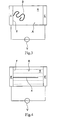
- Fig. 3 shows the state that a single-stranded nucleic acid 3 immobilized at the position of the terminal thereof on the surface f of one of the electrodes E,E is taking a high-order structure in a random coil form in the state of an impression voltage of 0.
- the electrode surface f has been surface-treated beforehand such that the terminal of the single-stranded nucleic acid 3 is immobilized there by chemical bonding such as coupling.
- streptavidin for example, a biotinylated terminal of a single-stranded nucleic acid can be immobilized.
- Fig. 4 illustrates the state that an immobilized single-stranded nucleic acid 4 has been stretched by the action of a high-frequency ac electric field.
- the immobilized single-stranded nucleic acid 4 is caused to direct in a single direction while being immobilized, and as a result, is stretched along the electric field. It is to be noted that, even once the single-stranded nucleic acid has stretched, the single-stranded nucleic acid returns into the original random coil form when the application voltage for the high-frequency ac electric field is lowered to 0.
- the other electrode e arranged opposite the electrode E is formed with a smaller area so that a non-uniform electric field is formed concentrating on the electrode e (as indicated by alternate long-and-short lines in Fig. 5).
- a construction with the surfaces of electrodes formed into rough surfaces having concavities and convexities by surface treatment such as sputtering and by etching or the like or a like construction can be adopted, because electric lines of force concentrate at the convexities and pointed edge portions of the electrodes.
- the single-stranded nucleic acid 1 existing in a free form in the aqueous solution R can be caused to migrate by dielectrophoresis toward the single position (electrode e), at which the electric lines of force concentrate, while causing it to stretch.
- the single-stranded nucleic acid can be immobilized at the position of its terminal on the electrode e.
- sign 5 in Fig. 5 indicates the single-stranded nucleic acid immobilized at the position of the terminal thereof on the electrode e.
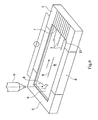
- FIG. 6 depicts one embodiment of a reaction detecting section equipped with a construction that permits arraying reaction detecting sections on a plate such as a DNA chip.
- This reaction detecting section 6 is provided with a reaction well A, which is a very small concave region capable of retaining the aqueous solution R, and opposing electrodes E,E arranged facing the reaction well A.
- Designated at sign 7 in Fig. 6 are a group of single-stranded DNA probes each of which has been immobilized beforehand in an stretched form on a surface f of the electrode E.
- Sign 8 in Fig. 6 indicates a single-stranded target nucleic acid added dropwise from a micronozzle N into the reaction well A. Shortly after the dropwise addition, this single-stranded target nucleic acid 8 takes a high-order structure of a random coil form.
- the single-stranded nucleic acid can be changed in structure to have an stretched form as designated at sign 9, and moreover, the stretched, single-stranded nucleic acid can be caused to migrate toward the side of the DNA probes 7 along the electric field (electric lines of force).
- hybridization can be allowed to efficiently proceed in a short time by the natural Brownian motion under suitable conditions of pH, temperature and like. Described specifically, between the DNA probe 7 and target, single-stranded nucleic acid 8 both of which are in stretched forms, respectively, high-accuracy hybridization is allowed to proceed with reduced miss-hybridization without being affected by a steric hindrance or the convection of the aqueous solution R when they include mutually-complementary base sequences.
- a DNA chip with a number of such reaction detecting sections 6 as illustrated in Fig. 7 arrayed on a substrate can be provided.
- a number of reaction detection sections 6 as described above are arrayed radially or in the direction of a circumference on such a disk plate 10 as shown in Fig. 7, and desired DNA probes 7 can be immobilized in the reaction detecting sections 6 divided in groups.
- a partial sequence (5 kbp) of ⁇ phage DNA was amplified by the PCR method (see NAKAYAMA: "Bioexperiments Illustrated", volume 3, Chapter 2, published in Japanese, Shujunsha Co., Ltd. (1998)).
- NAKAYAMA "Bioexperiments Illustrated", volume 3, Chapter 2, published in Japanese, Shujunsha Co., Ltd. (1998)).
- dTTP and dUTP-FITC were added at a ratio of 1:1 to fluorescently label the PCR product.
- a primer biotinylated at the 5'end thereof was used as a one-side primer.
- the PCR product was subjected to gel electrophoresis, a band was sliced out by dissection from the position of 5 kbp, and double-stranded DNA fragments were extracted from the gel.
- "QIAquick Gel Extraction KIT” QIAGEN K.K. was used for the extraction of the DNA fragments.
- the beads ("DYNABEADS M-280 streptavidin", 5 ⁇ L) in the kit were washed in the binding solution (20 ⁇ L), and were then suspended in the binding solution (20 ⁇ L). An avidin-biotin reaction was next conducted. Sample DNA (20 ⁇ L), which had been amplified by PCR with a biotinylated primer, and the above-described beads suspension, followed by incubation at room temperature for three hours. The beads were collected by a magnet, and subsequent to removal of the supernatant, were washed twice with the washing buffer (40 ⁇ L each) to eliminate unreacted DNA.
- aqueous DNA solution (5 ⁇ L) was placed between opposing aluminum electrodes arranged in a pair with an interval set at 25 ⁇ m, and a high-frequency ac electric field voltage of 1 MHz and 1.5 V/ ⁇ m was applied.
- a high-frequency ac electric field voltage 1 MHz and 1.5 V/ ⁇ m was applied.
- Fig. 8 is a microphotograph of a single strand of DNA in a random coil form in the aqueous solution before the electric field was applied
- Fig. 9 is a microphotograph of single strands of DNA stretched by the application of the electric field.
- the present invention can be used, for example, in a technology for immobilizing one or more detecting nucleic acids such as detecting DNA probes in stretched forms at predetermined locations on a substrate which makes up a DNA chip or in a technology for performing hybridization while stretching one or more immobilized, detecting nucleic acids and one or more target nucleic acids equipped with complementary strands.
- an ion cloud is considered to be formed by phosphoric ions (negative charges), which make up the skeleton of a single-stranded nucleic acid, and their surrounding hydrogen atoms (positive charges) derived from water.
- Polarization vectors (dipoles) produced by these negative charges and positive charges are, therefore, caused to orient in one direction as a whole upon application of a high-frequency ac electric field, and as a result, the single-stranded nucleic acid can be stretched.
- the aqueous solution is placed between opposing electrodes arranged at an interval of 25 ⁇ m or shorter and a high-frequency ac electric field is applied to the aqueous solution at a high frequency of 500 kHz or higher and an applied voltage sufficient to give an electric field strength of 1.2 V/ ⁇ m or higher, for example, dielectric polarization can be surely induced on the single-stranded nucleic acid existing in a random coil form. As a consequence, the single-stranded nucleic acid can be linearly stretched in parallel with the electric field.
- nucleic acid which is in an stretched form With a nucleic acid which is in an stretched form, its base sequent is exposed so that adverse effects due to a steric hindrance or thermal fluctuations can be eliminated. Its hybridization with another nucleic acid having a complementary strand is, therefore, allowed to proceed with high efficiency and high accuracy in a short time.
Landscapes
- Chemical & Material Sciences (AREA)
- Life Sciences & Earth Sciences (AREA)
- Organic Chemistry (AREA)
- Health & Medical Sciences (AREA)
- Engineering & Computer Science (AREA)
- Wood Science & Technology (AREA)
- Zoology (AREA)
- Proteomics, Peptides & Aminoacids (AREA)
- Analytical Chemistry (AREA)
- Genetics & Genomics (AREA)
- Biotechnology (AREA)
- Immunology (AREA)
- Molecular Biology (AREA)
- Biochemistry (AREA)
- Physics & Mathematics (AREA)
- Bioinformatics & Cheminformatics (AREA)
- General Engineering & Computer Science (AREA)
- General Health & Medical Sciences (AREA)
- Microbiology (AREA)
- Biophysics (AREA)
- Chemical Kinetics & Catalysis (AREA)
- Biomedical Technology (AREA)
- Hematology (AREA)
- Urology & Nephrology (AREA)
- Plant Pathology (AREA)
- Cell Biology (AREA)
- Food Science & Technology (AREA)
- Medicinal Chemistry (AREA)
- General Physics & Mathematics (AREA)
- Pathology (AREA)
- Measuring Or Testing Involving Enzymes Or Micro-Organisms (AREA)
- Apparatus Associated With Microorganisms And Enzymes (AREA)
Applications Claiming Priority (2)
| Application Number | Priority Date | Filing Date | Title |
|---|---|---|---|
| JP2003346779A JP2005110539A (ja) | 2003-10-06 | 2003-10-06 | 一本鎖核酸の伸長方法と一本鎖核酸伸長装置及びdnaチップ |
| PCT/JP2004/015094 WO2005033326A2 (fr) | 2003-10-06 | 2004-10-06 | Methode de prolongement d'acide nucleique monocatenaire, appareil de prolongement d'acide nucleique monocatenaire et puce adn associee |
Publications (2)
| Publication Number | Publication Date |
|---|---|
| EP1679369A2 true EP1679369A2 (fr) | 2006-07-12 |
| EP1679369A4 EP1679369A4 (fr) | 2007-12-12 |
Family
ID=34419559
Family Applications (1)
| Application Number | Title | Priority Date | Filing Date |
|---|---|---|---|
| EP04792334A Withdrawn EP1679369A4 (fr) | 2003-10-06 | 2004-10-06 | Methode de prolongement d'acide nucleique monocatenaire, appareil de prolongement d'acide nucleique monocatenaire et puce adn associee |
Country Status (6)
| Country | Link |
|---|---|
| US (1) | US20070184446A1 (fr) |
| EP (1) | EP1679369A4 (fr) |
| JP (1) | JP2005110539A (fr) |
| KR (1) | KR100868598B1 (fr) |
| CN (1) | CN1863909A (fr) |
| WO (1) | WO2005033326A2 (fr) |
Families Citing this family (9)
| Publication number | Priority date | Publication date | Assignee | Title |
|---|---|---|---|---|
| JP4765402B2 (ja) * | 2005-05-23 | 2011-09-07 | ソニー株式会社 | 電界印加によるポリ(a)rna作製方法 |
| US7745129B1 (en) * | 2006-07-12 | 2010-06-29 | Kenneth David Schatz | Methods for sequencing of a necleic acid |
| KR100958006B1 (ko) | 2008-06-18 | 2010-05-17 | 삼성모바일디스플레이주식회사 | 박막 트랜지스터, 그의 제조 방법 및 박막 트랜지스터를구비하는 평판 표시 장치 |
| US20100035252A1 (en) * | 2008-08-08 | 2010-02-11 | Ion Torrent Systems Incorporated | Methods for sequencing individual nucleic acids under tension |
| EP2475787A2 (fr) * | 2009-09-07 | 2012-07-18 | Caerus Molecular Diagnostics Incorporated | Détermination de séquence par l'utilisation de forces opposées |
| WO2017118390A1 (fr) * | 2016-01-05 | 2017-07-13 | 吴翔 | Manipulation sélective d'une molécule à l'aide d'un champ électrique, d'un champ magnétique ou d'un champ électromagnétique variables |
| US12385873B2 (en) | 2020-12-25 | 2025-08-12 | Aurangzeb Nafees Nagy | Detection of target nucleic acid molecules |
| US11872561B2 (en) * | 2021-03-12 | 2024-01-16 | Robert Bosch Gmbh | Systems for stretching polynucleotide structures |
| US20250137033A1 (en) * | 2023-11-01 | 2025-05-01 | Robert Bosch Gmbh | Dna unfolding using a free-end tag flow modifier |
Family Cites Families (7)
| Publication number | Priority date | Publication date | Assignee | Title |
|---|---|---|---|---|
| US4441972A (en) * | 1983-04-08 | 1984-04-10 | D.E.P. Systems, Inc. | Apparatus for electrofusion of biological particles |
| JP3721603B2 (ja) * | 1995-05-31 | 2005-11-30 | 株式会社島津製作所 | Dnaの複製方法 |
| JP3829491B2 (ja) * | 1998-08-27 | 2006-10-04 | 株式会社日立製作所 | プローブチップ、プローブチップ作成方法、試料検出方法、及び試料検出装置 |
| US6203683B1 (en) * | 1998-11-09 | 2001-03-20 | Princeton University | Electrodynamically focused thermal cycling device |
| EP2465943A3 (fr) * | 2001-03-16 | 2012-10-03 | Kalim Mir | Affichage de polymère linéaire |
| TWI234584B (en) * | 2002-08-16 | 2005-06-21 | Univ Nat Taiwan Normal | Nucleic acid sequencing method |
| EP1548103A4 (fr) * | 2002-08-20 | 2008-06-25 | Sony Corp | Partie de detection d'hybridation, puce de detection et procede d'hybridation |
-
2003
- 2003-10-06 JP JP2003346779A patent/JP2005110539A/ja not_active Abandoned
-
2004
- 2004-10-06 US US10/574,583 patent/US20070184446A1/en not_active Abandoned
- 2004-10-06 WO PCT/JP2004/015094 patent/WO2005033326A2/fr not_active Ceased
- 2004-10-06 EP EP04792334A patent/EP1679369A4/fr not_active Withdrawn
- 2004-10-06 KR KR1020067006577A patent/KR100868598B1/ko not_active Expired - Fee Related
- 2004-10-06 CN CNA2004800291020A patent/CN1863909A/zh active Pending
Also Published As
| Publication number | Publication date |
|---|---|
| WO2005033326A3 (fr) | 2005-05-19 |
| US20070184446A1 (en) | 2007-08-09 |
| KR100868598B1 (ko) | 2008-11-13 |
| WO2005033326A2 (fr) | 2005-04-14 |
| CN1863909A (zh) | 2006-11-15 |
| EP1679369A4 (fr) | 2007-12-12 |
| JP2005110539A (ja) | 2005-04-28 |
| KR20060105743A (ko) | 2006-10-11 |
Similar Documents
| Publication | Publication Date | Title |
|---|---|---|
| CN103328981B (zh) | 用于自动化可重复使用的平行生物反应的系统和方法 | |
| US8932815B2 (en) | Nucleic acid sample preparation | |
| EP2839035B1 (fr) | Préparation d'un échantillon d'acide nucléique | |
| US8632970B2 (en) | Multiplex capture of nucleic acids | |
| CN1291913A (zh) | 通过双向电泳在一种生物电芯片上无流道分离生物颗粒 | |
| JP2022501005A (ja) | アッセイを改善する為の化合物、組成物、及び方法 | |
| WO2015196141A1 (fr) | Préparation d'échantillons d'acide nucléique | |
| EP1679369A2 (fr) | Methode de prolongement d'acide nucleique monocatenaire, appareil de prolongement d'acide nucleique monocatenaire et puce adn associee | |
| CN114616344A (zh) | 用于绘制滚环扩增产物图谱的方法 | |
| Wang et al. | Template-free multiple signal amplification for highly sensitive detection of cancer cell-derived exosomes | |
| JP7049103B2 (ja) | 単一細胞の網羅的3’末端遺伝子発現解析法 | |
| WO2021095829A1 (fr) | Procédé de détection ou de quantification d'oligonucléotides | |
| JP2024533335A (ja) | オリゴヌクレオチド二本鎖におけるセンス鎖及びアンチセンス鎖を検出するための方法 | |
| US20080188374A1 (en) | In-Solution Microarray Assay | |
| US8975017B2 (en) | Process for concentrating nucleic acid molecules | |
| EP1677110A1 (fr) | Procede de production d'un substrat pour biodosage par superposition de deux substrats l'un sur l'autre, et substrat de biodosage | |
| WO2016185284A1 (fr) | Procédé pour isoler un acide nucléique cible à l'aide des protéines de liaison hétéroduplexes | |
| CN115948386A (zh) | 一种三向dna结构纳米银簇及其制备方法和应用 | |
| WO2001048249A2 (fr) | Detection de puce genique a mediation assuree par une recombinase | |
| RU2542476C1 (ru) | Бионаноконъюгат для обнаружения и выделения нуклеиновых кислот и способ его получения | |
| KR100601985B1 (ko) | 알루미나를 이용한 세포 분리 방법 | |
| WO2025163199A1 (fr) | Procédés d'amplification d'acides nucléiques cibles dans un échantillon | |
| CN116635536A (zh) | 用于制作条形码化颗粒群的物理图谱的方法 | |
| JP2006141342A (ja) | 核酸の解析法 |
Legal Events
| Date | Code | Title | Description |
|---|---|---|---|
| PUAI | Public reference made under article 153(3) epc to a published international application that has entered the european phase |
Free format text: ORIGINAL CODE: 0009012 |
|
| 17P | Request for examination filed |
Effective date: 20060405 |
|
| AK | Designated contracting states |
Kind code of ref document: A2 Designated state(s): DE FR GB |
|
| DAX | Request for extension of the european patent (deleted) | ||
| RBV | Designated contracting states (corrected) |
Designated state(s): DE FR GB |
|
| A4 | Supplementary search report drawn up and despatched |
Effective date: 20071112 |
|
| 17Q | First examination report despatched |
Effective date: 20080313 |
|
| STAA | Information on the status of an ep patent application or granted ep patent |
Free format text: STATUS: THE APPLICATION IS DEEMED TO BE WITHDRAWN |
|
| 18D | Application deemed to be withdrawn |
Effective date: 20091127 |