EP1679652B1 - Procédé et dispositif de segmentation d'image - Google Patents
Procédé et dispositif de segmentation d'image Download PDFInfo
- Publication number
- EP1679652B1 EP1679652B1 EP20050111825 EP05111825A EP1679652B1 EP 1679652 B1 EP1679652 B1 EP 1679652B1 EP 20050111825 EP20050111825 EP 20050111825 EP 05111825 A EP05111825 A EP 05111825A EP 1679652 B1 EP1679652 B1 EP 1679652B1
- Authority
- EP
- European Patent Office
- Prior art keywords
- contour
- colour
- vicinity
- labelled
- points
- Prior art date
- Legal status (The legal status is an assumption and is not a legal conclusion. Google has not performed a legal analysis and makes no representation as to the accuracy of the status listed.)
- Expired - Lifetime
Links
Images


Classifications
-
- G—PHYSICS
- G06—COMPUTING OR CALCULATING; COUNTING
- G06T—IMAGE DATA PROCESSING OR GENERATION, IN GENERAL
- G06T7/00—Image analysis
- G06T7/10—Segmentation; Edge detection
- G06T7/11—Region-based segmentation
-
- G—PHYSICS
- G06—COMPUTING OR CALCULATING; COUNTING
- G06T—IMAGE DATA PROCESSING OR GENERATION, IN GENERAL
- G06T7/00—Image analysis
- G06T7/10—Segmentation; Edge detection
- G06T7/12—Edge-based segmentation
-
- G—PHYSICS
- G06—COMPUTING OR CALCULATING; COUNTING
- G06T—IMAGE DATA PROCESSING OR GENERATION, IN GENERAL
- G06T7/00—Image analysis
- G06T7/10—Segmentation; Edge detection
- G06T7/149—Segmentation; Edge detection involving deformable models, e.g. active contour models
-
- G—PHYSICS
- G06—COMPUTING OR CALCULATING; COUNTING
- G06T—IMAGE DATA PROCESSING OR GENERATION, IN GENERAL
- G06T7/00—Image analysis
- G06T7/10—Segmentation; Edge detection
- G06T7/194—Segmentation; Edge detection involving foreground-background segmentation
-
- G—PHYSICS
- G06—COMPUTING OR CALCULATING; COUNTING
- G06V—IMAGE OR VIDEO RECOGNITION OR UNDERSTANDING
- G06V10/00—Arrangements for image or video recognition or understanding
- G06V10/20—Image preprocessing
- G06V10/26—Segmentation of patterns in the image field; Cutting or merging of image elements to establish the pattern region, e.g. clustering-based techniques; Detection of occlusion
-
- G—PHYSICS
- G06—COMPUTING OR CALCULATING; COUNTING
- G06V—IMAGE OR VIDEO RECOGNITION OR UNDERSTANDING
- G06V10/00—Arrangements for image or video recognition or understanding
- G06V10/20—Image preprocessing
- G06V10/28—Quantising the image, e.g. histogram thresholding for discrimination between background and foreground patterns
-
- G—PHYSICS
- G06—COMPUTING OR CALCULATING; COUNTING
- G06T—IMAGE DATA PROCESSING OR GENERATION, IN GENERAL
- G06T2207/00—Indexing scheme for image analysis or image enhancement
- G06T2207/10—Image acquisition modality
- G06T2207/10016—Video; Image sequence
-
- G—PHYSICS
- G06—COMPUTING OR CALCULATING; COUNTING
- G06T—IMAGE DATA PROCESSING OR GENERATION, IN GENERAL
- G06T2207/00—Indexing scheme for image analysis or image enhancement
- G06T2207/20—Special algorithmic details
- G06T2207/20092—Interactive image processing based on input by user
- G06T2207/20104—Interactive definition of region of interest [ROI]
Definitions
- the invention relates to a device and a method for segmenting images.
- the present invention proposes a method based on the active contours and also taking into account a colour discrimination constraint between the object to be segmented and the background.
- the present invention proposes a method according to claim 1.
- the method includes a step for automatically calculating a contour inscribed in the estimated contour, and a contour circumscribed around the estimated contour, such that the inscribed contour is internal to the object to be segmented and the circumscribed contour is external to the object to be segmented.
- the method includes a step for classifying in two regions pixels located in the space between the inscribed contour and the circumscribed contour, the pixels with colour closer to the distribution of the colours of the object than the distribution of the gutter colours in the vicinity of the object being labelled object and the other pixels being labelled gutter.
- the method includes a step for labelling the candidate points for each control point of the estimated contour, the label identifying whether each candidate point is internal to the estimated contour or external to the estimated contour.
- the energy associated with each candidate point is made up of a weighting, in addition to the colour discrimination term, a gradient term pulling the approximate contour drawn by the user towards the faces of the image, a tension term minimizing the length of the contour and a second-order regularization term minimizing the curves that are too pronounced.
- the invention also relates to a device for segmenting objects in an image according to claim 8.
- One object of the invention is to define a method for making this initial approximate contour converge towards the real contour of the object to be segmented. This method is based on an algorithmic plan of the active contours.
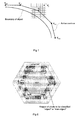
- Figure 1 shows the actual contour of the object to be segmented and the active contour, in a step of its process of convergence from the initial contour supplied by the user.
- the active contour is defined by a certain number of control points V i , corresponding to the ends of the arcs forming the contour.
- these arcs are straight-line segments, and the control points are made up of the ends of these segments.
- the number of control points V i varies according to the complexity of the contour.
- the control points V i are made to converge towards the actual contour of the object, according to a convergence plan known by the name of active contours.
- An active contour is defined as a parametered curve in an image, which iteratively approaches the boundary of an object under the influence of internal forces, calculated from the contour curve itself, and of external forces, which depend on the image.
- the internal forces constrain the shape of the curve to satisfy regularity constraints, the external forces optimize the positioning of the curve relative to the content of the image. The application of these forces is reflected in the minimizing of an energy functional.
- the minimizing of the energy is performed iteratively on each of the control points, until the contour is stabilized.
- a search window is defined in the vicinity of each control point.
- Each point inside this window constitutes a candidate point for the position of the new control point.
- the control point is moved in the window towards the candidate point for which a certain functional called energy is minimal. This process is applied in turn to all the control points, until convergence of the contour is achieved.
- the size of the window can, for example, be set at 21 pixels by 21 pixels. In other embodiments, the size of the window may be different.
- the size of the window to be used depends on the target application and the resolution of the image being processed.
- V i is used to denote the current position of a control point of the active contour.
- the aim is to make V i converge towards the true contour by calculating, for each point V j of a search window around V i , the energy of the contour obtained by replacing V i with V j , and by selecting the control point that provides the minimum energy as the new control point.
- the energy E(i) of the control point V i is defined as being the weighted sum of the following three terms:
- the weighting of these terms is defined by the user according to the properties of the contour. It can, for example, reduce the weight of the regularity terms in the case of highly convoluted shapes.
- the method of segmenting by active contours relies mainly on the detection of the boundaries of the object.
- the object of the invention is to introduce in the method of segmenting by active contours an additional constraint ensuring a certain uniformity in colour terms of the delimited region of the contour, in order to enhance the quality and the robustness of the segmentation obtained.
- the invention relates more particularly to the means of determining an additional term of the energy functional conditioning the convergence of the active contour.
- This colour discrimination term E colour (i, V j ) relies on the classification of the pixels in the vicinity of the estimated contour as "object" pixels and "non-object” pixels according to their colour, a classification which is made based on an initial knowledge of the distribution of the colours of the object and its vicinity.
- E colour (i,V j ) modifies the positioning of the contour to favour, in the vicinity of the contour, the placement of "object” classified pixels inside the contour, and the classification of "gutter” classified pixels outside the contour.
- Figure 2 gives a block diagram describing the means of calculating the colour discrimination term.
- an inscribed contour, internal to the object, and a circumscribed contour, external to the object are defined on the basis of the initial contour.
- Figure 3 shows a geometrical method of constructing an inscribed contour and a circumscribed contour, when the contour is modelled by a polygon.
- the bissector of the angle formed by the two adjacent segments is constructed at the peak and passing through the peak.
- a peak of the circumscribed (or inscribed) polygon is linked to V i by moving V i by a predefined distance d circ (or d inscr ) towards the outside (or towards the inside) along the bissector.
- Good operation of the invention requires the inscribed contour to be entirely internal to the object and the circumscribed contour to be all external to the object. If necessary, it may require the human operator to adjust the contours calculated automatically by the method described above, in order for these two conditions to be satisfied.
- each of the pixels located in the area of uncertainty bounded by the inscribed and circumscribed contours is classified as an "object" pixel or "non-object” pixel according to its colour which provides a binary classification map in this area.
- Various classification methods can be applied to this end. Two methods are described below by way of illustration:
- the steps E1 and E2 are performed prior to starting the active contour convergence process.
- a second binary segmentation map is constructed in the search window for a new contour point in the vicinity of the current control point V i .
- This map recalculated for each candidate position V j of the new contour point, assigns each pixel of the window a label specifying whether the pixel is located inside or outside the contour obtained by considering V j as the new contour point.
- the calculation of these maps can be based on algorithms well known in computer graphics, making it possible to test whether a point is or is not located inside a polygon.
- a step E4 uses the segmentation map based on the classification as "object" pixels and "non-object” pixels resulting from the step E2 on the one hand, and the map of segmentation into pixels inside and outside the candidate contour, obtained from the step E3, on the other hand. Based on these two maps, a count is made, inside the search window in the vicinity of V i , of the pixels satisfying the following conditions:
- the new position of the control point V i is that of the pixel V j for which the sum (N 1 + N 2 ) is maximum, which is equivalent to minimizing the opposite of the sum (N 1 + N 2 ) in the energy term of the active contour.
- the number of pixels (N 1 + N 2 ) obtained is standardized in the step E5 by the total number of pixels in the search window, and multiplied by a factor to supply the colour discrimination term of the energy of the active contour E colour (i,v j ).
- This multiplying factor must be negative and may, for example, be set at -1.
- E colour (i,v j ) is then added to the other known terms of the energy associated with an active contour, after multiplication by a weighting factor defined by the user, and the convergence of the contour is obtained iteratively by selecting, in the vicinity of each contour point, the candidate point which minimizes the total energy.
- E colour (i,v j ) makes it possible to incorporate in the contour estimation process a colour discrimination constraint, which tends to position the contour in such a way as to ensure a uniformity on the one hand, of all of the colours contained inside the contour, and, on the other hand, of all of the colours contained in a vicinity outside the contour.
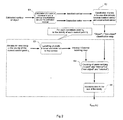
- the first method used in the preferred embodiment is based on the construction of models of the distribution of colours of the object and its external vicinity. Constructing these models entails defining two reference regions in the image, represented in Figure 4 :
- R obj is necessarily internal to the object, whereas R arp is located in a vicinity external to the object.
- a model of the colour distribution of the object and a model of the colour distribution of the background in the vicinity of the object can be constructed.
- a first method of constructing these models is shown in Figure 5 , assuming the adoption of a statistical model of each of these colour distributions by a sum of Gaussian laws or "Gaussian mixing".
- a first step S1 the list of pixels inside the reference region concerned, in other words R obj for calculating the model of colour distribution of the object and R arp for calculating the model of the colour distribution for background, is constructed.
- a step S2 the histogram of colours of the region is constructed.
- this operation conventional in image processing, uses a law for quantifying the representation space of the colour used that is allowed in principle. For example, it is possible to adopt a uniform N-level quantification according to each of the three colour axes, which is equivalent to quantifying each colour component in N possible values.
- the colour space is then divided into N 3 areas.
- the colour histogram of the region is defined as an array of N 3 cells or "bins", each bin being bijectively associated with an area.
- the value stored in a bin of the histogram represents the number of pixels of the region of the image processed with colour components that are located in the area of the colour space associated with the bin.
- the histogram is constructed by processing in turn all the pixels of the region concerned as follows: the colour components of each pixel are quantified, which determines the area of the colour space in which the pixel is located; the value of the bin associated with this area is then incremented by one unit.
- the colour histogram provides a first model of the colour distribution of the region; efforts are then made to simplify the model to obtain a parametric model with a small number of parameters.
- a step S3 regions of the histogram with high density are then detected. Peak detection algorithms, or "peak-picking" algorithms, widely known in computer graphics, can be used for this purpose.
- the output of the step S3 consists of a list of histogram peaks, corresponding to dominant colours strongly represented in the region concerned.
- the object of the step S4 is to derive a parametric statistical model of the colour histogram, using the list of peaks detected in the step S3.
- the vicinity of each peak is likened to a three-dimensional Gaussian distribution in the colour space, which is equivalent to modelling the total distribution of the colours by a Gaussian mixture model (GMM).
- GMM Gaussian mixture model
- Each of the Gaussian distributions forming the GMM is entirely determined by its average and its covariance matrix; these parameters of the model are estimated from the values of the bins of the histogram in the vicinity of the peak concerned.
- step S4 a parametric model of the colour distribution of the region, in the form of a Gaussian mixture. It is then possible to construct, from the "object" and “background” regions R obj and R arp , a model M obj of the colour distribution of the object and a model M arp of the colour distribution of the background.
- the binary classification of a pixel corresponding to the step E2 of the diagram in Figure 2 can then be obtained by calculating the likelihoods vr obj and vr arp of the pixel for the models M obj and M arp respectively: if vr obj is greater than vr arp , the pixel will be classified as "object", otherwise the pixel will be classified as "non-object”.
- a second method of implementing the step E2 for binary classification of the pixels as "object” or “non-object”, with reference to Figure 2 consists in using a “Seeded Region Growing” (SRG) algorithm, a detailed description of which can be found in the article by R. Adams and L. Bischof, entitled “Seeded region growing”, published in the IEEE review, Transactions on Pattern Analysis and Machine Intelligence, volume 16 no 6, June 1994, pages 641 to 647 .
- SRG Seeded Region Growing
- the SRG algorithm classifies all the pixels of an area of an image by growing small regions defined at the origin and for which the classes are known.
- the initial regions are formed by small vicinities of points distributed evenly around the perimeters of the inscribed and circumscribed contours.
- the regions adjacent to the inscribed contour belong to the objects since the inscribed contour is internal to the object.
- the regions adjacent to the circumscribed contour belong to the background.
- the SRG algorithm maintains a list of the pixels not yet classified, inside the area to be processed, that are adjacent to an existing region.
- each pixel is associated with a distance to its adjacent region, and the pixels of the list are sorted in ascending order of their distance.
- the distance between a pixel and a region represents a criterion of uniformity between the colour of the pixel and the or each colour representative of the region. In a very simplified implementation, this distance can be defined as the Euclidean distance in the representation space of the colour, between the colour of the pixel and the average colour of the region.
- An iteration of the algorithm consists in carrying out the following operations:
- This process is applied iteratively until the list is empty, which means that all the pixels of the area to be classified have been assigned to an initial region.
- the classification of the pixels is then defined by the classification of the initial region to which it was assigned: "object” if this region was initially adjacent to the inscribed contour, "non-object” otherwise.
- the invention is not limited to the exemplary embodiments given above.
Landscapes
- Engineering & Computer Science (AREA)
- Physics & Mathematics (AREA)
- General Physics & Mathematics (AREA)
- Theoretical Computer Science (AREA)
- Computer Vision & Pattern Recognition (AREA)
- Multimedia (AREA)
- Software Systems (AREA)
- Image Analysis (AREA)
Claims (6)
- Procédé de segmentation d'objets dans une image comprenant les étapes de- définition approximative d'un contour initial de l'objet à segmenter, ledit contour comprenant une pluralité de points dits de contrôle (Vi),- détermination d'un voisinage de points candidats (Vi,j) au voisinage de chaque point de contrôle (Vi),- détermination d'une énergie associée à chaque point candidat (Vi,j) du voisinage de chaque point de contrôle ,- convergence de chacun des points de contrôle (Vi) vers le point candidat (Vi,j) qui minimise ladite énergie fournissant ainsi un contour estimé de l'objet à segmenter,caractérisé en ce que l'énergie associée à chaque point candidat (Vi,j) comprend un terme de discrimination de couleur, et en ce que la minimisation du terme d'énergie relative au terme de discrimination de couleur consiste à sélectionner pour chaque point de contrôle (Vi) le point candidat (Vi,j) du voisinage dudit point de contrôle (Vi) pour lequel la somme N1 + N2 est minimale :- N1 est le nombre de points étiquetés comme intérieur au contour estimé et dont la couleur est étiquetée objet,- N2 est le nombre de points étiquetés comme extérieur au contour estimé et dont la couleur est étiquetée fond.
- Procédé selon la revendication 1 caractérisé en ce qu'il comprend une étape (E1) de calcul automatique d'un contour inscrit au contour estimé et d'un contour circonscrit au contour estimé, de telle sorte que le contour inscrit soit intérieur à l'objet à segmenter et que le contour circonscrit soit extérieur à l'objet à segmenter.
- Procédé selon la revendication 2 caractérisé en ce qu'il comprend une étape (E2) de classification en deux régions des pixels situés dans l'espace compris entre le contour inscrit et le contour circonscrit, les pixels dont la couleur est plus proche de la distribution des couleurs de l'objet que de la distribution des couleurs du fond au voisinage de l'objet étant étiquetés objet et les autres pixels étant étiquetés fond.
- Procédé selon l'une des revendications 1 à 3 caractérisé en ce qu'il comprend une étape (E3) d'étiquetage des points candidats (Vj,i) de chaque point de contrôle (Vi) du contour estimé, l'étiquette identifiant si chaque point candidat (Vj,i) est intérieur au contour estimé ou extérieur au contour estimé.
- Procédé selon l'une des revendications précédentes caractérisé en ce que l'énergie associée à chaque point candidat (Vi,j) est constituée d'une pondération, outre du terme de discrimination de couleur, d'un terme de gradient (Egradient(i, Vj)) attirant le contour approximatif dessiné par l'utilisateur vers les fronts de l'image, d'un terme de tension (Econtinuité(i,Vj)) minimisant la longueur du contour et d'un terme de régularisation (Ecourbure(i,Vj)) de second ordre minimisant les courbures trop prononcées.
- Dispositif de segmentation d'objets dans une image comprenant des moyens de- définition approximative d'un contour initial à l'objet à segmenter, ledit contour comprenant une pluralité de points dits de contrôle (Vi),- détermination d'un voisinage de points candidats (Vi,j) au voisinage de chaque point de contrôle (Vi),- détermination d'une énergie associée à chaque point candidat (Vi,j) du voisinage de chaque point de contrôle ,- convergence de chacun des points de contrôle (Vi) vers le point candidat (Vi,j) qui minimise ladite énergie fournissant ainsi un contour estimé de l'objet à segmenter,caractérisé en ce que l'énergie associée à chaque point candidat (Vi,j) comprend un terme de discrimination de couleur et en ce que la minimisation du terme d'énergie relative au terme de discrimination de couleur consiste à sélectionner pour chaque point de contrôle (Vi) le point candidat (Vi,j) du voisinage dudit point de contrôle (Vi) pour lequel la somme N1 + N2 est minimale :- N1 est le nombre de points étiquetés comme intérieur au contour estimé et dont la couleur est étiquetée objet,- N2 est le nombre de points étiquetés comme extérieur au contour estimé et dont la couleur est étiquetée fond.
Applications Claiming Priority (1)
| Application Number | Priority Date | Filing Date | Title |
|---|---|---|---|
| FR0550060A FR2880455A1 (fr) | 2005-01-06 | 2005-01-06 | Methode et dispositif de segmentation d'une image |
Publications (2)
| Publication Number | Publication Date |
|---|---|
| EP1679652A1 EP1679652A1 (fr) | 2006-07-12 |
| EP1679652B1 true EP1679652B1 (fr) | 2015-05-20 |
Family
ID=34952786
Family Applications (1)
| Application Number | Title | Priority Date | Filing Date |
|---|---|---|---|
| EP20050111825 Expired - Lifetime EP1679652B1 (fr) | 2005-01-06 | 2005-12-08 | Procédé et dispositif de segmentation d'image |
Country Status (5)
| Country | Link |
|---|---|
| US (1) | US7627175B2 (fr) |
| EP (1) | EP1679652B1 (fr) |
| JP (1) | JP4732172B2 (fr) |
| CA (1) | CA2532052C (fr) |
| FR (1) | FR2880455A1 (fr) |
Families Citing this family (24)
| Publication number | Priority date | Publication date | Assignee | Title |
|---|---|---|---|---|
| US7317855B2 (en) * | 2004-12-16 | 2008-01-08 | Corning Incorporated | Method of imparting twist to optical fiber |
| JP4644794B2 (ja) * | 2006-03-30 | 2011-03-02 | 株式会社日立メディコ | 画像認識装置 |
| DE102006028646A1 (de) * | 2006-06-22 | 2007-12-27 | Siemens Ag | Auswertungsverfahren für Bilddatensätze mit selbsttätiger Bestimmung von Auswertungsbereichen |
| US7773807B2 (en) * | 2006-08-29 | 2010-08-10 | Siemens Medical Solutions Usa, Inc. | Seed segmentation using l∞ minimization |
| US20080136934A1 (en) * | 2006-12-12 | 2008-06-12 | Industrial Technology Research Institute | Flame Detecting Method And Device |
| US7868772B2 (en) | 2006-12-12 | 2011-01-11 | Industrial Technology Research Institute | Flame detecting method and device |
| US8041114B2 (en) * | 2007-06-15 | 2011-10-18 | Microsoft Corporation | Optimizing pixel labels for computer vision applications |
| US8009911B2 (en) * | 2007-08-30 | 2011-08-30 | Siemens Aktiengesellschaft | Interactive image segmentation on directed graphs |
| JP5697989B2 (ja) | 2007-12-26 | 2015-04-08 | コーニンクレッカ フィリップス エヌ ヴェ | グラフィックスオブジェクトを重ね合わせるための画像プロセッサ |
| JP5448344B2 (ja) * | 2008-01-08 | 2014-03-19 | 株式会社Nttドコモ | 情報処理装置およびプログラム |
| US8428299B2 (en) | 2008-06-12 | 2013-04-23 | Thomson Licensing | Method of processing images to combat copying |
| JP5290915B2 (ja) * | 2009-09-03 | 2013-09-18 | キヤノン株式会社 | 画像処理装置、画像処理方法及びプログラム |
| CN106462975A (zh) * | 2014-05-28 | 2017-02-22 | 汤姆逊许可公司 | 用于对象跟踪和经由背景跟踪进行分割的方法和装置 |
| EP3748581A1 (fr) * | 2014-07-15 | 2020-12-09 | Koninklijke Philips N.V. | Dispositif, système et procédé permettant de segmenter une image d'un sujet |
| US12300273B2 (en) | 2014-12-11 | 2025-05-13 | Rdi Technologies, Inc. | Apparatus and method for visualizing periodic motions in mechanical components |
| US10062411B2 (en) | 2014-12-11 | 2018-08-28 | Jeffrey R. Hay | Apparatus and method for visualizing periodic motions in mechanical components |
| US9704266B2 (en) | 2014-12-11 | 2017-07-11 | Rdi, Llc | Non-contacting monitor for bridges and civil structures |
| US10013781B1 (en) * | 2017-06-13 | 2018-07-03 | Google Llc | Sewing machine-style polygon drawing method |
| US11159798B2 (en) * | 2018-08-21 | 2021-10-26 | International Business Machines Corporation | Video compression using cognitive semantics object analysis |
| US11423551B1 (en) | 2018-10-17 | 2022-08-23 | Rdi Technologies, Inc. | Enhanced presentation methods for visualizing motion of physical structures and machinery |
| US11373317B1 (en) | 2020-01-24 | 2022-06-28 | Rdi Technologies, Inc. | Measuring the speed of rotation or reciprocation of a mechanical component using one or more cameras |
| US11282213B1 (en) | 2020-06-24 | 2022-03-22 | Rdi Technologies, Inc. | Enhanced analysis techniques using composite frequency spectrum data |
| US11322182B1 (en) | 2020-09-28 | 2022-05-03 | Rdi Technologies, Inc. | Enhanced visualization techniques using reconstructed time waveforms |
| KR102827343B1 (ko) * | 2022-10-31 | 2025-07-01 | 한화오션 주식회사 | 이미지 기반 딥러닝과 거리 센서를 이용한 마그네트 크레인 자동화 장치 및 방법 |
Family Cites Families (4)
| Publication number | Priority date | Publication date | Assignee | Title |
|---|---|---|---|---|
| KR100414432B1 (ko) * | 1995-03-24 | 2004-03-18 | 마츠시타 덴끼 산교 가부시키가이샤 | 윤곽추출장치 |
| US5901240A (en) * | 1996-12-12 | 1999-05-04 | Eastman Kodak Company | Method for detecting the collimation field in a digital radiography |
| WO1999057683A1 (fr) * | 1998-05-04 | 1999-11-11 | The Johns Hopkins University | Procede et appareil de segmentation de petites structures dans des images |
| US6937760B2 (en) * | 2000-12-28 | 2005-08-30 | University Of Washington | Interactive frame segmentation with dynamic programming |
-
2005
- 2005-01-06 FR FR0550060A patent/FR2880455A1/fr active Pending
- 2005-12-08 EP EP20050111825 patent/EP1679652B1/fr not_active Expired - Lifetime
- 2005-12-21 US US11/314,380 patent/US7627175B2/en active Active
-
2006
- 2006-01-05 CA CA2532052A patent/CA2532052C/fr not_active Expired - Lifetime
- 2006-01-06 JP JP2006001837A patent/JP4732172B2/ja not_active Expired - Fee Related
Non-Patent Citations (6)
| Title |
|---|
| GAO J ET AL: "INTERACTIVE COLOR IMAGE SEGMENTATION EDITOR DRIVEN BY ACTIVE CONTOUR MODEL", PROCEEDINGS 1999 INTERNATIONAL CONFERENCE ON IMAGE PROCESSING. ICIP'99. KOBE, JAPAN, OCT. 24 - 28, 1999; [INTERNATIONAL CONFERENCE ON IMAGE PROCESSING], LOS ALAMITOS, CA : IEEE, US, 24 October 1999 (1999-10-24), pages 245 - 249, XP000921570, ISBN: 978-0-7803-5468-5, DOI: 10.1109/ICIP.1999.817110 * |
| GUNN S R ET AL: "A ROBUST SNAKE IMPLEMENTATION; A DUAL ACTIVE CONTOUR", IEEE TRANSACTIONS ON PATTERN ANALYSIS AND MACHINE INTELLIGENCE, IEEE COMPUTER SOCIETY, USA, vol. 19, no. 1, 1 January 1997 (1997-01-01), pages 63 - 68, XP000682684, ISSN: 0162-8828, DOI: 10.1109/34.566812 * |
| K ET AL: "A new colour image energy for active contours in natural scenes", PATTERN RECOGNITION LETTERS, ELSEVIER, AMSTERDAM, NL, vol. 17, no. 12, 25 October 1996 (1996-10-25), pages 1271 - 1277, XP004014008, ISSN: 0167-8655, DOI: 10.1016/0167-8655(96)00076-1 * |
| MIRHOSSEINI A R ET AL: "An optimally fast greedy algorithm for active contours", PROCEEDINGS OF 1997 IEEE INTERNATIONAL SYMPOSIUM ON CIRCUITS AND SYSTEMS, 1997. ISCAS '97., HONG KONG 9-12 JUNE 1997, NEW YORK, NY, USA,IEEE, US, vol. 2, 9 June 1997 (1997-06-09), pages 1189 - 1192, XP010236427, ISBN: 978-0-7803-3583-7, DOI: 10.1109/ISCAS.1997.622025 * |
| QIANG ZHOU ET AL: "Color and texture priors in active contours for model-based image segmentation", IMAGE AND SIGNAL PROCESSING AND ANALYSIS, 2003. ISPA 2003. PROCEEDINGS OF THE 3RD INTERNATIONAL SYMPOSIUM ON ROME, ITALY SEPT. 18-20, 2003, PISCATAWAY, NJ, USA,IEEE, ZAGREB, CROATIA, vol. 2, 18 September 2003 (2003-09-18), pages 690 - 695, XP010705154, ISBN: 978-953-184-061-3, DOI: 10.1109/ISPA.2003.1296364 * |
| T. GEVERS ET AL: "Color Invariant Snakes", PROCEDINGS OF THE BRITISH MACHINE VISION CONFERENCE 1998, 1 January 1998 (1998-01-01), pages 58.1 - 58.11, XP055156929, ISBN: 978-1-90-172504-9, DOI: 10.5244/C.12.58 * |
Also Published As
| Publication number | Publication date |
|---|---|
| US7627175B2 (en) | 2009-12-01 |
| US20060147116A1 (en) | 2006-07-06 |
| JP4732172B2 (ja) | 2011-07-27 |
| EP1679652A1 (fr) | 2006-07-12 |
| CA2532052C (fr) | 2015-06-02 |
| JP2006190307A (ja) | 2006-07-20 |
| FR2880455A1 (fr) | 2006-07-07 |
| CA2532052A1 (fr) | 2006-07-06 |
Similar Documents
| Publication | Publication Date | Title |
|---|---|---|
| EP1679652B1 (fr) | Procédé et dispositif de segmentation d'image | |
| US7450762B2 (en) | Method and arrangement for determining an object contour | |
| CN115272378B (zh) | 一种基于特征轮廓的人物图像分割方法 | |
| CN106991686B (zh) | 一种基于超像素光流场的水平集轮廓跟踪方法 | |
| KR101150901B1 (ko) | 위성영상을 이용한 객체기반 분석을 위한 자동 영상분할 방법 | |
| CN109035253A (zh) | 一种语义分割信息指导的深度学习自动图像抠图方法 | |
| JP2017521779A (ja) | 画像解析を用いた核のエッジの検出 | |
| WO2003021533A1 (fr) | Segmentation d'image couleur dans un systeme de reconnaissance d'objets | |
| JP2001043376A (ja) | 画像抽出方法及び装置並びに記憶媒体 | |
| CN111681249A (zh) | 基于Grabcut的砂石颗粒的改进分割算法研究 | |
| JP2006318474A (ja) | 画像シーケンス内のオブジェクトを追跡するための方法及び装置 | |
| KR20050085355A (ko) | 분할된 이미지로부터 폴스 엣지들을 제거하는 방법 및 장치 | |
| JP3490482B2 (ja) | エッジ及び輪郭抽出装置 | |
| JP3006338B2 (ja) | 運動領域輪郭検出装置 | |
| CN117876383A (zh) | 一种基于yolov5l的公路表面条状裂缝检测方法 | |
| JP4130915B2 (ja) | グラフィカルオブジェクトの境界情報の処理 | |
| CN118135141A (zh) | 一种基于岩石图像的孔隙三维重建方法及系统 | |
| CN117036202A (zh) | 一种面向遥感图像类不平衡的混合增强方法及系统 | |
| JP3716455B2 (ja) | 領域抽出方法及び領域抽出装置 | |
| JP2003162718A (ja) | 画像処理方法及びプログラム | |
| CN213714998U (zh) | 一种基于图像的砂石粒径分析设备 | |
| CN110717910B (zh) | 基于卷积神经网络的ct图像目标检测方法及ct扫描仪 | |
| Lezoray | Supervised automatic histogram clustering and watershed segmentation. Application to microscopic medical color images | |
| CN116630212B (zh) | 一种基于条件gan网络的自适应特征融合的数据合成方法 | |
| CN119540274B (zh) | 一种基于sam的sem图像处理方法 |
Legal Events
| Date | Code | Title | Description |
|---|---|---|---|
| PUAI | Public reference made under article 153(3) epc to a published international application that has entered the european phase |
Free format text: ORIGINAL CODE: 0009012 |
|
| AK | Designated contracting states |
Kind code of ref document: A1 Designated state(s): AT BE BG CH CY CZ DE DK EE ES FI FR GB GR HU IE IS IT LI LT LU LV MC NL PL PT RO SE SI SK TR |
|
| AX | Request for extension of the european patent |
Extension state: AL BA HR MK YU |
|
| 17P | Request for examination filed |
Effective date: 20061219 |
|
| AKX | Designation fees paid |
Designated state(s): DE FR GB NL |
|
| 17Q | First examination report despatched |
Effective date: 20070622 |
|
| RAP1 | Party data changed (applicant data changed or rights of an application transferred) |
Owner name: THOMSON LICENSING |
|
| REG | Reference to a national code |
Ref country code: DE Ref legal event code: R079 Ref document number: 602005046577 Country of ref document: DE Free format text: PREVIOUS MAIN CLASS: G06T0005000000 Ipc: G06T0007000000 |
|
| RIC1 | Information provided on ipc code assigned before grant |
Ipc: G06T 7/00 20060101AFI20141205BHEP |
|
| GRAP | Despatch of communication of intention to grant a patent |
Free format text: ORIGINAL CODE: EPIDOSNIGR1 |
|
| INTG | Intention to grant announced |
Effective date: 20150119 |
|
| GRAS | Grant fee paid |
Free format text: ORIGINAL CODE: EPIDOSNIGR3 |
|
| GRAA | (expected) grant |
Free format text: ORIGINAL CODE: 0009210 |
|
| AK | Designated contracting states |
Kind code of ref document: B1 Designated state(s): DE FR GB NL |
|
| REG | Reference to a national code |
Ref country code: GB Ref legal event code: FG4D |
|
| REG | Reference to a national code |
Ref country code: GB Ref legal event code: 746 Effective date: 20150603 |
|
| REG | Reference to a national code |
Ref country code: DE Ref legal event code: R096 Ref document number: 602005046577 Country of ref document: DE |
|
| REG | Reference to a national code |
Ref country code: NL Ref legal event code: MP Effective date: 20150520 |
|
| REG | Reference to a national code |
Ref country code: DE Ref legal event code: R097 Ref document number: 602005046577 Country of ref document: DE |
|
| PLBE | No opposition filed within time limit |
Free format text: ORIGINAL CODE: 0009261 |
|
| STAA | Information on the status of an ep patent application or granted ep patent |
Free format text: STATUS: NO OPPOSITION FILED WITHIN TIME LIMIT |
|
| 26N | No opposition filed |
Effective date: 20160223 |
|
| REG | Reference to a national code |
Ref country code: DE Ref legal event code: R119 Ref document number: 602005046577 Country of ref document: DE |
|
| REG | Reference to a national code |
Ref country code: FR Ref legal event code: ST Effective date: 20160831 |
|
| PG25 | Lapsed in a contracting state [announced via postgrant information from national office to epo] |
Ref country code: DE Free format text: LAPSE BECAUSE OF NON-PAYMENT OF DUE FEES Effective date: 20160701 |
|
| PG25 | Lapsed in a contracting state [announced via postgrant information from national office to epo] |
Ref country code: FR Free format text: LAPSE BECAUSE OF NON-PAYMENT OF DUE FEES Effective date: 20151231 |
|
| PG25 | Lapsed in a contracting state [announced via postgrant information from national office to epo] |
Ref country code: NL Free format text: LAPSE BECAUSE OF FAILURE TO SUBMIT A TRANSLATION OF THE DESCRIPTION OR TO PAY THE FEE WITHIN THE PRESCRIBED TIME-LIMIT Effective date: 20150520 |
|
| GBPC | Gb: european patent ceased through non-payment of renewal fee |
Effective date: 20161208 |
|
| REG | Reference to a national code |
Ref country code: GB Ref legal event code: S28 Free format text: APPLICATION FILED |
|
| REG | Reference to a national code |
Ref country code: GB Ref legal event code: S28 Free format text: RESTORATION ALLOWED Effective date: 20171107 |
|
| PG25 | Lapsed in a contracting state [announced via postgrant information from national office to epo] |
Ref country code: GB Free format text: LAPSE BECAUSE OF NON-PAYMENT OF DUE FEES Effective date: 20161208 |
|
| REG | Reference to a national code |
Ref country code: GB Ref legal event code: 732E Free format text: REGISTERED BETWEEN 20180927 AND 20181005 |
|
| PGFP | Annual fee paid to national office [announced via postgrant information from national office to epo] |
Ref country code: GB Payment date: 20221220 Year of fee payment: 18 |
|
| P01 | Opt-out of the competence of the unified patent court (upc) registered |
Effective date: 20230514 |
|
| GBPC | Gb: european patent ceased through non-payment of renewal fee |
Effective date: 20231208 |
|
| PG25 | Lapsed in a contracting state [announced via postgrant information from national office to epo] |
Ref country code: GB Free format text: LAPSE BECAUSE OF NON-PAYMENT OF DUE FEES Effective date: 20231208 |
|
| PG25 | Lapsed in a contracting state [announced via postgrant information from national office to epo] |
Ref country code: GB Free format text: LAPSE BECAUSE OF NON-PAYMENT OF DUE FEES Effective date: 20231208 |