EP1679704A1 - Méthode et appareil de lecture du contenu d'un milieu d'emmagasinage - Google Patents
Méthode et appareil de lecture du contenu d'un milieu d'emmagasinage Download PDFInfo
- Publication number
- EP1679704A1 EP1679704A1 EP05300013A EP05300013A EP1679704A1 EP 1679704 A1 EP1679704 A1 EP 1679704A1 EP 05300013 A EP05300013 A EP 05300013A EP 05300013 A EP05300013 A EP 05300013A EP 1679704 A1 EP1679704 A1 EP 1679704A1
- Authority
- EP
- European Patent Office
- Prior art keywords
- scanning
- data
- medium
- information
- retrieved
- Prior art date
- Legal status (The legal status is an assumption and is not a legal conclusion. Google has not performed a legal analysis and makes no representation as to the accuracy of the status listed.)
- Withdrawn
Links
- 238000000034 method Methods 0.000 title claims abstract description 88
- 239000000872 buffer Substances 0.000 claims abstract description 41
- 230000003139 buffering effect Effects 0.000 claims abstract description 22
- 238000005192 partition Methods 0.000 claims description 3
- 238000003780 insertion Methods 0.000 description 8
- 230000037431 insertion Effects 0.000 description 8
- 238000012545 processing Methods 0.000 description 5
- 230000006835 compression Effects 0.000 description 3
- 238000007906 compression Methods 0.000 description 3
- 238000010586 diagram Methods 0.000 description 3
- 230000003287 optical effect Effects 0.000 description 3
- 230000004044 response Effects 0.000 description 3
- 230000006870 function Effects 0.000 description 2
- 230000008569 process Effects 0.000 description 2
- 238000004458 analytical method Methods 0.000 description 1
- 238000013459 approach Methods 0.000 description 1
- 230000008859 change Effects 0.000 description 1
- 230000006837 decompression Effects 0.000 description 1
- 230000001419 dependent effect Effects 0.000 description 1
- 238000013461 design Methods 0.000 description 1
- 238000001514 detection method Methods 0.000 description 1
- 238000012360 testing method Methods 0.000 description 1
- 230000007704 transition Effects 0.000 description 1
Images
Classifications
-
- G—PHYSICS
- G11—INFORMATION STORAGE
- G11B—INFORMATION STORAGE BASED ON RELATIVE MOVEMENT BETWEEN RECORD CARRIER AND TRANSDUCER
- G11B19/00—Driving, starting, stopping record carriers not specifically of filamentary or web form, or of supports therefor; Control thereof; Control of operating function ; Driving both disc and head
- G11B19/02—Control of operating function, e.g. switching from recording to reproducing
- G11B19/12—Control of operating function, e.g. switching from recording to reproducing by sensing distinguishing features of or on records, e.g. diameter end mark
- G11B19/125—Control of operating function, e.g. switching from recording to reproducing by sensing distinguishing features of or on records, e.g. diameter end mark involving the detection of carrier data format
-
- A—HUMAN NECESSITIES
- A45—HAND OR TRAVELLING ARTICLES
- A45D—HAIRDRESSING OR SHAVING EQUIPMENT; EQUIPMENT FOR COSMETICS OR COSMETIC TREATMENTS, e.g. FOR MANICURING OR PEDICURING
- A45D33/00—Containers or accessories specially adapted for handling powdery toiletry or cosmetic substances
- A45D33/006—Vanity boxes or cases, compacts, i.e. containing a powder receptacle and a puff or applicator
- A45D33/008—Vanity boxes or cases, compacts, i.e. containing a powder receptacle and a puff or applicator comprising a mirror
-
- A—HUMAN NECESSITIES
- A45—HAND OR TRAVELLING ARTICLES
- A45D—HAIRDRESSING OR SHAVING EQUIPMENT; EQUIPMENT FOR COSMETICS OR COSMETIC TREATMENTS, e.g. FOR MANICURING OR PEDICURING
- A45D33/00—Containers or accessories specially adapted for handling powdery toiletry or cosmetic substances
- A45D33/20—Containers with movably mounted drawers
-
- B—PERFORMING OPERATIONS; TRANSPORTING
- B65—CONVEYING; PACKING; STORING; HANDLING THIN OR FILAMENTARY MATERIAL
- B65D—CONTAINERS FOR STORAGE OR TRANSPORT OF ARTICLES OR MATERIALS, e.g. BAGS, BARRELS, BOTTLES, BOXES, CANS, CARTONS, CRATES, DRUMS, JARS, TANKS, HOPPERS, FORWARDING CONTAINERS; ACCESSORIES, CLOSURES, OR FITTINGS THEREFOR; PACKAGING ELEMENTS; PACKAGES
- B65D43/00—Lids or covers for rigid or semi-rigid containers
- B65D43/14—Non-removable lids or covers
- B65D43/20—Non-removable lids or covers linearly slidable
-
- G—PHYSICS
- G11—INFORMATION STORAGE
- G11B—INFORMATION STORAGE BASED ON RELATIVE MOVEMENT BETWEEN RECORD CARRIER AND TRANSDUCER
- G11B27/00—Editing; Indexing; Addressing; Timing or synchronising; Monitoring; Measuring tape travel
- G11B27/10—Indexing; Addressing; Timing or synchronising; Measuring tape travel
- G11B27/19—Indexing; Addressing; Timing or synchronising; Measuring tape travel by using information detectable on the record carrier
- G11B27/28—Indexing; Addressing; Timing or synchronising; Measuring tape travel by using information detectable on the record carrier by using information signals recorded by the same method as the main recording
- G11B27/32—Indexing; Addressing; Timing or synchronising; Measuring tape travel by using information detectable on the record carrier by using information signals recorded by the same method as the main recording on separate auxiliary tracks of the same or an auxiliary record carrier
- G11B27/327—Table of contents
- G11B27/329—Table of contents on a disc [VTOC]
-
- A—HUMAN NECESSITIES
- A45—HAND OR TRAVELLING ARTICLES
- A45D—HAIRDRESSING OR SHAVING EQUIPMENT; EQUIPMENT FOR COSMETICS OR COSMETIC TREATMENTS, e.g. FOR MANICURING OR PEDICURING
- A45D33/00—Containers or accessories specially adapted for handling powdery toiletry or cosmetic substances
- A45D2033/001—Accessories
-
- G—PHYSICS
- G11—INFORMATION STORAGE
- G11B—INFORMATION STORAGE BASED ON RELATIVE MOVEMENT BETWEEN RECORD CARRIER AND TRANSDUCER
- G11B20/00—Signal processing not specific to the method of recording or reproducing; Circuits therefor
- G11B20/10—Digital recording or reproducing
- G11B20/10527—Audio or video recording; Data buffering arrangements
- G11B2020/1062—Data buffering arrangements, e.g. recording or playback buffers
- G11B2020/1075—Data buffering arrangements, e.g. recording or playback buffers the usage of the buffer being restricted to a specific kind of data
- G11B2020/10759—Data buffering arrangements, e.g. recording or playback buffers the usage of the buffer being restricted to a specific kind of data content data
- G11B2020/10768—Data buffering arrangements, e.g. recording or playback buffers the usage of the buffer being restricted to a specific kind of data content data by pre-caching the initial portion of songs or other recorded or downloaded data for starting playback instantly
Definitions
- This invention relates to a method and a device for scanning the contents of a storage medium.
- the device When a data carrier like CD-ROM or flash memory medium containing e.g. MP3, JPEG or other files is inserted into a playback device, the device often has to obtain structural information about the data carrier, e.g. for displaying a menu listing the files. For this purpose, the device scans through the medium, or rather the mediums content index or table of contents (TOC). For CD-ROM the expected maximum number of files is 8000, however the user interface may only show a few files at a time, usually about 10. For this scanning, two methods described in the following are known.
- TOC mediums content index or table of contents
- the first known method is "Immediate scanning": Files (i.e. TOC entries) are scanned only if necessary, i.e. when the user selects the respective sub menu or navigates inside this sub menu. The scanning result is immediately used.
- the major drawback of this method is the slow response during page change.
- the second known method is "Pre-scanning".
- the file system or TOC is scanned and memorized directly after insertion of the medium, e.g. optical disk or memory card.
- the drawback is that a large memory space is needed if the number of files is high, particularly when taking into account that in future the increasing capacity of e.g. DVD-ROM or flash memory will increase the maximum possible number of files. Scanning time will be long in case of huge data sets, thus the user will need to wait pretty long after insertion of a removable storage medium, before being able to see and/or access the menu listing of the files.
- the second method is used in most applications that support e.g. CD-ROM or memory card, whose size is normally less than 256 Megabytes (MB).
- MB Megabytes
- UI user interface
- the present invention comprises detecting the medium type, and dynamically deciding whether to use a first or a second media-scanning algorithm, based on information obtained during the medium detection and player resource information.
- This information may particularly include number of files and/or directories on current directory level and available buffering space or display capacity respectively, but also total number of files and/or directories on the medium, type of file system on the medium, total medium capacity, used medium capacity, and others.
- a scanning method selector decides which scanning method should be used.
- one aspect of the invention is the usage of a partial scanning method.
- This method incorporates scanning only a part of the structural information on the medium upon the insertion of the medium into a device, and not to scan the entire file system or TOC on the medium initially.
- the method includes usage of a controller that decides how much file information to scan at an initial first pass, and when to perform re-scanning for one or more further scanning passes.
- the inventive method for scanning a storage medium comprises the steps of receiving a request for structural information regarding said storage medium, such as a content index, determining at least the type of medium and type of file system on the medium, retrieving from said storage medium structural information indicating the structure and/or type of data items stored on the medium, such as files and/or directories, determining the amount of buffer space that is available for buffering the retrieved information, combining the retrieved and the determined values to determine a scanning type value, selecting, depending on the determined scanning type value, one of a plurality of scanning methods for scanning the storage medium or content index of said storage medium, wherein at least a first scanning method comprises scanning only a part of the storage medium or content index of said medium, and scanning the storage medium or content index of said medium according to the selected scanning method, wherein structural information is retrieved.
- the determination of the scanning type value may be based on predefined (or dynamically defined) rules. Further, upon selection of the first scanning method the scanning may be automatically stopped when structural information for a defined maximum number of data items is
- a device that utilizes the method is disclosed in claim 10.
- a device for scanning the contents or content index of a storage medium comprises means for receiving a request for structural information regarding said storage medium, e.g. user interface controller or interface to another processor, means for determining at least the type of medium and type of file system on the medium, means for retrieving from said storage medium structural information indicating the structure and/or type of data items stored on the medium, e.g. drive with pick-up means, means for determining the amount of buffer space that is available for buffering the retrieved information, e.g.
- processor means for combining the retrieved and the determined values to determine a scanning type value, means for selecting, depending on the determined scanning type value, one of a plurality of scanning methods for scanning the storage medium or its content index, and means for scanning the storage medium or its content index according to the selected scanning method, wherein structural information is retrieved.
- Said determining of the scanning type value may be based on predefined or dynamically defined rules.
- At least a first scanning method comprises scanning only a part of the storage medium or its content index.
- means may be included for automatically stopping the scanning when said first scanning method is selected and structural information for a defined maximum number of data items is retrieved.
- means for dynamically defining said rules may be included, e.g. fuzzy processor.
- the method according to the invention further comprises the step of buffering the retrieved data, wherein the retrieved data are compressed before buffering and decompressed after retrieval from the buffer.
- the defined maximum number of data items to be retrieved from the medium is determined by the maximum number of simultaneously displayable menu items on a user interface, which displays a menu portion using at least a part of the retrieved structural data as menu item data.
- scanning the storage medium for structural data is continued in the background of another application, wherein as much menu item data are retrieved as can immediately be buffered.
- said structural information comprises one or more of: total medium capacity, used and/or unused medium capacity, number of files and/or directories at least on a current hierarchical level, data types of at least a part of said files, track information associated with said files.
- said retrieved and determined values are transformed to fuzzy parameters, and for combining the retrieved and the determined values predefined rules are used for determining a scanning type value based on fuzzy logic procedures.
- the buffer used for buffering the retrieved data portion is divided into buffer partitions or subbuffers.
- the partial scanning method further comprises the steps of receiving from an application a request for more structural information, retrieving upon said request further structural data from the storage medium, wherein the amount of structural information is the amount of data that can be buffered in one of said subbuffers, overwriting the buffered data in a defined subbuffer with the further structural data while leaving the other subbuffers unchanged, and updating the application that uses the buffered data.
- the following steps are performed after the scanning is automatically stopped: detecting, based on the currently used structural information, which structural information is possible or probable to be used next, retrieving from the storage medium said detected structural information to be possible or probable to be used next, buffering the retrieved information, and selecting upon the next request structural information from said buffered information.
- simultaneous playback mode may be selected for one or more particular data types. Upon such selection of the simultaneous playback mode, the retrieving of structural data or track information for any of that particular data types has priority over retrieving of track information of other data types.
- the invention is applicable e.g. to playback devices, or any devices that may retrieve structural information from a storage medium and utilize this information for any further processing.
- the invention is particularly advantageous if only a fraction of this information per time is used for further processing, e.g. when an electronic display may list only a limited amount of content items at a time, or when buffering space is not sufficient for retrieving all structural information from the medium at once.
- the disclosed media-scanning scheme is self-adaptive to various real-time conditions, such as the media capacity, format, currently available buffer space etc.
- This scheme is applicable for, but not limited to, scanning of e.g. optical discs, USB memory cards or thumb-drives. It can be employed in applications that require the buffering of files and/or directories; it can also be customized for use in applications that require buffering of information retrieved from a removable storage medium.
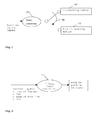
- Fig.1 shows an overall diagram of the media-scanning scheme according to the invention.
- the medium or its content index area usually a table of contents (TOC), and an indication area is scanned through in order to obtain this information.
- the structural information comprises usually at least medium type and/or file system type, number of files and/or directories on a top level or on any specified current level, but may also include one or more of total medium capacity, used and/or unused medium capacity, file type, file size, creation date, access date, length of file name or directory name, attached metadata or track information and others.
- the invention is based on the recognition of the fact that for different media, depending on their respective usage or occupation as indicated by their structural information, it may be more advantageous to use either one or another scanning algorithm.
- the invention comprises obtaining the mentioned structural information from a storage medium, and using that structural information and device specific information as decision-making inputs for dynamically deciding whether to use a first or a second scanning algorithm.
- a scanning method selector SEL decides which scanning method should be used, and indicates whether a first M1 or a second M2 scanning method shall be used, or initiates the respective selected scanning algorithm. It may physically or logically switch SW between the available scanning methods M1,M2. In principle, there may also be more than two scanning methods available. One of them may be defined to be the default method.
- a partial scanning method may be used. This method does not scan the entire file system of the medium (i.e. its content index) initially, e.g. upon insertion of the medium or upon request for displaying a menu or for generating an index. Instead, this method makes use of a controller to decide how much file information to scan at a first pass, and when to perform re-scanning after the initial scanning pass. It can be implemented using e.g. a microprocessor or the like.
- FIG.1 shows a medium-scanning method selector SEL, which controls with a switch SW which of the two (or more) scanning methods is used.
- the method selector is described in the following.
- the selector SEL may be a relatively simple fuzzy logic controller, which makes use of the possible decision-making inputs, i.e. the mentioned information obtained from the medium and device information, e.g. buffer size available in the playback device, number of displayable lines etc.
- the selector SEL uses a set of pre-defined rules to determine which of the available medium-scanning methods will be used, in this example pre-scanning method M1 or partial scanning method M2. In one embodiment however, the rules may be dynamically adapted to a current situation, e.g. player capabilities.
- the selected method will then be used, activated by a kind of logical switch SW.
- the choice may be between more than two medium-scanning methods.
- at least one of the available methods is the mentioned partial scanning method. It is also possible to select between various versions or types of partial scanning methods, e.g. the types listed below.
- the rules to determine the most suitable scanning scheme may depend on a few factors that indicate (a) the amount of resources that is needed for the retrieved data, e.g. the memory space required to store the medium information, and (b) in generalized form, the speed at which the information can be retrieved from the medium. Typically, if a medium has a large total capacity and a large used capacity, this indicates that the medium scanning process will be slow and may require a lot of memory. In this case, the partial-scanning method according to the invention will be more efficient, compared to the pre-scanning method. This can be expressed as a rule, like in the following example:
- the parameters "A_Lot" for the used medium capacity and “Little” for the input buffer size are fuzzy parameters.
- the used capacity being "A_Lot” may indicate that the medium is not full but a considerable amount of the total capacity of the medium is used, e.g. more than 75% but less than 90%.
- a table can be used indicating limits for the classification. With sufficient rules that describe the scenarios closely, the player will be able to determine the most suitable medium-scanning scheme to be used for different types of loaded media.
- SPB simultaneous playback
- a user may e.g. watch a picture slideshow while listening to audio.
- the player needs to present both, audio and picture or video data simultaneously.
- the respective file type here MP3 or JPEG
- MP3 or JPEG the respective file type
- the player should at least an MP3 file and a JPEG file have already been detected, in order to allow SPB to be detected.
- Another option is to start scanning immediately for an MP3 file or a JPEG file when the user selects SPB or enables the SPB function.
- the medium has a large capacity and is rather full, it is usually advantageous to use the partial scanning method.
- the disc contains only a few MP3 or JPEG files and a lot of non-multimedia files, there might still be some delay between consecutive MP3s or JPEGs during playback, due to the fact that it will take much longer to scan for the next MP3 or JPEG to play than if there were less files on the medium. But the delay will in almost all cases be shorter than with known scanning methods.
- a scanning method comprises a first scanning algorithm being e.g. a partial scanning algorithm, a different second scanning algorithm and re-scan controlling.
- a first scanning algorithm being e.g. a partial scanning algorithm
- a different second scanning algorithm e.g. a different second scanning algorithm
- re-scan controlling e.g. a different second scanning algorithm
- the partial scanning method is described in more detail.
- Various types of the partial scanning methods may be used.
- a device scans the content index for the entire medium and stores as much information as the buffers in the device can store, i.e. the device scans the medium's content index until its buffers are full. Subsequently, the device continues to scan the rest of the content index in order to determine the number of folders/directories and/or files that the medium contains. The device buffers the number of directories and/or files that the medium contains, and inputs this information to the fuzzy logic controller to determine when re-scanning should be done.
- the device In a second type of partial scanning algorithm, the device initially partitions its allocated memory into several buffers, instead of having just one buffer. Upon insertion of the medium, it scans and stores as much information as all the buffers can store. It stops scanning once the buffers are filled up. Re-scanning is performed whenever necessary. When more information is required, e.g. when the user navigates through the menu and more information is needed, not the total buffer needs to be re-filled, but only one or two. Thus, re-scanning can be short and quick.
- the device retrieves during initial scanning of the medium's content index only sufficient information for the next processing step, e.g. for a UI to display. If the UI may display only twenty titles simultaneously, then only twenty titles are initially scanned. It may however scan more titles to be prepared for the case that more data are needed, e.g. when the user scrolls up or down in the menu. During playback, or while the menu is displayed or the user navigates through the menu, scanning of the information of the files and/or directories continues in the background. This means that when during playback of e.g. an MP3 audio file the audio data buffers are sufficiently filled with MP3 data and the pick-up is idle for a moment, then the pick-up may continue e.g. to scan the TOC until the menu buffers are full, or until the next ten files/directories are scanned. Background scanning of files/directories should always have the lowest priority, since it should in no way affect the current playback.
- the UI may display only twenty titles simultaneously, then only twenty titles are initially
- the procedure of dynamically selecting one of the available scanning algorithms is described, as executed by the select block SEL in Fig.1.
- the third partial scanning method is selected to implement the partial scanning method, and further the track information is compressed before being buffered.
- the software Upon insertion of the medium, the software initiates that it is scanned for sufficient information for the UI to display.
- the pick-up or drive is idle, e.g. when no title is selected or when during playback the buffers are full, the background scanning of the information of the files and/or directories starts.
- the track information of MP3 tracks should always be given higher buffering priority than that of other files, because during playback of MP3 tracks the audio transition should be smooth, i.e. the audio buffers should never run empty. Hence, sufficient information of the MP3 tracks is needed.
- JPEG decoding may be done in the background since it is not as crucial for track information of JPEG pictures to be stored, compared to that of the MP3 tracks.
- Track information may comprise e.g. title, author, start/end address etc.
- the track information is retrieved from the medium, compressed before buffering and decompressed after buffering. This compression will enable the information of more files and/or directories to be stored, which reduces the frequency of re-scanning as well. Any known compression algorithm can be used for this purpose. Decompression can be done when the stored information is required.
- an implementation of a partial scanning method according to the invention comprises a partial scanning algorithm execution unit, e.g. processor, and a re-scan controller.
- the re-scan controller will be discussed below.
- the controller for the re-scanning of the files is modelled according to the third partial scanning method described above.
- the controller is only activated if the size of the allocated buffer is not sufficient for the determined/calculated maximum number of files.
- the main tasks of the fuzzy logic based re-scan controller are the following:
- a user interface of an audio CD player with integrated memory card reader may list seven lines of text.
- the player starts the drive and detects that it is a CD-ROM that has been inserted, and that it is formatted in a particular file system, e.g. Universal Disc Format (UDF). Further, the player reads the data structure on the top-level directory, finding that there are e.g. three directories and ten files on this level. It calculates the number of data items on this level being thirteen, and compares it with the number of data items it can buffer simultaneously. Assuming that this number is fifteen, it buffers the data relating to the thirteen data items immediately. If there were e.g. five directories and fifty files on the current level, the decision would be for partial scanning.
- UDF Universal Disc Format
- the UI uses data for the first seven data items to generate a display text.
- the display is updated with the buffered data.
- the player selects one of the subdirectories, the player re-scans the CD, or its TOC respectively, to successively determine the files and directories on the selected subdirectory level, while comparing the number of already detected files with the number of items it can buffer. It may also take into account the length of the text to be displayed, e.g. if it is one or two display lines.
- a controller as described above determines that no further scanning is useful since the related data cannot be simultaneously buffered nor displayed, and switches to a partial scanning method.
- the CD is not further scanned latest when the buffer is full, the current pick-up position is stored to continue scanning later, and the buffered data are sent to the UI for generating the display text.
- the text for songs #1-7 are displayed, and data for songs #1-15 are buffered.
- the data from the disc are compressed before buffering and must be decompressed after buffering.
- the player While the user scrolls down the menu in the current directory level and e.g. data for songs #7-13 are displayed, the player detects that the user may continue scrolling up or down, and determines that immediately after the next scrolling step the data for e.g. the songs #1-4 will not be used, and instead data for the songs #14-17 may be used. Thus, while the user reads the display or listens to one of the displayed songs, the player continues to scan the disc in the background, starting at the stored position to retrieve data for these songs. These data are buffered and may replace the data of the songs #1-4. Analogously, when the user scrolls up in the menu and approaches the first buffered title, the controller initiates re-scanning to get the data for the files that may soon be used. Therefore the data that are required for the next step are always available, without having to scan through the whole content index of the medium.
- the controller may also analyse which next steps are possible for the user, and retrieve data for a plurality of possible next steps, or all possible next steps. E.g. if the user may alternatively scroll down the menu or select a subdirectory, the controller retrieves data for both options in advance.
- the following information is input to the re-scan controller to decide when re-scan should be performed, which works e.g. based on fuzzy logic:
- the following rules are used to determine when re-scan should be performed.
- re-scanning of disc information happens when the required structural medium information is not already loaded in the buffer.
- the pick-up manager will be quite busy with retrieving data for playback, and there is little opportunity to carry out re-scanning.
- the user might however scroll the file-list or try to skip pictures using special keys (e.g. FWD or forward key) while MP3/JPEG is playing, so that re-scanning for displaying the file-list will be necessary.
- the fuzzy logic controller FLC shown in Fig.2 uses the MP3/JPEG buffer level as an input. The idea is that when the MP3 buffer level is above a safe limit, then the pick-up manager will have time to carry out re-scanning.
- the fuzzy logic controller FLC directs the pick-up manager to fill the MP3 buffer to a sufficiently safe amount.
- the buffer for MP3/JPEG must be large enough, in order to prevent that there will be for a short time no audio or no new JPEG displayed because of re-scanning.
- a safe buffer limit being high enough to ensure sufficient time for the pickup manager to switch from one task to the other, may be found by testing.
- the invention can be used when a device accesses any storage medium, e.g. a built-in hard disk.
- the invention can also be used in cases where the structural information is passed to another, following processing step or unit, and for any reason can be delivered faster by a pick-up than it will be processed by the other processing unit.
- the scan selector When the scan selector detects that no more data can be processed, or receives a respective indication signal, it may switch to the partial scanning method so that the scanning can be interrupted and later resumed, preferably at the current position that is stored for this purpose. In this case, there is first the conventional pre-scanning algorithm selected, and upon detecting that the data cannot be processed fast enough, the partial scanning algorithm is selected automatically. The pick-up position may be stored in that moment, and retrieved when partial scanning continues.
Landscapes
- Engineering & Computer Science (AREA)
- Mechanical Engineering (AREA)
- Signal Processing For Digital Recording And Reproducing (AREA)
- Information Retrieval, Db Structures And Fs Structures Therefor (AREA)
- Management Or Editing Of Information On Record Carriers (AREA)
- Indexing, Searching, Synchronizing, And The Amount Of Synchronization Travel Of Record Carriers (AREA)
Priority Applications (8)
| Application Number | Priority Date | Filing Date | Title |
|---|---|---|---|
| EP05300013A EP1679704A1 (fr) | 2005-01-10 | 2005-01-10 | Méthode et appareil de lecture du contenu d'un milieu d'emmagasinage |
| MYPI20055801A MY144733A (en) | 2005-01-10 | 2005-12-12 | Method and device for scanning the contents of a storage medium |
| DE602006000368T DE602006000368T2 (de) | 2005-01-10 | 2006-01-02 | Verfahren und Vorrichtung zum Scannen des Inhalts eines Speichermediums |
| EP06100007A EP1679705B1 (fr) | 2005-01-10 | 2006-01-02 | Procédé et dispositif de balayage du contenu d'un support de stockage |
| TW095100544A TWI382403B (zh) | 2005-01-10 | 2006-01-06 | 儲存媒體之掃描方法及裝置 |
| KR1020060002184A KR101218013B1 (ko) | 2005-01-10 | 2006-01-09 | 저장 매체의 내용 스캐닝 방법 및 장치 |
| CN2006100058101A CN1811959B (zh) | 2005-01-10 | 2006-01-10 | 扫描存储介质的内容的方法和设备 |
| JP2006002780A JP2006221615A (ja) | 2005-01-10 | 2006-01-10 | 記憶媒体の内容の走査方法および走査装置 |
Applications Claiming Priority (1)
| Application Number | Priority Date | Filing Date | Title |
|---|---|---|---|
| EP05300013A EP1679704A1 (fr) | 2005-01-10 | 2005-01-10 | Méthode et appareil de lecture du contenu d'un milieu d'emmagasinage |
Publications (1)
| Publication Number | Publication Date |
|---|---|
| EP1679704A1 true EP1679704A1 (fr) | 2006-07-12 |
Family
ID=34942484
Family Applications (2)
| Application Number | Title | Priority Date | Filing Date |
|---|---|---|---|
| EP05300013A Withdrawn EP1679704A1 (fr) | 2005-01-10 | 2005-01-10 | Méthode et appareil de lecture du contenu d'un milieu d'emmagasinage |
| EP06100007A Expired - Lifetime EP1679705B1 (fr) | 2005-01-10 | 2006-01-02 | Procédé et dispositif de balayage du contenu d'un support de stockage |
Family Applications After (1)
| Application Number | Title | Priority Date | Filing Date |
|---|---|---|---|
| EP06100007A Expired - Lifetime EP1679705B1 (fr) | 2005-01-10 | 2006-01-02 | Procédé et dispositif de balayage du contenu d'un support de stockage |
Country Status (7)
| Country | Link |
|---|---|
| EP (2) | EP1679704A1 (fr) |
| JP (1) | JP2006221615A (fr) |
| KR (1) | KR101218013B1 (fr) |
| CN (1) | CN1811959B (fr) |
| DE (1) | DE602006000368T2 (fr) |
| MY (1) | MY144733A (fr) |
| TW (1) | TWI382403B (fr) |
Cited By (1)
| Publication number | Priority date | Publication date | Assignee | Title |
|---|---|---|---|---|
| EP1724779A1 (fr) * | 2005-05-18 | 2006-11-22 | Siemens Aktiengesellschaft | Dispositif destiné à l'affichage d'un sommaire de support de données d'un support de données |
Families Citing this family (7)
| Publication number | Priority date | Publication date | Assignee | Title |
|---|---|---|---|---|
| EP1939760A1 (fr) * | 2006-12-20 | 2008-07-02 | Gemplus | Procédé et dispositif de gestion de données dans un environnement distribué |
| CN101540205B (zh) * | 2008-03-21 | 2013-03-27 | 深圳市朗科科技股份有限公司 | 闪存扫描方法 |
| CN101540203B (zh) * | 2008-03-21 | 2013-01-23 | 深圳市朗科科技股份有限公司 | 实时改变运行程序的方法 |
| CN101562051B (zh) * | 2008-04-18 | 2013-05-01 | 深圳市朗科科技股份有限公司 | 闪存介质扫描方法 |
| TWI385396B (zh) * | 2009-02-20 | 2013-02-11 | Hon Tech Inc | Test machine used to test the flash drive |
| CN104778222B (zh) * | 2015-03-23 | 2017-12-05 | 四川长虹电器股份有限公司 | 基于usb存储设备的媒体库建立及更新方法 |
| CN114328401B (zh) * | 2020-09-30 | 2025-11-14 | 华为技术有限公司 | 文件扫描方法及终端设备 |
Citations (2)
| Publication number | Priority date | Publication date | Assignee | Title |
|---|---|---|---|---|
| US6215743B1 (en) * | 1996-09-30 | 2001-04-10 | Laserdynamics, Inc. | Data recording and reproducing method for multi-layered optical disk system |
| US20020031071A1 (en) * | 2000-09-11 | 2002-03-14 | Han Yong Hee | Optical disc player and method for reproducing thereof |
Family Cites Families (8)
| Publication number | Priority date | Publication date | Assignee | Title |
|---|---|---|---|---|
| US5430872A (en) * | 1993-03-12 | 1995-07-04 | Asymetrix Corporation | Verifying multimedia linking for a multimedia presentation |
| US6370090B1 (en) * | 1998-06-10 | 2002-04-09 | U.S. Philips Corporation | Method, device, and information structure for storing audio-centered information with a multi-level table-of-contents (toc) mechanism and doubling of area-tocs, a device for use with such mechanism and a unitary storage medium having such mechanism |
| JP3204218B2 (ja) * | 1998-07-03 | 2001-09-04 | 日本電気株式会社 | ディジタルビデオディスク装置 |
| JP2001110171A (ja) * | 1999-10-13 | 2001-04-20 | Sony Corp | 記録再生装置および方法、端末装置、送受信方法、ならびに、記憶媒体 |
| EP1423854B1 (fr) * | 2001-09-06 | 2011-10-05 | Thomson Licensing | Procede et dispositif de chronometrage du temps passe a restituer des fichiers audio numeriques codes a debit binaire variable |
| TWI270876B (en) * | 2002-03-18 | 2007-01-11 | Samsung Electronics Co Ltd | Information storage medium including markup document and AV data, recording method, reproducing method, and reproducing apparatus therefor |
| JP2003280957A (ja) * | 2002-03-20 | 2003-10-03 | Ricoh Co Ltd | 情報記録再生装置におけるバッファメモリ管理方法 |
| JP4380193B2 (ja) * | 2003-03-25 | 2009-12-09 | ブラザー工業株式会社 | ファイルアクセス管理装置 |
-
2005
- 2005-01-10 EP EP05300013A patent/EP1679704A1/fr not_active Withdrawn
- 2005-12-12 MY MYPI20055801A patent/MY144733A/en unknown
-
2006
- 2006-01-02 DE DE602006000368T patent/DE602006000368T2/de not_active Expired - Lifetime
- 2006-01-02 EP EP06100007A patent/EP1679705B1/fr not_active Expired - Lifetime
- 2006-01-06 TW TW095100544A patent/TWI382403B/zh not_active IP Right Cessation
- 2006-01-09 KR KR1020060002184A patent/KR101218013B1/ko not_active Expired - Fee Related
- 2006-01-10 CN CN2006100058101A patent/CN1811959B/zh not_active Expired - Fee Related
- 2006-01-10 JP JP2006002780A patent/JP2006221615A/ja active Pending
Patent Citations (2)
| Publication number | Priority date | Publication date | Assignee | Title |
|---|---|---|---|---|
| US6215743B1 (en) * | 1996-09-30 | 2001-04-10 | Laserdynamics, Inc. | Data recording and reproducing method for multi-layered optical disk system |
| US20020031071A1 (en) * | 2000-09-11 | 2002-03-14 | Han Yong Hee | Optical disc player and method for reproducing thereof |
Cited By (1)
| Publication number | Priority date | Publication date | Assignee | Title |
|---|---|---|---|---|
| EP1724779A1 (fr) * | 2005-05-18 | 2006-11-22 | Siemens Aktiengesellschaft | Dispositif destiné à l'affichage d'un sommaire de support de données d'un support de données |
Also Published As
| Publication number | Publication date |
|---|---|
| DE602006000368D1 (de) | 2008-02-14 |
| EP1679705A1 (fr) | 2006-07-12 |
| TW200638342A (en) | 2006-11-01 |
| MY144733A (en) | 2011-10-31 |
| EP1679705B1 (fr) | 2008-01-02 |
| CN1811959A (zh) | 2006-08-02 |
| TWI382403B (zh) | 2013-01-11 |
| KR101218013B1 (ko) | 2013-01-02 |
| JP2006221615A (ja) | 2006-08-24 |
| DE602006000368T2 (de) | 2009-01-02 |
| KR20060081665A (ko) | 2006-07-13 |
| CN1811959B (zh) | 2011-02-16 |
Similar Documents
| Publication | Publication Date | Title |
|---|---|---|
| CA2693691C (fr) | Indexation de fichiers d'un dispositif de memoire de masse a acces selectif | |
| JP2006050648A (ja) | メモリ管理方法 | |
| KR100517753B1 (ko) | 정보 처리 장치 | |
| EP1679705B1 (fr) | Procédé et dispositif de balayage du contenu d'un support de stockage | |
| US20140286622A1 (en) | Method and apparatus for generating moving picture clip and/or displaying content file list, and recording medium storing program for executing the method | |
| KR100573686B1 (ko) | 광디스크 재생방법 | |
| JP5068866B2 (ja) | 再生装置、及びプログラム | |
| JP2004349778A (ja) | 要約再生機能を備えた再生装置及び要約再生方法 | |
| US20070041356A1 (en) | Navigating audio books using auditory cues | |
| US20080154953A1 (en) | Data display method and reproduction apparatus | |
| US20080046117A1 (en) | Method of preprocessing content and a content providing apparatus using the method of preprocessing content | |
| WO2000051128A1 (fr) | Procede de tri et de reproduction de donnees audio enregistrees sur un support d'enregistrement numerique | |
| US7751292B2 (en) | Control device, control method, recording device and recording method for recording real-time and non-real time data on recording medium | |
| US20070091736A1 (en) | System and method for storing and managing digital content | |
| KR101176069B1 (ko) | 저장된 방송 목록에 대한 빠른 정보검색(quick browsing) 기능을 갖춘 PVR 장치의 디스플레이 방법 | |
| JPH08212114A (ja) | データ記録装置及びデータ記録再生装置 | |
| JP5395508B2 (ja) | コンテンツ再生装置、及び制御プログラム | |
| JP4841612B2 (ja) | 再生装置、及びプログラム | |
| CN101256585B (zh) | 文件处理方法和装置 | |
| US20060233521A1 (en) | Content playback method and content player | |
| KR100621120B1 (ko) | 디렉토리 정보에 대한 사용자 인터페이스 표시 장치 및 방법 | |
| KR101061010B1 (ko) | 속성별 북마크 분류 저장 및 표시방법 | |
| US20060271587A1 (en) | Apparatus for displaying a data storage medium content directory of a data storage medium | |
| KR20050058639A (ko) | 광디스크 장치에서의 인덱스 디스크 작성 및 검색방법 | |
| JP2001291320A (ja) | 録音再生装置 |
Legal Events
| Date | Code | Title | Description |
|---|---|---|---|
| PUAI | Public reference made under article 153(3) epc to a published international application that has entered the european phase |
Free format text: ORIGINAL CODE: 0009012 |
|
| AK | Designated contracting states |
Kind code of ref document: A1 Designated state(s): AT BE BG CH CY CZ DE DK EE ES FI FR GB GR HU IE IS IT LI LT LU MC NL PL PT RO SE SI SK TR |
|
| AX | Request for extension of the european patent |
Extension state: AL BA HR LV MK YU |
|
| AKX | Designation fees paid | ||
| STAA | Information on the status of an ep patent application or granted ep patent |
Free format text: STATUS: THE APPLICATION IS DEEMED TO BE WITHDRAWN |
|
| 18D | Application deemed to be withdrawn |
Effective date: 20070115 |
|
| REG | Reference to a national code |
Ref country code: DE Ref legal event code: 8566 |