EP1681641A2 - Inkrementale Indexierung - Google Patents
Inkrementale Indexierung Download PDFInfo
- Publication number
- EP1681641A2 EP1681641A2 EP05112968A EP05112968A EP1681641A2 EP 1681641 A2 EP1681641 A2 EP 1681641A2 EP 05112968 A EP05112968 A EP 05112968A EP 05112968 A EP05112968 A EP 05112968A EP 1681641 A2 EP1681641 A2 EP 1681641A2
- Authority
- EP
- European Patent Office
- Prior art keywords
- index
- data
- increment
- database
- base
- Prior art date
- Legal status (The legal status is an assumption and is not a legal conclusion. Google has not performed a legal analysis and makes no representation as to the accuracy of the status listed.)
- Withdrawn
Links
Images








Classifications
-
- G—PHYSICS
- G06—COMPUTING OR CALCULATING; COUNTING
- G06F—ELECTRIC DIGITAL DATA PROCESSING
- G06F16/00—Information retrieval; Database structures therefor; File system structures therefor
- G06F16/20—Information retrieval; Database structures therefor; File system structures therefor of structured data, e.g. relational data
- G06F16/22—Indexing; Data structures therefor; Storage structures
- G06F16/2228—Indexing structures
- G06F16/2246—Trees, e.g. B+trees
-
- G—PHYSICS
- G06—COMPUTING OR CALCULATING; COUNTING
- G06F—ELECTRIC DIGITAL DATA PROCESSING
- G06F16/00—Information retrieval; Database structures therefor; File system structures therefor
- G06F16/20—Information retrieval; Database structures therefor; File system structures therefor of structured data, e.g. relational data
- G06F16/22—Indexing; Data structures therefor; Storage structures
- G06F16/2228—Indexing structures
Definitions
- the present invention relates to the updating of a database, particularly to how to handle indexing when inserting data rows.
- Computer databases are a common mechanism for storing information on computer systems while providing easy access to users.
- a typical database is an organized collection of related information stored as rows having fields of information.
- a database of employees may have a row for each employee comprising different columns or fields such as name, department, phone number, salary etc. All rows are organized as table, a two-dimensional structure with rows containing the rows and columns indicating the fields.
- every row can be indexed and the index entered into a base index.
- one index could indicate where to find the rows containing a particular name, another index could indicate where to find the rows containing specific departments.
- Both rows and indexes are physically stored on storage media such as tape or disk.
- storage media such as tape or disk.
- any action on the database e.g. processing a query, inserting a new row, indexing a new row etc., the corresponding data has to be retrieved from the storage medium into a cache where a database management system can actually perform this action.
- the index is large as well, and it takes quite a time to enter a new entry. This is particularly a problem, if the index is so large that it cannot be as a whole in the cache and a lot of storage medium reads are necessary for updating the index.
- a database management system for managing a database storing a database table comprising a plurality of data pages, each data page capable of storing a plurality of data rows, said data rows storing information organized into particular columns, said database table having a base index for logically ordering said plurality of data rows, said base index comprising a plurality of index entries wherein each data row is referenced by a corresponding index entry, a method for indexing the database is provided, said method comprising the steps of inserting a row, generating an index increment, making an index entry concerning said row into said index increment, and merging said index increment with said base index.
- the indexing is done immediately, to always provide correct access to all information. But the indexing is not done in the base index. An index increment is generated and the corresponding index entry is done in the index increment instead of the base index. Later on, the index increment is merged with the base index.
- the index increment will normally be much smaller than the base index, because it is newly generated. This facilitates its management a lot. The place, where to enter the new index entry, is found much faster than is the case when searching the whole base index for it. The merger of index increment and base index can be delayed to a moment, where the performance of the database management system is not impeded by this action. If a query is submitted, before index increment and base index have been merged, in addition to scanning the base index, the incremental index is scanned, too. Thus, it is ensured that correct access to all information is always provided, as well as speeding up indexing.
- more than one row is inserted, all index entries concerning the rows are made into said index increment, and the merging is done after all rows have been inserted and indexed.
- the gain in speed by indexing into an index increment instead of the base index is especially high.
- more than one row is inserted and more than one index increment is generated. This is especially convenient, if large amounts of rows are inserted that would otherwise lead to too large an index increment, thus leading again to a slow down of the indexing.
- the database comprises an additional base index, and an additional index increment is generated and merged with the additional base index. This also allows adapting the present invention for parallel databases as well.
- a database management system for managing a database storing a database table comprising a plurality of data pages, each data page capable of storing a plurality of data rows, said data rows storing information organized into particular columns, said database table having a base index for logically ordering said plurality of data rows, said base index comprising a plurality of index entries wherein each data row is referenced by a corresponding index entry, said database management system having data and index managing means with insert processing means and non-insert processing means, wherein the data and index managing means has additionally index increment building means for generating an index increment, when a row is inserted, to enter an index entry concerning said row into said index increment, and index increment merging means for merging said index increment with said base index.
- the data and index managing means operate to process the data in any way, e.g. reading data, deleting data, inserting data, responding to queries etc. These tasks are mainly categorized into tasks related to inserting done by the insert processing means, and into other tasks done by the non-insert processing means.
- the database management system has special features in form of index increment building means and the index increment merging means, both being components of the data and index managing means. These components allow for indexing inserted rows not in the base index, but in a specially generated index increment to speed up the indexing itself. Because of the smaller size of the index increment compared with the base index, less or even no retrievals of pages of the index incremental from the storage medium are necessary, leading to a gain in speed. As soon as appropriate, the index increments merging means can merge the index increment with the base index.
- the insert processing means and the non-insert processing means are adapted to cooperate with the index increment building means and the index increment merging means to fully take advantage of their possibilities.
- the non-insert processing means is adapted to check not only said base index, but also said incremental index, if there is any. This efficiently guarantees that independently of the time of a query, whether during updating the database or not, always all information is accessible. "Old" data may be found in the base index, "new” data may be found in index increments before merging and in the base index after merging.
- the insert processing means is adapted to activate the incremental index building means, when it inserts a row. This provides automatic generation of index increments, if needed.
- the insert processing means is adapted to activate the index increment merging means, after it has finished inserting.
- an automatic merging can be implemented.
- the database management system further comprises a cache managing means and a relational data system.
- the cache managing means operates to communicate with some storage medium to retrieve and load and write and store data.
- the relational data system performs tasks such as parsing, optimizing, predicate evaluation etc..
- a computer program product for a database management system having a database storing a database table comprising a plurality of data pages, each data page capable of storing a plurality of data rows, said data rows storing information organized into particular columns, said database table having a base index for logically ordering said plurality of data rows, said base index comprising a plurality of index entries wherein each data row is referenced by a corresponding index entry, said computer program product comprising computer program means being adapted to generate one or more index increments in case one or more rows are inserted into the database table, and merge the one or more index increments with said base index.
- the database comprises an additional base index and the computer program product comprises computer program means adapted to generate an additional index increment, and merge it with the additional base index.
- the present invention can be realized in hardware, software, or a combination of hardware and software. Any kind of computer system - or other apparatus adapted for carrying out the methods described herein - is suited.
- a typical combination of hardware and software could be a general-purpose computer system with a computer program that, when being loaded and executed, controls the computer system such that it carries out the methods described herein.
- Computer program means or computer program in the present context mean any expression, in any language, code or notation, of a set of instructions intended to cause a system having an information processing capability to perform a particular function either directly or after either or both of the following a) conversion to another language, code or notation; b) reproduction in a different material form.
- Figure 1 illustrates schematically a database management system 1 according to prior art. It may be implemented, for example, as computer with an appropriate computer program product running on it.
- the computer may be a stand-alone device or be a member of a network with servers and clients.
- the database management system 1 includes a relational data system 10, a data and index manager 11 and a cache manager 12. It interacts with an application program 2 or interactive user that generates database requests, e.g. in the form of SQL-statements.
- SQL-statements may be e.g. "insert” or non-insert statements, such as "read”, “select”, “delete”, etc. and result in retrieval or modifications of the stored data.
- the database requests like mentioned SQL-statements are processed by various components, such as relational data system 10, data and index manager 11 or cache manager 12, of the database management system 1 and result in retrieval or modification of the data stored in a storage media subsystem 3,4.
- the database requests are processed by the insert-processing module 110 for insert requests and by the non-insert processing module 111 for non-insert requests.
- Both modules 110, 111 are components of the data and index-managing module 10.
- the database management system 1 In response to the database requests, e.g. SQL-statements from the application program 2, the database management system 1 returns information on rows of the database table and status information. It may also receive information on rows to add.
- All data such as the content of the database table and the base index is stored on storage media 4, such as disks or tapes.
- the database management system 1 uses the cache manager 12. It manages the cache 120, for example arranged as buffer pools, and communicates with the media manager 3 by sending read or write pages requests and receiving data and index pages. Pages, also called blocks, are the entities corresponding to the physical blocks of the storage media containing the data of the database. They are provided by the media manager 3 by communicating with the media storage 4 via I/O programs addressing the physical blocks.
- the relational data system 10 is arranged to perform tasks such as parsing, optimizing, predicate evaluation etc..
- the database structure is illustrated in Figures 2a, b. There are shown the database table 20 where new data is entered as rows 201, 202, 203 with information of various categories arranged in columns (see Figures 2a,b).
- the base index 21 of the database table 20 is organized as tree.
- the index 21 has to be updated.
- the index update consists of adding an entry 211, 212, 213 pointing to the respective inserted database table row 201, 202, 203.
- the entries 211, 212, 213 are added into the index 21 at the appropriate position that is determined by the index tree structure and the index key value. Only in the case of ever increasing key values the inserted index entries are added at the end of the index resulting in no or few reads from the storage media, which consequently contributes to good performance. However, in general, an index entry needs to be added in a random fashion, with a large probability that the target index page is not in the database cache, resulting in a synchronous read from the storage media and, thus, a slow-down of the indexing process.
- index 21 In Figure 2a, only one index 21 is shown. Usually, there is a multitude of further indexes indexing the database table 20 depending on different criteria. In Figure 2b, there are three indexes 21, 22, 23, each indexing the database table 20 according to a different column. Each index 21, 22, 23 has to be updated, if a row insert occurs.
- the database management system is implemented as a parallel database, i.e. a group of database systems managing the same data, the indexes have to be maintained by all involved systems, adding an additional overhead due to contention of the indexes.
- indexing is the most important performance booster for query processing and regularly the only choice for tuning query performance.
- the queries also run in parallel with insert processing, so all the indexes must exist all the time to provide access to the data.
- the problem is particularly severe in a special mode of operation, where massive insert processing must complete in a given time interval and critical query processing must run on the same data, including newly inserted rows, at the same time with best possible performance.
- massive insert processing which is usually concentrated at some period-closing times: end of the day, week, month, year. These processes regularly need to complete in a given time window, as the subsequent business operations depend on them.
- the queries accessing the same data need to perform well, and for that they need the very indexes that are being updated and causing the insert operations' slow-down.
- the present invention provides a solution to this problem. Especially once the pattern of massive inserts is detected, a new index tree, i.e. an index increment 35 is spawn for each base index 31 that exists on the database table 30 (see Figure 3a). Only, in case the indexes are organized based on ever increasing index key values, where the new index entries are added at the end of each index, this is not necessary - but still possible.
- indexes are preferably incrementally indexed according to the present invention.
- applications designed for parallel databases take care of member-to-data affinity. They are written in a way that individual database systems access data partitions that are logically isolated from other systems, i.e. they do not access the same partitions. This isolation cannot be achieved for indexes that are not partitioned along with the data, therefore for most indexes.
- each database system can maintain its "own" index increments for each non-partitioning index. This isolation will be complete, thus resulting in drastic reduction of cost of sharing data.
- index increment 35 for indexing the newly inserted rows 301, 302, 303, a much smaller index tree has to be updated. It starts with a single page only (equivalent of one physical block of storage space) and grows with new inserts. The likelihood of target index pages being cached is much higher than in the case of updating a large monolithic base index.
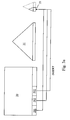
- Figure 3b illustrates how a query is process during incremental indexing or before the index increment 35 has been merged with the base index 31.
- the query processing in the present example "select", takes into account that a chosen index is not necessarily monolithic, but could have one or more increments.
- base index 31 is scanned for the rows to be selected, but also the index increment 35.
- this will increase the cost of index scan, which can be minimized, if parallel index scan is implemented. But it will be off-set many times by superior insert performance.
- the scan of the active index increment 35 i.e. the one being inserted at the time, is very likely to complete without any read from the storage medium, as the concerned pages are most likely cached.
- the index increment 35 is merged with the base index 31.
- the actual time for merging can be determined automatically, or merging can explicitly started by a user.
- the merging time should be chosen to minimize impeding other processes like queries.
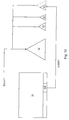
- the concept of incremental indexing can be adapted to multiple base indexes 31, 32, 33, each of them indexing the database table 30 according to different criteria.
- an incremental index 35, 36, 37 is generated for every base index 31, 32, 33, when new rows 301, 302, 303 are inserted. Accordingly, if a query is to be processed, for example "select”, not only the base indexes 31, 32, 33 are scanned, but also their associated index increments 35, 36, 37.
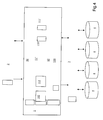
- index increments per base index there should be at least one index increment per base index. But it can also be advantageous to have more than one index increment 35, 38, 39 per base index 31, as illustrated in Figure 3d. For example, inserting may occur in several batches before merging, than for every batch separate index increments 35, 38, 39 could be generated. If separate index increments are generated, one avoids getting an index increment too large to be memory- or cache-resident. This would lower the performance.
- prior inserts to database table 30 have been indexed in the index increment 35 and then 38.
- the present insert of row 304 is indexed in the now active index increment 39.
- index increments 35 and 38 can be adapted to multiple indexes. It will further be noted, that it is possible to merge index increments 35 and 38 with the base index 31, while index increment 39 is active.
- FIG 4. An embodiment of the database management system according to the invention is schematically illustrated in Figure 4. It is basically identical to the database management system already explained with reference to Figure 1, with the exception, that the data and index manager 11' has been modified. It includes two additional modules, the index increment building module 112 and the index increment merging module 113. Besides, the insert processing module 110' and the non-insert processing module 111' have been modified in order to efficiently cooperate with the additional modules 112, 113.
- the previously existing modules 110', 111' that perform insert and non-insert-processing need to be modified to allow for the existence of index increments. If an index increment exists, the insert processing will need to be enhanced to insert index entries into the index increment, rather than the base index. For non insert operations, such as SQL queries, the data and index manager 11' will need to be modified to access index entries not only from the base index, but from the index increments as well.
- the index increment building module 112 generates one or more index increments for inserting index entries corresponding to data rows being inserted into the database table.
- the index increment merging module 113 merges the one or more index increments with the one or more base indexes after the new data rows have been inserted. They may be, for example, implemented as computer program product comprising computer program means adapted to do these tasks.
- the insert processing module 110' is modified to insert index entries into the index increment rather than in the base index, if an index increment exists.
- the non-insert processing module 111' is modified to look up data not only in the one or more base indexes, but also in the one or more index increments, to process queries or delete data.
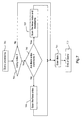
- Figure 5 shows a flowchart illustrating insert processing 501.
- a new row is inserted into the database table (step 503).
- the insert processing module has to check for every base index (step 511), whether there are any index increments (step 505). If there are, the index entry is done into the most recent index increment associated to the base index (step 507). If there are not, the index entry is made into the base index (step 509).
- Figure 6 shows a flowchart illustrating the process of building index increments as response to an insert statement (step 601). If a mass insert pattern is explicitly specified, e.g. by setting on a specific session variable, or automatically detected, e.g. by monitoring the insert rate over a specified time interval (see step 603), the possibility of generating an index increment will be considered. It will not be generated, if one or more of them already exist (step 605), and if the most recent index increment is small enough to be memory or cache resident (step 607). This process will be repeated for every index except for ever-increasing key indexes in non-data sharing environments (see step 609). After eventually generating an index increment, the insert processing as explained in Figure 5 is continued.
- a mass insert pattern is explicitly specified, e.g. by setting on a specific session variable, or automatically detected, e.g. by monitoring the insert rate over a specified time interval (see step 603), the possibility of generating an index increment will be considered. It will not be generated, if
- Figure 7 shows a flowchart illustrating how to modify the non-insert processing module with reference to the example of a query.
- the first decision is, whether an index is to be used (step 703). Whenever the query uses an index to access the data, it will be checked, if there are index increments for each of the indexes (step 705). If there are index increments, the base indexes and the index increments will be scanned (step 707). This can be done serially or in parallel. If there are no index increments, only the base indexes will be scanned (step 709). Depending on the result of the index scans, the data itself will be scanned and retrieved (step 711) and given back to the application, thus ending the query (step 713).
- the query process takes into account that a chosen index is not necessarily monolithic, but may have one or more increments. In general, this will increase the cost of index scan, which can be minimized, if parallel index scan is implemented, but it will be offset many times by superior insert performance. Note that the scan of the active index scan, i.e. the one being updated at the time, is very likely to complete without any read from the storage media, because these pages are most likely cached.
- Figures 8 and 9 show flowcharts illustrating the merging of index increments with the base index.
- the merge can be initiated implicitly (step 801), for example by a system agent that runs in the background and checks for some criteria that merging is due.
- a possible criterion is e.g. the number of index increments (step 803) or its size (step 805), but it can also be the overall query response time or any other indicator.
- the merge can as well be initiated explicitly on administrator request (step 901).
- steps 807, 903 a check whether the merge process is already going on will be performed. If yes, an appropriate message will be returned and no further action will be performed. If no, a check whether mass insert processing is currently running will be done (steps 809, 905). As merging during that process can be disruptive, only the base indexes and the index increments except the most recent one will be merged (steps 811, 907). If there is no mass insert processing going on, the base index is merged with all index increments to create a new base index.
- the merging may be performed according to any method known to the person skilled in the art, such as reorganization or rebuilding.
- the merging process should happen before the next mass insert process to avoid creating more than one index increments per base index.
Landscapes
- Engineering & Computer Science (AREA)
- Theoretical Computer Science (AREA)
- Software Systems (AREA)
- Data Mining & Analysis (AREA)
- Databases & Information Systems (AREA)
- Physics & Mathematics (AREA)
- General Engineering & Computer Science (AREA)
- General Physics & Mathematics (AREA)
- Information Retrieval, Db Structures And Fs Structures Therefor (AREA)
Priority Applications (1)
| Application Number | Priority Date | Filing Date | Title |
|---|---|---|---|
| EP05112968A EP1681641A3 (de) | 2005-01-13 | 2005-12-23 | Inkrementale Indexierung |
Applications Claiming Priority (2)
| Application Number | Priority Date | Filing Date | Title |
|---|---|---|---|
| EP05100168 | 2005-01-13 | ||
| EP05112968A EP1681641A3 (de) | 2005-01-13 | 2005-12-23 | Inkrementale Indexierung |
Publications (2)
| Publication Number | Publication Date |
|---|---|
| EP1681641A2 true EP1681641A2 (de) | 2006-07-19 |
| EP1681641A3 EP1681641A3 (de) | 2007-04-04 |
Family
ID=36240669
Family Applications (1)
| Application Number | Title | Priority Date | Filing Date |
|---|---|---|---|
| EP05112968A Withdrawn EP1681641A3 (de) | 2005-01-13 | 2005-12-23 | Inkrementale Indexierung |
Country Status (1)
| Country | Link |
|---|---|
| EP (1) | EP1681641A3 (de) |
Families Citing this family (1)
| Publication number | Priority date | Publication date | Assignee | Title |
|---|---|---|---|---|
| CN105590038A (zh) * | 2014-10-22 | 2016-05-18 | 中国人民解放军军事医学科学院放射与辐射医学研究所 | 一种推断寡核苷酸在基因组上结合位点的方法和系统 |
Citations (2)
| Publication number | Priority date | Publication date | Assignee | Title |
|---|---|---|---|---|
| EP0522363A2 (de) * | 1991-06-27 | 1993-01-13 | Digital Equipment Corporation | Verfahren und Gerät um eine grosse Datenbank mit hoher Dateneinlesefrequenz rationell zu indexieren und zu speichern |
| WO2003003255A2 (en) * | 2001-06-29 | 2003-01-09 | Trendium, Inc. | System, method and computer program product for deferred index building and storing temporally spaced apart bursts of data records in a database |
Family Cites Families (3)
| Publication number | Priority date | Publication date | Assignee | Title |
|---|---|---|---|---|
| US5685003A (en) * | 1992-12-23 | 1997-11-04 | Microsoft Corporation | Method and system for automatically indexing data in a document using a fresh index table |
| US5920854A (en) * | 1996-08-14 | 1999-07-06 | Infoseek Corporation | Real-time document collection search engine with phrase indexing |
| FR2798206B1 (fr) * | 1999-07-26 | 2002-04-12 | Echo | Moteur de recherche et procede d'indexation et de recherche de documents |
-
2005
- 2005-12-23 EP EP05112968A patent/EP1681641A3/de not_active Withdrawn
Patent Citations (2)
| Publication number | Priority date | Publication date | Assignee | Title |
|---|---|---|---|---|
| EP0522363A2 (de) * | 1991-06-27 | 1993-01-13 | Digital Equipment Corporation | Verfahren und Gerät um eine grosse Datenbank mit hoher Dateneinlesefrequenz rationell zu indexieren und zu speichern |
| WO2003003255A2 (en) * | 2001-06-29 | 2003-01-09 | Trendium, Inc. | System, method and computer program product for deferred index building and storing temporally spaced apart bursts of data records in a database |
Non-Patent Citations (2)
| Title |
|---|
| JAGADISH H V; ET AL: "Incremental organization for data recording and warehousing", PROCEEDINGS OF THE INTERNATIONAL ON VERY LARGE DATABASES, 26 August 1997 (1997-08-26), pages 16 - 25, XP002260948 * |
| O'NEIL P; CHENG E; GAWLICK D; O'NEIL E: "The log-structured merge-tree (LSM-tree)", ACTA INFORMATICA, vol. 33, no. 4, 1996, pages 351 - 385, XP009122954 * |
Also Published As
| Publication number | Publication date |
|---|---|
| EP1681641A3 (de) | 2007-04-04 |
Similar Documents
| Publication | Publication Date | Title |
|---|---|---|
| US7158996B2 (en) | Method, system, and program for managing database operations with respect to a database table | |
| US7577658B2 (en) | Hierarchical locking in B-tree indexes | |
| US4914569A (en) | Method for concurrent record access, insertion, deletion and alteration using an index tree | |
| US6792432B1 (en) | Database system with methods providing high-concurrency access in B-Tree structures | |
| US10078681B2 (en) | Differentiated secondary index maintenance in log structured NoSQL data stores | |
| CA2490212C (en) | Searchable archive | |
| US20050027692A1 (en) | Method, system, and program for accessing data in a database table | |
| EP1234258B1 (de) | System zur verwaltung der rdbm fragmentierungen | |
| US7174345B2 (en) | Methods and systems for auto-partitioning of schema objects | |
| US6859808B1 (en) | Mapping logical row identifiers for primary B+tree-like structures to physical row identifiers | |
| US5748952A (en) | System and method for avoiding complete index tree traversals in sequential and almost sequential index probes | |
| US20140258252A1 (en) | Method and system for dynamically partitioning very large database indices on write-once tables | |
| US7689574B2 (en) | Index and method for extending and querying index | |
| US20100235348A1 (en) | Loading an index with minimal effect on availability of applications using the corresponding table | |
| US6647386B2 (en) | Method, system, and program for reverse index scanning | |
| Muth et al. | The LHAM log-structured history data access method | |
| US7792839B2 (en) | Incremental indexing of a database table in a database | |
| US20030182272A1 (en) | Efficient implementation of an index structure for multi-column bi-directional searches | |
| JPH09212528A (ja) | データベースを記憶する方法、データベースからレコードを検索する方法、および、データベース記憶/検索システム | |
| US20110289112A1 (en) | Database system, database management method, database structure, and storage medium | |
| US7912838B2 (en) | System and method for performing just-in-time priming of a database cache | |
| US7512617B2 (en) | Interval tree for identifying intervals that intersect with a query interval | |
| CN115809268B (zh) | 一种基于分片索引的自适应查询方法和装置 | |
| US8290935B1 (en) | Method and system for optimizing database system queries | |
| EP1681641A2 (de) | Inkrementale Indexierung |
Legal Events
| Date | Code | Title | Description |
|---|---|---|---|
| PUAI | Public reference made under article 153(3) epc to a published international application that has entered the european phase |
Free format text: ORIGINAL CODE: 0009012 |
|
| AK | Designated contracting states |
Kind code of ref document: A2 Designated state(s): AT BE BG CH CY CZ DE DK EE ES FI FR GB GR HU IE IS IT LI LT LU LV MC NL PL PT RO SE SI SK TR |
|
| AX | Request for extension of the european patent |
Extension state: AL BA HR MK YU |
|
| PUAL | Search report despatched |
Free format text: ORIGINAL CODE: 0009013 |
|
| AK | Designated contracting states |
Kind code of ref document: A3 Designated state(s): AT BE BG CH CY CZ DE DK EE ES FI FR GB GR HU IE IS IT LI LT LU LV MC NL PL PT RO SE SI SK TR |
|
| AX | Request for extension of the european patent |
Extension state: AL BA HR MK YU |
|
| 17P | Request for examination filed |
Effective date: 20070822 |
|
| 17Q | First examination report despatched |
Effective date: 20071009 |
|
| AKX | Designation fees paid |
Designated state(s): AT BE BG CH CY CZ DE DK EE ES FI FR GB GR HU IE IS IT LI LT LU LV MC NL PL PT RO SE SI SK TR |
|
| STAA | Information on the status of an ep patent application or granted ep patent |
Free format text: STATUS: THE APPLICATION IS DEEMED TO BE WITHDRAWN |
|
| 18D | Application deemed to be withdrawn |
Effective date: 20100203 |