EP1683807A1 - Produits de combinaison utilisable dans le cadre d'un traitement antitumoral comprenant un anticoprs capable d'inhiber l'activité de CSF-1 - Google Patents
Produits de combinaison utilisable dans le cadre d'un traitement antitumoral comprenant un anticoprs capable d'inhiber l'activité de CSF-1 Download PDFInfo
- Publication number
- EP1683807A1 EP1683807A1 EP06113878A EP06113878A EP1683807A1 EP 1683807 A1 EP1683807 A1 EP 1683807A1 EP 06113878 A EP06113878 A EP 06113878A EP 06113878 A EP06113878 A EP 06113878A EP 1683807 A1 EP1683807 A1 EP 1683807A1
- Authority
- EP
- European Patent Office
- Prior art keywords
- activity
- csf
- substance
- inhibiting
- nucleic acid
- Prior art date
- Legal status (The legal status is an assumption and is not a legal conclusion. Google has not performed a legal analysis and makes no representation as to the accuracy of the status listed.)
- Withdrawn
Links
- 108010046938 Macrophage Colony-Stimulating Factor Proteins 0.000 title claims abstract description 66
- 230000000694 effects Effects 0.000 title claims abstract description 48
- 230000002401 inhibitory effect Effects 0.000 title claims abstract description 38
- 238000011282 treatment Methods 0.000 title claims abstract description 37
- 230000000259 anti-tumor effect Effects 0.000 title claims abstract description 13
- 102000007651 Macrophage Colony-Stimulating Factor Human genes 0.000 title abstract 4
- 239000000126 substance Substances 0.000 claims abstract description 84
- 150000007523 nucleic acids Chemical class 0.000 claims abstract description 47
- 230000001472 cytotoxic effect Effects 0.000 claims abstract description 40
- 108020004707 nucleic acids Proteins 0.000 claims abstract description 39
- 102000039446 nucleic acids Human genes 0.000 claims abstract description 39
- 102100028123 Macrophage colony-stimulating factor 1 Human genes 0.000 claims description 62
- 108090000765 processed proteins & peptides Proteins 0.000 claims description 44
- 206010028980 Neoplasm Diseases 0.000 claims description 41
- 102000004196 processed proteins & peptides Human genes 0.000 claims description 39
- 108090000623 proteins and genes Proteins 0.000 claims description 37
- 229920001184 polypeptide Polymers 0.000 claims description 33
- 201000011510 cancer Diseases 0.000 claims description 20
- 239000013066 combination product Substances 0.000 claims description 19
- 229940127555 combination product Drugs 0.000 claims description 19
- 102000004169 proteins and genes Human genes 0.000 claims description 14
- 239000003814 drug Substances 0.000 claims description 12
- 239000000427 antigen Substances 0.000 claims description 10
- 108091007433 antigens Proteins 0.000 claims description 10
- 102000036639 antigens Human genes 0.000 claims description 10
- 102000004127 Cytokines Human genes 0.000 claims description 9
- 108090000695 Cytokines Proteins 0.000 claims description 9
- 230000001772 anti-angiogenic effect Effects 0.000 claims description 8
- 230000001747 exhibiting effect Effects 0.000 claims description 6
- 238000002360 preparation method Methods 0.000 claims description 6
- 239000003795 chemical substances by application Substances 0.000 claims description 5
- 239000000203 mixture Substances 0.000 claims description 5
- 230000006907 apoptotic process Effects 0.000 claims description 4
- 239000003937 drug carrier Substances 0.000 claims description 4
- 230000030786 positive chemotaxis Effects 0.000 claims description 4
- 230000000340 anti-metabolite Effects 0.000 claims description 3
- 229940100197 antimetabolite Drugs 0.000 claims description 3
- 239000002256 antimetabolite Substances 0.000 claims description 3
- 239000003534 dna topoisomerase inhibitor Substances 0.000 claims description 3
- 229940044693 topoisomerase inhibitor Drugs 0.000 claims description 3
- 230000004913 activation Effects 0.000 claims description 2
- 239000000824 cytostatic agent Substances 0.000 claims 1
- 108091034117 Oligonucleotide Proteins 0.000 abstract description 61
- JLCPHMBAVCMARE-UHFFFAOYSA-N [3-[[3-[[3-[[3-[[3-[[3-[[3-[[3-[[3-[[3-[[3-[[5-(2-amino-6-oxo-1H-purin-9-yl)-3-[[3-[[3-[[3-[[3-[[3-[[5-(2-amino-6-oxo-1H-purin-9-yl)-3-[[5-(2-amino-6-oxo-1H-purin-9-yl)-3-hydroxyoxolan-2-yl]methoxy-hydroxyphosphoryl]oxyoxolan-2-yl]methoxy-hydroxyphosphoryl]oxy-5-(5-methyl-2,4-dioxopyrimidin-1-yl)oxolan-2-yl]methoxy-hydroxyphosphoryl]oxy-5-(6-aminopurin-9-yl)oxolan-2-yl]methoxy-hydroxyphosphoryl]oxy-5-(6-aminopurin-9-yl)oxolan-2-yl]methoxy-hydroxyphosphoryl]oxy-5-(6-aminopurin-9-yl)oxolan-2-yl]methoxy-hydroxyphosphoryl]oxy-5-(6-aminopurin-9-yl)oxolan-2-yl]methoxy-hydroxyphosphoryl]oxyoxolan-2-yl]methoxy-hydroxyphosphoryl]oxy-5-(5-methyl-2,4-dioxopyrimidin-1-yl)oxolan-2-yl]methoxy-hydroxyphosphoryl]oxy-5-(4-amino-2-oxopyrimidin-1-yl)oxolan-2-yl]methoxy-hydroxyphosphoryl]oxy-5-(5-methyl-2,4-dioxopyrimidin-1-yl)oxolan-2-yl]methoxy-hydroxyphosphoryl]oxy-5-(5-methyl-2,4-dioxopyrimidin-1-yl)oxolan-2-yl]methoxy-hydroxyphosphoryl]oxy-5-(6-aminopurin-9-yl)oxolan-2-yl]methoxy-hydroxyphosphoryl]oxy-5-(6-aminopurin-9-yl)oxolan-2-yl]methoxy-hydroxyphosphoryl]oxy-5-(4-amino-2-oxopyrimidin-1-yl)oxolan-2-yl]methoxy-hydroxyphosphoryl]oxy-5-(4-amino-2-oxopyrimidin-1-yl)oxolan-2-yl]methoxy-hydroxyphosphoryl]oxy-5-(4-amino-2-oxopyrimidin-1-yl)oxolan-2-yl]methoxy-hydroxyphosphoryl]oxy-5-(6-aminopurin-9-yl)oxolan-2-yl]methoxy-hydroxyphosphoryl]oxy-5-(4-amino-2-oxopyrimidin-1-yl)oxolan-2-yl]methyl [5-(6-aminopurin-9-yl)-2-(hydroxymethyl)oxolan-3-yl] hydrogen phosphate Polymers Cc1cn(C2CC(OP(O)(=O)OCC3OC(CC3OP(O)(=O)OCC3OC(CC3O)n3cnc4c3nc(N)[nH]c4=O)n3cnc4c3nc(N)[nH]c4=O)C(COP(O)(=O)OC3CC(OC3COP(O)(=O)OC3CC(OC3COP(O)(=O)OC3CC(OC3COP(O)(=O)OC3CC(OC3COP(O)(=O)OC3CC(OC3COP(O)(=O)OC3CC(OC3COP(O)(=O)OC3CC(OC3COP(O)(=O)OC3CC(OC3COP(O)(=O)OC3CC(OC3COP(O)(=O)OC3CC(OC3COP(O)(=O)OC3CC(OC3COP(O)(=O)OC3CC(OC3COP(O)(=O)OC3CC(OC3COP(O)(=O)OC3CC(OC3COP(O)(=O)OC3CC(OC3COP(O)(=O)OC3CC(OC3COP(O)(=O)OC3CC(OC3CO)n3cnc4c(N)ncnc34)n3ccc(N)nc3=O)n3cnc4c(N)ncnc34)n3ccc(N)nc3=O)n3ccc(N)nc3=O)n3ccc(N)nc3=O)n3cnc4c(N)ncnc34)n3cnc4c(N)ncnc34)n3cc(C)c(=O)[nH]c3=O)n3cc(C)c(=O)[nH]c3=O)n3ccc(N)nc3=O)n3cc(C)c(=O)[nH]c3=O)n3cnc4c3nc(N)[nH]c4=O)n3cnc4c(N)ncnc34)n3cnc4c(N)ncnc34)n3cnc4c(N)ncnc34)n3cnc4c(N)ncnc34)O2)c(=O)[nH]c1=O JLCPHMBAVCMARE-UHFFFAOYSA-N 0.000 abstract description 27
- 210000004027 cell Anatomy 0.000 description 65
- 239000002773 nucleotide Substances 0.000 description 30
- 125000003729 nucleotide group Chemical group 0.000 description 30
- 239000013598 vector Substances 0.000 description 25
- 238000000034 method Methods 0.000 description 24
- 108091000036 uracil phosphoribosyltransferase Proteins 0.000 description 19
- XRECTZIEBJDKEO-UHFFFAOYSA-N flucytosine Chemical compound NC1=NC(=O)NC=C1F XRECTZIEBJDKEO-UHFFFAOYSA-N 0.000 description 17
- 229960004413 flucytosine Drugs 0.000 description 17
- 238000001415 gene therapy Methods 0.000 description 16
- GHASVSINZRGABV-UHFFFAOYSA-N Fluorouracil Chemical compound FC1=CNC(=O)NC1=O GHASVSINZRGABV-UHFFFAOYSA-N 0.000 description 15
- 229960002949 fluorouracil Drugs 0.000 description 15
- 241000588724 Escherichia coli Species 0.000 description 14
- 241000282414 Homo sapiens Species 0.000 description 14
- 210000004881 tumor cell Anatomy 0.000 description 14
- ISAKRJDGNUQOIC-UHFFFAOYSA-N Uracil Chemical compound O=C1C=CNC(=O)N1 ISAKRJDGNUQOIC-UHFFFAOYSA-N 0.000 description 12
- OPTASPLRGRRNAP-UHFFFAOYSA-N cytosine Chemical compound NC=1C=CNC(=O)N=1 OPTASPLRGRRNAP-UHFFFAOYSA-N 0.000 description 12
- 235000018102 proteins Nutrition 0.000 description 11
- 102000019034 Chemokines Human genes 0.000 description 10
- 108010012236 Chemokines Proteins 0.000 description 10
- 108091028043 Nucleic acid sequence Proteins 0.000 description 10
- 230000006870 function Effects 0.000 description 9
- 102100025064 Cellular tumor antigen p53 Human genes 0.000 description 8
- 102000004190 Enzymes Human genes 0.000 description 8
- 108090000790 Enzymes Proteins 0.000 description 8
- 150000001875 compounds Chemical class 0.000 description 8
- 229940088598 enzyme Drugs 0.000 description 8
- 150000002632 lipids Chemical class 0.000 description 8
- 210000001616 monocyte Anatomy 0.000 description 8
- 239000013612 plasmid Substances 0.000 description 8
- 108020003175 receptors Proteins 0.000 description 8
- 102000005962 receptors Human genes 0.000 description 8
- 238000001890 transfection Methods 0.000 description 8
- 108010002350 Interleukin-2 Proteins 0.000 description 7
- 102000000588 Interleukin-2 Human genes 0.000 description 7
- 230000015572 biosynthetic process Effects 0.000 description 7
- 230000001413 cellular effect Effects 0.000 description 7
- 229960002963 ganciclovir Drugs 0.000 description 7
- IRSCQMHQWWYFCW-UHFFFAOYSA-N ganciclovir Chemical compound O=C1NC(N)=NC2=C1N=CN2COC(CO)CO IRSCQMHQWWYFCW-UHFFFAOYSA-N 0.000 description 7
- 239000000047 product Substances 0.000 description 7
- RNBMPPYRHNWTMA-UAKXSSHOSA-N 5-fluorouridine 5'-monophosphate Chemical compound O1[C@H](COP(O)(O)=O)[C@@H](O)[C@@H](O)[C@@H]1N1C(=O)NC(=O)C(F)=C1 RNBMPPYRHNWTMA-UAKXSSHOSA-N 0.000 description 6
- 206010006187 Breast cancer Diseases 0.000 description 6
- -1 C-CSF Proteins 0.000 description 6
- 108020004414 DNA Proteins 0.000 description 6
- 241000700605 Viruses Species 0.000 description 6
- 231100000433 cytotoxic Toxicity 0.000 description 6
- 238000012217 deletion Methods 0.000 description 6
- 230000037430 deletion Effects 0.000 description 6
- 229940079593 drug Drugs 0.000 description 6
- 230000010076 replication Effects 0.000 description 6
- 210000001519 tissue Anatomy 0.000 description 6
- 241001430294 unidentified retrovirus Species 0.000 description 6
- 229940035893 uracil Drugs 0.000 description 6
- 208000026310 Breast neoplasm Diseases 0.000 description 5
- 108700012434 CCL3 Proteins 0.000 description 5
- 102000000013 Chemokine CCL3 Human genes 0.000 description 5
- 108010074328 Interferon-gamma Proteins 0.000 description 5
- 241001465754 Metazoa Species 0.000 description 5
- 150000001413 amino acids Chemical class 0.000 description 5
- 210000000481 breast Anatomy 0.000 description 5
- 229940104302 cytosine Drugs 0.000 description 5
- 201000010099 disease Diseases 0.000 description 5
- 208000037265 diseases, disorders, signs and symptoms Diseases 0.000 description 5
- 239000012634 fragment Substances 0.000 description 5
- UYTPUPDQBNUYGX-UHFFFAOYSA-N guanine Chemical compound O=C1NC(N)=NC2=C1N=CN2 UYTPUPDQBNUYGX-UHFFFAOYSA-N 0.000 description 5
- 238000004519 manufacturing process Methods 0.000 description 5
- 230000004048 modification Effects 0.000 description 5
- 238000012986 modification Methods 0.000 description 5
- 230000035772 mutation Effects 0.000 description 5
- 238000012552 review Methods 0.000 description 5
- 230000035945 sensitivity Effects 0.000 description 5
- 238000012360 testing method Methods 0.000 description 5
- 238000012546 transfer Methods 0.000 description 5
- 241000701161 unidentified adenovirus Species 0.000 description 5
- 230000003612 virological effect Effects 0.000 description 5
- 108091032973 (ribonucleotides)n+m Proteins 0.000 description 4
- 108091026890 Coding region Proteins 0.000 description 4
- 241000701022 Cytomegalovirus Species 0.000 description 4
- JZNWSCPGTDBMEW-UHFFFAOYSA-N Glycerophosphorylethanolamin Natural products NCCOP(O)(=O)OCC(O)CO JZNWSCPGTDBMEW-UHFFFAOYSA-N 0.000 description 4
- 101000807008 Homo sapiens Uracil phosphoribosyltransferase homolog Proteins 0.000 description 4
- 240000004808 Saccharomyces cerevisiae Species 0.000 description 4
- 235000014680 Saccharomyces cerevisiae Nutrition 0.000 description 4
- 210000001744 T-lymphocyte Anatomy 0.000 description 4
- 235000001014 amino acid Nutrition 0.000 description 4
- 239000002870 angiogenesis inducing agent Substances 0.000 description 4
- 125000002091 cationic group Chemical group 0.000 description 4
- 229920006317 cationic polymer Polymers 0.000 description 4
- 230000034994 death Effects 0.000 description 4
- 238000009396 hybridization Methods 0.000 description 4
- 230000028993 immune response Effects 0.000 description 4
- 210000000987 immune system Anatomy 0.000 description 4
- 238000000338 in vitro Methods 0.000 description 4
- 238000001727 in vivo Methods 0.000 description 4
- 239000003446 ligand Substances 0.000 description 4
- 239000002609 medium Substances 0.000 description 4
- 230000007935 neutral effect Effects 0.000 description 4
- 150000008104 phosphatidylethanolamines Chemical class 0.000 description 4
- 230000008569 process Effects 0.000 description 4
- 238000013518 transcription Methods 0.000 description 4
- 230000035897 transcription Effects 0.000 description 4
- HFJMJLXCBVKXNY-IVZWLZJFSA-N 1-[(2r,4s,5r)-4-hydroxy-5-(hydroxymethyl)oxolan-2-yl]-5-prop-1-ynylpyrimidine-2,4-dione Chemical compound O=C1NC(=O)C(C#CC)=CN1[C@@H]1O[C@H](CO)[C@@H](O)C1 HFJMJLXCBVKXNY-IVZWLZJFSA-N 0.000 description 3
- ZRFXOICDDKDRNA-IVZWLZJFSA-N 4-amino-1-[(2r,4s,5r)-4-hydroxy-5-(hydroxymethyl)oxolan-2-yl]-5-prop-1-ynylpyrimidin-2-one Chemical compound O=C1N=C(N)C(C#CC)=CN1[C@@H]1O[C@H](CO)[C@@H](O)C1 ZRFXOICDDKDRNA-IVZWLZJFSA-N 0.000 description 3
- SYMHUEFSSMBHJA-UHFFFAOYSA-N 6-methylpurine Chemical compound CC1=NC=NC2=C1NC=N2 SYMHUEFSSMBHJA-UHFFFAOYSA-N 0.000 description 3
- RJOXFJDOUQJOMQ-UHFFFAOYSA-N 6-sulfanylidene-3,7-dihydropurin-2-one Chemical compound S=C1NC(=O)NC2=C1NC=N2 RJOXFJDOUQJOMQ-UHFFFAOYSA-N 0.000 description 3
- 241000700588 Human alphaherpesvirus 1 Species 0.000 description 3
- 102000008394 Immunoglobulin Fragments Human genes 0.000 description 3
- 108010021625 Immunoglobulin Fragments Proteins 0.000 description 3
- 206010061218 Inflammation Diseases 0.000 description 3
- 102100037850 Interferon gamma Human genes 0.000 description 3
- 101150021395 JUND gene Proteins 0.000 description 3
- 108010008707 Mucin-1 Proteins 0.000 description 3
- 241001529936 Murinae Species 0.000 description 3
- 108700020796 Oncogene Proteins 0.000 description 3
- 101710101148 Probable 6-oxopurine nucleoside phosphorylase Proteins 0.000 description 3
- 102000030764 Purine-nucleoside phosphorylase Human genes 0.000 description 3
- 101100502554 Saccharomyces cerevisiae (strain ATCC 204508 / S288c) FCY1 gene Proteins 0.000 description 3
- 102000006601 Thymidine Kinase Human genes 0.000 description 3
- 108020004440 Thymidine kinase Proteins 0.000 description 3
- 229960004150 aciclovir Drugs 0.000 description 3
- MKUXAQIIEYXACX-UHFFFAOYSA-N aciclovir Chemical compound N1C(N)=NC(=O)C2=C1N(COCCO)C=N2 MKUXAQIIEYXACX-UHFFFAOYSA-N 0.000 description 3
- 230000003213 activating effect Effects 0.000 description 3
- 125000000217 alkyl group Chemical group 0.000 description 3
- 238000002512 chemotherapy Methods 0.000 description 3
- 101150093170 codA gene Proteins 0.000 description 3
- 230000000295 complement effect Effects 0.000 description 3
- 125000000151 cysteine group Chemical group N[C@@H](CS)C(=O)* 0.000 description 3
- 239000005549 deoxyribonucleoside Substances 0.000 description 3
- 230000002255 enzymatic effect Effects 0.000 description 3
- 230000029142 excretion Effects 0.000 description 3
- 238000002474 experimental method Methods 0.000 description 3
- 238000009472 formulation Methods 0.000 description 3
- 230000004927 fusion Effects 0.000 description 3
- 230000004054 inflammatory process Effects 0.000 description 3
- 230000005764 inhibitory process Effects 0.000 description 3
- 210000004962 mammalian cell Anatomy 0.000 description 3
- 210000000056 organ Anatomy 0.000 description 3
- 239000002243 precursor Substances 0.000 description 3
- 229940002612 prodrug Drugs 0.000 description 3
- 239000000651 prodrug Substances 0.000 description 3
- 230000035755 proliferation Effects 0.000 description 3
- 238000001959 radiotherapy Methods 0.000 description 3
- 230000001105 regulatory effect Effects 0.000 description 3
- 210000002966 serum Anatomy 0.000 description 3
- 239000000243 solution Substances 0.000 description 3
- 229910052717 sulfur Inorganic materials 0.000 description 3
- 230000004083 survival effect Effects 0.000 description 3
- 230000008685 targeting Effects 0.000 description 3
- 231100000331 toxic Toxicity 0.000 description 3
- 230000002588 toxic effect Effects 0.000 description 3
- 238000013519 translation Methods 0.000 description 3
- 239000013603 viral vector Substances 0.000 description 3
- BFSVOASYOCHEOV-UHFFFAOYSA-N 2-diethylaminoethanol Chemical group CCN(CC)CCO BFSVOASYOCHEOV-UHFFFAOYSA-N 0.000 description 2
- FWMNVWWHGCHHJJ-SKKKGAJSSA-N 4-amino-1-[(2r)-6-amino-2-[[(2r)-2-[[(2r)-2-[[(2r)-2-amino-3-phenylpropanoyl]amino]-3-phenylpropanoyl]amino]-4-methylpentanoyl]amino]hexanoyl]piperidine-4-carboxylic acid Chemical compound C([C@H](C(=O)N[C@H](CC(C)C)C(=O)N[C@H](CCCCN)C(=O)N1CCC(N)(CC1)C(O)=O)NC(=O)[C@H](N)CC=1C=CC=CC=1)C1=CC=CC=C1 FWMNVWWHGCHHJJ-SKKKGAJSSA-N 0.000 description 2
- PQGCEDQWHSBAJP-TXICZTDVSA-N 5-O-phosphono-alpha-D-ribofuranosyl diphosphate Chemical compound O[C@H]1[C@@H](O)[C@@H](O[P@](O)(=O)OP(O)(O)=O)O[C@@H]1COP(O)(O)=O PQGCEDQWHSBAJP-TXICZTDVSA-N 0.000 description 2
- 102000007469 Actins Human genes 0.000 description 2
- 108010085238 Actins Proteins 0.000 description 2
- 241000271566 Aves Species 0.000 description 2
- 241000894006 Bacteria Species 0.000 description 2
- 241000283690 Bos taurus Species 0.000 description 2
- 102100031102 C-C motif chemokine 4 Human genes 0.000 description 2
- 101100054773 Caenorhabditis elegans act-2 gene Proteins 0.000 description 2
- 241000282465 Canis Species 0.000 description 2
- 108010015742 Cytochrome P-450 Enzyme System Proteins 0.000 description 2
- 102000003849 Cytochrome P450 Human genes 0.000 description 2
- 102000000311 Cytosine Deaminase Human genes 0.000 description 2
- 108010080611 Cytosine Deaminase Proteins 0.000 description 2
- 241000206602 Eukaryota Species 0.000 description 2
- 108700039691 Genetic Promoter Regions Proteins 0.000 description 2
- 102000008070 Interferon-gamma Human genes 0.000 description 2
- 102000015696 Interleukins Human genes 0.000 description 2
- 108010063738 Interleukins Proteins 0.000 description 2
- FFEARJCKVFRZRR-BYPYZUCNSA-N L-methionine Chemical compound CSCC[C@H](N)C(O)=O FFEARJCKVFRZRR-BYPYZUCNSA-N 0.000 description 2
- FBOZXECLQNJBKD-ZDUSSCGKSA-N L-methotrexate Chemical compound C=1N=C2N=C(N)N=C(N)C2=NC=1CN(C)C1=CC=C(C(=O)N[C@@H](CCC(O)=O)C(O)=O)C=C1 FBOZXECLQNJBKD-ZDUSSCGKSA-N 0.000 description 2
- 108090001090 Lectins Proteins 0.000 description 2
- 102000004856 Lectins Human genes 0.000 description 2
- 102100028198 Macrophage colony-stimulating factor 1 receptor Human genes 0.000 description 2
- 206010027202 Meningitis bacterial Diseases 0.000 description 2
- 241000713869 Moloney murine leukemia virus Species 0.000 description 2
- 241000713862 Moloney murine sarcoma virus Species 0.000 description 2
- 101000686934 Mus musculus Prolactin-7D1 Proteins 0.000 description 2
- 108700019961 Neoplasm Genes Proteins 0.000 description 2
- 102000048850 Neoplasm Genes Human genes 0.000 description 2
- 102000011755 Phosphoglycerate Kinase Human genes 0.000 description 2
- 229920002873 Polyethylenimine Polymers 0.000 description 2
- FAPWRFPIFSIZLT-UHFFFAOYSA-M Sodium chloride Chemical compound [Na+].[Cl-] FAPWRFPIFSIZLT-UHFFFAOYSA-M 0.000 description 2
- 101001099217 Thermotoga maritima (strain ATCC 43589 / DSM 3109 / JCM 10099 / NBRC 100826 / MSB8) Triosephosphate isomerase Proteins 0.000 description 2
- 108010022394 Threonine synthase Proteins 0.000 description 2
- 102000004357 Transferases Human genes 0.000 description 2
- 108090000992 Transferases Proteins 0.000 description 2
- 108060008682 Tumor Necrosis Factor Proteins 0.000 description 2
- 102100037717 Uracil phosphoribosyltransferase homolog Human genes 0.000 description 2
- DRTQHJPVMGBUCF-XVFCMESISA-N Uridine Chemical compound O[C@@H]1[C@H](O)[C@@H](CO)O[C@H]1N1C(=O)NC(=O)C=C1 DRTQHJPVMGBUCF-XVFCMESISA-N 0.000 description 2
- 206010046865 Vaccinia virus infection Diseases 0.000 description 2
- ATBOMIWRCZXYSZ-XZBBILGWSA-N [1-[2,3-dihydroxypropoxy(hydroxy)phosphoryl]oxy-3-hexadecanoyloxypropan-2-yl] (9e,12e)-octadeca-9,12-dienoate Chemical compound CCCCCCCCCCCCCCCC(=O)OCC(COP(O)(=O)OCC(O)CO)OC(=O)CCCCCCC\C=C\C\C=C\CCCCC ATBOMIWRCZXYSZ-XZBBILGWSA-N 0.000 description 2
- 230000009471 action Effects 0.000 description 2
- AWUCVROLDVIAJX-UHFFFAOYSA-N alpha-glycerophosphate Natural products OCC(O)COP(O)(O)=O AWUCVROLDVIAJX-UHFFFAOYSA-N 0.000 description 2
- 238000002668 animal-assisted therapy Methods 0.000 description 2
- 201000009904 bacterial meningitis Diseases 0.000 description 2
- 230000008901 benefit Effects 0.000 description 2
- 210000004369 blood Anatomy 0.000 description 2
- 239000008280 blood Substances 0.000 description 2
- 210000000988 bone and bone Anatomy 0.000 description 2
- HVYWMOMLDIMFJA-DPAQBDIFSA-N cholesterol Chemical compound C1C=C2C[C@@H](O)CC[C@]2(C)[C@@H]2[C@@H]1[C@@H]1CC[C@H]([C@H](C)CCCC(C)C)[C@@]1(C)CC2 HVYWMOMLDIMFJA-DPAQBDIFSA-N 0.000 description 2
- 238000010367 cloning Methods 0.000 description 2
- 235000018417 cysteine Nutrition 0.000 description 2
- 230000009615 deamination Effects 0.000 description 2
- 238000006481 deamination reaction Methods 0.000 description 2
- 230000002950 deficient Effects 0.000 description 2
- 230000004069 differentiation Effects 0.000 description 2
- 238000009792 diffusion process Methods 0.000 description 2
- 239000003085 diluting agent Substances 0.000 description 2
- 150000004665 fatty acids Chemical group 0.000 description 2
- 230000000799 fusogenic effect Effects 0.000 description 2
- 230000012010 growth Effects 0.000 description 2
- 230000003394 haemopoietic effect Effects 0.000 description 2
- 229910052739 hydrogen Inorganic materials 0.000 description 2
- 239000001257 hydrogen Substances 0.000 description 2
- FDGQSTZJBFJUBT-UHFFFAOYSA-N hypoxanthine Chemical compound O=C1NC=NC2=C1NC=N2 FDGQSTZJBFJUBT-UHFFFAOYSA-N 0.000 description 2
- 230000003053 immunization Effects 0.000 description 2
- 230000001939 inductive effect Effects 0.000 description 2
- 230000010354 integration Effects 0.000 description 2
- 230000003834 intracellular effect Effects 0.000 description 2
- 239000002523 lectin Substances 0.000 description 2
- 239000007788 liquid Substances 0.000 description 2
- 238000012423 maintenance Methods 0.000 description 2
- 108020004999 messenger RNA Proteins 0.000 description 2
- 229930182817 methionine Natural products 0.000 description 2
- 229960000485 methotrexate Drugs 0.000 description 2
- 210000004897 n-terminal region Anatomy 0.000 description 2
- 210000000440 neutrophil Anatomy 0.000 description 2
- 239000002777 nucleoside Substances 0.000 description 2
- 150000003833 nucleoside derivatives Chemical class 0.000 description 2
- PXQPEWDEAKTCGB-UHFFFAOYSA-N orotic acid Chemical compound OC(=O)C1=CC(=O)NC(=O)N1 PXQPEWDEAKTCGB-UHFFFAOYSA-N 0.000 description 2
- 210000001672 ovary Anatomy 0.000 description 2
- 229910052760 oxygen Inorganic materials 0.000 description 2
- 108700025694 p53 Genes Proteins 0.000 description 2
- 210000000496 pancreas Anatomy 0.000 description 2
- 239000002245 particle Substances 0.000 description 2
- 239000008194 pharmaceutical composition Substances 0.000 description 2
- 239000012071 phase Substances 0.000 description 2
- WTJKGGKOPKCXLL-RRHRGVEJSA-N phosphatidylcholine Chemical compound CCCCCCCCCCCCCCCC(=O)OC[C@H](COP([O-])(=O)OCC[N+](C)(C)C)OC(=O)CCCCCCCC=CCCCCCCCC WTJKGGKOPKCXLL-RRHRGVEJSA-N 0.000 description 2
- 150000003904 phospholipids Chemical class 0.000 description 2
- 229920000962 poly(amidoamine) Polymers 0.000 description 2
- 229920000333 poly(propyleneimine) Polymers 0.000 description 2
- 229920000642 polymer Polymers 0.000 description 2
- 229920000193 polymethacrylate Polymers 0.000 description 2
- 238000011160 research Methods 0.000 description 2
- 230000004044 response Effects 0.000 description 2
- 230000000717 retained effect Effects 0.000 description 2
- 230000001177 retroviral effect Effects 0.000 description 2
- 230000028327 secretion Effects 0.000 description 2
- 238000010532 solid phase synthesis reaction Methods 0.000 description 2
- PFNFFQXMRSDOHW-UHFFFAOYSA-N spermine Chemical compound NCCCNCCCCNCCCN PFNFFQXMRSDOHW-UHFFFAOYSA-N 0.000 description 2
- 238000003786 synthesis reaction Methods 0.000 description 2
- RWQNBRDOKXIBIV-UHFFFAOYSA-N thymine Chemical compound CC1=CNC(=O)NC1=O RWQNBRDOKXIBIV-UHFFFAOYSA-N 0.000 description 2
- 230000004614 tumor growth Effects 0.000 description 2
- 102000003390 tumor necrosis factor Human genes 0.000 description 2
- 208000007089 vaccinia Diseases 0.000 description 2
- 230000002792 vascular Effects 0.000 description 2
- GVJHHUAWPYXKBD-IEOSBIPESA-N α-tocopherol Chemical compound OC1=C(C)C(C)=C2O[C@@](CCC[C@H](C)CCC[C@H](C)CCCC(C)C)(C)CCC2=C1C GVJHHUAWPYXKBD-IEOSBIPESA-N 0.000 description 2
- DIGQNXIGRZPYDK-WKSCXVIASA-N (2R)-6-amino-2-[[2-[[(2S)-2-[[2-[[(2R)-2-[[(2S)-2-[[(2R,3S)-2-[[2-[[(2S)-2-[[2-[[(2S)-2-[[(2S)-2-[[(2R)-2-[[(2S,3S)-2-[[(2R)-2-[[(2S)-2-[[(2S)-2-[[(2S)-2-[[2-[[(2S)-2-[[(2R)-2-[[2-[[2-[[2-[(2-amino-1-hydroxyethylidene)amino]-3-carboxy-1-hydroxypropylidene]amino]-1-hydroxy-3-sulfanylpropylidene]amino]-1-hydroxyethylidene]amino]-1-hydroxy-3-sulfanylpropylidene]amino]-1,3-dihydroxypropylidene]amino]-1-hydroxyethylidene]amino]-1-hydroxypropylidene]amino]-1,3-dihydroxypropylidene]amino]-1,3-dihydroxypropylidene]amino]-1-hydroxy-3-sulfanylpropylidene]amino]-1,3-dihydroxybutylidene]amino]-1-hydroxy-3-sulfanylpropylidene]amino]-1-hydroxypropylidene]amino]-1,3-dihydroxypropylidene]amino]-1-hydroxyethylidene]amino]-1,5-dihydroxy-5-iminopentylidene]amino]-1-hydroxy-3-sulfanylpropylidene]amino]-1,3-dihydroxybutylidene]amino]-1-hydroxy-3-sulfanylpropylidene]amino]-1,3-dihydroxypropylidene]amino]-1-hydroxyethylidene]amino]-1-hydroxy-3-sulfanylpropylidene]amino]-1-hydroxyethylidene]amino]hexanoic acid Chemical compound C[C@@H]([C@@H](C(=N[C@@H](CS)C(=N[C@@H](C)C(=N[C@@H](CO)C(=NCC(=N[C@@H](CCC(=N)O)C(=NC(CS)C(=N[C@H]([C@H](C)O)C(=N[C@H](CS)C(=N[C@H](CO)C(=NCC(=N[C@H](CS)C(=NCC(=N[C@H](CCCCN)C(=O)O)O)O)O)O)O)O)O)O)O)O)O)O)O)N=C([C@H](CS)N=C([C@H](CO)N=C([C@H](CO)N=C([C@H](C)N=C(CN=C([C@H](CO)N=C([C@H](CS)N=C(CN=C(C(CS)N=C(C(CC(=O)O)N=C(CN)O)O)O)O)O)O)O)O)O)O)O)O DIGQNXIGRZPYDK-WKSCXVIASA-N 0.000 description 1
- JSPNNZKWADNWHI-PNANGNLXSA-N (2r)-2-hydroxy-n-[(2s,3r,4e,8e)-3-hydroxy-9-methyl-1-[(2r,3r,4s,5s,6r)-3,4,5-trihydroxy-6-(hydroxymethyl)oxan-2-yl]oxyoctadeca-4,8-dien-2-yl]heptadecanamide Chemical compound CCCCCCCCCCCCCCC[C@@H](O)C(=O)N[C@H]([C@H](O)\C=C\CC\C=C(/C)CCCCCCCCC)CO[C@@H]1O[C@H](CO)[C@@H](O)[C@H](O)[C@H]1O JSPNNZKWADNWHI-PNANGNLXSA-N 0.000 description 1
- OPCHFPHZPIURNA-MFERNQICSA-N (2s)-2,5-bis(3-aminopropylamino)-n-[2-(dioctadecylamino)acetyl]pentanamide Chemical compound CCCCCCCCCCCCCCCCCCN(CC(=O)NC(=O)[C@H](CCCNCCCN)NCCCN)CCCCCCCCCCCCCCCCCC OPCHFPHZPIURNA-MFERNQICSA-N 0.000 description 1
- FPVKHBSQESCIEP-UHFFFAOYSA-N (8S)-3-(2-deoxy-beta-D-erythro-pentofuranosyl)-3,6,7,8-tetrahydroimidazo[4,5-d][1,3]diazepin-8-ol Natural products C1C(O)C(CO)OC1N1C(NC=NCC2O)=C2N=C1 FPVKHBSQESCIEP-UHFFFAOYSA-N 0.000 description 1
- CITHEXJVPOWHKC-UUWRZZSWSA-N 1,2-di-O-myristoyl-sn-glycero-3-phosphocholine Chemical compound CCCCCCCCCCCCCC(=O)OC[C@H](COP([O-])(=O)OCC[N+](C)(C)C)OC(=O)CCCCCCCCCCCCC CITHEXJVPOWHKC-UUWRZZSWSA-N 0.000 description 1
- KILNVBDSWZSGLL-KXQOOQHDSA-N 1,2-dihexadecanoyl-sn-glycero-3-phosphocholine Chemical compound CCCCCCCCCCCCCCCC(=O)OC[C@H](COP([O-])(=O)OCC[N+](C)(C)C)OC(=O)CCCCCCCCCCCCCCC KILNVBDSWZSGLL-KXQOOQHDSA-N 0.000 description 1
- PORPENFLTBBHSG-MGBGTMOVSA-N 1,2-dihexadecanoyl-sn-glycerol-3-phosphate Chemical compound CCCCCCCCCCCCCCCC(=O)OC[C@H](COP(O)(O)=O)OC(=O)CCCCCCCCCCCCCCC PORPENFLTBBHSG-MGBGTMOVSA-N 0.000 description 1
- SNKAWJBJQDLSFF-NVKMUCNASA-N 1,2-dioleoyl-sn-glycero-3-phosphocholine Chemical compound CCCCCCCC\C=C/CCCCCCCC(=O)OC[C@H](COP([O-])(=O)OCC[N+](C)(C)C)OC(=O)CCCCCCC\C=C/CCCCCCCC SNKAWJBJQDLSFF-NVKMUCNASA-N 0.000 description 1
- NRJAVPSFFCBXDT-HUESYALOSA-N 1,2-distearoyl-sn-glycero-3-phosphocholine Chemical compound CCCCCCCCCCCCCCCCCC(=O)OC[C@H](COP([O-])(=O)OCC[N+](C)(C)C)OC(=O)CCCCCCCCCCCCCCCCC NRJAVPSFFCBXDT-HUESYALOSA-N 0.000 description 1
- TZCPCKNHXULUIY-RGULYWFUSA-N 1,2-distearoyl-sn-glycero-3-phosphoserine Chemical compound CCCCCCCCCCCCCCCCCC(=O)OC[C@H](COP(O)(=O)OC[C@H](N)C(O)=O)OC(=O)CCCCCCCCCCCCCCCCC TZCPCKNHXULUIY-RGULYWFUSA-N 0.000 description 1
- CBXRMKZFYQISIV-UHFFFAOYSA-N 1-n,1-n,1-n',1-n',2-n,2-n,2-n',2-n'-octamethylethene-1,1,2,2-tetramine Chemical compound CN(C)C(N(C)C)=C(N(C)C)N(C)C CBXRMKZFYQISIV-UHFFFAOYSA-N 0.000 description 1
- LDGWQMRUWMSZIU-LQDDAWAPSA-M 2,3-bis[(z)-octadec-9-enoxy]propyl-trimethylazanium;chloride Chemical compound [Cl-].CCCCCCCC\C=C/CCCCCCCCOCC(C[N+](C)(C)C)OCCCCCCCC\C=C/CCCCCCCC LDGWQMRUWMSZIU-LQDDAWAPSA-M 0.000 description 1
- KSXTUUUQYQYKCR-LQDDAWAPSA-M 2,3-bis[[(z)-octadec-9-enoyl]oxy]propyl-trimethylazanium;chloride Chemical compound [Cl-].CCCCCCCC\C=C/CCCCCCCC(=O)OCC(C[N+](C)(C)C)OC(=O)CCCCCCC\C=C/CCCCCCCC KSXTUUUQYQYKCR-LQDDAWAPSA-M 0.000 description 1
- WALUVDCNGPQPOD-UHFFFAOYSA-M 2,3-di(tetradecoxy)propyl-(2-hydroxyethyl)-dimethylazanium;bromide Chemical compound [Br-].CCCCCCCCCCCCCCOCC(C[N+](C)(C)CCO)OCCCCCCCCCCCCCC WALUVDCNGPQPOD-UHFFFAOYSA-M 0.000 description 1
- VHSHLMUCYSAUQU-UHFFFAOYSA-N 2-hydroxypropyl methacrylate Chemical compound CC(O)COC(=O)C(C)=C VHSHLMUCYSAUQU-UHFFFAOYSA-N 0.000 description 1
- LBSXSAXOLABXMF-UHFFFAOYSA-N 4-Vinylaniline Chemical compound NC1=CC=C(C=C)C=C1 LBSXSAXOLABXMF-UHFFFAOYSA-N 0.000 description 1
- LQLQRFGHAALLLE-UHFFFAOYSA-N 5-bromouracil Chemical compound BrC1=CNC(=O)NC1=O LQLQRFGHAALLLE-UHFFFAOYSA-N 0.000 description 1
- JDBGXEHEIRGOBU-UHFFFAOYSA-N 5-hydroxymethyluracil Chemical compound OCC1=CNC(=O)NC1=O JDBGXEHEIRGOBU-UHFFFAOYSA-N 0.000 description 1
- LRSASMSXMSNRBT-UHFFFAOYSA-N 5-methylcytosine Chemical compound CC1=CNC(=O)N=C1N LRSASMSXMSNRBT-UHFFFAOYSA-N 0.000 description 1
- CKOMXBHMKXXTNW-UHFFFAOYSA-N 6-methyladenine Chemical compound CNC1=NC=NC2=C1N=CN2 CKOMXBHMKXXTNW-UHFFFAOYSA-N 0.000 description 1
- VVIAGPKUTFNRDU-UHFFFAOYSA-N 6S-folinic acid Natural products C1NC=2NC(N)=NC(=O)C=2N(C=O)C1CNC1=CC=C(C(=O)NC(CCC(O)=O)C(O)=O)C=C1 VVIAGPKUTFNRDU-UHFFFAOYSA-N 0.000 description 1
- LOSIULRWFAEMFL-UHFFFAOYSA-N 7-deazaguanine Chemical compound O=C1NC(N)=NC2=C1CC=N2 LOSIULRWFAEMFL-UHFFFAOYSA-N 0.000 description 1
- LPXQRXLUHJKZIE-UHFFFAOYSA-N 8-azaguanine Chemical compound NC1=NC(O)=C2NN=NC2=N1 LPXQRXLUHJKZIE-UHFFFAOYSA-N 0.000 description 1
- 229960005508 8-azaguanine Drugs 0.000 description 1
- MSSXOMSJDRHRMC-UHFFFAOYSA-N 9H-purine-2,6-diamine Chemical compound NC1=NC(N)=C2NC=NC2=N1 MSSXOMSJDRHRMC-UHFFFAOYSA-N 0.000 description 1
- HRPVXLWXLXDGHG-UHFFFAOYSA-N Acrylamide Chemical compound NC(=O)C=C HRPVXLWXLXDGHG-UHFFFAOYSA-N 0.000 description 1
- 108010088751 Albumins Proteins 0.000 description 1
- 102000009027 Albumins Human genes 0.000 description 1
- 102100023635 Alpha-fetoprotein Human genes 0.000 description 1
- 241000710929 Alphavirus Species 0.000 description 1
- 102400000068 Angiostatin Human genes 0.000 description 1
- 108010079709 Angiostatins Proteins 0.000 description 1
- 101710081722 Antitrypsin Proteins 0.000 description 1
- 102100024003 Arf-GAP with SH3 domain, ANK repeat and PH domain-containing protein 1 Human genes 0.000 description 1
- 102000005427 Asialoglycoprotein Receptor Human genes 0.000 description 1
- 244000063299 Bacillus subtilis Species 0.000 description 1
- 235000014469 Bacillus subtilis Nutrition 0.000 description 1
- 102100021943 C-C motif chemokine 2 Human genes 0.000 description 1
- 102100036153 C-X-C motif chemokine 6 Human genes 0.000 description 1
- 101710085504 C-X-C motif chemokine 6 Proteins 0.000 description 1
- YDNKGFDKKRUKPY-JHOUSYSJSA-N C16 ceramide Natural products CCCCCCCCCCCCCCCC(=O)N[C@@H](CO)[C@H](O)C=CCCCCCCCCCCCCC YDNKGFDKKRUKPY-JHOUSYSJSA-N 0.000 description 1
- 101150104494 CAV1 gene Proteins 0.000 description 1
- 241000282472 Canis lupus familiaris Species 0.000 description 1
- 208000005623 Carcinogenesis Diseases 0.000 description 1
- 201000009030 Carcinoma Diseases 0.000 description 1
- 101150047856 Cav2 gene Proteins 0.000 description 1
- 206010008342 Cervix carcinoma Diseases 0.000 description 1
- 108010055166 Chemokine CCL5 Proteins 0.000 description 1
- 229920001661 Chitosan Polymers 0.000 description 1
- VEXZGXHMUGYJMC-UHFFFAOYSA-M Chloride anion Chemical compound [Cl-] VEXZGXHMUGYJMC-UHFFFAOYSA-M 0.000 description 1
- PTOAARAWEBMLNO-KVQBGUIXSA-N Cladribine Chemical compound C1=NC=2C(N)=NC(Cl)=NC=2N1[C@H]1C[C@H](O)[C@@H](CO)O1 PTOAARAWEBMLNO-KVQBGUIXSA-N 0.000 description 1
- 102000007644 Colony-Stimulating Factors Human genes 0.000 description 1
- 108010071942 Colony-Stimulating Factors Proteins 0.000 description 1
- 208000001333 Colorectal Neoplasms Diseases 0.000 description 1
- 206010010144 Completed suicide Diseases 0.000 description 1
- UHDGCWIWMRVCDJ-CCXZUQQUSA-N Cytarabine Chemical compound O=C1N=C(N)C=CN1[C@H]1[C@@H](O)[C@H](O)[C@@H](CO)O1 UHDGCWIWMRVCDJ-CCXZUQQUSA-N 0.000 description 1
- 102000053602 DNA Human genes 0.000 description 1
- 229940123780 DNA topoisomerase I inhibitor Drugs 0.000 description 1
- 229940124087 DNA topoisomerase II inhibitor Drugs 0.000 description 1
- 229920002307 Dextran Polymers 0.000 description 1
- 101150059079 EBNA1 gene Proteins 0.000 description 1
- 108010031111 EBV-encoded nuclear antigen 1 Proteins 0.000 description 1
- 238000002965 ELISA Methods 0.000 description 1
- 102400001047 Endostatin Human genes 0.000 description 1
- 108010079505 Endostatins Proteins 0.000 description 1
- 101150002048 FUR1 gene Proteins 0.000 description 1
- 241000282324 Felis Species 0.000 description 1
- 230000010337 G2 phase Effects 0.000 description 1
- 241000276438 Gadus morhua Species 0.000 description 1
- 101710115997 Gamma-tubulin complex component 2 Proteins 0.000 description 1
- 208000003098 Ganglion Cysts Diseases 0.000 description 1
- 208000031448 Genomic Instability Diseases 0.000 description 1
- 102100041003 Glutamate carboxypeptidase 2 Human genes 0.000 description 1
- ZWZWYGMENQVNFU-UHFFFAOYSA-N Glycerophosphorylserin Natural products OC(=O)C(N)COP(O)(=O)OCC(O)CO ZWZWYGMENQVNFU-UHFFFAOYSA-N 0.000 description 1
- 229930186217 Glycolipid Natural products 0.000 description 1
- 108010017213 Granulocyte-Macrophage Colony-Stimulating Factor Proteins 0.000 description 1
- 102100039620 Granulocyte-macrophage colony-stimulating factor Human genes 0.000 description 1
- 102000009465 Growth Factor Receptors Human genes 0.000 description 1
- 108010009202 Growth Factor Receptors Proteins 0.000 description 1
- 101710154606 Hemagglutinin Proteins 0.000 description 1
- 241000282412 Homo Species 0.000 description 1
- 101000892862 Homo sapiens Glutamate carboxypeptidase 2 Proteins 0.000 description 1
- 101000578784 Homo sapiens Melanoma antigen recognized by T-cells 1 Proteins 0.000 description 1
- 101000973997 Homo sapiens Nucleosome assembly protein 1-like 4 Proteins 0.000 description 1
- 101000947178 Homo sapiens Platelet basic protein Proteins 0.000 description 1
- 101000582950 Homo sapiens Platelet factor 4 Proteins 0.000 description 1
- 101000815628 Homo sapiens Regulatory-associated protein of mTOR Proteins 0.000 description 1
- 101000652747 Homo sapiens Target of rapamycin complex 2 subunit MAPKAP1 Proteins 0.000 description 1
- 101000648491 Homo sapiens Transportin-1 Proteins 0.000 description 1
- 241000701044 Human gammaherpesvirus 4 Species 0.000 description 1
- 241000341655 Human papillomavirus type 16 Species 0.000 description 1
- 241000714192 Human spumaretrovirus Species 0.000 description 1
- UFHFLCQGNIYNRP-UHFFFAOYSA-N Hydrogen Chemical compound [H][H] UFHFLCQGNIYNRP-UHFFFAOYSA-N 0.000 description 1
- 108010091358 Hypoxanthine Phosphoribosyltransferase Proteins 0.000 description 1
- 102000018251 Hypoxanthine Phosphoribosyltransferase Human genes 0.000 description 1
- UGQMRVRMYYASKQ-UHFFFAOYSA-N Hypoxanthine nucleoside Natural products OC1C(O)C(CO)OC1N1C(NC=NC2=O)=C2N=C1 UGQMRVRMYYASKQ-UHFFFAOYSA-N 0.000 description 1
- XQFRJNBWHJMXHO-RRKCRQDMSA-N IDUR Chemical compound C1[C@H](O)[C@@H](CO)O[C@H]1N1C(=O)NC(=O)C(I)=C1 XQFRJNBWHJMXHO-RRKCRQDMSA-N 0.000 description 1
- 108060003951 Immunoglobulin Proteins 0.000 description 1
- 102000001706 Immunoglobulin Fab Fragments Human genes 0.000 description 1
- 108010054477 Immunoglobulin Fab Fragments Proteins 0.000 description 1
- 108010050904 Interferons Proteins 0.000 description 1
- 102000014150 Interferons Human genes 0.000 description 1
- 102000003814 Interleukin-10 Human genes 0.000 description 1
- 108090000174 Interleukin-10 Proteins 0.000 description 1
- 102000013462 Interleukin-12 Human genes 0.000 description 1
- 108010065805 Interleukin-12 Proteins 0.000 description 1
- 102000004388 Interleukin-4 Human genes 0.000 description 1
- 108090000978 Interleukin-4 Proteins 0.000 description 1
- 108090001005 Interleukin-6 Proteins 0.000 description 1
- 102000004889 Interleukin-6 Human genes 0.000 description 1
- 108090001007 Interleukin-8 Proteins 0.000 description 1
- 102000004890 Interleukin-8 Human genes 0.000 description 1
- QIVBCDIJIAJPQS-VIFPVBQESA-N L-tryptophane Chemical compound C1=CC=C2C(C[C@H](N)C(O)=O)=CNC2=C1 QIVBCDIJIAJPQS-VIFPVBQESA-N 0.000 description 1
- 206010025323 Lymphomas Diseases 0.000 description 1
- 230000027311 M phase Effects 0.000 description 1
- 108010059343 MM Form Creatine Kinase Proteins 0.000 description 1
- 108010058398 Macrophage Colony-Stimulating Factor Receptor Proteins 0.000 description 1
- 101710150918 Macrophage colony-stimulating factor 1 receptor Proteins 0.000 description 1
- 108700018351 Major Histocompatibility Complex Proteins 0.000 description 1
- 101710091439 Major capsid protein 1 Proteins 0.000 description 1
- 241000124008 Mammalia Species 0.000 description 1
- 102100028389 Melanoma antigen recognized by T-cells 1 Human genes 0.000 description 1
- 108010006035 Metalloproteases Proteins 0.000 description 1
- 102000005741 Metalloproteases Human genes 0.000 description 1
- 102000003792 Metallothionein Human genes 0.000 description 1
- 108090000157 Metallothionein Proteins 0.000 description 1
- 206010027476 Metastases Diseases 0.000 description 1
- CERQOIWHTDAKMF-UHFFFAOYSA-M Methacrylate Chemical compound CC(=C)C([O-])=O CERQOIWHTDAKMF-UHFFFAOYSA-M 0.000 description 1
- 102100034256 Mucin-1 Human genes 0.000 description 1
- 102100023123 Mucin-16 Human genes 0.000 description 1
- 102100034263 Mucin-2 Human genes 0.000 description 1
- 108010008705 Mucin-2 Proteins 0.000 description 1
- 241000186366 Mycobacterium bovis Species 0.000 description 1
- CRJGESKKUOMBCT-VQTJNVASSA-N N-acetylsphinganine Chemical compound CCCCCCCCCCCCCCC[C@@H](O)[C@H](CO)NC(C)=O CRJGESKKUOMBCT-VQTJNVASSA-N 0.000 description 1
- 108010077850 Nuclear Localization Signals Proteins 0.000 description 1
- 108010089610 Nuclear Proteins Proteins 0.000 description 1
- 239000012124 Opti-MEM Substances 0.000 description 1
- 101710093908 Outer capsid protein VP4 Proteins 0.000 description 1
- 101710135467 Outer capsid protein sigma-1 Proteins 0.000 description 1
- 206010061902 Pancreatic neoplasm Diseases 0.000 description 1
- 108010089430 Phosphoproteins Proteins 0.000 description 1
- 102000007982 Phosphoproteins Human genes 0.000 description 1
- 102100021768 Phosphoserine aminotransferase Human genes 0.000 description 1
- 102100036154 Platelet basic protein Human genes 0.000 description 1
- 108010039918 Polylysine Proteins 0.000 description 1
- 239000004793 Polystyrene Substances 0.000 description 1
- 241000288906 Primates Species 0.000 description 1
- 208000000236 Prostatic Neoplasms Diseases 0.000 description 1
- 102000007327 Protamines Human genes 0.000 description 1
- 108010007568 Protamines Proteins 0.000 description 1
- 101710176177 Protein A56 Proteins 0.000 description 1
- 101710150451 Protein Bel-1 Proteins 0.000 description 1
- 229920001218 Pullulan Polymers 0.000 description 1
- CZPWVGJYEJSRLH-UHFFFAOYSA-N Pyrimidine Chemical compound C1=CN=CN=C1 CZPWVGJYEJSRLH-UHFFFAOYSA-N 0.000 description 1
- 206010057190 Respiratory tract infections Diseases 0.000 description 1
- 241000714474 Rous sarcoma virus Species 0.000 description 1
- 102100030852 Run domain Beclin-1-interacting and cysteine-rich domain-containing protein Human genes 0.000 description 1
- 229910020008 S(O) Inorganic materials 0.000 description 1
- 206010039491 Sarcoma Diseases 0.000 description 1
- 108091027568 Single-stranded nucleotide Proteins 0.000 description 1
- 108091081024 Start codon Proteins 0.000 description 1
- 244000057717 Streptococcus lactis Species 0.000 description 1
- 235000014897 Streptococcus lactis Nutrition 0.000 description 1
- 229930006000 Sucrose Natural products 0.000 description 1
- CZMRCDWAGMRECN-UGDNZRGBSA-N Sucrose Chemical compound O[C@H]1[C@H](O)[C@@H](CO)O[C@@]1(CO)O[C@@H]1[C@H](O)[C@@H](O)[C@H](O)[C@@H](CO)O1 CZMRCDWAGMRECN-UGDNZRGBSA-N 0.000 description 1
- 208000005400 Synovial Cyst Diseases 0.000 description 1
- 102000007614 Thrombospondin 1 Human genes 0.000 description 1
- 108010046722 Thrombospondin 1 Proteins 0.000 description 1
- 102000005497 Thymidylate Synthase Human genes 0.000 description 1
- IVTVGDXNLFLDRM-HNNXBMFYSA-N Tomudex Chemical compound C=1C=C2NC(C)=NC(=O)C2=CC=1CN(C)C1=CC=C(C(=O)N[C@@H](CCC(O)=O)C(O)=O)S1 IVTVGDXNLFLDRM-HNNXBMFYSA-N 0.000 description 1
- 239000000365 Topoisomerase I Inhibitor Substances 0.000 description 1
- 239000000317 Topoisomerase II Inhibitor Substances 0.000 description 1
- 102100028748 Transportin-1 Human genes 0.000 description 1
- 102000003425 Tyrosinase Human genes 0.000 description 1
- 108060008724 Tyrosinase Proteins 0.000 description 1
- 208000010165 Tyrosinosis Diseases 0.000 description 1
- 102000003990 Urokinase-type plasminogen activator Human genes 0.000 description 1
- 108090000435 Urokinase-type plasminogen activator Proteins 0.000 description 1
- 208000006105 Uterine Cervical Neoplasms Diseases 0.000 description 1
- 241000700618 Vaccinia virus Species 0.000 description 1
- JXLYSJRDGCGARV-WWYNWVTFSA-N Vinblastine Natural products O=C(O[C@H]1[C@](O)(C(=O)OC)[C@@H]2N(C)c3c(cc(c(OC)c3)[C@]3(C(=O)OC)c4[nH]c5c(c4CCN4C[C@](O)(CC)C[C@H](C3)C4)cccc5)[C@@]32[C@H]2[C@@]1(CC)C=CCN2CC3)C JXLYSJRDGCGARV-WWYNWVTFSA-N 0.000 description 1
- 108010067390 Viral Proteins Proteins 0.000 description 1
- 241001441550 Zeiformes Species 0.000 description 1
- 238000002835 absorbance Methods 0.000 description 1
- GFFGJBXGBJISGV-UHFFFAOYSA-N adenyl group Chemical class N1=CN=C2N=CNC2=C1N GFFGJBXGBJISGV-UHFFFAOYSA-N 0.000 description 1
- 239000002671 adjuvant Substances 0.000 description 1
- 239000000443 aerosol Substances 0.000 description 1
- 125000003342 alkenyl group Chemical group 0.000 description 1
- 125000004448 alkyl carbonyl group Chemical group 0.000 description 1
- 229940100198 alkylating agent Drugs 0.000 description 1
- 239000002168 alkylating agent Substances 0.000 description 1
- 229940087168 alpha tocopherol Drugs 0.000 description 1
- 108010026331 alpha-Fetoproteins Proteins 0.000 description 1
- 230000003698 anagen phase Effects 0.000 description 1
- 238000004458 analytical method Methods 0.000 description 1
- 238000004873 anchoring Methods 0.000 description 1
- 230000033115 angiogenesis Effects 0.000 description 1
- 230000002491 angiogenic effect Effects 0.000 description 1
- 238000010171 animal model Methods 0.000 description 1
- 229940045799 anthracyclines and related substance Drugs 0.000 description 1
- 230000001093 anti-cancer Effects 0.000 description 1
- 230000001475 anti-trypsic effect Effects 0.000 description 1
- 230000006023 anti-tumor response Effects 0.000 description 1
- 230000007503 antigenic stimulation Effects 0.000 description 1
- 229940045719 antineoplastic alkylating agent nitrosoureas Drugs 0.000 description 1
- 238000013459 approach Methods 0.000 description 1
- 206010003246 arthritis Diseases 0.000 description 1
- 108010006523 asialoglycoprotein receptor Proteins 0.000 description 1
- FZCSTZYAHCUGEM-UHFFFAOYSA-N aspergillomarasmine B Natural products OC(=O)CNC(C(O)=O)CNC(C(O)=O)CC(O)=O FZCSTZYAHCUGEM-UHFFFAOYSA-N 0.000 description 1
- 230000037429 base substitution Effects 0.000 description 1
- DRTQHJPVMGBUCF-PSQAKQOGSA-N beta-L-uridine Natural products O[C@H]1[C@@H](O)[C@H](CO)O[C@@H]1N1C(=O)NC(=O)C=C1 DRTQHJPVMGBUCF-PSQAKQOGSA-N 0.000 description 1
- 230000003115 biocidal effect Effects 0.000 description 1
- 230000006696 biosynthetic metabolic pathway Effects 0.000 description 1
- 210000004204 blood vessel Anatomy 0.000 description 1
- 201000008274 breast adenocarcinoma Diseases 0.000 description 1
- 230000000981 bystander Effects 0.000 description 1
- 210000004899 c-terminal region Anatomy 0.000 description 1
- 239000007978 cacodylate buffer Substances 0.000 description 1
- 230000036952 cancer formation Effects 0.000 description 1
- 229960004562 carboplatin Drugs 0.000 description 1
- 190000008236 carboplatin Chemical compound 0.000 description 1
- 231100000504 carcinogenesis Toxicity 0.000 description 1
- 230000003197 catalytic effect Effects 0.000 description 1
- 238000004113 cell culture Methods 0.000 description 1
- 230000022131 cell cycle Effects 0.000 description 1
- 230000025084 cell cycle arrest Effects 0.000 description 1
- 230000010261 cell growth Effects 0.000 description 1
- 210000000170 cell membrane Anatomy 0.000 description 1
- 230000004663 cell proliferation Effects 0.000 description 1
- 230000010307 cell transformation Effects 0.000 description 1
- 230000019522 cellular metabolic process Effects 0.000 description 1
- 230000033077 cellular process Effects 0.000 description 1
- 229920002678 cellulose Polymers 0.000 description 1
- 235000010980 cellulose Nutrition 0.000 description 1
- 210000003169 central nervous system Anatomy 0.000 description 1
- 229940106189 ceramide Drugs 0.000 description 1
- ZVEQCJWYRWKARO-UHFFFAOYSA-N ceramide Natural products CCCCCCCCCCCCCCC(O)C(=O)NC(CO)C(O)C=CCCC=C(C)CCCCCCCCC ZVEQCJWYRWKARO-UHFFFAOYSA-N 0.000 description 1
- 229930183167 cerebroside Natural products 0.000 description 1
- RIZIAUKTHDLMQX-UHFFFAOYSA-N cerebroside D Natural products CCCCCCCCCCCCCCCCC(O)C(=O)NC(C(O)C=CCCC=C(C)CCCCCCCCC)COC1OC(CO)C(O)C(O)C1O RIZIAUKTHDLMQX-UHFFFAOYSA-N 0.000 description 1
- 201000010881 cervical cancer Diseases 0.000 description 1
- 238000006243 chemical reaction Methods 0.000 description 1
- 230000001889 chemoattractive effect Effects 0.000 description 1
- 230000003399 chemotactic effect Effects 0.000 description 1
- 230000035605 chemotaxis Effects 0.000 description 1
- 235000012000 cholesterol Nutrition 0.000 description 1
- 238000004587 chromatography analysis Methods 0.000 description 1
- 229960004316 cisplatin Drugs 0.000 description 1
- DQLATGHUWYMOKM-UHFFFAOYSA-L cisplatin Chemical compound N[Pt](N)(Cl)Cl DQLATGHUWYMOKM-UHFFFAOYSA-L 0.000 description 1
- 229960002436 cladribine Drugs 0.000 description 1
- 230000005025 clonogenic survival Effects 0.000 description 1
- 238000011260 co-administration Methods 0.000 description 1
- 210000001072 colon Anatomy 0.000 description 1
- 208000029742 colonic neoplasm Diseases 0.000 description 1
- 230000005757 colony formation Effects 0.000 description 1
- 229940047120 colony stimulating factors Drugs 0.000 description 1
- 239000002299 complementary DNA Substances 0.000 description 1
- 229920001577 copolymer Polymers 0.000 description 1
- 229960000684 cytarabine Drugs 0.000 description 1
- 102000003675 cytokine receptors Human genes 0.000 description 1
- 108010057085 cytokine receptors Proteins 0.000 description 1
- 230000009089 cytolysis Effects 0.000 description 1
- 229940127089 cytotoxic agent Drugs 0.000 description 1
- 239000002254 cytotoxic agent Substances 0.000 description 1
- 231100000599 cytotoxic agent Toxicity 0.000 description 1
- GYOZYWVXFNDGLU-XLPZGREQSA-N dTMP Chemical compound O=C1NC(=O)C(C)=CN1[C@@H]1O[C@H](COP(O)(O)=O)[C@@H](O)C1 GYOZYWVXFNDGLU-XLPZGREQSA-N 0.000 description 1
- 230000006378 damage Effects 0.000 description 1
- 230000007812 deficiency Effects 0.000 description 1
- 238000004925 denaturation Methods 0.000 description 1
- 230000036425 denaturation Effects 0.000 description 1
- 239000000412 dendrimer Substances 0.000 description 1
- 210000004443 dendritic cell Anatomy 0.000 description 1
- 229920000736 dendritic polymer Polymers 0.000 description 1
- 230000002074 deregulated effect Effects 0.000 description 1
- 238000011161 development Methods 0.000 description 1
- 230000018109 developmental process Effects 0.000 description 1
- 235000014113 dietary fatty acids Nutrition 0.000 description 1
- 210000002249 digestive system Anatomy 0.000 description 1
- 102000004419 dihydrofolate reductase Human genes 0.000 description 1
- OGQYPPBGSLZBEG-UHFFFAOYSA-N dimethyl(dioctadecyl)azanium Chemical compound CCCCCCCCCCCCCCCCCC[N+](C)(C)CCCCCCCCCCCCCCCCCC OGQYPPBGSLZBEG-UHFFFAOYSA-N 0.000 description 1
- 229960003724 dimyristoylphosphatidylcholine Drugs 0.000 description 1
- 230000008034 disappearance Effects 0.000 description 1
- ZGSPNIOCEDOHGS-UHFFFAOYSA-L disodium [3-[2,3-di(octadeca-9,12-dienoyloxy)propoxy-oxidophosphoryl]oxy-2-hydroxypropyl] 2,3-di(octadeca-9,12-dienoyloxy)propyl phosphate Chemical compound [Na+].[Na+].CCCCCC=CCC=CCCCCCCCC(=O)OCC(OC(=O)CCCCCCCC=CCC=CCCCCC)COP([O-])(=O)OCC(O)COP([O-])(=O)OCC(OC(=O)CCCCCCCC=CCC=CCCCCC)COC(=O)CCCCCCCC=CCC=CCCCCC ZGSPNIOCEDOHGS-UHFFFAOYSA-L 0.000 description 1
- 230000004064 dysfunction Effects 0.000 description 1
- 238000004520 electroporation Methods 0.000 description 1
- 230000003028 elevating effect Effects 0.000 description 1
- 210000004696 endometrium Anatomy 0.000 description 1
- 210000001163 endosome Anatomy 0.000 description 1
- 230000003511 endothelial effect Effects 0.000 description 1
- 238000005516 engineering process Methods 0.000 description 1
- 210000003979 eosinophil Anatomy 0.000 description 1
- 210000000981 epithelium Anatomy 0.000 description 1
- 210000003238 esophagus Anatomy 0.000 description 1
- 208000021045 exocrine pancreatic carcinoma Diseases 0.000 description 1
- 239000013613 expression plasmid Substances 0.000 description 1
- 239000013604 expression vector Substances 0.000 description 1
- 229930195729 fatty acid Natural products 0.000 description 1
- 239000000194 fatty acid Substances 0.000 description 1
- 229960000390 fludarabine Drugs 0.000 description 1
- GIUYCYHIANZCFB-FJFJXFQQSA-N fludarabine phosphate Chemical compound C1=NC=2C(N)=NC(F)=NC=2N1[C@@H]1O[C@H](COP(O)(O)=O)[C@@H](O)[C@@H]1O GIUYCYHIANZCFB-FJFJXFQQSA-N 0.000 description 1
- VVIAGPKUTFNRDU-ABLWVSNPSA-N folinic acid Chemical compound C1NC=2NC(N)=NC(=O)C=2N(C=O)C1CNC1=CC=C(C(=O)N[C@@H](CCC(O)=O)C(O)=O)C=C1 VVIAGPKUTFNRDU-ABLWVSNPSA-N 0.000 description 1
- 235000008191 folinic acid Nutrition 0.000 description 1
- 239000011672 folinic acid Substances 0.000 description 1
- 230000002538 fungal effect Effects 0.000 description 1
- 108020001507 fusion proteins Proteins 0.000 description 1
- 102000037865 fusion proteins Human genes 0.000 description 1
- 230000005021 gait Effects 0.000 description 1
- 125000002519 galactosyl group Chemical group C1([C@H](O)[C@@H](O)[C@@H](O)[C@H](O1)CO)* 0.000 description 1
- 229940044627 gamma-interferon Drugs 0.000 description 1
- 150000002270 gangliosides Chemical class 0.000 description 1
- SDUQYLNIPVEERB-QPPQHZFASA-N gemcitabine Chemical compound O=C1N=C(N)C=CN1[C@H]1C(F)(F)[C@H](O)[C@@H](CO)O1 SDUQYLNIPVEERB-QPPQHZFASA-N 0.000 description 1
- 229960005277 gemcitabine Drugs 0.000 description 1
- 238000010353 genetic engineering Methods 0.000 description 1
- 239000003966 growth inhibitor Substances 0.000 description 1
- 239000001963 growth medium Substances 0.000 description 1
- 239000000185 hemagglutinin Substances 0.000 description 1
- 210000003958 hematopoietic stem cell Anatomy 0.000 description 1
- 230000006801 homologous recombination Effects 0.000 description 1
- 238000002744 homologous recombination Methods 0.000 description 1
- 239000005556 hormone Substances 0.000 description 1
- 229940088597 hormone Drugs 0.000 description 1
- 210000004408 hybridoma Anatomy 0.000 description 1
- 125000004435 hydrogen atom Chemical group [H]* 0.000 description 1
- 230000003301 hydrolyzing effect Effects 0.000 description 1
- 230000002209 hydrophobic effect Effects 0.000 description 1
- 125000002887 hydroxy group Chemical group [H]O* 0.000 description 1
- 210000002865 immune cell Anatomy 0.000 description 1
- 238000002649 immunization Methods 0.000 description 1
- 102000018358 immunoglobulin Human genes 0.000 description 1
- 229940072221 immunoglobulins Drugs 0.000 description 1
- 238000003364 immunohistochemistry Methods 0.000 description 1
- 230000001024 immunotherapeutic effect Effects 0.000 description 1
- 238000007901 in situ hybridization Methods 0.000 description 1
- 230000000415 inactivating effect Effects 0.000 description 1
- 238000010348 incorporation Methods 0.000 description 1
- 230000006698 induction Effects 0.000 description 1
- 230000006882 induction of apoptosis Effects 0.000 description 1
- 208000015181 infectious disease Diseases 0.000 description 1
- 230000008595 infiltration Effects 0.000 description 1
- 238000001764 infiltration Methods 0.000 description 1
- 239000003999 initiator Substances 0.000 description 1
- 230000000977 initiatory effect Effects 0.000 description 1
- 230000003993 interaction Effects 0.000 description 1
- 229960003130 interferon gamma Drugs 0.000 description 1
- 229940047124 interferons Drugs 0.000 description 1
- 229940047122 interleukins Drugs 0.000 description 1
- 231100000568 intoxicate Toxicity 0.000 description 1
- 230000010189 intracellular transport Effects 0.000 description 1
- 238000007918 intramuscular administration Methods 0.000 description 1
- 238000007912 intraperitoneal administration Methods 0.000 description 1
- 230000002601 intratumoral effect Effects 0.000 description 1
- 238000001990 intravenous administration Methods 0.000 description 1
- 229960004768 irinotecan Drugs 0.000 description 1
- UWKQSNNFCGGAFS-XIFFEERXSA-N irinotecan Chemical compound C1=C2C(CC)=C3CN(C(C4=C([C@@](C(=O)OC4)(O)CC)C=4)=O)C=4C3=NC2=CC=C1OC(=O)N(CC1)CCC1N1CCCCC1 UWKQSNNFCGGAFS-XIFFEERXSA-N 0.000 description 1
- FZWBNHMXJMCXLU-BLAUPYHCSA-N isomaltotriose Chemical compound O[C@@H]1[C@@H](O)[C@H](O)[C@@H](CO)O[C@@H]1OC[C@@H]1[C@@H](O)[C@H](O)[C@@H](O)[C@@H](OC[C@@H](O)[C@@H](O)[C@H](O)[C@@H](O)C=O)O1 FZWBNHMXJMCXLU-BLAUPYHCSA-N 0.000 description 1
- 239000000644 isotonic solution Substances 0.000 description 1
- 210000000867 larynx Anatomy 0.000 description 1
- 229960001691 leucovorin Drugs 0.000 description 1
- 208000032839 leukemia Diseases 0.000 description 1
- 230000000670 limiting effect Effects 0.000 description 1
- 239000002502 liposome Substances 0.000 description 1
- 210000004185 liver Anatomy 0.000 description 1
- 210000005229 liver cell Anatomy 0.000 description 1
- 208000014018 liver neoplasm Diseases 0.000 description 1
- 210000004072 lung Anatomy 0.000 description 1
- 239000003580 lung surfactant Substances 0.000 description 1
- 210000001365 lymphatic vessel Anatomy 0.000 description 1
- 210000002540 macrophage Anatomy 0.000 description 1
- 201000001441 melanoma Diseases 0.000 description 1
- 239000012528 membrane Substances 0.000 description 1
- 108020004084 membrane receptors Proteins 0.000 description 1
- 102000006240 membrane receptors Human genes 0.000 description 1
- GLVAUDGFNGKCSF-UHFFFAOYSA-N mercaptopurine Chemical compound S=C1NC=NC2=C1NC=N2 GLVAUDGFNGKCSF-UHFFFAOYSA-N 0.000 description 1
- 229960001428 mercaptopurine Drugs 0.000 description 1
- 230000037353 metabolic pathway Effects 0.000 description 1
- 230000004060 metabolic process Effects 0.000 description 1
- 239000002207 metabolite Substances 0.000 description 1
- 125000002496 methyl group Chemical group [H]C([H])([H])* 0.000 description 1
- YACKEPLHDIMKIO-UHFFFAOYSA-N methylphosphonic acid Chemical compound CP(O)(O)=O YACKEPLHDIMKIO-UHFFFAOYSA-N 0.000 description 1
- 210000003470 mitochondria Anatomy 0.000 description 1
- 230000011278 mitosis Effects 0.000 description 1
- 230000000394 mitotic effect Effects 0.000 description 1
- 230000037230 mobility Effects 0.000 description 1
- 239000000178 monomer Substances 0.000 description 1
- 150000004712 monophosphates Chemical class 0.000 description 1
- 210000000663 muscle cell Anatomy 0.000 description 1
- OKPYIWASQZGASP-UHFFFAOYSA-N n-(2-hydroxypropyl)-2-methylprop-2-enamide Chemical compound CC(O)CNC(=O)C(C)=C OKPYIWASQZGASP-UHFFFAOYSA-N 0.000 description 1
- 229940042880 natural phospholipid Drugs 0.000 description 1
- 230000014399 negative regulation of angiogenesis Effects 0.000 description 1
- 230000021616 negative regulation of cell division Effects 0.000 description 1
- 210000002569 neuron Anatomy 0.000 description 1
- VVGIYYKRAMHVLU-UHFFFAOYSA-N newbouldiamide Natural products CCCCCCCCCCCCCCCCCCCC(O)C(O)C(O)C(CO)NC(=O)CCCCCCCCCCCCCCCCC VVGIYYKRAMHVLU-UHFFFAOYSA-N 0.000 description 1
- 239000002353 niosome Substances 0.000 description 1
- 231100000957 no side effect Toxicity 0.000 description 1
- 238000010899 nucleation Methods 0.000 description 1
- 229940127073 nucleoside analogue Drugs 0.000 description 1
- 230000030648 nucleus localization Effects 0.000 description 1
- 229940124276 oligodeoxyribonucleotide Drugs 0.000 description 1
- 238000002515 oligonucleotide synthesis Methods 0.000 description 1
- 229960001756 oxaliplatin Drugs 0.000 description 1
- DWAFYCQODLXJNR-BNTLRKBRSA-L oxaliplatin Chemical compound O1C(=O)C(=O)O[Pt]11N[C@@H]2CCCC[C@H]2N1 DWAFYCQODLXJNR-BNTLRKBRSA-L 0.000 description 1
- 229940094443 oxytocics prostaglandins Drugs 0.000 description 1
- 238000004806 packaging method and process Methods 0.000 description 1
- 208000008443 pancreatic carcinoma Diseases 0.000 description 1
- 208000003154 papilloma Diseases 0.000 description 1
- 230000036961 partial effect Effects 0.000 description 1
- 230000007170 pathology Effects 0.000 description 1
- 230000035515 penetration Effects 0.000 description 1
- FPVKHBSQESCIEP-JQCXWYLXSA-N pentostatin Chemical compound C1[C@H](O)[C@@H](CO)O[C@H]1N1C(N=CNC[C@H]2O)=C2N=C1 FPVKHBSQESCIEP-JQCXWYLXSA-N 0.000 description 1
- 229960002340 pentostatin Drugs 0.000 description 1
- 230000035699 permeability Effects 0.000 description 1
- 238000002823 phage display Methods 0.000 description 1
- 210000001539 phagocyte Anatomy 0.000 description 1
- 239000000546 pharmaceutical excipient Substances 0.000 description 1
- 125000002467 phosphate group Chemical group [H]OP(=O)(O[H])O[*] 0.000 description 1
- 150000003905 phosphatidylinositols Chemical class 0.000 description 1
- YHHSONZFOIEMCP-UHFFFAOYSA-O phosphocholine Chemical compound C[N+](C)(C)CCOP(O)(O)=O YHHSONZFOIEMCP-UHFFFAOYSA-O 0.000 description 1
- 210000002826 placenta Anatomy 0.000 description 1
- 229920001308 poly(aminoacid) Polymers 0.000 description 1
- 229920001481 poly(stearyl methacrylate) Polymers 0.000 description 1
- 229920000058 polyacrylate Polymers 0.000 description 1
- 229920002851 polycationic polymer Polymers 0.000 description 1
- 229920002704 polyhistidine Polymers 0.000 description 1
- 229920000656 polylysine Polymers 0.000 description 1
- 229920002714 polyornithine Polymers 0.000 description 1
- 108010055896 polyornithine Proteins 0.000 description 1
- 229920002223 polystyrene Polymers 0.000 description 1
- 229920002717 polyvinylpyridine Polymers 0.000 description 1
- 230000003389 potentiating effect Effects 0.000 description 1
- 239000000843 powder Substances 0.000 description 1
- 239000003755 preservative agent Substances 0.000 description 1
- 238000004393 prognosis Methods 0.000 description 1
- 230000002035 prolonged effect Effects 0.000 description 1
- 230000000644 propagated effect Effects 0.000 description 1
- 150000003180 prostaglandins Chemical class 0.000 description 1
- 210000002307 prostate Anatomy 0.000 description 1
- 229940048914 protamine Drugs 0.000 description 1
- 235000019423 pullulan Nutrition 0.000 description 1
- 230000002685 pulmonary effect Effects 0.000 description 1
- 150000003230 pyrimidines Chemical class 0.000 description 1
- 230000001698 pyrogenic effect Effects 0.000 description 1
- 238000011002 quantification Methods 0.000 description 1
- 230000005855 radiation Effects 0.000 description 1
- 229960004432 raltitrexed Drugs 0.000 description 1
- 108700042226 ras Genes Proteins 0.000 description 1
- 230000006798 recombination Effects 0.000 description 1
- 238000005215 recombination Methods 0.000 description 1
- 230000022532 regulation of transcription, DNA-dependent Effects 0.000 description 1
- 230000003362 replicative effect Effects 0.000 description 1
- 208000020029 respiratory tract infectious disease Diseases 0.000 description 1
- 206010039073 rheumatoid arthritis Diseases 0.000 description 1
- 239000011780 sodium chloride Substances 0.000 description 1
- 230000003381 solubilizing effect Effects 0.000 description 1
- 239000002904 solvent Substances 0.000 description 1
- 241000894007 species Species 0.000 description 1
- 229940063675 spermine Drugs 0.000 description 1
- 150000003408 sphingolipids Chemical class 0.000 description 1
- 230000000087 stabilizing effect Effects 0.000 description 1
- 239000008223 sterile water Substances 0.000 description 1
- 230000004936 stimulating effect Effects 0.000 description 1
- 230000000638 stimulation Effects 0.000 description 1
- 210000002784 stomach Anatomy 0.000 description 1
- 238000007920 subcutaneous administration Methods 0.000 description 1
- 238000006467 substitution reaction Methods 0.000 description 1
- 239000005720 sucrose Substances 0.000 description 1
- 235000000346 sugar Nutrition 0.000 description 1
- 150000008163 sugars Chemical class 0.000 description 1
- 230000001629 suppression Effects 0.000 description 1
- 230000020382 suppression by virus of host antigen processing and presentation of peptide antigen via MHC class I Effects 0.000 description 1
- 238000001356 surgical procedure Methods 0.000 description 1
- 230000009885 systemic effect Effects 0.000 description 1
- 229940126585 therapeutic drug Drugs 0.000 description 1
- 238000002560 therapeutic procedure Methods 0.000 description 1
- RYYWUUFWQRZTIU-UHFFFAOYSA-K thiophosphate Chemical compound [O-]P([O-])([O-])=S RYYWUUFWQRZTIU-UHFFFAOYSA-K 0.000 description 1
- 229940113082 thymine Drugs 0.000 description 1
- 229960000984 tocofersolan Drugs 0.000 description 1
- 229960000303 topotecan Drugs 0.000 description 1
- UCFGDBYHRUNTLO-QHCPKHFHSA-N topotecan Chemical compound C1=C(O)C(CN(C)C)=C2C=C(CN3C4=CC5=C(C3=O)COC(=O)[C@]5(O)CC)C4=NC2=C1 UCFGDBYHRUNTLO-QHCPKHFHSA-N 0.000 description 1
- 231100000167 toxic agent Toxicity 0.000 description 1
- 239000003440 toxic substance Substances 0.000 description 1
- 230000001131 transforming effect Effects 0.000 description 1
- DCXXMTOCNZCJGO-UHFFFAOYSA-N tristearoylglycerol Chemical compound CCCCCCCCCCCCCCCCCC(=O)OCC(OC(=O)CCCCCCCCCCCCCCCCC)COC(=O)CCCCCCCCCCCCCCCCC DCXXMTOCNZCJGO-UHFFFAOYSA-N 0.000 description 1
- 239000002753 trypsin inhibitor Substances 0.000 description 1
- 241000712461 unidentified influenza virus Species 0.000 description 1
- DRTQHJPVMGBUCF-UHFFFAOYSA-N uracil arabinoside Natural products OC1C(O)C(CO)OC1N1C(=O)NC(=O)C=C1 DRTQHJPVMGBUCF-UHFFFAOYSA-N 0.000 description 1
- 229940045145 uridine Drugs 0.000 description 1
- 210000003932 urinary bladder Anatomy 0.000 description 1
- 229960005356 urokinase Drugs 0.000 description 1
- 210000004291 uterus Anatomy 0.000 description 1
- 230000035899 viability Effects 0.000 description 1
- 229960003048 vinblastine Drugs 0.000 description 1
- JXLYSJRDGCGARV-XQKSVPLYSA-N vincaleukoblastine Chemical compound C([C@@H](C[C@]1(C(=O)OC)C=2C(=CC3=C([C@]45[C@H]([C@@]([C@H](OC(C)=O)[C@]6(CC)C=CCN([C@H]56)CC4)(O)C(=O)OC)N3C)C=2)OC)C[C@@](C2)(O)CC)N2CCC2=C1NC1=CC=CC=C21 JXLYSJRDGCGARV-XQKSVPLYSA-N 0.000 description 1
- 229960004528 vincristine Drugs 0.000 description 1
- OGWKCGZFUXNPDA-XQKSVPLYSA-N vincristine Chemical compound C([N@]1C[C@@H](C[C@]2(C(=O)OC)C=3C(=CC4=C([C@]56[C@H]([C@@]([C@H](OC(C)=O)[C@]7(CC)C=CCN([C@H]67)CC5)(O)C(=O)OC)N4C=O)C=3)OC)C[C@@](C1)(O)CC)CC1=C2NC2=CC=CC=C12 OGWKCGZFUXNPDA-XQKSVPLYSA-N 0.000 description 1
- OGWKCGZFUXNPDA-UHFFFAOYSA-N vincristine Natural products C1C(CC)(O)CC(CC2(C(=O)OC)C=3C(=CC4=C(C56C(C(C(OC(C)=O)C7(CC)C=CCN(C67)CC5)(O)C(=O)OC)N4C=O)C=3)OC)CN1CCC1=C2NC2=CC=CC=C12 OGWKCGZFUXNPDA-UHFFFAOYSA-N 0.000 description 1
- 239000011782 vitamin Substances 0.000 description 1
- 229940088594 vitamin Drugs 0.000 description 1
- 235000013343 vitamin Nutrition 0.000 description 1
- 229930003231 vitamin Natural products 0.000 description 1
- XLYOFNOQVPJJNP-UHFFFAOYSA-N water Chemical compound O XLYOFNOQVPJJNP-UHFFFAOYSA-N 0.000 description 1
- 239000002076 α-tocopherol Substances 0.000 description 1
- 235000004835 α-tocopherol Nutrition 0.000 description 1
Classifications
-
- C—CHEMISTRY; METALLURGY
- C07—ORGANIC CHEMISTRY
- C07K—PEPTIDES
- C07K14/00—Peptides having more than 20 amino acids; Gastrins; Somatostatins; Melanotropins; Derivatives thereof
- C07K14/435—Peptides having more than 20 amino acids; Gastrins; Somatostatins; Melanotropins; Derivatives thereof from animals; from humans
- C07K14/52—Cytokines; Lymphokines; Interferons
- C07K14/53—Colony-stimulating factor [CSF]
-
- A—HUMAN NECESSITIES
- A61—MEDICAL OR VETERINARY SCIENCE; HYGIENE
- A61P—SPECIFIC THERAPEUTIC ACTIVITY OF CHEMICAL COMPOUNDS OR MEDICINAL PREPARATIONS
- A61P35/00—Antineoplastic agents
Definitions
- the present invention relates to combination products comprising (i) at least one substance capable of inhibiting the activity of CSF-1 and / or at least one nucleic acid, comprising at least one sequence coding for a substance capable of inhibiting the CSF-1 activity and (ii) at least one substance having cytotoxic activity and / or at least one nucleic acid, comprising at least one sequence coding for a substance having a cytotoxic activity.
- the present invention also relates to oligonucleotides capable of inhibiting the expression of CSF-1. The present invention is particularly useful in the context of the implementation of antitumor treatment.
- CSF-1 Cold stimulating factor 1
- monocytes a cytokine expressed especially by monocytes, it is a factor of differentiation, growth and survival of these cells. Its receptor is the product of the proto-oncogene c-fms (Sherr et al., 1990, Blood, 75, 1-12).
- CSF-1 is also expressed physiologically in the human endometrium and placenta as well as by some tumor cells. Studies carried out by immunohistochemistry and in situ hybridization have revealed a specificity of expression of CSF-1 in invasive tumor cells, whereas such production is not observed in intra-ductal or non-invasive tumor cells. (Scholl et al., J. Natl Cancer, Inst., 1994, 86, 120-126: J.
- CSF-1 CSF-1 receptor mediated endothelial growth factor-1
- invasive tumor cells The production of CSF-1 by invasive tumor cells is reflected in particular by an increase in its concentration in the plasma of patients, which can then reach more than 1000 pg / ml against less than 300 pg / ml in normal subjects. Such concentration is indicative of advanced disease status and poor short-term prognosis (Scholl et al, Br J. Cancer 1994, 69, 342-346, Scholl et al, Breast Cancer Res. 1996 39: 275-283).
- CSF-1 stimulates the mobility and invasiveness of tumor cells (Dorsch et al, Eur J Imm, 1993, 23, 186-90, Wang et al J. Immunol., 1988, 141, 575-579, Filderman et al, Cancer Research, 1992, 52, 3661-3666).
- CSF-1 also has a chemotactic effect on the precursors of the myeloid lineage, which promotes the infiltration of monocytes into the tumor.
- the presence of these monocytes is not sufficient to observe a destruction of the tumor by the immune system (Dorsch et al., 1993, Eur J Immunol, 23, 186-190).
- CSF-1 at high serum levels commonly found in patients with solid tumors of the breast, ovaries or pancreas, directs the differentiation of these monocytes into macrophages and not into dendritic cells capable of presenting the Tumor antigens and thus initiate an effective cytotoxic immune response directed against tumor cells (Scholl et al., 1996, Breast Cancer Treat., 39, 275-283, Baron et al., J. Cell Sci. 2000, 114, 999-1010).
- the present application relates to combination products that induce death of tumor cells and control CSF-1 concentration and / or CSF-1 activity in treated patients.
- the combination of these two properties is particularly interesting in the context of antitumor treatment. Indeed, the applicants have demonstrated that the patients with the best clinical responses to antitumor treatment, consisting of immunizing them against tumor cells using a vector coding for mucin MUC-1, were those whose Serum CSF-1 was the lowest. More particularly, such combination products make it possible to inhibit or delay cell proliferation by inducing the specific death of cells, particularly tumors, better presentation of the antigens and / or better stimulation of the immune cells of the host organism.
- the present invention offers an advantageous and effective alternative to the techniques of the prior art, in particular for treating cancer of humans or animals.
- substance capable of inhibiting the activity of CSF-1 is meant substances capable of inhibiting the expression of CSF-1 and substances capable of inhibiting the binding of CSF-1 to its receptor.
- capable of inhibiting the expression of CSF-1 is meant to mean that the action of said substance results in a decrease in the amount of CSF-1 produced by the target cell.
- the ability of a substance to inhibit the expression of CSF-1 can in particular be verified in vitro by contacting cells expressing CSF-1 with a substance capable of inhibiting the expression of CSF-1, and then measuring the amount of CSF-1 expressed by said cell (Birchenall-Roberts et al., J. Immunol 1990, 145, 3290-3296).
- the substance capable of inhibiting the activity of CSF-1 is an oligonucleotide.
- oligonucleotides capable of inhibiting the expression of CSF-1 there may be mentioned the oligonucleotide described by Birchenall-Roberts et al. (J. Immunol., 1990, 145, 3290-3296).
- This oligonucleotide capable of hybridizing at the initiation codon of the CSF-1 coding sequence ie the region between the nucleotide at position 97 and the nucleotide at position 99 inclusive of SEQ ID NO: 1 makes it possible to inhibit effectively expressing CSF-1 by the target cells.
- Applicants have also identified novel oligonucleotides capable of inhibiting CSF-1 expression.
- the present invention also relates to an oligonucleotide, capable of inhibiting the expression of CSF-1, from 8 to 100 nucleotides long, characterized in that it is capable of to hybridize to the region between the nucleotide at position 121 and the nucleotide at position 450 inclusive, preferably between the nucleotide at position 131 and the nucleotide at position 391 inclusive, and most preferably between the nucleotide at position 135 and the nucleotide at position 152 inclusive or between the nucleotide at position 284 and the nucleotide at position 301 inclusive or between the nucleotide at position 341 and the nucleotide at position 358 inclusive of SEQ ID NO: 1.
- oligonucleotide refers to a single-stranded nucleotide polymer.
- the nucleotides are well known to those skilled in the art, they are composed of at least one nucleic base, at least one ose group and at least one phosphate group.
- oligonucleotides according to the invention may be modified, in particular to improve their stability in vivo , their binding to the target sequence and / or their capture by the cells.
- modified oligonucleotides that can be used in the context of the present invention, mention may notably be made of oligonucleotides comprising one or more phosphorothioate, phosphotriester and / or methylphosphonate linkages.
- the oligonucleotide according to the invention will comprise one or more phosphorothioate bonds.
- modified oligonucleotides mention may also be made of those comprising one or more derivatives of adenine, guanine, cytosine, thymine and or uracil.
- derivatives include but are not limited to hypoxanthine, 5- (1-propynyl) -2'-deoxycytidine, 5- (1-propynyl) -2'deoxyuridine, 6-methyladenine, 5-methylcytosine, 5-bromouracil, 5-hydroxymethyluracil, 8-azaguanine, 7-deazaguanine and 2,6-diaminopurine.
- the oligonucleotide according to the invention comprises one or more 5- (1-propynyl) -2'deoxyuridine and / or one or more 5- (1-propynyl) -2'- deoxycytidine.
- the modified oligonucleotides mention may also be made of oligonucleotides in which one or more ose groups are substituted.
- substituted ose group is intended to denote the ose groups in which the hydrogen or hydroxyl at the 2 ', 3' and / or 5 'position is replaced by another chemical function.
- the oligonucleotide according to the invention comprises one or more 2'-methoxyethoxyl, 2'-propoxy and / or 2'-fluoro radicals.
- modified oligonucleotides are known to those skilled in the art and can be used in the context of the present invention. In particular, mention may be made of the oligonucleotides described in US Pat. No. 6,238,921, the content of which is incorporated herein by reference.
- oligonucleotides can be prepared according to techniques well known to those skilled in the art, in particular by solid phase synthesis techniques (for a review see Sproat et al., 1984, Solid-phase synthesis of oligodeoxyribonucleotides by the phosphotriester method In Oligonucleotide Synthesis - A Practical Approach, Gait, MJ Ed., IRL Press, Oxford pp. 83-115).
- hybridizable is meant that the oligonucleotide according to the invention is capable of binding specifically to a target sequence.
- the hybridization is the consequence of hydrogen bonds between the nucleotides of the oligonucleotide on the one hand and the nucleotides of the target sequence on the other hand.
- these two nucleotides must be complementary. It is known to those skilled in the art that it is not necessary that 100% of the nucleotides composing an oligonucleotide be complementary to the nucleotides of the target sequence for hybridization therein.
- the oligonucleotide according to the invention will have more than 80%, preferably more than 90% and quite preferably 100% of its nucleotides complementary to the nucleotides of the target sequence.
- Hybridization between an oligonucleotide and a target sequence can be verified according to methods well known to those skilled in the art. The methods described by Southern et al. (Ciba Found.Symp., 1997, 209, 38-44).
- Target sequence is intended to denote a genomic DNA sequence coding for a polypeptide the expression of which it is desired to modulate, the genomic DNA sequence or sequences involved in the transcriptional regulation of said sequence coding for a polypeptide of which it is desired to modulate the expression as well as the transcribed mRNA (s) of these genomic DNA sequences.
- the oligonucleotide according to the invention comprises from 8 to 30 nucleotides, preferably from 12 to 25 nucleotides and very preferably from 16 to 19 nucleotides.
- the oligonucleotide according to the invention may be transcribed from a nucleic acid sequence.
- the invention also relates to a nucleic acid comprising a coding sequence for an oligonucleotide according to the invention.
- substances capable of inhibiting the binding of CSF-1 to its receptor there may be mentioned, for example, antibodies, peptides, lipids or sugars capable of binding to CSF-1 or to its receptor.
- the substance capable of inhibiting the binding of CSF-1 to its receptor is an antibody.
- antibodies polyclonal antibodies, monoclonal antibodies, chimeric antibodies, scFvs and antibody fragments. More particularly, the term “fragment” of antibodies is intended to denote the F (ab) 2, Fab ', Fab, Fv, sFv fragments (Blazar et al., 1997, J. of Immunology 159, 5821-5833, Bird et al.
- the substance capable of inhibiting the binding of CSF-1 to its receptor is a peptide capable of binding to CSF-1 or to the CSF-1 receptor.
- peptides can be prepared according to procedures available in the prior art. For example, these peptides can be prepared by Phage display techniques (Smith, G.P., Curr Opin Biotechnol 2: 668-673 (1991).
- Substance with at least one cytotoxic activity means that the substance under consideration is capable of inducing or activating an immune response directed specifically against a target cell or inhibiting the growth and / or division of a According to a preferred case, this cytotoxic activity results in the death of said cell
- said target cell is a tumor cell (the cytotoxic activity is then called antitumor activity).
- the cytotoxic activity of a given substance can be evaluated in vitro by measuring cell survival or by short-term viability tests (such as for example the tryptan blue or MTT test), either by clonogenic survival tests (colony formation) (Brown and Wouters, 1999, Cancer Research, 59, 1391-1399) or in vivo by measuring tumor growth (size and / or volume) in an animal model (Ovejera and Houchens, 1981, Semin Oncol, 8, 386-393).
- short-term viability tests such as for example the tryptan blue or MTT test
- clonogenic survival tests colony formation
- tumor growth size and / or volume
- the substance having at least one cytotoxic activity is chosen from DNA-interacting substances, antimetabolites, topoisomerase inhibitors and spindle agents.
- the substances interacting with DNA are substances commonly used in the context of cancer treatments. Mention may especially be made of alkylating agents, methyl donors (for example nitrosoureas), organoplatinins (in particular cisplatin, carboplatin and oxaliplatin) and DNA splitting agents.
- Antimetabolites act by inhibiting cell metabolism and are also well known to those skilled in the art.
- antifolics such as, for example, methotrexate and raltitrexed
- antipurics such as cladribine, fludarabine, mercaptopurine and pentostatin
- antipyrimics such as, for example, cytarabine, fluorouracil and Gemcitabine.
- topoisomerase inhibitors examples include topoisomerase I inhibitors (e.g., irinotecan and topotecan) and topoisomerase II inhibitors (e.g., anthracyclines).
- Spindle agents are substances that block the formation or disappearance of the mitotic spindle, thereby causing inhibition of cellular mitosis.
- these there may be mentioned vincristine, vinblastine and taxoids.
- the substance having at least one cytotoxic activity is chosen from tumor-associated antigens (AAT).
- AAT tumor-associated antigens
- Some tumor cells express specific antigens. These AATs can be used as part of an immunotherapeutic treatment to initiate an immune response against tumor cells (for review, see for example, Bacchia et al., Haematologica, 2000, 85, 1172-206).
- AATs useful in the scope of the invention include but are not limited to MART-1 (Kawakami et al., J. Exp.Med.180: 347-352, 1994), MAGE-1, MAGE-3, GP- 100, (Kawakami et al., Proc Nat Acad Sci USA 91: 6458-6462, 1994), CEA, tyrosinase (Brichard et al J. Exp Med 178: 489, 1993), MUC-1 , MUC-2, the mutated ras oncogene, the p53, CA-125, PSA, PSMA, PAP and c-erb / B2 oncogene (Boon et al., Ann Rev. Immunol 12: 337, 1994).
- the substance having at least one cytotoxic activity is chosen from cytokines, polypeptides exhibiting chemo-attraction activity (ie chemokines), proteins encoded by a gene called "suicide gene” , anti-angiogenic protein factors and polypeptides exhibiting cell apoptosis activating activity.
- Cytokines are molecules naturally produced as a result of antigenic stimulation or an inflammatory reaction (Gillis and Williams, 1998, Curr Opin Immunol., 10, 501-503) whose utility in the course of treatment certain cancers has been shown in particular by Oettger (Curr Opin Immunol., 1991, 3, 699-705).
- the substance having at least one cytotoxic activity will preferentially denote a cytokine chosen from interferons ⁇ , ⁇ and ⁇ , interleukins, and in particular IL-2, IL-4, IL-6, IL-10 or IL-12, tumor necrosis factors (TNFs) and colony stimulating factors (eg GM-CSF, C-CSF, M-CSF).
- a cytokine chosen from interferons ⁇ , ⁇ and ⁇ , interleukins, and in particular IL-2, IL-4, IL-6, IL-10 or IL-12, tumor necrosis factors (TNFs) and colony stimulating factors (eg GM-CSF, C-CSF, M-CSF).
- said cytokine is selected from interleukin-2 (IL-2) and interferon gamma (IFN- ⁇ ).
- Interleukin-2 is responsible in particular for the proliferation of activated T cells, the multiplication and the activation of the cells of the immune system (for the nucleic acid sequence see in particular EP0206939).
- IFN- ⁇ activates the phagocytic cells and increases the expression of the surface antigens of class I and II of the major histocompatibility complex (for the nucleic acid sequence see in particular EP0206920).
- the combination product according to the invention is characterized in that it comprises at least two substances having at least one cytotoxic activity: interleukin-2 (IL-2) and gamma interferon ( IFN- ⁇ ).
- IL-2 interleukin-2
- IFN- ⁇ gamma interferon
- the substance having at least one cytotoxic activity is a polypeptide exhibiting a chemo-attraction activity (i.e. chemokines).
- chemokines are a subclass of the cytokine family. They are distinguished from other cytokines by their chemo-attractive property, especially during natural processes of chemotaxis, including attraction of cells of the immune system to the tissues in which the inflammation or infection is located, as well as by their properties. antiangiogenic.
- Chemokines are proteins of low molecular weight (between 8 and 10 kd), small (70 to 80 amino acids) whose amino acid sequences have a low homology rate (ranging from 10 to 70% depending on the chemokines considered) to define to date about 50 different chemokines. These chemokines can nevertheless be subdivided into 4 large families relative to the position of the cysteine residues that they contain.
- the preferred chemokine is the MIP-type chemokine, and more particularly selected from the group consisting of the chemokines MIP1 ⁇ and MIP1 ⁇ whose properties have been demonstrated by Wolpe et al (1988, J. Exp Med, 167, 570-581).
- MIP1 ⁇ whose nucleic acid and peptide sequences are described in Obaru et al. (1986, J. Biochem., 99, 885-894), the contents of which are incorporated by reference in this application, is produced by T cells and monocytes. It allows the chemo-attraction of eosinophils and T cells during respiratory tract infections; monocytes and neutrophils during rheumatoid arthritis, inflammations of the digestive system or bacterial meningitis. In addition, it inhibits the proliferation of hematopoietic precursors.
- MIP1 ⁇ whose nucleic acid and peptide sequences are described in Brown et al. (1989, J. Immunol., 142, 679-68), the contents of which are incorporated by reference in the present application, is also produced by T cells and monocytes. It exerts its chemo-attracting properties on monocytes and neutrophils in cases of bone arthritis and bacterial meningitis. Like MIP1 ⁇ , it inhibits the proliferation of hematopoietic precursors.
- MIP1 ⁇ and MIP1 ⁇ proteins which are known to those skilled in the art and which carry, for example, the names GOS19, LD78, pAT464, TY5 (mouse) or SIS ⁇ (mouse) for MIP1 ⁇ or pAT744, Act -2, G-26, H-400 (mouse) or hSIS ⁇ (mouse) for MIP1 ⁇ .
- MIP1 ⁇ one will choose for example the sequence corresponding to Act-2 (Lipes et al., 1988, PNAS, 85, 9704-9708), the content of which is incorporated herein by reference).
- the invention relates to the case in which said substance having at least one cytotoxic activity has at least one enzymatic activity selected from thymidine kinase activity, purine nucleoside phosphorylase activity, guanine or uracil or orotate activity. phosphoribosyl transferase and cytosine deaminase activity.
- CDase is an enzyme involved in the pyrimidine metabolic pathway through which exogenous cytosine is transformed through hydrolytic deamination into uracil.
- CDase activities have been demonstrated in prokaryotes and lower eukaryotes (Jund and Lacroute, 1970, J. Bacteriol, 102, 607-615, Beck et al., 1972, J. Bacteriol, 110, 219-228; Haan et al., 1972, Antonie van Leeuwenhoek 38, 257-263, Hoeprich et al., 1974, J. Dis Dis 130, 112-118, Esders and Lynn, 1985, J. Biol Chem 260, 3915.
- FCY1 genes of Saccharomyces cerevisiae (S. cerevisiae) and codA of E. coli encoding the CDase for these two organisms respectively are known and their published sequences (EP 402 108, Erbs et al., 1997, Curr, Genet, 31, 1-6, WO93 / 01281).
- CDase also deaminates a cytosine analogue, 5-fluorocytosine (5-FC) to 5-fluorouracil (5-FU) which is a highly cytotoxic compound especially when converted to 5-fluoro-UMP (5-FUMP).
- cytosine analogue 5-fluorocytosine
- 5-FU 5-fluorouracil
- Cells lacking CDase activity either because of an inactivating mutation of the gene coding for the enzyme, or because of their natural deficiency for this enzyme (eg, mammalian cells) are resistant to 5-FC (Jund and Lacroute, 1970, J. Bacteriol, 102, 607-615, Kilstrup et al., 1989, J. Bacteriol., 171, 2124-2127).
- This 5-FU passive diffusion property is an advantage over the tk / GCV reference system for which the neighborhood effect requires contact with cells that express tk (Mesnil et al., 1996, Proc Natl Acad Sci USA 93, 1831-1835). This effect is therefore an additional advantage of the use of CDase in the context of gene therapy, especially anticancer.
- sensitivity to 5-FC varies greatly depending on the cell lines.
- a low sensitivity is observed for example in human tumor lines PANC-1 (pancreatic carcinoma) and SK-BR-3 (breast adenocarcinoma) transduced by a retrovirus expressing the codA gene of E. Coli (Harris et al., 1994, Gene Therapy 1, 170-175).
- PANC-1 pancreatic carcinoma
- SK-BR-3 breast adenocarcinoma
- This undesirable phenomenon could be explained by the absence or low endogenous conversion of 5-FU formed by the enzymatic action of CDase in cytotoxic 5-FUMP.
- This step normally performed in mammalian cells by orotate phosphorylbosyl transferase (Peters et al., 1991, Cancer 68, 1903-1909), may be absent in some tumors and thus render gene therapy based on CDase , inoperative.
- uracil is transformed into UMP by the action of uracil phosphoribosyltransferase (thus having a UPRTase activity). This enzyme also converts 5-FU into 5-FUMP.
- fur1 mutants of S may be performed in mammalian cells by orotate phosphorylbosyl transferase (Peters et al., 1991, Cancer 68, 1903-1909).
- cerevisiae yeast are resistant to high concentrations of 5-FU (10 mM) and 5-FC (10 mM) because in the absence of UPRTase activity, 5-FU, resulting from the deamination 5-FC by CDase is not converted to cytotoxic 5-FUMP (Jund and Lacroute, 1970, J. Bacteriol., 102, 607-615).
- the upp and FUR1 genes encoding the UPRTase respectively of E. coli and S. cerevisiae were cloned and sequenced (Andersen et al., 1992, Eur J Biochem 204, 51-56, Kern et al., 1990, Gene 88, 149-157).
- the substance having at least one cytotoxic activity has a UPRTase activity which means that said polypeptide is capable of converting uracil or a derivative thereof to a monophosphate analogue and, in particular, -FU in 5-FUMP.
- the UPRTase which is the subject of the present invention may be of any origin, including prokaryotic, fungal or yeast.
- the nucleic acid sequences coding for the UPRTases of E. coli (Anderson et al., 1992, Eur. J. Biochem 204, 51-56), Lactococcus lactis (Martinussen and Hammer, 1994, J. Bacteriol 176, 6457-6463), Mycobacterium bovis (Kim et al., 1997, Biochem Mol Biol Int 41, 1117-1124) and Bacillus subtilis (Martinussen et al., 1995, J. Bacteriol 177, 271-274) can be used within the scope of the invention.
- yeast UPRTase and in particular that encoded by the S. cerevisiae FUR1 gene, the sequence of which is disclosed in Kern et al. (1990, Gene 88, 149-157) is introduced herein by reference.
- the gene sequences and corresponding UPRTases can be found in the literature and specialized databases (SWISSPROT, EMBL, Genbank, Medline ).
- the application WO9954481 describes a gene FUR1 lacking 105 nucleotides 5 'of the coding part allowing the synthesis of a UPRTase deleted from the first 35 residues in the N-terminal position and starting at the 36-position methionine in the native protein. .
- the expression product of the mutant gene, designated FUR1) 105 is capable of complementing a fur1 mutant of S. cerevisiae.
- the truncated mutant has a higher UPRTase activity than the native enzyme.
- the polypeptide encoded according to the invention is a deletion mutant of a native UPRTase.
- the deletion is preferably localized in the N-terminal region of the original UPRTase. It can be total (concern all the residues of said N-terminal region) or partial (concern one or more residues continuous or not in the primary structure).
- a polypeptide consists of N-terminal, central and C-terminal portions, each representing about one-third of the molecule.
- the S. cerevisiae UPRTase having 251 amino acids its N-terminal part consists of the first 83 residues starting with the so-called initiator methionine located in the first position of the native form.
- the UPRTase of E. coli its N-terminal portion covers positions 1 to 69.
- patent applications WO96 / 16183 and WO9954481 describe the use of a fusion protein encoding a two-domain enzyme having the activities CDase and UPRTase and demonstrate that the transfer of a hybrid gene codA :: upp or FCY1 :: FUR1 or FCY1 :: FUR1 ⁇ 105 carried by an expression plasmid increases the 5-FC sensitivity of transfected B16 cells.
- the protein and nucleic sequences described in these two applications are incorporated in the description of the present application.
- the polypeptide is a polypeptide fused in phase with at least one second polypeptide.
- fusion may occur anywhere in the first polypeptide, the N- or C-termini are preferred, including the N-terminus.
- a fusion of the CDase and UPRTase activities improves the sensitivity of the target cells to 5-FC and 5-FU.
- the substance having at least one cytotoxic activity is an anti-angiogenic protein factor.
- Angiogenesis is the process responsible for the formation of new capillaries from the already existing vascular network. This complex process is finely regulated in healthy tissues by the balance of effects of many angiogenic and antiangiogenic factors. However, in certain pathologies, and especially during the formation of a tumor, this process is deregulated: the angiogenic factors take precedence over the anti-angiogenic factors which allows a large vascularization of the tumors and consequently their rapid development and / or the appearance of metastases. Therefore, in the context of the present invention, an anti-angiogenic factor is considered to be a cytotoxic agent, especially antitumor.
- angiostatin forgiothelial growth Inhibitor
- endostatin for endothelial growth Inhibitor
- PF4 for Proliferin Related Protein
- VEGI for Vascular Endothelial Growth Inhibitor metalloproteases and urokinase.
- the substance having at least one cytotoxic activity may be a polypeptide exhibiting activating activity of cellular apoptosis, and more particularly the p53 protein.
- P53 is a nuclear phosphoprotein involved inter alia in the control of the expression of proteins involved in the cell cycle (Ozbun et al., 1995, Adv Cancer Res 66, 71-141 Selter et al, 1994, Int. Biochem 26, 145-154) and participating in numerous cellular processes related to genome stability and cell apoptosis (Harris et al., 1996, J. Natl Cancer Inst 88, 1442-1445, Kastan et al.
- the p53 gene has been identified and sequenced.
- the cDNA sequence is described in Matlashewski et al. (1984, EMBO J., 3, 3257-3262) and that of the protein in Lamp (1986, Mol Cell Biol., 6, 1379-1385).
- natural and functional polymorphic variants have been identified for which some amino acids are replaced by others without affecting the p53 function.
- said combination product further comprises pharmaceutically acceptable amounts of a prodrug capable of being transformed into a cytotoxic molecule by a substance having at least one cytotoxic activity.
- a prodrug will in particular be selected from the group consisting of acyclovir or ganciclovir (GCV), cyclophosphophamide, 6-methylpurine deoxyribonucleoside, 6-thioxanthine, cytosine or a derivative thereof or uracil or one of its derivatives.
- GCV ganciclovir
- said prodrug is 5-fluorocytosine (5FC) or 5-fluorouracil (5-FU)
- said combination product may also comprise one or more substances potentiating the cytotoxic effect of 5-FU.
- drugs which inhibit the enzymes of the de novo biosynthetic pathway of pyrimidines for example those mentioned hereinafter
- drugs such as Leucovorin
- drugs such as Leucovorin
- nucleic acid is intended to denote a DNA fragment and / or RNA, double-stranded or single-strand, linear or circular, natural isolated or synthetic, denoting a precise sequence of nucleotides, modified or otherwise, allowing define a fragment or a region of a nucleic acid without size limitation.
- the nucleic acid according to the invention will be a vector.
- nucleic acid designates a recombinant vector of plasmid or viral origin.
- plasmids may be cloning and / or expression vectors. In general, they are known to those skilled in the art and many of them are commercially available, but it is also possible to construct or modify them by genetic manipulation techniques.
- plasmids derived from pBR322 (Gibco BRL), pUC (Gibco BRL), pBluescript (Stratagene), pREP4, pCEP4 (Invitrogen) or else Poly (Lathe et al., 1987, Gene 57, 193-201).
- a plasmid used in the context of the present invention contains an origin of replication ensuring the initiation of replication in a producer cell and / or a host cell (for example, we will retain the ColE1 origin for a plasmid intended to be produced in E.
- coli and the oriP / EBNA1 system if it is desired to be self-replicating in a mammalian host cell, (Lupton and Levine, 1985, Mol.Cell Biol., 5, 2533-2542; et al., Nature 313 , 812-815) It may further comprise a selection gene for selecting or identifying transfected cells (eg, complementation of an auxotrophic mutation, gene coding for antibiotic resistance) Of course, it may comprise additional elements improving its maintenance and / or stability in a given cell ( cer sequence which favors the maintenance in the form of monomer of a plasmid (Summers and Sherrat, 1984, Cell 36, 1097-1). 103), integration sequences in the cellular genome.
- a viral vector it is possible to envisage a vector derived from a poxvirus (for example vaccinia virus, especially MVA, canaripox), an adenovirus, a retrovirus, a virus of the herpes, an alphavirus, a foamy virus or a virus associated with adenovirus. It will preferably use a non-replicative and non-integrative vector.
- the adenoviral vectors are particularly suitable for the implementation of the present invention. However, it should be noted here that in the context of the implementation of the present invention, the nature of the vector is of little importance.
- Retroviruses have the property of infecting and integrating mainly into dividing cells and in this respect are particularly suitable for the application of cancer.
- a recombinant retrovirus according to the invention generally comprises the LTR sequences, an encapsidation region and the nucleotide sequence according to the invention placed under the control of the retroviral LTR or of an internal promoter such as those described below. It can derive from a retrovirus of any origin (murine, primate, feline, human, etc.) and in particular MoMuLV (Moloney murine leukemia virus), MVS (Murine sarcoma virus) or Friend murine retrovirus (Fb29).
- MoMuLV Moloney murine leukemia virus
- MVS Murine sarcoma virus
- Fb29 Friend murine retrovirus
- the retroviral vector according to the invention may comprise modifications, in particular at the level of the LTRs (replacement of the promoter region by a eukaryotic promoter) or of the encapsidation region (replacement with a heterologous encapsidation region, for example of the VL30 type). (see applications WO9601324 and FR2762615).
- a defective adenoviral vector for replication that is to say devoid of all or part of at least one region essential to the replication selected from the regions E1, E2, E4 and / or L1-L5.
- a deletion of the E1 region is preferred.
- it can be combined with other modification (s) / deletion (s) affecting in particular all or part of the regions E2, E4 and / or L1-L5, insofar as the defective essential functions are complemented in trans by means of a complementation line and / or an auxiliary virus to ensure the production of the viral particles of interest.
- the vectors of the prior art such as for example those described in international applications WO 94/28152 and WO 97/04119.
- the deletion of the majority of the E1 region and of the transcription unit E4 is particularly advantageous.
- the adenoviral vector may further be devoid of all or part of the non-essential E3 region.
- the origin of the adenoviral vector according to the invention can be varied both from the point of view of the species and the serotype.
- an adenovirus of human or animal origin for example canine, avian, bovine, murine, ovine, porcine, simian
- a hybrid comprising fragments of adenoviral genome of at least two origins different.
- Mention may more particularly be made of CAV-1 or CAV-2 adenoviruses of canine origin, AVD of avian origin, or Bad type 3 of bovine origin (Zakharchuk et al., Arch Virol., 1993, 128: 171 Spibey and Cavanagh, J. Gen.
- an adenoviral vector of human origin preferably derived from an adenovirus of serotype C, in particular of type 2 or 5.
- An adenoviral vector according to the present invention can be generated in vitro in Escherichia coli (E. coli) by ligation or homologous recombination (see for example the international application WO 96/17070) or by recombination in a complementation line.
- E. coli Escherichia coli
- homologous recombination see for example the international application WO 96/17070
- the various adenoviral vectors and their preparation techniques are known (see, for example, Graham and Prevect, 1991, in Methods in Molecular Biology, Vol 7, p 109-128, Ed: EJ Murey, The Human Press Inc).
- nucleic acid comprises at least one sequence encoding an oligonucleotide and / or a polypeptide
- said nucleic acid further comprises the elements necessary to ensure the expression of said sequence after transfer into a target cell, including promoter sequences and / or regulatory sequences effective in said cell, and optionally the sequences required to allow excretion or expression on the target cell surface of said polypeptide.
- the elements necessary for the expression consist of all the elements allowing the transcription of the nucleotide sequence into RNA and the translation of the mRNA into a polypeptide, in particular the promoter sequences and / or efficient regulatory sequences in said cell, and optionally the sequences required to allow the excretion or expression on the surface of the target cells of said polypeptide. These elements can be regulatable or constitutive.
- the promoter is adapted to the selected vector and the host cell.
- antitrypsin CFTR
- promoters of the gene coding for muscle creatine kinase, for actin, for pulmonary surfactant, for immunoglobulins, for ⁇ -actin (Tabin et al., 1982, Mol.
- SR ⁇ Takebe et al., 1988, Mol Cell Biol., 8, 466-472
- the early promoter of the SV40 virus Simian Virus
- the RSV LTR Rous Sarcoma Virus
- the MPSV promoter TK-HSV-1 promoter
- CMV early promoter Cytomegalovirus
- vaccinia p7.5K promoters pH5R, pK1L, p28, p11 and adenoviral promoters E1A and MLP or a combination thereof promoters It may also be a promoter stimulating the expression of the gene in a tumor cell.
- CMV Cytomegalovirus
- tissue-specific promoter region especially when the tumor to be treated is derived from a particular cell type, or activatable under defined conditions.
- the literature provides a large amount of information relating to such promoter sequences.
- nucleic acid construct it is possible to introduce "neutral" or intron nucleotide sequences that do not interfere with transcription and are spliced before the translation step. Such sequences and their uses are described in the literature (WO 94/29471).
- Said nucleic acid may also contain sequences required for intracellular transport, for replication and / or for integration, for secretion, for transcription or for translation.
- nucleic acids that can be used according to the present invention can also be modified nucleic acids so that it is not possible for them to integrate into the genome of the target cell or of the nucleic acids stabilized with the aid of agents, such as for example spermine, which as such have no effect on the efficiency of transfection.
- the combination product according to the invention comprises at least one nucleic acid comprising at least one sequence coding for a substance capable of inhibiting the activity of CSF-1 and at least one coding sequence for a substance having at least one cytotoxic activity.
- nucleic acid sequence coding for a substance capable of inhibiting the activity of CSF-1 or for a substance having at least a cytotoxic activity, or a derived or mutated substance, insofar as the functions and properties of these substances are retained.
- mutation is understood to mean deletion and / or substitution and / or addition of one or more nucleotides.
- the nucleic acids and oligonucleotides according to the invention may advantageously be associated with at least one substance which associates with the nucleic acids.
- nucleic acid associating substance is intended to mean a substance, or a combination of several substances, which in particular makes it possible to improve the transfection efficiency and / or the stability of a vector and / or a oligonucleotide, particularly of a vector of plasmid origin, and / or the protection of said vector or said oligonucleotide in vivo with respect to the immune system of the host organism (Rolland A, Critical Reviews in Therapeutic Drug Carrier System, 15, (1998), 143-198). These substances associate with the nucleic acids by electrostatic, hydrophobic, cationic, covalent or preferentially non-covalent interaction.
- lipid substances such as DOTMA (Felgner et al., 1987, PNAS, 84, 7413-7417), DOGS or Transfectam TM (Behr et al., 1989, PNAS, 86, 6982-6986).
- the substance which associates with the nucleic acids may also be a cationic polymer such as, for example, polyamidoamine (Haensler and Szoka, Bioconjugate Chem.4 (1993), 372-379), a "dendrimer” polymer (WO 95/24221) , polyethylene imine or polypropylene imine (WO 96/02655), chitosan, a poly (amino acid) such as polylysine (US Pat. No.
- a cationic polymer such as, for example, polyamidoamine (Haensler and Szoka, Bioconjugate Chem.4 (1993), 372-379), a "dendrimer” polymer (WO 95/24221) , polyethylene imine or polypropylene imine (WO 96/02655), chitosan, a poly (amino acid) such as polylysine (US Pat. No.
- polyquaternary compound 5,595,897 or FR-2,719,316); a polyquaternary compound; protamine; polyimines; polyethylene imine or polypropylene imine (WO 96/02655); polyvinylamines; polycationic polymers substituted by DEAE, such as pullulans, celluloses; polyvinylpyridine; polymethacrylates; polyacrylates; polyoxethanes; polythiodiethylaminomethylethylene (P (TDAE)); polyhistidine; polyornithine, poly-p-aminostyrene; polyoxethanes; co-polymethacrylates (for example copolymers of HPMA, N- (2-hydroxypropyl) methacrylamide); the compounds described in US Pat.
- the substance that associates with the nucleic acids may also be a neutral, zwitterionic or negatively charged lipid.
- These neutral, zwitterionic or negatively charged lipids may be, for example, selected from the group comprising natural phospholipids of animal or plant origin, such as phosphatidylcholine, phosphocholine, phosphatidylethanolamine, sphingomyelin, phosphatidylserine, phosphatidylinositol, ceramide or cerebroside and their analogues; synthetic phospholipids which generally, but not exclusively, include two identical fatty acid chains, such as dimyristoylphosphatidylcholine, dioleoylphosphatidylcholine, dipalmitoylphosphatidylcholine, distearoylphosphatidylcholine, phosphatidylethanolamine (PE) and phosphatidylglycerol, and the like; phosphatidylcholine, cardiolipin,
- the oligonucleotides and nucleic acids used in the context of the present invention may further comprise targeting elements that can make it possible to direct the transfer of said nucleic acid sequence (s) to certain cell types or certain particular tissues (tumor cells, cells of the pulmonary epithelium, hematopoietic cell, muscle cell, nerve cell ). They can also be used to direct the transfer of an oligonucleotide or nucleic acid to certain preferred intracellular compartments such as the nucleus and mitochondria. It can also be elements facilitating penetration inside the cell or lysis of endosomes. Such targeting elements are widely described in the literature.
- lectins especially the peptide JTS-1 (see patent application WO 94/40958), oligonucleotides, lipids, hormones, vitamins, antigens, antibodies, ligands specific for membrane receptors, ligands capable of reacting with an anti-ligand, fusogenic peptides, nuclear localization peptides, or a combination of such compounds.
- it may be galactosyl residues for targeting the asialoglycoprotein receptor on the surface of liver cells, ligands capable of interacting with receptors such as growth factor receptors, cytokine receptors, lectins, adhesion proteins, it may also be an antibody fragment such as the Fab fragment, a fusogenic peptide INF-7 derived from the HA-2 subunit of the hemagglutinin of the influenza virus (Plank et al. al., 1994, J. Biol Chem 269, 12918-12924), a nuclear localization signal derived from SV40 virus T antigen or Epstein Barr virus EBNA-1 protein.
- the invention further relates to a pharmaceutical composition characterized in that it comprises an oligonucleotide, capable of inhibiting the expression of CSF-1, according to the invention and / or a nucleic acid comprising a sequence coding for such an oligonucleotide and a pharmaceutically acceptable carrier.
- the invention also relates to a pharmaceutical composition characterized in that it comprises a combination product as described above and a pharmaceutically acceptable carrier.
- a support is preferably isotonic, hypotonic or slightly hypertonic and has a relatively low ionic strength, such as for example a sucrose solution.
- such a support may contain any solvent, or aqueous or partially aqueous liquid such as non-pyrogenic sterile water.
- the pH of the formulation is further adjusted and buffered to meet the requirements for in vivo use.
- the formulation may also include a pharmaceutically acceptable diluent, adjuvant, or excipient, as well as solubilizing, stabilizing, preserving agents.
- a formulation in aqueous, non-aqueous or isotonic solution is preferred. It can be presented in single dose or in multidoses, in liquid or dry form (powder, freeze-dried ...) that can be reconstituted extemporaneously with a suitable diluent.
- the invention also relates to a method for inhibiting the expression of CSF-1 comprising contacting a cell which expresses CSF-1 with an oligonucleotide according to the invention and / or with a nucleic acid comprising a sequence coding for such an oligonucleotide .
- Another object according to the invention consists in the use of an oligonucleotide, capable of inhibiting the expression of CSF-1, or of a nucleic acid comprising a sequence coding for such an oligonucleotide for the preparation of a medicament intended for the treatment of the human or animal body, intended in particular for the treatment of cancer.
- the invention also involves the use of a substance capable of inhibiting the activity of CSF-1 for the preparation of a medicament for improving the efficacy of antitumor treatment.
- oligonucleotides ranging from 0.6 to 6.5 mg / kg / day
- Another object according to the invention consists in the use of a combination product as described above, for the preparation of a medicament for the treatment of the human or animal body, intended in particular for the treatment of cancer.
- the combination product according to the invention can be used in the context of simultaneous, consecutive or spread over time. Simultaneously refers to a co-administration.
- the compounds (i) and (ii) can be mixed prior to administration or can be administered at the same time in the host cell or organism. It is also possible to administer them consecutively, that is to say one after the other, regardless of the component of the combination product according to the invention administered first.
- a mode of administration spread over time or intermittent which stops and resumes at regular intervals or not one and / or the other of the two components. It is indicated that the routes and sites of administration of the two components may be different.
- the substance capable of inhibiting the activity of CSF-1 and / or the nucleic acid comprising at least one sequence coding for a substance capable of inhibiting CSF activity.
- -1 is administered beforehand so that the concentration of CSF-1 in the plasma of the host organism is less than 350 ⁇ g / ml at the time of administration of the substance having at least one cytotoxic activity.
- the amount of combination product to be administered varies depending on various parameters such as for example the nature of the substance capable of inhibiting the activity of CSF-1, the nature of the substance having at least one cytotoxic activity, the individual or the disease to be treated or the route of administration, or the host organ / tissue.
- doses of substances having at least one cytotoxic activity of 75 mg / kg / day of CDDP at one time and 500 mg / kg / day for 5 days in the case of cervical cancer can be mentioned.
- the possible routes of administration are multiple.
- the systemic, intragastric, subcutaneous, intracardiac, intramuscular, intravenous, intralymphatic, intraperitoneal, intratumoral, intranasal, intrapulmonary or intratracheal route may be mentioned.
- aerosol administration or instillation is advantageous.
- the administration of the oligonucleotide or combination product according to the invention is performed intratumorally or peritumorally intralymphatically, ie in an accessible tumor, at its periphery or in a lymphatic vessel or a ganglion connected to the affected organ or tumor.
- the invention also extends to a method for the treatment of diseases by gene therapy, characterized in that an organism or a host cell in need of such treatment is administered with a combination product according to the invention. comprising at least one nucleic acid and / or at least one oligonucleotide.
- the method of treatment will also include a further step of administering to the organism or the host cell pharmaceutically acceptable quantities of a predrug, preferably a cytosine analog. and, in particular, 5-FC.
- a dose of 50 to 500 mg / kg / day may be employed with a preference for 200 mg / kg / day.
- This predrug can be administered according to standard practices and this in a prior, concomitant or subsequent manner to that of the combination product of the present invention.
- the oral route is preferred.
- a single dose of pre-drug or repeated doses may be administered for a time long enough to allow the production of the toxic metabolite within the organism or host cell.
- cancers of the breast, ovary, uterus including those induced by papillomas virus), prostate, lung, bladder, liver, colon, pancreas, stomach, esophagus, larynx of the central nervous system and blood (lymphomas, leukemia etc ...) bones (sarcomas).
- the use or the treatment method of the invention is associated with prior or subsequent treatment of the patient by surgery. (including removal of the tumor partially or totally) or radiotherapy.
- the treatment according to the invention is applied beforehand, concomitantly or following said second treatment.
- this treatment will be applied following said second treatment.
- the efficiency of intracellular transfer of the oligonucleotide or nucleic acid can be advantageously facilitated for example by combination with an electroporation treatment (Vicat et al., 2000, Human Gene Therapy, 11, 909-916) and / or a treatment intended to modify the permeability of the blood vessels in which the administration is performed (WO 98/58542), or by any other means described in the literature.
- an electroporation treatment Vicat et al., 2000, Human Gene Therapy, 11, 909-916
- a treatment intended to modify the permeability of the blood vessels in which the administration is performed WO 98/58542
- oligonucleotides used in this study were synthesized by Eurogentec (Seraing, Belgium) and purified by chromatography.
- the modifications of the oligonucleotides used in this study are twofold. First, a modification of the phosphodiester phosphorothioate backbone. Secondly, a modification of the base chemistry, uridine (U) being replaced by 5- (1-propynyl) -2'deoxyuridine (pdU) and cytosine C by 5- (1-propynyl) -2 ' deoxycytidine (pdC). The base substitution rate was limited to 50% of the C and U content.
- oligonucleotides used to hybridize to SEQ ID NO: 1 were verified, in vitro, by thermal denaturation experiments. Formation of the oligonucleotide duplex / SEQ ID NO: 1 was followed by measuring the absorbance at 260 nm of a solution containing 1 ⁇ m of oligonucleotide and 1 ⁇ m of SEQ ID NO: 1, as a function of temperature. All experiments were performed in 10mM cacodylate buffer, 50mM NaCl, pH 7.0.
- the NS2T2A1 line is a human breast cell line (Ma et al., J. Cancer, 1998, 78: 112-119) obtained by mammoplasty, transformed with SV40. This line secretes CSF-1 linearly as a function of cell growth.
- the cells were cultured in M5 medium (Gibco, France) supplemented with 5% horse serum as described by Ma, et al. (Int J. Cancer, 1998, 78: 112-119) Seeding was done in 6-well plates at a concentration of 5 ⁇ 10 5 cells / ml / well. Oligonucleotide transfection was performed 24 hours later when the cells were in an exponential growth phase and had reached 60% to 80% confluency.
- Oligonucleotide transfection was performed using cytofectin GS-3815 (Glen reaserch, Sterling, VA).
- the oligonucleotides and cytofectin were diluted separately in polystyrene tubes with opti-MEM medium (Gibco, France), and then the cytofectin is mixed with an equal volume of diluted oligonucleotide.
- the mixture is left for 15 minutes at room temperature so as to allow the formation of oligonucleotide / cytofectin complexes.
- M5 medium is added to the solution in order to obtain the following final concentrations: 2.4 ⁇ g / ml of cytofectin and 250 nM of oligonucleotides.
- the amount of CSF-1 secreted in the culture medium of the NS2T2A1 cells was measured by an ELISA test, 24 hours after the beginning of the transfection, strictly referring to the protocol described by the supplier (R & D systems, Europe Ltd, UK ). The results are expressed as a percentage of CSF-1 expressed by transfected cells relative to CSF-1 expressed by a non-transfected cell line.
Landscapes
- Health & Medical Sciences (AREA)
- Chemical & Material Sciences (AREA)
- Organic Chemistry (AREA)
- Life Sciences & Earth Sciences (AREA)
- General Health & Medical Sciences (AREA)
- Medicinal Chemistry (AREA)
- Genetics & Genomics (AREA)
- Molecular Biology (AREA)
- Proteomics, Peptides & Aminoacids (AREA)
- Biophysics (AREA)
- Biochemistry (AREA)
- Gastroenterology & Hepatology (AREA)
- Zoology (AREA)
- Toxicology (AREA)
- Veterinary Medicine (AREA)
- Public Health (AREA)
- General Chemical & Material Sciences (AREA)
- Animal Behavior & Ethology (AREA)
- Chemical Kinetics & Catalysis (AREA)
- Pharmacology & Pharmacy (AREA)
- Nuclear Medicine, Radiotherapy & Molecular Imaging (AREA)
- Pharmaceuticals Containing Other Organic And Inorganic Compounds (AREA)
- Medicines That Contain Protein Lipid Enzymes And Other Medicines (AREA)
- Medicines Containing Antibodies Or Antigens For Use As Internal Diagnostic Agents (AREA)
- Medicines Containing Material From Animals Or Micro-Organisms (AREA)
Abstract
Description
- La présente invention concerne des produits de combinaison comprenant (i) au moins une substance capable d'inhiber l'activité de CSF-1 et/ou au moins un acide nucléique, comprenant au moins une séquence codant pour une substance capable d'inhiber l'activité de CSF-1 et (ii) au moins une substance ayant une activité cytotoxique et/ou au moins un acide nucléique, comprenant au moins une séquence codant pour une substance ayant une activité cytotoxique. La présente invention concerne également des oligonucléotides capables d'inhiber l'expression de CSF-1. La présente invention est particulièrement utile dans le cadre de la mise en oeuvre d'un traitement antitumoral.
- A ce jour, les résultats les plus encourageants obtenus dans le cadre de traitements antitumoraux concernent des traitements combinés qui associent un traitement à base de composés chimiques (chimiothérapie) et un traitement reposant sur l'utilisation de rayonnements (radiothérapie). Outre les désagréments importants qu'occasionne chez le patient ce type de traitement, on constate de 10 à 50 % de rechutes (suivant la précocité du traitement).
- Par ailleurs, des travaux conduits dans le domaine du cancer ont proposé d'adapter les protocoles de thérapie génique à la thérapie antitumorale. A cet égard, on peut par exemple citer les travaux de Meneguzzi et al. (1991, Virology, 181, 61-69) relatifs à l'immunisation contre des cellules tumorales à l'aide d'un vecteur recombinant de la vaccine exprimant les gènes E6 et E7 du virus du papillome humain de type 16 (voir également les brevets US 5,744,133 ou US 6,007,806) ou de Leroy et al. (1998, Res.Immunol. 149, : 681-684) qui ont montré que la production de cytokines sur les sites de la tumeur après administration intra-tumorale de vecteurs viraux recombinants permet l'induction d'une réponse immunitaire associée à une inhibition de la croissance tumorale. On peut également citer les résultats obtenus à l'aide de cellules génétiquement modifiées capables d'exprimer l'IL2 (Roschlitz et al., 1999, Cancer Gene Ther., 6, 271-281) ou de vecteurs viraux exprimant un antigène tumoral et une interleukine (Bizouarne et al., 1996, In « Breast cancer. Advances in Biology and Therapeutics », F. Calvo, M. Crepin and H. Magdalenat eds., 303-308 - pour une revue, voir Zhang ,1999, Cancer Gene Therapy, 6, 113-138).
- Toutefois, la réponse antitumorale observée dans le cadre de ces différents traitements, bien qu'encourageante, n'est pas meilleure que les réponses cliniques observées dans le cadre de traitements classiques (i.e. chimiothérapie, radiothérapie).
- Il est par conséquent souhaitable de disposer de nouveaux produits et/ou de nouvelles méthodes permettant la mise en oeuvre de traitements antitumoraux efficaces, aisés à mettre en place, permettant un contrôle prolongé du volume tumoral et l'augmentation du taux de survie des patients traités et présentant peu ou pas d'effets secondaires autres que l'activité cytotoxique recherchée.
- Le CSF-1 (Colony stimulating factor 1) est une cytokine notamment exprimée par les monocytes, c'est un facteur de différenciation, de croissance et de survie de ces cellules. Son récepteur est le produit du proto-oncogène c-fms (Sherr et al., 1990, Blood, 75, 1-12). Le CSF-1 est également exprimé de façon physiologique dans l'endomètre et le placenta humain ainsi que par certaines cellules tumorales. Des travaux réalisés par immunohistochimie et hybridation in situ ont mis en évidence une spécificité d'expression du CSF-1 dans les cellules tumorales invasives alors qu'une telle production n'est pas observée dans les cellules tumorales intra-canalaires, ou non-invasives (Scholl et al. J. Natl. Cancer. Inst., 1994, 86,120-126: J. Cellular. Biochem., 1992, 50, 350-356; Mol. Carcinog., 1993, 7207-211). La production de CSF-1 par les cellules tumorales invasives se traduit notamment par une augmentation de sa concentration dans le plasma des patients, qui peut alors atteindre plus de 1000 pg/ml contre moins de 300 pg/ml chez les sujets normaux. Une telle concentration témoigne d'un stade avancé de la maladie et d'un pronostic à court terme défavorable (Scholl et al, Br. J. Cancer. 1994, 69, 342-346; Scholl et al, Breast Cancer Res. Treat., 1996 39:275-283).
- Par ailleurs, il a été montré que le CSF-1 stimule la mobilité et l'invasivité des cellules tumorales (Dorsch et al, Eur. J. Imm., 1993; 23,186-90; Wang et al J. Immunol., 1988, 141, 575-579; Filderman et al, Cancer Research, 1992, 52, 3661-3666). Le CSF-1 a également un effet chimiotactique, sur les précurseurs de la lignée myéloïde, qui favorise l'infiltration des monocytes dans la tumeur. Pourtant, la présence de ces monocytes ne suffit pas pour observer une destruction de la tumeur par le système immunitaire (Dorsch et al., 1993, Eur. J. Immunol, 23, 186-190). Il semble en effet que le CSF-1, aux taux sériques élevés communément retrouvés chez des patients porteurs de tumeurs solides du sein, des ovaires ou du pancréas, oriente la différenciation de ces monocytes en macrophages et non pas en cellules dendritiques capables de présenter les antigènes tumoraux et ainsi d'amorcer une réponse immunitaire cytotoxique efficace dirigée contre les cellules tumorales (Scholl et al., 1996, Breast Cancer. Res. Treat., 39, 275-283; Baron et al, J. Cell. Sci., 2000, 114, 999-1010).
- La présente demande concerne des produits de combinaison permettant d'induire la mort des cellules tumorales et de contrôler la concentration de CSF-1 et/ou l'activité du CSF-1 chez les patients traités. L'association de ces deux propriétés est particulièrement intéressante dans le cadre d'un traitement antitumoral. En effet, les déposants ont mis en évidence que les patients présentant les meilleurs réponses cliniques à un traitement antitumoral, consistant à les immuniser contre les cellules tumorales à l'aide d'un vecteur codant pour la mucine MUC-1, étaient ceux dont le taux sérique de CSF-1 était le plus faible. Plus particulièrement, de tels produits de combinaison permettent d'inhiber ou de retarder la prolifération cellulaire en induisant la mort spécifique des cellules, notamment tumorales, une meilleure présentation des antigènes et/ou une meilleure stimulation des cellules immunes de l'organisme hôte. La présente invention offre une alternative avantageuse et efficace aux techniques de l'art antérieur, notamment pour traiter le cancer de l'homme ou de l'animal.
- Ainsi, la présente invention concerne un produit de combinaison comprenant :
- (i) au moins une substance capable d'inhiber l'activité de CSF-1 et/ou au moins un acide nucléique, comprenant au moins une séquence codant pour une substance capable d'inhiber l'activité de CSF-1 et,
- (ii) au moins une substance ayant au moins une activité cytotoxique et/ou au moins un acide nucléique, comprenant au moins une séquence codant pour une substance ayant au moins une activité cytotoxique.
- Par "substance capable d'inhiber l'activité de CSF-1" on entend désigner les substances capables d'inhiber l'expression de CSF-1 et les substances capables d'inhiber la liaison de CSF-1 à son récepteur.
- Par "capable d'inhiber l'expression de CSF-1" on entend signifier que l'action de ladite substance entraîne une diminution de la quantité de CSF-1 produite par la cellule cible. La capacité d'une substance à inhiber l'expression de CSF-1 peut notamment être vérifiée in vitro en mettant en contact des cellules exprimant CSF-1 avec une substance capable d'inhiber l'expression de CSF-1, puis en mesurant la quantité de CSF-1 exprimée par ladite cellule (Birchenall-Roberts et al., J. Immunol. 1990, 145, 3290-3296).
- Selon un mode de réalisation préféré de l'invention la substance capable d'inhiber l'activité de CSF-1 est un oligonucléotide.
- Parmi les oligonucléotides capables d'inhiber l'expression de CSF-1, on peut notamment citer l'oligonucléotide décrit par Birchenall-Roberts et al. (J. Immunol., 1990, 145, 3290-3296). Cet oligonucléotide capable de s'hybrider au niveau du codon d'initiation de la séquence codant CSF-1 (i.e. la région comprise entre le nucléotide en position 97 et le nucléotide en position 99 inclus de SEQ ID NO:1) permet d'inhiber efficacement l'expression de CSF-1 par les cellules cibles.
- Les déposants ont également identifiés de nouveaux oligonucléotides, capables d'inhiber l'expression de CSF-1.
- Ainsi, la présente invention concerne également un oligonucléotide, capable d'inhiber l'expression de CSF-1, de 8 à 100 nucléotides de long caractérisé en ce qu'il est capable de s'hybrider à la région comprise entre le nucléotide en position 121 et le nucléotide en position 450 inclus, préférentiellement entre le nucléotide en position 131 et le nucléotide en position 391 inclus, et de manière tout à fait préférée entre le nucléotide en position 135 et le nucléotide en position 152 inclus ou entre le nucléotide en position 284 et le nucléotide en position 301 inclus ou entre le nucléotide en position 341 et le nucléotide en position 358 inclus de SEQ ID NO:1.
- Le terme oligonucléotide fait référence à un polymère de nucléotides simple brin. Les nucléotides sont bien connus de l'homme de l'art, ils sont composés d'au moins une base nucléique, d'au moins un groupement ose et d'au moins un groupement phosphate.
- Les oligonucléotides selon l'invention peuvent être modifiés, notamment pour améliorer leur stabilité in vivo, leur liaison à la séquence cible et/ou leur capture par les cellules.
- Parmi les oligonucléotides modifiés utilisables dans le cadre de la présente invention, on peut notamment citer les oligonucléotides comprenant une ou plusieurs liaisons phosphorothioates, phosphotriesters et/ou methylphosphonates. Selon un mode de réalisation préféré, l'oligonucléotide selon l'invention comprendra une ou plusieurs liaisons phosphorothioates.
- Parmi les oligonucléotides modifiés, on peut également citer ceux comprenant un ou plusieurs dérivés de l'adénine, de la guanine, de la cytosine, de la thymine et ou de l'uracile. Ces dérivés comprennent mais ne se limitent pas à l'hypoxanthine, la 5-(1-propynyl)-2'-deoxycytidine, la 5-(1-propynyl)-2'deoxyuridine, la 6-méthyladénine, la 5-méthylcytosine, le 5-bromouracile, le 5-Hydroxyméthyluracile, la 8-azaguanine, la 7-déazaguanine et la 2,6-diaminopurine. Selon un mode de réalisation préféré de l'invention, l'oligonucléotide selon l'invention comprend une ou plusieurs 5-(1-propynyl)-2'deoxyuridine et/ou une ou plusieurs 5-(1-propynyl)-2'-deoxycytidine.
- Parmi les oligonucléotides modifiés on peut également citer les oligonucléotides dont un ou plusieurs groupements oses sont substitués. Par "groupement ose substitué", on entend désigner les groupements oses dont l'hydrogène ou l'hydroxyle en position 2', 3' et/ou 5' est remplacé par une autre fonction chimique. Selon un mode de réalisation préféré de l'invention, l'oligonucléotide selon l'invention comprend un ou plusieurs radicaux 2'-methoxyethoxyl, 2'-propoxy et/ou 2'-fluoro.
- D'autres oligonucléotides modifiés sont connus de l'homme de l'art et sont utilisables dans le cadre de la présente invention. On peut notamment citer les oligonucléotides décrits dans le brevet US 6,238,921 dont le contenu est incorporé ici par référence.
- Les oligonucléotides peuvent être préparés selon des techniques bien connues de l'homme de l'art, notamment par les techniques de synthèse en phase solide (pour une revue voir Sproat et al., 1984, Solid-phase synthesis of oligodeoxyribonucleotides by the phosphotriester method. In Oligonucleotide Synthesis - A practical approach, Gait,M.J. Ed.., IRL Press, Oxford pp.83-115).
- Par "capable de s'hybrider", on entend signifier que l'oligonucléotide selon l'invention est capable de se lier spécifiquement à une séquence cible. L'hybridation est la conséquence de liaisons hydrogènes entre les nucléotides de l'oligonucléotide d'une part et les nucléotides de la séquence cible d'autre part. Pour que la liaison entre deux nucléotides soit possible, il faut que ces deux nucléotides soient complémentaires. Il est connu de l'homme du métier qu'il n'est pas nécessaire que 100% des nucléotides composant un oligonucléotide soient complémentaires aux nucléotides de la séquence cible pour qu'il y est hybridation. Selon un mode de réalisation de l'invention, l'oligonucléotide selon l'invention aura plus de 80%, préférentiellement plus de 90% et de manière tout à fait préféré 100% de ses nucléotides complémentaires aux nucléotides de la séquence cible.
- L'hybridation entre un oligonucléotide et une séquence cible peut être vérifiée selon des méthodes bien connues de l'homme du métier. On peut notamment citer les méthodes décrites par Southern et al. (Ciba Found.Symp., 1997, 209, 38-44).
- La détermination de la séquence d'un oligonucléotide capable de s'hybrider à une séquence cible donnée est à la portée de l'homme du métier qui peut éventuellement s'aider d'un des logiciels conçus à cet effet (Song et al., Acta Pharmacol Sin., 2000, 21, 80-86).
- Par "séquence cible", on entend désigner une séquence d'ADN génomique codant pour un polypeptide dont on souhaite moduler l'expression, la ou les séquences d'ADN génomique impliquées dans la régulation de la transcription de ladite séquence codant pour un polypeptide dont on souhaite moduler l'expression, ainsi que le ou les ARNm transcrits de ces séquences d'ADN génomique.
- Avantageusement, l'oligonucléotide selon l'invention comprend de 8 à 30 nucléotides, de préférence de 12 à 25 nucléotides et de manière tout à fait préférée de 16 à 19 nucléotides.
- Dans le cas particulier ou l'oligonucléotide selon l'invention est composé uniquement d'acides desoxyribonucléiques il pourra être transcrit à partir d'une séquence d'acide nucléique. Ainsi l'invention concerne également un acide nucléique comprenant une séquence codant pour un oligonucléotide selon l'invention.
- Parmi les substances capables d'inhiber la liaison de CSF-1 à son récepteur, on peut citer par exemple les anticorps, peptides, lipides ou sucres capables de se lier à CSF-1 ou à son récepteur.
- Selon un mode de réalisation préféré, la substance capable d'inhiber la liaison de CSF-1 à son récepteur est un anticorps. Par "anticorps" on entend désigner les anticorps polyclonaux, les anticorps monoclonaux, les anticorps chimériques, les scFv et les fragments d'anticorps. Plus particulièrement, par «fragment» d'anticorps on entend désigner les fragments F(ab)2, Fab', Fab, Fv, sFv (Blazar et al., 1997, J. of Immunology 159, 5821-5833 ; Bird et al., 1988, Science 242, 423-426) et dAbs (Ward et al., 1989, Nature 341, 544) d'un anticorps natif qu'il soit d'origine polyclonale ou monoclonale (voir par exemple Monoclonal Antibodies : A manual of Techniques and Applications H. Zola (CRC Press, 1988) et Monoclonal Hybridoma Antibodies : Techniques and Applications, J. Hurrell (CRC Press, 1982)). Par ailleurs, une revue générale des techniques concernant la synthèse de fragments d'anticorps qui retiennent la spécificité de liaison de l'anticorps natif est accessible dans Winter et al. (1991, Nature 349, 293-299). Certains anticorps capables de se lier à CSF-1 ou à son récepteur sont disponibles commercialement (par exemple auprès de Oncogene Science, Manhasset, NY, USA). On peut également citer l'anticorps monoclonal décrit par Birchenall-Roberts et al. (J. Immunol., 1990, 145, 3290-3296).
- Selon un autre mode de réalisation de l'invention, , la substance capable d'inhiber la liaison de CSF-1 à son récepteur est un peptide capable de se lier à CSF-1 ou au récepteur de CSF-1. Ces peptides peuvent être préparés selon des procédures disponibles dans l'art antérieur. Par exemple, ces peptides peuvent être préparés par des techniques de Phage display (Smith, G. P., Curr. Opin. Biotechnol. 2: 668-673 (1991).
- Par "substance ayant au moins une activité cytotoxique », on entend indiquer que la substance considérée est capable d'induire ou d'activer une réponse immune dirigée spécifiquement contre une cellule cible ou d'inhiber la croissance et / ou la division d'une telle cellule. Selon un cas préféré, cette activité cytotoxique se traduit par la mort de ladite cellule. Dans un mode de réalisation préféré de l'invention, ladite cellule cible est une cellule tumorale (l'activité cytotoxique est alors appelée activité antitumorale).
- L'activité cytotoxique d'une substance donnée, notamment une activité antitumorale, peut être évaluée in vitro par la mesure de la survie cellulaire soit par des tests de viabilité à court terme (tel que par exemple le test au bleu tryptan ou MTT), soit par des tests de survie clonogénique (formation de colonies) (Brown et Wouters, 1999, Cancer Research, 59, 1391-1399) ou in vivo par la mesure de la croissance des tumeurs (taille et/ou volume) dans un modèle animal (Ovejera et Houchens, 1981, Semin. Oncol., 8, 386-393).
- Selon un mode de réalisation de l'invention la substance ayant au moins une activité cytotoxique est choisie parmi les substances interagissant avec l'ADN, les antimétabolites, les inhibiteurs de topo-isomérases et les agents du fuseau.
- Les substances interagissant avec l'ADN sont des substances couramment utilisées dans le cadre des traitements anticancéreux. On peut notamment citer les alkylants, les donneurs de méthyl (par exemple les nitroso-urées), les organoplatines (notamment le cisplatine, le carboplatine et l'oxaliplatine) et les agents scindants l'ADN.
- Les antimétabolites agissent en inhibant le métabolisme cellulaire et sont également bien connus de l'homme du métier. On peut citer notamment les antifoliques comme par exemple le méthotrexate et le raltitrexed, les antipuriques comme la cladribine, la fludarabine, la mercaptopurine et la pentostatine, et les antipyrimidiques comme par exemple la cytarabine, le Fluorouracil, et la Gemcitabine.
- Parmi les inhibiteurs de topo-isomérases, on peut citer notamment, les inhibiteurs de topo-isomérases I (e.g. l'irinotécan et le topotécan) et les inhibiteurs des topo-isomérases II (e.g. les anthracyclines).
- Les agents du fuseau sont des substances qui bloquent la formation ou la disparition du fuseau mitotique entraînant ainsi une inhibition de la mitose cellulaire. Parmi ceux-ci, on peut citer la vincristine, la vinblastine et les taxoïdes.
- Selon un mode de réalisation préférée de l'invention la substance ayant au moins une activité cytotoxique est choisie parmi les antigènes associés aux tumeurs (AAT). Certaines cellules tumorales expriment des antigènes spécifiques. Ces AAT peuvent être utilisés dans le cadre d'un traitement immunothérapeutique, pour initier une réponse immunitaire contre les cellules tumorales (pour une revue, voir par exemple, Bacchia et al. Haematologica, 2000, 85, 1172-206).
- Les AAT utilisables dans le cadre de l'invention comprennent mais ne se limitent pas à MART-1 (Kawakami et al. J. Exp. Med. 180:347-352, 1994), MAGE-1, MAGE-3, GP-100, (Kawakami et al. Proc. Nat. Acad. Sci. U.S.A. 91:6458-6462, 1994), CEA, la tyrosinase (Brichard et al. J. Exp. Med. 178:489, 1993),MUC-1, MUC-2, l'oncogène ras mutée, l'oncogène p53, CA-125, PSA, PSMA, PAP et c-erb/B2 (Boon et al., Ann. Rev. Immunol. 12:337, 1994).
- Selon un autre mode de réalisation de l'invention, la substance ayant au moins une activité cytotoxique est choisi parmi les cytokines, les polypeptides présentant une activité de chimio-attraction (i.e. chimiokines), les protéines codées par un gène appelé « gène suicide », les facteurs protéiques anti-angiogéniques et les polypeptides présentant une activité d'activation de l'apoptose cellulaire.
- Les cytokines sont des molécules naturellement produites à la suite d'une stimulation antigénique ou d'une réaction inflammatoire (Gillis and Williams, 1998, Curr. Opin. Immunol., 10, 501-503) dont l'utilité dans le cadre du traitement de certains cancers a été montrée notamment par Oettger (Curr. Opin. Immunol., 1991, 3, 699-705). Selon cette première variante de l'invention, la substance ayant au moins une activité cytotoxique désignera préférentiellement une cytokine choisie parmi les interférons α, β et γ, les interleukines, et notamment l'IL-2, l'IL-4, l'IL-6, l'IL-10 ou l'IL-12, les facteurs nécrosant des tumeurs (TNF) et les facteurs stimulateurs de colonies (par exemple GM-CSF, C-CSF, M-CSF).
- Selon un mode de réalisation préféré, ladite cytokine est sélectionnée parmi l'interleukine-2 (IL-2) et l'interféron gamma (IFN-γ). L'interleukine-2 est notamment responsable de la prolifération des lymphocytes T activés, de la multiplication et de l'activation des cellules du système immunitaire (pour la séquence en acide nucléique voir notamment EP0206939). L'IFN-γ active les cellules phagocytaires et accroît l'expression des antigènes de surface de classe I et II du complexe majeur d'histocompatibilité (pour la séquence en acide nucléique voir notamment EP0206920). Ces séquences en acides nucléiques sont incorporées à la demande par référence.
- Selon un mode de réalisation particulier, le produit de combinaison selon l'invention est caractérisé en ce qu'il comprend au moins deux substances ayant au moins une activité cytotoxique : l'interleukine-2 (IL-2) et l'interféron gamma (IFN-γ).
- Selon une autre variante de l'invention, la substance ayant au moins une activité cytotoxique est un polypeptide présentant une activité de chimio-attraction (i.e. chimiokines). Les chimiokines constituent une sous classe de la famille des cytokines. Elles se distinguent des autres cytokines par leur propriété chimio-attractive, notamment lors des processus naturels de chimiotactisme, et notamment d'attraction des cellules du système immunitaire vers les tissus dans lesquels siège l'inflammation ou l'infection, ainsi que par leurs propriétés anti-angiogéniques.
- Les chimiokines sont des protéines de faible poids moléculaire (entre 8 et 10 kd ), de petite taille (de 70 à 80 acides aminés) dont les séquences en acides aminés présentent un faible taux d'homologie (variant de 10 à 70 % selon les chimiokines considérées) permettant de définir à ce jour environ 50 chimiokines différentes. Ces chimiokines peuvent néanmoins être subdivisées en 4 grandes familles relatives à la position des résidus cystéines qu'elles renferment. Les familles α dont l'extrémité N-terminale comprend 2 cystéines séparées par un acide aminé unique (chimiokines de type IL-8, NAP-2, GCP-2) et ∃ dont l'extrémité N-terminale comprend 2 cystéines adjacentes (chimiokines de type RANTES, MIP1, MCP1) sont les mieux caractérisées (Horuk, R., 1994, Trends Pharmacol. Sci., 15, pages 159-165 ; Murphy, P.M., 1994, Annu. Rev. Immunol., 12, pages 593-633).
- Dans le cadre de la présente invention, la chimiokine préférée est la chimiokine de type MIP 1, et plus particulièrement sélectionnée parmi le groupe consistant en les chimiokines MIP1α et MIP1β dont les propriétés ont été mises en évidence par Wolpe et al (1988, J. Exp. Med, 167, 570-581).
- MIP1α , dont les séquences en acides nucléiques et peptidique sont décrites dans Obaru et al. (1986, J. Biochem., 99, 885-894), dont le contenu est incorporé par référence dans la présente demande, est produite par les lymphocytes T et les monocytes. Elle permet la chimio-attraction des éosinophiles et des lymphocytes T au cours des infections des voies respiratoires ; des monocytes et des neutrophiles au cours d'arthrites rhumatoïdales, d'inflammations du système digestif ou de méningites d'origine bactérienne. En outre, elle inhibe la prolifération des précurseurs hématopoïétiques.
- MIP1β, dont les séquences en acides nucléiques et peptidique sont décrites dans Brown et al. (1989, J. Immunol., 142, 679-68), dont le contenu est incorporé par référence dans la présente demande, est également produite par les lymphocytes T et les monocytes. Elle exerce ses propriétés chimio-attractives sur les monocytes et les neutrophiles dans les cas arthrites osseuses et les méningites bactériennes. Comme MIP1α, elle inhibe la prolifération des précurseurs hématopoïétiques.
- Il existe des variants naturels desdites protéines MIP1α et MIP1β qui sont connus de l'homme du métier et qui portent par exemple les noms GOS19, LD78, pAT464 , TY5 (de souris) ou SIS α (de souris) pour MIP1α ou pAT744, Act-2, G-26, H-400 (de souris) ou hSIS γ (de souris) pour MIP1β. Dans le cas particulier de MIP1β, on choisira par exemple la séquence correspondant à Act-2 (Lipes et al., 1988, PNAS, 85, 9704-9708), dont le contenu est incorporé ici en référence).
- Selon une autre variante de l'invention, la substance ayant au moins une activité cytotoxique est un polypeptide codé par un gène appelé « gène suicide ». Plusieurs études ont permis d'identifier des polypeptides qui ne sont pas toxiques en tant que tels mais qui présentent des propriétés enzymatiques catalytiques capables de transformer une substance inactive (pré-drogue) , par exemple un nucléoside ou un analogue de nucléoside, en substance hautement toxique pour la cellule, par exemple un nucléoside modifié qui peut être incorporé dans les chaînes d'ADN ou d'ARN en élongation, avec pour conséquence, notamment, l'inhibition de la division cellulaire ou des dysfonctionnements cellulaires conduisant à la mort de la cellule renfermant de tels polypeptides. Les gènes codant pour de tels polypeptides sont dits « gènes suicides ». De nombreux couples gène suicide/pré-drogue sont actuellement disponibles. On peut citer plus particulièrement, les couples :
- la thymidine kinase du virus herpès simplex de type 1 (TK HSV-1) et l' acyclovir ou le ganciclovir (GCV) (Caruso et al., 1993, Proc. Natl. Acad. Sci. USA 90, 7024-7028 ; Culver et al., 1992, Science 256, 1550-1552 ; Ram et al., 1997, Nat. Med. 3, 1354-1361);
- le cytochrome p450 de rat et la cyclophosphophamide (Wei et al., 1994, Human Gene Therapy 5, 969-978) ;
- la purine nucleoside phosphorylase d'Escherichia coli (E. Coli) et la 6-methylpurine deoxyribonucleoside (Sorscher et al., 1994, Gene Therapy 1, 233-238) ;
- la guanine phosphoribosyl transférase d'E. coli et la 6- thioxanthine (Mzoz et Moolten, 1993, Human Gene Therapy 4, 589-595) et
- la cytosine désaminase (CDase) et la 5-fluorocytosine (5FC).
- Selon un cas avantageux, l'invention concerne le cas selon lequel ladite substance ayant au moins une activité cytotoxique présente au moins une activité enzymatique sélectionnée parmi l'activité thymidine kinase, l'activité purine nucléoside phosphorylase, l'activité guanine ou uracile ou orotate phosphoribosyl transférase et l'activité cytosine désaminase.
- Plus particulièrement, la CDase est un enzyme qui intervient dans la voie métabolique des pyrimidines par laquelle la cytosine exogène est transformée par le biais d'une désamination hydrolytique en uracile. Des activités CDases ont été mises en évidence chez les procaryotes et les eucaryotes inférieurs (Jund et Lacroute, 1970, J. Bacteriol. 102, 607-615 ; Beck et al., 1972, J. Bacteriol. 110, 219-228 ; De Haan et al., 1972, Antonie van Leeuwenhoek 38, 257-263 ; Hoeprich et al., 1974, J. Inf. Dis. 130, 112-118 ; Esders et Lynn, 1985, J. Biol. Chem. 260, 3915-3922) mais elles sont absentes chez les mammifères (Koechlin et al., 1966, Biochem Pharmacol. 15, 435-446 ; Polak et al., 1976, Chemotherapy 22, 137-153). Les gènes FCY1 de Saccharomyces cerevisiae (S. cerevisiae) et codA d'E. coli codant respectivement pour la CDase de ces deux organismes sont connus et leurs séquences publiées (EP 402 108 ; Erbs et al., 1997, Curr. Genet. 31, 1-6 ; WO93/01281). La CDase désamine également un analogue de la cytosine, la 5-fluorocytosine (5-FC) en 5-fluorouracile (5-FU) qui est un composé hautement cytotoxique notamment lorsqu' il est converti en 5-fluoro-UMP (5-FUMP). Les cellules dépourvues d'activité CDase, en raison soit d'une mutation inactivante du gène codant pour l'enzyme, soit de leur déficience naturelle pour cette enzyme (par exemple les cellules mammifères) sont résistantes au 5-FC (Jund et Lacroute, 1970, J. Bacteriol. 102, 607-615 ; Kilstrup et al., 1989, J. Bacteriol., 171, 2124-2127). Par contre, il a été montré qu'il est possible de transmettre la sensibilité au 5-FC à des cellules mammifères dans lesquelles la séquence codant pour une activité CDase a été transférée (Huber et al., 1993, Cancer Res. 53, 4619-4626 ; Mullen et al., 1992, Proc. Natl. Acad. Sci. USA 89, 33-37 ; WO 93/01281). De plus, dans ce cas, les cellules avoisinantes non transformées deviennent également sensibles au 5-FC (Huber et al., 1994, Proc. Natl. Acad. Sci. USA 91, 8302-8306). Ce phénomène, appelé effet de voisinage (bystander en anglais), est dû à l'excrétion par les cellules exprimant l'activité CDase, de 5-FU qui intoxique les cellules voisines par simple diffusion à travers la membrane cellulaire. Cette propriété de diffusion passive du 5-FU constitue un avantage par rapport au système de référence tk/GCV pour lequel l'effet de voisinage nécessite un contact avec les cellules qui expriment tk (Mesnil et al., 1996, Proc. Natl. Acad. Sci. USA 93, 1831-1835). Cet effet constitue par conséquent un atout supplémentaire de l'utilisation de la CDase dans le cadre de la thérapie génique, notamment anticancéreuse.
- Cependant, la sensibilité au 5-FC varie beaucoup selon les lignées cellulaires. Une faible sensibilité est observée par exemple dans des lignées tumorales humaines PANC-1 (carcinome de pancréas) et SK-BR-3 (adénocarcinome du sein) transduites par un rétrovirus exprimant le gène codA d'E. Coli (Harris et al., 1994, Gene Therapy 1, 170-175). Ce phénomène indésirable pourrait s'expliquer par l'absence ou la faible conversion endogène du 5-FU formé par l'action enzymatique de la CDase en 5-FUMP cytotoxique. Cette étape, normalement assurée dans les cellules mammifères par l'orotate phospho-rybosyl transférase (Peters et al., 1991, Cancer 68, 1903-1909), peut être absente dans certaines tumeurs et rendre ainsi la thérapie génique, basée sur la CDase, inopérante. Chez les procaryotes et eucaryotes inférieurs, l'uracile est transformée en UMP par l'action de l'uracile phosphoribosyl transférase (présentant par conséquent une activité UPRTase). Cette enzyme convertit également le 5-FU en 5-FUMP. Ainsi des mutants fur1 de la levure S. cerevisiae sont résistants à de fortes concentrations de 5-FU (10 mM) et de 5-FC (10 mM) car en absence d'activité UPRTase, le 5-FU, provenant de la désamination du 5-FC par la CDase, n'est pas transformé en 5-FUMP cytotoxique (Jund et Lacroute, 1970, J. Bacteriol. 102, 607-615). Les gènes upp et FUR1 codant pour l'UPRTase respectivement d'E. coli et de S. cerevisiae ont été clonés et séquencés (Andersen et al., 1992, Eur. J. Biochem. 204, 51-56 ; Kern et al., 1990, Gene 88, 149-157).
- Selon un mode de réalisation de la présente invention, la substance ayant au moins une activité cytotoxique a une activité UPRTase ce qui signifie que ledit polypeptide est capable de convertir l'uracile ou un de ses dérivés en un analogue monophosphaté et, en particulier la 5-FU en 5-FUMP.
- L'UPRTase dont il est question dans la présente invention peut être d'une origine quelconque, notamment procaryotique, fongique ou de levure. A titre illustratif, les séquences d'acide nucléique codant pour les UPRTases d'E. coli (Anderson et al., 1992, Eur. J. Biochem 204, 51-56), de Lactococcus lactis (Martinussen et Hammer, 1994, J. Bacteriol. 176, 6457-6463), de Mycobacterium bovis (Kim et al., 1997, Biochem Mol. Biol. Int 41, 1117-1124) et de Bacillus subtilis (Martinussen et al., 1995, J. Bacteriol. 177, 271-274) peuvent être utilisées dans le cadre de l'invention. Mais on préfère tout particulièrement mettre en oeuvre une UPRTase de levure et notamment celle codée par le gène FUR1 de S. cerevisiae dont la séquence divulguée dans Kern et al. (1990, Gene 88, 149-157) est introduite ici par référence. A titre indicatif, les séquences des gènes et celles des UPRTases correspondantes peuvent être trouvées dans la littérature et les banques de données spécialisées (SWISSPROT, EMBL, Genbank, Medline...).
- Par ailleurs, la demande WO9954481 décrit un gène FUR1 dépourvu de 105 nucléotides en 5' de la partie codante permettant la synthèse d'une UPRTase délétée des 35 premiers résidus en position N-terminale et débutant à la méthionine en position 36 dans la protéine native. Le produit d'expression du gène mutant, désigné FUR1)105, est capable de complémenter un mutant fur1 de S. cerevisiae. En outre, le mutant tronqué présente une activité UPRTase supérieure à celle de l'enzyme native. Ainsi, selon un mode de réalisation particulièrement avantageux, le polypeptide codé selon l'invention est un mutant de délétion d'une UPRTase native. La délétion est de préférence localisée dans la région N-terminale de l'UPRTase d'origine. Elle peut être totale (concerner l'ensemble des résidus de ladite région N-terminale) ou partielle (concerner un ou plusieurs résidus continus ou non dans la structure primaire). D'une manière générale, un polypeptide est constitué de parties N-terminale, centrale et C-terminale, chacune représentant environ le tiers de la molécule. Par exemple, l'UPRTase de S. cerevisiae ayant 251 acides aminés, sa partie N-terminale est constituée des 83 premiers résidus débutant à la méthionine dite initiatrice située en première position de la forme native. Quant à l'UPRTase d'E. coli, sa partie N-terminale couvre les positions 1 à 69.
- En outre, les demandes de brevet WO96/16183 et WO9954481 décrivent l'utilisation d'une protéine de fusion codant pour une enzyme à deux domaines ayant les activités CDase et UPRTase et démontrent que le transfert d'un gène hybride codA::upp ou FCY1::FUR1 ou FCY1::FUR1Δ105 porté par un plasmide d'expression augmente la sensibilité au 5-FC de cellules B16 transfectées. Les séquences protéiques et nucléiques décrites dans ces deux demandes sont incorporées dans la description de la présente demande. Selon ce mode de réalisation, le polypeptide est un polypeptide fusionné en phase avec au moins un second polypeptide. Bien que la fusion puisse avoir lieu à un endroit quelconque du premier polypeptide, les extrémités N ou C-terminales sont préférées et notamment l'extrémité N-terminale. Une fusion des activités CDase et UPRTase permet d'améliorer la sensibilité des cellules cibles à la 5-FC et à la 5-FU.
- L'homme du métier est capable de cloner les séquences de CDase ou UPRTase à partir des données publiées, de procéder à d'éventuelles mutations, de tester les activités enzymatiques des formes mutantes dans un système acellulaire ou cellulaire selon la technologie de l'art ou en suivant le protocole indiqué dans la demande WO9954481 et de fusionner, notamment en phase, les polypeptides d'activité CDase et UPRTase, et par conséquent tout ou partie des gènes correspondants. Des polypeptides hybrides tels que décrits dans les demandes de brevet WO96/16183 et WO9954481 sont incorporées à la demande par référence.
- Selon une autre variante, la substance ayant au moins une activité cytotoxique est un facteur protéique anti-angiogénique. L'angiogénèse est le processus responsable de la formation de nouveaux capillaires à partir du réseau vasculaire déjà existant. Ce processus complexe est finement régulé dans les tissus sains par la balance des effets de nombreux facteurs angiogéniques et anti-angiogéniques. Cependant, dans certaines pathologies, et notamment lors de la formation d'une tumeur, ce processus est dérégulé : les facteurs angiogéniques prennent le pas sur les facteurs anti-angiogéniques ce qui permet une vascularisation importante des tumeurs et par voie de conséquence leur développement rapide et / ou l'apparition de métastases. C'est pourquoi, dans le cadre de la présente invention, un facteur anti-angiogénique est considéré comme étant un agent cytotoxique, notamment antitumoral. Parmi les différents facteurs anti-angiogéniques connus à l'heure actuelle on peut notamment citer l'angiostatine, l'endostatine, le facteur plaquettaire PF4, la thrombospondine-1, le PRP (pour Proliferin Related Protein), le VEGI (pour Vascular Endothelial Growth Inhibitor) les metalloprotéases et l'urokinase.
- Selon une autre variante de l'invention, la substance ayant au moins une activité cytotoxique peut être un polypeptide présentant une activité d'activation de l'apoptose cellulaire, et plus particulièrement la protéine p53. La p53 est une phosphoprotéine nucléaire intervenant notamment dans le contrôle de l'expression des protéines impliquées dans le cycle cellulaire (Ozbun et al, 1995, Adv. Cancer Res. 66, 71-141- Selter et al, 1994, Int. J. Biochem. 26, 145-154) et participant à de nombreux processus cellulaires liés à la stabilité du génome et à l'apoptose cellulaire (Harris et al, 1996, J. Natl. Cancer Inst. 88, 1442-1445 ; Kastan et al, 1991, Cancer Res. 51, 6304-6311 ; Kuerbitz et al, 1992, PNAS, 89, 7491-7495). Le gène p53 a été identifié et séquencé. La séquence du cDNA est décrite dans Matlashewski et al. (1984, EMBO J., 3, 3257-3262) et celle de la protéine dans Lamp (1986, Mol. Cell Biol., 6, 1379-1385). De même, des variants polymorphiques naturels et fonctionnels ont été identifiés pour lesquels certains amino acides sont remplacés par d'autres sans toutefois affecter la fonction p53. Par ailleurs, de nombreuses mutations ont été décrites dans la littérature relative au cancer qui peuvent se traduire par une perte de la fonction de cette protéine (Holstein et al, 1991, Science, 253, 49-53 ; Levine et al, 1991, Nature, 351, 453-456). Par exemple, Baker et al, (1989, Science, 244, 217) ont constaté que dans plus de 70% des tumeurs colorectales la fonction de ce gène p53 est perdue. Dans le cadre de la présente invention, il est possible d'utiliser en l'intégralité de la séquence d'acide nucléique codant pour le polypeptide p53 ou une partie seulement de ce polypeptide, ou un polypeptide dérivé ou muté, dans la mesure où la fonction de p53 est conservée. De telles séquences sont bien connues de l'homme du métier et il est possible de se référer par exemple à Matlashewski et al. (1984, EMBO J., 3, 3257-3262), Prives et al. (1994, Cell, 78, 543-546) ou Chen et al. (1996, Gene et Deve., 10, 2438-2451), dont les contenus sont incorporés dans la présente demande. Etant donné les propriétés du polypeptide p53 comme transactivateur transcriptionnel (Farmer et al., 1992, Nature, 358, 83-86) ou comme polypeptide capable d'interagir avec d'autres protéines (Harris, 1996, Carcinogenesis, 17, 1187-1198), l'activité p53 peut être mesurée par l'analyse de l'arrêt du cycle cellulaire en phase G1/S et G2/M, de l'induction de l'apoptose, de la suppression de la transformation cellulaire induite par les oncogènes ou de l'inhibition de l'angiogénèse.
- Selon un mode particulier de l'invention, ledit produit de combinaison comporte en outre des quantités acceptables d'un point de vue pharmaceutique d'une prodrogue capable d'être transformée en molécule cytotoxique par une substance ayant au moins une activité cytotoxique. Une telle prodrogue sera notamment sélectionnée dans le groupe consistant en l'acyclovir ou le ganciclovir (GCV), la cyclophosphophamide, la 6-methylpurine deoxyribonucleoside, la 6-thioxanthine, la cytosine ou un de ses dérivés ou l'uracile ou un de ses dérivés. De plus, lorsque ladite prodrogue est la 5-fluorocytosine (5FC) ou la 5-fluorouracile (5-FU ), ledit produit de combinaison peut également comprendre une ou plusieurs substances potentialisant l'effet cytotoxique du 5-FU. On peut citer en particulier, les drogues inhibant les enzymes de la voie de biosynthèse de novo des pyrimidines (par exemple celles citées ci-après), les drogues telles que la Leucovorin (Waxman et al., 1982, Eur. J. Cancer Clin. Oncol. 18, 685-692) qui en présence du produit du métabolisme du 5-FU (5-FdUMP) augmente l'inhibition de la thymidylate synthase ce qui entraîne une diminution du pool de dTMP nécessaire à la réplication et enfin les drogues telles que le méthotréxate (Cadman et al., 1979, Science 250, 1135-1137) qui en inhibant la dihydrofolate réductase et en élevant le pool d'incorporation de PRPP (phosphoribosylpyrophosphate) provoque l'augmentation de 5-FU dans l'ARN cellulaire.
- Par « acide nucléique », on entend désigner un fragment d'ADN et/ou d'ARN, double brin ou simple brin, linéaire ou circulaire, naturel isolé ou de synthèse, désignant un enchaînement précis de nucléotides, modifiés ou non, permettant de définir un fragment ou une région d'un acide nucléique sans limitation de taille.
- Selon un mode de réalisation préféré de l'invention, l'acide nucléique selon l'invention sera un vecteur. De façon préférée, selon la présente invention, « acide nucléique » désigne un vecteur recombinant d'origine plasmidique ou virale. Le choix des plasmides utilisables dans le cadre de la présente invention est vaste. Il peut s'agir de vecteurs de clonage et/ou d'expression. D'une manière générale, ils sont connus de l'homme du métier et nombre d'entre eux sont disponibles commercialement, mais il est également possible de les construire ou les modifier par les techniques de manipulation génétique. On peut citer à titre d'exemples les plasmides dérivés de pBR322 (Gibco BRL), pUC (Gibco BRL), pBluescript (Stratagène), pREP4, pCEP4 (Invitrogene) ou encore p Poly (Lathe et al., 1987, Gene 57, 193-201). De préférence, un plasmide mis en oeuvre dans le cadre de la présente invention contient une origine de réplication assurant l'initiation de la réplication dans une cellule productrice et/ou une cellule hôte (par exemple, on retiendra l'origine ColE1 pour un plasmide destiné à être produit dans E. coli et le système oriP/EBNA1 si l'on désire qu'il soit autoréplicatif dans une cellule hôte mammifère, (Lupton et Levine, 1985, Mol. Cell. Biol. 5, 2533-2542 ; Yates et al., Nature 313, 812-815). Il peut en outre comprendre un gène de sélection permettant de sélectionner ou identifier les cellules transfectées (par exemple complémentation d'une mutation d'auxotrophie, gène codant pour la résistance à un antibiotique). Bien entendu, il peut comprendre des éléments supplémentaires améliorant son maintien et/ou sa stabilité dans une cellule donnée (séquence cer qui favorise le maintien sous forme de monomère d'un plasmide (Summers et Sherrat, 1984, Cell 36, 1097-1103), séquences d'intégration dans le génome cellulaire .
- S'agissant d'un vecteur viral, on peut envisager un vecteur dérivant d'un poxvirus (par exemple virus de la vaccine, notamment MVA, canaripox), d'un adénovirus, d'un rétrovirus, d'un virus de l'herpès, d'un alphavirus, d'un foamy virus ou d'un virus associé à l'adénovirus. On aura de préférence recours à un vecteur non réplicatif et non intégratif. A cet égard, les vecteurs adénoviraux conviennent tout particulièrement à la mise en oeuvre de la présente invention. Toutefois, il convient de noter ici que dans le cadre de la mise en oeuvre de la présente invention, la nature du vecteur revêt peu d'importance.
- Les rétrovirus ont la propriété d'infecter et de s'intégrer majoritairement dans les cellules en division et à cet égard sont particulièrement appropriés pour l'application cancer. Un rétrovirus recombinant selon l'invention comporte généralement les séquences LTR, une région d'encapsidation et la séquence nucléotidique selon l'invention placée sous le contrôle du LTR rétroviral ou d'un promoteur interne tels que ceux décrits ci-après. Il peut dériver d'un rétrovirus d'une origine quelconque (murin, primate, félin, humain, etc.) et en particulier du MoMuLV (Moloney murine leukemia virus), MVS (Murine sarcoma virus) ou Friend murine retrovirus (Fb29). Il est propagé dans une lignée d'encapsidation capable de fournir en trans les polypeptides viraux gag, pol et/ou env nécessaires à la constitution d'une particule virale. De telles lignées sont décrites dans la littérature (PA317, Psi CRIP GP + Am-12 etc...). Le vecteur rétroviral selon l'invention peut comporter des modifications notamment au niveau des LTR (remplacement de la région promotrice par un promoteur eucaryote) ou de la région d'encapsidation (remplacement par une région d'encapsidation hétérologue, par exemple de type VL30) (voir les demandes WO9601324 et FR2762615).
- On pourra également avoir recours à un vecteur adénoviral défectif pour la réplication, c'est à dire dépourvu de tout ou partie d'au moins une région essentielle à la réplication sélectionnée parmi les régions E1, E2, E4 et/ou L1-L5. Une délétion de la région E1 est préférée. Mais elle peut être combinée à d'autres modification(s) / délétion(s) touchant notamment tout ou partie des régions E2, E4 et/ou L1-L5, dans la mesure où les fonctions essentielles défectives sont complémentées en trans au moyen d'une lignée de complémentation et/ou d'un virus auxiliaire afin d'assurer la production des particules virales d'intérêt. A cet égard, on peut avoir recours aux vecteurs de l'art antérieur tels que par exemple ceux décrits dans les demandes internationales WO 94/28152 et WO 97/04119. A titre illustratif, la délétion de la majorité de la région E1 et de l'unité de transcription E4 est tout particulièrement avantageuse. Dans le but d'augmenter les capacités de clonage, le vecteur adénoviral peut en outre être dépourvu de tout ou partie de la région E3 non essentielle. Selon une autre alternative, on peut mettre en oeuvre un vecteur adénoviral minimal retenant seulement les séquences essentielles à l'encapsidation, à savoir les ITRs (Inverted Terminal Repeat) 5' et 3' et la région d'encapsidation. Par ailleurs, l'origine du vecteur adénoviral selon l'invention, peut être variée aussi bien du point de vue de l'espèce que du sérotype. Il peut dériver du génome d'un adénovirus d'origine humaine ou animale (par exemple canine, aviaire, bovine, murine, ovine, porcine, simienne) ou encore d'un hybride comprenant des fragments de génome adénoviral d'au moins deux origines différentes. On peut citer plus particulièrement les adénovirus CAV-1 ou CAV-2 d'origine canine, DAV d'origine aviaire ou encore Bad de type 3 d'origine bovine (Zakharchuk et al., Arch. Virol., 1993, 128: 171-176 ; Spibey et Cavanagh, J. Gen. Virol., 1989, 70: 165-172 ; Jouvenne et al., Gene, 1987, 60: 21-28 ; Mittal et al., J. Gen. Virol., 1995, 76: 93-102). Cependant, on préférera un vecteur adénoviral d'origine humaine dérivant de préférence d'un adénovirus de sérotype C, notamment de type 2 ou 5. Un vecteur adénoviral selon la présente invention peut être généré in vitro dans Escherichia coli (E. coli) par ligation ou recombinaison homologue (voir par exemple la demande internationale WO 96/17070) ou encore par recombinaison dans une lignée de complémentation. Les différents vecteurs adénoviraux ainsi que leurs techniques de préparation sont connus (voir par exemple Graham et Prevect, 1991, in Methods in Molecular Biology, vol 7, p 109-128 ; Ed : E.J. Murey, The Human Press Inc).
- Dans le cas où l'acide nucléique comprend au moins une séquence codant un oligonucléotide et/ou un polypeptide, il convient de préciser que ledit acide nucléique comporte en outre les éléments nécessaires afin d'assurer l'expression de ladite séquence après transfert dans une cellule cible, notamment des séquences promotrices et/ou des séquences de régulation efficaces dans ladite cellule, et éventuellement les séquences requises pour permettre l'excrétion ou l'expression à la surface des cellules cibles dudit polypeptide. Les éléments nécessaires à l'expression sont constitués par l'ensemble des éléments permettant la transcription de la séquence nucléotidique en ARN et la traduction de l'ARNm en polypeptide, notamment les séquences promotrices et/ou des séquences de régulation efficaces dans ladite cellule, et éventuellement les séquences requises pour permettre l'excrétion ou l'expression à la surface des cellules cibles dudit polypeptide. Ces éléments peuvent être régulables ou constitutifs. Bien entendu, le promoteur est adapté au vecteur retenu et à la cellule hôte. On peut citer, à titre d'exemples, les promoteurs eucaryotes des gènes PGK (Phospho Glycérate Kinase), MT (metallothioneine ; Mc Ivor et al., 1987, Mol. Cell Biol., 7, 838-848), α-1 antitrypsine, CFTR, les promoteurs du gène codant pour la créatine kinase musculaire, pour l'actine, pour le surfactant pulmonaire, pour les immunoglobulines, pour la β-actine (Tabin et al., 1982, Mol. Cell Biol., 2, 426-436), SRα (Takebe et al., 1988, Mol. Cell. Biol., 8, 466-472), le promoteur précoce du virus SV40 (Simian Virus), le LTR du RSV (Rous Sarcoma Virus), le promoteur de MPSV, le promoteur TK-HSV-1, le promoteur précoce du virus CMV (Cytomegalovirus), les promoteurs du virus de la vaccine p7.5K pH5R, pK1L, p28, p11 et les promoteurs adénoviraux E1A et MLP ou une combinaison desdits promoteurs. Il peut également s'agir d'un promoteur stimulant l'expression du gène dans une cellule tumorale. On peut citer notamment les promoteurs des gènes MUC-1 surexprimé dans les cancers du sein et de la prostate (Chen et al., 1995, J. Clin. Invest., 96, 2775-2782), CEA (pour carcinoma embryonic antigen) surexprimé dans les cancers du colon (Schrewe et al., 1990, Mol. Cell. Biol., 10, 2738-2748), tyrosinose surexprimé dans les mélanomes (Vile et al., 1993, Cancer Res. 53, 3860-3864), ERB-2 surexprimé dans les cancers du sein et du pancréas (Harris et al., 1994, Gene Therapy, 1, 170-175) et α-fétoprotéine surexprimée dans les cancers du foie (Kanai et al., 1997, Cancer Res., 57, 461-465). Le promoteur précoce du Cytomégalovirus (CMV) est tout particulièrement préféré. Il est également possible d'utiliser une région promotrice tissu-spécifique, notamment lorsque la tumeur à traiter est issue d'un type cellulaire particulier, ou activable dans des conditions définies. La littérature procure un grand nombre d'informations relatives à de telles séquences promotrices. De même, dans ce type de construction d'acide nucléique, il est possible d'introduire des séquences nucléiques « neutres » ou introns qui ne nuisent pas la transcription et sont épissées avant l'étape de traduction. De telles séquences et leurs utilisations sont décrites dans la littérature (WO 94/29471). Ledit acide nucléique pourra également renfermer des séquences requises pour le transport intracellulaire, pour la réplication et/ou pour l'intégration, pour la sécrétion, pour la transcription ou la traduction. De telles séquences sont bien connues de l'homme du métier. Par ailleurs, les acides nucléiques utilisables selon la présente invention peuvent également être des acides nucléiques modifiés de sorte qu'il ne leur est pas possible de s'intégrer dans le génome de la cellule cible ou des acides nucléiques stabilisés à l'aide d'agents, tels que par exemple la spermine, qui en tant que tels n'ont pas d'effet sur l'efficacité de la transfection.
- Selon une variante préférée de l'invention, le produit de combinaison selon l'invention comprend au moins un acide nucléique comprenant au moins une séquence codant pour une substance capable d'inhiber l'activité de CSF-1 et au moins une séquence codant pour une substance ayant au moins une activité cytotoxique.
- Dans le cadre de la présente invention, il est possible d'utiliser l'intégralité ou une partie seulement de la séquence d'acide nucléique codant pour une substance capable d'inhiber l'activité de CSF-1 ou pour une substance ayant au moins une activité cytotoxique, ou une substance dérivée ou mutée, dans la mesure où les fonctions et les propriétés de ces substances sont conservées. Au sens de la présente invention, on entend par mutation, une délétion et / ou une substitution et / ou une addition d'un ou plusieurs nucléotides. De même, il est envisageable d'utiliser une séquence codant pour un polypeptide hybride provenant de la fusion de la séquence codant pour une substance capable d'inhiber l'activité de CSF-1 ou pour une substance ayant au moins une activité cytotoxique et de la séquence codant pour un polypeptide d'un autre type (par exemple, d'ancrage membranaire, de sécrétion).
- Les acides nucléiques et les oligonucléotides selon l'invention, peuvent avantageusement être associés à au moins une substance qui s'associe aux acides nucléiques.
- Par « substance qui s'associe aux acides nucléiques », on entend désigner une substance, ou une combinaison de plusieurs substances, qui permet en particulier d'améliorer l'efficacité transfectionnelle et/ou la stabilité d'un vecteur et ou d'un oligonucléotide, particulièrement d'un vecteur d'origine plasmidique, et/ou la protection dudit vecteur ou dudit oligonucléotide in vivo à l'égard du système immunitaire de l'organisme hôte (Rolland A, Critical reviews in Therapeutic Drug Carrier System, 15, (1998), 143-198). Ces substances s'associent aux acides nucléiques par interaction électrostatique, hydrophobe, cationique, covalente ou préférentiellement non covalente. De telles substances sont largement documentées dans la littérature accessible à l'homme du métier (voir par exemple Felgner et al., 1987, Proc. West. Pharmacol. Soc. 32, 115-121 ; Hodgson et Solaiman , 1996, Nature Biotechnology 14, 339-342 ; Remy et al., 1994, Bioconjugate Chemistry 5, 647-654). A titre illustratif, mais non limitatif, il peut s'agir de polymères cationiques, de lipides cationiques, mais également de liposomes, de protéines nucléaires ou virales ou encore de lipides neutres, zwitterioniques ou chargés négativement. Ces substances peuvent être utilisées seules ou en combinaison. Des exemples de tels composés, ainsi que de méthodes permettant de mesurer leur capacité à améliorer l'efficacité transfectionnelle et/ou la stabilité d'un vecteur donné, sont notamment disponibles dans les demandes de brevet WO 98/08489, WO 98/17693, WO 98/34910, WO 98/37916, WO 98/53853, EP 890362 ou WO 99/05183. Il peut notamment s'agir de substances lipidiques telles que le DOTMA (Felgner et al., 1987, PNAS, 84, 7413-7417), le DOGS ou Transfectam™ (Behr et al., 1989, PNAS, 86, 6982-6986), de la DMRIE ou DORIE (Felgner et al., 1993, Methods, 5, 67-75), du DC-CHOL (Gao et Huang, 1991, BBRC, 179, 280-285), du DOTAP™ (McLachlan et al., 1995, Gene Therapy, 2, 674-622) ou de la Lipofectamine™.
- Avantageusement, ces lipides cationiques sont sélectionnés parmi les lipides cationiques de formule (voir EP 901 463) :

- R1, R2, identiques ou différents, sont des alkyles C6-C23 ou des alcényles C6-C23, linéaires ou ramifiés, ou des carbonyles d'alkyles C6-C23 ou des carbonyles d'alcényles C6-C23, linéaires ou ramifiés,
- X est O, S, S(O) ou -NR3, R3 sont des atomes d'hydrogène ou des C1-C4 alkyles,
- n est un nombre entier positif compris entre 1 et 6,
- m est un nombre entier positif compris entre 1 et 6, et quand n > 1, m peut varier à l'intérieur d'une même molécule.
- La substance qui s'associe aux acides nucléiques peut également être un polymère cationique tel que par exemple la polyamidoamine (Haensler et Szoka, Bioconjugate Chem. 4 (1993), 372-379), un polymère "dendrimer" (WO 95/24221), du polyéthylène imine ou du polypropylène imine (WO 96/02655), du chitosan, un poly(aminoacide) comme la polylysine (US- 5,595,897 or FR- 2 719 316) ; un composé polyquaternaire ; la protamine; les polyimines; le polyéthylène imine ou le polypropylène imine (WO 96/02655); les polyvinylamines; les polymères polycationiques substitués par le DEAE, comme les pullulanes, les celluloses; la polyvinylpyridine; les polymethacrylates; les polyacrylates; les polyoxéthanes; le polythiodiethylaminomethylethylene (P(TDAE)); la polyhistidine; la polyornithine, le poly-p-aminostyrène; les polyoxéthanes; les co-polymethacrylates (par exemple les copolymères d'HPMA; N-(2-hydroxypropyl)-methacrylamide); les composés décrits dans US-A-3,910,862, les complexes de polyvinylpyrrolide de la DEAE avec le méthacrylate, le dextran, l'acrylamide, les polyimines, l'albumine, le 1-dimethylaminomethylmethacrylate et le chlorure d'ammonium de polyvinylpyrrolidonemethylacrylaminopropyltrimethyl; les polyamidoamines; les composés télomériques (demande de brevet EP0965583). Néanmoins, cette liste n'est pas exhaustive et d'autres polymères cationiques connus peuvent être utilisés pour obtenir les complexes d'acides nucléiques de l'invention. De plus ces lipides et polymères cationiques peuvent être fluorinés (voir par exemple WO 98/34910).
- La substance qui s'associe aux acides nucléiques peut également être un lipide neutre, zwitterionique ou chargé négativement. Ces lipides neutres, zwitterioniques ou chargés négativement peuvent être, par exemple, sélectionnés dans le groupe comprenant les phospholipides naturels d'origine animale ou végétale, tels que la phosphatidylcholine, la phosphocholine, la phosphatidyléthanolamine, la sphingomyéline, la phosphatidylsérine, le phosphatidylinositol , la céramide ou la cérebroside et leurs analogues ; les phospholipides synthétiques qui comportent généralement, mais non exclusivement deux chaînes d'acide gras identiques, tels que la dimyristoylphosphatidylcholine, la dioleoylphosphatidylcholine, la dipalmitoylphosphatidylcholine, la distearoylphosphatidylcholine, la phosphatidyléthanolamine (PE) et le phosphatidylglycérol, et leurs analogues ; la phosphatidylcholine, la cardiolipine, la phosphatidyléthanolamine, mono-, di- ou triacylglycérol, et l'alpha-tocophérol et leurs analogues ; le phosphatidylglycérol, l'acide phosphatidique ou l'analogue d'un phospholipide similaire ; le cholestérol, les glycolipides, les acides gras, les sphingolipides, les prostaglandines, les gangliosides, les niosomes, ou tout autre amphiphile naturel ou synthétique.
- Par ailleurs, les oligonucléotides et les acides nucléiques mis en oeuvre dans le cadre de la présente invention peuvent en outre comprendre des éléments de ciblage pouvant permettre de diriger le transfert desdite(s) séquence(s) d'acide nucléique vers certains types cellulaires ou certains tissus particuliers (cellules tumorales, cellules de l'épithélium pulmonaire, cellule hématopoïétique, cellule musculaire, cellule nerveuse...). Ils peuvent également permettre de diriger le transfert d'un oligonucléotide ou d'un acide nucléique vers certains compartiments intracellulaires préférés tels que le noyau et les mitochondries. Il peut en outre s'agir d'éléments facilitant la pénétration à l'intérieur de la cellule ou la lyse des endosomes. De tels éléments de ciblage sont largement décrits dans la littérature. Il peut par exemple s'agir de tout ou partie de lectines, de peptides, notamment le peptide JTS-1 (voir demande de brevet WO 94/40958), d'oligonucléotides, de lipides, d'hormones, de vitamines, d'antigènes, d'anticorps, de ligands spécifiques de récepteurs membranaires, de ligands susceptibles de réagir avec un anti-ligand, de peptides fusogèniques, de peptides de localisation nucléaire, ou d'une combinaison de tels composés. En particulier, il peut s'agir de résidus galactosyl permettant de cibler le récepteur des asialoglycoprotéines à la surface des cellules hépatiques, de ligands pouvant interagir avec des récepteurs tels que des récepteurs de facteurs de croissance, des récepteur de cytokines, de lectines, de protéines d'adhésion, il peut également s'agir d'un fragment d'anticorps tel que le fragment Fab, d'un peptide fusogénique INF-7 dérivé de la sous unité HA-2 de l'hémagglutinine du virus influenza (Plank et al., 1994, J. Biol. Chem. 269, 12918-12924), d'un signal de localisation nucléaire dérivé de l'antigène T du virus SV40 ou de la protéine EBNA-1 du virus Epstein Barr.
- L'invention concerne en outre une composition pharmaceutique caractérisée en ce qu'elle comprend un oligonucléotide, capable d'inhiber l'expression de CSF-1, selon l'invention et/ou un acide nucléique comprenant une séquence codant pour un tel oligonucléotide et un véhicule acceptable d'un point de vue pharmaceutique. L'invention concerne également une composition pharmaceutique caractérisée en ce qu'elle comprend un produit de combinaison tel que décrit précédemment et un véhicule acceptable d'un point de vue pharmaceutique. Un tel support est préférentiellement isotonique, hypotonique ou faiblement hypertonique et présente une force ionique relativement faible, tel que par exemple une solution de sucrose. Par ailleurs, un tel support peut renfermer tout solvant, ou liquide aqueux ou partiellement aqueux tel que de l'eau stérile non pyrogène. Le pH de la formulation est en outre ajusté et tamponné afin de répondre aux exigences d'utilisation in vivo. La formulation peut également inclure un diluant, un adjuvant ou un excipient acceptable d'un point de vue pharmaceutique, de même que des agents de solubilisation, de stabilisation, de préservation. Pour une administration injectable, on préfère une formulation en solution aqueuse, non-aqueuse ou isotonique. Elle peut être présentée en dose unique ou en multidoses, sous forme liquide ou sèche (poudre, lyophilisat...) susceptible d'être reconstituée de manière extemporanée par un diluant approprié.
- L'invention concerne également une méthode pour inhiber l'expression de CSF-1 consistant à mettre en contact une cellule qui exprime CSF-1 avec un oligonucléotide selon l'invention et/ou avec un acide nucléique comprenant une séquence codant pour un tel oligonucléotide.
- Un autre objet selon l'invention consiste en l'utilisation d'un oligonucléotide, capable d'inhiber l'expression de CSF-1, ou d'un acide nucléique comprenant une séquence codant pour une tel oligonucléotide pour la préparation d'un médicament destiné au traitement du corps humain ou animal, destiné notamment au traitement du cancer.
- L'invention consiste également en l'utilisation d'une substance capable d'inhiber l'activité de CSF-1 pour la préparation d'un médicament pour améliorer l'efficacité d'un traitement antitumoral.
- Les dosages les mieux appropriés varient en fonction de différents paramètres tels que par exemple l'individu ou la maladie à traiter ou la voie d'administration, ou encore de l'organe/tissus hôte. A titre indicatif on peut citer des doses d'oligonucléotides allant de 0.6 à 6.5 mg/kg/jour
- Un autre objet selon l'invention consiste en l'utilisation d'un produit de combinaison tel que décrit ci-dessus, pour la préparation d'un médicament destiné au traitement du corps humain ou animal, destiné notamment au traitement du cancer.
- Le produit de combinaison selon l'invention peut être mis en oeuvre dans le cadre d'une utilisation simultanée, consécutive ou étalée dans le temps. Simultanément fait référence à une co-administration. Dans ce cas, les composés (i) et (ii) peuvent être mélangées préalablement à l'administration ou peuvent être administrées en même temps dans la cellule ou l'organisme hôte. Il est également possible de les administrer consécutivement, c'est à dire l'une après l'autre, quelle que soit la composante du produit de combinaison selon l'invention administrée en premier. Enfin, on peut avoir recours à un mode d'administration étalé dans le temps ou intermittent qui s'arrête et reprend à intervalle régulier ou non de l'un et/ou de l'autre des deux composantes. On indique que les voies et les sites d'administration des deux composantes peuvent être différents.
- Selon un mode de réalisation préféré de l'invention, la substance capable d'inhiber l'activité de CSF-1 et/ou l'acide nucléique, comprenant au moins une séquence codant pour une substance capable d'inhiber l'activité de CSF-1 est administrée préalablement de façon à ce que la concentration en CSF-1 dans le plasma de l'organisme hôte soit inférieure à 350 pg/ml au moment de l'administration de la substance ayant au moins une activité cytotoxique.
- La quantité de produit de combinaison à administrer varie en fonction de différents paramètres tels que par exemple la nature de la substance capable d'inhiber l'activité de CSF-1, la nature de la substance ayant au moins une activité cytotoxique, l'individu ou la maladie à traiter ou la voie d'administration, ou encore de l'organe/tissus hôte. A titre indicatif, on peut citer des doses de substances ayant au moins une activité cytotoxique de 75 mg/kg/j de CDDP en une fois et de 500 mg/kg/j pendant 5 jours dans le cas du cancer du col utérin.
- Selon l'invention, les voies d'administration envisageables sont multiples. On peut citer par exemple la voie systémique, intragastrique, sous-cutanée, intracardiaque, intramusculaire, intraveineuse, intralymphatique, intrapéritonéale, intratumorale, intranasale, intrapulmonaire ou intratrachéale. Pour ces trois derniers modes de réalisation, une administration par aérosol ou instillation est avantageuse. De manière tout à fait préférée, l'administration de l'oligonucléotide ou du produit de combinaison selon l'invention est réalisée par voie intralymphatique intratumorale ou peritumorale, c'est à dire dans une tumeur accessible, à sa périphérie ou dans un vaisseau lymphatique ou un ganglion relié à l'organe affecté ou à la tumeur.
- L'invention s'étend également à une méthode pour le traitement des maladies par thérapie génique, caractérisée en ce que l'on administre à un organisme ou à une cellule hôte ayant besoin d'un tel traitement un produit de combinaison selon l'invention comprenant au moins un acide nucléique et/ou au moins un oligonucléotide.
- Avantageusement, dans le cas d'un traitement des maladies par thérapie génique, l'acide nucléique, en fonction de la nature du (ou des) vecteur(s) utilisé(s), comprendra dans sa forme prête à être administrer :
- lorsque le vecteur est d'origine plasmidique, de 0,01 à 100 mg d'ADN, de préférence entre 0,05 à 10 mg et, de manière tout à fait préférée de 0,5 à 5 mg ;
- lorsque le vecteur est d'origine virale, entre 104 et 1014 ufp (unités formant des plages), avantageusement entre 105 et 1013 ufp et de préférence entre 106 et 1012 ufp.
- Lorsque ledit traitement met en oeuvre une substance ayant une activité UPRTase, il peut être avantageux d'administrer en outre une seconde substance présentant une activité CDase. Dans ce dernier cas, l'administration des séquences UPRTase et CDase peut être simultanée ou consécutive, l'ordre d'administration étant sans importance. Selon un tel mode de réalisation, la méthode de traitement comprendra également une étape supplémentaire selon laquelle on administrera à l'organisme ou la cellule hôte des quantités acceptables d'un point de vue pharmaceutique d'une prédrogue, avantageusement d'un analogue de cytosine et, en particulier de la 5-FC. A titre illustratif, une dose de 50 à 500 mg/kg/jour peut être employée avec une préférence pour 200 mg/kg/jour. Cette prédrogue peut être administrée selon les pratiques standards et ceci de manière préalable, concomittante ou encore postérieure à celle du produit de combinaison de la présente invention. La voie orale est préférée. On peut administrer une dose unique de prédrogue ou des doses répétées pendant un temps suffisamment long pour permettre la production du métabolite toxique au sein de l'organisme ou de la cellule hôte.
- Parmi les applications envisageables, on peut citer les cancers du sein, de l'ovaire, de l'utérus (notamment ceux induits par les papillomas virus), de la prostate, du poumon, de la vessie, du foie, du colon, du pancréas, de l'estomac, de l'oesophage, du larynx du système nerveux central et du sang (lymphomes, leucémie etc...) des os (sarcomes).
- Selon un mode avantageux de l'invention, l'utilisation ou la méthode de traitement de l'invention est associée à un traitement antérieur ou ultérieur du patient par chirurgie (notamment par ablation de la tumeur partiellement ou totalement) ou par radiothérapie. Dans ce cas particulier, le traitement selon l'invention est appliqué de manière préalable, concomitante ou fait suite audit second traitement. De manière préférée, ce traitement sera appliqué suite audit second traitement.
- De façon similaire, l'efficacité du transfert intra-cellulaire de l'oligonucléotide ou de l'acide nucléique peut être avantageusement facilitée par exemple par combinaison avec un traitement d'électroporation (Vicat et al., 2000, Human Gene Therapy, 11, 909-916) et/ou un traitement visant à modifier la perméabilité des vaisseaux sanguins dans lesquels est réalisée l'administration (WO 98/58542), ou par tout autre moyen décrit dans la littérature.
- Les exemples qui suivent ont pour but d'illustrer les différents objets de la présente invention et n'ont par conséquence aucun caractère limitatif.
- Tous les oligonucléotides utilisés dans cette étude (SEQ ID NO:2 à SEQ ID NO:5) ont été synthétisés par Eurogentec (Seraing, Belgique) et purifiés par chromatographie. Les modifications des oligonucléotides utilisés dans cette étude sont de deux ordres. Premièrement, une modification du squelette phosphodiester en phosphorothioate. Deuxièmement, une modification de la chimie des bases, l'uridine (U) étant remplacée par une 5-(1-propynyl)-2'deoxyuridine (pdU) et la cytosine C par une 5-(1-propynyl)-2'-deoxycytidine (pdC). Le taux de substitution des bases a été limité à 50 % du contenu en C et U.
- La capacité des oligonucléotides utilisés à s'hybrider à SEQ ID NO:1 a été vérifiée, in vitro, par des expériences de dénaturation thermique. La formation du duplex oligonucléotide/SEQ ID NO:1 a été suivie en mesurant l'absorbance à 260nm d'une solution contenant 1 µm d'oligonucléotide et 1 µm de SEQ ID NO:1, en fonction de la température. Toutes les expériences ont été réalisées dans un tampon 10 mM cacodylate, 50mM NaCl, pH 7,0.
- La lignée NS2T2A1 est une lignée de cellules de sein humaine (Ma et al., Int. J. Cancer ,1998, 78:112-119) obtenue par mammoplastie, transformées par SV40. Cette lignée sécrète le CSF-1 de manière linéaire en fonction de la croissance cellulaire.
- Les cellules ont été cultivées dans du milieu M5 (Gibco, France) complémenté avec 5 % de sérum de cheval comme décrit par Ma, et al. (Int. J. Cancer ,1998, 78:112-119) L'ensemencement a été fait dans des plaques de 6 puits à une concentration de 5.105 cellules/ml/puit. La transfection par les oligonucléotides a été réalisée 24h après lorsque les cellules étaient en phase de croissance exponentielle et qu'elles avaient atteint 60 % à 80 % de confluence.
- La transfection par les oligonucléotides a été réalisée à l'aide de cytofectine GS-3815 (Glen reaserch, Sterling, VA). Les oligonucléotides et la cytofectine ont été dilués séparément dans des tubes en polystyrène avec du milieu opti-MEM (Gibco, France), puis la cytofectine est mélangée avec un volume égal d'oligonucléotide dilué. Le mélange est laissé 15 minutes à température ambiante de manière à permettre la formation des complexes oligonucléotides/cytofectine. Ensuite, du milieu M5 est ajouté à la solution de manière à obtenir les concentrations finales suivantes : 2,4 µg/ml de cytofectine et 250 nM d'oligonucléotides. Toutes les transfections ont été réalisées dans du milieu M5 et dans un volume final de 1 ml. Les complexes oligonucléotides/cytofectine ont été laissés en contact avec les cellules pendant 24h. Toutes les étapes décrites ci-dessus ont été réalisées en conditions stériles.
- Toutes les expériences ont été réalisées en triplicate pour chaque concentration d'oligonucléotides.
- La quantité de CSF-1 sécrété dans le milieu de culture des cellules NS2T2A1 a été mesurée, par un test ELISA, 24h après le début de la transfection, en se référant strictement au protocole décrit par le fournisseur (R&D systems, Europe Ltd, UK). Les résultats sont exprimés en pourcentage de CSF-1 exprimé par les cellules transfectées par rapport au CSF-1 exprimé par à une lignée cellulaire non transfectée.
- Les résultats obtenus sont regroupés dans le tableau ci-dessous.
Séquence de l'oligonucléotide Région d'hybridation sur SEQ ID NO:1 Pourcentage de CSF-1 exprimé SEQ ID NO:2 135-152 70% SEQ ID NO:3 284-301 39% SEQ ID NO:4 341-358 50% SEQ ID NO:5 409-426 90% - Ces résultats indiquent clairement que les cellules transfectées par les oligonucléotides selon l'invention expriment moins de CSF-1 que les cellules non-transfectées par lesdits oligonucléotides.

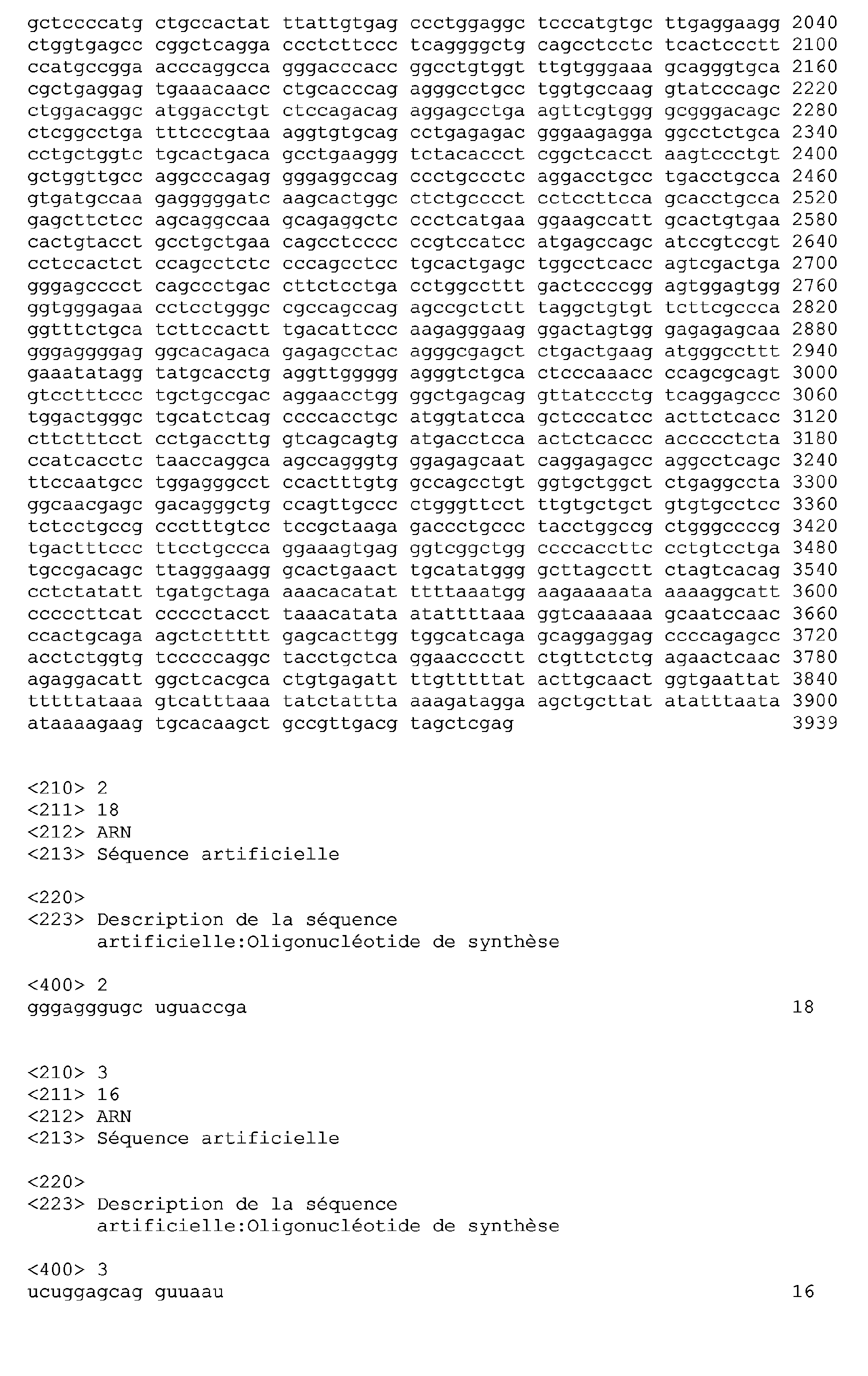
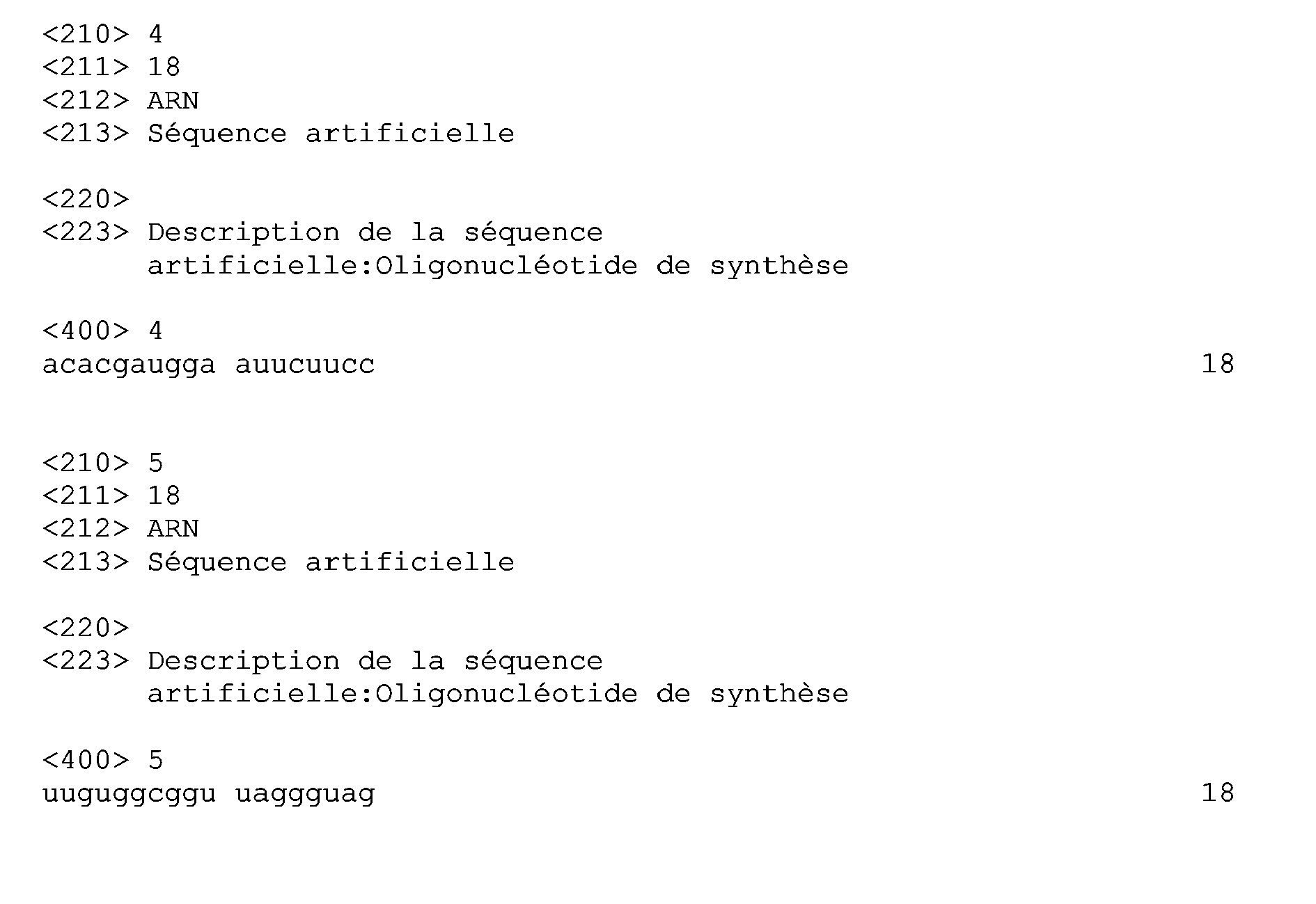
Claims (7)
- Produit de combinaison comprenant :(i) au moins une substance capable d'inhiber l'activité de CSF-1 et/ou au moins un acide nucléique, comprenant au moins une séquence codant pour une substance capable d'inhiber l'activité de CSF-1 et,(ii) (ii) au moins une substance ayant au moins une activité cytotoxique et/ou au moins un acide nucléique, comprenant au moins une séquence codant pour une substance ayant au moins une activité cytotoxique.caractérisé en ce que la substance capable d'inhiber l'activité de CSF-1 est un anticorps
- Produit de combinaison selon la revendication 1 caractérisé en ce que la substance ayant au moins une activité cytotoxique est choisie parmi les substances interagissant avec l'ADN, les antimétabolites, les inhibiteurs de topo-isomérases, les agents du fuseau et les agents cytostatiques.
- Produit de combinaison selon l'une des revendications 1 et 2, caractérisé en ce que la substance ayant au moins une activité cytotoxique est un antigène associé aux tumeurs.
- Produit de combinaison selon l'une des revendications 1 à 3, caractérisé en ce que la substance ayant au moins une activité cytotoxique est choisie parmi les cytokines, les polypeptides présentant une activité de chimio-attraction, les protéines codées par un gène suicide, les facteurs protéiques anti-angiogéniques et les polypeptides présentant une activité d'activation de l'apoptose cellulaire.
- Composition comprenant au moins un produit de combinaison selon l'une des revendications 1 à 4 et un véhicule acceptable d'un point de vue pharmaceutique.
- Utilisation d'un produit de combinaison selon les revendications 1 à 4, pour la préparation d'un médicament pour le traitement du cancer.
- Utilisation d'un anticorps capable d'inhiber l'activité de CSF-1 pour la préparation d'un médicament pour améliorer l'efficacité d'un traitement antitumoral.
Applications Claiming Priority (2)
| Application Number | Priority Date | Filing Date | Title |
|---|---|---|---|
| FR0200029 | 2002-01-03 | ||
| EP03712203A EP1463757A2 (fr) | 2002-01-03 | 2003-01-03 | Antisens diriges contre le csf-1 humain |
Related Parent Applications (1)
| Application Number | Title | Priority Date | Filing Date |
|---|---|---|---|
| EP03712203A Division EP1463757A2 (fr) | 2002-01-03 | 2003-01-03 | Antisens diriges contre le csf-1 humain |
Publications (2)
| Publication Number | Publication Date |
|---|---|
| EP1683807A1 true EP1683807A1 (fr) | 2006-07-26 |
| EP1683807A8 EP1683807A8 (fr) | 2006-10-11 |
Family
ID=8871144
Family Applications (2)
| Application Number | Title | Priority Date | Filing Date |
|---|---|---|---|
| EP03712203A Withdrawn EP1463757A2 (fr) | 2002-01-03 | 2003-01-03 | Antisens diriges contre le csf-1 humain |
| EP06113878A Withdrawn EP1683807A1 (fr) | 2002-01-03 | 2003-01-03 | Produits de combinaison utilisable dans le cadre d'un traitement antitumoral comprenant un anticoprs capable d'inhiber l'activité de CSF-1 |
Family Applications Before (1)
| Application Number | Title | Priority Date | Filing Date |
|---|---|---|---|
| EP03712203A Withdrawn EP1463757A2 (fr) | 2002-01-03 | 2003-01-03 | Antisens diriges contre le csf-1 humain |
Country Status (6)
| Country | Link |
|---|---|
| US (1) | US20050245471A1 (fr) |
| EP (2) | EP1463757A2 (fr) |
| JP (1) | JP2005525314A (fr) |
| AU (1) | AU2003216778A1 (fr) |
| CA (1) | CA2473570A1 (fr) |
| WO (1) | WO2003059395A2 (fr) |
Families Citing this family (6)
| Publication number | Priority date | Publication date | Assignee | Title |
|---|---|---|---|---|
| US20110091451A1 (en) * | 2002-11-15 | 2011-04-21 | Kavanaugh William M | Methods for preventing and treating cancer metastasis and bone loss associated with cancer metastasis |
| DK2311873T3 (en) | 2004-01-07 | 2018-11-26 | Novartis Vaccines & Diagnostics Inc | M-CSF-SPECIFIC MONOCLONAL ANTIBODY AND APPLICATIONS THEREOF |
| US20080026947A1 (en) * | 2006-02-08 | 2008-01-31 | Gmeiner William H | Cytotoxic nucleotides for targeted therapeutics |
| US8470977B2 (en) | 2008-03-14 | 2013-06-25 | Transgene S.A. | Antibody against the CSF-1R |
| DK2262836T3 (da) * | 2008-03-14 | 2016-04-04 | Transgene Sa | Antistof mod CSF-1R |
| US9486533B2 (en) | 2013-09-27 | 2016-11-08 | Wake Forest University Health Sciences | Pharmaceutical compositions for high-capacity targeted delivery |
Family Cites Families (2)
| Publication number | Priority date | Publication date | Assignee | Title |
|---|---|---|---|---|
| US5959097A (en) * | 1998-11-20 | 1999-09-28 | Isis Pharmaceuticals, Inc. | Antisense modulation of MEK2 expression |
| JP4307775B2 (ja) * | 1999-10-28 | 2009-08-05 | ゼイェトホサイン・アハリネヤート | Csf−1インヒビターの使用 |
-
2003
- 2003-01-03 EP EP03712203A patent/EP1463757A2/fr not_active Withdrawn
- 2003-01-03 US US10/500,709 patent/US20050245471A1/en not_active Abandoned
- 2003-01-03 JP JP2003559555A patent/JP2005525314A/ja not_active Withdrawn
- 2003-01-03 WO PCT/FR2003/000007 patent/WO2003059395A2/fr not_active Ceased
- 2003-01-03 EP EP06113878A patent/EP1683807A1/fr not_active Withdrawn
- 2003-01-03 CA CA002473570A patent/CA2473570A1/fr not_active Abandoned
- 2003-01-03 AU AU2003216778A patent/AU2003216778A1/en not_active Abandoned
Non-Patent Citations (3)
| Title |
|---|
| BIRCHENALL-ROBERTS M C ET AL: "Inhibition of murine monocyte proliferation by a colonystimulating factor-1 antisense oligodeoxynucleotide", JOURNAL OF IMMUNOLOGY, THE WILLIAMS AND WILKINS CO. BALTIMORE, US, vol. 145, no. 10, 15 November 1990 (1990-11-15), pages 3290 - 3296, XP002957654, ISSN: 0022-1767 * |
| KESHAVA N ET AL: "Blocking of colony stimulating factor expression with antisense RNA in breast and ovarian cancer epithelial cells leads to programmed cell death", PROCEEDINGS OF THE ANNUAL MEETING OF THE AMERICAN ASSOCIATION FOR CANCER RESEARCH, NEW YORK, NY, US, vol. 38, 1997, pages 500, XP002165344, ISSN: 0197-016X * |
| KESHAVA N ET AL: "Overexpression of macrophage colony-stimulating factor (CSF-1) and its receptor, c-fms, in normal ovarian granulosa cells leads to cell proliferation and tumorigenesis.", JOURNAL OF THE SOCIETY FOR GYNECOLOGIC INVESTIGATION. UNITED STATES 1999 JAN-FEB, vol. 6, no. 1, January 1999 (1999-01-01), pages 41 - 49, XP002254236, ISSN: 1071-5576 * |
Also Published As
| Publication number | Publication date |
|---|---|
| EP1463757A2 (fr) | 2004-10-06 |
| EP1683807A8 (fr) | 2006-10-11 |
| WO2003059395A3 (fr) | 2004-03-11 |
| AU2003216778A1 (en) | 2003-07-30 |
| WO2003059395A2 (fr) | 2003-07-24 |
| JP2005525314A (ja) | 2005-08-25 |
| US20050245471A1 (en) | 2005-11-03 |
| CA2473570A1 (fr) | 2003-07-24 |
Similar Documents
| Publication | Publication Date | Title |
|---|---|---|
| EP0998568B1 (fr) | Mutant ayant une activite uracile phosphoribosyl transferase | |
| JP4672659B2 (ja) | 改善されたシトシンデアミナーゼ活性を有するポリペプチド | |
| JP7080053B2 (ja) | 腫瘍の治療のための、キヌレニンを枯渇させる酵素の投与 | |
| JP2013209415A (ja) | 哺乳類における抗腫瘍または抗ウイルス治療を行う目的において設計された要素のキット | |
| JP2004506617A (ja) | 哺乳類において、細胞毒性治療、詳しくは抗腫瘍治療を行うための組合せ生成物 | |
| FR2794025A1 (fr) | Composition destinee a la mise en oeuvre d'un traitement antitumoral ou antiviral chez un mammifere | |
| EP1683807A1 (fr) | Produits de combinaison utilisable dans le cadre d'un traitement antitumoral comprenant un anticoprs capable d'inhiber l'activité de CSF-1 | |
| EP1100916A2 (fr) | Composition destinee a la mise en oeuvre d'un traitement cytotoxique, notamment antitumoral ou antiviral, chez un mammifere | |
| CA2435949A1 (fr) | Materiel biologique pour la preparation de compositions pharmaceutiques destinees au traitement de mammiferes | |
| HK1107360B (en) | Kit of parts designed for implementing an antitumoral or antiviral treatment in a mammal |
Legal Events
| Date | Code | Title | Description |
|---|---|---|---|
| PUAI | Public reference made under article 153(3) epc to a published international application that has entered the european phase |
Free format text: ORIGINAL CODE: 0009012 |
|
| AC | Divisional application: reference to earlier application |
Ref document number: 1463757 Country of ref document: EP Kind code of ref document: P |
|
| AK | Designated contracting states |
Kind code of ref document: A1 Designated state(s): AT BE BG CH CY CZ DE DK EE ES FI FR GB GR HU IE IT LI LU MC NL PT SE SI SK TR |
|
| 17P | Request for examination filed |
Effective date: 20061002 |
|
| 17Q | First examination report despatched |
Effective date: 20061106 |
|
| AKX | Designation fees paid |
Designated state(s): AT BE BG CH CY CZ DE DK EE ES FI FR GB GR HU IE IT LI LU MC NL PT SE SI SK TR |
|
| STAA | Information on the status of an ep patent application or granted ep patent |
Free format text: STATUS: THE APPLICATION IS DEEMED TO BE WITHDRAWN |
|
| 18D | Application deemed to be withdrawn |
Effective date: 20070517 |