EP1684192A1 - Plattform zur Integration heterogener Datenquellen - Google Patents
Plattform zur Integration heterogener Datenquellen Download PDFInfo
- Publication number
- EP1684192A1 EP1684192A1 EP05001407A EP05001407A EP1684192A1 EP 1684192 A1 EP1684192 A1 EP 1684192A1 EP 05001407 A EP05001407 A EP 05001407A EP 05001407 A EP05001407 A EP 05001407A EP 1684192 A1 EP1684192 A1 EP 1684192A1
- Authority
- EP
- European Patent Office
- Prior art keywords
- data
- ontology
- source
- query
- mapping
- Prior art date
- Legal status (The legal status is an assumption and is not a legal conclusion. Google has not performed a legal analysis and makes no representation as to the accuracy of the status listed.)
- Ceased
Links
Images

Classifications
-
- G—PHYSICS
- G06—COMPUTING OR CALCULATING; COUNTING
- G06F—ELECTRIC DIGITAL DATA PROCESSING
- G06F16/00—Information retrieval; Database structures therefor; File system structures therefor
- G06F16/20—Information retrieval; Database structures therefor; File system structures therefor of structured data, e.g. relational data
- G06F16/24—Querying
- G06F16/245—Query processing
- G06F16/2458—Special types of queries, e.g. statistical queries, fuzzy queries or distributed queries
- G06F16/2471—Distributed queries
-
- G—PHYSICS
- G06—COMPUTING OR CALCULATING; COUNTING
- G06F—ELECTRIC DIGITAL DATA PROCESSING
- G06F16/00—Information retrieval; Database structures therefor; File system structures therefor
- G06F16/20—Information retrieval; Database structures therefor; File system structures therefor of structured data, e.g. relational data
- G06F16/25—Integrating or interfacing systems involving database management systems
-
- Y—GENERAL TAGGING OF NEW TECHNOLOGICAL DEVELOPMENTS; GENERAL TAGGING OF CROSS-SECTIONAL TECHNOLOGIES SPANNING OVER SEVERAL SECTIONS OF THE IPC; TECHNICAL SUBJECTS COVERED BY FORMER USPC CROSS-REFERENCE ART COLLECTIONS [XRACs] AND DIGESTS
- Y10—TECHNICAL SUBJECTS COVERED BY FORMER USPC
- Y10S—TECHNICAL SUBJECTS COVERED BY FORMER USPC CROSS-REFERENCE ART COLLECTIONS [XRACs] AND DIGESTS
- Y10S707/00—Data processing: database and file management or data structures
- Y10S707/99931—Database or file accessing
Definitions
- the present invention relates to unified querying of distributed data sources and methods for the efficient recovery of information stored in distributed data sources.
- Enterprise data systems especially for large enterprises, typically include multiple data sources that may be based on different data schemas like
- enterprise employment data may be stored in a relational database conforming to a first relational database schema and enterprise accounting data may be stored in a relational databases conforming to a second relational database schema.
- enterprise accounting data may be stored in a relational databases conforming to a second relational database schema.
- tables are generally mapped to ontology classes, and fields of tables are generally mapped to properties of the classes.
- complex types are generally mapped to ontology classes, and elements and properties within complex types are generally mapped to ontology properties.
- the invention comprises a system, preferably a computer system, for unified querying of distributed data sources conforming to different data schema.
- the system comprises a plurality of data sources conforming each to a given data schema.
- the different data schema of the data sources can e.g. be a relational database, an XML text, a web service, etc.
- the different data sources can be stored in different storage means, on different computers in a network, at different plants, or on one computer or one hard disk drive.
- Each data schema has constructs for organizing the data and a data schema query language, like SQL, XQuery, a remote procedure call of an API of a web service, etc.
- the system also comprises a plurality of source ontologies, each corresponding to one data source.
- Each source ontology comprises a group of constructs.
- the group of constructs comprises at least classes and properties of the classes.
- the classes are called “categories” and the properties are called “attributes”.
- object properties sometimes called “relations” among.classes and the inheritance of properties are incorporated into the ontologies.
- datatype properties are the norm, for which the properties of a class can be defined in the form of data.
- the data are called instances of the classes.
- classes are sets and the data / instances are members of the sets.
- the instances of classes are called objects.
- the object model is preferably realized as a hierarchical structure of classes.
- the classes in a predetermined level are respectively allocated to precisely one class of a superior level, meaning only single inheritances are permitted.
- the class structure can also be more generally embodied as an acyclic graph for which multiple inheritances are permitted.
- An example for a class can be the class "person”.
- An example of a property for the class person is the "name" of a person.
- Classes or data can be linked via object properties. E. g., person A is "cooperating with” person B.
- mappings between each data source and its corresponding source ontology is defined.
- constructs of the data schema of the data source are mapped to constructs of the source ontology.
- tables are generally mapped to classes of the source ontology and fields of tables are generally mapped to properties of the classes.
- mapping between each data source and its corresponding source ontology is accomplished using a declarative system of rules based on predicate logic.
- One important characteristic of a declarative system of rules is that the result of an evaluation of the rules does not depend on the sequence of the definition of the rules.
- the mapping comprises means for querying the data source with the data schema query language of the data source.
- the system comprises at least one integration ontology.
- the integration ontology comprises a group of constructs, generally at least classes and properties.
- the integration ontology has an ontology query language associated therewith.
- the ontology query language of the integration ontology does not necessarily have to be the same as that of the source ontologies, although it usually is, for practical reasons.
- the system provides a mapping between each source ontology and the integration ontology.
- the integration ontology is a top level or global ontology.
- mapping constructs of the source ontologies are mapped to constructs of the integration ontology. It is the integration ontology which gives a unified view on the data. It enables the information integration.
- the mapping does not necessarily map a class of a source ontology to a class of the integration ontology and a property to a property.
- the ontologies can have different value units, different names, different structures, which might make it more appropriate in individual cases to map a certain class to a property.
- one source ontology may have the class "laser-printer” while the integration ontology may have the class "printers” with the property "type", an instance (realization, data) of which could be "laser-printer”.
- mapping between the source ontologies and the integration ontology is accomplished using a declarative system of rules based on predicate logic.
- the system also comprises query means for inputting a query related to the data of the data sources.
- the inference unit based on predicate logic for evaluating the query with the help of the rules. It is the inference unit that answers the query. For this purpose, the inference unit evaluates the rules, it chooses those rules, which are suitable for answering the question. In a top-down-approach, the rules successively lead from the integration ontology to the relevant source ontologies. Furthermore, the rules mapping the relevant source ontology to the corresponding data source comprise means for querying that data source with the data schema query language of that data source. These means translate queries into the language of the data schema. These queries can be answered and the results returned. These results are used by the inference unit to answer the query posed on the web service level. Thus, the inference unit serves as runtime unit for answering queries. Using the information from the ontologies and the rules it directly queries the underlying data sources. It is a separate unit and not part of the ontology structure.
- predicate logic based on predicate logic and not on business rules, which are often used in the prior art. This may need some explanation. If we restrict predicate logic to horn logic with negation (normal logic) then business rules and normal logic rules seem to be closely related at least from their surface representation, i.e. from their syntax. In contrast their underlying background theory are fundamentally different. Normal logic is based on a well-defined theory: the model theory of predicate logic. A Herbrand model is a (sometimes infinite) set of facts. The meaning of a set of normal logic rules and facts is defined by a unique minimal Herbrand model.
- a set of normal logic rules and facts is an abbreviation for a set of facts, the minimal Herbrand model.
- This minimal Herbrand model is defined independently from the given sequence of the rules, from the given sequence of the rule bodies and independently from the inference algorithm to compute this model.
- no theory is available.
- the meaning of a set of business rules is given by a simple inference algorithm: the Rete algorithm.
- the outcome of this algorithm is strongly dependent on the sequence of the rules, the sequence of the rule bodies and the operations used in the rule heads. So there is no independent theory what a set of rules means, but it has to be waited for an answer of the inference algorithm to get an idea of what the set of rules does. To make things worse, every business rule system behaves differently.
- the source ontology corresponding to a data source and its data schema can be automatically generated.
- predicate logic may be used to define ontologies and mappings between them in an unambiguous way. This definition may then be implemented in any programming language. These models can be executed directly using an inference engine. Thus, there is no loss of information or reinterpretation of information during the implementation phase and, thus, the execution corresponds to the original meaning and, additionally, the execution may be started immediately.
- the inference unit which serves as runtime engine, can dynamically access the rules and the structure of the ontologies during the evaluation of a query.
- a way to accomplish this is given, when the inference unit accesses the data structure in which the model is stored. This allows for dynamically modelling the data integration and at the same time querying the modelled structure. Thus, the model can be tested. Also, knowledge engineers and users of the system can work on the system at the same time.
- the integration ontology has an ontology query language associated therewith and the system comprises means for translating each query into the ontology query language of the integration ontology.
- At least one of the ontologies is complemented by a declarative system of rules based on predicate logic for expressing additional information.
- the system comprises in a preferred embodiment at least one query unit in the form of a web service for inputting a query relating to the data of the data sources.
- This query is translated from the web service input to the ontology query language of the integration ontology, allowing unified queries of the distributed data.
- a separate web service is defined for all relevant queries.
- the system comprises means for identifying queries or rules or combinations of rules that can be combined into a complex query in the data schema query language of the data source and means for translating these queries or rules or combinations of rules into a complex query in the data schema query language of the data source.
- queries combining different tables and field and their entries can be identified and translated into a corresponding SQL query.
- the system comprises means for dynamically filtering those data or rules or queries which cannot have an impact on answering the query posed on the web service level.
- the system can comprise a plurality of integration ontologies, integrating different data sources or integrating identical data sources and representing each a different view on the data.
- the method comprises choosing a plurality of data sources conforming each to a given data schema, each data schema having constructs for organizing the data and a data schema query language associated therewith.
- each source ontology comprises a group of constructs, the group of constructs comprising generally at least classes and properties.
- mapping between each data source and its corresponding source ontology is defined, wherein constructs of the data schema of the data source are mapped to constructs of the source ontology, and wherein the mapping comprises means for querying the data source with the data schema query language of the data source, and wherein the mapping between each data source and its corresponding source ontology is accomplished using a declarative system of rules based on predicate logic.
- an integration ontology comprising a group of constructs, the group of constructs comprising generally at least classes and properties.
- a mapping between each source ontology and the integration ontology is defined, wherein constructs of the source ontologies are mapped to constructs of the integration ontology, and wherein the mapping between the source ontologies and the integration ontology is accomplished using a declarative system of rules based on predicate logic.
- a query related to the data.of the data sources is posed and evaluated with the help of the rules using at least one inference unit based on predicate logic.
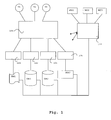
- Fig. 1 shows a general view of the enterprise information integration platform. Shown are a number of data sources XML, DB1, DB2, and RPC, RPC denoting a remote procedure call and standing for a web service. There is a source ontology 100, 102, 104, and 106 corresponding respectively to every data source. The source ontologies are integrated into an integration ontology 108. The integration ontology and the underlying structures can be accessed via predefined external views V1, V2, and V3. Corresponding to these external views are web services WS1, WS2, and WS3. These web services can be used to input queries into the system. The inference or runtime unit 110 is used for answering the queries.
- the runtime engine 110 while evaluating the query using the rules, directly accesses the external data sources.
- F-Logic is a useful ontology query language (see, e.g., J. Angele, G. Lausen: "Ontologies in F-Logic” in S. Staab, R. Studer (Eds.): Handbook on Ontologies in Information Systems. International Handbooks on Information Systems, Springer, 2003, page 29).
- F-Logic the following example might be of use, which maps the object properties between well-known biblical persons.
- F-Logic is suited for defining the class structure of an ontology, nevertheless, in many cases, the ontology languages RDF or OWL are used for these purposes.
- Rules written using F-Logic consist of a rule header (left side) and a rule body (right side).
- the first rule in the example given above means in translation: If Y is a man, whose father was X, then Y is one of the (there might be more than one) sons of X.
- the simple arrow "->" indicates that, for a given datatype or object property, only one value is possible, whereas the double-headed arrow "->>" indicates that more than one value might be assigned to a datatype or object property.
- the syntax of a query is similar to the definition of a rule, but the rule header is omitted.
- mapping of databases For the mapping of databases, a special built-in is defined. This built-in allows the access of the database. It creates e.g. SQL queries to the data of the database. The built-in is incorporated into the mapping rule.
- the following example illustrates accessing a database on an MS SQLServer as database type, running on a special computer or port called "host".
- the database contains a table "Person” containing information on the "Id” of the person, its "name” and its "town”.
- the mapping rule has the form:
- a relational database consists of a set of tables. Every table consists of a fixed number of named columns. For each column a data type is given. The contents of a table must conform to these data types. For a row in a table a (unique) key may be given identifying one row in an unambiguous way. This key may consist of the values of some columns or may be a separate additional value like a number. Foreign keys define links into other tables; they refer to the keys of other tables and, thus, represent relations or object properties.
- mapping of a relational database to its corresponding source ontology is defined as follows:
- the source ontology and the mapping may be generated automatically for the data schema of the relational database in the following way:
- the corresponding source ontology looks like the following (in F-Logic):
- the source ontology as well as the mappings from the tables to the source ontology can, thus, be generated automatically.
- Adabas data model is an extension of the relational data model.
- table structures it allows also multiple-valued fields and multiple groups of fields, which can again contain multiple fields.
- NF2 nested relational model
- the Adabas mapping consists of the following parts:
- the ontology class definitions are derived from the Adabas DDM definitions and are, therefore, containing only the long field names.
- Adabas DDM the following ontology class definition is automatically generated:
- the generic Adabas built-in has the following interface. It uses only the Adabas short names for accessing the instances.
- Appendix A contains an example ontology with a corresponding Adabas mapping.
- the ontologies, mappings and other rules are preferably stored as oxml-files.
- the source ontologies always have to be "complete”, i.e. they have to contain a construct for every parameter or construct of the underlying data source or web service. Otherwise, certain data would not be accessible.
- a mapping is needed between XML instances and F-Logic instances or constructs of the source ontologies.
- a XML schema can be generated, which contains the data type definitions of the data contained in the XML document.
- the corresponding XML document can be validated, i.e. the data in the document can be checked under the aspect, whether they conform to the correct data type.
- PSVI post schema validation info set
- mapping should preserve as much as possible information. However it is acceptable, if some information is lost, because the effort to preserve this is too high, e.g.
- mapping is defined as follows:
- mapping is illustrated by the following example.
- the XML schema of the example is illustrated in Fig. 2.
- mapping is realized by generated F-Logic mapping rules, which map the generated ontology classes and properties to the corresponding XML constructs with the help of this XML built-in.
- F-Logic mapping rules which map the generated ontology classes and properties to the corresponding XML constructs with the help of this XML built-in.
- This built-in generates XQueries.
- the XML results of the XQueries are mapped to ontology instances according to this rule.
- Web services can be considered as remote procedure call (RPC) with a list of input parameters and a list of output parameters, which contain the result.
- RPC remote procedure call
- a web service who delivers the current temperature of a city may have as input parameter the zip code and as output parameter the temperature.
- a corresponding source ontology would have a class "place” with two properties: "zip code” and "temperature”.
- the web service mapping is defined as follows:
- SOAP Simple Object Access Protocol
- SOAP is a lightweight XML-based messaging protocol used to encode the information in Web service request and response messages before sending them over a network.
- the web service mapping maps this SOAP request of the web service above to the following ontology instances. Please note that only the first instance is special to the web service mapping. All other instances are the same as in the XML mapping example.
- a generic built-in "webservice” realizes the transformation of the corresponding SOAP request to the ontology instances according to the mapping specified above.
- the built-in gets the WSDL description and its mapping to ontology definitions as input. From that it constructs ontology instances from the result of the SOAP request.
- mapping is realized by generated F-Logic mapping rules, which map the generated ontology classes and properties to this web service built-in.
- F-Logic mapping rules which map the generated ontology classes and properties to this web service built-in.
- Different external views on the integrated data can be defined by specifying predefined queries. They can be understood as predefined parameterized queries posed to the integration ontology and formulated in the query language of the integration ontology.
- a corresponding web service access of the system can be defined, which allows the corresponding querying of the system.
- Such web services take - in the most general case - an XML document as input and generate an XML document as output or answer.
- Such web services are called "document style web services”.
- the following example illustrates how the system works to determine the temperature of the place a certain person is living in.
- the temperature can be accessed via a web service, while the person is stored in a database.
- the system contains a web service "temperature”, giving the current temperature of a place, if the zip code is given as input.
- the web service built-in is ⁇ uri> denotes the location of the web service within the internet.
- ⁇ input> in this example is the zip code.
- ⁇ output> in this example is the temperature in degrees Celcius.
- the mapping of the database onto the class "person” is done in the following way: dbacces is a built-in. This rule guarantees the mapping between the database and the source ontology as usual.
- For mapping the web service we define the following rule: with the built-in "webservice”.
- the following query gives the temperature at the place of living for all persons:
- the system may present a browser interface for inputting the product number, e.g. 123.
- This browser front end is based on a document style web service.
- the query is translated by the inference engine into a query in the query language of the integration ontology as follows (in F-Logic): implying a suitable integration ontology. If, for simplicity reasons of this example, we assume that the source ontology is identical to the integration ontology, we then have to map the ontology onto the document style web service that returns product details.
- the mapping rule has to create the XML input of the web service and, at the same time, define the mapping of the output XML document to the ontology. Such a rule might look like:
- variables can be defined which are constructed dynamically when answering a query.
- the system describes source ontologies and integration ontologies.
- the system needs to provide a query mechanism to allow for retrieval of data that is described by such ontologies.
- Rule languages can be used for this. Rules that do not have a rule head return all variable bindings for the rule body that evaluate to a valid result. It is not inherently necessary that the rule language is also used as a query language. But having the same language and its implementation for describing and for querying data avoids many possible conflicts with data type processing and semantics of operations.
- Rules in predicate logic can describe properties of data objects as well as relations between data objects (object properties). For example a rule describing a logical property is: "If X is a German taxi, then X's colour is light ivory”. Examples for describing structural relationships are "isSonOf", “hasSons”. An inference engine derives those combinations of objects where beside logical conditions also structural relationships hold that have been specified in a query.
- the system preferably hides details about the ontology and query language. Therefore, it needs a query editor which allows for language independent specification of queries.
- the system's query editor starts from one selected class. It recursively allows for navigation along relations or object properties to further classes. This process spans a hierarchical structure (called tree) of class nodes with relations or object properties as connections. For each class node in the tree it is possible to specify restrictions and projections.
- the current query editor implements generation of queries for one specific restriction and projection semantics as described below. Actually, other semantics are conceivable and can be implemented.
- the Query Editor shows each class in the tree in a separate window pane. These panes are divided into three parts:
- the datatype properties part lists all datatype properties of a class. For each property one can choose whether this property shall be projected, i.e. be part of the query output or not.
- restriction clauses Independent of the projection, you can optionally specify restriction clauses.
- restriction clauses one can specify a value for the restriction. If one does not want to use a constant value but leave it to the application to specify the value when executing the query, then one can define a so-called "external variable".
- a value in the text box denotes an external variable, if the value is a string starting and ending with a $-character. It is possible to use the same external variable in different places of the query, even in different class nodes.
- a query only returns a result instance of a class, if there is at least one datatype property value which fulfils the specified restriction. As a consequence, if you have restrictions on multiple datatype properties, they all need at least one matching value; otherwise the object will be discarded.
- the relations or object properties part lists all object properties of a class.
- Query definition continues recursively for this class.
- the current object only belongs to the query result, if for each referenced class that has one or more restrictions (itself or its descendents) there is at least one referenced object that satisfies these restrictions. As a consequence, if you have restrictions on multiple object properties, they all need a matching value; otherwise the object will be discarded.
- the system uses an internal data structure to describe a query as specified in the query editor. This internal data structure will be used for further processing steps:
- Queries to be generated need to support expressiveness as described in a previous section. Also, generated queries do implement semantics as described in the previous section.
- the query generation creates a result projection, i.e. it defines a frame for the description of the result output for qualified objects.
- this frame is: "XRESULTVAR" is the name of the output variable. That means, in the end this variable will be bound to F-Logic terms that contain the description of the query result objects.
- the system uses an "orderedby" extension of the used F-Logic query language. "orderedby” is not direct part of F-Logic, instead it is to be appended after the dot. "orderedby” can be followed by one or more variable names, indicating which variables shall appear in the result tuples in which order.
- predicates For object properties that are used to navigate from one class to the referenced class, the system generates predicates like:
- F-Logic as a logic programming language returns all variable bindings that lead to a valid query result. To be valid, all variables need a value binding. If a variable cannot be bound with a value, then the other bindings are negligible and do not contribute to the query result.
- null value representations from an F-Logic perspective these are normal values.
- null value representation(s) see below.
- predicates that distinguish between given values and the situation where no value is given. The type of predicates to be generated here are:
- F-Logic's list-built-in is used to generate child lists. To ensure that lists are built for every parent node individually the system has to generate a key for each list first.
- the template for this key generation is:
- X shall have at least one datatype property named "attr” with value "val” and (if yes) bind all existing values (one at a time) to variable Y.
- variable Y shall be bound with all existing values (one at a time) and then we filter out all Y that have value "val”.
- the first part binds all values to Y, the second filters those Y that satisfy the built-in, e.g. greater, greaterorequal, contains, startswith, etc.
- the query can be exposed in a web service.
- the system Before a query can be deployed as a web service, the system has to generate a web service description, which consists of two parts.
- Web service description generation and query generation are done on the same internal data structure. It is important to keep these two processing steps in sync. This especially holds for the order of elements in the result. While the web service description implies order and multiplicity of these elements in XML schema sequences, the query generation has to construct F-Logic terms that will be transformed into matching XML documents.
- the web service execution is implemented in a generic framework that accepts a web service description, a query description, and input parameters.
- the web service delivers a query result as described in the web service's WSDL.
- the query description is an XML document containing the query string in the chosen query language enriched with descriptions of external parameters.
- the web service will send the resulting query string to a specified inferencing engine.
- the resulting XML document can be returned as the web service's invocation result.
- a dialog window asks for details about the server, to which the query shall be sent.
- the dialog window also asks for values of query parameters.
- the resulting result terms will be transformed into an XML structure.
- the system can display resulting XML documents.
- the ontolgies, as well as the language for the declarative rules, can differ.
- the object models are of the type OWL, while F-Logic is used as the rule language.
- OWL will be extended to encompass capabilities for defining rules.
- a query command is generated by the input web service.
- a series of declarative rules is processed in the inference unit. Since the declarative rules based on predicate logic in general are a declarative system, the sequence for the definition of the declarative rules is not important.
- the following illustrates the way the inference unit evaluates the rules to answer a query.
- Forward chaining means that the rules are applied to the data and derived data as long as new data can be deduced.
- backward chaining can be used.
- Backward chaining means that the evaluation has the query as starting point and looks for rules with suitable predicates in their heads that match with an atom of the body of the query. The procedure is recursively continued. Also backward chaining looks for facts with suitable predicate symbols.
- the inference engine performs a mixture of forward and backward chaining to compute (the smallest possible) subset of the model for answering the query. In most cases, this is much more efficient than the simple forward or backward chaining evaluation strategy.
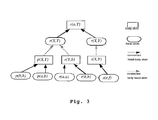
- the inference or evaluation algorithm works on a data structure called system graph (see e.g. Fig. 3).
- This graph represents the set of rules and their dependencies. Every atom of the rules (i. e. head or body, left hand or right hand side, or part of the body) is represented as a vertex of the graph. All atoms in the body of a rule - which may be connected by AND only - are connected to the head atom (header) of the rule by a connection or an edge. Every head atom, in turn, is upwardly connected to all body atoms with the same predicate symbol. Let's have a look at an example:
- the bottom-up evaluation using the system graph may be seen as a flow of data from the sources (facts) to the sinks (query) along the edges of the graph.
- This evaluation strategy corresponds to the naive evaluation [J. D. Ullman: “Principles of Database and Knowledge-Base Systems”; vol. I, Computer Sciences Press, Rockville, Maryland, 1988] and is the basis for the above mentioned alternating fixed point procedure. Because the system graph may contain cycles (in case of recursion within the set of rules) semi naive evaluation [J. D. Ullman: “Principles of Database and Knowledge-Base Systems”; vol. I, Computer Sciences Press, Rockville, Maryland, 1988] is applied in the preferred embodiment to increase efficiency.
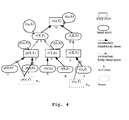
- the improved bottom-up evaluation (forward chaining) of the example mentioned above is shown in Fig. 4.
- the facts flowing to a vertex are shown in the bubble attached to the vertex.
- Fig. 4 exemplifies that facts are created for the vertices although they are useless for answering the posed query. For instance the fact p(b,b) (vertex 11) flowing to the body vertex p(X,Y) (vertex 2) cannot contribute in any way to the answer, because in the query r(a,Y) only instances of the variable X which are equal to the constant a are relevant. Such useless facts then in turn produce new useless facts in the subsequent evaluation.
- the key idea of the preferred embodiment is to abort the flow of useless facts as early as possible (i.e. as close to the sources of the graph as possible) attaching so-called blockers to the head-body edges of the graph.
- a blocker consists of a set of atoms.
- a blocker lets a fact pass, if there exists an atom within the blocker which matches with the fact.
- the blockers at the edges of the system graph are created during the evaluation process in the following way.
- constants within the query and within the rules are propagated downwards in the graph. Starting at the query or at a body atom, they are propagated to all head atoms, which are connected to this atom. From the head atoms they are propagated to the first body atom of the corresponding rule and from there in the same way downwards. In propagating the constants downwards, they produce new blocker atoms for the blockers at the sources.
- blockers can also be applied in the upper layers of the system graph, but this does not lead to an improvement of the performance. Therefore, blockers are only applied at the sources of the graph.
Landscapes
- Engineering & Computer Science (AREA)
- Theoretical Computer Science (AREA)
- Physics & Mathematics (AREA)
- Databases & Information Systems (AREA)
- Data Mining & Analysis (AREA)
- General Engineering & Computer Science (AREA)
- General Physics & Mathematics (AREA)
- Fuzzy Systems (AREA)
- Mathematical Physics (AREA)
- Probability & Statistics with Applications (AREA)
- Software Systems (AREA)
- Computational Linguistics (AREA)
- Information Retrieval, Db Structures And Fs Structures Therefor (AREA)
Priority Applications (3)
| Application Number | Priority Date | Filing Date | Title |
|---|---|---|---|
| EP05001407A EP1684192A1 (de) | 2005-01-25 | 2005-01-25 | Plattform zur Integration heterogener Datenquellen |
| US11/106,599 US7293010B2 (en) | 2005-01-25 | 2005-04-15 | Enterprise information integration platform |
| CNB2006100062639A CN100555280C (zh) | 2005-01-25 | 2006-01-25 | 企业信息集成平台 |
Applications Claiming Priority (1)
| Application Number | Priority Date | Filing Date | Title |
|---|---|---|---|
| EP05001407A EP1684192A1 (de) | 2005-01-25 | 2005-01-25 | Plattform zur Integration heterogener Datenquellen |
Publications (1)
| Publication Number | Publication Date |
|---|---|
| EP1684192A1 true EP1684192A1 (de) | 2006-07-26 |
Family
ID=34933434
Family Applications (1)
| Application Number | Title | Priority Date | Filing Date |
|---|---|---|---|
| EP05001407A Ceased EP1684192A1 (de) | 2005-01-25 | 2005-01-25 | Plattform zur Integration heterogener Datenquellen |
Country Status (3)
| Country | Link |
|---|---|
| US (1) | US7293010B2 (de) |
| EP (1) | EP1684192A1 (de) |
| CN (1) | CN100555280C (de) |
Cited By (9)
| Publication number | Priority date | Publication date | Assignee | Title |
|---|---|---|---|---|
| WO2008040954A1 (en) * | 2006-10-03 | 2008-04-10 | New Voice Media Ltd. | Method and apparatus for operating a computer-telephony system |
| WO2008053249A1 (en) * | 2006-11-02 | 2008-05-08 | Bae Systems Plc | Method of building a data integration environment |
| EP1944695A1 (de) * | 2007-01-15 | 2008-07-16 | Software Ag | Verfahren und System zur Überwachung eines Softwaresystems |
| EP1965313A1 (de) * | 2006-10-31 | 2008-09-03 | British Telecommunications Public Limited Company | Datenverarbeitung |
| EP2365448A1 (de) * | 2010-03-11 | 2011-09-14 | British Telecommunications PLC | Datenintegrationssystem |
| US8086615B2 (en) | 2005-03-28 | 2011-12-27 | Oracle International Corporation | Security data redaction |
| US8468160B2 (en) | 2009-10-30 | 2013-06-18 | International Business Machines Corporation | Semantic-aware record matching |
| CN106021306A (zh) * | 2016-05-05 | 2016-10-12 | 上海交通大学 | 基于本体匹配的案例搜索系统 |
| US10447857B2 (en) | 2006-10-03 | 2019-10-15 | Newvoicemedia Limited | Method and apparatus for operating a contact center system |
Families Citing this family (84)
| Publication number | Priority date | Publication date | Assignee | Title |
|---|---|---|---|---|
| US7730063B2 (en) | 2002-12-10 | 2010-06-01 | Asset Trust, Inc. | Personalized medicine service |
| US8069435B1 (en) * | 2003-08-18 | 2011-11-29 | Oracle America, Inc. | System and method for integration of web services |
| US20060184473A1 (en) * | 2003-11-19 | 2006-08-17 | Eder Jeff S | Entity centric computer system |
| US7607120B2 (en) * | 2004-04-20 | 2009-10-20 | Hewlett-Packard Development Company, L.P. | Method and apparatus for creating data transformation routines for binary data |
| US20060085451A1 (en) * | 2004-10-15 | 2006-04-20 | Microsoft Corporation | Mapping of schema data into data structures |
| US7536409B2 (en) * | 2005-02-15 | 2009-05-19 | International Business Machines Corporation | Having a single set of object relational mappings across different instances of the same schemas |
| US20060224628A1 (en) * | 2005-03-29 | 2006-10-05 | Bea Systems, Inc. | Modeling for data services |
| US8972423B2 (en) * | 2006-09-26 | 2015-03-03 | Siemens Product Lifecycle Management Software Inc. | Opaque mechanism for web service interoperability |
| US7941433B2 (en) | 2006-01-20 | 2011-05-10 | Glenbrook Associates, Inc. | System and method for managing context-rich database |
| US8495004B2 (en) * | 2006-03-27 | 2013-07-23 | International Business Machines Corporation | Determining and storing at least one results set in a global ontology database for future use by an entity that subscribes to the global ontology database |
| US8676785B2 (en) * | 2006-04-06 | 2014-03-18 | Teradata Us, Inc. | Translator of statistical language programs into SQL |
| US20080172360A1 (en) * | 2007-01-17 | 2008-07-17 | Lipyeow Lim | Querying data and an associated ontology in a database management system |
| US7693812B2 (en) * | 2007-01-17 | 2010-04-06 | International Business Machines Corporation | Querying data and an associated ontology in a database management system |
| US8166465B2 (en) | 2007-04-02 | 2012-04-24 | International Business Machines Corporation | Method and system for composing stream processing applications according to a semantic description of a processing goal |
| US8370812B2 (en) | 2007-04-02 | 2013-02-05 | International Business Machines Corporation | Method and system for automatically assembling processing graphs in information processing systems |
| US8117233B2 (en) * | 2007-05-14 | 2012-02-14 | International Business Machines Corporation | Method and system for message-oriented semantic web service composition based on artificial intelligence planning |
| US8868620B2 (en) * | 2007-06-08 | 2014-10-21 | International Business Machines Corporation | Techniques for composing data queries |
| US20080319957A1 (en) * | 2007-06-19 | 2008-12-25 | Microsoft Corporation | Extensible command trees for entity data model platform |
| US8584140B2 (en) * | 2007-09-21 | 2013-11-12 | Presenceid, Inc. | Systems and methods for receiving and sending messages about changes to data attributes |
| US7890447B2 (en) * | 2007-10-31 | 2011-02-15 | Dell Products L.P. | Information handling system and method for diagnosis, and repair, using rules collected by forward chaining |
| US8145684B2 (en) * | 2007-11-28 | 2012-03-27 | International Business Machines Corporation | System and computer program product for assembly of personalized enterprise information integrators over conjunctive queries |
| US8190596B2 (en) * | 2007-11-28 | 2012-05-29 | International Business Machines Corporation | Method for assembly of personalized enterprise information integrators over conjunctive queries |
| US7953755B2 (en) * | 2008-03-24 | 2011-05-31 | Dataura LLC | Semantic relational database |
| CN101571863B (zh) * | 2008-04-29 | 2012-03-28 | 国际商业机器公司 | 用于可变模式的xml文档的xml查询方法和系统 |
| US9110970B2 (en) * | 2008-07-25 | 2015-08-18 | International Business Machines Corporation | Destructuring and restructuring relational data |
| US8972463B2 (en) * | 2008-07-25 | 2015-03-03 | International Business Machines Corporation | Method and apparatus for functional integration of metadata |
| US8943087B2 (en) * | 2008-07-25 | 2015-01-27 | International Business Machines Corporation | Processing data from diverse databases |
| US9305238B2 (en) | 2008-08-29 | 2016-04-05 | Oracle International Corporation | Framework for supporting regular expression-based pattern matching in data streams |
| JP2012511767A (ja) * | 2008-12-12 | 2012-05-24 | コーニンクレッカ フィリップス エレクトロニクス エヌ ヴィ | オントロジーから関係データベースを作成するための方法及びモジュール |
| JP5471086B2 (ja) * | 2009-07-02 | 2014-04-16 | 富士通株式会社 | 情報統合装置、情報統合方法および情報統合プログラム |
| US9475359B2 (en) * | 2009-10-06 | 2016-10-25 | Johnson Controls Technology Company | Systems and methods for displaying a hierarchical set of building management system information |
| US20110087650A1 (en) * | 2009-10-06 | 2011-04-14 | Johnson Controls Technology Company | Creation and use of causal relationship models in building management systems and applications |
| US8655830B2 (en) * | 2009-10-06 | 2014-02-18 | Johnson Controls Technology Company | Systems and methods for reporting a cause of an event or equipment state using causal relationship models in a building management system |
| WO2011046560A1 (en) * | 2009-10-15 | 2011-04-21 | Hewlett-Packard Development Company, L.P. | Heterogeneous data source management |
| US20110106836A1 (en) * | 2009-10-30 | 2011-05-05 | International Business Machines Corporation | Semantic Link Discovery |
| US9305057B2 (en) | 2009-12-28 | 2016-04-05 | Oracle International Corporation | Extensible indexing framework using data cartridges |
| US9430494B2 (en) | 2009-12-28 | 2016-08-30 | Oracle International Corporation | Spatial data cartridge for event processing systems |
| US8959106B2 (en) | 2009-12-28 | 2015-02-17 | Oracle International Corporation | Class loading using java data cartridges |
| CN101814092A (zh) * | 2010-03-31 | 2010-08-25 | 沈阳理工大学 | 一种基于本体面向产品设计过程的知识集成方法 |
| CN101826108A (zh) * | 2010-04-09 | 2010-09-08 | 北京宇辰龙马信息技术服务有限公司 | 数据集成平台 |
| US9323828B2 (en) * | 2010-05-11 | 2016-04-26 | International Business Machines Corporation | Complex query handling |
| US8516016B2 (en) | 2010-07-07 | 2013-08-20 | Johnson Controls Technology Company | Systems and methods for facilitating communication between a plurality of building automation subsystems |
| US8682921B2 (en) | 2010-07-07 | 2014-03-25 | Johnson Controls Technology Company | Query engine for building management systems |
| US8793263B2 (en) | 2010-08-23 | 2014-07-29 | International Business Machines Corporation | Avoiding duplicate and equivalent data objects in service registries |
| US8713049B2 (en) * | 2010-09-17 | 2014-04-29 | Oracle International Corporation | Support for a parameterized query/view in complex event processing |
| US9189280B2 (en) | 2010-11-18 | 2015-11-17 | Oracle International Corporation | Tracking large numbers of moving objects in an event processing system |
| US20120158931A1 (en) * | 2010-12-15 | 2012-06-21 | Telefonaktiebolaget L M Ericsson (Publ) | Method and Apparatus for the Execution of Adaptable Composed Computer-Implemented Services with Integrated Policies |
| US8489639B2 (en) | 2011-03-04 | 2013-07-16 | Accenture Global Services Limited | Information source alignment |
| US8667024B2 (en) | 2011-03-18 | 2014-03-04 | International Business Machines Corporation | Shared data management in software-as-a-service platform |
| US8990416B2 (en) | 2011-05-06 | 2015-03-24 | Oracle International Corporation | Support for a new insert stream (ISTREAM) operation in complex event processing (CEP) |
| US8601029B2 (en) | 2011-05-27 | 2013-12-03 | International Business Machines Corporation | Data stewardship in federated multi-level master data management systems |
| US8380787B2 (en) | 2011-05-27 | 2013-02-19 | International Business Machines Corporation | Federation of master data management systems |
| US8635249B2 (en) | 2011-05-27 | 2014-01-21 | International Business Machines Corporation | Federation of multi-level master data management systems |
| US8635673B2 (en) | 2011-06-17 | 2014-01-21 | International Business Machines Corporation | Dynamic application adaptation in software-as-a-service platform |
| US8595798B2 (en) | 2011-06-17 | 2013-11-26 | International Business Machines Corporation | Enforcing data sharing policy through shared data management |
| US9652790B2 (en) | 2011-06-17 | 2017-05-16 | International Business Machines Corporation | Open data marketplace for municipal services |
| US9329975B2 (en) | 2011-07-07 | 2016-05-03 | Oracle International Corporation | Continuous query language (CQL) debugger in complex event processing (CEP) |
| US9495962B2 (en) * | 2011-09-19 | 2016-11-15 | Personetics Technologies Ltd. | System and method for evaluating intent of a human partner to a dialogue between human user and computerized system |
| US9563663B2 (en) | 2012-09-28 | 2017-02-07 | Oracle International Corporation | Fast path evaluation of Boolean predicates |
| US9953059B2 (en) | 2012-09-28 | 2018-04-24 | Oracle International Corporation | Generation of archiver queries for continuous queries over archived relations |
| US9280739B2 (en) | 2012-11-30 | 2016-03-08 | Dxcontinuum Inc. | Computer implemented system for automating the generation of a business decision analytic model |
| US10671926B2 (en) | 2012-11-30 | 2020-06-02 | Servicenow, Inc. | Method and system for generating predictive models for scoring and prioritizing opportunities |
| US10706359B2 (en) | 2012-11-30 | 2020-07-07 | Servicenow, Inc. | Method and system for generating predictive models for scoring and prioritizing leads |
| US10956422B2 (en) | 2012-12-05 | 2021-03-23 | Oracle International Corporation | Integrating event processing with map-reduce |
| CN103870455B (zh) * | 2012-12-07 | 2017-10-24 | 阿里巴巴集团控股有限公司 | 一种多数据源的数据集成处理方法和装置 |
| US10298444B2 (en) | 2013-01-15 | 2019-05-21 | Oracle International Corporation | Variable duration windows on continuous data streams |
| US9098587B2 (en) | 2013-01-15 | 2015-08-04 | Oracle International Corporation | Variable duration non-event pattern matching |
| US9390135B2 (en) | 2013-02-19 | 2016-07-12 | Oracle International Corporation | Executing continuous event processing (CEP) queries in parallel |
| US9047249B2 (en) | 2013-02-19 | 2015-06-02 | Oracle International Corporation | Handling faults in a continuous event processing (CEP) system |
| US9418113B2 (en) | 2013-05-30 | 2016-08-16 | Oracle International Corporation | Value based windows on relations in continuous data streams |
| US20160267503A1 (en) * | 2013-07-01 | 2016-09-15 | Salespredict Sw Ltd. | System and method for predicting sales |
| US10489355B1 (en) * | 2013-11-20 | 2019-11-26 | Progress Software Corporation | Schema tool for non-relational databases |
| US9934279B2 (en) | 2013-12-05 | 2018-04-03 | Oracle International Corporation | Pattern matching across multiple input data streams |
| IN2013CH05997A (de) | 2013-12-20 | 2015-06-26 | Infosys Ltd | |
| US9817851B2 (en) * | 2014-01-09 | 2017-11-14 | Business Objects Software Ltd. | Dyanmic data-driven generation and modification of input schemas for data analysis |
| US10324964B2 (en) * | 2014-01-16 | 2019-06-18 | Massachusetts Institute Of Technology | Method and systems for enhanced ontology assisted querying of data stores |
| US9244978B2 (en) | 2014-06-11 | 2016-01-26 | Oracle International Corporation | Custom partitioning of a data stream |
| US9712645B2 (en) | 2014-06-26 | 2017-07-18 | Oracle International Corporation | Embedded event processing |
| US20170286456A1 (en) * | 2014-08-29 | 2017-10-05 | Akana, Inc | Dynamic ontology schema generation and asset management for standards for exchanging data |
| US10120907B2 (en) | 2014-09-24 | 2018-11-06 | Oracle International Corporation | Scaling event processing using distributed flows and map-reduce operations |
| US9886486B2 (en) | 2014-09-24 | 2018-02-06 | Oracle International Corporation | Enriching events with dynamically typed big data for event processing |
| WO2017018901A1 (en) | 2015-07-24 | 2017-02-02 | Oracle International Corporation | Visually exploring and analyzing event streams |
| EP3163513A1 (de) * | 2015-10-26 | 2017-05-03 | Agfa Healthcare | Verfahren zur automatischen anfrageerzeugung in notation 3 (n3) regeln |
| CN108776697B (zh) * | 2018-06-06 | 2020-06-09 | 南京大学 | 一种基于谓词的多源数据集清洗方法 |
Citations (3)
| Publication number | Priority date | Publication date | Assignee | Title |
|---|---|---|---|---|
| US20020023091A1 (en) * | 2000-06-23 | 2002-02-21 | Silberberg David P. | Architecture for distributed database information access |
| WO2002021259A1 (en) * | 2000-09-08 | 2002-03-14 | The Regents Of The University Of California | Data source integration system and method |
| US20040098401A1 (en) * | 2001-05-17 | 2004-05-20 | Ontoprise Gmbh | Computer system |
Family Cites Families (10)
| Publication number | Priority date | Publication date | Assignee | Title |
|---|---|---|---|---|
| US7673282B2 (en) | 2001-05-25 | 2010-03-02 | International Business Machines Corporation | Enterprise information unification |
| US20030163450A1 (en) | 2001-05-25 | 2003-08-28 | Joram Borenstein | Brokering semantics between web services |
| US20030101170A1 (en) | 2001-05-25 | 2003-05-29 | Joseph Edelstein | Data query and location through a central ontology model |
| US20040093559A1 (en) | 2001-05-25 | 2004-05-13 | Ruth Amaru | Web client for viewing and interrogating enterprise data semantically |
| US7146399B2 (en) | 2001-05-25 | 2006-12-05 | 2006 Trident Company | Run-time architecture for enterprise integration with transformation generation |
| US7099885B2 (en) | 2001-05-25 | 2006-08-29 | Unicorn Solutions | Method and system for collaborative ontology modeling |
| US7877421B2 (en) | 2001-05-25 | 2011-01-25 | International Business Machines Corporation | Method and system for mapping enterprise data assets to a semantic information model |
| JP2006503351A (ja) * | 2002-09-20 | 2006-01-26 | ボード オブ リージェンツ ユニバーシティ オブ テキサス システム | 情報の発見と関係分析のためのコンピュータプログラム製品、システム及び方法 |
| US20060074980A1 (en) * | 2004-09-29 | 2006-04-06 | Sarkar Pte. Ltd. | System for semantically disambiguating text information |
| US7337170B2 (en) * | 2005-01-18 | 2008-02-26 | International Business Machines Corporation | System and method for planning and generating queries for multi-dimensional analysis using domain models and data federation |
-
2005
- 2005-01-25 EP EP05001407A patent/EP1684192A1/de not_active Ceased
- 2005-04-15 US US11/106,599 patent/US7293010B2/en not_active Expired - Fee Related
-
2006
- 2006-01-25 CN CNB2006100062639A patent/CN100555280C/zh not_active Expired - Fee Related
Patent Citations (3)
| Publication number | Priority date | Publication date | Assignee | Title |
|---|---|---|---|---|
| US20020023091A1 (en) * | 2000-06-23 | 2002-02-21 | Silberberg David P. | Architecture for distributed database information access |
| WO2002021259A1 (en) * | 2000-09-08 | 2002-03-14 | The Regents Of The University Of California | Data source integration system and method |
| US20040098401A1 (en) * | 2001-05-17 | 2004-05-20 | Ontoprise Gmbh | Computer system |
Non-Patent Citations (4)
| Title |
|---|
| KIFER M ET AL: "F-logic: a higher-order language for reasoning about objects, inheritance, and scheme", ACM PROCEEDINGS OF SIGMOD. INTERNATIONAL CONFERENCE ON MANAGEMENT OF DATA, vol. 18, no. 2, 31 May 1989 (1989-05-31), pages 134 - 146, XP002263498 * |
| STAAB S ET AL: "Semantic community Web portals", COMPUTER NETWORKS, ELSEVIER SCIENCE PUBLISHERS B.V., AMSTERDAM, NL, vol. 33, no. 1-6, June 2000 (2000-06-01), pages 473 - 491, XP004304786, ISSN: 1389-1286 * |
| STOIMENOV, L., ?OR?EVI?-KAJAN, S.: "Framework for Semantic GIS Interoperability", FACTA UNIVERSITATIS, SERIES MATHEMATICS AND INFORMATICS, vol. 17, 2002, pages 107 - 122, XP002331726, Retrieved from the Internet <URL:http://gislab.elfak.ni.ac.yu/leni/> * |
| WENHUA WU ET AL: "INTEGRATING DIVERSE CIM DATA BASES: THE ROLE OF NATURAL LANGUAGE INTERFACE", IEEE TRANSACTIONS ON SYSTEMS, MAN AND CYBERNETICS, IEEE INC. NEW YORK, US, vol. 22, no. 6, 1 November 1992 (1992-11-01), pages 1331 - 1346, XP000355590, ISSN: 0018-9472 * |
Cited By (16)
| Publication number | Priority date | Publication date | Assignee | Title |
|---|---|---|---|---|
| US8086615B2 (en) | 2005-03-28 | 2011-12-27 | Oracle International Corporation | Security data redaction |
| US10447857B2 (en) | 2006-10-03 | 2019-10-15 | Newvoicemedia Limited | Method and apparatus for operating a contact center system |
| WO2008040954A1 (en) * | 2006-10-03 | 2008-04-10 | New Voice Media Ltd. | Method and apparatus for operating a computer-telephony system |
| US9679034B2 (en) | 2006-10-03 | 2017-06-13 | New Voice Media, Ltd. | Method and apparatus for operating a computer-telephony system |
| EP1965313A1 (de) * | 2006-10-31 | 2008-09-03 | British Telecommunications Public Limited Company | Datenverarbeitung |
| US8311972B2 (en) | 2006-11-02 | 2012-11-13 | Bae Systems Plc | Method of building a data integration environment |
| WO2008053249A1 (en) * | 2006-11-02 | 2008-05-08 | Bae Systems Plc | Method of building a data integration environment |
| CN101282246A (zh) * | 2007-01-15 | 2008-10-08 | 软件股份公司 | 监控软件系统的方法和系统 |
| US8230398B2 (en) | 2007-01-15 | 2012-07-24 | Software Ag | Monitoring a software system based on a service oriented architecture |
| CN101282246B (zh) * | 2007-01-15 | 2013-03-06 | 软件股份公司 | 监控软件系统的方法和系统 |
| US8850401B2 (en) | 2007-01-15 | 2014-09-30 | Software Ag | Monitoring a software system using an interpretation rule of an ontology |
| EP1944695A1 (de) * | 2007-01-15 | 2008-07-16 | Software Ag | Verfahren und System zur Überwachung eines Softwaresystems |
| US8468160B2 (en) | 2009-10-30 | 2013-06-18 | International Business Machines Corporation | Semantic-aware record matching |
| EP2365448A1 (de) * | 2010-03-11 | 2011-09-14 | British Telecommunications PLC | Datenintegrationssystem |
| CN106021306A (zh) * | 2016-05-05 | 2016-10-12 | 上海交通大学 | 基于本体匹配的案例搜索系统 |
| CN106021306B (zh) * | 2016-05-05 | 2019-03-15 | 上海交通大学 | 基于本体匹配的案例搜索系统 |
Also Published As
| Publication number | Publication date |
|---|---|
| US7293010B2 (en) | 2007-11-06 |
| US20060167856A1 (en) | 2006-07-27 |
| CN100555280C (zh) | 2009-10-28 |
| CN1811772A (zh) | 2006-08-02 |
Similar Documents
| Publication | Publication Date | Title |
|---|---|---|
| US7293010B2 (en) | Enterprise information integration platform | |
| EP1686495B1 (de) | Abbilden von Web-Diensten auf Ontologien | |
| US7756904B2 (en) | Nested conditional relations (NCR) model and algebra | |
| US7149733B2 (en) | Translation of object queries involving inheritence | |
| US5970490A (en) | Integration platform for heterogeneous databases | |
| US7162469B2 (en) | Querying an object for properties | |
| US7672960B2 (en) | Performing operations on a set of objects in a database system | |
| US7054877B2 (en) | Dealing with composite data through data model entities | |
| Simitsis et al. | State-space optimization of ETL workflows | |
| EP1387297A2 (de) | Übersetzung von Verbundoperationen auf Objekteigenschaften in relationale Verbundoperationen | |
| US20030120659A1 (en) | Systems for developing websites and methods therefor | |
| Dieker et al. | Plug and play with query algebras: SECONDO, a generic DBMS development environment | |
| CA2519001A1 (en) | System and method of data agnostic business intelligence query | |
| Kozankiewicz et al. | Updatable XML views | |
| Brandani | Multi-database Access from Amos II using ODBC | |
| HK1094268A (en) | Integration platform for heterogeneous information sources | |
| Finance et al. | Query processing in IRO-DB | |
| Yerneni | Mediated query processing over autonomous data sources | |
| Sampaio et al. | Query processing in DOQL: A deductive database language for the ODMG model | |
| Malý | XML Document Adaptation and Integrity Constraints in XML | |
| Luong et al. | A Technical Perspective of DataCalc—Ad-hoc Analyses on Heterogeneous Data Sources | |
| Luong et al. | A Technical Perspective of DataCalc | |
| Wen et al. | Language-Integrated Queries in Scala | |
| Subieta | Query Language Construction | |
| Buckwalter | Generating executable persistent data storage/retrieval code from object-oriented specifications |
Legal Events
| Date | Code | Title | Description |
|---|---|---|---|
| PUAI | Public reference made under article 153(3) epc to a published international application that has entered the european phase |
Free format text: ORIGINAL CODE: 0009012 |
|
| 17P | Request for examination filed |
Effective date: 20051101 |
|
| AK | Designated contracting states |
Kind code of ref document: A1 Designated state(s): AT BE BG CH CY CZ DE DK EE ES FI FR GB GR HU IE IS IT LI LT LU MC NL PL PT RO SE SI SK TR |
|
| AX | Request for extension of the european patent |
Extension state: AL BA HR LV MK YU |
|
| RAP1 | Party data changed (applicant data changed or rights of an application transferred) |
Owner name: SOFTWARE AG Owner name: ONTOPRISE GMBH |
|
| REG | Reference to a national code |
Ref country code: HK Ref legal event code: DE Ref document number: 1094268 Country of ref document: HK |
|
| AKX | Designation fees paid |
Designated state(s): AT BE BG CH CY CZ DE DK EE ES FI FR GB GR HU IE IS IT LI LT LU MC NL PL PT RO SE SI SK TR |
|
| 17Q | First examination report despatched |
Effective date: 20080211 |
|
| STAA | Information on the status of an ep patent application or granted ep patent |
Free format text: STATUS: THE APPLICATION HAS BEEN REFUSED |
|
| 18R | Application refused |
Effective date: 20100924 |
|
| REG | Reference to a national code |
Ref country code: HK Ref legal event code: WD Ref document number: 1094268 Country of ref document: HK |