EP1684267A2 - Procédé et système de dissimulation de paquets perdus dans une transmission audio par flux - Google Patents
Procédé et système de dissimulation de paquets perdus dans une transmission audio par flux Download PDFInfo
- Publication number
- EP1684267A2 EP1684267A2 EP06250284A EP06250284A EP1684267A2 EP 1684267 A2 EP1684267 A2 EP 1684267A2 EP 06250284 A EP06250284 A EP 06250284A EP 06250284 A EP06250284 A EP 06250284A EP 1684267 A2 EP1684267 A2 EP 1684267A2
- Authority
- EP
- European Patent Office
- Prior art keywords
- packets
- lost
- audio
- time
- band
- Prior art date
- Legal status (The legal status is an assumption and is not a legal conclusion. Google has not performed a legal analysis and makes no representation as to the accuracy of the status listed.)
- Withdrawn
Links
- 238000000034 method Methods 0.000 title claims abstract description 59
- 230000005540 biological transmission Effects 0.000 title description 9
- 230000005236 sound signal Effects 0.000 claims abstract description 36
- 230000008569 process Effects 0.000 claims description 11
- 230000003213 activating effect Effects 0.000 claims description 3
- 238000010025 steaming Methods 0.000 claims 1
- 230000004048 modification Effects 0.000 description 5
- 238000012986 modification Methods 0.000 description 5
- 230000015556 catabolic process Effects 0.000 description 4
- 238000006731 degradation reaction Methods 0.000 description 4
- 230000007704 transition Effects 0.000 description 4
- 238000004891 communication Methods 0.000 description 3
- 230000006870 function Effects 0.000 description 2
- 238000009499 grossing Methods 0.000 description 2
- 230000010076 replication Effects 0.000 description 2
- 238000006467 substitution reaction Methods 0.000 description 2
- 230000001360 synchronised effect Effects 0.000 description 2
- 230000006835 compression Effects 0.000 description 1
- 238000007906 compression Methods 0.000 description 1
- 230000002596 correlated effect Effects 0.000 description 1
- 230000006735 deficit Effects 0.000 description 1
- 230000001934 delay Effects 0.000 description 1
- 238000009795 derivation Methods 0.000 description 1
- 238000001514 detection method Methods 0.000 description 1
- 239000000284 extract Substances 0.000 description 1
- 238000005562 fading Methods 0.000 description 1
- 238000001914 filtration Methods 0.000 description 1
- 238000005192 partition Methods 0.000 description 1
Images




Classifications
-
- G—PHYSICS
- G10—MUSICAL INSTRUMENTS; ACOUSTICS
- G10L—SPEECH ANALYSIS TECHNIQUES OR SPEECH SYNTHESIS; SPEECH RECOGNITION; SPEECH OR VOICE PROCESSING TECHNIQUES; SPEECH OR AUDIO CODING OR DECODING
- G10L21/00—Speech or voice signal processing techniques to produce another audible or non-audible signal, e.g. visual or tactile, in order to modify its quality or its intelligibility
- G10L21/04—Time compression or expansion
-
- G—PHYSICS
- G10—MUSICAL INSTRUMENTS; ACOUSTICS
- G10L—SPEECH ANALYSIS TECHNIQUES OR SPEECH SYNTHESIS; SPEECH RECOGNITION; SPEECH OR VOICE PROCESSING TECHNIQUES; SPEECH OR AUDIO CODING OR DECODING
- G10L19/00—Speech or audio signals analysis-synthesis techniques for redundancy reduction, e.g. in vocoders; Coding or decoding of speech or audio signals, using source filter models or psychoacoustic analysis
- G10L19/005—Correction of errors induced by the transmission channel, if related to the coding algorithm
-
- G—PHYSICS
- G10—MUSICAL INSTRUMENTS; ACOUSTICS
- G10L—SPEECH ANALYSIS TECHNIQUES OR SPEECH SYNTHESIS; SPEECH RECOGNITION; SPEECH OR VOICE PROCESSING TECHNIQUES; SPEECH OR AUDIO CODING OR DECODING
- G10L25/00—Speech or voice analysis techniques not restricted to a single one of groups G10L15/00 - G10L21/00
- G10L25/03—Speech or voice analysis techniques not restricted to a single one of groups G10L15/00 - G10L21/00 characterised by the type of extracted parameters
- G10L25/18—Speech or voice analysis techniques not restricted to a single one of groups G10L15/00 - G10L21/00 characterised by the type of extracted parameters the extracted parameters being spectral information of each sub-band
Definitions
- the present invention generally relates to methods and systems for high quality audio streaming applications, and more particularly to a method and system for lost packet concealment so as to improve the quality of multimedia audio signals in high quality audio streaming applications.
- Multimedia streaming refers to continuous delivery of synchronized media data like video, audio, text, and animation.
- streaming is used to indicate that the data representing the various media types are provided over a network to a client computer on a real-time, as-needed basis, rather than being pre-delivered in its entirety before playback.
- the client computer renders streaming data as they are received from a network server, rather than waiting for an entire "file" to be delivered.
- audio information such as broadband multimedia
- analog audio data are converted into digital data, and the digital data are encapsulated into packets suitable for transmission over a packet network, for example Internet.
- the audio information data are extracted and presented to an output media device.
- Packets may be lost for a variety of reasons. For example, congestion of routers and gateways may lead to a packet being discarded; delays in packet transmission may cause a packet to arrive too late at the receiver to be played back in real-time; or heavy loading of the workstations may result in scheduling difficulties in real-time multitasking operating systems. Moreover, impairments of communication channels such as noise, fading and network congestion, may give rise to nacket loss during transmission, causing audio quality degradation. Since it is impractical to request for retransmission of lost packet in real-time streaming applications, various methods have been proposed to reconstruct the lost packets at the receiver.
- Pitch Waveform Replication employs Pitch Detection Algorithm either side of a lost packet, to find suitable signal to cover the loss. This method is found to work better than the first two, however, it is not applicable to wideband audio where it is impossible/difficult to find the single pitch.
- Time-scale modification includes time-scale compression for speeding-up playback rate of the signal and time-scale expansion for slowing-down playback rate of the signal.
- TSM is to stretch both or either sides of the lost packet to cover the lost packet.
- One of the important steps in TSM is to find the best matched segments for overlap-and-add operation using correlation.
- the existing lost packet concealment technique employing Time Scale Modification uses the same segment matching parameters for the entire frequency band. These parameters are not accurate when applied to wide band signals, giving rise to more severe quality degradation in the low frequency band.
- the present invention provides an audio streaming system for transmitting audio signals with high quality.
- the audio streaming system comprises a receiver for receiving an input audio signal transmitted through the audio streaming system and playing back the input audio signal as an output audio signal; wherein the receiver includes an error concealment module for lost packet concealment; wherein the error concealment module includes a time-expansion unit with a Multi-band Time Expansion algorithm, a decision-making unit and a packet buffer; and wherein the Multi-band Time Expansion algorithm can perform single band time expansion and multi-band time expansion according to the instructions from the decision-making unit.
- the packet buffer within the receiver is operably coupled to receive a sequence of incoming packets of the input audio signal from the audio streaming system, and store the received packets.
- the decision-making unit is operably coupled to the packet buffer to monitor any lost packets in the received audio input signal so that it decides the appropriate time-expanding methods for lost packet concealment; wherein the decision-making process of the decision-making unit includes selecting a threshold value for using different time-expansion method; calculating a count_loss parameter for lost packets in the received input audio signal; and determining of whether the count_loss parameter is more or less than the threshold value; thereby, if the count_loss parameter is more than the threshold value, the input audio signal will be separated into two or more bands to conceal lost packets, or if the count_loss parameter is less than the threshold value, the input audio signal will be treated as a single band to conceal lost packets.
- the present invention also provides the Multi-band Time Expansion algorithm for the lost packet concealment.
- the Multi-band Time Expansion algorithm includes detecting the number of continuously lost packets in an audio input signal; detecting the correctly received packets on either side of the lost packets; time-expanding the correctly received packets that may be from either one side or both sides of the lost packets; wherein the correctly received packets are stretched to cover the length of the lost packets; and overlap-adding the stretched packets so that the lost packets are concealed.
- the time expanding of the correctly received packets includes correlation search within a search window for appropriate time positions where overlapping segments are extracted from the input signal.
- each band goes through separate correlation search procedures and uses different sets of the appropriate time positions for time expansion.
- the separate correlation search procedures include one or more of the followings: separate search window ranges, separate search window steps, and separate search window starting points.
- the values obtained in a previous time expansion process can be used as reference/starting points for a current time expansion process.
- the boundaries of overlap-added stretched packets are smoothed out by fade-out and fade-in method.
- the present invention further provides a method for lost packet concealment so as to provide high quality audio signals in multimedia streaming applications.
- the method includes storing correctly received packets of an audio input signal in a buffer, wherein the number of buffered packets can be selected based on the amount of available memory; activating a Multi-band Time Expansion algorithm for lost packet concealment; and concealing the lost packets by executing the chosen time expansion algorithm.
- One objective of the present invention is to improve the sound quality of broadband audio transmitted over error prone channels.
- the advantages of the present invention include easy implementation, computational efficiency, and provision of better audio quality.
- FIG 1 shows as an example of time scale expansion the waveforms of one input audio signal and one output audio signal after time scale expansion of the input audio signal.
- FIG 2 illustrates the principles of WSOLA algorithm by showing the time expanding with overlapping segments.
- FIG 3 illustrates the determination of positions of ⁇ ⁇ by cross correlation in the application of the WSOLA algorithm.
- FIG 4 illustrates the operations of multi-band time expansion in accordance with one embodiment of the present invention.
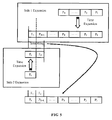
- FIG 5 illustrates the operations of lost packet concealment by time expansion through WSOLA algorithm in accordance with one embodiment of the present invention.
- FIG 6 is a flow-chart of decision making for lost packet concealment.
- FIG 7 shows an exemplary multi-band audio streaming system with lost packet concealment feature in accordance with the present invention.
- FIG 8 shows one exemplary configuration of the error concealment 735 of FIG 7 by incorporating the features of FIG 5 and FIG 6.
- the present invention provides a system and method employing Multi-band Time Expansion for lost packet concealment in streaming audio applications.
- the present invention derives from the realization of the broadband characteristics of high quality audio.
- the present invention further provides some techniques to reduce computational power requirement, making it more feasible for practical implementation.
- FIG 1 shows as an example of time scale expansion the waveforms of one input audio signal and one output audio signal after time scale expansion of the input audio signal.
- WOLA Waveform Similarity Overlap-Add
- the basic principle of the WSOLA algorithm is very straightforward.
- the WSOLA method is based on constructing a synthetic waveform that maintains maximal local similarity to the original signal.
- the synthetic waveform y(n) and original waveform x(n) have maximal similarity around time instances specified by a time warping function. Simply put, the original signal is first divided into two overlapping segments. Then by altering the length of the overlapping segments, the resulting output duration is changed.
- x(n) be the input speech signal to be modified
- y(n) the time-scale modified signal
- ⁇ be the time-scaling parameter. If ⁇ is less than 1 then the speech signal is expanded in time. If ⁇ is greater than 1 then the speech signal is compressed in time.
- FIG 2 there is provided a brief description of how these overlap-add techniques are used for time-expansion signals.
- overlapping segments S k are extracted from the input signal at time instance x k and are superimposed with less overlap in the output at time instance y k .
- the output is obtained by adding two half segments of length ⁇ y .
- a Hanning window is used to weigh the two segments before the summation.
- the Overlap-Add output is now another sine wave with the same pitch.
- the output pitch is intact.
- phase discontinuities arise if the two segments being superimposed are not in phase with each other. Therefore, the values x k have to be selected carefully. The appropriate positions for x k are determined by finding the maximum across correlation within a search window.
- FIG 3 there is provided the determination of positions of x k by cross correlation.
- the cross correlation between the two half segments to be superimposed is computed.
- the best position for x k is located by moving x k within the search window [i min , i max ] and finding the maximum cross correlation.
- the search window length has to cover at least one pitch period of the signal.
- the search window length is also limited by the computational resource available in real time applications. Therefore, it is normally impractical to obtain the perfectly synchronized segments.
- FIG 4 there is provided an illustration of the operations of Multi-band Time Expansion.
- the input signal is separated into two bands by digital filtering. It is to be appreciated that the input signal may be divided into more than two bands depending on the computational constraints.
- the low pass filtered and high pass filtered signals go through separate correlation search procedures and different sets of best matched positions ⁇ ⁇ are used for time expansion.
- the Correlation Search uses different search window ranges [i min , i max, ] search steps and initial values for different bands, which makes the searching procedure more efficient.
- the separately time expanded low band and high band are then combined to obtain the full band time expanded output.
- the digital filter coefficients can be easily computed with Matlab tools.
- FIG 5 illustrates how the Multi-band Time Expansion can be used to conceal lost packets in audio transmission.
- a two-side time expansion method is employed.
- P1, P2, ..., PB are B data packets correctly received before the lost packets and Pc is the current correctly received packet.
- the B packets are stretched to length of (B+L)*P+F1, where P is the packet size, L is the number of continuously lost packets and F1 is the number of additional samples to be used for smoothing operation.
- the current correctly received packet Pc is stretched to the length of (P+F2), where F2 is the number of additional samples to be used for smoothing operation.
- OLAs are a way of smoothly combining two signals that overlap at one edge.
- the signals are weighted by windows and then added (mixed) together.
- the windows are so designed that the sum of the weights at any particular sample is equal to 1. That is, no gain or attenuation is applied to the overall sum of the signals.
- the windows are so designed that the signal on the left starts out at weight 1 and gradually fades out to 0, while the signal on the right starts out at weight 0 and gradually fades in to weight 1.
- FIG 6 is a flow-chart of decision making for lost packet concealment.
- the parameter count_loss is to count the number of continuously lost packets and it is initialized to zero at the beginning 610. Packets in the buffer are numbered 1, 2,..., B, with index 1 for the earliest packet.
- the system waits for the time to expire for checking each batch of packets 620, it will check whether the current packet is lost or not 630. If the current packet is lost, count_loss is incremented by 1 and the packet numbered count_loss in the buffer is played 640.
- the system will continue to check whether the previous packet is lost or not 650. If the previous packet is not lost, it means that both the current packet and the previous packet are received successfully, count_loss is reset to zero, the earliest packet in the buffer is played and the current packet is appended to the buffer 680. If the previous packet is lost while the current packet is received correctly, the Multi-band Time Expansion will conceal the L previously lost packets in ways detailed in FIG 5. Low power consumption considerations demand to use Multi-band Time Expansion only when the error rate is high.
- the threshold E is used to decide whether to use single-band or multi-band time expansion methods. Depending on the trade off between audio quality and power consumption, the threshold E is selected accordingly.
- the system will check whether the count_loss is more or less than the threshold E as selected by the user 660. If the count_loss is more than the threshold E, the input audio signal will be separated into two or more bands to conceal previously lost packets, and then the output packet is numbered 1 in buffer and the count_loss is set to 0 690. If the count_loss is less than the threshold E, the input audio signal will be treated as a single band to conceal previously lost packets, and then the output packet is numbered 1 in buffer and the count_loss is set to 0 670.
- the present invention further provides means to save power consumption and computational constraints.
- the values obtained in the previous time expansion process can be used as reference/starting points for current time expansion. This helps to reduce the correlation search window, effectively bringing down the computational requirement.
- the parameters for one band can be used as a starting reference for the next band.
- the final correlated point of the previous band may be used as the starting point for the search for the correlation of a new band.
- the present invention provides an audio streaming system with the Multi-band Time Expansion algorithm.
- the audio streaming system comprises a transmitter 710, a communication channel 720, and a receiver 730.
- the transmitter 710 includes an audio encoder 711, a packetization means 712, a channel encoder 713, and a modulator 714.
- the receiver 130 includes a demodulator 731, a channel decoder 732, a de-packetization means 733, a audio decoder 734, and an error concealment module 735. All the components of the audio streaming system 700 are standard items except the error concealment module 135 to be discussed later.
- the audio encoder 711 may be a source coder for reducing the raw multimedia bit rate.
- the source coder is comprised of a plurality of subband source coders, one for every multimedia type. Many subband coders are known and appreciated by those skilled in the art.
- each packet has at least a header and one or more informational fields.
- a packet may be of fixed or variable length.
- the header of a packet contains a field called sequence number.
- the header of a packet also contains a field describing the number of information fields that it contains and their importance.
- the channel encoder performs channel coding to accommodate the imperfect or packet losing nature of channels.
- the error concealment module 735 includes a time-expansion unit with a Multi-band Time Expansion algorithm, a decision-making unit and a packet buffer.
- the exemplary configuration of the time-expansion unit and the decision-making unit is shown in FIG 8.
- the packet buffer within the receiver is operably coupled to receive a sequence of incoming packets from the transmitter.
- the decision-making unit is operably coupled to the packet buffer.
- the decision-making unit extracts the sequence number present in the header of every packet and detects, first, whether packets have arrived in order, and, second, the presence of packet loss. When the packets are played, the decision-making unit will instruct the time-expansion unit to conceal any lost packets.
- the audio streaming system of the present invention may implement the Multi-band Time Expansion algorithm in embedded systems or computers.
- the system stores correctly received packets in a buffer, depending on the amount of available memory.
- the operation comprises the following steps: storing correctly received packets in a buffer, wherein the number of buffered packets can be selected based on the amount of available memory; activating the lost packet concealment algorithm; deciding when to use what time expansion algorithm; and executing the chosen time expansion algorithm. For example, if the multi-band time expansion technique is used to conceal lost packets, the operations as detailed in FIG 5 are executed.
- time expansion operations include time expanding the buffered B data packets to length of (B+L)*P+F1; time-expanding the currently received packet to length of (P+F2); merging these two data chunks into one of length (B+L+1)*P using fade-out and fade-in processing.
- the time expansion operation can be further decomposed into the following steps: separating the incoming signal into different frequency bands; for each signal path, using correlation search to determine best matched positions and stretching the signal with overlap-add method.
Landscapes
- Engineering & Computer Science (AREA)
- Computational Linguistics (AREA)
- Signal Processing (AREA)
- Health & Medical Sciences (AREA)
- Audiology, Speech & Language Pathology (AREA)
- Human Computer Interaction (AREA)
- Physics & Mathematics (AREA)
- Acoustics & Sound (AREA)
- Multimedia (AREA)
- Quality & Reliability (AREA)
- Data Exchanges In Wide-Area Networks (AREA)
Applications Claiming Priority (1)
| Application Number | Priority Date | Filing Date | Title |
|---|---|---|---|
| SG200500303A SG124307A1 (en) | 2005-01-20 | 2005-01-20 | Method and system for lost packet concealment in high quality audio streaming applications |
Publications (2)
| Publication Number | Publication Date |
|---|---|
| EP1684267A2 true EP1684267A2 (fr) | 2006-07-26 |
| EP1684267A3 EP1684267A3 (fr) | 2007-11-28 |
Family
ID=35998492
Family Applications (1)
| Application Number | Title | Priority Date | Filing Date |
|---|---|---|---|
| EP06250284A Withdrawn EP1684267A3 (fr) | 2005-01-20 | 2006-01-19 | Procédé et système de dissimulation de paquets perdus dans une transmission audio par flux |
Country Status (3)
| Country | Link |
|---|---|
| US (1) | US8165128B2 (fr) |
| EP (1) | EP1684267A3 (fr) |
| SG (1) | SG124307A1 (fr) |
Cited By (6)
| Publication number | Priority date | Publication date | Assignee | Title |
|---|---|---|---|---|
| WO2008022207A3 (fr) * | 2006-08-15 | 2008-04-24 | Broadcom Corp | distorsion temporelle d'un signal audio décodé après une perte de paquets |
| RU2414010C2 (ru) * | 2006-08-22 | 2011-03-10 | Квэлкомм Инкорпорейтед | Трансформация шкалы времени кадров в широкополосном вокодере |
| CN101375330B (zh) * | 2006-08-15 | 2012-02-08 | 美国博通公司 | 丢包后解码音频信号的时间扭曲的方法 |
| CN101325537B (zh) * | 2007-06-15 | 2012-04-04 | 华为技术有限公司 | 一种丢帧隐藏的方法和设备 |
| US9478220B2 (en) | 2006-11-30 | 2016-10-25 | Samsung Electronics Co., Ltd. | Frame error concealment method and apparatus and error concealment scheme construction method and apparatus |
| WO2017153006A1 (fr) * | 2016-03-07 | 2017-09-14 | Fraunhofer-Gesellschaft zur Förderung der angewandten Forschung e.V. | Procédé de dissimulation hybride : combinaison de dissimulation de perte de paquet du domaine fréquentiel et temporel dans des codecs audio |
Families Citing this family (19)
| Publication number | Priority date | Publication date | Assignee | Title |
|---|---|---|---|---|
| CN101873266B (zh) * | 2004-08-30 | 2015-11-25 | 高通股份有限公司 | 用于语音ip传输的自适应去抖动缓冲器 |
| US8085678B2 (en) * | 2004-10-13 | 2011-12-27 | Qualcomm Incorporated | Media (voice) playback (de-jitter) buffer adjustments based on air interface |
| US8355907B2 (en) * | 2005-03-11 | 2013-01-15 | Qualcomm Incorporated | Method and apparatus for phase matching frames in vocoders |
| US8155965B2 (en) * | 2005-03-11 | 2012-04-10 | Qualcomm Incorporated | Time warping frames inside the vocoder by modifying the residual |
| JP2007114417A (ja) * | 2005-10-19 | 2007-05-10 | Fujitsu Ltd | 音声データ処理方法及び装置 |
| CN100578618C (zh) * | 2006-12-04 | 2010-01-06 | 华为技术有限公司 | 一种解码方法及装置 |
| CN101321033B (zh) * | 2007-06-10 | 2011-08-10 | 华为技术有限公司 | 帧补偿方法及系统 |
| CN100524462C (zh) | 2007-09-15 | 2009-08-05 | 华为技术有限公司 | 对高带信号进行帧错误隐藏的方法及装置 |
| US8706479B2 (en) * | 2008-11-14 | 2014-04-22 | Broadcom Corporation | Packet loss concealment for sub-band codecs |
| US20100169105A1 (en) * | 2008-12-29 | 2010-07-01 | Youngtack Shim | Discrete time expansion systems and methods |
| US8321216B2 (en) * | 2010-02-23 | 2012-11-27 | Broadcom Corporation | Time-warping of audio signals for packet loss concealment avoiding audible artifacts |
| ES3017132T3 (en) * | 2012-06-08 | 2025-05-12 | Samsung Electronics Co Ltd | Method and apparatus for concealing frame error and method and apparatus for audio decoding |
| CN107731237B (zh) | 2012-09-24 | 2021-07-20 | 三星电子株式会社 | 时域帧错误隐藏设备 |
| CN103714821A (zh) | 2012-09-28 | 2014-04-09 | 杜比实验室特许公司 | 基于位置的混合域数据包丢失隐藏 |
| ES2635555T3 (es) | 2013-06-21 | 2017-10-04 | Fraunhofer-Gesellschaft zur Förderung der angewandten Forschung e.V. | Aparato y método para el desvanecimiento de señales mejorado en diferentes dominios durante el ocultamiento de errores |
| US10553230B2 (en) * | 2015-11-09 | 2020-02-04 | Sony Corporation | Decoding apparatus, decoding method, and program |
| JP2018166313A (ja) * | 2017-03-28 | 2018-10-25 | 富士通株式会社 | 異常検出プログラム、異常検出装置及び異常検出方法 |
| EP3553777B1 (fr) * | 2018-04-09 | 2022-07-20 | Dolby Laboratories Licensing Corporation | Dissimulation de perte de paquets à faible complexité pour des signaux audio transcodés |
| CN113612808B (zh) * | 2021-10-09 | 2022-01-25 | 腾讯科技(深圳)有限公司 | 音频处理方法、相关设备、存储介质及程序产品 |
Family Cites Families (10)
| Publication number | Priority date | Publication date | Assignee | Title |
|---|---|---|---|---|
| US4698842A (en) * | 1985-07-11 | 1987-10-06 | Electronic Engineering And Manufacturing, Inc. | Audio processing system for restoring bass frequencies |
| US4845562A (en) * | 1988-06-10 | 1989-07-04 | Rca Licensing Corporation | Widescreen television reception and recording system utilizing conventional equipment |
| US5930373A (en) * | 1997-04-04 | 1999-07-27 | K.S. Waves Ltd. | Method and system for enhancing quality of sound signal |
| US7545854B1 (en) * | 1998-09-01 | 2009-06-09 | Sirf Technology, Inc. | Doppler corrected spread spectrum matched filter |
| US6285767B1 (en) * | 1998-09-04 | 2001-09-04 | Srs Labs, Inc. | Low-frequency audio enhancement system |
| KR100684054B1 (ko) * | 1998-09-08 | 2007-02-16 | 코닌클리케 필립스 일렉트로닉스 엔.브이. | 오디오 시스템의 베이스 강화 수단 |
| SE517156C2 (sv) * | 1999-12-28 | 2002-04-23 | Global Ip Sound Ab | System för överföring av ljud över paketförmedlade nät |
| US7069208B2 (en) * | 2001-01-24 | 2006-06-27 | Nokia, Corp. | System and method for concealment of data loss in digital audio transmission |
| US6789123B2 (en) * | 2001-12-28 | 2004-09-07 | Microsoft Corporation | System and method for delivery of dynamically scalable audio/video content over a network |
| US7137626B2 (en) * | 2002-07-29 | 2006-11-21 | Intel Corporation | Packet loss recovery |
-
2005
- 2005-01-20 SG SG200500303A patent/SG124307A1/en unknown
-
2006
- 2006-01-10 US US11/329,382 patent/US8165128B2/en not_active Expired - Fee Related
- 2006-01-19 EP EP06250284A patent/EP1684267A3/fr not_active Withdrawn
Non-Patent Citations (4)
| Title |
|---|
| FARBER N ET AL: "Adaptive playout scheduling and loss concealment for voice communication over ip networks" IEEE TRANSACTIONS ON MULTIMEDIA, IEEE SERVICE CENTER, PISCATAWAY, NJ, US, vol. 5, no. 4, December 2003 (2003-12), pages 482-493, XP011103230 ISSN: 1520-9210 * |
| SANNECK H ET AL: "A new technique for audio packet loss concealment" GLOBAL TELECOMMUNICATIONS CONFERENCE, 1996. GLOBECOM '96. 'COMMUNICATIONS: THE KEY TO GLOBAL PROSPERITY LONDON, UK 18-22 NOV. 1996, NEW YORK, NY, USA,IEEE, US, 18 November 1996 (1996-11-18), pages 48-52, XP010220171 ISBN: 0-7803-3336-5 * |
| SPLEESTERS, VERHELST, WAHL: "On the application of automatic waveform editing for time warping digital and analog recordings" PREPRINTS OF THE AUDIO ENGINEERING CONVENTION, 96TH CONVENTION, no. 3843, 26 February 1994 (1994-02-26), - 1 March 1994 (1994-03-01) pages 1-11, XP007903229 Amsterdam * |
| TAN R K C ET AL: "A TIME-SCALE MODIFICATION ALGORITHM BASED ON THE SUBBAND TIME-DOMAIN TECHNIQUE FOR BROAD-BAND SIGNAL APPLICATIONS" JOURNAL OF THE AUDIO ENGINEERING SOCIETY, AUDIO ENGINEERING SOCIETY, NEW YORK, NY, US, vol. 48, no. 5, May 2000 (2000-05), pages 437-449, XP001043754 ISSN: 1549-4950 * |
Cited By (21)
| Publication number | Priority date | Publication date | Assignee | Title |
|---|---|---|---|---|
| US8024192B2 (en) | 2006-08-15 | 2011-09-20 | Broadcom Corporation | Time-warping of decoded audio signal after packet loss |
| WO2008022176A3 (fr) * | 2006-08-15 | 2008-05-08 | Broadcom Corp | Dissimulation de perte de paquets pour codage prédictif de sous-bande à base d'extrapolation de guide d'ondes audio pleine bande |
| KR101046982B1 (ko) * | 2006-08-15 | 2011-07-07 | 브로드콤 코포레이션 | 전대역 오디오 파형의 외삽법에 기초한 부분대역 예측코딩에 대한 패킷 손실 은닉 기법 |
| US8000960B2 (en) | 2006-08-15 | 2011-08-16 | Broadcom Corporation | Packet loss concealment for sub-band predictive coding based on extrapolation of sub-band audio waveforms |
| US8005678B2 (en) | 2006-08-15 | 2011-08-23 | Broadcom Corporation | Re-phasing of decoder states after packet loss |
| US8041562B2 (en) | 2006-08-15 | 2011-10-18 | Broadcom Corporation | Constrained and controlled decoding after packet loss |
| US8078458B2 (en) | 2006-08-15 | 2011-12-13 | Broadcom Corporation | Packet loss concealment for sub-band predictive coding based on extrapolation of sub-band audio waveforms |
| CN101375330B (zh) * | 2006-08-15 | 2012-02-08 | 美国博通公司 | 丢包后解码音频信号的时间扭曲的方法 |
| WO2008022207A3 (fr) * | 2006-08-15 | 2008-04-24 | Broadcom Corp | distorsion temporelle d'un signal audio décodé après une perte de paquets |
| US8195465B2 (en) | 2006-08-15 | 2012-06-05 | Broadcom Corporation | Time-warping of decoded audio signal after packet loss |
| US8214206B2 (en) | 2006-08-15 | 2012-07-03 | Broadcom Corporation | Constrained and controlled decoding after packet loss |
| RU2414010C2 (ru) * | 2006-08-22 | 2011-03-10 | Квэлкомм Инкорпорейтед | Трансформация шкалы времени кадров в широкополосном вокодере |
| US8239190B2 (en) | 2006-08-22 | 2012-08-07 | Qualcomm Incorporated | Time-warping frames of wideband vocoder |
| US9478220B2 (en) | 2006-11-30 | 2016-10-25 | Samsung Electronics Co., Ltd. | Frame error concealment method and apparatus and error concealment scheme construction method and apparatus |
| US9858933B2 (en) | 2006-11-30 | 2018-01-02 | Samsung Electronics Co., Ltd. | Frame error concealment method and apparatus and error concealment scheme construction method and apparatus |
| US10325604B2 (en) | 2006-11-30 | 2019-06-18 | Samsung Electronics Co., Ltd. | Frame error concealment method and apparatus and error concealment scheme construction method and apparatus |
| US8355911B2 (en) | 2007-06-15 | 2013-01-15 | Huawei Technologies Co., Ltd. | Method of lost frame concealment and device |
| CN101325537B (zh) * | 2007-06-15 | 2012-04-04 | 华为技术有限公司 | 一种丢帧隐藏的方法和设备 |
| WO2017153006A1 (fr) * | 2016-03-07 | 2017-09-14 | Fraunhofer-Gesellschaft zur Förderung der angewandten Forschung e.V. | Procédé de dissimulation hybride : combinaison de dissimulation de perte de paquet du domaine fréquentiel et temporel dans des codecs audio |
| KR20180118781A (ko) * | 2016-03-07 | 2018-10-31 | 프라운호퍼 게젤샤프트 쭈르 푀르데룽 데어 안겐반텐 포르슝 에. 베. | 하이브리드 은닉 방법: 오디오 코덱들에서 주파수 및 시간 도메인 패킷 손실 은닉의 결합 |
| US10984804B2 (en) | 2016-03-07 | 2021-04-20 | Fraunhofer-Gesellschaft Zur Foerderung Der Angewandten Forschung E.V. | Hybrid concealment method: combination of frequency and time domain packet loss concealment in audio codecs |
Also Published As
| Publication number | Publication date |
|---|---|
| SG124307A1 (en) | 2006-08-30 |
| US8165128B2 (en) | 2012-04-24 |
| US20060184861A1 (en) | 2006-08-17 |
| EP1684267A3 (fr) | 2007-11-28 |
Similar Documents
| Publication | Publication Date | Title |
|---|---|---|
| US8165128B2 (en) | Method and system for lost packet concealment in high quality audio streaming applications | |
| US7596488B2 (en) | System and method for real-time jitter control and packet-loss concealment in an audio signal | |
| US7337108B2 (en) | System and method for providing high-quality stretching and compression of a digital audio signal | |
| US7590531B2 (en) | Robust decoder | |
| EP1088205B1 (fr) | Techniques ameliorees de recuperation de trames perdues pour systemes parametriques a codage predictif de la parole | |
| EP1086451B1 (fr) | Procede destine a effectuer un masquage de pertes de trames | |
| US8045571B1 (en) | Adaptive jitter buffer-packet loss concealment | |
| US7447639B2 (en) | System and method for error concealment in digital audio transmission | |
| US20050055201A1 (en) | System and method for real-time detection and preservation of speech onset in a signal | |
| US20030033140A1 (en) | Time-scale modification of signals | |
| US20110208517A1 (en) | Time-warping of audio signals for packet loss concealment | |
| US20020097807A1 (en) | Wideband signal transmission system | |
| US6873954B1 (en) | Method and apparatus in a telecommunications system | |
| WO2006130293A2 (fr) | Lecture a vitesse variable de donnes audionumeriques | |
| US7627467B2 (en) | Packet loss concealment for overlapped transform codecs | |
| JPH07334191A (ja) | パケット音声復号方法 | |
| KR100792209B1 (ko) | 디지털 오디오 패킷 손실을 복구하기 위한 방법 및 장치 | |
| Gueham et al. | An enhanced interleaving frame loss concealment method for voice over IP network services | |
| JP2005107283A (ja) | VoIP音声通信におけるパケット損失隠蔽方法、装置およびプログラム | |
| JPH0777999A (ja) | 音声時間軸圧縮伸長方法 | |
| Floros et al. | Frequency-domain stochastic error concealment for wireless audio applications | |
| Bhute et al. | Adaptive Playout Scheduling and Packet Loss Concealment Based on Time-Scale Modification for Voice Transmission over IP | |
| Gokhale | Packet loss concealment in voice over the Internet | |
| Bhute et al. | Error concealment schemes for speech packet transmission over IP network | |
| Westerlund | Media-specific Forward Error Correction in a CELP Speech Codec Applied to IP Networks |
Legal Events
| Date | Code | Title | Description |
|---|---|---|---|
| PUAI | Public reference made under article 153(3) epc to a published international application that has entered the european phase |
Free format text: ORIGINAL CODE: 0009012 |
|
| AK | Designated contracting states |
Kind code of ref document: A2 Designated state(s): AT BE BG CH CY CZ DE DK EE ES FI FR GB GR HU IE IS IT LI LT LU LV MC NL PL PT RO SE SI SK TR |
|
| AX | Request for extension of the european patent |
Extension state: AL BA HR MK YU |
|
| PUAL | Search report despatched |
Free format text: ORIGINAL CODE: 0009013 |
|
| AK | Designated contracting states |
Kind code of ref document: A3 Designated state(s): AT BE BG CH CY CZ DE DK EE ES FI FR GB GR HU IE IS IT LI LT LU LV MC NL PL PT RO SE SI SK TR |
|
| AX | Request for extension of the european patent |
Extension state: AL BA HR MK YU |
|
| RIC1 | Information provided on ipc code assigned before grant |
Ipc: G10L 21/04 20060101ALI20071024BHEP Ipc: G10L 19/00 20060101AFI20060331BHEP |
|
| AKX | Designation fees paid | ||
| REG | Reference to a national code |
Ref country code: DE Ref legal event code: 8566 |
|
| STAA | Information on the status of an ep patent application or granted ep patent |
Free format text: STATUS: THE APPLICATION IS DEEMED TO BE WITHDRAWN |
|
| 18D | Application deemed to be withdrawn |
Effective date: 20080529 |