EP1685263B1 - Procede de production d'un composant a matrice metallique et a renforcement par des fibres ou des particules - Google Patents
Procede de production d'un composant a matrice metallique et a renforcement par des fibres ou des particules Download PDFInfo
- Publication number
- EP1685263B1 EP1685263B1 EP03773705A EP03773705A EP1685263B1 EP 1685263 B1 EP1685263 B1 EP 1685263B1 EP 03773705 A EP03773705 A EP 03773705A EP 03773705 A EP03773705 A EP 03773705A EP 1685263 B1 EP1685263 B1 EP 1685263B1
- Authority
- EP
- European Patent Office
- Prior art keywords
- matrix material
- fibers
- temperature
- particles
- coating
- Prior art date
- Legal status (The legal status is an assumption and is not a legal conclusion. Google has not performed a legal analysis and makes no representation as to the accuracy of the status listed.)
- Expired - Lifetime
Links
Images

Classifications
-
- C—CHEMISTRY; METALLURGY
- C22—METALLURGY; FERROUS OR NON-FERROUS ALLOYS; TREATMENT OF ALLOYS OR NON-FERROUS METALS
- C22C—ALLOYS
- C22C47/00—Making alloys containing metallic or non-metallic fibres or filaments
- C22C47/08—Making alloys containing metallic or non-metallic fibres or filaments by contacting the fibres or filaments with molten metal, e.g. by infiltrating the fibres or filaments placed in a mould
- C22C47/12—Infiltration or casting under mechanical pressure
-
- B—PERFORMING OPERATIONS; TRANSPORTING
- B22—CASTING; POWDER METALLURGY
- B22D—CASTING OF METALS; CASTING OF OTHER SUBSTANCES BY THE SAME PROCESSES OR DEVICES
- B22D17/00—Pressure die casting or injection die casting, i.e. casting in which the metal is forced into a mould under high pressure
- B22D17/007—Semi-solid pressure die casting
-
- B—PERFORMING OPERATIONS; TRANSPORTING
- B22—CASTING; POWDER METALLURGY
- B22D—CASTING OF METALS; CASTING OF OTHER SUBSTANCES BY THE SAME PROCESSES OR DEVICES
- B22D19/00—Casting in, on, or around objects which form part of the product
- B22D19/14—Casting in, on, or around objects which form part of the product the objects being filamentary or particulate in form
-
- C—CHEMISTRY; METALLURGY
- C22—METALLURGY; FERROUS OR NON-FERROUS ALLOYS; TREATMENT OF ALLOYS OR NON-FERROUS METALS
- C22C—ALLOYS
- C22C1/00—Making non-ferrous alloys
- C22C1/12—Making non-ferrous alloys by processing in a semi-solid state, e.g. holding the alloy in the solid-liquid phase
-
- B—PERFORMING OPERATIONS; TRANSPORTING
- B22—CASTING; POWDER METALLURGY
- B22F—WORKING METALLIC POWDER; MANUFACTURE OF ARTICLES FROM METALLIC POWDER; MAKING METALLIC POWDER; APPARATUS OR DEVICES SPECIALLY ADAPTED FOR METALLIC POWDER
- B22F2998/00—Supplementary information concerning processes or compositions relating to powder metallurgy
- B22F2998/10—Processes characterised by the sequence of their steps
Definitions
- particle-reinforced semifinished products are produced with a thixoformable metal matrix and then converted by thixoforming into parts with near-net shape shape.
- MMC materials metal matrix composites
- high-strength reinforcing fibers can increase the lack of high-temperature strength and rigidity of these materials, which is the case for many applications.
- short production cycles and the production of close-to-net shape components should reduce manufacturing costs.
- the powder metallurgical shaping route is basically known by sintering and subsequent pressing, if necessary by hot pressing or hot isostatic pressing (HIP).
- sintering process are very time-consuming and costly and do not allow net-shape molding of complex component geometries.
- considerable residual porosities usually occur, which can adversely affect the properties.
- melt metallurgical and liquid phase impregnations and die casting techniques are generally used.
- the long reaction and contact times of molten metallic phases with the reinforcing fibers and the molds or surfaces cause undesirable damage.
- dissolution and elimination processes as well as chemical interface reactions occur.
- a complex system technology is required, which works with comparatively long cycle times for the shaping.
- working with liquid, chemically highly active light metal melts usually aluminum
- the Thixoumform compiler is basically known in the aforementioned prior art for the transformation of special particle-reinforced alloys, especially aluminum-based. With the known methods, however, it is not possible to produce components which have a near-net shape and which have high strength and can be adapted to specific loads. Also, the production of semi-finished products in the prior art is not disclosed.
- MMC embedded fibers or particles
- the method should also allow the most cost-effective and energy-saving production of components that are molded close to production (net-shape-molding).
- a two-phase or multi-phase region in which a liquid phase fraction is present is utilized.
- a pronounced solidification interval of the alloy to be formed is required, ie a temperature range in which both solid and liquid phase components are present next to one another (cf. Fig. 1 ).
- thixo-forming for the production of composite materials reinforced by embedded fibers allows significantly improved properties to be achieved.
- coated fiber composites are used for producing the semifinished product, particularly advantageous properties of the parts produced therefrom result.
- a better homogeneity results in comparison to individual layers of fiber composites and matrix material.
- Another advantage is the significantly lower temperature compared to the use of melt processes or melt infiltration processes and the significantly reduced shaping time. In this way it is possible to dispense with the coating of the stored fibers or particles, since the embedded fibers are hardly damaged by the short melting process at a relatively low temperature.
- an alternating layer structure of the semifinished product allows significantly shorter infiltration paths of the melt to be achieved.
- significantly improved tool life results, which leads to significant cost savings, for example compared to the squeeze casting. It can achieve fast process times in the range of milliseconds compared to several seconds for squeeze casting and several hours for diffusion bonding.
- the shaping in a temperature range below the squeeze casting achieves energy savings of a corresponding size. Due to the reduced liquid phase content during shaping, a shortening of the solidification time in the tool and thus a reduction of the cycle time is made possible.
- the entire melting operation (melting furnace, alloying furnace, degassing, alloying control, casting furnace) can be dispensed with. Furthermore, owing to the modified tool concept, significantly less circuit material accumulates, which must be remelted before re-introduction into the production process.
- the Strength of the matrix material by a suitable heat treatment in particular by solution annealing and aging to increase.
- the term “semifinished product” is understood to mean the preform, which is subsequently formed by thixoforming within the tool to form the component.
- This semifinished product may be a prepreg consisting of a single or preferably of several laminate layers.
- semifinished products are therefore always understood to mean the generic term which includes a prepreg and other preforms prepared in another way, which are manufactured inside the tool by thixotropic forming of the component.
- a prepreg is produced by laminating layers of coated fiber composites and matrix material in the form of sheets.
- layers of coated fiber composites are preferably joined together alternately with the suitable metal sheets by lamination in order to provide the desired shape of the semifinished product.
- Thixoumformung provides the provision of the matrix material in the form of sheets, sufficiently short flow paths and yet to ensure even wetting of the trapped fibers or particles.
- the sheets are provided in the form of cold-rolled sheets.
- the sheets are provided in the form of cold-rolled sheets.
- a fine-grained recrystallization with a globular structure occurs, which has a favorable effect on the resulting properties of the component.
- the coating of the fiber composite with the metallic matrix material can be carried out according to a first process variant by a screen printing process.
- Another variant of the method for coating a fiber composite with the metallic matrix material consists in an application by electrostatic charging.
- Another method variant for coating a fiber composite with a metallic matrix material consists in an electrophoretic deposition (EPD) of an aqueous suspension with the assistance of an electric field.
- EPD electrophoretic deposition
- the fiber structure to be coated is connected electrically conductively as an electrode and the charge-carrying metal powder particles are driven by the electric field deposited on the fiber or fabric surface as a uniform layer.
- Such process control is particularly useful with fiber composites that are inherently electrically conductive, such as C fibers.
- other fibers which are not readily electrically conductive can also be processed using suitable intermediate layers.
- metal particles are preferably used which have a particle size with a diameter between 10 nm and 100 microns, preferably with sizes between 100 nm and 10 microns.
- targeted charge distributions of the solid particles in the suspension can be set, which permit a concentration and field strength-dependent mass transport for layer deposition. In this way, the properties of the subsequently produced component can be varied within wide limits and adapted to the respective requirements.
- a Fa serverbund is coated by thermal spraying with the metallic matrix material.
- thermal spraying is basically atmospheric Plasma spraying (APS), electric wire spraying, wire flame spraying or high-speed flame spraying in question.
- the thermal spraying is preferably carried out by electric arc wire spraying or powder plasma spraying, in particular by atmospheric plasma spraying.
- Fiber composites which are provided with thermally sprayed metal layers, offer the advantage of a finer grained structure compared to the use of alternating layers of sheets and fiber composites. While the grain sizes of thixotropically deformable Al-Si sheets are in the range of 2 to 20 ⁇ m, the dimensions of the individual phases in the thermally sprayed AlSi layer structure are in the sub-micron range due to the high cooling rate during layer application. As a result, an improved impregnability of the metallic phase in the fiber skeleton can be achieved in the thixotropic deformation.
- the volume ratio of matrix material to fibers is preferably set between 0.3 and 8.0, in particular between 0.8 and 3.0, during thermal spraying.
- the fiber composite is preferably cooled during thermal spraying, in particular using liquid carbon dioxide.
- the fiber composite is held under tension during thermal spraying on a carrier device.
- composites can be produced in this way, in which stored long fibers are subjected to tensile stress under load, without the matrix itself being claimed in an undesired manner beforehand.
- the carrier device can promote fiber composite in allow continuously or in clock mode in a coating layer for thermal spray coating.
- the fiber composite can be guided via a winding device.
- a spray distance of 50 to 200 mm is maintained between the surface of the fiber composite and the nozzle exit during the coating by plasma spraying, while in a coating by electric arc spraying a spray distance of 80 to 300 mm is maintained.
- a mixture of the matrix material and of short fibers is granulated or pelletized.
- the volume ratio of matrix material to fibers in this case is preferably between 0.3 and 5, preferably between 1 and 2.
- a mixture of the matrix material and powdered particles is granulated or pelletized.
- the production of granules or pellets using short fibers or powdery particles can be advantageously used to produce special graded layers or to produce, for example, bearing materials.
- the mixture produced by granulation or pelletizing is applied to a fiber composite by a suitable coating method.
- a suitable coating method for this purpose, in turn, the thermal spraying, a screen printing or other previously mentioned method can be used.
- Long fibers in this context are understood to mean a fiber length of at least 1 mm or an aspect ratio (ratio of length to diameter) of the fiber of at least 50, preferably of at least 100, particularly preferably of at least 150.
- the layer sequence in the lamination of prepregs can be varied in a suitable manner in order to influence the properties of the component to be produced in a targeted manner.
- fibrous composites of long fibers coated with matrix material can be laminated together in a suitable manner.
- layers of matrix material in the form of sheets or foils can be inserted.
- intermediate layers of granules or pellets can be inserted.
- the combination of coated fiber composites with preforms made from pelletizing or granulating blends of matrix material and short fibers or particles is also conceivable.
- a prepreg produced by laminating is provided with an outer layer of matrix material.
- the surface of the manufactured component is largely free of embedded fibers or particles.
- fiber composites can be used in a variety of forms to ensure certain properties of the manufactured component.
- fiber composites can be used as a clutch of unidirectional long fibers (UD), it can spin nonwovens ("unwoven") or woven fiber composites in the form of 2D fiber composites, 3D fiber composites, in the form of knitted or crocheted used.
- the semifinished product can be produced from graded layers, in order to achieve a specific influencing of the properties at particularly stressed areas of the component or in preferred stress directions.
- the ratio of matrix material to fibers can be selectively changed over the component cross-section.
- aluminum alloys or copper alloys are preferably used, in particular alloys which consist of the main components aluminum, magnesium and copper or which consist of the main components copper and tin or zinc.
- the matrix material alloys consist of alloys of the type AlMg4.5Mn0.4 (AA 5182), of the type AlMgSi1 (EN AW-6082), of the type AlSi7Mg (EN AW-356, EN-AW-357), of the type AlSi3 (AA 208, AA 296), of the type AlSi12 (AA 336, AA 384), of the type CuZn40A12 or of the type CuSn13, 5A10.3.
- the matrix material alloys consist of alloys of the type AlMg4.5Mn0.4 (AA 5182), of the type AlMgSi1 (EN AW-6082), of the type AlSi7Mg (EN AW-356, EN-AW-357), of the type AlSi3 (AA 208, AA 296), of the type AlSi12 (AA 336, AA 384), of the type CuZn40A12 or of the type CuSn13, 5A10.3.
- the metallic matrix material itself is reinforced by embedded particles which are preferably formed as oxide ceramics, as carbides, as nitrides, as metals or alloys or as tribologically active substances.
- Fiber reinforcement of the MMC according to the invention fibers are used, which consist of carbon, silicon carbide, alumina, mullite. Also, modifications of these fibers with nitrogen, titanium, boron, carbon or silicon and their compounds are conceivable.
- coated fibers can also be used on their surface according to a further process variant, in particular fibers provided with diffusion barrier or protective layers or fibers provided with adhesion promoter layers.
- the properties of the component to be manufactured can be adapted to the respective requirements to an even greater extent.
- Adhesives the interfacial adhesion between embedded fibers and the metallic matrix phase can be improved.
- fibers which are less compatible with the matrix phase used can also be incorporated.
- Silicon carbide, silicon nitride, titanium carbide, titanium nitride, carbon or mixed phases or compounds thereof are particularly suitable for coating the fibers.
- fibers are preferably used with a diameter between 0.5 and 150 .mu.m, more preferably between 5 and 20 microns.
- the fibers can be used both as long fibers or continuous fibers and in the form of short fibers ("chopped fibers").
- the semifinished product is heated to a specific temperature interval as a function of the matrix material used, within which the matrix material has a defined liquid phase fraction.
- the semifinished product is heated to a temperature between 574 and 584 ° C. for thixoforming, whereby a liquid phase fraction of between 43 and 51% by volume is established.
- a liquid phase fraction of between 43 and 51% by volume is established.
- the alloy AlMgSi1 is used, heating to a temperature between 635.degree. C. and 645.degree. C. takes place for thixoforming, a liquid phase proportion of between about 15 and 35% being established.
- heating takes place over a temperature range between 871 ° C. and 875 ° C., with a liquid phase fraction of between about 20 and 40%.
- the Thixoumformung is preferably done as Thixoschmieden within a suitable tool (die) with controlled ram speed and pressing force. Tappet speed and pressing force are adapted to the process. Tappet speeds up to 800 mm / s are possible.
- the impact velocity of the tool upper part on the workpiece is preferably set between 10 mm / s and 300 mm / s depending on the used fiber matrix ratio, the component complexity and the component volume.
- the tool is preferably heated to temperatures between 100 ° C and 400 ° C.
- the semifinished product is precompressed in a mold according to a first process variant.
- the mold used here is preferably the tool used later for thixoforming.
- the precompressed semi-finished product can now be preheated outside the tool, which can be done inductively, in a convection oven with inert gas atmosphere, with infrared radiators or with lasers, is then introduced in the preheated state in the tool and then converted thixotropic, in particular thixogeschmiedet.
- the preferred matrix materials allow the semifinished product to be heated up to the temperature necessary for the thixotropic forming while the semifinished product still has sufficient strength, which permits handling of the semifinished product for insertion into the mold, which can happen automatically, for example. Only when the pressure is subsequently applied by thixoforging over the stamp does the semifinished product lose its shear strength, so that the material is formed in a very short time.
- the semifinished products within the tool are heated to a temperature above the solidus line, but below the liquidus line of the matrix material.
- the layered material can be brought by a slight pressure into contact with the mold wall. This improves the heat transfer and thus reduces the heating time.
- the thixotropic transformation takes place, preferably by forging.
- a controlled cooling of the thixotropically deformed component preferably takes place within the tool in order to achieve directional solidification of the metallic matrix.
- composite materials produced in this way can preferably be used as production-shaped (net-shaped) high-strength structural components with high specific rigidity or with a high specific modulus of elasticity.
- Fig. 1 is a phase diagram of the preferred eutectic system Al-Si (with magnesium additives) shown.
- the solid content in the dark hatched area is ⁇ (Al).
- Alloys suitable for thixotropic transformation are wrought alloy AlMgSi1 and casting alloy AlSi7Mg.
- a narrow temperature range is required which lies between the solidus line and the liquidus line for the wrought alloy AlMgSi1 and Fig. 1 is characterized by the rectangular drawn temperature range, which is between 635 and 645 ° C. In this area, the liquid content (L) is 15 to 35%.
- the Thixoumformung of such light metal materials has been developed in particular for the production of molded parts, which have a production-related shaping.
- the semifinished product In the temperature range at which the Thixoumformung takes place, the semifinished product is still present with sufficient strength that allows handling of the semi-finished product (also called "bolt" in thixoforging).
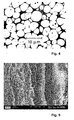
- the alloys in question ideally have a globolithic structure which forms a solid-phase skeleton and thus ensures good handleability of the heated semifinished product when it is placed in the tool (the mold) (cf. Fig. 4 ).
- This solid-phase skeleton breaks up under shear stress and thus ensures a reduction of the yield stress, so that high flow paths in the tool and a near-net shape forming are ensured.
- MMCs are now prepared with a metallic matrix material, which is reinforced by embedded fibers or particles, by preparing a semi-finished product in which the fibers or particles are contained in a metallic matrix material and the semifinished product by thixotropic forming in a tool at a temperature is formed above the solidus temperature and below the liquidus temperature of the metallic matrix material.
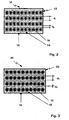
- a semi-finished product designated generally by the numeral 10 is produced by laminating of alternating sheet metal and fiber fabric layers.
- a fiber composite 12 consists for example of carbon fibers, which are arranged in the form of a fabric.
- fiber composite layers 12 are laminated alternately with thin metal sheets 14 of the matrix material, for example AlSi7Mg.
- the thicknesses d 1 of the fiber composites 12 and d 2 of the sheets 14 are adjusted.
- the semifinished product 10 is enclosed by an outer layer 18 of matrix material, in order to ensure that as far as possible no fibers reach the surface of the component during the subsequent thixoforming.
- an outer layer 18 of matrix material such as a semifinished product or prepreg is placed in a suitable die form and reshaped therein in the appropriate temperature range by thixoforging using a plunger.
- precompacting can first be carried out within the tool in a still cold state, and then the semifinished product 10 outside the die mold can be preheated to the temperature necessary for thixotropic deformation.
- This can be carried out inductively or alternatively in a circulating air oven with protective gas atmosphere or with high-power infrared radiators or by means of laser by rapid heating of the precompressed semifinished product.
- a quick transfer takes place in the suitably preheated Gesenkform (100 to 400 ° C). This process can be done manually, semi or fully automated. Then the thixo forging process is carried out.
- the ram meets with process-specifically adapted ram speed of up to 800 mm / s on the surface of the semi-finished product.
- the impact velocity of the ram on the semi-finished product is preferably set between 10 mm / s and 300 mm / s depending on the fiber-matrix ratio, the component complexity and the component volume.
- the plunger is expediently preheated accordingly.
- the heating of the semifinished product can also take place within the die tooling.
- the layered semifinished product can be brought into contact with the tool wall by a slight pressure, which improves the heat transfer and reduces the heating time.
- the thixotropic transformation takes place by thixoforging.
- sheets preferably cold-rolled sheets are used, since the high dislocation density during subsequent rewarming in the course of the thixo-forming results in fine-grained recrystallization with a globular structure.
- a second process variant according to the invention for the production of a semifinished product consists in the coating of individual fiber composites, which are then laminated by superimposing into a prepreg and expediently again surrounded by an outer metal layer or film layer of matrix material.
- a third alternative, which does not lie within the scope of the invention, for producing the semifinished product consists in producing a mixture of short fibers or pulverulent reinforcing particles with metallic matrix powders. This is followed by shaping by dry pressing or further processing, again by application to a fiber composite by a coating process.
- application by electrostatic charging, application by screen printing or electrophoretic deposition (EPD) to the fiber structure is generally suitable for coating the fiber composite.
- an electrically conductive or electrically rendered fiber structure is connected as an electrode, and the charge-carrying metal powder particles are driven by an electric field deposited on the fiber or fabric surface as a uniform layer.
- the metal particles have a particle size with diameters between 10 nm and 100 ⁇ m, preferably with sizes between 100 nm and 10 ⁇ m.
- a particularly preferred coating method is the coating by thermal spraying.
- This is in particular Electro-arc wire spraying and powder plasma spraying, preferably atmospheric plasma spraying (APS) in the foreground.
- APS atmospheric plasma spraying
- a temperature increase of the fiber composite is largely avoided by targeted cooling measures, so that temperatures of at most 100 ° C can be maintained in the rule, and thus damage to the fibers is excluded.
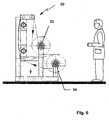
- long or continuous fibers or fiber composites produced therefrom stretched or zugvorgespannt on a suitable support device 30 (see. Fig. 6 ) and applying one or more layers of matrix metal by thermal spraying.
- a winding system 30 according to Fig. 6 can be unwound continuously or intermittently from a roll 34, which contains fiber composite layers to be coated, in a coating plane (left-hand curved surface in FIG Fig. 6 ) and then rewind onto a roll 32 after coating.
- suitable dimensioning and coating thickness in this case firstly a coating can take place on a first upper side and then a coating on the opposite surface.
- a particular advantage lies in the targeted bias of the fabric in the coating plane, which can also be made controllable in order to ensure an equal, permanent bias.
- thermally and convectively generated stresses in the fiber structure are mechanically compensated.
- a 5-axis robotic motion system can be used which moves an arc or plasma torch in a manner such that NC controlled motion sequences can be retrieved from previously stored programs for consistent coating and reproducibly and processably realized .
- spray gaps of 50 to 200 mm between nozzle exit and fiber surface are preferably used between 100 and 140 mm in APS and between 120 and 160 mm in electric arc spraying.
- such layers 22 of fiber composites coated on both sides with matrix metal 24 are laminated together to form a prepreg, and preferably encased externally by a sheet metal 18 of matrix metal so as to produce a semifinished product 20.
- the coating thickness d 3 can be suitably controlled in the previous coating operation. For this purpose, single or multiple layers can be applied and the layer thickness, of course, be influenced by the speed of transit or residence time and the other spray parameters. If larger layers of matrix metal are desired, individual metal sheets or foils can also be interposed.
- mixtures of matrix metal powders and short fibers or reinforcing particle powders are produced. These granulated or pelletized mixtures can then be compacted into a green body by cold pressing, which is then used as a semi-finished product. If the matrix metal has sufficient ductility, cold pressing can take place without pressing aids. If the ductility of the metal matrix material is lower, suitable binder aids (eg paraffin) which volatilise easily during later heating are added.
- suitable binder aids eg paraffin
- Another variant of the method consists in the application of the mixtures produced by granulation or pelletizing by a suitable coating method on fiber composites, which in turn can be done for example by thermal spraying.
- graded layers can be used to produce special component properties which are adapted to specific local thermal or mechanical stresses, for which purpose the entire spectrum in the processing of fiber composites can be utilized.
Landscapes
- Engineering & Computer Science (AREA)
- Mechanical Engineering (AREA)
- Chemical & Material Sciences (AREA)
- Materials Engineering (AREA)
- Metallurgy (AREA)
- Organic Chemistry (AREA)
- Manufacture Of Alloys Or Alloy Compounds (AREA)
Claims (15)
- Procédé de production d'un composant en matériau composite (MMC) à matrice métallique, qui est renforcée par des fibres ou des particules intégrées, comprenant les étapes suivantes :- fabrication d'un semi-produit (10 ; 20), dans lequel sont contenues les fibres (16) ou les particules et la matrice métallique (14 ; 24) et- thixoformage du semi-produit (10 ; 20) dans un outil à une température au-dessus de la température de solidus et en dessous de la température de liquidus de la matrice métallique (14 ; 24),caractérisé en ce que l'étape de la fabrication d'un semi-produit (10 ; 20) comprend un revêtement d'un matériau composite renforcé par des fibres avec la matrice métallique ou avec un mélange granuleux ou de pellets composé de la matrice métallique et de fibres courtes ou de particules poudreuses grâce à un procédé qui est sélectionné dans le groupe constitué par- revêtement du matériau composite renforcé par des fibres par projection thermique, de préférence par projection atmosphérique au plasma (APS), par projection par fils métalliques ou par projection par arc électrique ;- revêtement du matériau composite renforcé par des fibres avec la matrice métallique par un procédé de sérigraphie ;- revêtement du matériau composite renforcé par des fibres avec la matrice métallique par charge électrostatique ;- revêtement du matériau composite renforcé par des fibres avec la matrice métallique par séparation électrophorétique à partir d'une suspension aqueuse assistée d'un champ électrique.
- Procédé selon la revendication 1, caractérisé en ce qu'une succession de couches (12, 14 ; 22) est laminée pour former une feuille pré-imprégnée (10 ; 20), qui contient des matériaux composites renforcés par des fibres (22) revêtus de matrice métallique ou des composites en fibres (22) revêtus de mélanges composés de la matrice métallique et de fibres courtes ou de particules, contenant également des tôles en matrice métallique (14) ou des mélanges composés de la matrice métallique et de fibres courtes ou de particules.
- Procédé selon la revendication 2, caractérisé en ce que les mélanges de la matrice métallique (14) et de fibres courtes ou de particules sont fabriqués par procédés de granulation ou de pelletisation.
- Procédé selon l'une des revendications précédentes, caractérisé en ce que le rapport volumique de la matrice métallique aux fibres est réglé entre 0,3 et 8,0, de préférence entre 0,8 et 3,0.
- Procédé selon l'une des revendications précédentes, caractérisé en ce que, pendant la fabrication du semi-produit, le matériau composite renforcé par des fibres est réchauffé pour une durée de 5 secondes maximum, de préférence de 2 secondes maximum, à une température de 300° C maximum.
- Procédé selon l'une des revendications précédentes, caractérisé en ce que le matériau composite renforcé par des fibres est maintenu par effort de traction pendant la projection thermique sur un dispositif support (30).
- Procédé selon l'une des revendications 3 à 6, caractérisé en ce que l'on utilise, lors de l'étape de la transformation en pellets ou en granulés, des fibres d'une longueur comprise entre 0,5 et 20 mm, de préférence entre 2 et 6 mm, et en ce que l'on utilise de préférence un rapport de volume de matrice métallique par rapport aux fibres situé entre 0,3 et 5, encore mieux entre 1 et 2.
- Procédé selon l'une des revendications précédentes, caractérisé en ce que l'on utilise au moins une couche avec un matériau composite renforcé par des fibres en fibres longues d'une longueur d'au moins un millimètre ou en fibres longues avec un rapport d'aspect (rapport de la longueur au diamètre) d'au moins 50, de préférence d'au moins 100, encore mieux d'au moins 150, pour la fabrication d'une feuille pré-imprégnée.
- Procédé selon l'une des revendications précédentes, caractérisé en ce que l'on utilise comme matrice métallique un alliage d'aluminium ou un alliage de cuivre, en particulier un alliage, qui se compose des éléments principaux d'aluminium, de magnésium et de silicium ou des éléments principaux de cuivre et d'étain ou de zinc, de préférence un alliage qui est sélectionné à partir du groupe constitué par des alliages du type AlMg4, 5Mn0,4, AlMgSil, AlSi7Mg, AlSi3, AlSi12, CuZn40A12 et CuSnl3, SA10,3.
- Procédé selon l'une des revendications précédentes, caractérisé en ce que la matrice métallique est renforcée par des particules intégrées, qui sont constituées de préférence de céramiques oxydées, de carbures, de nitrures, de métaux ou d'alliages ou de matériaux à effet tribologique.
- Procédé selon l'une des revendications précédentes, caractérisé en ce que l'on utilise des fibres, qui se composent de carbone, de carbure de silicium, d'oxyde d'aluminium, de mullite ou contiennent des modifications de ces fibres avec de l'azote, du titane, du bore, du carbone ou du silicium ou de leurs composés, les fibres étant revêtues de préférence à leur surface, en particulier de couches anti-diffusion et de couches de protection ou de couches d'agent adhésif.
- Procédé selon la revendication 11 caractérisé en ce que l'on utilise des fibres revêtues de carbure de silicium, de nitrure de silicium, de carbure de titane, de nitrure de titane, de carbone ou de phases mixtes ou composés à partir de celles-ci.
- Procédé selon l'une des revendications précédentes, caractérisé en ce que le semi-produit est chauffé lors de l'utilisation de l'alliage AlSi7Mg pour le thixoformage à une température située entre 574 et 584° C, lors de l'utilisation de l'alliage AlMgSil à une température située entre 635 et 645° C, et lors de l'utilisation de l'alliage CuZn40A12 à une température située entre 871 et 875° C.
- Procédé selon l'une des revendications précédentes, caractérisé en ce que l'outil est préchauffé, de préférence à une température située entre 100 et 400° C.
- Procédé selon l'une des revendications précédentes, caractérisé en ce que le composant est refroidi après le formage thixotrope à l'intérieur de l'outil en dessous de la température de solidus.
Applications Claiming Priority (1)
| Application Number | Priority Date | Filing Date | Title |
|---|---|---|---|
| PCT/EP2003/012352 WO2005052199A1 (fr) | 2003-11-05 | 2003-11-05 | Procede de production d'un composant a matrice metallique et a renforcement par des fibres ou des particules |
Publications (2)
| Publication Number | Publication Date |
|---|---|
| EP1685263A1 EP1685263A1 (fr) | 2006-08-02 |
| EP1685263B1 true EP1685263B1 (fr) | 2008-07-23 |
Family
ID=34626348
Family Applications (1)
| Application Number | Title | Priority Date | Filing Date |
|---|---|---|---|
| EP03773705A Expired - Lifetime EP1685263B1 (fr) | 2003-11-05 | 2003-11-05 | Procede de production d'un composant a matrice metallique et a renforcement par des fibres ou des particules |
Country Status (6)
| Country | Link |
|---|---|
| US (1) | US20060021728A1 (fr) |
| EP (1) | EP1685263B1 (fr) |
| AT (1) | ATE402271T1 (fr) |
| AU (1) | AU2003282089A1 (fr) |
| DE (1) | DE50310214D1 (fr) |
| WO (1) | WO2005052199A1 (fr) |
Cited By (3)
| Publication number | Priority date | Publication date | Assignee | Title |
|---|---|---|---|---|
| DE102011008646A1 (de) * | 2011-01-14 | 2012-07-19 | Recan Gmbh | Gießverfahren |
| DE102011003415A1 (de) * | 2011-02-01 | 2012-08-02 | Bayerische Motoren Werke Aktiengesellschaft | Verfahren zum Herstellen eines metallischen Bauteils |
| DE102014118747A1 (de) | 2014-12-16 | 2016-06-16 | Universität Stuttgart | Verfahren und Vorrichtung zur Verbindung von Faserwerkstoffen mit Metallwerkstoffen |
Families Citing this family (6)
| Publication number | Priority date | Publication date | Assignee | Title |
|---|---|---|---|---|
| DE102004001644A1 (de) * | 2004-01-12 | 2005-08-04 | Mtu Aero Engines Gmbh | Halbzeug aus Verbundwerkstoff und Verfahren zur Herstellung eines Halbzeugs aus Verbundwerkstoff |
| JP4685357B2 (ja) * | 2004-01-20 | 2011-05-18 | 本田技研工業株式会社 | 金属基複合材製成形品の成形方法 |
| DE202006004118U1 (de) * | 2006-03-14 | 2007-08-02 | Institut für Umformtechnik Universität Stuttgart | Bauteil auf der Basis eines Hybridwerkstoffes |
| SE0701358L (sv) * | 2007-06-01 | 2008-10-07 | Skf Ab | En lagerkomponent för ett rullningslager eller ett glidlager |
| DE102007042494B4 (de) * | 2007-09-03 | 2009-09-24 | Fraunhofer-Gesellschaft zur Förderung der angewandten Forschung e.V. | Bauteil sowie seine Verwendung |
| DE102009015418B4 (de) * | 2009-03-27 | 2017-07-13 | Bayerische Motoren Werke Aktiengesellschaft | Verfahren zur Herstellung eines Bauteils |
Family Cites Families (8)
| Publication number | Priority date | Publication date | Assignee | Title |
|---|---|---|---|---|
| DE3000171C2 (de) * | 1980-01-04 | 1982-04-29 | Vereinigte Aluminium-Werke Ag, 5300 Bonn | Faserverstärkter Verbundwerkstoff und Verfahren zu seiner Herstellung |
| US4469757A (en) * | 1982-05-20 | 1984-09-04 | Rockwell International Corporation | Structural metal matrix composite and method for making same |
| US4894088A (en) * | 1986-12-16 | 1990-01-16 | Kabushiki Kaisha Kobe Seiko Sho | Pellet for fabricating metal matrix composite and method of preparing the pellet |
| US5211776A (en) * | 1989-07-17 | 1993-05-18 | General Dynamics Corp., Air Defense Systems Division | Fabrication of metal and ceramic matrix composites |
| US5468358A (en) * | 1993-07-06 | 1995-11-21 | General Atomics | Fabrication of fiber-reinforced composites |
| KR100247143B1 (ko) * | 1998-02-04 | 2000-04-01 | 박호군 | 반응고 성형용 전신재 sic/(2xxx al+si)복합재료 및 그의 제조방법 |
| US6151198A (en) * | 1998-11-18 | 2000-11-21 | International Business Machines Corporation | Overmolding of actuator E-block by thixotropic or semisolid forging |
| US6250364B1 (en) * | 1998-12-29 | 2001-06-26 | International Business Machines Corporation | Semi-solid processing to form disk drive components |
-
2003
- 2003-11-05 WO PCT/EP2003/012352 patent/WO2005052199A1/fr not_active Ceased
- 2003-11-05 DE DE50310214T patent/DE50310214D1/de not_active Expired - Lifetime
- 2003-11-05 AT AT03773705T patent/ATE402271T1/de active
- 2003-11-05 EP EP03773705A patent/EP1685263B1/fr not_active Expired - Lifetime
- 2003-11-05 AU AU2003282089A patent/AU2003282089A1/en not_active Abandoned
-
2005
- 2005-07-20 US US11/186,006 patent/US20060021728A1/en not_active Abandoned
Cited By (4)
| Publication number | Priority date | Publication date | Assignee | Title |
|---|---|---|---|---|
| DE102011008646A1 (de) * | 2011-01-14 | 2012-07-19 | Recan Gmbh | Gießverfahren |
| DE102011003415A1 (de) * | 2011-02-01 | 2012-08-02 | Bayerische Motoren Werke Aktiengesellschaft | Verfahren zum Herstellen eines metallischen Bauteils |
| DE102014118747A1 (de) | 2014-12-16 | 2016-06-16 | Universität Stuttgart | Verfahren und Vorrichtung zur Verbindung von Faserwerkstoffen mit Metallwerkstoffen |
| EP3034892A1 (fr) | 2014-12-16 | 2016-06-22 | Universität Stuttgart | Procede et dispositif de liaison de materiaux renforces par des fibres a des composants metalliques |
Also Published As
| Publication number | Publication date |
|---|---|
| ATE402271T1 (de) | 2008-08-15 |
| AU2003282089A1 (en) | 2005-06-17 |
| EP1685263A1 (fr) | 2006-08-02 |
| US20060021728A1 (en) | 2006-02-02 |
| DE50310214D1 (de) | 2008-09-04 |
| WO2005052199A1 (fr) | 2005-06-09 |
Similar Documents
| Publication | Publication Date | Title |
|---|---|---|
| DE2642757C2 (fr) | ||
| EP0270670B1 (fr) | Couche de metal antifriction et procede pour sa fabrication | |
| EP0622476B1 (fr) | Substrats métalliques avec revêtement MMC induits par laser | |
| EP2261397A1 (fr) | Procédé de fabrication d'une matière active composite à matrice métallique | |
| KR20180117203A (ko) | 티타늄, 알루미늄, 바나듐, 및 철로 이루어진 bcc 재료, 및 이로 제조된 제품 | |
| EP2123377A1 (fr) | Procédé de fabrication d'une pièce à usiner, en particulier un outil de bloc de jeu de construction ou une pièce d'outil de bloc de jeu de construction | |
| KR20100092969A (ko) | Ti입자 분산 마그네슘기 복합 재료 및 그 제조 방법 | |
| KR20180112071A (ko) | 알루미늄, 티타늄, 및 지르코늄으로 이루어진 hcp 재료, 및 이로 제조된 제품 | |
| WO2005052199A1 (fr) | Procede de production d'un composant a matrice metallique et a renforcement par des fibres ou des particules | |
| EP2327808A1 (fr) | Materiau composite a base de magnesium dans lequel sont dispersees des particules de ti et procede de production associe | |
| EP2140042B1 (fr) | Génération d'une partie structure composite à fibres d'un composant par traitement de refusion par laser | |
| EP1632463B1 (fr) | Materiau composite | |
| EP2343143A2 (fr) | Procédé de fabrication de composants en métaux réfractaires | |
| DE4139421C2 (de) | Verfahren zum Überziehen einer Substratoberfläche mit einer Sinterschicht und pulverförmiges Ausgangsmaterial dafür | |
| WO2022216380A2 (fr) | Alliages à base d'al-ni-fe-zr pour des applications à haute température | |
| AT406837B (de) | Verfahren und vorrichtung zur herstellung von metall-matrix-verbundwerkstoffen | |
| WO2004043875A2 (fr) | Composites ceramique-metal ou metal-ceramique | |
| DE102006040120B3 (de) | Verbundwerkstoff und Verfahren zu seiner Herstellung | |
| EP3661677A1 (fr) | Procédé de moussage de métal dans un bain de liquide | |
| EP3990674A1 (fr) | Alliage d'aluminium riche en cr présentant une haute résistance à la compression et au cisaillement | |
| US5217815A (en) | Arc sprayed continously reinforced aluminum base composites | |
| EP1096032B1 (fr) | Matériau composite à matrice métallique renforcée par des fibres | |
| Siegert et al. | Thixoforging of continuous fiber-reinforced AlSi/AlMg-alloys | |
| DE102007005394B3 (de) | Verfahren zur Herstellung beschichteter Verschleißteile mit Hartstoff-Metallmatrix-Verbunden auf Fe-, Ni- und Co-Basis durch Strangpressen | |
| DE102005059429B4 (de) | Verfahren zur Herstellung verschleißbeständiger Schichtverbunde mit hartstoffhaltigen Schichtwerkstoffen auf Fe-Basis |
Legal Events
| Date | Code | Title | Description |
|---|---|---|---|
| PUAI | Public reference made under article 153(3) epc to a published international application that has entered the european phase |
Free format text: ORIGINAL CODE: 0009012 |
|
| 17P | Request for examination filed |
Effective date: 20050714 |
|
| AK | Designated contracting states |
Kind code of ref document: A1 Designated state(s): AT BE BG CH CY CZ DE DK EE ES FI FR GB GR HU IE IT LI LU MC NL PT RO SE SI SK TR |
|
| RIN1 | Information on inventor provided before grant (corrected) |
Inventor name: MESSMER, GUENTHER Inventor name: SPEICHER, MARCUS Inventor name: GADOW, RAINER Inventor name: SIEGERT, KLAUS Inventor name: VON NIESSEN, KONSTANTIN Inventor name: UNSELD, PETER |
|
| DAX | Request for extension of the european patent (deleted) | ||
| 17Q | First examination report despatched |
Effective date: 20070205 |
|
| GRAP | Despatch of communication of intention to grant a patent |
Free format text: ORIGINAL CODE: EPIDOSNIGR1 |
|
| GRAS | Grant fee paid |
Free format text: ORIGINAL CODE: EPIDOSNIGR3 |
|
| GRAA | (expected) grant |
Free format text: ORIGINAL CODE: 0009210 |
|
| AK | Designated contracting states |
Kind code of ref document: B1 Designated state(s): AT BE BG CH CY CZ DE DK EE ES FI FR GB GR HU IE IT LI LU MC NL PT RO SE SI SK TR |
|
| REG | Reference to a national code |
Ref country code: GB Ref legal event code: FG4D Free format text: NOT ENGLISH |
|
| REG | Reference to a national code |
Ref country code: CH Ref legal event code: EP |
|
| REG | Reference to a national code |
Ref country code: IE Ref legal event code: FG4D Free format text: LANGUAGE OF EP DOCUMENT: GERMAN |
|
| REF | Corresponds to: |
Ref document number: 50310214 Country of ref document: DE Date of ref document: 20080904 Kind code of ref document: P |
|
| NLV1 | Nl: lapsed or annulled due to failure to fulfill the requirements of art. 29p and 29m of the patents act | ||
| PG25 | Lapsed in a contracting state [announced via postgrant information from national office to epo] |
Ref country code: PT Free format text: LAPSE BECAUSE OF FAILURE TO SUBMIT A TRANSLATION OF THE DESCRIPTION OR TO PAY THE FEE WITHIN THE PRESCRIBED TIME-LIMIT Effective date: 20081223 Ref country code: ES Free format text: LAPSE BECAUSE OF FAILURE TO SUBMIT A TRANSLATION OF THE DESCRIPTION OR TO PAY THE FEE WITHIN THE PRESCRIBED TIME-LIMIT Effective date: 20081103 Ref country code: NL Free format text: LAPSE BECAUSE OF FAILURE TO SUBMIT A TRANSLATION OF THE DESCRIPTION OR TO PAY THE FEE WITHIN THE PRESCRIBED TIME-LIMIT Effective date: 20080723 |
|
| PG25 | Lapsed in a contracting state [announced via postgrant information from national office to epo] |
Ref country code: FI Free format text: LAPSE BECAUSE OF FAILURE TO SUBMIT A TRANSLATION OF THE DESCRIPTION OR TO PAY THE FEE WITHIN THE PRESCRIBED TIME-LIMIT Effective date: 20080723 Ref country code: BG Free format text: LAPSE BECAUSE OF FAILURE TO SUBMIT A TRANSLATION OF THE DESCRIPTION OR TO PAY THE FEE WITHIN THE PRESCRIBED TIME-LIMIT Effective date: 20081023 Ref country code: SI Free format text: LAPSE BECAUSE OF FAILURE TO SUBMIT A TRANSLATION OF THE DESCRIPTION OR TO PAY THE FEE WITHIN THE PRESCRIBED TIME-LIMIT Effective date: 20080723 |
|
| REG | Reference to a national code |
Ref country code: IE Ref legal event code: FD4D |
|
| PG25 | Lapsed in a contracting state [announced via postgrant information from national office to epo] |
Ref country code: IE Free format text: LAPSE BECAUSE OF FAILURE TO SUBMIT A TRANSLATION OF THE DESCRIPTION OR TO PAY THE FEE WITHIN THE PRESCRIBED TIME-LIMIT Effective date: 20080723 Ref country code: EE Free format text: LAPSE BECAUSE OF FAILURE TO SUBMIT A TRANSLATION OF THE DESCRIPTION OR TO PAY THE FEE WITHIN THE PRESCRIBED TIME-LIMIT Effective date: 20080723 Ref country code: DK Free format text: LAPSE BECAUSE OF FAILURE TO SUBMIT A TRANSLATION OF THE DESCRIPTION OR TO PAY THE FEE WITHIN THE PRESCRIBED TIME-LIMIT Effective date: 20080723 |
|
| PG25 | Lapsed in a contracting state [announced via postgrant information from national office to epo] |
Ref country code: SK Free format text: LAPSE BECAUSE OF FAILURE TO SUBMIT A TRANSLATION OF THE DESCRIPTION OR TO PAY THE FEE WITHIN THE PRESCRIBED TIME-LIMIT Effective date: 20080723 Ref country code: CZ Free format text: LAPSE BECAUSE OF FAILURE TO SUBMIT A TRANSLATION OF THE DESCRIPTION OR TO PAY THE FEE WITHIN THE PRESCRIBED TIME-LIMIT Effective date: 20080723 Ref country code: RO Free format text: LAPSE BECAUSE OF FAILURE TO SUBMIT A TRANSLATION OF THE DESCRIPTION OR TO PAY THE FEE WITHIN THE PRESCRIBED TIME-LIMIT Effective date: 20080723 |
|
| PLBE | No opposition filed within time limit |
Free format text: ORIGINAL CODE: 0009261 |
|
| STAA | Information on the status of an ep patent application or granted ep patent |
Free format text: STATUS: NO OPPOSITION FILED WITHIN TIME LIMIT |
|
| BERE | Be: lapsed |
Owner name: UNIVERSITAT STUTTGART CENTER OF COMPETENCE FOR CA Effective date: 20081130 |
|
| PG25 | Lapsed in a contracting state [announced via postgrant information from national office to epo] |
Ref country code: MC Free format text: LAPSE BECAUSE OF NON-PAYMENT OF DUE FEES Effective date: 20081130 |
|
| REG | Reference to a national code |
Ref country code: CH Ref legal event code: PL |
|
| 26N | No opposition filed |
Effective date: 20090424 |
|
| PG25 | Lapsed in a contracting state [announced via postgrant information from national office to epo] |
Ref country code: IT Free format text: LAPSE BECAUSE OF FAILURE TO SUBMIT A TRANSLATION OF THE DESCRIPTION OR TO PAY THE FEE WITHIN THE PRESCRIBED TIME-LIMIT Effective date: 20080723 |
|
| PG25 | Lapsed in a contracting state [announced via postgrant information from national office to epo] |
Ref country code: BE Free format text: LAPSE BECAUSE OF NON-PAYMENT OF DUE FEES Effective date: 20081130 |
|
| PG25 | Lapsed in a contracting state [announced via postgrant information from national office to epo] |
Ref country code: LI Free format text: LAPSE BECAUSE OF NON-PAYMENT OF DUE FEES Effective date: 20081130 Ref country code: CH Free format text: LAPSE BECAUSE OF NON-PAYMENT OF DUE FEES Effective date: 20081130 |
|
| PG25 | Lapsed in a contracting state [announced via postgrant information from national office to epo] |
Ref country code: SE Free format text: LAPSE BECAUSE OF FAILURE TO SUBMIT A TRANSLATION OF THE DESCRIPTION OR TO PAY THE FEE WITHIN THE PRESCRIBED TIME-LIMIT Effective date: 20081023 |
|
| PG25 | Lapsed in a contracting state [announced via postgrant information from national office to epo] |
Ref country code: HU Free format text: LAPSE BECAUSE OF FAILURE TO SUBMIT A TRANSLATION OF THE DESCRIPTION OR TO PAY THE FEE WITHIN THE PRESCRIBED TIME-LIMIT Effective date: 20090124 Ref country code: LU Free format text: LAPSE BECAUSE OF NON-PAYMENT OF DUE FEES Effective date: 20081105 Ref country code: CY Free format text: LAPSE BECAUSE OF FAILURE TO SUBMIT A TRANSLATION OF THE DESCRIPTION OR TO PAY THE FEE WITHIN THE PRESCRIBED TIME-LIMIT Effective date: 20080723 |
|
| PG25 | Lapsed in a contracting state [announced via postgrant information from national office to epo] |
Ref country code: TR Free format text: LAPSE BECAUSE OF FAILURE TO SUBMIT A TRANSLATION OF THE DESCRIPTION OR TO PAY THE FEE WITHIN THE PRESCRIBED TIME-LIMIT Effective date: 20080723 |
|
| PG25 | Lapsed in a contracting state [announced via postgrant information from national office to epo] |
Ref country code: GR Free format text: LAPSE BECAUSE OF FAILURE TO SUBMIT A TRANSLATION OF THE DESCRIPTION OR TO PAY THE FEE WITHIN THE PRESCRIBED TIME-LIMIT Effective date: 20081024 |
|
| PGFP | Annual fee paid to national office [announced via postgrant information from national office to epo] |
Ref country code: AT Payment date: 20101112 Year of fee payment: 8 |
|
| PGFP | Annual fee paid to national office [announced via postgrant information from national office to epo] |
Ref country code: GB Payment date: 20101118 Year of fee payment: 8 |
|
| PGFP | Annual fee paid to national office [announced via postgrant information from national office to epo] |
Ref country code: FR Payment date: 20111130 Year of fee payment: 9 |
|
| PGFP | Annual fee paid to national office [announced via postgrant information from national office to epo] |
Ref country code: DE Payment date: 20111220 Year of fee payment: 9 |
|
| REG | Reference to a national code |
Ref country code: AT Ref legal event code: MM01 Ref document number: 402271 Country of ref document: AT Kind code of ref document: T Effective date: 20121105 |
|
| GBPC | Gb: european patent ceased through non-payment of renewal fee |
Effective date: 20121105 |
|
| PG25 | Lapsed in a contracting state [announced via postgrant information from national office to epo] |
Ref country code: AT Free format text: LAPSE BECAUSE OF NON-PAYMENT OF DUE FEES Effective date: 20121105 |
|
| REG | Reference to a national code |
Ref country code: FR Ref legal event code: ST Effective date: 20130731 |
|
| REG | Reference to a national code |
Ref country code: DE Ref legal event code: R119 Ref document number: 50310214 Country of ref document: DE Effective date: 20130601 |
|
| PG25 | Lapsed in a contracting state [announced via postgrant information from national office to epo] |
Ref country code: DE Free format text: LAPSE BECAUSE OF NON-PAYMENT OF DUE FEES Effective date: 20130601 |
|
| PG25 | Lapsed in a contracting state [announced via postgrant information from national office to epo] |
Ref country code: GB Free format text: LAPSE BECAUSE OF NON-PAYMENT OF DUE FEES Effective date: 20121105 Ref country code: FR Free format text: LAPSE BECAUSE OF NON-PAYMENT OF DUE FEES Effective date: 20121130 |