EP1685663B1 - Dispositif flash de controle des performances optiques - Google Patents
Dispositif flash de controle des performances optiques Download PDFInfo
- Publication number
- EP1685663B1 EP1685663B1 EP03778204.2A EP03778204A EP1685663B1 EP 1685663 B1 EP1685663 B1 EP 1685663B1 EP 03778204 A EP03778204 A EP 03778204A EP 1685663 B1 EP1685663 B1 EP 1685663B1
- Authority
- EP
- European Patent Office
- Prior art keywords
- data
- quality
- optical
- optical signal
- signal
- Prior art date
- Legal status (The legal status is an assumption and is not a legal conclusion. Google has not performed a legal analysis and makes no representation as to the accuracy of the status listed.)
- Expired - Lifetime
Links
- 230000003287 optical effect Effects 0.000 title claims abstract description 84
- 238000000034 method Methods 0.000 claims abstract description 47
- 238000001228 spectrum Methods 0.000 claims abstract description 26
- 238000012544 monitoring process Methods 0.000 claims abstract description 24
- 230000005540 biological transmission Effects 0.000 claims abstract description 21
- 230000003595 spectral effect Effects 0.000 claims abstract description 15
- 238000012545 processing Methods 0.000 claims abstract description 13
- 238000000354 decomposition reaction Methods 0.000 claims abstract description 6
- 238000004458 analytical method Methods 0.000 claims abstract description 4
- 230000001131 transforming effect Effects 0.000 claims abstract 2
- 238000013528 artificial neural network Methods 0.000 claims description 11
- 230000008569 process Effects 0.000 claims description 6
- 238000010183 spectrum analysis Methods 0.000 claims description 3
- 238000010586 diagram Methods 0.000 description 11
- 238000005259 measurement Methods 0.000 description 10
- 238000012360 testing method Methods 0.000 description 10
- 238000013459 approach Methods 0.000 description 7
- 239000013598 vector Substances 0.000 description 7
- 238000004891 communication Methods 0.000 description 4
- 238000001514 detection method Methods 0.000 description 4
- 238000000926 separation method Methods 0.000 description 4
- 238000013144 data compression Methods 0.000 description 3
- 230000001965 increasing effect Effects 0.000 description 3
- 230000010354 integration Effects 0.000 description 3
- 230000008901 benefit Effects 0.000 description 2
- 238000007906 compression Methods 0.000 description 2
- 230000006835 compression Effects 0.000 description 2
- 230000000694 effects Effects 0.000 description 2
- 239000000835 fiber Substances 0.000 description 2
- 238000007726 management method Methods 0.000 description 2
- 239000013307 optical fiber Substances 0.000 description 2
- 238000010079 rubber tapping Methods 0.000 description 2
- 238000012549 training Methods 0.000 description 2
- 108010076504 Protein Sorting Signals Proteins 0.000 description 1
- 230000032683 aging Effects 0.000 description 1
- 230000003466 anti-cipated effect Effects 0.000 description 1
- 230000000295 complement effect Effects 0.000 description 1
- 230000003247 decreasing effect Effects 0.000 description 1
- 230000001419 dependent effect Effects 0.000 description 1
- 238000013461 design Methods 0.000 description 1
- 239000006185 dispersion Substances 0.000 description 1
- 238000005516 engineering process Methods 0.000 description 1
- 230000002708 enhancing effect Effects 0.000 description 1
- 238000011065 in-situ storage Methods 0.000 description 1
- 230000004807 localization Effects 0.000 description 1
- 238000004519 manufacturing process Methods 0.000 description 1
- 238000012986 modification Methods 0.000 description 1
- 230000004048 modification Effects 0.000 description 1
- 238000010606 normalization Methods 0.000 description 1
- NJPPVKZQTLUDBO-UHFFFAOYSA-N novaluron Chemical compound C1=C(Cl)C(OC(F)(F)C(OC(F)(F)F)F)=CC=C1NC(=O)NC(=O)C1=C(F)C=CC=C1F NJPPVKZQTLUDBO-UHFFFAOYSA-N 0.000 description 1
- 230000010287 polarization Effects 0.000 description 1
- 238000000513 principal component analysis Methods 0.000 description 1
- 238000001303 quality assessment method Methods 0.000 description 1
- 230000009467 reduction Effects 0.000 description 1
- 230000001172 regenerating effect Effects 0.000 description 1
- 230000004044 response Effects 0.000 description 1
- 238000012546 transfer Methods 0.000 description 1
- 230000009466 transformation Effects 0.000 description 1
- 230000000007 visual effect Effects 0.000 description 1
Images



Classifications
-
- H—ELECTRICITY
- H04—ELECTRIC COMMUNICATION TECHNIQUE
- H04B—TRANSMISSION
- H04B10/00—Transmission systems employing electromagnetic waves other than radio-waves, e.g. infrared, visible or ultraviolet light, or employing corpuscular radiation, e.g. quantum communication
- H04B10/07—Arrangements for monitoring or testing transmission systems; Arrangements for fault measurement of transmission systems
- H04B10/075—Arrangements for monitoring or testing transmission systems; Arrangements for fault measurement of transmission systems using an in-service signal
- H04B10/079—Arrangements for monitoring or testing transmission systems; Arrangements for fault measurement of transmission systems using an in-service signal using measurements of the data signal
- H04B10/0795—Performance monitoring; Measurement of transmission parameters
- H04B10/07953—Monitoring or measuring OSNR, BER or Q
-
- H—ELECTRICITY
- H04—ELECTRIC COMMUNICATION TECHNIQUE
- H04B—TRANSMISSION
- H04B10/00—Transmission systems employing electromagnetic waves other than radio-waves, e.g. infrared, visible or ultraviolet light, or employing corpuscular radiation, e.g. quantum communication
- H04B10/07—Arrangements for monitoring or testing transmission systems; Arrangements for fault measurement of transmission systems
- H04B10/075—Arrangements for monitoring or testing transmission systems; Arrangements for fault measurement of transmission systems using an in-service signal
- H04B10/079—Arrangements for monitoring or testing transmission systems; Arrangements for fault measurement of transmission systems using an in-service signal using measurements of the data signal
- H04B10/0795—Performance monitoring; Measurement of transmission parameters
- H04B10/07957—Monitoring or measuring wavelength
Definitions
- the present invention relates to the field of optical performance monitoring as currently applied in dense wavelength-division multiplexing.
- An OPM consists of a spectrometric transducer and a computing means.
- the spectrometric transducer converts an optical signal into a digital signal representative of the spectrum of the input optical signal.
- the computing means processes that digital signal in such a way as to provide the final result of measurement, i.e. an estimate of the parameters of the optical signal being monitored in a DWDM system.
- a fractional portion of optical power typically 2%, is tapped from the mainstream optical signal running through the optical fibre, using a tap coupler. The purpose of tapping is monitoring the optical signal while keeping the properties of the main traffic unchanged. Since the tapped signal will not be added back to the mainstream signal, there is little effect on the properties of the transmitted data, and the OPM thus provides an almost non-invasive measurement.
- the weak signal tapped from the mainstream optical signal is then directed to an optical unit, by which the channelized wavelength components are separated.
- the optical unit therefore performs a spectral decomposition of the optical signal; the results of that decomposition are detected by a detector.
- the detector converts optical signals into electrical signals.
- the electrical signals are transmitted to the electronics circuitry for processing and digital output.
- the principle of operation of a spectrometric transducer may refer to various physical phenomena that make possible separation of spectral components of the input optical signal.
- the following devices are examples of technical means used for this purpose:
- a conventional optical network performance monitor typically contains a detection element that is responsive to the combination of all signal channels carried by a main signal stream, and that is operative to generate data containing information of a collective power level provided by all channels. Such data generated in the electrical domain are not sufficient to provide detailed information of channel performance. For instance, if a power level of one of a plurality of channels of the mainstream signal is decreased while a power level of another channel is increased, a total power level measured by such device typically remains constant, thereby providing an inaccurate indication of a monitored network performance.
- performance monitoring is preferably carried out in the optical layer.
- An OPM constitutes an integrated spectrometric device at a module level operating in the optical layer, the device which is capable of monitoring the performance of all individual channels, and of providing rapid channel identification, i.e. the estimates of power (P), central wavelength ( ⁇ ), and optical signal-to-noise ratio (OSNR) for each channel.
- P power
- ⁇ central wavelength
- OSNR optical signal-to-noise ratio
- OPMs may be classified into three groups: Type-I OPMs, Type-II OPMs, and Type-III OPMs.
- a Type-I OPM is a monitor capable of providing real-time measurements of power for each DWDM channel.
- a Type-II OPM is a monitor capable of providing real-time measurements of power, central wavelength, and optical signal-to-noise ratio for each channel.
- a Type-III OPM is able, moreover, to predict indicators of the service quality provided by a DWDM system such as the bit-error rate (BER) and Q-factor (Q).
- BER bit-error rate
- Q Q-factor
- the Type-I OPM commonly uses demultiplexing-type spectrometric transducers. Since a demultiplexing-type component, e.g. an AWG, gives a set of fixed discrete channels with a pre-defined frequency interval, i.e. channel spacing, such OPM is only able to provide power measurements at the wavelength positions corresponding to the DWDM channels. It is obvious that the measurements will be biased when there is thermal drift of some wavelength-related properties of the optical part of the OPM. A type-II OPM is able to provide more network information than a type-I OPM since it not only measures power, but also wavelength variation and OSNR.
- a demultiplexing-type component e.g. an AWG
- BER or Q is influenced by the receiver noise.
- the tunable filter introduces signal distortions contributing to an increase in BER (decrease in Q) or a reduction in reliability.
- BER is determined by counting bits, a process which takes place in the time domain. Assuming a regular BER value in the order of 10 -12 , and assuming a transmission bit rate of 2.5 Gb/s, it is to be expected that-on average- every 400 s of data flow one faulty bit is to be detected. To determine BER estimate with an acceptable accuracy, a testing time of several hours is necessary.
- WO 01/052451 shows a system in which a measure of in-band cross-talk is made using DSP and a spectrum analyser to obtain an estimate of BER.
- WO 00/71980 shows a method of calibrating a spectrometer using a reference signal to obtain calibratum data
- an optical performance monitor as defined by claim 9.
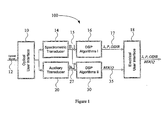
- Figure 1 is a schematic diagram of an embodiment of an OPM.
- Figure 2 is a plot of the representation of two signals provided by an auxiliary transceiver included in the OPM of Figure 1 .
- Figure 3 is a schematic diagram of the auxiliary transducer included in the OPM of Figure 1 .
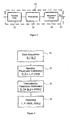
- Figure 4 is a flow diagram illustrating the operation of the Flash of Figure 1 .
- Figure 5 is a schematic diagram illustrating the methodology of quasi-dynamic measurand reconstruction.
- Figure 6 is a schematic diagram illustrating the methodology of quasi-dynamic system calibration.
- Figure 7 is a flow diagram illustrating the functionality of a neural network to be used for the determination of BER and/or Q.
- Figure 8 shows a schematic diagram of another embodiment of the FLASH of Figure 1 .
- the Flash OPM 100 includes an optical user interface 10 that receives an optical input signal 12, and directs the received signal 12 to a spectrometric transducer 14.
- the spectrometric transducer 14 separates the input signal 12 into its spectral components and converts those components into corresponding electrical signals.
- the resultant data set ⁇ ⁇ n ⁇ 15 is representative of the spectrum of the optical signal 12.
- the spectrometric transducer 14 may utilise an optical element, such as a grating or a variable linear filter, to provide a spatial separation of the components of the signal 12 and direct them to a sensor array where they are converted into corresponding electrical signals.
- Such transducers are well known in the optical art and need not be described in further detail.
- the data set ⁇ ⁇ n ⁇ 15 is directed to a processing function 16 that implements one or more of a first set of DSP algorithms (DSP Algorithms I) for signal reconstruction and enhancement.
- the processor 16 may be a general purpose computer implementing algorithms contained as software instructions resident in a memory device such as a data carrier. Alternatively, the processor may be a dedicated device configured to process the data set in accordance with the selected algorithm.
- the DSP Algorithms I, executed by the processor 16, will typically be chosen to perform reconstruction of spectrum parameters, using a non-linear and non-stationary approach, and provides estimates 17 for P, ⁇ , and OSNR.
- the processor 16 may also implement procedures that compensate for variations in temperature, wavelength drifts, aging of the optical components, and the like to enhance the information provided by the processor.
- the output from the processor 16 provides estimates 17 of the power P, wavelength ⁇ and signal to noise ratio OSNR which are sent to an electrical user interface 18. These outputs based on the spectral analysis quality of the data signal by using one or more of the parameters. For example the channel power may be used as an indicator of quality, or the central wavelength of the channel or by the OSNR.
- BER or Q depends on all the elements of a telecommunication link.
- the spectrum of the transmitted signal contains more information on BER or Q than the estimates 17 of P, ⁇ , OSNR that are possibly determined on the basis of the data ⁇ ⁇ n ⁇ 15 representative of said spectrum, but - as a rule - it does not contain sufficient information on chromatic dispersion and polarization-related effects such as PMD.
- PMD chromatic dispersion and polarization-related effects
- the received signal 12 is also directed to an auxiliary transducer 20 in parallel to the spectrometric transducer 14.
- the auxiliary transducer 20 processes the received signal 12 to obtain a data set ⁇ p ⁇ k,m ⁇ 27 that represents time-domain parameters ⁇ p k,m ⁇ of the signal 12.
- t ⁇ - ⁇ , + ⁇ and k 1 , ... , K , sup s k t
- Figures 2a and 2b show how the signal distortion is reflected in the parameters ⁇ p ⁇ k,m ⁇ defined in the above described way. More specifically, in Figure 2a there are shown two demodulated signals 201 and 202, signal 201 being an undistorted square pulse signal while signal 202 is the same signal after distortion. Figure 2b shows the dependence of the time-domain parameters ⁇ p ⁇ k,m ⁇ on the threshold value s m th for the undistorted and distorted signals 201 and 202, respectively.
- the time-domain parameter ⁇ p ⁇ k,m ⁇ of distorted signal 202 may be viewed, as shown on Figure 2a , as the area 204 under curve (signal) 202 which is above line 203 (threshold).
- the distorted signal 202 results in time-domain parameters ⁇ p ⁇ k,m ⁇ that vary in a non-linear fashion as a consequence of the presence of distortion, which may be seen in Figure 2b by the difference between the time-domain parameters for the undistorted signal 201 and the distorted signal 202 for a given threshold value s m th .
- the differences 211, 214 and 217 between the time-domain parameters 212, 215 and 218 of the undistorted signal 201 and the time-domain parameters 213, 216 and 219 of the distorted signal 202, respectively, are not equal.
- the non linearities may be used to provide an indication of the nature and degree of distortion to which the signal has been subjected.
- signal 202 is processed so as to identify non-linearities relative to an ideal signal 201, and from these non-linearities provide an assessment of the degree or type of the distortion.
- the time-domain parameters ⁇ p ⁇ k,m ⁇ form a function that recognizes the shape of the distorted signal 202 and is indicative of the distortion, which may not be as readily apparent from the spectrum data set ⁇ ⁇ n ⁇ .
- the estimates ⁇ p ⁇ k,m ⁇ 27 may be obtained by an auxiliary transducer 20, shown in Figure 3 , composed of a tunable filter 22 followed by a high-speed photodiode 24.
- the output of the diode 24 is processed by an integration circuit 26 to provide the output ⁇ p ⁇ k,m ⁇ 27.
- the tunable filter 22 is used to select a channel so that the associated photodiode 24 reproduces s k ( t ) by demodulation, and the integration circuit performs the operation such as that defined by Equation 1 for each of the selected thresholds.
- the output 27 and 15 of the auxiliary transducer 20 and the spectrometric transducer 14, respectively, are provided to a processor 30 that implements selected ones of a second set of DSP algorithms (DSP Algorithms II) to extract further information from the received signal 12.
- the processor 30 may be a specific hardware implementation structured to perform a specific selected algorithm or may be a general-purpose computing device that operates upon the data sets 15 and 27 in accordance with programmed instructions contained on a memory device.
- the processor 30 executes one or more of the second set of selected DSP algorithms (DSP Algorithms II) to analyse the data ⁇ ⁇ n ⁇ 15 and ⁇ p ⁇ k,m ⁇ 27, and provide an estimate 35 for BER or Q.
- the estimate 35 is next transferred to the electrical user interface 18.
- the electrical user interface 18 transfers the estimates 17 and 35 of P, ⁇ , OSNR, and BER or Q to the user that is assessing the performance of a particular channel, and to monitor the quality of a signal transmitted on said channel
- the interface 18 may function to provide readouts of the parameters being monitored but preferably operates to provide a visual indication of the departure of the parameters from predetermined acceptable levels.
- the interface may monitor over a period of time the quality factor Q of the respective channels for a period of time and provide a signal indicating if the quality on one or more channels has varied from an acceptable value to an unacceptable value.
- each channel may be monitored for BER and an indication provided if the BER has varied from an acceptable to an unacceptable value.
- a first step 41 the data ⁇ ⁇ n
- n 1, ..., N ⁇ representative of the spectrum of a total DWDM signal are acquired, as well as the estimates ⁇ p ⁇ k,m
- the first set of DSP algorithms (DSP Algorithms I), which will be described further below, is used to determine the estimates 17 of the parameters P , ⁇ , and OSNR for each channel - on the basis of the data ⁇ ⁇ n ⁇ 15, step 42.
- step 43 those data ⁇ ⁇ n ⁇ 15 are used again, this time together with the estimates ⁇ p ⁇ k,m ⁇ 27 of the time-domain parameters, to determine the estimate 35 of BER or Q.
- the second set of algorithms (DSP Algorithms II), which will be described further below, is used.
- a last step 44 there are reported the estimates 17 and 35 of P , ⁇ , OSNR and BER or Q, useful for a network monitoring system.
- the method provides a number of advantages compared to traditional out-of-service BER-test techniques.
- the method is an optical-layer testing method, which is also an in-service method.
- a BER test of all channels is performed in parallel and thus simultaneously.
- the method provides a low-cost solution as well as a fast solution to the problem of in-service monitoring of DWDM networks.
- Test times, according to the method described in Figure 4 remain substantially constant as channel counts increase. Also, the described method does not depend on the transmission protocol, on the data format or on the generation of complex test signals.
- the first subset of algorithms (DSP Algorithms I), used for determination of the estimates 17 of the parameters P , ⁇ , and OSNR, contains the algorithms for spectrum reconstruction and estimation of spectrum parameters that are well known in the art, for example those described in detail in US Pat. No. 5,991,023 to Morawski et al., issued November 23, 1999 , and in US Pat. No. 6,002,479 to Barwicz et al., issued December 14, 1999 .
- the estimates 17 of the channel parameters P, ⁇ , OSNR may be calculated directly from the estimates of a 1 , a 2 , and l .
- the second set of DSP algorithms (DSP Algorithms II), used for extracting useful BER and Q information, may be constructed according to the following principles.
- a spectrometric transducer 14 converts input optical signal into a set of data ⁇ ⁇ n ⁇ 15 representative of the spectrum of this signal.
- the spectrometric transducer 14 is, for example, part of a Type-II FLASH device, but it is not restricted to such devices and applications.
- N represents a number of photodiodes in the detector array.
- ⁇ ⁇ ( ⁇ max - ⁇ min )/( N - 1). It is assumed that the data ⁇ ⁇ n ⁇ 15 represent a spectrum of K channels combined in a DWDM system under consideration.
- the length of this subsequence is variable, and amounts for example to 3, 4, 5, 6 or more elements.
- considerations are limited to one channel only, and the symbol ⁇ ⁇ n ⁇ is used for denoting this subsequence.
- a person of skill in the art is able to extend the concept with ease to any other number of channels.
- the problem of determining BER or Q may be solved in a broad context of algorithmic options, which are derived from ideas of quasi-dynamic measurand reconstruction that is a well-established and well-recognised methodology in digital signal processing, as for example illustrated in the paper " The Role of Digital Signal Processing in Measurement Science”, published in “Measurement Science - A Discussion” (Ohmsha Press Pub., Tokyo 2000, pp. 77-102 ). High redundancy of measurement information in raw measurement data is the main distinctive feature of any problem of quasi-dynamic measurand reconstruction. Consequently, implicit or explicit compression of data is present in any procedure for solving such a problem.
- the value of a scalar measurand x , BER or Q, is estimated on the basis of a subsequence of data ⁇ ⁇ n ⁇ 15 representative of the channel spectrum and the parameters ⁇ p ⁇ k,m ⁇ 27 to which the measurand is approximately related..
- a large family of DSP methods for estimation of BER or Q may be derived from the general methodology for solving problems of quasi-dynamic measurand reconstruction.
- This methodology consists of two steps: compression of the data ⁇ ⁇ n ⁇ 15 and ⁇ p ⁇ k,m ⁇ 27, i.e. transformation of the data ⁇ ⁇ n ⁇ 15 and ⁇ p ⁇ k,m ⁇ 27 into an estimate p ⁇ 32 of a vector of informative parameters p, ⁇ ⁇ n ⁇ , ⁇ p ⁇ k m ⁇ ⁇ p ⁇ , and subsequent estimation of x on the basis of p ⁇ , p ⁇ ⁇ x ⁇ .
- This methodology is illustrated in the schematic diagram shown in Figure 5 .
- Inputs containing the subsequence ⁇ ⁇ n ⁇ 15 and ⁇ p ⁇ k,m ⁇ 27 are provided to a data compressor 31.
- the data compressor 31 compresses the subsequence ⁇ ⁇ n ⁇ 15 and ⁇ p ⁇ k,m ⁇ 27 to obtain a set containing an estimate p 32, which is provided to a BER or Q estimator 33.
- the BER or Q estimator 33 responds with an output set 35 containing an estimate35 x ⁇ of x, i.e. of BER or Q.
- a complexity of the method illustrated in Figure 5 depends on a number of informative parameters, i.e. the dimension of the vector p 32. The greater the number of informative parameters, the more time is required both for calibration and for BER or Q estimation.
- v 1 , ... , N cal .
- a schematic diagram for a method of calibration is outlined. An input containing the subsequence y ⁇ n , v cal 61 and p ⁇ m , v cal 62 is provided to a data compressor 63.
- the set 64 containing the parameters p ⁇ v cal is provided to a BER or Q estimator 65.
- the BER or Q estimator 65 responds with an output set 66 containing a datum x ⁇ n , v cal 66.
- a data adjustor 67 the data x ⁇ n , v cal 66 and x ⁇ n , v cal are compared. The result of this comparison is provided as feedback to the data compressor 62 and the BER or Q estimator 65, where in turn this information is utilized in constructing an approximation of the relationship p ⁇ x using a set of input-output pairs: p ⁇ v cal , x ⁇ v cal
- v 1 , ... , N cal .
- a large variety of algorithms is possibly generated by combining various techniques of data compression with various types of approximators.
- the following techniques of data compression are optionally used: principal component analysis, computation of inner products of the data ⁇ ⁇ n ⁇ 15 and ⁇ p ⁇ k,m ⁇ 27 and linearly independent sequences ⁇ e j,n
- j 1,..., J ⁇ , approximation of the spectrum y ( ⁇ ) on the basis of ⁇ ⁇ n ⁇ 15 and ⁇ p ⁇ k,m ⁇ 27 using a parameterised function ⁇ ( ⁇ n ; a ) with a being a vector of parameters, and computation of the moments of the spectrum y ( ⁇ ) on the basis of ⁇ ⁇ n ⁇ 15.
- an application-specific vector of informative parameters could contain estimates 17 of P , ⁇ , and OSNR, the estimates determined on the basis of ⁇ ⁇ n ⁇ 15 and ⁇ p ⁇ k,m ⁇ 27.
- the most evident candidate for the measurand estimator i.e. the BER or Q estimator, is a neural network being a universal approximator.
- B-splines are to be considered as measurand estimators.
- a person of skill in art will be able to suggest further methods of data compression and final measurand estimation.
- a Radial Basis Functions (RBF) neural network 34 is designed as illustrated in the schematic diagram shown in Figure 7 .
- This particular network performs both the function of data compressor and of BER/Q estimator.
- the neural network 34 receives as inputs data sets ⁇ ⁇ n ⁇ 15 and ⁇ p ⁇ k,m ⁇ 27.
- the neural network 34 is trained to respond with an estimate x ⁇ 35 of x (BER or Q) on the basis of ⁇ ⁇ n ⁇ and ⁇ p ⁇ k,m ⁇ .
- the data set ⁇ ⁇ n ⁇ 15 stem from a low-resolution spectrometric transducer and the parameters ⁇ p ⁇ k,m ⁇ 27 from an auxiliary transducer.
- the sets of data used for training preferably represent a telecommunication signal distorted in various ways by its propagation through optical elements such as fibers, amplifiers, and filters.
- any other universal approximator may be used, e.g. another type of neural network or a multi-dimensional spline function.
- a cascade of two neural networks may be designed: the first to perform the function of data compressor, the second - of BER/Q estimator.
- the Flash OPM 100a includes an optical user interface 10a, that provides received signal 12a to a spectrometric transducer 14a.
- a processor 16a implements a first set of DSP algorithms (DSP Algorithms I).
- the output of the processor 16a is applied to the electrical user interface 18a and to a further processor 50 that implements a further set of DSP algorithms (DSP Algorithms III).
- the received signal 12a is also fed to an auxiliary transducer 20a and to the processor 30a for implementing the second set of DSP algorithms (DSP Algorithms II) as described above to obtain estimate 35a of BER or Q.
- the processor 50 utilises the DSP algorithms (DSP Algorithms II) to process the estimates 17a of P, ⁇ , and OSNR according to information suitable for control of DGE.
- DSP Algorithms II DSP Algorithms II
- a person of skill in the art easily envisions further applications of DSP-type processing units. These applications are feasible, since the spectrum retrieved by the spectrometric transducer, such as 14,14a, and processed by the processors 16,16a, inherently contain relevant and significant information characterizing the input optical signal.
- optical performance monitors such as 100 and 100a takes place within a time range of 50-200 milliseconds. This allows for in situ monitoring of an optical signal transmitted on a given channel, and for immediate undertaking of measures to reroute an optical signal to an alternative channel, once a too high value of BER or too low value of Q is detected. Assuming a response time of the monitor of 50 milliseconds, and a transmission bit rate of 2.5 Gb/s, a data buffer of 1.6 MB is sufficient to ensure that no data are lost during the detection of a fault-signalling BER or Q value and rerouting of an optical signal. By shifting the determination of BER or Q values from the electrical domain into the optical domain, a continuous, real-time quality assessment of an optical channel is possible, and it is further possible to route data transmission without a significant loss of information.
Landscapes
- Physics & Mathematics (AREA)
- Electromagnetism (AREA)
- Engineering & Computer Science (AREA)
- Computer Networks & Wireless Communication (AREA)
- Signal Processing (AREA)
- Optical Communication System (AREA)
Claims (9)
- Procédé pour contrôler une qualité de transmission de données d'au moins un canal optique 12, le procédé comprenant les étapes qui consistent :à diriger un signal optique vers un transducteur spectrométrique 14 pour déterminer un ensemble de données {ỹn} représentatif d'un spectre du signal optique 12, ledit signal optique 12 étant transmis sur ledit canal optique 12 au niveau d'une instance dans le temps ;à diriger également le signal optique 12 vers un transducteur auxiliaire 20 parallèlement au transducteur spectrométrique 14 pour obtenir à partir du signal optique 12 un autre ensemble de données {Pkm} indiquant des paramètres de domaine de temps du signal optique 12 ;à effectuer une analyse sur les deux ensembles de données {ỹn} {Pkm} pour déterminer une estimation d'un paramètre "x" prédéterminé du signal optique.
- Procédé pour contrôler une qualité de transmission de données selon la revendication 1, étant précisé que ledit paramètre de la transmission de données est sélectionné dans le groupe constitué par le taux d'erreurs binaires de la transmission de données, une longueur d'onde, un rapport signal optique-bruit (OSNR) et un facteur de qualité Q de la transmission de données.
- Procédé pour contrôler une qualité de transmission de données selon l'une quelconque des revendications 1 à 2, étant précisé que l'étape de l'analyse de spectre pour déterminer une qualité du signal optique comprend les étapes qui consistent : à effectuer une décomposition spectrale du signal optique ; à déterminer un ensemble de données représentatif d'un résultat de la décomposition spectrale ; et à obtenir une estimation "x" d'un paramètre "x" prédéterminé, "x" étant un taux d'erreurs binaires ou un facteur de qualité, à partir de l'ensemble de données, le paramètre "x" prédéterminé décrivant une qualité du signal optique.
- Procédé pour contrôler une qualité de transmission de données selon la revendication 3, étant précisé que l'estimation "x" est déterminée grâce à une comparaison de l'ensemble de données avec un ensemble de données idéal.
- Procédé pour contrôler une qualité de transmission de données selon la revendication 4, étant précisé que la comparaison est réalisée à l'aide d'un processeur pour calculer l'estimation à partir d'une corrélation identifiée du paramètre "x" prédéterminé et de l'ensemble de données.
- Procédé pour contrôler une qualité de transmission de données selon la revendication 5, étant précisé que le processeur pour calculer l'estimation "x" à partir d'une corrélation identifiée du paramètre "x" prédéterminé et l'ensemble de données est un réseau neuronal.
- Procédé pour contrôler une qualité de transmission de données selon l'une quelconque des revendications 1 à 6, étant précisé que la qualité de plus d'un canal optique est contrôlée par un même traitement d'analyse de spectre.
- Procédé pour contrôler une qualité de transmission de données selon l'une quelconque des revendications 1 à 7, étant précisé que le paramètre prédéterminé d'au moins un canal optique est contrôlé sur une période de temps, et qu'un signal d'indication est fourni, le signal d'indication indiquant au moins un canal optique sur lequel la valeur du paramètre a varié à partir d'une valeur acceptable jusqu'à une valeur inacceptable.
- Dispositif de contrôle des performances optiques (100) pour contrôler un signal optique (12) et pour fournir une estimation d'un paramètre "x" prédéterminé de ce signal (12), le dispositif de contrôle des performances optiques (100) comprenant :un transducteur spectrométrique (14) pour effectuer une décomposition spectrale du signal optique incident (12) et pour transformer le signal optique décomposé en un premier ensemble de données {ỹn} représentatif du spectre du signal optique (12) ;un transducteur auxiliaire (20) pour recevoir également le signal optique (12) parallèlement au transducteur spectrométrique (14) et pour fournir comme sortie un second ensemble de données {Pkm} représentatif de paramètres de domaine de temps du signal optique (12) ;un processeur pour recevoir chacun des ensembles de données et pour leur appliquer des routines de traitement de signaux numériques (16, 30) pour obtenir des estimations du paramètre prédéterminé.
Applications Claiming Priority (2)
| Application Number | Priority Date | Filing Date | Title |
|---|---|---|---|
| CA2413218A CA2413218C (fr) | 2002-11-29 | 2002-11-29 | Moniteur de performance optique instantanee |
| PCT/CA2003/001874 WO2004051889A2 (fr) | 2002-11-29 | 2003-12-01 | Dispositif flash de controle des performances optiques |
Publications (2)
| Publication Number | Publication Date |
|---|---|
| EP1685663A2 EP1685663A2 (fr) | 2006-08-02 |
| EP1685663B1 true EP1685663B1 (fr) | 2013-10-16 |
Family
ID=32399904
Family Applications (1)
| Application Number | Title | Priority Date | Filing Date |
|---|---|---|---|
| EP03778204.2A Expired - Lifetime EP1685663B1 (fr) | 2002-11-29 | 2003-12-01 | Dispositif flash de controle des performances optiques |
Country Status (5)
| Country | Link |
|---|---|
| US (1) | US7315370B2 (fr) |
| EP (1) | EP1685663B1 (fr) |
| AU (1) | AU2003285255A1 (fr) |
| CA (1) | CA2413218C (fr) |
| WO (1) | WO2004051889A2 (fr) |
Families Citing this family (11)
| Publication number | Priority date | Publication date | Assignee | Title |
|---|---|---|---|---|
| ATE313175T1 (de) * | 2003-08-18 | 2005-12-15 | Cit Alcatel | Verfahren zur optischen übertragung und optischer empfänger |
| US20050276601A1 (en) * | 2004-03-02 | 2005-12-15 | Morawski Roman Z | Nonlinear data processing dedicated to an optical spectrum analyzer |
| US8111988B1 (en) * | 2008-06-10 | 2012-02-07 | Lockheed Martin Corporation | Method for monitoring wavelength-division multiplexed signal |
| GB2498336A (en) * | 2012-01-04 | 2013-07-17 | Oclaro Technology Plc | Monitoring multiple optical channels |
| US9124363B2 (en) * | 2012-06-04 | 2015-09-01 | Cisco Technology, Inc. | Digital frequency offset monitor for coherently detected optical superchannels |
| WO2014055889A1 (fr) * | 2012-10-04 | 2014-04-10 | Sean Patrick Adam | Procédé et dispositif pour fournir une santé de canal pour un système wdm |
| US9553663B1 (en) * | 2015-09-21 | 2017-01-24 | Inphi Corporation | System and method for calibration of an optical module |
| US10236982B1 (en) * | 2017-12-21 | 2019-03-19 | Ciena Corporation | Fiber parameter identification |
| US10404362B1 (en) * | 2018-02-22 | 2019-09-03 | Subcom, Llc | Fault detection and reporting in line monitoring systems |
| CN108957125A (zh) * | 2018-03-20 | 2018-12-07 | 北京邮电大学 | 基于机器学习的智能频谱图分析方法 |
| CN113177074B (zh) * | 2021-04-02 | 2023-09-29 | 北京科技大学 | 一种提升环境自适应性的光学性能监测系统及方法 |
Family Cites Families (45)
| Publication number | Priority date | Publication date | Assignee | Title |
|---|---|---|---|---|
| US5296956A (en) * | 1992-07-17 | 1994-03-22 | At&T Bell Laboratories | Performance monitoring and fault location for optical equipment, systems and networks |
| WO1994006052A1 (fr) * | 1992-09-10 | 1994-03-17 | Fujitsu Limited | Systeme de circuit optique et ses constituants |
| US5513029A (en) * | 1994-06-16 | 1996-04-30 | Northern Telecom Limited | Method and apparatus for monitoring performance of optical transmission systems |
| CA2155693C (fr) * | 1994-08-25 | 1999-12-14 | Daniel A. Fishman | Methode et dispositif de controle de systemes de transmission optique et de localisation de defaillance |
| JP2950190B2 (ja) * | 1995-03-28 | 1999-09-20 | 株式会社田村電機製作所 | カード発行装置 |
| UA46054C2 (uk) * | 1995-09-15 | 2002-05-15 | Пллб Елеттроніка С.П.А. | Система, спосіб та пристрій для моніторингу оптоволоконного кабелю |
| JP2848440B2 (ja) * | 1995-11-22 | 1999-01-20 | 日本電気株式会社 | 回線品質監視回路 |
| US5745616A (en) * | 1996-11-27 | 1998-04-28 | Lucent Technologies Inc. | Waveguide grating router and method of making same having relatively small dimensions |
| WO1999067609A1 (fr) | 1998-06-23 | 1999-12-29 | Ditech Corporation | Ecran de reseau optique |
| US6215565B1 (en) * | 1998-07-27 | 2001-04-10 | Mci Communications Corporation | Method of and system for diagnosing optical system failures |
| CN1320311A (zh) * | 1998-08-28 | 2001-10-31 | E-Tek光电方案公司 | 在波分多路复用光纤系统中光学性能监测的方法和装置 |
| US6317231B1 (en) * | 1998-09-04 | 2001-11-13 | Lucent Technologies Inc. | Optical monitoring apparatus and method for network provisioning and maintenance |
| US6816681B2 (en) * | 1998-09-24 | 2004-11-09 | Nortel Networks Limited | Analogous channel method for performance monitoring and equalization in optical networks |
| KR100303324B1 (ko) * | 1999-05-12 | 2001-09-26 | 윤종용 | 파장분할다중 광전송시스템의 성능감시장치의 기준파장 제공장치 |
| AU4903000A (en) * | 1999-05-21 | 2000-12-12 | Bookham Technology Plc | Method and system for adaptive interpretation of spectrometric data combined with continual re-calibration |
| US6473210B1 (en) * | 1999-08-20 | 2002-10-29 | Anritsu Company | Method for measuring the performance of broadband dense wavelength division multiplexer (DWDM) using non-linear iterative algorithm |
| US6344910B1 (en) * | 1999-09-23 | 2002-02-05 | Avanex Corporation | Optical performance monitor |
| EP1247356A2 (fr) * | 2000-01-14 | 2002-10-09 | Corning Incorporated | Systeme et procede de mesure de l'intermodulation intrabande dans des systemes de communication optiques |
| US6407376B1 (en) * | 2000-03-03 | 2002-06-18 | Axsun Technologies, Inc. | Optical channel monitoring system with self-calibration |
| US6377730B1 (en) * | 2000-03-24 | 2002-04-23 | Agere Systems Guardian Corp. | Waveguide based component optical signal power and wavelength detector |
| US20010031107A1 (en) * | 2000-04-26 | 2001-10-18 | Bradshaw Scott H. | Wavelength selector for optical performance monitor |
| GB0012701D0 (en) * | 2000-05-24 | 2000-07-19 | Geary Michael D | Automated astrological data retrieval and analysis |
| US6577786B1 (en) * | 2000-06-02 | 2003-06-10 | Digital Lightwave, Inc. | Device and method for optical performance monitoring in an optical communications network |
| US20020063923A1 (en) * | 2000-06-02 | 2002-05-30 | Lightchip, Inc. | System and method for improving optical signal-to-noise ratio measurement range of a monitoring device |
| US6396051B1 (en) * | 2000-06-07 | 2002-05-28 | Sycamore Networks, Inc. | High resolution optical performance monitor for DWDM system |
| US6912359B2 (en) * | 2000-09-08 | 2005-06-28 | The Regents Of The University Of California | Methods for monitoring performance in optical networks |
| KR100340203B1 (ko) * | 2000-09-19 | 2002-06-15 | 오길록 | 파장분할 다중화 방식 광전송 시스템의 광성능 감시장치 |
| US6922532B2 (en) * | 2000-12-07 | 2005-07-26 | Frederic Simard | Optical performance monitoring for D/WDM networks |
| CA2328748C (fr) * | 2000-12-18 | 2005-03-01 | Saeid Seydnejad | Interaction de tonalites pilotes srs et effets de troisieme ordre en surveillance des performances optiques |
| US6714743B2 (en) * | 2001-03-02 | 2004-03-30 | Optoplex Corporation | Wide range tunable filter |
| US20020130256A1 (en) * | 2001-03-16 | 2002-09-19 | David Macki | Spectrum, time and protocol domain optical performance monitor |
| US20020141010A1 (en) * | 2001-03-16 | 2002-10-03 | Dave Rodgers | Coupled data and wavelength reference for optical performance monitoring in fiber optic systems |
| US20020138796A1 (en) * | 2001-03-23 | 2002-09-26 | Jacob John M. | Intelligent performance monitoring in optical networks using FEC statistics |
| US20020141009A1 (en) * | 2001-03-28 | 2002-10-03 | Jin Yu | Performance monitoring for multi-port optical devices and systems |
| US20020172458A1 (en) * | 2001-04-06 | 2002-11-21 | Downie John D. | Optical system that improves spectrally distorted signals |
| US7068944B2 (en) * | 2001-04-16 | 2006-06-27 | Agilent Technologies, Inc. | Multi-function optical performance monitor |
| US6671434B2 (en) * | 2001-04-17 | 2003-12-30 | Jds Uniphase Corporation | Optical performance monitor |
| US7460785B2 (en) * | 2001-05-23 | 2008-12-02 | Lucent Technologies Inc. | Performance monitoring in an optical communication system |
| CA2357226A1 (fr) * | 2001-09-12 | 2003-03-12 | Optenia Inc. | Controleur de performance pour reseaux optiques |
| KR100419424B1 (ko) * | 2001-09-22 | 2004-02-19 | 삼성전자주식회사 | 파장 분할 다중화 시스템에서의 광신호 성능 검사 장치 |
| US20030138251A1 (en) | 2001-10-12 | 2003-07-24 | Harish Jayaram | Method and system for performance monitoring in an optical network |
| FR2832274B1 (fr) * | 2001-11-15 | 2006-08-25 | Alcatel Optronics | Procede de controle dynamique d'un module optique |
| US7031606B2 (en) * | 2001-11-23 | 2006-04-18 | Tropic Networks Inc. | Method and system for monitoring performance of optical network |
| US6836349B2 (en) * | 2001-12-07 | 2004-12-28 | Jds Uniphase Corporation | Optical performance monitoring device |
| KR100445905B1 (ko) * | 2001-12-13 | 2004-08-25 | 한국전자통신연구원 | 다중파장 광 전송 시스템에서 광 신호 성능 측정 장치 및그 방법 |
-
2002
- 2002-11-29 CA CA2413218A patent/CA2413218C/fr not_active Expired - Fee Related
-
2003
- 2003-12-01 AU AU2003285255A patent/AU2003285255A1/en not_active Abandoned
- 2003-12-01 EP EP03778204.2A patent/EP1685663B1/fr not_active Expired - Lifetime
- 2003-12-01 US US10/724,356 patent/US7315370B2/en not_active Expired - Fee Related
- 2003-12-01 WO PCT/CA2003/001874 patent/WO2004051889A2/fr not_active Ceased
Also Published As
| Publication number | Publication date |
|---|---|
| WO2004051889A3 (fr) | 2004-08-19 |
| CA2413218A1 (fr) | 2004-05-29 |
| WO2004051889A2 (fr) | 2004-06-17 |
| CA2413218C (fr) | 2015-01-27 |
| US20040165886A1 (en) | 2004-08-26 |
| AU2003285255A1 (en) | 2004-06-23 |
| US7315370B2 (en) | 2008-01-01 |
| EP1685663A2 (fr) | 2006-08-02 |
Similar Documents
| Publication | Publication Date | Title |
|---|---|---|
| JP7176373B2 (ja) | 光伝送システムおよび光伝送システムの故障診断方法 | |
| US6907197B2 (en) | Method and apparatus for measuring and estimating optical signal to noise ratio in photonic networks | |
| US20210058154A1 (en) | Method for monitoring an optical communications system | |
| EP2174113B1 (fr) | Système et procédé servant à identifier des défaillances dans un équipement de surveillance de ligne à l'aide d'un gain de boucle différentielle | |
| CN105577272B (zh) | 光通信信号的带内噪声确定 | |
| EP1685663B1 (fr) | Dispositif flash de controle des performances optiques | |
| CN104079347A (zh) | 一种光信噪比测量方法 | |
| EP2903182B1 (fr) | Diagnostic de pannes dans des réseaux optiques | |
| CN108966687A (zh) | 在真实网络条件下确定通道osnr和通道osnr裕度 | |
| CN110178320A (zh) | 具有标准化输出的高分辨率线路监测技术和使用该技术的光通信系统 | |
| US6714741B1 (en) | Method and apparatus for monitoring an optical WDM network | |
| US7969561B2 (en) | Apparatus and method for monitoring extinction ratio of optical signals | |
| US7457032B2 (en) | Arrangement, system, and method for accurate power measurements using an optical performance monitor (OPM) | |
| US20080075457A1 (en) | Methods and systems for optical performance monitoring | |
| CN117692061A (zh) | 一种实时监测装置及一种密集波分传输系统 | |
| Lobzov et al. | Channel performance criteria in optical transport systems with forward error correcting codes | |
| EP1517459B1 (fr) | Dispositif et procédé d'analyse d'un signal transmit par une liaison de communication | |
| CN114759981B (zh) | Osnr测量方法、装置、设备及可读存储介质 | |
| US20040126109A1 (en) | Method for estimating bit-error-ratios within an optical communications network | |
| CN119171987A (zh) | 光滤波器性能检测方法、装置、设备、介质和程序产品 | |
| CN101771464B (zh) | 光信号明暗比监测装置与方法 | |
| CN116232454A (zh) | 一种光纤调制格式信号相位参数测量装置及方法 |
Legal Events
| Date | Code | Title | Description |
|---|---|---|---|
| PUAI | Public reference made under article 153(3) epc to a published international application that has entered the european phase |
Free format text: ORIGINAL CODE: 0009012 |
|
| 17P | Request for examination filed |
Effective date: 20051021 |
|
| AK | Designated contracting states |
Kind code of ref document: A2 Designated state(s): AT BE BG CH CY CZ DE DK EE ES FI FR GB GR HU IE IT LI LU MC NL PT RO SE SI SK TR |
|
| 17Q | First examination report despatched |
Effective date: 20070209 |
|
| REG | Reference to a national code |
Ref country code: DE Ref legal event code: R079 Ref document number: 60345101 Country of ref document: DE Free format text: PREVIOUS MAIN CLASS: H04B0010080000 Ipc: H04B0010079000 |
|
| RIC1 | Information provided on ipc code assigned before grant |
Ipc: H04B 10/079 20130101AFI20130318BHEP |
|
| GRAP | Despatch of communication of intention to grant a patent |
Free format text: ORIGINAL CODE: EPIDOSNIGR1 |
|
| INTG | Intention to grant announced |
Effective date: 20130502 |
|
| GRAS | Grant fee paid |
Free format text: ORIGINAL CODE: EPIDOSNIGR3 |
|
| GRAA | (expected) grant |
Free format text: ORIGINAL CODE: 0009210 |
|
| AK | Designated contracting states |
Kind code of ref document: B1 Designated state(s): AT BE BG CH CY CZ DE DK EE ES FI FR GB GR HU IE IT LI LU MC NL PT RO SE SI SK TR |
|
| REG | Reference to a national code |
Ref country code: GB Ref legal event code: FG4D |
|
| REG | Reference to a national code |
Ref country code: CH Ref legal event code: EP |
|
| REG | Reference to a national code |
Ref country code: IE Ref legal event code: FG4D |
|
| REG | Reference to a national code |
Ref country code: AT Ref legal event code: REF Ref document number: 636925 Country of ref document: AT Kind code of ref document: T Effective date: 20131115 |
|
| REG | Reference to a national code |
Ref country code: DE Ref legal event code: R096 Ref document number: 60345101 Country of ref document: DE Effective date: 20131212 |
|
| REG | Reference to a national code |
Ref country code: NL Ref legal event code: VDEP Effective date: 20131016 |
|
| REG | Reference to a national code |
Ref country code: AT Ref legal event code: MK05 Ref document number: 636925 Country of ref document: AT Kind code of ref document: T Effective date: 20131016 |
|
| PG25 | Lapsed in a contracting state [announced via postgrant information from national office to epo] |
Ref country code: SE Free format text: LAPSE BECAUSE OF FAILURE TO SUBMIT A TRANSLATION OF THE DESCRIPTION OR TO PAY THE FEE WITHIN THE PRESCRIBED TIME-LIMIT Effective date: 20131016 Ref country code: FI Free format text: LAPSE BECAUSE OF FAILURE TO SUBMIT A TRANSLATION OF THE DESCRIPTION OR TO PAY THE FEE WITHIN THE PRESCRIBED TIME-LIMIT Effective date: 20131016 Ref country code: NL Free format text: LAPSE BECAUSE OF FAILURE TO SUBMIT A TRANSLATION OF THE DESCRIPTION OR TO PAY THE FEE WITHIN THE PRESCRIBED TIME-LIMIT Effective date: 20131016 Ref country code: BE Free format text: LAPSE BECAUSE OF FAILURE TO SUBMIT A TRANSLATION OF THE DESCRIPTION OR TO PAY THE FEE WITHIN THE PRESCRIBED TIME-LIMIT Effective date: 20131016 |
|
| PG25 | Lapsed in a contracting state [announced via postgrant information from national office to epo] |
Ref country code: ES Free format text: LAPSE BECAUSE OF FAILURE TO SUBMIT A TRANSLATION OF THE DESCRIPTION OR TO PAY THE FEE WITHIN THE PRESCRIBED TIME-LIMIT Effective date: 20131016 Ref country code: AT Free format text: LAPSE BECAUSE OF FAILURE TO SUBMIT A TRANSLATION OF THE DESCRIPTION OR TO PAY THE FEE WITHIN THE PRESCRIBED TIME-LIMIT Effective date: 20131016 Ref country code: CY Free format text: LAPSE BECAUSE OF FAILURE TO SUBMIT A TRANSLATION OF THE DESCRIPTION OR TO PAY THE FEE WITHIN THE PRESCRIBED TIME-LIMIT Effective date: 20131016 |
|
| PG25 | Lapsed in a contracting state [announced via postgrant information from national office to epo] |
Ref country code: PT Free format text: LAPSE BECAUSE OF FAILURE TO SUBMIT A TRANSLATION OF THE DESCRIPTION OR TO PAY THE FEE WITHIN THE PRESCRIBED TIME-LIMIT Effective date: 20140217 |
|
| REG | Reference to a national code |
Ref country code: DE Ref legal event code: R097 Ref document number: 60345101 Country of ref document: DE |
|
| PG25 | Lapsed in a contracting state [announced via postgrant information from national office to epo] |
Ref country code: EE Free format text: LAPSE BECAUSE OF FAILURE TO SUBMIT A TRANSLATION OF THE DESCRIPTION OR TO PAY THE FEE WITHIN THE PRESCRIBED TIME-LIMIT Effective date: 20131016 |
|
| REG | Reference to a national code |
Ref country code: CH Ref legal event code: PL |
|
| PLBE | No opposition filed within time limit |
Free format text: ORIGINAL CODE: 0009261 |
|
| STAA | Information on the status of an ep patent application or granted ep patent |
Free format text: STATUS: NO OPPOSITION FILED WITHIN TIME LIMIT |
|
| PG25 | Lapsed in a contracting state [announced via postgrant information from national office to epo] |
Ref country code: LU Free format text: LAPSE BECAUSE OF FAILURE TO SUBMIT A TRANSLATION OF THE DESCRIPTION OR TO PAY THE FEE WITHIN THE PRESCRIBED TIME-LIMIT Effective date: 20131201 Ref country code: CZ Free format text: LAPSE BECAUSE OF FAILURE TO SUBMIT A TRANSLATION OF THE DESCRIPTION OR TO PAY THE FEE WITHIN THE PRESCRIBED TIME-LIMIT Effective date: 20131016 Ref country code: SK Free format text: LAPSE BECAUSE OF FAILURE TO SUBMIT A TRANSLATION OF THE DESCRIPTION OR TO PAY THE FEE WITHIN THE PRESCRIBED TIME-LIMIT Effective date: 20131016 Ref country code: IT Free format text: LAPSE BECAUSE OF FAILURE TO SUBMIT A TRANSLATION OF THE DESCRIPTION OR TO PAY THE FEE WITHIN THE PRESCRIBED TIME-LIMIT Effective date: 20131016 Ref country code: RO Free format text: LAPSE BECAUSE OF FAILURE TO SUBMIT A TRANSLATION OF THE DESCRIPTION OR TO PAY THE FEE WITHIN THE PRESCRIBED TIME-LIMIT Effective date: 20131016 Ref country code: MC Free format text: LAPSE BECAUSE OF FAILURE TO SUBMIT A TRANSLATION OF THE DESCRIPTION OR TO PAY THE FEE WITHIN THE PRESCRIBED TIME-LIMIT Effective date: 20131016 |
|
| 26N | No opposition filed |
Effective date: 20140717 |
|
| REG | Reference to a national code |
Ref country code: IE Ref legal event code: MM4A |
|
| PG25 | Lapsed in a contracting state [announced via postgrant information from national office to epo] |
Ref country code: DK Free format text: LAPSE BECAUSE OF FAILURE TO SUBMIT A TRANSLATION OF THE DESCRIPTION OR TO PAY THE FEE WITHIN THE PRESCRIBED TIME-LIMIT Effective date: 20131016 |
|
| REG | Reference to a national code |
Ref country code: DE Ref legal event code: R097 Ref document number: 60345101 Country of ref document: DE Effective date: 20140717 |
|
| PG25 | Lapsed in a contracting state [announced via postgrant information from national office to epo] |
Ref country code: IE Free format text: LAPSE BECAUSE OF NON-PAYMENT OF DUE FEES Effective date: 20131201 Ref country code: LI Free format text: LAPSE BECAUSE OF NON-PAYMENT OF DUE FEES Effective date: 20131231 Ref country code: CH Free format text: LAPSE BECAUSE OF NON-PAYMENT OF DUE FEES Effective date: 20131231 |
|
| PG25 | Lapsed in a contracting state [announced via postgrant information from national office to epo] |
Ref country code: SI Free format text: LAPSE BECAUSE OF FAILURE TO SUBMIT A TRANSLATION OF THE DESCRIPTION OR TO PAY THE FEE WITHIN THE PRESCRIBED TIME-LIMIT Effective date: 20131016 |
|
| PG25 | Lapsed in a contracting state [announced via postgrant information from national office to epo] |
Ref country code: TR Free format text: LAPSE BECAUSE OF FAILURE TO SUBMIT A TRANSLATION OF THE DESCRIPTION OR TO PAY THE FEE WITHIN THE PRESCRIBED TIME-LIMIT Effective date: 20131016 |
|
| PG25 | Lapsed in a contracting state [announced via postgrant information from national office to epo] |
Ref country code: HU Free format text: LAPSE BECAUSE OF FAILURE TO SUBMIT A TRANSLATION OF THE DESCRIPTION OR TO PAY THE FEE WITHIN THE PRESCRIBED TIME-LIMIT; INVALID AB INITIO Effective date: 20031201 Ref country code: BG Free format text: LAPSE BECAUSE OF FAILURE TO SUBMIT A TRANSLATION OF THE DESCRIPTION OR TO PAY THE FEE WITHIN THE PRESCRIBED TIME-LIMIT Effective date: 20131016 |
|
| PG25 | Lapsed in a contracting state [announced via postgrant information from national office to epo] |
Ref country code: GR Free format text: LAPSE BECAUSE OF NON-PAYMENT OF DUE FEES Effective date: 20131016 |
|
| REG | Reference to a national code |
Ref country code: FR Ref legal event code: PLFP Year of fee payment: 13 |
|
| PGFP | Annual fee paid to national office [announced via postgrant information from national office to epo] |
Ref country code: GB Payment date: 20151229 Year of fee payment: 13 |
|
| PGFP | Annual fee paid to national office [announced via postgrant information from national office to epo] |
Ref country code: FR Payment date: 20151217 Year of fee payment: 13 |
|
| PGFP | Annual fee paid to national office [announced via postgrant information from national office to epo] |
Ref country code: DE Payment date: 20151229 Year of fee payment: 13 |
|
| PG25 | Lapsed in a contracting state [announced via postgrant information from national office to epo] |
Ref country code: GR Free format text: LAPSE BECAUSE OF FAILURE TO SUBMIT A TRANSLATION OF THE DESCRIPTION OR TO PAY THE FEE WITHIN THE PRESCRIBED TIME-LIMIT Effective date: 20140117 |
|
| REG | Reference to a national code |
Ref country code: DE Ref legal event code: R119 Ref document number: 60345101 Country of ref document: DE |
|
| GBPC | Gb: european patent ceased through non-payment of renewal fee |
Effective date: 20161201 |
|
| REG | Reference to a national code |
Ref country code: FR Ref legal event code: ST Effective date: 20170831 |
|
| PG25 | Lapsed in a contracting state [announced via postgrant information from national office to epo] |
Ref country code: FR Free format text: LAPSE BECAUSE OF NON-PAYMENT OF DUE FEES Effective date: 20170102 |
|
| PG25 | Lapsed in a contracting state [announced via postgrant information from national office to epo] |
Ref country code: DE Free format text: LAPSE BECAUSE OF NON-PAYMENT OF DUE FEES Effective date: 20170701 Ref country code: GB Free format text: LAPSE BECAUSE OF NON-PAYMENT OF DUE FEES Effective date: 20161201 |