EP1686112B1 - Process for distilling a mixture of isomeric diisocyanatodiphenylmethanes - Google Patents
Process for distilling a mixture of isomeric diisocyanatodiphenylmethanes Download PDFInfo
- Publication number
- EP1686112B1 EP1686112B1 EP06000883.6A EP06000883A EP1686112B1 EP 1686112 B1 EP1686112 B1 EP 1686112B1 EP 06000883 A EP06000883 A EP 06000883A EP 1686112 B1 EP1686112 B1 EP 1686112B1
- Authority
- EP
- European Patent Office
- Prior art keywords
- mdi
- diisocyanatodiphenylmethane
- weight
- mixture
- dividing wall
- Prior art date
- Legal status (The legal status is an assumption and is not a legal conclusion. Google has not performed a legal analysis and makes no representation as to the accuracy of the status listed.)
- Expired - Lifetime
Links
Images

Classifications
-
- C—CHEMISTRY; METALLURGY
- C07—ORGANIC CHEMISTRY
- C07C—ACYCLIC OR CARBOCYCLIC COMPOUNDS
- C07C263/00—Preparation of derivatives of isocyanic acid
- C07C263/18—Separation; Purification; Stabilisation; Use of additives
- C07C263/20—Separation; Purification
-
- H—ELECTRICITY
- H04—ELECTRIC COMMUNICATION TECHNIQUE
- H04M—TELEPHONIC COMMUNICATION
- H04M1/00—Substation equipment, e.g. for use by subscribers
- H04M1/02—Constructional features of telephone sets
- H04M1/0202—Portable telephone sets, e.g. cordless phones, mobile phones or bar type handsets
- H04M1/0249—Details of the mechanical connection between the housing parts or relating to the method of assembly
Definitions
- the invention relates to a process for the distillation of a mixture at least consisting of 2,2'-diisocyanatodiphenylmethane (2,2'-MDI), 2,4'-diisocyanatodiphenylmethane (2,4'-MDI) and 4,4'-diisocyanatodiphenylmethane (4 , 4'-MDI) to obtain 2,4'-diisocyanatodiphenylmethane poor in 2,2'-diisocyanatodiphenylmethane and mixtures of 4,4'- and 2,4'-diisocyanatodiphenylmethane which are deficient in 2,2'-diisocyanatodiphenylmethane.
- Diisocyanatodiphenylmethane isomers are constituents of polyisocyanate mixtures of the diphenylmethane series, which are formed in the phosgenation of aniline / formaldehyde condensates, also referred to below as polyaminopolyphenylpolymethanes.
- isomeric diisocyanatodiphenylmethanes mainly consisting of 2,2'-diisocyanatodiphenylmethane, 2,4'-diisocyanatodiphenylmethane and 4,4'-diisocyanatodiphenylmethane (hereinafter also referred to simply as MDI isomer mixture or crude MDI mixture), pure diisocyanatodiphenylmethane can then be added.
- Isomers or mixtures of two or three isomers are separated according to desired product specifications. For the separation, various processes based on distillation or crystallization or a combination of distillation and crystallization are known in the art.
- WO 02/070581 a process for the preparation of 2,4'-diisocyanatodiphenylmethane by separation from an MDI raw mixture.
- EP 1 475 367 A1 describes a process for the distillation of a mixture of isomeric Diisocyanatodiphenylmethane, at least consisting of 2,2'-diisocyanatodiphenylmethane, 2,4'-diisocyanatodiphenylmethane and 4,4'-diisocyanatodiphenylmethane, wherein the distillation is carried out at least one stage and in at least one distillation stage a dividing wall column is used ,
- the application can not be deduced to adjust the concentration of 2,4'-diisocyanatodiphenylmethane in the side stream to a value in the range of 95 to 99 wt .-%.
- Object of the present invention is therefore an economical and technically simple process for the distillation of a mixture of isomeric Diisocyanatodiphenylmethane, at least consisting of 2,2'-diisocyanatodiphenylmethane, 2,4'-diisocyanatodiphenylmethane and 4,4'-diisocyanatodiphenylmethane (hereinafter called starting mixture) which allows the preparation of 2,4'-MDI which is free of 2,2'-MDI or at least only a very low 2,2'-MDI content of the order of a maximum of 0.2% by weight. having.
- starting mixture 4,4'-diisocyanatodiphenylmethane
- the invention relates to a process for the preparation of 2,2'-MDI poor 2,4'-MDI by distillation of either a starting mixture of isomeric Diisocyanatodiphenylmethane, at least consisting of 2,2'-diisocyanatodiphenylmethane, 2,4'-diisocyanatodiphenylmethane and 4, 4'-diisocyanatodiphenylmethane, or a mixture obtained in a distillative preliminary separation of the starting mixture, which comprises 0 to 15 wt .-% of 2,2'-MDI, 12 to 60 wt .-% of 2,4'-MDI and to 25 to 88 wt .-% of 4,4'-MDI, wherein the distillation is carried out at least one stage and in at least one distillation stage a dividing wall column is used, wherein the starting mixture or present by distillation preliminary Diisocyanatodiphenylmethan isomer mixture completely as the feed stream to the Vor
- the mixture of isomeric diisocyanatodiphenylmethanes used in the process according to the invention is formed in the phosgenation of polyaminopolyphenylpolymethanes, which are prepared by condensation of aniline and formaldehyde, to form polyisocyanatopolyphenylpolymethanes.
- phosgenation which is preferably carried out in monochlorobenzene (MCB) as a solvent
- MCA monochlorobenzene
- the starting mixture may additionally contain: solvents, for example chlorobenzene, and other lower-boiling compounds, eg phenyl isocyanate, with a proportion of less than 2 wt .-%, at most 5 wt .-% Polyisocyanatopolyphenylmethane and a maximum of 5 wt .-% higher molecular compounds that have arisen due to thermal stress.
- solvents for example chlorobenzene
- other lower-boiling compounds eg phenyl isocyanate
- the process according to the invention is based on the distillative separation of the MDI isomers from the starting mixture in a one-stage or multistage process by means of a dividing wall column in at least one of the distillation stages.
- a dividing wall column in at least one of the distillation stages.
- the advantage of the process according to the invention lies in the use of a dividing wall column, with which lower production costs are connected due to the lower technical complexity compared to known distillation processes without dividing wall column.
- a dividing wall runs vertically in the middle part of the column. This divides the column into four zones: a prefractionation zone and a main fractionation zone in the region of the dividing wall, as well as a sump zone (stripping zone) and a rectification zone (top zone).
- a sump zone sump zone
- a rectification zone top zone
- the multicomponent stream is fed.
- zone A the part of the prefractionation zone above the feed
- zone B the part below the feed
- the overhead product is taken from the rectification zone (zone C), the bottoms product from the stripping zone (zone F).
- An intermediate product is taken from the main fractionation zone, the part of the main fractionation zone above the exit being also referred to as zone D and the part below the exit as zone E.
- a 2-core mixture is obtained which is 0 to 5 wt .-% of 2,2'-MDI, 5 to 15 wt .-% of 2,4'-MDI and 80 to 95 wt .-% of 4,4'-MDI.
- a mixture also called starting mixture
- Distillation can be used.
- an additional distillation step takes place, in which the MDI isomer mixture from the monomer-polymer separation (starting mixture) is fed to an isomer distillation (distillative pre-separation).
- This additional distillation step which precedes the distillation process according to claim 1, leads to a mixture which comprises 0 to 15 wt .-% of 2,2'-MDI, 12 to 60 wt .-% of 2,4'-MDI and from 25 to 88% by weight of 4,4'-MDI. It can be used as feed stream to the dividing wall column.
- This mixture which can serve as a feed stream to the dividing wall column, preferably consists of a maximum of 3.0% 2,2'-MDI, 30 to 60% (eg 49.9%) 2,4'-MDI and 40 to 70% 4, 4'-MDI (eg 46.9%) as well as traces of low-boiling components.
- the starting mixture or the MDI isomer mixture after distillative pre-separation is fed laterally in the region of the dividing wall by the process according to the invention to the dividing wall column.
- the partition is located in the middle region of the column and divides the cross section of the column. The length of the partition depends on the process conditions and on the properties of the mass transfer elements used.
- the number of required separation stages in the individual column sections depends on the process conditions, in particular the composition of the feed and the desired products. For example, e.g. With generously designed head and sump specifications, a mass transfer zone in the head section and bottom section can be dispensed with and can be minimized in the area of the dividing wall.
- a fabric packing with eg 500 m 2 / m 3 specific surface a partition wall length of about 6 to 8 m.
- the mass transfer zones in the top and bottom of the column are each 1.20 to 2.50 m, for example 1.80 m, high and have in each case 6 to 12, for example 8, separation stages.
- the prefractionation zone has 10 to 14 stages upstream of the feed and 13 to 17 stages below the feed.
- the main fractionation zone has 14 to 18 separation stages above the outfeed of the side stream and 12 to 16 separation stages below the outfeed.
- the starting mixture or the MDI isomer mixture after distillative pre-separation is fed completely as feed stream to the prefractionation zone of the dividing wall column.
- the bottom stream of the dividing wall column is fed to an evaporator and partially evaporated.
- the vapor stream from the evaporator is returned to the dividing wall column, first flows through the packing of the sump zone and is divided according to the pressure conditions on Vorfr neglectier- and Hauptfr syndrome.
- the vapor streams from these zones unite when leaving the partition wall zone and last flow through the head zone.
- the vapors at the top of the dividing wall column are condensed and at 88 to 99.6%, preferably 98 to 99%, for example 98, 5%, returned to the head zone.
- the recirculating liquid is passed below the top zone to 20 to 60%, preferably 30 to 50%, for example 40%, in the Vorfr quasiierzone and 40 to 80%, preferably 50 to 70%, for example 60%, in the main fractionation.
- the side stream is first completely withdrawn and then returned to the main fractionation zone at 60 to 97%, preferably 75 to 85%, eg 80%.
- the vapor flow in the prefractionation zone and the main fractionation zone adjusts according to the packing pressure losses.
- the total pressure at the inlet and outlet areas of the partition is the same for both zones. If, from the process engineering point of view, a zone is to be exposed more strongly to steam in the region of the dividing wall, the cross sections of the prefractionation zone and the main fractionation zone can also be chosen differently. By appropriate choice of the partial cross sections of the two zones, the process can be optimized in terms of energy requirements.
- mass transfer elements packages are particularly suitable. However, it is also possible to use other mass transfer elements known in the distillation industry, e.g. Fillers or bottoms.
- the dividing wall column is operated in terms of pressure and temperature under similar process conditions as a column of the conventional distillation technique.
- the absolute operating pressure of such a column is set at 0.5 to 30 mbar, the top pressure is preferably 3 to 16 mbar.
- the head temperature is 165 to 205 ° C.
- the bottom pressure is preferably 9 to 25 mbar at temperatures of 205 to 225 ° C.
- a stream which comprises at least 80% of the 4,4'-diisocyanatodiphenylmethane fed in is discharged as bottom.
- This bottom stream can be recycled to the dividing wall column or to the polymer monomer separation.
- the top product is a mixture consisting of 2,2'-diisocyanatodiphenylmethane (maximum 80% by weight), 2,4'-diisocyanatodiphenylmethane (18 to 80% by weight) and 4,4'-diisocyanatodiphenylmethane (2 wt .-% max) and as a side stream, a mixture of 2,4'-diisocyanatodiphenylmethane and 4,4'-diisocyanatodiphenylmethane with a weight ratio of 99: 1 to 95: 5.
- the sidestream content of 2,2'-MDI is very small, i. concentrations of not more than 0.2% by weight, preferably not more than 0.1% by weight, are achieved.
- a mixture of 95 to 98% by weight of 2,4'-MDI and at most 5% by weight of 4,4'-MDI is withdrawn in the side stream.
- concentration of 2,4'-MDI in the side stream within limits of 95 to Be varied 99 wt .-%.
- the reflux ratio in the top is set in particular in the range of 7.5 to 250, but is more preferably in the range of 30 to 90, wherein the top stream is 2 to 12 wt .-% based on the feed stream.
- the bottom stream is 20 to 85 wt .-%, preferably 40 to 60 wt .-%, of the feed stream.
- the method according to the invention can also be carried out with a further side stream take-off below the first side stream take-off.
- the second side stream withdrawal is also in the main fractionation zone.
- a mixture of 4,4'-MDI and 2,4'-MDI with 18 to 82 wt .-% 2,4'-MDI can be removed.
- Particularly preferred is a commercially utilizable mixture of 50 to 60 wt .-% 2,4'-MDI with a maximum of 0.2 wt .-% 2,2'-diisocyanatodiphenylmethane removed.
- the main product namely substantially pure 2,4'-MDI
- the amount of the side stream is preferably at least 3 wt .-% of the feed stream. More preferably, the proportion of sidestream is 38 to 50% by weight, e.g. 44%, of the feed stream.
- the main product consists of 95 to 99 wt .-% of 2,4'-MDI and at most 5 wt .-%, in particular 1 to 5 wt .-%, 4,4'-MDI, wherein the proportion of 2,2 ' -MDI is at most 0.2% by weight.
- a particularly preferred product in the side stream is a mixture of 95 to 98 wt .-% 2,4'-MDI and 2.5 to 5 wt .-% 4,4'-MDI, wherein the proportion of 2,2'-MDI maximum 0.2 wt .-% is.
- the bottom product preferably consists of 2 to 35 wt .-% 2,4'-MDI and 65 to 98 wt .-% 4,4'-MDI, more preferably from 8 to 12 wt .-% 2,4'-MDI and 88 to 92% by weight of 4,4'-MDI. In this case, the bottom product can be returned to the upstream distillation (distillative pre-separation).
- the top product preferably consists of 20 to 67% by weight of 2,2'-MDI, 33 to 80% by weight of 2,4'-MDI, the proportion of 4,4'-MDI being at most 2% by weight ,
- the distillation of the MDI isomer mixture is carried out in one stage by means of a dividing wall column.
- an MDI raw mixture from the polymer monomer separation starts mixture
- the dividing wall column in the middle region of the dividing wall.
- chlorine-containing low boilers, solvents and the largest proportion of 2,2'-MDI are transferred into zone C via zone A.
- portions of the 2,4'-isomer are transported into this zone and, depending on the set reflux ratio, either withdrawn overhead or forced into zone D. In zone D, these portions strike a stream that passes through the bulkhead at the bottom and undergoes a pre-separation into zones 2,4'-MDI and 4,4'-MDI via zones B and E.
- the crude distillate from the polymer monomer separation is first in a first column in a top stream consisting of low boilers, 2,2'-MDI, 2,4'-MDI and 4,4'-MDI, and a bottom stream, consisting separated from residues on 2,4'-MDI and the majority of 4,4'-MDI.
- the bottom stream of this first distillation stage without dividing wall column can be separated in a conventional manner in a downstream column in a top stream of pure 4,4'-MDI and a bottom stream, the latter being e.g. can be recycled back to the polymer-monomer distillation.
- the top stream of the first distillation stage is used to obtain 2,2'-MDI poor 2,4'-MDI and a 2,2'-MDI poor 2,4 '- / 4,4'-MDI mixture by means of a dividing wall column.
- this top stream is fed into the prefractionation zone A, B of a dividing wall column.
- a Leichsiederstrom is taken, which contains most of the fed with the feed 2,2'-MDI, while from the Hauptfr Adrianierzone D, E, a 2,2'-MDI-poor 2,4'-MDI (max 0.2% 2,2'-MDI) with a low content of 4,4'-MDI (max 5%).
- About the bottom of the dividing wall column falls to a stream containing about 90% of 4,4'-MDI and about 10% 2,4'-MDI and, for example, for pure recovery of 4,4'-MDI crystallization or another distillative Separation can be supplied.
- the MDI isomer mixture is also distilled in two stages with a dividing wall column in the second stage.
- the crude distillate from the polymer monomer separation is first in a first column in a top stream consisting of low boilers, 2,2'-MDI, 2,4'-MDI and 4,4'-MDI, and a bottom stream, consisting from residues on 2,4'-MDI and the majority of 4,4'-MDI, separated.
- the bottom stream of the first distillation stage can be separated again in a conventional manner in a downstream column in a top stream of pure 4,4'-MDI and a bottom stream, the latter can be recycled, for example, in the polymer-monomer distillation.
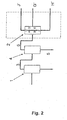
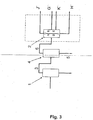
- the top stream of the first distillation stage is analogous to the two-stage distillation described above FIG. 2 the recovery of 2,2'-MDI poor 2,4'-MDI and a 2,2'-MDI poor 2,4 '- / 4,4'-MDI mixture in a dividing wall column.
- a low-boiler stream is taken off, which contains most of the fed with the feed 2,2'-MDI, while from the Hauptfr pressierzone D, E, a first side stream consisting of 2,2'-MDI-poor 2,4 '-MDI (maximum 0.2% 2,2'-MDI) with low content of 4,4'-MDI (maximum 5%) is taken.
- a first side stream consisting of 2,2'-MDI-poor 2,4 '-MDI (maximum 0.2% 2,2'-MDI) with low content of 4,4'-MDI (maximum 5%) is taken.
- About the bottom of the dividing wall column falls to a stream containing about 90% 4,4'-MDI and about 10% 2,4'-MDI and, for example, for pure recovery of 4,4'-MDI crystallization or another distillative Separation can be supplied.
- FIG. 1 It will according to FIG. 1 carried out a one-stage distillation with a dividing wall column.
- tissue packs with a specific surface area of 500 m 2 / m 3 are used in the dividing wall column.
- 40% by weight of the liquid is passed to the prefractionation zone and 60% by weight to the main fractionation zone.
- the rectification zone and the stripping zone each have 8 separation stages, the prefractionation zone has 12 separation stages at the top and 14 separation stages below, the main fractionation zone has 16 separation stages at the top and 14 separation stages at the bottom, with the separation stages above and below - here and below - the separation stages above and below the feeding of the feed stream into the prefractionation zone or the side stream withdrawal from the main fractionation zone is meant.
- the head pressure is 6 mbar.
- the return at the distillate removal is 56: 1
- the return at the side stream take-off is 3.7: 1.
- FIG. 1 It will according to FIG. 1 carried out a one-stage distillation with a dividing wall column.
- tissue packs with a specific surface area of 500 m 2 / m 3 are used in the dividing wall column.
- 50% by weight of the liquid is passed to the prefractionation zone and 50% by weight to the main fractionation zone.
- the rectification zone and the stripping zone each have 8 separation stages, the prefractionation zone has 12 separation stages at the top and 14 separation stages at the bottom, the main fractionation zone has 16 separation stages at the top, 12 separation stages at the center and 2 separation stages at the bottom.
- the head pressure is 6 mbar.
- the return at the distillate removal is 72: 1, the return at the upper side stream take-off is 8.2: 1, the return at the lower side stream take-off is 3.9: 1.
- the upper side stream is taken from the 16th fractionation stage of the main fractionation zone.
- the lower side stream is taken from the 28th separation stage of the main fractionation zone.
- the head pressure is 6 mbar.
- the return on the distillate removal is 75: 1, the return at the upper side stream take-off is 9.3: 1, at the lower side stream take-off 4.0: 1.
- 11 kg / h of an isomer mixture consisting of 3.0% by weight of 2,2'-MDI, 50.0% by weight of 2,4'-MDI and 47.0% by weight of 4,4'-MDI are fed to the dividing wall column on the 13th stage from above in the prefractionation zone in the region of the dividing wall.
- the dividing wall column is taken from four product streams: 0.6 kg / h overhead stream, consisting of 53.3% by weight of 2,2'-MDI, 46.6% by weight of 2,4'-MDI with a maximum of 0.1% by weight .-% 4,4'-MDI; 2.6 kg / h from the upper side stream consisting of 0.1% by weight of 2,2'-MDI, 97.5% by weight of 2,4'-MDI, 2.4% by weight of 4, 4'-MDI; 4.5 kg / h of a lower side stream consisting of 0.07% by weight of 2,2'-MDI, 55% by weight of 2,4'-MDI, 44.93% by weight of 4,4'- MDI and a bottom stream of 3.3 kg / h with an isomeric purity of 92.8% 4,4'-MDI and 7.2% 2,4'-MDI.
Landscapes
- Chemical & Material Sciences (AREA)
- Organic Chemistry (AREA)
- Engineering & Computer Science (AREA)
- Signal Processing (AREA)
- Organic Low-Molecular-Weight Compounds And Preparation Thereof (AREA)
Description
Die Erfindung betrifft ein Verfahren zur Destillation eines Gemisches wenigstens bestehend aus 2,2'-Diisocyanatodiphenylmethan (2,2'-MDI), 2,4'-Diisocyanatodiphenylmethan (2,4'-MDI) und 4,4'-Diisocyanatodiphenylmethan (4,4'-MDI) zur Gewinnung von an 2,2'-Diisocyanatodiphenylmethan armem 2,4'-Diisocyanatodiphenylmethan sowie von an 2,2'-Diisocyanatodiphenylmethan armen Gemischen aus 4,4'- und 2,4'-Diisocyanatodiphenylmethan.The invention relates to a process for the distillation of a mixture at least consisting of 2,2'-diisocyanatodiphenylmethane (2,2'-MDI), 2,4'-diisocyanatodiphenylmethane (2,4'-MDI) and 4,4'-diisocyanatodiphenylmethane (4 , 4'-MDI) to obtain 2,4'-diisocyanatodiphenylmethane poor in 2,2'-diisocyanatodiphenylmethane and mixtures of 4,4'- and 2,4'-diisocyanatodiphenylmethane which are deficient in 2,2'-diisocyanatodiphenylmethane.
Diisocyanatodiphenylmethan-Isomere sind Bestandteile von Polyisocyanatgemischen der Diphenylmethanreihe, welche bei der Phosgenierung von Anilin/Formaldehyd-Kondensaten, im Folgenden auch Polyaminopolyphenylpolymethane genannt, entstehen.Diisocyanatodiphenylmethane isomers are constituents of polyisocyanate mixtures of the diphenylmethane series, which are formed in the phosgenation of aniline / formaldehyde condensates, also referred to below as polyaminopolyphenylpolymethanes.
Die Kondensation von Anilin und Formaldehyd sowie die Phosgenierung der Polyaminopolyphenylpolymethane sind aus dem Stand der Technik hinlänglich bekannt. Nach der Phosgenierung von Polyaminopolyphenylpolymethanen wird zunächst Phosgen vollständig entfernt. Dann werden die höheren Homologen des Diisocyanatodiphenylmethans (auch Polyisocyanatopolyphenylpolymethane genannt) abgetrennt. Aus dem verbleibenden Gemisch isomerer Diisocyanatodiphenylmethane, hauptsächlich bestehend aus 2,2'-Diisocyanatodiphenylmethan, 2,4'-Diisocyanatodiphenylmethan und 4,4'-Diisocyanatodiphenylmethan (nachfolgend auch vereinfachend als MDI-Isomerengemisch oder MDI-Rohgemisch bezeichnet), können anschließend reine Diisocyanatodiphenylmethan-Isomere oder Gemische aus zwei oder drei Isomeren nach gewünschten Produktspezifikationen abgetrennt werden. Für die Abtrennung sind verschiedene Verfahren auf Basis einer Destillation oder Kristallisation oder einer Kombination aus Destillation und Kristallisation aus dem Stand der Technik bekannt.The condensation of aniline and formaldehyde and the phosgenation of the polyaminopolyphenylpolymethanes are well known in the art. After the phosgenation of Polyaminopolyphenylpolymethanen phosgene is first completely removed. Then the higher homologues of diisocyanatodiphenylmethane (also called polyisocyanatopolyphenylpolymethanes) are separated off. From the remaining mixture of isomeric diisocyanatodiphenylmethanes, mainly consisting of 2,2'-diisocyanatodiphenylmethane, 2,4'-diisocyanatodiphenylmethane and 4,4'-diisocyanatodiphenylmethane (hereinafter also referred to simply as MDI isomer mixture or crude MDI mixture), pure diisocyanatodiphenylmethane can then be added. Isomers or mixtures of two or three isomers are separated according to desired product specifications. For the separation, various processes based on distillation or crystallization or a combination of distillation and crystallization are known in the art.
Beispielsweise beschreibt
Ferner ist aus
Für viele Anwendungen ist die Gegenwart von 2,2'-Diisocyanatodiphenylmethan in den Wertstoffen oder Wertstoffgemischen nicht erwünscht. Bei einfachen Destillationen von rohen Diisocyanatodiphenylmethangemischen ist jedoch eine Abtrennung von 2,2'-MDI nicht oder nur unter erheblichem technischen und ökonomischen Aufwand möglich.For many applications, the presence of 2,2'-diisocyanatodiphenylmethane in the recyclables or mixtures of useful materials is not desirable. In simple distillations of crude Diisocyanatodiphenylmethangemischen but separation of 2,2'-MDI is not possible or only with considerable technical and economic effort.
Aufgabe der vorliegenden Erfindung ist es daher, ein ökonomisches und technisch einfaches Verfahren zur Destillation eines Gemisches isomerer Diisocyanatodiphenylmethane, wenigstens bestehend aus 2,2'-Diisocyanatodiphenylmethan, 2,4'-Diisocyanatodiphenylmethan und 4,4'-Diisocyanatodiphenylmethan (im Folgenden Ausgangsgemisch genannt) bereitzustellen, welches die Herstellung von 2,4'-MDI erlaubt, das frei von 2,2'-MDI ist oder zumindest nur einen sehr geringen 2,2'-MDI-Gehalt in der Größenordnung von maximal 0,2 Gew.-% aufweist.Object of the present invention is therefore an economical and technically simple process for the distillation of a mixture of isomeric Diisocyanatodiphenylmethane, at least consisting of 2,2'-diisocyanatodiphenylmethane, 2,4'-diisocyanatodiphenylmethane and 4,4'-diisocyanatodiphenylmethane (hereinafter called starting mixture) which allows the preparation of 2,4'-MDI which is free of 2,2'-MDI or at least only a very low 2,2'-MDI content of the order of a maximum of 0.2% by weight. having.
Gegenstand der Erfindung ist ein Verfahren zur Herstellung von an 2,2'-MDI armem 2,4'-MDI durch Destillation entweder eines Ausgangsgemisches isomerer Diisocyanatodiphenylmethane, wenigstens bestehend aus 2,2'-Diisocyanatodiphenylmethan, 2,4'-Diisocyanatodiphenylmethan und 4,4'-Diisocyanatodiphenylmethan, oder eines in einer destillativen Vortrennung des Ausgangsgemisches erhaltenen Gemisches, welches zu 0 bis 15 Gew.-% aus 2,2'-MDI, zu 12 bis 60 Gew.-% aus 2,4'-MDI und zu 25 bis 88 Gew.-% aus 4,4'-MDI besteht, wobei die Destillation mindestens einstufig ausgeführt ist und in mindestens einer Destillationsstufe eine Trennwandkolonne eingesetzt wird, wobei das Ausgangsgemisch oder das nach destillativer Vortrennung vorliegende Diisocyanatodiphenylmethan-Isomerengemisch als Feedstrom vollständig auf die Vorfraktionierzone der Trennwandkolonne geführt wird, dadurch gekennzeichnet, dass die Flüssigkeitsaufteilung zwischen Vorfraktionierzone und Hauptfraktionierzone der Trennwandkolonne so vorgenommen wird, dass im Seitenstrom ein Gemisch erhalten wird, welches maximal 0,2 Gew.-% 2,2'-Diisocyanatodiphenylmethan und 95 bis 99 Gew.-%, bevorzugt 95 bis 98 Gew.-%, besonders bevorzugt 97,5 bis 98 Gew.-% 2,4'-Diisocyanatodiphenylmethan enthält, wobei sich die Gewichtsprozentangaben auf die Zusammensetzung der Isomere beziehen.The invention relates to a process for the preparation of 2,2'-MDI poor 2,4'-MDI by distillation of either a starting mixture of isomeric Diisocyanatodiphenylmethane, at least consisting of 2,2'-diisocyanatodiphenylmethane, 2,4'-diisocyanatodiphenylmethane and 4, 4'-diisocyanatodiphenylmethane, or a mixture obtained in a distillative preliminary separation of the starting mixture, which comprises 0 to 15 wt .-% of 2,2'-MDI, 12 to 60 wt .-% of 2,4'-MDI and to 25 to 88 wt .-% of 4,4'-MDI, wherein the distillation is carried out at least one stage and in at least one distillation stage a dividing wall column is used, wherein the starting mixture or present by distillation preliminary Diisocyanatodiphenylmethan isomer mixture completely as the feed stream to the Vorfraktionierzone the dividing wall column is performed, characterized in that the liquid distribution between Vorfraktionierzone and Hauptfraktionierzone the dividing wall column carried out so that in the side stream, a mixture is obtained, which is at most 0.2 wt .-% of 2,2'-diisocyanatodiphenylmethane and 95 to 99 wt .-%, preferably 95 to 98 wt .-%, particularly preferably 97.5 contains up to 98 wt .-% of 2,4'-diisocyanatodiphenylmethane, wherein the percentages by weight relate to the composition of the isomers.
Sofern nicht anders angegeben, handelt es sich hier und im Folgenden bei Prozentangaben um Gewichtsprozent, wobei sich die Prozentangaben immer auf die Zusammensetzung der Isomere beziehen.Unless otherwise stated, percentages here and below are percentages by weight, the percentages always referring to the composition of the isomers.
Das bei dem erfindungsgemäßen Verfahren eingesetzte Gemisch isomerer Diisocyanatodiphenylmethane entsteht bei der Phosgenierung von Polyaminopolyphenylpolymethanen, welche durch Kondensation von Anilin und Formaldehyd hergestellt werden, zu Polyisocyanatopolyphenylpolymethanen. Nach der Phosgenierung, welche vorzugsweise in Monochlorbenzol (MCB) als Lösungsmittel durchgeführt wird, werden auf destillativem Wege zunächst das Lösungsmittel und Phosgen weitgehend entfernt.The mixture of isomeric diisocyanatodiphenylmethanes used in the process according to the invention is formed in the phosgenation of polyaminopolyphenylpolymethanes, which are prepared by condensation of aniline and formaldehyde, to form polyisocyanatopolyphenylpolymethanes. After the phosgenation, which is preferably carried out in monochlorobenzene (MCB) as a solvent, the solvent and phosgene are initially removed by distillation.
Dann wird mittels Destillation in einer an sich bekannten, z.B. aus
Das erfindungsgemäße Verfahren beruht auf der destillativen Abtrennung der MDI-Isomeren aus dem Ausgangsgemisch in einem ein- oder mehrstufigen Verfahren mittels einer Trennwandkolonne in wenigstens einer der Destillationsstufen. Mit Hilfe des erfindungsgemäßen Verfahrens gelingt die Auftrennung eines MDI-Rohgemisches in reines 2,4'-Diisocyanatodiphenylmethan und ein Gemisch aus 2,4'-Diisocyanatodiphenylmethan und 4,4'-Diisocyanatodiphenylmethan, wobei die Trennwandkolonne für unterschiedliche Feed-Zusammensetzungen und Produktspezifikationen ausgelegt werden kann. Andererseits ist für viele Anwendungszwecke der Gehalt an 4,4'-MDI von geringerer Bedeutung, so dass die Abtrennung von 2,4'-MDI nicht die vollständige Trennung von 4,4'-MDI bedeuten muss. Der Vorteil des erfindungsgemäßen Verfahrens liegt in der Verwendung einer Trennwandkolonne, womit niedrigere Herstellkosten aufgrund des geringeren technischen Aufwands gegenüber bekannten Destillationsverfahren ohne Trennwandkolonne verbunden sind.The process according to the invention is based on the distillative separation of the MDI isomers from the starting mixture in a one-stage or multistage process by means of a dividing wall column in at least one of the distillation stages. With the aid of the process according to the invention, it is possible to separate an MDI raw mixture into pure 2,4'-diisocyanatodiphenylmethane and a mixture of 2,4'-diisocyanatodiphenylmethane and 4,4'-diisocyanatodiphenylmethane, the dividing wall column being designed for different feed compositions and product specifications can. On the other hand, for many applications, the content of 4,4'-MDI is of less importance, so that the separation of 2,4'-MDI need not mean the complete separation of 4,4'-MDI. The advantage of the process according to the invention lies in the use of a dividing wall column, with which lower production costs are connected due to the lower technical complexity compared to known distillation processes without dividing wall column.
Der Einsatz mindestens einer Trennwandkolonne zur Gewinnung von 2,4'-MDI aus einem Gemisch isomerer Diisocyanatodiphenylmethane ermöglicht es, im Vergleich zu Destillationsverfahren nach dem Stand der Technik einen bzw. zwei Destillationsschritte einzusparen. Damit ist einerseits der apparative Aufwand erheblich geringer, da neben der Destillationskolonne auch zusätzliche Wärmetauscher, Verrohrungen, usw. eingespart werden. Andererseits reduziert sich dadurch der Energieaufwand in bedeutendem Maße, da weniger Wärme zugeführt werden muss. Des Weiteren ist bei einer geringeren Anzahl von Destillationsschritten aufgrund der geringeren thermischen Belastung der durch Reaktionen der Isocyanatgruppen bedingte Rückstandsanteil geringer.The use of at least one dividing wall column for obtaining 2,4'-MDI from a mixture of isomeric diisocyanatodiphenylmethanes makes it possible to save one or two distillation steps in comparison to prior art distillation processes. Thus, on the one hand the equipment cost is considerably lower, as in addition to the distillation column and additional heat exchangers, piping, etc. can be saved. On the other hand, this significantly reduces the energy consumption, since less heat must be supplied. Furthermore, with a smaller number of distillation steps due to the lower thermal load caused by reactions of the isocyanate groups residue is lower.
Die Destillation eines Mehrkomponentengemisches in einer Trennwandkolonne ist beispielsweise aus
Üblicherweise wird bei einer Monomer-Polymertrennung ein 2-Kern-Gemisch erhalten, das zu 0 bis 5 Gew.-% aus 2,2'-MDI, zu 5 bis 15 Gew.-% aus 2,4'-MDI und zu 80 bis 95 Gew.-% aus 4,4'-MDI besteht. Ein solches Gemisch (auch Ausgangsgemisch genannt) kann bei der erfindungsgemäßen Destillation eingesetzt werden. In einer Ausführungsform des erfindungsgemäßen Verfahrens findet jedoch ein zusätzlicher Destillationsschritt statt, in dem das MDI-Isomerengemisch aus der Monomer-Polymertrennung (Ausgangsgemisch) einer Isomerendestillation (destillative Vortrennung) zugeführt wird. Dieser zusätzliche Destillationsschritt, der dem Destillationsverfahren gemäß Anspruch 1 vorgeschaltet ist, führt zu einem Gemisch, welches zu 0 bis 15 Gew.-% aus 2,2'-MDI, zu 12 bis 60 Gew.-% aus 2,4'-MDI und zu 25 bis 88 Gew.-% aus 4,4'-MDI besteht. Es kann als Feedstrom zur Trennwandkolonne eingesetzt werden. Bevorzugt besteht dieses Gemisch, das als Feedstrom zur Trennwandkolonne dienen kann, aus maximal 3,0 % 2,2'-MDI, 30 bis 60% (z.B. 49,9%) 2,4'-MDI und 40 bis 70% 4,4'-MDI (z.B. 46,9%) sowie Spuren von Leichtsiedern.Usually, in a monomer-polymer separation, a 2-core mixture is obtained which is 0 to 5 wt .-% of 2,2'-MDI, 5 to 15 wt .-% of 2,4'-MDI and 80 to 95 wt .-% of 4,4'-MDI. Such a mixture (also called starting mixture) can in the inventive Distillation can be used. In one embodiment of the process according to the invention, however, an additional distillation step takes place, in which the MDI isomer mixture from the monomer-polymer separation (starting mixture) is fed to an isomer distillation (distillative pre-separation). This additional distillation step, which precedes the distillation process according to claim 1, leads to a mixture which comprises 0 to 15 wt .-% of 2,2'-MDI, 12 to 60 wt .-% of 2,4'-MDI and from 25 to 88% by weight of 4,4'-MDI. It can be used as feed stream to the dividing wall column. This mixture, which can serve as a feed stream to the dividing wall column, preferably consists of a maximum of 3.0% 2,2'-MDI, 30 to 60% (eg 49.9%) 2,4'-MDI and 40 to 70% 4, 4'-MDI (eg 46.9%) as well as traces of low-boiling components.
Das Ausgangsgemisch oder das MDI-Isomerengemisch nach destillativer Vortrennung wird nach dem erfindungsgemäßen Verfahren der Trennwandkolonne seitlich im Bereich der Trennwand zugeführt. Die Trennwand befindet sich im mittleren Bereich der Kolonne und teilt den Querschnitt der Kolonne. Die Länge der Trennwand ist abhängig von den Prozessbedingungen und von den Eigenschaften der eingesetzten Stoffaustauschelemente.The starting mixture or the MDI isomer mixture after distillative pre-separation is fed laterally in the region of the dividing wall by the process according to the invention to the dividing wall column. The partition is located in the middle region of the column and divides the cross section of the column. The length of the partition depends on the process conditions and on the properties of the mass transfer elements used.
Die Anzahl der erforderlichen Trennstufen in den einzelnen Kolonnenabschnitten ist abhängig von den Prozessbedingungen, insbesondere der Zusammensetzung des Zulaufes und der gewünschten Produkte. So ist z.B. bei großzügig ausgelegten Kopf- und Sumpfspezifikationen eine Stoffaustauschzone im Kopfteil und Sumpfteil verzichtbar und im Bereich der Trennwand minimierbar.The number of required separation stages in the individual column sections depends on the process conditions, in particular the composition of the feed and the desired products. For example, e.g. With generously designed head and sump specifications, a mass transfer zone in the head section and bottom section can be dispensed with and can be minimized in the area of the dividing wall.
In einer besonders bevorzugten Ausführungsform ergibt sich bei dem Einsatz einer Gewebepackung mit z.B. 500 m2/m3 spezifischer Oberfläche eine Trennwandlänge von ca. 6 bis 8 m. Die Stoffaustauschzonen im Kopf und Sumpf der Kolonne sind jeweils 1,20 bis 2,50 m, z.B. 1,80 m, hoch und haben jeweils 6 bis 12, z.B. 8, Trennstufen. Die Vorfraktionierzone hat oberhalb der Einspeisung 10 bis 14 Trennstufen und unterhalb der Einspeisung 13 bis 17 Trennstufen. Die Hauptfraktionierzone hat oberhalb der Ausspeisung des Seitenstroms 14 bis 18 Trennstufen und unterhalb der Ausspeisung 12 bis 16 Trennstufen.In a particularly preferred embodiment results in the use of a fabric packing with eg 500 m 2 / m 3 specific surface a partition wall length of about 6 to 8 m. The mass transfer zones in the top and bottom of the column are each 1.20 to 2.50 m, for example 1.80 m, high and have in each
Das Ausgangsgemisch oder das MDI-Isomerengemisch nach destillativer Vortrennung wird als Feedstrom vollständig auf die Vorfraktionierzone der Trennwandkolonne geführt. Der Sumpfstrom der Trennwandkolonne wird einem Verdampfer zugeführt und teilweise verdampft. Der Dampfstrom aus dem Verdampfer wird in die Trennwandkolonne zurückgeführt, durchströmt zunächst die Packung der Sumpfzone und teilt sich entsprechend den Druckverhältnissen auf Vorfraktionier- und Hauptfraktionierzone auf. Die Dampfströme aus diesen Zonen vereinigen sich beim Verlassen der Trennwandzone und durchströmen zuletzt die Kopfzone. Die Brüden am Kopf der Trennwandkolonne werden kondensiert und zu 88 bis 99,6 %, bevorzugt 98 bis 99%, z.B. 98, 5%, in die Kopfzone zurückgegeben. Die zurücklaufende Flüssigkeit wird unterhalb der Kopfzone zu 20 bis 60%, bevorzugt 30 bis 50%, z.B. 40%, in die Vorfraktionierzone und zu 40 bis 80%, bevorzugt 50 bis 70 %, z.B. 60%, in die Hauptfraktionierzone geleitet. Der Seitenstrom wird zunächst vollständig abgezogen und dann zu 60 bis 97 %, bevorzugt 75 bis 85%, z.B. 80%, in die Hauptfraktionierzone zurückgegeben. Die Dampfströmung in der Vorfraktionierzone und der Hauptfraktionierzone stellt sich entsprechend den Packungsdruckverlusten ein. Der Gesamtdruck an den Ein- und Austrittsbereichen der Trennwand ist für beide Zonen gleich. Falls aus prozesstechnischer Sicht im Bereich der Trennwand eine Zone stärker mit Dampf beaufschlagt werden soll, können die Querschnitte von Vorfraktionierzone und Hauptfraktionierzone auch unterschiedlich gewählt werden. Durch entsprechende Wahl der Teilquerschnitte der beiden Zonen kann der Prozess hinsichtlich des Energiebedarfes optimiert werden.The starting mixture or the MDI isomer mixture after distillative pre-separation is fed completely as feed stream to the prefractionation zone of the dividing wall column. The bottom stream of the dividing wall column is fed to an evaporator and partially evaporated. The vapor stream from the evaporator is returned to the dividing wall column, first flows through the packing of the sump zone and is divided according to the pressure conditions on Vorfraktionier- and Hauptfraktionierzone. The vapor streams from these zones unite when leaving the partition wall zone and last flow through the head zone. The vapors at the top of the dividing wall column are condensed and at 88 to 99.6%, preferably 98 to 99%, for example 98, 5%, returned to the head zone. The recirculating liquid is passed below the top zone to 20 to 60%, preferably 30 to 50%, for example 40%, in the Vorfraktionierzone and 40 to 80%, preferably 50 to 70%, for example 60%, in the main fractionation. The side stream is first completely withdrawn and then returned to the main fractionation zone at 60 to 97%, preferably 75 to 85%, eg 80%. The vapor flow in the prefractionation zone and the main fractionation zone adjusts according to the packing pressure losses. The total pressure at the inlet and outlet areas of the partition is the same for both zones. If, from the process engineering point of view, a zone is to be exposed more strongly to steam in the region of the dividing wall, the cross sections of the prefractionation zone and the main fractionation zone can also be chosen differently. By appropriate choice of the partial cross sections of the two zones, the process can be optimized in terms of energy requirements.
Als Stoffaustauschelemente sind Packungen besonders geeignet. Verwendbar sind aber auch andere in der Destillationstechnik bekannte Stoffaustauschelemente, wie z.B. Füllkörper oder Böden.As mass transfer elements, packages are particularly suitable. However, it is also possible to use other mass transfer elements known in the distillation industry, e.g. Fillers or bottoms.
Die Trennwandkolonne wird hinsichtlich Druck und Temperatur unter ähnlichen Prozessbedingungen betrieben wie eine Kolonne der konventionellen Destillationstechnik. Der absolute Betriebsdruck einer solchen Kolonne wird bei 0,5 bis 30 mbar eingestellt, der Kopfdruck beträgt bevorzugt 3 bis 16 mbar. Je nach Gemischzusammensetzung beträgt die Kopftemperatur 165 bis 205 C. Der Sumpfdruck beträgt bevorzugt 9 bis 25 mbar bei Temperaturen von 205 bis 225 C.The dividing wall column is operated in terms of pressure and temperature under similar process conditions as a column of the conventional distillation technique. The absolute operating pressure of such a column is set at 0.5 to 30 mbar, the top pressure is preferably 3 to 16 mbar. Depending on the mixture composition, the head temperature is 165 to 205 ° C. The bottom pressure is preferably 9 to 25 mbar at temperatures of 205 to 225 ° C.
Bei der erfindungsgemäßen Destillation des Gemisches isomerer Diisocyanatodiphenylmethane in der Trennwandkolonne wird als Sumpf ein Strom ausgeschleust, der mindestens 80% des eingespeisten 4,4'-Diisocyanatodiphenylmethans enthält. Dieser Sumpfstrom kann in die Trennwandkolonne oder in die Polymer-Monomertrennung zurückgeführt werden. Als Kopfprodukt wird in Abhängigkeit vom Feedstrom ein Gemisch, bestehend aus 2,2'-Diisocyanatodiphenylmethan (max. 80 Gew.-%), 2,4'-Diisocyanatodiphenylmethan (18 bis 80 Gew.-%) und 4,4'-Diisocyanatodiphenylmethan (max. 2 Gew.-%) sowie als Seitenstrom ein Gemisch aus 2,4'-Diisocyanatodiphenylmethan und 4,4'-Diisocyanatodiphenylmethan mit einem Gewichtsverhältnis von 99:1 bis 95:5 erhalten. Erfindungsgemäß bedeutsam ist, dass im Seitenstrom der Gehalt an 2,2'-MDI sehr klein ist, d.h. es werden Konzentrationen von maximal 0,2 Gew.-%, bevorzugt maximal 0,1 Gew.-%, erreicht.In the distillation according to the invention of the mixture of isomeric diisocyanatodiphenylmethanes in the dividing wall column, a stream which comprises at least 80% of the 4,4'-diisocyanatodiphenylmethane fed in is discharged as bottom. This bottom stream can be recycled to the dividing wall column or to the polymer monomer separation. Depending on the feed stream, the top product is a mixture consisting of 2,2'-diisocyanatodiphenylmethane (maximum 80% by weight), 2,4'-diisocyanatodiphenylmethane (18 to 80% by weight) and 4,4'-diisocyanatodiphenylmethane (2 wt .-% max) and as a side stream, a mixture of 2,4'-diisocyanatodiphenylmethane and 4,4'-diisocyanatodiphenylmethane with a weight ratio of 99: 1 to 95: 5. Significantly, according to the present invention, the sidestream content of 2,2'-MDI is very small, i. concentrations of not more than 0.2% by weight, preferably not more than 0.1% by weight, are achieved.
In einer besonders bevorzugten Ausführungsform des erfindungsgemäßen Verfahrens wird im Seitenstrom ein Gemisch aus 95 bis 98 Gew.-% 2,4'-MDI und maximal 5 Gew.-% 4,4'-MDI abgezogen. Durch geeignete Flüssigkeitsaufteilung zwischen Vorfraktionierzone und Hauptfraktionierzone kann die Konzentration von 2,4'-MDI im Seitenstrom in Grenzen von 95 bis 99 Gew.-% variiert werden. Das Rücklaufverhältnis im Kopf wird insbesondere im Bereich von 7,5 bis 250 eingestellt, liegt jedoch besonders bevorzugt im Bereich von 30 bis 90, wobei der Kopfstrom 2 bis 12 Gew.-% bezogen auf den Feedstrom beträgt. Der Sumpfstrom beträgt 20 bis 85 Gew.-%, vorzugsweise 40 bis 60 Gew.-%, des Feedstromes.In a particularly preferred embodiment of the process according to the invention, a mixture of 95 to 98% by weight of 2,4'-MDI and at most 5% by weight of 4,4'-MDI is withdrawn in the side stream. By suitable liquid distribution between Vorfraktionierzone and Hauptfraktionierzone, the concentration of 2,4'-MDI in the side stream within limits of 95 to Be varied 99 wt .-%. The reflux ratio in the top is set in particular in the range of 7.5 to 250, but is more preferably in the range of 30 to 90, wherein the top stream is 2 to 12 wt .-% based on the feed stream. The bottom stream is 20 to 85 wt .-%, preferably 40 to 60 wt .-%, of the feed stream.
Alternativ kann das erfindungsgemäße Verfahren auch mit einer weiteren Seitenstromentnahme unterhalb der ersten Seitenstromentnahme ausgeführt werden. Die zweite Seitenstromentnahme liegt dabei auch in der Hauptfraktionierzone. Hier kann ein Gemisch aus 4,4'-MDI und 2,4'-MDI mit 18 bis 82 Gew.-% 2,4'-MDI entnommen werden. Besonders bevorzugt wird ein kommerziell verwertbares Gemisch aus 50 bis 60 Gew.-% 2,4'-MDI mit maximal 0,2 Gew.-% 2,2'-Diisocyanatodiphenylmethan entnommen.Alternatively, the method according to the invention can also be carried out with a further side stream take-off below the first side stream take-off. The second side stream withdrawal is also in the main fractionation zone. Here, a mixture of 4,4'-MDI and 2,4'-MDI with 18 to 82 wt .-% 2,4'-MDI can be removed. Particularly preferred is a commercially utilizable mixture of 50 to 60 wt .-% 2,4'-MDI with a maximum of 0.2 wt .-% 2,2'-diisocyanatodiphenylmethane removed.
Nach dem erfindungsgemäßen Verfahren wird das Hauptprodukt, nämlich weitgehend reines 2,4'-MDI, als Seitenstrom der Trennwandkolonne in der Hauptfraktionierzone entnommen. Die Menge des Seitenstromes beträgt bevorzugt mindestens 3 Gew.-% des Feedstroms. Besonders bevorzugt beträgt der Anteil des Seitenstromes 38 bis 50 Gew.-%, z.B. 44%, des Feedstroms. Das Hauptprodukt besteht zu 95 bis 99 Gew.-% aus 2,4'-MDI und maximal 5 Gew.-%, insbesondere 1 bis 5 Gew.-%, 4,4'-MDI, wobei der Anteil an 2,2'-MDI maximal 0,2 Gew.-% beträgt. Besonders bevorzugtes Produkt im Seitenstrom ist ein Gemisch aus 95 bis 98 Gew.-% 2,4'-MDI und 2,5 bis 5 Gew.-% 4,4'-MDI, wobei der Anteil an 2,2'-MDI maximal 0,2 Gew.-% beträgt. Das Sumpfprodukt besteht bevorzugt aus 2 bis 35 Gew.-% 2,4'-MDI und 65 bis 98 Gew.-% 4,4'-MDI, besonders bevorzugt aus 8 bis 12 Gew.-% 2,4'-MDI und 88 bis 92 Gew.-% 4,4'-MDI. In diesem Fall kann das Sumpfprodukt in die vorgeschaltete Destillation (destillative Vortrennung) zurückgeführt werden. Das Kopfprodukt besteht vorzugsweise aus 20 bis 67 Gew.-% 2,2'-MDI, 33 bis 80 Gew.-% 2,4'-MDI, wobei der Anteil an 4,4'-MDI maximal 2 Gew.-% beträgt.In the process according to the invention, the main product, namely substantially pure 2,4'-MDI, is taken off as a side stream of the dividing wall column in the main fractionation zone. The amount of the side stream is preferably at least 3 wt .-% of the feed stream. More preferably, the proportion of sidestream is 38 to 50% by weight, e.g. 44%, of the feed stream. The main product consists of 95 to 99 wt .-% of 2,4'-MDI and at most 5 wt .-%, in particular 1 to 5 wt .-%, 4,4'-MDI, wherein the proportion of 2,2 ' -MDI is at most 0.2% by weight. A particularly preferred product in the side stream is a mixture of 95 to 98 wt .-% 2,4'-MDI and 2.5 to 5 wt .-% 4,4'-MDI, wherein the proportion of 2,2'-MDI maximum 0.2 wt .-% is. The bottom product preferably consists of 2 to 35 wt .-% 2,4'-MDI and 65 to 98 wt .-% 4,4'-MDI, more preferably from 8 to 12 wt .-% 2,4'-MDI and 88 to 92% by weight of 4,4'-MDI. In this case, the bottom product can be returned to the upstream distillation (distillative pre-separation). The top product preferably consists of 20 to 67% by weight of 2,2'-MDI, 33 to 80% by weight of 2,4'-MDI, the proportion of 4,4'-MDI being at most 2% by weight ,
In einer ersten Ausführungsform gemäß
Je nach Abnahmestelle in der Hauptfraktionierzone, d.h. im Bereich D, E, können sowohl unterschiedliche Isomerengemische, bestehend aus 2,2'-, 2,4'- und 4,4'-MDI, als auch reine Isomere entnommen werden. Unter reinen Isomeren sind hier Isomere zu verstehen, die kommerziell verwertbar sind und keiner weiteren Trennung mehr bedürfen.Depending on the sampling point in the main fractionation zone, ie in the region D, E, both different isomer mixtures consisting of 2,2'-, 2,4'- and 4,4'-MDI, as well as pure isomers be removed. Pure isomers are to be understood as meaning isomers which are commercially utilizable and require no further separation.
In einer zweiten Ausführungsform gemäß
Der Sumpfstrom dieser ersten Destillationsstufe ohne Trennwandkolonne kann in an sich bekannter Art und Weise in einer nachgeschalteten Kolonne in einen Kopfstrom aus reinem 4,4'-MDI und einen Sumpfstrom aufgetrennt werden, wobei letzterer z.B. wieder in die Polymer-Monomer-Destillation zurückgeführt werden kann.The bottom stream of this first distillation stage without dividing wall column can be separated in a conventional manner in a downstream column in a top stream of pure 4,4'-MDI and a bottom stream, the latter being e.g. can be recycled back to the polymer-monomer distillation.
Der Kopfstrom der ersten Destillationsstufe dient der Gewinnung von an 2,2'-MDI armem 2,4'-MDI und einem an 2,2'-MDI armen 2,4'-/4,4'-MDI-Gemisch mittels Trennwandkolonne. Zu diesem Zweck wird dieser Kopfstrom in die Vorfraktionierzone A, B einer Trennwandkolonne eingespeist. Am Kopf der Trennwandkolonne wird ein Leichsiederstrom entnommen, der den größten Teil des mit dem Feed eingespeisten 2,2'-MDI enthält, während aus der Hauptfraktionierzone D, E ein 2,2'-MDI-armes 2,4'-MDI (max. 0,2% 2,2'-MDI) mit geringem Gehalt an 4,4'-MDI (max. 5%) entnommen werden kann. Über den Sumpf der Trennwandkolonne fällt ein Strom an, der ca. 90 % 4,4'-MDI und ca. 10 % 2,4'-MDI enthält und beispielsweise zur Reingewinnung von 4,4'- MDI einer Kristallisation oder einer weiteren destillativen Trennung zugeführt werden kann.The top stream of the first distillation stage is used to obtain 2,2'-MDI poor 2,4'-MDI and a 2,2'-MDI poor 2,4 '- / 4,4'-MDI mixture by means of a dividing wall column. For this purpose, this top stream is fed into the prefractionation zone A, B of a dividing wall column. At the top of the dividing wall column a Leichsiederstrom is taken, which contains most of the fed with the
In einer dritten Ausführungsform gemäß
Der Sumpfstrom der ersten Destillationsstufe kann wieder in an sich bekannter Art und Weise in einer nachgeschalteten Kolonne in einen Kopfstrom aus reinem 4,4'-MDI und einen Sumpfstrom aufgetrennt werden, wobei letzterer beispielsweise in die Polymer-Monomer-Destillation zurückgeführt werden kann.The bottom stream of the first distillation stage can be separated again in a conventional manner in a downstream column in a top stream of pure 4,4'-MDI and a bottom stream, the latter can be recycled, for example, in the polymer-monomer distillation.
Der Kopfstrom der ersten Destillationsstufe dient analog zu der oben beschriebenen zweistufigen Destillation gemäß
Über den Sumpf der Trennwandkolonne fällt ein Strom an, der ca. 90 % 4,4'-MDI und ca. 10% 2,4'-MDI enthält und beispielsweise zur Reingewinnung von 4,4'- MDI einer Kristallisation oder einer weiteren destillativer Trennung zugeführt werden kann.About the bottom of the dividing wall column falls to a stream containing about 90% 4,4'-MDI and about 10% 2,4'-MDI and, for example, for pure recovery of 4,4'-MDI crystallization or another distillative Separation can be supplied.
Es wird gemäß
12,5 kg/h eines Isomerengemisches, bestehend aus 3,0 Gew.-% 2,2'-MDI, 50,0 Gew.-% 2,4'-MDI und 47,0 Gew.-% 4,4'-MDI, werden der Trennwandkolonne in der Vorfraktionierzone auf der 13. Stufe von oben zugeführt. Der Trennwandkolonne werden drei Produktströme entnommen: 0,6 kg/h Kopfstrom, bestehend aus 56,4 Gew.-% 2,2'-MDI, 43,5 Gew.-% 2,4'-MDI und 0,1 Gew.-% 4,4'-MDI; 5,5 kg/h Seitenstrom, bestehend aus 0,1 Gew.-% 2,2'-MDI, 97,5 Gew.-% 2,4'-MDI und 2,4 Gew.-% 4,4'-MDI; 6,4 kg/h Sumpfstrom mit einer Isomerenreinheit an 4,4'-MDI von 90 % und 10 % 2,4'-MDI. Der Seitenstrom wird nach der 16. Trennstufe der Hauptfraktionierungszone entnommen.12.5 kg / h of an isomer mixture consisting of 3.0% by weight of 2,2'-MDI, 50.0% by weight of 2,4'-MDI and 47.0% by weight 4,4 ' -MDI are fed to the dividing wall column in the prefractionation zone at the 13th stage from above. The dividing wall column is taken from three product streams: 0.6 kg / h overhead stream consisting of 56.4% by weight of 2,2'-MDI, 43.5% by weight of 2,4'-MDI and 0.1% by weight. -% 4,4'-MDI; 5.5 kg / h side stream consisting of 0.1% by weight of 2,2'-MDI, 97.5% by weight of 2,4'-MDI and 2.4% by weight of 4,4'-MDI MDI; 6.4 kg / h bottom stream with an isomeric purity of 4,4'-MDI of 90% and 10% 2,4'-MDI. The side stream is taken after the 16th separation stage of the main fractionation zone.
Es wird gemäß
11 kg/h eines Isomerengemisches, bestehend aus 3,0 Gew.-% 2,2'-MDI, 50,0 Gew.-% 2,4'-MDI und 47,0 Gew.-% 4,4'-MDI werden der Trennwandkolonne auf der 13. Stufe von oben in der Vorfraktionierzone im Bereich der Trennwand zugeführt. Der Trennwandkolonne werden vier Produktströme entnommen: 0,6 kg/h Kopfstrom, bestehend aus 53,3 Gew.-% 2,2'-MDI, 46,6 Gew.-% 2,4'-MDI mit maximal 0,1 Gew.-% 4,4'-MDI; 2,6 kg/h aus dem oberen Seitenstrom, bestehend aus 0,1 Gew.-% 2,2'-MDI, 97,5 Gew.-% 2,4'-MDI, 2,4 Gew.-% 4,4'-MDI; 4,5 kg/h eines unteren Seitenstroms, bestehend aus 0,07 Gew.-% 2,2'-MDI, 55 Gew.-% 2,4'-MDI, 44,93 Gew.-% 4,4'-MDI und ein Sumpfstrom von 3,3 kg/h mit einer Isomerenreinheit von 92,8 % 4,4'-MDI und 7,2 % 2,4'-MDI.11 kg / h of an isomer mixture consisting of 3.0% by weight of 2,2'-MDI, 50.0% by weight of 2,4'-MDI and 47.0% by weight of 4,4'-MDI are fed to the dividing wall column on the 13th stage from above in the prefractionation zone in the region of the dividing wall. The dividing wall column is taken from four product streams: 0.6 kg / h overhead stream, consisting of 53.3% by weight of 2,2'-MDI, 46.6% by weight of 2,4'-MDI with a maximum of 0.1% by weight .-% 4,4'-MDI; 2.6 kg / h from the upper side stream consisting of 0.1% by weight of 2,2'-MDI, 97.5% by weight of 2,4'-MDI, 2.4% by weight of 4, 4'-MDI; 4.5 kg / h of a lower side stream consisting of 0.07% by weight of 2,2'-MDI, 55% by weight of 2,4'-MDI, 44.93% by weight of 4,4'- MDI and a bottom stream of 3.3 kg / h with an isomeric purity of 92.8% 4,4'-MDI and 7.2% 2,4'-MDI.
Claims (4)
- Process for producing 2,4'-MDI poor in 2,2'-MDI by distillation either of a starting mixture of isomeric diisocyanatodiphenylmethanes at least consisting of 2,2'-diisocyanatodiphenylmethane, 2,4'-diisocyanatodiphenylmethane and 4,4'-diisocyanatodiphenylmethane or of a mixture obtained in a distillative preseparation of the starting mixture and consisting of 0% to 15% by weight of 2,2'-diisocyanatodiphenylmethane, of 12% to 60% by weight of 2,4'-diisocyanatodiphenylmethane and of 25% to 88% by weight of 4,4'-diisocyanatodiphenylmethane, wherein the distillation is configured as an at least single-stage distillation and a dividing wall column is employed in at least one distillation stage, wherein the starting mixture or the diisocyanatodiphenylmethane isomer mixture present after the distillative preseparation is entirely passed onto the prefractionating zone of the dividing wall column as a feed stream, characterized in that the liquid division between the prefractionating zone and the main fractionating zone of the dividing wall column is undertaken such that a mixture containing 95% to 99% by weight of 2,4'-diisocyanatodiphenylmethane and not more than 0.2% by weight of 2,2'-diisocyanatodiphenylmethane is obtained in the sidestream, wherein the reported percentages by weight relate to the composition of the isomers.
- Process according to Claim 1, characterized in that in addition a mixture of 4,4'-MDI and 2,4'-MDI comprising 18% to 82% by weight of 2,4'-MDI is obtained.
- Process according to Claim 2, characterized in that a mixture of 4,4'-MDI and 2,4'-MDI comprising 50% to 60% by weight of 2,4'-MDI and not more than 0.2% by weight of 2,2'-MDI is obtained.
- Process according to any of Claims 1-3, characterized in that the distillation is configured as a two-stage distillation with a dividing wall column in the second stage, wherein the tops stream from the first column is sent to the dividing wall column as a feed stream.
Applications Claiming Priority (1)
| Application Number | Priority Date | Filing Date | Title |
|---|---|---|---|
| DE102005004170A DE102005004170A1 (en) | 2005-01-29 | 2005-01-29 | Process for the distillation of a mixture of isomeric diisocyanatodiphenylmethanes |
Publications (2)
| Publication Number | Publication Date |
|---|---|
| EP1686112A1 EP1686112A1 (en) | 2006-08-02 |
| EP1686112B1 true EP1686112B1 (en) | 2019-06-26 |
Family
ID=35809784
Family Applications (1)
| Application Number | Title | Priority Date | Filing Date |
|---|---|---|---|
| EP06000883.6A Expired - Lifetime EP1686112B1 (en) | 2005-01-29 | 2006-01-17 | Process for distilling a mixture of isomeric diisocyanatodiphenylmethanes |
Country Status (11)
| Country | Link |
|---|---|
| US (1) | US7521576B2 (en) |
| EP (1) | EP1686112B1 (en) |
| JP (1) | JP5001558B2 (en) |
| KR (1) | KR101359425B1 (en) |
| CN (1) | CN1810776A (en) |
| BR (1) | BRPI0600167A (en) |
| DE (1) | DE102005004170A1 (en) |
| HU (1) | HUE045265T2 (en) |
| PT (1) | PT1686112T (en) |
| SG (1) | SG124404A1 (en) |
| TW (1) | TW200639143A (en) |
Families Citing this family (15)
| Publication number | Priority date | Publication date | Assignee | Title |
|---|---|---|---|---|
| EP2337777B1 (en) * | 2008-10-02 | 2020-04-01 | Dow Global Technologies LLC | Methods for purification of isocyanate mixtures |
| US9505711B2 (en) | 2010-11-17 | 2016-11-29 | Basf Se | Method for purifying mixtures comprising 4,4′-methylenediphenyl diisocyanate |
| ES2533977T3 (en) | 2010-11-17 | 2015-04-16 | Basf Se | Procedure for the purification of mixtures containing 4,4'-methylene diphenyldiisocyanate |
| JP2014500878A (en) | 2010-11-17 | 2014-01-16 | ビーエーエスエフ ソシエタス・ヨーロピア | Process for refining a mixture comprising 4,4'-methylenediphenyl diisocyanate |
| KR101898745B1 (en) | 2010-11-17 | 2018-09-13 | 바스프 에스이 | Process for preparing methylenedi(phenyl isocyanate) |
| US8907124B2 (en) | 2010-11-17 | 2014-12-09 | Basf Se | Process for preparing methylenedi(phenyl isocyanate) |
| US20120123153A1 (en) * | 2010-11-17 | 2012-05-17 | Basf Se | Method for purifying mixtures comprising 4,4'-methylenediphenyl diisocyanate |
| WO2013081873A1 (en) * | 2011-11-30 | 2013-06-06 | Dow Global Technologies Llc | Process for the production of methylene diphenyl diisocyanate isomer mixtures with high 2,4'- methylene diphenyl diisocyanate purity |
| MX390867B (en) | 2014-06-24 | 2025-03-21 | Covestro Deutschland Ag | METHODS FOR PRODUCING CHEMICAL PRODUCTS WITH OPERATIONAL INTERRUPTIONS. |
| CN105457324B (en) | 2014-08-20 | 2019-12-27 | 科思创德国股份有限公司 | Baffle rectifying tower |
| PT3500553T (en) | 2016-08-17 | 2021-07-29 | Covestro Deutschland Ag | Process for producing an isocyanate and at least one further chemical product in an integrated production |
| CN109535383B (en) * | 2017-09-21 | 2022-07-15 | 科思创德国股份有限公司 | A kind of diisocyanate composition and its application |
| PT3735405T (en) | 2018-01-05 | 2021-12-29 | Covestro Intellectual Property Gmbh & Co Kg | Method for producing methylene-diphenylene-diisocyanates and polymethylene-polyphenylene-polyisocyanates |
| EP4247508A1 (en) * | 2020-11-23 | 2023-09-27 | Covestro Deutschland AG | Distillation unit and method for separating a liquid substance mixture into two to six liquid product flows with different compositions |
| WO2026047031A1 (en) | 2024-08-30 | 2026-03-05 | Covestro Deutschland Ag | Apparatus and method for separating a substance mixture |
Family Cites Families (8)
| Publication number | Priority date | Publication date | Assignee | Title |
|---|---|---|---|---|
| US2471134A (en) * | 1946-07-17 | 1949-05-24 | Standard Oil Dev Co | Fractionation apparatus |
| US4189354A (en) * | 1976-07-10 | 1980-02-19 | Bayer Aktiengesellschaft | Process for the production of diisocyanatodiphenyl methane isomers with an adjusted content of chlorine compounds |
| DE2631168B2 (en) * | 1976-07-10 | 1979-03-08 | Bayer Ag, 5090 Leverkusen | Process for the preparation of diisocyanatodiphenylmethane isomers with an adjusted content of chlorine compounds |
| DE10111337A1 (en) * | 2001-03-08 | 2002-09-12 | Basf Ag | Process for the production of MDI, in particular 2.4'-MDI |
| US7913183B2 (en) * | 2002-10-08 | 2011-03-22 | Microsoft Corporation | System and method for managing software applications in a graphical user interface |
| ATE337297T1 (en) * | 2002-10-22 | 2006-09-15 | Bayer Materialscience Ag | METHOD FOR PURIFYING DIISOCYANATOTOLUENE USING A DISTILLATION COLUMN WITH PARTITION WALL IN THE FINAL CLEANING |
| DE10260092A1 (en) * | 2002-12-19 | 2004-07-01 | Basf Ag | Process for the purification of isocyanates |
| EP1475367B1 (en) * | 2003-05-08 | 2010-07-07 | Bayer MaterialScience AG | Distillation process for separating diisocyanatodiphenylmethane isomers |
-
2005
- 2005-01-29 DE DE102005004170A patent/DE102005004170A1/en not_active Withdrawn
-
2006
- 2006-01-17 EP EP06000883.6A patent/EP1686112B1/en not_active Expired - Lifetime
- 2006-01-17 PT PT60008836T patent/PT1686112T/en unknown
- 2006-01-17 HU HUE06000883A patent/HUE045265T2/en unknown
- 2006-01-24 US US11/338,458 patent/US7521576B2/en not_active Expired - Lifetime
- 2006-01-26 CN CNA2006100046509A patent/CN1810776A/en active Pending
- 2006-01-26 SG SG200600557A patent/SG124404A1/en unknown
- 2006-01-27 BR BRPI0600167-0A patent/BRPI0600167A/en not_active Application Discontinuation
- 2006-01-27 TW TW095103235A patent/TW200639143A/en unknown
- 2006-01-30 JP JP2006020882A patent/JP5001558B2/en not_active Expired - Fee Related
- 2006-01-31 KR KR1020060009263A patent/KR101359425B1/en not_active Expired - Fee Related
Non-Patent Citations (1)
| Title |
|---|
| None * |
Also Published As
| Publication number | Publication date |
|---|---|
| KR101359425B1 (en) | 2014-02-07 |
| PT1686112T (en) | 2019-10-10 |
| SG124404A1 (en) | 2006-08-30 |
| HUE045265T2 (en) | 2019-12-30 |
| US20060173206A1 (en) | 2006-08-03 |
| BRPI0600167A (en) | 2006-09-19 |
| JP5001558B2 (en) | 2012-08-15 |
| KR20060087469A (en) | 2006-08-02 |
| CN1810776A (en) | 2006-08-02 |
| JP2006206593A (en) | 2006-08-10 |
| US7521576B2 (en) | 2009-04-21 |
| EP1686112A1 (en) | 2006-08-02 |
| DE102005004170A1 (en) | 2006-08-03 |
| TW200639143A (en) | 2006-11-16 |
Similar Documents
| Publication | Publication Date | Title |
|---|---|---|
| EP1475367B1 (en) | Distillation process for separating diisocyanatodiphenylmethane isomers | |
| EP1717223B2 (en) | Method for the purification of isocyanates | |
| EP1686112A1 (en) | Process for distilling a mixture of isomeric diisocyanatodiphenylmethanes | |
| EP1596954B2 (en) | Method for extractive distillation | |
| DE10056841A1 (en) | Distillation purification of butadiene comprises using single partitioned column | |
| WO2002062733A1 (en) | Method for recovering crude 1,3-butadiene by extractive distillation from a c4 cut | |
| DE2631168B2 (en) | Process for the preparation of diisocyanatodiphenylmethane isomers with an adjusted content of chlorine compounds | |
| EP2162418A1 (en) | Continuous process for preparing neral in pure or enriched form | |
| DE2933601C2 (en) | Process for obtaining mixtures of diphenyl methane diisocyanate isomers and optionally pure 4,4'-diphenyl methane diisocyanate with a low content of uretdiones and hydrolyzable chlorine compounds | |
| EP1506957A1 (en) | Process for the preparation of mixtures of di- and polyisocyanates of the diphenylmethane series with a high amount of 4,4'-methylenediphenyldiisocyanate and 2,4'-methylenediphenyldiisocyanate | |
| EP2640696B1 (en) | Process for purifying mixtures comprising 4,4'-methylene diphenyl diisocyanate | |
| EP0133538A2 (en) | Process for the purification of polyisocyanates | |
| DE102005032430A1 (en) | Process for the preparation of toluenediamine | |
| WO2015024859A1 (en) | Process for obtaining organic isocyanates from distillation residues from isocyanate preparation | |
| DE3521458C2 (en) | ||
| EP1746083B1 (en) | Process for the production of toluylene diamine | |
| EP0079516B1 (en) | Process for making 4,4'-diisocyanatodiphenyl methane | |
| EP2640695B1 (en) | Process for purifying mixtures comprising 4,4'-methylene diphenyl diisocyanate | |
| DE2404170C3 (en) | Continuous process for the partial separation of 4,4'-methylenebis (phenyl isocyanate) from a polymethylene polyphenyl polyisocyanate starting mixture | |
| EP0228623B1 (en) | Process for separating c5+-hydrocarbons from a gaseous stream | |
| EP1979306B1 (en) | Process for simultaneously preparing 4,4'-diphenylmethanediamine and diphenylmethane diisocyanate and polyphenylenepolymethylene polyisocyanates | |
| DE19838932C2 (en) | Process for the production of 1,2-butadiene | |
| DE102004001872A1 (en) | Process for distilling a mixture of isomeric diisocyanatodiphenylmethanes | |
| EP3640238B1 (en) | Method for the preparation of di- and polyamines of the diphenyl methane series | |
| EP0175117A2 (en) | Process for recovering pure diisocyanates |
Legal Events
| Date | Code | Title | Description |
|---|---|---|---|
| PUAI | Public reference made under article 153(3) epc to a published international application that has entered the european phase |
Free format text: ORIGINAL CODE: 0009012 |
|
| AK | Designated contracting states |
Kind code of ref document: A1 Designated state(s): AT BE BG CH CY CZ DE DK EE ES FI FR GB GR HU IE IS IT LI LT LU LV MC NL PL PT RO SE SI SK TR |
|
| AX | Request for extension of the european patent |
Extension state: AL BA HR MK YU |
|
| 17P | Request for examination filed |
Effective date: 20070202 |
|
| AKX | Designation fees paid |
Designated state(s): AT BE BG CH CY CZ DE DK EE ES FI FR GB GR HU IE IS IT LI LT LU LV MC NL PL PT RO SE SI SK TR |
|
| RAP1 | Party data changed (applicant data changed or rights of an application transferred) |
Owner name: BAYER INTELLECTUAL PROPERTY GMBH |
|
| 17Q | First examination report despatched |
Effective date: 20150925 |
|
| RAP1 | Party data changed (applicant data changed or rights of an application transferred) |
Owner name: COVESTRO DEUTSCHLAND AG |
|
| STAA | Information on the status of an ep patent application or granted ep patent |
Free format text: STATUS: EXAMINATION IS IN PROGRESS |
|
| GRAP | Despatch of communication of intention to grant a patent |
Free format text: ORIGINAL CODE: EPIDOSNIGR1 |
|
| STAA | Information on the status of an ep patent application or granted ep patent |
Free format text: STATUS: GRANT OF PATENT IS INTENDED |
|
| INTG | Intention to grant announced |
Effective date: 20190208 |
|
| RIN1 | Information on inventor provided before grant (corrected) |
Inventor name: SCHAL, HANS-PETER Inventor name: WOLF, ULRICH |
|
| GRAS | Grant fee paid |
Free format text: ORIGINAL CODE: EPIDOSNIGR3 |
|
| GRAA | (expected) grant |
Free format text: ORIGINAL CODE: 0009210 |
|
| STAA | Information on the status of an ep patent application or granted ep patent |
Free format text: STATUS: THE PATENT HAS BEEN GRANTED |
|
| AK | Designated contracting states |
Kind code of ref document: B1 Designated state(s): AT BE BG CH CY CZ DE DK EE ES FI FR GB GR HU IE IS IT LI LT LU LV MC NL PL PT RO SE SI SK TR |
|
| REG | Reference to a national code |
Ref country code: GB Ref legal event code: FG4D Free format text: NOT ENGLISH |
|
| REG | Reference to a national code |
Ref country code: CH Ref legal event code: EP |
|
| REG | Reference to a national code |
Ref country code: AT Ref legal event code: REF Ref document number: 1148112 Country of ref document: AT Kind code of ref document: T Effective date: 20190715 |
|
| REG | Reference to a national code |
Ref country code: DE Ref legal event code: R096 Ref document number: 502006016287 Country of ref document: DE |
|
| REG | Reference to a national code |
Ref country code: IE Ref legal event code: FG4D Free format text: LANGUAGE OF EP DOCUMENT: GERMAN |
|
| REG | Reference to a national code |
Ref country code: NL Ref legal event code: FP |
|
| REG | Reference to a national code |
Ref country code: PT Ref legal event code: SC4A Ref document number: 1686112 Country of ref document: PT Date of ref document: 20191010 Kind code of ref document: T Free format text: AVAILABILITY OF NATIONAL TRANSLATION Effective date: 20190919 |
|
| PG25 | Lapsed in a contracting state [announced via postgrant information from national office to epo] |
Ref country code: LT Free format text: LAPSE BECAUSE OF FAILURE TO SUBMIT A TRANSLATION OF THE DESCRIPTION OR TO PAY THE FEE WITHIN THE PRESCRIBED TIME-LIMIT Effective date: 20190626 Ref country code: SE Free format text: LAPSE BECAUSE OF FAILURE TO SUBMIT A TRANSLATION OF THE DESCRIPTION OR TO PAY THE FEE WITHIN THE PRESCRIBED TIME-LIMIT Effective date: 20190626 Ref country code: FI Free format text: LAPSE BECAUSE OF FAILURE TO SUBMIT A TRANSLATION OF THE DESCRIPTION OR TO PAY THE FEE WITHIN THE PRESCRIBED TIME-LIMIT Effective date: 20190626 |
|
| REG | Reference to a national code |
Ref country code: LT Ref legal event code: MG4D |
|
| PG25 | Lapsed in a contracting state [announced via postgrant information from national office to epo] |
Ref country code: LV Free format text: LAPSE BECAUSE OF FAILURE TO SUBMIT A TRANSLATION OF THE DESCRIPTION OR TO PAY THE FEE WITHIN THE PRESCRIBED TIME-LIMIT Effective date: 20190626 Ref country code: GR Free format text: LAPSE BECAUSE OF FAILURE TO SUBMIT A TRANSLATION OF THE DESCRIPTION OR TO PAY THE FEE WITHIN THE PRESCRIBED TIME-LIMIT Effective date: 20190927 Ref country code: BG Free format text: LAPSE BECAUSE OF FAILURE TO SUBMIT A TRANSLATION OF THE DESCRIPTION OR TO PAY THE FEE WITHIN THE PRESCRIBED TIME-LIMIT Effective date: 20190926 |
|
| REG | Reference to a national code |
Ref country code: HU Ref legal event code: AG4A Ref document number: E045265 Country of ref document: HU |
|
| PG25 | Lapsed in a contracting state [announced via postgrant information from national office to epo] |
Ref country code: CZ Free format text: LAPSE BECAUSE OF FAILURE TO SUBMIT A TRANSLATION OF THE DESCRIPTION OR TO PAY THE FEE WITHIN THE PRESCRIBED TIME-LIMIT Effective date: 20190626 Ref country code: SK Free format text: LAPSE BECAUSE OF FAILURE TO SUBMIT A TRANSLATION OF THE DESCRIPTION OR TO PAY THE FEE WITHIN THE PRESCRIBED TIME-LIMIT Effective date: 20190626 Ref country code: RO Free format text: LAPSE BECAUSE OF FAILURE TO SUBMIT A TRANSLATION OF THE DESCRIPTION OR TO PAY THE FEE WITHIN THE PRESCRIBED TIME-LIMIT Effective date: 20190626 Ref country code: EE Free format text: LAPSE BECAUSE OF FAILURE TO SUBMIT A TRANSLATION OF THE DESCRIPTION OR TO PAY THE FEE WITHIN THE PRESCRIBED TIME-LIMIT Effective date: 20190626 |
|
| PG25 | Lapsed in a contracting state [announced via postgrant information from national office to epo] |
Ref country code: ES Free format text: LAPSE BECAUSE OF FAILURE TO SUBMIT A TRANSLATION OF THE DESCRIPTION OR TO PAY THE FEE WITHIN THE PRESCRIBED TIME-LIMIT Effective date: 20190626 Ref country code: IS Free format text: LAPSE BECAUSE OF FAILURE TO SUBMIT A TRANSLATION OF THE DESCRIPTION OR TO PAY THE FEE WITHIN THE PRESCRIBED TIME-LIMIT Effective date: 20191026 Ref country code: IT Free format text: LAPSE BECAUSE OF FAILURE TO SUBMIT A TRANSLATION OF THE DESCRIPTION OR TO PAY THE FEE WITHIN THE PRESCRIBED TIME-LIMIT Effective date: 20190626 |
|
| PG25 | Lapsed in a contracting state [announced via postgrant information from national office to epo] |
Ref country code: TR Free format text: LAPSE BECAUSE OF FAILURE TO SUBMIT A TRANSLATION OF THE DESCRIPTION OR TO PAY THE FEE WITHIN THE PRESCRIBED TIME-LIMIT Effective date: 20190626 |
|
| PG25 | Lapsed in a contracting state [announced via postgrant information from national office to epo] |
Ref country code: PL Free format text: LAPSE BECAUSE OF FAILURE TO SUBMIT A TRANSLATION OF THE DESCRIPTION OR TO PAY THE FEE WITHIN THE PRESCRIBED TIME-LIMIT Effective date: 20190626 Ref country code: DK Free format text: LAPSE BECAUSE OF FAILURE TO SUBMIT A TRANSLATION OF THE DESCRIPTION OR TO PAY THE FEE WITHIN THE PRESCRIBED TIME-LIMIT Effective date: 20190626 |
|
| PG25 | Lapsed in a contracting state [announced via postgrant information from national office to epo] |
Ref country code: IS Free format text: LAPSE BECAUSE OF FAILURE TO SUBMIT A TRANSLATION OF THE DESCRIPTION OR TO PAY THE FEE WITHIN THE PRESCRIBED TIME-LIMIT Effective date: 20200224 |
|
| REG | Reference to a national code |
Ref country code: DE Ref legal event code: R097 Ref document number: 502006016287 Country of ref document: DE |
|
| PLBE | No opposition filed within time limit |
Free format text: ORIGINAL CODE: 0009261 |
|
| STAA | Information on the status of an ep patent application or granted ep patent |
Free format text: STATUS: NO OPPOSITION FILED WITHIN TIME LIMIT |
|
| PG2D | Information on lapse in contracting state deleted |
Ref country code: IS |
|
| 26N | No opposition filed |
Effective date: 20200603 |
|
| PG25 | Lapsed in a contracting state [announced via postgrant information from national office to epo] |
Ref country code: MC Free format text: LAPSE BECAUSE OF FAILURE TO SUBMIT A TRANSLATION OF THE DESCRIPTION OR TO PAY THE FEE WITHIN THE PRESCRIBED TIME-LIMIT Effective date: 20190626 Ref country code: SI Free format text: LAPSE BECAUSE OF FAILURE TO SUBMIT A TRANSLATION OF THE DESCRIPTION OR TO PAY THE FEE WITHIN THE PRESCRIBED TIME-LIMIT Effective date: 20190626 |
|
| REG | Reference to a national code |
Ref country code: CH Ref legal event code: PL |
|
| GBPC | Gb: european patent ceased through non-payment of renewal fee |
Effective date: 20200117 |
|
| PG25 | Lapsed in a contracting state [announced via postgrant information from national office to epo] |
Ref country code: GB Free format text: LAPSE BECAUSE OF NON-PAYMENT OF DUE FEES Effective date: 20200117 Ref country code: FR Free format text: LAPSE BECAUSE OF NON-PAYMENT OF DUE FEES Effective date: 20200131 Ref country code: LU Free format text: LAPSE BECAUSE OF NON-PAYMENT OF DUE FEES Effective date: 20200117 |
|
| PG25 | Lapsed in a contracting state [announced via postgrant information from national office to epo] |
Ref country code: LI Free format text: LAPSE BECAUSE OF NON-PAYMENT OF DUE FEES Effective date: 20200131 Ref country code: CH Free format text: LAPSE BECAUSE OF NON-PAYMENT OF DUE FEES Effective date: 20200131 |
|
| PG25 | Lapsed in a contracting state [announced via postgrant information from national office to epo] |
Ref country code: IE Free format text: LAPSE BECAUSE OF NON-PAYMENT OF DUE FEES Effective date: 20200117 |
|
| REG | Reference to a national code |
Ref country code: AT Ref legal event code: MM01 Ref document number: 1148112 Country of ref document: AT Kind code of ref document: T Effective date: 20200117 |
|
| PG25 | Lapsed in a contracting state [announced via postgrant information from national office to epo] |
Ref country code: AT Free format text: LAPSE BECAUSE OF NON-PAYMENT OF DUE FEES Effective date: 20200117 |
|
| PGFP | Annual fee paid to national office [announced via postgrant information from national office to epo] |
Ref country code: NL Payment date: 20211228 Year of fee payment: 17 |
|
| PGFP | Annual fee paid to national office [announced via postgrant information from national office to epo] |
Ref country code: HU Payment date: 20220109 Year of fee payment: 17 |
|
| PG25 | Lapsed in a contracting state [announced via postgrant information from national office to epo] |
Ref country code: CY Free format text: LAPSE BECAUSE OF FAILURE TO SUBMIT A TRANSLATION OF THE DESCRIPTION OR TO PAY THE FEE WITHIN THE PRESCRIBED TIME-LIMIT Effective date: 20190626 |
|
| PGFP | Annual fee paid to national office [announced via postgrant information from national office to epo] |
Ref country code: PT Payment date: 20220117 Year of fee payment: 17 |
|
| PGFP | Annual fee paid to national office [announced via postgrant information from national office to epo] |
Ref country code: BE Payment date: 20221226 Year of fee payment: 18 |
|
| PGFP | Annual fee paid to national office [announced via postgrant information from national office to epo] |
Ref country code: DE Payment date: 20221220 Year of fee payment: 18 |
|
| REG | Reference to a national code |
Ref country code: NL Ref legal event code: MM Effective date: 20230201 |
|
| PG25 | Lapsed in a contracting state [announced via postgrant information from national office to epo] |
Ref country code: PT Free format text: LAPSE BECAUSE OF NON-PAYMENT OF DUE FEES Effective date: 20230717 Ref country code: NL Free format text: LAPSE BECAUSE OF NON-PAYMENT OF DUE FEES Effective date: 20230201 |
|
| PG25 | Lapsed in a contracting state [announced via postgrant information from national office to epo] |
Ref country code: HU Free format text: LAPSE BECAUSE OF NON-PAYMENT OF DUE FEES Effective date: 20230118 |
|
| REG | Reference to a national code |
Ref country code: DE Ref legal event code: R119 Ref document number: 502006016287 Country of ref document: DE |
|
| PG25 | Lapsed in a contracting state [announced via postgrant information from national office to epo] |
Ref country code: DE Free format text: LAPSE BECAUSE OF NON-PAYMENT OF DUE FEES Effective date: 20240801 |
|
| PG25 | Lapsed in a contracting state [announced via postgrant information from national office to epo] |
Ref country code: BE Free format text: LAPSE BECAUSE OF NON-PAYMENT OF DUE FEES Effective date: 20240131 |
|
| PG25 | Lapsed in a contracting state [announced via postgrant information from national office to epo] |
Ref country code: DE Free format text: LAPSE BECAUSE OF NON-PAYMENT OF DUE FEES Effective date: 20240801 Ref country code: BE Free format text: LAPSE BECAUSE OF NON-PAYMENT OF DUE FEES Effective date: 20240131 |
|
| REG | Reference to a national code |
Ref country code: BE Ref legal event code: MM Effective date: 20240131 |