EP1686821A1 - Ausgleichen der Zellenauslastung bei Interfrequenz-Handover in mehrbandigen zellularen Kommunikationsnetzen - Google Patents
Ausgleichen der Zellenauslastung bei Interfrequenz-Handover in mehrbandigen zellularen Kommunikationsnetzen Download PDFInfo
- Publication number
- EP1686821A1 EP1686821A1 EP05250916A EP05250916A EP1686821A1 EP 1686821 A1 EP1686821 A1 EP 1686821A1 EP 05250916 A EP05250916 A EP 05250916A EP 05250916 A EP05250916 A EP 05250916A EP 1686821 A1 EP1686821 A1 EP 1686821A1
- Authority
- EP
- European Patent Office
- Prior art keywords
- cell
- cells
- wireless device
- mobile wireless
- base station
- Prior art date
- Legal status (The legal status is an assumption and is not a legal conclusion. Google has not performed a legal analysis and makes no representation as to the accuracy of the status listed.)
- Withdrawn
Links
- 230000010267 cellular communication Effects 0.000 title 1
- 238000004891 communication Methods 0.000 claims abstract description 98
- 238000000034 method Methods 0.000 claims abstract description 20
- 238000012546 transfer Methods 0.000 claims abstract description 16
- 238000005259 measurement Methods 0.000 abstract description 16
- 230000010354 integration Effects 0.000 abstract description 2
- 230000006870 function Effects 0.000 description 17
- 230000005540 biological transmission Effects 0.000 description 9
- 230000015654 memory Effects 0.000 description 9
- 238000010586 diagram Methods 0.000 description 5
- 230000003287 optical effect Effects 0.000 description 5
- 230000008901 benefit Effects 0.000 description 4
- 230000001413 cellular effect Effects 0.000 description 3
- 230000008859 change Effects 0.000 description 3
- 230000008569 process Effects 0.000 description 3
- 230000007704 transition Effects 0.000 description 3
- 230000009471 action Effects 0.000 description 2
- 238000011217 control strategy Methods 0.000 description 2
- 238000013461 design Methods 0.000 description 2
- 230000006866 deterioration Effects 0.000 description 2
- 238000011161 development Methods 0.000 description 2
- 230000000694 effects Effects 0.000 description 2
- 239000000463 material Substances 0.000 description 2
- 238000010295 mobile communication Methods 0.000 description 2
- 238000012986 modification Methods 0.000 description 2
- 230000004048 modification Effects 0.000 description 2
- 238000012544 monitoring process Methods 0.000 description 2
- 239000004065 semiconductor Substances 0.000 description 2
- 230000011664 signaling Effects 0.000 description 2
- 230000003595 spectral effect Effects 0.000 description 2
- 238000001228 spectrum Methods 0.000 description 2
- 230000002411 adverse Effects 0.000 description 1
- 230000000903 blocking effect Effects 0.000 description 1
- 230000002301 combined effect Effects 0.000 description 1
- 238000010276 construction Methods 0.000 description 1
- 230000008878 coupling Effects 0.000 description 1
- 238000010168 coupling process Methods 0.000 description 1
- 238000005859 coupling reaction Methods 0.000 description 1
- 238000005516 engineering process Methods 0.000 description 1
- 230000007257 malfunction Effects 0.000 description 1
- 238000013507 mapping Methods 0.000 description 1
- 230000007246 mechanism Effects 0.000 description 1
- 239000013307 optical fiber Substances 0.000 description 1
- 238000012545 processing Methods 0.000 description 1
- 238000009877 rendering Methods 0.000 description 1
- 230000010076 replication Effects 0.000 description 1
- 230000004044 response Effects 0.000 description 1
- 230000003068 static effect Effects 0.000 description 1
- 239000000126 substance Substances 0.000 description 1
Images




Classifications
-
- H—ELECTRICITY
- H04—ELECTRIC COMMUNICATION TECHNIQUE
- H04W—WIRELESS COMMUNICATION NETWORKS
- H04W36/00—Hand-off or reselection arrangements
- H04W36/14—Reselecting a network or an air interface
- H04W36/142—Reselecting a network or an air interface over the same radio air interface technology
-
- H—ELECTRICITY
- H04—ELECTRIC COMMUNICATION TECHNIQUE
- H04W—WIRELESS COMMUNICATION NETWORKS
- H04W36/00—Hand-off or reselection arrangements
- H04W36/16—Performing reselection for specific purposes
- H04W36/22—Performing reselection for specific purposes for handling the traffic
Definitions
- This invention relates generally to telecommunications, and more particularly, to wireless communications.
- a service provider or network operator generally provides a variety of multimedia data and/or voice communication services to different users over a wireless network in a communications system. To render such data and/or voice communication services, these providers or operators manage radio resources including system capacity or throughput. Using these radio resources, a user of a mobile wireless device may avail any one or more of the data and/or voice communication services.
- a communications system may exchange information for these services across a network according to one or more protocols. To this end, a plurality of base stations may be distributed within an area to be serviced by a digital cellular network.
- various users within the area may access the communications system and, thus, other interconnected wireless telecommunications systems, via one or more of the base stations.
- Each area covered by a base station is commonly referred to as a cell.
- Each of the base stations is set to transmit at a preselected pilot power level sufficient to cover its cell, such that the combined effect is to cover the entire region.
- the pilot channels are broadcast in the downlink to allow cell identification and receipt level measurements.
- a mobile wireless device maintains communications with the wireless telecommunications system by communicating with one and then another base station.
- the mobile wireless device may communicate with the closest base station, the base station with the strongest signal, the base station with a capacity sufficient to accept communications, etc.
- a mobile wireless device or a mobile terminal or a Mobile Station (MS), such as User Equipment (UE) often changes from one cell to another. This cell change or transfer procedure is generally called handover.
- MS Mobile Station
- UE User Equipment
- the mobile wireless device and a base station make certain measurements during the conversation.
- a GSM network may broadcast the mobile wireless device a list of neighboring cells to be measured. The measurements may be sent to the base station and also to a Radio Network Controller (RNC).
- RNC Radio Network Controller
- the RNC connects the base station to a Core Network (CN). Using these measurements from the mobile wireless device, the RNC may determine a cell, among the neighboring cells, which could be used for an eventual handover.
- CN Core Network
- GSM Global System of Mobile Communications
- GSM1900 two frequency bands that are generally used in the United States of America (USA) market are GSM850 at 850 MHz and GSM1900 at 1900 MHz, and in the European Union (EU) market are GSM900 at 900 MHz and GSM1800 at 1800 MHz.
- the Third Generation Partnership Project (3GPP) Universal Mobile Telephone System (UMTS, 3G1x) may operate at different frequency bands.
- network operators or service providers such as AWS Convergence Technologies, Inc. of Gaithersburg, MD, USA or Cingular Wireless of Atlanta, GA, USA own double-band licenses for operating UMTS850 or UMTS1900 networks.
- the base stations (i.e., Node Bs) in conventional 3GPP standard based UMTS networks operate at carrier frequencies of about 2000 MHz with a maximum transmit power of 43 dBm. About 10% of this power is continuously used for the transmission of a common pilot channel (CPICH).
- CPICH common pilot channel
- most of the inter-frequency handover algorithms are based on measurements on a Primary Common Pilot Channel (P-CPICH) performed by mobile wireless devices in a communications system. These measurements on the pilot channel reflect the quality of a received signal by a user.
- P-CPICH Primary Common Pilot Channel
- an inter-frequency handover algorithm based on a UMTS standard release uses P-CPICH (E c / I 0 ) values measured by the mobile wireless devices.
- the cell, at the other frequency, to which a mobile wireless device is handed over to, is a cell selected from a target set of cells with a best quality of the received signal. That is, within the target set of cells, different cells are ranked according to the measured P-CPICH (E c / I 0 ) levels. Based on the rank, a target cell is selected to which the mobile wireless device may be handed over from a current cell.
- the UMTS standard based inter-frequency handover algorithm implements an inter-frequency handover as a hard handover between the different frequency bands [See 3GPP TS 25.331 Radio Resource Control (RRC), Protocol Specification (Release 6); 3GPP TR 25.931 UTRAN Functions].
- RRC Radio Resource Control
- This inter-frequency handover algorithm does not consider any network aspects for the hard handover.
- the present invention is directed to overcoming, or at least reducing, the effects of, one or more of the problems set forth above.
- a method for allocating frequency bands associated with a multi-band network across a first and a second cell in a communications system.
- the method comprises determining a load parameter associated with the first and second cells in the communications system, selecting a target cell among the first and second cells for a mobile wireless device for transferring the mobile wireless device from a first frequency band to a second frequency band based on the load parameter of the first and second cells.
- a method for controlling a communications system including a first and a second base station and a radio network controller.
- the method comprises determining a load parameter associated with the first and second cells in the communications system.
- the method further comprises executing instructions at a mobile wireless device to measure pilot power of a first common pilot channel associated with a first frequency band from a first base station associated with the first cell, executing instructions at the mobile wireless device to measure pilot power of a second common pilot channel associated with a second frequency band from the first base station associated with the second cell or from a second base station associated with the second cell and executing instructions at the radio network controller to cause an inter-frequency handover for a user of the mobile wireless device.
- a target cell may be selected among the first and second cells for transferring the mobile wireless device from a first to a second frequency band associated with a multi-band network based on the load parameter associated with the first and second cells together with the measured pilot power of the first and second common pilot channels.
- a communications system comprises a first and a second base station associated with a multi-band network, a radio network controller coupled to the first and second base stations, and a storage coupled to the radio network controller.
- the storage may store instructions to cause an inter-frequency handover for a user of a mobile wireless device that determines a load parameter associated with a first and second cell in the communications system, measures pilot power of a first common pilot channel associated with a first frequency band from a first base station associated with the first cell and measures pilot power of a second common pilot channel associated with a second frequency band from the first base station associated with the second cell or from a second base station associated with the second cell, and selects a target cell among the first and second cells for transferring the mobile wireless device from the first to the second frequency band associated with a multi-band network based on the load parameter associated with the first and second cells together with the measured pilot power of the first and second common pilot channels.
- an article comprising a computer readable storage medium storing instructions that, when executed cause a communications system to determine a load parameter associated with a first and a second cell in the communications system for allocating frequency bands associated with a multi-band network across the first and second cells in the communications system, and select a target cell among the first and second cells for a mobile wireless device for transferring the mobile wireless device from a first frequency band to a second frequency band based on the load parameter of the first and second cells.
- an article comprising a computer readable storage medium storing instructions that, when executed cause a communications system to determine a load parameter associated with a first and a second cell in the communications system for controlling the communications system including a first and a second base station and a radio network controller. Instructions may be executed at a mobile wireless device to measure pilot power of a first common pilot channel associated with a first frequency band from a first base station associated with the first cell. Likewise, instructions may be executed at the mobile wireless device to measure pilot power of a second common pilot channel associated with the second frequency band from the first base station associated with the second cell or from a second base station associated with the second cell.
- instructions may be executed at the radio network controller to cause an inter-frequency handover for a user of the mobile wireless device.
- a target cell may be selected among the first and second cells for transferring the mobile wireless device from a first to a second frequency band associated with a multi-band network based on the load parameter associated with the first and second cells together with the measured pilot power of the first and second common pilot channels.
- an apparatus for allocating frequency bands associated with a multi-band network across a first and a second cell in a communications system.
- the apparatus comprises means for determining a load parameter associated with the first and second cells in the communications system and means for selecting a target cell among the first and second cells for a mobile wireless device to transfer the mobile wireless device from a first frequency band to a second frequency band based on the load parameter of the first and second cells.
- an apparatus for controlling a communications system including a first and a second base station and a radio network controller.
- the apparatus comprises means for determining a load parameter associated with the first and second cells in the communications system, means for executing instructions at a mobile wireless device to measure pilot power of a first common pilot channel associated with a first frequency band from a first base station associated with the first cell, means for executing instructions at the mobile wireless device to measure pilot power of a second common pilot channel associated with a second frequency band from the first base station associated with the second cell or from a second base station associated with the second cell, means for executing instructions at the radio network controller to cause an inter-frequency handover for a user of the mobile wireless device, and means for selecting a target cell among the first and second cells to transfer the mobile wireless device from a first to a second frequency band associated with a multi-band network based on the load parameter associated with the first and second cells together with the measured pilot power of the first and second common pilot channels.
- a radio resource management algorithm provides for an inter-frequency handover based on cell loads in addition to primary pilot channel information, such as pilot power of a first and second common pilot channels.
- This inter-frequency handover may increase overall capacity as well as Quality of Service (QoS) of a multi-band network in a communications system.
- QoS Quality of Service
- a method is provided for allocating frequency bands associated with a multi-band network across a first and a second cell in a communications system. The method comprises determining a load parameter associated with the first and second cells in the communications system, selecting a target cell among the first and second cells for a mobile wireless device for transferring the mobile wireless device from a first frequency band to a second frequency band based on the load parameter of the first and second cells.
- inter-frequency handover algorithm may ensure an improved system capacity and an improved QoS at different frequency bands.
- a communications system 100 is illustrated, in accordance with one embodiment of the present invention.
- Examples of the communications system 100 of Figure 1 include a Universal Mobile Telecommunication System (UMTS), although it should be understood that the present invention may be applicable to other systems that support data and/or voice communication.
- UMTS Universal Mobile Telecommunication System
- one or more mobile wireless devices 105(1-N) may communicate with a data network 110, such as the Internet, and/or a public telephone system (PSTN) 115 through one or more base stations including a first and a second base station 120(1-m).
- PSTN public telephone system
- the data network 110 may be a packet-switched data network, such as a data network according to the Internet Protocol (IP).
- IP Internet Protocol
- RRC Request for Comments
- Other examples of different types of a packet-based data network include Asynchronous Transfer Mode (ATM), Frame Relay networks, and the like.
- the data network 110 may refer to one or more communication networks, channels, links, or paths, and systems or devices (such as routers) used to route data over such networks, channels, links, or paths.
- a multi-band network comprising the data network 110 and the PSTN 115, the first and second base stations 120(1-m) and the radio network controller 130 may be defined at least in part by a UMTS protocol.
- UMTS Universal Mobile Telecommunication Standard
- other embodiments may employ one or more similar protocols in the communications system 100.
- the communications system 100 is not limited to the mobile wireless devices 105(1-N) and the first and a second base station 120(1-m). Those skilled in the art will also appreciate that the communications system 100 enables the mobile wireless devices 105(1-N) to communicate with the data network 110 and/or the PSTN 115. It should be understood, however, that the configuration of the communications system 100 of Figure 1 is exemplary in nature, and that fewer or additional components may be employed in other embodiments of the communications system 100 without departing from the spirit and scope of the instant invention. For example, any desirable number of communication devices may be included in the communications system 100. Furthermore, the communication devices may include any desirable number of the mobile wireless devices 105(1-N) and/or the first and a second base stations 120, as well as any other desirable type of device.
- wireless communications the mobile wireless devices 105(1-N) and the first and a second base station 120(1-m) may be established according to any one or more of network and/or communication protocols including, but not limited to, a UMTS protocol, a Global System for Mobile communications (GSM) protocol, a Code Division Multiple Access (CDMA) protocol, such as Wide Code Division Multiple Access (WCDMA) protocol and the like.
- GSM Global System for Mobile communications
- CDMA Code Division Multiple Access
- WCDMA Wide Code Division Multiple Access
- the mobile wireless device 105 may take the form of any of a variety of devices, including cellular phones, personal digital assistants (PDAs), laptop computers, digital pagers, wireless cards, and any other device capable of accessing the data network 110 and/or the PSTN 115 through the first and second base stations 120(1-m).
- PDAs personal digital assistants
- laptop computers laptop computers
- digital pagers wireless cards
- any other device capable of accessing the data network 110 and/or the PSTN 115 through the first and second base stations 120(1-m).
- the first and second base stations 120(1-m) may be coupled to a Radio Network Controller (RNC) 130 by one or more connections 135, such as T1/E1 lines or circuits, ATM virtual circuits, cables, optical digital subscriber lines (DSLs), and the like.
- RNC 130 operates to control and coordinate the first and second base stations 120(1-m) to which it is connected.
- the RNC 130 of Figure 1 generally provides replication, communications, runtime, and system management services, and, as discussed below in more detail below, may be involved in coordinating the transition of the mobile wireless device 105(1) during transitions between the first and second base stations 120(1-m).
- the RNC 130 may be coupled to a Core Network (CN) 140 via a connection 145, which may take on any of a variety of forms, such as T1/E1 lines or circuits, ATM virtual circuits, cables, optical digital subscriber lines (DSLs), and the like.
- CN 140 operates as an interface to the data network 110 and/or to the public telephone system (PSTN) 115.
- PSTN public telephone system
- the CN 140 performs a variety of functions and operations, such as user authentication, however, a detailed description of the structure and operation of the CN 140 is not necessary to an understanding and appreciation of the instant invention. Accordingly, to avoid unnecessarily obfuscating the instant invention, further details of the CN 140 are not presented herein.
- the mobile wireless device 105(N) is shown to include a receiver 150, a transmitter 155, a controller 160, an antenna 165, a memory 170 storing instructions, such as a pilot power measuring software (S/W) 175.
- the controller 160 controls the flow of information between the first and second base stations 120(1-m) and the RNC 130.
- the RNC 130 may comprise a storage 180 storing instructions, such as a cell load based inter-frequency handover software (S/W) 185.
- S/W cell load based inter-frequency handover software
- persons of ordinary skill in the art should appreciate that the present invention is not so limited. That is, instructions of the pilot power measuring S/W 175 and the cell load based inter-frequency handover S/W 185 may be implemented in any desirable number of entities and may be stored in other desirable forms, such as firmware and/or hardware logic.
- the transmitter 155 may transmit one or more encoded signals provided by the controller 160 using the antenna 165 and the receiver 150 may receive encoded signals.
- each base station 120 is capable of transmitting and receiving signals.
- the mobile wireless device 105(1) and the first and second base stations 120(1-m) may exchange a variety of frames including control frames, data frames, fill frames, and idle frames over an air interface.
- the controller 160 generally operates to control both the transmission and reception of data and control signals over the antenna 165 on a multiplicity of channels including a shared channel, a data channel, and a control channel and to communicate information to and from the RNC 130 via the transmitter 155 and the receiver 150, respectively.
- the multiplicity of channels may be used to effect a controlled scheduling of communications from the mobile wireless device 105(N) to the first and/or the second base stations 120(1-m).
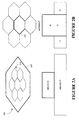
- a hierarchical cell structure 200 consistent with an embodiment of the instant invention is schematically depicted with two frequency bands for the communications system 100 shown in Figure 1.
- a first frequency (f 1 ) is assigned to macro cells 205 and a second frequency (f 2 ) to micro cells 210 to benefit from the combined radio resources of a first and a second frequency band in a multi-band network, such as a multi-band UMTS network.
- the macro cells 205 may be relatively large cells, e.g., tens of square miles in area that are optimized to provide coverage over capacity.
- the micro cells 210 may be relatively small cells within a cellular network, enabling a greater frequency reuse by allowing radio frequency propagation to be confined to a small local area.
- the multi-band UMTS network e.g., the PSTN 115 and/or the data network 110, such as based on the 3GPP standard, specified in 3GPP TS 25.307, may be operated at two different frequency bands (e.g., UMTS850, LTMTS1900, etc.).
- two different frequency bands e.g., UMTS850, LTMTS1900, etc.
- use of the pilot power measuring S/W 175 and the cell load based inter-frequency handover S/W 185 with these two different coexistent (co-local) frequency bands may offer a relatively higher system capacity and a relatively better Quality of Service (QoS) in the communications system 100.
- QoS Quality of Service
- a hotspot 250 is schematically depicted as another example scenario in the communications system 100 shown in Figure 1 where the second frequency (f 2 ) is allocated besides the first frequency (f 1 ) to split the hotspot 250 consistent with an embodiment of the instant invention.
- the hotspot 250 in the macro cells 205 may correspond to a situation where a relatively large number of users gather in a relatively small area within a cell or a sector, for example, an audience gathered in an auditorium.
- the hotspot 250 may refer to a single point within a cell or a sector.
- the pilot power measuring S/W 175 along with the cell load based inter-frequency handover S/W 185 may cooperatively enable an increase in system capacity of the communications system 100 while significantly improving QoS.
- the Connection Admission Control generally refers to a set of actions taken by a network, such as the data network 110 during a call set-up phase (or during a call re-negotiation phase) to determine whether a connection request may be accepted or should be rejected (or whether a request for re-allocation may be accommodated).
- the Connection Admission Control may enable the data network 110 to manage traffic in an incoming call, a session or at a connection level based on predefined criteria.
- the Connection Admission Control may enable a cell to reject or admit one or more users according to an objective function, while guaranteeing a QoS to any new users as well as the active users. More specifically, switches in the data network 110 may use a CAC function during a connection setup to determine whether or not a connection requested QoS will violate QoS for existing connections.
- the Congestion Control may maintain an operating state for the data network 110 when demand exceeds capacity of the communications system 100.
- a ConC function may perform a radio resource and/or traffic management to avoid and/or prevent undesired situations, such as a buffer overflow, an insufficient bandwidth that may cause the data network 110 to malfunction.
- a flow chart illustrates power rise/noise rise versus system load in the communications system 100 shown in Figure 1 as well as a typical Call Admission Control (CAC) threshold and Congestion Control (ConC) threshold in accordance with one embodiment of the present invention.
- the Connection Admission Control may restrict new calls of different types of real-time applications based on a Connection Admission Control threshold.
- a CAC threshold (thrCAC) may refer to a number of slots that a new call of each type of real-time application may use in a wireless mobile telecommunications system, such as the telecommunication system 100 when using a Time Division Multiple Access modulation.
- the CAC threshold may define call blocking and forced termination probabilities.
- a ConC threshold may refer to a maximum allowable backlog of frames that a transport layer (L4) of the data network 110 may buffer before sending a choke message and a maximum allowable backlog of frames that a link layer (L2) of the data network 110 may buffer before sending a control frame.
- the system load comprises cell load, which is currently being experienced in a cell.
- the cell load may be determined in a variety of ways without departing from the spirit and scope of the instant invention.
- the cell load may be calculated as a function of the number of mobile stations currently connected to the cell.
- the cell load may be determined as a function of the aggregate transmission rate between the various mobile wireless devices 105(1-N) and the first or second base station 120(1-m). That is, one heavy user may place similar demands to three relatively light users.
- the cell load may be determined by the ratio of the actual measured transmitted power of the cell to the total maximum transmit power.
- the mobile wireless device 105(N) while located at a same position, may communicate with more than one cell. For example, with one cell at the frequency band (f1) and another cell at the frequency band (f2).
- the mobile wireless device 105(N) may measure pilot power of at least two Common Pilot Channels (CPICHs) one for each frequency band, i.e., a first and a second common pilot channel where a common pilot channel is broadcast within the entire cell.
- the first common pilot channel may be associated with the first frequency band (f1) from the first base station 120(1) associated with a first cell and the second common pilot channel may be associated with the second frequency band (f2) from the first base station 120(1) being associated with a second cell or from the second base station 120(m) being associated with the second cell.
- the mobile wireless device 105(N) may transfer from its home cell (e.g., at frequency (f1)), i.e., the first cell associated with the first base station 120(1) to a new cell, i.e., the second cell (i) at the frequency (f2) and associated with the same first base station 120(1) or (ii) at the frequency (f2) and associated with another base station, such as the second base station 120(m) or at the frequency (f1) and associated with the second base station 120(m) in a conventional or non-inter-frequency handover. That is, the mobile wireless device 105(N) may not change from one base station to another base station in at each inter-frequency handover.
- f1 home cell
- the mobile wireless device 105(N) may transfer from its home cell (e.g., at frequency (f1)), i.e., the first cell associated with the first base station 120(1) to a new cell, i.e., the second cell (i) at the frequency (f2) and associated with the same first base station
- a cell load for a cell in the communications system 100 may adversely affect a ranking of the cells in a target set of cells.
- the two mobile wireless devices 105(1) and 105(N) such as mobile stations, one located near a particular base station and the other one located far away therefrom may measure different values of E c / I 0 on the first and second common pilot channels, P-CPICH because of factors including different path loss, intra-cell and inter-cell interference.
- EclIo may represent a dimensionless ratio of the average power of a channel, typically the first and second common pilot channels, to the total signal power.
- a load parameter L denotes the cell load before the arrival of a new user while a load parameter L 'indicates the cell load after the arrival of a new user.
- the mobile wireless device 105(N) may wish to transfer from an overloaded cell to a target cell because of a higher E C / I 0 on the CPICH while taking into account the load parameter L in the target cell. If the cell load in the target cell is a bit less ( ⁇ L) than the CAC threshold level (thrCAC), then the handover of the user to this cell may lead to load L', and, therefore, may avoid trespassing CAC threshold (thrCAC).
- the cell load based inter-frequency handover S/W 185 may avoid triggering of a call admission control mechanism that otherwise result in a significant deterioration of a link quality of other users in the target cell. In other words, avoidance of an inefficient inter-frequency handover may prevent a significant loss of network capacity.
- the cell load based inter-frequency handover S/W 185 takes additionally into account the network or system load measurements via a generic function " f."
- the function g(L) may mathematically take into account the mapping of the load parameter L to the generic function " f " for the purposes of an inter-frequency handover.
- a cell load may be measured as the difference between the current load in the target cell and the CAC threshold (thrCAC), as illustrated in Figure 3.
- the cell load based inter-frequency handover S/W 185 may rank the cells in the target set by taking into account both the user specific signal quality and the system load for the inter-frequency handover and load balancing while substantially utilizing available radio resources.
- a stylistic representation of a region 400 is illustrated in which the communications system 100 of Figure 1 may be employed for balancing load in the inter-frequency handover of wireless communications across an overloaded cell 405 and a target cell 410(1) according to one embodiment of the present invention.
- the region 400 e.g., a network coverage area for rendering a particular service, such as a multimedia data and/or voice communication service to a user may be separated into a plurality of sub-regions called cells or sectors to be serviced by the communications system 100.
- the network coverage area may refer to a geographical area where devices can exchange messages with an acceptable quality and a performance level.
- each cell may be associated with a separate base station 120 and each cell may have a plurality of adjacent neighboring cells.
- six neighboring cells 410(1-6) may surround the overloaded cell 405.
- the mobile wireless device 105(1) may transfer to another cell, i.e., the first cell 410(1) selected form a target set of cells 405, 410(1) among the neighboring candidate cells 410(1-6).
- the mobile wireless device 105(1) may need to transition from communicating with the overloaded cell 405 to communicating with a target cell, such as the first cell 410(1) that a user may enter.
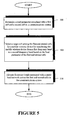
- Figure 5 is a flow diagram illustrating one embodiment of the interoperation of the various components including the pilot power measuring S/W 175 at the mobile wireless device 105(N) and the cell load based an inter-frequency handover S/W 185 at the radio network controller 130 coupled to the first base station 120(1) and the second base station 120(m) of the communications system 100 of Figures 1 and 4.
- the pilot power measuring S/W 175 and the cell load based an inter-frequency handover S/W 185 may cooperatively allocate frequency bands, associated with a multi-band network comprising the data network 110 and the PSTN 115, across the overloaded cell 405 and the target cell 410(1) shown in Figure 4.
- the wireless device 105(N) may wish to transfer from the overloaded cell 405 associated with the first base station 120(1) to enter the target cell 410(1) associated with the second base station 120(m).
- the RNC 130 may employ an inter-frequency handover strategy. The process of a cell selection from a target set of cells for an inter-frequency handover begins at block 500 with determining the load parameter L associated with the cells 405, 410(1) in the communications system 100.
- the mobile wireless device 105(N) may measure certain parameters including pilot power of a common pilot channel associated with the first and second base stations 120(1-m), which may be in its active set to determine the quality of communications. While a communications session is only established with a current serving cell, the mobile wireless device 105(N), using the pilot power measuring S/W 175 nonetheless monitors one or more channels of the other base stations in its active set that would be available should a cell load and pilot power level based cell selection occurs for an inter-frequency handover.
- the mobile wireless device 105(N) and the RNC 130 using the measured pilot power of each of the first and second base stations 120(1-m) and the load parameters L of the target set of cells determine the target cell and/or whether an inter-frequency handover is warranted.
- the RNC 130 selects the first cell 410(1) form the target set of the cells 405, 410(1) among candidate cells 405 and 410(1-6) associated with the first and second base stations 120(1-m) based on the load parameters L of the cells 405, 410(1) for the mobile wireless device 105(N).
- the RNC 130 may transfer the mobile wireless device 105(N) from a first frequency band to a second frequency band based on the load parameters L of the cells 405, 410(1) of the target set.
- the communications system 100 may allocate frequency bands to users on a multiplicity of channels associated with a multi-band network across at least two cells, i.e., the first cell 405 and the second cell 410(1).
- the overloaded cell 405 and the selected target cell 410(1) are controlled by different base stations 120(1) and 120(m), respectively.
- the RNC 130 may determine whether or not there is a need to switchover from communications between the mobile wireless device 105(N) and the first base station 120(1) to communications between the mobile wireless device 105(N) and the second base station 120(m). To this end, a messaging process may be used to switch over from the overloaded cell 405 to the target cell 410(1). Generally, an actual cell switchover starts when the RNC 130 sends Radio Link Reconfiguration Commit messages to the first base station 120(1) to cease any scheduled transmission at a defined time. The mobile wireless device 105(N) begins "listening" to scheduling information from the target cell 410(1) at the defined time after sending "Physical Channel Reconfiguration Complete" messages.
- the first and second base stations 120(1-m) may periodically report Signal to Interference Ratio (SIR) measurements to the RNC 130.
- the RNC 130 may use feedback of the radio channel conditions, such as SIR from the first and second base stations 120(1-m) in the active set or mobile reported best cell measurement, to trigger switching from the overloaded cell 405 to the target cell 410(1).
- SIR Signal to Interference Ratio
- a conventional signaling may be used to identify the overloaded cell 405 during a cell selection after measurements of the load parameters L made by the RNC 130 indicate to the mobile wireless device 105(N) that the best cell is not the overloaded cell 405. Based on these measurements of the load parameters L, the mobile wireless device 105(N) indicates its new primary serving cell, i.e., the target cell 410(1). Once the cells 405, 410(1-6) receive the indication of the new primary serving cell from the mobile wireless device 105(N), all cells send the primary/non-primary cell indications to the RNC 130. The RNC 130 responds by switching user plane traffic to a transport interface of the new primary or target cell 410(1) using signaling messages.
- the RNC 130 may send the following information to the mobile wireless device 105(N): the cells that the wireless device 105(N) should be monitoring; the radio channel information for any new cells to be monitored. However, the RNC 130 may periodically re-assign which cells in the active set that the mobile wireless device 105(N) should monitor.
- a flow diagram illustrates one embodiment of a control strategy employed in the communications system 100 of Figures 1-4 for selecting the target cell 410(1) to transfer from the overloaded cell 405 and handling the inter-frequency handover based on the measured pilot power of the first and second common pilot channels and the load parameter L of the overloaded cell 405 and the cell 410(1) shown in Figure 4.
- the mobile wireless device 105(N) may execute instructions to measure the pilot power of a first common pilot channel associated with the first frequency band from the first base station 120(1) associated with a first cell, i.e., the overloaded cell 405 and measure the pilot power of a second common pilot channel associated with the second frequency band from the first base station 120(1) associated with a second cell, i.e., the target cell 410(1) or from the second base station 120(m) associated with the second cell, i.e., the target cell 410(1).
- the S/W 175 may determine signal quality for the first and second cells 445, 410(1) based on a ratio of an average power of the first and second common pilot channels to a total signal power E c / I 0 .
- the RNC 130 may control the communications system 100 by executing instructions that cause an inter-frequency handover for a user of the mobile wireless device 105(N).
- the S/W 175 and 185 may cooperatively manage radio resources in the first and second base stations 120(1-m) for determining communications between at least one of the first and second base stations 120(1-m) and the mobile wireless device105(N).
- the load parameters L associated with the first and second cells 405, 410(1) may be determined by measuring a change in at least one of radio transmit power and noise from the first and second base stations 120(1-m).
- the first and second cells 405, 410(1) of the target set of cells may be ranked based on the corresponding load parameters L, as indicated at block 615.
- the target cell 410(1) may be selected among the candidate cells 405, 410(1-6) at block 620 for the mobile wireless device 105(N).
- an overloaded cell may be determined, that is, the first cell 405 may be indicated to be relatively overloaded between the first and second cells 405, 410(1) based on the measured pilot power of the first and second common pilot channels together with the load parameter of the first and second cells405, 410(1).
- the RNC 130 may select from the target set of cells 405, 410(1), the target cell 410(1) with a load that balances load in the communications system 100, substantially preventing the inter-frequency handover of the user to a cell with a higher load than the overloaded cell 405.
- the RNC 130 may cause the inter-frequency handover.
- the mobile wireless device 105(N) may then be transferred from one frequency band to another frequency band, such as from a higher frequency band to a lower frequency band or vice versa, as indicated in block 630.
- One example of the higher frequency band includes 2000 MHz and examples of lower frequency bands include 900 MHz or 450 MHz.
- the pilot power measuring S/W 175 and the cell load based inter-frequency handover S/W 185 may cause transfer of the mobile wireless device 105(N) to a desired frequency band. Therefore, in one embodiment, selection of an appropriate frequency band may be realized for the mobile wireless device 105(N) in the multi-band network based on measurements of the first and second pilot channel properties and the load parameters L by taking into account the load of the cells for an inter-frequency handover.
- This integration of the load into the ranking of the target set cells may prevent an inter-frequency handover of users to cells with a relatively higher load, resulting in a deterioration of QoS.
- the RNC 130 may increase, therefore, an overall system capacity as well as the QoS of the data network 110, leading to a significantly higher user satisfaction, in some embodiments. For example, by monitoring the IuB-Interface to track radio resource management messages including load measurements.
- the software implemented aspects of the invention are typically encoded on some form of program storage medium or implemented over some type of transmission medium.
- the program storage medium may be magnetic (e.g., a floppy disk or a hard drive) or optical (e.g., a compact disk read only memory, or "CD ROM"), and may be read only or random access.
- the transmission medium may be twisted wire pairs, coaxial cable, optical fiber, or some other suitable transmission medium known to the art. The invention is not limited by these aspects of any given implementation.
- the invention has been illustrated herein as being useful in a telecommunications network environment, it also has application in other connected environments.
- two or more of the devices described above may be coupled together via device-to-device connections, such as by hard cabling, radio frequency signals (e.g., 802.11(a), 802.11(b), 802.11(g), Bluetooth, or the like), infrared coupling, telephone lines and modems, or the like.
- the present invention may have application in any environment where two or more users are interconnected and capable of communicating with one another.
- control units may include a microprocessor, a microcontroller, a digital signal processor, a processor card (including one or more microprocessors or controllers), or other control or computing devices as well as executable instructions contained within one or more storage devices.
- the storage devices may include one or more machine-readable storage media for storing data and instructions.
- the storage media may include different forms of memory including semiconductor memory devices such as dynamic or static random access memories (DRAMs or SRAMs), erasable and programmable read-only memories (EPROMs), electrically erasable and programmable read-only memories (EEPROMs) and flash memories; magnetic disks such as fixed, floppy, removable disks; other magnetic media including tape; and optical media such as compact disks (CDs) or digital video disks (DVDs).
- DRAMs or SRAMs dynamic or static random access memories
- EPROMs erasable and programmable read-only memories
- EEPROMs electrically erasable and programmable read-only memories
- flash memories such as fixed, floppy, removable disks
- CDs compact disks
- DVDs digital video disks
Landscapes
- Engineering & Computer Science (AREA)
- Computer Networks & Wireless Communication (AREA)
- Signal Processing (AREA)
- Mobile Radio Communication Systems (AREA)
Applications Claiming Priority (1)
| Application Number | Priority Date | Filing Date | Title |
|---|---|---|---|
| US11/044,248 US20060166677A1 (en) | 2005-01-27 | 2005-01-27 | Balancing load of cells in inter-frequency handover of wireless communications |
Publications (1)
| Publication Number | Publication Date |
|---|---|
| EP1686821A1 true EP1686821A1 (de) | 2006-08-02 |
Family
ID=34940475
Family Applications (1)
| Application Number | Title | Priority Date | Filing Date |
|---|---|---|---|
| EP05250916A Withdrawn EP1686821A1 (de) | 2005-01-27 | 2005-02-17 | Ausgleichen der Zellenauslastung bei Interfrequenz-Handover in mehrbandigen zellularen Kommunikationsnetzen |
Country Status (5)
| Country | Link |
|---|---|
| US (1) | US20060166677A1 (de) |
| EP (1) | EP1686821A1 (de) |
| JP (1) | JP2006211645A (de) |
| KR (1) | KR20060086812A (de) |
| CN (1) | CN1812286A (de) |
Cited By (7)
| Publication number | Priority date | Publication date | Assignee | Title |
|---|---|---|---|---|
| EP2073579A1 (de) * | 2007-12-21 | 2009-06-24 | Nokia Siemens Networks S.p.A. | Verfahren und Systeme für die Handhabung von Übergabeprozessen in zellularen Kommunikationsnetzen, entsprechendes Netzwerk und Computerprogrammprodukt |
| WO2010066607A1 (en) * | 2008-12-12 | 2010-06-17 | St-Nxp Wireless France | Method and device for assigning a cell to a wireless communication apparatus, and corresponding apparatus |
| EP2213985A1 (de) * | 2006-09-15 | 2010-08-04 | Itron, Inc. | SONS-Managementzahl in einem Zellennetzwerk |
| CN101951664A (zh) * | 2010-09-14 | 2011-01-19 | 天津理工大学 | 一种负载不平衡的无线网络中用户接入与切换的方法 |
| WO2013078841A1 (zh) * | 2011-12-02 | 2013-06-06 | 中兴通讯股份有限公司 | 移动负载均衡的方法和系统 |
| EP2109944A4 (de) * | 2007-01-13 | 2013-11-06 | Samsung Electronics Co Ltd | Verfahren und system zum übertragen und empfangen von signalen mithilfe mehrerer frequenzbänder in einem drahtlosen kommunikationssystem |
| US11122485B2 (en) | 2009-02-02 | 2021-09-14 | Huawei Technologies Co., Ltd. | Method and apparatus for mobility management |
Families Citing this family (95)
| Publication number | Priority date | Publication date | Assignee | Title |
|---|---|---|---|---|
| US6563809B1 (en) | 1999-04-28 | 2003-05-13 | Tantivy Communications, Inc. | Subscriber-controlled registration technique in a CDMA system |
| KR100893860B1 (ko) * | 2004-06-10 | 2009-04-20 | 엘지전자 주식회사 | 광대역 무선 접속 시스템에 적용되는 핸드오버 수행 방법및 핸드오버 실패시 통신 재개 방법 |
| IL166804A (en) * | 2005-02-10 | 2012-08-30 | Cellvine Ltd | Apparatus and method for traffic load balancing in wireless networks |
| US7616956B2 (en) * | 2005-03-15 | 2009-11-10 | Interdigital Technology Corporation | Measurement request report extensions for media independent handover |
| US8112094B1 (en) * | 2005-06-09 | 2012-02-07 | At&T Mobility Ii Llc | Radio access layer management |
| US7353030B2 (en) * | 2005-07-29 | 2008-04-01 | Nextel Communications Inc. | Systems and methods for handovers between base radios |
| US20070087713A1 (en) * | 2005-10-13 | 2007-04-19 | Core Ronald S | Method and system for balancing load across carrier seams in a multi-band system |
| IN266795B (de) * | 2006-03-20 | 2015-06-03 | Beceem Communications Inc | |
| US7996032B2 (en) * | 2006-03-27 | 2011-08-09 | Qualcomm Incorporated | Power control and resource management in orthogonal wireless systems |
| WO2008031258A1 (en) * | 2006-08-22 | 2008-03-20 | Huawei Technologies Co., Ltd. | Radio resource redistribution at handover |
| US20080081607A1 (en) * | 2006-09-29 | 2008-04-03 | Motorola, Inc. | Method for managing calls in a communication network |
| US7620416B2 (en) * | 2006-09-29 | 2009-11-17 | Intel Corporation | Transmission power normalization |
| US20080101301A1 (en) * | 2006-10-27 | 2008-05-01 | Motorola, Inc. | Handover in a cellular communication system |
| US8335202B2 (en) * | 2006-11-20 | 2012-12-18 | Qualcomm Incorporated | Sending pilots on secondary channels for improved acquisition and handoff in cellular communication |
| US20080132241A1 (en) * | 2006-11-30 | 2008-06-05 | Motorola, Inc. | Method and apparatus to facilitate using a path to dynamically schedule wireless access point support for a given communication system |
| US8320328B2 (en) | 2007-03-19 | 2012-11-27 | Qualcomm Incorporated | Channel dependent credit accumulation for mobile handover |
| US9002364B2 (en) * | 2007-05-22 | 2015-04-07 | Tango Networks, Inc. | System, method, and computer-readable medium for concurrent termination of multiple calls at a mobile terminal |
| KR101048456B1 (ko) * | 2007-10-16 | 2011-07-11 | 삼성전자주식회사 | 무선 접속 통신 시스템에서 셀 부하 예측 장치 및 방법 |
| US7941155B2 (en) * | 2007-11-27 | 2011-05-10 | Samsung Electronics Co., Ltd. | Calculation and broadcast of cell-load ratio and intelligent cell selection for IEEE802.16M |
| US20090143089A1 (en) * | 2007-11-29 | 2009-06-04 | Samsung Electronics Co., Ltd. | Apparatus and method for performing an expedited handover using a dedicated ranging channel in a wireless network |
| KR101425440B1 (ko) * | 2008-01-14 | 2014-08-04 | 삼성전자주식회사 | 멀티-스테이션의 연합 자원 할당 및 연합 그룹 핸드오버를위한 이동통신 시스템 및 연합 자원 할당 방법 |
| WO2009116753A2 (en) * | 2008-03-17 | 2009-09-24 | Lg Electronics Inc. | Method of cell selection in heirarchical cell structure based on cell quality |
| US8477737B2 (en) * | 2008-03-26 | 2013-07-02 | Alcatel Lucent | System and method to improve uplink coverage in multi-carrier systems |
| US9094979B2 (en) * | 2008-05-16 | 2015-07-28 | Qualcomm Incorporated | Load balancing in a wireless communication system |
| KR101067048B1 (ko) * | 2008-05-19 | 2011-09-22 | 주식회사 케이티 | 셀 부하 측정 및 선호 서비스 목록을 이용한 단말기의핸드오버 제어 방법 및 장치 |
| EP2282581B1 (de) * | 2008-05-29 | 2018-07-04 | NTT DoCoMo, Inc. | Mobilkommunikationsverfahren, femtozellen-funkbasisstation |
| EP2312896B1 (de) | 2008-08-06 | 2018-01-10 | Sharp Kabushiki Kaisha | Basisstationsvorrichtung, mobilstationsvorrichtung und entsprechende kommunikationsverfahren unter verwendung von trägeraggregation |
| CN101677464B (zh) * | 2008-09-17 | 2012-10-03 | 展讯通信(上海)有限公司 | 无线通信网络中多频带调度系统及其方法 |
| US8270975B2 (en) * | 2009-01-05 | 2012-09-18 | Intel Corporation | Method of managing network traffic within a wireless network |
| KR101505089B1 (ko) * | 2009-01-13 | 2015-03-23 | 삼성전자주식회사 | 이동통신 시스템의 핸드오버 장치 및 방법 |
| US8295235B2 (en) * | 2009-03-13 | 2012-10-23 | Clearwire Ip Holdings Llc | Load balancing multiple among multiple carriers in a sector |
| US20100246399A1 (en) * | 2009-03-24 | 2010-09-30 | Qualcomm Incorporated | Multi-channel management and load balancing |
| US8977282B2 (en) * | 2009-03-24 | 2015-03-10 | Qualcomm Incorporated | Multi-channel management and load balancing |
| GB2474503B (en) | 2009-10-19 | 2014-05-21 | Ubiquisys Ltd | Controlling mobility in cellular networks |
| US8942717B2 (en) * | 2009-11-30 | 2015-01-27 | Intel Corporation | Load balancing techniques in wireless networks |
| US8576815B2 (en) * | 2009-12-04 | 2013-11-05 | Verizon Patent And Licensing Inc. | Long term evolution (LTE) mobile anchoring |
| JP5184504B2 (ja) * | 2009-12-25 | 2013-04-17 | 株式会社エヌ・ティ・ティ・ドコモ | 無線基地局システム、無線基地局制御装置、収容セル数決定プログラム及び収容セル数決定方法 |
| EP2549791B1 (de) * | 2010-03-17 | 2017-11-22 | Fujitsu Limited | Drahtloses kommunikationssystem, kommunikationssteuerungsverfahren und basisstation |
| JP5352513B2 (ja) * | 2010-03-31 | 2013-11-27 | 株式会社日立製作所 | 無線通信システム及びハンドオーバー制御方法 |
| JP5447119B2 (ja) | 2010-04-12 | 2014-03-19 | 富士通株式会社 | 無線通信システム、基地局および無線通信方法 |
| KR101105351B1 (ko) | 2010-04-29 | 2012-01-16 | 성균관대학교산학협력단 | 셀룰러 시스템에서 인접 셀 간 셀 재 선택을 수행하는 방법 |
| US8660086B2 (en) * | 2010-05-04 | 2014-02-25 | Nokia Corporation | Method and apparatus for admission control and forced handover in a multi-layer network configuration |
| JP2012015838A (ja) * | 2010-07-01 | 2012-01-19 | Nec Corp | 基地局装置および負荷分散方法 |
| US8937900B2 (en) | 2010-07-20 | 2015-01-20 | Qualcomm Incorporated | Enhancing pilot channel transmission in TD-SCDMA multicarrier systems using secondary carrier frequencies |
| US9420543B2 (en) * | 2010-12-10 | 2016-08-16 | Qualcomm Incorporated | Control of transmission power on high-speed dedicated physical control channel |
| US8576719B2 (en) * | 2011-01-06 | 2013-11-05 | Clearwire Ip Holdings Llc | System and method for dynamically balancing a maximum number of active remote device users between base stations |
| CN102612101B (zh) * | 2011-01-24 | 2016-08-03 | 中兴通讯股份有限公司 | CoMP中实现切换小区集选取的方法和系统 |
| CN102625389B (zh) | 2011-01-31 | 2015-09-30 | 华为技术有限公司 | 一种移动通信网络的接入方法、装置和系统 |
| CN102685776B (zh) * | 2011-03-08 | 2017-03-15 | 中兴通讯股份有限公司 | 通过CoMP技术降低小区负荷的方法及装置 |
| CN102740360B (zh) * | 2011-04-12 | 2016-08-03 | 中兴通讯股份有限公司 | 一种小区负荷控制方法及装置 |
| US9036503B1 (en) | 2011-06-24 | 2015-05-19 | Sprint Communications Company L.P. | Interband traffic management in a multi-band wireless network |
| CN102281605A (zh) * | 2011-08-01 | 2011-12-14 | 中兴通讯股份有限公司 | 业务切换方法及装置 |
| US20130094472A1 (en) * | 2011-10-14 | 2013-04-18 | Qualcomm Incorporated | Methods and apparatuses for reducing voice/data interruption during a mobility procedure |
| US9042287B2 (en) | 2011-11-14 | 2015-05-26 | Qualcomm Incorporated | Methods and apparatus for improving network loading |
| CN102547857A (zh) * | 2011-12-19 | 2012-07-04 | 中兴通讯股份有限公司 | 负荷均衡处理方法以及控制装置 |
| CN102547860B (zh) * | 2012-03-02 | 2015-07-22 | 中兴通讯股份有限公司 | 一种多频段网络的负荷均衡方法和系统 |
| JP5858840B2 (ja) * | 2012-03-27 | 2016-02-10 | 三菱電機株式会社 | 無線通信システム、無線通信基地局、管理装置、無線通信端末、および無線通信方法 |
| WO2013164033A1 (en) * | 2012-05-03 | 2013-11-07 | Huawei Technologies Sweden Ab | Optimizing parameter settings for handover of terminals on a common transportation platform |
| CN103428720B (zh) | 2012-05-23 | 2017-07-07 | 华为技术有限公司 | 确定不必要切换的方法和基站 |
| US9980247B2 (en) | 2012-10-26 | 2018-05-22 | Qualcomm Incorporated | Primary cell signaling for eMBMS in carrier aggregation |
| US10111049B2 (en) * | 2012-10-26 | 2018-10-23 | Qualcomm Incorporated | Multiband eMBMS enhancement using carrier aggregation |
| US10129822B2 (en) | 2012-12-06 | 2018-11-13 | At&T Intellectual Property I, L.P. | Device-based idle mode load balancing |
| US9998983B2 (en) | 2012-12-06 | 2018-06-12 | At&T Intellectual Property I, L.P. | Network-assisted device-based intelligent radio access control |
| US9549343B2 (en) | 2012-12-06 | 2017-01-17 | At&T Intellectual Property I, L.P. | Traffic steering across radio access technologies and radio frequencies utilizing cell broadcast messages |
| US9544841B2 (en) | 2012-12-06 | 2017-01-10 | At&T Intellectual Property I, L.P. | Hybrid network-based and device-based intelligent radio access control |
| US9544842B2 (en) | 2012-12-06 | 2017-01-10 | At&T Intellectual Property I, L.P. | Network-based intelligent radio access control |
| US9374773B2 (en) * | 2012-12-06 | 2016-06-21 | At&T Intellectual Property I, L.P. | Traffic steering across cell-types |
| US9554416B2 (en) | 2013-04-26 | 2017-01-24 | Intel IP Corporation | Shared spectrum reassignment in a spectrum sharing context |
| WO2014175919A1 (en) * | 2013-04-26 | 2014-10-30 | Intel IP Corporation | Shared spectrum reassignment in a spectrum sharing context |
| US9521268B2 (en) * | 2013-06-03 | 2016-12-13 | Broadcom Corporation | Application layer integration into a multi-rat access and handover environment |
| US9888422B2 (en) | 2013-06-03 | 2018-02-06 | Avago Technologies General Ip (Singapore) Pte. Ltd. | System and method for adaptive access and handover configuration based on prior history in a multi-RAT environment |
| US9907006B2 (en) | 2013-06-03 | 2018-02-27 | Avago Technologies General Ip (Singapore) Pte. Ltd. | Cross radio access technology access with handoff and interference management using communication performance data |
| US9380646B2 (en) | 2013-09-24 | 2016-06-28 | At&T Intellectual Property I, L.P. | Network selection architecture |
| US9226197B2 (en) | 2013-10-21 | 2015-12-29 | At&T Intellectual Property I, L.P. | Network based speed dependent load balancing |
| US9241305B2 (en) | 2013-10-28 | 2016-01-19 | At&T Intellectual Property I, L.P. | Access network discovery and selection function enhancement with cell-type management object |
| US9332471B2 (en) * | 2013-11-07 | 2016-05-03 | Transpacific Ip Management Group Ltd. | Cell selection or handover in wireless networks |
| US9986461B2 (en) * | 2013-12-24 | 2018-05-29 | Huawei Technologies Co., Ltd | On-demand radio coordination in a software-defined network |
| JP2016072715A (ja) * | 2014-09-29 | 2016-05-09 | 株式会社日立製作所 | 無線通信システムおよび負荷分散方法ならびに基地局 |
| US9398518B2 (en) | 2014-10-21 | 2016-07-19 | At&T Intellectual Property I, L.P. | Cell broadcast for signaling resource load from radio access networks |
| US9930566B2 (en) | 2014-12-01 | 2018-03-27 | Cellwize Wireless Technologies Ltd. | Method of controlling traffic in a cellular network and system thereof |
| FR3033111A1 (fr) * | 2015-02-23 | 2016-08-26 | Orange | Procede d'utilisation d'une gestion automatique de communication, procede et dispositif de gestion automatique de communication et terminal l'utilisant |
| US9380594B1 (en) | 2015-05-21 | 2016-06-28 | Qualcomm Incorporated | Autonomous layer management |
| WO2016197331A1 (zh) * | 2015-06-09 | 2016-12-15 | 华为技术有限公司 | 一种频段切换方法、终端 |
| US11259225B2 (en) * | 2015-10-16 | 2022-02-22 | Telefonaktiebolaget Lm Ericsson (Publ) | Apparatus and method for cell frequency change procedure signal timing selection |
| US10187838B2 (en) | 2015-11-03 | 2019-01-22 | Futurewei Technologies, Inc. | System and method for load rebalancing |
| US10298510B1 (en) * | 2015-12-16 | 2019-05-21 | Amazon Technologies, Inc. | Controlling data transmission rates of multiple devices |
| EP3424240B1 (de) * | 2016-03-04 | 2020-07-22 | Telefonaktiebolaget LM Ericsson (PUBL) | Lastausgleich zwischen frequenzen |
| CN107580337B (zh) * | 2016-07-05 | 2022-05-13 | 中兴通讯股份有限公司 | 一种热点区域识别方法和装置 |
| CN107872816B (zh) * | 2016-09-27 | 2021-04-20 | 中国电信股份有限公司 | 用于负载均衡的方法、窄带物联网终端及系统 |
| US11109290B2 (en) * | 2017-08-04 | 2021-08-31 | Charter Communications Operating, Llc | Switching connections over frequency bands of a wireless network |
| US10306548B2 (en) | 2017-08-04 | 2019-05-28 | Charter Communications Operating, Llc | Voting to connect to a wireless network |
| US10506616B2 (en) | 2017-08-04 | 2019-12-10 | Charter Communications Operating, Llc | Prioritizing preferred networks |
| US11160003B2 (en) | 2017-08-04 | 2021-10-26 | Charter Communications Operating, Llc | Connecting to a wireless network based on a device mobility state |
| US10462721B2 (en) * | 2017-11-28 | 2019-10-29 | Mediatek Singapore Pte. Ltd. | Method and apparatus for cell reselection in mobile communications |
| US12538147B2 (en) | 2023-05-24 | 2026-01-27 | T-Mobile Usa, Inc. | Determining a root cause of a failed interaction between a mobile device and a wireless telecommunication network |
Citations (4)
| Publication number | Priority date | Publication date | Assignee | Title |
|---|---|---|---|---|
| US6021123A (en) * | 1995-12-27 | 2000-02-01 | Kabushiki Kaisha Toshiba | Cellular radio system using CDMA scheme |
| US20040120286A1 (en) * | 2002-12-23 | 2004-06-24 | Uwe Schwarz | Transmission method, system and radio network controller |
| US20040121777A1 (en) * | 2001-04-26 | 2004-06-24 | Uwe Schwarz | Method and network element for controlling handover |
| WO2004057899A1 (en) * | 2002-12-19 | 2004-07-08 | Nokia Corporation | System and handover mechanism in frequency multiple band environment and equipment therefor |
Family Cites Families (9)
| Publication number | Priority date | Publication date | Assignee | Title |
|---|---|---|---|---|
| US4799253A (en) * | 1987-07-20 | 1989-01-17 | Motorola, Inc. | Colocated cellular radiotelephone systems |
| US6069871A (en) * | 1997-07-21 | 2000-05-30 | Nortel Networks Corporation | Traffic allocation and dynamic load balancing in a multiple carrier cellular wireless communication system |
| US6792276B1 (en) * | 1999-07-13 | 2004-09-14 | Telefonaktiebolaget Lm Ericsson (Publ) | Hot spot with tailored range for extra frequency to minimize interference |
| US6609007B1 (en) * | 1999-09-14 | 2003-08-19 | Lucent Technologies Inc. | Apparatus and method for controlling the transmission power of the forward link of a wireless communication system |
| US6748222B1 (en) * | 2000-11-06 | 2004-06-08 | Nortel Networks Limited | Method and system for providing load-balanced communication |
| US6799045B1 (en) * | 2000-11-07 | 2004-09-28 | Telefonaktiebolaget Lm Ericsson (Publ) | Reliable congestion control in a CDMA-based mobile radio commmunications system |
| US20030125039A1 (en) * | 2001-12-27 | 2003-07-03 | Nortel Networks Limited | Multi-carrier traffic allocation enhancements to reduce access failures and to work across bands |
| US7142861B2 (en) * | 2003-12-12 | 2006-11-28 | Telefonaktiebolaget Lm Ericsson (Publ) | Mobile communications in a hierarchical cell structure |
| US7197307B2 (en) * | 2004-02-27 | 2007-03-27 | Nokia Corporation | Hard handover method and controller |
-
2005
- 2005-01-27 US US11/044,248 patent/US20060166677A1/en not_active Abandoned
- 2005-02-17 EP EP05250916A patent/EP1686821A1/de not_active Withdrawn
- 2005-09-21 JP JP2005273018A patent/JP2006211645A/ja active Pending
- 2005-09-26 CN CN200510106879.9A patent/CN1812286A/zh active Pending
- 2005-09-27 KR KR1020050089701A patent/KR20060086812A/ko not_active Withdrawn
Patent Citations (4)
| Publication number | Priority date | Publication date | Assignee | Title |
|---|---|---|---|---|
| US6021123A (en) * | 1995-12-27 | 2000-02-01 | Kabushiki Kaisha Toshiba | Cellular radio system using CDMA scheme |
| US20040121777A1 (en) * | 2001-04-26 | 2004-06-24 | Uwe Schwarz | Method and network element for controlling handover |
| WO2004057899A1 (en) * | 2002-12-19 | 2004-07-08 | Nokia Corporation | System and handover mechanism in frequency multiple band environment and equipment therefor |
| US20040120286A1 (en) * | 2002-12-23 | 2004-06-24 | Uwe Schwarz | Transmission method, system and radio network controller |
Cited By (13)
| Publication number | Priority date | Publication date | Assignee | Title |
|---|---|---|---|---|
| US9129514B2 (en) | 2006-09-15 | 2015-09-08 | Itron, Inc. | Number of sons management in a cell network |
| EP2213985A1 (de) * | 2006-09-15 | 2010-08-04 | Itron, Inc. | SONS-Managementzahl in einem Zellennetzwerk |
| US7827268B2 (en) | 2006-09-15 | 2010-11-02 | Itron, Inc. | Number of sons management in a cell network |
| EP2109944A4 (de) * | 2007-01-13 | 2013-11-06 | Samsung Electronics Co Ltd | Verfahren und system zum übertragen und empfangen von signalen mithilfe mehrerer frequenzbänder in einem drahtlosen kommunikationssystem |
| US10014931B2 (en) | 2007-01-13 | 2018-07-03 | Samsung Electronics Co., Ltd. | Method and system for transmitting and receiving signal using multiple frequency bands in a wireless communication system |
| EP2073579A1 (de) * | 2007-12-21 | 2009-06-24 | Nokia Siemens Networks S.p.A. | Verfahren und Systeme für die Handhabung von Übergabeprozessen in zellularen Kommunikationsnetzen, entsprechendes Netzwerk und Computerprogrammprodukt |
| US9066272B2 (en) | 2008-12-12 | 2015-06-23 | St Ericsson (France) Sas | Method and device for assigning a cell to a wireless communication apparatus, and corresponding apparatus |
| CN102246559B (zh) * | 2008-12-12 | 2014-05-14 | 意法爱立信(法国)有限公司 | 将蜂窝单元分配到无线通信设备的方法和装置及相应的无线通信设备 |
| FR2940001A1 (fr) * | 2008-12-12 | 2010-06-18 | St Nxp Wireless France | Procede et dispositif d'affectation d'une cellule a un appareil de communication sans fil, et appareil correspondant |
| WO2010066607A1 (en) * | 2008-12-12 | 2010-06-17 | St-Nxp Wireless France | Method and device for assigning a cell to a wireless communication apparatus, and corresponding apparatus |
| US11122485B2 (en) | 2009-02-02 | 2021-09-14 | Huawei Technologies Co., Ltd. | Method and apparatus for mobility management |
| CN101951664A (zh) * | 2010-09-14 | 2011-01-19 | 天津理工大学 | 一种负载不平衡的无线网络中用户接入与切换的方法 |
| WO2013078841A1 (zh) * | 2011-12-02 | 2013-06-06 | 中兴通讯股份有限公司 | 移动负载均衡的方法和系统 |
Also Published As
| Publication number | Publication date |
|---|---|
| CN1812286A (zh) | 2006-08-02 |
| JP2006211645A (ja) | 2006-08-10 |
| KR20060086812A (ko) | 2006-08-01 |
| US20060166677A1 (en) | 2006-07-27 |
Similar Documents
| Publication | Publication Date | Title |
|---|---|---|
| EP1686821A1 (de) | Ausgleichen der Zellenauslastung bei Interfrequenz-Handover in mehrbandigen zellularen Kommunikationsnetzen | |
| US7430420B2 (en) | Cell selection and inter-frequency handover | |
| EP1313244B1 (de) | Kommunikationseinrichtung und verfahren zur kommunikation in einem digitalen mobilen kommunikationsnetz | |
| EP1844575B1 (de) | Verfahren und system zur schätzung der anzahl zusätzlich erlaubter anrufe zur verwendung bei der rufzulassungssteuerung | |
| US6181943B1 (en) | Method and apparatus for inter-frequency hand-off in wireless communication systems | |
| CN101981964B (zh) | 提高多载波系统中上行链路覆盖范围的系统和方法 | |
| US8494542B2 (en) | Method and apparatus for mobile station-assisted load balancing in wireless packet data networks | |
| US7310526B2 (en) | Load-aware handoff and site selection scheme | |
| JP4904051B2 (ja) | 共用無線チャネル上の負荷分散 | |
| US6792273B1 (en) | Method and apparatus for resource reservation in a mobile radio communication system | |
| US7415275B2 (en) | Frequency selection apparatus, a mobile communications system, and a multi-band frequency resource management method | |
| JP4720977B2 (ja) | 基地局制御装置、移動体通信システム、および近隣セルリストフィルタリング方法 | |
| CA2534976C (en) | Passive probing for handover in a local area network | |
| US6901254B2 (en) | Method of selecting base transceiver system in communication system | |
| EP0953264B1 (de) | Zentralisierte funknetzsteuerung in einem mobilkommunikationssystem | |
| US20040131037A1 (en) | Method to control the packet switching traffic in digital cellular communication systems | |
| KR20020077899A (ko) | 이동 통신 네트웍의 핸드오버 제어 방법 | |
| EP1142414A1 (de) | Verfahren und vorrichtung zur reservierung von netzresourcen in einem mobilen funkkommunikationssystem | |
| US20020105932A1 (en) | Radio communication system and communication terminal apparatus used therein | |
| US20140248884A1 (en) | Base Station, Communication System, and Method and Program for Controlling Base Station | |
| US20070049317A1 (en) | Controlling transmission power in a reverse link of a feedback-based spread spectrum wireless network | |
| US9001769B1 (en) | Managing access node channel loading | |
| US20110124332A1 (en) | System and method for load balancing among multiple base stations using network initiated handovers | |
| KR20090032518A (ko) | 광대역 통신시스템에서 핸드오버시 부하균등을 위한 방법및 장치 | |
| CN114466376A (zh) | 数据传输方法、装置、设备及存储介质 |
Legal Events
| Date | Code | Title | Description |
|---|---|---|---|
| PUAI | Public reference made under article 153(3) epc to a published international application that has entered the european phase |
Free format text: ORIGINAL CODE: 0009012 |
|
| 17P | Request for examination filed |
Effective date: 20050310 |
|
| AK | Designated contracting states |
Kind code of ref document: A1 Designated state(s): AT BE BG CH CY CZ DE DK EE ES FI FR GB GR HU IE IS IT LI LT LU MC NL PL PT RO SE SI SK TR |
|
| AX | Request for extension of the european patent |
Extension state: AL BA HR LV MK YU |
|
| 17Q | First examination report despatched |
Effective date: 20060727 |
|
| AKX | Designation fees paid |
Designated state(s): DE FR GB |
|
| 17Q | First examination report despatched |
Effective date: 20060727 |
|
| STAA | Information on the status of an ep patent application or granted ep patent |
Free format text: STATUS: THE APPLICATION IS DEEMED TO BE WITHDRAWN |
|
| 18D | Application deemed to be withdrawn |
Effective date: 20090127 |