EP1688512A1 - Acier structural sans plomb pour contruction mecanique presentant une excellente usinabilite et une anisotropie de resistance reduite - Google Patents
Acier structural sans plomb pour contruction mecanique presentant une excellente usinabilite et une anisotropie de resistance reduite Download PDFInfo
- Publication number
- EP1688512A1 EP1688512A1 EP06005867A EP06005867A EP1688512A1 EP 1688512 A1 EP1688512 A1 EP 1688512A1 EP 06005867 A EP06005867 A EP 06005867A EP 06005867 A EP06005867 A EP 06005867A EP 1688512 A1 EP1688512 A1 EP 1688512A1
- Authority
- EP
- European Patent Office
- Prior art keywords
- steel
- steels
- content
- machinability
- lead
- Prior art date
- Legal status (The legal status is an assumption and is not a legal conclusion. Google has not performed a legal analysis and makes no representation as to the accuracy of the status listed.)
- Withdrawn
Links
Images



Classifications
-
- C—CHEMISTRY; METALLURGY
- C22—METALLURGY; FERROUS OR NON-FERROUS ALLOYS; TREATMENT OF ALLOYS OR NON-FERROUS METALS
- C22C—ALLOYS
- C22C38/00—Ferrous alloys, e.g. steel alloys
- C22C38/02—Ferrous alloys, e.g. steel alloys containing silicon
-
- C—CHEMISTRY; METALLURGY
- C22—METALLURGY; FERROUS OR NON-FERROUS ALLOYS; TREATMENT OF ALLOYS OR NON-FERROUS METALS
- C22C—ALLOYS
- C22C38/00—Ferrous alloys, e.g. steel alloys
- C22C38/001—Ferrous alloys, e.g. steel alloys containing N
-
- C—CHEMISTRY; METALLURGY
- C22—METALLURGY; FERROUS OR NON-FERROUS ALLOYS; TREATMENT OF ALLOYS OR NON-FERROUS METALS
- C22C—ALLOYS
- C22C38/00—Ferrous alloys, e.g. steel alloys
- C22C38/002—Ferrous alloys, e.g. steel alloys containing In, Mg, or other elements not provided for in one single group C22C38/001 - C22C38/60
-
- C—CHEMISTRY; METALLURGY
- C22—METALLURGY; FERROUS OR NON-FERROUS ALLOYS; TREATMENT OF ALLOYS OR NON-FERROUS METALS
- C22C—ALLOYS
- C22C38/00—Ferrous alloys, e.g. steel alloys
- C22C38/04—Ferrous alloys, e.g. steel alloys containing manganese
-
- C—CHEMISTRY; METALLURGY
- C22—METALLURGY; FERROUS OR NON-FERROUS ALLOYS; TREATMENT OF ALLOYS OR NON-FERROUS METALS
- C22C—ALLOYS
- C22C38/00—Ferrous alloys, e.g. steel alloys
- C22C38/18—Ferrous alloys, e.g. steel alloys containing chromium
-
- C—CHEMISTRY; METALLURGY
- C22—METALLURGY; FERROUS OR NON-FERROUS ALLOYS; TREATMENT OF ALLOYS OR NON-FERROUS METALS
- C22C—ALLOYS
- C22C38/00—Ferrous alloys, e.g. steel alloys
- C22C38/18—Ferrous alloys, e.g. steel alloys containing chromium
- C22C38/20—Ferrous alloys, e.g. steel alloys containing chromium with copper
-
- C—CHEMISTRY; METALLURGY
- C22—METALLURGY; FERROUS OR NON-FERROUS ALLOYS; TREATMENT OF ALLOYS OR NON-FERROUS METALS
- C22C—ALLOYS
- C22C38/00—Ferrous alloys, e.g. steel alloys
- C22C38/18—Ferrous alloys, e.g. steel alloys containing chromium
- C22C38/22—Ferrous alloys, e.g. steel alloys containing chromium with molybdenum or tungsten
-
- C—CHEMISTRY; METALLURGY
- C22—METALLURGY; FERROUS OR NON-FERROUS ALLOYS; TREATMENT OF ALLOYS OR NON-FERROUS METALS
- C22C—ALLOYS
- C22C38/00—Ferrous alloys, e.g. steel alloys
- C22C38/18—Ferrous alloys, e.g. steel alloys containing chromium
- C22C38/24—Ferrous alloys, e.g. steel alloys containing chromium with vanadium
-
- C—CHEMISTRY; METALLURGY
- C22—METALLURGY; FERROUS OR NON-FERROUS ALLOYS; TREATMENT OF ALLOYS OR NON-FERROUS METALS
- C22C—ALLOYS
- C22C38/00—Ferrous alloys, e.g. steel alloys
- C22C38/18—Ferrous alloys, e.g. steel alloys containing chromium
- C22C38/40—Ferrous alloys, e.g. steel alloys containing chromium with nickel
- C22C38/42—Ferrous alloys, e.g. steel alloys containing chromium with nickel with copper
-
- C—CHEMISTRY; METALLURGY
- C22—METALLURGY; FERROUS OR NON-FERROUS ALLOYS; TREATMENT OF ALLOYS OR NON-FERROUS METALS
- C22C—ALLOYS
- C22C38/00—Ferrous alloys, e.g. steel alloys
- C22C38/18—Ferrous alloys, e.g. steel alloys containing chromium
- C22C38/40—Ferrous alloys, e.g. steel alloys containing chromium with nickel
- C22C38/44—Ferrous alloys, e.g. steel alloys containing chromium with nickel with molybdenum or tungsten
-
- C—CHEMISTRY; METALLURGY
- C22—METALLURGY; FERROUS OR NON-FERROUS ALLOYS; TREATMENT OF ALLOYS OR NON-FERROUS METALS
- C22C—ALLOYS
- C22C38/00—Ferrous alloys, e.g. steel alloys
- C22C38/18—Ferrous alloys, e.g. steel alloys containing chromium
- C22C38/40—Ferrous alloys, e.g. steel alloys containing chromium with nickel
- C22C38/46—Ferrous alloys, e.g. steel alloys containing chromium with nickel with vanadium
-
- C—CHEMISTRY; METALLURGY
- C22—METALLURGY; FERROUS OR NON-FERROUS ALLOYS; TREATMENT OF ALLOYS OR NON-FERROUS METALS
- C22C—ALLOYS
- C22C38/00—Ferrous alloys, e.g. steel alloys
- C22C38/60—Ferrous alloys, e.g. steel alloys containing lead, selenium, tellurium, or antimony, or more than 0.04% by weight of sulfur
Definitions
- the present invention relates to a lead-free steel for machine structural use which exhibits low anisotropy in mechanical properties and excellent machinability in various cuttingmethods and cutting conditions and which does not contain lead.
- the Pb-containing free cutting steel which contains Pb exhibits excellent properties that it is lower in the deterioration of mechanical properties than a standard steel, it has improved chip disposability (the property capable of discharging chips more smoothly) in ordinary turning, and it is capable of lengthening the life of a tools employed for drilling, tapping, reaming, boring or the like. Furthermore, the Pb-containing free cutting steel facilitates discharging chips at the time of deep drilling to give (hole depth/drill diameter) ⁇ 3 and is excellent in the prevention of the breakage of the tool due to sudden chip clogging.
- the conventional Pb-containing free cutting steels has the following disadvantages.
- Pb is a quite effective element for the improvement of machinability of steels, it is an environmentally hazardous material. Due to this, because of a recent increase in interest in the environmental issues, it is desired to develop a steel material without Pb and comparable to the Pb-containing free cutting steel.
- an S-containing free cutting steel which contains S has an improvement effect of lengthening the life of a tool for a relatively wide range of cutting; however, it is inferior to the Pb-containing free cutting steel in chip disposability.
- a steel contains S MnS which exists as an inclusion is extended during hot rolling or hot forging. Due to this, such a steel has a disadvantage in strength anisotropy, i.e. the mechanical properties of such a steel including impact strength are deteriorated as the direction is closer from an rolling direction to a right angle direction. Accordingly, it is necessary to suppress the S content of a steel material intended to be employed as a component which is considered to be given much importance to impact strength, which in turn provides insufficient machinability.
- a Ca-deoxidized free cutting steel in which the melting point of an oxide-based inclusion in the steel is lowered by Ca deoxidization hardly influences the strength property of the steel material and exhibits an excellent effect of lengthening the life of a carbide tool in a high velocity cutting region.
- the Ca-deoxidized free cutting steel has little effect in machinability improvement other than the effect of lengthening the life of the carbide tool. Normally, therefore, the Ca-deoxidized free cutting steel is employed in combination with S or Pb so as to obtain all-round machinability.
- Japanese Examined Patent Publication No. 51-4934 discloses a free cutting steel which contains one or two of Group I elements of Mg and Ba and one or more of Group II elements of S, Se and Te, as well as a free cutting steel which selectively contains Ca.
- O is actively added to these steels in a range of 0.002 to 0.01%. Therefore, they might be low in fatigue strength.
- oxides in the steels increase by the active addition of O, thereby possibly deteriorating machinability such as drilling machinability.
- Japanese Patent Publication No. 51-63312 discloses a free cutting steel which contains S, Mg and one or more elements of Ca, Ba, Sr, Se and Te.
- 51-63312 fails to concretely show the composition of the steel and insufficiently discloses the technique.
- this steel is based on the assumption of Al deoxidization, there is fear that an Al content thereof exceeds 0.02%, no restriction is given to an O content thereof and fatigue strength is lowered.
- the quantity of oxides in the steel increase by the active addition of O, and the machinability such as drilling machinability is, therefore, deteriorated.
- the present invention has been achieved in view of the above-stated conventional disadvantages and has an object to provide a lead-free steel for machine structural use, which does not contain Pb and is equal to or higher than the conventional Pb-containing free cutting steels in properties, excellent in machinability and low in strength anisotropy.
- the invention claimed in claim 1 is a lead-free steel for machine structural use with excellent machinability and low strength anisotropy, comprising, on the weight basis, C: 0.10 to 0.65%; Si: 0.03 to 1.00%; Mn: 0.30 to 2.50%; S: 0.03 to 0.35%; Cr: 0.1 to 2.0%; Al: less than 0.010%; Ca: 0.0005 to 0.020%; Mg: 0.0003 to 0.020%; O: less than 20 ppm; and the balance being Fe and inevitable impurities.
- Steels for machine structural use are roughly classified to three types of a heat-treated steel, a non-heat treated steel and a case hardening steel which are employed differently according to purposes and the like. Due to this, in the lead-free steel for machine structural use of the present invention, these three types of steels are different slightly in preferred composition ranges.
- C is an essential element for securing strength as the steel for machine structural use and not less than 0.10% of C is added. However, too much C causes the increase of hardening and deteriorates toughness and machinability. Therefore, the upper limit is set at 0.65%.
- the C content of the heat-treated steel is, in particular, preferably 0.28 to 0.55%, more preferably 0.32 to 0.48%.
- the C content of the non-heat treated steel is preferably 0.10 to 0.55%, more preferably 0.35 to 0.50%.
- the C content of the case hardening steel is preferably 0.10 to 0.30%, more preferably 0.12 to 0.28%.
- the lower limit is set at 0.03%.
- too much Si deteriorates ductility; besides, it also deteriorates machinability by generating SiO 2 which forms inclusion of high hardness in the steel. Therefore the upper limit thereof is set at 1.00%.
- the Si content of any of the above three types of steels is preferably 0.10 to 0.50%, more preferably 0.15 to 0.35%.
- Mn is an important element to secure the strength, toughness, ductility in hot rolling and hardenability
- Mn is an essential element to generate a sulfide-based inclusion according to the present invention. Therefore, not less than 0.30% of Mn is added. However, too much Mn causes the increase of hardness and deteriorates machinability. Therefore, the upper limit is set at 2.50%.
- the Mn content of any of the above three types of steel is preferably 0.40 to 2.00%, more preferably 0.60 to 1.50%. S: 0.03 to 0.35%
- S is an element for generating a sulfide-based inclusion which can improve machinability.
- it is necessary to add at least not less than 0.03% of S.
- machinability improves.
- too much S makes it difficult to control the form of the sulfide by Ca and Mg and deteriorates impact-resistance anisotropy. Therefore, the upper limit is set at 0.35%.
- the S content of any of the above three types of steel is preferably 0.04 to 0.30%, more preferably 0.08 to 0.20%.
- Cr is added to improve the hardenability and toughness of the steel. To obtain the effects, not less than 0.1% of Cr is necessary. On the other hand, if a large quantity of Cr is added, the hardness of a work material increases. It is, therefore, necessary to set a Cr content at not more than 2.0% so as to secure machinability.
- the Cr content of any of the above three types of steels is preferably 0.10 to 1.50%, more preferably 0.15 to 1.20%. Al: less than 0.010%
- an Al content is not less than 0.010%, an inclusion consisting of Al 2 O 3 with a high hardness is generated, which causes the deterioration of machinability and that of fatigue strength.
- the preferred range for the Al content hardly differs among the above three types of steels.
- Ca as well as Mn and Mg is an element for generating a sulfide.
- Ca generates a mixed oxide of A1 and Si and contributes to the improvement effects of a machinability and an anisotropy of mechanical property by the control of the conformation of a sulfide.
- it is necessary to add at least not less than 0.0005% of Ca.
- Ca yield is very low in the manufacturing of the steel. The effects are saturated if Ca is included more than required. Therefore the upper limit thereof is set at 0.020%.
- the Ca content of any of the above three types of steels is preferably 0.0005 to 0.0060%, more preferably 0.0005 to 0.0040%.
- Mg 0.0003 to 0.020%
- Mg exhibits the same effects as those of Ca. If combined with Ca, Mg contributes to a great improvement effects of a machinability and an anisotropy of mechanical property. To obtain the effects, it is necessary to add at least not less than 0.0003% of Mg. The effects are saturated in vain if Mg is included more than required. Therefore the upper limit thereof is set at 0.020%.
- the Mg content of any of the above three types of steels is preferably 0.0003 to 0.0060%, more preferably 0.0005 to 0.0040%. O: less than 20 ppm
- O is decreased as much as possible so as to suppress the generation of an oxide-based hard inclusion harmful to machinability. If not less than 20 ppm of O is included, the quantity of generated oxide-based hard inclusion increases, which deteriorates machinability and fatigue strength. It is, therefore, necessary to set the quantity of O at less than 20 ppm.
- the preferred range for O hardly differs among the three types of steels.
- the present invention it is possible to restrict the form of an oxide by giving such limitations to the Al content and O content, respectively, and it is possible tominimize the deterioration of impact properties, particularly impact-resistance anisotropy (strength anisotropy) and to improve the machinability of the steel comparably to that of a Pb-containing free cutting steel by setting the S content higher than an ordinary level and simultaneously including Ca and Mg in the steel.
- These strength anisotropy and machinability improvement effects are greater than a case where only one of Ca or Mg is contained in the steel material.
- the invention claimed in claim 2 is a lead-free steel for machine structural use with excellent machinability and low strength anisotropy, comprising, on the weight basis, C: 0.10 to 0.65%; Si: 0.03 to 1.00%; Mn: 0.30 to 2.50%; S: 0.03 to 0.35%; Cr: 0.1 to 2.0%; Al: less than 0.005%; Ca: 0.0005 to 0.020%; Mg: 0.0003 to 0.020%; O: less than 20 ppm; and the balance being Fe and inevitable impurities.
- the most notable advantage of the present invention is that the Al content is further decreased from that of the lead-free steel for machine structural use according to claim 1, to less than 0.005%.
- the Al content of not less than 0.005% accelerates the generation of CaS in large quantities in the molten steel, whereby CaS is deposited on continuous casting nozzles and the nozzles tend to be clogged.
- the Al content By restricting the Al content to less than 0.005%, this disadvantage can be surely overcome.
- the lead-free steel for machine structural use further comprises one or more elements selected from a group of, on the weight basis, Mo: 0.05 to 1.00%, Ni: 0.1 to 3.5%, V: 0.01 to 0.50%, Nb: 0.01 to 0.10%, Ti: 0.01 to 0.10% and B: 0.0005 to 0.0100%.
- Mo and Ni are elements which can improve the hardenability and toughness of the steel and are added if necessary. To obtain these effects, it is preferable to add not less than 0.05% of Mo and not less than 0.1% of Ni. Too much Mo and Ni cause the increase of the hardness of the work material. Therefore, tosecuremachinability, itispreferable that the Mo content is set at not more than 1.00% and the Ni content is set at not more than 3.5%.
- the Mo content of any of the above three types of steels is preferably 0.10 to 0.40%, more preferably 0.15 to 0.30%.
- Ni content of any of the above three types of steels is preferably 0.40 to 3.00%, more preferably 0.40 to 2.00%.
- V is an element which has a strong precipitation strengthening effect, it is added if hardening and tempering treatments are omitted. To obtain this effect, it is preferable to add not less than 0.01% of V. If the V content is more than 0.50%, the effect is saturated. It is, therefore, preferable to set the upper limit at 0.50%.
- the V content of the non-heat treated steel is preferably 0.05 to 0.35%, more preferably 0.05 to 0.30%.
- Nb 0.01 to 0.10%
- Ti 0.01 to 0.10%
- Nb and Ti have effects of generating carbonitrides and making crystal grains finer by the pinning effect, respectively, and are added if necessary. To obtain these effects, it is necessary to add not less than 0.01% of Nb and not less than 0.01% of Ti. However, if more than 0.10% of Nb and more than 0.10% of Ti are included in the steel, these effects are saturated. Therefore, the respective upper limits are preferably 0.10%. The range is more preferably 0.01 to 0.08%, most preferably 0.01 to 0.06% B: 0.0005 to 0.0100%
- Even a low B content has effects of improving the hardenability and mechanical properties of the steel, and B is added if necessary. To obtain the effects, it is necessary to add not less than 0.0005% of B. If more than 0.0100% of B is contained, the effects are saturated.
- the upper limit is, therefore, preferably 0.0100%.
- the range is more preferably 0. 0005 to 0.0060%, most preferably 0.0005 to 0.0040%.
- the lead-free steel for machine structural use further comprises one or two elements selected from a group of, on the weight basis, Bi: 0.01 to 0.30% and REM: 0.001 to 0.10%.
- the upper limit is preferably 0.30%.
- the range is more preferably 0.01 to 0.10%, most preferably 0.01 to 0.08%.
- REM 0.001 to 0.10%
- an REM rare-earth element
- the REM mainly consists of mixed alloys of Ce, La, Nd, Pr and Sm.
- the upper limit is preferably 0.10%.
- the range is more preferably 0.001 to 0.006%, most preferably 0.001 to 0.004%.
- the lead-free steel for machine structural use comprises one or two selected from a group of (Ca, Mg) S and (Ca, Mg, Mn) S as a sulfide-based inclusion.
- a group of (Ca, Mg) S and (Ca, Mg, Mn) S as a sulfide-based inclusion.
- various sulfides combining S with Ca, Mg and Mn are various sulfides combining S with Ca, Mg and Mn.
- a mixed sulfide (Ca, Mg)S consisting of Ca, Mg and S or a mixed sulfide (Ca, Mg, Mn) S consisting of Ca, Mg, Mn and S, it is possible to greatly improve the carbide tool wear property.
- a steel A according to the present invention and conventional steels B and C, which are all heat-treated steels, are prepared and compared with one another.
- the conventional steel B is a Pb-containing free cutting steel which contains 0.1% of Pb.
- This conventional steel B is out of the scope of the present invention in terms of an S content and an O content.
- the conventional steel C is a steel to which Ca and Mg are not added.
- Each steel material is molten in a vacuummelting furnace with the capacity of 100 kg, forged and extended to ⁇ 60 mm at 1200°C, and a part thereof is further forged and extended to a rectangular steel material of 40x70 mm. Thereafter, each steel is subjected to a heat treatment including hardening at 880°C and then tempering at 580°C.
- a JIS No. 4 specimen and a JIS No. 3 specimen are employed as a tensile test specimen and an impact test specimen, respectively.
- the object of the present invention is to develop a steel which replaces a Pb-containing free cutting steel
- the machinability test evaluation items are evaluated with an emphasis on chip disposability and drilling machinability which are advantages of the Pb-containing free cutting steel.
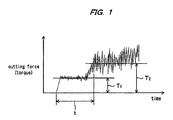
- a cutting force (torque T 2 ) is measured from the start of drilling. While assuming drilling time t required until the torque T 2 becomes twice as large as a stable drilling torque T 1 as “stable drilling time”, “stable drilling depth (mm) "which is defined as “stable drilling time (sec)” x “feed (mm/sec)” is calculated and evaluated.
- the steel A according to the present invention exhibits superior properties to those of the conventional steels B and C for all the evaluation items.
- the steel A is far superior to the conventional Pb-containing free cutting steels.
- the conventional steel E is a Pb-containing free cutting steel which contains 0.17% of Pb.
- the conventional steel F is a Pb-containing free cutting steel to which Pb and Ca are added, namely which contains 0.18% of Pb and 22 ppm of Ca.
- the conventional steel G does not contain Ca and Mg.
- the Al content of each of the conventional steels E to G exceeds 0.010%.
- Respective steel materials are molten in a vacuum melting furnace with the capacity of 30 kg, forged and extended to ⁇ 40 mm at 1200°C, and a part thereof is further forged and extended to a rectangular steel material of 40x70 mm. Thereafter, each of the steels is held for 30 minutes at 1200°C, and then an air-cooling heat treatment is conducted thereto.
- machinability tests Using the ⁇ 40 mm steel materials, machinability tests, a tensile test and an L-direction impact test are conducted. Using the 40x70 mm rectangular steel materials, a T-direction impact test is conducted.
- Test methods, cutting conditions, tensile test specimens and impact test specimens are the same as those in the first embodiment.
- the steel D according to the present invention exhibits superior properties to those of the conventional steels E to G in all the evaluation items.
- the steel D particularly exhibits far superior performances in carbide tool loss by wear and drill life to those of the conventional Pb-containing free cutting steels.
- steels H and I according to the present invention and conventional steels J and K, all of which are case hardening steels, are prepared and compared with one another.
- the conventional steel J is a free cutting steel to which S and Pb are added in large quantities.
- the Al content of each of the conventional steels J and K exceeds 0.010%.
- Each steel material ismolten in a vacuummelting furnace with the capacity of 100 kg, forged and extended to ⁇ 60 mm at 1200°C, and a part thereof is further forged and extended to a rectangular steel material of 40x70 mm. Thereafter, each steel material is subjected to a normalizing heat treatment for 60 minutes at 900°C.
- machinability tests are conducted.
- the specimens for tensile test and L-direction impact test are cut out of above ⁇ 60 mm steel materials and the specimens for T-direction impact test are cut out of the above 40x70 mm rectangular steel materials. After these specimens are hardened at 880°C and tempered at 180°C, they are finished and then subjected to mechanical tests.
- the steels H and I according to the present invention exhibit superior properties at least in machinability to those of the conventional steels J and K.
- the steels H and I maintain almost the same mechanical properties as those of the conventional steels.
- the drill life of the steel H according to the present invention to which Bi is added is, in particular, lengthened surprisingly.
- This improvement is derived from the fact that the deformation of inclusions are accelerated by the lowmelting behavior of Bi and the mixed sulfide has an effect of suppressing the progress of the tool wear.
- a steel L according to the present invention conventional steels M and N and a comparison steel O, which are non-heat treated steel, are prepared and compared with one another in fatigue properties.
- the conventional steel M is a free cutting steel which contains Pb
- the conventional steel N is a Pb composite free cutting steel which contains Ca in addition to Pb.
- the comparison steel O is a steel obtained by increasing an O content to more than 20 ppm in the steel according to the present invention.
- Each steel material is molten in a vacuummelting furnace with the capacity of 30 kg, forged and extended to ⁇ 60 mm at 1200°C, held at 1200°C for 30 minutes and then subjected to an air-cooling heat treatment.
- Specimens are cut out from the ⁇ 60 mm steel materials respectively, and tensile tests and Ono-type rotating and bending fatigue tests are conducted.
- the steel L according to the present invention exhibits tensile strength which has little difference from that of the conventional steel M (lead-containing free cutting steel) and that of the conventional steel N (lead composite free cutting steel) and exhibits a fatigue limit and an endurance ratio which are equal to or higher than those of the conventional steels M and N.
- the comparison steel O which is higher in oxygen content than the steel L according to the present invention, is inferior in fatigue properties. It is considered that this is due to the increase of the quantity and magnitude of an oxide inclusion.
- heat-treated steels and non-heat treated steels are evaluated for continuous casting properties.
- steels P to S according to the present invention and comparison steels T to Ware prepared.
- the comparison steels T to W are obtained by increasing the Al contents to not less than 0.05%, respectively, in the steels P to S according to the present invention.
- a continuous casting test is conducted using a bloom continuous casting machine of the rating type of 370mm X 530mm after melting the steels in an electric furnace with the capacity of 130-ton-LF (ladle refining furnace)-RH (vacuum degassing machine). It is then tested whether or not molten metals of 130 tons are cast by the continuous casting machine.
- steel X which is a non-heat treated steel according to the present invention shown in Table 8 is prepared and inclusions in the steel are observed.
- the steel X according to the present invention is molten in a vacuummelting furnace with the capacity of 30 kg and forged and extended to ⁇ 40 mm at 1200°C. Thereafter, the steel is heldat 1200°C for 30minutes and then subjected to anair-cooling heat treatment.
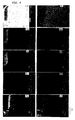
- Fig. 2 is a drawing-replacing photograph which shows SEM (scanning electron microscope) images and the respective images of elements Mn, Si, Mg, S, Al, Fe, O, P and Ca at the same position of the SEM image.
- Mn, Mg, S and Ca are detected in the same inclusion and the existence of MnS, (Mg, Ca) S and (Mn, Mg, Ca) S is confirmed.
- a sulfide normally represented by MnS is formed into rod-like form after forging and extending, that in the steel according to this invention is spherical. This is considered to demonstrate that the notch effect by the inclusions is decreased during the mechanical property tests and that impact-resistance anisotropy in mechanical properties is improved.
- a steel X according to the present invention and conventional steels Y and Z are prepared and subjected to tests for carbide tool loss by wear, chip disposabilityindices, deep drilling properties and drilllives. Test conditions and the like are the same as those in the first embodiment. In addition, the distribution of alloy elements on the face worn parts (crater worn parts) of the respective tools is observed.
- the conventional steel Y is a lead composite free cutting steel which contains Pb and Ca.
- the conventional steel Z is a steel which does not contain Pb but in which an Al content is increased, without adding Ca and Mg.
- a manufacturing method for the steels Y and Z is the same as that of the steel X according to the present invention.
- the steel X according to the present invention is superior in all of the evaluation items to the conventional steels Y and Z.
- FIGs. 3 to 5 are drawing-replacing photographs each of which shows the SEM image of the surface of the face worn part of the tool after the wear test and the images of elements Ca, S, Mn, Mg, W, Fe, Si, Al and O at the same position of the SEM image.
- more steels according to the present invention and comparison steels are prepared and evaluated for machinability and the other properties as in the case of the first embodiment.
- the comparison steel b1 has an S content below the lower limit and the comparison steel b2 has an S content exceeding the upper limit.
- the comparison steel b3 has an Al content exceeding the upper limit.
- the comparison steel b4 has a Ca content below the lower limit and the comparison steel b5 has a Ca content exceeding the upper limit.
- the comparison steel b6 has an Mg content below the lower limit and the comparison steel b7 has an Mg content exceeding the upper limit.
- the comparison steel b8 has an O content exceeding the upper limit.
- Heat-treated steels are manufactured in the same manner as that in the first embodiment and non-heat treated steels are manufactured in the same manner as that in the second embodiment.
- those that have data in hardening and tempering item are the heat-treated steels and those that have data in an air-cooling treatment (afterheatingat 1200°C) item are the non-heat treated steels.
- heat-treated steels mechanical tests are conducted after hardening and tempering; and as to non-heat treated steels, they are conducted after heating at 1200 °C followed by air-cooling treatment.
- the other conditions are the same as those in the first to third embodiments.
- the comparison steel b1 the S content of which is below the lower limit cannot attain sufficient properties in carbide tool loss by wear, chip disposability, deep drilling property and drill life.
- the comparison steel b2 the S content of which exceeds the upper limit is inferior in impact-resistance anisotropy and endurance ratio.
- the comparison steel b3 the Al content of which exceeds the upper limit is inferior in carbide tool loss by wear and endurance ratio. Further, compared to non-heat treated steel (air-cooled steels) among the steels a1 to a78 of the present invention, since the comparison steel b3 consists of the non-heat treated steel, the deep drilling property and drill life of the comparison steel b3 do not reach very good level but remain at good level, whereas almost all the steels according to the present invention exhibit very good levels in deep drilling and drill life like Pb-containing free cutting steels.
- the comparison steel b4 the Ca content of which is below the lower limit does not exhibit excellent carbide tool loss by wear, drill life and impact-resistance anisotropy.
- the comparison steel b5 the Ca content of which exceeds its upper limit does not exhibit an excellent endurance ratio.
- the comparison steel b6 the Mg content of which is below the lower limit does not exhibit excellent carbide tool loss by wear, drill life and impact-resistance anisotropy.
- the comparison steel b7 the Mg content of which exceeds the upper limit does not exhibit an excellent endurance ratio.
- the comparison steel b8 the O content of which exceeds the upper limit does not exhibit excellent carbide tool loss by wear, drill life and endurance ratio.
- Table 18 evaluation criterion carbide tool loss by wear chip disposability index deep drilling property drill life impact-resistance anisotropy endurance ratio O 0.04 or less 35 or more 73 or more 850 or more 0.50 or more 0.54 or more ⁇ 0.05 - 0.12 13 - 34 61 - 72 600 - 849 0.30 - 0.49 0.43 - 0.53 ⁇ 0.13 or more 12 or less 60 or less 599 or less 0.29 or less 0.42 or less
Landscapes
- Chemical & Material Sciences (AREA)
- Engineering & Computer Science (AREA)
- Materials Engineering (AREA)
- Mechanical Engineering (AREA)
- Metallurgy (AREA)
- Organic Chemistry (AREA)
- Treatment Of Steel In Its Molten State (AREA)
- Heat Treatment Of Steel (AREA)
Applications Claiming Priority (1)
| Application Number | Priority Date | Filing Date | Title |
|---|---|---|---|
| EP00902931A EP1270757B1 (fr) | 2000-02-10 | 2000-02-10 | Acier structural sans plomb pour construction mecanique presentant une excellente usinabilite et une anisotropie de resistance reduite |
Related Parent Applications (1)
| Application Number | Title | Priority Date | Filing Date |
|---|---|---|---|
| EP00902931A Division EP1270757B1 (fr) | 2000-02-10 | 2000-02-10 | Acier structural sans plomb pour construction mecanique presentant une excellente usinabilite et une anisotropie de resistance reduite |
Publications (1)
| Publication Number | Publication Date |
|---|---|
| EP1688512A1 true EP1688512A1 (fr) | 2006-08-09 |
Family
ID=36581965
Family Applications (1)
| Application Number | Title | Priority Date | Filing Date |
|---|---|---|---|
| EP06005867A Withdrawn EP1688512A1 (fr) | 2000-02-10 | 2000-02-10 | Acier structural sans plomb pour contruction mecanique presentant une excellente usinabilite et une anisotropie de resistance reduite |
Country Status (1)
| Country | Link |
|---|---|
| EP (1) | EP1688512A1 (fr) |
Cited By (2)
| Publication number | Priority date | Publication date | Assignee | Title |
|---|---|---|---|---|
| WO2009021606A1 (fr) * | 2007-08-15 | 2009-02-19 | Rheinmetall Waffe Munition Gmbh | Procédé de fabrication et acier pour enveloppes de munition lourdes |
| CN114381659A (zh) * | 2021-12-06 | 2022-04-22 | 首钢京唐钢铁联合有限责任公司 | 一种低碳低磷低铝高氮超低硫钢及其制备方法 |
Citations (9)
| Publication number | Priority date | Publication date | Assignee | Title |
|---|---|---|---|---|
| US3647425A (en) * | 1969-04-07 | 1972-03-07 | Nippon Kokan Kk | Free cutting steel containing small amounts of aluminum and calcium |
| US4004922A (en) * | 1974-10-11 | 1977-01-25 | Ugine Aciers | Free machining steel |
| JPS57140854A (en) * | 1981-02-23 | 1982-08-31 | Nippon Steel Corp | Machine structural steel with superior machinability |
| JPS57140853A (en) * | 1981-02-23 | 1982-08-31 | Nippon Steel Corp | Free cutting steel with superior mechanical property |
| EP0487024A1 (fr) * | 1990-11-21 | 1992-05-27 | Nippon Steel Corporation | Tube en acier, soudé par résistance électrique, pour la construction mécanique et présentant une très bonne usinabilité |
| JPH07188847A (ja) * | 1993-12-28 | 1995-07-25 | Kawasaki Steel Corp | 被削性に優れた機械構造用炭素鋼 |
| JPH07188849A (ja) * | 1993-12-28 | 1995-07-25 | Kawasaki Steel Corp | 被削性に優れた機械構造用炭素鋼 |
| JPH10176241A (ja) * | 1996-12-17 | 1998-06-30 | Nippon Steel Corp | 切断およびボルト孔加工の容易な高靱性高力ボルト接合スプライスプレート用鋼板およびこの鋼板を用いたスプライスプレート |
| JPH11350065A (ja) * | 1998-06-04 | 1999-12-21 | Daido Steel Co Ltd | 旋削加工性に優れた熱間鍛造用非調質鋼 |
-
2000
- 2000-02-10 EP EP06005867A patent/EP1688512A1/fr not_active Withdrawn
Patent Citations (9)
| Publication number | Priority date | Publication date | Assignee | Title |
|---|---|---|---|---|
| US3647425A (en) * | 1969-04-07 | 1972-03-07 | Nippon Kokan Kk | Free cutting steel containing small amounts of aluminum and calcium |
| US4004922A (en) * | 1974-10-11 | 1977-01-25 | Ugine Aciers | Free machining steel |
| JPS57140854A (en) * | 1981-02-23 | 1982-08-31 | Nippon Steel Corp | Machine structural steel with superior machinability |
| JPS57140853A (en) * | 1981-02-23 | 1982-08-31 | Nippon Steel Corp | Free cutting steel with superior mechanical property |
| EP0487024A1 (fr) * | 1990-11-21 | 1992-05-27 | Nippon Steel Corporation | Tube en acier, soudé par résistance électrique, pour la construction mécanique et présentant une très bonne usinabilité |
| JPH07188847A (ja) * | 1993-12-28 | 1995-07-25 | Kawasaki Steel Corp | 被削性に優れた機械構造用炭素鋼 |
| JPH07188849A (ja) * | 1993-12-28 | 1995-07-25 | Kawasaki Steel Corp | 被削性に優れた機械構造用炭素鋼 |
| JPH10176241A (ja) * | 1996-12-17 | 1998-06-30 | Nippon Steel Corp | 切断およびボルト孔加工の容易な高靱性高力ボルト接合スプライスプレート用鋼板およびこの鋼板を用いたスプライスプレート |
| JPH11350065A (ja) * | 1998-06-04 | 1999-12-21 | Daido Steel Co Ltd | 旋削加工性に優れた熱間鍛造用非調質鋼 |
Non-Patent Citations (4)
| Title |
|---|
| PATENT ABSTRACTS OF JAPAN vol. 006, no. 239 (C - 137) 26 November 1982 (1982-11-26) * |
| PATENT ABSTRACTS OF JAPAN vol. 1995, no. 10 30 November 1995 (1995-11-30) * |
| PATENT ABSTRACTS OF JAPAN vol. 1998, no. 11 30 September 1998 (1998-09-30) * |
| PATENT ABSTRACTS OF JAPAN vol. 2000, no. 03 30 March 2000 (2000-03-30) * |
Cited By (2)
| Publication number | Priority date | Publication date | Assignee | Title |
|---|---|---|---|---|
| WO2009021606A1 (fr) * | 2007-08-15 | 2009-02-19 | Rheinmetall Waffe Munition Gmbh | Procédé de fabrication et acier pour enveloppes de munition lourdes |
| CN114381659A (zh) * | 2021-12-06 | 2022-04-22 | 首钢京唐钢铁联合有限责任公司 | 一种低碳低磷低铝高氮超低硫钢及其制备方法 |
Similar Documents
| Publication | Publication Date | Title |
|---|---|---|
| US9725783B2 (en) | Steel for machine structure use excellent in cutting tool lifetime and machining method of same | |
| EP1790748B1 (fr) | Acier pour tube en acier | |
| JP4473928B2 (ja) | 被削性と衝撃値に優れた熱間加工鋼材 | |
| KR101162743B1 (ko) | 피삭성과 강도 특성이 우수한 기계 구조용 강 | |
| EP1270757B1 (fr) | Acier structural sans plomb pour construction mecanique presentant une excellente usinabilite et une anisotropie de resistance reduite | |
| JP2009007643A (ja) | 被削性に優れた機械構造用鋼 | |
| KR20060047819A (ko) | 냉간공구강 | |
| EP2439303A1 (fr) | Acier pour la formation de structures mécaniques | |
| JP2002069569A (ja) | 機械的特性に優れた機械構造用快削鋼 | |
| JP2001131684A (ja) | 切り屑処理性に優れた機械構造用鋼 | |
| JP3558889B2 (ja) | 被削性に優れる熱間鍛造のまま使用される機械構造用鋼 | |
| EP1484422B1 (fr) | Acier de decolletage contenant du soufre | |
| JP4041413B2 (ja) | 切り屑処理性に優れた機械構造用鋼、およびその製造方法 | |
| CN101688274B (zh) | 低碳硫快削钢 | |
| JP4451808B2 (ja) | 疲労特性と耐結晶粒粗大化特性に優れた肌焼用圧延棒鋼およびその製法 | |
| JP3270035B2 (ja) | 被削性に優れ,強度異方性の小さい鉛無添加の機械構造用鋼 | |
| JP2000144339A (ja) | 高耐食快削ステンレス鋼 | |
| JP4148311B2 (ja) | 被削性に優れ、強度異方性の小さい鉛無添加の機械構造用鋼 | |
| JP2003226934A (ja) | 被削性にすぐれた機械構造用鋼 | |
| JP2001200341A (ja) | 土砂摩耗特性に優れた工具鋼 | |
| WO2003064715A9 (fr) | Acier non raffine de type bainite pour nitruration, procede de production correspondant et produit nitrure | |
| JP2001152279A (ja) | 快削鋼 | |
| JP2001214241A (ja) | 被削性に優れた機械構造用鋼材及び機械構造部品 | |
| JP2989766B2 (ja) | 疲労特性および被削性に優れた肌焼鋼 | |
| JP2000328182A (ja) | 熱間加工性に優れる機械構造用快削鋼 |
Legal Events
| Date | Code | Title | Description |
|---|---|---|---|
| PUAI | Public reference made under article 153(3) epc to a published international application that has entered the european phase |
Free format text: ORIGINAL CODE: 0009012 |
|
| 17P | Request for examination filed |
Effective date: 20060322 |
|
| AC | Divisional application: reference to earlier application |
Ref document number: 1270757 Country of ref document: EP Kind code of ref document: P |
|
| AK | Designated contracting states |
Kind code of ref document: A1 Designated state(s): AT BE CH CY DE DK ES FI FR GB GR IE IT LI LU MC NL PT SE |
|
| AKX | Designation fees paid |
Designated state(s): DE GB |
|
| STAA | Information on the status of an ep patent application or granted ep patent |
Free format text: STATUS: THE APPLICATION IS DEEMED TO BE WITHDRAWN |
|
| 18D | Application deemed to be withdrawn |
Effective date: 20070210 |