EP1688536B1 - Feutre de papeterie et son procédé de fabrication - Google Patents
Feutre de papeterie et son procédé de fabrication Download PDFInfo
- Publication number
- EP1688536B1 EP1688536B1 EP20060002492 EP06002492A EP1688536B1 EP 1688536 B1 EP1688536 B1 EP 1688536B1 EP 20060002492 EP20060002492 EP 20060002492 EP 06002492 A EP06002492 A EP 06002492A EP 1688536 B1 EP1688536 B1 EP 1688536B1
- Authority
- EP
- European Patent Office
- Prior art keywords
- layer
- paper
- press
- wet paper
- batt
- Prior art date
- Legal status (The legal status is an assumption and is not a legal conclusion. Google has not performed a legal analysis and makes no representation as to the accuracy of the status listed.)
- Expired - Lifetime
Links
Images

Classifications
-
- D—TEXTILES; PAPER
- D21—PAPER-MAKING; PRODUCTION OF CELLULOSE
- D21F—PAPER-MAKING MACHINES; METHODS OF PRODUCING PAPER THEREON
- D21F7/00—Other details of machines for making continuous webs of paper
- D21F7/08—Felts
- D21F7/083—Multi-layer felts
-
- D—TEXTILES; PAPER
- D21—PAPER-MAKING; PRODUCTION OF CELLULOSE
- D21F—PAPER-MAKING MACHINES; METHODS OF PRODUCING PAPER THEREON
- D21F3/00—Press section of machines for making continuous webs of paper
-
- D—TEXTILES; PAPER
- D21—PAPER-MAKING; PRODUCTION OF CELLULOSE
- D21F—PAPER-MAKING MACHINES; METHODS OF PRODUCING PAPER THEREON
- D21F7/00—Other details of machines for making continuous webs of paper
- D21F7/08—Felts
-
- Y—GENERAL TAGGING OF NEW TECHNOLOGICAL DEVELOPMENTS; GENERAL TAGGING OF CROSS-SECTIONAL TECHNOLOGIES SPANNING OVER SEVERAL SECTIONS OF THE IPC; TECHNICAL SUBJECTS COVERED BY FORMER USPC CROSS-REFERENCE ART COLLECTIONS [XRACs] AND DIGESTS
- Y10—TECHNICAL SUBJECTS COVERED BY FORMER USPC
- Y10S—TECHNICAL SUBJECTS COVERED BY FORMER USPC CROSS-REFERENCE ART COLLECTIONS [XRACs] AND DIGESTS
- Y10S162/00—Paper making and fiber liberation
- Y10S162/90—Papermaking press felts
-
- Y—GENERAL TAGGING OF NEW TECHNOLOGICAL DEVELOPMENTS; GENERAL TAGGING OF CROSS-SECTIONAL TECHNOLOGIES SPANNING OVER SEVERAL SECTIONS OF THE IPC; TECHNICAL SUBJECTS COVERED BY FORMER USPC CROSS-REFERENCE ART COLLECTIONS [XRACs] AND DIGESTS
- Y10—TECHNICAL SUBJECTS COVERED BY FORMER USPC
- Y10T—TECHNICAL SUBJECTS COVERED BY FORMER US CLASSIFICATION
- Y10T442/00—Fabric [woven, knitted, or nonwoven textile or cloth, etc.]
- Y10T442/30—Woven fabric [i.e., woven strand or strip material]
- Y10T442/3707—Woven fabric including a nonwoven fabric layer other than paper
- Y10T442/378—Coated, impregnated, or autogenously bonded
- Y10T442/3789—Plural nonwoven fabric layers
Definitions
- the present invention relates to a paper transporting felt and a press apparatus of a paper machine having the paper transporting felt.
- a paper machine includes a wire part, a press part, and a drier part.
- the wire part, the press part, and the drier part are arranged in that order in a wet paper transporting direction.
- a wet paper is transported sequentially through wet paper transporting members provided in the wire part, the press part, and the drier part, water is squeezed out of the wet paper in the meantime, and the wet paper is finally dried on a drier canvas (as a paper transporting member) in the drier part.
- a press apparatus disposed in the press part includes a plurality of press mechanisms arranged in series in the wet paper transporting direction.
- Each press mechanism includes a pair of paper transporting felts having an endless belt shape and a pair of rolls (that is, roll press) or a roll and shoe (that is, shoe press) as a press vertically opposite to each other to interpose a part of the pair of paper transporting felts therebetween.
- the paper machine is classified into a roll press type paper machine in which a press apparatus interposing and pressing a part of the paper transporting felts, which interpose the wet paper, between a roll and a roll is provided in the press part and a shoe press type paper machine in which a press apparatus interposing and pressing a part of the paper transporting felts, which interpose the wet paper, between a roll and a shoe is provided in the press part.
- the shoe press type paper machine can have a greater press zone of a pressing portion (that is, a nip) of the press than that of the roll press type paper machine which is used more widely, the pressing time can be more elongated. Accordingly, the shoe press type paper machine can have more excellent dewatering characteristic.
- the wet paper transported by the paper transporting felts of the press apparatus is sequentially transported through the paper transporting felts of a plurality of press mechanisms arranged in series while squeezing out water therefrom and then the surfaces of the wet paper are smoothed.
- the paper transporting felts should have a function of transporting the wet paper, a function of squeezing water out of the wet paper, a paper separating function of smoothly separating the wet paper from the paper transporting felt for sending the wet paper to a next process (in other words, facilitating the peeling of the wet paper from the paper transporting felts), and a wet paper surface smoothing function of smoothing the surfaces of the wet paper.
- the paper transporting felts of the press mechanism disposed on the downstream side in the wet paper transporting direction require the wet paper surface smoothing function rather than the function of squeezing water out of the wet paper as a more important function.
- a barrier layer is formed by impregnating a batt layer formed on the surface of a base layer with the emulsion resin and performing a calender machining to the wet paper side surface of the batt layer into a dense and smooth surface of a chamois leather type, or a rough fiber layer formed on the surface of the base layer is impregnated with the emulsion resin to form a barrier layer (non-woven fiber layer) on the rough fiber layer, and a fine fiber layer is formed on the barrier layer (non-woven fiber layer).
- the barrier layer prevents the emulsion resin from reaching the wet paper side surface of the paper transporting felt, it is possible to prevent the re-wetting and the blowing of the paper transporting felt and thus to enhance a papermaking speed.
- the paper transporting felt is pressed along with the wet paper in the pressing portion of the press mechanism, it is possible to reduce a factor of hindering the surface smoothing of the wet paper that air contained in the paper transporting felt is pushed out from the wet paper side surface to roughen the surface of the wet paper.
- a press felt for a paper machine is described in WO 03/091498 .
- the press felt comprises a base structure and a batt fiber layer attached to a first surface of the base structure.
- the press felt is compacted by treating with a polymer material.
- US 4 357 386 describes a composite papermaker felt made up of a textile base layer, an intermediate layer of polymeric resin foam particles and a covering layer of non-woven staples fibers.
- a press fabric with a foam coated surface is described in EP 0 367 739 .
- the paper transporting felt has a fiber layer including thermoplastic fibers or melted fibers, and the thermoplastic fibers or the melted fibers are melted by heating the surface of the fiber layer to form the liquid impermeable layer.
- a paper transporting felt in which a surface of resin layer which faces the wet paper has an upwardly opened gap ( JP-A-62-21895 ).
- a plurality of open grooves are formed in the polymer resin layer which faces the wet paper by means of dissolution of solvent-removal materials (more specifically, solvent-removal fibers) in order to improve wear resistance, spacing resistance and compression resistance, so that water permeability is obtained using the gaps formed in the polymer resin layer which faces the wet paper (more specifically, a hardened polymer resin layer) by means of the plurality of open groove.
- the paper transporting felts mounted on a plurality of press mechanisms arranged in series have different main functions.
- the function of squeezing water out of the wet paper is mainly required for the paper transporting felt mounted on the press mechanism disposed on the upstream side in the wet paper transporting direction among the plurality of press mechanisms and the function of smoothing the surface of the wet paper is mainly required for the paper transporting felt mounted on the press mechanism disposed on the downstream side in the wet paper transporting direction. That is, the surface smoothness of the wet paper may mainly depend upon the paper transporting felt mounted on the press mechanism disposed on the downstream side in the wet paper transporting direction among the plurality of press mechanisms.
- the paper transporting felt mounted on the press mechanism disposed on the downstream side in the wet paper transporting direction among the plurality of press mechanisms should have a smooth surface which faces the wet paper.
- the paper transporting felt mounted on the press mechanism disposed on the downstream side should have a dewatering characteristic more or less.
- the water contained in the wet paper is absorbed and squeezed out by the paper transporting felt which is compressed and decompressed in the pressing portion of the press mechanism. That is, the paper transporting felts require proper ventilation ability, compression ability, and decompression ability for efficiently squeezing out water.
- a press apparatus of the paper machine specifically, in a press apparatus of a shoe press type paper machine or a single nip-type paper machine, since a pressing portion (that is, nip) of a press applies a very large pressure to the paper transporting felt to squeeze out water, the batt layer of the paper transporting felt coming into direct contact with the pressing portion of the press can be easily damaged and thus a lifetime of the paper transporting felt (that is, a usable period of time of the paper transporting felt) is short. Accordingly, maintenance for regularly interchanging the paper transporting felt with a new one is required.
- fibers on the batt layer of the paper transporting felt which comes into direct contact with the wet paper, remarkably falls out (loss of fiber) or are cut out due to the high pressure and friction by the pressing portion (i.e., nip).
- Most of the falling out or cut-out fibers are discharged out of the press apparatus by means of a cleaning unit such as a shower and suction box, however, some of the fibers may be stuck to the surface of the wet paper.
- the paper made of the wet paper to which the fibers falling out or cut out are stuck may have poor printability (more specifically, the decolorization may occurs on printing). Accordingly, the quality of the paper products such as printed materials is deteriorated due to the falling out of the fibers from the surface of the batt layer of the paper transporting felts which comes into direct contact with the wet paper. Further, since the surface of the wet paper side batt layer is rough due to the falling out of the fibers, it is a factor which deteriorates the surface smoothness of the wet paper.
- the paper transporting felt of which the wet paper side surface is processed which is disclosed in U.S. Patent No. 4,500,588 , is a paper transporting felt having an excellent surface smoothness and a water impermeability (that is, ability of allowing water not to pass from the wet paper side surface to the press side surface), but has a poor ability of squeezing water out of a wet paper. Therefore, since a high ability of squeezing water out of the wet paper cannot be expected for the paper transporting felt, it is preferable so as to utilize the paper transporting felt that the dewatering of the wet paper is completely performed by a press mechanism disposed on the upstream side in the wet paper transporting direction.
- the paper transporting felt of which the wet paper side surface is subjected to the calender process which is disclosed in U.S. Patent No. 4,500,588 , can be preferably mounted on a press apparatus disposed on the downstream side in the wet paper transporting direction among a plurality of press mechanisms arranged in series.
- a press apparatus disposed on the downstream side in the wet paper transporting direction among a plurality of press mechanisms arranged in series.
- the paper transporting felt mounted on the press mechanism disposed on the downstream side in the wet paper transporting direction among a plurality of press mechanisms has a function of squeezing water out of the wet paper more or less.
- the paper transporting felt which is disclosed in U.S. Patent No. 4,500,588 , in which the non-woven fiber layer is interposed between the rough fiber layer facing the base layer and the micro fiber layer facing the wet paper and having the fiber lumps is not suitable for the press apparatus of the paper machine in which the high ability of squeezing water out of the wet paper is required for the paper transporting felt.
- a liquid impermeable layer is formed by heating the surface of a fiber layer including thermoplastic fibers or melted fibers to melt the thermoplastic fibers or the melted fibers.
- the paper transporting felt has a feature that the thickness of the liquid impermeable layer can be controlled to some extent by adjusting the amount of heat applied from the surface of the fiber layer.
- the depth of the paper transporting felt (that is, the thickness of the liquid impermeable layer) is limited in consideration of the thermal deterioration or thermal decomposition of the thermoplastic fibers or the melted fibers. Accordingly, the thickness of the liquid impermeable layer is automatically limited not to be too thick.
- the wet paper side surface includes a fiber layer, very great pressure or friction is applied to the fiber by the pressing portion and thus the falling-out or cutting-out of fiber (that is, loss of fiber) from the surface of the fiber layer remarkably occurs.
- the loss of fiber from the surface of the fiber layer coming into direct contact with the wet paper in the paper transporting felt deteriorates the quality of paper products such as print mediums.
- the surface of the fiber layer is roughened due to the loss of fiber, the surface smoothness of the wet paper is remarkably lowered.
- An object of the present invention is to provide a paper transporting felt which has a smaller damage resulting from the pressing by a press of a press mechanism and which has an excellent durability, a proper dewatering characteristic, and an excellent performance of smoothing the surface of a wet paper, and a press apparatus of a paper machine having the paper transporting felt.
- the invention provides a paper transporting felt for a paper machine, comprising: a base layer; a first batt layer which is formed on a wet paper side surface of the base layer; a second batt layer which is formed on a press side surface of the base layer; a polymer elastic material which is impregnated in the base layer, the first batt layer and the second batt layer; and a wet paper contacting layer which is formed on a wet paper side surface of the first batt layer so as to come into direct contact with the wet paper, and which includes a flexible resin material, wherein a compressibility of the wet paper contacting layer is larger than a compressibility of a layer formed by the base layer, the first batt layer and the second batt layer.
- the resin material includes a foaming resin or a hollow particulate resin.
- a difference between the compressibility of the wet paper contacting layer and the compressibility of the layer formed by the base layer, the first batt layer and the second batt layer is more than or equal to 5% under 10kg/cm 2 pressure (i.e. at a pressure of 10 Kg/cm 2 ) .
- the invention also provides a press apparatus of a paper machine having the above paper transporting felt.
- the invention also provides a press apparatus of a paper machine having a plurality of press mechanisms each having the paper transporting felt, in which the plurality of press mechanisms are disposed in series along a transporting direction of the wet paper transported by the paper transporting felts.
- the above paper transporting felt is provided in a press mechanism disposed on a downstream side in the transporting direction among the plurality of press mechanisms.
- the above press apparatus of the paper machine may be a press apparatus of a shoe press type paper machine, in which the press of the press apparatus is a shoe press having a roll and a shoe pressing the paper transporting felt.
- the above press apparatus of the paper machine may be a press apparatus of a roll press type paper machine, in which the press of the press apparatus is a roll press having a pair of rolls pressing the paper transporting felt.
- the base layer, the first batt layer and the second batt layer include the polymer elastic material, and the wet paper contacting layer is formed of a flexible resin material. Accordingly, since the base layer, the first batt layer and the second batt layer include the polymer elastic material such as a synthetic resin, the base layer and the second batt layer have a high mechanical strength against the pressing by the press of the press mechanism. Therefore, even when the paper transporting felt is strongly pressed by the pressing portion of the press, the paper transporting felt is less damaged and thus the paper transporting felt has an excellent durability. As a result, since the lifetime of the paper transporting felt is elongated, the frequency of interchanging the paper transporting felt can be reduced.
- the wet paper contacting layer made of a flexible resin material has a larger compressibility than that of a layer formed of the base layer, the first batt layer and the second batt layer, it has a proper compression and decompression ability as compared to a layer formed of the base layer, the first batt layer and the second batt layer, therefore, it is possible to absorb the water from the wet paper.
- the falling out of the fibers from the wet paper contacting layer does not occur at all, the surface smoothness of the wet paper can be improved. Further, since the fibers do not fall out of the wet paper contacting layer, the life cycle of the paper transporting felt (i.e., the available period of the paper transporting felts) can be extended and the frequency of interchange can be reduced.
- the resin material forming the wet paper contacting layer includes a foaming resin or a hollow particulate resin
- the wet paper contacting layer has smooth and porous internal construction.
- the paper transporting felt is suitably cushioned and capable of squeezing out the water, thereby possibly make the surface of the wet paper smooth.
- the wet paper contacting layer has a proper compression and decompression ability.
- the paper transporting felt is preferably used on the downstream side of the transporting direction of the press apparatus.
- the polymer elastic material can be the synthetic resin such as aqueous urethane resin, aqueous acryl resin, aqueous epoxy resin, and aqueous synthetic rubber (that is, aqueous emulsion resin).
- a polymer elastic material is impregnated in the base layer, the first batt layer and the second batt layer, and is then heated and cured.
- the press apparatus of the paper machine includes a papermaking transporting belt, the excellent operational advantages can be obtained as described above.
- the press apparatus of the paper machine comprising the plurality of press mechanisms having the above paper transporting felt
- the plurality of press mechanisms are disposed in series along the transporting direction of the wet paper transported by the paper transporting felts, the water can be efficiently squeezed out of the wet paper and the surface of the wet paper can be suitably smoothed, thereby enabling the papermaking work at a high speed.
- the paper transporting felt is provided in the press mechanism disposed on the downstream side in the transporting direction among the plurality of press mechanisms, it can be considered that the water permeability is slightly smaller than that of the paper transporting felt having the smaller content of the polymer elastic material, but since the more excellent function of smoothing the surface of the wet paper, it is possible to enhance the surface smoothness of the wet paper and to enable the papermaking work at a high speed.
- Fig. 1 is a vertical cross-sectional view illustrating a paper transporting felt (paper transporting felt 100) according to an embodiment of the present invention
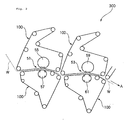
- Fig. 2 is a plan view schematically illustrating a paper transporting felt according to an embodiment of the present invention.
- the paper transporting felt 100 includes a base layer 11, a batt layer 13 (first batt layer 13A and second batt layer 13B), and a wet paper contacting layer 25. More specifically, the first batt layer 13A is formed on the wet paper side surface of the base layer 11, the second batt layer 13B is formed on a press side surface (more specifically, a surface facing one of a pair of rolls or one of a roll and a shoe) of the base layer 11, and the wet paper contacting layer 25 is formed on the wet paper side surface of the first batt layer 13A so that the wet paper contacting layer 25 comes into direct contact with a wet paper.
- the base layer 11 and the batt layer 13 are entangled with each other through a needling operation to form a body.
- the base layer 11 serves to give a strength to the paper transporting felt 100 and can be properly made of a woven cloth composed of a synthetic fiber such as nylon 6 (that is, N6) and nylon 66 (that is, N66) having excellent wear resistance, fatigue resistance, extensibility, and flame resistance or a natural fiber such as wool, a cloth made of a string material overlapped but not woven, or a cloth made into a film shape.
- the woven cloth is used for the base layer 11.
- the batt layer 13 (the first batt layer 13A and the second batt layer 13B) is a non-split fiber layer formed out of staple fibers 17 having a size of 6 decitex or more (generally about 17 decitex).
- the material constituting the batt layer 13 may properly include the same material as the base layer 11.
- the second batt layer 13B may be omitted depending upon characteristics required for the paper transporting felt 100.
- the base layer 11, the first batt layer 13A and the second batt layer 13B include a polymer elastic material 23 in fibers thereof or in a space between the staple fibers 17.
- the polymer elastic material 23 can include synthetic resin such as aqueous urethane resin, aqueous acryl resin, aqueous epoxy resin, and aqueous synthetic rubber (that is, aqueous emulsion resin).
- Such a polymer elastic material 23 is impregnated in the second batt layer 13B, the base layer 11 and the first batt layer 13A by applying the polymer elastic material 23 to the surface of the second batt layer 13B (the bottom surface in Fig.
- the base layer 11 the first batt layer 13A and the second batt layer 13B include the polymer elastic material 23, entangling points of fibers constituting the base layer 11, the first batt layer 13A and the second batt layer 13B are coupled to each other with the polymer elastic material 23, thereby stabilizing the shape and enhancing the mechanical strength. That is, even when the paper transporting felt 100 is pressed in a pressing portion of a press mechanism, it is not flattened for a long time and change in density and ventilation with the lapse of time is small to be stable.
- the wet paper contacting layer 25 is formed of a flexible resin layer which is formed on the wet paper side surface of the first batt layer 13A.
- the resin material forming the resin layer is, for example, a resin material including a foaming resin and a hollow microparticulate resin and makes the resin layer flexible.
- the compressibility of the wet paper contacting layer 25 is larger than that of a portion (layer) of the paper transporting felt 100, which is formed by the base layer 11, the first batt layer 13A and the second batt layer 13B.
- the compressibility of the wet paper contacting layer 25 is in the range of 25% to 40%, and preferably in the range of 30% to 35%.
- the portion (layer) of the paper transporting felt 100, which is formed by the base layer 11, the first batt layer 13A and the second batt layer 13B has the compressibility ranging from 20 % to 35%, preferably from 25% to 30%.
- the compressibility is obtained such that, using a plate press testing machine (not shown), a test piece of the paper transporting felt 100 is pressed at an initial pressure of 2kg/cm2 and then is pressed up to 10kg/cm2 pressure, while each thickness of the wet paper contacting layer 25 and the portion (layer) of the paper transporting felt 100, which is formed by the base layer 11, the first batt layer 13A and the second batt layer 13B is measured by an image output from an optical microscope, for each pressure.
- the compressibility is then obtained by assigning the measured thicknesses to an expression as below. The same tests as the above are carried out for each of a plurality of test pieces of a paper transporting felt 100. Further, the initial pressure is applied to the test piece in the above test, so as to measure the thickness without an error by smoothing the surface of the test piece.
- Compressibility ( % ) 100 ⁇ ( t ⁇ 2 - t ⁇ 1 ) / t ⁇ 2 (where t1 is the thickness of the test piece at a pressure of 10kg/cm 2 , and t2 is the thickness of the test piece at the initial pressure of 2kg/cm 2 )
- test piece from the paper transporting felt 100 itself is used as a test piece, it is difficult to measure the individual thicknesses of the wet paper contacting layer and the portion (layer) in the paper transporting felt 100, which is formed by the base layer 11, the first batt layer 13A and the second batt layer 13B. More specifically, it is difficult to obtain the test pieces having uniform thicknesses, respectively, for the wet paper contacting layer 25 and the portion (layer) of the paper transporting felt 100, which is formed by the base layer 11, the first batt layer 13A and the second batt layer 13B, from just slicing the paper transporting felt 100.
- the foaming resin is formed by bubbling, for example, an aqueous urethane resin, an aqueous acryl resin and an aqueous epoxy resin or by mixing a foaming agent in the resin to mix a plurality of microscopic air bubbles with the resin.
- the wet paper contacting layer 25 contains a plurality of microscopic air bubbles 27, thereby having high flexibility and smooth surfaces.
- the resin including the hollow microparticulate resin is formed by mixing a hollow microparticulate resin such as thermal expansive microcapsules in the resin including an aqueous urethane resin, aqueous acryl resin and aqueous epoxy.
- the thermal expansive microcapsules are microscopic plastic spheres (for example, the average diameter is 10 to 17 ⁇ ) that are generated by polymer shell containing liquid gas, and are hollow spherical particles of which the volume increases 40 times by heating at 80 to 190°C. Accordingly, the wet paper contacting layer 25 has a plurality of air bubbles 27.
- the wet paper contacting layer 25 containing the thermal expansive microcapsules has improved flexibility, surface smoothness and dimensional stability.
- "EXPANCEL” (trade mark; made by Japan ferrite Co., Ltd.) is given as a specific example of the thermal expansive microcapsule.
- the base weight of the wet paper contacting layer 25 is 200 g/m 2
- the basic weight of the first batt layer 13A is 400 g/m 2
- the basic weight of the base layer 11 is 650 g/m 2
- the basic weight of the second batt layer 13B is 100 g/m 2 .
- the polymer elastic material 23 is impregnated in the base layer 11, the first batt layer 13A and the second batt layer 13B by 5 wt%, respectively, and is not impregnated in the wet paper contacting layer 25.
- Measuring basic weights of respective elements of a light-weighted example of the paper transporting felt 100 are that the base weight of the wet paper contacting layer 25 is 100 g/m 2 , the basic weight of the first batt layer 13A is 200 g/m 2 , the basic weight of the base layer 11 is 200 g/m 2 , and the second batt layer 13B is omitted.
- the polymer elastic material 23 is impregnated in the base layer 11 and the first batt layer 13A by 1 wt% and is not impregnated in the wet paper contacting layer 25.
- the base weight of the wet paper contacting layer 25 is 300 g/m 2
- the basic weight of the first batt layer 13A is 800 g/m 2
- the basic weight of the base layer 11 is 1500 g/m 2
- the basic weight of the second batt layer 13B is 300 g/m 2 .
- the polymer elastic material 23 is impregnated in the base layer 11, the first batt layer 13A and the second batt layer 13B by 10 wt%, respectively, and is not impregnated in the wet paper contacting layer 25.
- a method of manufacturing the paper transporting felt 100 will be briefly described. Firstly, a woven base layer 11 is integrally formed with a batt layer 13 on both surfaces thereof, through a needling operation, etc.
- the wet paper contacting layer 25 i.e., a resin layer
- the wet paper contacting layer 25 is formed by coating a foaming resin onto the wet paper side surface of the first batt layer 13A and then drying it.
- the wet paper contacting layer 25 (i.e., a resin layer) is formed by coating the resin including the thermal expansive microcapsules onto the wet paper side surface of the first batt layer 13A, expanding the thermal expansive microcapsules by heating and drying it.
- the polymer elastic material 23 is impregnated in the second batt layer 13B, the base layer 11 and the first batt layer 13A by applying the polymer elastic material 23 to the surface of the second batt layer 13B (the bottom surface in Fig. 1 ) by the use of a roller or a coater blade or spraying the polymer elastic material thereto by the use of a spray, and is then heated and cured by the use of hot wind.
- the amount of the polymer elastic material 23 impregnated in the base layer 11, the first batt layer 13A and the second batt layer 13B is properly selected depending upon the characteristic required for the press mechanism fitted with the paper transporting felt 100.
- the base layer 11, the first batt layer 13A and the second batt layer 13B having an excellent durability and a small compression and decompression ability and the wet paper contacting layer 25 having a compression and decompression ability greater than that of the base layer 11, the first batt layer 13A and the second batt layer 13B are formed.
- the respective kind of fibers forming the base layer 11 and the batt layer 13, the kind and the amount of the resin material forming the wet paper contacting layer 25, and the kind and the impregnated amount of the polymer elastic material 23 is properly selected in consideration of the characteristics about each case or the combination thereof.
- a press apparatus 300 of a paper machine (shoe press type paper machine) fitted with the paper transporting felt 100 having an endless belt shape (ring shape) will be described with reference to Fig. 2 .
- the press apparatus 300 is a so-called closed draw-type press apparatus 300 in which two mechanisms of a first press mechanism 51 and a second press mechanism 53 are arranged in series in the transporting direction of the wet paper W (direction indicated by an arrow A).
- the closed draw type paper machine in which the wet paper W is transported and pressed in the state where it is interposed between two pairs of paper transporting felts 100, it is possible to stably transport the wet paper W at a high speed of 1200 to 1400 m/min. Accordingly, it is possible to make paper with much higher efficiency compared with the open draw type paper machine.
- the first press mechanism 51 includes a pair of paper transporting felts 100 and a first shoe 55 and a first roll 57 (in other words, first shoe press) which are opposed to each other to form a first nip (in other words, first pressing portion) therebetween.
- the second press mechanism 53 includes a pair of paper transporting felts 100 and a second shoe 59 and a second roll 61 (in other words, second shoe press) which are opposed to each other to form a second nip (in other words, second pressing portion) therebetween.
- the paper transporting felts 100 can be employed as the upper and lower paper transporting felts of the first press mechanism 51 and the second press mechanism 53, respectively, but may be employed as any one of the upper and lower paper transporting felts of the first press mechanism 51 and the second press mechanism 53.
- any paper transporting felt may be employed as the other paper transporting felts, depending upon the papermaking characteristics.
- paper transporting felts having a surface smoothing ability rather than a dewatering characteristic are employed as a pair of paper transporting felts mounted on the second press mechanism 53 disposed on the downstream side. Therefore, it is preferable that the pair of the paper transporting felts 100 be employed as the paper transporting felts of the second press mechanism 53.
- the wet paper W which is delivered from a wire part (not shown) to the first press mechanism 51 is interposed and transported between a pair of paper transporting felts 100, the water is squeezed out of the wet paper by pressing the wet paper with the first shoe 55 and the first roll 57, and the squeezed water is absorbed into the wet paper contacting layer 25 of the paper transporting felt 100.
- the wet paper W is delivered to the second press mechanism 53 and interposed and transported between a pair of paper transporting felts 100, the water is further squeezed out of the wet paper by pressing the wet paper with the second shoe 59 and the second roll 61, and then the squeezed water is absorbed into the wet paper contacting layer 25 of the paper transporting felts 100.
- the wet paper contacting layer 25 of the paper transporting felt 100 is formed of a flexible resin material and the surface which faces the wet paper thereof is dense and flat. Accordingly, the wet paper W having the flat surface is formed, is delivered to a drier part (not shown), and is then dried therein. Since the second batt layer 13B, the base layer 11 and the first batt layer 13A of the paper transporting felt 100 coming in contact with the pressing portions between the first shoe 55 and the first roll 57 or between the second shoe 59 and the second roll 61 include the polymer elastic material 23 and thus the mechanical strengths thereof are enhanced, they are not damaged from the strong pressing in the pressing portions. Therefore, the paper transporting felts have an excellent durability.
- the press apparatus 300 of a shoe press type paper machine having two-stage press mechanisms 51 and 53 has been described as an example of the press apparatus of a paper machine according to the present invention, but the present invention can be applied to a press apparatus having one press mechanism or a press apparatus having a plurality of press mechanisms arranged in series, of course.
- the paper transporting felt 100 is a paper transporting felt which is at least one paper transporting felt of a pair of paper transporting felts, which are disposed in a press apparatus 300 provided in a press part of a paper machine, which form a press mechanism 51 or 53 together with a press (roll 57 or 61 and shoe 55 or 59) in the press apparatus, which are transported while sandwiching a wet paper, and which are pressurized by the press.
- the paper transporting felt 100 includes a base layer 11; a first batt layer 13A which is formed on a wet paper side surface of the base layer 11; a second batt layer 13B which is formed on a press side surface of the base layer 11; a polymer elastic material 23 which is impregnated in the base layer 11, the first batt layer 13A and the second batt layer 13B; and a wet paper contacting layer 25 which is formed on a wet paper side surface of the first batt layer 13A so as to come into direct contact with the wet paper W, and which has a flexible resin material.
- the compressibility of the wet paper contacting layer 25 is larger than the compressibility of the layer formed by the base layer 11, the first batt layer 13A and the second batt layer 13B.
- the flexible resin material of the wet paper contacting layer 25 includes a foaming resin or a particulate resin.
- the difference of the compressibility of the wet paper contacting layer 25 and the compressibility of the layer formed by the base layer 11, the first batt layer 13A and the second batt layer 13B is preferably more than or equal to 5% at a pressure of 10kg/cm 2 .
- the press apparatus 300 includes a plurality of press mechanisms having the paper transporting felt 100 and the plurality of press mechanisms 51 and 53 are arranged in series in the wet paper transporting direction A in which the wet paper is transported by the paper transporting felt 100.
- the base layer 11, the first batt layer 13A and the second batt layer 13B include the polymer elastic material 23 and the wet paper contacting layer 25 is formed of the flexible resin material. Accordingly, since the base layer 11, the first batt layer 13A and the second batt layer 13B include the polymer elastic material 23 such as a synthetic resin, the base layer and the second batt layer have a high mechanical strength against the pressing by the presses of the press mechanisms 51 and 53. Therefore, even when the paper transporting felt 100 is strongly pressed by the pressing portions of the presses, the paper transporting felt is less damaged and thus the paper transporting felt has an excellent durability.
- the wet paper contacting layer 25 made of a flexible resin material has a larger compressibility than that of the layer made of the base layer 11, the first batt layer 13A and the second batt layer 13B, and has a proper compression and decompression ability as compared to the layer made of the base layer 11, the first batt layer 13A and the second batt layer 13B, it is possible to absorb the water from the wet paper.
- the falling out of the fibers from the wet paper contacting layer 25 does not occur at all, the surface smoothness of the wet paper can be improved. Further, as described above, since the fibers do not fall out of the wet paper contacting layer 25, the life cycle of the paper transporting felt 100 (i.e., the available period of the paper transporting felts 100) can be extended and the frequency in interchange can be reduced.
- the paper transporting felt 100 has a proper compression and decompression ability because the difference between the compressibility of the wet paper contacting layer 25 and the compressibility of the layer made of the base layer 11, the first batt layer 13A and the second batt layer 13B is more than or equal to 5% at a pressure of 10kg/cm 2 , i.e. the compressibility of the wet paper contacting layer is larger than that of the layer formed of the base layer 11, the first batt layer 13A and the second batt layer 13B.
- the press apparatus 300 of a paper machine when a plurality of press mechanisms 51 and 53 having the paper transporting felt 100 are arranged in series in the wet paper transporting direction in which the wet paper W is transported by the papermaking transporter belts 100, the water can be efficiently squeezed out of the wet paper W and the surface of the wet paper can be suitably smoothed, thereby enabling the papermaking work at a high speed.
- the water permeability is slightly smaller than that of the paper transporting felt having the smaller content of the polymer elastic material 23, but since the more excellent function of smoothing the surface of the wet paper, it is possible to enhance the surface smoothness of the wet paper W and to enable the papermaking work at a high speed.
- the paper transporting felt 100 has a dewatering function, the paper transporting felt can absorb the water out of the wet paper W and can deliver the wet paper to the drier part in which a next process is performed, thereby reducing the thermal energy consumption in the drying process using hot wind, even when the paper transporting felt is mounted on the press mechanism 53 disposed on the downstream side.
- the present invention is not limited to the embodiments described above, but may be properly modified and changed in form. Otherwise, materials, shape, measurements, numerical values, types, numbers, arrangement positions, and the like of the respective elements in the embodiments described above may be arbitrary and not limited, only if they can implement the present invention.
- the paper transporting felt according to the present invention when the paper transporting felt according to the present invention is mounted on a press apparatus of a shoe press type paper machine with an open draw type having a portion where the wet paper W is independently transported during transporting, the same advantages can be effectively obtained.
- the paper transporting felt according to the present invention when the paper transporting felt according to the present invention is mounted on a press apparatus of a roll press type paper machine with a closed draw type or an open draw type, the excellent operational advantages of the present invention described above can be obtained.
Landscapes
- Paper (AREA)
Claims (7)
- Feutre de transport de papier (100) pour une machine à papier, comprenant les éléments suivants :- une couche de base (11) ;- une première couche de dalle (13A) formée sur une surface latérale du papier mouillé de la couche de base (11) ;- une deuxième couche de dalle (13B) formée sur une surface du côté presse de la couche de base (11) ;- un matériau élastique polymère (23) imprégné dans la couche de base (11), la première couche de dalle (13A) et la deuxième couche de dalle (13B) ;caractérisé par
une couche de contact (25) avec le papier mouillé, formée sur une surface latérale du papier mouillé de la première couche de dalle (13A), de façon à entrer en contact direct avec le papier mouillé, et comprenant un matériau en résine souple,
dans lequel une compressibilité de la couche de contact (25) avec le papier mouillé est supérieure à une compressibilité d'une couche formée par la couche de base (11), la première couche de dalle (13A) et la deuxième couche de dalle (13B). - Feutre de transport de papier selon la revendication 1,
dans lequel le matériau en résine souple comprend une résine mousseuse ou une résine à particules creuses. - Feutre de transport de papier selon l'une des revendications 1 ou 2,
dans lequel une différence entre la compressibilité de la couche de contact (25) avec le papier mouillé et la compressibilité de la couche formée par la couche de base (11), la première couche de dalle (13A) et la deuxième couche de dalle (13B) est supérieure ou égale à 5% à une pression de 10kg/cm2. - Appareil presse d'une machine à papier, comprenant le feutre de transport de papier selon l'une des revendications 1 à 3.
- Appareil presse d'une machine à papier, comprenant une pluralité de mécanismes de presse possédant chacun le feutre de transport de papier selon l'une des revendications 1 à 3,
dans lequel la pluralité de mécanismes de presse (51, 53) est disposée en séries le long de la direction de transport du papier mouillé transporté par les feutres de transport de papier. - Appareil presse d'une machine à papier selon la revendication 5,
dans lequel le feutre de transport de papier (100) est prévu dans un mécanisme de presse (53) disposé du côté aval dans la direction de transport, parmi la pluralité de mécanismes de presse. - Méthode de fabrication d'un feutre de transport de papier, comprenant les étapes suivantes :- formation d'une première et d'une deuxième couche de dalle (13A, 13B) sur les côtés opposés d'une couche de base tissée (11) ;- formation d'une couche de contact (25) avec le papier mouillé, comprenant un matériau en résine souple situé d'un côté du papier mouillé de la première couche de dalle (13A) ; et- application d'un matériau souple polymère (23) sur la surface de la deuxième couche de dalle (13B) pour imprégner la deuxième couche de dalle (13B), la couche de base (11) et la première couche de dalle (13A) avec le matériau souple polymère (23).
Applications Claiming Priority (1)
| Application Number | Priority Date | Filing Date | Title |
|---|---|---|---|
| JP2005030300A JP2006214058A (ja) | 2005-02-07 | 2005-02-07 | 抄紙搬送フェルトおよび該抄紙搬送フェルトを備えた抄紙機のプレス装置 |
Publications (2)
| Publication Number | Publication Date |
|---|---|
| EP1688536A1 EP1688536A1 (fr) | 2006-08-09 |
| EP1688536B1 true EP1688536B1 (fr) | 2008-06-25 |
Family
ID=36236763
Family Applications (1)
| Application Number | Title | Priority Date | Filing Date |
|---|---|---|---|
| EP20060002492 Expired - Lifetime EP1688536B1 (fr) | 2005-02-07 | 2006-02-07 | Feutre de papeterie et son procédé de fabrication |
Country Status (10)
| Country | Link |
|---|---|
| US (1) | US7517434B2 (fr) |
| EP (1) | EP1688536B1 (fr) |
| JP (1) | JP2006214058A (fr) |
| KR (1) | KR20060090177A (fr) |
| CN (1) | CN1818208B (fr) |
| AU (1) | AU2006200518A1 (fr) |
| BR (1) | BRPI0600252A (fr) |
| CA (1) | CA2535325A1 (fr) |
| DE (1) | DE602006001526D1 (fr) |
| TW (1) | TW200639294A (fr) |
Families Citing this family (12)
| Publication number | Priority date | Publication date | Assignee | Title |
|---|---|---|---|---|
| US20080190510A1 (en) * | 2007-02-09 | 2008-08-14 | Ralf Burbaum | High density press fabric |
| US20080216980A1 (en) * | 2007-03-08 | 2008-09-11 | Johan Malmqvist | Paper machine belt with water impermeable base layer and porous surface |
| JP5199601B2 (ja) * | 2007-03-29 | 2013-05-15 | イチカワ株式会社 | スムージングベルト |
| DE102007019960A1 (de) * | 2007-04-27 | 2008-11-06 | Voith Patent Gmbh | Verbesserungen bei Transferbändern, Hintergrund der Erfindung |
| JP5148973B2 (ja) * | 2007-11-20 | 2013-02-20 | イチカワ株式会社 | 抄紙用フェルト |
| DE102008040706A1 (de) * | 2008-07-24 | 2010-01-28 | Voith Patent Gmbh | Pressfilz und Verfahren zu dessen Herstellung |
| JP4477091B1 (ja) * | 2009-03-19 | 2010-06-09 | イチカワ株式会社 | 抄紙用フェルト |
| JP4625135B1 (ja) * | 2009-11-10 | 2011-02-02 | イチカワ株式会社 | 抄紙用プレスフェルトおよび抄紙方法 |
| JP6389041B2 (ja) * | 2014-02-03 | 2018-09-12 | イチカワ株式会社 | 湿紙搬送用ベルト |
| DE102016206385A1 (de) * | 2016-04-15 | 2017-10-19 | Voith Patent Gmbh | Bespannung und Verfahren zum Herstellen einer Bespannung |
| DE102016206384B4 (de) * | 2016-04-15 | 2026-04-23 | Voith Patent Gmbh | Bespannung und Verfahren zum Herstellen einer Bespannung |
| CN110924215B (zh) * | 2019-11-26 | 2024-06-18 | 宁夏星河新材料科技有限公司 | 一种配装悬臂式换毛毯机架的造纸用压榨机 |
Family Cites Families (21)
| Publication number | Priority date | Publication date | Assignee | Title |
|---|---|---|---|---|
| US4357386A (en) * | 1981-11-16 | 1982-11-02 | Albany International Corp. | Papermakers felt and method of manufacture |
| FI64960C (fi) * | 1982-10-08 | 1984-02-10 | Tamfelt Oy Ab | Transportfilt foer papperstillverkning och foerfarande foer des tillverkning |
| US4657806A (en) * | 1985-03-25 | 1987-04-14 | Albany International Corp. | Wet press papermakers felt |
| JPS61252389A (ja) * | 1985-04-25 | 1986-11-10 | 市川毛織株式会社 | 抄紙用加圧ベルト |
| JPH0226960Y2 (fr) * | 1985-09-13 | 1990-07-20 | ||
| DE3614949A1 (de) * | 1986-05-02 | 1987-11-05 | Heimbach Gmbh Thomas Josef | Materialbahn, insbesondere fuer filterzwecke, verfahren zu deren herstellung sowie deren verwendung |
| US4851281A (en) * | 1987-04-14 | 1989-07-25 | Huyck Corporation | Papermakers' felt having compressible elastomer elements and methods of producing same |
| US5232768A (en) * | 1988-06-09 | 1993-08-03 | Nordiskafilt Ab | Wet press fabric to be used in papermaking machine |
| US5118557A (en) * | 1988-10-31 | 1992-06-02 | Albany International Corp. | Foam coating of press fabrics to achieve a controlled void volume |
| US5360518A (en) * | 1991-12-18 | 1994-11-01 | Albany International Corp. | Press fabrics for paper machines |
| US5298124A (en) * | 1992-06-11 | 1994-03-29 | Albany International Corp. | Transfer belt in a press nip closed draw transfer |
| DE29700642U1 (de) | 1997-01-15 | 1998-05-14 | F+E Gesellschaft für Bekleidungsinnovation mbH & Co. KG, 83098 Brannenburg | Einrichtung zum Verstärken von Stoffrändern |
| DE29706427U1 (de) * | 1997-04-10 | 1997-06-05 | Huyck-Austria Ges.M.B.H., Gloggnitz | Biegsames Band, insbesondere zum Einsatz in Papiermaschinen |
| US7265067B1 (en) | 1998-06-19 | 2007-09-04 | The Procter & Gamble Company | Apparatus for making structured paper |
| ATE287471T1 (de) * | 2000-02-23 | 2005-02-15 | Voith Fabrics Patent Gmbh | Verfahren zur herstellung eines bandes für papiermaschinen |
| US6383339B1 (en) * | 2000-03-30 | 2002-05-07 | Weavexx Corporation | Transfer belt |
| EP1162307B1 (fr) * | 2000-06-06 | 2003-11-12 | Thomas Josef Heimbach Gesellschaft mit beschränkter Haftung & Co. | Bande pour presse à patin pour machines à papier |
| GB0204308D0 (en) * | 2002-02-23 | 2002-04-10 | Voith Fabrics Heidenheim Gmbh | Papermachine clothing |
| FI20020804A0 (fi) * | 2002-04-26 | 2002-04-26 | Tamfelt Oyj Abp | Järjestely paperikoneen puristinosalla |
| JP4102644B2 (ja) * | 2002-10-24 | 2008-06-18 | イチカワ株式会社 | 抄紙用プレスフェルト及び抄紙機用プレス装置 |
| JP4370425B2 (ja) * | 2003-04-10 | 2009-11-25 | イチカワ株式会社 | 抄紙用ニードルフェルト |
-
2005
- 2005-02-07 JP JP2005030300A patent/JP2006214058A/ja active Pending
-
2006
- 2006-02-06 KR KR1020060011006A patent/KR20060090177A/ko not_active Ceased
- 2006-02-06 US US11/347,317 patent/US7517434B2/en not_active Expired - Fee Related
- 2006-02-06 CN CN2006100032402A patent/CN1818208B/zh not_active Expired - Fee Related
- 2006-02-07 TW TW095104030A patent/TW200639294A/zh unknown
- 2006-02-07 EP EP20060002492 patent/EP1688536B1/fr not_active Expired - Lifetime
- 2006-02-07 BR BRPI0600252 patent/BRPI0600252A/pt not_active IP Right Cessation
- 2006-02-07 CA CA 2535325 patent/CA2535325A1/fr not_active Abandoned
- 2006-02-07 AU AU2006200518A patent/AU2006200518A1/en not_active Abandoned
- 2006-02-07 DE DE200660001526 patent/DE602006001526D1/de not_active Expired - Lifetime
Also Published As
| Publication number | Publication date |
|---|---|
| US7517434B2 (en) | 2009-04-14 |
| JP2006214058A (ja) | 2006-08-17 |
| EP1688536A1 (fr) | 2006-08-09 |
| KR20060090177A (ko) | 2006-08-10 |
| BRPI0600252A (pt) | 2006-10-03 |
| US20060175032A1 (en) | 2006-08-10 |
| TW200639294A (en) | 2006-11-16 |
| DE602006001526D1 (de) | 2008-08-07 |
| CA2535325A1 (fr) | 2006-08-07 |
| CN1818208B (zh) | 2011-07-06 |
| CN1818208A (zh) | 2006-08-16 |
| AU2006200518A1 (en) | 2006-08-24 |
Similar Documents
| Publication | Publication Date | Title |
|---|---|---|
| US7481907B2 (en) | Paper transporting felt, and press apparatus of paper machine having paper transporting felt | |
| FI109108B (fi) | Kuljetushihna | |
| US7517434B2 (en) | Paper transporting felt, and press apparatus of paper machine having paper transporting felt | |
| US6585858B1 (en) | Apparatus for calendering a sheet material web carried by a fabric | |
| FI81858C (fi) | Vaevnad foer en pappersmaskin. | |
| EP1085124B1 (fr) | Bande de transfert et procédé pour sa fabrication | |
| US9145643B2 (en) | Wet paper web transfer belt, papermaking system, papermaking method and design method of a papermaking system | |
| EP1085125A2 (fr) | Bande de transfert et procédé pour sa fabrication | |
| EP2567025B1 (fr) | Toile de fabrication de papier ayant une structure renforçante perméable | |
| US7481906B2 (en) | Paper transporting felt, and press apparatus of paper machine having the paper transporting felt | |
| MXPA06001503A (en) | Paper transporting felt, and press apparatus of paper machine having paper transporting felt | |
| US20080216980A1 (en) | Paper machine belt with water impermeable base layer and porous surface | |
| JP5199601B2 (ja) | スムージングベルト | |
| EP0987366A2 (fr) | Feutre de presse à essorage amélioré | |
| JP2006097181A (ja) | 抄紙搬送フェルトおよび該抄紙搬送フェルトを備えた抄紙機のプレス装置 | |
| JP2008248461A5 (fr) | ||
| CA1317144C (fr) | Feutre presseur aiguillete | |
| WO2000052263A1 (fr) | Toile de transfert |
Legal Events
| Date | Code | Title | Description |
|---|---|---|---|
| PUAI | Public reference made under article 153(3) epc to a published international application that has entered the european phase |
Free format text: ORIGINAL CODE: 0009012 |
|
| AK | Designated contracting states |
Kind code of ref document: A1 Designated state(s): AT BE BG CH CY CZ DE DK EE ES FI FR GB GR HU IE IS IT LI LT LU LV MC NL PL PT RO SE SI SK TR |
|
| AX | Request for extension of the european patent |
Extension state: AL BA HR MK YU |
|
| 17P | Request for examination filed |
Effective date: 20061020 |
|
| 17Q | First examination report despatched |
Effective date: 20061117 |
|
| AKX | Designation fees paid |
Designated state(s): DE FI FR IT SE |
|
| GRAP | Despatch of communication of intention to grant a patent |
Free format text: ORIGINAL CODE: EPIDOSNIGR1 |
|
| GRAS | Grant fee paid |
Free format text: ORIGINAL CODE: EPIDOSNIGR3 |
|
| GRAA | (expected) grant |
Free format text: ORIGINAL CODE: 0009210 |
|
| RIN1 | Information on inventor provided before grant (corrected) |
Inventor name: INOUE, KENJI Inventor name: OOUCHI, TAKASHI |
|
| AK | Designated contracting states |
Kind code of ref document: B1 Designated state(s): DE FI FR IT SE |
|
| REF | Corresponds to: |
Ref document number: 602006001526 Country of ref document: DE Date of ref document: 20080807 Kind code of ref document: P |
|
| REG | Reference to a national code |
Ref country code: SE Ref legal event code: TRGR |
|
| PLBE | No opposition filed within time limit |
Free format text: ORIGINAL CODE: 0009261 |
|
| STAA | Information on the status of an ep patent application or granted ep patent |
Free format text: STATUS: NO OPPOSITION FILED WITHIN TIME LIMIT |
|
| 26N | No opposition filed |
Effective date: 20090326 |
|
| PGFP | Annual fee paid to national office [announced via postgrant information from national office to epo] |
Ref country code: FR Payment date: 20110218 Year of fee payment: 6 Ref country code: IT Payment date: 20110212 Year of fee payment: 6 Ref country code: FI Payment date: 20110211 Year of fee payment: 6 Ref country code: DE Payment date: 20110208 Year of fee payment: 6 Ref country code: SE Payment date: 20110211 Year of fee payment: 6 |
|
| PG25 | Lapsed in a contracting state [announced via postgrant information from national office to epo] |
Ref country code: FI Free format text: LAPSE BECAUSE OF NON-PAYMENT OF DUE FEES Effective date: 20120207 Ref country code: SE Free format text: LAPSE BECAUSE OF NON-PAYMENT OF DUE FEES Effective date: 20120208 |
|
| REG | Reference to a national code |
Ref country code: FR Ref legal event code: ST Effective date: 20121031 |
|
| PG25 | Lapsed in a contracting state [announced via postgrant information from national office to epo] |
Ref country code: IT Free format text: LAPSE BECAUSE OF NON-PAYMENT OF DUE FEES Effective date: 20120207 |
|
| REG | Reference to a national code |
Ref country code: DE Ref legal event code: R119 Ref document number: 602006001526 Country of ref document: DE Effective date: 20120901 |
|
| PG25 | Lapsed in a contracting state [announced via postgrant information from national office to epo] |
Ref country code: FR Free format text: LAPSE BECAUSE OF NON-PAYMENT OF DUE FEES Effective date: 20120229 |
|
| PG25 | Lapsed in a contracting state [announced via postgrant information from national office to epo] |
Ref country code: DE Free format text: LAPSE BECAUSE OF NON-PAYMENT OF DUE FEES Effective date: 20120901 |