EP1689014A1 - Verfahren zur Herstellung einer Membran für eine Membran-Elektroden-Anordnung und Membran-Elektroden-Anordnung - Google Patents
Verfahren zur Herstellung einer Membran für eine Membran-Elektroden-Anordnung und Membran-Elektroden-Anordnung Download PDFInfo
- Publication number
- EP1689014A1 EP1689014A1 EP05002446A EP05002446A EP1689014A1 EP 1689014 A1 EP1689014 A1 EP 1689014A1 EP 05002446 A EP05002446 A EP 05002446A EP 05002446 A EP05002446 A EP 05002446A EP 1689014 A1 EP1689014 A1 EP 1689014A1
- Authority
- EP
- European Patent Office
- Prior art keywords
- sections
- irradiated
- membrane
- film
- electrode assembly
- Prior art date
- Legal status (The legal status is an assumption and is not a legal conclusion. Google has not performed a legal analysis and makes no representation as to the accuracy of the status listed.)
- Withdrawn
Links
Images

Classifications
-
- H—ELECTRICITY
- H01—ELECTRIC ELEMENTS
- H01M—PROCESSES OR MEANS, e.g. BATTERIES, FOR THE DIRECT CONVERSION OF CHEMICAL ENERGY INTO ELECTRICAL ENERGY
- H01M8/00—Fuel cells; Manufacture thereof
- H01M8/10—Fuel cells with solid electrolytes
- H01M8/1016—Fuel cells with solid electrolytes characterised by the electrolyte material
- H01M8/1018—Polymeric electrolyte materials
- H01M8/1069—Polymeric electrolyte materials characterised by the manufacturing processes
- H01M8/1086—After-treatment of the membrane other than by polymerisation
- H01M8/1088—Chemical modification, e.g. sulfonation
-
- B—PERFORMING OPERATIONS; TRANSPORTING
- B01—PHYSICAL OR CHEMICAL PROCESSES OR APPARATUS IN GENERAL
- B01D—SEPARATION
- B01D67/00—Processes specially adapted for manufacturing semi-permeable membranes for separation processes or apparatus
- B01D67/0081—After-treatment of organic or inorganic membranes
- B01D67/0093—Chemical modification
- B01D67/00931—Chemical modification by introduction of specific groups after membrane formation, e.g. by grafting
-
- C—CHEMISTRY; METALLURGY
- C08—ORGANIC MACROMOLECULAR COMPOUNDS; THEIR PREPARATION OR CHEMICAL WORKING-UP; COMPOSITIONS BASED THEREON
- C08J—WORKING-UP; GENERAL PROCESSES OF COMPOUNDING; AFTER-TREATMENT NOT COVERED BY SUBCLASSES C08B, C08C, C08F, C08G or C08H
- C08J5/00—Manufacture of articles or shaped materials containing macromolecular substances
- C08J5/20—Manufacture of shaped structures of ion-exchange resins
- C08J5/22—Films, membranes or diaphragms
- C08J5/2287—After-treatment
-
- H—ELECTRICITY
- H01—ELECTRIC ELEMENTS
- H01B—CABLES; CONDUCTORS; INSULATORS; SELECTION OF MATERIALS FOR THEIR CONDUCTIVE, INSULATING OR DIELECTRIC PROPERTIES
- H01B1/00—Conductors or conductive bodies characterised by the conductive materials; Selection of materials as conductors
- H01B1/06—Conductors or conductive bodies characterised by the conductive materials; Selection of materials as conductors mainly consisting of other non-metallic substances
- H01B1/12—Conductors or conductive bodies characterised by the conductive materials; Selection of materials as conductors mainly consisting of other non-metallic substances organic substances
- H01B1/122—Ionic conductors
-
- H—ELECTRICITY
- H01—ELECTRIC ELEMENTS
- H01M—PROCESSES OR MEANS, e.g. BATTERIES, FOR THE DIRECT CONVERSION OF CHEMICAL ENERGY INTO ELECTRICAL ENERGY
- H01M8/00—Fuel cells; Manufacture thereof
- H01M8/10—Fuel cells with solid electrolytes
- H01M8/1016—Fuel cells with solid electrolytes characterised by the electrolyte material
- H01M8/1018—Polymeric electrolyte materials
- H01M8/1065—Polymeric electrolyte materials characterised by the form, e.g. perforated or wave-shaped
-
- H—ELECTRICITY
- H01—ELECTRIC ELEMENTS
- H01M—PROCESSES OR MEANS, e.g. BATTERIES, FOR THE DIRECT CONVERSION OF CHEMICAL ENERGY INTO ELECTRICAL ENERGY
- H01M8/00—Fuel cells; Manufacture thereof
- H01M8/10—Fuel cells with solid electrolytes
- H01M8/1016—Fuel cells with solid electrolytes characterised by the electrolyte material
- H01M8/1018—Polymeric electrolyte materials
- H01M8/1069—Polymeric electrolyte materials characterised by the manufacturing processes
- H01M8/1086—After-treatment of the membrane other than by polymerisation
- H01M8/1093—After-treatment of the membrane other than by polymerisation mechanical, e.g. pressing, puncturing
-
- B—PERFORMING OPERATIONS; TRANSPORTING
- B01—PHYSICAL OR CHEMICAL PROCESSES OR APPARATUS IN GENERAL
- B01D—SEPARATION
- B01D2323/00—Details relating to membrane preparation
- B01D2323/38—Graft polymerization
- B01D2323/385—Graft polymerization involving radiation
-
- C—CHEMISTRY; METALLURGY
- C08—ORGANIC MACROMOLECULAR COMPOUNDS; THEIR PREPARATION OR CHEMICAL WORKING-UP; COMPOSITIONS BASED THEREON
- C08J—WORKING-UP; GENERAL PROCESSES OF COMPOUNDING; AFTER-TREATMENT NOT COVERED BY SUBCLASSES C08B, C08C, C08F, C08G or C08H
- C08J2381/00—Characterised by the use of macromolecular compounds obtained by reactions forming in the main chain of the macromolecule a linkage containing sulfur with or without nitrogen, oxygen, or carbon only; Polysulfones; Derivatives of such polymers
- C08J2381/08—Polysulfonates
-
- H—ELECTRICITY
- H01—ELECTRIC ELEMENTS
- H01M—PROCESSES OR MEANS, e.g. BATTERIES, FOR THE DIRECT CONVERSION OF CHEMICAL ENERGY INTO ELECTRICAL ENERGY
- H01M2300/00—Electrolytes
- H01M2300/0017—Non-aqueous electrolytes
- H01M2300/0065—Solid electrolytes
- H01M2300/0082—Organic polymers
-
- H—ELECTRICITY
- H01—ELECTRIC ELEMENTS
- H01M—PROCESSES OR MEANS, e.g. BATTERIES, FOR THE DIRECT CONVERSION OF CHEMICAL ENERGY INTO ELECTRICAL ENERGY
- H01M8/00—Fuel cells; Manufacture thereof
- H01M8/10—Fuel cells with solid electrolytes
- H01M8/1004—Fuel cells with solid electrolytes characterised by membrane-electrode assemblies [MEA]
-
- Y—GENERAL TAGGING OF NEW TECHNOLOGICAL DEVELOPMENTS; GENERAL TAGGING OF CROSS-SECTIONAL TECHNOLOGIES SPANNING OVER SEVERAL SECTIONS OF THE IPC; TECHNICAL SUBJECTS COVERED BY FORMER USPC CROSS-REFERENCE ART COLLECTIONS [XRACs] AND DIGESTS
- Y02—TECHNOLOGIES OR APPLICATIONS FOR MITIGATION OR ADAPTATION AGAINST CLIMATE CHANGE
- Y02E—REDUCTION OF GREENHOUSE GAS [GHG] EMISSIONS, RELATED TO ENERGY GENERATION, TRANSMISSION OR DISTRIBUTION
- Y02E60/00—Enabling technologies; Technologies with a potential or indirect contribution to GHG emissions mitigation
- Y02E60/30—Hydrogen technology
- Y02E60/50—Fuel cells
-
- Y—GENERAL TAGGING OF NEW TECHNOLOGICAL DEVELOPMENTS; GENERAL TAGGING OF CROSS-SECTIONAL TECHNOLOGIES SPANNING OVER SEVERAL SECTIONS OF THE IPC; TECHNICAL SUBJECTS COVERED BY FORMER USPC CROSS-REFERENCE ART COLLECTIONS [XRACs] AND DIGESTS
- Y02—TECHNOLOGIES OR APPLICATIONS FOR MITIGATION OR ADAPTATION AGAINST CLIMATE CHANGE
- Y02P—CLIMATE CHANGE MITIGATION TECHNOLOGIES IN THE PRODUCTION OR PROCESSING OF GOODS
- Y02P70/00—Climate change mitigation technologies in the production process for final industrial or consumer products
- Y02P70/50—Manufacturing or production processes characterised by the final manufactured product
Definitions
- the invention relates to a method for preparing a membrane to be assembled in a membrane electrode assembly. Further, the invention relates to a membrane electrode assembly.
- PEFCs Polymer electrolyte fuel cells
- a single cell consists of a solid polymer membrane serving as electrolyte, sandwiched between two electrodes, the anode and cathode, respectively.
- This layered component is known as membrane electrode assembly (MEA).
- MEA membrane electrode assembly
- the MEA is usually assembled into a filter-press type cell housing, which provides electronic contact to the electrodes and comprises a means for reactant distribution and product removal.
- a plurality of individual fuel cells, separated by bipolar plates, are stacked to form a fuel cell stack in order to obtain the desired operating voltage by connecting the plurality of fuel cells in series.
- the polymer electrolyte or proton exchange membrane serves both as suitable proton conductor as well as separator of anode and cathode compartment.
- hydrogen a hydrogen containing gas mixture or methanol-water mixture is supplied to the anode, whereas oxygen or air is supplied to the cathode.
- the hydrogen molecules are split into protons and electrons on the anode side, while on the cathode side oxygen molecules react with protons and electrons to form water.
- a catalyst deposited at the membrane-electrode interface such as platinum
- the hydrogen molecules are split into protons and electrons on the anode side, while on the cathode side oxygen molecules react with protons and electrons to form water.
- electrons are exchanged via an external circuitry, with an electric load being part of said circuitry, and protons via the proton exchange membrane.
- Such a fuel cell is disclosed, for example, in the international patent application WO 2005/004265, which deals with a solution to a crucial problem during operating such type of fuel cell, namely the proper humidification of the polymer electrolyte membrane.
- Another important issue to be treated seriously is the proper design of the proton exchange membrane.
- One proposed method for fabricating proton exchange membranes is the process of radiation grafting, providing a component with suitable mechanical stability and simultaneously good proton conductivity and water transport properties. Those aspects have been treated in the yet not published international patent application PCT/EP2004/006362.
- a membrane electrode assembly comprising a polymer electrolyte layer which is sandwiched between a cathode layer and an anode layer, wherein said polymer electrolyte layer is a non ion and non electron conducting, preformed polymer film modified locally by radiation grafting and sulfonation, thereby providing proton conductivity in the film area to be covered by the electrodes (active area), and untreated sections of the film in the region outside or within the active area.
- the term "untreated section” should be generally understood in a sense that the properties in the un-irradiated sections differ from the properties in the irradiated sections.
- This method and this assembly yield a polymer film that has, due to the controlled local profile of the irradiation, regions of distinct and appropriate properties to serve as a fuel cell electrolyte. It is therefore possible to generate within the same polymer film a multitude of modified sections which have in their water swollen state proton-conductive properties, separated by sections of un-modified original insulating starting material. This allows the incorporation of a plurality of separate fuel cells within a single polymer film. Furthermore, this method allows the realization of additional gradients of various film and membrane properties, such as conductivity, water uptake, etc., within the same "activated" section and also over the thickness of the membrane for the purpose of asymmetric grafting.
- said predetermined irradiation profile may be chosen to provide a irradiation gradient increasing from the margins of the sections to be irradiated to the inner portions of the sections to be irradiated.
- the predetermined irradiation profile may be grid-shaped. Additionally or alternatively, the thickness of the membrane in the sections to be irradiated may be reduced as compared to the thickness of the membrane in the areas that remain un-irradiated. Again, additionally or alternatively, the sections to be irradiated may be subject to an imprinting or embossing step in order to generate a three-dimensional membrane structure.
- One or more of these features allow the control of the expansion of the film. The expansion occurs in the irradiated sections upon grafting and subsequent sulfonation / swelling of the material.
- the expansion can be balanced by either reducing the membrane thickness in the irradiated (active or activated) sections, or leaving distinct, connected sections un-irradiated as support for the sections bearing the functional groups, or imprinting a three-dimensional structure within the activated section in order to balance the said expansion, with the additional advantage of an improved contact between the activated sections and the material to be attached to the activated sections.
- the steps of irradiation and subsequent chemical modification by grafting and post-processing may be carried out repeatedly using different irradiation profiles and different chemical compounds or precursors thereof, respectively. This feature allows to "grow" the activated sections of the membrane in a desired manner.
- FIG. 1 depicts a schematic view of a polymer film, hereinafter referred to as PEM 2.
- the PEM layer 2 comprises various treated sections, hereinafter referred to as active sections 4, which are separated from each other by separation bands 6.
- the active sections 4 have been generated by irradiation of these sections with an electron beam having a predetermined irradiation profile in order to both define irradiated sections and to form reactive centers, i.e.
- radicals in said irradiated sections of the PEM layer 2 and by subsequently exposing the irradiated sections of the PEM layer 2 to a monomer or a mixture of monomers amenable to radical polymerization in order to achieve the formation of a graft copolymer in said irradiated sections, followed by further chemical steps, such as sulfonation, in order to arrive at the final product of an active section 4 with respect to fuel cell functionality.
- the active sections 4 are separated from each other by the separation bands 6.
- the separation bands 6 can be subjected to a separate irradiation and chemical modification step in order to introduce specific properties even in these initially un-irradiated and un-grafted separation bands 6 in the PEM layer 2.
- suitable materials for the PEM layer 2, suitable irradiation steps and profiles and suitable grafting conditions and materials are proposed in the international patent application PCT/EP2004/010252.
- the use of the predetermined irradiation profile applied to the PEM layer 2 allows therefore to generate this active sections 4 which have full fuel cell ion exchange functionality.
- the sections 4 are all placed within the same plane of the PEM layer 2.
- the separation bands 6 in between the active sections 4 serve the purpose of stabilizing the regions comprising the active sections 4 since these separation bands 6 are sections having no ion exchange functionality and therefore they are not subject to bulging and buckling.
- the periphery 8 of the PEM layer 2 has the same properties as the separation bands 6 and serves sealing purposes, thereby offering an inert contact to a bipolar plate since the PEM layer 2 in its untreated status is an insulator and fluid tight separator.
- Figure 2 is a schematic cross sectional view through an active section 4 of the PEM layer 2.
- the active section 4 has been treated prior to the irradiation and chemical modification steps by an imprinting step to reduce its thickness to a smaller thickness d 2 as compared to the normal thickness d 1 of the separation bands 6.
- this figure shows the mechanical structuring of the film prior to modification through irradiation and grafting by introducing a ridged structure within an active section 4.
- the ridged structure is advantageous in the sense of offering spare volume to balance any swelling which otherwise would lead to bulging/buckling of the active sections 4 upon chemical modification.
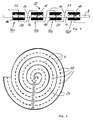
- FIG. 3 now schematically illustrates a fuel cell module 10 having a number of fuel cell sections 12a, 12b, 12c and 12d which are connected electrically in series by electric conductors 14.
- Each cell section 12a to 12d comprises an active section 4 of the PEM layer 2, a cathode 16 and an anode 18.
- an oxygen containing gas can be supplied in a cathode chamber 20, which is commonly used for all cathodes 16.
- a hydrogen or methanol containing fluid can be supplied in an anode chamber 22 which is commonly used for all anodes 18.
- cathode chambers 20 and anode chambers 22 simplify the design of the full cell module 10 tremendously since between the single fuel cell sections 12a to 12d additional insulation material is obsolete.
- the electric conductors 14 have to penetrate through the PEM layer 2 in the sections of the separation bands 6. Since the untreated separation bands 6 do not have ion exchange properties and can therefore be considered insulating, the electric conductors 14 do not have to be insulated specifically.
- FIG 4 finally illustrates one design option for a fuel cell module which can be derived from the new fuel cell arrangement which might be called a "Multi-cell-in-one-layer-concept".
- the full cell module shown in Figure 4 comprises a wound PEM layer comprising a plurality of fuel cells 12.
- the active regions and thereby the fuel cells 12 are separated from each other by separation bands 6 which are in Figure 4 shown as the gaps in the dashed line which stands for the PEM layer.
- the separation bands can be used in this embodiment as joints for the wound structure when the fuel cells 12 are substantially planar.
- the windings are separated from each other by an intermediate layer 24 which essentially serves the purpose of separating the cathode chamber 20 from the anode chamber 22 in the next winding. It can be easily seen from this example that the "Multi-cell-in-one-layer-concept" offers a variety of new fuel cell design concepts which have not been accessible with the prior art stack technology of substantially parallel and planar fuel cells.
Landscapes
- Chemical & Material Sciences (AREA)
- Engineering & Computer Science (AREA)
- Manufacturing & Machinery (AREA)
- Chemical Kinetics & Catalysis (AREA)
- General Chemical & Material Sciences (AREA)
- Life Sciences & Earth Sciences (AREA)
- Electrochemistry (AREA)
- Sustainable Energy (AREA)
- Sustainable Development (AREA)
- Health & Medical Sciences (AREA)
- Polymers & Plastics (AREA)
- Organic Chemistry (AREA)
- Inorganic Chemistry (AREA)
- Medicinal Chemistry (AREA)
- Materials Engineering (AREA)
- Transplantation (AREA)
- Physics & Mathematics (AREA)
- Spectroscopy & Molecular Physics (AREA)
- Fuel Cell (AREA)
- Graft Or Block Polymers (AREA)
- Printers Or Recording Devices Using Electromagnetic And Radiation Means (AREA)
- Separation Using Semi-Permeable Membranes (AREA)
- Treatments Of Macromolecular Shaped Articles (AREA)
Priority Applications (7)
| Application Number | Priority Date | Filing Date | Title |
|---|---|---|---|
| EP05002446A EP1689014A1 (de) | 2005-02-04 | 2005-02-04 | Verfahren zur Herstellung einer Membran für eine Membran-Elektroden-Anordnung und Membran-Elektroden-Anordnung |
| CNB2006800040638A CN100521346C (zh) | 2005-02-04 | 2006-01-25 | 用于制备要装配在膜电极组件中的膜的方法和膜电极组件 |
| US11/883,143 US20090053611A1 (en) | 2005-02-04 | 2006-01-25 | Method for Preparing a Membrane to Be Assembled in a Membrane Electrode Assembly and Membrane Electrode Assembly |
| DE602006020840T DE602006020840D1 (de) | 2005-02-04 | 2006-01-25 | Verfahren zur herstellung einer membran für die anordnung in einer membranelektrodenanordnung und membranelektrodenanordnung |
| PCT/EP2006/000628 WO2006081970A2 (en) | 2005-02-04 | 2006-01-25 | A method for preparing a membrane to be assembled in a membrane electrode assembly and membrane electrode assembly |
| EP06703834A EP1844516B1 (de) | 2005-02-04 | 2006-01-25 | Verfahren zur herstellung einer membran für die anordnung in einer membranelektrodenanordnung und membranelektrodenanordnung |
| AT06703834T ATE503282T1 (de) | 2005-02-04 | 2006-01-25 | Verfahren zur herstellung einer membran für die anordnung in einer membranelektrodenanordnung und membranelektrodenanordnung |
Applications Claiming Priority (1)
| Application Number | Priority Date | Filing Date | Title |
|---|---|---|---|
| EP05002446A EP1689014A1 (de) | 2005-02-04 | 2005-02-04 | Verfahren zur Herstellung einer Membran für eine Membran-Elektroden-Anordnung und Membran-Elektroden-Anordnung |
Publications (1)
| Publication Number | Publication Date |
|---|---|
| EP1689014A1 true EP1689014A1 (de) | 2006-08-09 |
Family
ID=34933608
Family Applications (2)
| Application Number | Title | Priority Date | Filing Date |
|---|---|---|---|
| EP05002446A Withdrawn EP1689014A1 (de) | 2005-02-04 | 2005-02-04 | Verfahren zur Herstellung einer Membran für eine Membran-Elektroden-Anordnung und Membran-Elektroden-Anordnung |
| EP06703834A Expired - Lifetime EP1844516B1 (de) | 2005-02-04 | 2006-01-25 | Verfahren zur herstellung einer membran für die anordnung in einer membranelektrodenanordnung und membranelektrodenanordnung |
Family Applications After (1)
| Application Number | Title | Priority Date | Filing Date |
|---|---|---|---|
| EP06703834A Expired - Lifetime EP1844516B1 (de) | 2005-02-04 | 2006-01-25 | Verfahren zur herstellung einer membran für die anordnung in einer membranelektrodenanordnung und membranelektrodenanordnung |
Country Status (6)
| Country | Link |
|---|---|
| US (1) | US20090053611A1 (de) |
| EP (2) | EP1689014A1 (de) |
| CN (1) | CN100521346C (de) |
| AT (1) | ATE503282T1 (de) |
| DE (1) | DE602006020840D1 (de) |
| WO (1) | WO2006081970A2 (de) |
Cited By (2)
| Publication number | Priority date | Publication date | Assignee | Title |
|---|---|---|---|---|
| WO2012107425A1 (de) * | 2011-02-08 | 2012-08-16 | Fraunhofer-Gesellschaft zur Förderung der angewandten Forschung e. V. | Ionenleitender festkörperseparator |
| WO2018172073A1 (de) * | 2017-03-21 | 2018-09-27 | Robert Bosch Gmbh | Pem-membran-elektroden-einheit, pem-zelle und verfahren zum herstellen einer pem-membran-elektroden-einheit |
Families Citing this family (2)
| Publication number | Priority date | Publication date | Assignee | Title |
|---|---|---|---|---|
| WO2012160779A1 (ja) * | 2011-05-20 | 2012-11-29 | 三洋電機株式会社 | 燃料電池 |
| KR102737020B1 (ko) * | 2020-12-31 | 2024-12-03 | 코오롱인더스트리 주식회사 | 막-전극 어셈블리 및 그 제조방법 |
Citations (4)
| Publication number | Priority date | Publication date | Assignee | Title |
|---|---|---|---|---|
| WO2001061774A1 (en) * | 2000-02-17 | 2001-08-23 | Nedstack Holding B.V. | Reinforced ion exchange membrane |
| WO2003018654A1 (en) * | 2001-08-27 | 2003-03-06 | Ballard Power Systems Inc. | Process for preparing graft copolymer membranes |
| WO2004004053A2 (en) * | 2002-06-28 | 2004-01-08 | Pirelli & C. S.P.A. | Fuel cell incorporating a polymer electrolyte membrane grafted by irradiation |
| WO2005014702A1 (en) * | 2003-07-24 | 2005-02-17 | Paul Scherrer Institut | Method for grafting a chemical compound to a support substrate |
Family Cites Families (2)
| Publication number | Priority date | Publication date | Assignee | Title |
|---|---|---|---|---|
| US5591539A (en) * | 1993-04-13 | 1997-01-07 | Pall Corporation | Electrolytically conductive battery separator polymeric film |
| JP2002198068A (ja) * | 2000-12-26 | 2002-07-12 | Aisin Seiki Co Ltd | 固体高分子電解質膜及びその製造方法 |
-
2005
- 2005-02-04 EP EP05002446A patent/EP1689014A1/de not_active Withdrawn
-
2006
- 2006-01-25 CN CNB2006800040638A patent/CN100521346C/zh not_active Expired - Fee Related
- 2006-01-25 AT AT06703834T patent/ATE503282T1/de not_active IP Right Cessation
- 2006-01-25 US US11/883,143 patent/US20090053611A1/en not_active Abandoned
- 2006-01-25 DE DE602006020840T patent/DE602006020840D1/de not_active Expired - Lifetime
- 2006-01-25 EP EP06703834A patent/EP1844516B1/de not_active Expired - Lifetime
- 2006-01-25 WO PCT/EP2006/000628 patent/WO2006081970A2/en not_active Ceased
Patent Citations (4)
| Publication number | Priority date | Publication date | Assignee | Title |
|---|---|---|---|---|
| WO2001061774A1 (en) * | 2000-02-17 | 2001-08-23 | Nedstack Holding B.V. | Reinforced ion exchange membrane |
| WO2003018654A1 (en) * | 2001-08-27 | 2003-03-06 | Ballard Power Systems Inc. | Process for preparing graft copolymer membranes |
| WO2004004053A2 (en) * | 2002-06-28 | 2004-01-08 | Pirelli & C. S.P.A. | Fuel cell incorporating a polymer electrolyte membrane grafted by irradiation |
| WO2005014702A1 (en) * | 2003-07-24 | 2005-02-17 | Paul Scherrer Institut | Method for grafting a chemical compound to a support substrate |
Non-Patent Citations (2)
| Title |
|---|
| HUSLAGE J ET AL: "Radiation-grafted membrane/electrode assemblies with improved interface", ELECTROCHIMICA ACTA, ELSEVIER SCIENCE PUBLISHERS, BARKING, GB, vol. 48, no. 3, 11 December 2002 (2002-12-11), pages 247 - 254, XP004391825, ISSN: 0013-4686 * |
| YANG X M ET AL: "Guided self-assembly of symmetric diblock copolymer films on chemically nanopatterned substrates", MACROMOLECULES, AMERICAN CHEMICAL SOCIETY, EASTON, PA, US, vol. 33, no. 26, December 2000 (2000-12-01), pages 9575 - 9582, XP002223275, ISSN: 0024-9297 * |
Cited By (4)
| Publication number | Priority date | Publication date | Assignee | Title |
|---|---|---|---|---|
| WO2012107425A1 (de) * | 2011-02-08 | 2012-08-16 | Fraunhofer-Gesellschaft zur Förderung der angewandten Forschung e. V. | Ionenleitender festkörperseparator |
| US20140045096A1 (en) * | 2011-02-08 | 2014-02-13 | Fraunhofer-Gesellschaft Zur Forderung Der Angewandten Forschung E.V. | Ion-conducting solid-state separator |
| US9991486B2 (en) * | 2011-02-08 | 2018-06-05 | Fraunhofer-Gesellschaft Zur Forderung Der Angewandten Forschung E.V. | Ion-conducting solid-state separator |
| WO2018172073A1 (de) * | 2017-03-21 | 2018-09-27 | Robert Bosch Gmbh | Pem-membran-elektroden-einheit, pem-zelle und verfahren zum herstellen einer pem-membran-elektroden-einheit |
Also Published As
| Publication number | Publication date |
|---|---|
| CN101116214A (zh) | 2008-01-30 |
| EP1844516B1 (de) | 2011-03-23 |
| WO2006081970A2 (en) | 2006-08-10 |
| CN100521346C (zh) | 2009-07-29 |
| DE602006020840D1 (de) | 2011-05-05 |
| US20090053611A1 (en) | 2009-02-26 |
| ATE503282T1 (de) | 2011-04-15 |
| WO2006081970A3 (en) | 2007-05-31 |
| EP1844516A2 (de) | 2007-10-17 |
Similar Documents
| Publication | Publication Date | Title |
|---|---|---|
| CA2288160C (en) | Polymer electrolyte membrane fuel cell with fluid distribution layer having integral sealing capability | |
| US5958616A (en) | Membrane and electrode structure for methanol fuel cell | |
| WO2000002273A2 (en) | Electrochemical fuel cell having a membrane electrode assembly formed in-situ and methods for forming same | |
| EP2612390B1 (de) | Anordnung für eine umkehrbare brennstoffzelle | |
| US20040040862A1 (en) | Method and system for producing high-pressure hydrogen | |
| JP6026561B2 (ja) | 膜電極接合体および膜電極接合体の製造方法 | |
| KR20060109476A (ko) | 연료 전지 종판 조립체 | |
| US20150333340A1 (en) | Flow fields for use with an electrochemical cell | |
| US8148436B2 (en) | Ion/electron-conducting composite polymer membrane, manufacturing processes thereof and planar fuel cell core comprising it | |
| US20080145732A1 (en) | Proton Exchange Fuel Cell | |
| EP1518289B1 (de) | Brennstoffzelle mit durch strahlung gepfropfter polymer-elektrolyt-membran | |
| US20180233760A1 (en) | Polymer electrolyte fuel cells and production method thereof | |
| EP1844516B1 (de) | Verfahren zur herstellung einer membran für die anordnung in einer membranelektrodenanordnung und membranelektrodenanordnung | |
| US20040115498A1 (en) | Composite proton exchange membrane and method of manufacturing the same | |
| US6979510B2 (en) | Solid polymer electrolyte membrane of a fuel cell and method for producing the same | |
| US20080038612A1 (en) | Localized Deactivation Of A Membrane | |
| KR102375457B1 (ko) | 전해조용 채칼형 유로구조 및 그 유로구조를 갖는 고분자 전해질 전해조 | |
| JP4296667B2 (ja) | 触媒電極および該触媒電極の製造方法並びに燃料電池 | |
| WO2009067617A1 (en) | Fuel cell flow field plate assembly | |
| WO2024037530A1 (zh) | 燃料电池 | |
| KR101355543B1 (ko) | 메탈폼의 제조방법 및 이 메탈폼이 구비된 전기화학 스택 | |
| US20090181281A1 (en) | Electrochemical cell bipolar plate | |
| JP2009503254A (ja) | 複数の圧縮可能な層を含む流動場部材を備えた電気化学セル | |
| JP2012099332A (ja) | 燃料電池システム | |
| JP2004220995A (ja) | 膜−電極接合体、その製造方法、及び燃料電池 |
Legal Events
| Date | Code | Title | Description |
|---|---|---|---|
| PUAI | Public reference made under article 153(3) epc to a published international application that has entered the european phase |
Free format text: ORIGINAL CODE: 0009012 |
|
| AK | Designated contracting states |
Kind code of ref document: A1 Designated state(s): AT BE BG CH CY CZ DE DK EE ES FI FR GB GR HU IE IS IT LI LT LU MC NL PL PT RO SE SI SK TR |
|
| AX | Request for extension of the european patent |
Extension state: AL BA HR LV MK YU |
|
| AKX | Designation fees paid | ||
| STAA | Information on the status of an ep patent application or granted ep patent |
Free format text: STATUS: THE APPLICATION IS DEEMED TO BE WITHDRAWN |
|
| 18D | Application deemed to be withdrawn |
Effective date: 20070210 |
|
| REG | Reference to a national code |
Ref country code: DE Ref legal event code: 8566 |