EP1690253B1 - Hochoptimiertes nichtlineares least-squares-verfahren für die sinusoid-schallmodellierung - Google Patents
Hochoptimiertes nichtlineares least-squares-verfahren für die sinusoid-schallmodellierung Download PDFInfo
- Publication number
- EP1690253B1 EP1690253B1 EP04803399A EP04803399A EP1690253B1 EP 1690253 B1 EP1690253 B1 EP 1690253B1 EP 04803399 A EP04803399 A EP 04803399A EP 04803399 A EP04803399 A EP 04803399A EP 1690253 B1 EP1690253 B1 EP 1690253B1
- Authority
- EP
- European Patent Office
- Prior art keywords
- frequencies
- computation
- window
- exp
- computed
- Prior art date
- Legal status (The legal status is an assumption and is not a legal conclusion. Google has not performed a legal analysis and makes no representation as to the accuracy of the status listed.)
- Expired - Lifetime
Links
- 238000000034 method Methods 0.000 title claims abstract description 107
- 230000002194 synthesizing effect Effects 0.000 claims abstract description 4
- 238000005457 optimization Methods 0.000 claims description 77
- 230000004044 response Effects 0.000 claims description 74
- 239000011159 matrix material Substances 0.000 claims description 55
- 238000001228 spectrum Methods 0.000 claims description 51
- 230000000694 effects Effects 0.000 claims description 10
- 238000003786 synthesis reaction Methods 0.000 claims description 8
- 230000015572 biosynthetic process Effects 0.000 claims description 7
- 239000013598 vector Substances 0.000 claims description 7
- 230000008030 elimination Effects 0.000 claims description 6
- 238000003379 elimination reaction Methods 0.000 claims description 6
- 238000000926 separation method Methods 0.000 claims description 6
- 238000006243 chemical reaction Methods 0.000 claims description 5
- 238000013518 transcription Methods 0.000 claims description 5
- 230000035897 transcription Effects 0.000 claims description 5
- 230000009466 transformation Effects 0.000 claims 1
- 238000004458 analytical method Methods 0.000 description 16
- 230000006870 function Effects 0.000 description 13
- 239000011295 pitch Substances 0.000 description 13
- 230000036961 partial effect Effects 0.000 description 6
- 230000005236 sound signal Effects 0.000 description 6
- 238000007781 pre-processing Methods 0.000 description 4
- 238000013016 damping Methods 0.000 description 3
- 230000014509 gene expression Effects 0.000 description 3
- 230000008450 motivation Effects 0.000 description 3
- 238000012952 Resampling Methods 0.000 description 2
- 238000005311 autocorrelation function Methods 0.000 description 2
- 230000001143 conditioned effect Effects 0.000 description 2
- 230000001419 dependent effect Effects 0.000 description 2
- 230000003595 spectral effect Effects 0.000 description 2
- 238000001308 synthesis method Methods 0.000 description 2
- 230000006978 adaptation Effects 0.000 description 1
- 230000001174 ascending effect Effects 0.000 description 1
- 230000008901 benefit Effects 0.000 description 1
- 230000005540 biological transmission Effects 0.000 description 1
- 230000008859 change Effects 0.000 description 1
- 230000006835 compression Effects 0.000 description 1
- 238000007906 compression Methods 0.000 description 1
- 238000010276 construction Methods 0.000 description 1
- 230000003111 delayed effect Effects 0.000 description 1
- 238000009795 derivation Methods 0.000 description 1
- 238000000605 extraction Methods 0.000 description 1
- 230000006872 improvement Effects 0.000 description 1
- 230000004048 modification Effects 0.000 description 1
- 238000012986 modification Methods 0.000 description 1
- 230000009467 reduction Effects 0.000 description 1
- 238000007670 refining Methods 0.000 description 1
- 230000010076 replication Effects 0.000 description 1
- 238000006467 substitution reaction Methods 0.000 description 1
Images






Classifications
-
- G—PHYSICS
- G10—MUSICAL INSTRUMENTS; ACOUSTICS
- G10L—SPEECH ANALYSIS TECHNIQUES OR SPEECH SYNTHESIS; SPEECH RECOGNITION; SPEECH OR VOICE PROCESSING TECHNIQUES; SPEECH OR AUDIO CODING OR DECODING
- G10L19/00—Speech or audio signals analysis-synthesis techniques for redundancy reduction, e.g. in vocoders; Coding or decoding of speech or audio signals, using source filter models or psychoacoustic analysis
- G10L19/04—Speech or audio signals analysis-synthesis techniques for redundancy reduction, e.g. in vocoders; Coding or decoding of speech or audio signals, using source filter models or psychoacoustic analysis using predictive techniques
- G10L19/08—Determination or coding of the excitation function; Determination or coding of the long-term prediction parameters
- G10L19/093—Determination or coding of the excitation function; Determination or coding of the long-term prediction parameters using sinusoidal excitation models
-
- G—PHYSICS
- G10—MUSICAL INSTRUMENTS; ACOUSTICS
- G10L—SPEECH ANALYSIS TECHNIQUES OR SPEECH SYNTHESIS; SPEECH RECOGNITION; SPEECH OR VOICE PROCESSING TECHNIQUES; SPEECH OR AUDIO CODING OR DECODING
- G10L25/00—Speech or voice analysis techniques not restricted to a single one of groups G10L15/00 - G10L21/00
- G10L25/48—Speech or voice analysis techniques not restricted to a single one of groups G10L15/00 - G10L21/00 specially adapted for particular use
Definitions
- the present invention relates to the sinusoidal modelling (analysis and synthesis) of musical signals and speech.
- the analysis computes for a windowed signal of length N , a set of K amplitudes, phases and frequencies using nonlinear least squares estimation techniques.
- the synthesis comprises the reconstruction of the signal from these parameters.
- Methods are disclosed for three different models being; 1) a stationary sinusoidal model with arbitrary frequencies, 2) a stationary sinusoidal model with several series of harmonic frequencies and 3) a nonstationary model with complex polynomial amplitudes of order P . It is disclosed how the computational complexity can be reduced significantly by using any window with a bandlimited frequency response. For instance, the complex amplitude computation for the first model is reduced from O ( K 2 N ) to O ( N log N ).
- a scaled table look-up method is disclosed which allows to use window lengths which are not necessarily a power of two.
- the sinusoidal modelling of sound signals such as music and speech is a powerful tool for parameterizing sound sources. Once a sound has been parameterized, it can be synthesized for example, with a different pitch and duration.
- the offset value n 0 allows the origin of the timescale to be placed exactly in the middle of the window. For a signal with length N , n 0 equals N - 1 2 .
- the complexity would be O ( NK ) with N being the number of samples and K the number of sinusoidal components.
- the computational efficiency of the synthesis can be improved by using an inverse fourier transform.
- the method requires the use of a window length which is a power of two and does not allow nonstationary behavior of the sinusoids within the window.
- the present invention relates to the modelling (analysis and synthesis) of musical signals and speech and provides therefore highly optimized nonlinear least squares methods.
- section 1 an introduction to the invention is given. Three different sinusoidal models are presented in subsection 1.1. An overview of the nonlinear least squares methodology is described in section 1.2 and illustrated by Figure 1 . The computational complexity can be reduced significantly by using a window with a bandlimited frequency response. Subsection 1.3 describes such a window and its frequency response is illustrated by Figures 2 and 3 .
- Section 2 discusses efficient spectrum computation methods for the different models and is illustrated by Figure 4 .
- Section 3 discloses a highly optimized least squares method for the computation of the complex amplitudes.
- the time domain derivation is described in subsection 3.2, which is transformed to the frequency domain in section 3.3. It is shown that the bandlimited property of the frequency response of the square window results in a band diagonal system matrix as depicted in Figure 5 . This makes that the system can be solved in linear time instead of a power three complexity.
- the amplitude estimation algorithm is illustrated by Figure 6 .
- Section 4 describes frequency optimization methods for the stationary nonharmonic signa, as there are
- Section 5 discloses the frequency optimization for the harmonic model. Efficient algorithms for gradient-based (subsection 5.1), Gauss-Newton (subsection 5.2), Levenberg-Marquardt (subsection 5.3) and Newton (subsection 5.4) optimization are disclosed and unified in (subsection 5.5). The frequency optimization algorithms for the harmonic model are depicted in Figure 8 and Figure 9 .
- Section 6 shows that the amplitude estimation method can be extended to the complex polynomial amplitude model described in subsection 6.1.
- Subsection 6.2 discloses how the system matrix can be made band diagonal as is illustrated by figure 10 .
- the complete algorithm is depicted by Figure 11 .
- subsection 6.3 it is derived how the instantaneous phases and amplitudes can be computed from the complex polynomial amplitudes. It is shown that the instantaneous frequency can be used as a new estimate of the frequency. The instantaneous amplitude can also be interpreted as a damped function. It is shown how the damping factor can be computed.
- Section 8 describes a preprocessing routine which determines the number of diagonal bands D that are relevant.
- Section 9 describes several applications which are facilitated by the invention, as there are
- the invention concerns in a main embodiment a method for modelling, analyzing and/or synthesizing, a windowed signal according to claim 1.
- the present invention discloses highly optimized non linear least squares methods for sinusoidal modelling of audio and speech. Depending on the assumptions that can be made about the signal, three types of models are considered
- the goal of the nonlinear least squares method consists of determining the frequencies and complex amplitudes for these different models by minimizing the square difference between the model x n and a recorded signal x n .
- ⁇ n 0 N - 1 x n - x ⁇ n 2
- This difference ⁇ n defined as r n ⁇ x n - x ⁇ n is called the residual.
- the amplitudes can be computed analytically by a standard least squares procedure.
- the frequencies on the other hand cannot be computed analytically and are optimized iteratively. Applying the frequency optimization and amplitude computation in an alternating manner is called a nonlinear least squares method .
- Figure 1 depicts the complete analysis/synthesis method according to the embodiment of the invention.
- the initial values for the frequencies ⁇ k are determined.
- this consists of a simple peak picking.
- a (multi-)pitch estimator can be used for the harmonic stationary sources.
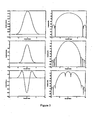
- the frequency response of the Blackmann-Harris window is shown in Figure 2 . Any other window with a bandlimited frequency response can be applied. Throughout the description of the invention, the bandlimited property of the frequency response of the window will play a crucial role. In addition, the derivatives of the frequency response are also bandlimited. Taking the derivative of the frequency responses is equivalent with multiplying the window with a straight line as shown by Eq. (9). Also the frequency response of the square window is bandlimited which can be understood easily taking into account that taking the square in the time domain is equivalent with a convolution in the frequency domain. This however, doubles the size of the main lobe. These frequency responses are illustrated in Fig. 3 .
- the spectrum model X m is a linear combination of frequency responses of the window, which are shifted over ⁇ k and weighted with a complex factor A k .
- the derivatives of the frequency response are bandlimited and can be computed by look-up tables. This reduces the complexity from O ( KPN ) for the time domain computation of the nonstationary model to O ( KP + N log N ) where the first term comes from the spectrum computation second term from the inverse fourier transform. Since the order of the polynomial P is rather small, the second term predominates the complexity.
- An preferred embodiment of the method according to the invention comprises the computation of the spectrum as a linear combination of the frequency responses of the window according to Eq. (11) for the stationary nonharmonic model, Eq. (12) of the harmonic model and Eq. (13) for the nonstationary model, whereby only the main lobes of the responses are computed by using look-up tables.
- This method reduced the time complexity from O ( KPN ) to O ( N log N ).
- the major difference with the present invention is that all amplitudes are computed simultaneously for a given set of frequencies. This allows to resolve strongly overlapping frequency responses of sinusoidal components.
- the original computational complexity of this method is O ( K 2 N ) where the K denotes the number of partials and N the signal length.
- the invention solves this problem in O(N log N ) and reduces the space complexity, which is originally O ( K 2 ), to O ( K ).
- the complex amplitude computation is derived in the time domain.
- the error function ⁇ ( A ; ⁇ ) expresses the square difference between the samples in the windowed signal x n and the signal model x n .
- the main computational burden is the construction of the matrices B and C and solving the system of linear equations which have complexity O ( K 2 N ) and O ( K 3 ) respectively.
- N ⁇ corresponds with the maximal possible value of k + l which corresponds with the lower right corner of the matrix. This is illustrated in Figure 5 .
- a typical method to solve a linear set of equations is Gaussian elimination with back-substitution.
- This method has a time complexity O ( K 3 ).
- this method requires a time complexity O ( D 2 K ). Since D is significantly smaller than K this results finally in O ( K ).
- a preferred embodiment of the method according to the invention comprises the step of computing the stationary complex amplitudes, by solving the equations given in Eq. (19), using Eq. (20) such that only the elements around the diagonal of B are taken into account, whereby a shifted form B is computed containing only D diagonal bands of B according to Eq. (27) and Eq. (20), whereby the computation of the Eq. (20) requires the computation of the frequency response of the window and the square window denoted by W ( m ) and Y ( m ) respectively, and solving equation given by Eq. (19) directly from B and C (Eq. (28)) by an adapted gaussian elimination procedure.
- a first class of optimization algorithms are based on the gradient of the error function defined by h l ⁇ ⁇ ⁇ ⁇ ⁇ ;
- a second well-known method is called Gauss-Newton optimization and consists of making a first order Taylor approximation of the signal model around an initial estimate of the frequencies denoted as ⁇ ⁇ ⁇ . .
- w n exp - 2 ⁇ ⁇ i ⁇ k ⁇ n - n 0 N ⁇ w n ⁇ exp - 2 ⁇ ⁇ i ⁇ ⁇ ⁇ k ⁇ n - n 0 N + w n ⁇ - 2 ⁇ ⁇ i ⁇ n - n 0 N ⁇ exp - 2 ⁇ ⁇ i ⁇ ⁇ k ⁇ n - n 0 N ⁇ ⁇ ⁇ k - ⁇ k the error function yields ⁇ ⁇ ⁇ ;
- the error function after iteration ( r ) is denoted by ⁇ ( ⁇ ( r ) ; A ) and the optimization step of the frequenties that was achieved with regularization factor ⁇ ( r ) as ⁇ ( ⁇ ( r ) ).
- the influence on the cost function for the next iteration is expressed by ⁇ ⁇ ⁇ ⁇ + ⁇ ⁇ ⁇ ⁇ ⁇ ; A
- This term can be computed in constant time by taking in account the bandlimited property of W "( m ). Again, since this term only yields non zero values on the diagonal, the O ( K ) complexity is maintained. Also, this method can be combined with the regularization term that is used for Levenberg-Marquardt optimization.
- the system matrix for Newton optimization is band diagonal and can be regularized when this is desired.
- the O ( K ) complexity is maintained.
- R A l ⁇ m 0 N - 1 R m ⁇ W ⁇ ⁇ ⁇ ⁇ l - m )
- H lk R A k ⁇ A l ⁇ Y ⁇ ⁇ ⁇ ⁇ k + ⁇ ⁇ l - R A k ⁇ A l * ⁇ Y ⁇ ⁇ ⁇ ⁇ k - ⁇ ⁇ l - ⁇ 1 ⁇ ⁇ kl ⁇ 2
- R A l ⁇ m 0 N - 1 R m ⁇ W ⁇ ⁇ ⁇ ⁇ l - m + ⁇ kl ⁇ ⁇ 2
- a preferred embodiment of the method according to the invention comprises the step of optimizing the frequencies for the stationary nonharmonic model by solving the equation given in Eq. (34), using Eq. (42) such that only elements around the diagonal of H are taken into account, whereby a shifted form H is computed containing only the D diagonal bands according to Eq. (36) and Eq.
- the model consists of S sources each modelled by S k harmonic components. For this model, only the fundamental frequencies are optimized. The amplitude estimation is computed by the method disclosed in section 2, however care must be taken that different components with very close frequencies are eliminated. The computation of the optimization of the frequencies takes place in an analogue manner as for the independent sinusoids.
- the system matrix can be ill-conditioned in the case of very weak components. When this occurs, one can add the unity matrix I multiplied with a regularization factor ⁇ . This value can be updated as described in section 3.3.
- a preferred embodiment of the method according to the invention comprises the optimization the frequencies for the harmonic signal model, by computing the optimization step solving Eq. (48) using Eq. (49), whereby the gradient h is computed from the residual spectrum R m , amplitude A l and frequencies ⁇ , and requires the computation of derivative of the frequency response of the window W '( m ), whereby the first term of H requires the computation of the second derivative of the frequency response of the square window denoted Y ''( m ), whereby the second term of H is computed from the residual spectrum R m , amplitude A l and frequencies ⁇ k , and requires the computation of the second derivative of the frequency response W'' ( m ), whereby the parameter ⁇ 1 allows to switch between different optimization methods and the parameter ⁇ 2 regularizes the system matrix.
- the system matrix has a size 2 KP ⁇ 2 KP .
- Each ( p , q )-couple denotes a submatrix of the matrices of size K ⁇ K . From the bandlimited property of [ Y ( m )] and its derivatives follows that these submatrices of B 1,1 and B 2,2 are band diagonal. In an analogue manner, since [ Y ( m )] and its derivatives always yield zero, the submatrices B 1,2 and B 2,1 contain only zeros. This structure is depicted at the top of Figure 10 .
- the upper left and lower right kwadrants contain band diagonal submatrices for each ( p , q )-couple. This implies that all relevant values are stored at positions defined by a quadruple ( l, q, k, p ) for which the following conditions hold: - D ⁇ k - l ⁇ D 0 ⁇ p ⁇ P - 1 0 ⁇ q ⁇ P - 1
- a least squares method is derived which allows to analyse non stationary sinusoidal components defined by Eq.(50).
- This model for a windowed signal of length N consists of K sinusoidal components with complex polynomial component of order P .
- the computation of the system matrix has a complexity O (( KP ) 2 N ) and solving the equations a complexity O (( KP ) 3 ).
- O KP ( DP ) 2
- the order of the polynomial and the number of diagonal bands is quite small relative to the number of components K and number of samples N .
- a preferred embodiment of the method according to the invention comprises the step of computing the polynomial complex amplitudes by solving the equation given in Eq. (55), using Eq. (56) such that only the elements around the diagonal of B are taken into account, whereby a shifted form B is computed containing only PD diagonal bands of B according to Eq. (64) and Eq. (56), whereby the computation is required of the frequency response of the square window and its derivatives ⁇ p ⁇ m p ⁇ Y m , whereby the computation is required of the frequency response of the window and its derivatives ⁇ p ⁇ m p ⁇ W m , and solving the equation given by Eq. (55) directly from H and C by an adapted gaussian elimination procedure.
- This method reduced the complexity from O (( KP ) 3 ) to O ( KP ( DP ) 2 ).
- ⁇ k r + 1 ⁇ k r - 1 N ⁇ A ⁇ k , 0 r ⁇ A ⁇ k , 1 i - A ⁇ k , 0 i ⁇ A ⁇ k , 1 r A ⁇ k , 0 i 2 + A ⁇ k , 0 r 2
- the amplitude derivatives evaluated at n 0 define a second order approximation of the instantaneous amplitude around n 0 .
- a preferred embodiment of the method according to invention comprises the step of computing the instantaneous frequencies and the instantaneous amplitudes according to Eq. (69), whereby the instantaneous frequency can be used as a frequency estimate for the next iteration as expressed in Eq. (73).
- the method comprises the step of computing damping factor according to Eq. (78), in case that the amplitudes are exponentially damped.
- the FFT requires that the window size is a power of two. However one can desire to use a window length which is not a power of two. For that case, a scaled table lookup method is disclosed which allows to use arbitrary window lengths which are zero padded up to a power of two. First, a theoretical motivation is given which is represented in Fig. 12 .
- the fourier transform of a window with length M is denoted as yielding W M ⁇ m - m 0
- the spectral bandwidth of the frequency response is enlarged to - N M ⁇ ⁇ ⁇ m ⁇ N M ⁇ ⁇ .
- a preferred embodiment of the method according to the invention comprises a method to compute the frequency response of a window with length M zero padded up to a length N by using a scaled table look-up according to Eq. (82).
- the preprocessing determines how many diagonals of the matrix B must be taken into account. This is done by counting the number of sinusoidal components that fall in the main lobe of each frequency response. The maximum number of components over all frequency responses yields the value for D .
- the computational improvement of the method according to the invention facilitates a large number of applications such as; arbitrary sample rate conversion, multi-pitch extraction, parametric audio coding, source separation, audio classification, audio effects, automated transcription and annotation.
- the window length can be altered by scaling the frequency response of the sinusoidal components.
- the amplitudes for all these frequencies can be determined by the optimized amplitude estimation method presented in section 3.
- the resampling factor ⁇ can be any real number and results therefore in an arbitrary sample rate conversion.
- the efficient analysis method will improve pitch estimation techniques.
- Current (multi)-pitch estimators based on autocorrelation such as the summary autocorrelation function (SACF) and the enhanced summary autocorrelation function (ESACF), allow to estimate multiple pitches.
- SACF summary autocorrelation function
- ESACF enhanced summary autocorrelation function
- none of these methods takes into account the overlapping peaks that might occur.
- the frequency optimization for harmonic sources which is presented in this invention allows to improve the fundamental frequencies iteratively leading to very accurate pitch estimations.
- very small analysis windows can be used which enable to track fast variations in the pitch in an accurate manner.
- the method optimizes all parameters so that an accurate match is obtained. By synthesizing each pitch component to a different signal, the sound sources in the polyphonic recording can be be separated.
- Figure 1 depicts the complete Analysis/Synthesis method according to the embodiment of the invention.
- a windowed short time signal x n (1) and its fourier transform (2) X m (3) the initial values of the frequencies (5) are computed (4). These frequencies (5) are then pre-processed (6) and the number of diagonal bands D (7) is determined.
- the amplitudes (11) are computed from X m , the number of diagonal bands (7) and the pre-processed frequencies (8).
- the amplitudes (11) and frequencies (8) are used to calculate the spectrum X ⁇ m (13).
- the difference (14) between the synthesized spectrum X m (13) and the original spectrum X m (3) yields the residual spectrum R m (16).
- This residual spectrum (16), the frequencies (8) and amplitudes (11) are used to optimize (9) the frequency values (5) for the next iteration.
- a stopping criterium evaluator (17) determines whether the loop is continued. Several criteria were described in section 1.2. When the criterium is met, the iteration is terminated (18).
- the time-domain model x ⁇ n is obtained by taking an inverse fourier transform (19) of the spectrum X ⁇ m (13).
- a short notation is depicted (20) which takes as input the signal x n and produces a synthesized signal x ⁇ n , the amplitudes A and frequencies ⁇ .
- Figure 2 illustrates the band limited property of respectively W ( m ) (top), W '( m ) (middle) and W "( m ) (bottom). On the left they are represented on the linear scale. On the right they represented on the dB scale.
- Figure 3 illustrates frequency response of the zero padded Blackmann-Harris window W M N m (top), the squared Blackmann-Harris window Y ( m ) (middle) and its second derivative Y'' ( m ) (bottom). Also these frequency responses are band limited and are shown on the linear scale on the left, and on the dB scale on the right.
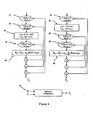
- Figure 4 depicts the detail of the spectrum computation.
- the computation is given for the harmonic model.
- the range of m -values is determined (23).
- the frequency response W ( m ) is computed and multiplied with the amplitude (25).
- the spectrum computation is shown for the nonstationary model is shown.
- the range of spectrum samples m is computed (27).
- Figure 5 illustrates the band diagonal property of the system matrix B that is used for the amplitude computation.
- the matrices B 1,1 and B 1,1 can be written in terms of two matrices Y + (33) and Y - (32) as indicated by (34).
- the index k denotes the column of the matrix and l the row. This implies that k - l and k + l indicate respectively the diagonal and antidiagonal of the matrix.
- the input value for the function Y ( m ) is obtained which denotes the frequency response of the square window (31).
- the space complexity is reduced by storing only the relevant diagonals in a 'shifted matrix' (35) .
- Figure 6 depicts the detail of a method of computing the amplitudes of the sinusdoidal components in a sound signal in O(N log N) time, according to the invention.
- the amplitudes A (44) are computed from a spectrum X m for a given set of frequencies ⁇ . This is realized by constructing the matrices C 1 , C 2 (40) and the matrices , (42) according to Eq. (20). By solving the set of equations represented by these matrices the amplitudes are computed (44).
- the vectors C 1 and C 2 are computed by determining for all partials l (36) the range of m values (37), (38) of the main lobe and computing the value for each m -value (40) according to Eq.
- Figure 7 depicts the frequency optimization for the non harmonic model according to the embodiment of the invention. It shows how the gradient and system matrix are computed for different optimization methods as described in section 4. For each sinusoidal component (46), the relevant range of spectrum samples m is determined (47). Over this range (48), the gradient elements and the diagonal elements of the system matrix are computed (49) according to Eq. (41). Then, all diagonals k (50) of the system matrix are computed (51) according to Eq. (41). In addition, a regularization term is added to the diagonal elements (51) according to Eq. (38). The optimization step (54) is computed by solving the set of equations (53). A short notation is denoted by (55). As follows from Eq. 42, the parameters ⁇ 1 and ⁇ 2 allow to switch between different optimization methods and allow to regularize the system matrix.
- Figures 8 and 9 depict the frequency optimization for the harmonic model according to the embodiment of the invention.
- the relevant range of spectrum samples m is determined (58) . This range is used (59) for the computation of gradient h and diagonal elements of the system matrix H (60) according to Eq. 49.
- the other elements of H are computed.
- the ranges of r -values are determined (68, 71, 74) and matrix elements are computed (70, 73, 76) over these values (69, 72, 75), according to Eq. (49).
- the regularization term ⁇ 2 (63) is added to the diagonal values.
- the optimization step ⁇ ( ⁇ ) (65) is computed by solving the equations (64).
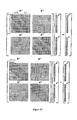
- Figure 10 shows the band diagonal submatrices for each ( p . q )-couple. All relevant values are positioned around the main diagonal by inverting the indexation order.
- Figure 11 depicts the embodiment of the the polynomial amplitude computation as defined in Eq. (56). For each component l (78) the range of m -values is determined (79). The values C 1 and C 2 are computed (82) by iterating over q (80) and m (81). The diagonal bands of B 1,1 and B 2,2 are computed (85) and stored in and by iterating over l (78), p (83), q (80) and k (84). Finally, the complex polynomial amplitudes are computed by solving the equations (86).
- Figure 12 illustrates the theoretic motivation for a scaled table look-up.
- a time domain window of length M denoted by w M ( n ) (87) is considered for which the frequency response (90) is bandlimited within a range [- ⁇ , ⁇ ].
- this window is zero padded up to a length N (88) this results in a scaling in the frequency domain (91).
- the spectrum is truncated (92) resulting in a length N '.
- a window with length M ' zero padded up to a length N ' is obtained (89).
- Figure 13 shows several applications of the analysis method according to the embodiment of the invention.
- the top of the figure illustrates the application of the invention (93) in the context of parametric/sinusoidal audio coding.
- the amplitudes A , frequencies ⁇ and noise residual r n are encoded (94) in a bitstream (95) which can be stored, broadcasted or transmitted (96).
- the decoder (97) computes the amplitudes A , frequencies ⁇ and noise residual r n back from the bitstream. Subsequently, the spectrum is computed (98) and by taking the IFFT (99) and adding the noise residual (100), the signal model is computed (101).
- the invention (102) facilitates advanced audio effects.
- the parameters A , ⁇ and the noise residual r n are processed by an effects processor (103) yielding the processed values A *, ⁇ * and r n * (104). With these values, the spectrum is computed (105), an IFFT is taken (106) and the modified residual r n * is added (107), resulting in the modified signal x ⁇ n * (108).
- a source demultiplexer (110) classifies all component by their sound source (111). By computing the spectrum (112) and taking the inverse transform (113), the different sources are synthesized separately (114).
Landscapes
- Engineering & Computer Science (AREA)
- Physics & Mathematics (AREA)
- Multimedia (AREA)
- Health & Medical Sciences (AREA)
- Audiology, Speech & Language Pathology (AREA)
- Human Computer Interaction (AREA)
- Computational Linguistics (AREA)
- Acoustics & Sound (AREA)
- Signal Processing (AREA)
- Complex Calculations (AREA)
- Length Measuring Devices With Unspecified Measuring Means (AREA)
- Measurement Of Mechanical Vibrations Or Ultrasonic Waves (AREA)
- Measurement Of Velocity Or Position Using Acoustic Or Ultrasonic Waves (AREA)
- Luminescent Compositions (AREA)
- Ceramic Products (AREA)
Claims (10)
- Verfahren zum Modellieren, Analysieren und/oder Synthetisieren eines Fensterkonzeptsignals, welches das gleichzeitige Berechnen der Frequenzen und komplexen Amplituden aus dem Signal unter Verwendung eines nichtlinearen Verfahrens der kleinsten Quadrate umfasst, wodurch die rechnerische Komplexität reduziert wird, indem die Bandbeschränkungseigenschaft des Fensters berücksichtigt wird, die zu banddiagonalen Systemmatrizen für die Berechnung des Amplitudenschritts führt, wobei das Verfahren verwendet
entweder
ein stationäres nichtharmonisches Signalmodell x̃n der Länge N gemäß (Glg. (2)):
oder
ein harmonisches Signalmodell x̃n der Länge N gemäß (Glg. (3)):
welches Verfahren ferner den Schritt zum Berechnen der stationären komplexen Amplituden umfasst, indem die Gleichungen (Glg. (19)) gelöst werden:
wobei Ar und Ai die reellen und imaginären Variablen der komplexen Amplitude Ak oder Ak,p sind und


wobei l einen Gleichungsindex und eine entsprechende Zeile der Matrix B kennzeichnet und wobei k den Index einer Komponente und einer entsprechende Spalte der Matrix B kennzeichnet, wobei (Glg. (20)):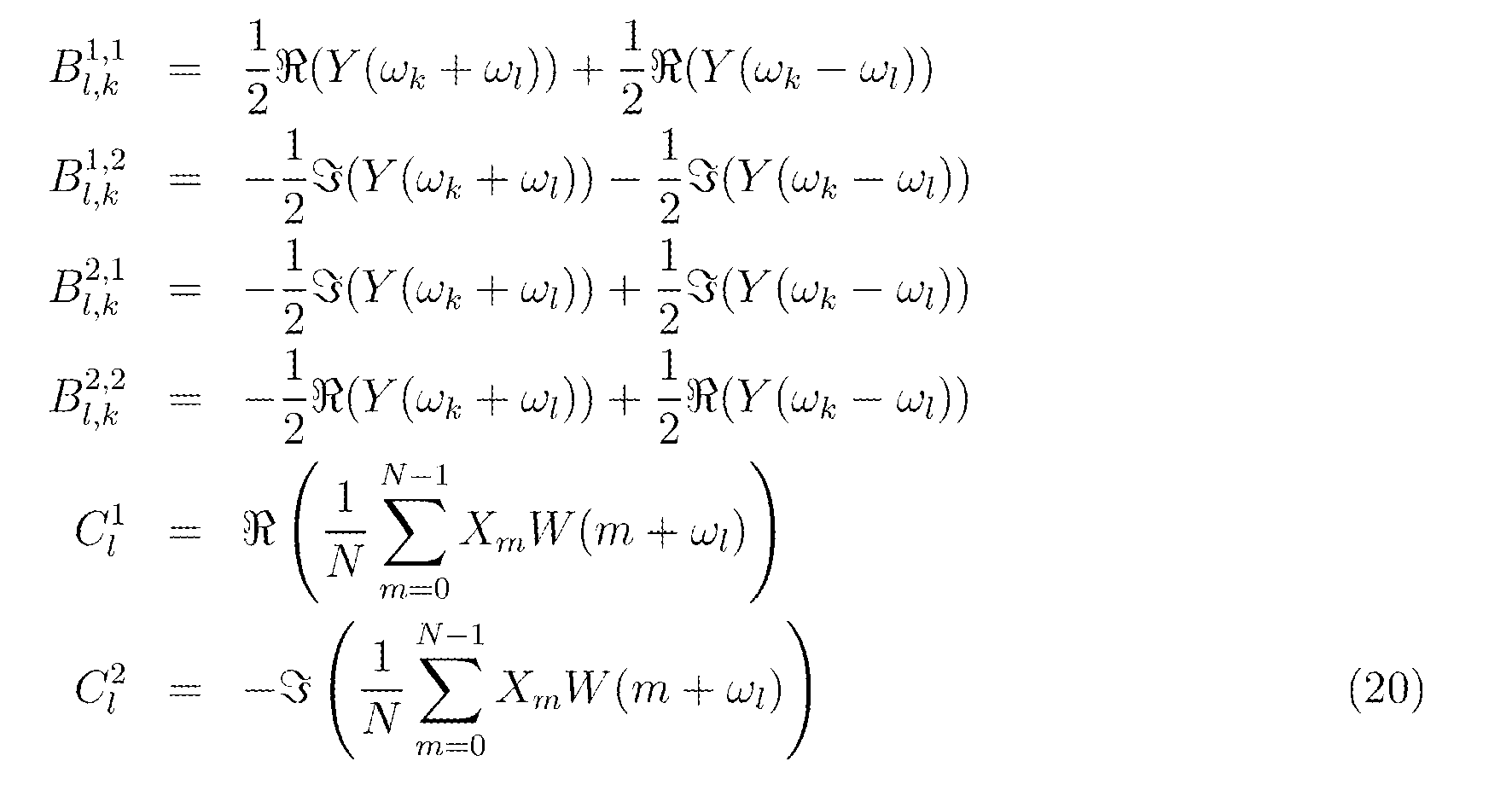


B berechnet wird, die nur D diagonale Bänder enthält, die gespeichert sind um die Hauptdiagonale der Matrix B herum gemäß (Glg. (27)):
B und C in (Glg. (28))
- Verfahren nach Anspruch 1,
umfassend die Berechnung des Spektrums als einer Linearkombination der Frequenzgänge des Fensters gemäß (Glg. (11)):
oder (Glg. (12)):
wobei die Fouriertransformation eines komplexen Signals ein Spektrum X̃m ergibt, wobei W(m) die zeitdiskrete Fouriertransformation von wn bezeichnet und womit nur die Hauptäste der Responsekurven unter Verwendung von Nachschlagetabellen berechnet werden. - Verfahren nach Anspruch 1 oder 2, ferner den Optimierungsschritt der Frequenzen für das stationäre nichtharmonische Modell umfassend, indem die Gleichung (Glg. (34)):


wobei ω̂k und ω̂l Anfangsabschätzungen der Frequenzen derart sind,
dass nur die Elemente um die Diagonale von H herum berücksichtigt werden, wodurch eine verschobene Form vonH berechnet wird, die nur D diagonale Bänder enthält gemäß (Glg. (36)):
H und h gemäß (Glg. (37)):
ω als der Vektor der Frequenzen ω k definiert ist. - Verfahren nach Anspruch 1 oder 2, ferner den Optimierungsschritt der Frequenzen für das harmonische Signalmodell umfassend, indem der Optimierungsschritt berechnet wird durch Lösen von (Glg. (48)):


- Verwenden eines Verfahrens nach einem der Ansprüche 1 bis 4 für die genaue Pitch-Abschätzung.
- Verwenden eines Verfahrens nach einem der Ansprüche 1 bis 4 für die freie Abtastratenumstellung.
- Verwenden eines Verfahrens nach einem der Ansprüche 1 bis 4 für parametrische/sinusförmige Audiocodierer, wobei der Rauschrest, die Amplituden und die Frequenzen in einem Bitstrom codiert werden, der gespeichert, an der Senderseite ausgestrahlt oder gesendet wird, wobei der Empfänger den Bitstrom in die Parameter zurück codiert und den Schall synthetisiert.
- Verwenden eines Verfahrens nach einem der Ansprüche 1 bis 4 für Audioeffekte, womit der Rest rn , die Amplituden
A und die Frequenzenω durch einen Effektprozessor manipuliert, der
A * undω * liefert, und mit diesen modifizierten Parametern synthetisiert werden, wobei der Rest rn = xn -x̃n nach Definition die inverse Fourierttransformation von Rm = Xm - X̃m ist,A als der Vektor der komplexen Amplituden Ak undω als der Vektor der Frequenzen ω k definiert ist, undA *,ω * und
A ,ω und rn bezeichnen, die für die Synthese verwendet werden. - Verwenden eines Verfahrens nach einem der Ansprüche 1 bis 4 für die Quellenseparierung, wobei die sinusförmigen Komponenten, die von derselben Schallquelle herrühren, gruppiert und getrennt synthetisiert werden.
- Verwenden eines Verfahrens nach einem der Ansprüche 1 bis 4 für die automatisierte Annotation und Transkription, wodurch das Signal entsprechend den Werten der Amplituden und Frequenzen segmentiert wird.
Applications Claiming Priority (2)
| Application Number | Priority Date | Filing Date | Title |
|---|---|---|---|
| PCT/BE2003/000207 WO2005055201A1 (en) | 2003-12-01 | 2003-12-01 | A highly optimized method for modelling a windowed signal |
| PCT/EP2004/013630 WO2005055202A1 (en) | 2003-12-01 | 2004-12-01 | A highly optimized nonlinear least squares method for sinusoidal sound modelling |
Publications (2)
| Publication Number | Publication Date |
|---|---|
| EP1690253A1 EP1690253A1 (de) | 2006-08-16 |
| EP1690253B1 true EP1690253B1 (de) | 2009-09-02 |
Family
ID=34637725
Family Applications (1)
| Application Number | Title | Priority Date | Filing Date |
|---|---|---|---|
| EP04803399A Expired - Lifetime EP1690253B1 (de) | 2003-12-01 | 2004-12-01 | Hochoptimiertes nichtlineares least-squares-verfahren für die sinusoid-schallmodellierung |
Country Status (6)
| Country | Link |
|---|---|
| US (1) | US7783477B2 (de) |
| EP (1) | EP1690253B1 (de) |
| AT (1) | ATE441921T1 (de) |
| AU (1) | AU2003291862A1 (de) |
| DE (1) | DE602004022973D1 (de) |
| WO (2) | WO2005055201A1 (de) |
Cited By (2)
| Publication number | Priority date | Publication date | Assignee | Title |
|---|---|---|---|---|
| RU2463701C2 (ru) * | 2010-11-23 | 2012-10-10 | Государственное образовательное учреждение высшего профессионального образования Московский технический университет связи и информатики (ГОУ ВПО МТУСИ) | Цифровые способ и устройство определения мгновенной фазы принятой реализации гармонического или квазигармонического сигнала |
| CN107452392A (zh) * | 2013-01-08 | 2017-12-08 | 杜比国际公司 | 临界采样滤波器组中的基于模型的预测 |
Families Citing this family (11)
| Publication number | Priority date | Publication date | Assignee | Title |
|---|---|---|---|---|
| US8749543B2 (en) * | 2006-08-15 | 2014-06-10 | Microsoft Corporation | Three dimensional polygon mesh deformation using subspace energy projection |
| US8340957B2 (en) * | 2006-08-31 | 2012-12-25 | Waggener Edstrom Worldwide, Inc. | Media content assessment and control systems |
| US8271266B2 (en) * | 2006-08-31 | 2012-09-18 | Waggner Edstrom Worldwide, Inc. | Media content assessment and control systems |
| BRPI0718738B1 (pt) * | 2006-12-12 | 2023-05-16 | Fraunhofer-Gesellschaft Zur Forderung Der Angewandten Forschung E.V. | Codificador, decodificador e métodos para codificação e decodificação de segmentos de dados representando uma corrente de dados de domínio de tempo |
| US9466307B1 (en) * | 2007-05-22 | 2016-10-11 | Digimarc Corporation | Robust spectral encoding and decoding methods |
| US8131542B2 (en) * | 2007-06-08 | 2012-03-06 | Honda Motor Co., Ltd. | Sound source separation system which converges a separation matrix using a dynamic update amount based on a cost function |
| US8190440B2 (en) * | 2008-02-29 | 2012-05-29 | Broadcom Corporation | Sub-band codec with native voice activity detection |
| WO2021154211A1 (en) * | 2020-01-28 | 2021-08-05 | Hewlett-Packard Development Company, L.P. | Multi-channel decomposition and harmonic synthesis |
| CN114070276B (zh) * | 2020-08-04 | 2025-09-09 | 株洲变流技术国家工程研究中心有限公司 | 基于Levenberg-Marquardt方法的特定次谐波抑制脉宽调制方法及装置 |
| CN116698994B (zh) * | 2023-07-31 | 2023-10-27 | 西南交通大学 | 一种非线性模态试验方法及装置 |
| CN119577431B (zh) * | 2025-01-24 | 2025-07-08 | 国网天津市电力公司营销服务中心 | 计及故障电弧辨识的电流信号压缩采集重构法及相关设备 |
Family Cites Families (3)
| Publication number | Priority date | Publication date | Assignee | Title |
|---|---|---|---|---|
| EP0215915A4 (de) * | 1985-03-18 | 1987-11-25 | Massachusetts Inst Technology | Behandlung akustischer wellenformen. |
| US4973111A (en) * | 1988-09-14 | 1990-11-27 | Case Western Reserve University | Parametric image reconstruction using a high-resolution, high signal-to-noise technique |
| US5504833A (en) * | 1991-08-22 | 1996-04-02 | George; E. Bryan | Speech approximation using successive sinusoidal overlap-add models and pitch-scale modifications |
-
2003
- 2003-12-01 AU AU2003291862A patent/AU2003291862A1/en not_active Abandoned
- 2003-12-01 WO PCT/BE2003/000207 patent/WO2005055201A1/en not_active Ceased
-
2004
- 2004-12-01 WO PCT/EP2004/013630 patent/WO2005055202A1/en not_active Ceased
- 2004-12-01 AT AT04803399T patent/ATE441921T1/de not_active IP Right Cessation
- 2004-12-01 DE DE602004022973T patent/DE602004022973D1/de not_active Expired - Lifetime
- 2004-12-01 EP EP04803399A patent/EP1690253B1/de not_active Expired - Lifetime
- 2004-12-01 US US10/581,141 patent/US7783477B2/en not_active Expired - Fee Related
Cited By (3)
| Publication number | Priority date | Publication date | Assignee | Title |
|---|---|---|---|---|
| RU2463701C2 (ru) * | 2010-11-23 | 2012-10-10 | Государственное образовательное учреждение высшего профессионального образования Московский технический университет связи и информатики (ГОУ ВПО МТУСИ) | Цифровые способ и устройство определения мгновенной фазы принятой реализации гармонического или квазигармонического сигнала |
| CN107452392A (zh) * | 2013-01-08 | 2017-12-08 | 杜比国际公司 | 临界采样滤波器组中的基于模型的预测 |
| CN107452392B (zh) * | 2013-01-08 | 2020-09-01 | 杜比国际公司 | 临界采样滤波器组中的基于模型的预测 |
Also Published As
| Publication number | Publication date |
|---|---|
| US7783477B2 (en) | 2010-08-24 |
| EP1690253A1 (de) | 2006-08-16 |
| WO2005055201A1 (en) | 2005-06-16 |
| AU2003291862A1 (en) | 2005-06-24 |
| WO2005055202A1 (en) | 2005-06-16 |
| US20070124137A1 (en) | 2007-05-31 |
| DE602004022973D1 (de) | 2009-10-15 |
| ATE441921T1 (de) | 2009-09-15 |
Similar Documents
| Publication | Publication Date | Title |
|---|---|---|
| Virtanen et al. | Separation of harmonic sounds using multipitch analysis and iterative parameter estimation | |
| US6741960B2 (en) | Harmonic-noise speech coding algorithm and coder using cepstrum analysis method | |
| JP5854520B2 (ja) | オーディオ信号用の位相ボコーダに基づく帯域幅拡張方法における改善された振幅応答及び時間的整列のための装置及び方法 | |
| US7783477B2 (en) | Highly optimized nonlinear least squares method for sinusoidal sound modelling | |
| CN103999076A (zh) | 包括将声音信号变换成频率调频域的处理声音信号的系统和方法 | |
| Saito et al. | Specmurt analysis of polyphonic music signals | |
| EP0759201A1 (de) | System zur analyse und synthese von tönen | |
| Abe et al. | Sinusoidal model based on instantaneous frequency attractors | |
| Carabias-Orti et al. | Constrained non-negative sparse coding using learnt instrument templates for realtime music transcription | |
| Christensen et al. | Optimal filter designs for separating and enhancing periodic signals | |
| Virtanen | Audio signal modeling with sinusoids plus noise | |
| Every | Separation of musical sources and structure from single-channel polyphonic recordings | |
| Christensen et al. | Joint fundamental frequency and order estimation using optimal filtering | |
| Badiezadegan et al. | A wavelet-based thresholding approach to reconstructing unreliable spectrogram components | |
| Masri et al. | A review of time–frequency representations, with application to sound/music analysis–resynthesis | |
| Boccardi et al. | Sound morphing with Gaussian mixture models | |
| JP2012027196A (ja) | 信号分析装置、方法、及びプログラム | |
| JPH0573093A (ja) | 信号特徴点の抽出方法 | |
| CN112259063B (zh) | 一种基于音符瞬态字典和稳态字典的多音高估计方法 | |
| Yang et al. | Singing voice separation based on deep regression neural network | |
| Kükrer et al. | Frequency estimation of multiple complex sinusoids using noise suppressing predictive FIR filter | |
| Bogaards | Analysis-assisted sound processing with audiosculpt | |
| Harma et al. | Discrete representation of signals on a logarithmic frequency scale | |
| Abeysekera et al. | An investigation of window effects on the frequency estimation using the phase vocoder | |
| Wells et al. | High accuracy frame-by-frame non-stationary sinusoidal modelling |
Legal Events
| Date | Code | Title | Description |
|---|---|---|---|
| PUAI | Public reference made under article 153(3) epc to a published international application that has entered the european phase |
Free format text: ORIGINAL CODE: 0009012 |
|
| 17P | Request for examination filed |
Effective date: 20060620 |
|
| AK | Designated contracting states |
Kind code of ref document: A1 Designated state(s): AT BE BG CH CY CZ DE DK EE ES FI FR GB GR HU IE IS IT LI LT LU MC NL PL PT RO SE SI SK TR |
|
| DAX | Request for extension of the european patent (deleted) | ||
| 17Q | First examination report despatched |
Effective date: 20070914 |
|
| RAP1 | Party data changed (applicant data changed or rights of an application transferred) |
Owner name: UNIVERSITEIT ANTWERPEN |
|
| GRAP | Despatch of communication of intention to grant a patent |
Free format text: ORIGINAL CODE: EPIDOSNIGR1 |
|
| GRAC | Information related to communication of intention to grant a patent modified |
Free format text: ORIGINAL CODE: EPIDOSCIGR1 |
|
| GRAS | Grant fee paid |
Free format text: ORIGINAL CODE: EPIDOSNIGR3 |
|
| GRAA | (expected) grant |
Free format text: ORIGINAL CODE: 0009210 |
|
| AK | Designated contracting states |
Kind code of ref document: B1 Designated state(s): AT BE BG CH CY CZ DE DK EE ES FI FR GB GR HU IE IS IT LI LT LU MC NL PL PT RO SE SI SK TR |
|
| REG | Reference to a national code |
Ref country code: CH Ref legal event code: EP |
|
| REG | Reference to a national code |
Ref country code: IE Ref legal event code: FG4D |
|
| REF | Corresponds to: |
Ref document number: 602004022973 Country of ref document: DE Date of ref document: 20091015 Kind code of ref document: P |
|
| PG25 | Lapsed in a contracting state [announced via postgrant information from national office to epo] |
Ref country code: LT Free format text: LAPSE BECAUSE OF FAILURE TO SUBMIT A TRANSLATION OF THE DESCRIPTION OR TO PAY THE FEE WITHIN THE PRESCRIBED TIME-LIMIT Effective date: 20090902 Ref country code: SE Free format text: LAPSE BECAUSE OF FAILURE TO SUBMIT A TRANSLATION OF THE DESCRIPTION OR TO PAY THE FEE WITHIN THE PRESCRIBED TIME-LIMIT Effective date: 20090902 Ref country code: FI Free format text: LAPSE BECAUSE OF FAILURE TO SUBMIT A TRANSLATION OF THE DESCRIPTION OR TO PAY THE FEE WITHIN THE PRESCRIBED TIME-LIMIT Effective date: 20090902 |
|
| PGFP | Annual fee paid to national office [announced via postgrant information from national office to epo] |
Ref country code: LU Payment date: 20091222 Year of fee payment: 6 |
|
| LTIE | Lt: invalidation of european patent or patent extension |
Effective date: 20090902 |
|
| PG25 | Lapsed in a contracting state [announced via postgrant information from national office to epo] |
Ref country code: SI Free format text: LAPSE BECAUSE OF FAILURE TO SUBMIT A TRANSLATION OF THE DESCRIPTION OR TO PAY THE FEE WITHIN THE PRESCRIBED TIME-LIMIT Effective date: 20090902 Ref country code: PL Free format text: LAPSE BECAUSE OF FAILURE TO SUBMIT A TRANSLATION OF THE DESCRIPTION OR TO PAY THE FEE WITHIN THE PRESCRIBED TIME-LIMIT Effective date: 20090902 |
|
| PG25 | Lapsed in a contracting state [announced via postgrant information from national office to epo] |
Ref country code: CY Free format text: LAPSE BECAUSE OF FAILURE TO SUBMIT A TRANSLATION OF THE DESCRIPTION OR TO PAY THE FEE WITHIN THE PRESCRIBED TIME-LIMIT Effective date: 20090902 |
|
| PG25 | Lapsed in a contracting state [announced via postgrant information from national office to epo] |
Ref country code: EE Free format text: LAPSE BECAUSE OF FAILURE TO SUBMIT A TRANSLATION OF THE DESCRIPTION OR TO PAY THE FEE WITHIN THE PRESCRIBED TIME-LIMIT Effective date: 20090902 Ref country code: RO Free format text: LAPSE BECAUSE OF FAILURE TO SUBMIT A TRANSLATION OF THE DESCRIPTION OR TO PAY THE FEE WITHIN THE PRESCRIBED TIME-LIMIT Effective date: 20090902 Ref country code: ES Free format text: LAPSE BECAUSE OF FAILURE TO SUBMIT A TRANSLATION OF THE DESCRIPTION OR TO PAY THE FEE WITHIN THE PRESCRIBED TIME-LIMIT Effective date: 20091213 Ref country code: PT Free format text: LAPSE BECAUSE OF FAILURE TO SUBMIT A TRANSLATION OF THE DESCRIPTION OR TO PAY THE FEE WITHIN THE PRESCRIBED TIME-LIMIT Effective date: 20100104 Ref country code: CZ Free format text: LAPSE BECAUSE OF FAILURE TO SUBMIT A TRANSLATION OF THE DESCRIPTION OR TO PAY THE FEE WITHIN THE PRESCRIBED TIME-LIMIT Effective date: 20090902 Ref country code: IS Free format text: LAPSE BECAUSE OF FAILURE TO SUBMIT A TRANSLATION OF THE DESCRIPTION OR TO PAY THE FEE WITHIN THE PRESCRIBED TIME-LIMIT Effective date: 20100102 |
|
| PG25 | Lapsed in a contracting state [announced via postgrant information from national office to epo] |
Ref country code: SK Free format text: LAPSE BECAUSE OF FAILURE TO SUBMIT A TRANSLATION OF THE DESCRIPTION OR TO PAY THE FEE WITHIN THE PRESCRIBED TIME-LIMIT Effective date: 20090902 |
|
| PG25 | Lapsed in a contracting state [announced via postgrant information from national office to epo] |
Ref country code: AT Free format text: LAPSE BECAUSE OF FAILURE TO SUBMIT A TRANSLATION OF THE DESCRIPTION OR TO PAY THE FEE WITHIN THE PRESCRIBED TIME-LIMIT Effective date: 20090902 |
|
| PLBE | No opposition filed within time limit |
Free format text: ORIGINAL CODE: 0009261 |
|
| STAA | Information on the status of an ep patent application or granted ep patent |
Free format text: STATUS: NO OPPOSITION FILED WITHIN TIME LIMIT |
|
| PG25 | Lapsed in a contracting state [announced via postgrant information from national office to epo] |
Ref country code: MC Free format text: LAPSE BECAUSE OF NON-PAYMENT OF DUE FEES Effective date: 20100701 Ref country code: DK Free format text: LAPSE BECAUSE OF FAILURE TO SUBMIT A TRANSLATION OF THE DESCRIPTION OR TO PAY THE FEE WITHIN THE PRESCRIBED TIME-LIMIT Effective date: 20090902 |
|
| REG | Reference to a national code |
Ref country code: CH Ref legal event code: PL |
|
| 26N | No opposition filed |
Effective date: 20100603 |
|
| PG25 | Lapsed in a contracting state [announced via postgrant information from national office to epo] |
Ref country code: IE Free format text: LAPSE BECAUSE OF NON-PAYMENT OF DUE FEES Effective date: 20091201 Ref country code: LI Free format text: LAPSE BECAUSE OF NON-PAYMENT OF DUE FEES Effective date: 20091231 Ref country code: GR Free format text: LAPSE BECAUSE OF FAILURE TO SUBMIT A TRANSLATION OF THE DESCRIPTION OR TO PAY THE FEE WITHIN THE PRESCRIBED TIME-LIMIT Effective date: 20091203 Ref country code: CH Free format text: LAPSE BECAUSE OF NON-PAYMENT OF DUE FEES Effective date: 20091231 |
|
| PG25 | Lapsed in a contracting state [announced via postgrant information from national office to epo] |
Ref country code: IT Free format text: LAPSE BECAUSE OF FAILURE TO SUBMIT A TRANSLATION OF THE DESCRIPTION OR TO PAY THE FEE WITHIN THE PRESCRIBED TIME-LIMIT Effective date: 20090902 Ref country code: BG Free format text: LAPSE BECAUSE OF FAILURE TO SUBMIT A TRANSLATION OF THE DESCRIPTION OR TO PAY THE FEE WITHIN THE PRESCRIBED TIME-LIMIT Effective date: 20091231 |
|
| PG25 | Lapsed in a contracting state [announced via postgrant information from national office to epo] |
Ref country code: HU Free format text: LAPSE BECAUSE OF FAILURE TO SUBMIT A TRANSLATION OF THE DESCRIPTION OR TO PAY THE FEE WITHIN THE PRESCRIBED TIME-LIMIT Effective date: 20100303 |
|
| PG25 | Lapsed in a contracting state [announced via postgrant information from national office to epo] |
Ref country code: TR Free format text: LAPSE BECAUSE OF FAILURE TO SUBMIT A TRANSLATION OF THE DESCRIPTION OR TO PAY THE FEE WITHIN THE PRESCRIBED TIME-LIMIT Effective date: 20090902 |
|
| PG25 | Lapsed in a contracting state [announced via postgrant information from national office to epo] |
Ref country code: LU Free format text: LAPSE BECAUSE OF NON-PAYMENT OF DUE FEES Effective date: 20101201 |
|
| PGFP | Annual fee paid to national office [announced via postgrant information from national office to epo] |
Ref country code: NL Payment date: 20141219 Year of fee payment: 11 |
|
| REG | Reference to a national code |
Ref country code: FR Ref legal event code: PLFP Year of fee payment: 12 |
|
| REG | Reference to a national code |
Ref country code: NL Ref legal event code: MM Effective date: 20160101 |
|
| PG25 | Lapsed in a contracting state [announced via postgrant information from national office to epo] |
Ref country code: NL Free format text: LAPSE BECAUSE OF NON-PAYMENT OF DUE FEES Effective date: 20160101 |
|
| REG | Reference to a national code |
Ref country code: FR Ref legal event code: PLFP Year of fee payment: 13 |
|
| REG | Reference to a national code |
Ref country code: FR Ref legal event code: PLFP Year of fee payment: 14 |
|
| PGFP | Annual fee paid to national office [announced via postgrant information from national office to epo] |
Ref country code: FR Payment date: 20171221 Year of fee payment: 14 Ref country code: DE Payment date: 20171211 Year of fee payment: 14 |
|
| PGFP | Annual fee paid to national office [announced via postgrant information from national office to epo] |
Ref country code: GB Payment date: 20171221 Year of fee payment: 14 Ref country code: BE Payment date: 20171219 Year of fee payment: 14 |
|
| REG | Reference to a national code |
Ref country code: DE Ref legal event code: R119 Ref document number: 602004022973 Country of ref document: DE |
|
| GBPC | Gb: european patent ceased through non-payment of renewal fee |
Effective date: 20181201 |
|
| REG | Reference to a national code |
Ref country code: BE Ref legal event code: MM Effective date: 20181231 |
|
| PG25 | Lapsed in a contracting state [announced via postgrant information from national office to epo] |
Ref country code: FR Free format text: LAPSE BECAUSE OF NON-PAYMENT OF DUE FEES Effective date: 20181231 Ref country code: DE Free format text: LAPSE BECAUSE OF NON-PAYMENT OF DUE FEES Effective date: 20190702 |
|
| PG25 | Lapsed in a contracting state [announced via postgrant information from national office to epo] |
Ref country code: BE Free format text: LAPSE BECAUSE OF NON-PAYMENT OF DUE FEES Effective date: 20181231 |
|
| PG25 | Lapsed in a contracting state [announced via postgrant information from national office to epo] |
Ref country code: GB Free format text: LAPSE BECAUSE OF NON-PAYMENT OF DUE FEES Effective date: 20181201 |